Introduction
With very few exceptions, histories of Assyriology have tended to focus on success stories. They have mostly been written by and about dominant personalities, institutions and practices, rather than work done on the peripheries of the discipline.Footnote 2 As Julian Reade has demonstrated with his study of Hormuzd Rassam (1826–1910), peripheral participants have often been (deliberately) obscured by more dominant figures.Footnote 3 In a similar vein, histories of Assyriological institutions—such as the British Museum—focus on activities inside the organisational boundary and understandably do not capture fleeting interactions with figures who perform at their margins.Footnote 4 Marginal figures have, however, received recent attention in science and technology studies (STS), especially those who endeavoured to be practitioners in their own right. Attempts to understand the social roots of intellectual endeavour have gone along with recovering the contribution of unrecognised, low-status auxiliary participants—such as artisans, technicians, assistants and women—who were rendered “invisible” in contemporary accounts of scientific work.Footnote 5 These STS studies reveal the difficulties of recovering the involvement of such figures: with very few collections of personal papers and a paucity of other written sources, often the picture the historian has to work with is frustratingly incomplete. Yet such work also makes clear the benefits, as historian Patricia Fara explains in her study of female scientific participants: “retrieving these invisible assistants…gives a far more realistic picture of how science was actually carried out”.Footnote 6 This paper acts as a case study in how the same benefits apply to histories of Assyriology: how recovering contributions to knowledge-making by low-status, marginal actors gives a richer picture of past Assyriological practices and the entire research community in which the most prominent figures operated.
Here I analyse the career of a late-nineteenth-century Assyriologist named William St. Chad Boscawen (1855–1913), who is barely traceable in written histories of the discipline. As a young man in the 1870s Boscawen gained employment at the British Museum and was on course for a high-level Assyriological career. Yet his prospects were suddenly halted upon losing his job under a cloud of shame. Boscawen never regained the elite-level career he had begun and drifted into the disciplinary periphery, where he remained for the next thirty or so years. By the 1910s, he was conducting Assyriological research within a very different setting: that of a private museum of history of medicine, owned by pharmaceuticals entrepreneur Henry Solomon Wellcome (1853–1936). Wellcome's Historical Medical Museum (HMM) was intended to educate medical professionals and opened in 1913 after a decade of intensive collecting activity.Footnote 7 Boscawen was employed from c.1906 within this museum-building enterprise, researching Assyro-Babylonian religion and healing. The HMM and its collections have been the subject of recent academic attention—and have gained high public profile since the opening of Wellcome Collection on London's Euston Road in 2007—but the institution's activities in relation to the ancient Near East are little historicized. Studying Boscawen's involvement at the HMM thus complements recent work tracing the individual staff subsumed under the museum's institutional identity.Footnote 8 As we shall see, Boscawen's relocation was only partially successful, and his contributions to knowledge transient, limited by social factors more than technical expertise. My analysis concludes with a discussion section that employs a sociological framework to explore how social factors influence the movement of people between disciplines as much as academic factors. In doing so, I address larger questions of how academic knowledge travels to new disciplinary settings, and how people, and Assyriological knowledge itself, are transformed in the process.Footnote 9
An elite career interrupted
William St. Chad Boscawen (1855–1913), pictured in Fig. 1, typifies the challenges of studying marginal figures. His biographical details are hard to trace and he received no obituaries; even his exact birth date is hard to ascertain.Footnote 10 Historian Sheila Evers details his early career at the British Museum and E.A. Wallis Budge (1857–1934) includes him in a rather florid insider history of Assyriology.Footnote 11 Budge was Boscawen's successor at the British Museum, though they first encountered each other as young men (aged 17 and 20 respectively) taking cuneiform classes together.Footnote 12 It has been well noted that Budge is an unreliable narrator, but his 1925 account of Boscawen's career is the only extant contemporary source.Footnote 13 This paper pieces together Boscawen's later career using his own publications, mentions within correspondence of other Assyriologists, and the extensive archives of the Wellcome Foundation and Historical Medical Museum held in the Wellcome Library, London.
Photographic portrait of William St Chad Boscawen (1855–1913) from E.A. Wallis Budge's The Rise and Progress of Assyriology (1925), which appears alongside the only contemporary—but problematic—account of Boscawen's career. Budge recounts that he obtained the photograph personally from Boscawen (preface, xii–xiii). Plate facing page 120. Source: Wellcome Library, London

Boscawen's route into Assyriology in the 1870s was typical of his time and highly dependent on personal connections. His interest in the subject was first sparked by his minister father, aided by the relevant books that filled the family rectory near Wrexham.Footnote 14 Budge's account says that the young Boscawen attended Rossall, a boarding school in Lancashire that educated the sons of clergymen. There he eagerly read famous works by the likes of Austen Henry Layard and Henry Rawlinson on cuneiform discoveries and decipherment. Soon afterwards he was making his own transcriptions of previously published cuneiform texts.Footnote 15 Boscawen also took semi-formal classes in cuneiform and Egyptian hieroglyphs conducted in London through the Society for Biblical Archaeology (SBA), Britain's academic society of archaeologists, theologians and researchers studying the ancient Near East. These “Archaic Classes” for training students in Egyptology and Oriental Archaeology began in 1875, bankrolled through private philanthropy and taught by leading Orientalists including Archibald Henry Sayce and Samuel Birch of the British Museum.Footnote 16 Boscawen thus became well connected with Sayce and other influential figures in the discipline, including William Henry Fox Talbot and Rawlinson. That same year, these contacts helped him gain a position at the British Museum, as a Senior Assistant under the linguist Birch. Aged twenty Boscawen thus entered into high-status Assyriological training and employment.Footnote 17 He also began participating in the SBA in his own right; the Society accepted Boscawen's membership in 1876 and elected him to its council the following year.Footnote 18
Once employed at the British Museum, Boscawen was given access to cuneiform texts and opportunities to participate in translation work with increasing levels of responsibility. During his probationary year, Boscawen shared a work-space with 35-year-old Assyriologist George Smith (1840–1876), whose own route into Assyriology in the 1860s had followed a similar path—of reading Layard and Rawlinson, self-taught cuneiform and then a junior Museum position.Footnote 19 In 1872, Smith had shot to fame upon discovering a cuneiform parallel to the biblical flood story among the Museum's tablet collection.Footnote 20 After the discovery of the so-called Flood Tablet, the public clamoured for new results.Footnote 21 Smith acquired a high public profile through his famous lectures and widely read book The Chaldean Account of Genesis (1876).Footnote 22 Readers of the Daily Telegraph newspaper also funded him to undertake additional expeditions to search for more fragments of biblically related evidence.Footnote 23 Boscawen was employed to assist Smith in examining the large haul of tablets acquired in Baghdad and Nineveh on those expeditions.
Within a year of Boscawen's arrival, the British Museum's trustees desired to send Smith on yet further excavations in Mesopotamia. He left for Constantinople in October 1875 but never returned to the Museum; he met with an untimely death from dysentery while travelling, at the age of 36. The loss of Smith as a friend and mentor left a deep impression on the young Boscawen. Smith's discoveries epitomised the importance and excitement of an Assyriological career and the two men were close enough in age for Smith to be a role model. Boscawen delivered the eloge for his friend at a meeting of the SBA; his words were notably “somewhat melancholic” enough to warrant a mention in the dry prose of the Society's Proceedings.Footnote 24
After Smith's death, Boscawen worked alone on his tablets for nearly a year. Historian Sheila Evers discusses how Boscawen continued unpacking tablets from crates, organising and cleaning them and resuming the translations that Smith had begun in his field notebooks.Footnote 25 He also taught the “Archaic Classes” in Assyrian (Akkadian) language for the year 1877.Footnote 26 Talbot and his correspondents discussed the promising nature of the young Assyriologist's work: Birch considered Boscawen for a high-level role preparing cuneiform text copy for official publication, and he was also mooted as a potential replacement for Smith to edit the next volume of Rawlinson's Cuneiform Inscriptions series.Footnote 27
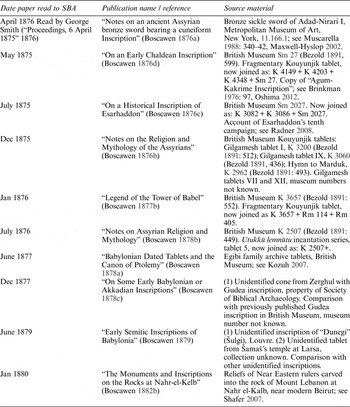
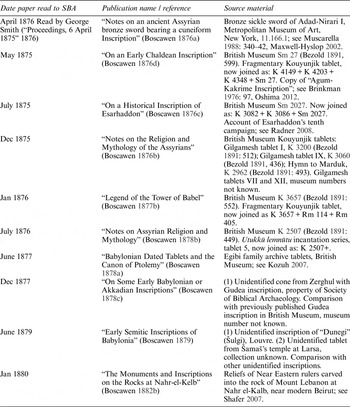
And indeed, his output was prolific: in his initial two years at the British Museum, Boscawen published eight articles in the SBA's Transactions and Proceedings, based predominantly on studies of the Museum's cuneiform tablets. Table 1 lists the source material (as far as possible) for Boscawen's SBA papers, illustrating the range of texts that he worked on.Footnote 28 His earliest paper presented Smith's researches on a bronze sword of Adad-nirari I in a private collection (1876a). Three papers contained translation and discussion of individual tablets that Smith had acquired for the Museum: an inscription recounting Esarhaddon's tenth campaign (1876c); a tablet naming a Kassite king (1876d); and a tablet thought to mention the “Tower of Babel” (1877b). Three further papers discussed groups of British Museum tablets, respectively focusing on: Assyrian prayers and incantations (1878b); themes of immortality in the “Izdubar legend” (now known as the Gilgamesh epic; 1876b); and Babylonian commercial documents known as the Egibi Tablets (1878a), which I will discuss in detail shortly. Boscawen also contributed a translation of Tablet XII of the Gilgamesh epic for the SBA publication Records of the Past.Footnote 29
Cuneiform source material for Boscawen's publications in the Society of Biblical Archaeology's Proceedings and Transactions, 1876–82. Museum numbers are given where known
Despite this promising publication record, however, troubling signs indicated that all was not well with the young Assyriologist. Around the time of Smith's death, British Museum departmental correspondence shows that Boscawen entered into a pattern of repeated absences and financial problems. Boscawen's father and Birch both mediated with Museum authorities on his behalf, but matters became critical at the end of his probationary year. Boscawen nearly lost his employment for “contraven[ing] several official regulations”, and it was only interventions by Rawlinson, Talbot and Sayce (at the behest of Boscawen's father) that saved him; the Trustees extended Boscawen's probation for another six months. Although his attendance stabilised for a while, in March 1877 it deteriorated again, just as his full employment was confirmed.Footnote 30 Boscawen had clearly been affected by Smith's death, and was also subjected to the state of tension that engulfed the whole Department of Oriental Antiquities that year. Mrs Mary Smith, widow of George, entered into a dispute with the Department over who owned the rights to her late husband's draft notes and sketches, and any research resulting from them.
The tense environment in the museum was magnified in the summer of 1877, when the results of Boscawen's research brought him unexpected publicity. Certain tablets in Smith's collection, which Boscawen had been working on, were starting to draw attention from Assyriologists. Particularly significant were the group of texts known as the Egibi Tablets, which reported the transactions of the Egibi family of bankers from Babylon in the seventh century b.c.e. Footnote 31 Their importance emerged when they were thought to provide concrete dates for events mentioned in the biblical Book of Daniel. While Boscawen worked on the proof of a paper on the Egibi material, Smith's widow claimed that his work was based on notebooks that were her family's property; she demanded withdrawal of any further access by museum staff until the books could be properly valued and arbitrated. Boscawen completed his paper on the tablets amid this bitter conflict, though his absences and apparent financial problems continued. Smith's death had resulted in Boscawen being given responsibility for high-profile and valuable material, which he didn't fully have ownership over, and which he didn't appear ready to cope with. On 5th June 1877 Boscawen was due to read his paper before the SBA, but he was “so prostate from overstrain and trouble” that he was unable to read it himself.Footnote 32
SBA members were clearly excited enough by the paper's contents that they unanimously voted to hold an extra meeting on 3rd July for the purpose of discussing it.Footnote 33 Unusually, this lengthy discussion was also appended when the paper was published in the Society's Transactions, comprising an additional 54 pages of text.Footnote 34 Boscawen's paper also quickly attracted interest from beyond the SBA, as the Egibi results were hailed as further examples of cuneiform evidence supporting the historicity of the Old Testament. According to Budge, religious bodies requested Boscawen to give lectures on the topic and journalists waylaid him in the Museum galleries asking for news of his latest discoveries.Footnote 35 Reports on the findings also appeared in an array of newspapers through into 1878.Footnote 36
Just as Boscawen's Assyriological reputation was on the cusp of being made—and less than a month after the SBA heard the Egibi paper—his time at the British Museum abruptly ended. On 16th June 1877 there was a robbery in the Museum galleries, during which Assyrian objects were stolen from cases. Boscawen was absent from the Museum and unable to account sufficiently for his whereabouts at the time; neither did he reappear to assist with the investigation. Budge's later account of the matter claims that Boscawen had begun seeking relief from the strain of his studies with “a somewhat Bohemian set of literary men and newspaper correspondents” who frequented the Museum's Reading Room. These dubious companions allegedly fuelled Boscawen's absences.Footnote 37 While there is no indication that Boscawen himself was a suspect in the robbery, his dereliction of duty and instability raised such doubts among the Museum's Trustees that they swiftly ended his employment.Footnote 38 News of the incident circulated amongst Assyriologists, with one passing Talbot the news that “the sad loss at the B.M. has most disturbed Dr Birch” and that “Mr Boscawen is dismissed”.Footnote 39
Boscawen's abrupt departure from the British Museum was shameful enough that a coded reference was made in print to his misdemeanours. According to Birch, in 1876 Boscawen began editing Smith's incomplete History of Sennacherib manuscript; yet when the volume was finally published after Boscawen's dismissal, his name was no longer associated with the project.Footnote 40 The book's preface states rather cryptically that an “Assyrian scholar” was supposed to work on the manuscript but “never did anything towards completing it” owing to a “variety of unforeseen circumstances”.Footnote 41 Boscawen's actual level of contribution to the text is unknown, but the obfuscated referral to his transgressions in print is revealing of the damage done to the young Assyriologist's reputation.
Assyriology on the periphery
With his job at the British Museum gone, the 22-year-old Boscawen's disciplinary progression in Assyriology changed course, in a less prestigious direction. He was unable to access primary materials or mentorship at the Museum, and he no longer published cuneiform texts from the Museum collection. A survey of the SBA Transactions and Proceedings shows that Boscawen published only three further papers there after his dismissal, based on sources outside the British Museum: a private SBA collection, the Louvre, and in-situ rock inscriptions (see Table 1).Footnote 42 Boscawen's membership of the Society of Biblical Archaeology also soon ceased; membership lists do not include his name at any point after 1882.Footnote 43
Boscawen's movement out from the British Museum corresponded with a movement into studying the geographically peripheral, and less prestigious, areas of the cuneiform world. In 1879, contacts in Assyriological societies aided Boscawen in obtaining a position on an expedition to the Levant, namely the ancient Biblical city of Carchemish in the southeast of modern-day Turkey.Footnote 44 Although little is known about his activities at Carchemish, Boscawen reportedly wrote the anonymously authored expedition progress reports for The Times, London, and The Graphic.Footnote 45 There is also some evidence that he brought artefacts back with him: the Pitt Rivers Museum in Oxford contains one Neolithic axe head acquired by Boscawen in the region.Footnote 46 Boscawen's last paper produced for the SBA Transactions also resulted from this trip; it concerned rock inscriptions carved into Mount Lebanon at Nahr el-Kalb, near modern Beirut, placed by generations of Assyrian kings on conquered territory in the geographical periphery of the empire.Footnote 47 His time in the Near East, however, was dogged by further personal problems; Budge's tell-tale biography reports that Boscawen fell into bad company, ended up with no money, was soundly beaten and had his clothes and shoes stolen. The British Consul in Damascus eventually paid for his return home as a “distressed British subject”.Footnote 48
Roger Moorey's historical survey of biblical archaeology indicates that the archaeology of Palestine was afforded a much lower status at this time than the archaeology of neighbouring Mesopotamia. Boscawen continued to conduct research in this lower-status field, authoring several articles for the Palestine Exploration Fund (PEF)'s Palestine Exploration Quarterly in 1881–82. The PEF was an organisation funded by the Church of England that studied the archaeology, natural history and customs of the Holy Lands in order to aid Biblical understanding.Footnote 49 Boscawen's articles in this publication variously tackled Assyrian interactions with the peoples of Palestine and Syria, Hittite inscriptions, and a Phoenician tablet depicting a demon.Footnote 50
Boscawen's move into research with lower academic status also combined with him taking his Assyriological knowledge into the public sphere. He established himself in public lecturing and producing popular articles on Assyriological subjects, including for Harper's Magazine and The Times.Footnote 51 According to Budge, Boscawen had also done freelance commission work for London's antiquities dealers while at the British Museum, producing catalogues of their cuneiform tablets.Footnote 52 Such work likely also provided an additional income source after his departure the Museum. Boscawen carried on this way in the less prestigious periphery of Assyriology from his mid 20s through to his mid 40s (c.1880–1900), with his publications from this time clustering into periods of academic productivity.
In 1886–87, almost a decade after his ignominious dismissal, the Trustees of the British Museum permitted Boscawen to give two series of public lectures at the Museum, though they were listed as “unofficial” and were not organised under the auspices of the museum itself. The first series, on Babylonian and Assyrian antiquities, was attended by an average audience of 200 people and received good reviews.Footnote 53 Their popularity led to another six lectures the following year, which were published under the title From Under the Dust of Ages.Footnote 54 These popular lectures were joined by a generalist book on biblical archaeology in 1895, plus six more “unofficial” lectures at the British Museum between 1898 and 1901.Footnote 55 He also produced a highly illustrated history of Babylonia titled The First of Empires in 1903, which was well reviewed in Nature magazine.Footnote 56 There is no evidence that he ever re-joined the SBA, though the Proceedings record isolated instances of comments by Boscawen at a few meetings; these occur in periodic intervals that correspond to years when he was academically productive—1883, 1899, 1903 and 1904.
While Boscawen's professional and social contacts assisted him in his early career, Budge reports that he later became increasingly distant from these networks:
[F]riend after friend secured for him work of a lucrative character, but he lost position after position through his failure to keep his promises and to work to time. He would undertake to write an article or book or review, receive part payment on account, and then disappear … He wore out all his friends, for when arrangements had been made for him to lecture in London or Scotland or elsewhere, and the audiences had bought their tickets and taken their seats, he would sometimes keep them waiting half an hour and sometimes not appear at all. He made more money by his writings on Oriental Archaeology than any other man in England, and yet he was never free from acute financial anxiety; his boon companions helped him to spend all he got, and his friends, taking advantage of his easy-going, pleasure-loving disposition, stripped him bare.Footnote 57
Although Budge's views are likely to be coloured by his own prejudices, his account reveals that Boscawen's personal trouble continued unabated.
Evidence of increasing instability appears in the records of the British Museum. Upon termination of his employment in 1877, Boscawen could only access the resources of the Reading Room via a standard reader's ticket.Footnote 58 During one visit in October 1905, staff in the Reading Room had to ask him to leave the building; this shameful experience happened to only a handful of people in a year, usually through insobriety or criminality. In Boscawen's unfortunate case it was because he was in a condition of “uncleanliness that had attracted attention”. The Museum's Trustees saw the situation as sufficiently serious enough to warrant his “immediate withdrawal from the Room”, followed by a ban from the premises and the permanent revocation of his reader's ticket.Footnote 59
By the time Boscawen's book The First of Empires went into a second edition in 1906, he was no longer lecturing and there are no traces of his participation in Assyriological societies, nor extant evidence of published lectures or articles. He had long since moved from the centre of the discipline to an existence near its periphery, but at this point Boscawen all but disappeared from the landscape of public Assyriology. He was not a total outsider, as his recent publications lent him some credentials in the discipline, but the revocation of his British Museum readers' access saw him one further step removed from disciplinary participation. Budge's account also suggests his disappearance from the subject. But Boscawen in fact took his Assyriological knowledge to a different environment entirely: he began to conduct work for the pharmaceuticals entrepreneur Henry Solomon Wellcome who was planning a large-scale private museum of history of medicine in London.
Moving into history of medicine
With the aim of stimulating the study of the great past, I am organising an Exhibition in connection with the history of medicine… Owing to the magnitude of the work involved in arranging, classifying and obtaining loans of interest from all quarters of the globe, and to my desire to make the Exhibition as complete as possible…the date fixed, therefore, is 1913. Meanwhile, I should greatly appreciate any information which may be forwarded to me in regard to medical traditions, references, and illustrations of antient [sic] medical or surgical treatment[.]
—Henry S. Wellcome Footnote 60Appeals for assistance with Henry Wellcome's Historical Medical Exhibition, such as this one, appeared in medical journals and pharmaceutical company publications throughout the decade beginning 1903. Wellcome's collecting spiralled into a plan for a museum on a vast scale, which would display artefacts of medical history from ancient times to the present day. And as the advert quoted above suggests, Wellcome was not just collecting objects; he was also collecting together knowledge related to history of medicine from ancient to modern times. Medical historians have recently explored how the turn of the twentieth century saw a rise of interest by medical doctors in the history of their discipline.Footnote 61 Wellcome was part of a community of London medical professionals pursuing medical history that attempted to engage with Assyriology as an academic discipline.Footnote 62
While Wellcome's museum-building enterprise was ostensibly the personal project of one man, it actually involved a complex network of actors, as several historians have explicated using archives held in the Wellcome Library, London. Collecting and research were initially carried out using the infrastructure of his pharmaceuticals firm, Burroughs Wellcome and Company (BW&C), and large numbers of staff, collectors, dealers and contacts worked on Wellcome's behalf.Footnote 63 At their head was BW&C's librarian and historical researcher, C.J.S. Thompson (1862–1943), who had responsibility for collecting activities and exhibition preparations. Thompson oversaw much of the day-to-day purchasing and research activities, corresponding with Wellcome while he was away on business trips.Footnote 64 From late 1910, operations were conducted from premises at 54a Wigmore Street in the heart of London's elite medical district, which also housed the growing exhibition materials. The Historical Medical Exhibition finally opened in summer 1913, as projected, and became a permanent museum—the Historical Medical Museum (HMM).Footnote 65
In constructing a museum related to history of medicine, Wellcome wanted displays related to the progress of medicine across ancient and modern world civilizations, including Assyria and Babylonia. BW&C had previously created Assyrian and Babylonian imagery for commercial advertising by drawing on displays in the British Museum, and books such as Layard's widely circulated Monuments of Nineveh (1849–53).Footnote 66 Wellcome wished to go beyond popular accounts, however, when researching and displaying ancient medicine for his embryonic museum.Footnote 67
For these ends, Wellcome's museum-building enterprise came into contact with William St. Chad Boscawen in March 1903, when Boscawen was in his late 40s: a crumbling copy of a BW&C letter book in the Wellcome Library records that the Assyriologist was paid for conducting translation work on medical texts.Footnote 68 In 1906, Boscawen began further sporadic, piecemeal work for the HMM, which lasted intermittently over a period of seven years. His proficiency in cuneiform gave him a desirable linguistic skill-set, while his background of popular article writing demonstrated experience with synthetic research and presenting Assyriological topics to general audiences.
Boscawen's interactions with the HMM are detailed in Thompson's written reports to Wellcome, and also in 51 letters between Thompson and Boscawen contained in the institution's “staff file” on its employee.Footnote 69 Correspondence indicates he had several productive periods working for the HMM between 1906 and 1908, working from a specially procured room at 19 Whiskin Street for a wage of thirty-five shillings per week.Footnote 70 Thompson reported to Wellcome that his employee was ploughing through cataloguing large quantities of Egyptian objects that Wellcome had bought and stored in a warehouse:
I engaged a suitable room for Mr. Boscawen, about a quarter of a mile away, for ten shillings and sixpence per week, inclusive of gas and fire. I got him to start work there last Monday morning, and am keeping a strict watch upon him. I have a box of things taken over to the room every day. The things are counted in the morning and are again checked in the evening before being taken back to the warehouses. Boscawen is very pleased with the objects he has examined so far.Footnote 71
Thompson clearly kept Boscawen under close scrutiny, mindful of leaving valuable objects unattended with a man in recurring financial trouble, but his reports to Wellcome also reveals the value that Boscawen brought to the collecting enterprise. Wellcome had the money to purchase vast quantities of material, but Boscawen had the skills to bring order to the chaotic boxes: he remounted disintegrating drawings and stabilised ancient pottery using British Museum methods; he catalogued over 630 items of painted Coptic linen, mummy cloths, pottery and papyri and picked out “very fine” pieces of interest to report to Thompson. Thompson put him to work transcribing and translating hieroglyphic inscriptions on papyri, to see if he could “make any discoveries of medical interest.”Footnote 72
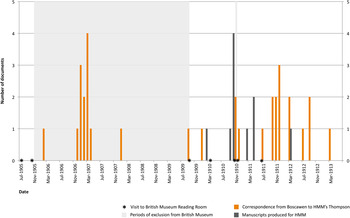
Boscawen's experience of the British Museum collection, and his ability to identify what Wellcome had, was invaluable. Although he himself had been expelled from the British Museum, he became an intermediary between the world of the public museum and the commercial world of Wellcome's private collecting. Indeed, Boscawen's comments that certain objects were “better than the British Museum and South Kensington” or “far the best I have seen” were all proudly passed to Wellcome in Thompson's progress reports.Footnote 73 In return, work for the HMM not only gave Boscawen a degree of financial security but also bestowed him with additional status as an employed Assyriologist. In October 1909 Boscawen also reapplied for a British Museum reader's ticket, and the relevant authorities granted his request.Footnote 74 With this regained access, he conducted several research visits while under the employment of the HMM. Fig. 2 plots Boscawen's research visits to (and exclusions from) the British Museum Reading Room between 1905 and 1913, and correlates them with his correspondence and work outputs for the HMM. It shows how closely Boscawen's pattern of re-established access to the British Museum—albeit in a peripheral capacity as a researcher—coincided with his production of work for the HMM.
Chart correlating the dates of Boscawen's correspondence and manuscript outputs for the HMM, with his visits to (and exclusions from) the British Museum Reading Room, 1905–1913. Produced by the author using the archival sources: WA/HMM/RP/Tho/4, WA/HMM/RP/Tho/7, WA/HMM/ST/Ear/A.11, all from WA, WL; Boscawen Reference Boscawen1910a, 1910b, 1910c, Reference Boscawen1910d, 1911a, Reference Boscawen1911b, Reference Boscawen1912, WL; BMCA records (full list in bibliography)

By 1910 Boscawen's letters mention being in contact with E.A. Wallis Budge, his successor at the Museum, by now promoted to Keeper of the Department of Assyrian and Egyptian Antiquities.Footnote 75 Boscawen passed on snippets of British Museum information to Thompson, heard via Budge, regarding new finds of tablets in Babylonia that might have medical content.Footnote 76 He also had established enough credibility to ask an Assyriologist from the Department to look up some fragments of Babylonian tablets related to medicine.Footnote 77 However, he was still not entirely trustworthy: Thompson himself had contacts in the Reading Room and used them to keep an eye on Boscawen's whereabouts.Footnote 78 Boscawen's personal difficulties clearly continued, as his productive work was interspersed with absences for illness and various disappearances without warning; his correspondence record contains long gaps (see Fig. 2), followed by subsequent apologies to Thompson. Boscawen also consistently presented with financial difficulties, asking for advances on his wages. The HMM repeatedly stepped in to help Boscawen when he fell into difficulty. After Boscawen absconded from his position without warning in February 1910, Thompson told Wellcome of how he restored his employee's stability:
Shortly after Christmas, Boscawen disappeared, and I was unable to find him anywhere. […] I eventually learned that he was in the Workhouse Infirmary, in Endell St, under another name, suffering from acute muscular rheumatism. When he was discharged, I went to see him, and though quite a wreck and practically destitute, he seems likely to pull round. He told me that if he could only have a few shillings a week assured, it would help keep him straight and out of the streets. … He promised to bring me copy regularly every Friday, if I would pay him 10/- for the same, if I thought it of sufficient value. He began last week and has brought me already some interesting material about Gula, the Babylonian goddess of healing… Such material will be very useful later on. I propose to keep him at this and see how it works.Footnote 79
“[Y]ou did well”, Wellcome responded. “[K]eep him at work all you can”.Footnote 80
Boscawen worked well for several months, but unfortunately became unstable once more in November of that year, losing his accommodation and again experiencing the shame of ejection from the British Museum reading room for “uncleanliness”.Footnote 81 Unlike the previous instance, however, Thompson was able to assist him immediately. This time his reader's ticket was not revoked; he was instead “suspended temporarily, (or rather advised to stay away) unofficially”.Footnote 82 A school friend helped Boscawen to find new accommodation and provided some cast-off shoes and clothes so he could present himself properly; Thompson was his last option for a clean pair of trousers. While trapped inside his rooms for want of a few last items of clothing, Boscawen told Thompson he had put his isolation to productive use in completing “240 hours of translating” Assyrian cuneiform tablets. In contrast to Boscawen's previous exclusion, which had lasted for four years, Thompson managed to restore his access to the Reading Room only two weeks later; Thompson showed the Reading Room attendant a doctor's letter confirming the Assyriologist's cleanliness and Boscawen was permitted to re-enter (exclusion period and subsequent visits shown on Fig. 2).Footnote 83
With the HMM supporting his academic endeavours and material wellbeing, Boscawen had several periods of productive research related to ancient medicine. He produced nine manuscripts through 1910; their dates of completion are plotted on Fig. 2. Several of the manuscripts contain research related to the iconography and mythology of Mesopotamian healing gods and goddesses. At this time the HMM was embarking on a project to acquire and display statues of major healing deities from around the world, including the particular Mesopotamian deities that Boscawen was working on—Ea, Gula and Adapa. Some of the documents likely informed the imagery used in this “deity curation” project for the HMM's Hall of Statuary display, with Boscawen reporting that he had been “most successful” in looking up illustrations of the gods and goddesses involved.Footnote 84 Other manuscripts don't have an easily identifiable purpose, including some on healing gods, Babylonian plague legends and Babylonian liver divination. These surviving drafts may have been intended for a publication on “gods of healing” from different civilizations that Boscawen had first proposed in 1910, but which was never completed.Footnote 85 Boscawen had complained of difficulties in finishing the manuscript due to ill health, but nevertheless, several self-contained manuscript sections do exist in the archive and these were never put to use.Footnote 86 Two other draft manuscripts by Boscawen were also supposedly intended for publication, as part of a series of “Lecture Memoranda” published by the HMM, but these never appeared in published form either; they remain as typed drafts in the archive.Footnote 87 Just as Henry Wellcome oversaw the collection of masses of objects as an end in itself, with no clear plans for their use, knowledge of the past was similarly constructed and hoarded without apparent purpose.
Boscawen may have also contributed content to a more overtly commercial BW&C publication while at the HMM—a souvenir publication for the 1909 International Press Conference, which gave an evolutionary account of journalistic development from ancient to modern times.Footnote 88 The book does contain Assyrian and Babylonian content but it is not possible to determine whether Boscawen produced it. Although Thompson wished for Boscawen's assistance with the matter, the request coincided with a period when the Assyriologist vanished from the premises.Footnote 89 Yet there is also a broader difficulty involved in tracing the purposes of Boscawen's research and establishing his authorship of published writings—namely, the conditions that the HMM imposed on its researchers. Historical material published by BW&C at this time bore no trace of individual authorship, and any contribution would have been subsumed under the BW&C name regardless. Henry Wellcome was notoriously controlling over work done on behalf of his museum; he shrouded its activities in secrecy and refused access to visiting academics. Academic knowledge was treated like the commercial knowledge of the pharmaceuticals trade and protected accordingly. Wellcome insisted that research done by individuals was the property of the institution and reserved the right to publish it. Research intended for museum publications was placed under strict conditions of use, governed by confidentiality clauses lifted straight from the pharmaceuticals industry. From 1910 onwards, researchers had to sign a confidentiality agreement with BW&C management. Such agreements included a renouncement of rights to communicate research without written permission from the company. Wellcome himself also placed boundaries on staff work, “reserving” particular topics for future projects that either never materialised or took many years to be published. Frances Larson has documented how these conditions caused friction with several museum employees, and led to resignations over the issue.Footnote 90
Boscawen too conducted his research under the “absolutely confidential” conditions imposed by the HMM; he had to agree in writing to Thompson's conditions that “no description, sketch, or drawing is to be published”, and that “no use” would be made of “any object that you may see here, or which may pass through your hands in the course of your work”.Footnote 91 Although Assyriologists at this time made their reputations through publishing their research, Boscawen was by this point an outsider in the knowledge economy of his own discipline; his immediate need for money warranted working on unpublishable material.
Beyond 1911, records indicate that the HMM was increasingly unable to sustain Boscawen's productive employment. His life was becoming increasingly disordered: his contact with the HMM was broken for long periods (see Fig. 2), he made pleas for advance wages, and was in and out of infirmaries with long periods of illness. Thompson pursued Boscawen by letter when he disappeared from the museum, asking after his whereabouts, but by this point the Assyriologist was living an itinerant life, moving rapidly between addresses in urban London. As Boscawen drifted further into the disciplinary periphery over time, he also gravitated geographically inwards from affluent suburban areas into London's poorer inner city (mapped on Fig. 3. Online only). As money became increasingly problematic, he moved to an address within walking distance of the HMM. Boscawen's last recorded admission to the British Museum Reading Room was in July 1911 and, although his reader's ticket bore his sister and brother-in-law's upmarket address in Notting Hill, he had in fact been shifting between temporary accommodation in rather insalubrious neighbourhoods of London, such as Holy Cross and Camden (see Fig. 3. Online only).Footnote 92
Boscawen's interactions with the HMM after 1910 indicate the extent to which the Assyriologist had dropped out of the disciplinary margins entirely. He was no longer publishing anything professionally, nor participating in Assyriological work elsewhere. His professional network consisted of the HMM, and his peripheral access to the BM through Thompson was unstable. His health and personal circumstances were in a precarious state, and his social network was restricted to a few friends, on whom he was reliant for the basic functional processes in his life.Footnote 93 While residing in workhouse infirmaries or boarding houses, Boscawen used correspondence addresses in very close proximity to the British Museum—Great Russell Street and Museum Street, both a stone's throw from the Museum's front steps (see Fig. 3. Online only). Gravitating towards this institution perhaps represented a last grasp at presenting stability and respectability to his employers, even as he led a peripatetic life, excluded from the Museum's Assyriological activities.
Using his Museum Street address, Boscawen sent a postcard in July Reference Boscawen1912 (bearing a picture of the British Museum's Egyptian gallery) to ask Thompson if he had any work available.Footnote 94 The two men discussed the possibility of Boscawen doing research in relation to ancient Sudan, where Wellcome was funding archaeological excavations, but they could not reach an agreement over monetary matters; Boscawen seems to have refused to work for ten shillings per week, which was a third of his previous rate.Footnote 95 After six subsequent months of silence, Boscawen re-established contact on 27th March 1913, explaining that he had been in an infirmary but now wished to discuss the possibilities of doing new research. The HMM's much anticipated opening ceremony was at this point only two months away, and he asked how the preparations were going.Footnote 96 But Boscawen did not live to see the HMM finally materialise; this was to be the last letter he exchanged with Thompson. On 4th April, Thompson wrote to Wellcome with the news that Boscawen had died:
I was sorry to hear yesterday of the death of Mr. Boscawen. He had disappeared, and no one had seen anything of him since December last. I have made several enquiries, but was unable to obtain any clue, until, curiously enough, last week I received a letter from him stating that he has been thirteen weeks in a hospital with a broken leg, but he gave no address. He hoped to be out in a few days' time when he would call and see me as he had some interesting matter to communicate. I at once wrote to him to his old address in Great Russell Street, telling him that I should very much like to see him as soon as he was able to get out. Yesterday a man called at Snow Hill Buildings to say that he died on Tuesday morning last.Footnote 97
Boscawen's sister and brother-in-law subsequently gave Thompson further details regarding the circumstances of the Assyriologist's death, “as we understand he has done a good deal of work for you”. As the brother-in-law explained, Boscawen had checked into a hotel after leaving hospital, as the new room he had acquired was not ready. He had died during the night in the hotel.Footnote 98
“It is a sad ending to a clever man who once had a brilliant career before him”, Thompson wrote to Wellcome. Wellcome underlined these words in agreement and added a reply in the margin, which retains its sentiment despite his usual curtly abbreviated style: “It is very sad[.] such good brain[,] ability and qualifications[.] gone wrong + wasted because he w[oul]d not go straight[.]”Footnote 99 This brief written exchange may be the closest thing to an obituary Boscawen received. His death was not reported in newspapers or noted in Assyriological publications; society journals only commemorated fellow members and Boscawen had long since become an isolated outsider. Even Budge, who had dealings with Boscawen during his HMM period, did not mention the Assyriologist's work for Wellcome when he came to write about him several years later; instead he presented the end of Boscawen's life solely as a narrative of failure.Footnote 100
The process of professional breakdown for Boscawen was fundamentally entangled with that of personal breakdown, and led to tragic consequences. Yet despite the tremendous challenges the errant Boscawen posed, Thompson saw value in continuing to employ him—for his language skills, subject specialist knowledge and links to the academic world of the British Museum. And, ultimately, Boscawen was the closest that the HMM ever came to successfully accessing Assyriological knowledge; Thompson was subsequently unable to persuade another Assyriologist to work for him. A collection of Babylonian tablets came up for sale at Sotheby's auction house shortly after Boscawen's death and Thompson desired to purchase any tablets of medical interest. Yet as no-one at the HMM had the requisite knowledge to read them, Thompson asked for assistance from a former British Museum Assyriologist named Reginald Campbell Thompson (1876–1941).Footnote 101 Unfortunately for Wellcome's curator, Campbell Thompson didn't respond before the auction; he was excavating at the site of the ancient city of Carchemish (where Boscawen had once worked) and then travelling on his honeymoon.Footnote 102 The HMM decided to purchase “thirty or forty” of the tablets anyway, probably influenced by Wellcome's insistence that good objects should not be allowed to slip away. Without access to a cuneiform-literate specialist, Thompson had to base his judgment purely on the aesthetic criteria of “the condition they were in, and the legibility of the characters”.Footnote 103 After the purchase he then repeatedly attempted to entice Campbell Thompson to work on these tablets, but there is no evidence that he, or any other Assyriologist, ever did until their eventual publication from 1986 to 2002.Footnote 104
Early HMM accession register entries describe cuneiform tablets solely descriptively, such as, “Babylonian clay tablet with cuneiform characters”.Footnote 105 Wellcome's museum was easily able to acquire cuneiform tablets in the absence of experts, but could not easily understand what was written on them. Such problems presumably continued into the 1920s, when the HMM acquired approximately 250 tablets which were supposedly from a third millennium BCE Babylonian temple. These were later discovered to be mostly administrative documents recording receipt of sheep and goats—and entirely unrelated to medicine.Footnote 106 Whereas cuneiform tablets were mobile and purchasable, given enough financial resources, Assyriologists themselves and the knowledge they possessed remained much harder to procure and control.
Marginality and disciplinary movement—discussion and conclusions
How can we understand and contextualise Boscawen's career on the margins of the Assyriological discipline? One way to place his trajectory into a broader context is to apply methods from the field of sociology, developed for understanding participation in expert communities. Sociologists Jean Lave and Etienne Wenger have analysed the process of admission into a “community of practice”, tracing how newcomers become full participants through a period of apprenticeship-like training, which they term “legitimate peripheral participation” (LPP).Footnote 107 LPP explains how newcomers begin with a legitimate right of belonging within a community of practice but are also legitimately on its margins. Apprentices begin on the periphery by participating in small-scale, low-risk activity under the supervision of fully established members. They are gradually permitted to participate in increasingly complex and high-level work, eventually progressing to the centre of the community and expert, full participant status.
Boscawen's early career at the British Museum initially followed Lave and Wenger's classic LPP progression of admission into the discipline of Assyriology: he studied cuneiform under well-established disciplinary figures and these contacts provided him with employment at a high-level institution. He began in a legitimately peripheral role, shadowing Smith and working under his supervision. Yet Boscawen's LPP progression was suddenly halted due to traumatic collapse following Smith's death. The inexperienced scholar was given access to Smith's very high-value material and pushed into expert status at the centre of the community too fast, without the support of a role model or mentor. He received great attention for his work on the Egibi tablets, yet was also subject to great pressure. He was further exposed to a bitter contest over rights to the material, which proved too much to handle. After being sacked in disgrace from the British Museum, Boscawen's disciplinary progression reversed into the Assyriological periphery as he was unable to complete his disciplinary apprenticeship. Boscawen was an Assyriologist on the margins, pursuing less prestigious work on the geographical borders of Mesopotamia and in the non-specialist fringes of disciplinary publications. He progressively lost access to his elite contacts and networks through continued personal problems.
Although Lave and Wenger do not themselves address movement between expert communities, we can draw on their LPP framework to see Boscawen's trajectory as an incomplete, and ultimately unsuccessful, attempt to relocate from one disciplinary community into another. Through employment at the HMM Boscawen attempted to integrate into a new disciplinary community—that of practitioner-historians of medicine. Within the HMM, Thompson and Wellcome valued Boscawen's Assyriological skills, which were a prized resource, and which aided his progress into historical-medical work. Boscawen brought high-status Assyriological knowledge from the British Museum into a new disciplinary setting in history of medicine, and in doing so gained additional professional status. Disciplinary relocation allowed him to re-gain expert standing and restored his access to the British Museum and its resources. In return, Boscawen provided the HMM with specialist academic knowledge from the world of elite public museums, which was difficult to access otherwise—as the Museum's subsequent encounters with Assyriologists attest. Yet Boscawen himself was unable to participate or integrate fully in the elite medical community that made up the HMM and its audiences; his relocation into a historical medical context was combined with a desperate climb out of destitution. He remained unenculturated and on the margins of the HMM's historical-medical network, with his contributions to knowledge transient and limited by social factors more than technical expertise. Despite repeated efforts of these well-connected men to improve his social and personal standing, Boscawen could not maintain sufficient status to participate, ultimately leading to a tragic end.
Lave and Wenger's sociological work analyses how admission into a community of practice is a process of social enculturation: the acquisition of practices that includes ways of being and behaving as well as technical skills. Successful disciplinary relocation is highly dependent on personality and social expertise, with academic trajectories linked to social ones. Boscawen did not possess the necessary personal and social skills to relocate successfully, or to re-access his old disciplinary community. His lack of integration was not due to deficiencies in Assyriological ability, however; Boscawen's technical skills were never criticized by central disciplinary figures. In the 1870s Birch and Talbot praised him as a promising scholar, and much later Budge posthumously described him as “an expert in cuneiform”.Footnote 108 Rather, Boscawen's personality and behaviour set him apart: Assyriologists called his trustworthiness and decorum into question, giving his transgressions a veiled condemnation in print. Boscawen's failure to integrate resulted from an inability to enculturate socially into any disciplinary community. Yet this is not to imply that his failures were due simply to a lack of personal responsibility. Rather, because successful integration depends on mentoring from central figures, as Lave and Wenger's framework shows, then surely some responsibility should lie with his colleagues and employers at the British Museum for their lack of support after Smith's death.
Boscawen's disordered and unstable state meant that personally he was elusive and liminal. Yet his knowledge contributions generated for the HMM were also deliberately subsumed and controlled. He became an “invisible practitioner” in his new disciplinary world.Footnote 109 As Assyriological knowledge moved into the world of the private museum and commercially-related enterprise it was deliberately “black boxed”, obscuring its means of production.Footnote 110 Boscawen's research outputs were commissioned under a secrecy agreement, re-branded as a BW&C product, and even hoarded without purpose in a similar manner to Wellcome's object collection. Within Wellcome's museum, Assyriological knowledge was transformed into secret knowledge with a distinctly commercial character.
One of my intended outcomes for this paper has been to add Boscawen's name to the growing roll call of invisible staff whose contributions underpinned the HMM as an institution. Another has been to highlight the role of a peripheral figure in bringing academic knowledge from Assyriology into a new disciplinary setting around 1900, exploring methodological issues relevant to studying marginal actors. Given the limits of surviving archival evidence, the outline of Boscawen's career given here is necessarily provisional and subject to revision: it is a preliminary sketch rather than a finished portrait. Yet it demonstrates the extent to which even highly marginal participants leave traces within archives of well-ordered institutions by the early twentieth century. My intention was not to rehabilitate Boscawen as a success story within history of Assyriology; conversely, Boscawen's case study serves as an argument for going beyond success stories and central figures in such histories, to include, in addition, contributions from the disciplinary margins. It demonstrates the extent to which contributions to knowledge-making by low-status, marginalised actors can be recovered, and how studying such people gives a richer, more nuanced picture of past Assyriological practices and research communities.
Supplementary Materials and Methods
To view supplementary material for this article, please visit http://dx.doi.org/10.1017/S0021088915000108.