Significant outcomes
∙ Functional memory disorder (FMD) can be separated from amnestic mild cognitive impairment (a-MCI) using a detailed neuropsychology battery.
∙ Age of acquisition (AoA) analysis of semantic fluency has utility in distinguishing neurodegenerative a-MCI from functional memory disorder.
Limitations
∙ There was no long-term follow-up of our participants.
Introduction
Memory complaints occur across the age span but increase with advancing age (Reference Commissaris, Ponds and Jolles1,Reference Ponds, Commissaris and Jolles2) and are common reasons for seeking medical help. In recent years, media and public attention toward memory complaints has increased following the development of national dementia strategies in many countries and politicians pledging to defeat dementia (3). These policies aim to improve the detection of dementia, in particular Alzheimer’s disease (AD), at the earliest time possible. However, for these strategies to be most effective, accurate screening by general practitioners and early distinction of progressive neurodegenerative memory problems from other causes of memory complaints is required. There is evidence that, at present, screening procedures are not working well and that the proportion of patients without dementia is increasing in memory clinics (Reference Menon and Larner4–Reference Bell, Harkness, Dickson and Blackburn6).
The label ‘functional memory disorder’ (FMD) has been proposed to describe those patients who experience subjective memory complaints and present to memory clinics but do not have an underlying neurodegenerative or psychiatric cause (Reference Blackburn, Wakefield, Shanks, Harkness, Reuber and Venneri7). Diagnostic criteria for FMD have been proposed by Schmidtke et al. (Reference Schmidtke, Pohlmann and Metternich8), and include subjective memory complaints that affect functioning in everyday life, have been present for more than 6 months, and cannot be explained by a clear psychiatric cause. Whilst there is debate on how these research criteria could be utilised in clinical practice (Reference Stone, Pal, Blackburn, Reuber, Thekkumpurath and Carson9), they can be used as a basis for diagnosing those patients who come to the memory clinics but who do not fit criteria for a memory complaint compatible with a neurodegenerative aetiology. Patients with functional disorders are not exclusive to memory clinics, and are commonly seen in general neurology clinics (Reference Stone, Carson and Duncan10). In a review of functional neurological symptoms by Carson et al. (Reference Carson, Brown and David11), it was noted that UK neurologists find these patients the hardest to treat (Reference Carson, Stone, Warlow and Sharpe12). Previously, a functional neurological diagnosis was reached after excluding other ‘organic causes’, but more recent attempts have been made to provide positive diagnostic criteria for functional neurological disorders. The Diagnostic and Statistical Manual of Mental Disorders 5 (DSM-5) utilises lack of consistency and positive or objectifiable signs to diagnose somatic symptom disorder. For example, clinicians reached the diagnosis of functional weakness in 14% of patients without further investigations by the objectifiable detection of profound weakness of hip extension but good hip extension power when testing contralateral hip flexion power (Hoover’s sign) (Reference Stone, Warlow and Sharpe13).
Amariglio et al. (Reference Amariglio, Townsend, Grodstein, Sperling and Rentz14) investigated specific memory complaints and reported that a ‘change in memory’ was the most common complaint. However, the least common type of complaint – ‘getting lost in familiar surroundings’ (reported by only 1.6% of participants) – correlated with impairment on tasks failed by patients with AD, that is, delayed recall, category fluency and confrontation naming. Furthermore, the complaint most associated with normal ageing, that is, ‘forgetting something one second to the next’, showed no relationship with the cognitive tests administered to the sample (Reference Petersen15). Therefore, specific memory complaints may be useful indicators of both FMD and early neurodegeneration.
It is extremely important, however, to detect genuine cases of MCI prodromal to AD (Reference Petersen16) in order to provide support for patients and families and to test the efficacy of new medications. However, distinguishing MCI due to AD from normal ageing can be difficult (Reference Petersen16). Detailed and extensive neuropsychological testing, however, can achieve high diagnostic accuracy. Specific patterns of performance on neuropsychological tests (e.g. impaired semantic memory, tested using category fluency tasks) have been established as a useful early marker of AD while semantic memory remains fairly stable across the lifespan (Reference Wakefield, McGeown, Shanks and Venneri17) unlike the decline in episodic memory (Reference Ciaramelli, Lauro-Grotto and Treves18). Measuring semantic memory in the presence of memory complaints can more accurately separate healthy ageing from prodromal AD (Reference Venneri, Mitolo and De Marco19).
A novel way to further analyse performance on the category fluency task has been through the extended analysis of the latent lexical attributes of each exemplar produced (e.g. AoA (Reference Forbes-McKay and Venneri20), typicality (Reference Vita, Marra and Spinelli21)). This approach appears useful in discriminating normal from pathological ageing seen in MCI and AD (Reference Forbes-McKay and Venneri20). To the best of our knowledge, the diagnostic usefulness of detailed neuropsychological testing and that of lexical parameter analysis have not been studied in people with FMD and represents a useful avenue to pursue.
The aim of the current study was to establish whether there is a specific neuropsychological profile that characterises patients with FMD and would differentiate this patient group from healthy individuals on the one hand and from patients with mild neurodegenerative cognitive syndromes (a-MCI) on the other. Specifically, we expected that an extensive lexical semantic analysis of items produced on a category fluency task would help with this differentiation.
Material and methods
Research participants
Data from patients who attended a tertiary assessment NHS-based memory clinic were included in the study. All patients had undergone neurological assessment and extensive neuropsychological testing.
A total of 20 patients diagnosed with FMD were included in this study, and this diagnosis was made when patients reported memory symptoms without any evidence of an organic neurodegenerative disease and in the absence of significant active psychiatric morbidity (e.g. general anxiety disorder, depression). In contrast to the original research criteria for FMD proposed by Schmidtke et al. (Reference Schmidtke, Pohlmann and Metternich8), we did not use age >70 as an exclusion criterion.
In all, 20 patients with a diagnosis of MCI single or multi domain, amnestic type with probable neurodegenerative aetiology were included (a-MCI). Those who had a history indicative of vascular brain disease or had other vascular risk factors were excluded. All patients diagnosed with MCI met the Petersen criteria (Reference Petersen15).
Clinical interview data from the neuropsychological report were searched for educational attainment, professional career status and for features of potential precipitating psychosocial stressors.
A total of 20 healthy adult controls with no subjective memory complaints were matched for age and education. The controls were selected from a large sample of participants who had been involved in a large standardisation study of a battery of neuropsychological tests and had undergone thorough background health screening before enrolment in that study.
FMD and a-MCI patients were selected among consecutive referrals to a memory clinic for tertiary assessment. When considering patients and controls for inclusion in this retrospective study, care was taken to match as closely as possible the FMD, MCI and healthy control participants for demographic variables such as age, gender, and education, although perfect matching for education across the three groups was not possible. For all patients included in this study, long-term follow-up assessments are available and their diagnostic status has been clinically confirmed. This study was carried out according to the Declaration of Helsinki and was approved by the Regional Ethics Committee for Yorkshire and Humber. Written informed consent for retrospective analyses of their data was obtained from each study participant.
Tasks and procedure
All participants had a detailed assessment by a clinician experienced in diagnosing neurodegenerative dementia and underwent structural brain imaging. The neuropsychological battery included a global screening measure (Mini Mental State Examination, MMSE) as well as tests of language, memory, attention, executive functioning and visuospatial ability (for details of tests, please refer to Table 1). In addition to the number of items produced on the category fluency task, an additional score was derived by calculating the mean (arithmetic mean) AoA score. AoA values were obtained from ratings acquired by an earlier study (Reference Biundo, Gardini and Caffarra22). To control for the number of words produced, the AoA analysis was repeated including the mean AoA score for only the first five words produced in each category (‘animals’ and ‘fruits’) with an AoA score generated based on a total of 10 words.
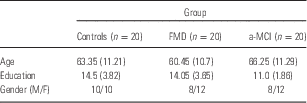
Demographic data (Mean and (SD))

Statistical analyses
Analyses of individual scores from the neuropsychological test battery completed by patients and controls were done using analyses of covariance [between subject factor: group (FMD, controls, a-MCI); covariate: education]. To control for multiple comparisons, the significance value was lowered to p<0.0026.
Results
Demographics
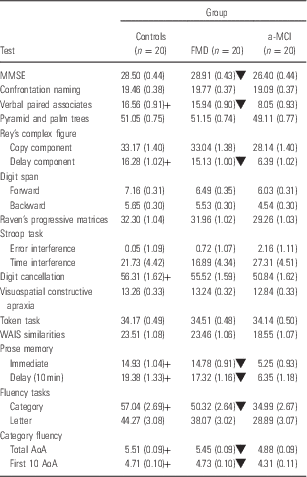
There were no significant age differences between the controls and either patient group, or between the patient groups (Table 1). The FMD patients and healthy controls differed significantly from the a-MCI (p<0.016 and p<0.005, respectively) in years of formal education, but not from each other. Table 2 shows the mean scores (and standard error) achieved by each group on the neuropsychological tests used in the battery. Significant between groups differences are highlighted by symbols.
Neuropsychological scores (Mean and (SE))

a-MCI, amnestic mild cognitive impairment; FMD, functional memory disorder.
Multiple comparisons: p<0.0026.
Key: ▼ significant difference, FMD>a-MCI. +Significant difference, controls>a-MCI.
Key: ▼ significant difference, FMD>a-MCI (p<0.005–0.0001 range). +Significant difference, controls>a-MCI (p<0.009–0.0001 range).
FMD patients versus controls
The FMD patients did not differ from the healthy control group in terms of cognitive ability on any aspect of the neuropsychological battery in univariate or multivariate analyses.
Focusing on the AoA analysis, there were no significant differences seen between the FMD patients and the control group, either in terms of total count or when the analysis was restricted to the first 10 words produced in this test.
FMD patients versus a-MCI patients
The FMD patients significantly outperformed the a-MCI patient group on several tasks in the battery. Specifically, those centred on the memory and language domains. Significant differences were seen on tasks assessing global cognition (MMSE: p<0.001), memory (verbal paired associates: p<0.0001; Rey’s Figure, delay component: p<0.0001; and both components of Prose Memory: p<0.0001), and category fluency (category fluency task: p<0.001) (see Table 2).
Focusing on the AoA analysis, the FMD patients produced words that were higher in AoA value (i.e. acquired later in life) at p<0.0001 for both the total word count and the first 10-word analysis, indicating that the total result was not an artefact of the FMD patients producing more words overall on this task (see Table 2).
Control group versus a-MCI patients
Similarly to the FMD patients, the control group also outperformed the a-MCI patients on global cognition, memory (verbal and non-verbal domains), and category fluency. Focusing on the AoA analysis between these two groups, the controls produced words that were higher in AoA value (p<0.0001) compared with the a-MCI patients, again on both the total words and first 10-word analysis (see Table 2).
Discussion
In this study the neuropsychological profile of functional memory disorder patients was compared with those of a group of a-MCI patients and one of control participants without memory complaints, to investigate whether distinctive cognitive changes could be detected through an extensive battery of tests designed to reveal the earliest signs of neurodegeneration. As a group, functional memory patients reported subjective memory concerns for various reasons, including worrying about incipient dementia. At the individual level, verbal accounts of their memory failures were extensive and detailed. However, despite their subjective complaints no evidence was found in their neuropsychological profile or the comparison of the performance of FMD patients and healthy controls to suggest the presence of any objective memory impairment, especially not one suggestive of an early neurodegenerative disease.
a-MCI patients are of great interest because this state can be a transitional (prodromal) state that has a higher conversion rate to AD compared with non-amnestic MCI (Reference Petersen15). There were many significant differences in the neuropsychological profile of a-MCI patients and FMD patients, in particular in tasks assessing domains that have previously been recognised as early indicators of underlying neuropathology, for example, short- and long-term memory (both verbal and visual) and category fluency (Reference Wakefield, McGeown, Shanks and Venneri17). Semantic memory and the associated lexical characteristic analysis are useful in the early detection of abnormal ageing in MCI (Reference Forbes-McKay and Venneri20) and are also early indicators of AD neuropathology (Reference Hardy23,Reference Venneri, McGeown, Biundo, Mion, Nichelli and Shanks24). In the current study, no difference was found between FMD patients and healthy controls in the AoA analysis. In contrast, the profile was significantly different between the two patient groups, providing supporting evidence that the memory complaints of FMD patients are not caused by an underlying neurodegenerative process, given the evidence that this latent variable is particularly sensitive to the earliest changes in mediotemporal cortex caused by AD pathology (Reference Hardy23,Reference Venneri, McGeown, Biundo, Mion, Nichelli and Shanks24).
On tests of attention and executive control, such as the digit cancellation task, Stroop task, although not significantly different from each other, the control group did perform better than the FMD group. A similar finding has also been reported by Metternich et al. (Reference Metternich, Schmidtke and Hull25), who noted that it could be the calm testing environment that removes significant differences between these groups and that distractedness in the real environment could distinguish normal healthy individuals from FMD individuals. Detection of these subthreshold differences between healthy ageing individuals and those with FMD could be a potential avenue for future research with larger samples. Questions to answer include what the reason for this difference is, and whether there are any functional or anatomical findings to support this view. For example, people with depression have dysfunction in frontal subcortical circuits (Reference Kong, Wu and Tang26). There are five frontal subcortical circuits that are disrupted in some forms of neurodegeneration, but also in some psychiatric disorders, and underlie different phenotypes, several related to memory and attention (Reference Tekin and Cummings27). Patients who present with a fugue state (memory disorder related to mood and stress) typically have normal structural brain imaging but detailed neuropsychological and neuro-radiological investigation of an individual suggested micro-structural changes in white matter fibre tracts in the right prefrontal lobe (Reference Tramoni, Aubert-Khalfa, Guye, Ranjeva, Felician and Ceccaldi28).
Retrospective descriptive analysis of data extracted from the contemporaneous neuropsychology clinic records suggests that life events (e.g. changes at work, family relationship strains) might significantly and insidiously affect the day-to-day lives of the FMD group with no conscious awareness by the patients themselves. For example, when attention is removed from the task at hand (e.g. going into a room to retrieve an item) or even subconsciously, by being focussed on a life event, a resulting attentional slip (i.e. forgetting what the particular item was) can prompt people with FMD to misattribute these memory lapses to neuropathology. This can cause greater rumination and worry about memory slips as described in Schmidtke et al. work (Reference Schmidtke, Pohlmann and Metternich8,Reference Metternich, Schmidtke and Hull25). Previous research has also shown that subjective memory complaints are frequently caused by psychiatric disorders, most commonly by a depressive disorder, and these patients are often seen in memory clinics (Reference Høgh, Waldemar and Knudsen29). Investigating the psychosocial determinants of forgetfulness in persons aged between 53 and 94 (mean age=72 years), Mol et al. (Reference Mol, van Boxtel, Willems and Jolles30) found that ‘low memory self-efficacy, negative attitude, high memory related anxiety and high subjective norm’ (i.e. what others in society think about memory failures) all contributed to a person’s perceived forgetfulness.
There has been a steep increase in people referred to secondary care memory clinics (31,32) and the steady rise in the number of patients with FMD referred to memory clinics (Reference Menon and Larner4–Reference Bell, Harkness, Dickson and Blackburn6) is of concern, in terms of expense and potential harm of people with FMD suffering increased anxiety by attending a memory clinic (Reference Samsi, Abley and Campbell33). Efforts should be made to detect FMD at primary care level. The reason for this increase may be multifactorial. For example, the increase in media attention over dementia and early dementia diagnosis might have prompted more people to report to GP services. GP uncertainty in diagnosis of functional patients may in turn generate more referrals to specialist memory clinics. There is, therefore, a need for possible screening tools, which can be used in primary care to investigate cognitive impairment, and therefore limiting the potential harm of over-diagnosing or over-referring people to memory clinics (Reference Le Couteur, Doust, Creasey and Brayne34). Without neuropsychology and the experience of specialists, this task is particularly difficult. The addition of semantic memory tasks (e.g. category fluency) to the short screening tests such as the six-item cognitive impairment test (6CIT), which, although widely used in primary care, lacks sufficient sensitivity or specificity (Reference Hessler, Brönner and Etgen35), may help distinguish FMD from neurodegenerative disorders such as early AD. Also recent research has focussed on the use of conversation analysis for this purpose (Reference Elsey, Drew and Jones36,Reference Jones, Drew and Elsey37), whereby conversations between patients, neurologists and accompanying persons were analysed to identify specific interactions that can be useful to distinguish FMD and early organic patients.
Other factors that may be useful positive indicators of FMD include educational attainment level and certain personality traits, such as over achievement or perfectionism that can be conducive to worry that accompanies occasional attentional slips or memory failures (Reference Schmidtke, Pohlmann and Metternich8). A vicious circle can enhance these concerns in FMD patients. In our current study, we noted that 13 of our FMD group had achieved post high school education, with seven of those also having University level education, supporting previous work (Reference Schmidtke, Pohlmann and Metternich8,Reference Metternich, Schmidtke, Dykierek and Hull38). Furthermore, high career achievement was also reported in the majority of FMD patients, which included several business owners and management positions. However, similar professions and high education was seen in the healthy controls who participated in this study. A possible route for treatment would be to investigate psychosocial risk factors (Reference Metternich, Schmidtke, Dykierek and Hull38) and explore beliefs about memory failures. We noted in clinical communications between the neuropsychologist and the patient, that only one person admitted that mood (in this case, anxiety) could be the cause of their subjective memory concerns, which supports research in functional weakness patients (Reference Stone, Warlow and Sharpe13). Memory complaints in FMD are similar to those experienced by many healthy ageing people (e.g. forgetting PIN numbers, getting lost mid-conversation, forgetting the reason for walking into a room). However, they are more severe, or rather the perception of these memory failures is greater. Reassurance that their subjective memory complaints are not found on objective testing, may not be effective in all FMD patients (Reference Schmidtke, Pohlmann and Metternich8). As found in this study, subjective memory concerns can occur for many different reasons depending on the individual patient – from fear of dementia (Reference Commissaris, Jolles, Verhey, Ponds, Damoiseaux and Kok39,Reference Commissaris, Verhey and Jolles40) with increasing age or family history, to possible personality factors, and to an increase in stressful life events. Furthermore, a person’s attitude, in particular their negative attitude, towards their memory could be a way to target treatment (Reference Mol, Ruiter, Verhey, Dijkstra and Jolles41), although a multidisciplinary therapeutic approach is likely the best option (Reference Metternich, Schmidtke, Dykierek and Hull38).
The relationship between subjective memory complaints and psychiatric conditions/affective disorders, such as depression or anxiety, is an interesting avenue of further studies with FMD patients, but in this study we excluded those with severe and chronic depressive disorders to have a ‘pure’ sample. Greater awareness of FMD is required by primary and secondary care in order to devise better screening tools that will distinguish these patients from those with signs of an early neurodegenerative disease.
Acknowledgements
The authors would like to thank the participants who took part in this study. The support to recruitment by personnel in the Sheffield Teaching Hospital Clinical Research Facility is acknowledged.
Authors’ Contribution: This article was conceived by A.V., S.W., M.R. and D.J.B. Participants were recruited and data collected by S.W., D.J.B., K.H. and A.K. All authors contributed to writing and reviewing the manuscript.
Financial Support
This study was partially funded by a grant by the National Institute for Health Research (NIHR) under its Research for Patient Benefit (RfPB) Programme [Grant reference number PB-PG-0211-24079]. The views expressed are those of the author(s) and not necessarily those of the NHS, the NIHR or the Department of Health.
Conflicts of Interest
We have no conflicts of interest to declare.
Ethical Standards
The authors assert that all procedures contributing to this work comply with the ethical standards of the relevant national and institutional committees on human experimentation and with the Helsinki Declaration of 1975, as revised in 2008.