





1. Introduction
The effects of case loss extend far beyond the realization of nominal forms (Dragomirescu & Nicolae Reference Dragomirescu, Nicolae, Ledgeway and Maiden2016:911, Reinöhl Reference Reinöhl2016:8). One widely discussed consequence is the increased use of adpositions, which assume functions previously expressed by inflectional case (Meillet Reference Meillet1918:98–99, Pinkster Reference Pinkster, Pinkster and Genee1990:195, 207, Norde Reference Norde and Faarlund2001:246, Hewson & Bubeník Reference Hewson and Bubeník2006:viii, Dragomirescu & Nicolae Reference Dragomirescu, Nicolae, Ledgeway and Maiden2016:911). Word order is likewise often argued to take over some of the functions formerly encoded by case, including the marking of grammatical relations (Meillet Reference Meillet1918:98–99, Kiparsky Reference Kiparsky, van Kemenade and Vincent1997:461, Liu et al. Reference Liu, Yan and Liu2025:340, 342).Footnote 1
Another proposed consequence of case loss is the emergence of definite and indefinite articles, as illustrated by the contrast between Russian and Bulgarian.
(1)
Russian
knig-a
lezhit
na
stol-e
book-
nom.sg
lie.3sg.prs
on
table.
loc.sg
‘The book is on the table.’
(2)
Bulgarian
kniga-ta
e
na
masa-ta
book-
def
be.3sg.prs
on
table-
def
‘The book is on the table.’
Russian, like most Slavic languages, has a relatively rich case system (typically around six cases) but lacks articles. Bulgarian, by contrast, has a definite article and makes only limited use of inflectional case. This contrast exemplifies a broader pattern that has been proposed for several Indo-European clades. As inflectional case is reduced, articles tend to emerge. This inverse relationship between case-inventory size and articles has been argued for Romance (Giusti Reference Giusti, Haider, Olsen and Vikner1995, Reference Giusti2015, Posner Reference Posner1996:126, Ledgeway Reference Ledgeway, Heine and Narrog2011:720), Germanic (Paul Reference Paul1919:§149, Tschirch Reference Tschirch1975:168, Giusti Reference Giusti, Haider, Olsen and Vikner1995, Crisma Reference Crisma, Sleeman and Perridon2011:175, Jones & Jones Reference Jones and Jones2019:§43, §266, van Gelderen Reference van Gelderen2024:19), and South Slavic (Hewson & Bubeník Reference Hewson and Bubeník2006:21). On some accounts, it has been extended to the family as a whole (Hewson Reference Hewson1972:14, Krámsky Reference Krámsky1972:49, Martin et al. Reference Martin, Sitaridou and Hinzen2021), and on others proposed as a universal tendency across languages (Wahlström Reference Wahlström2015:170).
Beyond its typological interest, this relationship has direct implications for syntactic theory. Proposals concerning the structure of the nominal domain, such as those of Giusti (Reference Giusti, Haider, Olsen and Vikner1995) and Giusti and Iovino (Reference Giusti and Iovino2016), are partly motivated by the association between case loss and the emergence of articles. Clarifying the nature of this relationship is therefore essential, since it bears directly on how case loss restructures the grammar of a language.
Claims of a relationship between case and articles have not gone unchallenged, however. Wood (Reference Wood2003:74), for instance, observes that apparent counterexamples occur in both directions. There are languages characterized by both rich inflection and articles (such as Classical Armenian), and languages that lack both (such as Chinese). She concludes that ‘it cannot be assumed that when a language loses case morphology it has to develop articles’ (see also Anward & Swedenmark Reference Anward, Swedenmark and Åström1997, Philippi Reference Philippi, van Kemenade and Vincent1997:64, Barðdal Reference Barðdal2001:192–93, Reference Barðdal, Barðdal and Chelliah2009:131). Börjars, Harries, and Vincent (Reference Börjars, Harries and Vincent2016:e30–e31) raise a different objection. They argue that case loss and article grammaticalization are independent processes that may cooccur but are not causally linked.
Part of the difficulty is that several distinct questions are often conflated in this debate. The first concerns the empirical form of the relationship: do articles arise specifically in the absence of case, or do they become more likely as case inventories are reduced? The second concerns its nature: under either interpretation, is the relationship deterministic or probabilistic? The third concerns causation: does case loss play a causal role in the emergence of articles, either directly or indirectly, or do both phenomena reflect a common underlying process? These questions require different types of evidence and should be evaluated separately.
The exceptions observed by Wood (Reference Wood2003:74) and Barðdal (Reference Barðdal, Barðdal and Chelliah2009:131) show that the relationship between case loss and articles is not deterministic. This is unsurprising, given the rarity of absolute universals (Evans & Levinson Reference Evans and Levinson2009:439). Wood and Barðdal invoke these counterexamples with a more ambitious aim, however—to deny a causal relationship between case loss and the emergence of articles. That conclusion does not follow directly from the evidence. Their examples undermine a deterministic account, but they do not rule out a probabilistic association, which may or may not reflect an underlying causal structure (Eells Reference Eells1991).
At present, it remains unclear whether a statistical association between case inventories and articles exists in Indo-European. Three major limitations of previous studies have left this question unresolved. First, they have relied on samples that are too small or too unevenly distributed across clades to support general conclusions. Second, they have not accounted for phylogenetic and geographic nonindependence,Footnote 2 even though the distribution of case inventories (Kulikov Reference Kulikov2012:291) and articles (Heine & Kuteva Reference Heine and Kuteva2005:110, 120, Goldstein Reference Goldstein2022) in Indo-European exhibits both. Third, they have rarely employed statistical methods appropriate to this problem. Addressing these limitations requires broader data coverage together with models that account for phylogenetic and spatial structure.
One common approach to nonindependence in typology is strategic sampling (e.g. Dryer Reference Dryer1989, Reference Dryer1992), but this is unsatisfactory for at least two reasons. First, it only mitigates the issue, since samples with closely related languages are still likely to exhibit nonindependence that violates the assumptions of standard statistical methods (Shcherbakova et al. Reference Shcherbakova, Blasi, Gast, Skirgård, Gray and Greenhill2024:3). Second, it requires excluding languages, the result of which is that already limited data become even more restricted (Cysouw Reference Cysouw2011:416–17, Cathcart et al. Reference Cathcart, Carling, Larsson, Johansson and Round2018:4, Guzmán Naranjo & Becker Reference Guzmán Naranjo and Becker2021:617). This practice is particularly problematic with ancient languages, which offer crucial information about linguistic history but are only sparsely attested.
The relationship between case and articles is further complicated by the association between definite and indefinite articles. Building on earlier typological work, Goldstein Reference Goldstein2022 argues that within Indo-European, indefinite articles emerged at a faster rate among languages that already had a definite article than among those without. This evolutionary trajectory underpins the implicational universal that languages with an indefinite article are likely to have a definite article but not vice versa (Moravcsik Reference Moravcsik1969:87, Heine Reference Heine1997:69). When the role of case is taken into consideration, it remains unclear whether the association between definite and indefinite articles persists or whether their cooccurrence reflects their shared relationship with case.
This study addresses four questions. First, is there a probabilistic relationship between case-inventory size and the presence of definite articles in Indo-European? Second, does a comparable relationship hold for indefinite articles? Third, does the association between definite and indefinite articles persist once case inventory is taken into account? Fourth, does the available evidence support a causal interpretation of these relationships? To address these questions, I employ Bayesian logistic regression models that incorporate both phylogenetic comparative methods and a spatiotemporal Gaussian process (Rasmussen & Williams Reference Rasmussen and Christopher2006). This framework enables the estimation of statistical associations while accounting for nonindependence among languages and provides explicit quantification of uncertainty in both parameter estimates and predictions.
The results provide statistical support for an inverse association between case-inventory size and the presence of articles. As case inventories are reduced, the probability that a language exhibits a definite article increases, with posterior median probabilities exceeding 0.5 at four cases. A similar pattern holds for indefinite articles, although the transition occurs at somewhat smaller case inventories. Median predicted probabilities approach and exceed 0.5 between three and four cases. These results suggest that articles are more likely in languages whose case systems have been reduced to core grammatical cases. They thus challenge the view that articles are expected only in languages that have lost case entirely. Under the revised picture, Ancient Greek, which retains four cases alongside a definite article, is not the anomaly it has sometimes been taken to be (pace Martin et al. Reference Martin, Sitaridou and Hinzen2021:256–57). Its case inventory falls squarely within the range at which article emergence is predicted.
The results further indicate that the presence of a definite article is associated with a higher probability of an indefinite article even after controlling for case inventory and phylogenetic and spatiotemporal nonindependence. This association is, however, more sensitive to model specification than the relationship between case-inventory size and the presence of articles, and should therefore be interpreted with greater caution. The question of causation remains unresolved. Although the observed associations are consistent with several causal scenarios, the present analysis is based on observational data and does not provide a basis for identifying the underlying causal structure.
The article is structured as follows. Section 2 provides an overview of the history of case and articles in Indo-European. Sections 3 and 4 introduce the data and methods used in this study, respectively. The results are presented in Section 5 and discussed in Section 6. Section 7 brings the article to a close with summary remarks and an overview of future research.
2. Inflectional-case inventories and articles in Indo-European
2.1. Inflectional case
The earliest Indo-European languages are characterized by cumulative exponence and comparatively rich case inventories. Traditional reconstructions of Proto-Indo-European posit at least eight cases: nominative, genitive, dative, accusative, ablative, instrumental, locative, and vocative (Hewson & Bubeník Reference Hewson and Bubeník2006:334, Clackson Reference Clackson2007:90–92, Barðdal & Kulikov Reference Barðdal and Kulikov2009:470, Fortson Reference Fortson2010:113–19, Kulikov Reference Kulikov2012:290, Klein Reference Klein, van Beek, Kloekhorst, Kroonen, Pronk and de Vaan2018:79). The status of a ninth case, the allative, remains contested (Kim Reference Kim, Cooper, Rau and Weiss2013:128, Melchert Reference Melchert, Hansen, Hyllested, Jørgensen and Kroonen2017, Miller Reference Miller2019:103). Kim (Reference Kim, Cooper, Rau and Weiss2013) argues that Proto-Indo-European nominal inflection was more fluid and typologically mixed than traditionally reconstructed, with a core set of fusional case endings alongside adverbial suffixes of varying productivity, many of which were later reanalyzed as case markers.
Across the family, the dominant diachronic tendency is toward case reduction (Hewson & Bubeník Reference Hewson and Bubeník2006:21; for case loss more generally, see Blake Reference Blake2001:175–80), as illustrated in Figure 1. Two mechanisms are typically invoked to account for this development: sound change and syncretism. Sound change contributes to the erosion of case distinctions through the weakening of word-final syllables, which are the primary locus of case morphology (Paul Reference Paul1919:§277). Syncretism, in turn, collapses formally distinct cases into a smaller set of exponents.
Case inventories as a function of time, which is measured in millennia before the year 2000 (kya). Jitter has been added to the number of cases. Contemporary languages are assigned an age of 0, whereas the ages of premodern languages are estimated from their earliest textual attestation. Data from earlier languages are sparse but suggest higher case inventories. A generalized additive model (GAM) is used for the smoothed trend on account of the uneven chronological distribution of the data.

Figure 1. Long description
The horizontal X axis is labeled Time k y a, representing millennia before the year 2000, with a scale from 3.5 on the left to 0 on the right. The vertical Y axis is labeled Number of Cases, ranging from 1 to 8.
Data points are represented by blue semi-transparent circles. A red smoothed trend line, generated by a G A M, slopes downward from left to right, starting at approximately 7 cases at 3.5 k y a and ending at approximately 3 cases at 0 k y a. A light pink shaded area around the red line represents the confidence interval, which is wider on the left and narrows as it approaches the present day.
Specific data distribution:
* From 3.5 to 1 k y a, data points are sparse and scattered between 3 and 8 cases.
* At the 0 k y a mark on the far right, there is a dense vertical cluster of points representing contemporary languages, ranging from 1 to 8 cases, with a high concentration between 1 and 2 cases and another cluster around 6 cases.
Case loss in Indo-European, however, is not reducible to the disappearance or neutralization of morphological markers (see e.g. Calabrese Reference Calabrese, Lema and Treviño1998:110 on Latin). It frequently involves the restructuring of the case system through the fusion of formal exponents and morphosyntactic functions. In such cases, the functional domain of a declining case is absorbed by a surviving one (Luraghi Reference Luraghi, Ramat, Carruba and Bernini1987, Reference Luraghi, Booij, Lehmann, Mugdan and Fabellini2000, Reference Luraghi2009:147, Kulikov Reference Kulikov2012:291, Dragomirescu & Nicolae Reference Dragomirescu, Nicolae, Ledgeway and Maiden2016:912, Klein Reference Klein, van Beek, Kloekhorst, Kroonen, Pronk and de Vaan2018, Rappaport Reference Rappaport and Drinka2020). The Latin ablative provides a canonical example. Its morphosyntax reflects the merger of earlier ablative, instrumental, and locative categories.
Although the dominant tendency in Indo-European is toward case reduction, new cases have nonetheless arisen in Baltic (Senn Reference Senn1966:92–93, Petit Reference Petit2007:338–60), Indic (Masica Reference Masica1991:231; cf. Kulikov Reference Kulikov2012:295–96), Ossetic (Cheung Reference Cheung, Lubotsky, Schaeken and Wiedenhof2008, Stilo Reference Stilo2009:711–12, Belyaev Reference Belyaev2010), and Russian (Kulikov Reference Kulikov2012:293). Armenian and Balto-Slavic also exhibit a relative resistance to case loss compared to other clades (Kulikov Reference Kulikov2009:452, Reference Kulikov2012:293–94). Classical Armenian is particularly conservative in this respect, as it preserves a case system that largely reflects traditional Proto-Indo-European distinctions (Kortlandt Reference Kortlandt2003 [1984]).
2.2. Articles
The diachronic development of articles in Indo-European follows a trajectory that contrasts sharply with that of inflectional case (Figure 2). The earliest attested languages (such as Hittite, Vedic Sanskrit, and Mycenaean Greek) uniformly lack articles, and Proto-Indo-European is accordingly reconstructed without them. The absence of cognate articles across clades further suggests that articles grammaticalized only after the major Indo-European lineages had diverged (Goldstein Reference Goldstein2022:671–72). Articles are therefore treated as innovations within individual clades (Hewson & Bubeník Reference Hewson and Bubeník2006:4, Goldstein Reference Goldstein2022:670–73).
Article inventories as a function of time, measured in millennia before the year 2000 (kya). Jitter has been applied to the article data to improve visibility. Contemporary languages are assigned an age of 0, while the dates of premodern languages are based on their earliest textual attestation.

Figure 2. Long description
The X axis is labeled Time k y a, representing millennia before the year 2000, ranging from approximately 4 on the left to 0 on the right. The Y axis is labeled Presence of Articles with two categorical levels: Absent at the bottom and Present at the top. A legend at the top identifies pink circles and lines as Definite Article and blue circles and lines as Indefinite Article.
Data points are jittered around the Absent and Present lines. At 4 k y a, most data points for both article types are clustered at the Absent level. As time approaches 0 k y a, there is a significant increase in the density of points at the Present level, particularly for contemporary languages at the 0 mark.
Two linear regression lines with shaded confidence intervals illustrate the trend. The pink line for definite articles starts higher on the Y axis at 4 k y a and shows a steady positive linear increase toward the Present level. The blue line for indefinite articles starts lower than the pink line at 4 k y a but exhibits a steeper positive linear increase, nearly meeting the pink line at the 0 k y a mark. Both trends indicate that the presence of articles in documented languages has increased over time.
Whether articles within a clade reflect inheritance from an intermediate ancestor, contact-induced diffusion among related languages, or parallel independent grammaticalization is not always clear, and different mechanisms may be operative in different clades. The relative roles of inheritance and contact have been widely debated (Putzu & Ramat Reference Putzu, Ramat and Bisang2001, Heine & Kuteva Reference Heine and Kuteva2006:97–139, Goldstein Reference Goldstein2022:693–94). Borrowing of articles is thought to have occurred in at least some languages, notably Assamese, Bengali, and Oriya (Masica Reference Masica1991:250), but more commonly contact leads to pattern borrowing rather than the transfer of article forms, in line with Matras Reference Matras2020:236. The postposed definite article, as in the Bulgarian example in 2 above, is often considered an areal feature of the Balkan Sprachbund (Friedman & Joseph Reference Friedman and Joseph2025:576–99, Sobolev Reference Sobolev2025:39). Under such an account, it would represent a case of pattern borrowing, since the languages involved derive their postposed articles from different etymological sources. Some accounts attribute the development of articles in Romance and Germanic to contact as well (Dahl Reference Dahl2004:127), which would likewise represent pattern borrowing rather than the transfer of forms.
In languages that possess both definite and indefinite articles, establishing their relative chronology is not always straightforward. In Romance, for example, the available evidence does not decisively determine their order of development. Where the diachronic sequence can be identified, however, definite articles consistently precede indefinite ones, as in Greek and Armenian (see Goldstein Reference Goldstein2022:673–76 for additional cases). More broadly, Goldstein Reference Goldstein2022 argues that the emergence of a definite article increases the likelihood of subsequent indefinite article development. The overall tendency in Indo-European is therefore toward two-article systems (Lakoff Reference Lakoff, Stockwell and Ronald1972:174).
Altogether these observations suggest a broad generalization: reductions in case inventories tend to precede the emergence of articles. Establishing the precise onset of case loss is often difficult, but in several well-documented languages, such as Ancient Greek, English, and German, it is clear that case reduction was already underway prior to the grammaticalization of articles. In other cases, however, the relative chronology is difficult to determine. In the transition from Latin to Romance, for example, the dominant view holds that articles emerged after the loss of case marking (Hertzenberg Reference Hertzenberg2015:18), but Renzi (Reference Renzi1992) suggests that the broader OV-to-VO typological shift led to the grammaticalization of articles, which in turn facilitated the subsequent collapse of the case system.
3. Data
This study is based on a sample of ninety-four Indo-European languages, comprising sixteen premodern and seventy-eight contemporary varieties. The sample corresponds to that used in Chang et al. Reference Chang, Cathcart, Hall and Garrett2015a and Goldstein Reference Goldstein2022.Footnote 3 The geographic distribution of the sampled languages is shown in Figure 3. According to Glottolog 5.1, Indo-European contains 586 languages (Hammarström et al. Reference Hammarström, Forkel, Haspelmath and Bank2024), so the present sample represents approximately 16% of the family.
Geographic distribution of sampled languages (N = 94).

Figure 3. Long description
The map uses a coordinate system with Latitude on the Y axis from 20 degrees South to 60 degrees North and Longitude on the X axis from 20 degrees West to 100 degrees East.
In the Northwest (Europe), there is a high density of languages including Icelandic, Old English, and Irish in the far West. Moving East through Central Europe are Dutch, German, Polish, and Lithuanian. Southern Europe features Portuguese, Spanish, Italian, and Greek.
In the Northeast and Central regions, languages like Russian, Belarusian, and Ukrainian are plotted, extending toward Eastern Armenian and Hittite in the Middle East.
In the East (South Asia), a cluster includes Pashto, Urdu, Hindi, Bengali, and Assamese, with Tocharian A and B located further Northeast. Sinhalese is the southernmost point in Asia.
In the South, Afrikaans is isolated as a single data point in Southern Africa.
Data points are represented by colored dots (shades of green, blue, purple, and yellow) with leader lines connecting labels to specific geographic coordinates.
3.1. Measuring case inventories
An explicit definition of morphological case is required in order to operationalize case-inventory size. In the typological literature, case is commonly defined as a system marking the relationship between dependent nouns and their heads (Blake Reference Blake2001:1), a definition that encompasses both synthetic affixes and analytic adpositions. This broader view reflects the fact that even in languages with extensive inflectional systems, adpositions often contribute to encoding grammatical relations (Blake Reference Blake2001:8). The present study adopts a narrower definition: case is restricted to bound morphology. This restriction is motivated by the hypothesis under investigation, namely the relationship between articles and inflectional case. The criteria used to measure case inventories are summarized in Table 1 and discussed below.
Criteria for measuring case inventories.

Table 1. Long description
The table consists of two columns titled Criterion and Description.
Row 1. Criterion 1. Only synthetic case markers are considered; analytic case markers such as adpositions are not.
Row 2. Criterion 2. Only cases on nouns as opposed to pronouns or determiners are considered.
Row 3. Criterion 3. The counts for each language are based on the number of rows in the nominal paradigm and not the number of case markers. This applies to noun paradigms in languages with affixal case marking and determiner paradigms where case is realized on determiners.
Row 4. Criterion 4. Vestigial case markers are excluded.
Row 5. Criterion 5. Vocatives are excluded.
3.1.1. Criteria 1 and 2
The first two criteria follow directly from the focus on the relationship between inflectional case and articles. Including analytic markers such as postpositions or clitics would distort the measurement. As a result, several phenomena commonly described as case markers are excluded. These include the secondary cases of Tocharian (Pinault Reference Pinault2008:462–74, Reference Pinault, Fruyt, Mazoyer and Pardee2011:383, Kim Reference Kim, Cooper, Rau and Weiss2013:130–35, Adams Reference Adams2015:73–78), most ‘layer II’ markers in Indic (e.g. Spencer Reference Spencer2005), and possessive clitics in English and other Germanic languages.
3.1.2. Criterion 3
In his typological survey, Iggesen (Reference Iggesen2013) operationalizes case-inventory size in terms of morphological contrasts. A zero-marked base form counts as a case only when it contrasts with an overtly marked form, and languages without any such contrasts receive a count of zero. Although this operationalization is explicit and internally coherent, it introduces a complication for statistical modeling. Since zero exponence counts as a case only when it participates in a contrast, one-case systems are impossible and inventories skip directly from zero to two. This gap is not an empirical property of case systems but a byproduct of the criterion. Languages without overt case marking could just as well be analyzed as having a single noncontrastive case.
By contrast, this study measures case inventories as the number of rows in a nominal paradigm, which sets the lower bound at one rather than zero. In English, for example, the noun paradigm consists of a single row (Table 2). This operationalization has three consequences. First, the locus of case marking is not taken into consideration. In languages such as German, Romanian (Gönczöl-Davies Reference Gönczöl-Davies2020:§2.4), and Shughni (Edelman & Dodykhudoeva Reference Edelman, Dodykhudoeva and Windfuhr2009:794), where case is realized on determiners rather than nouns, the determiner paradigm supplies the row count, which ensures that inventories are measured uniformly across languages regardless of exponence. Second, variation in morphological realization is ignored (Kulikov Reference Kulikov2009:451). In Latin, for instance, the number of distinct exponents for a given case varies according to number, gender, and declensional class, but the number of paradigm rows remains constant. Third, nonautonomous cases, which lack a dedicated exponent and are realized instead through paradigm-specific patterns of syncretism, are not distinguished from the cases whose forms they share and therefore do not contribute a separate row to the count (Zaliznjak Reference Zaliznjak and Zaliznjak1973:69–74 = Zaliznjak Reference Zaliznjak and Zaliznjak2002:629–36, Mel’čuk Reference Mel’čuk, Brecht and Levine1986:66–68, Blake Reference Blake2001:22–24, Corbett Reference Corbett2010).
English noun paradigm.

Table 2. Long description
The table consists of two columns and two rows.
* The first row contains the headers: Singular in the left column and Plural in the right column.
* The second row contains the data: the word dog in the Singular column and the word dogs in the Plural column.
3.1.3. Criterion 4
Vestigial case refers to forms that preserve historical case morphology but no longer participate in the synchronic paradigm. In Old English, for example, certain adverbial forms descend from an earlier instrumental case but are not analyzed as such synchronically. Comparable cases include the Gothic instrumental (Miller Reference Miller2019:§4.2), the Latin locative, and the instrumental and ablative in Sindhi (Khubchandani Reference Khubchandani, Cardona and Jain2003:639).
3.1.4. Criterion 5
The vocative is excluded on functional grounds. Unlike other cases, it does not encode a relationship between a predicate and a dependent (Blake Reference Blake2001:8, 156, Daniel & Spencer Reference Daniel and Spencer2009). It is therefore unlikely that it has any relationship to definiteness marking, and its inclusion would introduce noise into the analysis.
3.2. Measurement uncertainty
For many languages in the sample, the size of the case inventory is uncontroversial. In others, however, legitimate analytic disagreements yield different counts (Blake Reference Blake2001:10–12, Heine Reference Heine2009:458), a situation analogous to variation in phoneme inventories (Anderson et al. Reference Anderson, Tresoldi, Greenhill, Forkel, Gray and List2023:150). Such disagreements are well known in Indo-Iranian (e.g. Zograf Reference Zograf1976:§68, Friedman Reference Friedman1991:86, Jahani & Korn Reference Jahani, Korn and Windfuhr2009:651) and arise even in a language as well described as English (Payne Reference Payne2009, Anderson Reference Anderson, Börjars, Denison and Scott2013).
In ambiguous cases, I follow the diagnostics proposed by Blake (Reference Blake2001:11–12): phonologically conditioned allomorphy is taken as evidence for affixhood, and distribution across coordinated noun phrases serves as a secondary test. These criteria are informative but not always decisive, as they may conflict when a marker shows phonological integration yet behaves syntactically like a postposition (Blake Reference Blake2001:11–12, Lowe Reference Lowe2016).
To assess the sensitivity of the results to such uncertainty, I conduct a measurement-error analysis (see Section S3 of the supplementary materials for details). The analysis models case counts as imprecise rather than exact and asks how much the results change as the assumed degree of imprecision increases. Disagreement of ±1–2 cases has negligible effects on the parameter estimates. The results change appreciably only when the uncertainty is far larger than any plausible analytic disagreement would warrant (see supplementary Figure S3). Only a small number of languages in the sample are subject to this degree of uncertainty: Digor Ossetic, Nepali, Romani, and the Tocharian languages. The counts assigned to three of these run counter to the inverse association argued for in this article. Nepali is assigned one case and lacks articles; Romani is assigned seven cases and has a definite article; and the Tocharian languages are assigned three cases and lack articles. Alternative analyses (larger inventories for Nepali and Tocharian or a smaller one for Romani) would strengthen rather than undermine the results reported in Section 5.
3.3. The distribution of case inventories
Figure 4 shows the frequency distribution of case inventories across the ninety-four languages in the sample (see supplementary Table S5 for individual counts). The distribution is strongly right-skewed. Most languages have inventories of one to three cases. Frequencies are generally lower at larger inventory sizes, although there is a notable concentration of six-case systems driven primarily by Baltic and Slavic. Most other clades cluster more tightly around lower median values with relatively limited internal variation, although Indic stands out for its broader spread (Figure 5). Figure 6 situates these inventories geographically. Smaller case inventories are concentrated in central and western Europe, particularly among Romance and Germanic languages, whereas larger inventories predominate in eastern Europe. The Indian subcontinent exhibits substantial heterogeneity.
The frequency distribution of case inventories. Most languages have fewer than four cases. The prominence of the six-case inventories is due primarily to Baltic and Slavic.

The distribution of case inventories by clade. Most clades exhibit little variation around the median (jitter has been added to enhance the visibility of individual data points), but Indic stands out for its spread.

Figure 5. Long description
The Y-axis is labeled Number of Cases and ranges from 0 to 8. The X-axis is labeled Clade and lists thirteen categories from left to right.
* Romance: Median at 1, with a tight cluster of points between 0.5 and 2.5.
* Celtic: Median at 1.5, box spanning 1 to 2.8, points up to 4.
* Iranian: Median at 2, box spanning 2 to 3, with outliers reaching 8.
* Germanic: Median at 2, box spanning 1 to 4, points clustered between 0.5 and 4.5.
* Tocharian: Represented by a horizontal line at 3 with two nearby points.
* Indic: The most varied clade, median at 3, box spanning 2 to 6, with points spread from 1 to 7.
* Greek: Median at 3.5, box spanning 3.2 to 3.8, tight cluster of points.
* Albanian: Median at 4, box spanning 3.5 to 4.5, points between 3 and 5.
* Italic: Represented by a horizontal line at 5 with two points.
* Armenian: Median at 5, box spanning 4.5 to 6, points between 3.8 and 7.
* Baltic: Represented by a horizontal line at 6 with three points.
* Slavic: Represented by a horizontal line at 6 with a cluster of points and two low outliers near 1.
* Anatolian: Represented by a horizontal line at 8 with one point above it.
The geographic distribution of case inventories. Smaller case inventories preponderate in central and western Europe, whereas the languages of eastern Europe generally have more than five cases. The Indian subcontinent is characterized by a diverse range of case inventories.

Figure 6. Long description
A geographical map plotted on a grid of Latitude and Longitude. To the right, a legend titled Number of Cases uses a color gradient from dark blue for 1 case to bright yellow for 8 cases.
* In Western and Central Europe, there is a high density of dark blue and purple dots, mostly labeled with numbers 1 through 4.
* Moving East into Eastern Europe and the Caucasus, the dots transition to orange and yellow, with labels 6, 7, and 8 appearing more frequently.
* In the Indian subcontinent and surrounding regions of South Asia, the distribution is highly diverse, featuring a mix of all colors and numbers ranging from 1 to 8 scattered across the peninsula.
* A single dark blue dot labeled 1 is located in Southern Africa.
* The majority of data points are concentrated between 0 and 100 degrees Longitude and 0 and 60 degrees Latitude.
3.4. Measuring article inventories
The identification of definite and indefinite articles is straightforward in many Indo-European languages. Romance and Germanic, for example, clearly exhibit both, while Anatolian and most Slavic languages are equally clear in lacking them. In other cases, however, article status is less straightforward. Two recurrent sources of ambiguity arise. One concerns the boundary between definite articles and demonstratives (Dryer Reference Dryer2013a); the other concerns the distinction between the numeral ‘one’ and an indefinite article (Dryer Reference Dryer2013b). Upper Sorbian illustrates the first type of ambiguity (Berger Reference Berger2007:1), while Kashmiri illustrates the second (Wali & Koul Reference Wali and Koul1997:101). To address these issues, this study adopts the criteria for articlehood proposed by Becker (Reference Becker2021).
3.4.1. Criteria
Becker (Reference Becker2021:37) defines articles in terms of three properties. First, they function as referential markers. Second, they cooccur with lexical referential expressions, typically nouns. Third, they occur systematically (allowing for limited exceptions) in contexts consistent with their referential function. Building on earlier work (Himmelmann Reference Himmelmann1997:41, Wendtland Reference Wendtland2011:24, Becker Reference Becker2018:70, Reference Becker2021:139), I further argue that the consistent use of definite articles with semantically definite referents, in addition to pragmatically definite ones, distinguishes them from demonstratives (Goldstein Reference Goldstein2022:665).
Pragmatically definite referents are identifiable only through contextual information.
-
(3) Pragmatic definite
Caesar used both cavalry and infantrymen to subdue the Gauls. The infantrymen were particularly fierce.
The phrase the infantrymen refers anaphorically to the infantrymen in the first sentence. By contrast, semantically definite referents are identifiable independently of context (Goldstein Reference Goldstein2022:664).
-
(4) Semantic definite
The sun is a star at the center of our solar system.
Since there is only one salient referent of this type, contextual information is unnecessary.
Descriptive grammars do not always document the full range of semantically definite contexts in which a determiner is used. Given this limitation, I classified a determiner as a definite article if it is used systematically in at least one pragmatically definite and one semantically definite context (Goldstein Reference Goldstein2022:665–66). This criterion excludes disputed cases, which typically arise from nonobligatory or inconsistent usage. In Old English, for example, disagreement often centers on whether article-like uses of a determiner that are not obligatory suffice for classification as an article. On this basis, I distinguished between a narrow data set, which excludes such cases, and a broader data set, in which they are included despite failing the systematicity criterion. I adopt the narrow data set in the present study (see supplementary Table S6).
Indefinite articles are commonly analyzed as having two readings, specific and nonspecific.
-
(5) Specific indefinite
I saw an eland on my way to work this morning.
-
(6) Nonspecific indefinite
Do you have a job for me today?
In 5, the referent is specific, whereas in 6 it need not be. I classified determiners as indefinite articles if they are used consistently with either type of indefinite reference (Goldstein Reference Goldstein2022:666).
3.4.2. The distribution of article inventories
Figure 7 shows the frequency distribution of article inventories across the ninety-four languages in the sample. Most languages either lack articles altogether or possess both a definite and an indefinite article (Lakoff Reference Lakoff, Stockwell and Ronald1972:174). Figure 8 situates these inventories in their geographic and phylogenetic contexts and reveals several general patterns. Languages without articles are the most geographically dispersed, which is consistent with their status as the ancestral state of the family. Languages with only a single article are comparatively rare and show no clear geographic clustering. Those with only a definite article are scattered across multiple regions and clades, particularly in Europe and the Balkans, whereas languages with only an indefinite article form a tightly clustered group within Iranian (Goldstein Reference Goldstein2022:690–92). By contrast, languages with both articles are concentrated in central and western Europe, which reflects their presence throughout Germanic and Romance. Although languages can lose articles, there is no evidence for loss among the languages in my sample (Goldstein Reference Goldstein2022:673).
The frequency distribution of definite and indefinite article inventories in Indo-European. Most languages either lack articles altogether or possess both a definite and an indefinite article. Languages with only a single article are comparatively rare, particularly those with only an indefinite article.

The geographic and phylogenetic distribution of article inventories. Languages without articles are the most widely dispersed. Languages with both articles are concentrated in central and western Europe. Systems with only a definite article are scattered across several regions, whereas those with only an indefinite article are restricted to a small number of Iranian languages.

Figure 8. Long description
A grid of four maps with Latitude on the y-axis (0 to 80) and Longitude on the x-axis (0 to 100).
* Top-Left Panel (No Articles): Shows the widest distribution across Eurasia. Slavic (blue) and Baltic (orange) clades are in the Northwest; Indic (yellow) is concentrated in the South; Iranian (light cyan) and Tocharian (dark grey) are in the East.
* Top-Right Panel (Definite Only): Points are scattered. Celtic (dark brown) is in the Northwest (British Isles); Germanic (light green) is in Northern Europe; Greek (purple) and Armenian (magenta) are in the Southeast.
* Bottom-Left Panel (Indefinite Only): Highly clustered distribution. Points are almost exclusively Iranian (light cyan) clades located in Central Asia.
* Bottom-Right Panel (Both Articles): Concentrated in Western and Central Europe. Germanic (light green) and Romance (light pink) clades dominate the Northwest; Greek (purple) and Albanian (bright pink) are in the Southeast; a small cluster of Indic (yellow) is in the South.
A legend on the right titled Clade lists 12 categories: Romance, Celtic, Iranian, Germanic, Tocharian, Indic, Greek, Albanian, Italic, Armenian, Baltic, Slavic, and Anatolian.
3.4.3. The distribution of article and case inventories
Figure 9 shows the distribution of case-inventory sizes across the four article-system types. A clear contrast emerges between languages with and without articles. Languages lacking articles have substantially larger case inventories, with a median of six, whereas languages with both definite and indefinite articles have much smaller inventories, with a median of one. Languages with only a single article fall between these extremes but are comparatively few in number. The overall distribution anticipates the inverse association between case-inventory size and the presence of articles demonstrated in Section 5 below.
Distribution of case-inventory sizes by article system. Each panel shows the frequency of languages with a given number of cases within an article-inventory type. The dashed red line indicates the median.

Figure 9. Long description
The figure consists of four panels arranged in a 2 by 2 grid. The horizontal x-axis for all panels is labeled Number of Cases ranging from 1 to 8. The vertical y-axis is labeled Frequency with varying scales.
* Top-Left Panel: Both Articles (n=37). The distribution is heavily skewed to the left, with a peak of over 20 languages at 1 case. The frequency drops sharply for 2 to 6 cases. The dashed red median line is positioned at 1.
* Top-Right Panel: Definite Article Only (n=13). The distribution shows a peak of 5 languages at 1 case, a secondary peak of 4 languages at 3 cases, and a small cluster at 6 cases. The dashed red median line is positioned at 4.
* Bottom-Left Panel: Indefinite Article Only (n=5). The distribution shows 4 languages at 1 case and 1 language at 2 cases. The dashed red median line is positioned at 2.
* Bottom-Right Panel: No Articles (n=39). The distribution is bimodal, with a peak of 11 languages at 1 case and a higher peak of 14 languages at 5 cases. The dashed red median line is positioned at 6.
3.5. Spatiotemporal and phylogenetic data
Three types of data are used to capture nonindependence among languages: geographic coordinates, language dates, and phylogenetic trees. Geographic distances are computed as pairwise great-circle (Haversine) distances from latitude and longitude coordinates obtained primarily from Glottolog 5.1 (Hammarström et al. Reference Hammarström, Forkel, Haspelmath and Bank2024), supplemented where necessary with data from the World atlas of language structures (WALS; Dryer & Haspelmath Reference Dryer and Haspelmath2013b), Grambank (Skirgård et al. Reference Skirgård, Haynie, Blasi, Hammarström, Collins, Latarche and Lesage2023), and IE-CoR (Anderson et al. Reference Anderson, Scarborough, Jocz, Kümmel, Jügel, Irslinger and Pooth2025), and rescaled to units of 1,000 km.
For temporal data, contemporary languages are assigned a date of 0, while premodern languages are associated with intervals based on their approximate dates of textual attestation (measured in centuries relative to the present). Temporal distance between languages is defined as the absolute difference in their dates. For premodern languages, dates are treated as latent variables with uniform priors over these intervals, and temporal distances are computed on the latent values. Since contemporary languages all have date 0, the temporal component does not differentiate among them and contributes only to relationships involving premodern languages. These spatial and temporal distances are incorporated into a separable spatiotemporal Gaussian process using Matérn-3/2 covariance kernels in space and time, as described in Section 4 below and Section S1.4 of the supplementary materials.
Phylogenetic structure is incorporated using a sample of fifty posterior trees inferred under the A3 model of Chang et al. Reference Chang, Cathcart, Hall and Garrett2015a,Footnote 4 rather than a single tree, so that phylogenetic uncertainty is propagated into the parameter estimates. The A3 configuration is selected because its estimate of the Indo-European root age aligns with current specialist consensus (Anthony & Ringe Reference Anthony and Ringe2015). The maximum clade credibility tree from this analysis is shown in Figure 10 with the observed article inventories mapped onto the tips.
Maximum clade credibility tree of the A3 data set and model of Chang et al. Reference Chang, Cathcart, Hall and Garrett2015a with observed article inventories.

Figure 10. Long description
A horizontal cladogram branching from left to right. The terminal nodes on the right list specific languages, each marked with a colored circle representing its character state.
Major clades from top to bottom include:
* Anatolian and Tocharian: Hittite, Tocharian B, and Tocharian A are marked with red circles for No articles.
* Indo-Iranian: A large group including Avestan, Persian, and Hindi. Most are marked with red circles, though Sogdian and Kashmiri show orange for Definite article only.
* Greek and Armenian: Modern Greek and Armenian varieties are marked with blue circles for Both articles, while Ancient Greek and Classical Armenian show orange.
* Balto-Slavic: Includes Old Prussian, Latvian, and Russian. Most are marked with red circles, though some modern Slavic languages show blue.
* Germanic: Includes English, German, and Dutch. Most modern Germanic languages are marked with blue circles, while Gothic and Old English are marked with red.
* Celtic: Includes Welsh and Irish, mostly marked with orange or blue.
* Italic/Romance: Includes Latin (red) and modern Romance languages like Italian, Spanish, and French, which are all marked with blue circles.
A legend on the right titled Character State defines the four color-coded categories:
* Red circle: No articles.
* Orange circle: Definite article only.
* Light green circle: Indefinite article only.
* Blue circle: Both articles.
4. Methods
This study models the relationship between case-inventory size and article systems using Bayesian logistic regression. Each language contributes two binary outcomes: the presence of a definite article and the presence of an indefinite article. These outcomes are modeled jointly using two interrelated logistic submodels that share an ordinal predictor for case-inventory size. Table 3 summarizes the variables and their roles.
Summary of variables.

Table 3. Long description
The table consists of four columns titled Variable, Description, Type, and Status.
Row 1:
- Variable: Definite article.
- Description: The presence or absence of a definite article in a language.
- Type: Dichotomous.
- Status: Outcome and predictor.
Row 2:
- Variable: Indefinite article.
- Description: The presence or absence of an indefinite article in a language.
- Type: Dichotomous.
- Status: Outcome.
Row 3:
- Variable: Case inventory.
- Description: Number of inflectional noun cases in a language.
- Type: Ordinal.
- Status: Predictor.
To account for phylogenetic and spatial nonindependence among languages, two hierarchical random-effect components are used: a phylogenetic term and a separable spatiotemporal Gaussian process. Four model specifications are then compared. They correspond to the four possible combinations of these two components: a baseline model without hierarchical structure, a model with a phylogenetic term only, a model with a spatiotemporal Gaussian process only, and a model including both components. See Table 4 for the main parameters of the models. The combined model provides the best predictive fit among these specifications. The parameter estimates reported below are therefore based on this model, which assumes that shared ancestry and geographic proximity affect the two article outcomes in the same way. Alternative specifications that relax this assumption performed worse under leave-one-out cross-validation, which suggests that the latent phylogenetic and spatiotemporal factors that predict definite articles operate similarly for indefinite articles.
Main parameters of the logistic regression models.

Table 4. Long description
The table consists of two columns titled Name and Description.
* Row 1: Name is Intercept Definite article (beta sub 0,def). Description is Baseline probability of a definite article being present when predictors are at their reference values.
* Row 2: Name is Case yields Definite article (theta sub def). Description is Effect of case inventory on the presence of a definite article.
* Row 3: Name is Intercept Indefinite article (beta sub 0,indef). Description is Baseline probability of an indefinite article being present when predictors are at their reference values.
* Row 4: Name is Case yields Indefinite article (theta sub indef). Description is Effect of case inventory on the presence of an indefinite article.
* Row 5: Name is Definite yields Indefinite article (beta sub def yields indef). Description is Effect of having a definite article on the presence of an indefinite article.
In addition to the four primary specifications, a complete-mediation model is also considered, in which case inventory affects indefinite articles only indirectly via definite articles. This model yields slightly worse predictive performance than the primary specification. Additional details are given in Section S1 of the supplementary materials, and the results of all model comparisons are reported in Section S2.5.
4.1. Limitations
The modeling approach adopted here has several limitations, which fall into four broad categories: data representation, historical processes, model assumptions, and directionality of effects.
At the level of data representation, case inventories are represented solely by their size. As a result, changes in case systems that do not affect the number of cases are not captured (Kulikov Reference Kulikov2009:451). Articles are likewise represented as binary presence–absence indicators, which means that languages whose articles derive from different etymological sources receive identical codings. Within Romance, for example, definite articles derive from both the demonstrative ille ‘that’ and the intensifier ipse ‘self’, which implies at least two grammaticalization events that are indistinguishable under the current coding (see further Goldstein Reference Goldstein2022:671–73).
The analysis is synchronic rather than dynamic. It does not model the transition processes by which case systems and article inventories evolve over time (Greenberg Reference Greenberg and Puhvel1969, Guzmán Naranjo & Becker Reference Guzmán Naranjo and Becker2021:658–60). Languages are represented spatially as point locations, even though they are spoken over geographic areas (Guzmán Naranjo & Becker Reference Guzmán Naranjo and Becker2021:660–61). Although polygon-based representations are increasingly available (Ranacher et al. Reference Ranacher, Forkel, Efrat-Kowalsky, Urban, Hehli, Franz and Biland2025), they are not yet available for many ancient languages, which provide crucial information for the early history of Indo-European. Language contact is also not modeled directly. Instead, geographic distance serves as a proxy, which may only partially capture contact dynamics (Guzmán Naranjo & Becker Reference Guzmán Naranjo and Becker2021:661, Becker & Guzmán Naranjo Reference Becker and Naranjo2025:599–600).
The statistical model also relies on several simplifying assumptions. The Gaussian process kernel used to model spatiotemporal nonindependence is stationary and isotropic. Covariance depends only on pairwise spatial and temporal distances rather than on absolute location or time, and correlation decays uniformly with distance. The kernel is also separable. As a result, the model cannot capture spatiotemporal diffusion processes in which spatial dependence varies over time or temporal dependence varies across space. The phylogenetic component assumes that trait similarity between related languages reflects inheritance from a common ancestor. This assumption does not hold in languages where articles arise within a clade, such as Romance and Germanic, rather than being inherited from a common ancestor. The prior on the total residual scale parameter partially mitigates this limitation by restricting the degree to which the phylogenetic component absorbs between-clade variation (see supplementary Section S1.3).
Finally, the model does not allow for bidirectional effects between case inventories and articles. Although some authors have argued that articles influence the development of case systems (Tiraspol’skij Reference Tiraspol’skij1980:73–74, Hewson & Bubeník Reference Hewson and Bubeník2006:364), I am not aware of any empirical evidence for such an effect within Indo-European.
Despite these limitations, the present study provides a more detailed and methodologically rigorous account of the relationship between case inventories and articles than previous work.
5. Results
Figure 11 shows the posterior distributions of the regression coefficients with the 50% and 89% highest posterior density intervals (HPDIs). None of these intervals includes zero, which corresponds to a null relationship.Footnote 5 The results indicate a robust negative association between nominal case-inventory size and the presence of both definite and indefinite articles, alongside a positive association between definite and indefinite articles. An additional analysis reported in Section S2.2 of the supplementary materials separates the case-article association into within-clade and between-clade components. The between-clade component is stronger. Clades that have undergone extensive case loss, such as Germanic and Romance, are also those where articles have emerged. The weaker within-clade component reflects the fact that by the time articles emerge within a clade, substantial case loss has already occurred, which leaves limited residual covariation between the two features at the synchronic within-clade level. The association between definite and indefinite articles is robust at both levels of analysis.
Posterior distributions of the regression coefficients. Points denote posterior medians, and horizontal bars show 50% and 89% highest posterior density intervals (HPDIs) on the log-odds scale. The dashed vertical line indicates zero (no effect). All 89% HPDIs exclude zero.

Figure 11. Long description
The x-axis is labeled Coefficient and ranges from minus 5.0 to 2.5. A dashed vertical line is positioned at 0.0. Three density plots are stacked vertically, each featuring a central dot for the median, a thick horizontal bar for the 50 percent H P D I, and a thin horizontal bar for the 89 percent H P D I.
* The top distribution is yellow and labeled Case yields Indefinite Article. Its median is approximately minus 1.5, with the entire 89 percent H P D I located between minus 2.5 and minus 0.5.
* The middle distribution is red and labeled Case yields Definite Article. Its median is approximately minus 1.2, with the 89 percent H P D I spanning from minus 2.2 to minus 0.2.
* The bottom distribution is blue and labeled Definite Article yields Indefinite Article. Its median is approximately 1.4, with the 89 percent H P D I spanning from 0.5 to 2.3.
All three distributions are entirely on one side of the zero line, indicating that the 89 percent H P D Is exclude zero.
Figures 12 and 13 present posterior predictions for the probability of definite and indefinite articles across the observed range of case inventories. For the indefinite outcome, predictions are computed conditional on the presence of a definite article, which reflects the diachronic sequence in which definite articles typically precede indefinite ones (see supplementary Section S2.3 for details). Since the model constrains the case effect to be monotone, the predicted probabilities increase steadily as case inventories decrease. The data determine the direction and magnitude of the effect across case levels. For definite articles, the posterior median predicted probability exceeds 0.5 at four cases. For indefinite articles, the posterior median crosses this threshold at approximately three to four cases. Rather than marking an abrupt threshold, these transition points reflect the gradual increase in the probability of articles as inflectional case marking is reduced. The results are consistent with earlier claims that article systems tend to emerge in languages with reduced case inventories (Hewson & Bubeník Reference Hewson and Bubeník2006:15, 364), but show that the transition occurs at different points for definite and indefinite articles.
Posterior predicted probability of a definite article as a function of nominal case-inventory size under the main model. Each violin summarizes the posterior distribution of predicted probabilities for a given inventory size, evaluated using phylogenetic and spatiotemporal latent effects averaged across the languages in the sample. Superimposed boxplots and points indicate the interquartile range and median. Predicted probabilities increase as case inventories decrease, reflecting the monotonic specification of the case effect, with the median exceeding 0.5 at four cases.

Figure 12. Long description
A violin plot with superimposed boxplots and median points.
* The Y-axis is labeled Predicted Probability and ranges from 0.00 to 1.00 in increments of 0.25. A horizontal dashed line is positioned at the 0.50 mark.
* The X-axis is labeled Size of Nominal Case Inventory and displays integer values from 8 down to 1, moving from left to right.
* Data Trends:
- At inventory size 8, the median probability is approximately 0.33, with the entire interquartile range below the 0.50 dashed line.
- As the inventory size decreases from 8 to 5, the median and violin distributions shift upward.
- At inventory size 4, the median point crosses above the 0.50 threshold for the first time.
- At inventory size 1, the median probability reaches its highest point at approximately 0.65, with the majority of the violin distribution and the entire interquartile range situated above the 0.50 line.
* Each violin plot shows a wider density in the middle and tapers at the top and bottom, indicating the posterior distribution of the predicted probabilities.
Posterior predicted probability of an indefinite article as a function of nominal case-inventory size, conditional on the presence of a definite article. Each violin summarizes the posterior distribution of predicted probabilities for a given inventory size, evaluated using phylogenetic and spatiotemporal latent effects averaged across the languages in the sample. Boxplots and points indicate the interquartile range and median. Predicted probabilities increase as inventories decrease, reflecting the monotonic specification of the case effect, with the median exceeding 0.5 at approximately three to four cases. Languages lacking a definite article fall outside the scope of these predictions. Since the model estimates a positive association between definite and indefinite articles, predicted probabilities for languages without a definite article are lower than those shown here. Marginal predictions that average over definite-article status are shown in Figure S1 of the supplementary materials.

Figure 13. Long description
A violin plot with an x-axis titled Size of Nominal Case Inventory and a y-axis titled Predicted Probability. The x-axis is ordered from 8 on the left to 1 on the right. The y-axis ranges from 0.00 to 1.00 with a dashed horizontal reference line at 0.50.
Moving from left to right:
* At inventory size 8, the median probability is approximately 0.30, with the entire interquartile range below the 0.50 line.
* At inventory size 7, the median rises slightly to approximately 0.35.
* At inventory size 6, the median is approximately 0.40.
* At inventory size 5, the median is approximately 0.45.
* At inventory size 4, the median reaches the 0.50 reference line.
* At inventory size 3, the median is approximately 0.55, with the interquartile range now spanning the 0.50 line.
* At inventory size 2, the median is approximately 0.60.
* At inventory size 1, the median is highest at approximately 0.65, with the majority of the distribution and the entire interquartile range above the 0.50 line.
Each data point consists of a vertical violin shape representing the distribution density, a central white boxplot showing the interquartile range, and a black dot indicating the median. The overall trend shows a monotonic increase in the probability of an indefinite article as the number of nominal cases decreases.
6. Discussion
The results support the claim that languages with smaller case inventories are on average more likely to exhibit both definite and indefinite articles. This inverse association challenges accounts that restrict the emergence of articles to languages that have lost case marking entirely. On this view, languages such as Ancient Greek, with a four-case inventory and a definite article, are neither exceptional nor in need of special explanation (pace Martin et al. Reference Martin, Sitaridou and Hinzen2021:240–41, 256–58).
The remainder of this section situates these results within a broader typological and diachronic context. Section 6.1 reinterprets the relationship between case inventories and articles in terms of Blake’s implicational case hierarchy. Section 6.2 examines apparent exceptions to this inverse association. Section 6.3 then considers whether the observed association between case-inventory size and the presence of articles admits a causal interpretation.
6.1. Reduced case inventories and the case hierarchy
6.1.1. Comparing case inventories across languages
The analysis has focused on the size of case inventories rather than on their composition, that is, the specific cases present in each language. This choice reflects the difficulty of comparing individual cases crosslinguistically (Blake Reference Blake2001:155, 157). Labels such as dative or ablative are not semantically consistent from one language to another. Even closely related languages may differ substantially in how a given case is used. For example, although both Ancient Greek and Sanskrit have a dative case, the Greek dative continues a syncretism of earlier dative, locative, and instrumental cases and thus differs markedly from its Sanskrit counterpart in its semantic range (Kühner & Gerth Reference Kühner and Gerth1898:404–5, Green Reference Green1913:18–19, 21–23, Petersen Reference Petersen1918a,Reference Petersenb, Luraghi Reference Luraghi, Ramat, Carruba and Bernini1987:362, 365, Calabrese Reference Calabrese, Nevins and Bachrach2008:165, Goldstein Reference Goldstein2021:10–11). Conversely, the Latin ablative and the Old and Middle High German instrumental are functionally similar but are conventionally assigned different labels. Despite these discrepancies, it is possible to formulate crosslinguistic generalizations about reduced case systems by drawing on Blake’s implicational case hierarchy and the distinction between grammatical and semantic cases.
6.1.2. Blake’s implicational case hierarchy
The distribution of cases across languages has been argued to follow an implicational hierarchy (Blake Reference Blake2001:89, 160, Hewson & Bubeník Reference Hewson and Bubeník2006:52).
-
(7) Implicational hierarchy among cases: Nominative >> Accusative, Ergative >> Genitive >> Dative >> Locative >> Ablative/Instrumental >> Others
Smaller case inventories contain only the higher-ranked cases in the hierarchy. A two-case system includes nominative and accusative (or nominative and ergative), while a three-case system adds genitive, and so on. Although the interpretation of individual cases (e.g. accusative) varies across languages (Arkadiev Reference Arkadiev, Epps and Arkhipov2009), there is considerable uniformity in the structure of reduced case systems. Inventories that contrast nominative and instrumental while lacking accusative or ergative, for instance, are not expected.
The hierarchy also predicts a characteristic trajectory of case loss, whereby peripheral cases (such as ablative and instrumental) are typically lost before core cases (such as nominative and accusative). This trajectory is well attested in Indo-European (Rosén Reference Rosén1999:137, Blake Reference Blake2001:155, Luraghi Reference Luraghi2004, Hewson & Bubeník Reference Hewson and Bubeník2006:52, Malchukov & Spencer Reference Malchukov and Spencer2009a:655, Sobolev Reference Sobolev2009, Kulikov Reference Kulikov2012:291). The long-term effect is convergence toward a shared core inventory (Calabrese Reference Calabrese, Lema and Treviño1998:85–86). Languages such as Ancient Greek, Gothic, Old English, Old Irish, and Old Norse exemplify this convergence, as each retains nominative, accusative, genitive, and dative—cases typically classified as grammatical rather than semantic.
6.1.3. Grammatical and semantic cases: a reinterpretation of the results
Grammatical cases encode abstract syntactic relations (e.g. subject, object), whereas semantic cases typically express spatial, instrumental, and related meanings (Blake Reference Blake2001:31–33, 201), though many cases serve both functions. Following Blake Reference Blake2001:31 and Hewson & Bubeník Reference Hewson and Bubeník2006:16–17, nominative, accusative/ergative, genitive, and dative are treated here as grammatical cases, with nominative, accusative, and ergative constituting the core and genitive and dative the noncore subset. Viewed in these terms, the results of Section 5 can be reformulated more precisely. In Indo-European, definite articles tend to emerge once case systems have been reduced primarily to grammatical cases, and often to their core subset. Languages that retain larger inventories of semantic or peripheral cases, by contrast, tend not to exhibit definite articles.
6.2. Exceptions to the inverse association
The inverse association admits two types of exception: languages with small case inventories but no articles, and languages with relatively large case inventories that nonetheless exhibit a definite article. The first group includes languages such as Hindi (two cases), Nepali (one), and the Tocharian languages (three), all of which are predicted to have a relatively high probability of exhibiting a definite article. Their exceptional status admits at least two explanations, one functional and one methodological.
The functional explanation concerns the role of differential object marking (DOM). Both Hindi and Nepali encode distinctions of specificity and definiteness in the object domain through DOM, which potentially reduces the functional pressure for article development. In such cases, DOM may fulfill communicative functions typically associated with articles (Montaut Reference Montaut, Seržant and Witzlack-Makarevich2018:307, fn. 10, Goldstein Reference Goldstein2022:690–91).Footnote 6 More generally, the relationship between case inventories and articles may be partially obscured in a model that considers only one type of definiteness marking.
The methodological explanation is that the case inventories of these languages may be underestimated. As noted in Section 3.2, the boundary between inflectional and adpositional marking can be difficult to draw. If one were to include the secondary cases of Tocharian (as in Carling Reference Carling2019:52, 64) and the postpositional markers of Nepali (Masica Reference Masica1991:238–39), these languages would exhibit larger inventories. Their lack of articles would then be expected under the model.
The second group of exceptions comprises languages with relatively large case inventories that nonetheless exhibit a definite article, such as Classical Armenian and Romani, both with seven cases. One possible explanation is language contact, which has been proposed for Romani (Matras Reference Matras2002:19), though it is less clearly applicable to Classical Armenian. A second possible explanation is the U-shaped development of the Romani case system. Like other Indic languages, Romani underwent substantial case reduction before developing so-called layer II cases from postpositions. If the definite article grammaticalized during this earlier stage, when the case system was still reduced, its presence would be consistent with the inverse association identified here. An important question for future research is whether Romani articles indeed emerged prior to the reexpansion of the case system.
6.3. The question of causation
The analysis presented above establishes a robust association between case-inventory size and the presence of definite and indefinite articles, but does not alone demonstrate that case lossFootnote 7 causes the grammaticalization of articles. Causal inference in historical linguistics remains challenging (e.g. Luraghi Reference Luraghi, Luraghi and Bubeník2010, Aitchison Reference Aitchison2013:142, Winter-Froemel Reference Winter-Froemel2013, Levshina Reference Levshina2021:5), both because of conceptual difficulties (Illari & Russo Reference Illari and Russo2014) and because the available data are sparse and observational. Although formal methods for causal inference, ranging from general frameworks (e.g. Pearl Reference Pearl2009, Pearl et al. Reference Pearl, Glymour and Jewell2016) to recent developments in phylogenetic comparative modeling (e.g. Ringen et al. Reference Ringen, Martin and Jaeggi2021, Sheehan et al. Reference Sheehan, Watts, Gray, Bulbulia, Claessens, Ringen and Atkinson2023, Ringen et al. Reference Ringen, Claessens, Martin and Jaeggi2026), are becoming increasingly sophisticated, their application to linguistic change is still relatively recent (Moscoso del Prado Martín Reference Moscoso del Prado Martín2014, Levshina Reference Levshina2021, Rosemeyer & Van de Velde Reference Rosemeyer and Van de Velde2021, Shcherbakova et al. Reference Shcherbakova, Blasi, Gast, Skirgård, Gray and Greenhill2024, Nijs et al. Reference Nijs, Van de Velde and Cuyckens2025). Given these constraints, I do not attempt to resolve the causal question. Instead, I outline three scenarios consistent with the observed association: direct causation, mediated causation, and a common-cause scenario in which case loss and article emergence are not causally related to each other.
6.3.1. Direct causation
Figure 14 represents a simplified causal scenario in which case loss directly promotes the emergence of articles. The diagram is intentionally schematic. It abstracts away from the magnitude and locus of case loss and from the precise sequencing of definite and indefinite article development.
Schematic representation of a direct-causation scenario in which case loss increases the likelihood of article emergence, with definite articles preceding indefinite articles.

Two general considerations bear on a direct-causation account. First, it is necessary to distinguish between conditions and causes. A reduction in case inventory may constitute a precondition for article emergence (for example, if articles arise only once inflectional marking has been reduced largely to core grammatical cases) without itself being the factor that triggers the change. The proximate cause may instead lie outside the grammatical system itself, in cognitive, sociolinguistic, or usage-based factors, rather than in case loss per se (Labov Reference Labov1994:5, Sinnemäki Reference Sinnemäki2020:3). Second, article emergence need not follow a single causal pathway. Similar outcomes may arise from different underlying processes across languages.
Nevertheless, several lines of evidence are compatible with a direct causal connection between case and definiteness. Diachronically, König (Reference König, Heine and Narrog2011:514) documents a trajectory in which a definiteness marker develops into a nominative and eventually an ergative case marker, which suggests a close relationship between definiteness marking and case morphology. Synchronically, many languages use case to encode definiteness or specificity. Accusative case may mark specific or definite objects (Enç Reference Enç1991, Paul Reference Paul1998:21–26, Todd Reference Todd2008:40), while genitive or partitive case can signal indefiniteness (Giusti Reference Giusti, Haider, Olsen and Vikner1995:90, Philippi Reference Philippi, van Kemenade and Vincent1997, Kiparsky Reference Kiparsky, Butt and Geuder1998). In Old Church Slavic, for example, genitive-accusative objects tend to be definite, whereas nominative-accusative objects are typically indefinite (Huntley Reference Huntley, Comrie and Corbett1993:137–38). Such patterns suggest that changes in case marking may directly affect how definiteness is encoded and thereby facilitate the emergence of articles.
Some theoretical accounts posit an even tighter connection. Giusti (Reference Giusti, Haider, Olsen and Vikner1995:77, 86, 89) argues that inflectional case and articles are realizations of a single nominal functional head (F). In languages with overt case, F is realized as case morphology. In languages with articles, it surfaces as a determiner. Diachronically, articles emerge as case morphology weakens. She motivates this proposal with detailed syntactic diagnostics and diachronic evidence from Germanic. Giusti and Iovino (Reference Giusti and Iovino2016:221, 243) extend this line of analysis to Latin, arguing that it already projects a split DP layer despite lacking articles. On their account, this structure explains why the Romance languages independently grammaticalized articles as nominal case morphology became less robust. The independence of these developments across the Romance languages is assumed rather than demonstrated, however. While these accounts offer a coherent explanation for article emergence, they do not yield precise predictions about how much case reduction is required, in terms of the number or the type of cases lost. Moreover, the extent to which this mechanism generalizes beyond Romance and Germanic remains an open empirical question.
6.3.2. Mediated causation
A second scenario, illustrated in Figure 15, treats the causal relationship between case loss and article emergence as mediated by the expansion of adpositions. This expansion may involve increases in type frequency, token frequency, semantic range, or some combination thereof (Braune Reference Braune and Reiffenstein2004 [1886]:§192a, Hewson & Bubeník Reference Hewson and Bubeník2006:viii, ix, 15, 48, Stilo Reference Stilo2009:712, König Reference König, Heine and Narrog2011:514–15, Ledgeway Reference Ledgeway, Heine and Narrog2011:720). Among the archaic Indo-European languages, for example, the bare instrumental case often encodes the agent of a passive predicate (Jamison Reference Jamison1979, Hettrich Reference Hettrich1990, Melchert Reference Melchert, Gunkel, Katz, Vine and Weiss2016). Following the loss of this case, passive agents are typically expressed by adpositional phrases (Goldstein Reference Goldstein, Catt, Kim, Kobayashi and Vine2019).
Schematic representation of a mediated-causation scenario in which case loss results in the expansion of adpositional marking, which in turn facilitates the emergence of articles.

More generally, article emergence can be viewed as part of the broader rise of configurational syntax accompanying the reduction of nominal case morphology. This perspective is developed by Hewson and Bubenik (Reference Hewson and Bubeník2006), who argue that the emergence of the adpositional phrase constitutes the earliest major configurational innovation of this transition and serves as a structural model for the later development of other fixed phrasal configurations, including article-noun configurations.
Alongside the expansion of adpositional marking, case reduction may also increase the grammatical role of constituent order. In several Indo-European languages, flexible word-order systems have been argued to mark definiteness distinctions (Krámsky Reference Krámsky1972:42–43, Hewson & Bubeník Reference Hewson and Bubeník2006:364). If case loss increases reliance on constituent order for the expression of grammatical relations, articles may emerge as an alternative or reinforcing marker of definiteness. Some scholars reject the idea that definiteness is systematically encoded in syntax, however (e.g. Hanna Reference Hanna2004:73). In Latin, for instance, where definiteness correlates with certain word-order patterns, the relationship appears to be mediated by information-structural factors such as referentiality and specificity rather than by the grammatical encoding of definiteness itself (cf. Devine & Stephens Reference Devine and Stephens2006:62).
6.3.3. Common-cause scenarios and confounds
A third possibility is that case loss and article emergence are not causally related, either because they respond to a shared underlying factor (as represented in Figure 16) or because they unfold through independent processes that nonetheless pattern together crosslinguistically. Börjars, Harries, and Vincent (Reference Börjars, Harries and Vincent2016:e30–e31), for instance, argue that in the history of North Germanic, case loss and the grammaticalization of definiteness marking are driven by entirely different forces: phonological change, on the one hand, and discourse-structural reorganization, on the other. Under either scenario, any crosslinguistic association between case loss and article emergence would reflect processes other than direct or mediated causation.
Schematic representation of a common-cause scenario in which case loss and article emergence are not causally related but arise from a shared underlying factor. Identifying and controlling for such confounding influences is a central challenge in analyzing their association.

Several potential common causes merit consideration. At the linguistic level, aspect has been argued to play a role in the grammaticalization of articles, either alongside case loss or independently of it (Abraham Reference Abraham, van Kemenade and Vincent1997, Leiss Reference Leiss2000, Reference Leiss, Stark, Leiss and Abraham2007, Bauer Reference Bauer, Stark, Leiss and Abraham2007, Lavidas Reference Lavidas, Mathieu and Truswell2017). Word order is another candidate, as discussed in the preceding section. It is also possible that the expansion of adpositional marking contributes both to case loss and to the emergence of articles. More broadly, shifts toward increasingly configurational syntax and greater reliance on syntagmatic cues may simultaneously promote both developments.
Potential common causes may also arise from the sociolinguistic context. One influential hypothesis holds that exoteric communicative environments, particularly those involving substantial adult second-language learning, favor greater transparency, regularization, and learnability (Thurston Reference Thurston1987, Wray & Grace Reference Wray and Grace2007). Early large-scale empirical work appeared to support this view (Lupyan & Dale Reference Lupyan and Dale2010). However, once phylogenetic and spatial nonindependence are taken into account, empirical support for this hypothesis largely disappears. A recent large-scale analysis finds no inverse association between exotericity-related sociodemographic variables and grammatical complexity, and where positive effects are found, they are weak (Shcherbakova et al. Reference Shcherbakova, Michaelis, Haynie, Passmore, Gast, Gray, Greenhill, Blasi and Skirgård2023).
More direct evidence comes from studies of case inventories themselves. Languages with a higher proportion of adult second-language (L2) speakers tend to exhibit reduced case systems or no case at all (Bentz & Winter Reference Bentz and Winter2013). Typological work that jointly models language-internal and sociolinguistic predictors further refines this picture (Sinnemäki Reference Sinnemäki2020). For case-inventory size, the proportion of L2 speakers is a more important predictor than word order, whereas both word order and L2 proportion predict the presence versus absence of case. These findings suggest that the same sociolinguistic pressures that reduce case inventories may also promote article emergence and thus constitute a plausible confound in any attempt to attribute article emergence to case loss.
7. Conclusion
This article has shown that the loss of nominal case in Indo-European is systematically associated with a major reorganization of the nominal domain. The results reveal a robust probabilistic inverse relationship between case marking and article systems that persists even when phylogenetic relationships and spatiotemporal autocorrelation are modeled. Estimated probabilities indicate that lower case-inventory sizes are associated with higher probabilities of definite and indefinite articles. The posterior median for definite articles exceeds 0.5 at four cases, while for indefinite articles, conditional on the presence of a definite article, the corresponding median crosses 0.5 between three and four cases. The presence of a definite article further increases the probability of an indefinite article, over and above the effect of case-inventory size. Recast in terms of grammatical versus semantic case, the results suggest a more precise generalization. Articles tend to grammaticalize once case systems have been reduced to a core set of grammatical cases. This perspective explains why systems such as Ancient Greek, with four cases and a definite article, are not the anomaly they have sometimes been taken to be, since their case inventories fall squarely within the range in which article emergence is predicted.
Several issues remain open. First, the analysis establishes the association but does not identify its causal mechanism. The observed pattern is compatible with direct, mediated, and common-cause accounts. Disentangling these possibilities requires causal models that jointly represent the evolution of linguistic and sociolinguistic variables and the competing causal pathways linking them. Second, the present analysis operates at the level of language-wide properties. A fuller account will require investigation at the level of usage: how speakers distribute definiteness cues across resources such as morphology, aspect, word order, and articles in actual discourse, and how these distributions shift over time (Levshina Reference Levshina2021). Third, it is unclear whether the association identified here is specific to Indo-European or reflects a more general typological tendency. Evidence from Australian languages, where large case inventories are common and articles are rare (Blake Reference Blake2001:xv–xvi, 158), suggests that the pattern may extend beyond Indo-European.
By demonstrating an inverse association between case-inventory size and article systems in Indo-European, this study sharpens the empirical basis of a long-standing typological debate and identifies the causal and evolutionary questions that remain open.
Supplementary material
The supplementary material for this article can be found at http://doi.org/10.1017/S0097850726000147.
Data availability statement
The data and code used in this study are archived on Zenodo (https://doi.org/10.5281/zenodo.20309293).
Acknowledgments
I am grateful to Chundra Cathcart, Victor Friedman, Russell Gray, Matías Guzmán Naranjo, Frederik Hartmann, Siavash Jalal, and Andy Lin for helpful discussions on many aspects of this paper. I also thank Muhammad Rehan and Tom Francis for their assistance with data collection. Earlier versions of this research were presented at the 6th CreteLing Summer School, the UCLA Indo-European Studies Seminar, the First Eurasian Congress of Linguists, the 2025 Cross-Linguistic Explorations in Space, Time and Evolution Workshop, and the 43rd East Coast Indo-European Conference, where I benefited from valuable feedback. Finally, I thank two anonymous referees, John Beavers, Graeme Trousdale, and Freek Van de Velde for comments that substantially improved the paper. [Full editorial history: Received 06 February 2025; revision invited 05 November 2025; revision received 30 January 2026; accepted pending revisions 14 March 2026; revision received 04 May 2026; accepted 13 May 2026.]
Funding statement
This research was supported by the University of California, Los Angeles (UCLA) Council on Research through a Research Allowance Program grant.
Competing interests
None.
Ethics statement
Ethical approval was not required.
Declaration of AI use
The author used ChatGPT (OpenAI) and Claude (Anthropic) for assistance with programming and manuscript preparation. All AI-generated suggestions were reviewed by the author, who takes full responsibility for the content of this work.
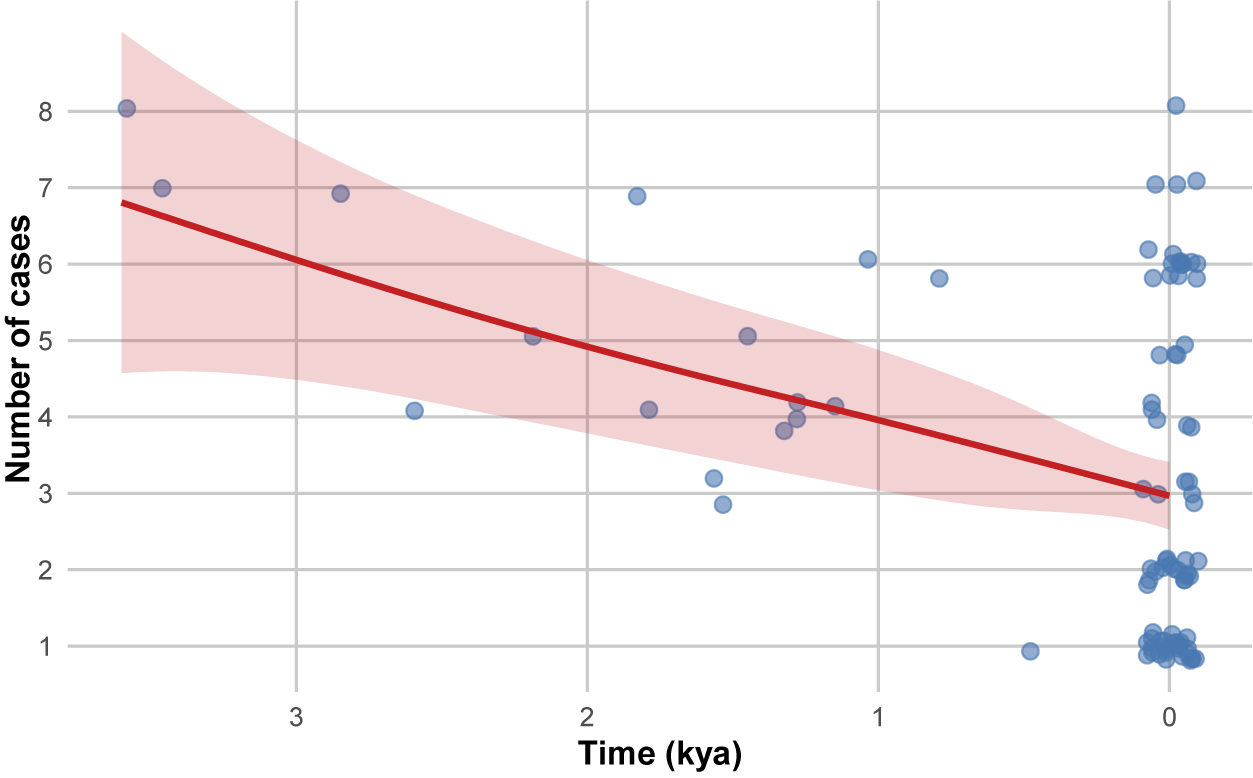
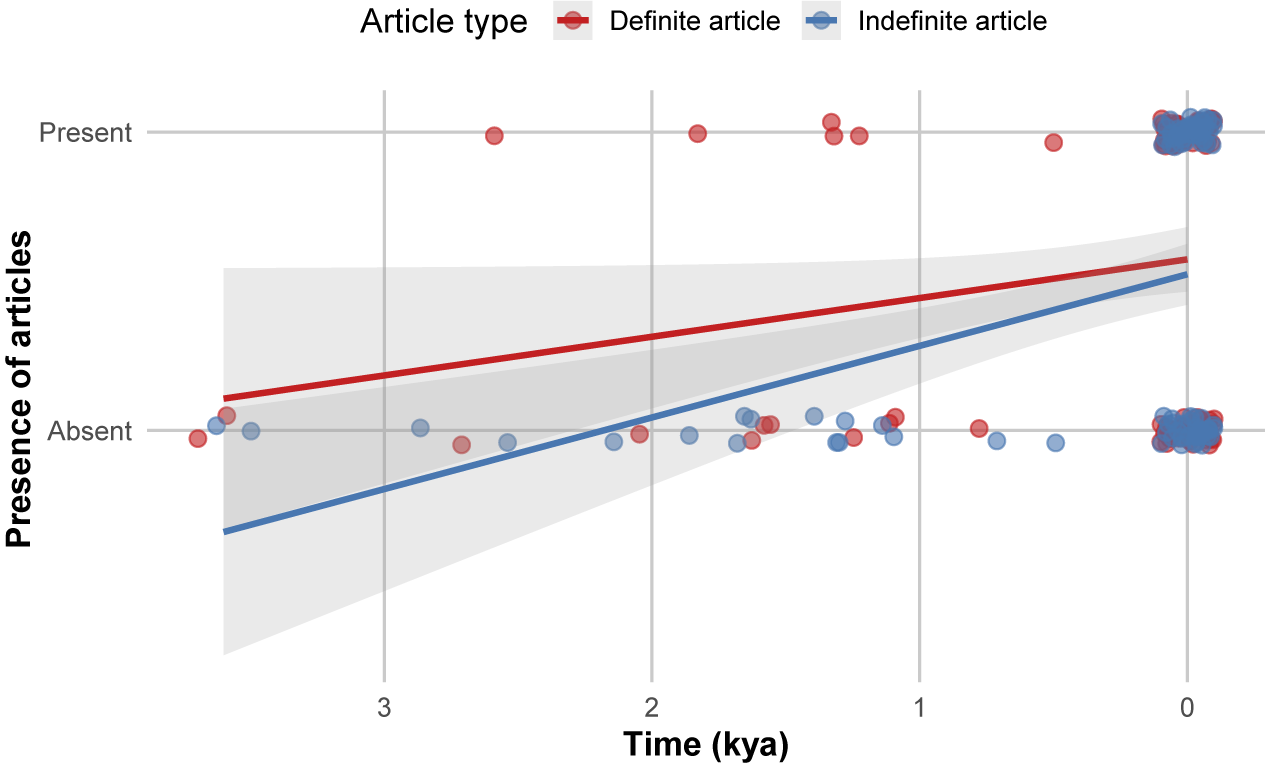
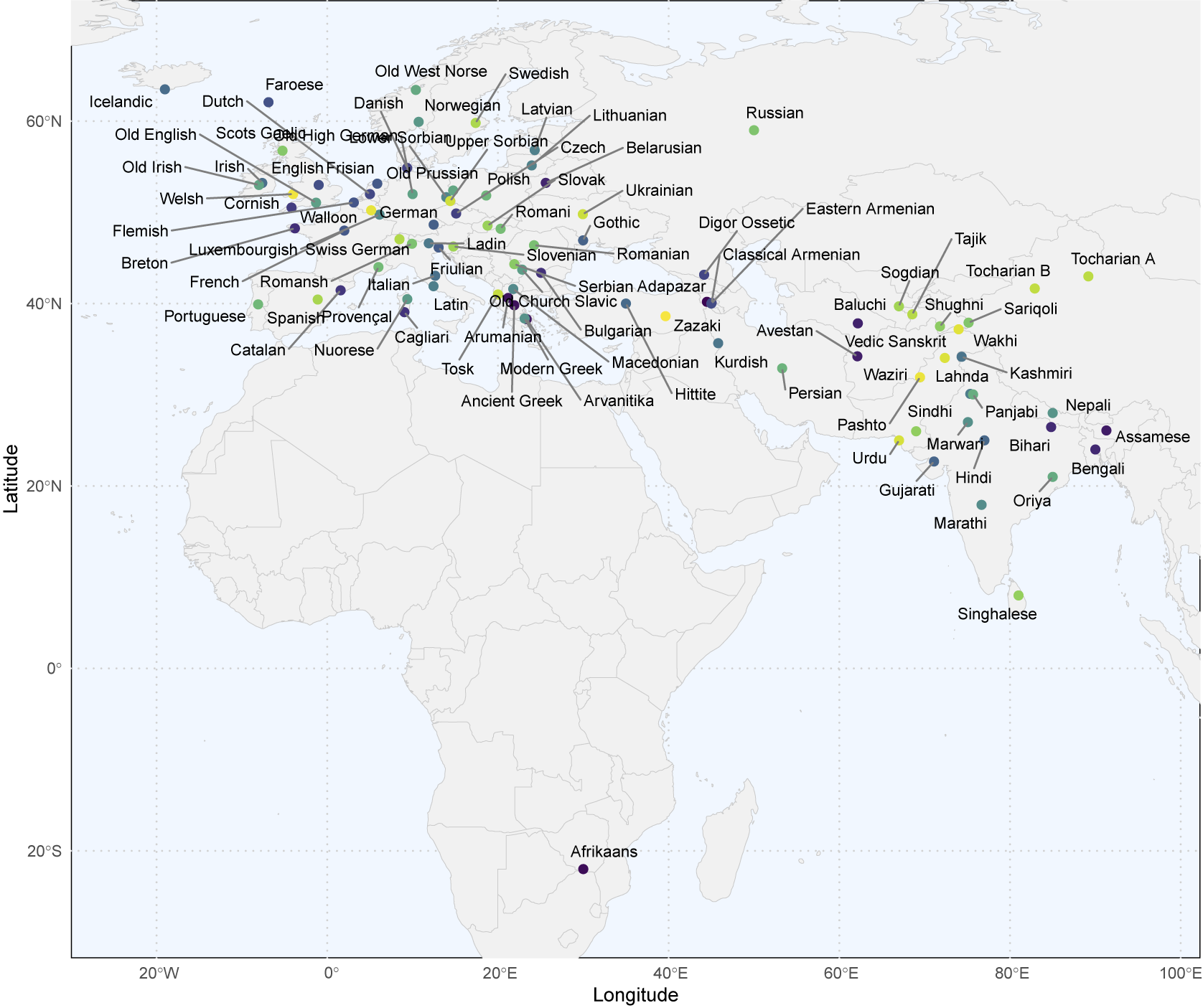
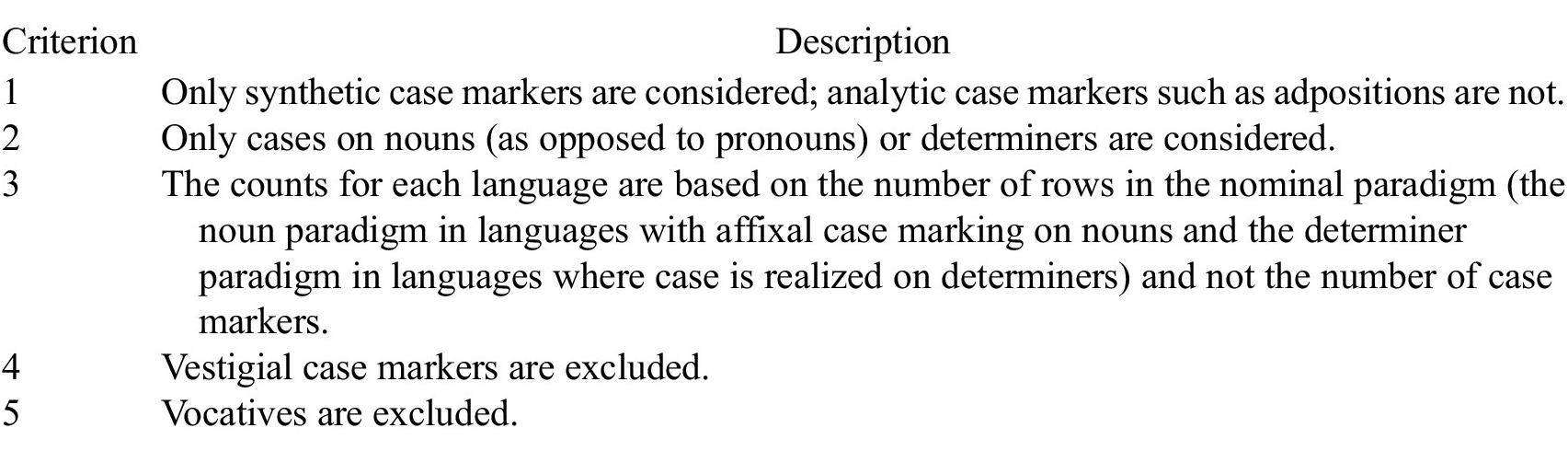
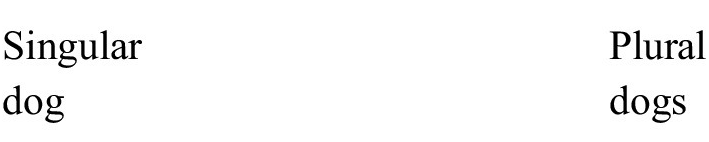
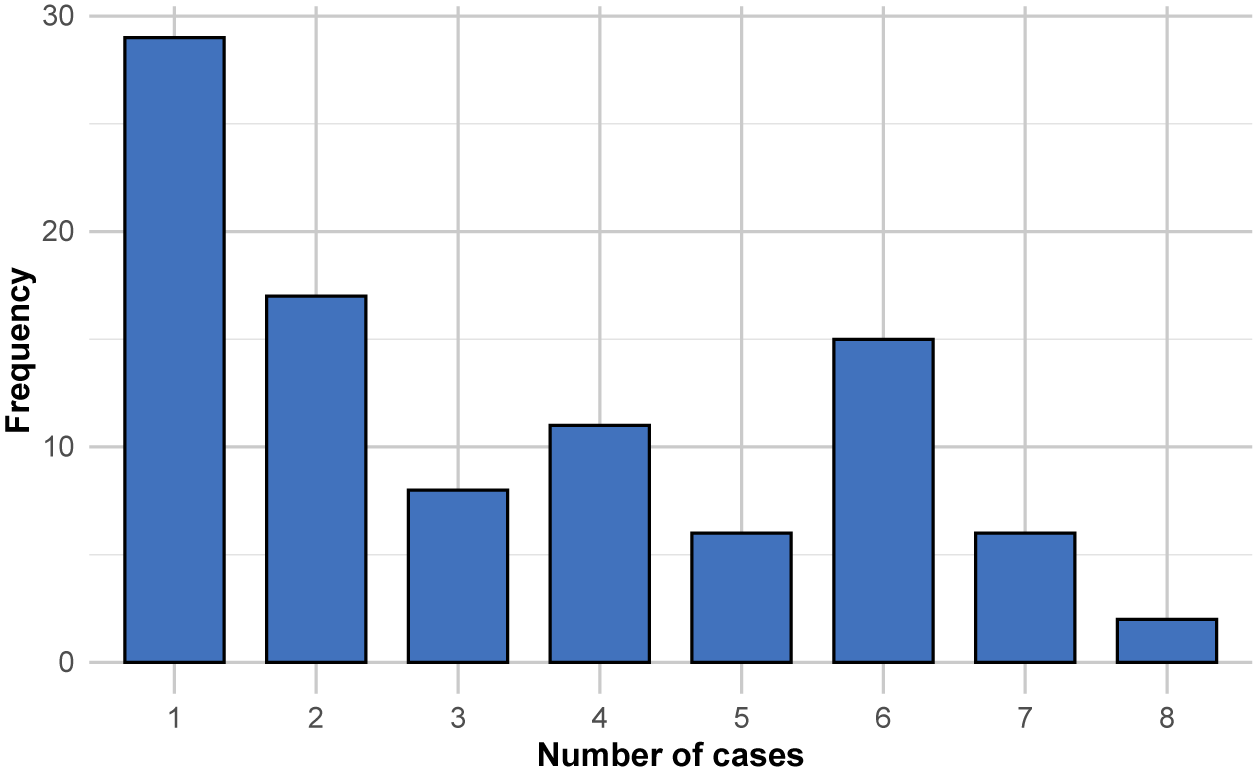
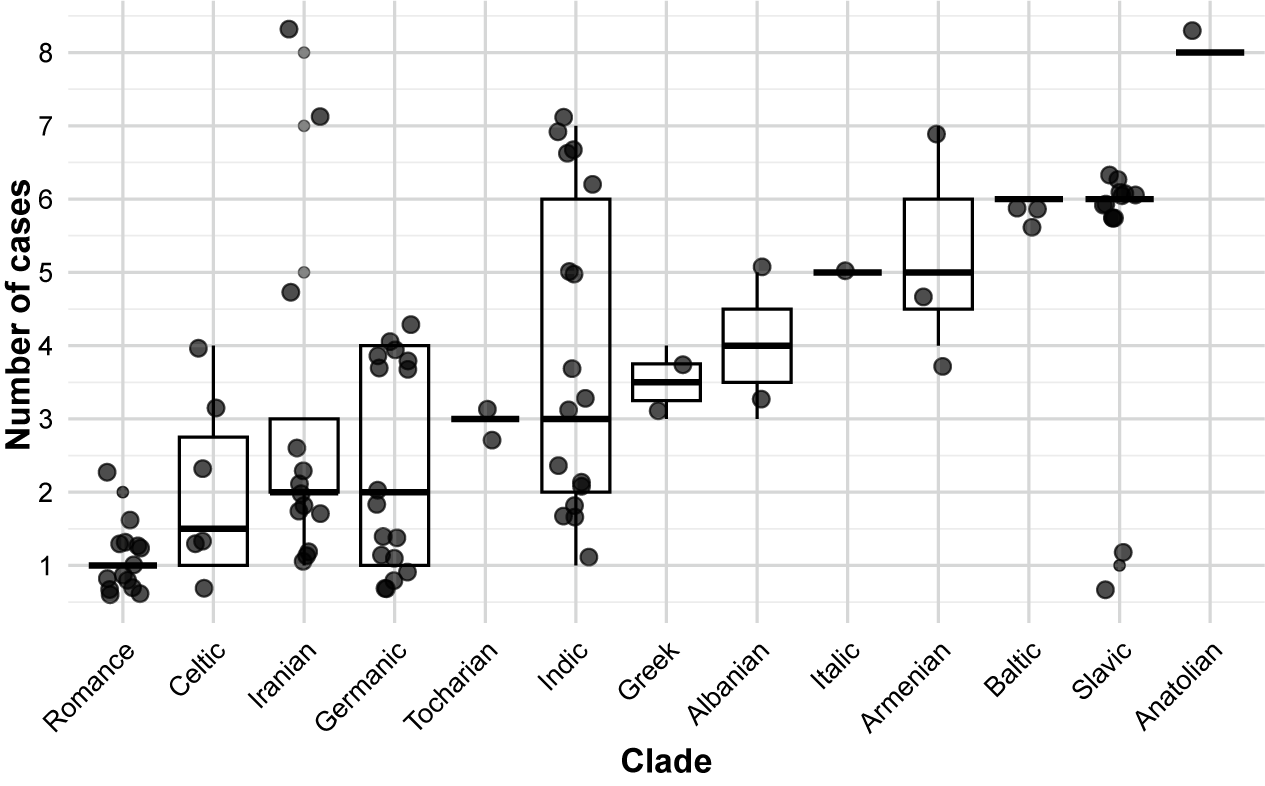
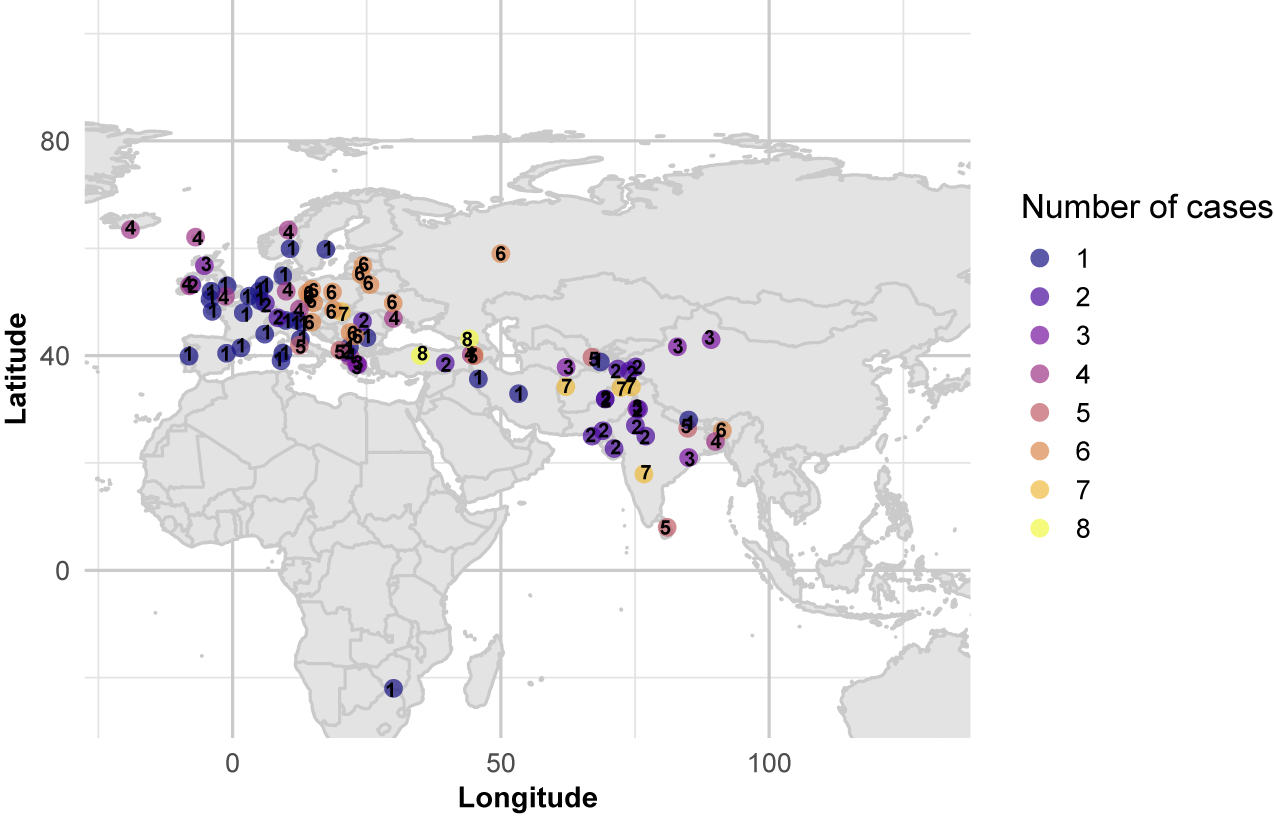
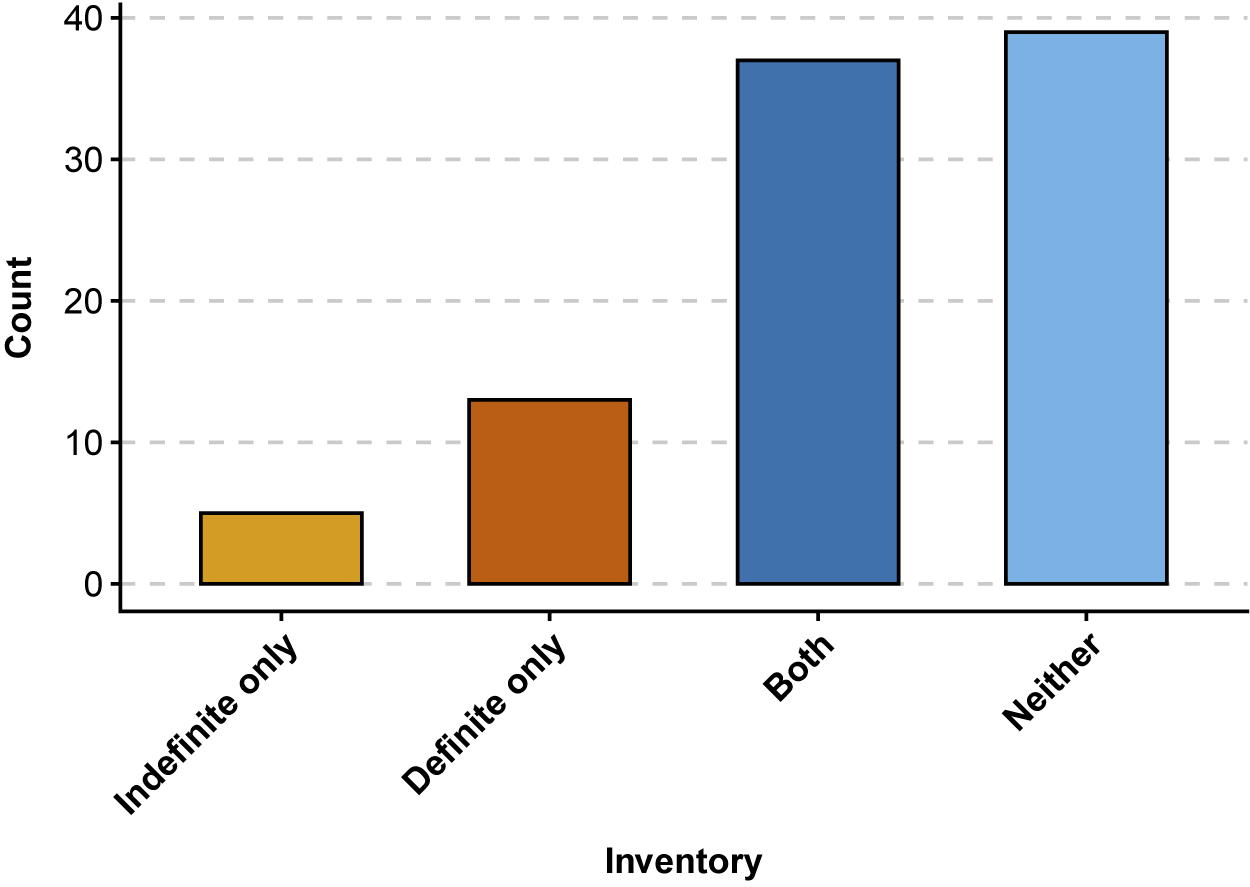
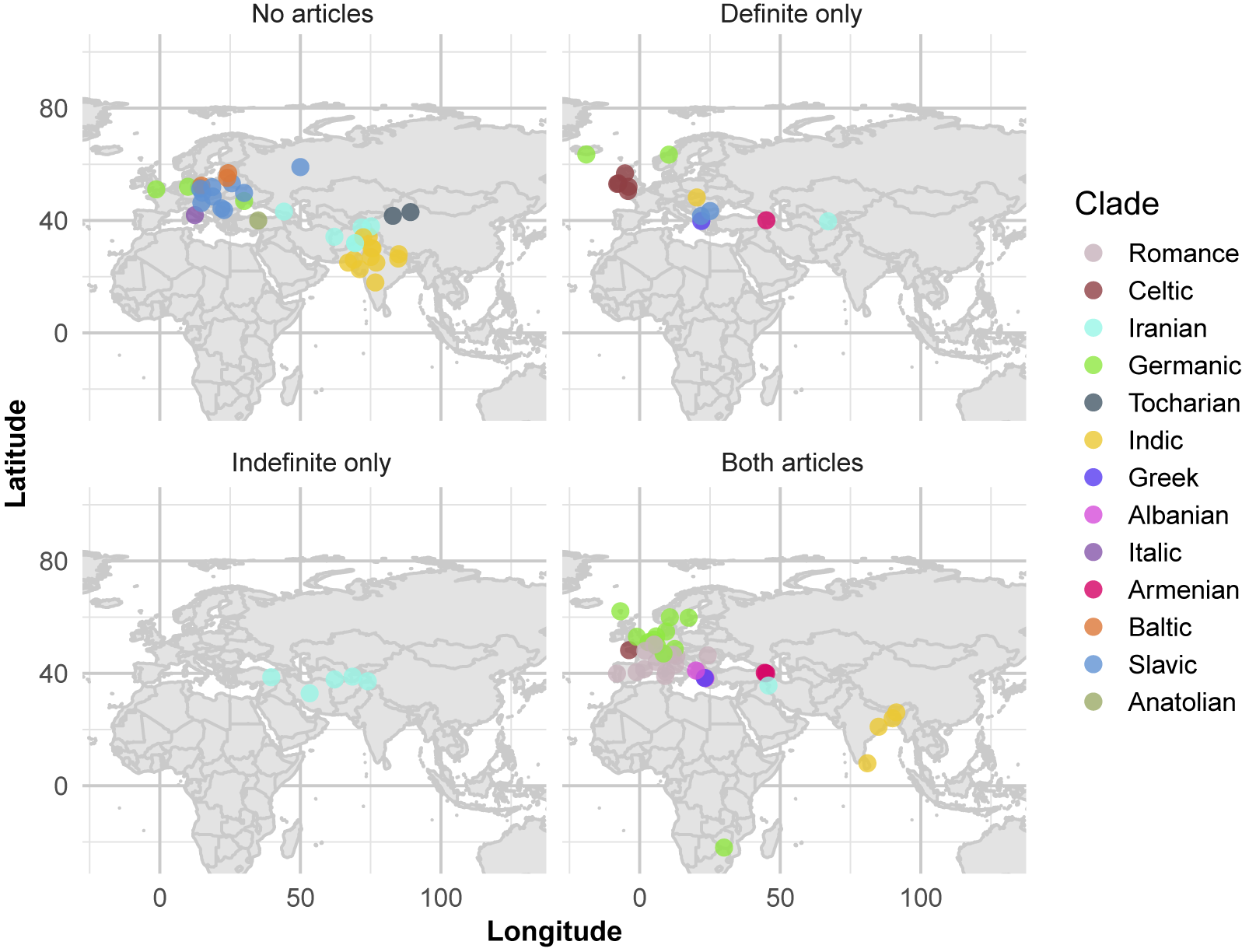
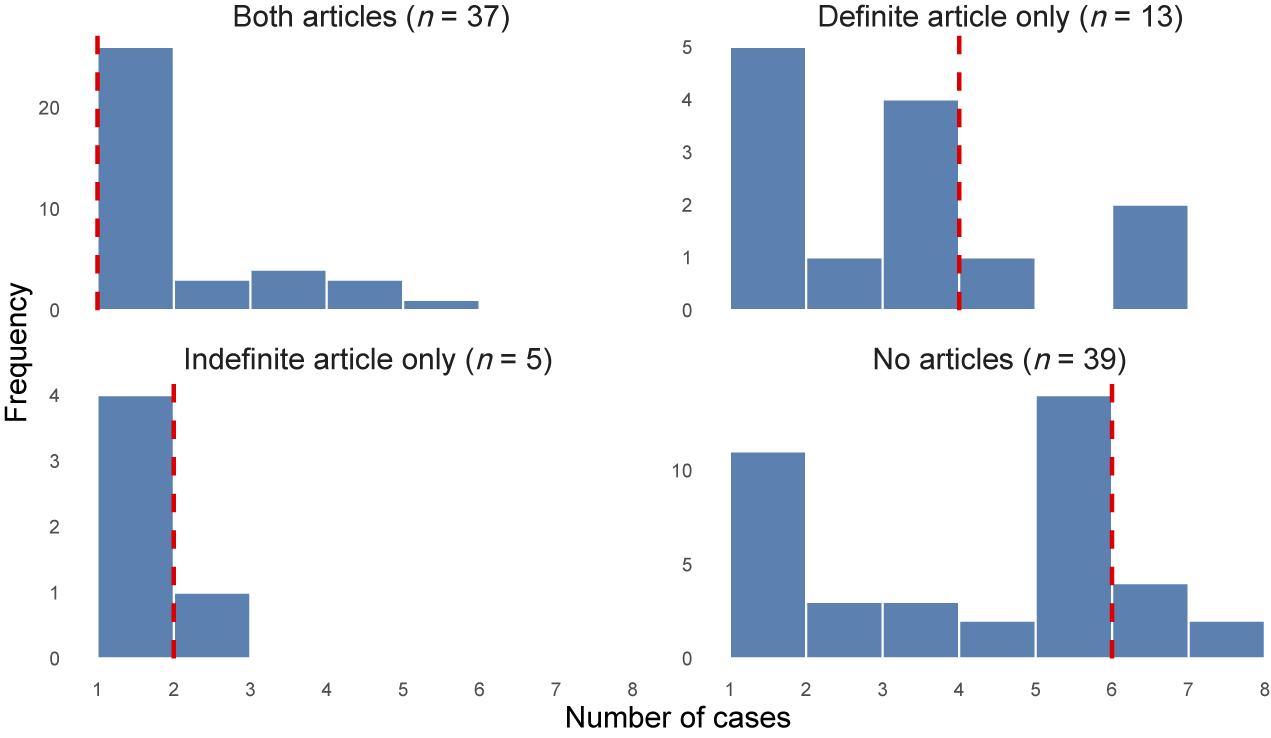
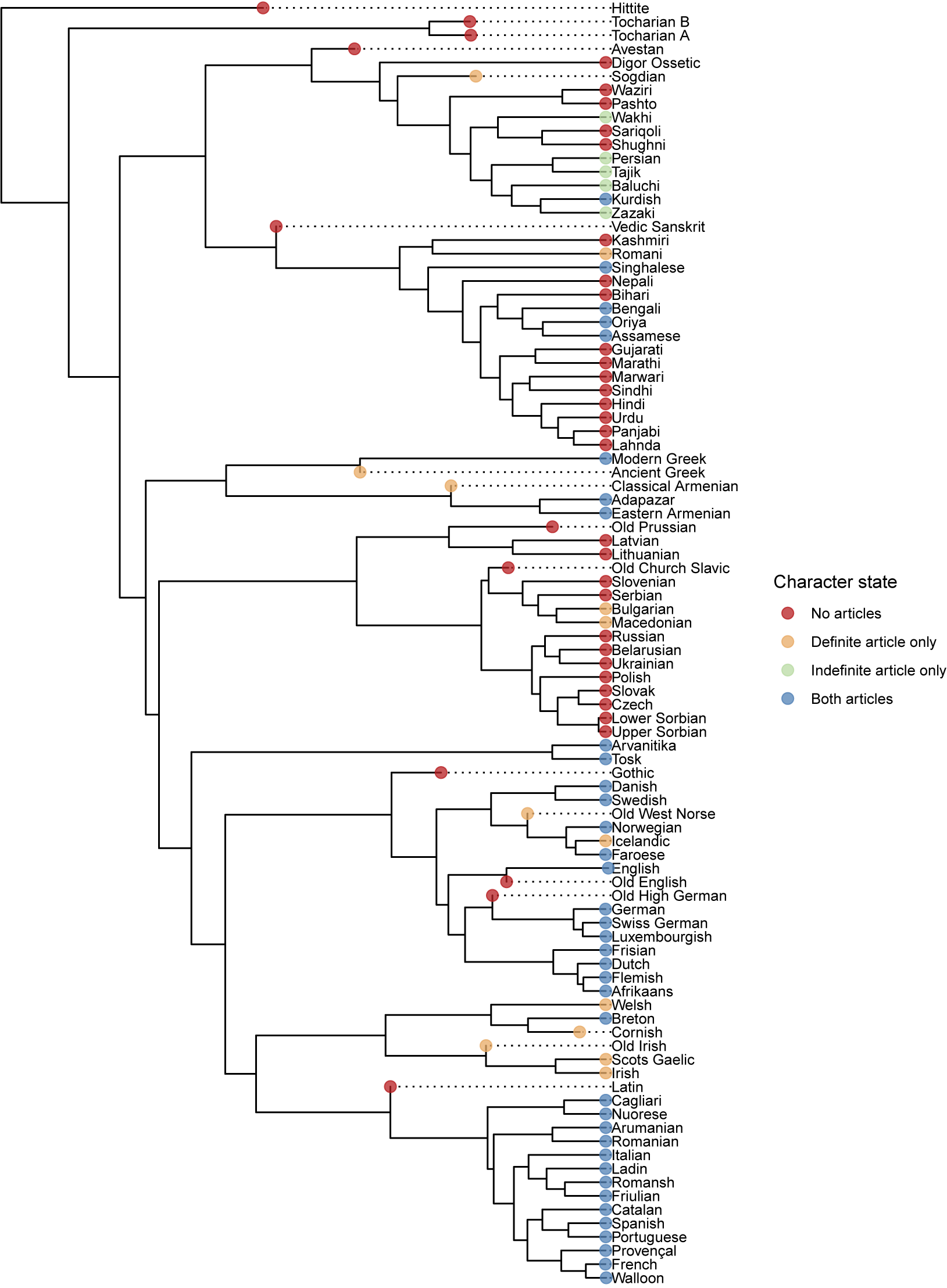

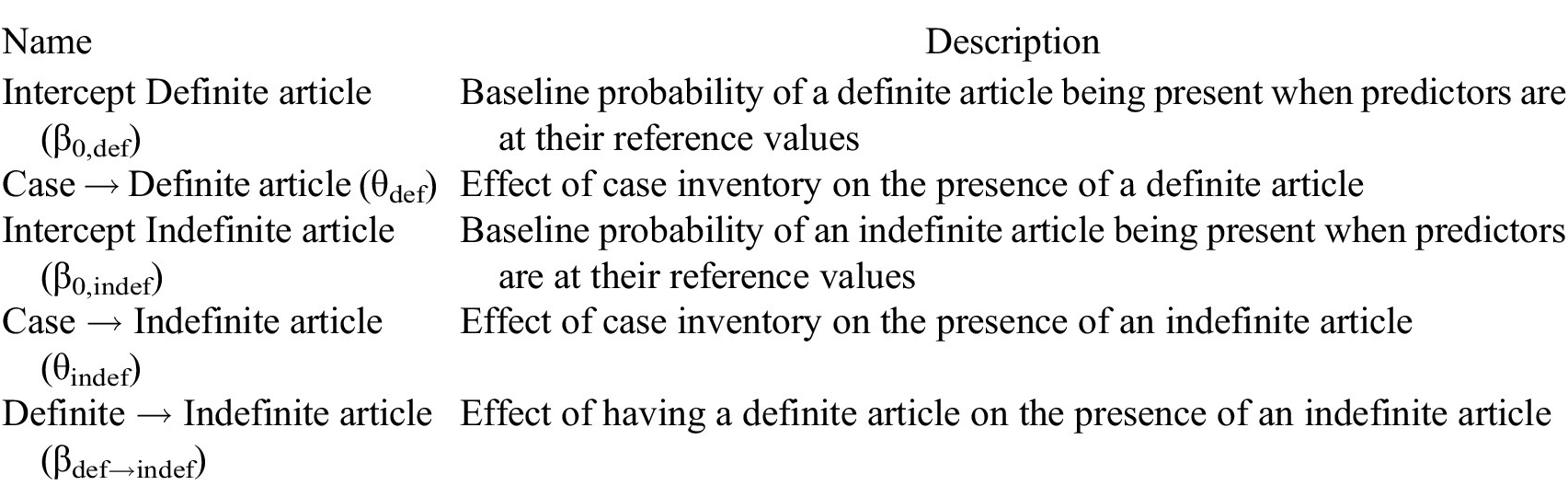
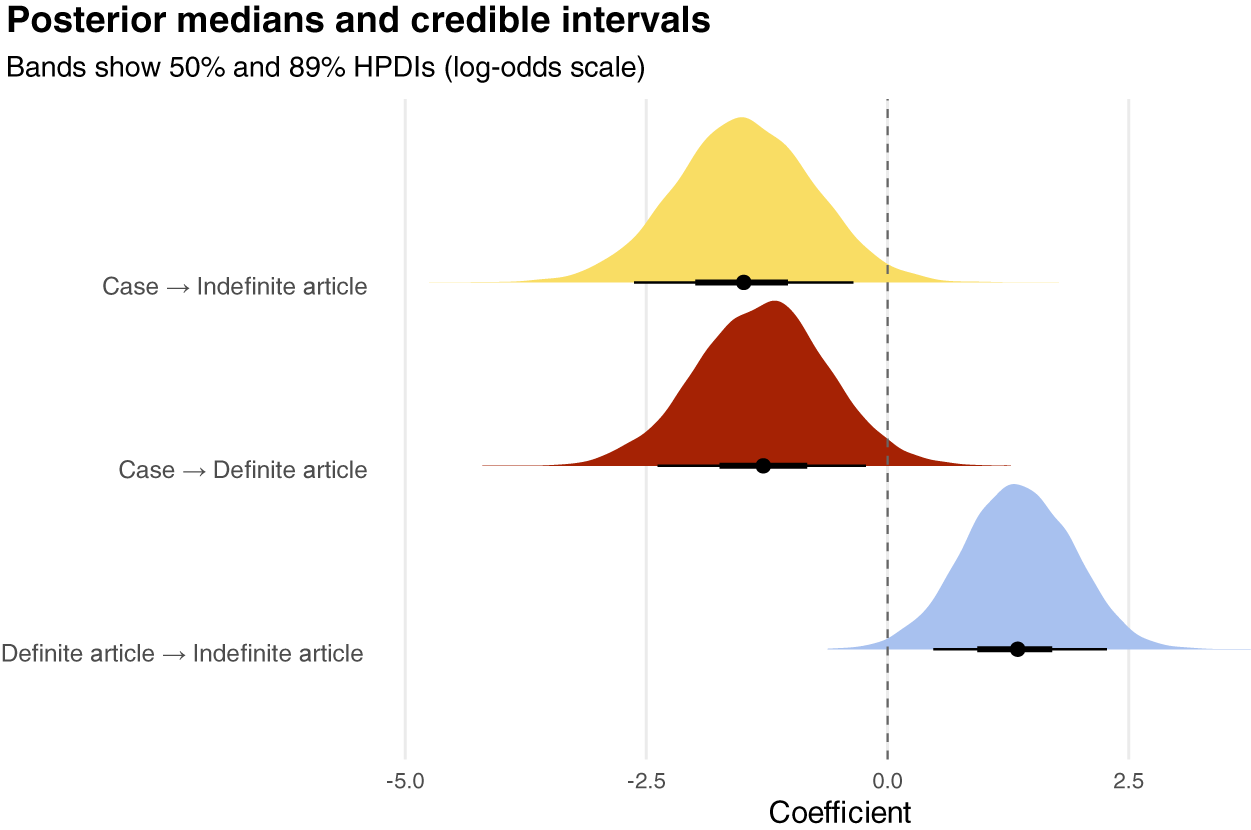
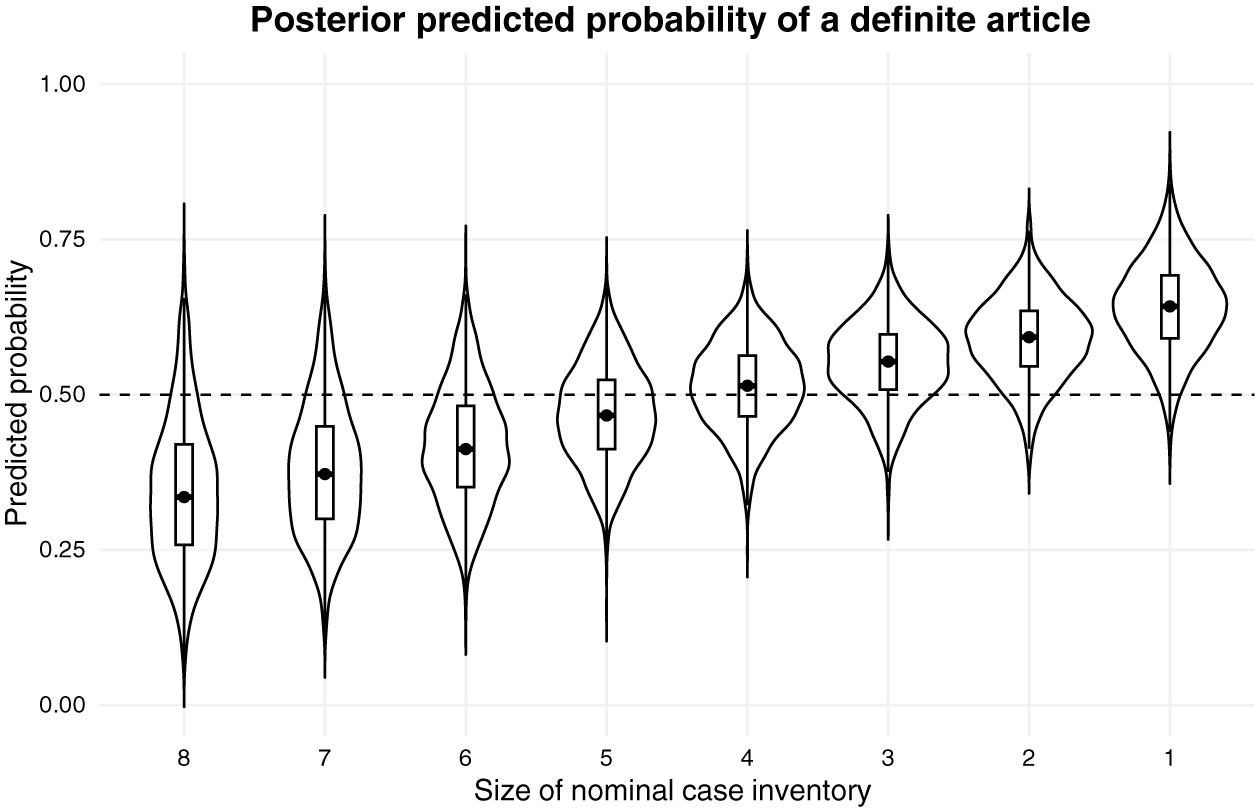
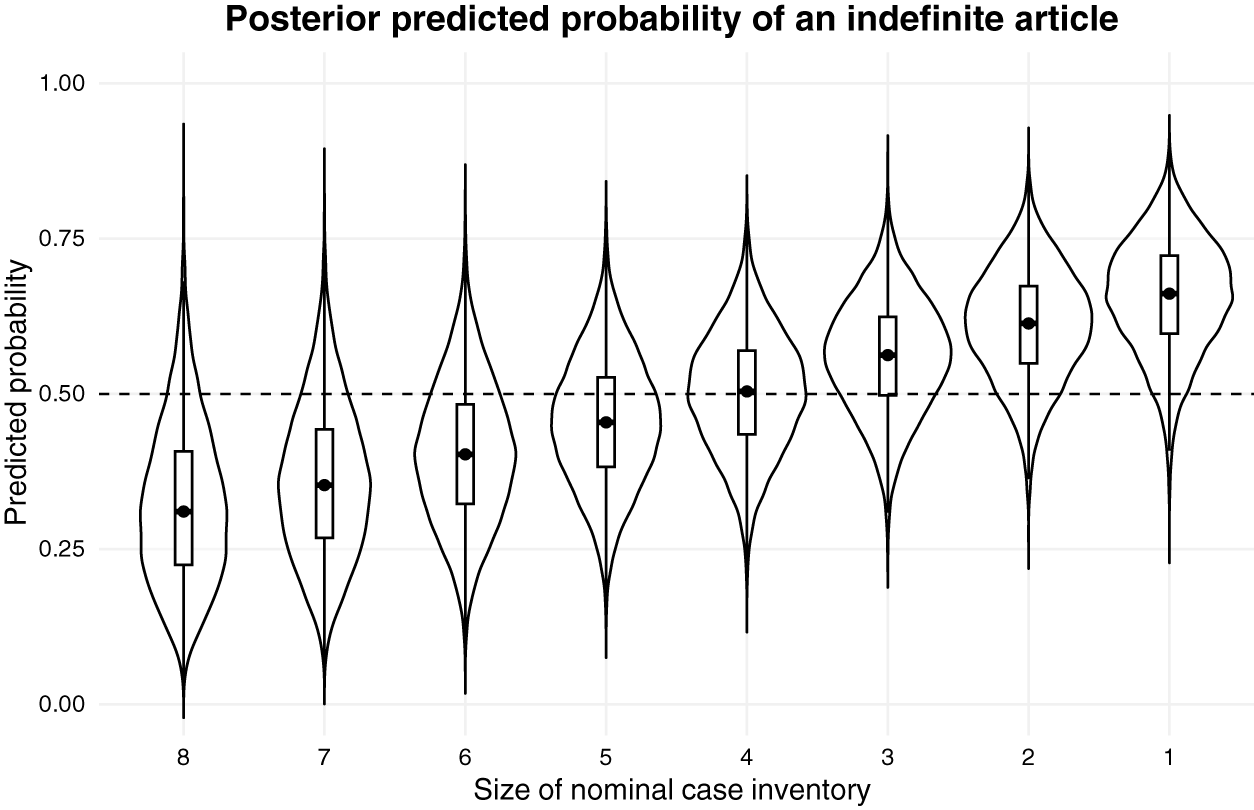


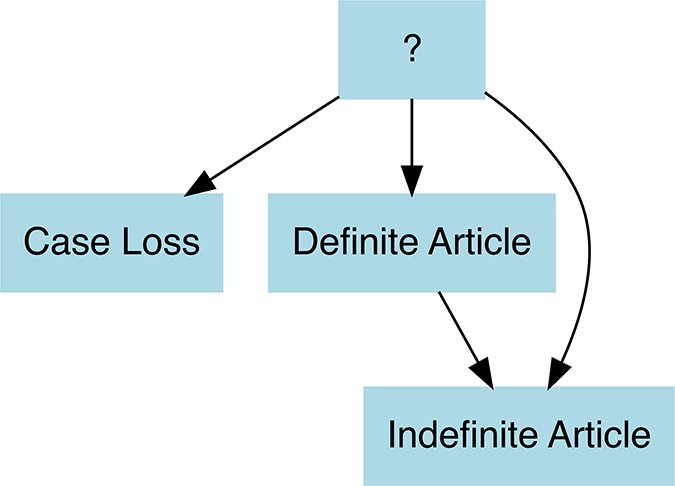


 Open access

