How does repeated or chronic childhood adversity shape biobehavioral development and, through it, mental and physical health? In the health sciences, there is a widely accepted answer to this question. Instantiated in models of “toxic stress” (Shonkoff et al., Reference Shonkoff, Garner, Siegel, Dobbins, Earls and McGuinn2012) and “allostatic load” (Lupien et al., Reference Lupien, Ouellet-Morin, Hupbach, Tu, Buss, Walker, Cicchetti and Cohen2006; McEwen & Stellar, Reference McEwen and Stellar1993), that answer posits a striking duality: biological responses to stress are usually adaptive in the short term, but protracted activation of stress responsive systems is maladaptive and toxic in the long term. Toxic stress causes disruptions of brain structure and function, resulting in dysregulation of physiological mediators—autonomic, neuroendocrine, metabolic, and immune—“that are the precursors of later impairments in learning and behavior as well as the roots of chronic, stress-related physical and mental illness” (Shonkoff et al., Reference Shonkoff, Garner, Siegel, Dobbins, Earls and McGuinn2012, p. e236). As eloquently stated by Juster et al. (Reference Juster, Bizik, Picard, Arsenault-Lapierre, Sindi and Trepanier2011), the wear and tear of toxic stress and altered stress hormone functioning “inexorably strains interconnected biomarkers that eventually collapse like domino pieces trailing toward stress-related endpoints” (p. 725).
From an evolutionary perspective, models of toxic stress and allostatic load immediately raise the question: Why would natural selection have favored organisms that, by default, respond to chronic adversity by becoming dysfunctional or dysregulated? There can be no doubt that high-stress environments that are dangerous and lack essential resources, compared with low-stress environments that are safe and well resourced, undermine fitness. Developmental adaptations to high-stress environments should enable individuals to “make the best of a bad situation” (i.e., to mitigate the inevitable fitness costs), even though “the best” may still constitute a high-risk strategy that jeopardizes the organism's health and survival.
Models of toxic stress and allostatic load trace undesirable outcomes to pathogenic processes rooted in stressful life experiences, such as repeated or chronic childhood adversities, together with biological vulnerabilities. The key limitation of such models is that they do not provide a theory of adaptive individual differences in physiological mediators and related patterns of social and physical development. In the absence of such a theory, models of toxic stress and allostatic load have operated on the assumption that there is an optimal level of biological responsivity to social and environmental challenges, and that overly heightened or dampened responsivity is dysfunctional and tends to undermine mental and physical health (e.g., Evans & English, Reference Evans and English2002; Juster et al., Reference Juster, Bizik, Picard, Arsenault-Lapierre, Sindi and Trepanier2011; Lupien et al., Reference Lupien, Ouellet-Morin, Hupbach, Tu, Buss, Walker, Cicchetti and Cohen2006).
Models of toxic stress and allostatic load form a widely held set of basic assumptions that have powerfully influenced how scientists conceptualize and study stress–health relations. In this article, we argue that acceptance of these assumptions, without placing them in a larger evolutionary–developmental framework, has impeded our understanding of the role of stress responsive systems in adaptively regulating development. The assumption that protracted stress exposures dysregulate biological response systems, and that only low or moderate levels of stress promote well-regulated responses, has led scientists to pathologize individual differences. This dominant position has effectively foreclosed consideration of the developmental functions of different patterns of stress responsivity.
In total, models of toxic stress and allostatic load focus on the long-term costs of childhood stress and adversity—the “wear and tear” on multiple organ systems induced by chronic stress—but do not address the benefits of calibrating autonomic, neuroendocrine, metabolic, and immune systems to match current and future environments. We argue that this overemphasis on costs misses something fundamental and thus weakens the conceptual power of the toxic stress/allostatic load perspective. The result has been an imbalanced approach to research that has yielded dramatically more empirical knowledge about dysfunction than adaptive function, making it difficult to gain a coherent “big picture” of the subject matter.
Aims and Organization of the Paper
The overarching goal of the current paper is help fill out this big picture by providing a more balanced evolutionary analysis of the costs and benefits of stress in regulating human development. We argue that stressful environments do not so much impair development as direct or regulate it toward strategies that are adaptive under stressful conditions, and that explicit modeling of biological fitness trade-offs, as instantiated in life history theory, is needed to more fully explain the complex relations between developmental exposures to stress, stress responsivity, behavioral strategies, and health.
The more targeted goal of this paper is to advance a specific evolutionary–developmental theory of stress–health relations—the adaptive calibration model (ACM; Del Giudice, Ellis, & Shirtcliff, Reference Del Giudice, Ellis and Shirtcliff2011)—as a revision and extension of the allostatic load model (ALM), and to juxtapose these two approaches. Grounded in the larger metatheoretical framework of life history theory, the ACM supplements the ALM and revises some of its key assumptions, thus laying the foundation for a broad theory of individual differences in stress responsivity. We first introduce life history theory and developmental programming, focusing on the key concepts of adaptation, maladaptation, and mismatch. Then we summarize the logic of the ACM and review select empirical findings. We explicitly compare the ACM and ALM, drawing out their different implications for understanding adaptive and maladaptive developmental responses to stress, review critical literature relating to the two theories, and discusses implications for intervention. We conclude that the ACM provides a valid revision and extension of the ALM as a general theory of the role of stress in regulating human development.
Adaptive and Maladaptive Plasticity
Theory and research in evolutionary biology has come to acknowledge that, in most species, single “best” strategies for survival and reproduction are unlikely to evolve. This is because the best strategy varies as a function of the physical, economic, and social parameters of one's environment (Crawford & Anderson, Reference Crawford and Anderson1989), and thus a strategy that promotes success in some environmental contexts may lead to failure in others. Selection pressures therefore tend to favor phenotypic plasticity, the capacity of a single genotype to support a range of phenotypes in response to ecological conditions that recurrently influenced fitness during a species' evolutionary history. When exposures to given ecological conditions lead to “durable biological change in the structure or function of a tissue, organ, or biological system” (Kuzawa & Quinn, Reference Kuzawa and Quinn2009, p. 132), it is commonly described as developmental plasticity. Adaptive developmental plasticity is a nonrandom process; it is the outcome of structured Organism × Environment interactions that were shaped by natural selection to increase the capacity and tendency of individuals to track their developmental environments and adjust their phenotypes accordingly. Developmental plasticity is ubiquitous throughout the animal world (see extensive reviews in DeWitt & Scheiner, Reference DeWitt and Scheiner2004; Pigliucci, Reference Pigliucci2001; West-Eberhard, Reference West-Eberhard2003).
Developmental plasticity is critically important for enabling organisms to adapt to stress, which has always been part of the human experience. Indeed, almost half of children in hunter–gatherer societies (the best model for human demographics before the agricultural revolution) die before reaching adulthood (Kaplan & Lancaster, Reference Kaplan, Lancaster, Wachter and Bulatao2003; Volk & Atkinson, Reference Volk and Atkinson2013). Thus, from an evolutionary–developmental perspective, stressful rearing conditions, even if those conditions engender sustained stress responses that must be maintained over time, should not so much impair physiological systems as direct or regulate them toward setpoints and reactivity patterns that are adaptive under stressful conditions (Ellis, Boyce, Belsky, Bakermans-Kranenburg, & van IJzendoorn, Reference Ellis, Boyce, Belsky, Bakermans-Kranenburg and van IJzendoorn2011; Ellis et al., Reference Ellis, Del Giudice, Dishion, Figueredo, Gray and Griskevicius2012; see also Gatzke-Kopp, Reference Gatzke-Kopp2011; Mead, Beauchaine, & Shannon, Reference Mead, Beauchaine and Shannon2010).
Because developmental plasticity involves durable change, it is inherently forward looking; that is, it involves predicting and preparing for future environments. Boyce and Ellis (Reference Boyce and Ellis2005) make this explicit in their definition of conditional adaptation: “evolved mechanisms that detect and respond to specific features of childhood environments, features that have proven reliable over evolutionary time in predicting the nature of the social and physical world into which children will mature, and entrain developmental pathways that reliably matched those features during a species' natural selective history” (p. 290). During fetal development and infancy, important features of the environment are communicated to the child via the placenta and lactation in nutrients, metabolites, hormones, growth factors, and immune factors that reflect the mother's current and past experiences (Bateson et al., Reference Bateson, Barker, Clutton-Brock, Debal, D'Udine and Foley2004; Kuzawa & Quinn, Reference Kuzawa and Quinn2009; Mousseau & Fox, Reference Mousseau and Fox1998). Beyond these molecular signals from the mother, relevant features of the environment are detected and encoded through the child's ongoing experiences.
Developmental plasticity necessitates developmental trade-offs. For example, Rana sylvatica tadpoles alter their size and shape based on the presence of dragonfly larvae in their rearing environment (Van Buskirk & Relyea, Reference Van Buskirk and Relyea1998). These alterations involve development of smaller and shorter bodies and deep tail fins. Although tadpoles that do not undergo these morphological changes are highly vulnerable to predation by dragonflies, those that do but end up inhabiting environments that are not shared with dragonflies have relatively poor developmental and survival outcomes. In short, the predator-induced phenotype is only conditionally adaptive. This process highlights that, in many cases, natural selection favors a primary phenotype that yields high payoffs under favorable circumstances and a secondary phenotype that “makes the best of a bad situation” (West-Eberhard, Reference West-Eberhard2003).
Adaptive plasticity in the development of life history strategies
A major framework in evolutionary biology for explaining patterns of developmental plasticity is life history theory (e.g., Belsky, Steinberg, & Draper, Reference Belsky, Steinberg and Draper1991; Chisholm, Reference Chisholm1999; K. Hill & Kaplan, Reference Hill and Kaplan1999; Stearns, Reference Stearns1992). Because of structural and resource limitations, organisms cannot maximize all components of fitness simultaneously and instead are selected to make trade-offs that prioritize resource expenditures, so that greater investment of time and/or resources in one domain occurs at the expense of investment in competing domains. For example, resources spent on an inflammatory host response to fight infection cannot be spent on reproductive effort. Thus, the benefits of an inflammatory host response are traded off against the costs of lower ovarian function in women and reduced musculoskeletal function in men (Clancy et al., Reference Clancy, Klein, Ziomkiewicz, Nenko, Jasienska and Bribiescas2013; Muehlenbein & Bribiescas, Reference Muehlenbein and Bribiescas2005). Trade-offs between reproductive effort and health go in the opposite direction as well, as early reproductive maturation is linked to more physical health problems in adulthood (Allsworth, Weitzen, & Boardman, Reference Allsworth, Weitzen and Boardman2005; Golub et al., Reference Golub, Collman, Foster, Kiimmel, Rajpert-De Meyts and Reiter2008; He et al., Reference He, Zhang, Hunter, Hankinson, Louis and Hediger2010; Lakshman et al., Reference Lakshman, Forouhi, Sharp, Luben, Bingham and Khaw2009). Each trade-off constitutes a decision node in allocation of resources, and each decision node influences the next decision node (opening up some options, foreclosing others) in an unending chain over the life course (Ellis, Figueredo, Brumbach, & Schlomer, Reference Ellis, Figueredo, Brumbach and Schlomer2009). This chain of resource-allocation decisions, expressed in the development of a coherent, integrated suite of physiological and behavioral traits, constitutes the individual's life history strategy.
At the broadest level of analysis, these traits covary along a dimension of “slow” versus “fast” life history. Variation along the slow–fast continuum is observed both between related species and between individuals of the same species (Réale et al., Reference Réale, Garant, Humphries, Bergeron, Careau and Montiglio2010; Sæther, Reference Sæther1988). Some people adopt slower strategies characterized by later reproductive development and behavior, a preference toward relatively stable pair bonds, an orientation toward longer term investments and outcomes, and allocation of resources toward enhancing the growth and long-term survival of both oneself and offspring; whereas, others display faster strategies characterized by the opposite pattern (see Belsky et al., Reference Belsky, Steinberg and Draper1991; Ellis et al., Reference Ellis, Figueredo, Brumbach and Schlomer2009; Figueredo et al., Reference Figueredo, Vásquez, Brumbach, Schneider, Sefcek and Tal2006; Kaplan & Gangestad, Reference Kaplan, Gangestad and Buss2005). Fast life history strategies are comparatively high risk, focusing on mating opportunities (including more risky and aggressive behavior), reproducing at younger ages, and producing a greater number of offspring with more variable outcomes.
As first articulated in detail by Belsky et al. (Reference Belsky, Steinberg and Draper1991), developmental calibration of slow versus fast life history strategies is a prototypical case of developmental plasticity (in interaction with genetic variation). Key dimensions of the environment that regulate the development of life history strategies include energy availability, extrinsic morbidity–mortality, and predictability of environmental change (Ellis et al., Reference Ellis, Figueredo, Brumbach and Schlomer2009). Extrinsic morbidity–mortality refers to external sources of disability and death that are relatively insensitive to the adaptive decisions of the organism. When environmental factors cause high levels of extrinsic morbidity–mortality, then even prime-age adults suffer relatively high levels of disability and death, and the probability of a child, or his or her parents and grandparents, surviving able bodied until the child reaches adulthood is greatly reduced. Extrinsic morbidity–mortality is signaled by such proximal cues as exposures to violence, harsh family environments, and premature disability and death of people around you. Environmental unpredictability involves stochastic changes in ecological and familial conditions (e.g., residential changes, parental changes, resource fluctuations).
Energetic resources (caloric intake, energy expenditures, and related health conditions) set the baseline for many developmental processes. Energy scarcity slows growth and delays sexual maturation and reproduction, resulting in a “slow” life history strategy (e.g., Ellison, Reference Ellison2001). However, when bioenergetic resources are adequate to support growth and development, then proximal cues to extrinsic morbidity–mortality and unpredictability generally promote faster life history strategies (see Belsky, Schlomer, & Ellis, Reference Belsky, Schlomer and Ellis2012; Brumbach, Figueredo, & Ellis, Reference Brumbach, Figueredo and Ellis2009; Placek & Quinlan, Reference Placek and Quinlan2012; Simpson et al., Reference Simpson, Griskevicius, Kuo, Sung and Collins2012, for supporting longitudinal data). Trade-offs incurred by the fast life history strategy include reduced health, vitality, and longevity of self and offspring (see below, Long-term adapations to stress). As discussed below, the ACM posits that stress responsive systems play a central role in regulating life history trade-offs in relation to environmental conditions.
From adaptation to maladaptation
By definition, maladaptation is a failure of adaptation; thus, the former can only be defined in relation to the latter. By constantly weeding out unsuccessful variation, natural selection produces incremental modifications in existing phenotypes, leading to an accumulation of characteristics that are organized to enhance survival and reproductive success. These characteristics are termed adaptations. Through natural selection, adaptations acquire biological functions and the appearance of purposeful design: they are for something. The immune system functions to protect organisms from pathogens, the heart functions as a blood pump, and the cryptic coloring of many insects has the function of preventing their detection by predators. The core idea of evolutionary psychology is that many psychological characteristics are adaptations, just as many physical characteristics are, and that the principles of evolutionary biology that are used to explain our bodies are equally applicable to our minds (for an extended discussion, see Durrant & Ellis, Reference Durrant, Ellis, Nelson and Mizumori2013).
Adaptations can fail for many reasons, resulting in maladaptation (Crespi, Reference Crespi2000; Nesse, Reference Nesse2005). All biological mechanisms are vulnerable to malfunction at some rate. Developmental pathways typically evolve canalization properties (e.g., biochemical buffering mechanisms) that confer robustness against accidents and perturbations. However, the accumulation of such events over time can affect development, resulting in random deviations from the target phenotype (developmental instability; see Møller & Swaddle, Reference Møller and Swaddle1997). More dramatically, an adaptation may cease to perform its intended functions because of harmful genetic mutations, accidents, environmental insults beyond its regulatory capacity, or manipulation by other organisms (e.g., pathogens).
Even when biological mechanisms perform normally, an organism may develop a phenotype that is poorly suited for its environment and, consequently, experience a diminution in fitness (often accompanied by other deleterious outcomes). Thus, maladaptation is closely connected to the concept of mismatch (for an extended discussion, see Frankenhuis & Del Giudice, Reference Frankenhuis and Del Giudice2012; Nederhof & Schmidt, Reference Nederhof and Schmidt2012). Mismatch is a state of disequilibrium whereby a trait that evolved in or conditionally adapted to one environment becomes maladaptive in another. Organisms are potentially vulnerable to mismatch because their phenotypes are necessarily adapted to ancestral environments; that is, our brains and bodies are designed to execute adaptations—regulate developmental trajectories to match local conditions, calibrate social strategies, perform a wide and structured variety of tasks—that promoted fitness in our environments of evolutionary adaptedness (Tooby & Cosmides, Reference Tooby, Cosmides, Barkow, Tooby and Cosmides1992). In addition, our phenotypes are conditionally adapted to childhood environments, which may or may not be continuous with adult environments.
The possibility of mismatch raises a subtle but crucial point regarding the meaning of adaptive. Broadly speaking, psychological and physiological processes can be described as adaptive if they result from the unimpaired functioning of adaptations. Thus, adaptive in the broad sense is a shorthand to describe the functioning of naturally selected processes and mechanisms, regardless of whether they are currently promoting reproductive success (i.e., adaptive in the narrow sense). For example, processes of conditional adaptation generate alternative patterns of physiology and behavior that once, even if no longer, promoted fitness under varying environmental conditions. In this sense, systematic shifts toward a faster life history strategy under conditions of high extrinsic morbidity–mortality are adaptive responses, regardless of their current impact on fitness. Likewise, pursuit of mating relationships with fertile partners is guided by adaptive psychological processes, regardless of whether contraceptive technology prevents reproduction in present-day societies.
By contrast, from a public health perspective, different patterns of behavior are “adaptive versus maladaptive,” depending on the extent to which they promote versus threaten people's health, safety, and psychological well-being. For the remainder of this paper, we use adaptive only in the evolutionary sense of the term and use desirable to connote adaptiveness from a public health perspective. A crucial point is that natural selection favors biological adaptations when their fitness benefits outweigh the costs, not when they are cost free; thus, many adaptive responses have undesirable effects.
Mismatch
There are a number of causes of mismatch. An individual may experience novel environments that are outside the range recurrently encountered over evolutionary history (i.e., evolutionary mismatch). In this case, all developmental bets are off (i.e., relevant adaptations may no longer function normally) and the person may experience maladaptive or “abnormal” outcomes. For example, Romanian or Ukrainian orphanages (Dobrova-Krol, van IJzendoorn, Bakermans-Kranenburg, & Juffer, Reference Dobrova-Krol, van IJzendoorn, Bakermans-Kranenburg and Juffer2010; Nelson et al., Reference Nelson, Zeanah, Fox, Marshall, Smyke and Guthrie2007) constitute genuinely substandard, novel environments that are beyond the normative range of conditions encountered over human evolution. Children's brains and bodies simply could not have evolved to respond adaptively to collective rearing by paid, custodial, nonkin caregivers with minimal human contact (see Hrdy, Reference Hrdy1999). More broadly, the concept of evolutionary mismatch applies more broadly to many novel aspects of modern environments. A much discussed example is the “obesogenic niche.” Modern Western environments, unlike human ancestral environments, include easy availability of high-calorie foods and relatively little requirement for physical exercise, with the result that millions of people worldwide suffer the physical and psychological consequences of obesity (Eaton & Eaton, Reference Eaton and Eaton2003; J. O. Hill, Reference Hill2006; Konner & Eaton, Reference Konner and Eaton2010). Humans are well adapted for putting on weight but not for taking it off, because the latter problem rarely occurred in ancestral environments. Another prevalent mismatch between present and past environments could result from mass media saturation. For example, the media exposes girls and women to a relentless stream of images of unrealistically attractive “competitors.” This artificial, evolutionarily novel social stimulus may hyperactivate evolved mechanisms that regulate female competition for attractiveness and status, contributing to the rising incidence of eating disorders (e.g., Abed, Reference Abed1998).
Mismatch also occurs when environmental cues have limited validity, and thus, adaptive responses fail to correctly predict future environmental conditions (i.e., developmental mismatch). For instance, conditional adaptations to violent contexts, such as neurobiological changes supporting heightened vigilance and aggression (Mead et al., Reference Mead, Beauchaine and Shannon2010; Pollak, Reference Pollak2008), may prove disadvantageous in alternative contexts. This kind of developmental mismatch can occur when environments change for better or for worse. For example, human infants show reduced psychomotor and mental development during the first year of life when they have been exposed to discordant, as opposed to concordant, levels of prenatal and postnatal maternal depression, even though the concordant condition involves greater cumulative exposure to stress (Sandman, Davis, & Glynn, Reference Sandman, Davis and Glynn2012).
Developmental mismatch is a potential cost of developmental programming, a risk incurred by an organism when it employs current information (e.g., early life stress) to shape future developmental trajectories. Selection can favor developmental programming, even if the potential costs are high, as long as the average benefits outweighed the average costs over evolutionary history. In total, processes of conditional adaptation and phenotype–environment matching are fallible, and a number of circumstances can lead to maladaptation.
ACM
The ACM is a theory of developmental programing focusing on calibration of the stress response system (SRS) and associated life history strategies to local environmental conditions. The SRS is the fulcrum on which the theory pivots, as it plays a central role in orchestrating the physical and psychosocial development of both humans and nonhuman species (Ellis, Jackson, & Boyce, Reference Ellis, Jackson and Boyce2006; Korte et al., Reference Korte, Koolhaas, Wingfield and McEwen2005).
One of the most remarkable features of the SRS is the wide range of individual variation in its physiological parameters. Some individuals respond quickly and strongly even to minor events, while others show flat response profiles in most situations. Further, the balance of activation among the main SRS subsystems (sympathetic nervous system [SNS], parasympathetic nervous system [PNS], and hypothalamus–pituitary–adrenal [HPA] axis) can vary considerably from one individual to the next. It is difficult to overstate the real-world relevance of such individual variability. On the one hand, decades of research have shown that physiological patterns of stress responsivity constitute a primary integrative pathway by which psychosocial environmental factors are transmuted into the behavioral, autonomic, and immunologic manifestations of human pathology (Lupien et al., Reference Lupien, Ouellet-Morin, Hupbach, Tu, Buss, Walker, Cicchetti and Cohen2006; McEwen & Stellar, Reference McEwen and Stellar1993), as per models of allostatic load. On the other hand, patterns of stress responsivity regulate variation in a wide range of adaptive processes and behaviors including, but not limited to, growth and metabolism, reproductive status and fertility, aggression and risk taking, pair bonding and caregiving, and learning and memory (see below, The role of the SRS in regulating development of life history strategies), as per the ACM. Clearly, understanding the causes of such individual differences and their development over the life course has important implications for medicine, psychology, and psychiatry.
Unfortunately, the present state of research in this intrinsically cross-disciplinary field is characterized by fragmentation, a lack of replicable empirical phenomena, and the absence of an integrative theoretical framework. Hundreds of papers on SRS functioning are published every year, but it is still extremely difficult to synthesize the diverse, and often contradictory, empirical findings and gain a coherent big picture of the subject matter (for an incisive discussion of this issue, see Rosmalen & Oldehinkel, Reference Rosmalen and Oldehinkel2011). Although the stress literature has contributed a wealth of insight into the mechanics of how stress responses are elicited, the same research seldom asks why or for what purpose.
In our view, the main “missing links” in the scientific literature are (a) a coherent, systematic account of the biological functions of the SRS; (b) an evolutionary–developmental theory of individual differences capable of explaining adaptation, and maladaptation, of stress physiology and behavior to local environmental conditions; and (c) a functionally valid taxonomy of stress response profiles, including neurobiological correlates (e.g., serotonergic function), behavioral correlates (e.g., aggression, self-regulation), and developmental trajectories. Filling in these missing links would enable scientists to move beyond the primarily inductive theory building that now dominates the field and dramatically increase their ability to advance targeted hypotheses about individual differences and their development.
Toward this end, we recently advanced the ACM, an evolutionary–developmental theory of individual differences in stress responsivity. The ACM has its main theoretical foundations in life history theory (see above, Adaptive plasticity in the development of life history strategies) and the theory of adaptive developmental plasticity (West-Eberhard, Reference West-Eberhard2003); it integrates and extends previous evolutionary models of stress (e.g., Boyce & Ellis, Reference Boyce and Ellis2005; Flinn, Reference Flinn2006; Korte, Koolhaas, Wingfield, & McEwen, Reference Korte, Koolhaas, Wingfield and McEwen2005; Porges, Reference Porges2001, Reference Porges2007; Worthman, Reference Worthman2009) into a coherent theoretical framework. The integrative power of the ACM makes it possible to connect and explain a large number of disparate findings about the SRS and its role in human development, health, and disease, and it provides considerable leverage in generating novel empirical hypotheses (see Del Giudice et al., Reference Del Giudice, Ellis and Shirtcliff2011).
The central tenet of the ACM is that the SRS operates as a mechanism of conditional adaptation, with a key role in regulating the development of individual life history strategies (Figure 1). To facilitate the present comparison between the ACM and ALM, the current paper focuses on this central tenet. In addition, the ACM builds on the theoretical core shown in Figure 1 to derive a functional taxonomy of stress response profiles. This taxonomy includes four main responsivity patterns encompassing different neurobiological indicators, behavioral outcomes, and developmental trajectories. Because the validity and completeness of the ACM taxonomy is orthogonal to the present critique of the ALM, we do not present this taxonomy here and instead refer readers to Del Giudice et al. (Reference Del Giudice, Ellis and Shirtcliff2011) and Ellis, Del Giudice, and Shirtcliff (Reference Ellis, Del Giudice, Shirtcliff, Beauchaine and Hinshaw2013).
(Color online) The core theoretical structure of the adaptive calibration model. SRS, stress response system; LH, life history; OT, oxytocin; 5-HT, serotonin; DA, dopamine. From “The Adaptive Calibration Model of Stress Responsivity,” by M. Del Giudice, B. J. Ellis, and E. A. Shirtcliff, Reference Del Giudice, Ellis and Shirtcliff2011, Neuroscience & Biobehavioral Reviews, 35, pp. 1562–1592.

In the ACM, the activation of autonomic, neuroendocrine, metabolic, and immune system responses during childhood provides information about threats and opportunities in the environment, their type, and their severity. Over time, this information becomes embedded in the parameters (recurring set points and reactivity patterns) of these systems. (Such biological embedding is supported by extensive research linking childhood stress to enduring individual differences in autonomic, neuroendocrine, metabolic, and immune system profiles; reviewed in Bilbo & Schwarz, Reference Bilbo and Schwarz2012; Miller, Chen, & Parker, Reference Miller, Chen and Parker2011.) These parameters provide the developing person with statistical summaries of key dimensions of the environment. For example, sustained activation of the HPA axis is generated by exposures to danger, unpredictable or uncontrollable contexts, and social evaluation, as well as energetic stress (see Dickerson & Kemeny, Reference Dickerson and Kemeny2004; Dickerson, Mycek, & Zaldivar, Reference Dickerson, Mycek and Zaldivar2008; Gunnar, Talge, & Herrera, Reference Gunnar, Talge and Herrera2009); thus, the HPA axis tracks the key environmental variables involved in regulation of alternative life history strategies. Analogous arguments have been made regarding mesolimbic dopamine (Gatzke-Kopp, Reference Gatzke-Kopp2011). In turn, individual differences in SRS functioning regulate the coordinated development of a broad cluster of life history relevant traits (Figure 1; see below, The role of the SRS in regulating development of life history strategies).
Although the ACM focuses on developmental plasticity, all developmental processes are the product of Organism × Environment interactions. These interactions are instantiated in phenotypic reaction norms (see Schlichting & Pigliucci, Reference Schlichting and Pigliucci1998), which prescribe the range of developmental outcomes that different individuals can achieve under different environmental conditions. Because some individuals have wider reaction norms than others (i.e., differential susceptibility to environmental influence; Belsky & Pluess, Reference Belsky and Pluess2009; Ellis et al., Reference Ellis, Boyce, Belsky, Bakermans-Kranenburg and van IJzendoorn2011), some individuals are more likely than others to experience sustained developmental change in response to environmental exposures. Further, individuals differ in the location of their reaction norms along SRS dimensions (Boyce & Ellis, Reference Boyce and Ellis2005), with change more likely to occur for some individuals around higher end and others around the lower end of stress responsivity. Within these reaction norm constraints, the ACM articulates a theory of environmental regulation (see Dingemanse & Wolf, Reference Dingemanse and Wolf2010, for an extended discussion of individual differences in plasticity from a reaction norm perspective).
In total, the SRS (a) collects and biologically embeds information from the environment and (b) makes use of that information (within phenotypic reaction norms) to match the developing person to local environmental conditions in the service of life history goals. At one level, this matching process involves developmental regulation of life history relevant traits (e.g., growth, learning, and risk taking). At another level, ongoing SRS activity feeds back on the system itself (curved arrow in Figure 1), resulting in facultative adjustments in responsivity patterns that are calibrated to current environmental conditions and the individual's overall strategy. This underscores that responsivity patterns develop over time and may change, within limits, if the local environment undergoes significant change (i.e., recalibration). Changes in responsivity are also expected to occur in tandem with key hormonal switches such as adrenarche, gonadarche, childbirth, and menopause. More details on pathways and transitions in development of responsivity patterns can be found in Del Giudice and colleagues (Reference Del Giudice, Ellis and Shirtcliff2011; see also Del Giudice & Belsky, Reference Del Giudice, Belsky, Buss and Hawley2011).
Taken together, developmental calibrations and later recalibrations of the SRS both enable and constrain plasticity. They enable plasticity by regulating phenotypic variation to match a broad range of environmental conditions in the service of life history goals. They constrain plasticity insofar as this regulation is a nonrandom process shaped by natural selection to achieve certain phenotypic outcomes under certain conditions (as per life history theory). Further, developmental calibration can result in developmental mismatch (the cost of conditional adaptation) when later recalibrations are not adequate to meet the demands of a new environment. A key issue in the field concerns the relative importance of developmental calibration versus later recalibrations of SRS parameters and related life history strategies; greater potential for recalibration means greater malleability over time and less risk of mismatch (see especially Blair & Raver, Reference Blair and Raver2012a, who argue that the ACM and other conditional adaptation models overemphasize constraints on plasticity).
The role of the SRS in allostasis and transduction of environmental information
Environmental events signaling threats to survival or well-being produce a set of complex, highly orchestrated responses within the neural circuitry of the brain and peripheral neuroendocrine pathways regulating metabolic, immunologic, and other physiological functions. The SRS comprises primarily three anatomically distinct yet integrated and cross-regulated circuits: the PNS, SNS, and HPA axis. The general function of the PNS is to promote vegetative functions in the absence of stress (i.e., rest and restorative behavior) and reduce or downregulate cardiac activity (see Del Giudice et al., Reference Del Giudice, Ellis and Shirtcliff2011; Porges, Reference Porges2007). When a stressor is encountered, the PNS responds quickly by withdrawing this inhibitory influence (i.e., vagal withdrawal), allowing the SNS to operate unopposed and thus causing rapid increases in physiological arousal (Lovallo & Sollers, Reference Lovallo, Sollers and Fink2007). The PNS promotes flexible responding to stress, sustained attention, and coping with mild to moderate stressors (such as solving a difficult puzzle). More extreme defense reactions associated with “freeze/hide” behaviors also involve PNS activation, albeit via different efferent fibers (Porges, Reference Porges2007).
If parasympathetic deactivation is not sufficient to cope with the present challenge, activation of the SNS quickly occurs, providing a second layer of response in this hierarchy. Sympathetic activation mediates fight/flight responses following a fast, direct pathway via the noradrenergic innervation of visceral organs and a slower, hormonal pathway through innervation of the adrenal medulla (e.g., Goldstein & Kopin, Reference Goldstein and Kopin2008; Gunnar & Vazquez, Reference Gunnar, Vazquez, Cicchetti and Cohen2006). Following SNS activation, the adrenal medulla secretes epinephrine and norepinephrine to increase heart rate, respiration, blood supply to skeletal muscles, and glucose release in the bloodstream.
The third component of the SRS is the HPA axis, which mounts more delayed, long-term responses to environmental challenges (though traditional distinctions between rapid and delayed responsivity have become increasingly blurred; Joëls & Baram, Reference Joëls and Baram2009). The endpoint of the HPA response is cortisol release by the adrenal cortex, typically within 5 min after the triggering event, with a cortisol peak between 10 and 30 min (Sapolsky, Romero, & Munck, Reference Sapolsky, Romero and Munck2000). The main effects of cortisol are to (a) mobilize physiological and psychological resources (e.g., energy release, alertness and vigilance, memory sensitization; e.g., Flinn, Reference Flinn2006; van Marle, Hermans, Qin, & Fernández, Reference van Marle, Hermans, Qin and Fernández2009), and (b) counterregulate physiological effects of SNS activation, facilitating stress recovery (Munck, Guyre, & Holbrook, Reference Munck, Guyre and Holbrook1984).
The process by which the regulatory parameters of the SRS (as well as other neurobiological systems) are modified in the face of challenge is termed allostasis (i.e., “stability through change”; Sterling & Eyer, Reference Sterling, Eyer, Fisher and Reason1988). Allostasis refers to the moment to moment process of increasing or decreasing vital functions (i.e., adaptively adjusting physiological parameters within the organism's operating range) to new steady states in response to the demands of the environment and the organism's resources (McEwen & Stellar, Reference McEwen and Stellar1993; see also Lupien et al., Reference Lupien, Ouellet-Morin, Hupbach, Tu, Buss, Walker, Cicchetti and Cohen2006). Allostasis functions to help the organism cope with challenging events, or stressors, enabling short-term adaptation to environmental perturbations. However, the term allostasis is not always used consistently; for example, some authors (e.g., Beauchaine, Neuhaus, Zalewski, Crowell, & Potapova, Reference Beauchaine, Neuhaus, Zalewski, Crowell and Potapova2011) restrict the meaning of allostasis to long-term, potentially permanent changes in the system's parameters in contexts of protracted stress (what McEwen and Wingfield, Reference McEwen and Wingfield2003, labeled allostatic states and is now more commonly referred to as biological embedding).
The SRS orchestrates whole-organism reactions to challenge through a suite of coordinated responses (i.e., allostatic adjustments). Depending on the intensity and duration of a stressor, SRS activation can reorient attentional focus, increase the organism's readiness for action (e.g., by increased heart/respiratory rate and changes in blood flow to various organs), shift the balance between different memory- and learning-related processes, release glucose into the bloodstream, suppress (or enhance) reproductive functioning, regulate immune function, and so on (e.g., Cribbet, Williams, Gunn, & Rau, Reference Cribbet, Williams, Gunn and Rau2011; Flinn, Reference Flinn2006; Joëls, Fernandez, & Roozendaal, Reference Joëls, Fernandez and Roozendaal2011; Miller et al., Reference Miller, Chen and Parker2011; Porges, Reference Porges2007; Sapolsky et al., Reference Sapolsky, Romero and Munck2000; Schwabe & Wolf, Reference Schwabe and Wolf2013). The concept of allostasis represents a significant point of convergence between the ACM and the ALM. The ACM explicitly embraces the concept of allostasis and describes the coordination of allostatic responses as one of the main biological functions of the SRS.
The SRS responds not only to threats and challenges in the environment but also to novelties and positive social opportunities (e.g., unexpected or exciting rewards, opportunities for status enhancement, potential sexual partners; see López, Hay, & Conklin, Reference López, Hay and Conklin2009; Roney, Lukaszewski, & Simmons, Reference Roney, Lukaszewski and Simmons2007). For example, in a naturalistic study on a Caribbean island, Flinn, Nepomnaschy, Muehlenbein, and Ponzi (Reference Flinn, Nepomnaschy, Muehlenbein and Ponzi2011) documented significantly elevated cortisol levels among children during the two days prior to Christmas, compared with a control period, but only among children who had high expectations for presents or other exciting activities. More generally, the SRS appears to mediate susceptibility to both cost-inflicting and benefit-conferring features of the environment, operating as an amplifier (when highly responsive) or filter (when unresponsive) of various types of contextual information (see extended discussion in Ellis et al., Reference Ellis, Del Giudice, Shirtcliff, Beauchaine and Hinshaw2013). This dual function of the SRS is captured by the concept of biological sensitivity to context (Boyce & Ellis, Reference Boyce and Ellis2005), which posits that a highly responsive SRS increases the organism's openness to the environmental influence. Depending on levels of nurturance and support versus harshness and unpredictability in their developmental environments, children who display heightened stress responsivity experience either the best or the worst of psychiatric and biomedical outcomes within the populations from which they are drawn (reviewed in Ellis et al., Reference Ellis, Boyce, Belsky, Bakermans-Kranenburg and van IJzendoorn2011).
The role of the SRS in regulating development of life history strategies
The ACM proposes that, across development, the environmental information collected by the SRS (in interaction with the child's genotype) canalizes physiological and behavioral phenotypes to match local ecological contexts (Figure 1). The SRS coordinates the development of alternative life history strategies by affecting a broad suite of physiological and psychological traits, including growth and maturation, sexual and reproductive functioning, social learning, aggression, competition and risk taking, pair bonding, and related factors. Wingfield and colleagues (Reference Wingfield, Breuner, Jacobs, Lynn, Maney and Ramenofsky1998; Wingfield & Kitaysky, Reference Wingfield and Kitaysky2002) argued that high-intensity acute stressors activate a temporary, survival-oriented “emergency life history stage.” The ACM takes a longer view and concentrates on the role of the SRS in the regulation of life history traits and trade-offs across the organism's life course (see also Crespi & Denver, Reference Crespi and Denver2005; Decker & Aggott, Reference Decker and Aggott2013; Korte et al., Reference Korte, Koolhaas, Wingfield and McEwen2005; Worthman, Reference Worthman2009). The assumption is that these traits and trade-offs are regulated in ways that once, even if possibly no longer, reliably enhanced fitness across different environmental contexts.
In life history theory, growth and learning are treated as components of somatic effort, as they channel the organism's resources in the construction of the adult phenotype (Geary, Reference Geary2002). Somatic investment includes investment in “embodied capital” (e.g., strength, coordination, skills, knowledge), which may require extensive amounts of learning and exercise to build and maintain (Kaplan & Gangestad, Reference Kaplan, Gangestad and Buss2005). The SRS is crucially involved in the regulation of growth and metabolism, and chronic stress has been linked to individual differences in physical growth patterns (e.g., Nyberg et al., Reference Nyberg, Leonard, Tanner, McDade, Huanca and Godoy2012). The SRS also modulates learning in a number of different ways: HPA and autonomic profiles have been associated with individual differences in cognitive functioning (e.g., Staton, El-Sheikh, & Buckhalt, Reference Staton, El-Sheikh and Buckhalt2009), memory (see Joëls et al., Reference Joëls, Fernandez and Roozendaal2011), and self-regulation (e.g., Blair, Granger, & Razza, Reference Blair, Granger and Razza2005; Blair et al., Reference Blair, Granger, Willoughby, Mills-Koonce, Cox and Greenberg2011).
The other fundamental dimension of investment in life history theory is reproductive effort, which in turn can be subdivided into mating and parenting effort (Geary, Reference Geary2002). The SRS is functionally implicated in all the components of mating and parenting, beginning with sexual maturation. The autonomic systems, HPA, and gonadal axes are connected by extensive functional cross-talk (Ellis, Reference Ellis2004; Flinn et al., Reference Flinn, Nepomnaschy, Muehlenbein and Ponzi2011), and heightened HPA activity is linked to pubertal maturation (e.g., Gunnar, Wewerka, Frenn, Long, & Griggs, Reference Gunnar, Wewerka, Frenn, Long and Griggs2009; Netherton, Goodyer, Tamplin, & Herbert, Reference Netherton, Goodyer, Tamplin and Herbert2004; Shirtcliff, Granger, Booth, & Johnson, Reference Shirtcliff, Granger, Booth and Johnson2005) and lower fecundity (reviewed in Flinn et al., Reference Flinn, Nepomnaschy, Muehlenbein and Ponzi2011). Psychosocial stressors generally provoke early or accelerated development of the hypothalamic–pituitary–ovarian axis but suppressed ovarian functioning in mature individuals (reviewed in Ellis, Reference Ellis2004).
Cortisol responsivity has been linked to the age of first intercourse in women (Brody, Reference Brody2002), and variation in SRS functioning is also associated with romantic attachment styles (e.g., Quirin, Pruessner, & Kuhl, Reference Quirin, Pruessner and Kuhl2008; Laurent & Powers, Reference Laurent and Powers2007). Most relevant, these styles predict relationship stability, commitment, and investment, which are key determinants of parenting effort in humans (reviewed in Del Giudice, Reference Del Giudice2009). More directly, SRS functioning affects parenting behavior, including controlling and intrusive parenting practices, inconsistent discipline, and parental sensitivity to children's needs and demands (e.g., Martorell & Bugental, Reference Martorell and Bugental2006; Mills-Koonce et al., Reference Mills-Koonce, Propper, Gariepy, Barnett, Moore and Calkins2009; Sturge-Apple, Davies, Cicchetti, & Cummings, Reference Sturge-Apple, Davies, Cicchetti and Cummings2009). In men, cortisol and testosterone work together to direct somatic and behavioral effort toward mating or parenting (e.g., Gettler, McDade, & Kuzawa, Reference Gettler, McDade and Kuzawa2011).
Finally, sexual competition is a crucial aspect of mating effort. Dominance seeking, aggression, and risk taking are all functionally connected to mating competition, and all are associated with SRS functioning in interaction with testosterone, serotonin, and dopamine (e.g., Alink et al., Reference Alink, van IJzendoorn, Bakermans-Kranenburg, Mesman, Juffer and Koot2008; van Goozen, Faichild, Snoek, & Harold, Reference van Goozen, Faichild, Snoek and Harold2007; Mather & Lighthall, Reference Mather and Lighthall2012; Starcke & Brand, Reference Starcke and Brand2012). Furthermore, stress exposure regulates mating behavior by altering mate preferences and affecting the perceived attractiveness of potential sexual partners (e.g., Lass-Hennemann et al., Reference Lass-Hennemann, Deuter, Kuehl, Schulz, Blumenthal and Schachinger2010).
In summary, the SRS not only collects and encodes crucial life history relevant information but is also involved in the regulation of all the major aspects of human life history strategies. Other systems that contribute to life history regulation include the hypothalamic–pituitary–gonadal axis, the serotonergic, dopaminergic, and oxytocinergic systems, and the immune system. Not coincidentally, all of these systems engage in extensive bidirectional cross-talk with the SRS (see Cabib & Puglisi-Allegra, Reference Cabib and Puglisi-Allegra2012; Gatzke-Kopp, Reference Gatzke-Kopp2011; Gotlib, Joormann, Minor, & Hallmayer, Reference Gotlib, Joormann, Minor and Hallmayer2008; Miller et al., Reference Miller, Chen and Parker2011; van Goozen et al., Reference van Goozen, Faichild, Snoek and Harold2007; Worthman, Reference Worthman2009).
ALM: Limitations and Comparison With the ACM
Allostatic load is a label for the long-term costs of allostasis; it is often described as the wear and tear that results from repeated allostatic adjustments (i.e., adaptation to stressors), exposing the organism to adverse health consequences. The ALM emphasizes that biological responses to threat, although essential for survival, have negative, long-term effects that promote illness. For example, soldiers undergoing high-intensity military survival training show increases in the sympathetic neural transmitter neuropeptide Y (NPY) following interrogations (Morgan et al., Reference Morgan, Wang, Southwick, Rasmusson, Hazlett and Hauger2000). This increase plays a functional role in adjusting to high-stress conditions: soldiers who experienced greater increases in NPY remained more interactive with their environment and were rated as exhibiting greater mental alertness during the interrogations (Morgan et al., Reference Morgan, Wang, Southwick, Rasmusson, Hazlett and Hauger2000). The trade-off is that upregulation of the NPY system mediates stress-induced obesity and metabolic syndrome (Kuo et al., Reference Kuo, Kitlinska, Tilan, Li, Baker and Johnson2007). This gets at the crux of the ALM: the benefits of mounting biological responses to threat are traded off against costs to mental and physical health, and these costs (allostatic load) increase as the organism ages.
Among other adverse outcomes, allostatic load is thought to cause SRS dysregulation, resulting, for example, in excessive or insufficient responses to stressors and increasing the risk for mental and physical health problems (e.g., Juster et al., Reference Juster, Bizik, Picard, Arsenault-Lapierre, Sindi and Trepanier2011; Juster, McEwen, & Lupien, Reference Juster, McEwen and Lupien2010). The idea of physiological dysregulation is integral to the ALM, which assumes that there is an optimal level of biological responsivity to social and environmental challenges. Accordingly, both hyperarousal and hypoarousal, recurring over or under activity of physiological mediators, are routinely described as dysfunctional deviations from the norm (e.g., Adam, Reference Adam2012; Juster et al., Reference Juster, Bizik, Picard, Arsenault-Lapierre, Sindi and Trepanier2011; Lupien et al., Reference Lupien, Ouellet-Morin, Hupbach, Tu, Buss, Walker, Cicchetti and Cohen2006), usually caused by a combination of excessive stress exposure and genetic or epigenetic vulnerability. Some models based on allostatic load assume that these response patterns evolved to meet the demands of more dangerous ancestral environments but are mismatched to less perilous modern environments, thus setting in motion pathogenic processes that eventuate in mental and physical illness (e.g., Miller et al., Reference Miller, Chen and Parker2011).
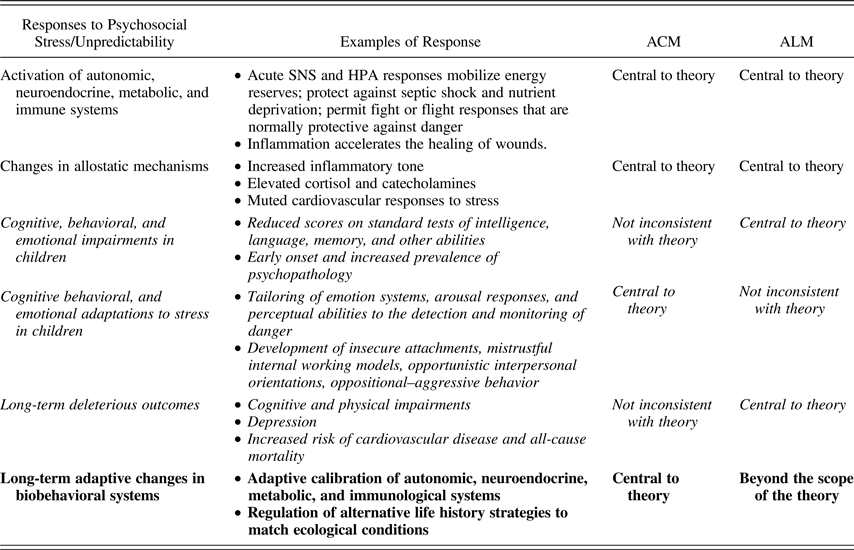
Basic tenets of the ACM and ALM are juxtaposed in Table 1. Both the ACM and ALM emphasize the adaptive nature of short-term physiological responses to stress (reviewed in Blair & Raver, Reference Blair and Raver2012b; Meaney, Reference Meaney2010; see Table 1, Activation of autonomic, neuroendoorine, metabolic, and immune systems). Further, the ACM concurs with the ALM regarding the effects of childhood stress and adversity on regulation of allostatic mechanisms. Indeed, as reviewed above, a substantial body of research has now documented biological embedding of early life stress in SRS parameter values (Table 1, Changes in allostatic mechanisms). However, in the ALM this biological embedding is construed negatively, as the result of cumulative stress exposures that predispose the individual to morbidities and premature mortality (Hertzman, Reference Hertzman1999; Hertzman & Wiens, Reference Hertzman and Wiens1996). Accordingly, the ALM links biological embedding of early life stress to dysregulation of physiological mediators (e.g., Evans, Reference Evans2003; Evans & Kim, Reference Evans and Kim2007, Reference Evans and Kim2012; Evans & Schamberg, Reference Evans and Schamberg2009; Essex et al., Reference Essex, Shirtcliff, Burk, Ruttle, Klein and Slattery2011; Miller & Chen, Reference Miller and Chen2010), placing children and adolescents at risk for undesirable developmental outcomes. As shown in Table 1 (Cognitive, behavioral, and emotional impairments in children), some of these outcomes include lower performance on standard tests of intelligence and executive functions and increased mental health problems (e.g., Badanes, Watamura, & Hankin., Reference Badanes, Watamura and Hankin2011; Blair et al., Reference Blair, Granger, Willoughby, Mills-Koonce, Cox and Greenberg2011; Essex et al., Reference Essex, Shirtcliff, Burk, Ruttle, Klein and Slattery2011; Evans & Schamberg, Reference Evans and Schamberg2009; Hastings et al., Reference Hastings, Shirtcliff, Klimes-Dougan, Allison, Derose and Kendziora2011; Rogosch, Dackis, & Cicchetti, Reference Rogosch, Dackis and Cicchetti2011).
Comparison of adaptive calibration model (ACM) and allostatic load model (ALM)
Note: See the main text for supporting citations and explanations of the effects listed here. Italic type indicates a difference in emphasis between the ACM and ALM. Bold type indicates a qualitative divergence between the two theories. SNS, sympathetic nervous system; HPA, hypothalamic–pituitary–adrenal.
The ACM also acknowledges that chronic SRS activation carries substantial costs, in terms of biological fitness as well as health and well-being. While the ACM stresses conditional adaptation, it leaves open the possibility that, for a number of reasons, some developmental outcomes are biologically maladaptive or mismatched to their environment (see above, Adaptive and Maladaptive Plasticity). In terms of proximal responses to childhood adversity, the ACM and ALM mainly differ in their emphasis on the benefits (ACM) versus the costs (ALM) of allostatic adjustments (as shown in the italicized area of Table 1; see also McEwen, Reference McEwen2012).
Cost–benefit trade-offs in the development of alternative phenotypes
The ACM and ALM diverge considerably in how they deal with cost–benefit trade-offs, individual differences, and long-term developmental changes. From an evolutionary standpoint, the ALM makes no distinction between the meanings of adaptive and maladaptive as conceptualized from a public health versus evolutionary perspective. Maladaptation is typically inferred whenever there are substantial costs to the organism. For example, if elevated cortisol levels in adolescents are associated with an undesirable outcome, such as reduced working memory, then elevated cortisol is classified as a marker of allostatic load (see Juster et al., Reference Juster, Bizik, Picard, Arsenault-Lapierre, Sindi and Trepanier2011). This reasoning ignores the crucial fact that biological processes are maintained by natural selection when their fitness benefits outweigh the costs, not when they are cost free; indeed, even large costs can be offset by large enough expected benefits. For example, in dangerous and unpredictable environments, organisms often accept the risk of severe damage in exchange for a chance of improving their condition (see Daly & Wilson, Reference Daly and Wilson2005; Ellis et al., Reference Ellis, Del Giudice, Dishion, Figueredo, Gray and Griskevicius2012; Frankenhuis & Del Giudice, Reference Frankenhuis and Del Giudice2012; Smallwood, Reference Smallwood1996; Winterhalder, Reference Winterhalder, Dunbar and Barrett2007). When health and reproductive success conflict, natural selection favors the latter at the expense of the former (see Nesse, Reference Nesse2001). Although there are practical reasons for identifying allostatic load biomarkers, this approach alone is incomplete because it only specifies dysfunction and not the adaptive functions of developmentally calibrated biological parameters.
Because of the failure to distinguish between (mal)adaptive and (un)desirable outcomes, most applications of the ALM do not adequately address the trade-offs involved in the development of physiological and behavioral phenotypes; as a consequence, the ALM literature often lacks a theory of adaptive individual variation in stress responsivity (for a notable exception, see Korte et al., Reference Korte, Koolhaas, Wingfield and McEwen2005). Instead, the ALM focuses on optimal SRS parameter values, as defined by covariation with desirable health outcomes; deviations from these optimal settings form the basis of “dysregulation.” The applied goal of the ALM is to identify nonoptimal autonomic, neuroendocrine, metabolic, and immune profiles that predict psychiatric and biomedical disorder (e.g., Juster et al., Reference Juster, McEwen and Lupien2010, Reference Juster, Bizik, Picard, Arsenault-Lapierre, Sindi and Trepanier2011; see Table 1, Long-term deleterious outcomes), with nonoptimal typically designated as scoring above the median (e.g., Evans & Schamberg, Reference Evans and Schamberg2009; Evans & Kim, Reference Evans and Kim2012) or in the top quartile (e.g., Evans, Reference Evans2003; Juster et al., Reference Juster, Bizik, Picard, Arsenault-Lapierre, Sindi and Trepanier2011) on allostatic load biomarkers. The ultimate goal is to find robust predictors that apply across contexts and, thus, have the most clinical value. Within this framework, the development of individual differences is usually traced to pathogenic processes (e.g., toxic stress).
In contrast, the ACM emphasizes adaptation in context and posits that optimal SRS parameter values vary as a function of environmental conditions. From this perspective, the notion of globally optimal baseline or responsivity levels for SRS parameters (e.g., below the median, not in the top quartile) is highly problematic; indeed, the entire body of literature on biological sensitivity to context demonstrates that the value of hyporesponsivity versus hyperresponsivity is context dependent (Boyce & Ellis, Reference Boyce and Ellis2005; Ellis et al., Reference Ellis, Boyce, Belsky, Bakermans-Kranenburg and van IJzendoorn2011; see above, The role of the SRS in allostasis and transduction of environmental information). At the crux of this issue is the crucial distinction between desirable and adaptive outcomes.
The ACM gives full consideration to the costs and benefits of SRS responsivity. For example, consider heightened stress responsivity in a dangerous, unpredictable environment. In the ACM, it is hypothesized that the costs of repeated SRS activation are offset by improved management of danger. Although the system is on a hair trigger, with a resulting increase in anxiety and/or aggression, few instances of actual danger will be missed (e.g., anxiety is associated with increased attention to and reduced gating of threat-relevant information; Stout, Shackman, & Larson, Reference Stout, Shackman and Larson2013). In addition, engaging in a fast, present-oriented life history strategy makes it optimal to discount the long-term health costs of chronic SRS activation if the immediate benefits are large enough (for in-depth discussion, see Del Giudice et al., Reference Del Giudice, Ellis and Shirtcliff2011). In the ALM framework, the same pattern of responsivity would be treated as dysfunctional because the stress response is deployed even in absence of true dangers (e.g., “excessive” response, “unnecessary” triggering; see Beauchaine et al., Reference Beauchaine, Neuhaus, Zalewski, Crowell and Potapova2011; Lupien et al., Reference Lupien, Ouellet-Morin, Hupbach, Tu, Buss, Walker, Cicchetti and Cohen2006) and because of the associated undesirable states and health risks (e.g., interpersonal distress). However, this approach fails to consider that natural defenses are usually designed by natural selection to accept a high rate of false positives (the “smoke detector principle”; Nesse, Reference Nesse2005). In most instances, unnecessary responding is an adaptive feature of the system (though a costly one) rather than a sign of dysregulation or malfunction.
Adaptations to stress in children
The core assumption of the ACM is that exposures to stress do not so much impair development as direct or regulate it toward strategies that are adaptive under stressful conditions. The implications of this assumption are far-reaching. If individual differences largely reflect conditional adaptation, then individuals showing dysregulated physiological patterns should outperform “normal” individuals when placed in conditions resembling the high-risk contexts to which they are ostensibly adapted (see Table 1, Cognitive, behavioral, and emotional adaptations to stress in children).
Support for this hypothesis has accrued in rodent studies. Quality of maternal investment in rats tracks ecological conditions, with higher levels of stress causing lower maternal investment (i.e., low levels of maternal licking and grooming; Champagne, Reference Champagne2008). As reviewed by Champagne (Reference Champagne2008), this low maternal investment alters pups' stress physiology and brain morphology. Although such changes in pups may seem disadvantageous (i.e., higher corticosterone levels, shorter dendritic branch lengths, lower spine density in hippocampal neurons) and even impair performance on tests of spatial learning and memory under standard conditions (Bredy, Humpartzoomian, Cain, & Meaney, Reference Bredy, Humpartzoomian, Cain and Meaney2003; Liu, Diorio, Day, Francis, & Meaney, Reference Liu, Diorio, Day, Francis and Meaney2000), pups who have experienced low licking and grooming actually display enhanced learning and memory processes under stressful conditions (Bagot et al., Reference Bagot, van Hasselt, Champagne, Meaney, Krugers and Joels2009; Champagne et al., Reference Champagne, Bagot, van Hasselt, Ramakers, Meaney and de Kloet2008). Rats also display conditional adaptations to peer violence; specifically, rats that experience repeated social defeat as adolescents display more proactive defensive behaviors (Bingham et al., Reference Bingham, McFadden, Zhang, Bhatnagar, Beck and Valentino2011) and are better able to cope (behaviorally and physiologically) with social defeat as adults (Buwalda, Stubbendorff, Zickert, & Koolhaas, Reference Buwalda, Stubbendorff, Zickert and Koolhaas2013).
Adapting this paradigm to human research could be challenging, but it would provide a critical test of the ACM vis-à-vis the ALM. The most directly relevant extant research concerns children who have experienced significant psychosocial adversity (especially maltreatment). Adverse childhood experiences alter the parameters of allostatic systems (e.g., Danese & McEwen, Reference Danese and McEwen2012; Del Giudice et al., Reference Del Giudice, Ellis and Shirtcliff2011). As with rats, these changes may seem disadvantageous (e.g., heightened HPA activity, elevated inflammation levels, smaller volume of the prefrontal cortex; Danese & McEwen, Reference Danese and McEwen2012), and maltreated children score lower than comparison groups on standard tests of intelligence and executive functions (e.g. Ayoub et al., Reference Ayoub, O'Connor, Rappolt-Schlichtmann, Vallotton, Raikes and Chazan-Cohen2009; Rieder & Cicchetti, Reference Rieder and Cicchetti1989). Yet such children may show enhanced ability to detect, learn, and remember stimuli that are ecologically relevant to them (Frankenhuis & Weerth, Reference Frankenhuis and de Weerth2013). This includes enhanced perceptual sensitivity to angry facial cues (Pollak, Reference Pollak2008), increased anticipatory monitoring of the environment in the context of interpersonal hostility (Pollak, Vardi, Bechner, & Curtin, Reference Pollak, Vardi, Bechner and Curtin2005), greater accuracy in identifying facial expressions of anger based on degraded visual information (Pollak, Messner, Kistler, & Cohn, Reference Pollak, Messner, Kistler and Cohn2009), greater speed in accurately labeling fearful faces (Masten et al., Reference Masten, Guyer, Hodgdon, McClure, Charney and Ernst2008), enhanced recall of distracting aggressive stimuli (Pollak & Tolley-Schell, Reference Pollak and Tolley-Schell2003; Rieder & Cicchetti, Reference Rieder and Cicchetti1989), and greater accuracy in identifying an adult in a photo line-up with whom they previously had a stressful interaction (Eisen, Goodman, Qin, Davis, & Crayton, Reference Eisen, Goodman, Qin, Davis and Crayton2007).
A similar logic applies to “behavior problems” in socioemotional development. Although children who experience high levels of familial and ecological stress tend to display more mental health symptoms, as per the ALM, many of these symptoms could be reconceptualized as conditional adaptations to harsh or unpredictable environments. According to life history models of human development, and much supporting research, such conditional adaptations include development of insecure attachments, a mistrustful internal working model, an opportunistic interpersonal orientation, a preference for smaller immediate rewards over larger future ones, hostile attribution bias, oppositional–aggressive behavior, and affiliation with deviant peers (e.g., Belsky et al., Reference Belsky, Steinberg and Draper1991; Belsky, Rosenberger, & Crnic Reference Belsky, Rosenberger, Crnic, Goldberg, Muir and Kerr1995; Campbell, Spieker, Vandergrift, Belsky, & Burchinal, Reference Campbell, Spieker, Vandergrift, Belsky and Burchinal2010; Del Giudice, Reference Del Giudice2009; Dishion, Ha, & Véronneau, Reference Dishion, Ha and Véronneau2012; Dodge, Pettit, Bates, & Valente, Reference Dodge, Pettit, Bates and Valente1995; McCullough, Pedersen, Schroder, Tabak, & Carver, Reference McCullough, Pedersen, Schroder, Tabak and Carver2013; Ramos, Victor, Seidl-de-Moura, & Daly, Reference Ramos, Victor, Seidl-de-Moura and Daly2013). The life history literature clearly conceptualizes this suite of cognitive and behavioral adaptations as childhood precursors (and eventual indicators) of a fast life history strategy.
Long-term adaptations to stress: The developmental regulation of alternative life history strategies
According to the ACM, childhood adaptations to stress may eventuate in long-term adaptive changes in biobehavioral systems. Herein lies the key difference between the ACM and ALM (as shown in the bold print in Table 1). In the ALM, energy devoted to mounting autonomic, neuroendocrine, metabolic, and immune responses to threat is traded off against wear and tear on multiple organ systems (recall the analogy of collapsing dominos toward stress-related endpoints). The ACM extends this logic by conceptualizing these trade-offs as decision nodes in allocation of resources. Each decision node influences the next decision node in an ongoing process that guides development of alternative life history strategies. It is through this chain of resource-allocation decisions, embedded in the regulatory parameters of the SRS and related biological systems, that the developing organism adapts to local conditions. Thus, the ACM shifts the emphasis from dysregulation to conditional adaptation (see Table 1, Long-term adaptive changes in biobehavioral systems).
From an evolutionary perspective, increased wear and tear is a cost of pursuing a fast life history strategy. The fast strategy is instantiated in a chain of resource-allocation decisions over the life course that make the best of a bad situation by trading off survival for reproduction. Thus, many biologically embedded changes that the ALM conceptualizes as costs (e.g., heightened HPA reactivity) the ACM views as decision nodes in development of a faster strategy. Conversely, slower life history strategies involve greater allocation of resources toward enhancing growth, vitality, and long-term survival (e.g., DNA repair). Life history theory therefore predicts that slower life history strategies will be linked to better physical and mental health than will faster life history strategies, and more so as the life course progresses.
This process of entraining faster life history strategies, at the cost of increasing allostatic load, is compellingly demonstrated in rodents. As discussed above, extensive research with rats has documented various effects of receiving low levels of maternal licking and grooming in the first week of life. Many of these effects involve apparent costs that, in the ALM literature, are described as allostatic load biomarkers or their outcomes (e.g., heightened HPA and SNS reactivity to stress, pervasively higher rates of fear-induced behavior, reduced hippocampal synaptic development, vulnerability to cocaine and alcohol use; Francis & Kuhar, Reference Francis and Kuhar2008; Liu et al., Reference Liu, Diorio, Day, Francis and Meaney2000; Meaney, Reference Meaney2010). However, in the ACM these allostatic changes and their biobehavioral outcomes operate as decision nodes in allocation of resources (opening up some developmental options and foreclosing others, with different cost–benefit trade-offs). Specifically, through programming of the epigenome and associated biobehavioral changes, low levels of licking and grooming bias development of female pups toward earlier onset of puberty, higher sexual proceptivity toward novel males, increased lordosis in response to male mounts, sharply higher rates of pregnancy following mating sessions, and lower quality parental investment in their own offspring (Cameron, Del Corpo, et al., Reference Cameron, Del Corpo, Diorio, McAllister, Sharma and Meaney2008; Cameron, Shahrokh, et al., Reference Cameron, Shahrokh, Del Corpo, Dhir, Szyf and Champagne2008; Sakhai, Kriegsfeld, & Francis, Reference Sakhai, Kriegsfeld and Francis2011). Thus, consistent with life history theory, female rats growing up under conditions of heightened environmental stress, as indicated by low parental investment in the first week of life, regulate development toward faster life history strategies (Meaney, Reference Meaney2007). Male rats raised under these conditions engage in more play fighting as adolescents (Parent & Meaney, Reference Parent and Meaney2008) and aggressive behavior as adults (Menard & Hakvoort, Reference Menard and Hakvoort2007).
Analogous processes operate in humans. As discussed above, physiological, cognitive, behavioral, and maturational changes in response to environmental danger and unpredictability function as childhood precursors of a fast life history strategy, which then consolidates over time (see especially Brumbach et al., Reference Brumbach, Figueredo and Ellis2009). These stress-mediated changes shift resource allocations toward more risky and aggressive behavior, earlier pubertal timing and sexual debut, enhanced early fertility, less stable pair bonding, more offspring, and less parental investment per child (e.g., Belsky et al., Reference Belsky, Schlomer and Ellis2012; Belsky, Steinberg, Houts, Halpern-Felsher, Reference Belsky, Steinberg, Houts and Halpern-Felsher2010; Ellis et al., Reference Ellis, Bates, Dodge, Fergusson, Horwood and Pettit2003, Reference Ellis, Figueredo, Brumbach and Schlomer2009; Ellis, McFadyen-Ketchum, Dodge, Pettit, & Bates, Reference Ellis, McFadyen-Ketchum, Dodge, Pettit and Bates1999; Nettle, Reference Nettle2010; Nettle, Coall, & Dickins, Reference Nettle, Coall and Dickins2010, 2011; Painter et al., Reference Painter, Westendorp, de Rooij, Osmond, Barker and Roseboom2008; Placek & Quinlan, Reference Placek and Quinlan2012; Simpson, Griskevicius, Kuo, Sung, & Collins, Reference Simpson, Griskevicius, Kuo, Sung and Collins2012)—at the price of reduced health and longevity (including allostatic load; see especially Allsworth et al., Reference Allsworth, Weitzen and Boardman2005; Bleil et al., Reference Bleil, Adler, Pasch, Sternfeld, Gregorich and Rosen2012, Reference Bleil, Adler, Appelhans, Gregorich, Sternfeld and Cedars2013; Brumbach et al., Reference Brumbach, Figueredo and Ellis2009; Geronimus et al., Reference Geronimus, Hicken, Pearson, Seashols, Brown and Cruz2010). Cross-sectional and longitudinal studies have both shown that individuals who pursue faster life history strategies suffer from more mental health problems, medical ailments (e.g., thyroid disease, high blood pressure or hypertension, ulcers), and physical health symptoms (e.g., sore throat or cough, dizziness; Brumbach et al., Reference Brumbach, Figueredo and Ellis2009; Figueredo, Vasquez, Brumbach, & Schneider, Reference Figueredo, Vasquez, Brumbach and Schneider2004; Sefcek & Figueredo, Reference Sefcek and Figueredo2010).
Such life history trade-offs are nicely illustrated by the work of Bleil and colleagues (Reference Bleil, Adler, Appelhans, Gregorich, Sternfeld and Cedars2013, 2012), who found that heightened psychosocial stress was associated with not only ovarian reserve depletion in older women but also earlier puberty and higher antral follicle count in younger women, indicating a faster life history strategy. Likewise, women who were exposed in utero to the Dutch famine of 1944–1945 not only have increased risk of chronic degenerative disease but also start reproducing at a younger age, have more offspring, more twins, and are less likely to remain childless (Painter et al., Reference Painter, Westendorp, de Rooij, Osmond, Barker and Roseboom2008), again indicating a faster life history strategy. Analogous effects of early life stress on reproductive outcomes are also well documented in women exposed to more normative prenatal and postnatal stressors (e.g., low birth weight for gestational age, separation from mother in childhood, lack of paternal involvement; Nettle et al., Reference Nettle, Coall and Dickins2010, Reference Nettle, Coall and Dickins2011).
It is important to note, however, that human research on the relations between early life stress, health outcomes, and life history strategy is correlational; causation may be bidirectional. On the one hand, developmental exposures to stress may induce faster life history strategies at a cost to mental and physical health. On the other hand, these stress exposures may first damage the soma (i.e., erode phenotypic condition in a manner that reduces health and longevity), and the damaged soma itself may induce a faster life history strategy (see Nettle, Frankenhuis, & Rickard, Reference Nettle, Frankenhuis and Rickard2013; Wells, Reference Wells2012). For example, according to Geronimus' (Reference Geronimus1992) “weathering hypothesis,” Black women experience accelerated health deterioration as a result of the cumulative impact of repeated experiences of socioeconomic adversity and marginalization. Geronimus (Reference Geronimus1996) demonstrated that among Black women, especially those from lower socioeconomic groups, advancing maternal age above 15–16 years was linearly related to increasing odds of low birth weight and very low birth weight offspring, and that this effect was accounted for by deteriorating health. These data may be most consistent with the hypothesis that the effects of repeated exposure to stress on early reproduction are mediated by damage to the soma, rather than vice versa. Either way, these two causal pathways are not mutually exclusive, and both are consistent with life history theory insofar as early adverse experiences function to promote faster life history strategies (see Nettle et al., Reference Nettle, Frankenhuis and Rickard2013).
In total, through a chain of linking decision nodes, stress-mediated regulation of life history strategies guides development along specific pathways. The shift down the fast track can be understood as a conditional adaptation, despite the substantial costs. Development of a fast life history strategy in this context is not impairment or dysfunction; it is a coherent, organized response to stress that has been shaped by a natural selective history of recurring exposures to harsh or unpredictable environments.
Implications for intervention
For biologists, there are no ideal phenotypes. Rather, the adaptive merits of phenotype are apparent only in relation to success within a particular set of environmental conditions: One single phenotype does not fit all. (Meaney, Reference Meaney2010, p. 65)
Life history theory highlights the problem with trying to identify ideal patterns of development and pathologizing deviations from the purported ideal. There is no single ideal stress responsivity pattern or associated life history strategy. Rather, different strategies are calibrated by, and thus matched to, relevant environmental conditions (in interaction with genetic factors). Consider the unemotional pattern in the ACM (Del Giudice et al., Reference Del Giudice, Ellis and Shirtcliff2011), which involves low SRS responsivity and a fast, mating-oriented life history strategy. A key physiological correlate of the unemotional pattern appears to be a profile of dopaminergic hypoactivity, which is characterized by impulsivity and sensation seeking, a strong preference for immediate over delayed rewards, low fearfulness, and elevated risk taking and aggression (see Gatzke-Kopp, Reference Gatzke-Kopp2011). Although clearly undesirable from a public health perspective, unemotional patterns may be adapted to harsh and unpredictable environmental conditions (Del Giudice et al., Reference Del Giudice, Ellis and Shirtcliff2011; Gatzke-Kopp, Reference Gatzke-Kopp2011). Therefore, preventing or altering this phenotype (e.g., through dopamine agonists) could be equivalent to “declawing the cat”: removing the psychological and behavioral weaponry necessary to survive and control resources in one's local ecology (Ellis et al., Reference Ellis, Del Giudice, Dishion, Figueredo, Gray and Griskevicius2012).
More generally, the problem with pathologizing risky and aggressive behavioral strategies, with designating their biological substrates (i.e., biomarker values) as dysregulated, and with implementing interventions that simply try to stop these strategies, is that it ignores motivation and function. Consider, for example, risky behaviors that expose adolescents to danger and inflict harm on others but increase dominance in social hierarchies and leverage access to mates (e.g., Gallup, O'Brien, & Wilson, Reference Gallup, O'Brien and Wilson2011; Palmer & Tilley, Reference Palmer and Tilley1995; Sylwester & Pawlowski, Reference Sylwester and Pawlowski2011). Risky in this context does not equal maladaptive or abnormal. Recognizing that risky and aggressive behaviors are often adaptive in context is critical to designing effective interventions.
Broadly speaking, intervention efforts may be stuck in a pattern of fighting against functional adaptations to stress. For example, early work identified “hostile attribution bias” as a response to high-risk environments that promotes aggressive behavior (Dodge, Reference Dodge1980). This gave rise to social–cognitive interventions designed to change or “correct” this bias (e.g., Bierman, Greenberg, & the Conduct Problems Prevention Research Group, Reference Bierman, Greenberg, Peters and McMahon1996). Because this approach works against the adaptation, it is fighting an uphill battle, and it may contribute to declawing the cat. Imagine how much more powerful interventions could be if they worked with, instead of against, powerful adaptive responses to adversity (see Ellis et al., Reference Ellis, Del Giudice, Dishion, Figueredo, Gray and Griskevicius2012).
Research on attentional style may support such an approach. Children who experience relatively high levels of stress during the prenatal, early childhood, and middle childhood periods tend to display attentional styles in adolescence that appear to be adapted to environmental danger and unpredictability. Specifically, such adolescents tend to show a combination of superior performance on shifting attention tasks (i.e., tasks that reflect the ability to switch between two competing, unpredictable response sets) and inferior performance on sustained attention tasks (i.e., tasks that reflect the ability to maintain stable performance over a prolonged period of time); whereas, adolescents from low-stress backgrounds tend to show the opposite pattern (Nederhof, Ormel, & Oldehinkel, in press). Building on the ACM, Nederhof et al. conceptualize the ability for shifting attention compared to sustaining attention as a vigilant phenotype that can readily switch between tasks to scan the environment for potential dangers. Educational interventions for high-risk children could potentially be designed to work with, instead of against, this attentional style (e.g., in classroom structures, how information is packaged and delivered).
Research on early attachment and information-processing styles provides another useful example. According to life history models of human development, early attachment processes are shaped by levels of psychosocial stress and support in and around the family, as mediated by variation in the quality and reliability of parental investment, and function to regulate the development of alternative life history strategies. Whereas high levels of family risk and uncertainty promote insecure attachments and the development of faster life history strategies, safe and predictable family environments promote secure attachments and slower strategies (Belsky et al., Reference Belsky, Steinberg and Draper1991; Chisholm, Reference Chisholm1999; Simpson & Belsky, Reference Simpson, Belsky, Cassidy and Shaver2008). As discussed above, alternative life history strategies involve not only social and emotional adaptations to stress but also cognitive adaptations, which may be instantiated in different information processing styles. Belsky, Spritz, & Crnic (Reference Belsky, Spritz and Crnic1996) hypothesized that children with insecure versus secure attachment histories would display cognitive–affective biases toward negative versus positive information, respectively. This hypothesis was tested in a sample of 3-year-old boys who watched puppet shows in which characters experienced both discrete positive events (e.g., happy puppet receiving a birthday present) and negative events (e.g., unhappy puppet spilling his juice). The children with insecure mother–infant attachment histories (assessed at age 12 months) remembered negative events more accurately than positive events and more accurately than did the securely attached children. The reverse was true for children with secure attachment histories. These data suggest that children with insecure versus secure attachment styles develop different affective–cognitive specializations, which may reflect adaptations to different levels of early life stress and support. Again, educational interventions could be designed to utilize these specializations to enhance learning outcomes in high-risk children.
A life history perspective on development supports this approach to intervention, while also emphasizing the importance of ecological context. From an evolutionary perspective, the developmental outcomes associated with fast life history strategies—insecure attachments, engaging in high-risk behaviors associated with immediate rewards, discounting the future, having a child as a teenager—constitute reliable developmental responses to environmental cues indicating that life is short and future outcomes cannot be controlled or predicted. Because these are powerful evolved responses, Band-Aid interventions (e.g., sex education, birth control, promoting self-esteem, training coping skills, teaching problem-solving strategies) are unlikely to effect change at a foundational level (see Johns, Dickins, & Clegg, Reference Johns, Dickins and Clegg2011).
Prevention and treatment programs could instead benefit from two alternative approaches. The first involves harnessing the power of functional adaptations to stress to achieve socially desirable goals. As discussed above, this could mean restructuring educational practices to take advantage of cognitive adaptations to harsh environments (e.g., shifting attention, quick decision making, memory for negative information, bias toward short-term gains over long-term benefits; see Wenner, Bianchi, Figueredo, Rushton, & Jacobs, Reference Wenner, Bianchi, Figueredo, Rushton and Jacobs2013). Among individuals who have developed these adaptations, the same logic applies to placing them into jobs that turn their putative weaknesses into strengths. The second involves addressing causative environmental conditions. This means altering the social contexts of disadvantaged children and adolescents in ways that, through changes in their experiences, induce an understanding that they can lead longer, healthier, more predictable lives (Ellis et al., Reference Ellis, Del Giudice, Dishion, Figueredo, Gray and Griskevicius2012).
Finally, discussing the adaptive logic of psychological and physiological processes in therapeutic settings may help patients make sense of their distress, gain a broader understanding of the costs and benefits of their behaviors, and devise alternative coping strategies that do not conflict with their personal goals. Gilbert (Reference Gilbert2002) offers several examples of how evolutionary insights can be integrated in cognitive therapy to shape interventions and promote patients' self-understanding.
Caveats
Whatever the value of intervention approaches informed by an evolutionary perspective, there are contexts in which the intervention goal is to change established adaptations to stress (e.g., to mold the person into developing a slow life history strategy). Although attaining this goal is inherently challenging (insofar as it “goes against the grain” and may create mismatches between the developing person and their local environment), such an intervention strategy could still improve health and help children and adolescents function more successfully in educational institutions and the larger society. The resulting tension between intervention costs and benefits, including possible side effects of programs aimed at reducing health-risking behaviors, should always be considered (see Ellis et al., Reference Ellis, Del Giudice, Dishion, Figueredo, Gray and Griskevicius2012, for an extended analysis of the strengths and weaknesses of different intervention approaches to altering life history strategies).
Several caveats and qualifications are in order. First, as discussed above, there are genuinely pathological conditions (e.g., genetic abnormalities, accidents or environmental insults beyond an organism's regulatory capacity, manipulation by other organisms) that cause evolved mechanisms to malfunction. Intervention is generally needed when the system is broken.
Second, even if evolved mechanisms are not impaired, modern environments may alter the cost–benefit balance, so that adaptive calibration misfires and the costs completely outweigh the benefits. There are a number of reasons why adaptive calibration can fail (see above, Mismatch), such as when a developmental mismatch occurs between early programming environments and later environments (e.g., when a person is programmed to “live fast and die young” but then matures into a stable environment with an 80-year life expectancy). In this context individuals may benefit from treatments that bring physiological and affective–cognitive systems into alignment with current conditions. However, this cannot be simply assumed but needs to be argued case by case.
Third, according to the smoke detector principle (Nesse, Reference Nesse2005), a protective mechanism (e.g., anxiety) may be calibrated to accept many false positives because the cost of activating a defense is often small compared to the large cost of not responding adequately to a genuine danger. Thus, in some cases, blocking the system by external intervention may actually reduce costs (such as interpersonal distress) and have no special side effects.
Fourth, evolutionary conflicts of interest exist on multiple levels, and behavioral strategies that are adaptive in context for the individual (e.g., antisocial personality disorder; see Boutwell, Barnes, Deaton, & Beaver, Reference Boutwell, Barnes, Deaton and Beaver2013) may not be adaptive for other family members and/or society (the reverse is also true). Depending on the focus of an intervention, different criteria may apply. In many cases, there may be no ideal solution to the problem.
Conclusion
Built explicitly on the foundation of modern evolutionary biology, the ACM provides a framework for research on stress and development that supplements the ALM and revises some of its key assumptions, thus laying the foundation for a broad theory of individual differences in stress responsivity. We believe that the ACM embodies the main insights of the ALM without sharing its limitations. In comparison with the ALM, the ACM offers a more sophisticated model of developmental plasticity and individual differences that explains and integrates a wider spectrum of findings. In addition, as we have articulated in other publications, the ACM advances novel, testable predictions that potentially address important anomalies in the field regarding complex relations among psychosocial environmental factors, stress responsivity, life history strategies, and health (Del Giudice et al., Reference Del Giudice, Ellis and Shirtcliff2011; Ellis et al., Reference Ellis, Del Giudice, Shirtcliff, Beauchaine and Hinshaw2013). Because of their divergent focus and underlying assumptions, especially regarding adaptive calibration versus stress dysregulation, the ACM and ALM are only partially complementary and, in some cases, support different approaches to prevention and treatment.
Both the ACM and ALM focus on changes in allostatic mechanisms resulting from early life stress (i.e., biological embedding). However, the theories diverge in their explanation of the functional (or dysfunctional) role of these changes. The ALM is a disease model; it has been productive in mapping how dysregulated autonomic, neuroendocrine, metabolic, and immune mediators can strain the organism until it breaks. In spite of (or because of) these accomplishments and the resulting dominant position of the ALM in the field, the model has largely foreclosed consideration of the functional role of variation in allostatic mediators in regulating developmental plasticity. The resulting imbalance has impeded our understanding of normal developmental processes and, consequently, abnormal development as well.
The crucial point is that, by emphasizing the pathways leading directly from adversity to dysfunction (i.e., how chronic stress “inexorably strains interconnected biomarkers that eventually collapse like domino pieces trailing toward stress-related endpoints”; Juster et al., Reference Juster, Bizik, Picard, Arsenault-Lapierre, Sindi and Trepanier2011, p. 725), the ALM misses something fundamental about development. It misses the coherent, functional biobehavioral changes that occur in response to stress over time. We need to understand these functional developmental changes to understand dysfunction (e.g., allostatic load and its consequences). These changes not only promote adaptation to current challenges (as emphasized by both the ALM and ACM) but also shape longer term developmental trajectories to match expected future conditions. This long-term focus of the ACM is critical to understanding stress–health relationships because, to a great extent, allostatic load is a byproduct of the chain of resource-allocation decisions that characterize the development of different life history strategies over the life course (see above, Long-term adaptations to stress). The strength of the ACM is that it provides a broad framework for explaining these functional developmental changes while also advancing specific, testable hypotheses.
We believe that this change of focus matters not only for theory and research but also for intervention. Based on the literature on biological embedding of early life stress, Shonkoff and colleagues (Reference Shonkoff, Garner, Siegel, Dobbins, Earls and McGuinn2012), in their report for the American Academy of Pediatrics, raised the call to arms for early intervention:
Significant reductions in chronic disease could be achieved across the life course by decreasing the number and severity of adverse experiences that threaten the wellbeing of young children and by strengthening the protective relationships that help mitigate the harmful effects of toxic stress. (p. e239)
The future of pediatrics lies in . . . translating scientific advances into more effective strategies and creative interventions to reduce the early childhood adversities that lead to lifelong impairments in learning, behavior, and health. (p. e243)
We fully support this call to arms but believe that intervention strategies based solely on the toxic stress/allostatic load perspective are likely to achieve limited results. Following the analogy of collapsing domino pieces, the model assumes that reducing the “number and severity of adverse experiences” will reduce “lifelong impairments in learning, behavior, and health.” Although we do not question this assumption, the limitation of this approach is that toxic stress/allostatic load is only half of the story. The other half of the story is the coherent, functional responses to stress, including regulation of alternative life history strategies, that reliably emerge in given developmental contexts. These responses have to be taken into account to more fully and accurately capture child and adolescent development under conditions of psychosocial stress and unpredictability.
The bottom line is that knowledge is power. As discussed earlier, whether the goal is to work with functional adaptations to stress or to intervene against them, successful policy and practice depend on understanding when and how these adaptations emerge and can be changed. Research is urgently needed to recover a high-resolution map of these functional adaptations, to identify the specific social and environmental factors that shape their expression, and to trace their onset, course, and sensitive periods for change. This would greatly enhance our ability to translate research on stress–health relationships into effective interventions for the crucial goals of risk prevention and management.
In conclusion, we are not arguing that the ALM is wrong per se; indeed, the extensive body of research documenting the negative effects of allostatic load on health is incontrovertible. Rather, our proposition is that the ALM is incomplete; its overemphasis on the costs of allostasis weakens its conceptual power. The ALM lacks the insight and heuristic power of a modern evolutionary–developmental framework. In the long run, the field may be better served by a theory that explicitly considers life history trade-offs in development of alternative phenotypes, as instantiated in the resource allocation decisions that define the complex relations between developmental exposures to stress, stress responsivity, behavioral strategies, and health.