




No CrossRef data available.
Article contents
Hepatitis C virus infection is associated with reduced white matter N-acetylaspartate in abstinent methamphetamine users
Published online by Cambridge University Press: 06 February 2004
Extract
Nearly 3,000,000 people in the United States, and over 100,000,000 people worldwide, are infected with hepatitis C virus (HCV), with an increasing trajectory for the foreseeable future (Alter et al., 1999). While hepatic encephalopathy has been long recognized as a disorder associated with cerebral structural, metabolic, and cognitive changes (e.g., Tarter et al., 1989), HCV infection itself is increasingly associated with changes in the brain, even in the absence of hyperammonemia. Specifically, HCV-infected individuals may have deficits in cognitive functions such as attention, working memory, and speed of information processing (Forton et al., 2002; Hilsabeck et al., 2002). They may also have abnormalities on magnetic resonance spectroscopy (MRS), a non-invasive method to measure cerebral metabolites. The most reliably measured compounds using a standard 1.5 Tesla MRI scanner are N-acetylaspartate (NAA), a marker of neuronal integrity; choline and choline-containing compounds (Cho), a measure of cell membrane turnover and lipid changes; myo-Inositol (Ins), a possible indicator of glial proliferation and/or osmolar changes; and creatine+phosphocreatine (Cr), an indicator of high energy stores that is often used as a relative standard for other metabolites. In the first studies of HCV using MRS, Forton et al. (2001; 2002) found elevated Cho/Cr in the frontal white matter and basal ganglia in patients with HCV. In addition patients with two or more impaired neuropsychological test performances had higher Cho/Cr compared to those with less than two impaired test performances.Dr. Erin D. Bigler served as Action Editor during the course of this review.
Information
- Type
- RESEARCH LETTER
- Information
- Journal of the International Neuropsychological Society , Volume 10 , Issue 1 , January 2004 , pp. 110 - 113
- Copyright
- © 2004 The International Neuropsychological Society
INTRODUCTION
Nearly 3,000,000 people in the United States, and over 100,000,000 people worldwide, are infected with hepatitis C virus (HCV), with an increasing trajectory for the foreseeable future (Alter et al., 1999). While hepatic encephalopathy has been long recognized as a disorder associated with cerebral structural, metabolic, and cognitive changes (e.g., Tarter et al., 1989), HCV infection itself is increasingly associated with changes in the brain, even in the absence of hyperammonemia. Specifically, HCV-infected individuals may have deficits in cognitive functions such as attention, working memory, and speed of information processing (Forton et al., 2002; Hilsabeck et al., 2002). They may also have abnormalities on magnetic resonance spectroscopy (MRS), a non-invasive method to measure cerebral metabolites. The most reliably measured compounds using a standard 1.5 Tesla MRI scanner are N-acetylaspartate (NAA), a marker of neuronal integrity; choline and choline-containing compounds (Cho), a measure of cell membrane turnover and lipid changes; myo-Inositol (Ins), a possible indicator of glial proliferation and/or osmolar changes; and creatine+phosphocreatine (Cr), an indicator of high energy stores that is often used as a relative standard for other metabolites. In the first studies of HCV using MRS, Forton et al. (2001; 2002) found elevated Cho/Cr in the frontal white matter and basal ganglia in patients with HCV. In addition patients with two or more impaired neuropsychological test performances had higher Cho/Cr compared to those with less than two impaired test performances.
There is no consensus regarding HCV neuropathogenesis, but two main theories have been postulated. (See Forton et al., 2001, 2002; Kramer, 2002). First, HCV infection upregulates pro-inflammatory cytokines, which may cross the blood-brain barrier and cause neural injury. Second, similar to HIV, HCV may use monocytes to enter the brain, where it may infect, or where viral proteins may injure neural cells (Caussin-Schwemling et al., 2001).
In the United States drug abuse is the most important risk factor for HCV infection. Drugs particularly associated with HCV risk are heroin, methamphetamine, and cocaine. Of these, methamphetamine dependence is both the most prevalent (1.7% of the US population, compared with 0.7% for heroin and 0.2% for cocaine; Robbins & Regier, 1991), and also it is the drug for which there is strongest evidence for a neurotoxic effect based on animal models (Davidson et al., 2001) and limited human studies. The latter evidence includes increased likelihood of neuropsychological impairment (Rippeth et al., 2004, this issue) as well as changes in brain metabolites on MR spectroscopy (reduced NAA in frontal white matter and basal ganglia, reduced creatine in basal ganglia, and elevated choline-containing compounds and myo-inositol in frontal gray matter; Ernst et al., 2000).
Given the increased risk for brain injury among methamphetamine abusers, we questioned whether the addition of HCV infection would have a further detrimental effect. In this preliminary study we compared concentrations of the metabolites NAA, Cho, Ins, and Cr in three groups: hepatitis C seropositive methamphetamine dependent individuals (HCV+/Meth+); hepatitis C seronegative methamphetamine dependent individuals (HCV−/Meth+); and HCV−/Meth− controls. We predicted that NAA would be lowest in HCV+/Meth+, followed by HCV−/Meth+, and would be highest in HCV−/Meth−, suggesting greater neural injury when both risks were present; and that there would be selective increase in the inflammatory markers Ins and Cho in HCV+/Meth+ only, reflecting putative inflammatory changes due to HCV.
METHODS
Research Participants
Six HCV+/Meth+, 10 HCV−/Meth+, and 10 control (HCV−/Meth−) participants were recruited and tested at the San Diego HIV Neurobehavioral Research Center. HCV infected individuals were identified by measurement of HCV IgG in plasma by ELISA. HCV RNA was measured in plasma by polymerase chain reaction (SuperQuant, National Genetics Institute). All participants of this preliminary study were HIV seronegative. Demographic and medical characteristics of the groups are presented in Table 1. The groups did not differ significantly on age [F(2,23) = 0.30, p = .74], or education [F(2,23) = 1.34, p = .28]. As would be expected, the HCV+ group had mildly elevated liver function enzymes, although other general indicators of liver function were within the normal range. Participants with history of schizophrenia or other severe psychiatric disorder, opportunistic infection of the brain, hepatic encephalopathy, or head injury with a loss of consciousness greater than 30 min were excluded. Methamphetamine dependence was assessed using the Structured Clinical Interview for DSM–IV. Participants were excluded if they met dependence criteria for any drug other than methamphetamine, including alcohol.
Demographic and medical characteristics of participant groups

Procedure
Single voxel MR spectroscopy was conducted with a General Electric 1.5-T scanner (Signa LX) at the VA San Diego Healthcare System. A PRESS sequence (TE 35 milliseconds, TR 3 s) was used to acquire spectra from voxels of interest in the midline frontal gray matter (20 × 20 × 20 mm), the predominantly white matter right anterior centrum semiovale (20 × 20 × 20 mm), and the head of the right caudate nucleus (15 × 15 × 15 mm). Anatomic placement of the voxels was performed using T1-weighted axial localizers. The frontal lobe spectra were based on 64 acquisitions, whereas 96 acquisitions were used for the caudate due to its smaller voxel size.
Spectra were processed using LCModel software (Provencher, 1993) to produce absolute quantitation of metabolites which eliminate the difficulty in interpretation associated with metabolite ratios. Partial volume corrections were then applied to remove the contribution of CSF in each voxel to generate measurements of NAA, Cho, Ins, and Cr were calculated (see Schweinsburg et al., 2000).
All participants received comprehensive neuropsychological testing, with subsequent clinical ratings as described previously (Heaton et al., 1995). The study was approved by the Human Subjects Protection Program at the University of California, San Diego and participants gave written informed consent prior to enrollment.
RESULTS
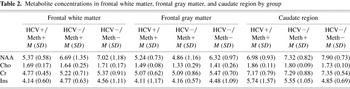
As indicated in Table 2, in the right frontal white matter region, NAA differed significantly between groups [F(2,23) = 3.97, p = .03]. Tukey follow-up tests for all pairwise comparisons revealed 23% lower NAA in the frontal white matter of the HCV+/Meth+ group compared to controls. There was also a trend toward significantly lower frontal white matter NAA in HCV+/Meth+ (20%) compared to the HCV−/Meth+. Frontal gray matter NAA was lower in both Meth+ groups, but there was no evidence for greater reduction in HCV+/Meth+ (17% reduction for HCV+/Meth+, 23% for HCV−/Meth+) compared to controls [F(2,23) = 8.91, p = .001]. The concentration of NAA in the caudate region did not differ significantly between groups although HCV+/Meth+ evidenced a 12% reduction compared to controls and the HCV−/Meth+ showed a 7% reduction compared to controls. Reliable group differences in Cho, Cr and mI were not observed.
Metabolite concentrations in frontal white matter, frontal gray matter, and caudate region by group

Given the significant findings in the frontal white matter region, correlations were calculated between ratings of neuropsychological impairment and NAA levels for the combined Meth+ groups. Lower NAA values were associated with higher ratings of global neuropsychological impairment (r = −0.52, p < .05). In addition, 83.3% of the HCV+/Meth+ group were rated as impaired on the global rating in comparison to 50.0% of the HCV−/Meth+ and 10.0% of the controls.
DISCUSSION
These preliminary results indicate that HCV infection may worsen methamphetamine-associated neuronal injury in white matter. Consistent with our hypotheses, NAA was lower in the white matter region of the right anterior centrum semiovale in the HCV+/Meth+ compared to controls and HCV−/Meth+ groups. In addition, reduction in this marker of neuronal integrity was correlated with worse global neuropsychological deficit in the combined Meth+ groups.
Without longitudinal study, we cannot determine whether the suggested neuronal injury is reversible. Studies evaluating patients before and after treatment for HCV will be required. Our pilot study was limited by the absence of HCV−infected, non-methamphetamine-dependent individuals, a limitation which precluded our being able to look at the effect of HCV in isolation. Contrary to our hypotheses and other reports (e.g., Forton et al., 2002), Cho and Ins were not elevated in the HCV+/Meth+ group. Larger studies should determine if this disagreement is due to inadequate power, or whether the combination of methamphetamine and HCV alters the neuropathogenesis of the latter.
ACKNOWLEDGMENTS
This research is supported by the National Institute on Drug Abuse Program Project #P01DA12065 NeuroAIDS: Effects of Methamphetamine. Portions of this paper were presented at the 31st annual meeting of the International Neuropsychological Society, Honolulu, Hawaii, February, 2003.
The HIV Neurobehavioral Research Center (HNRC) is supported by Center award MH 62512 from NIMH. The views expressed in this article are those of the authors and do not reflect the official policy or position of the Department of the Navy, Department of Defense, nor the United States Government.
The San Diego HIV Neurobehavioral Research Center (HNRC) group is affiliated with the University of California, San Diego, the Naval Hospital, San Diego, and the San Diego Veterans Affairs Healthcare System, and includes: Director: Igor Grant, M.D.; Co-Directors: J. Hampton Atkinson, M.D. and J. Allen McCutchan, M.D.; Center Manager: Thomas D. Marcotte, Ph.D.; Naval Hospital San Diego: Mark R. Wallace, M.D. (P.I.); Neuromedical Component: J. Allen McCutchan, M.D. (P.I.), Ronald J. Ellis, M.D., Scott Letendre, M.D., Rachel Schrier, Ph.D.; Neurobehavioral Component: Robert K. Heaton, Ph.D. (P.I.), Mariana Cherner, Ph.D., Julie Rippeth, Ph.D., Joseph Sadek, Ph.D., Steven Paul Woods, Psy.D.; Imaging Component: Terry Jernigan, Ph.D. (P.I.), John Hesselink, M.D.; Neuropathology Component: Eliezer Masliah, M.D. (P.I.); Clinical Trials Component: J. Allen McCutchan, M.D., J. Hampton Atkinson, M.D., Ronald J. Ellis, M.D., Ph.D., Scott Letendre, M.D.; Data Management Unit: Daniel R. Masys, M.D. (P.I.), Michelle Frybarger, B.A. (Data Systems Manager); Statistics Unit: Ian Abramson, Ph.D. (P.I.), Reena Deutsch, Ph.D., Deborah Lazzaretto, M.A., Tanya Wolfson, M.A.
References
REFERENCES
Alter, M.J.,
Kruszon-Moran, D.,
Nainan, O.V.,
McQuillan, G.M.,
Gao, F.,
Moyer, L.A.,
Kaslow, R.A., &
Margolis, H.S.
(1999).
The prevalence of hepatitis C infection in the United States, 1988
through 1994.
New England Journal of Medicine,
341,
556–562.Google Scholar
Caussin-Schwemling, C.,
Schmitt, C., &
Stoll-Keller, F.
(2001).
Study of the infection of human blood derived
monocyte/macrophages with hepatitis C virus in vitro.
Journal of Medical Virology,
65,
14–22.Google Scholar
Davidson, C.,
Gow, A.J.,
Lee, T.H., &
Ellinwood, E.H.
(2001).
Methamphetamine neurotoxicity: Necrotic and apoptotic mechanisms
and relevance to human abuse and treatment.
Brain Research,
36,
1–22.Google Scholar
Ernst, T.,
Chang, L.,
Leonido-Yee, M., &
Speck O.
(2000).
Evidence for long-term neurotoxicity associated with
methamphetamine abuse: A 1H MRS study.
Neurology,
54,
1344–1349.Google Scholar
Forton, D.M.,
Allsop, J.M.,
Main, J.,
Foster, G.R.,
Thomas, H.C., &
Taylor-Robinson, S.D.
(2001).
Evidence for a cerebral effect of the hepatitis C virus.
Lancet,
358,
38–39.Google Scholar
Forton, D.M.,
Thomas, H.C.,
Murphy, C.A.,
Allsop, J.M.,
Foster, G.R.,
Main, J.,
Wesnes, K.A., &
Taylor-Robinson, S.D.
(2002).
Hepatitis C and cognitive impairment in a cohort of patients with
mild liver disease.
Hepatology,
35,
433–439.Google Scholar
Heaton, R.K.,
Grant, I.,
Butters, N.,
White, D.A.,
Kirson, D.,
Atkinson, J.H.,
McCutchan, J.A.,
Taylor, M.,
Kelly, M.D.,
Ellis, R.J.,
Wolfson, T.,
Velin, R.,
Marcotte, T.D.,
Hesselink, J.R.,
Jernigan, T.L.,
Chandler, J.,
Wallace, M.,
Abramson, I.,
and the HNRC Group.
(1995).
The HNRC 500—neuropsychology of HIV infection at different
disease stages.
Journal of the International Neuropsychological Society,
1,
231–251.Google Scholar
Hilsabeck, R.C.,
Perry, W., &
Hassanein, T.I.
(2002).
Neuropsychological impairment in patients with chronic hepatitis C.
Hepatology,
35,
440–446.Google Scholar
Kramer, L.,
Bauer, E.,
Funk, G.,
Hofer, H.,
Jessner, W.,
Steindl-Munda, P.,
Wrba, F.,
Madl, C.,
Gangl, A., &
Ferenci, P.
(2002).
Subclinical impairment of brain function in chronic hepatitis C
infection.
Journal of Hepatology,
37,
349–354.Google Scholar
Provencher, S.W.
(1993).
Estimation of metabolite concentrations from localized in vivo
proton NMR spectra.
Magnetic Resonance in Medicine,
30,
672–679.Google Scholar
Rippeth, J.D.,
Heaton, R.K.,
Carey, C.L.,
Marcotte, T.D.,
Moore, D.J.,
Gonzalez, R.,
Wolfson, T., &
Grant, I.
(2004).
Methamphetamine dependence increases risk of neuropsychological
impairment in HIV infected persons.
Journal of the International Neuropsychological Society
(this issue),
1–14.Google Scholar
Robbins, L.N. &
Regier, D.A. (Eds.).
(1991).
Psychiatric disorders in America.
New York:
The Free Press.
Schweinsburg, B.C.,
Taylor, M.J.,
Videen, J.S.,
Alhassoon, O.M.,
Patterson, T.L., &
Grant I.
(2000).
Elevated myo-inositol in gray matter of recently detoxified but not
long-term abstinent alcoholics: A preliminary MR spectroscopy
study.
Alcoholism Clinical and Experimental Research,
24,
699–705.Google Scholar
Tarter, R.E.,
Edwards, K.L., &
Van Thiel, D.H.
(1989).
Neuropsychological dysfunction due to liver disease. In
R.E. Tarter,
D.H. Van Thiel, &
K.L. Edwards (Eds.),
Medical neuropsychology (pp.
75–97).
New York:
Plenum Press.

Demographic and medical characteristics of participant groups
Metabolite concentrations in frontal white matter, frontal gray matter, and caudate region by group
 You have
Access
- 24
- Cited by