Introduction
Background
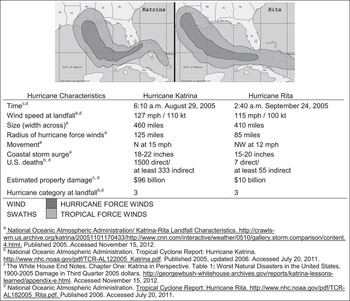
Hurricane Rita was the most intense tropical cyclone observed in the Gulf of Mexico and the fourth most intense Atlantic hurricane ever recorded.1 It struck the US Gulf Coast approximately three weeks after Hurricane Katrina. The storm made US landfall on September 24, 2005 as a category 3 storm (120 mph winds), approximately 257 statute miles west of Hurricane Katrina, just 26 days later (Figure 1).2-4 Rita's proximity and timing with regards to Katrina further stressed regional communities, making their hospitals more vulnerable to the demands of patient care. The proximity and timing of these disasters prompted multiple hospital evacuations.
Hurricanes Katrina and Rita Characteristics

Importance
Prior to 2005, several studies have addressed hospitals’ vulnerability to disasters, and emphasized the need to develop robust hospital evacuation plans.Reference Chavez and Binder5-Reference McGlown8 In the post Katrina-Rita period, increased credence has been given to the complexity of this issue, including in response to Hurricanes Gustav-Ike period (2008) that prompted the largest community evacuations in US history.9-13 Some reports have emphasized developing threat matrixes that facilitate decision making when faced with the choice of sheltering-in-place or evacuating.14-Reference Kader16 The data collected in support of such processes, however, have been obtained in a non-structured or non-transferable format and are often anecdotal and frequently predicated on interviews with single hospital teams in isolated incidents, ie, the data collection tools and research methods lacked consistency and scientific rigor. This study investigates multiple hospitals evacuations using a previously tested, standardized data collection instrument.
Goals of This Investigation
The authors attempted to identify the planning areas that impacted hospital management of evacuations and to compare the challenges faced when sheltering-in-place.
Methods
Study Design and Setting
Investigators initiated this observational, retrospective study eight months following Hurricane Rita's landfall, and completed the data collection in 2006. All facilities were part of the same hospital system and either partially or fully evacuated in preparation for or in response to Hurricane Rita.
Selection of Participants
Eligible hospitals were defined as having conducted either partial or full patient evacuation activities. Participants were identified by an initial screening questionnaire that was distributed system-wide. Participation from all eligible hospitals was encouraged by the system's Chief Executive Officer (CEO). Study participants from these institutions were members of the hospital's Incident Management Team (IMT) and were responsible for decision making and evacuation implementation. Members of each IMT included the Chief Medical Officer, CEO/Administrator, Financial Officer, Nurse Officer (CNO) and Officers of Safety, Operations, or Communications. Other IMT interviewees included the Public Information Officer, Supplies/Materials Manager, and a Human Resources representative. However, not all from this latter group were represented on each hospital IMT. A total of 28 participants were interviewed across the hospital systems.
Interventions and Measurements
Interviews occurred within the hospital Emergency Operations Center (EOC) and lasted for two hours to three and a half hours. The data collection tool, originally designed to benchmark hospitals for evacuation due to earthquakes, was slightly modified for this study to address hospital evacuations due to hurricanes.Reference Schultz, Koenig and Auf der Heide17 All responses were collated and examined by each question and section in standardized quantitative comparisons.
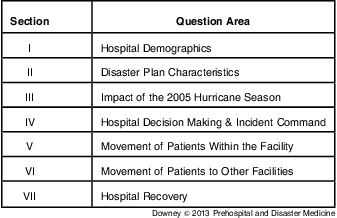
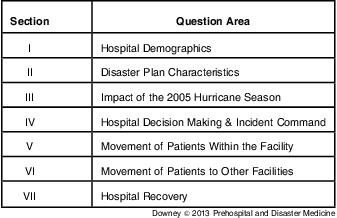
Seven survey question sections were assessed (Table 1). These sections included 95 questions representing 421 benchmarking indicators. The same two investigators interviewed participants consistently across sections, ie, each investigator asked the same question to all IMTs. The measurements made were the groups’ recorded answers to the questions from the tool and are reported here by each consecutive interview section. The study was approved by the hospital system's institutional review board.
Survey Tool Sections
Outcomes
The study's main outcomes were the characterization of the initial challenges hospitals faced in evacuating patients as a result of a hurricane.
Results
Ten hospitals were identified as potentially eligible for the study and seven facilities were found to meet the criteria and agreed to participate. The verbal answers to the questions from the data collection tool were recorded by the same two-person interview team in real time and are listed here in each consecutive section.
Hospital Demographics
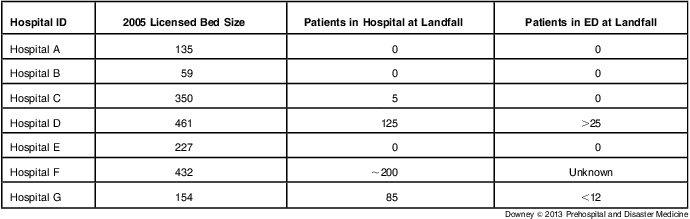
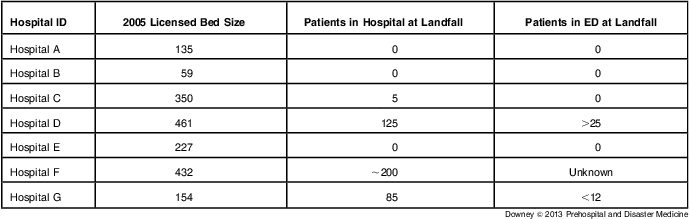
Licensed bed capacities for the seven acute care hospitals ranged from 59-461 (average 260). Five hospitals were in the center of Hurricane Rita's strike path. During landfall, all hospitals had decompressed their patient census to numbers ranging from zero to approximately 200 (the hospital with the most patients was at the periphery of the strike zone). Precise percentage of decompression was not recorded by the hospitals (Table 2). Three hospitals reported evacuation of all patients. All hospitals contained Intensive Care Units (ICUs) that included some combination of Critical Care Units, Medical Intensive Care Units, Surgical Intensive Care Units, or Pediatric Intensive Care Units. Two hospitals had Neonatal Intensive Care Units. The one hospital offering all services was the same hospital that reported having its ED at capacity during landfall.
Hospital Licensed Bed Size and Census
Abbreviations: ED, emergency department
Disaster Plan Characteristics
Each institution reported that its Emergency Operations Plan (EOP) was “all hazards” and addressed the potential of hospital evacuation including movement of patients vertically, horizontally, and off-site to other facilities. The majority of the survey teams reported that their EOPs had evacuation considerations specific to hurricanes (n = 6) and included a combination of the following decision-making indicators: projected landfall time (n = 4), category (n = 3), local jurisdictional recommendation (n = 3), storm positioning (n = 2), and strike zone (n = 1).
Impact of Hurricane Rita on Hospitals
All hospitals had decompressed their patient censuses by discharging patients and canceling/rescheduling elective surgeries in the pre-landfall period. However, all EDs continued to accept and treat patients (via ambulances, walk-ins, etc.) while they were evacuating (one hospital did so with restrictions). Horizontal and/or vertical evacuations were conducted within three hospitals. Five of the seven hospitals reported significant critical resource shortages resulting from the hurricane: electrical power, water resources, staffing, equipment, and supplies. Shortages of one resource negatively impacted others, eg, shortages of generator fuel reduced electrical capabilities and loss of electrical power reduced water pressure. The two remaining hospitals at the periphery of the strike zone did not experience electrical power or water shortages, but did experience staffing shortages.
Hospital EOPs assumed that the need for generator power would last for no more than three days. During Hurricane Rita, however, five hospitals experienced the loss of electrical power for a mean of 4.8 days (range: .5-11 days). The same five hospitals reported that their generators initially bridged the gap of local electrical outages, but issues with dirty fuel, quick connect capabilities, and delay in receiving fuel re-supply were challenging.
Flooding posed a serious threat to the generators; five of seven were located at or below ground level. The most frequently-cited generator flood protection measure was sandbags. One hospital team reported that flood gate measures were in place, and one team reported planning to raise their generator with a jack. Emergency generator power met minimal hospital requirements, but did not broadly support the air conditioning chillers, which increased safety risks due to the condensation that caused wet walls and floors, damaged sensitive electronic equipment, and placed heat stress on the staff and patients.
Potable water resources (bottled) were on-site for all hospitals (one hospital had a 2,000 gallon reserve tank) and four planned to augment their resources with off-site venders. Non-potable water resources were augmented by off-site venders that included the fire department and an aqua center in proximity to the hospital. None of the hospitals had water wells (for either potable or non-potable water), but one hospital reported plans to construct one.
Supply deficits included oxygen, perishable food, pharmaceuticals, and clothing. Service deficits included transportation, fuel and generator delivery, laundry, and in-hospital sleeping accommodations. Clinical staffing deficits included physicians, nurses, radiologists, and laboratory technicians. Nonclinical staffing deficits included security, maintenance, ancillary services, switchboard operators, and case managers. The majority of facilities had nonhospital personnel (such as the National Guard) participate in the evacuation process. For clinical volunteers, hospital teams reported that credentialing verification protocols were in place and followed, but that the process needed improvement.
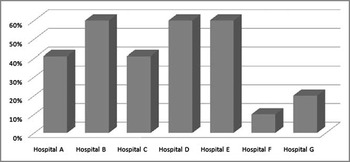
Staffing shortages existed for all hospitals. Three institutions that fully evacuated experienced understaffing of 40%-60% (Figure 2) and four hospitals sustained depressed staffing levels for over four weeks. One hospital established a labor pool by multi-tasking positions and rotating staff. Local jurisdictional evacuation orders created housing problems and loss of essential personnel in some institutions. Incident Management Teams reported the following durations for returning to prehospital staffing levels: 1-2 days (n = 2), 3-4 days (n = 1), 4 or more weeks (n = 3), and 8 or more months (n = 1). Staff was needed after the evacuation was completed to maintain core hospital functions and to support recovery bridging to normal operations.
Staffing Shortages During Hurricane Rita

Hospital Decision Making and Incident Command
Positions authorized to activate the EOP included the Regional CEO, CNO, the Administrator-on-Call, or their designee. Four activations were initiated by an alternate individual filling a role, not by the primary person assigned this task by the EOP. The same positions were responsible for making the decision to evacuate patients. The Hospital Incident Command System (HICS) was a component of four hospital's EOPs and the ICS was activated during evacuation.
Hospital evacuation criteria listed in the EOPs included combinations of internal hospital conditions, weather/environmental conditions and city, parish/county, or state emergency declarations. Criteria to activate hospital evacuation (either partial or full) existed for six of the seven hospitals. Three IMTs used EOP criteria as the basis for their evacuation decision and three IMT used a combination of criteria from both their EOPs and elsewhere. One IMT made the decision to evacuate based on criteria not in their written plan (news information, conference calls with state and parish/county EOCs, and transportation dynamics).
Incident Management Teams reported that their decisions to evacuate would have been facilitated by: community situational awareness (especially regarding other evacuating hospitals) and potential impact to the hospital's structure, corporate recommendations and expectations, status of community transportation resources, and the realization that inadequate family disaster planning would affect staffing capabilities. Incident Management Team members reported that their decision was most influenced by National Oceanic and Atmospheric Administration advisory notices (ie, storm strength, direction, and estimated landfall), mandatory evacuation orders, staff shortages, lack of city services, and local resource depletion.
Movement of Patients within the Facility
Patients were consolidated, either vertically or horizontally, where practical and possible. Movement was accomplished by multiple means with both clinical and nonclinical staff. Physicians, nurses, and patient technicians were the most frequently used human resource but in-hospital volunteers, engineers, security personnel, radiologists, and respiratory therapists also assisted. The majority of patients were moved by gurneys, wheelchairs, beds, or walking. Few were carried. None of the hospitals used evacuation slides. Few human resources outside the hospital's staff were available.
The critically ill and the neonates were the first to be evacuated. Patient movement for evacuation (combined among all hospitals) included: 80 medical/surgical floor patients, at least 33 Intensive Care Unit (ICU) patients, 10 rehabilitation patients, eight Neonatal ICU patients, and two obstetrical patients. One facility combined its ICU patients with Cardiac Care Unit patients for a total of 13 patients. One facility reported having a single patient who was too fragile to evacuate. Incident Management Teams reported that continued patient care was a challenge, given the extreme staffing shortages. No fatalities occurred as a result of patient evacuation.
Power loss did not impact the use of elevators for evacuation, but it is important to note that the evacuation activities were initiated before the arrival of topical force winds. One IMT reported that elevator use for evacuation impeded moving patients quickly (too few elevators created a backup) and one IMT reported that the lack of staging area procedures affected the timely movement of patients. Shortages of staff to oversee patients in staging areas were complicated by long delays while patients waited for transport.
Recovery
At the time of the interviews, three hospitals indicated that revisions to their EOPs were underway. The collective revisions included: development of a hurricane plan with checklists and criteria for activation, evacuation, prolonged and isolated hospital operation, inclusion of HICS, improvements to the patient tracking and medical record transfer, creation of staffing policies, and identification of key personnel for specific roles.
Recovery challenges included:
● difficulty in locating and tracking employees (n = 6);
● lack of familiarity by hospital personnel/decision makers with the EOP (n = 6);
● absence of hospital physicians and staff (n = 5);
● poor community emergency management coordination (n = 4);
● inefficient patient tracking systems (n = 4);
● reduced communication capabilities (n = 4);
● unclear/undefined responsibilities for patient management during disaster (n = 4);
● lack of awareness for community-wide hospital services; (n = 2);
● limited availability of equipment, supplies, and medications (n = 2); and
● deficiency of rapid hospital damage assessment and emergency credentialing of volunteers (n = 1).
Contradictions between community-issued mandatory evacuation orders and simultaneous requests for hospitals to remain open were repeatedly acknowledged.
Issues not specifically identified in the data collection tool included: improved security measures for hospitals, attention to liabilities associated with unauthorized vehicle use, conflicts between hospitals and nonhospital jurisdictions regarding the ultimate authority for hospital evacuation-related decisions, planning related to families and pets, and overreliance on two-way radios for communication.
Discussion
The decision to either evacuate patients or shelter-in-place triggers significant activities and associated risks. To date, limited data on this subject have been gathered in an objective and systematic fashion whereby multiple, simultaneous hospital evacuations are reported and discussed in a standardized context. This study provides such data and offers insight into how hospital teams can improve their management of these incidents.
Disaster Plan Characteristics
Hospital EOPs should anticipate sustained patient surge in their EDs. Emergency Operations Plans should be refined to contain specific indicators to initiate patient decompression, sheltering-in-place, or evacuation activities. The current study suggests that pre-defined evacuation indicators such as projected landfall time, storm category, issuance of mandatory evacuation orders, storm positioning, and estimated strike zone would also facilitate IMT decision making.
Health care facilities should include evacuation drills as a component of preparedness and planning, and augment their drills with training. Emergency preparedness education and tools such the HICS resources can facilitate the development of these drills.18
Impact of Hurricanes on Hospitals
Hospitals should carefully assess the potential demand for generator power during a hurricane and consider that demand in the context of actual functional requirements. Current industry standards encourage hospitals to plan for 96 hours of sustainability that includes power from emergency generators in support of patient care.19 The results of this study suggest that the 96 hour standard currently in place is insufficient. Hospitals should secure generator fuel supplies through local distributors, and alert them to impending incidents. Contingency plans for obtaining additional fuel and fuel filters should also be identified.
Generator protection strategies should incorporate threat-specific risks such as tidal surges or fresh water flooding. Sandbags may be an effective flood measure in less extreme situations, but generators ideally should be raised above ground level. Doing so, however, tends to be cost prohibitive. Given the increased threat of hurricanes, reaching a reasonable solution for the provision of hospital generator power is paramount to not only supporting health care facilities during incidents, but in averting potential legal implications and consequences following an incident.20
Chillers are a key component of the heating, ventilation, and air conditioning system and should be supported by emergency generators. High interior temperatures and humidity may cause floors and walls to sweat, creating sterilization and safety hazards that further stress the patient care environment during disasters. Staff sleeping accommodations should support utilization for extended periods and be included in the temperature-controlled areas. Sufficient water supply estimates for potable and non-potable use should also be incorporated into the planning for both hospital staff and patient needs.
Maintaining adequate hospital staffing is an endemic, well-documented problem.Reference Barbera, Macintyre and DeAtley21-23 In this study, the IMTs recommended improvements to human resources and staffing policies. These included improved emergency communication messaging, patient and staff tracking, clarified expectations, required personal preparedness plans (that include family and pets), and assigned shift-work expectations in advance. The IMTs indicated that these policies would improve the ability to predict human resource requirements and determine subsequent response and recovery capabilities.
Hospital Decision Making and Incident Command
Facilities that received funding from the Hospital Preparedness Program had initiated implementation of the National Incident Management System (NIMS), but were not required to have completed the process.24, 25 Most hospitals were aware of the Joint Commission requirements for the inclusion of an incident command structure in their EOPs, with HICS being a “best practice” example. In this study, three hospitals did not utilize HICS during the evacuation. For the four facilities that did, the decision to evacuate was made by an individual filling the role of Incident Commander under HICS, not by the primary person authorized for this responsibility. This finding potentially demonstrates the effectiveness of a hospital incident management system.
Movement of Patients within the Facility
Moving patients requires documentation. This process was frequently cited as problematic because hospitals attempting to move patients in anticipation of Rita were also experiencing patient surge from Hurricane Katrina evacuees. Patient movement strategies should include both horizontal and vertical logistical considerations that do not fully rely upon elevator use. Patient consolidation strategies should also include the use of both medical and nonmedical personnel, since reduction in staff will occur, and few if any resources will exist outside the hospital to facilitate this effort.
Patient-staging strategies should be in place prior to an incident and should address both all-hazards and hazard-specific considerations. Supporting policies should include provision for unique patient care service needs and include both safety and security considerations.
Recovery
Hospital IMTs discussed recovery as a function of both their preparedness level and how well the EOP, as a tool, facilitated their decision making. Clearly, delineating staff expectations is crucial; staffing policies for shift work and personal plan development impacted the availability of staff and ultimately the resumption of patient services. Reassessing the disparity between anticipated and actual electrical and water needs is also critical to resuming operations. Rapid damage assessments that consider original and refurbished structural integrity as part of the EOP would expedite the hospitals ability to safely re-open as well.
Limitations
The data were collected in a prospective manner using real time interviews. However, the investigators were constrained by the overall retrospective nature of the study that included a four to six month delay in getting study approval and conducting interview sessions. While the same researchers were able to interview IMTs of seven evacuated hospitals in this system, the sample size was relatively small and therefore not large enough to establish statistical significance. Nonetheless, the systematic approach to data collection from multiple hospitals responding to the same event provides a degree of evidence not currently available. Lastly, as data were collected, it became clear that future studies might benefit from enhancements to the survey tool such as incorporating terminology that is consistent with hospital ICS (at the time of these data collection it was not required). Further, count specifics, such as staff and patient characteristics would provide an enhanced perspective of the challenges faced. This revision to the data collection tool would improve its construct validity.
Conclusion
This study involved a standardized assessment process to identify decision-making indicators that can assist EOP development and hospital IMT decision making during the potential evacuation due to a hurricane. It provided an initial benchmark of seven hospitals in a similar evacuation context so that initial decision making prior to evacuation could be assessed and best practice recommendations can be provided. Enhancement to the data collection tool (eg, detail regarding restrictions to accepting patients, credentialing verification process challenges, HICS use) as it applies to hospital EOP improvement may contribute to strengthening hospital resilience during crisis, and ultimately the field of disaster science.