Advances in the surgical and medical management of children and adolescents with congenital or acquired heart disease have resulted in significant reductions in mortality, but paradoxically a greater number of children and adolescents are now living with the morbidity associated with the underlying cardiac lesion and/or its treatment. Such morbidity may affect psychosocial,Reference Wray and Sensky 1 – Reference Karsdorp, Everaerd and Kindt 3 neurodevelopmental,Reference Forbess, Visconti and Hancock-Friesen 4 , Reference Snookes, Gunn and Eldridge 5 and physical functioning,Reference Limperopoulos, Majnemer and Shevell 6 , Reference Mahle, McBride and Paridon 7 with a resulting impact on health-related quality of life.Reference Wernovsky 8 Outcome assessment focusing on health-related quality of life has therefore become increasingly important, particularly because it can provide information that may improve clinical decision making. Furthermore, health-related quality of life measures are frequently being included as outcomes in clinical trials, and more recently their use as a patient-reported outcome measure has been advocated.Reference Fitzpatrick, Davey and Buxton 9 Increasingly, such measures are being included as part of routine care as the need for improvements in patient care and optimisation of resource allocation become more apparent.
Health-related quality of life has been defined as “the specific impact of an illness or injury, medical treatment, or health care policy on an individual's quality of life”Reference Drotar 10 and included within this is the individual's perception of the impact of their disease or condition on their physical health status, psychological and social functioning, and emotional well-being both in terms of their ability to function within these domains and their satisfaction from doing so.Reference Naughton and Shumaker 11 , Reference Eiser and Morse 12 Health-related quality of life can be measured using generic or disease-specific measures, with advantages and disadvantages to both. However, disease-specific measures may provide a more comprehensive view of a particular disease or condition, be more sensitive to change over time, and be more able to discriminate between different disease subgroups. In order to assess outcomes in a paediatric cardiac population and evaluate changes as a result of specific therapeutic regimens, a reliable and valid disease-specific measure of health-related quality of life is required.
The development and testing of any new psychometric instrument is a time-consuming, multi-stage process, the results of which need to be understood if one is making inferences based on scores derived from the measure. Quality criteria have been proposed for assessing the measurement properties of health status questionnaires,Reference Terwee, Bot and de Boer 13 including validity – content, construct, and criterion – reliability, and responsiveness.Reference Streiner and Norman 14 , Reference Koot and Wallander 15 A further important aspect is the generalisability of the measure to populations other than the specific population with which it was developed, which may include different geographical regions or patient populations.Reference Messick 16 Different approaches to establishing generalisability have been adopted, including the comparison of aspects such as response option variability, patterns of correlation and reliability between populations from different sites or locations.
The Pediatric Cardiac Quality of Life Inventory was developed at the Children's Hospital of Philadelphia,Reference Marino, Shera and Wernovsky 17 and is a brief, disease-specific quality of life measure for children and adolescents with heart disease. It covers the age range of 8–18 years, is self-administered, and exists in participant and parent-proxy formats. Following translation for use in the United Kingdom, the linguistic validity of the British version has been established.Reference Wray, Franklin and Brown 18 In both the United StatesReference Marino, Tomlinson and Wernovsky 19 and the United Kingdom,Reference Wray, Franklin and Brown 20 large multi-centre cohort studies have demonstrated that the measure is reliable – assessed by test–retest reliability – and internally valid – measured by a construct validity model incorporating correlations of scores with disease severity, medical care utilisation, and established generic quality of life and behavioural measures, and cross-informant variance – and its generalisability has recently been established in the United States.Reference Marino, Drotar and Cassedy 21
The purpose of the present study was to demonstrate the generalisability of the Pediatric Cardiac Quality of Life Inventory in the United Kingdom, by comparing item response option variability, total and subscale scores, patterns of correlation, and internal consistency between the three centres.
Methods
Study design
This was a prospective, multi-centre, cross-sectional study of children and adolescents with congenital or acquired heart disease and their parent/guardian. The study was approved by the Brompton Harefield and National Heart and Lung Institute Ethics Committee.
Subject selection and recruitment
Participants were recruited from three large paediatric tertiary cardiac centres – The Royal Brompton and Harefield NHS Foundation Trust, Great Ormond Street Hospital for Children NHS Foundation Trust, and Birmingham Children's Hospital NHS Foundation Trust – in the United Kingdom between September, 2007 and August, 2009. Children undergoing surgery at these three centres represent ∼35% of the population of children undergoing cardiac interventions for congenital heart disease in the United Kingdom. 22
Patients were eligible for participation if they had a known diagnosis of congenital or acquired heart disease, were fluent in English, were aged 8–18 years, and were under routine follow-up at one of the three centres. Patients who had a significant comorbid physical or mental health condition, major developmental delay, or had a recent acute change in their cardiac status necessitating a non-routine clinic attendance or other medical intervention were excluded. Parents – an inclusive term for parents and guardians – were excluded if they were unable to give informed consent. Parents and young people aged 16 years and older gave written consent to participate and younger patients were asked to assent.
Data collection
A research assistant administered the Pediatric Cardiac Quality of Life Inventory and other questionnaires to the patient and parent and, in order to minimise data contamination resulting from patient and parent discussion, supervised the completion of the questionnaires. The investigator read the questionnaire to any participants who were unable to read.
Demographic information about both the patients and their parents was obtained from parent report, and clinical data – diagnosis, medical, and surgical history – were retrieved from the medical notes.
Statistical analysis
Data on the reliability and validity of the Pediatric Cardiac Quality of Life Inventory in the United Kingdom have been reported previouslyReference Wray, Franklin and Brown 20 and serve as the basis for the generalisability analyses presented here. Four stages of analysis were undertaken:
-
• Descriptive statistics were computed for all relevant demographic and clinical variables from the three centres. Six specific clinical variables were chosen for further analysis because of their relevance for families and clinicians. Chi-squared or Wilcoxon rank-sum tests were applied, dependent on the nature of the data. The type 1 error (α) was adjusted to 0.008 to account for the correlational nature of the clinical variables.
-
• Response option variability was individually assessed using simple and relative frequency measurements for each item on the questionnaire for each respondent group – child, parent of child, adolescent, and parent of adolescent – of each centre. Item responses were on a five-point Likert scale and if any item on any form from any centre had a single response option comprising 90% or more of the item's selected responses it was identified as potentially problematic and investigated further. Such items do not have enough variability to add significant meaning to the sum scores generated.
-
• The psychometric properties of the questionnaire were evaluated by comparing the sample from each centre by respondent group. Total and subscale scores were compared, and median Spearman correlations were computed for item–subscale, item–total, subscale–subscale, and subscale–total. In each case derived scale scores were computed with the exclusion of the item response being analysed.
-
• Internal consistency for each respondent group was assessed using Cronbach's α coefficient analysis of the total score and each of the subscale totals. Values of Cronbach's α of >0.70 were considered internally consistent.Reference Marino, Tomlinson and Wernovsky 19
All data were analysed using SAS v9.1. An a priori significance level of p < 0.008 was used for all statistical comparisons. Correlations were interpreted as ≤0.20 poor; 0.21–0.40 fair; 0.41–0.60 moderate; 0.61–0.80 good; and ≥0.81 excellent agreement.
Results
Demographic characteristics
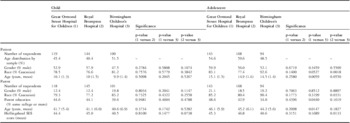
A total of 1537 patients and parents were evaluated (consent rate: 86%), 625 of whom were recruited from the Royal Brompton Hospital, 523 from Great Ormond Street Hospital, and 389 from Birmingham Children's Hospital. Demographic data for both patients and parents are shown in Table 1. Although there were no significant differences on any demographic variables between parents or child respondents from the three centres, adolescents from Great Ormond Street were significantly older than those from Birmingham Children's Hospital (p = 0.0059) and there were significantly fewer Caucasian adolescents from the Royal Brompton Hospital compared with Birmingham Children's Hospital (p = 0.0018).
Subject demographic variables at each of the three sites.

SES = socio-economic status
Response option variability
No response option on any item was chosen by more than 90% of respondents. The ranges for the highest response option percentages were 26–68% for Great Ormond Street, 24–73% for the Royal Brompton Hospital, and 25–65% for Birmingham Children's Hospital.
Comparisons of total score and subscale correlations
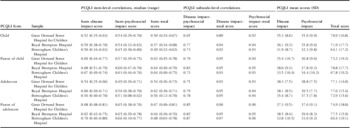
There were no significant differences between the three centres in terms of total score and subscale correlations. All median item–subscale score and item–total score correlations were moderate or good for all centres. Correlations between subscale–subscale and subscale–total were good or high for each centre and correlation patterns were similar. Mean subscale and total scores were not statistically different across the groups, although there was a trend for patients from Birmingham Children's Hospital to have lower scores than patients from either of the other two centres on both self and proxy ratings (Table 2).
PCQLI item, subscale, and score comparisons between the three sites.

PCQLI = Pediatric Cardiac Quality of Life Inventory; SD = standard deviation
Internal consistency
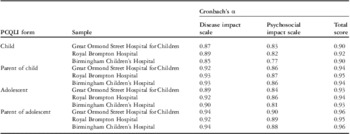
Measures of internal consistency were high (0.83–0.96) across all forms – child, adolescent, parent of child, and parent of adolescent – for each sample and the samples were indistinguishable (Table 3).
Internal consistency of subscales and total score on the PCQLI at the three sites.

PCQLI = Pediatric Cardiac Quality of Life Inventory
Clinical variables
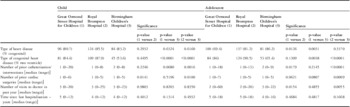
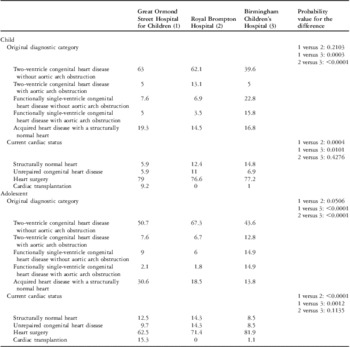
The three samples differed with respect to the type of heart disease, that is, congenital versus acquired; the type of congenital heart disease, that is, two ventricle versus functionally single ventricle; number of previous catheterisations/interventions; number of previous cardiac surgeries; number of visits to the doctor in the previous year; original diagnostic category; and current cardiac status (Table 4). The samples from Great Ormond Street Hospital and the Royal Brompton Hospital differed only on current cardiac status, primarily because of the larger proportion of patients with either structurally normal hearts or unrepaired congenital heart disease at the Royal Brompton Hospital and the greater proportion of patients who had undergone cardiac transplantation at Great Ormond Street Hospital (Table 5). The main difference between the samples from Birmingham Children's Hospital compared with the other two samples was the significantly higher proportion of children and adolescents with functionally single-ventricle conditions at Birmingham Children's Hospital and their resulting higher medical care utilisation – number of previous cardiac catheterisations, cardiac surgeries, and visits to the doctor in the previous year.
Patient clinical variables at each site.

Percentage values for original diagnostic category and current cardiac status: comparison between the three sites.

Discussion
This study demonstrates that the Pediatric Cardiac Quality of Life Inventory, a disease-specific quality of life measure for children and adolescents aged 8–18 years with heart disease, is generalisable in the United Kingdom. The demographic characteristics of the three samples were broadly comparable, although the adolescent sample from Birmingham Children's Hospital differed on mean age and race from the samples of Great Ormond Street and the Royal Brompton Hospital, respectively. However, comparison of the three samples indicated statistically significant differences on a number of the clinical variables. In part, this reflected some of the variability in referral patterns for children and adolescents with heart disease, together with differences between the centres in terms of procedures undertaken. For example, cardiac transplantation is not performed at all the centres, and Birmingham Children's Hospital, in particular, receives a large number of referrals for the treatment of hypoplastic left heart syndrome. Such variation is also likely to be the reason why the samples differed on medical care utilisation variables, with those children with functionally single-ventricle conditions more likely to have had a greater number of cardiac catheterisations and cardiac operations. Despite the differences in the clinical characteristics of the three samples, the similarities in response option variability, patterns of correlations, and internal consistency further support the generalisability of the Pediatric Cardiac Quality of Life Inventory to other populations of children and adolescents with heart disease in the United Kingdom. In contrast, the differences in clinical characteristics are likely to explain the trend of lower subscale and total scores of the children and adolescents from Birmingham Children's Hospital on the Pediatric Cardiac Quality of Life Inventory because of the higher proportion of patients with functionally single-ventricle conditions from this centre compared with the other two.
Other published disease-specific quality of life instruments for children and adolescents with heart disease have little or no data to support their generalisability for use in the United Kingdom. Two of the measures – the PedsQL Cardiac moduleReference Uzark, Jones and Burwinkle 23 and the Congenital Heart Adolescent and Teenager QuestionnaireReference Kendall, Lewin and Parsons 24 – were developed at single centres in North America and there are no published data for their wider use. The ConQoLReference Macran, Birks and Parsons 25 was developed with a sample of 640 children and adolescents with congenital heart disease from six centres in the United Kingdom. Testing of the measure was achieved via postal completion, with response rates for the centres varying between 41% and 53%, but there are no published data comparing the data from the six centres. Owing to the lack of published generalisability data for all of these measures, their use outside the sites where they were developed may not generate quality of life data that are reliable or valid.
There are some limitations that need to be taken into consideration. First, although the racial representativeness of the study population within the wider population of the United Kingdom is supported – census data suggest that 87.9% of the population are White 26 – some potential participants were ineligible because they did not speak English. The results may therefore only be generalisable to English-speaking children and adolescents with heart disease. Furthermore, all the three centres were in England, and although there were some patients from Wales and Scotland included in the sample the broader applicability of the measure outside England to the wider United Kingdom may be limited. However, the similarity of educational systems throughout the United Kingdom suggests that there is unlikely to be a significant difference between the countries. Finally, although consistent with other studies – including the sample from the United States – the majority of parent respondents were female and the socio-economic status of the parent respondent samples was above average.
The increasing requirement for multi-centre studies and the use of health-related measures as outcomes in clinical trials, either within a single country or cross-nationally, has highlighted the need for measures that are valid, reliable, and comparable across multiple sites. Using instruments that have proven generalisability is often neglected but is a core requirement if the results of a study are to be meaningful. The demonstration of the external validity of the Pediatric Cardiac Quality of Life Inventory in the United Kingdom together with the internal validity and reliability reported previously indicate that it is a suitable and appropriate measure for assessing health-related quality of life in children and adolescents with heart disease. As mortality rates continue to fall and the emphasis on morbidity and quality of life outcomes increases, the Pediatric Cardiac Quality of Life Inventory will be a useful and effective tool for assessing the impact of treatments and other heart-disease related factors on quality of life.
Acknowledgements
The following people and organisations participated in the enrollment of patients, data collection, data entry or study coordination: Royal Brompton and Harefield NHS Trust: Laura Casale, Annabel Bryant, Sue Holmes and Annette Waye; Great Ormond Street Hospital: Sophie Guy, Claire Orrells; Birmingham Children's Hospital: Jessica Arkley, Hatice Tin, Germaine Ingley, Rachael Mulcare, Ameera Zumla and Katie Morton; Cincinnati Children's Hospital Medical Center: Charlotte Andersen, Katelyn Mellion, Jackie Sage and Mary Berger; and staff at Little Hearts Matter and The Cardiomyopathy Association.
Funding: This study was supported by a philanthropic donation from an Angel Donor in the UK. Project support in the US was provided by the National Institute of Child Health and Human Development, the American Heart Association, Pennsylvania/Delaware Affiliate, the Cincinnati Children's Hospital Research Foundation, and the Children's Hospital of Philadelphia Institutional Development Fund.