Introduction
Information on the helminth fauna of carnivores, which occupy the highest positions in food chains, is still fragmentary, especially in the grey wolf Canis lupus L. In the Polish parasitological literature, data on parasites of non-captive wolf are limited to three contributions, two of them published several decades ago. Furmaga & Wysocki (Reference Furmaga and Wysocki1949) reported the presence of over 1000 helminth specimens in a dissected wolf. Sołtys (Reference Sołtys1964) studied the parasite fauna of several wolves shot in the region of Lublin and the Białowieża Forest, and noted a 100% helminth infection rate. The only recent paper containing a review of the helminth fauna of wild wolf is that by Kloch & Bajer (Reference Kloch and Bajer2003), based on a coprological analysis of wolves from the southern part of the Mazurian Lakeland. Equally scanty data from Europe, Asia and North America have been summarized recently by Mech & Boitani (Reference Mech and Boitani2003) and Craig & Craig (Reference Craig and Craig2005). From neighbouring countries of Poland, the following papers can be mentioned: Shimalov & Shimalov (Reference Shimalov and Shimalov2000) from Belarus; Casulli et al. (Reference Casulli, La Rosa, Amanti and Pozio2001) from the European part of Russia; and Martinek et al. (2001) from Slovakia. The parasite fauna of the grey wolf in Europe has also been examined by Papadopoulos et al. (Reference Papadopoulos, Himonas, Papazahariadou and Antoniadou-Sotiriadou1997) in Greece; Segovia et al. (Reference Segovia, Torres, Miquel, Llaneza and Feliu2001, Reference Segovia, Guerrero, Torres, Miquel and Feliu2003) in Spain; and Guberti et al. (Reference Guberti, Stancampino and Francisci1993) in Italy. Knowledge of the parasite fauna of Nearctic wolves seems to be more comprehensive, especially in Canada (Holmes & Podesta, Reference Holmes and Podesta1968; Choquette et al., Reference Choquette, Gibson, Kuyt and Pearson1973; Samuel et al., Reference Samuel, Ramalingam and Carbyn1978), USA (Byman et al., Reference Byman, Van Ballenberghe, Scholotthauer and Erickson1976; Archer et al., Reference Archer, Taft and Thiel1986; Zarnke et al., 1999) and Greenland (Marquard-Petersen, Reference Marquard-Petersen1997).
In Poland the wolf occurs mainly in the Carpathians and large forest systems of the north-eastern and eastern parts of the country. Very few wolves live in suboptimum habitats – a mosaic of fields and small forests, or margins of heavily urbanized areas (Nowak & Mysłajek, Reference Nowak, Mysłajek, Broda and Mastaj2003; Jędrzejewski et al., Reference Jędrzejewski, Niedziałkowska, Nowak and Jędrzejewska2004). In central and western Poland the wolf is uncommon, and the total population in 2001 was estimated to be 550 (Jędrzejewski et al., Reference Jędrzejewski, Schmidt, Theuerkauf, Jędrzejewska, Selva, Zub and Szymura2002). The wolf has been a protected species since 1998, although the recolonization of areas where it had been exterminated in earlier times has been very slow. This results mainly from a variety of human barriers, which slow down or preclude migrations (Jędrzejewski et al., Reference Jędrzejewski, Niedziałkowska, Nowak and Jędrzejewska2004, Reference Jędrzejewski, Niedziałkowska, Mysłajek, Nowak and Jędrzejewska2005). Because the wolf is strictly protected in Poland, coprological examination is the only method that can be used to determine levels of helminth infection.
Materials and methods
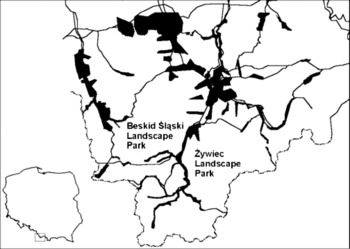
The studies were carried out in 2002–2004, in the Beskid Śląski Landscape Park (BSL, area 386 km2) and Żywiec Landscape Park (ZL, 359 km2). The area is located in the westernmost part of the Polish Carpathians, near the Slovak and Czech border (fig. 1). The landscape parks, which include mountain massifs exceeding an altitude of 1200 m, are separated by the densely populated Soła River valley, with numerous roads and villages. The estimated wolf population includes five packs, three inhabiting ZL and two, BSL (Nowak & Mysłajek, Reference Nowak, Mysłajek, Broda and Mastaj2003). The territories of the packs in ZL include forests, which are more compact and more remote from human habitations, while wolves in BSL live in forests more fragmented by urbanized areas with a well-developed tourist infrastructure.
Faecal samples from the two collecting sites Beskid Śląski Landscape Park (BSL) and Żywiec Landscape Park (ZL) in the western Beskidy Mountains.

During regular field trips in 2002–2004, 89 samples of wolf faeces were collected, 59 from BSL and 30 from ZL. In winter we gathered scats during the snowtracking of wolves and checking their resting places, while in summer we inspected forest roads or tourist paths, and visited abandoned pup-rearing places or rendezvous sites, which had been identified earlier by a howling stimulation method. During the study period no stray dogs were recorded other than dogs travelling with tourists or forest workers. To avoid confusion between the faeces of foxes or other carnivores (domestic or feral dogs) and wolf faeces, only scats that were typical for wolves (more than 3 cm diameter, containing large pieces of bones, hooves and hair, and having a characteristic smell) were collected, or those faeces found near other evidence of the presence of wolves, e.g. wolf tracks on mud or wolf prey. Most faeces collected were fresh, and samples (2–4 g each) were placed in plastic containers and preserved in 4% formalin.
In the laboratory, samples were examined for the presence of parasite eggs/larvae, using the standard decantation method (Thienpont et al., Reference Thienpont, Rochette and Vanparijs1986). Egg identification was based on morphological characteristics (shape and structure of shell) and measurements. The prevalence and intensity of infection were calculated based on Bush et al. (Reference Bush, Lafferty, Lotz and Shostak1997). In order to assess the species richness of the wolf parasite fauna (component communities = all parasite species exploiting the same host population) in the two studied areas, a species accumulation curve and non-parametric estimates of species richness were applied (Poulin, Reference Poulin1998; Krebs, Reference Krebs1999). The estimators used (Chao2 and Bootstrap; for formulas, see Colwell, Reference Colwell2004) made it possible to calculate species richness irrespective of the proportion of rare and accessory species, based on data expressed as present (1) and absent (0), and for differing and small sample sizes (Poulin, Reference Poulin1998; Walther & Morand, Reference Walther and Morand1998). Species diversity was estimated with the Shannon–Weaver index, and the significance of differences between its values in the compared populations were tested with the non-parametric Mann–Whitney U-test. The normality of distribution was tested with Shapiro–Wilks' W-test. Calculations were performed using the programs EstimateS 7 (Colwell, Reference Colwell2004) and Statistica 7.1 (StatSoft Polska, Kraków).
Results and discussion
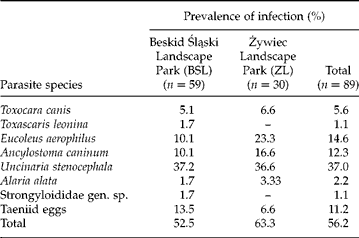
Among 89 samples collected, 50 contained eggs of nematodes, tapeworms and flukes. The total prevalence of heminth infection was 56.2%. The list of wolf parasites found in BSL and ZL is shown in table 1. Among the recorded parasites there were six nematodes, the remaining two were fluke and taeniid eggs.
Prevalence of infection (%) with gastrointestinal helminths in wolves from the two survey areas Beskid Śląski Landscape Park (BSL) and Żywiec Landscape Park (ZL) in the western Beskidy Mountains.
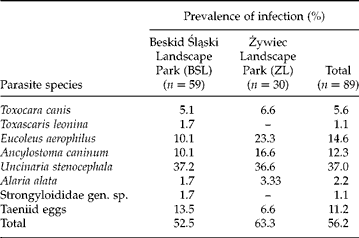
The most frequently recorded parasites were hookworms, especially Uncinaria stenocephala, the eggs of which were found in 37% of samples. The indices of infection with this nematode did not differ much between the two areas (BSL, 37.2% versus 36.6%, ZL), with a slightly higher prevalence in the packs from BSL. Uncinaria stenocephala was previously recorded in the wolf, both in Poland (Sołtys, Reference Sołtys1964; Kloch & Bajer, Reference Kloch and Bajer2003) and other European countries (Guberti et al., Reference Guberti, Stancampino and Francisci1993; Papadopoulos et al., Reference Papadopoulos, Himonas, Papazahariadou and Antoniadou-Sotiriadou1997; Shimalov & Shimalov, Reference Shimalov and Shimalov2000; Segovia et al., Reference Segovia, Torres, Miquel, Llaneza and Feliu2001; Craig & Craig, Reference Craig and Craig2005) as well as in North America (Holmes & Podesta, Reference Holmes and Podesta1968; Choquette et al., Reference Choquette, Gibson, Kuyt and Pearson1973; Byman et al., Reference Byman, Van Ballenberghe, Scholotthauer and Erickson1976; Mech & Boitani, Reference Mech and Boitani2003). The prevalence of infection with another hookworm, Ancylostoma caninum, was much lower, only 12.3%. The indices for the two populations were different, with a higher prevalence in the ZL population. Although separation of eggs of U. stenocephala and A. caninum is difficult and omitted by some authors, in our opinion it is possible. A detailed morphological, and especially biometrical, analysis of the eggs revealed clear differences in their size: in U. stenocephala they were 68–72 × 43–50 μm and in A. caninum 50–62 × 28–40 μm. Egg size and morphology in the two species are compatible with data reported by Thienpont et al. (Reference Thienpont, Rochette and Vanparijs1986) and Foreyt (Reference Foreyt2001). A similar approach and methodology of egg identification can be found in Byman et al. (Reference Byman, Van Ballenberghe, Scholotthauer and Erickson1976) and Gompper et al. (Reference Gompper, Goodman, Kays, Ray, Florello and Wade2003). From a review of literature based on necropsy sections, the two nematode species are found in wolves from various parts of Europe and North America, and the differences in prevalences between the two species in the present work (U. stenocephala 37% versus A. caninum 12.3%) agree with the reported studies based on necropsies. For example, Segovia et al. (Reference Segovia, Torres, Miquel, Llaneza and Feliu2001) examined 47 wolves from Spain and reported a higher prevalence of U. stenocephala (51.1%) compared to A. caninum (8.5%) and Shimalov & Shimalov (Reference Shimalov and Shimalov2000) in Belarus found a prevalence of 15.4% (U. stenocephala) and 13.5% (A. caninum).
Eucoleus aerophilus has not previously been recorded from wolves in Poland. In the present case it was found in 14.6% of samples; the species was twice as frequent in samples from ZL than from BSL. This nematode has a direct life cycle but can utilize paratenic hosts such as oligochaetes of the genera Lumbricus, Allolobophora and Bimestus (Anderson, Reference Anderson2000). Eucoleus aerophilus has been found to occur in wolves in Belarus and Canada (Holmes & Podesta, Reference Holmes and Podesta1968; Shimalov & Shimalov, Reference Shimalov and Shimalov2000).
Toxocara canis and Toxascaris leonina were not found frequently in our material. Eggs of T. canis were detected in only 5.6% of samples, and the prevalence was similar in the two studied populations. Although it was not confirmed in this paper, T. canis is one of the most common parasites of both wild and domestic canids. In Poland and in other countries of Europe and America, this nematode has been recorded in many reported studies (Mech & Boitani, Reference Mech and Boitani2003; Craig & Craig, Reference Craig and Craig2005). The relatively low prevalence of T. canis in our studies may not reflect the actual prevalence of this parasite in the wolf. The present results (5.6%) correspond with other data based on coprological analysis: 7.7% from Poland (Kloch & Bajer, Reference Kloch and Bajer2003) or 1% from the USA (Byman et al., Reference Byman, Van Ballenberghe, Scholotthauer and Erickson1976). However, the values based on necropsies are usually much higher, e.g. 17% in Italy, 16.6% in Greece or 21.2% in Belarus (Guberti et al., Reference Guberti, Stancampino and Francisci1993; Papadopoulos et al., Reference Papadopoulos, Himonas, Papazahariadou and Antoniadou-Sotiriadou1997; Shimalov & Shimalov, Reference Shimalov and Shimalov2000). According to Kloch & Bajer (Reference Kloch and Bajer2003) this may suggest that the eggs could be washed out of the faeces; for example, by rain or thawing snow.
Toxascaris leonina was one of the least frequent parasites in the wolf. Such a low prevalence of 1.1% is surprising, as this nematode has direct transmission via larvated eggs or via paratenic hosts such as rodents. In Poland Kloch & Bajer (Reference Kloch and Bajer2003) described the parasite in 1.9% of faecal samples, in Spain and Belarus the corresponding values were 4.3% and 13.5% of necropsied wolves (Segovia et al., Reference Segovia, Torres, Miquel, Llaneza and Feliu2001; Shimalov & Shimalov, Reference Shimalov and Shimalov2000) and in Canada prevalences ranged from 9 to 80% (Holmes & Podesta, Reference Holmes and Podesta1968; Choquette et al., Reference Choquette, Gibson, Kuyt and Pearson1973; Samuel et al., Reference Samuel, Ramalingam and Carbyn1978). Also, a recent analysis of T. leonina in wolves by Craig & Craig (Reference Craig and Craig2005) showed a clear disproportion in the frequency of the nematode in the Nearctic and Palaearctic regions (prevalence 27 versus 9.7%). In the present case the dominant components of the wolves' diet are ungulates, which constitute 95% of the food biomass (Nowak et al., Reference Nowak, Mysłajek and Jędrzejewska2005). This may suggest difficulties in completing the life cycle based on rodents as paratenic hosts, which would explain the low prevalence of T. leonina in the wolf.
The finding of a single egg in wolf faeces with a structure and size (64 × 40 μm; ellipse, single and thin wall, including short and narrow larva) corresponding to those of strongyloid nematodes is rather unexpected. However, there are rare cases of the possibility of eggs of Strongyloides stercoralis being found in domestic or wild canids, including wolves (Bruski & Stewart, 2000; Foreyt, Reference Foreyt2001; Gundłach & Sadzikowski, Reference Anderson2004).
The fluke found in our samples was Alaria alata, which has been found in Poland in 78% of wolves only during necropsies (Sołtys, Reference Sołtys1964), and in 13% and 2.1% of wolves in Belarus and Spain, respectively (Shimalov & Shimalov, Reference Shimalov and Shimalov2000; Segovia et al., Reference Segovia, Torres, Miquel, Llaneza and Feliu2001). In the life cycle of Alaria, the main role is played by amphibians and small rodents. The low prevalence (2.2%) and the fact that only a single egg was found confirm the small proportion of small vertebrates in the wolf diet in BSL and ZL (Nowak et al., Reference Nowak, Mysłajek and Jędrzejewska2005). Mesocercariae of A. alata have been observed in wild boar muscles in Spain and this seems to be a more likely source of wolf infection (Segovia et al., Reference Segovia, Guerrero, Torres, Miquel and Feliu2003).
Taeniid eggs were found in 11.2% of samples, but the morphological and biometrical characteristics did not permit an unequivocal identification. Because of the partial maceration of eggs, significant criteria, such as the absence/presence of an egg capsule or thickness of the embriophore, could not be observed. Prevalence indices in the two studies areas were clearly different, with tapeworm eggs found in 13.6% of samples in BSL and in 6.6% in ZL.
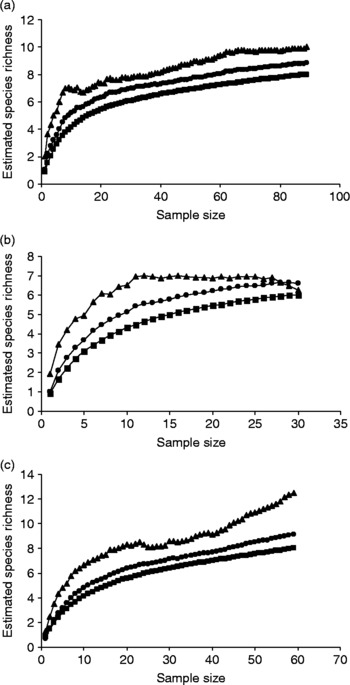
Curves of species accumulation for component communities of the parasites of wolves from the two areas and from all faecal samples did not reach an asymptote, thus indicating the presence of some additional species not recorded in this study. The species richness estimator Chao2 showed that by analysing all 89 samples, the number of species detected through coprological analysis was 10 ( ± 3.74). The value calculated with a more conservative Bootstrap estimator was 8.87 (fig. 2a). Considering the observed number of species (8), it can be concluded that most wolf endoparasites are detectable with coprological methods. Examining additional samples would not increase the species list in any significant way. The parasite component community of wolves from ZL proved to be equally well studied. Similar values of actual (6) and estimated species richness (Chao2, 6.25 ± 0.73; Bootstrap, 6.62) are indicated, with a small standard deviation (fig. 2b). The endoparasite component community from BSL proved to be less thoroughly studied, as evidenced by a greater difference between the observed (8) and the estimated species richness (Chao2, 12.5 ± 0.02; Bootstrap, 9.4) and the course of the curves (fig. 2c). The results indicate the necessity of examining additional samples from BSL.
Species richness estimates predicted for helminth component communities: (a) both sites combined; (b) Żywiec Landscape Park (ZL); (c) Beskid Śląski Landscape Park (BSL). Three curves are shown on each graph. The lower curves are based on the number of observed species (equivalent to the species accumulation curve which will merge with the total species richness asymptote), and the two others show the results of the Chao2 and Bootstrap non-parametric estimators of species richness. ■, observed; ▲, Chao2 estimator; ●, Bootstrap estimator.

The distribution of the Shannon–Weaver values was significantly different from normal. The population from BSL had higher species diversity that that from ZL. These differences were statistically significant at P < 0.001 (Mann–Whitney U-test, Z = − 3.45, n 1 = 59, n 2 = 30).
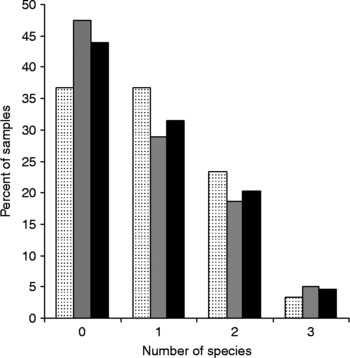
Among all 89 samples, 31.4% contained one parasite species, 20.2% two species and only 4.5% contained three parasite species. In 43.8% of samples, no helminth eggs were found (fig. 3). An almost identical distribution of parasites was found in the faeces of wolves inhabiting BSL, but the distribution was marginally different in the ZL samples. The proportion of samples with none or only one parasite species was the same (36.6%). On the other hand, 23.3% of samples from ZL contained eggs of two, and only 3.3% contained three confirmed parasite species.
The number of parasite species identified per sample in the two collecting sites Beskid Śląski Landscape Park (BSL) and Żywiec Landscape Park (ZL) in western Beskidy Mountains. Black bars, total; grey bars, BSL; dotted bars, ZL.

The degree of helminth invasion in the wolves from the two studies areas was similar, as indicated by the prevalence values (BSL, 52.5% versus ZL, 63.3%). The index was slightly higher in ZL, while the diversity and richness indices were higher in BSL. A factor that may influence the observed differences is the proximity of human settlements (in the case of BSL) which, at least theoretically, facilitates parasite transmission between wolves and dogs. However, in the present studies this factor does not seem to be critical. Although the BSL samples were characterized by a greater species richness and diversity (T. leonina, common in dogs, was recorded here), the higher prevalences of other parasite species in ZL does not implicate dog–wolf transmission as an important factor.
Acknowledgements
We would like to thank Dr T. Kokurewicz for statistical consultation and Professor M.B. Pokryszko for revising the English.