Introduction
Ivermectin, a member of the avermectin family of drugs derived from an actinomycete isolated from soil in Japan, is a broad-spectrum parasiticide against nematode and arthropod parasites of domestic livestock (Miller et al., Reference Miller, Kunz, Oehler and Miller1981; Benz, Reference Benz1985; Drummond, Reference Drummond1985). Regardless of the formulations, cattle do not metabolize ivermectin, so most of it is excreted in the faeces of treated cattle (Campbell et al., Reference Campbell, Fisher, Stapley, Albers-Schönberg and Jacob1983) and remains in the faeces to act against dung-breeding flies of economic importance. However, ivermectin residues in dung are not selective and kill non-target beneficial insects, which would otherwise accelerate degradation of the dung (Wall & Strong, Reference Wall and Strong1987). The elimination of dung-decomposing insects, which help to return nutrients to the soil, may lead to important consequences in pasture ecosystems, as undegraded dung pats increase, fouling the grassland and reducing available grazing area.
Extensive works on the effects of this drug on dung-breeding insects have been done by Strong & Wall (Reference Strong and Wall1988, Reference Strong and Wall1994), Roncalli (Reference Roncalli and Campbell1989), Madsen et al. (Reference Madsen, Nielsen, Holter, Pedersen, Jespersen, Vagn Jensen, Nansen and Grønvold1990), Fincher (Reference Fincher1992), Sommer & Nielsen (Reference Sommer and Nielsen1992), Sommer et al. (Reference Sommer, Steffansen, Nielsen, Grønvold, Vagn Jensen, Jespersen, Springborg and Nansen1992), Strong (Reference Strong1992, Reference Strong1993), Lumaret et al. (Reference Lumaret, Galante, Lumbreras, Mena, Bertrand, Bernal, Cooper, Kadiri and Crow1993), Floate (Reference Floate1998a) and Floate et al. (Reference Floate, Colwell and Fox2002). A recent review was published by Floate et al. (Reference Floate, Wardhaugh, Boxall and Sherratt2005).
Since 1996, with the spread of pour-on formulation, ivermectin has been used widely in Japan to control parasites in cattle. Iwasa et al. (Reference Iwasa, Maryuama, Nakamura, Yamashita and Watanabe2005a,Reference Iwasa, Nakamura, Fukaki and Yamashitab) reported on the effects of ivermectin on dung-breeding flies and beetles (Liatongus minutus Motschulsky, 1860) in Hokkaido, but further surveys involving other dung beetles are needed.
In Japan, especially, the number of dung beetles in pastures are rapidly decreasing and currently 43 species have been designated as ‘rare’ or ‘endangered’ species by the Ministry of Environment or Prefectural Governor (Tsukamoto, Reference Tsukamoto2003).
The purpose of this study is to evaluate the effects of dung voided by ivermectin-treated cattle on the reproduction and survival of dung beetles, Caccobius jessoensis Harold, 1867, Copris ochus Motschulsky, 1860 and Copris acutidens Motschulsky, 1860; the latter are listed as ‘rare’ or ‘endangered’ species in Japan.
Materials and methods
Cattle and dung collection
The experiments were carried out at a pasture of the Obihiro University of Agriculture and Veterinary Medicine. In experiment 1, four Holsteins (dry cows, aged 43–60 months) were selected and ivermectin (Ivomec® Topical, Merial Limited) was topically applied on 30 May 2004 using pour-on formulation at the recommended dose of 500 μg kg−1 of body weight. Four Holsteins (lactating cows, aged 40–72 months) were used as controls. In experiment 2, three Holsteins (dry cows, aged 44–60 months) and one Japanese black cow (breeding cow, aged 71 months) were selected, and ivermectin was applied in the same way on 10 July 2004. Three Holsteins (dry cows, aged 42–70 months) and one Japanese black cow (breeding cow, aged 67 months) were used as controls. The cows fed primarily on timothy and orchard grass in a pasture; however, in experiment 1, the treated-cows (dry) and control cows (lactating) were given 2 and 6 kg of commercial concentrate (corn and soybean grain) per cow per day, respectively. In experiment 2, both the treated and control cows were given 2 kg of commercial concentrate per cow per day. The cows were grazed separately in a pasture in experiment 1; but, in experiment 2, they grazed together in the pasture. None of the cows had been treated previously with anthelmintics or insecticides. Dung pats were collected immediately after defecation at 1, 3, 7, 14, 21, 28 and 35 days following treatment. In each collection, dung pats from four cows in each group were mixed and frozen at −20°C until used.
Determination of ivermectin concentrations
The concentration of ivermectin in the faeces was determined using high-performance liquid chromatography (HPLC) following the method of Payne et al. (Reference Payne, Hicks and Wehner1995) with some modifications: on each sample day, only one faecal sample from a dung pat was analysed; the extraction was carried out with homogenization (PHYSCOTRON, Microtec Co., Ltd) at 10,000 rpm for 1 min (instead of sonication); and avermectin B1 was added as an internal standard.
The effects of ivermectin on reproduction and the emergence of Caccobius jessoensis Harold
Laboratory bioassays
C. jessoensis is a small but important dung-burying beetle, especially in Hokkaido, Japan. In the spring, male-female pairs cooperate to make dung brood balls beneath the dung, and eggs are laid inside the brood balls. Hatched larvae feed on the dung and grow to pupae in the summer. Parental adults do not remain for the purpose of brood-caring in the same dung pat. The new generation emerges in the autumn and overwinters as an adult. Adults tested were collected from the pasture of the Obihiro University of Agriculture and Veterinary Medicine. One 90 g faecal sample from both the treatment and control groups in experiments 1 and 2 was placed on volcanic ash-soil (15 cm in depth) in a container (12 cm diameter×18 cm deep). Three male-female pairs were placed on the faeces in each container, which was covered with gauze and maintained at 22°C (16L-8D). Faeces was replaced with fresh samples once per week for 6–8 weeks; and, at that time, volcanic ash-soil from each container was sieved to collect any brood balls that were produced. These brood balls were placed in a plastic cup (8 cm diameter×4 cm deep) containing andosol and were kept at 22°C (16L-8D) until adult emergence, 1–2 months later. Rearing tests for the treatment and control cattle were replicated 4–8 times for each dung collection date.
Field experiment
Twenty-four artificial dung pats (700 g, three pats each per collection date for the treated and control cows) for 1, 7, 14 and 21 days post-treatment were deposited each on a 17-cm layer of andosol in a plastic box (33×33×19 cm). Boxes were then placed in a field area adjacent to the pasture on 3 July, for experiment 1, and on 7 August, for experiment 2, for seven days for exposure to insect activity. One month after exposure, the brood balls constructed by the dung beetles were collected and examined. Brood balls obtained were kept at 22°C (16L-8D) until the adults emerged.
The effects of ivermectin on adult mortality and reproduction of Copris ochus Motschulsky and C. acutidens Motschulsky
C. ochus is a large dung-burying beetle, which is distributed throughout Japan, Korea and China. In spring and summer in Japan, male-female pairs of C. ochus feed on dung and cooperate in excavating an underground chamber, which is provisioned with a mass of dung; and adults remain a long time in the same dung pat for the purpose of brood-caring. This species may, over the course of the winter, become either adults or mature larvae (Bang et al., Reference Bang, Kwon, Hwang, Mah and Wardhaugh2004). We tested adults collected in the Hidaka subprefecture of Hokkaido in July and August. One 100 g faecal sample (one-day dung after treatment in experiment 2) from each treatment and control group was placed on the volcanic ash-soil (30 cm deep) in a container (30-cm diameter×40 cm deep). One male-female pair was placed on the faeces in each container, which was covered with gauze, and maintained at room temperature (22–28°C). In total, 12 pairs plus three females (when males were not available) and 11 pairs plus three females were tested in the control and treatment groups, respectively.
C. acutidens is a medium-sized dung-burying beetle, which is also distributed throughout Japan and adjacent countries in East Asia. In spring (June), overwintering male-female pairs also cooperated in the construction of a brood chamber that is provisioned with fresh dung for oviposition. Adults remain and spend time in the same dung pat to care for the brood-balls from spring to summer. In autumn (September), a new generation emerges as adults and hibernates over the course of the winter. Adults tested were collected in the Yamanashi Prefecture of Honshu in June and September. A 50 g faecal sample (one-day dung after treatment in experiment 2) from each treatment and control group was placed on volcanic ash-soil (15 cm deep) in a container (12-cm diameter×18 cm deep). One male-female pair was placed on the faeces in each container, which was covered with gauze and maintained at the same room temperature as C. ochus. Faeces were replaced with fresh samples once per week for up to 90 days; and, at the same time, ash-soil from each container was examined to collect any brood balls produced. In total, 12 pairs plus four females and 15 pairs plus four females were tested in the control and treatment groups, respectively.
Data analysis
Differences of values between the control and treatment groups were analysed by the non-parametric Mann-Whitney U test. Fisher's PLSD comparisons yielded differences of values among the dates of dung collection.
Results
Determination of ivermectin concentration
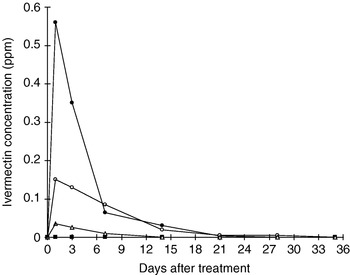
Ivermectin residues attained maximal concentrations at 1 day after treatment in both administrations, but their concentrations were greatly different 1 and 3 days after treatment (fig. 1). Both concentration peaks declined to a similar level 7 days after treatment, and ivermectin was detected for up to 21 (experiment 1) or 28 days (experiment 2). No ivermectin was detected at 28 days (experiment 1) and 35 days (experiment 2) after treatments; the determination limit was 0.002 ppm. In the control cattle, no ivermectin was detected in experiment 1, but in experiment 2 some low concentrations were detected 1 day (0.036 ppm), 3 days (0.026 ppm) and 7 days (0.01 ppm) after treatment.
Ivermectin concentration in dung (ppm of wet weight) after treatments (500 μg kg−1) (–●–, treatment (exp.1); –○–, treatment (exp.2); –■–, control (exp.1); –△–, control (exp. 2)).

The effects of ivermectin on adult survival, brood ball production and emergence of C. jessoensis Harold
Laboratory bioassay
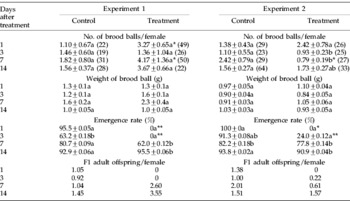
In experiments 1 and 2, there appeared to be no effects of ivermectin on adult mortality of C. jessoensis (data not shown). In experiment 1, the number of brood balls constructed per female by C. jessoensis were significantly more abundant in ivermectin-treated cows 1 and 7 days after treatment (table 1). Conversely, numbers of brood balls were significantly lower 7 days after treatment in experiment 2. No significant difference in the numbers of brood balls was found on other dates between control and treated cows. There were also no differences between control and treated cows regarding the weight of brood balls in each experiment. However, adult emergence rates were severely reduced or null at 1 and 3 days (P<0.01) after treatment in both experiments with 62.0–77.8% recovery at 7 days and nearly complete recovery at 14 days. Some emergences 3 days after treatment in experiment 2 may be attributed to the lower concentration of ivermectin excreted in dung for experiment 2 than experiment 1. The average number of F1 adult offspring per female was low 1 and 3 days after treatment in both experiments, in agreement with the emergence rates (table 1).
Numbers and weights of brood balls, emergence rates and F1 adult offspring/female in Caccobius jessoensis reared in dung from treated and control cattle in experiments 1 and 2.

Values in parentheses are total numbers of brood balls.
*, ** Significantly different between control and treatment within the rows in each experiment (*P<0.05, **P<0.01; Mann-Whitney U test).
Values followed by the same letters within the columns are not significantly different (Fisher's PLSD; P<0.05).
Field experiment
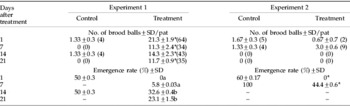
Data for brood balls collected from soil beneath the dung pats after one week exposure are shown in table 2. The brood balls of dung beetles, Caccobius jessoensis Harold and Liatongus minutus (Motsculsky), were obtained; however, as there were very few of the latter species, only data of C. jessoensis were shown. In experiment 1, the number of brood balls constructed by C. jessoensis was 184; these were more abundant on all collection dates from treated cattle than from those of the control cows. Adult emergence rates from the dung of the treated cattle were null at 1 day and 5.8% at 7 days after treatment; these results were significantly different from those of 14 and 21 days after treatment (32.6% and 23.1%, respectively). In experiment 2, brood balls amounted to only a small number in both control (9) and treatment (11) cows, and no significant difference was found between them. Adult emergence rates from the dung of treated cattle were significantly reduced at 1 and 7 days after treatment.
Emergence rates and numbers of brood balls of Caccobius jessoensis recovered from soil beneath dung pats of control and treated cattle after seven days exposure in the field.

Values in parentheses are total numbers of brood balls.
* Significantly different between control and treatment within the rows in each experiment (P<0.05; Mann-Whitney U test).
Values followed by the same letters within the collumns are not significantly different (P<0.05; Mann-Whitney U test).
The effects of ivermectin on adult survival and brood ball production of Copris ochus Motschulsky and Copris acutidens Motschulsky
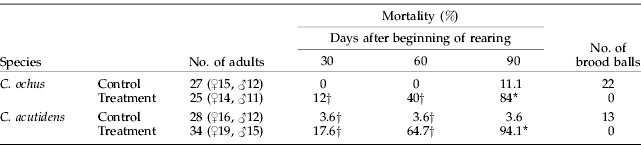
Table 3 shows mortality and brood ball numbers for adult C. ochus emerging from the dung of the control and treated cows. From the dung of treated cattle, 12% and 40% of the adults emerged from tunnels and died 30 and 60 days, respectively, after rearing began. Upon examination of the nests after 90 days, accumulated adult mortality was very high, reaching 84%; no brood balls were constructed in the nests. Alternatively, in the dung of the control cattle, there were no dead adults emerged from the tunnels at 30 and 60 days after the start of rearing, and accumulated adult mortality was only 11.1% after 90 days. Twelve pairs plus three females in the control dung produced 22 brood balls. For C. acutidens, in the dung of treated-cattle, 17.6% and 64.7% of the adults emerged from tunnels and died at 30 and 60 days, respectively, after the start of rearing (table 3). Adult mortality after 90 days was very high (94.1%) without brood ball production. In dung from the control cattle, the accumulated adult mortality was 3.6% from 30 to 90 days after rearing had begun. Twelve pairs plus four females constructed 13 brood balls.
Accumulated adult mortality (%) and numbers of brood balls of Copris ochus and C. acutidens reared in dung from control and treated cattle.
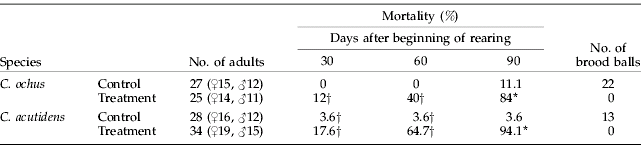
† Percentages are based on numbers of dead adults found on surface of soil in rearing cages.
* Significantly different between control and treatment in each experiment (P<0.05; Mann-Whitney U test).
Discussion
Ivermectin by pour-on formulation was excreted in dung for at least 14 to 28 days after treatment with a peak at the first or third day post-treatment (Sommer et al., Reference Sommer, Steffansen, Nielsen, Grønvold, Vagn Jensen, Jespersen, Springborg and Nansen1992; Iwasa et al., Reference Iwasa, Maryuama, Nakamura, Yamashita and Watanabe2005a,Reference Iwasa, Nakamura, Fukaki and Yamashitab). The present results are similar to those reported in previous papers, but there was considerable difference of concentrations at 1 and 3 days after treatment in the two experiments. It is known that the concentration of ivermectin in faeces can be affected by the diet of cattle (Cook et al., Reference Cook, Dadour and Ali1996). Although the reason for the difference in concentrations between the two experiments is unclear, concentrations may have varied with diet or physiological differences of the cattle. Some low concentrations, at 1 day (0.036 ppm), 3 days (0.026 ppm) and 7 days (0.010 ppm) in the control group of experiment 2, are due to contamination in the dung collection or to self-contamination through mutual grooming of the two groups in the same pasture, as shown by Barber & Alvinerie (Reference Barber and Alvinerie2003) ; these concentrations did not affect adult emergence. High concentrations of ivermectin 1 and 3 days after treatment reflect a severe reduction of adult emergence of C. jessoensis on the same dates (fig.1, table 1).
In Onthophagus binodis Thunberg, dung from cattle treated with abamectin by injection caused a reduction in the mean number of brood balls up to four weeks (Ridsdill-Smith, Reference Ridsdill-Smith1988) and 34 days (Dadour et al., Reference Dadour, Cook and Hennessy2000) after treatment. On the other hand, there were no significant differences in the mean numbers of brood balls produced by Onthophagus gazella (Fabricius) (Fincher, Reference Fincher1992; Yamashita et al., Reference Yamashita, Yoshida, Watanabe and Mikami2004) and Euoniticellus intermedius (Reiche) (Fincher, Reference Fincher1992) in dung from ivermectin-treated cattle for both injection and pour-on formulations. The present results of brood ball construction and weight of brood balls in experiments 1 and 2 show that brood ball construction in C. jessoensis is also not affected by pour-on treatment of the recommended dose of ivermectin. In experiment 1, a significant increase in numbers of brood balls at 1 and 7 days post-treatment may be influenced by differences of diets as mentioned below. In either case, it is probable that the effects of ivermectin on brood ball construction are considerably different between species.
It is known that some dung beetles are attracted to ivermectin-containing dung pats, but ivermectin alone is not attractive to dung beetles (Wardhaugh & Mahon, Reference Wardhaugh and Mahon1991; Holter et al., Reference Holter, Sommer, Grønvold and Madsen1993; Floate, Reference Floate1998b). In field experiment 1, brood balls found in the soil beneath dung pats after 7 days exposure were more abundant in the dung of treated cattle than in that of the control cattle (table 2). However, it is unclear whether C. jessoensis had a preference for dung from ivermectin-treated cattle over that of the control cattle, because there were some differences in the amount of concentrate diets (corn and soybean grain) given between treated (dry) and control (lactating) cattle in experiment 1. In experiment 2, in which there was no difference in the amount of concentrate diet between treated and control cattle, it is difficult to compare the effects of ivermectin residues on the attraction and colonization of dung beetles because of the small number of brood balls constructed. The small numbers of brood balls in experiment 2 (middle of July) may be due to the short breeding period of C. jessoensis. Floate et al. (Reference Floate, Wardhaugh, Boxall and Sherratt2005) emphasized that factors such as animal diet or dung moisture are more important on the effects of ivermectin on the attraction and colonization of dung-dwelling insects. Further investigation is needed.
In Onthophagus binodis, the larval survival was significantly prevented up to one week (Ridsdill-Smith, Reference Ridsdill-Smith1988), and adult emergence was greatly reduced up to 3–6 days (Dadour et al., Reference Dadour, Cook and Hennessy2000) after treatment in dung from cattle treated with abamectin by injection. Fincher (Reference Fincher1992) reported that the emergence of adult Onthophagus gazella and Euoniticellus intermedius in the dung from steers treated with ivermectin by injection was reduced for two and one weeks after treatment, respectively. Krüger & Scholtz (Reference Krüger and Scholtz1997) noted that adult emergence of two dung beetles, Euoniticellus intermedius and Onitis alexis Klug, were reduced in the dung of steers treated with ivermectin by injection for 2–14 days and 2–7 days after treatment, respectively. In pour-on formulation, emergence of adults in dung from cattle treated with ivermectin was reduced for 1–2 weeks in Euoniticellus intermedius (Fincher, Reference Fincher1996), 2–3 weeks in Onthophagus gazella (Fincher, Reference Fincher1996) and two weeks in Liatongus minutus (Iwasa et al., Reference Iwasa, Nakamura, Fukaki and Yamashita2005b). At present, however, there is no report on the effect of ivermectin on larvae of the genus Caccobius. The present results of laboratory and field experiments show that pour-on formulation of the recommended dose of ivermectin could greatly reduce adult emergence of C. jessoensis for at least 3–7 days, returning to normal 14 days after treatment. The effect of the pour-on formulation of ivermectin on C. jessoensis, which is a small species (5–8 mm body length), is short-term in comparison with those of medium-sized dung beetles, mentioned above. Further surveys would be needed to corroborate the relationships of body size of dung beetles and the effect of ivermectin (if any) on emergence reduction.
Ivermectin and abamectin residues in dung have no effect on adult mortality in sexually mature dung beetles Onthophagus binodis and Euoniticellus intermedius (Ridsdill-Smith, Reference Ridsdill-Smith1988; Fincher, Reference Fincher1992) and Bubas bubalus (Oliver) (Wardhaugh & Rodriguez-Menendez, Reference Wardhaugh and Rodriguez-Menendez1988), whereas sexually immature adults of the dung beetle, O. binodis, exhibited some mortality in abamectin residues in dung (Houlding et al., Reference Houlding, Ridsdill-Smith and Bailey1991; Dadour et al., Reference Dadour, Cook and Hennessy2000). Wardhaugh & Rodriguez-Menendez (Reference Wardhaugh and Rodriguez-Menendez1988) showed that ivermectin residues in dung caused a high mortality of newly emerged adult Copris hispanus (Fabricius), although no mortality was found among sexually matured adults. This high mortality in newly-emerged adults might be due to an accumulation of a great amount of dung ingested. Actually, it is known that adult dung beetles generally emerge sexually immature and then go through a period of intense feeding (Halffter & Edmonds, Reference Halffter and Edmonds1982). Bang et al. (Reference Bang, Kwon, Hwang, Mah and Wardhaugh2004) showed that, in spring (June and July), adults of C. ochus were overwintering beetles and the emergence of a new generation commenced in late summer (August) in Korea and that both undergo a period of intensive feeding before oviposition; whereas, it is known that, in spring (June), adults of C. acutidens are also overwintering beetles and a new generation of beetles emerge in autumn (September). Adults of C. ochus and C. acutidens tested were collected in July–August, and June and September, respectively. It was indicated that ivermectin dung residues cause a high mortality in the field-collected beetles of two Copris species regardless of the season and generation. Asian C. ochus is a large dung beetle, similar to the European C. hispanus, whereas C. acutidens is a medium-sized species. All are brood-care species. From spring to summer in Japan, male-female pairs of these species eat dung and cooperate in excavating an underground chamber, which is provisioned with a mass of dung; adults remain in the same dung pat for brood-care for a long time. Ivermectin concentrations remain relatively stable in dung pats for at least 45 days in the field (Sommer et al., Reference Sommer, Steffansen, Nielsen, Grønvold, Vagn Jensen, Jespersen, Springborg and Nansen1992). Therefore, adults increase their exposure to ivermectin residue in dung and are likely to be affected by it, as compared with non-brood-care species, which nest repeatedly and move from pad to pad.
It is well known that C. ochus is widely distributed in East Asia and has a high dung-decomposing activity; an average weight of their brood balls is about 40 g per ball (Bang et al., Reference Bang, Huerta, Kim and Goo2001). However, this species has rapidly decreased in pastures in the past ten years and is listed as a ‘rare’ or ‘endangered’ species in 25 prefectures of Japan (Hori, Reference Hori2005). C. acutidens is also designated as a ‘rare’ species in four prefectures in Japan. These Copris species are exposed to a variety of threats, e.g. frequent renovation of grassland, change of dung composition due to an increase of concentrate diets and residues of veterinary parasiticides and drugs used in pastures. In Japan, ivermectin has been used in pastures throughout the country with the advent of pour-on formulation since 1996. Most public stock farms treated cattle with ivermectin 2–3 times from spring to autumn. Treatment with ivermectin in spring and summer coincides with the period of breeding activity of dung beetles. The results of the present study suggest that the decrease of C. ochus in Japanese pastures can be partly attributed to the contamination of dung with anthelmintic drugs such as ivermectin. McCracken (Reference McCracken1993) noted that rare species of dung beetles could be put at risk by use of avermectins because they may not have recolonization potential. Use of harsh anthelmintics such as ivermectin, during the breeding season of dung-dwelling insects, could especially accelerate the reduction of the populations of rare dung beetles such as Copris. Krüger & Scholtz (Reference Krüger and Scholtz1998) suggested that the use of ivermectin affected community structure through a reduction in species diversity in a large-scale field study. Many other common dung beetles, such as C. jessoensis, whose larvae are affected by ivermectin also, possibly, have long-term risks affecting the reduction of their populations in Japanese pastures.
Floate et al. (Reference Floate, Colwell and Fox2002) compared four endectocide products for their effects on non-pest insects in cattle dung and showed that they were ranked in descending order of adverse effect: doramectin>ivermectin>eprinomectin>moxidectin. Choosing endectocide products, which least affect dung-decomposing insects, is important. Moreover, the effects of these products on dung-degradation should be assessed to avoid environmental hazards in pasture.
Acknowledgements
We thank Dr T. Iketaki and Mr K. Hamamura of the Agricultural Field Science Center, Obihiro University of Agriculture and Veterinary Medicine for their kind help in pour-on treatment on cattle. Our thanks are also due to Mrs S. Hori of the Historical Museum of Hokkaido and to W. Takayama and H. Yoshida of the Hokkaido Laboratory of Herpetology for their kindness in offering material regarding Copris ochus. This work was supported by grants for environmental research allocated to National Research Institutes (Research on Pollution Prevention and Control), Ministry of the Environment.