




No CrossRef data available.
Article contents
Visuomotor control in survivors of childhood acute lymphoblastic leukemia treated with chemotherapy only
Published online by Cambridge University Press: 26 August 2005
Abstract
Treatment for childhood acute lymphoblastic leukemia (ALL), which includes CNS prophylaxis, is associated with central and peripheral neurotoxicity. The purpose of the present study was to analyze the effects of chemotherapy on various levels of visuomotor control in survivors of childhood ALL treated without cranial irradiation, and to identify risk factors for possible deficits. Visuomotor function was compared between children after treatment for ALL (n = 34), children after treatment for Wilms tumor, which consists of non-CNS directed chemotherapy (n = 38), and healthy controls (n = 151). Three tasks were administered: a simple visual reaction time task and two tasks measuring visuomotor control with one requiring a higher level of cognitive control than the other. Visuomotor deficits were detected only in the ALL group, with poorer performance restricted to the condition requiring the highest level of control. Significant risk factors for poorer performance were female gender and a short time since end of treatment, and a trend was found for a young age at diagnosis. A high cumulative methotrexate dose was an adverse predictive factor in girls. The results indicate that chemotherapy-induced central neurotoxicity in childhood ALL treatment is associated with higher order visuomotor control deficits. Girls appear to be particularly vulnerable. (JINS, 2005, 11, 554–565.)
Information
- Type
- Research Article
- Information
- Journal of the International Neuropsychological Society , Volume 11 , Issue 5 , September 2005 , pp. 554 - 565
- Copyright
- © 2005 The International Neuropsychological Society
INTRODUCTION
Long-term survival in childhood acute lymphoblastic leukemia (ALL) has improved substantially due to evolution of multi-agent chemotherapy protocols and to the introduction of prophylactic treatment of the central nervous system (CNS) (Pui et al., 1998). The 5-year overall survival curves have now reached 80% in developed countries (Gatta et al., 2002). This has resulted in an increasing interest in the late effects of disease and treatment on physical, mental and social well-being of the survivors. Several elements of therapy for ALL may affect the function of the central and peripheral nervous system, and cognitive deficits (e.g., Anderson et al., 2000; Brown et al., 1992; Butler et al., 1994; Moleski, 2000; Ochs et al., 1991) as well as gross and fine motor impairments (Galea et al., 2004; Harila-Saari et al., 2001; Lehtinen et al., 2002; Reinders-Messelink et al., 1996; Vainionpaa, 1993; Wright et al., 1998) have been reported in survivors of childhood ALL. CNS-directed treatment is a standard component of therapy for ALL. Evidence of a detrimental effect of prophylactic cranial irradiation on neurocognitive function in children with ALL (Cousens et al., 1988; Jankovic et al., 1994; Meadows et al., 1981) has resulted in reduction of the use of cranial irradiation and the development of chemotherapy-only protocols with the same or better rate of treatment success (Kamps et al., 2002; Tubergen et al., 1993).
The current study was conducted to assess possible visuomotor deficits in survivors of childhood ALL treated with chemotherapy only. There is limited knowledge of long-term visuomotor outcome in children with ALL. The majority of reports on this subject include studies performed during or shortly after end of treatment. Studies on motor function in children with ALL have demonstrated that, while gross motor skills may improve after treatment, fine motor problems in children with ALL may increase over time (Reinders-Messelink et al., 1999). Vincristine has been implicated as the cause of these motor impairments, because of its toxic effect on the peripheral nervous system. Vincristine-induced neurotoxicity is dose-related (Carbone et al., 1963) and causes a peripheral, symmetric mixed sensory–motor, and autonomic polyneuropathy which is more marked distally (Gidding et al., 1999). CNS toxicity from intravenous vincristine is rare, most likely due to poor penetration through the intact blood–brain barrier (Kellie et al., 2002). Corticosteroids may contribute to motor problems in children treated for ALL as they can cause proximal myopathy (DeAngelis et al., 1991). Both peripheral neuropathy and myopathy in children with ALL have been found to regress quickly after end of treatment, although subtle motor deficits have been reported up to 2 years after cessation of chemotherapy (Harila-Saari et al., 1998; Reinders-Messelink et al., 1996).
Motor and somatosensory evoked potential studies have shown that there is a central nervous system component in motor and sensory dysfunction in children with ALL (Harila-Saari et al., 1998, 2001; Vainionpaa et al., 1997). CNS-directed chemotherapy for ALL, consisting of intrathecal methotrexate, alone or in combination with cytarabine and corticosteroids, and of systemic methotrexate and corticosteroids, is associated with central neurotoxicity (Kerr et al., 2001; Surtees et al., 1998). Various studies have demonstrated visuomotor deficits in relationship with other cognitive impairments in children with ALL after treatment with chemotherapy only (Copeland et al., 1996; Kingma et al., 2001; Lesnik et al., 1998).
Motor and cognitive development are closely interrelated and, when cognitive development is disturbed, motor development is often also adversely affected (Diamond, 2000). This is supported by evidence from children with neurodevelopmental disorders as attention deficit hyperactivity disorder and autism, in which cognitive deficits are frequently accompanied by visuomotor problems (Kalff et al., 2003; Muller et al., 2003). That CNS disorders in children may lead to visuomotor deficits has also been established in children with phenylketonuria (Huijbregts et al., 2003), periventricular brain injury (Downie et al., 2003; Jakobson et al., 2001), (mild) closed head injury (Heitger et al., 2004), HIV infection (Frank et al., 1997) and early hydrocephalus (Erickson et al., 2001). Measures of visuomotor skills are possibly the instruments most sensitive to cerebral damage (Frank et al., 1997; Heitger et al., 2004). Many motor tasks employed in these studies involve some degree of cognitive (executive) control.
As risk factors for poorer cognitive performance after childhood ALL treated with chemotherapy only, female gender (Brown et al., 1998; Von der Weid et al., 2003; Waber et al., 1992) and a young age at diagnosis (Copeland et al., 1996; Von der Weid et al., 2003) have been reported.
To assess the nature of possible visuomotor deficits in survivors of ALL, visuomotor tasks requiring varying levels of cognitive control were employed. A tracking task, involving the drawing of a circle within predefined borders, largely relies on automatic processing. A pursuit task in which a randomly moving target has to be followed, demands higher level cognitive control as it involves non-automatized movements that require concurrent planning and execution. Survivors of a Wilms tumor, a childhood cancer of the kidney, were included in the study. These children received a different chemotherapy regimen, not directed at the CNS. Healthy controls were also included.
We sought to determine whether visuomotor function was impaired in survivors of childhood ALL treated with chemotherapy only. We hypothesized that the central effects of chemotherapy for ALL on visuomotor function have the greatest impact on the condition requiring the highest level of control. Because children with a Wilms tumor did not receive chemotherapy with central neurotoxic properties we would not expect to observe these deficits in this group. To determine risk factors for possible visuomotor deficits in survivors of ALL, the association between outcome and different components of chemotherapy was examined, as well as the role of patient and disease characteristics.
PARTICIPANTS AND METHODS
Research Participants and Treatment Protocols
We studied children in complete remission from ALL who had finished treatment at least one year before. The children with ALL were recruited from the VU University Medical Center. Children were excluded if they suffered a pre-existent neurological or psychiatric disorder or a learning disability, had presented with CNS leukemia, received cranial irradiation or suffered a relapse. All other children who had been treated for ALL with chemotherapy only at this institution and who were between 4.5 and 18 years of age at the time of the study were eligible to participate. Of the 42 children who met the criteria for inclusion in the study, 36 agreed to participate and 34 (81%) completed a full assessment. Reasons for refusal were reluctance of parents to burden the children with tests for research or lack of time. The characteristics of the non-participants regarding demographic, disease, or treatment variables did not differ from the participating children. From both participating study centers, the VU University Medical Center and the Erasmus Medical Center/Sophia Children's Hospital, in total 38 children with a Wilms tumor were included, also at least 1 year after end of treatment, and matched as closely as possible for age and gender to the children with ALL. The children with a Wilms tumor formed a clinical control group who had also experienced cancer and chemotherapy, but no CNS-directed treatment. Siblings of children with ALL (n = 20) and of children with a Wilms tumor (n = 23) were enlisted in a sibling control group. The healthy control group consisted of 108 healthy, age-matched schoolchildren, among them schoolmates of the children with ALL or a Wilms tumor. From these three groups, children were excluded in case of a history of a neurological or psychiatric disorder or a learning disability. Informed consent was obtained following the guidelines of the ethical committees of both treatment centers.
The children with ALL had been treated according to the consecutive Dutch Childhood Leukemia Study Group (DCLSG) ALL treatment protocols 6 to 9 (Kamps et al., 1999, 2002; Veerman et al., 1996), and were diagnosed between 1985 and 1999. Patients were stratified into risk groups based on leukemia cell load, cell phenotype and spread of the disease. Patients with standard risk ALL were treated according to standard treatment protocols while intermediate and high risk patients, who were at higher risk for relapse of the disease, received intensified treatment. The criteria for risk group classification varied across the different protocols. In our study, 15 children had been treated according to the ALL standard treatment protocols and 19 according to intensified protocols, these numbers corresponding with the distribution of risk groups nationwide (Kamps et al., 1999, 2002; Veerman et al., 1996). CNS-directed treatment consisted of intrathecal chemotherapy and of systemically administered methotrexate and corticosteroids. Intrathecal chemotherapy consisted of “triple therapy”: methotrexate, prednisolone, and cytarabine (DCLSG protocol ALL 6, 8 and 9), or of methotrexate alone (DCLSG protocol ALL 7). Intrathecal drug doses varied little between risk groups and the various protocols. Regarding potentially neurotoxic chemotherapy, the greatest difference between standard ALL treatment and intensified ALL treatment, was the dose of systemic, intravenously administered, methotrexate. Standard ALL treatment included medium dose intravenous methotrexate (three or four doses of 2 g/m2, depending on the protocol), whereas intensified ALL treatment entailed high dose intravenous methotrexate (ranging from four doses of 3 g/m2 to six doses of 5 g/m2). Corticosteroids used were dexamethasone and/or prednisone. DCLSG protocols ALL 6 and 9 were dexamethasone based whereas protocols ALL 7 and 8 were prednisone based. Other drugs used were vincristine, l-asparaginase, 6-mercaptopurine in standard treatment protocols and additionally cytarabine, cyclofosfamide and daunorubicine in intensified treatment protocols. Total duration of ALL treatment was 18 to 24 months.
Children with a Wilms tumor were treated with pre-operative chemotherapy, followed by a nephrectomy, systemic chemotherapy and when necessary with local radiation therapy, according to SIOP protocols 9 and 93-01 (D'Angio, 1983; Tournade et al., 2001). Children with a Wilms tumor did not receive CNS-directed treatment. Chemotherapy consisted of vincristine and actinomycine-D in favorable stratified cases. In patients with advanced stage disease and/or unfavorable histology, anthracyclines, ifosfamide, etoposide and carboplatinum were added. Chemotherapy continued for 3 to 9 months after diagnosis, depending on stage and histology.
Neurological Status
Clinical neurological examination, performed in most survivors (25 children with ALL and 18 children with a Wilms tumor) by one medical doctor to assess motor function (based on Touwen's neurological examination (Touwen, 1979)), revealed no pareses, ataxia, or tremor in any of the children. Deep tendon reflexes were low to absent in 2/25 survivors of ALL (8%) and 2/18 survivors of a Wilms tumor (11%). On only one item a significant difference was found between the survivor groups: slight dysdiadochokinesia was recorded in 6 out of 25 (24%) of survivors of ALL (1 standard risk patient and 5 high-risk patients) while no dysdiadochokinesia was detected in the survivors of a Wilms tumor (p = .025). Interviews with the parents of all participating survivors of ALL or a Wilms tumor revealed no significant differences between these two groups regarding frequency of reported neurological symptoms. None of the symptoms were reported to be major or to affect daily life importantly. Most children were in normal schools, with two survivors of ALL and no survivors of a Wilms tumor following special education programs. Parents of 32% of children with ALL reported some kind of mild motor problem in their children versus 29% of parents of children with a Wilms tumor. Mild problems with handwriting and/or drawing were most frequently reported (in 19% and 16% of cases, respectively), followed by mild gross motor problems (18% and 8%, respectively).
Visuomotor Tasks (Figure 1)
Three visuomotor subtests of a computerized test battery, the Amsterdam Neuropsychological Tasks (ANT), were administered (De Sonneville, 1999). The ANT program was designed to measure the various aspects of attention and information processing. The tests used in this study have previously been shown to be sensitive for detection of specific visuomotor deficits, for example in children with attention deficit hyperactivity disorder (Kalff et al., 2003) and children with phenylketonuria (Huijbregts et al., 2003). The tests were performed using a notebook computer with a 14″ TFT color screen and a symmetrical computer wheel mouse. The tests were administered in a quiet room in the outpatient clinic, at home or at school. Every child had the opportunity to practice the tasks in a separate session preceding the actual test moment. A simple visual reaction time test (baseline speed) was used as a reference task. The tracking task involves execution of a movement that can be planned in advance, requiring a low level of controlled processing. The pursuit task involves close pursuit of a target moving unpredictably, in random directions, demanding a much higher level of controlled processing.

Visuomotor tasks.
Baseline speed
This task involves minimal cognitive effort. The subject is required to press a mouse-key as quickly as possible when a fixation cross in the center of the computer screen changes into a white square (imperative signal). Following the response, the fixation cross reappears. The time interval between a response and the next signal onset varies randomly between 500–2500 ms to prevent anticipation strategies. There are separate trials (n = 32) for the right and left index finger.
Tracking
This task measures accuracy and stability of movement along a planned trajectory. The subject is required to move the cursor in between an outer circle (radius 8.5 cm) and an inner circle (radius 7.5 cm) presented on the computer screen by moving the computer mouse cursor which is shaped as a tiny dot. The movement is executed with the preferred hand; in clockwise direction for the right hand and in counter-clockwise direction for the left hand. To assess performance on this task, the position of the mouse cursor is continuously recorded, using the midline as reference. The mean radial distance of the cursor to the midline per circle segment (1/60th of the circle) is computed, resulting in 60 deviation scores. The standard deviation (SD) of these 60 deviation scores from the midline is computed as a measure for stability of movement. The percentage of the circle positions that are inside the borders of the circle and result from a movement in the correct direction, is used as a measure of the accuracy of performance on this task.
Pursuit
This task measures accuracy and stability of movement along an unpredictable trajectory. The subject is required to continuously trace a target star moving randomly on the screen by moving the computer mouse with the preferred hand over a time period of 60 s. While motor demands are identical to the tracking task, cognitive demands are higher. As the trajectory of the target is unpredictable, this task demands the concurrent planning and execution of movements. The ANT program computes the mean distance between the mouse cursor and the moving target per second resulting in 60 deviation scores. The mean distance and the standard deviation of the deviation scores are calculated and taken as a measure of accuracy and stability of performance, respectively.
Data Analysis
Mean reaction time for the preferred hand in the baseline speed task, and the measures for accuracy and stability on the tracking and pursuit tasks were transformed into z scores using age-appropriate norm values, obtained from the ANT program manual (De Sonneville, 2003). Z scores were derived from 1-year age bands and drawn from a comparison sample of 2712 for the baseline speed task, 773 for the tracking task and 585 for the pursuit task.
In a first step, mean z scores were compared using two-way ANOVAs with group and gender as the between-subjects variables. The siblings of the survivors and the schoolchildren were taken together as one healthy control group, because the comparison of their results using ANOVA showed no differences between the two groups on any of the measures (.10 < p < .98 and .01 < d < .28). This left three groups in the analyses: survivors of ALL, survivors of a Wilms tumor and healthy controls. Contrast analyses, using a simple contrast with the healthy controls as a reference group, were performed to examine the differences between controls and survivors of a Wilms tumor and between controls and survivors of ALL, respectively. Gender was used as a between-subjects variable based on previous reports of gender differences with regard to cognitive sequelae of ALL. Effect sizes for group contrasts and gender effects were computed as Cohen's d, which represents the magnitude of mean differences in standard deviation units, with d = .2 indicating small, d = .5 moderate, and d > .8 indicating large effect sizes (Cohen, 1988). Univariate analyses were performed per task measure, with α set at .018 after Bonferroni adjustment for correlated multiple comparisons (Uitenbroek, 2003).
In a second step, the risk factors for poorer visuomotor performance in survivor groups were examined using multiple regression analyses. To identify predictors of task performance, exploratory correlation analyses were performed between the outcome measures and various patient, disease, and treatment factors as independent variables. Besides gender, these were age at diagnosis, time since end of treatment and cumulative doses of chemotherapy with neurotoxic properties (intravenous vincristine, intravenous, intrathecal and oral methotrexate, intravenous and intrathecal cytarabine, intrathecal prednisolone, oral dexamethasone and oral prednisone). Variables that correlated at r > .20 with an outcome measure were entered as predictor variables into a hierarchical multiple regression model. Patient factors were entered in the first step, disease and treatment factors in the second step and possible interaction terms in the third step, with α set at 0.05. Predictor variables were centered around the mean to prevent problems with multicollinearity (Aiken and West, 1991).
RESULTS
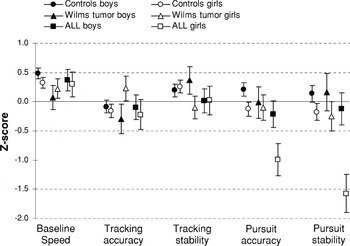
Characteristics of the study children and doses of potentially neurotoxic chemotherapy are depicted in Table 1. Mean age at diagnosis was significantly lower and mean time elapsed since end of treatment was significantly longer in survivors of a Wilms tumor than in survivors of ALL in our study. The boy/girl ratio did not differ significantly between groups. There were no significant differences between chemotherapy doses between boys and girls in either survivor group. There were no associations between any of the findings on neurological examination and the ANT outcome measures in the survivor groups. In Figure 2, mean z scores for all task measures are depicted per group, for boys and girls separately. The results of the two-way ANOVAs, with group and gender as between subjects variables, indicate no significant main or interaction effects on the measures of baseline speed, tracking accuracy and tracking stability. The effect sizes for all group and gender contrasts on these measures were small. Differences did emerge, however, for the measures of pursuit accuracy and pursuit stability. For pursuit accuracy there was a significant main effect of group [F(2,217) = 5.23, p = .006]. Contrast analysis showed significantly worse results for pursuit accuracy in survivors of ALL compared to controls (contrast estimate, CE: −.64, p = .001, d = .50), while performance of survivors of a Wilms tumor on this measure did not differ from controls (CE: −0.11, p = .56, d = .11). A trend was found for the main effect of gender [F(1,217) = 5.14, p = .024, d = .32]. There was no interaction effect of Group × Gender on pursuit accuracy (p = .37). For pursuit stability, the main effect of group [F(2,217) = 6.34, p = .002] was significant. Contrast analysis showed that the contrast between survivors of ALL and controls was significant for pursuit stability (CE: −.83, p = .001, d = .46), while survivors of a Wilms tumor did not differ from controls (CE: −.07, p = .76, d = .06). The main effect of gender was also significant [F(1,217) = 12.21, p = .001, d = .22], with girls performing worse than boys. There was a non-significant trend for an interaction effect of Group × Gender [F(2,217) = 2.93, p = .056]. The Group × Gender interaction effect on pursuit stability was significant when contrasting survivors of ALL with controls [F(1,181) = 5.90, p = .016], indicating that the group difference between survivors of ALL and controls was particularly evident in girls.
Summary of group characteristics and doses of potentially neurotoxic chemotherapy for study groups: boys, girls and total


Z scores for visuomotor task outcome by group and gender (M, SE). Note: a lower (negative) z score indicates a worse performance.
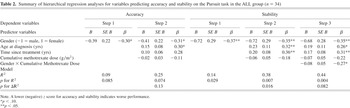
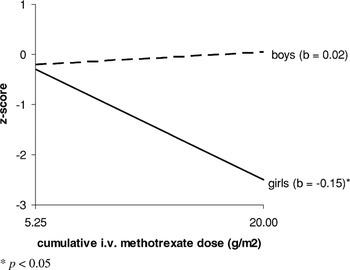
The results of the hierarchical multiple regression analyses of risk factors for worse performance on the pursuit task within the ALL group are presented in Table 2. In the final model for the pursuit stability measure, main effects indicate female gender and a shorter time since treatment as significant risk factors for worse performance. A non-significant trend level effect was found for age at diagnosis. A trend was also found for the two-way interaction effect of Gender × Cumulative Systemic Methotrexate Dose. Post-hoc simple slope analysis of the two-way interaction revealed a significant relation between a higher cumulative systemic methotrexate dose and worse performance on pursuit stability in girls (p = .046), while there was no significant relation between methotrexate dose and performance in boys (see Figure 3). Gender and age at diagnosis were trend level predictors of accuracy on the pursuit task in the ALL group. The direction of these trend level main effects indicated female gender and a young age at diagnosis as risk factors for worse performance. Within the Wilms tumor group, none of the entered independent variables were associated with any of the task outcome measures on a significant or trend level.
Summary of hierarchical regression analyses for variables predicting accuracy and stability on the Pursuit task in the ALL group (n = 34)


Regression lines for relations between cumulative i.v. methotrexate dose and pursuit stability as moderated by gender in ALL survivors, at mean values for age at diagnosis and time since treatment (two-way interaction). Notes: b = unstandardized regression coefficient, i.e. simple slope. A lower (negative) z score indicates worse performance. Indicated values for cumulative i.v. methotrexate dose on the x-axis are minimum and maximum values in the ALL study group.
DISCUSSION
This study provides evidence for subtle visuomotor control deficits in children after treatment for ALL with chemotherapy only. Compared to healthy controls including siblings of the survivors, the survivors of ALL showed poorer performance on a visuomotor pursuit task. There were no deficiencies on a tracking task or in simple motor reaction time. No visuomotor deficits were found in survivors of a Wilms tumor, who received a less intensive and presumably less neurotoxic chemotherapy regimen.
That worse visuomotor performance in survivors of childhood ALL is restricted to the condition requiring the highest level of cognitive control, supports our hypothesis on the central effects of chemotherapy for ALL on visuomotor function. The pursuit task involves a relatively high level of cognitive control, as concurrent planning and execution of movement is required while moving the computer mouse along a trajectory that is unpredictable. Motor demands; namely, manipulating the mouse cursor across the screen, are similar in the pursuit task and in the tracking task. Cognitive demands are much lower during the tracking task, however, as the trajectory of movement with the computer mouse can be planned in advance. The drawing of a circle becomes an increasingly automated action throughout development, also making the tracking task easier to perform than the pursuit task. The baseline speed task measures simple reaction time, rendering low motor and cognitive demands.
The results we report are in accordance with results of studies using the same visuomotor tasks as in our study in different populations with CNS disorders. In a study on children with attention-deficit/hyperactivity disorder, high-level visuomotor control deficits as measured with the pursuit task were linked to behavioral problems (Kalff et al., 2003). In children with phenylketonuria, affecting biochemical parameters, differences between patients and healthy controls were significantly greater on the pursuit task than on the tracking task (Huijbregts et al., 2003). In adult multiple sclerosis patients, performance on the pursuit task was found to correlate with disease severity (De Sonneville et al., 2002).
Visuomotor control involves occipito–parietal and frontal cerebral areas (Hamzei et al., 2002; Wise et al., 1997), as well as the cerebellum and the basal ganglia (Miall et al., 2001) and their interconnections. Through the dorsal stream of visual areas in the parietal lobe, localization and movement are perceived, crucial for performance of visuomotor tasks. The parietal cortex and frontal motor areas are linked by cortico–cortical connections, as well as by a subcortical pathway through the cerebellum (Glickstein, 2000). The frontal cortex has a critical role in the attentional control of unpracticed movements (Richer et al., 1999). Involvement of the prefrontal region has been shown to increase with increasing attention load during visuomotor action (Chaminade & Fonlupt, 2003). The myelination of the prefrontal cortex and of cerebellar–prefrontal networks has a protracted course during childhood and adolescence (Fuster, 2002; Klingberg et al., 1999). Because less mature brain areas are believed to be more susceptible to damage than areas that are more mature, the prefrontal cortex and cerebellar–prefrontal networks may have a large window of vulnerability during development (Ciesielksi et al., 1997).
Lesnik et al. (1998) demonstrated cerebellar-frontal subsystem changes on structural MRI in children with ALL treated before the age of 5 with chemotherapy only. Methotrexate is the cytostatic drug mostly implicated in central neurotoxicity in children with ALL (Shuper et al., 2000). Cerebral white matter changes (Chu et al., 2003; Dambska & Laure-Kamionowska, 1999; Surtees et al., 1998), neuronal damage (Chu et al., 2003; Quinn et al., 1998; Van Gool et al., 2000) and neurotransmitter abnormalities (Madhyastha et al., 2002) have been described in children treated with chemotherapy.
That performance of the survivors of ALL on the pursuit task is impaired in the absence of major neurological deficits, indicates it is a marker of more subtle neurological impairment. This is in accordance with the notion that measures of visuomotor skills may be sensitive indicators of cerebral damage (Frank et al., 1997; Heitger et al., 2004). The frequency of reported neurological symptoms and signs corresponds with the results of other studies on neurological function in children treated for ALL with chemotherapy only, with gross motor difficulties, abnormal deep tendon reflexes, dysdiadochokinesia and/or fine motor problems being reported in 30–50% of children after the end of treatment (Harila-Saari et al., 1998; Harila-Saari et al., 2001; Reinders-Messelink et al., 1996) and still detectable in 8–30% of children 5 years after cessation of therapy (Lehtinen et al., 2002). Results of sensory and motor evoked potential studies suggest that neurological abnormalities are associated with demyelinative injury to central as well as peripheral nerve tracts (Harila-Saari et al., 2001; Lehtinen et al., 2002; Vainionpaa et al., 1997). In their studies on motor performance in children with ALL, Reinders-Messelink et al. (1996, 1999, 2001) found that problems with balance and gross motor performance occurred mainly during treatment and improved with time, while fine motor problems appeared after treatment. As vincristine neuropathy is acute and decreases with time (Postma et al., 1993), it is postulated that these fine motor problems may be due to methotrexate neurotoxicity, which can have a late onset and run a chronic course (Vezmar et al., 2003).
Worse performance on the pursuit task in survivors of ALL is associated with female gender and a short time since end of treatment in our study. A trend is found for a young age at diagnosis as a risk factor. There is also a trend for an interaction between gender and cumulative systemic methotrexate dose. In girls, a higher cumulative systemic methotrexate dose is significantly associated with less stable performance on the pursuit task. To our knowledge, this is the first time that a direct relation between methotrexate dose and visuomotor task performance is reported in survivors of ALL treated with chemotherapy only, albeit only in girls.
Greater vulnerability of girls to chemotherapy-induced central neurotoxic effects of chemotherapy has been noted in several studies on neuropsychological sequelae of ALL treatment (Brown et al., 1998; Von der Weid et al., 2003; Waber et al., 1992). Notably, in a behavioral study in rats, female animals were more sensitive to the effects of therapies involving methotrexate than males (Mullenix et al., 1994). Gender differences in brain maturation may explain divergent vulnerabilities between girls and boys. Increase in white matter during childhood has been demonstrated to be smaller in girls than in boys (De Bellis et al., 2001), which could result in girls being more susceptible to the damaging effects of chemotherapy on myelin.
The negative association of time since end of treatment with performance on the pursuit task may indicate that the effects of chemotherapy in children with ALL on visuomotor function ameliorate with time, however, this should be confirmed in a study with a longer follow-up time. Although age at diagnosis as a predictor of pursuit accuracy and of pursuit stability does not reach significance in our study, our finding of a trend level effect suggests that a young age at diagnosis as a risk factor for worse visuomotor performance in survivors of ALL may be worthy of further study. This association would be in accordance with previous studies that report a younger age at diagnosis as a risk factor for worse cognitive performance in survivors of ALL (Copeland et al., 1996; Von der Weid et al., 2003), suggesting a greater vulnerability of less mature brain structures to neurotoxic insult (Ciesielski et al., 1999).
Although it is difficult to take into account the effects of all treatment variables, it appears from our results that the role of vincristine-related peripheral neurotoxicity in performance on the pursuit task may be limited in survivors of ALL past 1 year after end of treatment. If peripheral neuropathy were likely to play an important part, performance on the tracking task would have been expected to be similarly impaired, as motor manipulation demands are comparable to the pursuit task even though cognitive demands are less. We also found no correlation between cumulative vincristine dose and accuracy or stability of movement during the pursuit task in survivors of ALL or a Wilms tumor, while neuropathy due to vincristine has previously been demonstrated to be correlated with cumulative dose (Verstappen et al., 2003).
The findings of this study should be interpreted in the light of some limitations. First, although the sample size was sufficient for detecting differences between groups even with moderate effect sizes, the size of the ALL group was relatively small for analyzing all possible risk factors. Some predictors (age at diagnosis, interaction of Gender × Cumulative systemic methotrexate dose) in the regression analyses did not exceed trend level although the size of their coefficients suggests these factors are not trivial. Also, the variations between the treatment protocols employed for the children in this study, in combination with the complex nature of these treatments, limit definitive interpretation of the exact role of all treatment components, their possible interactions and mode of administration. Another issue is that the mean interval between end of treatment and assessment was longer in survivors of a Wilms tumor than in survivors of ALL. As a consequence, the absence of visuomotor deficits in the Wilms tumor group should be interpreted with some caution.
In conclusion, our results demonstrate that survivors of ALL treated with chemotherapy only, still show subtle visuomotor deficits after having finished treatment at least 1 year earlier. Worse visuomotor performance is restricted to conditions where higher order control is required, and is likely due to central neurotoxic effects of the treatment. The finding that girls seem to be more vulnerable to central neurotoxic effects of chemotherapy underscores the results of previous studies and should be subject of further investigation.
ACKNOWLEDGMENTS
This study was supported by a grant to the first, second, and fifth authors from the Dutch Cancer Society (AZVU 2001–2390) and by the VU Childhood Cancer Research Fund (VONK).
References
REFERENCES
Aiken, L.S. &
West, S.G.
(1991).
Multiple regression: Testing and interpreting interactions.
Newbury Park, CA:
Sage Publications.
Anderson, V.A.,
Godber, T.,
Smibert, E.,
Weiskop, S., &
Ekert, H.
(2000).
Cognitive and academic outcome following cranial irradiation and
chemotherapy in children: A longitudinal study.
British Journal of Cancer,
82,
255–262.Google Scholar
Brown, R.T.,
Madan-Swain, A.,
Pais, R.,
Lambert, R.G.,
Baldwin, K.,
Casey, R.,
Frank, N.,
Sexson, S.B.,
Ragab, A., &
Kamphaus, R.W.
(1992).
Cognitive status of children treated with central nervous system
prophylactic chemotherapy for acute lymphocytic leukemia.
Archives of Clinical Neuropsychology,
7,
481–497.Google Scholar
Brown, R.T.,
Madan-Swain, A.,
Walco, G.A.,
Cherrick, I.,
Ievers, C.E.,
Conte, P.M.,
Vega, R.,
Bell, B., &
Lauer, S.J.
(1998).
Cognitive and academic late effects among children previously
treated for acute lymphocytic leukemia receiving chemotherapy as CNS
prophylaxis.
Journal of Pediatric Psychology,
23,
333–340.Google Scholar
Butler, R.W.,
Hill, J.M.,
Steinherz, P.G.,
Meyers, P.A., &
Finlay, J.L.
(1994).
Neuropsychologic effects of cranial irradiation, intrathecal
methotrexate, and systemic methotrexate in childhood cancer.
Journal of Clinical Oncology,
12,
2621–2629.Google Scholar
Carbone, P.P.,
Bono, V.,
Frei, E., III, &
Brindley, C.O.
(1963).
Clinical studies with vincristine.
Blood,
21,
640–647.Google Scholar
Chaminade, T. &
Fonlupt, P.
(2003).
Changes of effective connectivity between the lateral and medial
parts of the prefrontal cortex during a visual task.
European Journal of Neuroscience,
18,
675–679.Google Scholar
Chu, W.C.,
Chik, K.W.,
Chan, Y.L.,
Yeung, D.K.,
Roebuck, D.J.,
Howard, R.G.,
Li, C.K., &
Metreweli, C.
(2003).
White matter and cerebral metabolite changes in children undergoing
treatment for acute lymphoblastic leukemia: Longitudinal study with MR
imaging and 1H MR spectroscopy.
Radiology,
229,
659–669.Google Scholar
Ciesielksi, K.T.,
Harris, R.J.,
Hart, B.L., &
Pabst, H.F.
(1997).
Cerebellar hypoplasia and frontal lobe cognitive deficits in
disorders of early childhood.
Neuropsychologia,
35,
643–655.Google Scholar
Ciesielski, K.T.,
Lesnik, P.G.,
Benzel, E.C.,
Hart, B.L., &
Sanders, J.A.
(1999).
MRI morphometry of mamillary bodies, caudate nuclei, and prefrontal
cortices after chemotherapy for childhood leukemia: Multivariate models of
early and late developing memory subsystems.
Behavioral Neuroscience,
113,
439–450.Google Scholar
Cohen, J.
(1988).
Statistical power analysis for the behavioral sciences
(2nd ed.).
Hillsdale, NJ:
Lawrence Earlbaum Associates.
Copeland, D.R.,
Moore, B.D.,
Francis, D.J.,
Jaffe, N., &
Culbert, S.J.
(1996).
Neuropsychologic effects of chemotherapy on children with cancer: A
longitudinal study.
Journal of Clinical Oncology,
14,
2826–2835.Google Scholar
Cousens, P.,
Waters, B.,
Said, J., &
Stevens, M.
(1988).
Cognitive effects of cranial irradiation in leukaemia: A survey and
meta-analysis.
Journal of Child Psychology and Psychiatry,
29,
839–852.Google Scholar
D'Angio, G.J.
(1983).
SIOP (International Society of Paediatric Oncology) and the
management of Wilms' tumor.
Journal of Clinical Oncology,
1,
595–596.Google Scholar
Dambska, M. &
Laure-Kamionowska, M.
(1999).
Brain damage in children in course of neoplastic diseases.
Folia Neuropathologica,
37,
133–137.Google Scholar
De Bellis, M.D.,
Keshavan, M.S.,
Beers, S.R.,
Hall, J.,
Frustaci, K.,
Masalehdan, A.,
Noll, J., &
Boring, A.M.
(2001).
Sex differences in brain maturation during childhood and
adolescence.
Cerebral Cortex,
11,
552–557.Google Scholar
De Sonneville, L.M.J.
(1999).
Amsterdam Neuropsychological Tasks: A computer-aided assessment
program. In
B.P.L.M. den Brinker,
P.J. Beek,
A.N. Brand,
S.J. Maarse, &
L.J.M. Mulder (Eds.),
Cognitive ergonomics, clinical assessment and computer-assisted
learning: Computers in psychology (pp.
187–203).
Lisse, The Netherlands:
Swets & Zeitlinger.
De Sonneville, L.M.J.
(2003).
Amsterdam Neuropsychological Tasks, Manual: Database and
Appendix.
Amstelveen, The Netherlands:
SONAR.
De Sonneville, L.M.J.,
Boringa, J.B.,
Reuling, I.E.W.,
Lazeron, R.H.C.,
Adèr, H.J., &
Polman, C.H.
(2002).
Information processing characteristics in subtypes of multiple
sclerosis.
Neuropsychologia,
40,
1751–1765.Google Scholar
DeAngelis, L.M.,
Gnecco, C.,
Taylor, L., &
Warrell, R.P., Jr.
(1991).
Evolution of neuropathy and myopathy during intensive
vincristine/corticosteroid chemotherapy for non-Hodgkin's
lymphoma.
Cancer,
67,
2241–2246.Google Scholar
Diamond, A.
(2000).
Close interrelation of motor development and cognitive development
and of the cerebellum and prefrontal cortex.
Child Development,
71,
44–56.Google Scholar
Downie, A.L.S.,
Jakobson, L.S.,
Frisk, V., &
Ushycky, I.
(2003).
Periventricular brain injury, visual motion processing, and reading
and spelling abilities in children who were extremely low
birthweight.
Journal of the International Neuropsychological Society,
9,
440–449.Google Scholar
Erickson, K.,
Baron, I.S., &
Fantie, B.D.
(2001).
Neuropsychological functioning in early hydrocephalus: Review from a
developmental perspective.
Child Neuropsychology,
7,
199–229.Google Scholar
Frank, E.G.,
Foley, G.M., &
Kuchuk, A.
(1997).
Cognitive functioning in school-age children with human
immunodeficiency virus.
Perceptual and Motor Skills,
85,
267–272.Google Scholar
Fuster, J.M.
(2002).
Frontal lobe and cognitive development.
Journal of Neurocytology,
31,
373–385.Google Scholar
Galea, V.,
Wright, M.J., &
Barr, R.D.
(2004).
Measurement of balance in survivors of acute lymphoblastic leukemia
in childhood.
Gait & Posture,
19,
1–10.Google Scholar
Gatta, G.,
Capocaccia, R.,
Coleman, M.P.,
Ries, L.A., &
Berrino, F.
(2002).
Childhood cancer survival in Europe and the United States.
Cancer,
95,
1767–1772.Google Scholar
Gidding, C.E.,
Kellie, S.J.,
Kamps, W.A., &
de Graaf, S.S.
(1999).
Vincristine revisited.
Critical Reviews in Oncology/Hematology,
29,
267–287.Google Scholar
Glickstein, M.
(2000).
How are visual areas of the brain connected to motor areas for the
sensory guidance of movement?
Trends in Neuroscience,
23,
613–617.Google Scholar
Hamzei, F.,
Dettmers, C.,
Rijntjes, M.,
Glauche, V.,
Kiebel, S.,
Weber, B., &
Weiller, C.
(2002).
Visuomotor control within a distributed parieto-frontal
network.
Experimental Brain Research,
146,
273–281.Google Scholar
Harila-Saari, A.H.,
Huuskonen, U.E.J.,
Tolonen, U.,
Vainionpaa, L.K., &
Lanning, B.M.
(2001).
Motor nervous pathway function is impaired after treatment of
childhood acute lymphoblastic leukemia: A study with motor evoked
potentials.
Medical and Pediatric Oncology,
36,
345–351.Google Scholar
Harila-Saari, A.H.,
Vainionpaa, L.K.,
Kovala, T.T.,
Tolonen, E.U., &
Lanning, B.M.
(1998).
Nerve lesions after therapy for childhood acute lymphoblastic
leukemia.
Cancer,
82,
200–207.Google Scholar
Heitger, M.H.,
Anderson, T.J.,
Jones, R.D.,
Dalrymple-Alford, J.C.,
Frampton, C.M., &
Ardagh, M.W.
(2004).
Eye movement and visuomotor arm movement deficits following mild
closed head injury.
Brain,
127,
575–590.Google Scholar
Huijbregts, S.C.,
De Sonneville, L.M.,
Van Spronsen, F.J.,
Berends, I.E.,
Licht, R.,
Verkerk, P.H., &
Sergeant, J.A.
(2003).
Motor function under lower and higher controlled processing demands
in early and continuously treated phenylketonuria.
Neuropsychology,
17,
369–379.Google Scholar
Jakobson, L.S.,
Frisk, V.,
Knight, R.M.,
Downie, A.L.S., &
Whyte, H.
(2001).
The relationship between periventricular brain injury and deficits
in visual processing among extremely-low-birthweight (< 1000 g)
children.
Journal of Pediatric Psychology,
26,
503–512.Google Scholar
Jankovic, M.,
Brouwers, P.,
Valsecchi, M.G.,
Van Veldhuizen, A.,
Huisman, J.,
Kamphuis, R.,
Kingma, A.,
Mor, W.,
Van Dongen-Melman, J., &
Ferronato, L.
(1994).
Association of 1800 cGy cranial irradiation with intellectual
function in children with acute lymphoblastic leukaemia. ISPACC.
International Study Group on Psychosocial Aspects of Childhood
Cancer.
Lancet,
344,
224–227.Google Scholar
Kalff, A.C.,
de Sonneville, L.M.,
Hurks, P.P.,
Hendriksen, J.G.,
Kroes, M.,
Feron, F.J.,
Steyaert, J.,
van Zeben, T.M.,
Vles, J.S., &
Jolles, J.
(2003).
Low- and high-level controlled processing in executive motor control
tasks in 5–6-year-old children at risk of ADHD.
Journal of Child Psychology and Psychiatry,
44,
1049–1057.Google Scholar
Kamps, W.A.,
Bokkerink, J.P.,
Hahlen, K.,
Hermans, J.,
Riehm, H.,
Gadner, H.,
Schrappe, M.,
Slater, R.,
van den Berg-de Ruiter, E.,
Smets, L.A.,
De Vaan, G.A.,
Weening, R.S.,
van Weerden, J.F.,
Van Wering, E.R., &
van der Does-van den Berg, A.
(1999).
Intensive treatment of children with acute lymphoblastic leukemia
according to ALL-BFM-86 without cranial radiotherapy: Results of Dutch
Childhood Leukemia Study Group Protocol ALL-7 (1988–1991).
Blood,
94,
1226–1236.Google Scholar
Kamps, W.A.,
Bokkerink, J.P.,
Hakvoort-Cammel, F.G.,
Veerman, A.J.,
Weening, R.S.,
Van Wering, E.R.,
van Weerden, J.F.,
Hermans, J.,
Slater, R.,
van den Berg, E.,
Kroes, W.G., &
van der Does-van den Berg, A.
(2002).
BFM-oriented treatment for children with acute lymphoblastic
leukemia without cranial irradiation and treatment reduction for standard
risk patients: Results of DCLSG protocol ALL-8 (1991–1996).
Leukemia,
16,
1099–1111.Google Scholar
Kellie, S.J.,
Barbaric, D.,
Koopmans, P.,
Earl, J.,
Carr, D.J., &
de Graaf, S.S.N.
(2002).
Cerebrospinal fluid concentrations of vincristine after bolus
intravenous dosing—A surrogate marker of brain penetration.
Cancer,
94,
1815–1820.Google Scholar
Kerr, J.Z.,
Berg, S., &
Blaney, S.M.
(2001).
Intrathecal Chemotherapy.
Critical Reviews in Oncology/Hematology,
37,
227–236.Google Scholar
Kingma, A.,
Van Dommelen, R.I.,
Mooyaart, E.L.,
Wilmink, J.T.,
Deelman, B.G., &
Kamps, W.A.
(2001).
Slight cognitive impairment and magnetic resonance imaging
abnormalities but normal school levels in children treated for acute
lymphoblastic leukemia with chemotherapy only.
Journal of Pediatrics,
139,
413–420.Google Scholar
Klingberg, T.,
Vaidya, C.J.,
Gabrieli, J.D.E.,
Moseley, M.E., &
Hedehus, M.
(1999).
Myelination and organization of the frontal white matter in
children: A diffusion tensor MRI study.
Neuroreport,
10,
2817–2821.Google Scholar
Lehtinen, S.S.,
Huuskonen, U.E.,
Harila-Saari, A.H.,
Tolonen, U.,
Vainionpaa, L.K., &
Lanning, B.M.
(2002).
Motor nervous system impairment persists in long-term survivors of
childhood acute lymphoblastic leukemia.
Cancer,
94,
2466–2473.Google Scholar
Lesnik, P.G.,
Ciesielski, K.T.,
Hart, B.L.,
Benzel, E.C., &
Sanders, J.A.
(1998).
Evidence for cerebellar-frontal subsystem changes in children
treated with intrathecal chemotherapy for leukemia—Enhanced data
analysis using an effect size model.
Archives of Neurology,
55,
1561–1568.Google Scholar
Madhyastha, S.,
Somayaji, S.N.,
Rao, M.S.,
Nalini, K., &
Bairy, K.L.
(2002).
Hippocampal brain amines in methotrexate-induced learning and memory
deficit.
Canadian Journal of Physiology and Pharmacology,
80,
1076–1084.Google Scholar
Meadows, A.T.,
Gordon J., Massari D.J.,
Littman P., Fergusson J., &
Moss K.
(1981).
Declines in IQ scores and cognitive dysfunctions in children with
acute lymphocytic leukaemia treated with cranial irradiation.
Lancet,
318,
1015–1018.Google Scholar
Miall, R.C.,
Reckess, G.Z., &
Imamizu, H.
(2001).
The cerebellum coordinates eye and hand tracking movements.
Nature Neuroscience,
4,
638–644.Google Scholar
Moleski, M.
(2000).
Neuropsychological, neuroanatomical, and neurophysiological
consequences of CNS chemotherapy for acute lymphoblastic leukemia.
Archives of Clinical Neuropsychology,
15,
603–630.Google Scholar
Mullenix, P.J.,
Kernan, W.J.,
Schunior, A.,
Howes, A.,
Waber, D.P.,
Sallan, S.E., &
Tarbell, N.J.
(1994).
Interactions of steroid, methotrexate, and radiation determine
neurotoxicity in an animal model to study therapy for childhood
leukemia.
Pediatric Research,
35,
171–178.Google Scholar
Muller, R.A.,
Kleinhans, N.,
Kemmotsu, N.,
Pierce, K., &
Courchesne, E.
(2003).
Abnormal variability and distribution of functional maps in autism:
An FMRI study of visuomotor learning.
American Journal of Psychiatry,
160,
1847–1862.Google Scholar
Ochs, J.,
Mulhern, R.,
Fairclough, D.,
Parvey, L.,
Whitaker, J.,
Ch'ien, L.,
Mauer, A., &
Simone, J.
(1991).
Comparison of neuropsychologic functioning and clinical indicators
of neurotoxicity in long-term survivors of childhood leukemia given
cranial radiation or parenteral methotrexate: A prospective study.
Journal of Clinical Oncology,
9,
145–151.Google Scholar
Postma, T.J.,
Benard, B.A.,
Huijgens, P.C.,
Ossenkoppele, G.J., &
Heimans, J.J.
(1993).
Long-term effects of vincristine on the peripheral nervous
system.
Journal of Neurooncology,
15,
23–27.Google Scholar
Pui, C.H.,
Mahmoud, H.H.,
Rivera, G.K.,
Hancock, M.L.,
Sandlund, J.T.,
Behm, F.G.,
Head, D.R.,
Relling, M.V.,
Ribeiro, R.C.,
Rubnitz, J.E.,
Kun, L.E., &
Evans, W.E.
(1998).
Early intensification of intrathecal chemotherapy virtually
eliminates central nervous system relapse in children with acute
lymphoblastic leukemia.
Blood,
92,
411–415.Google Scholar
Quinn, C.T.,
Griener, J.C.,
Bottiglieri, T., &
Kamen, B.A.
(1998).
Methotrexate, homocysteine, and seizures.
Journal of Clinical Oncology,
16,
393–394.Google Scholar
Reinders-Messelink, H.A.,
Schoemaker, M.M.,
Hofte, M.,
Goeken, L.N.H.,
Kingma, A.,
van den Briel, M.M., &
Kamps, W.A.
(1996).
Fine motor and handwriting problems after treatment for childhood
acute lymphoblastic leukemia.
Medical and Pediatric Oncology,
27,
551–555.Google Scholar
Reinders-Messelink, H.A.,
Schoemaker, M.M.,
Snijders, T.A.B.,
Goeken, L.N.H.,
van den Briel, M.M.,
Bokkerink, J.P.M., &
Kamps, W.A.
(1999).
Motor performance of children during treatment for acute
lymphoblastic leukemia.
Medical and Pediatric Oncology,
33,
545–550.Google Scholar
Reinders-Messelink, H.A.,
Schoemaker, M.M.,
Snijders, T.A.B.,
Goeken, L.N.H.,
Bokkerink, J.P.M., &
Kamps, W.A.
(2001).
Analysis of handwriting of children during treatment for acute
lymphoblastic leukemia.
Medical and Pediatric Oncology,
37,
393–399.Google Scholar
Richer, F.,
Chouinard, M.J., &
Rouleau, I.
(1999).
Frontal lesions impair the attentional control of movements during
motor learning.
Neuropsychologia,
37,
1427–1435.Google Scholar
Shuper, A.,
Stark, B.,
Kornreich, L.,
Cohen, I.J.,
Aviner, S.,
Steinmetz, A.,
Stein, J.,
Goshen, Y., &
Yaniv, I.
(2000).
Methotrexate treatment protocols and the central nervous system:
Significant cure with significant neurotoxicity.
Journal of Child Neurology,
15,
573–580.Google Scholar
Surtees, R.,
Clelland, J., &
Hann, I.
(1998).
Demyelination and single-carbon transfer pathway metabolites during
the treatment of acute lymphoblastic leukemia: CSF studies.
Journal of Clinical Oncology,
16,
1505–1511.Google Scholar
Tournade, M.F.,
Com-Nougue, C.,
de Kraker, J.,
Ludwig, R.,
Rey, A.,
Burgers, J.M.,
Sandstedt, B.,
Godzinski, J.,
Carli, M.,
Potter, R., &
Zucker, J.M.
(2001).
Optimal duration of preoperative therapy in unilateral and
nonmetastatic Wilms' tumor in children older than 6 months: Results
of the Ninth International Society of Pediatric Oncology Wilms' tumor
trial and study.
Journal of Clinical Oncology,
19,
488–500.Google Scholar
Touwen, B.C.L.
(1979).
Examination of the child with minor neurological
dysfunction.
Clinics in Developmental Medicine (2nd ed.),
Vol. 71.
London:
Heineman.
Tubergen, D.G.,
Gilchrist, G.S.,
O'Brien, R.T.,
Coccia, P.F.,
Sather, H.N.,
Waskerwitz, M.J., &
Hammond, G.D.
(1993).
Prevention of CNS disease in intermediate-risk acute lymphoblastic
leukemia: Comparison of cranial radiation and intrathecal methotrexate and
the importance of systemic therapy: A Childrens Cancer Group
report.
Journal of Clinical Oncology,
11,
520–526.Google Scholar
Uitenbroek, D.G.
(2003).
SISA Bonferroni.
Southampton, UK:
D.G. Uitenbroek.
Retrieved July 01, 2004, from the World Wide Web:
http://home.clara.net/sisa/bonfer.htm
Vainionpaa, L.
(1993).
Clinical neurological findings of children with acute
lymphoblastic-leukemia at diagnosis and during treatment.
European Journal of Pediatrics,
152,
115–119.Google Scholar
Vainionpaa, L.,
Kovala, T.,
Tolonen, U., &
Lanning, M.
(1997).
Chemotherapy for acute lymphoblastic leukemia may cause subtle
changes of the spinal cord detectable by somatosensory evoked
potentials.
Medical and Pediatric Oncology,
28,
41–47.Google Scholar
Van Gool, S.W.,
Van Kerschaver, E.,
Brock, P.,
Pottel, H.,
Hulstaert, F.,
Vanmechelen, E.,
Uyttebroeck, A.,
Van De Voorde, A., &
Vanderstichele, H.
(2000).
Disease- and treatment-related elevation of the neurodegenerative
marker tau in children with hematological malignancies.
Leukemia,
14,
2076–2084.Google Scholar
Veerman, A.J.P.,
Hahlen, K.,
Kamps, W.A.,
van Leeuwen, E.F.,
De Vaan, G.A.,
Solbu, G.,
Suciu, S.,
van Wering, E.R., &
van der Does-Van den Berg, A.
(1996).
High cure rate with a moderately intensive treatment regimen in
non-high-risk childhood acute lymphoblastic leukemia. Results of protocol
ALL VI from the Dutch Childhood Leukemia Study Group.
Journal of Clinical Oncology,
14,
911–918.Google Scholar
Verstappen, C.C.P.,
Heimans, J.J.,
Hoekman, K., &
Postma, T.J.
(2003).
Neurotoxic complications of chemotherapy in patients with
cancer—Clinical signs and optimal management.
Drugs,
63,
1549–1563.Google Scholar
Vezmar, S.,
Becker, A.,
Bode, U., &
Jaehde, U.
(2003).
Biochemical and clinical aspects of methotrexate
neurotoxicity.
Chemotherapy,
49,
92–104.CrossRefGoogle Scholar
Von der Weid, N.,
Mosimann, I.,
Hirt, A.,
Wacker, P.,
Nenadov, B.M.,
Imbach, P.,
Caflisch, U.,
Niggli, F.,
Feldges, A., &
Wagner, H.P.
(2003).
Intellectual outcome in children and adolescents with acute
lymphoblastic leukaemia treated with chemotherapy alone: Age- and
sex-related differences.
European Journal of Cancer,
39,
359–365.Google Scholar
Waber, D.P.,
Tarbell, N.J.,
Kahn, C.M.,
Gelber, R.D., &
Sallan, S.E.
(1992).
The relationship of sex and treatment modality to neuropsychologic
outcome in childhood acute lymphoblastic leukemia.
Journal of Clinical Oncology,
10,
810–817.Google Scholar
Wise, S.P.,
Boussaoud, D.,
Johnson, P.B., &
Caminiti, R.
(1997).
Premotor and parietal cortex: Corticocortical connectivity and
combinatorial computations.
Annual Review of Neuroscience,
20,
25–42.Google Scholar
Wright, M.J.,
Halton, J.M.,
Martin, R.F., &
Barr, R.D.
(1998).
Long-term gross motor performance following treatment for acute
lymphoblastic leukemia.
Medical and Pediatric Oncology,
31,
86–90.Google Scholar

Visuomotor tasks.

Summary of group characteristics and doses of potentially neurotoxic chemotherapy for study groups: boys, girls and total
Z scores for visuomotor task outcome by group and gender (M, SE). Note: a lower (negative) z score indicates a worse performance.
Summary of hierarchical regression analyses for variables predicting accuracy and stability on the Pursuit task in the ALL group (n = 34)
Regression lines for relations between cumulative i.v. methotrexate dose and pursuit stability as moderated by gender in ALL survivors, at mean values for age at diagnosis and time since treatment (two-way interaction). Notes: b = unstandardized regression coefficient, i.e. simple slope. A lower (negative) z score indicates worse performance. Indicated values for cumulative i.v. methotrexate dose on the x-axis are minimum and maximum values in the ALL study group.
 You have
Access
- 53
- Cited by