

INTRODUCTION
An increasing trend in many postsecondary foreign language classes in North America is the presence of heritage language learners. In its broadest sense, heritage language learners are the children of families who speak an ethnolinguistically minority language, but in this article I only discuss the case of immigrants. As adults, these children of immigrant families wish to learn, relearn, or improve their current level of linguistic proficiency in their family language. In language programs such as Spanish, Russian, East Asian languages, Hindi-Urdu, Turkish, Arabic, and others, heritage language learners attend classes initially geared to second language (L2) learners with no previous knowledge of the language. Alternatively, and depending on the institution, heritage speakers can also enroll in classes specifically designed for students with cultural and linguistic ties to the language. Although the presence of heritage speakers in language classes is not new,Footnote 1 what is new is the recognition that heritage language learners are a different breed of language learners whose partial knowledge of the language presents a unique set of challenges to language practitioners. What is also new is the growing sense that minority languages are worth preserving and maintaining, rather than suppressing or ignoring.Footnote 2 Indeed, among certain political circles, heritage language learners represent a unique and valuable national resource, as they can potentially fulfill the need for advanced and competent speakers of critical languages (Campbell & Rosenthal, Reference Campbell, Rosenthal and Rosenthal2000).
Today, the upcoming field of heritage language education has found a place and a voice of its own within applied linguistics. As a field that emerged out of necessity, driven primarily by demographic changes, heritage language education has been strongly concerned with issues of cultural identity (i.e., who exactly are heritage speakers?) as well as pedagogical and practical questions, including what to teach and how to best instruct heritage language learners so that their personal, cultural, and linguistic needs can be properly met (Brinton, Kagan, & Bauckus, Reference Brinton, Kagan and Bauckus2008). Nonetheless, Valdés (Reference Valdés, Colombi and Alarcón1997, Reference Valdés2005) and Lynch (Reference Lynch2003) have raised concerns about the atheoretical character of the field and its blind appropriation and adaptation of foreign language methods (Valdés, Fishman, Chávez, & Pérez, Reference Valdés, Fishman, Chávez and Pérez2006). The implication of claims such as these seems to be that if heritage language education wants to move forward as a field of inquiry, it must develop a theory of heritage language acquisition. Although there is a growing body of descriptive studies (large-scale and single case-studies) of heritage speakers’ profiles, there is very little systematic theoretically driven research on heritage language learners, heritage acquisition, and the psycholinguistic processes involved in this type of learning. This situation is rapidly changing. Although there is a substantial body of work on language policy and identity related to heritage speakers (see the special issue of The Modern Language Journal 2005, volume 89, number 4), my purpose in this article is to discuss the development of linguistic knowledge of heritage language speakers from childhood to adulthood and the conditions under which language learning does or does not occur. Placing heritage language acquisition within current and viable cognitive and linguistic theories of acquisition, I discuss what most recent basic research has so far uncovered about heritage speakers of different languages and their language learning process. I conclude by establishing directions for future research.
HERITAGE LANGUAGE LINGUISTIC SYSTEMS
The term heritage speaker was first introduced in Canada in the mid-1970s (see Cummins, Reference Cummins2005) but has been gaining ground in the United States since the 1990s. Broadly defined, heritage speakers are child and adult members of a linguistic minority who grew up exposed to their home language and the majority language. For some researchers, this definition also includes indigenous languages, not just immigrant languages (Fishman, Reference Fishman, Valdés, Fishman, Chávez and Pérez2006). Representative minorities are Spanish, East Asian, Russian, and Arabic heritage speakers.
Despite different language backgrounds, cultures, educational and social classes, and exposure to different varieties and registers of their home language, heritage speakers share a common characteristic: They have achieved partial command of the family language, short of the native speaker level of their parents and of peers raised in their home countries. Heritage speakers are a special case of child bilingualism. Because the home or family language is a minority language, not all heritage language children have access to education in their heritage language. Consequently, the vast majority of adult heritage speakers typically have very strong command of the majority language, while proficiency and literacy in the family language varies considerably. Although one can certainly find some heritage speakers with very advanced or even nativelike proficiency in the two languages (e.g., some Spanish heritage speakers studied by Montrul, Reference Montrul2006), for most heritage speakers, the home language is the weaker language. Proficiency in the weaker language can range from mere receptive skills (most often listening) to intermediate and advanced oral and written skills, depending on the language, the community, and a host of other sociolinguistic circumstances.
Recent linguistic, psycholinguistic, sociolinguistic, and pedagogical research has identified a series of grammatical areas that are affected in heritage language grammars. These linguistic areas include vocabulary, morphosyntax (case, verbal and nominal agreement, tense, aspect, and mood), pronominal reference, article semantics, word order, relative clauses, and conjunctions, among many others. Yet the fact that heritage speakers display gaps in their linguistic knowledge does not mean they have acquired a rogue grammar or that their knowledge is somehow chaotic. Linguistically oriented studies of heritage language systems show that in many respects heritage language grammars reveal processes of simplification attested in language contact situations, the emergence of new linguistic varieties, and diachronic language change. Let us examine some specific characteristics of heritage language grammars as revealed by most recent linguistic research.
Phonetics and Phonology
Although the language of heritage speakers is usually perceived as having nonnative and nonstandard features, pronunciation is the linguistic domain most spared from this impression. Heritage speakers are typically described as having good phonology, especially when they are compared to adult L2 learners of similar morphosyntactic proficiency. For example, Au, Knightly, Jun, and Oh (Reference Au, Knightly, Jun and Oh2002) and Oh, Jun, Knightly, and Au (Reference Oh, Jun, Knightly and Au2003) studied the phonetic perception and production abilities of Korean and Spanish heritage speakers of very low productive proficiency in the languages (overhearers). Tests of pronunciation and voice onset time (VOT) measurements for Spanish voiceless stops (labial /p/, dental /t/, velar /k/) and for the denti-alveolar Korean stops (aspirated /th/, plain /t/, tense and /t’/) revealed that the heritage speakers were significantly more nativelike than comparison groups of L2 learners who had not been exposed to Korean or Spanish since childhood. Nonetheless, the heritage speakers also differed significantly from the Spanish and Korean native speaker control groups, suggesting that heritage speakers also display some nonnative phonological features.
Similar measurable nonnative effects in pronunciation of Korean as a heritage language are reported by Yeni-Komshian, Flege, and Liu (Reference Yeni-Komshian, Flege and Liu2000). Other evidence comes from a study of the vowels system of Western Armenian conducted by Godson (Reference Godson2004). Godson found that the vowel quality of the heritage speakers showed some transfer from English in some Western Armenian vowels, but the quality of other vowels was also different from the quality of the same vowels in monolingual and fluent bilingual Western Armenian speakers. To date, the pronunciation of heritage speakers remains an understudied area, but the few available studies suggest that there are measurable systematic differences between monolinguals and heritage speakers worth investigating in future research, especially to address theoretical debates on the role of early input for phonological abilities in bilinguals.
Vocabulary
The acquisition of vocabulary is context specific and depends largely on experience. Heritage language speakers know many words in their heritage language, but most often these are words related to common objects used in the home and childhood vocabulary. In fact, heritage language speakers also have significant gaps in their vocabulary and find it difficult to retrieve words they do not use very frequently. Polinsky (Reference Polinsky1997, Reference Polinsky2007) found that vocabulary proficiency correlated positively with structural accuracy in Russian heritage speakers: Those speakers who knew more basic words from a list of 200 items exhibited better control of agreement, case markers, and subordination in spontaneous speech. In a more recent study, Polinsky (Reference Polinsky, Ravid and Bat-Zeev Shyldkrot2005) investigated knowledge of word classes in heritage speakers of very low proficiency in Russian. Polinsky found that heritage speakers had better command of verbs (as measured in word recognition and translation accuracy) than of nouns and adjectives. These findings are not surprising, given the fact that in language attrition situations nouns are more frequently used in code switching and borrowings than verbs and adjectives (Poplack, Reference Poplack1980). Furthermore, as Polinsky explained, verbs are semantically more dense and heavier than nouns (containing both lexical and structural information), and hence more costly to lose.
To date, there are very few studies of lexical knowledge in this population. In particular, the relationship between grammar and the lexicon needs to be explored more closely in future psycholinguistic research, especially if, as several authors suggested, this relationship has pedagogical and assessment potential for both L2 learners and heritage language learners (Fairclough, Reference Fairclough2008; Lam, Pérez-Leroux, & Ramírez, Reference Lam, Pérez-Leroux and Ramírez2003).
Morphosyntax
Perhaps the linguistic area most noticeably affected in heritage language grammars is inflectional morphology. In the nominal domain, many languages mark number, gender, and case. Heritage speakers of languages with overt gender, number, and case marking produce a significant number of errors as compared to native speakers or even their own parents (first generation immigrants). For example, Russian has a three-way gender system (masculine, feminine, neuter), and Spanish has a two-way system (masculine, feminine). Although monolingual Russian and Spanish-speaking children control gender marking by age 4 or earlier with almost 100% accuracy (with the exception of most irregular, less frequent, and marked forms), Polinsky (Reference Polinsky2008a) and Montrul, Foote, and Perpiñán (Reference Montrul, Foote and Perpiñán2008a) have independently shown that heritage speakers display very high error rates with gender marking (ranging from 5% to 25%). In Russian, the neuter and feminine genders are the most affected in heritage speakers. Indeed, Polinsky (Reference Polinsky2008a) found that while higher-proficiency Russian heritage speakers still displayed a three-way gender system, lower-proficiency speakers had a two-way distinction, consisting of only masculine and feminine, and no neuter. Similarly, Montrul et al. found that when Spanish heritage speakers made gender errors, these were most frequent with feminine nouns and with nouns with noncanonical or nontransparent word endings. If masculine gender is considered the default in Spanish and feminine is the marked form, clearly Spanish heritage language grammars also show simplification of marked forms and retention of the default.
Agreement in noun phrases has also been studied in Arabic as a heritage language. Arabic is a language with a very complex system of gender and plural morphology: There are different endings for masculine and feminine plural nouns and adjectives. Furthermore, Arabic makes an important distinction between nouns for people (human) and nouns for things (nonhuman). The feminine human ending -aat is the most frequent ending, and the masculine human ending is -uun/-iin (mudarris “teacher,” mudarrisun “teachers”), but there are numerous exceptions to these patterns. Arabic has what is called the broken plural, which is a very productive process involving a change of root rather than simply suffixation (similar but not identical to ablaut verbs in English, such as bring-brought). Examples of broken plurals are kitaab “book” -kutub “books” and film “film” -?aflaam “films.” Benmamoun, Albirini, Saadah, and Montrul (Reference Benmamoun, Albirini, Saadah and Montrul2008) investigated productive control of plural agreement patterns in heritage speakers of Egyptian Arabic, heritage speakers of Palestinian-Jordanian Arabic, and native speakers of the two dialects in spontaneous oral production and elicited oral production tasks. Benmamoun et al. found that the native speakers performed at 99–100% accuracy; but the heritage speakers produced up to 30% error rates with some words. While heritage speakers retained knowledge of broken plurals and Semitic roots in general, they tended to use the wrong pattern. Heritage speakers also made the same types of errors attested in monolingual Arabic speaking children during the stage of early language development: They overextended the plural feminine suffix -aat to masculine contexts.
Case marking is another candidate for erosion and imperfect mastery in heritage language grammars. Full Russian has a six-way distinction in nouns: nominative, accusative, dative, instrumental, oblique, and genitive. According to Polinsky (Reference Polinsky2007, Reference Polinsky, Brinton, Kagan and Bauckus2008b), the case system is severely reduced in heritage speakers: Dative is replaced by accusative, and accusative by nominative, in many constructions with subjects, direct, and indirect objects. Thus, while native speakers of Russian use the six-case markings, heritage speakers tend to use two: nominative and accusative. Similar omission patterns have been reported in Korean by Song, O'Grady, Cho, and Lee (Reference Song, O'Grady, Cho, Lee and Kim1997). Although nominative and accusative case markers are typically dropped in Korean, monolingual children and adults gain full control of the case system, including the discourse-pragmatic conditions under which case markers can be dropped or retained. Song et al. found that while 5- to 8-year-old monolingual Korean children were 86% accurate at comprehending OVS sentences in Korean with nominative and accusative case markers, 5- to 8-year-old Korean heritage speakers performed at less than 34% accuracy. They tended to interpret OVS sentences as SOV sentences, ignoring the case markers. Similar omission of case markers and reliance on a more fixed SVO nominative-accusative order has been documented in Spanish heritage speakers and in heritage speakers of South Asian languages (Moag, Reference Moag and Gambhir1995). Montrul and Bowles (Reference Montrul and Bowles2009) showed that adult Spanish heritage speakers omit the dative preposition “a” with dative experiencer subjects with gustar-type verbs (*Juan le gusta la música instead of AJuan le gusta la música “Juan likes music”), and they omit the same preposition when it appears with animate direct objects (*Juan vio María instead of Juan vio a María “Juan saw Maria”).
The verbal domain exhibits similar morphological problems in heritage language speakers, especially problems with subject-verb agreement (see Moag, Reference Moag and Gambhir1995, for South Asian languages) and with tense paradigms. Heritage speakers of Spanish and Russian seem to control regular forms of the present and past tenses but confuse aspectual distinctions between perfective and imperfective forms (Montrul, Reference Montrul2002; Polinsky, Reference Polinsky2007; Silva-Corvalán, Reference Silva-Corvalán1994). The subjunctive mood (in both present and past) is poorly controlled by Spanish heritage speakers in production and in comprehension (Montrul, Reference Montrul, Potowski and Cameron2007; Silva-Corvalán, Reference Silva-Corvalán1994), and so is the conditional (Silva-Corvalán). These types of errors are not common in speakers who have full control of their native language (first generation immigrants and monolingual native speakers). Rothman (Reference Rothman2007) also found that Brazilian Portuguese heritage speakers do not develop knowledge of inflected infinitives, a feature that is learned at school by exposure to written registers.
Syntax
The erosion of case and agreement morphology characteristic of many heritage language grammars has consequences for the basic clause structure and for pronominal reference. In languages with flexible word order, case markers allow the speaker and hearer to keep track of the participants (and grammatical relations). As a result, Russian and Spanish heritage speakers tend to rely on SVO word order, while Korean speakers prefer SOV order (Song et al., Reference Song, O'Grady, Cho, Lee and Kim1997). Montrul (Reference Montrul2010) found that while Spanish heritage speakers accepted and comprehended SVO sentences accurately, they were much less accurate with sentences with preverbal objects. A typical consequence of the loss of agreement and more rigid word order relates to the licensing of null and overt subjects, especially in null subject languages such as Russian and Spanish. In these languages, both null and overt pronouns are grammatical because the person and number information is recoverable from the agreement morphology. However, the distribution of null and overt subjects is licensed by discourse-pragmatic factors, such as topic continuation, topic shift, or switch reference. Studies have found that Spanish and Russian heritage speakers tend to overuse overt subjects in topic shift and switch reference contexts where null subjects would be pragmatically more appropriate (Montrul, Reference Montrul2004; Polinsky, Reference Polinsky2007; Silva-Corvalán, Reference Silva-Corvalán1994).
Another vulnerable domain in heritage language grammars is long-distance dependencies, including pronominal reference within and beyond the sentence, as with reflexive pronouns (anaphors like English himself). Korean has three reflexives—caki, casin, and caki-casin—which differ in their distribution and interpretation. Caki is subject oriented and prefers long-distance antecedents (beyond the clause). Caki-casin requires a local antecedent (within the clause). Casin can take local or long-distance antecedents. In English, reflexive pronouns (himself or herself) are typically subject oriented and take local antecedents (i.e., in Paul said that Peter hurt himself, himself refers to Peter, the subject of its own clause, but in a language like Korean, it could refer to Paul, the subject of the more distant main clause). Kim, Montrul, and Yoon (Reference Kim, Montrul and Yoon2009) found that long-distance preferences were affected in adult Korean heritage speakers. Heritage speakers preferred local binding for caki and seemed to treat casin and caki-casin indistinguishably, as if they had a two-anaphor system. Their interpretations differed sharply from those of monolingual Korean speakers. Other problems with reflexive pronouns are reported by Polinsky and Kagan (Reference Polinsky and Kagan2007) in Russian heritage speakers.
Finally, heritage speakers have been shown to have problems with more complex structures, like relative clauses. Polinsky (Reference Polinsky, Angtonenko, Bailyn and Bethin2008c) tested comprehension of subject and object relative clauses in Russian heritage speakers, and so did O'Grady, Lee, and Choo (Reference O'Grady, Lee and Choo2001). They both found that heritage speakers had significant difficulty with object relative clauses (the cat that the dog is chasing) as opposed to subject relative clauses (the dog that is chasing the cat). Thus, in terms of relativization, there is an advantage for subjects as opposed to objects in heritage language grammars, as in many languages of the world (e.g., Malagasy).
To summarize, under reduced input and output conditions, heritage speakers seem to develop some core aspects of their family language, but their grammatical systems show a marked tendency toward simplification and overregularization of complex morphological patterns and restricted word order. It is also possible that many of these effects could also be triggered by transfer from English, the dominant language in most of the empirical studies conducted to date. After all, English has strict SVO order and does not have overt case markers, null subjects, subjunctive morphology, complex plural morphology, gender, or different types of reflexive pronouns. Ideally, studies of the same heritage language with different contact languages should be undertaken to investigate the extent to which transfer from the dominant language influences the degree of incomplete acquisition found in heritage language grammars. A study of this sort is Kim (Reference Kim2007), who investigated the local and long-distance properties of the three Korean reflexives caki, casin, and caki-casin in Korean heritage speakers residing in the United States (dominant language English) and Korean heritage speakers residing in China (dominant language Mandarin). Although Korean and Chinese have long-distance binding and English does not, Kim found that the Korean heritage speakers still preferred more local binding than long-distance binding regardless of the contact language. Kim's results indicate that the contact language is not always the main cause behind the preferences observed with binding, but this is something that should be investigated in more detail.
Contrasting First, Second, and Heritage Language Acquisition
To understand the grammatical competence of adult heritage speakers whose language presents many of the characteristics described in the previous section, it is instructive to review how language acquisition may have taken place in their childhood, and how their acquisition path differs from that of normally developing children brought up in a predominantly monolingual environment. Normally developing monolingual children eventually acquire full grammatical competence in their native language. Early first language (L1) acquisition happens through the aural medium and takes place in a naturalistic setting by means of interaction with caregivers. Language acquisition is said to be uniform because children exposed to the same language or dialect reach the same level of linguistic development (and competence) despite variations in input. Eventually, children converge on the grammar of other adult members of their speech community. The outcome of normal L1 acquisition is successful, although this does not mean it is entirely error free.
Although it is common to read in the acquisition literature that by the age of 3–4, normally developing children have acquired the basic structural system of their language (Guasti, Reference Guasti2002; O'Grady, Reference O'Grady1997); a great deal of vocabulary learning; and the acquisition of complex syntax, semantics, and pragmatics, as well as command of different spoken and written registers and pragmatic conventions take place during the school-age period (Chomsky, Reference Chomsky1969; Menyuk & Brisk, Reference Menyuk and Brisk2005; Nippold, Reference Nippold1998). (In fact, vocabulary learning takes place throughout the life span.) Around age 4, children's metalinguistic ability develops through emergent literacy and continues at school, where children learn to read and write. At the end of the process, children become educated adult native speakers capable of functioning in different social and professional contexts.
In principle, children growing up in bilingual and multilingual environments—like heritage speakers—also have the potential to develop full linguistic competence in one, two or all the languages they are exposed to. However, the actual realization of such potential ultimately depends on many factors, including parental discourse strategies, status of the languages in the community, availability of a speech community beyond the family, attitudes toward the language, access to education in the language, and so on (Montrul, Reference Montrul2008). The precise situation of many heritage languages is that they are minority languages, spoken primarily at home in an informal context. Like monolingual children, heritage language children acquire the language naturalistically, from interaction with the family. Some heritage language children are simultaneous bilinguals: They were exposed to the heritage language and the majority language since birth, either because one or the two parents also speak the majority language, or because the child received child care in the majority language. Other heritage language children are sequential bilinguals or heritage language-dominant, at least up to age 5 (preschool). In these cases, perhaps the two parents speak the minority language and the language is used almost exclusively in the home. Other children immigrate with their parents in mid-childhood (ages 7–9). These children acquire the majority language predominantly at school, after the foundations of the heritage language are in place. If there are siblings in the family, the typical pattern is that the older siblings in the family have stronger command of the home language than the younger children in the family. In most heritage language families, siblings tend to speak in the majority language with each other and with other heritage language children. Highlighting the effect of age in incomplete acquisition and L1 attrition, Montrul (Reference Montrul2008) showed that the extent of incomplete acquisition is greater in heritage speakers who are simultaneous bilinguals than in heritage language speakers who are sequential bilinguals and have had a longer period of sustained exposure to the heritage language before intense exposure to the majority language began.
In general, most heritage language children receive schooling in the majority language (English in the United States). Organized instruction in the heritage language is available for some children depending on the language, the community, and parental effort. East Asian families, for example, have been particularly proactive in organizing community-based schools to promote their language and culture, but similar schools are not available for many other heritage languages.
Restricted daily access to the language (in terms of frequency of exposure and use) in limited contexts (primarily home and possibly church) during the age of primary linguistic development (from birth to puberty, according to the critical period hypothesis) is one of the main reasons behind the incomplete patterns of acquisition, and perhaps attrition, as observed in many adult heritage language grammars.Footnote 3 Unlike monolingual children who reach full development of their native language, heritage language speakers have distinctive gaps in their linguistic knowledge, as we have seen. Lack of formal schooling in the heritage language makes the problem even worse for some language groups: As children, heritage speakers miss the chance to learn formal registers along with the vocabulary and complex structures that are typical of written language (Polinsky & Kagan, Reference Polinsky and Kagan2007; Rothman, Reference Rothman2007).
Descriptively, heritage language acquisition has some features of early L1 acquisition, but not all. Heritage language acquisition is incomplete L1 acquisition that takes place in a bilingual environment rather than a monolingual one. As such, heritage language acquisition also exhibits characteristics of adult L2 acquisition, which, due to its variable outcome, is typically described as not uniform, not universal, and unsuccessful (i.e., nonconvergent; see Bley-Vroman, Reference Bley-Vroman, Gass and Schachter1989, Reference Bley-Vroman2009). Because L2 learners also bring solid knowledge of a mature linguistic system, they make both developmental errors, like L1 learners, and transfer errors due to influence from their L1, especially at early stages. A key difference between L1 and L2 acquisition, however, is that while child L1 learners overcome developmental errors without need for instruction, L2 learners continue to make many errors even after receiving instruction, practice, and correction. Although some researchers argue that attainment of full linguistic competence in the L2 is in principle possible, it is by no means guaranteed. Fossilization can occur at any point in L2 development.
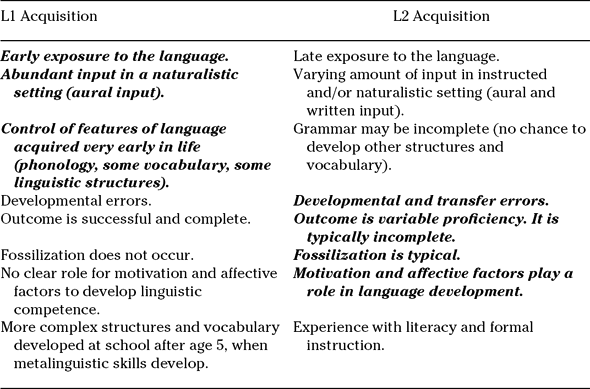
Table 1 summarizes the main features of these three types of acquisition: L1, L2, and heritage language acquisition. Characteristics in italic bold font represent the intersecting subset between L1 and L2 acquisition that mark heritage language acquisition.
Characteristics of L1, L2, and Heritage Language Acquisition
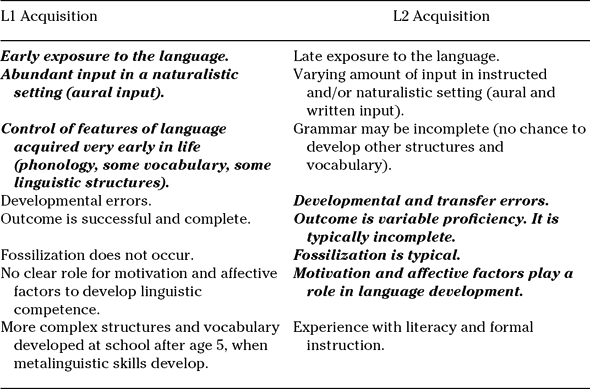
As can be seen in Table 1, heritage language learners like L1 learners are exposed to the language in early childhood through the aural medium in a naturalistic context (family), before the emergence of literacy. This is the period during which the essence of native speaker competence develops. Heritage language learners may command basic structures of the language if they received appropriate input and used (produced) the language, or only a subset of those structures, if the input and output were less abundant. Because heritage language acquisition takes place in a bilingual environment, as heritage language learners develop command of the majority language, they also make transfer errors. The outcome of heritage language acquisition is also variable and often incomplete, as in L2 acquisition, due to reduction of input and use of the target language in restricted contexts. Fossilization, so typical of L2 acquisition but undocumented in L1 acquisition, is also frequent in incomplete heritage language acquisition. Like L2 learners, heritage language learners need strong motivation to maintain and learn the heritage language, and issues of identity are very important. However, a key difference between heritage speakers and L2 learners has to do with context of acquisition and literacy. L2 acquisition typically occurs in a classroom setting, with heavy emphasis on reading and writing, and grammatical explanations, practice, feedback, and assessment of the developing L2 skills. If instructed, L2 learners are very literate in the L2 and have highly developed metalinguistic awareness of the language, while heritage language learners can be illiterate or have less developed literacy skills in the heritage language than in the majority language.
THREE THEORETICAL PERSPECTIVES: FORMAL LINGUISTIC, COGNITIVE, AND EMERGENTIST
Existing theoretical perspectives on language acquisition have been applied to explain monolingual acquisition by children and L2 acquisition by adults. Bilingual acquisition can also be accommodated within these perspectives. For example, it has been hypothesized that L1 and L2 acquisition utilize very different learning mechanisms, as spelled out in Bley-Vroman's (Reference Bley-Vroman, Gass and Schachter1989, Reference Bley-Vroman2009) fundamental difference hypothesis (FDH). According to Bley-Vroman (and other generative linguists), child L1 acquisition is largely guided by innate mechanisms that are assumed to be part of Universal Grammar (Chomsky, Reference Chomsky1986). That is, at the outset of language acquisition, children are guided by the inventory of principles and constraints subsumed under Universal Grammar. To explain the apparent differences between L1 and L2 acquisition in terms of outcome (successful and complete in L1 acquisition, variable and incomplete in L2 acquisition), the main claim of the FDH is that access to Universal Grammar is subject to a critical period. Postpuberty L2 learners can no longer use the same domain-specific (i.e., purely linguistic) mechanisms used by L1 learners. When learning a second language, L2 learners can only rely on their L1 knowledge (a particular instantiation of Universal Grammar, but not the full spectrum of linguistic options) and the principles and parameters active in their language. Consequently, in addition to L1 knowledge, L2 learners must resort to domain-general problem-solving skills, like analogy or pattern matching.Footnote 4
This particular position within generative linguistics is echoed within cognitive and neurolinguistic perspectives on L2 acquisition, which do not necessarily view language and language learning by children as innate, but as part of general cognition, and take into account the distinction between procedural and declarative knowledge and implicit and explicit language learning (DeKeyser, Reference DeKeyser, Doughty and Long2003; Paradis, Reference Paradis2004, Reference Paradis2009). Implicit knowledge refers to that learned without awareness of what is being learned, and it is learned incidentally or not (depending on the author). Implicit knowledge is stored in procedural memory, and when this knowledge is accessed or recalled, it is executed automatically and quickly. By contrast, explicit knowledge is acquired with awareness of what is being learned and with conscious effort. Because explicit knowledge is learned explicitly, individuals can verbalize this knowledge on demand. It is stored in declarative or episodic memory, where our world knowledge is stored.
Adult educated native speakers have both systems of learning available and use them as needed. According to Paradis (Reference Paradis2004), when young children speak or comprehend language, they use implicit competence (or knowledge) only. This is also true of adults who are illiterate. By contrast, incipient L2 learners use explicit knowledge of the L2 when producing or understanding the L2 and steadily and in tandem develop implicit competence of it. In agreement with Bley-Vroman's (Reference Bley-Vroman, Gass and Schachter1989) position, DeKeyser (Reference DeKeyser2000, Reference DeKeyser, Doughty and Long2003) also contended that adult L2 learners use a different cognitive system to learn an L2 because maturational constraints apply to implicit linguistic competence acquired early in childhood. The decline of procedural memory and loss of implicit cognitive mechanisms for language somewhere in childhood—what Bley-Vroman took to be Universal Grammar and domain-specific mechanisms—forces late L2 learners to rely on explicit learning.
Another approach to language acquisition is emergentism (O'Grady, Reference O'Grady2005). Like the cognitive and neurolinguistic approach, emergentism stands in contrast to the nativist approach that posits an innate Universal Grammar. The essence of emergentism is that language is an epiphenomenon, emerging from the interaction of general purpose cognitive abilities with each other and with the environment. For the theory of Universal Grammar, input underdetermines knowledge of language; however, for emergentism, it shapes it: General learning principles extract inductive generalizations and statistical regularities from the input. The key question for this approach is what the emergent linguistic knowledge looks like, and on this question answers vary. For N. C. Ellis (Reference Ellis2002, Reference Ellis, Doughty and Long2009), the emergent linguistic knowledge consists of local associations and memorized chunks; for Goldberg (Reference Goldberg and MacWhinney1999) and Tomasello (Reference Tomasello2003), it is constructions; and for O'Grady (Reference O'Grady2005), it is memorized processing routines. Although emergentism has extensively been applied to the problem of L2 acquisition (N. C. Ellis, Reference Ellis2002; MacWhinney, Reference MacWhinney1987; O'Grady, Lee, & Kwak, Reference O'Grady, Lee, Kwak, Ritchie and Bhatia2009), it is not clear how with respect to the outcome of the acquisition process the “fundamental” differences between child L1 and adult L2 learners are captured by this approach if the two populations use the same general learning mechanisms. One possibility is to say that the main differences between L1 and L2 acquisition are in the amount of input exposure and in the influence from the L1. Another possibility is that children and adults vary on how they parse and process input and the units they operate on (the less is more hypothesis of Johnson & Newport, Reference Johnson and Newport1989).
To summarize, the three perspectives described—Universal Grammar, cognitive approaches, and emergentism—emphasize different components of the language learning process: innate linguistic knowledge, general learning processes, and input, respectively, all of which are relevant in heritage language acquisition. While the three approaches often present themselves as competitors in confronting challenges of linguistic analysis and acquisition (nativism vs. emergentism, or cognitive approaches vs. Universal Grammar), they could actually be seen as complementary, were it not for the fact that they start from very different sets of assumptions about grammar, knowledge, and learning. I believe that the three approaches, or perhaps a combination of the three, are suitable to extend to heritage language acquisition.
RECENT EMPIRICAL FINDINGS
The Nature of Incomplete Acquisition
If some cases of heritage language acquisition are partial, incomplete, or interrupted L1 acquisition in a bilingual environment, one theoretical prediction is that heritage language learners’ knowledge of the language (prior to instruction in a classroom) has been acquired as in L1 acquisition: implicitly and through access to Universal Grammar in childhood, before closure of the critical period. (See the weaker language as L1 hypothesis as spelled out by Montrul, Reference Montrul2008.) That is, heritage language learners should have implicit knowledge of aspects of phonology and morphosyntax that emerge or are acquired very early in childhood and that are not overly dependent on a heavy amount of continuous input (e.g., word order, pronominal reference, clitic pronouns). If a great deal of complex grammatical knowledge is underdetermined by input as the theory of Universal Grammar assumes, then heritage language speakers should also demonstrate knowledge of structures and constructions that are not frequent or obvious from the input, such as binding constraints, wh-movement, aspects of lexical semantics, and other poverty of the stimulus phenomenon. Kim et al. (Reference Kim, Montrul and Yoon2009) found that heritage speakers had basic knowledge of anaphor binding in Korean. Montrul, Foote, and Perpiñán (Reference Montrul, Foote, Perpiñán, Almazán, Bruhn de Garavito and Valenzuela2008b) found that Spanish heritage speakers had robust knowledge of wh-movement in Spanish, and Montrul (Reference Montrul2006) found that even heritage speakers of low proficiency in Spanish made a syntactic distinction between unaccusative and unergative verbs.
In turn, if other aspects of language need more input and sustained exposure and use, as the emergentist approach maintains, then inflectional morphology and other aspects of language that are context-dependent, acquired after age 4 or 5, and reinforced through reading and formal instruction at school will not be fully developed. For example, specialized vocabulary, forms of address and honorifics in East Asian languages, complex structures like relative clauses, and semantically and pragmatically conditioned uses of the subjunctive in Spanish and Russian should either be missing in heritage language learners or remain imperfectly acquired, depending on the amount of input received. Although many of the characteristics of heritage language grammars described earlier seem to match these theoretical predictions, few studies conducted to date have been carried out with these theoretical approaches in mind. Therefore, if one wants to tease apart which available language learning theory best applies to heritage language grammars, more basic and theory-driven empirical research should be pursued. It is also important to continue investigating heritage language grammars and heritage language competence in their own right, and to compare heritage speakers with speakers with full command of the language, or even monolingual children in the process of development. Not only is this research design important, but it is also suitable to pinpoint more precisely which grammatical features heritage language learners manage to develop under reduced input and output conditions and which others remain underdeveloped into adulthood at all levels of structural analysis.
Comparisons of L2 Learners and Heritage Language Learners
Since the field of heritage language education is primarily concerned with how to teach heritage language learners and how to help them regain aspects of language they lost or to help them acquire those that they never developed, it is also instructive to make predictions on how heritage language learners may approach the learning process as compared with L2 learners with no previous knowledge of the language. Here again, theoretical approaches that apply to these two learning conditions are very suitable to extend to heritage language acquisition: heritage language learners fall in between L1 and L2 acquisition, as shown in Table 1.
If early age of acquisition is particularly important for phonology, heritage language learners should have better pronunciation and perceptual discrimination than L2 learners. Although early age of acquisition should also bring advantages for heritage language learners in morphosyntax, the existing literature on critical periods for language indicate that phonology is more affected by age effects than morphosyntax. Nonetheless, both L2 learners and heritage language learners are expected to exhibit transfer from the dominant language, which is the L1 in the case of L2 learners but the majority language in the case of heritage language learners.
If timing of input is crucial for developing the essence of native speaker competence, heritage language learners should benefit from having received exposure to the heritage language, even if minimal, in early childhood. According to theoretical models that assume the critical period hypothesis, like some positions within Universal Grammar (Bley-Vroman, Reference Bley-Vroman, Gass and Schachter1989, Reference Bley-Vroman2009) and cognitive and neurolinguistic approaches to L2 acquisition (DeKeyser, Reference DeKeyser, Doughty and Long2003; Paradis, Reference Paradis2004), heritage language learners should have more nativelike knowledge than L2 learners of comparable proficiency in the language. This hypothesis has been confirmed in the realm of phonology and pronunciation. As mentioned earlier, studies of Korean and Spanish heritage speakers and L2 learners by Au et al. (Reference Au, Knightly, Jun and Oh2002); Knightly, Jun, Oh, and Au (Reference Knightly, Jun, Oh and Au2003); and Oh et al. (Reference Oh, Jun, Knightly and Au2003) support this prediction. These studies found that heritage speakers with very low proficiency in the language performed significantly better than L2 learners on perception and production of VOTs in the two languages and in overall accent. Their findings on morphosyntax broadly defined, however, did not show differences between the groups. Similarly, Bruhn de Garavito's (Reference Bruhn de Garavito2002) study of verb movement in Spanish and O'Grady et al.'s (Reference O'Grady, Lee and Choo2001) study of case markers and relative clauses in Korean found no differences between L2 learners and heritage language learners, echoing the findings of Au et al. (Reference Au, Knightly, Jun and Oh2002) and Knightly et al. (Reference Knightly, Jun, Oh and Au2003).
By contrast, Montrul's (Reference Montrul2005) study of unaccusativity in Spanish found advantages for heritage language learners over L2 learners of low proficiency. Yet, other recent studies report mixed results. Håkansson (Reference Håkansson1995) found that heritage speakers of Swedish were significantly more nativelike with the verb second (V2) phenomenon than L2 learners of Swedish, but the two groups were equally nonnativelike on gender, number, and definiteness in noun phrases. Montrul (Reference Montrul2010) found no differences between Spanish heritage speakers and Spanish L2 learners with knowledge of object clitic placement in a written grammaticality judgment task, but while the heritage speakers outperformed the L2 learners in their acceptance of sentences with alternative word order (topicalizations), the L2 learners were more nativelike than the heritage speakers at rejecting ungrammatical sentences without differential object marking in Spanish. Hence, it is not yet clear whether heritage speakers and L2 learners differ significantly from each other in their morphosyntactic knowledge.
Mode of Acquisition, Types of Knowledge and Tasks
Other hypotheses can be made if we take into account how age and mode of acquisition impinge on different types of knowledge. However, how the languages are tested and the types of tasks used to measure linguistic competence in the two types of learners become very significant. Since heritage language learners are primarily naturalistic and very often illiterate learners, and L2 learners are instructed and literate learners, heritage language learners should do better than L2 learners on grammatical areas tested through oral production and aural comprehension tasks. By contrast, L2 learners may outperform heritage language learners in untimed written tasks that maximize the use of metalinguistic and explicit knowledge of the language.
There is also the possibility that because heritage language learners are less literate in the heritage language than L2 learners are in their L2, many strict comparisons between the two groups are hard to interpret (or at least existing comparisons may say much less about actual grammatical competence than on language processing as a function of experience.) Because heritage language learners are primarily naturalistic learners, they are better at processing the language aurally. Furthermore, they have little metalinguistic competence and awareness. L2 learners acquire the language primarily through literacy, and oral skills tend to be less emphasized in the classroom. R. Ellis (Reference Ellis2005) and R. Ellis, Loewen, and Erlam (Reference Ellis, Loewen and Erlam2006) have discussed how different written and oral tasks used in typical L2 acquisition studies can indirectly tap more implicit or explicit knowledge of the language. It is thus not surprising to find that heritage language learners tend to outperform L2 learners in oral tasks that minimize metalinguistic knowledge (and conscious memorization of rules), while L2 learners outperform heritage language learners on written tasks that require high levels of metalinguistic awareness. Montrul et al. (Reference Montrul, Foote and Perpiñán2008a) found that Spanish heritage speakers were significantly more accurate than L2 learners on gender agreement in an oral picture naming task, but much less accurate on a written recognition task and a written comprehension task. It would be fruitful to expand this line of research to investigate how heritage language learners of different levels of proficiency in their different abilities (listening, speaking, reading, and writing) perform on different types of tasks, and how they compare with L2 learners of similar proficiency in the same skills. In addition to investigating grammatical knowledge, it is also crucial to investigate how heritage language learners process the heritage language during listening and reading.
Reactivity to Classroom Instruction, Type of Feedback, and Ultimate Attainment
Finally, let us consider the issue of whether pedagogical methods used with typical L2 learners can be applied with heritage language learners. Although Valdés et al. (Reference Valdés, Fishman, Chávez and Pérez2006) have voiced concerns about extending blindly pedagogies from L2 learning to heritage language classroom, it is time to evaluate the extent to which those methods work. In this respect, L2 classroom research has much to offer to the heritage language classroom, whether it involves classes developed exclusively for heritage language learners or mixed classes that cater to both types of learners.
Perhaps the biggest question is how heritage language learners react to classroom instruction, if they have implicit knowledge of the heritage language acquired in childhood. Once in the classroom, will they continue to learn the heritage language implicitly as L1-acquiring children, or will they now rely on explicit learning, like adult L2 learners? Can they eventually catch up with the missing explicit and metalinguistic knowledge that they did not get at school through reading and writing instruction?
There is no doubt that heritage language learners have high levels of communicative competence in the heritage language, but need to expand vocabulary, develop literacy skills in different genres, and improve grammatical accuracy. One possibility is that the implicit learning of the language heritage learners bring to the classroom may reactivate, facilitate, and speed up learning and relearning of the heritage language. The other possibility is that because they are adults, heritage language learners can only now rely on explicit learning, like L2 learners, and their acquisition of the heritage language will be as successful as that of L2 learners, but not necessarily nativelike in all domains. For the latter, research shows that occasional focus on form is beneficial for L2 learners (Carroll & Swain, Reference Carroll and Swain1993; R. Ellis et al., Reference Ellis, Loewen and Erlam2006). If L2 learners do not receive explicit instruction as to how or in which contexts something is correct or incorrect in the target language, they are not likely to notice it, especially if their native language interferes. Since interference from the majority language is also at play in heritage language learners, the same question applies to them.
Classroom research with heritage language learners is quite scant at the moment, but it is certainly an area that deserves more detailed investigation. A recent study by Montrul and Bowles (Reference Montrul and Bowles2009) found that Spanish heritage speakers omit the preposition “a” required with animate direct objects in Spanish and wanted to find out whether explicit instruction with feedback would help heritage language learners notice this gap in their linguistic knowledge. Montrul and Bowles (Reference Montrul and Bowles2010) tested two groups of adult Spanish heritage speakers using a pretest-posttest design with instruction intervention. Bowles and Montrul (Reference Bowles, Montrul, Leow, Campos and Lardiere2009) did the same with Spanish L2 learners. Results of both studies showed improvement and reactivity to instruction in the L2 learners and heritage language learners as measured by written production and a written grammaticality judgment task. Because the L2 learners and heritage language learners were of different proficiency level, it was not possible to compare the results of the two studies directly. Nonetheless, the magnitude of the improvement from pretest to posttest was much higher in heritage language learners than in the L2 learners, but this could have been due to the fact that the heritage language learners’ were of higher proficiency than the L2 learners. Another recent study that compared L2 learners and heritage language learners’ interpretations of imperfect subjunctive in written tasks and two types of instruction is Potowski, Jegerski, and Morgan-Short (Reference Potowski, Jegerski and Morgan-Short2009). They found no differences between the groups by instruction type, but they did find differences between the groups on improvement on imperfect subjunctive after instruction. The L2 learners were more reactive to explicit instruction with subjunctive than the heritage language learners.
In summary, if heritage language learners received some crucial input during the critical period, given optimal amounts of input and time to develop the underdeveloped skills through instruction, they should be able to catch up with educated native speakers if that is what their linguistic goal is. According to the theoretical models discussed, heritage language learners have the cognitive and linguistic potential to reach nativelike competence in the heritage language at the grammatical level. Whether this potential is realized may not only depend on more optimal input and output conditions but also on motivation and specific needs.
TOWARD THE FUTURE
In conclusion, heritage language acquisition is a complex process with a host of linguistic, affective, political, educational, social, and cultural variables affecting its outcome. A great deal of existing studies have investigated the sociolinguistic situation of minority languages and have provided comprehensive profiles of the linguistic and academic abilities of some heritage language learners. While linguistic and acquisition-oriented research has offered a more nuanced perspective on the language and development of heritage language systems, far more needs to be done to make more direct contributions to the heritage language classroom. On the one hand, we need more psycholinguistically oriented studies of adult heritage speakers to find out how they process input in the heritage language and in different skills. On the other hand, we need to carry out more longitudinal studies of children at the onset of the school-age period and until adolescence, to trace more precisely the demise of home language skills as a result of schooling in the majority language. These types of studies are likely to give us a more precise picture of what exactly adult heritage language speakers are missing in terms of academic language and how lack of academic support affects later language development. Finally, if quality and quantity of input are crucial in heritage language development and form the bases of the theory of emergentism, then we definitely also need controlled studies of parental input and of input throughout the life span. Most studies to date rely on estimates of input frequency from self-reports or analyses of corpora. But estimates are not measurements. Studies of input will also help us understand more directly the role of the family and community in the shaping of heritage language grammars.