
War is expensive. Troops must be equipped and weapons must be procured. As Cicero famously quipped, “the sinews of war [are] unlimited money.”Footnote 1 Governments can meet these expenses by printing money, taxing, or borrowing.Footnote 2 Printing money is a mechanism by which governments repudiate debts (by inflating away their value), while taxes have an upper bound of 100 percent (and public resistance can keep taxes below that level). Thus, governments largely turn to borrowing.Footnote 3
But a government's borrowing needs will run headlong into the fundamental problem of sovereign finance: the inability of lenders to compel governments to repay debt.Footnote 4 The enormous borrowing requirements of war, typically concentrated in a short period of time, make the sovereign's credibility problem more difficult because the state (or, at least, the leadership) may not exist tomorrow (let alone be able to repay debts). For these reasons, scholars widely acknowledge that political institutions are crucial for reducing borrowing costs.Footnote 5 As Schultz and Weingast state, “institutions of limited government underpin a financial system that is capable of sustaining large expenditures on military competition in a manner that is consistent with long-term economic growth.”Footnote 6
Central banks play the key role in enhancing a government's ability to borrow, particularly during times of war. As Broz states, “the main societal public good [of central banks] was fiscal in nature and involved improving government credit worthiness during wartime.”Footnote 7 When a government charters a bank to serve as its fiscal agent, the bank supplies funds to the government, manages the national debt, and handles the government's accounts. In return for the rents associated with those functions, the bank invests in government bonds. While ultimate responsibility for honoring debts remains in the sovereign's hands, placing the immediate responsibility in the hands of the chartered bank gives investors confidence that government bonds, if purchased, can be redeemed. This, in turn, gives the government an easy source of financing.Footnote 8
However, I go beyond Broz, both theoretically and empirically. Unlike Broz, I argue that the sovereign need not internalize society's welfare function to maintain the central bank. Instead, the sovereign's dependency on capital, combined with a desire for cheap credit, incentivizes the sovereign to allow the central bank to persist. Empirically, this study provides the first systematic evidence (with the exception of anecdotes)Footnote 9 that central banks enhance governments' ability to borrow during times of war. In fact, the empirical evidence will largely suggest that, for the pre-1914 time period, central banks enhance sovereign borrowing only during times of war.
Both nondemocratic and democratic leaders have recognized the financial advantages central banks can accord governments during times of war. Upon establishing the Banque de France, Napoleon pronounced, “the Bank does not solely belong to its shareholders; it also belongs to the state which granted it the privilege of creating money.”Footnote 10 Alexander Hamilton observed that “The aid afforded to the United States, by [The Bank of North America], during the remaining period of the war, was of essential consequence.”Footnote 11 Reflecting on the Federal Reserve's role during World War I, Carter Glass, the sponsoring senator of the Glass-Owen Act that created the United States Federal Reserve, remarked:
If there was a trace of exaggeration in the estimate of that seasoned English economist who declared the federal reserve system “worth to the commerce of America more than three Panama Canals,” nevertheless, it must be conceded that, in the crucial test of a world war, it was found to be more indispensable to civilization than three times three Panama Canals. This merely means that I agree with the considered judgment of those eminent bankers of this and other lands who have said that the World War could not have been financed but for the Federal Reserve Act. And if not financed, of course, it could not, except at infinitely greater sacrifice, have been won by the United States and associated nations.Footnote 12
Using data on the London sovereign debt market from 1816 to 1914, I find that the presence of a central bank drives down borrowing costs during times of war.Footnote 13 I focus on the 1816 to 1914 time period for three primary reasons.Footnote 14 First, before the Napoleonic period, few nations had significant international debts.Footnote 15 Second, the role of central banks changed after World War I. Until World War I, military financing motivated the creation of many (if not most) central banks, while the gold standard constrained monetary policy (thereby limiting concerns that governments could indiscriminately print money to eliminate bondholder claims). Since World War I, central bankers have focused more on controlling inflation, rather than fiscal management. Third, while none of the interstate wars during this time period were of the length or magnitude of World War II, this did not obviate the need for war financing. Inflation-adjusted military expenditure data from 1816 to 1914 show that military expenditures the year before a war are an average of £18 million ($93 million), while military expenditures during war years rise to an average £30 million ($152 million).Footnote 16
Credibility Problems in Sovereign Finance
Sovereigns desire funds but face a credibility problem with honoring the loans issued to acquire such funds. This credibility problem becomes more difficult during times of war, when there is an enormous amount of borrowing required in a short period of time and the sovereign's survival is at stake. Lenders desire maximizing profits on loans, but they cannot sufficiently punish the government in case of default. This is attributable, in part, to an inability to credibly enforce a boycott on sovereign loans.
The Needs and Problem of the Sovereign
Recall that this study is focused on the borrowing behavior of sovereigns during the nineteenth and early twentieth centuries. This is important to keep in mind because the primary function of sovereigns before the mid-twentieth century was providing the means of warfare.Footnote 17 As Ferguson puts it, “The process of parliamentarization and bureaucratization were first made necessary by the cost of war. But in the twentieth century they developed a momentum of their own, increasingly diverting resources away from military towards civilian employment and redistributive transfers.”Footnote 18 Providing the means of warfare in the modern nation-state system required an easy means of finance, typically in the form of debt. Tilly makes this point in reference to European states:
After 1500, as the means of successful warfare became more and more expensive, the rulers of most European states spent much of their time raising money … [Since] few large states have ever been able to pay for their military expenditures out of current revenues … they have coped with the shortfall by one form of borrowing or another.Footnote 19
Since the sovereign's expenditures were directed primarily toward warfare and the key instrument for financing military expenditures was borrowing, times of peace placed little burden on a sovereign's ability to maintain current expenditures or to honor whatever limited borrowing was required to maintain a smaller, peacetime force.Footnote 20 However, war onset induced a surge in sovereign expenditures that might generate a potentially unsustainable level of borrowing. For example, when discussing the impact of the Crimean War on European financial markets, Ferguson describes how “even for powers which did not directly fight in it, the Crimean War increased military expenditure above the level of revenues available from taxation, and therefore forced all concerned … to go to the bond market.”Footnote 21 The sudden war-associated surge in debt heightened concerns over sovereign default (not to mention war's ability to destroy the state's resources, compel regime change, or even eliminate the state). As Kirshner aptly states, “these wartime consequences and burdens do not pass unnoticed by the financial community.”Footnote 22 Hence, war-time “premiums” are imposed in the form of higher borrowing costs.Footnote 23
This highlights the central principle of government borrowing: the sovereign's willingness to pay.Footnote 24 The sovereign has a credibility problem with respect to honoring its debt obligations. Without an authoritative entity that can force the sovereign to honor debt contracts, the sovereign cannot credibly commit to promises to repay debts. As North and Weingast say, “Consider a loan to a sovereign in which the ruler promises to return the principal along with interest at a specified date. What prevents the sovereign from simply ignoring the agreement and keeping the money?”Footnote 25
North and Weingast go on to dismiss reputational concerns as a possible solution: because sovereigns have time-inconsistent preferences, the need to ensure political survival could lead the sovereign to heavily discount future benefits, thereby making immediate default more enticing.Footnote 26 Such time inconsistencies become more pronounced during times of war. War places large fiscal demands on sovereigns and can intimately and obviously risk the sovereign's survival. Under such circumstances, sovereigns could view the definitive gain from a one-off default as preferred to vague future opportunities.Footnote 27
The government's credibility problem implies that any institution that can increase the penalty on the sovereign for default should also improve the ability of the sovereign to borrow during times of war.Footnote 28 Indeed, any mechanism designed to influence a government's borrowing costs should have its primary (if not sole) effect during times of war. Identifying the constituative components of such an institution requires exploring lenders’ needs and problems.
The Needs and Problem of Lenders
The primary motive of lenders is to maximize the return on their investments. Because an important source of investment return for lenders is the interest charged on loans to the government, lenders want to ensure that the government makes good on its interest payments and repays the money it borrows. But lacking an effective means of centralized enforcement, lenders attempt to compel government repayment by threating to cut off loans. In theory, the maximum penalty that can be imposed on a government for default is a complete boycott by all lenders.Footnote 29 In the words of Hirschman, the ability of investors to “exit” by refusing payment should induce the sovereign “to search for ways and means to correct whatever faults have led to exit.”Footnote 30
Unfortunately, just as the government faces a credibility problem with respect to making payments, lenders face a credibility problem with respect to punishment. Two problems undermine the credibility of lender punishment. First, punishing the sovereign by withholding funds hurts lenders.Footnote 31 A boycott means lenders are willing to walk away from their current investments with the sovereign, thereby allowing it to default. But such losses could be prohibitively costly to lenders. Moreover, because a boycott means losing a potential source of new investments, lenders also incur the opportunity costs associated with forgoing the potentially high return (accounting for default risk) offered by new loans to the sovereign. This is why, according to Bulow and Rogoff, many defaults are partial, with lenders seeking ways to renegotiate the terms of a loan.Footnote 32
Collective action is the second problem impeding lenders’ ability to effectively punish the government if it defaults. The collective action problem originates from the government's ability to offer extraordinary terms to lenders willing to defect from the boycott.Footnote 33 As Bulow and Rogoff argue, “the initial lending consortium will never gain any ex post monopoly power over the country as long as the country is always allowed to repay its outstanding loans by replacing them with loans from a new consortium.”Footnote 34 Weingast elaborates: “Although it might be easy for the lenders who were harmed by a default to refuse to provide new funds, other potential lenders may find it too costly to join the boycott.”Footnote 35
To gain a deeper understanding of the problems associated with having a large number of lenders, as well as the potential solutions to those problems, I borrow from Weingast by considering the sovereign's value for debt.Footnote 36 Assume the sovereign places value on debt finance (denominated in dollars), but that value increases at a decreasing rate. If there are no limits on the sovereign's ability to borrow, the sovereign will borrow until the marginal productivity of the last dollar borrowed equals the cost of borrowing that dollar, which is the interest rate i. Call this level of borrowing D*. If the lenders are small relative to the sovereign, then the first few loans are very valuable to the sovereign, but the last few loans are not. In particular, the last dollar borrowed at D* has a net value of 0 since its marginal value is equal to the cost of borrowing. Because a punishment of 0 will cost the sovereign nothing, a threat by the lender to withhold these last funds is insufficient to deter the sovereign from default. In contrast, if defaulting on any one lender leads to a complete boycott of the sovereign, then the sovereign loses the funds from all loans, not just those with a net value of 0. This will diminish the sovereign's incentive to default. Of course, a total boycott requires the lenders on whom the government has not defaulted to enforce the boycott, which, as I explained, is difficult to achieve.
A key assumption underlying this discussion is that the lenders are numerous and small. If the lenders are instead small in number and large, this might change the government's behavior. In this case, the last dollar of the last loan borrowed will have a net value of 0, but the last loan itself will not be valued at 0 (because it is likely that this last loan contributed more than just the last dollar borrowed). This means the dilemma facing the sovereign and the lenders can be stated like this: although the sovereign prefers that each lender be one of many, the lenders prefer to be one of a few.
The Argument
Any institution capable of increasing the penalty on the sovereign for default should also improve the sovereign's ability to borrow, most notably during times of war (when an enormous amount of borrowing in a short period of time heightens fear of default). A central bank is one such institution. Indeed, I argue that a central bank is not just any institution, but a critical institution for enhancing the penalty imposed on sovereigns for default.
A central bank helps overcome the twin credibility problems of the sovereign and lenders. By being the sole direct purchaser of government debt, the central bank increases the effective punishment that can be imposed on the government for defaulting on the marginal lender. This increases lenders’ confidence that the government will be punished in case of default, thereby making lenders willing to purchase the debt at a lower rate. The central bank benefits from the rents associated with being the monopoly issuer of the debt and, as a profit-motivated entity, does not have an incentive to default on the secondary lenders. The sovereign, dependent on the low borrowing costs offered by the central bank, has an incentive to retain the bank. In effect, the sovereign and the central bank become “mutual hostages.”Footnote 37
The Role of Central Banks
Lenders respond to the risk involved in sovereign lending by raising the costs of borrowing (via higher interest rates). Since allaying lenders’ fears of default will lower the sovereign's borrowing cost, sovereigns have an incentive to identify confidence-building mechanisms. Creating an institution that increases the credibility of being penalized for default should improve the sovereign's ability to borrow.
One institution is a representative body, where a portion of that body is composed of creditors. Schultz and Weingast argue that granting political authority to a parliament or representative legislature with “power over the purse” constrains (if not eliminates) the sovereign's ability to unilaterally default.Footnote 38 Requiring the sovereign to bargain with a representative assembly lowers borrowing costs, thereby enabling “tax smoothing” policies that avoid oppressive tax increases. However, as North and Weingast aptly claim, “The triumph of the Parliament raises the issue of why it would not then proceed to act just like the king? Its motives were no more lofty than those of the Crown.”Footnote 39
Another institution that can increase the credibility of the lenders’ penalty is a central bank. Indeed, before the twentieth century, central banks were largely created for the exact purpose of enhancing the government's ability to secure loans to pay heightened military expenditures.Footnote 40 When a government chartered a bank to serve as its exclusive fiscal agent, the bank supplied funds to the government, managed the national debt, and handled the government's accounts. In return for being the exclusive manager of the government's accounts (and receiving the associated rents), the bank was required to invest its assets in government bonds. This ensured the government an easy source of financing.Footnote 41
Addressing the collective action problem
A central bank addresses the lenders’ collective action problem. Recall that lenders prefer to be as few in number as possible, as this increases the effective punishment that lenders can inflict on the sovereign. By granting a central bank exclusive right to issue government debt, it becomes illegal for any individual to provide a loan outside the purview of the bank.Footnote 42 Hence, the central bank is not just one of a few lenders (which is preferred by the lenders), but the only direct lender to the sovereign. Being the sole direct lender also gives the central bank the ability to enforce a boycott on the sovereign until the sovereign agrees to repay. As Weingast explains, “By centralizing the loan decisions in a single intermediary rather than among a large, diffuse community of agents, the bank's charter allowed it to enforce a community credit boycott.”Footnote 43
Simultaneously and critically, the central bank, as with individual banks, is motivated to maximize the return on its investments. This means the central bank has longer time horizons than the sovereign. The central bank, wanting to maximize its investments, wishes to avoid defaulting on the individual banks to whom it sells the sovereign's debts. In reference to the Bank of England, J.R. Jones notes how the bank “had an obvious and permanent concern to perpetuate its own existence and to maximize the profits which it made from government loan operations.”Footnote 44
Knowing the central bank can enforce a boycott on a sovereign default and that the central bank shares their profit motive instills individual lenders with confidence in the sovereign's debt. The lenders are concerned about the sovereign's creditworthiness, fiscal policy, and war-financing ability only to the extent that these factors influence the lenders’ profits. This is why the prominent nineteenth-century international financier Nathan Rothschild said that his preferred business “consists entirely in Government transactions & Bank operations,” by which he meant central banks such as the Bank of England and Banque de France.Footnote 45
Addressing the credibility problem
The central bank also addresses the sovereign's credibility problem. Given a central bank's ability to impose a costly punishment on the sovereign, the creation and promotion of a central bank creates investor confidence. However, this is contingent on the sovereign somehow overcoming its short time horizons. In other words, even if the central bank effectively imposes a creditor boycott and even if the central bank itself has a long time horizon, the sovereign still faces a credibility problem, except now with respect to its willingness to retain the central bank. What will prevent the sovereign from defaulting on the central bank and/or revoking its charter? In reference again to the Bank of England, Jones acknowledges that “another statute could have been enacted at anytime to suspend or reduce the interest due on the loans that had been contracted.”Footnote 46
A mechanism by which the central bank establishes sovereign credibility becomes clear by again considering how the sovereign prefers that each lender be one of many, while the lenders prefer to be one of a few. Establishing a central bank shrinks the pool of direct lenders to one. This ensures that the net value of the last lender remains high, thereby discouraging the sovereign from default. Thus, the creation of the central bank is not without costs to the sovereign—the sovereign, by constraining its ability to “cherry-pick” lenders, has tied its hands to one lender. But because this one lender receives the rents from being the exclusive issuer of the sovereign's debt on the secondary market, the lender is willing to provide the government with favorable access to and terms of credit. While the sovereign (either the crown or a parliament) could still choose to default on the central bank (or prematurely disband the central bank by eliminating it before the charter's expiration), doing so returns the government to the same credibility problem it faced previously, except now with respect to the provision of charters. Hence, the sovereign, dependent on the low borrowing costs offered by the central bank, has an incentive to retain the bank.
The mechanism is similar to that of merchant guilds during medieval times. These guilds coordinated the efforts of foreign traders to enforce a cessation of trade with a ruler who refused to protect trading rights or make payments. According to Grieg, Milgrom, and Weingast, powerful rulers cooperated with foreign merchants to establish guilds because “the guild's power enabled trade to expand to the benefit of the merchants and rulers alike.”Footnote 47 Indeed, Grieg, Milgrom, and Weingast go on to point out how central banks seem to share the same mechanisms—they can initiate a credit boycott and punish lenders who attempt to lend to the government outside the boycott (by refusing to offer to the lenders the sovereign debt in the central bank's possession).Footnote 48
Of course, no system, be it merchant guilds or central banks, is completely and fully credible. The sovereign could still threaten to fire central bankers who wish to act against the sovereign's interests or handsomely reward those who do act in the sovereign's interests.Footnote 49 Consider that the United States eliminated the First Bank of the United States in 1811 and, in particular, the Second Bank of the United States in 1836. Since the Second Bank of the United States was associated with his chief political rival, Henry Clay, President Andrew Jackson vowed “The Bank is trying to kill me, but I will kill it.”Footnote 50
Thus, central banks do not “solve” the sovereign's credibility problem, but the sovereign's desire for cheap finance, and the central bank's ability to satisfy that desire, place a large constraint on the sovereign's ability to renege from his/her commitment to lenders. Would Jackson have made the same decision if the US government, like England and many other European countries, had a greater demand for debt and been involved in a series of wars?Footnote 51 The likely answer is no. Indeed, Jackson's spending cuts and paying down of the national debt (which was accomplished in his second term) is considered by some economic historians to be “an exceptional occurrence in world history.”Footnote 52
The sovereign's desire for cheap finance is a mechanism that complements the mechanism offered by Broz, that the sovereign remains committed to the central bank because doing so reduces the economic distortions created by financing war through current taxation.Footnote 53 I do not refute the desire to pursue “tax smoothing” (that is, financing wartime expenditures by borrowing, then servicing and amortizing the debt by taxation in peacetime) as motivating the sovereign's commitment to the central bank. However, the sovereign's incentives need only be predicated on its desire to acquire cheap war finance, not, as Broz states, because it “internalizes aggregate welfare, meaning that it has incentives to supply public goods and to minimize the deadweight loss of inefficient arrangements”Footnote 54 Such benefits may result from the sovereign's decision, but perhaps only as collateral benefits.
The sovereign and the central bank, because of either the desire to pursue tax-smoothing policies or simply the desire to acquire favorable terms of finance, become “mutual hostages”: the bank benefits from the rents afforded by the sovereign-sanctioned monopoly and the sovereign benefits from the ability to acquire financing at favorable rates.Footnote 55 Consequently, the sovereign allows the bank to persist for reasons analogous to the incentives identified by Bueno de Mesquita and colleagues: the leader does not want to lose the revenue-enhancing properties accorded by the central bank.Footnote 56 Stated simply, the government does not want to “kill the goose that lays golden eggs.”
Dependence on Capital and Central Bank Persistence
In many ways, the idea of a central bank and sovereign becoming “mutual hostages” shares similarities to Przeworski and Wallerstein's argument regarding the state's structural dependence on capital.Footnote 57 They maintain that governments, in need of private firms to provide the economy with investment, will be compelled to enact policies that are in the best interest of capital holders. More precisely, the government's ability to set policy is constrained by the actions of capital owners because capital owners will withdrawal assets if they anticipate a loss in profits (whether or not those owners directly lobby the government).
While Preworski and Wallerstein applied this idea to the ability of private investment to enhance an economy's future material welfare (through investments that enhance production and employment),Footnote 58 Tilly extends the argument to the government's needs for finance: “The availability of credit depends on a state's previous repayments of its debts, to be sure, but it depends even more on the presence of capitalists.”Footnote 59 Though one may (correctly) contend that state dependency on capital is present without a central bank, the central bank enables the owners of capital to coordinate their boycotting efforts. For this reason, capital desires the creation of a central bank, and the sovereign, desirous of reducing the cost of acquiring capital's funds, is willing to oblige.
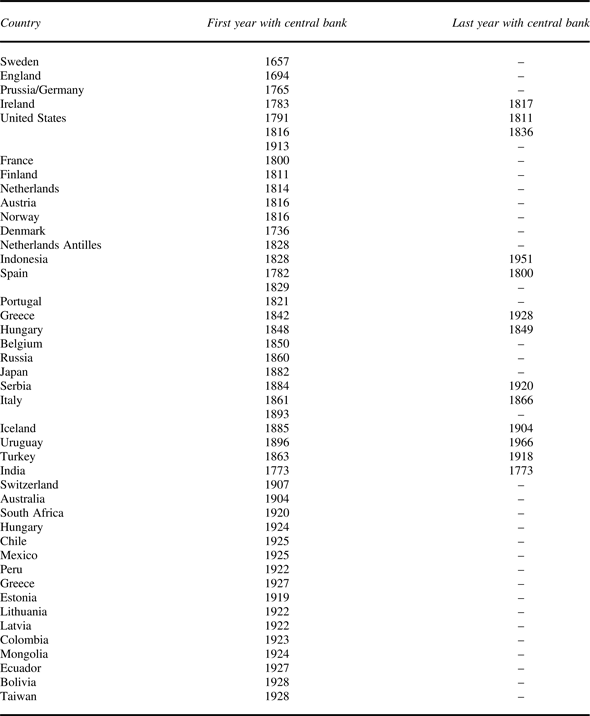
If this aspect of the argument is true, then one should expect central banks to be rather sticky institutions. This appears to be the case. Table 1 lists all central banks created before 1930.Footnote 60 In addition to listing the country's name, Table 1 reports the founding year (first year with Central Bank) and ending year (last year with Central Bank) for each central bank. Out of the forty-six central banks listed, thirty-three (72 percent) have not been disbanded.
Countries with central banks before 1930

Sources: See the online appendix.
Admittedly, one cannot disregard the role of “luck,” particularly in the case of the Bank of England's persistence. Without its series of eighteenth-century wars with France, the British government may have decided to revoke the Bank's charter during its early years of existence.Footnote 61 Instead, the timing of renewal decisions nearly always coincided with a time of war. As Jones says, “The French wars made the Bank and the Financial Interests indispensible and put practical limits on the action the Parliament could undertake, even by statute.”Footnote 62 Thus, while the British Parliament could have passed legislation at virtually any time revising the Bank's charter or the government might have passed a new law altering or canceling the original charter, the Bank of England's charter continued to be renewed because England's rivalry with France generated frequent wars during the eighteenth century.Footnote 63
Empirical Implication
Whether the presence of a central bank improves the ability of a sovereign to borrow is ultimately an empirical question. My argument suggests a simple testable implication: a central bank reduces the borrowing costs of a government, particularly when the enormous and concentrated borrowing requirements of war make acute the sovereign's credibility problem. I state this argument in the following hypothesis:
H1
Ceteris paribus, central banks reduce a government's borrowing costs.
Again, this result should hold especially during times of war.
Research Design
For reasons discussed earlier, I will test this hypothesis using data from the 1816 to 1914 time period. Because identifying the relationship between borrowing costs and central banks requires accounting both for a variety of potentially confounding factors and for peculiarities in panel data, I rely on multivariate analysis.
Units of Analysis
To test my hypothesis, I consider, for those countries for which data exist, all country-years from 1816 to 1914. Using all country years, when coupled with the inclusion of an interaction term between the presence of a central bank and involvement in an interstate war, enables me to identify if having a central bank during times of war induces a substantively different change in borrowing costs compared with times of peace.
Operationalizing Borrowing Costs
My dependent variable must measure a government's borrowing costs. Since the bonds governments issue must offer interest to compensate investors for the risk of inflation and default, economists typically capture a government's borrowing costs in relative terms. They do this using the difference between the interest rate on the government bonds considered to have the least likelihood of default and the interest rate on bonds of other governments.Footnote 64 This difference is called the spread, which captures the risk premium that a government must pay. Thus, if i S is the interest rate on the “secure” asset and i R is the interest rate on the “risky” asset, then the difference i R − i S indicates the additional return the “risky” asset must provide to compensate the lender for the added risk of default relative to the “secure” asset. In the modern global system the most secure bonds are US Treasury bonds, but during the nineteenth century and early twentieth century the most secure bonds were those issued by the British government. Hence, most studies looking historically at government borrowing costs rely on the spread between a government's bond yields and the yields on British bonds, specifically British long-term Consols.Footnote 65
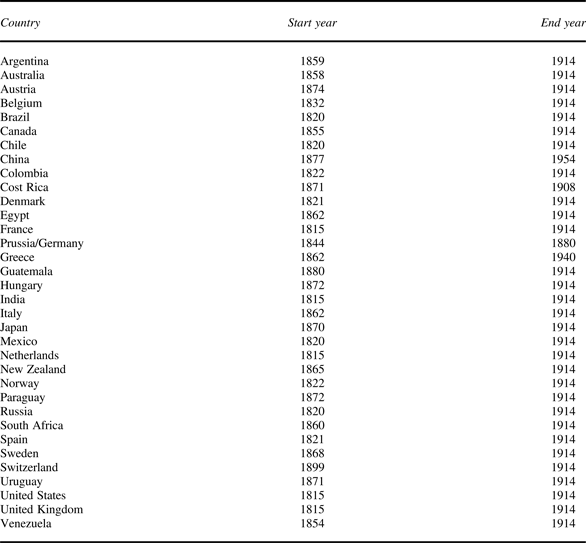
Computing the spread requires data on government bond yields.Footnote 66 Though such data are widely available for the later half of the twentieth century, they are limited for the nineteenth and early twentieth centuries.Footnote 67 The Global Financial Database (GFD) provides government bond yield data covering this earlier time period for thirty-four countries (Table 2).Footnote 68 I compute, for each country in each year, the difference between the median annual yield on that country's long-term government bonds and the median annual yield on British long-term government bonds.Footnote 69 I use long-term government bonds (such as British Consuls), rather than municipal bonds or bonds for specific projects (such as railroad bonds). Overall, I have a continuous dependent variable ranging from -2.79 to 1.9, with a mean value of 0.87 and a standard deviation of 0.55.Footnote 70
Countries with sovereign debt yield data, 1816 to 1914

Source: Global Financial Database.
Operationalizing Central Banks
To operationalize when a country possessed a central bank, I draw from a variety of sources to create an original data set of central bank creation and presence.Footnote 71 Table 1 lists all central banks created up to 1930. In addition to the observations detailed in the theoretical section, two further observations can be gleaned from Table 1. First, as Broz initially observed, many central banks are formed during war (Swedish Riksbank, the Bank of England, the Bank of France, the Bank of Finland, the Bank of the Netherlands, and the Bank of Portugal), while others are established immediately following war to absorb the over issuance of paper currency (the First and Second Banks of the United States, the Austrian National Bank, the National Bank of Norway, and the National Bank of Denmark).Footnote 72 Second, a substantial number of countries possessed central banks at various times during the nineteenth century (but not so many that I lack variation in the presence of central banks). This illustrates that the central bank variable is not simply a proxy for “Bank of England” or “British hegemony” during the nineteenth century. I use the information from Table 1 to create the binary variable central bank, which equals 1 if a country has a central bank in year t, and 0 otherwise.
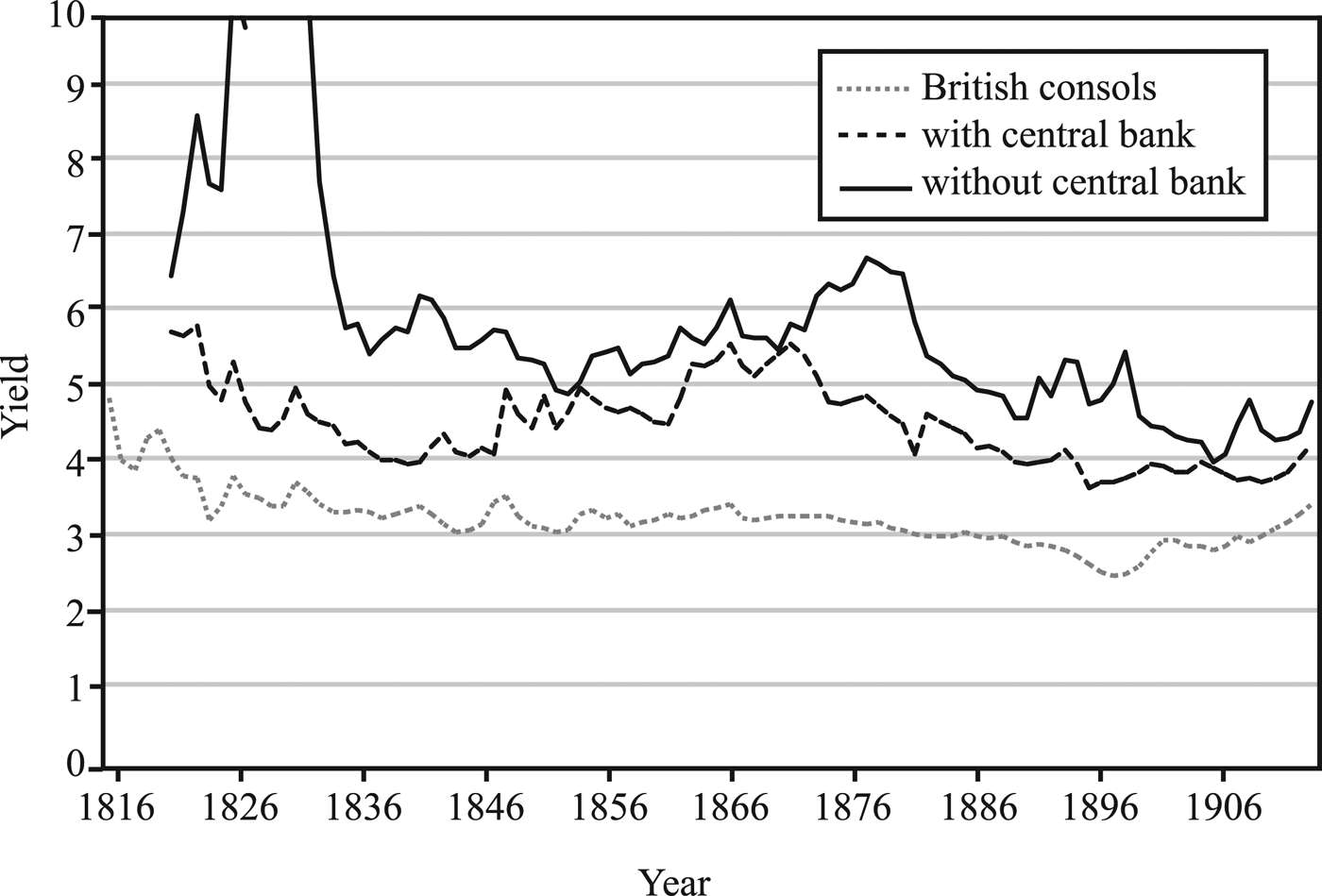
To illustrate how the presence of a central bank relates to borrowing costs, consider Figure 1. It depicts the bond yields of three groups of countries from 1816 to 1914: the annual yield of British long-term bonds (Consols); the median annual yield on long-term bonds for other countries (that is, other than the UK) with a central bank; and the median annual yield on long-term bonds for countries without a central bank. Looking at Figure 1, one should first take note that, unsurprisingly, the yield on British Consols is the lowest line over the entire time period. Second, and quite strikingly, Figure 1 shows that, despite exhibiting volatility, the line for governments lacking a central bank (the solid line) is consistently higher than the line for governments with a central bank (the dashed line). This strongly suggests that central banks accord countries favorable terms of financing. However, confirming this association requires conducting multivariate analysis that controls for potentially confounding variables and accounts for the unique features of panel data.
Median annual yields on sovereign debt for British bonds and various categories of countries

Operationalizing Interstate War and the Interaction with Central Banks
The modifying variable captures whether a country is involved in a Correlates of War (COW) data set interstate war that began during the 1816 to 1914 time period.Footnote 73 The list of wars includes large wars (the Crimean War from 1853 to 1856 and World War I, which began in 1914) and short wars (such as the Seven Weeks War in 1866). Since my expectation is that central banking will induce a larger reduction in the spread during times of war compared with times of peace, I include an interaction between the interstate war variable and the central bank variable. This enables me to compare the impact of a central bank on the spread when a country is at peace versus when it is at war.Footnote 74
Control Variables
To conduct multivariate analysis, I control for factors that could explain both lower borrowing costs and the presence of a central bank. I begin by describing how I control for the presence of representative institutions. Next, I describe how I control for a number of factors discussed in Dincecco's recent empirical work on the history of sovereign credit risk.Footnote 75
Representative institutions
Given the prevalence of “democratic advantage” claims in the literature,Footnote 76 I control for institutions that constrain the ability of a country's leader to default. To accomplish this, I use the executive constraints variable from the Polity IV data set.Footnote 77 This variable codes the extent to which institutionalized constraints are placed on the decision-making powers of chief executives. Such constraints can be legislatures, councils of nobles, powerful advisors to a monarch, the military in coup-prone polities, and/or a strong judiciary.Footnote 78 Thus, this variable captures a wide range of limited government, not just democratically elected legislatures. This is important because the time period I am considering has a limited number of fully liberal democracies.
executive constraints uses a 1 to 7 scale, where 7 represents the highest level of constraints. Cox argues that most legislatures in the world are legislatures only in name—they lack a veto over legislation, they lack a veto over the budget, and/or they lack a means to remove the executive.Footnote 79 One way to accommodate this concern is to limit the coding of representative institutions to the highest level of the executive constraints variable (when executive constraints = 7). A country scores a 7 on executive constraints when a legislature, ruling party, or council of nobles initiates most important legislation and the executive is chosen by the accountability group (or is elected in multiparty elections).Footnote 80 Therefore, I code the binary variable representative institutions to equal 1 when executive constraints is equal to 7, and 0 otherwise. From 1816 to 1914, fifteen countries had a score of 7 in at least one year (representing 754 country-years).
Financial development
I account for a country's level of financial development. A country with a developed internal financial sector may be able to acquire more favorable financing terms. Of course, it is possible (likely, in fact) that the presence of a central bank explains the development of a country's financial market. In other words, a country's financial sector's development may be part of the causal path explaining the relationship between a central bank and favorable financing terms. Therefore, I control for the financial sector's level of development to isolate a central bank's fiscal agency role from its role in financial market development.
I use two indicators of financial market development: urbanization and adherence to the gold standard. Since Kroos,Footnote 81 scholars have recognized a strong relationship between urbanization rates and the development of financial markets. Recent work by Rousseau and Sylla and Bodenhorn and Cuberes further establish this relationship.Footnote 82 Though these studies have not yet identified the direction of causality, what is important for the present study is the existence of a link. Therefore, I use urbanization rates to proxy for a country's development of internal financial markets.Footnote 83 The variable urbanization takes the log of the COW measure of a country's urban population divided by the COW measure of a country's total population.Footnote 84
Dincecco,Footnote 85 citing Bordo and Rockoff and Obstfeld and Taylor,Footnote 86 highlights how another indicator of financial development and integrity was adherence to the gold standard. According to Bordo and Rockoff, because the gold standard signaled both financial rectitude and that a government would run large fiscal deficits only in emergencies, this “significantly lowered the cost of loans from metropolitan Europe.”Footnote 87 Drawing from the MessinerFootnote 88 coding of de facto and de jure convertibility into gold, the variable gold standard equals 1 if country i in year t is on a gold standard, and 0 otherwise.Footnote 89
Economic size and performance
I include several indicators of economic size and performance. Country size indicates if the country has a tax base adequate to accord the government the ability to pay back debt.Footnote 90 I control for economic size using each country's COW annual estimate of iron and steel production and total population.Footnote 91 Economic performance, by increasing revenues, can change incentives to go to war and take on new debts (and, hence, create central banks). I control for economic performance by including the year-to-year change in a country's iron and steel production. Also, since the openness of a country to the global economy can affect economic performance, I draw on the Trade Agreement Database of Pahre to identify when countries were members of trade agreements from 1816 to 1914.Footnote 92
Previous defaults
I control for previous government defaults. Governments can resort to default in the face of a fiscal crisis. This is particularly salient given my focus on war finance, as Dincecco highlights that many early modern executives resorted to default to handle the large debts accumulated during war.Footnote 93 The dummy variable default is coded 1 in any year in which a country is in partial or full default on publicly held debts. While DinceccoFootnote 94 codes this variable using data from Reinhart, Rogoff, and Savastano,Footnote 95 I rely on a more up-to-date (and comprehensive) list of government defaults from Reinhart and Rogoff.Footnote 96
Internal stability and internal war
I control for internal disturbances that destabilize the political regime, thereby influencing default risk. To capture the presence of an internal disturbance within a country, the variable internal disruption equals 1 when, according to the Polity IV data set, a country experiences at least a partial collapse of central authority.Footnote 97 I also control for whether a country is involved in a COW intrastate or colonial war that began during the 1816 to 1914 time period.Footnote 98
Tax rates
Scheve and Stasavage identify how states financed war mobilization by altering the highest tax rate on inherited wealth.Footnote 99 This fiscal instrument might substitute for the need to use or create a central bank. Therefore, using the tax rate data reported in their study, I control for the top tax rate placed on inherited wealth.Footnote 100
Estimation Approach
I use panel data, also called time series cross-sectional (TSCS) data. Such data present a set of challenges to inference. The first difficulty is to account for unit-level unobserved heterogeneity because failure to account for unobserved differences between countries could lead to ommitted variable bias. The two common approaches are fixed effects and random effects. Fixed effects might be problematic when a variable of interest varies slowly or rarely over time because the resulting multicollinearity between the fixed effects and the variable of interest will lead to inefficient standard errors.Footnote 101 As Table 1 shows, the presence of a central bank varies very little for most countries. Some countries had a central bank for the length of the entire sample and some countries had no central bank at all. In fact, only two countries in my sample show any notable variation in the central bank variable: the United States and Spain.
The alternative approach is random effects. This requires assuming zero covariance between the variables (particularly the variable of interest) and the unobserved unit-level effect. While there is no test for this assumption, I conduct a Hausman test for systematic differences in the coefficients between the fixed effects and the random effects model (where a finding of systematic differences will suggest that the random effects model is misspecified).Footnote 102 I fail to reject the null hypothesis of no systematic differences between the coefficients in the fixed effects and the random effects model (chi-square statistic of 10.16, with a p-value of 0.81), thereby indicating that the random effects model is not misspecified. Nevertheless, I present results from both fixed effects and random effects models.
The second difficulty with my data is that diagnostic tests found my data to be stationary, but autocorrelated.Footnote 103 Thus, in addition to accounting for unit-level heterogeneity, I model time dynamics. This can be accomplished with a variety of empirical strategies. A common approach for modeling time dynamics is to include a lagged dependent variable (LDV), but NickellFootnote 104 and Judson and OwenFootnote 105 show how including an LDV with fixed effects can produce bias when the time panels are relatively short (less than thirty years). Several of the time panels in my data fit this criteria. This is another reason (besides concerns about the low over-time variation in the central bank variable) that I should consider random effects models. In addition to including a lagged dependent variable, I also consider estimation approaches that model a first-order auto-regressive—AR(1)—process and/or include a time polynomial.Footnote 106
Given these difficulties and the variety of approaches for addressing them, I consider and compare the results from nine models. As a baseline specification, I first use ordinary least squares (OLS) with no unit-level heterogeneity corrections and no time dynamics in Model 1. Next, I consider eight other models with different empirical modeling strategies. In Model 2, I use OLS with an LDV, fourth-degree time polynomial, and fixed effects. In Model 3, I use OLS with an LDV, fourth-degree time polynomial, and random effects. In Model 4, I use feasible generalized least squares (FGLS) with an LDV, AR(1) correction, and fixed effects. In Model 5, I use FGLS with an LDV, AR(1) correction, and random effects. Plümper and TroegerFootnote 107 suggest using fixed-effects vector decomposition (FEVD) when one must include fixed effects in a model with a slowly changing variable of interest.Footnote 108 Thus, I use FEVD with an LDV in Model 6, and then, in Model 7, I use FEVD with an LDV and AR(1) correction. In Model 8, I use an LDV, AR(1) correction, and Driscoll-Kraay standard errors, which are well-calibrated standard errors in the presence of cross-sectional correlations.Footnote 109 In Model 9, I estimate a model with an LDV, AR(1) correction, Driscoll-Kraay standard errors, and fixed effects.
Empirical Results
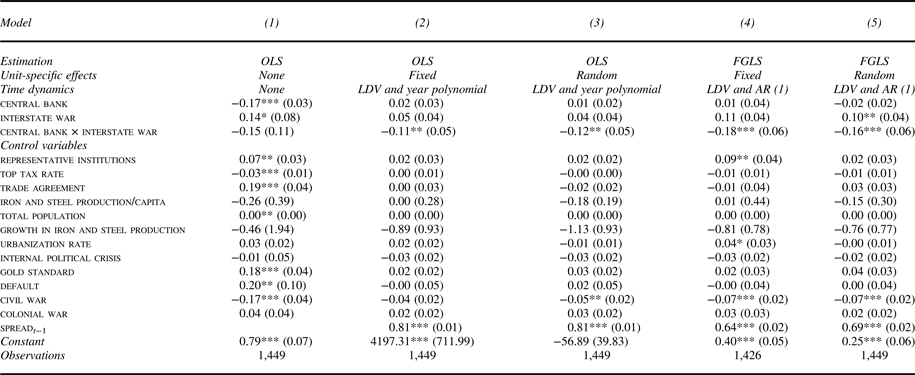
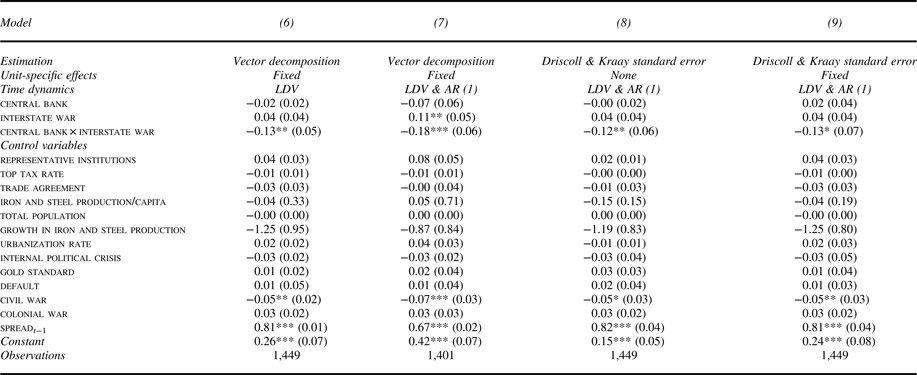
Tables 3 and 4 report the results from the nine different estimation approaches I described. Table 3 reports the results from the first five models and Table 4 reports the results from the last four models.
Impact of central banks on bond spreads

Notes: Models 2 and 3 estimated using xtreg command in Stata. Models 4 and 5 estimated using xtregar command in Stata. AR(1) = first-order auto-regressive. FGLS = feasible generalized least squares. LDV = lagged dependent variable. OLS = oridinary least squares. *** p < .01; ** p < .05; * p < .10.
Impact of central banks on bond spreads, additional models

Notes: Models 1 and 2 estimated using xtfevd command in Stata. AR(1) = first-order auto-regressive. LDV = lagged dependent variable. Models 3 and 4 estimated using xtscc command in Stata. *** p < .01; ** p < .05; * p < .10.
Despite estimating nine different models, they offer several common and notable results. First, recall that I am primarily interested in the coefficient on central bank and its interaction with the interstate war variable. All nine models show a negative coefficient on the interaction term.Footnote 110 Moreover, in eight of the nine models, the coefficient on the interaction term is statistically significant (at the 0.99 confidence level in three models, at the 0.95 confidence level in four models, and at the 0.90 confidence level in one model). The one exception is Model 1, but this model contains no unit-specific effects or time dynamics. Overall, this suggests that the presence of a central bank will reduce the spread when a country is at war (though confirming this effect requires considering the full marginal effect).
Second, in only the base model is the coefficient on central bank statistically significant and substantively large compared with the coefficient on the interaction term. This means that, after accounting for time dynamics and unit-level heterogeneity, central banks have no statistically discernible impact on the bond spread during times of peace.
Third, for reasons discussed in Brambor, Clark, and Golder, I include the interstate war variable as a separate constituative term.Footnote 111 All nine models report a positive coefficient on this variable (though only three models indicate that the coefficient is statistically significant at conventional levels). The positive sign is consistent with my theory since it suggests that countries at war but lacking a central bank will have a higher bond spread compared with countries without a central bank and not at war. In other words, it shows that war can lead to an increase in a state's borrowing costs.
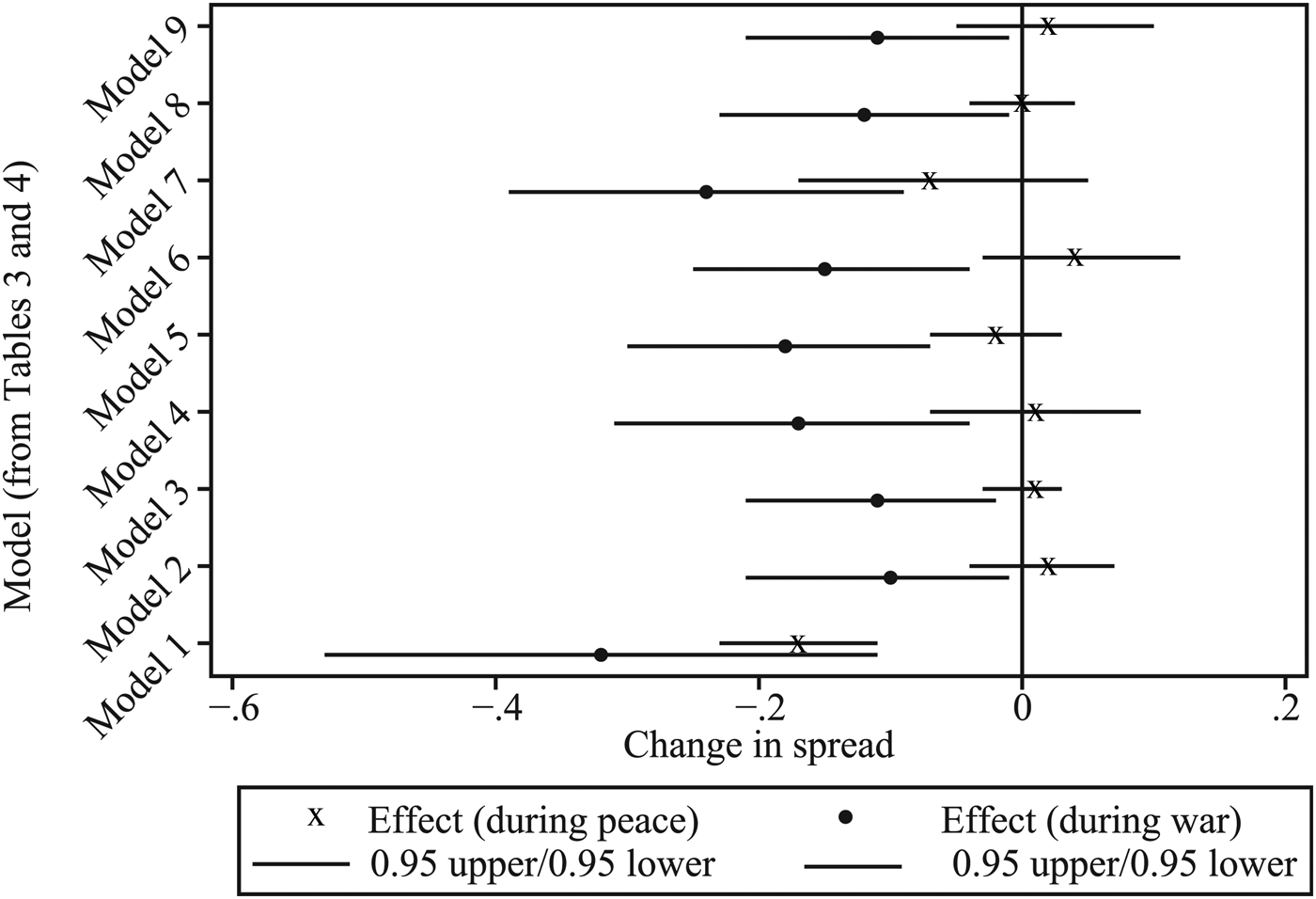
Fourth, when an interaction term is included in a model with a continuous dependent variable (as is the case here), the full marginal effect of the variable of interest (central bank) is the sum of the coefficients on this variable and its interaction with the modifying variable (interstate war). Evaluating this marginal effect is best accomplished visually. Therefore, Figure 2 depicts, for each of the models in Tables 3 and 4, the marginal effect of a central bank during peace (when interstate war = 0) and the marginal effect of a central bank during war (when interstate war = 1), along with the confidence intervals for the effect.Footnote 112 Across the models, one can see that the effect for a central bank on the bond spread is negative, but the magnitude of the effect is smaller during times of peace compared with the magnitude of the effect during times of war (and the confidence intervals for the effect during times of peace include 0).
Marginal effect central bank of bond spread, at peace and at war

To place the effects shown in Figure 2 in perspective, consider that the average spread during war over this time period is 0.92 percentage points. Therefore, using the 0.24 percentage point reduction during wartime as an example (from Model 7), possessing a central bank could produce a [(0.68 – 0.92)/0.92] 26 percent reduction in wartime borrowing costs for the average country. Overall, these results support the primary hypothesis that central banks improve a country's ability to borrow, at least during wartime.
It is worth noting the results for a few of the control variables. First, the coefficient on representative institutions in all nine models is positive (though it is only statistically significant in two of the models). The positive sign is particularly interesting, because it suggests that representative institutions actually raise borrowing costs (though, again, the coefficient is insignificant). However, this result might simply be a function of the limited presence of representative institutions during the time period under consideration (1816 to 1914). Second, in eight of the nine models, the coefficient on the civil war variable is statistically significant and in all nine models it is negative. The negative sign is surprising because it suggests that being in a state of civil war reduces borrowing costs. This result might be related to the wave of internal revolutions during the late 1840s or could be driven by the US Civil War, since the numerous financial innovations implemented during the conflict expanded the US access to credit. Space constraints do not allow for further exploration into either of these two results, but they point to interesting questions for future research.
Robustness Checks
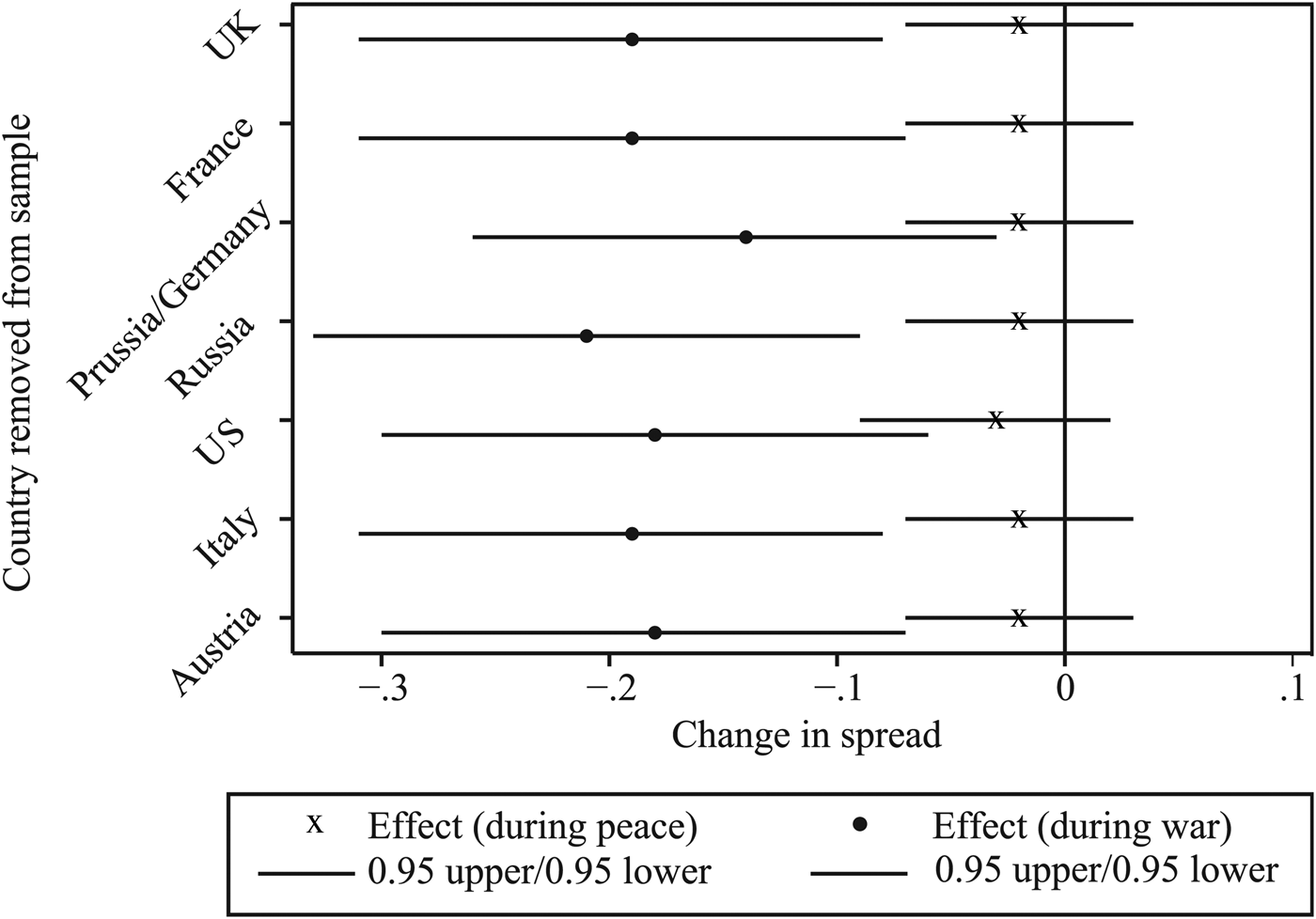
Despite my best efforts to capture unit-level heterogeneity, one may worry that there is something peculiar about the early adopters of central banks (England, Prussia, United States, France) and that this may drive my findings. It could be the case that some important feature of these key countries enables them to better finance wars and that this important unobservable is not captured by the observables in the model. Although it is not possible to account for all possible unobservable factors, a test that can assuage such concerns is to iteratively remove some key countries from the estimation to see if doing so attenuates the results. I perform such a test using the FGLS models with a lagged dependent variable and AR(1) correction (Models 4 and 5 from Table 3). The results from employing this procedure on Model 5 are depicted visually in Figure 3 (a similar pattern to that shown in Figure 3 is obtained if one instead uses Model 4). Although the effect is slightly attenuated when Prussia/Germany is removed from the sample and slightly enhanced when Russia is removed from the sample, Figure 3 shows that, by and large, the results remain highly consistent regardless of the country removed: possessing a central bank leads to a statistically significant reduction in the bond spread during times of war.
Marginal efferct central bank of bond spread, at peace and at war (key countries removed from sample)

To gain further confidence in my findings, I conduct a series of additional robustness checks. The results from these tests are reported in the online appendix. Here, I simply motivate each test, describe each test, and briefly summarize the findings from each test.
First, Table 1 shows that the diffusion of central banking to other countries was not instantaneous. Broz recognizes this when he says that “adopting the English exemplar thus appears to have been difficult.”Footnote 113 Broz refers to this as the “Diffusion Conundrum” and claims that the degree of political centralization explains the variation in central bank adoption: domestic resistance to central banking decreases with domestic political centralization.Footnote 114 He suggests that political centralization may confound my results: the coefficient on central bank will capture both the fiscal agency role of the central bank and the effect of political centralization. For this reason, I control for government centralization. Earlier versions of the Polity data set (Polity I and II) recorded the structural centralization of political authority using the variable centralization.Footnote 115 Including this variable leaves the substantive and statistical effect of a central bank, both at times of war and peace, nearly identical to those reported in Tables 3 and 4.
Second, I consider an alternative measure for adherence to the gold standard.Footnote 116 This again produces similar results to those reported in Tables 3 and 4. Third, Stasavage posits that the ability of central banks to reduce borrowing costs is closely linked to representative institutions.Footnote 117 For Stasavage, representative institutions ensure that governments allow central banks to remain managers of debt and loan repayment. If creditors have political influence within a representative assembly, they can block revisions to the central bank's statute.Footnote 118 However, Flandreau and Flores question this claim, noting that “adequate borrowers were not necessarily those with constitutions and commitments. Those who could implement the policy adjustments that monopolist underwriters would require were also eligible.”Footnote 119 Indeed, a number of central banks have persisted and thrived under autocracy:Footnote 120 the Banque de France remained intact despite France's democratic transition not occurring until 1875; Prussia maintained its central bank up to the time of the Weimar Republic's establishment; and Russia's central bank, established in 1860, existed well through the end of the Tsars’ reign. Nevertheless, I explicitly test Stasavage's claim by splitting my sample into two subsamples: one where representative institutions equals 1 and one where representative institutions equals 0. While I find that the effect of central banks is negative when a country has representative institutions and when the country does not have representative institutions, the effect is statistically significant only for countries without representative institutions (which is contrary to Stasavage's claim). One should note that when the country has representative institutions, the confidence interval around the effect (−0.31 to 0.17) contains the point estimate for when the country does not have representative institutions (−0.14). Similarly, when the country does not have representative institutions, the confidence interval around the effect (−0.27 to −0.02) contains the point estimate for when the country has representative institutions (−0.07). This suggests that, statistically speaking, the effect is indistinguishable between countries with and without representative institutions.
Fourth, North, Wallis, and Weingast argue that developing countries may have the same institutions in name as developed countries, but these institutions do not operate in the same way.Footnote 121 To consider their argument, I create the variable rich, which equals 1 when a country has iron and steel production per capita above the median level for my sample, 0 otherwise. I explicitly test North, Wallis, and Weingast's claim by splitting my sample into two subsamples: one where rich equals 1 and one where rich equals 0. This test finds that while the effect of a central bank on borrowing costs is negative during times of war for both rich countries and poor countries, it is statistically significant only for poor countries. Since the confidence intervals do not overlap, this lends some credence to the North, Wallis, and Weingast argument. However, one must keep in mind that, during the time period under evaluation, most countries would be considered poor by today's standards.
Beaulieu, Cox, and Saiegh argue that one must consider both the price (that is, interest rate) and access to credit when evaluating democracies’ borrowing advantages and that sovereigns may seek access to credit only if they anticipate receiving a good price.Footnote 122 Accounting for access to international credit markets is also critical because, as Flandreau and Flores highlight, being at war may eliminate a country's access to foreign credit.Footnote 123 In short, failing to account for whether and how a country has access to credit could introduce selection bias into my cost of borrowing model. To account for this potential selection bias, I use a Heckman two-stage procedure where the first stage is a credit access model and the second stage is the borrowing cost model.Footnote 124 The dependent variable in the selection stage model is the binary variable credit access, which equals 1 if country I existed in year t but did not have a recorded value for sovereign yield data in year t, and 0 otherwise. The independent variables in the selection stage model are the same as in the borrowing cost model, with one exception: I follow Beaulieu, Cox, and Saiegh by including in the selection stage the alliance relations similarity of country i with the system leader (the United Kingdom for the 1816 to 1914 time period).Footnote 125 This is done to satisfy the Heckman model's exclusion restriction. Each of these variables is then lagged one period to account for potential endogenous effects. I find that, even after accounting for selection effects, the coefficients on the central bank variable and the interaction between central banks and interstate war are largely similar (both substantively and statistically) to those reported in Tables 3 and 4.
Conclusion
Central banks enhance a government's ability to borrow during war when there is an enormous amount of borrowing required in a short period of time. Data covering the nineteenth and early twentieth centuries reveal that central banks reduce a government's borrowing costs during war. In other words, a central bank can fulfill the function (highlighted by Jacques Necker in 1784) of “giving reassurances on the sovereign's intentions, and by proving that no motive can incite him to fail his obligations.”Footnote 126
These findings highlight three reasons to extend the analysis into the mid-to-late twentieth century. First, I find that representative institutions are not associated with lower costs of borrowing. Although potentially provocative, this null finding might be related to my sample not including the numerous liberal democracies found in the mid- to late twentieth century. Second, although the presence of central banks became more widespread (and nearly universal) by the late twentieth century, their independence from ruling officials varies widely. Should such variation in independence affect governments’ ability to borrow? How is the effect of such independence modified by the exchange rate regime of the government, especially since this can have an impact on a government's ability to increase spending?Footnote 127 Third, one should consider whether the shift in government spending from a warfare focus to a welfare focus led to central banks playing a more or less important role in governments acquiring favorable financing.
Future work should also seek to answer a logical question posed by my findings: If the presence of a central bank improves a government's ability to borrow during times of war, does this, in turn, translate into better war effort, a higher likelihood of victory, or even a greater likelihood of peace? With respect to fighting ability and likelihood of victory, Shea finds that access to credit and the cost of credit are much more important for democracies than nondemocracies.Footnote 128 Because democracies are more sensitive to the societal pressures that long wars can generate (which can compel a democracy to end its war effort), affordable financing can mitigate these pressures. If this finding is correct, then should the presence of a central bank have a larger impact on the probability of victory for democracies compared with autocracies? With respect to the prospects for peace, Slantchev finds that acquiring an unsustainable debt that will be difficult (if not impossible) to service during peace can lead states to fight until defeat.Footnote 129 If this claim is correct, then could the presence of a central bank mitigate concerns over the sustainability of accumulated war debt, thereby improving the prospects for peace?
Future research should also conduct dyadic tests that may reveal a “Central Bank Peace” that either complements, substitutes, or even explains the democratic peace (the empirical regularity that democratic regimes rarely fight one another) and liberal peace (the empirical regularity that trade lowers the probability of conflict). A regularity between joint central bank possession and peaceful relations may also speak to recent work on financial interests preventing conflict.Footnote 130 Kirshner argues that the financial community (from private investment firms to government central banks), by fearing the macroeconomic instability caused by war, pressures governments to pursue peaceful foreign relations. In contrast to Kirshner, my argument suggests that central banks and financial development lead to peace, not because financial interests are pacifists, but because central banks deter aggressors by facilitating the financing of war machines.
Supplementary material
An online appendix is available at http://dx.doi.org/10.1017/S0020818314000265.