In December 2019, a severe acute respiratory syndrome coronavirus type 2 (SARS-CoV-2) infection broke out in Wuhan, Hubei Province, China. Reference Huang, Wang and Li1–Reference Zou, Ruan and Huang3 It was officially named the Coronavirus disease 2019 (COVID-19) by the World Health Organization (Geneva, Switzerland) on February 12, 2020. The rapidly increasing number of cases and the allocation of more hospitals and beds for patients with COVID-19 required the support of healthcare workers outside Wuhan. Reference Zhang, Bo and Lin4 A press conference held regularly by the COVID-19 control headquarters in China announced that 346 non-military Medical Aid Teams (MATs) and 42600 medical team members were sent to Wuhan from other regions in China, under the call of the National Health Commission of the People’s Republic of China by March 8, 2020. In light of the psychological impact of COVID-19 on the general public, a systematic review of the effects of COVID-19 exposure on healthcare providers is critical for improving the response after crises occur. Reference Lai, Ma and Wang5–Reference Şahin, Aker, Şahin and Karabekiroğlu8 A considerable proportion of healthcare workers reported symptoms of depression, anxiety, insomnia, and distress when taking care of patients with COVID-19 domestically and around the world. Reference Lai, Ma and Wang5,Reference Şahin, Aker, Şahin and Karabekiroğlu8,Reference Alshekaili, Hassan and Al Said9 The mental health of the medical and nursing staff in Wuhan have recently been reported and the importance of being prepared to support frontline workers through mental health interventions at times of widespread crisis should be emphasized. Reference Lai, Ma and Wang5,Reference Kang, Ma and Chen7 Till date, the workload and the effectiveness of psychological consulting and their relationship with the position and specialties of the healthcare workers in Wuhan at the beginning of the pandemic have not been described. Therefore, this study investigates the workload and psychological impact of the COVID-19 pandemic on MAT members and their preparation in Wuhan, to gain a general understanding of the impact of the pandemic on healthcare workers’ workload, and psychological interventions, and to know what to prepare for an epidemic in the future.
Methods
Study design
This is a cross-sectional study on the workload and psychological impact of Chinese MATs in the early days of the COVID-19 pandemic using an online survey.
Participants
The MAT staff (MAT leaders and members) sent to Remin Hospital of Wuhan University, a designated hospital in Wuhan, from tertiary hospitals in other provinces, or municipalities directly under the central government in China from February 1 to March 30, 2020 were included in this study. The provinces and municipalities included 2 developed regions, 2 regions at the middle economic level, and 2 economically underdeveloped regions. Participants who did not provide electronic informed consent for the present study were excluded.
Survey contents
A total of 9 medical team leaders of the MAT sent from other provinces or municipalities from February 1 to March 30, 2020 were all investigated to address potential sources of bias. In addition, data were collected from medical staff who had treated or cared for patients of COVID-19. A web-based survey consisting of 6 questions was used to investigate the composition of each MAT and the supply of medical materials reviewed and filled in by the MAT leaders. Another questionnaire consisting of 25 questions, filled by all members of MATs, included the demographic information, preparation (pre-service training), the workload in Wuhan, psychological counseling, and its effectiveness (which was evaluated according to the self-evaluation results in the questionnaire), and an open-ended qualitative question for additional comments. The psychological counseling survey included whether or not the respondent received psychological consulting before, during, and after their stay in Wuhan, and whether or not the consulting was helpful for individuals. The questions consisting of multiple items included a 5-point Likert scale, where 1 indicated “very little importance/support”, and 5 indicated “critical importance/very big support." Reference Chauvin, Shukla, Rice and Rispel10 (Supplementary material)
Survey methodology
The survey was conducted from April 1 to April 24, 2020, when the MAT staff had left Wuhan for local quarantine. The purpose of the surveys and precautions regarding the questionnaire were first introduced online to all participants. Then, the participants completed anonymous self-administered questionnaires online before April 24, 2020. An independent investigator who was blinded to the design of this study collected and analyzed the questionnaires. All participants who completed the required items in the questionnaire surveys were included in the analysis.
Statistical analysis
The survey data were analyzed using Stata 14.0 (StataCorp LLC, Texas, USA). Counting data were presented as ‘rate’ or ‘composition ratio,' and the Chi-square test or the Fisher exact test was chosen for the comparison of differences between groups. The normality of continuous data was determined according to the Kolmogorov-Smirnov test. Normally distributed data were presented as the mean with the standard deviation (SD), and Student’s t-test or analysis of variance was used to compare groups. Non-normally distributed data were expressed as medians and interquartile ranges (IQR) and the Mann-Whitney U test was used to compare groups. Multivariate logistic regression was performed to identify the factors significantly associated with effectiveness of psychiatry counseling. Multivariate cox regression was performed to assess the risk factors associated with longer working time per day. Independent variables examined in the models were age group, position, specialty, first aid skills, pre-job training, pre-psychological consulting, psychological consulting, and post-psychological consulting. Statistical significance was set at P < 0.05.
Results
Participants ‘demographic characteristics
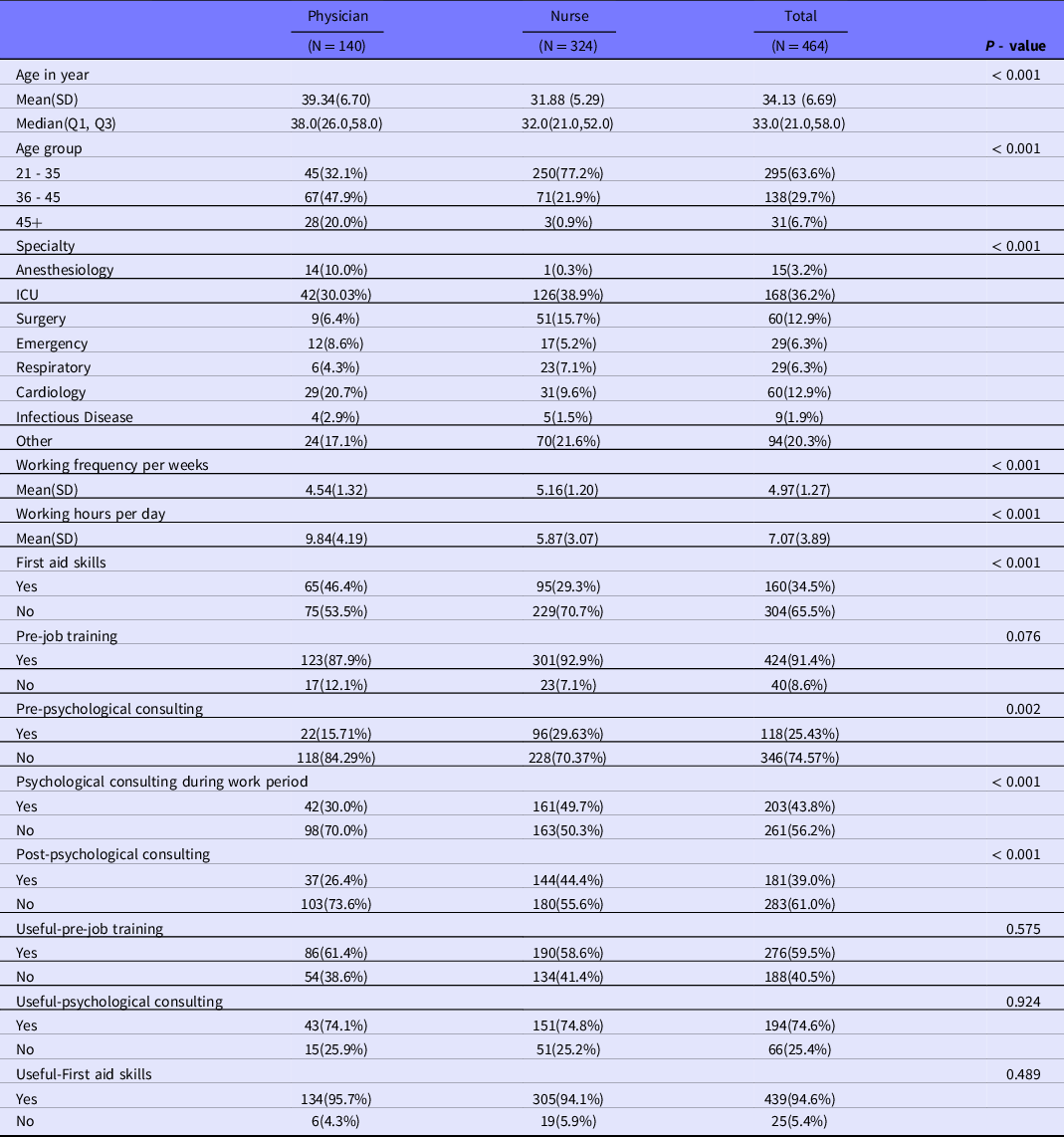
The leaders of 9 MATs from 6 provinces or municipalities all participated in the first survey. The response rate of the first survey was 100%. In the second survey, 550 survey questionnaires were received, of which 464 valid questionnaires were collected and incomplete ones excluded. The response rate of the second survey was 70.0%. Among the valid questionnaires, there were 324 nurses and 140 doctors who specialized in anesthesiology, intensive care unit (ICU), surgery, emergency, pneumology, cardiology, infectious disease, and others. The average ages of doctors and nurses who participated in the survey were 39.34 ± 6.70 (26∼58 years) and 31.88 ± 5.29 (21∼52 years), respectively, with 72 (15.5%) being males. Compared with nurses, doctors were significantly older (P < 0.001), worked longer hours per day (9.84 ± 4.19 hours vs 5.87 ± 3.07 hours, P < 0.001), and worked less frequently per week (4.54 ± 1.32 days vs 5.16 ± 1.20 days, P < 0.001) (Table 1).
Summary results of participants

Composition of MATs
The median value of members in a MAT was 136 [130,146], of which 100 [93,100] were nurses. The percentage of nurses in each MAT varied from 60.0% to 80.0%. Regarding doctors, each MAT in this study included pulmonary physicians (n = 58, 17.0%) and ICU doctors (n = 61, 17.9%). Among the MATs, 6 included emergency room (ER) physicians (n = 25, 7.3%) and cardiologists (n = 10, 2.9%), 4 included anesthesiologists (n = 19, 5.6%) and surgeons (n = 8, 2.3%), 2 included psychologists (n = 3, 0.9%), and 1 included a radiologist (n = 1, 0.3%). The lack of medical material supplies was considered the greatest factor (84% of the votes in terms of big or very big constraints) that negatively affected the organizational efficiency of MATs.
Preparation of MATs
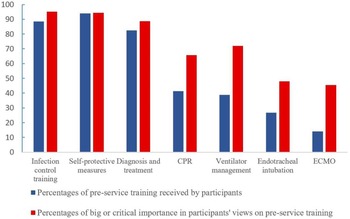
Before going to Wuhan, 32.2% of the participants were members of the Medical Emergency Team (MET) at the hospital. Almost all of the MAT members (91.2%) received pre-service training before departure for Wuhan, including nosocomial infection control training (quarantine zone setup and protection, 88.5%), self-protective measures (94.0%), diagnosis and treatment of novel Coronavirus pneumonia (82.4%), cardiopulmonary resuscitation (41.4%), ventilator management (38.9%), endotracheal intubation (26.8%), and extracorporeal membrane oxygenation (ECMO) (14.1%). The 3 most important pre-service trainings in the view of the participants in this study were nosocomial infection control, self-protective measures, and diagnosis and treatment of COVID-19, accounting for 95.1%, 94.3%, and 88.7% of the participants respectively. Others included management of ventilators (72.0%), cardiopulmonary resuscitation (65.8%), endotracheal intubation (48.0%), ECMO management (45.5%), central venous catheter placement (38.1%), and bedside ultrasound (0.4%) (Figure 1).
Preparation of MATs.
Pre-service trainings received by the healthcare workers and the most important trainings in the view of the participants. CPR, cardiopulmonary resuscitation; ECMO, extracorporeal membrane oxygenation.

The proportion of first aid skills received among nurses was significantly lower than those among doctors (29.3% vs 46.4%, P < 0.001) while the proportion of psychological consulting received among nurses was significantly higher than those among doctors (49.7% vs 30.0%, P < 0.001). There was no significant difference between doctors and nurses in the proportions of pre-job training and the effectiveness of pre-job training, psychological consulting, and first aid skills training (Table 1).
Workload of MATs
The median stay of MATs in Wuhan was 51 [48, 53] days. Pulmonary physicians were responsible for ward rounds (93.3%), patient classification referring to the classification of patient severity (63.3%), and critical patient management (83.3%). ICU doctors were responsible for ward rounds (90.5%), patient classification (66.7%), and critical patient management (88.1%). ICU doctors and nurses played a predominant role in the resuscitation of critical patients, managing of continuous renal replacement therapy (CRRT), and ECMO (95.3%). Out of the participants in our questionnaire, 95% believed that pulmonary physicians played a key role in treating mild COVID-19 symptoms. In treating of severe and critical patients, 95.1% of the participants believed that ICU doctors played a key role. More participants thought that anesthesiologists and cardiologists played a key role in treating critical patients (59.2% and 51.4%, respectively) than mild patients (26.6% and 36.1%, respectively), while 41% of the participants believed that nurses who used to work in the ICU played a key role in managing critical patients.
A total of 95% of the participants believed that the number of pulmonary physicians needs to be increased in the treatment of mild patients, and the number of ICU doctors needs to be increased in the treatment of severe and critical patients while 73% of the participants believed that the number of nurses needs to be increased.
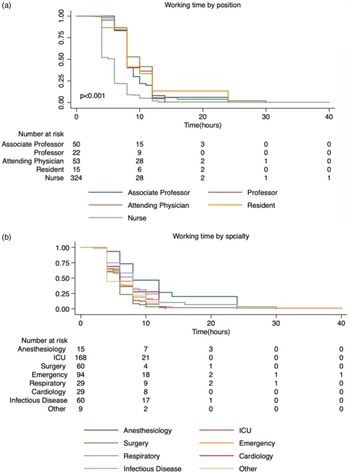
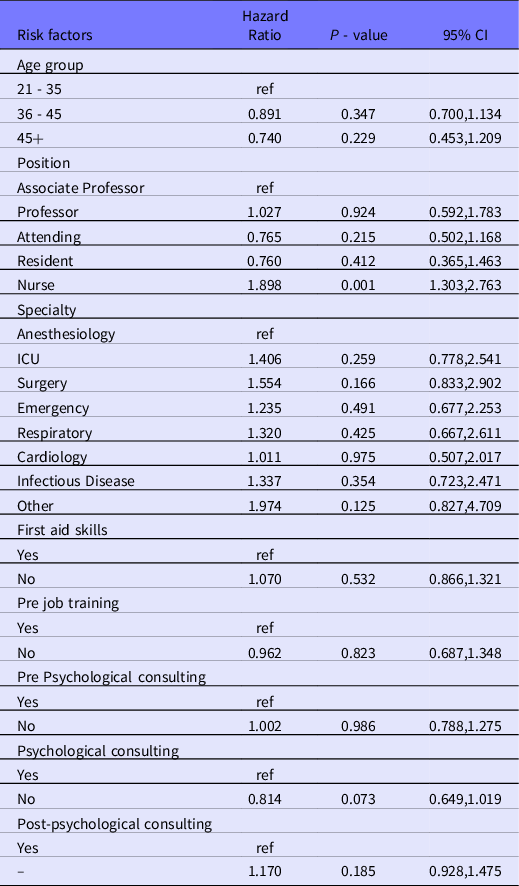
The Kaplan-Meier survival analysis showed that the working time (hours per day) of nurses was significantly longer than that of doctors (P < 0.001) (Figure 2). In the multivariate analysis using the Cox regression to identify risk factors for a day’s working time, only ‘nurse’ was identified as an independent factor (hazard ratio 1.898; 95% confidence interval [CI] 1.303-2.763; P = 0.001). Age of healthcare workers (P = 0.347, P = 0.229), specialties, and whether receiving first aid skills (P = 0.532), pre-job training (P = 0.823), and psychological consulting (P = 0.986, P = 0.073, P = 0.185, respectively) were not risk factors for working time-related workload. No significant differences were found between working time and doctors’ positions and specialties (Figure 2, Table 2).
Kaplan-Meier survival analysis of working time.
a. The analysis of the working time of different positions showed that the nurses’ working time was significantly longer than that of physicians at all levels (P < 0.001). b. The analysis of the working time of different specialties showed no significant difference.

Multivariate cox regression for day working time

Psychological counseling and its effectiveness
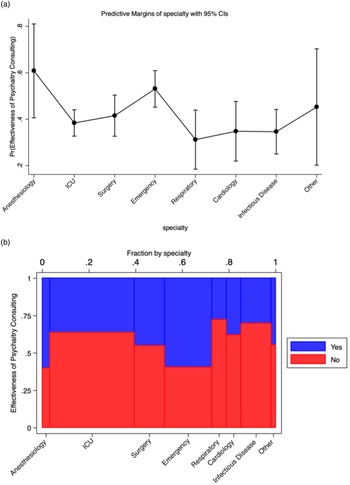
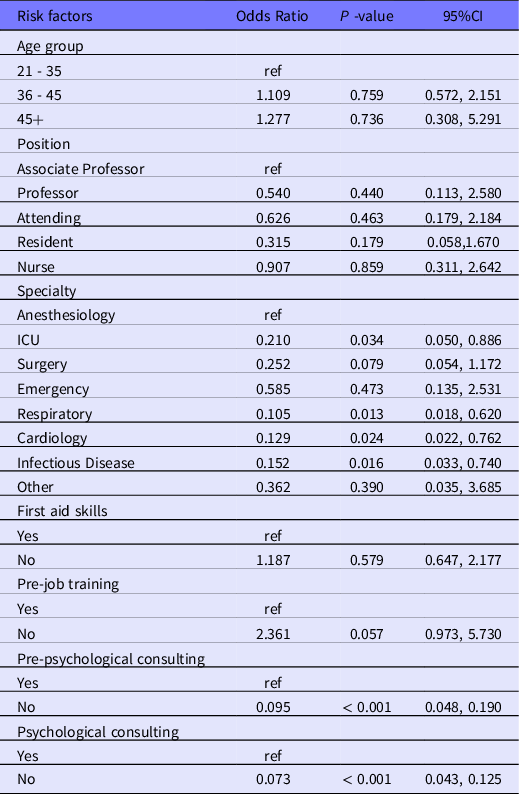
With respect to the psychological level, the efficiency of the protective measures was the biggest concern to respondents, accounting for 84.4%. Other concerns were about their capabilities of adapting themselves to work in Wuhan (61.4%) and their families at home (54.5%). According to the questionnaire results, 25.1% of the participants received psychological counseling before leaving for Wuhan. The figure increased to 44.0% during their stay in Wuhan and decreased to 39.8% during centralized quarantine after leaving Wuhan. Psychological counseling was thought to be necessary before departure for Wuhan by 60.0% of the participants, by 88.3% during their stay in Wuhan, by 65.2% during centralized quarantine after leaving Wuhan, and by 39.5% after the quarantine. Only 6 out of 464 participants (1.3%) thought that psychological counseling was not necessary at all. The study also showed that psychological consulting was more effective for the doctors from anesthesiology and emergency departments than for those from the ICU, surgery, respiratory, cardiology, and infectious disease departments. The chi-square test results also showed that more than 50% of anesthesiologists and emergency doctors thought that psychological counseling was effective (P < 0.001) (Figure 3 ). Considering the confounding factors (age, position, first aid skills, and pre-service training), the results of multivariate logistic regression showed that the effectiveness of psychological consultation (which was evaluated according to the self-evaluation results in the questionnaire) with respect to the specialty of doctors, showed that ICU (OR 0.210; 95% CI 0.050, 0.886; P = 0.034), respiratory (OR 0.105; 95% CI 0.018, 0.620; P = 0.013), cardiology (OR 0.129; 95% CI 0.022, 0.762; P = 0.024), and infectious disease doctors (OR 0.152; 95% CI 0.033, 0.740; P = 0.016) were statistically significant predictive factors when compared to anesthesiologists (Table 3).
Effectiveness of psychological counseling by specialty using chi-square test.
A. Prediction range of effectiveness by specialty with 95% confidential interval. B. The distribution of specialties on the effectiveness of psychological counseling.

Multivariate logistic regression for the effectiveness of psychological counseling

Discussion
In this survey, we found that the working time per day of nurses was significantly longer than that of doctors sent to Wuhan during the pandemic. The position of ‘nurse’ was identified as an independent risk factor for a day’s work. The biggest concern of the healthcare workers was the efficiency of the protective measures. The most important pre-service training was nosocomial infection control. The effectiveness of psychological counseling but not the workload depends on the physicians’ specialties. Therefore, the psychological interventions and preparations are suggested to be made for the medical staff in different departments and different positions.
During the SARS epidemic in 2003, the number of medical teams sent to the epidemic area in China was far less than those sent during the COVID-19 pandemic. On January 8, 2006, the State Council issued an overall national emergency plan for public emergencies, marking the initial formation of China’s emergency plan framework system. On November 1, 2007, the Emergency Response Law of the People’s Republic of China was promulgated and implemented, which provided comprehensive orientation and guidance for the management of emergency response teams, also known as MAT. The MATs helped Wuhan against the COVID-19 epidemic mainly in 2 aspects: alleviating the shortage of medical staff in Wuhan and relieving the shortage of medical materials in epidemic areas.
The MET treatment concept was proposed as early as 1952 at the world’s first ICU treatment unit established in Copenhagen, Denmark. The establishment of MET can significantly reduce the mortality of inpatients. Reference Jones, DeVita and Bellomo11 In this study, 32.2% of the participants were members of MET in the hospital before being sent to Wuhan. This proportion was not very high. Therefore, pre-service training was critical, as it prepared healthcare workers to work safely and efficiently in Wuhan. Nosocomial infection control training and self-protective measures training were received by most of the participants and also identified as the 2 most important trainings in this study. However, there were more participants who regarded the cardiopulmonary resuscitation and management of ventilator and ECMO as the critical important pre-service trainings than those actually received in this study. Thus, trainings about these aspects are suggested to be strengthened in the future. It is also worth mentioning that although the medical team brought a variety of materials into Wuhan, the lack of medical materials was still a major factor restricting the efficiency of MATs in this study.
Fever, coughing, and fatigue are the primary signs and symptoms of COVID-19. Reference Guan, Ni and Hu12 A total of 71% of admitted patients required mechanical ventilation at the early stage of the epidemic. Reference Yang, Yu and Xu13 In response, each MAT in this study included pulmonary and ICU physicians. Although the MATs were mainly composed of doctors from pulmonary and ICU departments (34.3%), the results of this study showed that there was still a need for more pulmonary physicians, ICU doctors, and nurses by the majority of the participants (95.0%, 73.0% respectively), indicating the huge workload of doctors and nurses. Therefore, staffing should be optimized.
As far as the length of working time of doctors and nurses was concerned, when compared with nurses, doctors worked longer hours per day (9.84 ± 4.19 hours vs 5.87 ± 3.07 hours, P < 0.001). However, in the multivariate Cox regression model, the ‘nurse’ was identified as an independent factor compared with the Associate Professor (hazard ratio 1.898; 95% CI 1.303, 2.763; P = 0.001). The possible reason for the inconsistency in the above results is that the positions of doctors were divided to 4 levels (Resident, Attending Physician, Associate Professor, and Professor) and confounding factors have been considered in the multivariate Cox regression model. Moreover, by consulting the questionnaire content, we found that the working hours of nurses varied greatly.
Public health emergency response lessons learned by Rapid Deployment Force in the United States demonstrate that healthcare workers need to receive psychological first aid. Reference Pierson, Kirchoff and Orsega14,Reference Iskander, McLanahan, Thomas, Henry, Byrne and Williams15 During this pandemic, healthcare workers in China faced great psychological pressure. Reference Kang, Ma and Chen7 Frontline healthcare workers engaged in direct diagnosis, treatment, and care of patients with COVID-19 were associated with a higher risk of symptoms of depression, anxiety, insomnia, and distress. Reference Lai, Ma and Wang5,Reference Wang, Guan and Zhu16 In this study, only a few participants (1.3%) thought that psychological counseling was not necessary. However, only 2 out of 9 MATs included psychologists. Psychological counseling should have been strengthened throughout their stay in Wuhan, even after leaving for home. It is worth noting that the effectiveness of psychological consulting rated above 50% was only from physicians in the anesthesiology and emergency departments. This may be related to the nature of their responsibilities. Anesthesiologists and emergency doctors were more involved in rescue works, therefore they endured more pressure from their daily work than other physicians during the pandemic. Hence, they required more psychological consulting and might be more easily relieved after psychological consulting. Moreover, psychological consulting was found to be less effective in nurses who worked more time per day than doctors according to the Kaplan-Meier survival analysis in this study. Working long hours is more likely to cause fatigue. Although the proportion of psychological consulting received among nurses was significantly higher than those among doctors, our study suggested that psychological counseling might be more effective in relieving working pressure than in relieving fatigue caused by long working hours. Teo et al.’s study showed that among the participants with a high burnout level, the most frequently cited barriers to seeking psychological help were ‘negative evaluation of therapy’ (60.0%) and ‘time constraints’ (50.0%). Reference Teo, Xu and Ho17 Interestingly, nurses choosing WeChat network’s psychological counseling phone application for self-relaxation to cope with stress were found to have higher PTGI (Post-traumatic growth inventory questionnaire) scores than others, which indicates that these 2 ways may be better and more effective for nurses to relax and relieve stress. Reference Li, Mao and Wang18 Moreover, doctors were older and more experienced in the adjustment of the pressure caused by work than nurses, which is consistent with the previous report. Reference Lai, Ma and Wang5 This study showed that more concern needs to be placed on the workload and the reasonable application of psychological counseling in MAT members when an epidemic/pandemic occurs.
Limitations
The data for this study was derived from a cross-sectional study design. Therefore, it is inappropriate to draw causal conclusions from the data. In addition, we collected data using online surveys, so the possibility of selection bias should be considered. We used 2 questionnaires in this study to collect information on the composition of the MATs (which could only be acquired from the leaders of the MATs),the preparation, workload, and psychological impact of the MATs’ members. Also, the effectiveness of psychological counseling was recorded according to the self-evaluation results in the questionnaire other than the evaluation scales such as the Depression, Anxiety, and Stress Scale (DASS-21), Patient Health Questionnaire-9, or Insomnia Severity Index used in other studies. We did not use gender in the regression model because almost all the nurses were female, which may be a confounding factor to the variable of “position” in this study.
Conclusion
This is the first time that healthcare workers have been sent to an epidemic area on such a large scale in China. The lack of medical materials was considered the greatest factor that negatively affected the organizational efficiency of the MATs. The biggest concern of the healthcare workers was the efficiency of the protective measures. The most important pre-service training was thought to be nosocomial infection control. Healthcare workers were prepared with pre-service training, but still suggested to receive psychological counseling during their duty. Psychological counseling was thought to be necessary for healthcare workers, however, psychological counseling should be intensified, especially psychological counseling for different specialties of care providers, and varying degrees of workload in future pandemics.
Acknowledgments
The authors acknowledge the participation and contributions of the 9 Medical Aid Teams from Shanghai, Xinjiang Province, Chongqing, Liaoning Province, Fujian Province, Sichuan Province, Tianjin, Shanxi Province, and Shandong Province.
Data availability statement
The datasets used and analyzed during the current study are available from the corresponding author on reasonable request.
Author contributions
JZ, XS, and CL operationalized the concept; survey construction was carried out by JZ and XS, and data collection by PL and FG; XS and XZ performed the analysis and interpretation of data; the manuscript was drafted by JZ, and critically reviewed with intellectual input provided by CL, ZL and CM; the manuscript was revised by JZ, ZL, XS, XZ and KY. All authors approved the final manuscript.
These authors contributed equally: Jing Zhong, Zhe Luo, Xingfeng Sun, and Xining Zhao.
Funding statement
This work was supported by the National Natural Science Foundation of China (No. 82172187, 81971868 to J Zhong, 81873948, 82072213 to CH Miao, Shanghai, China), Shanghai Academic/Technology Research Leader Program (20XD1423000 to J Zhong, Shanghai, China), Clinical Research Project of Zhongshan Hospital (No. 2020ZSLC41 to J Zhong, Shanghai, China), Excellent Backbone Plan Of Zhongshan Hospital (No. 2021ZSGG16 to J Zhong, Shanghai, China), Intelligent Medical Service Project of Zhongshan Hospital (No. 2020ZHZS25 to CH Miao, Shanghai, China)
Conflict of interest
The authors declare that they have no competing interests.
Ethical standards
The study was approved by the Ethics Committee of Zhongshan Hospital Fudan University, Shanghai, China and was conducted with the agreement of the medical staff. The personal information of the medical staff involved in the survey was not disclosed. Written consent was sought from participants and they were told specifically that their involvement could be terminated if they so wished without undue consequences. The survey was anonymous and confidentiality of information was assured.