Courts are at the heart of a new wave of political science, socio-legal, and public policy research around the globe. Answering a clarion call for further comparative work,Footnote 1 scholars of courts from ArgentinaFootnote 2 to ZimbabweFootnote 3 are increasingly examining the factors that drive judicial decision making, the role that judiciaries play in democratic politics, and the practical and political consequences of courts and law. The countries of Latin America, with similar legal-political traditions and broadly parallel political histories, provide a particularly promising batch of cases for analysis and comparison.
Until recently, however, the study of courts was not a priority for scholars of Latin American politics: after all, one of the key lessons of the self-proclaimed demise of the Law and Development research program three decades ago was that courts were seldom likely to have a positive effect on political development in the presence of executive over-reaching.Footnote 4 Even though the transitions to democracy of the 1980s had significant implications for Latin American judiciaries, most research on courts in the region began well after the “third wave” had passed through most Latin American countries.Footnote 5 Indeed, until the first major post-authoritarian volume on courts in Latin American democracies was published in 1993,Footnote 6 most comparative political science research on political institutions in the region remained focused on presidents, parties and assemblies.
A first set of works on Latin American courts focuses primarily on the judicial reform efforts of the late 1980s and 1990s, and on issues of transitional justice. This literature has emphasized the challenges of reform (in particular, of simultaneously addressing the problems of judicial independence, access, efficiency and accountability),Footnote 7 as well as the degree to which reform led to the improvement of courts' performance in ways that might contribute to economic growth.Footnote 8 A second strain in the literature examines the ways in which the region's new democracies attempted to address remaining authoritarian enclaves and provide transitional justice.Footnote 9
The focus of the literature has widened more recently to encompass two broader themes: courts' contribution to social justice and judicial politics. Research on the first theme focuses on the role of courts in admittedly unequal Latin American societies and, especially, how they can contribute to bridging gaps in the application of law, including the breach between formal legality and actual practice.Footnote 10 Scholarship on the second theme examines the performance of courts as political institutions, at both the micro-political level (deciding who gets what, when, and how), as well as the macro level (ruling on disputes between branches of government, and acting as a check and a balance on both the executive and legislative branches).
The focus of this article is this fourth research theme: judicial politics in the contemporary period. This strain of the literature analyzes courts first and foremost from the perspective of their involvement in politics: it examines the institutional structures that underpin and shape that involvement; explores how judges take decisions on political issues; and examines how courts distribute political power and affect policy outcomes. The field comprises various sub-themes, such as the judicialization of politics, judicial independence, and judicial power, and scholars utilize myriad approaches to examine and explain variation in these phenomena, ranging from legal scholars' focus on factors such as the legal process, doctrine, and jurisprudence to more typically political science emphases such as the impact of judicial institutional structure and cultural norms, and the strategic and attitudinal motivations for judges' decision-making. Scholars also use a variety of qualitative, quantitative, and game theoretic methods to analyze data and draw inferences, and to carry out various types of comparative inquiry.
Perhaps due to this diversity, the research program analyzing judicial politics in Latin America remains largely uncoordinated. Insofar as the questions being asked vary among scholars, this lack of coordination is unfortunate but understandable. Yet a suboptimal amount of cross-fertilization occurs among scholars asking similar questions but studying different countries, or using different approaches or analytic methods. Further, little comparative work is conducted—either cross-nationally, or within country cases (across provinces, time, areas of law, policy arenas, or levels of the judiciary, for example).
This article examines the rich breadth of research on judicial politics in Latin America with the goal of contributing to the coherent and progressive accumulation of knowledge in this field. The remainder of the article proceeds in five sections, in which we review the main questions scholars have posed regarding courts and politics in Latin America; then examine the literature's main findings and theoretical debates. We next highlight key conceptual debates, analyze the research methods scholars have employed, and we close by suggesting some directions in which the study of judicial politics in Latin America might proceed.
Main Research Questions in the Surveyed Literature
The Boundaries of Our Inquiry
Lest this enterprise become too unwieldy, we have delimited the literature selected for inclusion in our survey using four essential criteria. Each piece surveyed here (1) focuses primarily on the subject of judicial politics as defined above; (2) is written in English;Footnote 11 (3) is either a dissertation completed, or a book, book chapter, or major academic journal article published, between 1980 and 2006;Footnote 12 and (4) examines at least one Latin American nation.
Despite our attempts to be systematic, drawing boundaries around the large and heterogeneous literature on judicial politics in Latin America involves difficult and controversial decisions. Undoubtedly we have failed to include some works that others will consider germane to judicial politics. With these caveats in mind, however, we are reasonably confident that the 90 pieces considered here are representative of the contemporary state of the debate on judicial politics in Latin America.
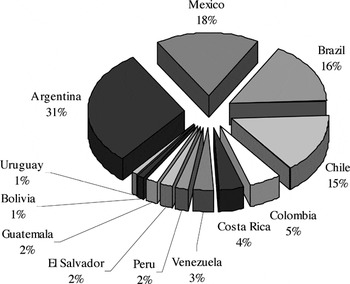
We begin our inquiry by offering a few parameters. Figures 1–3 show the distribution of this literature in terms of type of publication, scope, and countries under analysis.
Type of publication

Scope of research

Countries studied

These figures contain some signals that the study of judicial politics in Latin America remains a maturing field. First, the bulk of the work comprises short pieces (book chapters and articles) rather than full-length books. The few books that focus exclusively on the topic are more or less equally divided between compilations of disparately themed single country chapters, and more in-depth case studies (often springing from doctoral dissertations).Footnote 13 Further, the figures demonstrate that scholars of judicial politics in Latin America tend to focus on one country rather than engaging in explicitly cross-national inquiry. With respect to countries studied, much of the research analyzes four of the 21 countries in the region (Argentina, Brazil, Chile, and Mexico); most Latin American judiciaries have been examined in only one or two chapter-length studies or have not been studied at all. Finally, although it is not shown in these figures, the majority of the work on judicial politics in Latin America focuses predominantly on high courts (supreme courts or constitutional courts); full national or federal court systems come in a distant second place, only scant attention is paid to state court systems, and practically no work examines intra-judicial relations or dynamics.
Key Lines of Inquiry in the Surveyed Literature
We place the literature surveyed in this article in three categories: one that focuses on judiciaries' interactions with other branches of government; a second that examines the degree to which judiciaries affect public policy outcomes; and a final one that provides classificatory or mainly descriptive analyses of courts and legal institutions.
Interaction between the judicial and elected branches
Three questions underlie much of the research on the interaction between the judicial and elected branches in Latin America. First, why do executives delegate power to courts, and what sort of formal power is delegated?Footnote 14 A second question, usually couched in terms of the judicialization of politics, is whether courts are being increasingly drawn into political debates, and if so, in what patterns this process occurs.Footnote 15
The third and most-researched question regards whether and when courts check the elected branches. While some work in this vein analyzes judicial assertiveness in authoritarian settings, most research examines the question under democratic rule.Footnote 16 The bulk of this literature is steeped in a normative supposition that checks on the elected branches—and especially on the region's powerful executives—are a positive occurrence. While some of this research is largely descriptive, seeking to understand whether and how courts actually act to check executives, most studies adopt an explanatory framework.Footnote 17 Some scholars query the political conditions under which justices or courts rule against the government.Footnote 18 Others question the extent to which public or societal support has permitted courts to challenge executives and implement judicial policy preferences,Footnote 19 or the degree to which societal demands can activate courts and influence the direction of judicial decision-making.Footnote 20 Others investigate the importance of institutional factors: Domingo, for example, asks whether institutional changes increase the ability of courts to act independently of the executive;Footnote 21 Brinks examines the degree to which judicial reform affects judges' preferences and decisional independence;Footnote 22 and several others explore how institutional and constitutional design affect judicial independence and the scope of judicial decisions.Footnote 23
Most of these inquiries concern countries—such as Argentina and Mexico—featuring hyper-presidential systems and a tradition of judicial dependence. In such settings, the expectation is that courts will be neither willing nor able to challenge the elected branches, and the intriguing question becomes the particular configuration of conditions under which they will dare to do so. A smaller group of scholars—almost entirely students of the Chilean judiciary—reverses the query, questioning why seemingly independent courts fail to enforce checks on the executive and instead defer to the government.Footnote 24 Finally, a small subset of work addresses both questions. Huneeus, for example, seeks to explain the evolution of Chile's judiciary from a deferential into a (selectively) less quiescent power, and Staton asks why Mexican courts authoritatively resolve political conflict at some points, but seem to avoid controversial issues at others.Footnote 25
Courts as policy-makers
The second main line of inquiry analyzes courts' effects on public policy. A recent Inter-American Development Bank publication summarizes four key roles Latin American judiciaries play in the policymaking process (veto player, policy player, impartial referee, and societal representative) and posits that levels of judicial independence are a major determinant of courts' ability “to improve the stability, public-regardingness, or adaptability of policy choices.”Footnote 26 While this report glosses over the potential role of courts as reluctant veto points activated by other political actors, and puts less emphasis than it might on the fact that not all judicial intervention in the policy realm is likely to be policy-enhancing, other pieces in this line of inquiry develop these issues.
Ríos-Figueroa and Taylor, for instance, question the effect of different institutional structures on policy outcomes, inquiring how various facets of judicial independence and judicial review may lead to different patterns of policy contestation in Brazilian and Mexican courts.Footnote 27 Others explore the effects of changes in judicial structure on policy outcomes and political debatesFootnote 28 and on courts' influence in specific policy arenas.Footnote 29 And Iaryczower et al. seek to understand how lobbying in legislatures may influence the role courts play in policymaking indirectly, by “altering the political constraints under which [they] operate.”Footnote 30
Finally, a small but growing subset of the judicial politics literature focuses on courts' effects on social policy as a result of societal actors' initiation of social and economic rights litigation.Footnote 31 Courtis, for example, examines why it might be difficult for Latin American judiciaries to assume and play an effective role in the creation of social policy.Footnote 32 In a similar vein, Lima Lopes, exploring the Brazilian case, discusses the pressure that social rights litigation places on the judicial branch due to its public policy implications, highlighting the “distributive sting” rights-enforcing decisions on such cases can carry.Footnote 33 And Uprimny notes that since 1991 the Colombian Constitutional Court has made high-impact decisions that have expanded social policies consistent with the broad rights laid out in the expansive 1991 Constitution.Footnote 34 He outlines the effects the Court's rulings have had on the design of economic policy, and describes the controversies that surround the Court's policy role. In sum, this work suggests that courts' assumption of a role in socio-economic policymaking is contested: judges and policy-makers alike are aware that judicial decisions on cases regarding social and economic rights can have significant policy and budgetary consequences. More attention to courts' willingness and ability to engage in social policy-making and to the implications for governability and democratic stability is certainly warranted.
Classificatory and descriptive analyses of courts and legal institutions
A final line of inquiry encompasses both the comparative classification of regional courts and judicial structures, and more historical descriptions of the evolution of courts and legal systems. With respect to the first, a number of early studies focused on identifying the structural features of Latin American politics in which judicial dependence was rooted.Footnote 35 Later studies sought to develop more encompassing measures of judicial performance,Footnote 36 and to classify constitutional adjudication systems in comparative perspective.Footnote 37 Such work has contributed to the development of uniform variables and datasets that can, in turn, serve as a basis for further comparative research on judicial performance, and on particular constitutional features and their effects.Footnote 38
A second subset of literature in this more descriptive line of inquiry is composed of historically-based case studies of the dynamics and institutions crucial to the evolution of judicial politics in the region: judicial review,Footnote 39 judicialization,Footnote 40 judicial independence,Footnote 41 the broader social consequences of legal change,Footnote 42 and the functioning of the legal system and the relationships between law, politics, and society.Footnote 43
In sum, the scope of inquiry undertaken by scholars of judicial politics in Latin America since 1980 has been quite broad. Significant efforts have been made to classify important judicial structures and institutions, and the literature has asked a series of intriguing questions regarding the causes and determinants of judicial involvement in politics and policy debates. The next section examines the findings and theoretical debates this research has generated.
Findings and Theoretical Debates
In this section we outline the findings and theoretical debates that have arisen in the literature on judicial politics in Argentina, Brazil, Chile, Colombia, and Mexico. Scholars of Latin American judicial politics have focused the most attention on these five nations, and the resultant scholarship contains the main conclusions that have emerged in the broader literature. We find five main areas of consensus and debate.
Activating the Judiciary
The first area of scholarship examines who accesses courts to contest policy, which institutional features facilitate and block access, and to what effect courts are used as an alternate policy-making venue. In some countries, such as Costa Rica, broad access to the constitutional chamber of the high court means that policy is open to challenge by almost anyone with the energy to file suit.Footnote 44 And in Colombia, expansive access to judicial review in combination with the creation of the Constitutional Court in 1991 have meant a substantial rebalancing of power in Colombian society, as previously weak actors can now flex their muscles through the judiciary.Footnote 45 Smulovitz and Behrend examine the “judicialization of protest” in Argentina, analyzing how societal actors have used courts as an element in their mobilizations against particular government policies and practices, forcing political actors into both pre-emptive and reactive policy change.Footnote 46
Other scholars working in this area, drawing on the “haves come out ahead” literature,Footnote 47 describe the opposite dynamic: how judicial rules and structure advantage certain policy actors more than others in the court system and, consequently, in the political system more generally. Scholars of the Brazilian judiciary, for instance, explore the effects of the combination of relatively progressive (though extraordinarily inefficient) lower courts, with a relatively efficient high court that can only be directly accessed by a small number of actors.Footnote 48 This combination has meant that the entire judiciary has become a “powerful resource” for questioning or blocking decisions made in the political arena, while a few veto players with standing to file in the high court are especially well empowered to activate the judiciary to policy ends. The greater political use of the courts has made the potentially destabilizing counter-majoritarian nature of abstract review stand out in high relief.Footnote 49
The strategic use of full court systems—from lower courts through high courts—as a political bailiwick for policy opponents is a theme that is relevant across Latin America, particularly in view of the ubiquity of economic reforms in the 1990s, which implied significant costs for well-organized and entrenched interest groups that oftentimes had considerable access to courts.Footnote 50
Building Judicial Power
A second area of scholarship seeks to understand how courts acquire power, and a subset of that work examines the dialectic relationship between judicial power and judicial independence, as well as the interaction between judicial power and judicial accountability.
Judicial power can be “delegated” by elected leaders who implement reforms to entrust power to judiciaries in new democracies, and it can be “constructed” by judges who zealously calibrate their decisions against the expected responses of the public and the elected branches. With regard to the first, Finkel's analysis of the Mexican case shows how political uncertainty can lead to judicial independence when political incumbents delegate power to courts so as to preserve their rights in case they should become the opposition: she argues that the 1994 judicial reform, with its introduction of new judicial review powers and independence guarantees, was motivated by the ruling party's fear of losing power.Footnote 51 The PRI, in other words, saw the writing on the wall, and sought the institutional protections gained by granting greater power to the courts.Footnote 52
But the delegation of power to courts may occur even when electoral defeat does not loom. As Domingo has noted, there are incentives for even well-ensconced executives to favor independent courts.Footnote 53 Predominant among these is the view that courts may serve to legitimate current policy decisions: while a more independent court may overturn a few policies here and there, when it supports the actions of the elected branches, the government can point to that sanction as legal legitimation.
In terms of “constructed” power, judges use a number of formal and informal strategies to build court power. As noted by several authors in the Gloppen et al. compendium, courts may seek to construct power through symbolic rulings in largely insignificant cases, rather than through hugely momentous legal judgments.Footnote 54 As they attempt to “grow” their institutional power, judges may seek out merely symbolic victories in cases with little practical repercussion.Footnote 55
While most would agree that judicial power and judicial independence are inextricably linked, there is significant debate with regard to the nature of the relationship. In Brazil for example, the gradual construction of judicial independence in an uncertain and extremely challenging institutional environment has been carried out piece-meal through elaborate kabuki-style shadow boxing between the executive branch and the judiciary. The high court in particular has used its power to secure for itself an “institutional environment where it can remain free from external political interference,” via “token decisions and declarations by the Court and its justices … [which] function as a form of pressure bargaining to preserve autonomy.”Footnote 56 It has been suggested, in contrast, that the Chilean judiciary had to engage in self-restraint (i.e., limit its own power) in order to retain independence:
the refusal of courts to actually exercise their powers of judicial control of the constitution … represented the continuation of a long held strategic stance aimed at maintaining the very autonomy and political independence that has historically allowed them to play a crucial role in the promotion and maintenance of the legality that has characterized the country.Footnote 57
Finally, increasing judicial power inevitably raises the issue of judicial accountability, or the age-old question of who guards the guardians. Given the counter-majoritarian character of judicial review, powerful courts may at some point issue decisions that anger a significant portion of the electorate. In the Colombian case, scholars wonder about the potential for backlash against the surprisingly progressive Constitutional Court.Footnote 58 Similar questions regarding judicial accountability are addressed in Gloppen et al.:Footnote 59 How unaccountable are courts, and at what point does their lack of accountability become a concern—only when they become independent,Footnote 60 or well before then?Footnote 61
These and related questions will gain increasing relevance if more of the region's judiciaries follow in their Brazilian, Colombian, and Costa Rican counterparts' footsteps in building judicial power. Consequently, the construction of judicial power and the interplay between judicial independence, power, and accountability are questions ripe for further examination in Latin America.
Exercising Judicial Power in the Political Arena
A third area of inquiry relates to the conditions under which courts will exercise power by challenging the other branches of government when they deem that elected leaders have overstepped their constitutional or legal bounds.Footnote 62
There is overall consensus in the literature on judicial politics in Latin America that the judiciaries in the countries that have been the focus of some study can be divided into discrete groups according to the frequency and degree to which their component courts assert power in the political realm. In the first group, composed of Brazil, Colombia, Costa Rica, and increasingly, Mexico, courts assert considerable power, though they play significantly different roles in national policy deliberations. In a second group, which includes Argentina and Chile, courts theoretically have significant formal power, but for different reasons are reluctant or unable to assert it consistently. A third group includes nations in which courts rarely exercise power and where their involvement in politics is spasmodic, unpredictable, and generally of less recurrent import to policy (if not political) outcomes, such as Guatemala, Peru, and Venezuela.
The main factors used to explain the willingness of courts to challenge government power are the overall political environment, and institutional factors within courts. With regard to the first, several scholars of the Argentine high court view the uncertain political environment as a cause of strategic behavior by judges.Footnote 63 Some scholars argue that judges acting under such uncertainty are less likely to vote against the government as the president's control of Congress increases.Footnote 64 Helmke points to both the uncertain political environment and institutional weakness suggesting that as incumbent executives approach the end of their terms, high court judges “who lack institutional security begin facing incentives to increase their antigovernment rulings to distance themselves from a weakening government.”Footnote 65 Chavez, also addressing the Argentine case, emphasizes the importance of the historical political context, noting how similar institutional configurations may lead to the emergence of different levels of checks and balances “depending on the dispersal of power and competitive politics.”Footnote 66
In contrast to the Argentine case, most research on democratic Chile assigns less causal weight to the political environment, perhaps because the post-transition dominance of the center-left Concertación coalition has meant little variation on that variable. The key puzzle for most researchers studying Chile is why relatively independent courts exercise power so selectively. Most scholars offer institutional and cultural explanations, rather than strategic accounts, of judicial politics.Footnote 67 Hilbink, for example, posits the important role of judicial identity in “constitut[ing] the goals that judges have, rather than simply constraining the achievement of pre-existing goals,” and explains how that identity is constantly reinforced due to the Chilean judiciary's particular institutional rules and structure.Footnote 68 This new institutional approach has counterparts in Mexico and Brazil, where research has emphasized how characteristics of judicial institutions affect standard choice situations, constrain political and judicial actors' strategies, and limit (or empower) political actors' ability to bring challenges against government.Footnote 69
A very different factor has been used in the Mexican case to explain courts' willingness and ability to challenge the actions and policies of the elected branches: the existence of “basic social support structures.”Footnote 70 The general argument, which has also been raised in the Argentine case,Footnote 71 is that courts may feel empowered to challenge elected leaders in high-stakes cases (even when facing opposition from a hostile executive branch) if sufficient societal support exists for a challenging decision. Staton also highlights the importance of societal support in the Mexican case, and its relevance to judges seeking to build institutional legitimacy.Footnote 72 He suggests that public support is an important factor in justices' strategic calculations about the cases on which they will challenge the elected branches (greater potential support for a challenging decision is equated with a decreased likelihood of subsequent attack by the elected branches).
Further examination of these hypotheses and the conditions under which courts exercise power seems merited. In so doing, it might be salutary to move toward testing hypotheses that have been advanced to explain judicial behavior in other parts of the world. For instance, each of the three main approaches to this question in the U.S. literature—the attitudinal model, strategic accounts, and new institutional approaches—has explanatory potential in the region. While the attitudinal model has caught on slowly among scholars of Latin American courts, there are some efforts in that direction: Helmke and Sanders, for instance, have examined the “goals” of judges, developing a game-theoretic model that links judicial behavior (including challenging elected leaders) to those goals, and identifying four “ideal types” of judges: loyalists, policy seekers, institutionalists, and careerists.Footnote 73 Since we cannot assume that Latin American judges and justices' ideologies are not important to their decision making, further analysis of judicial attitudes, especially in countries where there is greater institutional stability, seems warranted.
Moreover, as noted above, strategic accounts that analyze the ongoing game among the branches of government are relatively new and few, but show promise, as in Iaryczower's depiction of “strategic compliance” and Helmke's description of “strategic defection” in Argentina.Footnote 74 In fact, many political settings in Latin America exhibit the uncertainty that is thought to lead to strategic judicial behavior, for instance, suggesting that this approach to judicial decision-making and the exertion of judicial power might have significant explanatory power in the region.
Finally, the new institutional vein of the U.S. literature increasingly takes into account the effect of variables internal to judicial institutions, ranging from legal culture to caseload management. The new institutional view of courts seems extremely pertinent to judiciaries in Latin America, where factors such as a lifetime judicial career and the formalism of the legal system not only constrain judges' options but may also be constitutive of their normative preferences in cases regarding public policy. Miller, for example, suggests that the way in which a “sociology of judicial review” develops and evolves in a polity can affect courts' ability to constrain the executive.Footnote 75
Of course, we are not suggesting that the U.S. and Latin American contexts are so similar that theories that have proven to have merit in the former would naturally apply in the latter. Nor are we suggesting that the literature on U.S. courts is the only possible source of new hypotheses to test regarding decision making on the region's courts. Our main point is that the field of comparative judicial politics, with one foot planted in public law and the other in comparative politics, might well benefit from greater cross-regional fertilization.
The Exercise of Judicial Power in Different Arenas
A fourth theme questions the exercise of judicial power beyond the political realm, researching the uneven exercise of power by courts across different arenas of public life and in regard to different types of cases.
Discussing the Mexican case, Magaloni notes the incongruity between the increasingly effective checks that courts have placed on the executive branch since the mid-1990s, and the inability of the political system to successfully police widespread threats to individual rights.Footnote 76 This discrepancy between what she refers to as the Madisonian and Hobbesian dimensions of power has been examined in the Argentine and, again, Mexican contexts by Domingo, who questions the inability of courts to provide any meaningful protection against encroachments on individual rights by members of the state or third parties, even as they have managed to check executives (albeit inconsistently).Footnote 77 In a related vein, Couso argues that Chilean courts circumscribed their decision making (i.e., tempered their own power) in the constitutional realm so as to preserve their power to freely decide less contentious, quotidian struggles in the legal realm.Footnote 78
A second branch of research on this theme is exemplified by Rodríguez et al., who question the “selective way” in which the Colombian judiciary functions, given over to commercial and financial interests and primarily absorbed by procedural, low-salience issues.Footnote 79 This view echoes Mirow's history of Spanish American law, with its emphasis on the notion that despite “wide swings in political stability, and … even in near crisis, the sectors dependent on private law … have been able to function with little disturbance.”Footnote 80
The study of divergent patterns of judicial performance—that is, of why judiciaries rapidly absorb and process cases regarding certain issues while deflecting or delaying resolution of cases involving other issues—is clearly inchoate. Further within-country comparative analysis of the uneven nature of court performance, which gets to the heart of questions of judicial power and judicial politics in the region, is clearly needed.
Judicial Dynamics and Democracy
A final—and perhaps more tacit than explicit—debate in the literature regards the relationship between judicial independence and judicial power, on the one hand, and regime dynamics on the other.
Much of the work surveyed in this article either implicitly or explicitly holds the normative assumption that, as Gloppen et al. note, “courts are important for the working and consolidation of democratic regimes.”Footnote 81 Yet analysts have different viewpoints regarding how, exactly, courts affect regime dynamics. Some analysts are absolutely sanguine about courts' effects on democracy. Farer, for example, argues that law (and, presumably, courts) may contribute to “deepening [the] roots and enhancing [the] democratic quality of elected governments.”Footnote 82 This belief is also reflected in much of the comparative politics literature on the transition and consolidation of democracy in Latin America,Footnote 83 and indeed, the potential positive effects of courts on democracy and on the legitimacy of the decisions taken by democratic governments continue to be a key motivation for research on courts in the region.
Others implicitly suggest that this normative bias needs to be critically appraised. One group, for example, wonders whether courts' new-found independence can sometimes be prejudicial, leading to unpredictable effects on executive policymakingFootnote 84 or democracy.Footnote 85 Others see cause for celebration as well as concern. Pérez Perdomo describes how the very same Venezuelan high court justices kept political change within democratic limits at the end of the 1990s but then acted to block political opposition in the next decade.Footnote 86 And Faundez draws on the Colombian experience to argue that while legal reform is not an “absolutely futile path towards democratization,” it is undoubtedly an uncertain one.Footnote 87
A final group of scholars is skeptical about the impact courts might have on many aspects of democracy. Larkins, for example, analyzes the strategies that Argentine President Menem (1989–1999) used to reconfigure executive-judicial relations in his favor.Footnote 88 Taylor questions whether longstanding forms of corporatism are perpetuated by the institutional rules governing constitutional review in Brazil.Footnote 89 And other authors wonder whether our hopes regarding courts' potential contribution to democracy are simply misplaced, especially given the counter-majoritarian nature of judicial review.Footnote 90
These contradictory findings regarding the links between courts and democracy no doubt reflect authors' normative biases, as well as empirical variation in Latin America. Yet we suggest that perhaps the most important source of the uncertainty regarding courts' impacts on political regimes—and simultaneously the main reason why the issue has not generated a more heated debate—is the fact that the links between (1) judicial independence, (2) judicial power, and (3) democracy, while a backdrop to many inquiries, are rarely an explicit focus of research. In Latin America as elsewhere, we urgently need to clearly conceptualize and operationalize these three concepts, develop testable hypotheses regarding the relationships among them, and empirically explore those propositions.Footnote 91
In sum, research on judicial politics in Latin America has produced a range of intriguing findings. Yet theoretical debate remains embryonic. We suggest four factors that may have hampered the development of debate. First, scholars of judicial politics in the region often fail to acknowledge and cite related work, especially when that work concerns different nations in the region. Second, scholars are hesitant to employ frameworks used by those who study other regions in the world, despite the wealth of hypotheses and insights the broader judicial politics literature has to offer. While the fact that Latin America follows the civil rather than common law tradition means that theories developed to explain judicial phenomena in other regions might need to be modified in order to account for outcomes in the Latin American context, this should not prevent us from adopting, adapting, and exploring the utility of those explanations. Third, the dearth of explicitly comparative research by scholars of Latin America (be it cross-national, or subnational comparison across space, time, issue areas, or judicial levels to name just a few possibilities) diminishes the basis for debate and compromises our ability to adjudicate among the competing explanations for key phenomena of judicial politics. A final reason for the lack of more vibrant theoretical debate may be the fact that we have yet to complete important pre-requisites for such debate, achieving clear definitions and developing workable operationalizations for the concepts that form the building blocks of our theories. The next section examines this issue.
Conceptual Debates and Challenges
Three main conceptual problems plague studies of judicial politics in Latin America. First, many authors fail to define the key terms on which their studies rely. Second, when authors do define their terms, they infrequently acknowledge competing definitions or reconcile their conceptualizations with those previous definitions, resulting in the inconsistent use of concepts. Finally, scholars' operationalizations of key terms do not always faithfully reflect their conceptualizations, further muddying the analytic waters.
In this section, we identify three central concepts in the literature on judicial politics in Latin America (judicialization, judicial independence, and judicial power), and outline the debates that surround them—acknowledging that those debates remain incomplete in some cases. We also briefly mention three additional concepts: the rule of law, politicization (of the judiciary), and judicial accountability. While space does not allow us to develop a discussion of this second group of concepts here, we point out a few of the challenges they pose for the field of judicial politics, both in Latin America and beyond. Our aims in this section are to show how the conceptualization challenges mentioned above are reflected in the study of judicial politics in Latin America, and to offer a foundation that can be used to begin to build toward greater conceptual awareness.
Central Conceptual Debates
Judicialization
Of the terms reviewed here, judicialization is perhaps the one on which there is the greatest degree of conceptual consensus. Most of the authors in the surveyed literature who define the term start from the essential definition offered by Vallinder. Vallinder suggests that judicialization involves the infusion of courts into political arenas, and the adoption of court-like or legalistic decision-making processes in non-judicial settings.Footnote 92 Nonetheless, most scholars of judicial politics in Latin America, whose essential interest is in courts, define judicialization as just the first of Vallinder's two dimensions.
Some scholars, however, depart from that consensus. A few adopt narrower definitions, equating judicialization with judicial power,Footnote 93 or operationalizing the term as something akin to judicial activism.Footnote 94 Others adopt broader definitions. Domingo, for example, understands judicialization as:
first, the process by which there is an increase in the impact of judicial decisions upon political and social processes. Second…. the process by which political conflict is increasingly resolved at the level of the courts. Third …. [it] reflects the degree to which regime legitimacy is increasingly constructed upon the public perception of the state's capacity and credibility in terms of delivering on rule of law, and rights protection. Finally, it refers to the growing trend … to use law and legal mechanisms to mobilize around specific policies, social and economic interests and demands.Footnote 95
Despite the relative consensus regarding the ubiquity of the phenomenon (if not the breadth of the term's meaning), the judicialization dynamics highlighted by scholars of Latin America contrast in interesting ways with the generalizations regarding the causes and consequences highlighted by Tate and Vallinder, for instance. To offer just two examples, where Tate and Vallinder see the spread of democracy as a cause of judicialization,Footnote 96 Sieder et al. see judicialization as driven by the “very weaknesses of contemporary democracy in Latin America.”Footnote 97 And while Tate and Vallinder seem to assume a kind of structural bias in favor of judicialization, portraying judges as unwitting victims of expanding and politically explosive caseloads, some Latin American scholars question this view. Pérez Perdomo, for instance, wonders whether judicialization is the result of courts' voluntary assumption of a more active role, or whether in fact political actors invite judicial interventions.Footnote 98
Debates about variation in judicialization are central to the evolution of the judicial politics literature. It seems to us, then, that the sensible course is to stick as closely as possible to Vallinder's simple conceptual formulation, noted above, in the interest of enhancing the probability and tractability of comparative work across and within Latin American countries, as well as among different regions of the world.
Judicial independence
The literature on judicial politics is replete with discussions and analyses of judicial independence, likely the trickiest of the terms explored here. A number of simple definitions exist, exemplified by Iaryczower et al.: “the extent to which justices can reflect their preferences in their decisions without facing retaliation measures.”Footnote 99 Such simple definitions, however, leave implicit one important factor that should be more explicitly recognized: the law. Judicial independence does not mean complete freedom to decide cases; it is the freedom to decide cases within the constraints imposed by the court's jurisdiction, by existing law, and in light of the merit of the case at hand.Footnote 100
As Miller suggests and many agree, one fundamental challenge in conceptualizing judicial independence is identifying “from whom” courts could or should be independent.Footnote 101 Ríos-Figueroa expands this point, arguing that two clear distinctions are apparent in the discussion of independence: judicial “independence to” take decisions (for example, against the government in the case of an unconstitutional act), and judicial “independence from” other political actors, both in terms of the legal provisions that establish the relation between judges and the other branches of government, and whether politicians act in accordance with those legal provisions.Footnote 102
But what does independence entail in practice? There is widespread agreement on three dimensions of independence:
1. Autonomy of the judiciary from other branches of government, referred to alternately as “political autonomy,”Footnote 103 “autonomy,”Footnote 104 or “political independence.”Footnote 105 This dimension includes the ability to take decisions free of pressure from the elected branches. Obviously, a court's degree of autonomy may be influenced by its institutional stability, and by rules regarding appointments, tenure, salary, and court size.Footnote 106
2. Independence of a court from the parties to a case,Footnote 107 sometimes referred to as “judicial impartiality.”Footnote 108 Brinks, for example, invokes Shapiro's model of triadic dispute resolution, noting that judges must be neither (1) identified with, nor (2) unilaterally influenced by anyone with an interest in the outcome of the dispute. In other words, judges must have independence from the parties to a suit on two dimensions: their preferences and their decisions.Footnote 109
3. Independence of lower court judges from their superiors in the judicial hierarchy—that is, “internal independence.”Footnote 110 This dimension of judicial independence obviously has considerable bearing on the efficiency and uniformity of a court system's influence on policy outcomes. Other things equal, a court system such as Chile's, with low internal independence, can be expected to perform more uniformly and efficiently than a court system with high internal independence, such as Brazil's.
There are many difficulties associated with operationalizing judicial independence. Some work seeks to measure independence by evaluating the frequency with which courts rule against the government.Footnote 111 Nonetheless, Iaryczower et al. warn that “judicial independence cannot be measured simply by considering judicial reversals of governmental acts,”Footnote 112 and we agree: interpreting rulings that seek to place limits on the exercise of government power as evidence of judicial independence can be misleading. Moreover, doing so belies scholars' tacit assumption that courts should rule against the government—an assumption that ignores four crucial political realities.
First, it is undeniably the case that governments often act constitutionally (implying that judicial endorsement of their actions cannot be equated with either deference or subservience). Further, opposition political forces frequently use the judiciary to challenge perfectly legal and constitutional governmental policies as an extension of their political strategies elsewhere in the political system.Footnote 113 Third, even courts widely considered to be independent more frequently than not rule in favor of the government. Finally, dependent courts are perfectly capable of selectively challenging governments: for instance, case selection mechanisms (especially in high courts) may permit judges to issue challenging rulings in less highly charged cases that fall within the “tolerance interval” of the executive and legislative branches,Footnote 114 while avoiding more controversial cases.Footnote 115 Thus even when courts do challenge the elected branches, the range of cases on which they will do so may be circumscribed by the preferences of one of those branches, implying that they are not, in fact, independent.Footnote 116
While we endorse the three-dimensional definition of judicial independence outlined above, we acknowledge that it, too, suffers from serious operationalization challenges. An initial step toward operationalizing the first dimension would be to think about potential empirical indicators of pressure by the elected branches. Prior to a particular judicial decision, one might seek evidence of visits to justices from executive branch personnel (often captured in the media); following a certain ruling, one might try to identify acts of retribution (including the nomination of new judges, changes in courts' administrative or budgetary conditions, or attacks in the media) and other acts that constitute a significant rebuke to the courts (an overruling constitutional amendment, for example).Footnote 117 In addition to the “extra-legal” resistance and retaliation that are commonplace in some Latin American contexts, any of these actions (many of which can be perfectly legal and constitutional) could have significant repercussions for judicial independence.
Judicial power
The term “judicial power” is used far less frequently in the literature on judicial politics in Latin America than is “judicial independence,” and few analyses focus explicitly on the power of courts.Footnote 118 Nonetheless, judicial power is implicit in much of the writing on judicial politics: it is implied in notions of horizontal accountability or political accountability (without power, even the most independent court acting in the most judicialized context will fail in its efforts to curb over-reaching executives); it is implicit in the notions of judicial impact or judicial policymaking (judicial power is a pre-requisite for both); and it is obviously highly relevant to any research on the effects of courts on regime dynamics. Further, the elements that we suggest comprise judicial power are referenced in practically every study considered here.
Culling ideas from a range of work (and guided in part by the discussions of judicial assertiveness and authority in Kapiszewski),Footnote 119 one useful way to conceptualize judicial power might be to understand it as comprising potential power and active power. Potential power might be composed of jurisdiction and discretion, while assertiveness and authoritativeness might constitute active power.
Jurisdiction would refer to “the range of subject matter upon which the courts may rule.”Footnote 120 While few scholars include this attribute in their conceptualizations of judicial power, it seems common sense to do so. After all, courts are not necessarily able to rule in all policy arenas: constitutional stipulations may prevent them from exercising jurisdiction on, say, political rights. And, all else equal, it seems straightforward that a court that can only rule on a narrow range of topics has less potential power than one with broad jurisdiction.
The second and related dimension of potential power is discretion. Any court's decision-making latitude is constrained both by legal-institutional rules, and by political calculations and context. As to the first set of constraints, as Gargarella notes, laws, constitutional stipulations, judicial rules, previous jurisprudence, and existing doctrine all place limits on courts' freedom of decision.Footnote 121 In terms of the second group of constraints, Taylor, as well as Wilson and Rodríguez Cordero point out that judges' ability to choose their own battles is compromised when they must issue rulings on conflicts into which they are unwillingly pulled by political actors taking advantage of judicial “veto points”Footnote 122 or “legal opportunity structures.”Footnote 123 It would thus seem that judges' discretion is limited from many directions. Yet in Latin America's weakly institutionalized contexts, room for innovation often exists. For instance, while judges may not be able to create new law out of whole cloth, they can often exploit ambiguities in the legal-institutional context to defensively manage their relationship with the elected branches.Footnote 124 And as Kapiszewski (Reference Kapiszewski 2007) documents, both the Argentine and Brazilian Supreme Courts take full advantage of the fact that they have sole control over the timing of their decisions to “choose the political moment” at which to hand down controversial rulings. In short, courts facing fewer or ambiguously defined legal-institutional and political constraints have more discretion, and thus, greater potential power.
Judicial assertiveness is at the heart of active judicial power. An assertive court is one that challenges powerful actors.Footnote 125 Here we again emphasize a key point made earlier: while many studies of judicial politics in Latin America have interpreted judicial challenges to powerful actors (in particular, the executive branch) as an indicator of judicial independence, we propose that it is more accurate to consider such challenges an indicator of judicial assertiveness. Understood as such, judicial assertiveness and the factors that guide courts' selective assertion of power (which may vary across countries, courts, time, and types of case, among other axes), has been a major objective of the research on judicial politics in Latin America.
The final dimension of judicial power, authoritativeness, refers to the extent to which a court's decisions are regarded as legally binding and, in practice, to the idea of compliance with judicial decisions by losing parties. Drawing on the Mexican case, Staton has taken a substantively and methodologically admirable first step in the examination of compliance; he argues that courts sometimes engage in “strategic public relations”—that is, make public their opposition to government policies in a (not always successful) attempt to increase the likelihood of government compliance with a judicial decision against those policies.Footnote 126 Gloppen et al. (Reference Gloppen , Gargarella and Skaar 2004) approach the issue from the perspective of accountability, asking how well courts ensure transparency, oblige answerability by public officials and enforce controllability on governments overstepping their bounds. We think further study of compliance should be a key objective as the research program on judicial politics in Latin America moves forward.
Related Conceptual Challenges
Three other concepts that are fundamental to the comparative judicial politics enterprise are rule of law, politicization of the judiciary, and accountability. Although we do not have space to adequately address these important concepts in all their complexity, we briefly lay out some central concerns in hopes that future judicial politics studies will work to clarify conceptualizations of these important phenomena.
Rule of law
Among the many concepts discussed in the surveyed literature, one of the most widely used and least well defined and operationalized is the “rule of law.” Rather than entering the conceptual fray, we will simply express two concerns. First, efforts to define the term both in the surveyed literature and in the broader field have found little common ground—existing definitions of the concept vary considerably.Footnote 127 Our second concern centers on operationalization: in one sense, the rule of law represents an important conceptual shorthand for adherence to the law as a matter of social practice. Yet as soon as the conceptual rubber hits the empirical road, the rule of law defined as such becomes inherently immeasurable, subjective, and subject to categorical rejection—that is—we are immediately paralyzed by a significant “data problem.” Neither of these challenges justifies discarding the concept altogether; in fact, we hope both will serve as motivation for researchers to work toward more mutually informed conceptualization.
Politicization of the judiciary
Another term that is often used but seldom clearly conceptualized in the literature is the “politicization” of the judiciary. The term is generally employed only when authors are arguing that the phenomenon inevitably precedes or follows the judicialization of politics, but scholars rarely define or discuss politicization as thoroughly as they analyze judicialization.Footnote 128 Two possible meanings are the importance of political parties or partisan ideology to judicial appointments or promotions, and the degree to which individual judges' decisions align with their political party or track shifts in partisan dominance in government (i.e., are non-law-driven). Others use the term to refer to the increasing focus on judicial decisions in debates in the broader body politic. One way or the other, the concept's connotation is negative in much of the work surveyed here.Footnote 129 Given that courts appear to be assuming a more active role in politics in a number of Latin American countries, understanding how politics affects courts and their decisions—and thus understanding what we mean by and how we measure the “politicization” of the judiciary—will likely be increasingly important.
Accountability
Accountability is a conceptual upstart. Its increasing use in discussions of judicial politics in Latin America has corresponded roughly with the publication by Guillermo O'Donnell of various essays on the subject, and has been cemented by its inclusion in the title of three edited volumes on the rule of law in the region.Footnote 130 Yet as the editors of one of these volumes notes, “the meaning of ‘accountability’ is about as muddled as concepts get in the social sciences.”Footnote 131 This confusion is due in part to the fact that “accountability” has various potential objectives (e.g., probity, policy, performance) and may involve myriad potential actors (e.g., elected leaders, prosecutors, media, judges, oversight agencies, publics).
For instance, scholars use the term in discussing the degree to which courts (and oversight agencies) engage in routinized control of elected officials' actions such that they are “answerable” for their behavior.Footnote 132 Yet the term is also used to refer to judicial accountability, or (as noted earlier) the old dilemma of who shall guard the guardians.Footnote 133 Conceptualized as such, discussions of accountability immediately intersect with analyses of judicial independence: does judicial independence require accountability to some greater authority (be it to an oversight body such as a judicial council or to some amorphous notion such as received jurisprudential tradition), or might such accountability in fact ultimately compromise judicial independence? The central dilemma that scholars must address, then, is how to delimit accountability: accountability of whom, to which actors or ideals, and to what end?
This necessarily partial review of the central concepts and conceptual debates in the literature on judicial politics in Latin America sends a critical message: greater attention must be paid to the definition and use of key terms. We do not presume that the discussions above will constitute the final word on any of the concepts mentioned. We do, however, hope that recognition of the conceptual limitations and contributions of past work will enable the field to begin to develop a dialogue about terms and concepts that takes into account existing definitions, thus providing a common starting point for theory-building and empirical testing. To be clear, we are not endorsing complete conceptual homogeneity. If scholars prefer more nuanced or inclusive definitions of fundamental concepts than those used in related work, we simply suggest that they indicate how their definitions relate to those proposed by other scholars, and offer compelling reasons for their deviation from those definitions. We believe such careful use of concepts will facilitate dialogue among scholars, and help the judicial politics research program move forward as a coherent whole.
Research Methods
In this section, we critique what we see as the insufficiently self-conscious use of research methods in the study of judicial politics in Latin America. We also suggest how the failure of the field as an explicitly comparative endeavor may be preventing it from realizing its significant intellectual potential.
Data Collection
The types of data and evidence presented in the work we surveyed are divided between qualitative and quantitative. On the qualitative front, the written decisions of courts are, perhaps, the most-often used type of data. Complementary qualitative sources include media accounts;Footnote 134 primary documents available in national archives;Footnote 135 interview data;Footnote 136 and data gathered through non-participant observation.Footnote 137
With regard to quantitative data, the range includes surveys of judges,Footnote 138 legal experts,Footnote 139 and broader publics;Footnote 140 data on law courses and judicial salaries;Footnote 141 and data on the number of courts and the change in the distribution of cases among differential judicial instances.Footnote 142 Other researchers created their own data and databases: measures of institutional evolution;Footnote 143 cross-national measures of constitutions;Footnote 144 measures of judicial opinions and the votes of individual justices on particular cases;Footnote 145 and measures based on systematic content analysis of interview transcripts.Footnote 146
Unfortunately, the studies listed above constitute a minority of the works surveyed. While many other authors probably carried out field research and likely used various data sources in their analyses (beyond judicial decisions), a substantial proportion of the studies reviewed here are narrative historical accounts that make little reference to the specific data that support the analysis, or explain how those data were collected.
A second concern regards case selection. Most of the works surveyed here failed to report the technique employed to select the judicial decisions on which the analysis was based. This is dangerous in a number of ways. First, it means scholars could in theory bias their samples toward cases that support their arguments. Also, unless rigorous techniques are employed, scholars can tend to re-select and re-analyze the cases that are most familiar from previous research. Such cases and decisions may or may not be representative of the docket and rulings of the courts under study, and their re-selection may lead to the recycling of erroneous conclusions about how courts behave. We advocate that scholars employ systematic case-selection techniques—and that they include in their analyses a clear description and justification of that technique as well as a general description of the resulting universe of cases, so readers know whether the scholar examined, for instance, only “dramatic” cases, all cases in which a decision was rendered, all cases in the universe of a particular legal instrument, all of the cases on a court's docket, etc.
Analytic Methods
A number of analytic methods could potentially be used to study judicial politics. Scholars might engage in descriptive or explanatory work, and in either realm, might carry out large-n research (which tends to lend itself to quantitative analytic strategies), or small-n or case study work (to which they would be more likely apply qualitative analytic techniques).Footnote 147 In the explanatory realm, scholars might approach their analytic task deductively or inductively.
The bulk of the research surveyed here falls into the descriptive camp, providing in-depth reports of courts' involvement in judicial politics,Footnote 148 or alternately, describing courts' historical evolution over a certain period.Footnote 149 The legal case reviews in our survey, as well as more socio-legal analysisFootnote 150 also fall in this descriptive camp, as do many of the contributions to the edited volumes on the region. As their categorization as “descriptive” suggests, these works are generally not intended to test hypotheses, but rather to depict the current state of affairs in a given country, document the presence of judicial politics or judicialization, build the concepts that form the basis of our inquiries, and provide close analysis of particular judicial features. These are obviously all worthy goals.
With respect to the subset of work that is explanatory in nature, few pieces make effective use of the many excellent research tools that are available to carry out qualitative causal analysis, or the equally useful set of quantitative analytic techniques. A few exceptions thus stand out. With regard to qualitative methods, Larkins utilizes a critical-juncture/path-dependence framework in his longitudinal examination of the Argentine and Peruvian judiciaries,Footnote 151 and various studies utilize process tracing to help explain court-executive relations.Footnote 152 Another small subset of the explanatory work uses quantitative methods to draw causal inferences, including statistical models.Footnote 153 And a final tiny subset uses game theoretic methods to explain judicial phenomena.Footnote 154
Beyond these few works, however, most scholars simply do not report using rigorous research methods of any type. Given that the nuanced and causally complex nature of judicial politics would seem to lend itself naturally to the use of rigorous qualitative analytic techniques such as congruence testing, counterfactual analysis, necessary/sufficient conditions frameworks, Ragin's “qualitative comparative analysis” (QCA), and fuzzy-set analysis, to name just a few, the under-use of such tools is disappointing and unfortunate. Further, both Staton's and Helmke's inquiries illustrate the validity and utility of game theoretic methods in the study of judicial politics in Latin America.
In light of the field's relative youth, it is perhaps no surprise that the literature on courts in Latin America is predominantly descriptive; such work serves as the foundation of any field. As the research program advances, the more frequent use of qualitative or quantitative methods to draw inferences and identify patterns in judicial behavior would further improve our descriptive base. We also feel it would be advantageous to slide the research program's center of gravity closer to the explanatory end of the spectrum, applying the rich variety of methods mentioned here to understanding the causes and consequences of crucial judicial processes. Moving in that direction could eventually lead us to broader theoretical conclusions that would be testable beyond the Latin American countries in which they were generated, including in contexts outside the region.
Methods of Comparison
Our survey suggests an important imbalance in the Latin American judicial politics research program: while an incredibly rich body of case studies has been produced, the field has been less effective in undertaking comparative inquiry within or across countries.
Regarding within-country comparison, the surveyed literature does include a number of pieces of exemplary research across various periods within the same nation.Footnote 155 However, as noted earlier, few studies compare different subnational regions of particular countries—for instance, contrasting the decision-making of different state supreme courts. Further, few studies compare judicial practices, judicial rulings or, more generally, how courts function at different levels of the judiciary in a particular country,Footnote 156 despite the fact that federal systems such as Argentina, Brazil, and Mexico would lend themselves to such analysis. While some scholars have begun to compare judicial decision-making across varying arenas of public life (refer to our discussion of the exercise of judicial power in different areas), little work has compared judicial decision-making across different policy areas in a certain polity,Footnote 157 or across different areas of law (public and private law, for example). In short, with such a strong descriptive base laid, there is enormous potential for subnational comparative work.
Further, beyond studies referred to earlier that attempt to categorize judiciaries along different institutional features, there is little rigorous cross-national inquiry, for example, of the policy effects of different judicial frameworks, histories, or cultures. While several unpublished dissertationsFootnote 158 and a handful of articlesFootnote 159 offer explicitly cross-national analyses, they are in the minority; even book-length compilations of national case studies—a format that should facilitate comparative inquiry—do not necessarily draw out the cross-national comparisons implicit in the analyses that constitute them. To some degree, the lack of cross-national analysis is understandable (and inherently defensible). Engaging in cross-national comparison can involve serious methodological challenges: collecting good data in a consistent manner in more than one country can be quite difficult, as can drawing anything more than tentative lessons from paired cases with fewer observations than explanatory variables.Footnote 160 Yet on the whole, we believe that our collective failure to produce rigorous cross-national analysis represents a missed opportunity. Given the broad similarities that characterize the region's judicial systems, and the very different forms that judicial politics takes, Latin America seems to represent an ideal laboratory for analyses that privilege breadth over depth. Moreover, with two notable exceptions,Footnote 161 few authors go beyond Latin America to draw comparative lessons, despite the fact that existing research on Spain, Portugal, Korea, India, South Africa, and a number of other cases offers the potential for highly revealing cross-regional comparative analysis.
In short, the abundance of existing single-country studies—the majority of which are careful and detailed—offers a rich opportunity for meta-synthesis and comparison that could likely yield important returns for the broader field of judicial politics. Extending Martin Shapiro's plea that scholars study any law but constitutional law, any court but the Supreme Court, and any country but the United States, we encourage further comparative examination across types of law, courts, and countries.Footnote 162
Conclusion
Over its barely two decades of development, the field of judicial politics in Latin America has grown quickly into a eclectic and exciting area of inquiry. Our survey of the literature revealed three major lines of study around which the most important theoretical debates revolve. First, scholars have explored the relations between the judicial and elected branches of government, and in particular the conditions under which Latin American courts are more apt to check (or more likely to defer to) elected leaders. In a region prone to hyper-presidentialism, this is obviously an important concern. A second line of inquiry relates to the effects courts have on the policy process and policy outcomes. Given the crucial importance ascribed to the waves of economic and social policy reforms in the region over the past quarter century, scholars' interest in courts' involvement in policymaking also seems quite appropriate. Finally, a third line of study includes classificatory and descriptive analyses of courts and legal institutions. The thick description these works generate forms the bedrock of our knowledge.
Our survey also revealed a great deal about the theoretical orientation of the field. Scholars of Latin America have earned a reputation for being quite good at producing local level knowledge, as well as carrying out strong “mid-level, theoretically informed empirical study of one or more countries.”Footnote 163 To what extent is that true of the study of judicial politics in Latin America? In a sense, this is the wrong place to answer that question, since our survey of the literature—by design—excludes work that is solely theoretical. But it is fairly evident that while work on judicial politics in Latin America has addressed some important theoretical debates—such as those regarding the activation of judicial actors, the delegation and construction of judicial power and its exercise in the political realm, as well as the relationship between judicial independence and power on the one hand, and regime dynamics on the other—the literature on judicial politics in Latin America is not at the leading edge of theory-building. That privilege belongs to scholars of U.S. and European judicial politics. Why might this be the case?
One obvious answer is time: the field of Latin American judicial politics has existed for less than two decades. Yet we believe at least three other characteristics have inhibited the field's progress: our inattention to conceptualization, our lack of methodological rigor, and our weak emphasis on comparative inquiry. With regard to the first, our review of the various understandings scholars hold of several of the fundamental concepts in the field suggests that students of judicial politics in Latin America have not placed nearly enough emphasis on developing and employing clear and operationalizable definitions for key terms, or on taking into account existing conceptual contributions (whether to accept or reject them). We suggest that scholars draw on previous work when defining key concepts rather than constantly reinventing the wheel. More “self-aware” conceptualization would doubtless aid the field of judicial politics in generating more broadly applicable theoretical contributions.
Second, perhaps because scholars have been racing to catalogue the emergence of judicial politics in the region and analyze its dynamics, most analysts have carried out their inquiries without using rigorous methods to select cases, gather evidence, or draw inferences. Without greater methodological care the field will have enormous difficulty moving forward as a scholarly enterprise.
A final issue that may have hindered further theory building is the absence of deeper cross-national and subnational comparative inquiry. With regard to the former, while the field has produced a host of wonderful country case studies, and even a handful of cross-national studies, little has been done to integrate them and draw out their broader theoretical lessons. Latin America is a region of countries with historical and linguistic similarities, characteristics that facilitate cross-national examination, and we echo Epstein in urging scholars to “grasp the comparative advantage.”Footnote 164 Moreover, as the discussions above suggested, subnational comparative analysis can take myriad forms, and engaging in that sort of study allows analysts to reap the benefits of comparative inquiry without facing the methodological challenges inherent in cross-national analysis. We firmly believe that if scholars of Latin American judicial politics engage in more comparative inquiry of either sort, they will likely produce new findings and insights with the potential to influence and inform debates about courts in other regions of the world.
Related to the issue of theory-building—and despite the intellectual advances the field has made and the fascinating findings it has generated—we believe that a number of judicial politics' most interesting dynamics have yet to be the focus of sustained inquiry. In the remainder of this conclusion, we highlight some prime candidates for future examination. We first mention some of the actors, courts, and legal institutions that we might bring into future study. We then advocate an expanded focus on the aftermath of judicial rulings. Finally, we endorse more work identifying and analyzing the connections between courts and regime dynamics.
Actors, Courts, and Legal Institutions
There has been little analysis (in English) of Latin American judicial elites.Footnote 165 For the most part, we know little about the backgrounds, ideologies, or preferences of the region's judges and justices, and have barely begun to explore the politicization of the region's judiciaries or the implications of that dynamic for those who populate Latin American courts.Footnote 166 Although the career paths of some Latin American judges can be longer, more bureaucratic, and to a certain degree more insulated than those of their North American colleagues, this is not always the case, and even where it is, justices' ideology, culture, and attitudes must exert some effect on their decision-making. Additional study of these powerful individuals might go a long way in informing our analyses of judicial politics. Scholars wishing to take this approach could certainly find strong theoretical foundations in the judicial politics literature from outside the region.
Yet we also propose a sharper focus on the involvement in and importance to judicial politics of actors beyond judges. Here we may be jumping on a moving train given recent publications in this spirit. For instance, Pérez Perdomo has authored a book examining Latin American lawyers. Also, an edited volume by Halliday et al., which includes three chapters on Latin America, examines the effects on political liberalism of what they refer to as the “legal complex” (the bench, the bar, and “all other legally-trained personnel in a society who undertake legal work”); while the outcome of interest is different, the focus on this broader set of actors is instructive.Footnote 167 Garro has taken a look at the role of the public ministry in Argentina, and the role of Brazil's quasi-independent prosecutors has sparked a burgeoning literature.Footnote 168 Comparison with other prosecutorial bodies in the region might provide effective insights into choices regarding which crimes to prosecute and which policy subjects to prioritize, the effectiveness of prosecution, and the overall effect of these dynamics on judicial politics. Future work might explore the involvement of the office of the ombudsmen (often referred to as the Defensor del Pueblo), of auditors, of councils of state, and of judicial councils in judicial politics.Footnote 169 Finally, in particular in Latin America where law professors often litigate, litigators often teach, and academics can be a source of authoritative doctrine, it could be informative to consider the impacts that legal academics (and legal education) may have on judicial politics.
On a similar note, we believe it is crucial that our analyses move beyond high courts to examine other judicial bodies. We would highlight lower courts and electoral courts as two particularly interesting candidates for additional study. While the interventions of high courts are doubtless important, the fact that they often transfix us can lead to insufficient attention to the “everyday” or “routine” justice carried out by lower courts, which can be more socially relevant and certainly influence judicial politics.Footnote 170 As Beer has found, for instance, local level conditions may lead to significant variance in judicial performance across states.Footnote 171 For their part, electoral courts by their very nature play at the sensitive core of the democratic process. While these courts have triggered recent interest,Footnote 172 incorporating them further into the judicial politics fold might provide useful intellectual synergies and lead to new insight into judicial politics.
Our next points concern which facets of the courts might be worthy of greater study. Few authors have closely examined the internal dynamics of the region's courts. In much of the literature, courts are typically described in the aggregate; little attention is given to how individual courts function “on the inside” or to how this and other features might differ across courts and over time. Few analyses focus on whether high court presidents are appointed or elected (and by whom) and what role they play; whether high courts orally deliberate over cases; who (if anyone) controls the docket and the timing of decisions; and how, logistically and intellectually, courts deal with their frequently immense case loads.Footnote 173 Studying courts' internal rules and processes, examining and contrasting their formal and informal institutional rules, and exploring how, procedurally, they make decisions all seem to be endeavors that would improve our understanding of judicial efficiency in particular, and judicial behavior in general.
We also advocate further study of the nature of the relationships among different courts and different instances of the judiciary. For instance, for countries that have both a constitutional tribunal and a supreme court (e.g., Chile, Colombia, and Peru), the interactions and potential for competition between these two bodies is important to understand. Further, there is already some consensus among those who analyze judicial politics in Chile and Brazil that inter-instance relations (specifically, a highly disciplined vertical structure in Chile and a somewhat disjointed one in Brazil) are important to the shape of judicial politics in those countries. One can easily imagine that there may be considerable variation in local judges' influence on high courts as well as their susceptibility to pressures from those courts.Footnote 174 Indeed, the relationships among courts at different levels of a judiciary may be greatly influenced by how strictly hierarchical the judiciary is, whether or not lateral entry is permitted, whether judicial careers exist, and how appointment and promotion occur. Those relationships, in turn, may influence the full judiciary's effect on policy and political outcomes in ways that are not revealed through research that focuses on high courts alone. In short, to arrive at a clearer picture of Latin American judiciaries and judicial politics, it is crucial that we move our studies down and across the judicial ranks, that we examine courts from the inside out, and that we examine their inter-relationships.
Finally, we suggest that greater advances could be made in our understanding of judicial politics in Latin America if law itself were to become a more prominent consideration in our analyses. We are not suggesting that political scientists become legal scholars. Rather, we simply believe that in our analyses of the judicialization of politics, of courts' increasing involvement in policy-making, and of their willingness and ability to assert power, we keep in mind that legal rules are the fundamental background for judicial behavior. Even in Latin America's least-institutionalized settings, constitutions, substantive and procedural codes, laws, legal doctrines, theories of judicial interpretation, and existing jurisprudence all motivate, enable, and constrain judicial actors.Footnote 175 Consequently, investigating and including such legal institutions in our examinations of judicial dynamics—even if doing so makes our explorations more time-consuming and complicated—would doubtless enrich our descriptions and explanations of judicial behavior and politics.
The Aftermath of Judicial Decisions
We also suggest further exploration of the aftermath of judicial rulings. To state the idea plainly: if we care what difference courts actually make (as we assume all who study judicial politics do), we must investigate what happens after they make the crucial rulings on which our inquiries tend to focus. A first missing element is attention to whether, when, to what degree, and why those against whom courts rule comply with judicial decisions. The speed at which and degree to which executives adhere to the letter and spirit of judicial rulings that challenge their exercise of power are obviously of particular importance for studies interested in courts as potential agents of “horizontal accountability.” Without compliance, judicial rulings matter far less. What is more, a lack of compliance with a court's controversial and high-profile decisions may end up significantly weakening its power. As a result, judges may make strategic choices as they consider whether or not to challenge the elected branches, ponder the timing of their decisions, and mold the breadth and reach of their rulings.
More generally, however, we hope the literature will begin to examine the broader impact of judicial decisions, and what we can infer from that impact about the functions or roles that courts play in the countries of the region. To offer just one example, while scholars of Latin American courts have begun to address the crucial topic of social rights adjudication,Footnote 176 the extraordinary policy consequences—and economic ramifications—that courts' rulings in this area can have are seldom fully addressed in those studies. To understand judicial impact, we need to know how judicial decisions—such as those mandating free medicine or electoral recounts or pension increases—ripple through political systems, provide ammunition in political battles, and affect political and policy outcomes. By tracing the results and broader aftermath of judicial decisions, we will be able to determine what function courts are actually playing in the polities under study, be it as an effective defender of social rights, guardian of the democratic process, economic policy-maker, or any of myriad roles courts have the potential to play.Footnote 177
Courts and Regime Dynamics
Democracy is the elephant in the corner. It looms over all of judicial politics, as both a motivating force behind research, and as an often silent but central conspirator in the formulation of research questions. While there is something of a consensus in much of the comparative politics literature that strong courts are important for stable, high-quality democracies and that weak courts can imperil them,Footnote 178 as suggested above, no such consensus exists in the literature on judicial politics in the region.
For instance, several scholars wonder about the effects of strong courts on executive policy autonomy and democracy. In countries with powerful judiciaries, marginalized groups or representatives of specific interests may be introduced into the policy game via the courts,Footnote 179 with significant policy repercussions for majorities. To what degree does their introduction enhance the “consensual nature” of some political systems,Footnote 180 and how far can this process go without testing the limits of majorities' patience? What, in other words, are the consequences of judicial power for “policy stability and democratic governance”?Footnote 181 To what extent do expanding judicial power and low judicial accountability represent an “explosive formula for democracy”?Footnote 182
Somewhat paradoxically (given that courts remain weak in much of the region), scholars have less to say about the implications of judicial weakness for democracy. A few authors have examined the courts-regime connection in the Venezuelan case, carrying out both historical studies of the performance of courts during past authoritarian interludes and examinations of the recent reversal of the democratic order and dilution of judicial power.Footnote 183 And at least one scholar has wondered whether certain political dynamics (i.e., clientelismFootnote 184) are inherently incompatible with strong courts. Yet a series of other important questions remains unasked. Does judicial weakness inexorably encourage the trampling of institutional limits by elected leaders? Are certain institutional frameworks more susceptible to executive abuse? How does corruption influence judicial dynamics and judicial politics? Can legal cultures emerge—both in the courts and in society more broadly—that provide effective protections against executive tampering and corruption?Footnote 185
A related concern regards the effect of democracy and democratic beliefs on judicial behavior itself. We naturally assume that judges act differently under authoritarian and democratic conditions, yet few studies focus explicitly on this contrast, preventing us from perceiving what difference regime type makes to judicial dynamics and judicial politics.Footnote 186 Moreover, the way in which judges understand democracy may have an important effect on their behavior. Decisions about whether to enforce social rights, adjudicate so-called political questions, or give priority to individual rights over broader economic concerns may all revolve around judges' understandings of democracy and their beliefs about the best ways of preserving or expanding it. While judges are certainly influenced by many other factors, norms and beliefs about democracy may be more relevant than the attention devoted to them would suggest.Footnote 187
An equally important issue is courts' involvement in fundamental political dynamics that do not necessarily—but certainly can—have regime repercussions. Latin American democracies periodically experience “critical political junctures” such as war or shifts in the dominant national political coalition. Moreover, like developing democracies the world over, they have been particularly susceptible to repeated political, economic, and institutional crises. Such events produce an array of conflicts that political and social actors are increasingly turning to the region's courts to resolve. How do Latin American courts respond when they are drawn into such processes of dramatic change, and what lessons do these episodes suggest about the nature of judicial politics and the relationship between courts, law, and democratic politics?
In sum, the relationship between judicial power on the one hand, and political dynamics and the quality and stability of democracy on the other remains quite unclear. As suggested earlier, we believe that this lack of clarity results at least in part from the fact that few scholars focus specifically on the empirical links between judicial dynamics and regime dynamics. This is not to suggest that studying judicial politics for its own sake is not important—it obviously is. But given the consensus that courts have the potential to affect democratic quality and stability in substantial ways—and that the quality of democracy may influence court behavior—focused inquiry on the courts-regime connection should be of paramount importance.
It is no longer reasonable to argue that Latin American courts are understudied. They are less studied than are the region's executives and legislatures, but they are the focus of more inquiry than in the past, and are the subject of more recent research than courts in any other region of the developing world.Footnote 188 Yet while judicial politics in Latin America is an undeniably vibrant new field of inquiry, we still have much to learn. Whether the research program spreads its wings will depend in great part on how well future research incorporates past studies and builds on them to address under-analyzed research themes, and on scholars' careful use of concepts and systematic employment of research methods. Given the research program's strong foundations and current momentum, and the interest Latin America's courts continue to generate, addressing these challenges is an especially worthy endeavor.