

Introduction
Infections of ruminants with Haemonchus spp. are among the most important causes of low productivity of ruminants raised in tropical and subtropical areas worldwide. Haemonchus contortus, H. placei and H. similis are the species of the genus Haemonchus that are found in the Americas (Hoberg et al., Reference Hoberg, Lichtenfels and Gibbons2004).
It has been shown that the host-specificity of Haemonchus spp. varies according to location. For instance, a mixed infection with H. placei and H. contortus was reported in cattle in the USA (Gasbarre et al., Reference Gasbarre, Smith, Hoberg and Pilitt2009) and in small ruminants in Mauritania, Africa (Jacquiet et al., Reference Jacquiet, Cabaret, Thiam and Cheikh1998). In other geographical areas, such as the French West Indies, there is a strong host-specificity in which cross-infection is negligible. This allows for the implementation of cattle and small ruminant management programmes to produce ‘clean pastures’ (Giudici et al., Reference Giudici, Aumont, Mahieu, Saulai and Cabaret1999). Therefore, understanding the epidemiology of infections is essential for the design of efficient programmes of prophylaxis against gastrointestinal nematode infections. However, this is difficult in Brazil due to the lack of proper identification of Haemonchus species. Most studies have made no attempt to differentiate H. placei from H. contortus (reviewed by Amarante, Reference Amarante2011).
Molecular techniques are currently used in epidemiological studies to identify species precisely, but DNA amplification and sequencing require high-quality DNA. Unfortunately, most specimens in helminth collections have been fixed with formaldehyde, and high-quality DNA cannot be extracted from fixed worms. Thus, studies using worms preserved in formaldehyde still rely on identification methods based on morphology.
Most studies involving nematode systematics are based on the analysis of male specimens, especially the morphology of copulatory bursae and spicules. The identification of Haemonchus species is usually based on three measurements: total length of the spicule, the distance from the tip to the hook of the right spicule, and the distance from the tip to the hook of the left spicule. Haemonchus similis specimens have spicule measurements that differ completely from those found for H. contortus and H. placei, which allow their unequivocal identification (Lichtenfels et al., Reference Lichtenfels, Pilitt and Hoberg1994). However, H. contortus and H. placei specimens can have overlapping spicule measurements. This similarity can be overcome by analysing the synlophe, because the distribution and number of ridges throughout the body of the worm vary between the three species, allowing the identification of H. contortus, H. placei and H. similis specimens, regardless of gender (Lichtenfels et al., Reference Lichtenfels, Pilitt and Le Jambre1986, Reference Lichtenfels, Pilitt and Hoberg1994).
To better evaluate the usefulness of female Haemonchus specimens for species identification, we analysed the morphology of a collection of worms obtained from cattle and sheep in shared pastures. Based on the results, we also precisely determined the host-specificity of H. contortus, H. placei and H. similis occurring sympatrically on a farm located in the western region of São Paulo State, Brazil.
Material and methods
Experimental design
The experimental design of this study was previously described by Rocha et al. (Reference Rocha, Bresciani, Barros, Fernandes, Silva and Amarante2008). Briefly, the study was conducted on a farm located at Tupi Paulista, São Paulo State, Brazil. The experimental area comprised 8.43 ha of pastureland divided into six areas of 1.41 ha each. An internal electrified fence was used to subdivide each area into eight paddocks (0.176 ha each) to produce an eight-paddock rotational grazing system. Three groups of sheep and three groups of cattle grazed this system at a stocking rate of 15.6 ewes/ha and 2.85 steers/ha.
Four worm-free tracer lambs were introduced into each sheep group on 16 January, 17 February, 27 July and 14 October 2005 to obtain a total of 48 tracer animals. These tracer lambs grazed with the sheep for 32 days and were then housed for an additional 28 days and fed a ration free of contamination by infective nematode larvae. At the end of this period, all tracer lambs were sacrificed for nematode identification and counting.
The two heaviest steers of each group were sacrificed on 23 May 2005, and another six steers were slaughtered at the end of the experiment for nematode identification and counting, resulting in a total of 12 studied bovines.
Following sacrifice, the abomasum was removed and its content was preserved in a 5% formaldehyde solution. All recovered nematodes were counted and identified according to Ueno & Gonçalves (Reference Ueno and Gonçalves1998). Ten female Haemonchus worms per abomasum sample were chosen at random for analysis, or all available specimens were analysed when there were fewer than ten parasites present.
The synlophe analysis described by Lichtenfels et al. (Reference Lichtenfels, Pilitt and Le Jambre1986, Reference Lichtenfels, Pilitt and Hoberg1994) was used for the identification of Haemonchus species. Female Haemonchus specimens were placed on a glass slide, and the slide was placed over a ruler to measure their length through stereomicroscopy. The use of the ruler also allowed the exact determination of their mid-body position. Based on these measurements, slices of each worm were cut by hand at exactly the mid-body and 1–2 mm after the mid-body. Under the stereomicroscope, it was also possible to visualize the oesophageal–intestinal junction, and a slice was taken from this region. The needle of an insulin syringe was used to cut the worms. The glass slide containing these slices was then transferred to a microscope to record the presence of the synlophe, and enumerate the longitudinal ridges. The voucher species were deposited at the Coleção Helmintológica do Instituto Oswaldo Cruz, Rio de Janeiro, Brazil.
Data analysis
Data on worm length were analysed using a one-way analysis of variance, with P< 0.05 being considered statistically significant. The range and arithmetic means ( ± standard deviation) were calculated, with the means compared using the Tukey test at a significance level of 5%.
Results
Adult females of Haemonchus used in the present study were obtained from 7 of 12 adult cattle and from 42 sheep. Based on the synlophe analysis, only H. placei and H. similis were found in cattle. Their identification was possible because H. similis showed 26 ridges on the mid-body, whereas H. placei specimens had no ridges on this region of the body. Both species had 34 ridges at the oesophageal–intestinal junction and no ridges below the mid-body (table 1). In cattle, the predominant species was H. similis (90.9%), followed by H. placei (9.1%). With the exception of one H. placei specimen, 307 of the 308 female specimens analysed from sheep were identified as H. contortus. The H. contortus specimens were characterized as having 30 ridges at the oesophageal–intestinal junction, 22 ridges on the mid-body and ridges present below the mid-body (table 2).
Measurements (mean values ± standard deviation) and morphometrics of female Haemonchus placei and H. similis from cattle grazing the same pastures as sheep; n= number of worms examined, and the range in size of worms is given in parentheses.

Measurements (mean values ± standard deviation) and morphometrics of female Haemonchus placei and H. contortus from sheep grazing the same pastures as cattle; n= number of worms examined, and the range in size of worms is given in parentheses.

Haemonchus placei females had the longest mean body length and mean tail length, whereas the H. contortus body and tail measurements were intermediate, and H. similis specimens had the shortest body and tail measurements. There was a significant difference (P< 0.05) between the species in the means of these variables. However, some overlap between the body lengths of the three species was observed (tables 1 and 2).
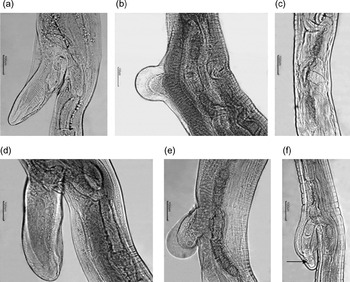
All H. similis females showed linguiform vulval lobes with a long vagina that extended along the vulval flap and opened near its extremity (fig. 1). Haemonchus placei and H. contortus had linguiform or knobbed vulval lobes, and 18% of the H. contortus females were smooth, i.e. they did not have vulval lobes (fig. 1).
Vulvar region of female Haemonchus spp. from sheep and cattle grazing the same pastures. Haemonchus contortus linguiform (a), with knob (b) and smooth (c); H. placei linguiform (d) and with knob (e); and H. similis with a long vagina that extends into the linguiform flap and opens (arrow) in the flap (f).

Discussion
The H. placei specimens had the longest body length, whereas H. contortus and H. similis had intermediate and the shortest body lengths, respectively. However, overlapping measurements in the body length demonstrated that this variable is of little value for the classification of females of these species. In the present study, the H. contortus females obtained from sheep had a mean length of 19.6 mm. This measurement is shorter than the lengths of female H. contortus isolates from Sweden and Kenya, which presented average lengths between 21.8 and 22.7 mm (Troell et al., Reference Troell, Tingstedt and Höglund2006). Lichtenfels et al. (Reference Lichtenfels, Pilitt and Hoberg1994) reported body lengths of 10.4–17 mm for H. similis, which are similar to those observed in the present study (10–16 mm), whereas Gibbons (Reference Gibbons1979) reported H. similis specimens with a broader range of body lengths (8.05–19.50 mm). The H. placei females examined in this study had body lengths from 15 to 24 mm, and similar sizes were previously reported for this species (12.5–25.5 mm) by Lichtenfels et al. (Reference Lichtenfels, Pilitt and Hoberg1994).
Most females recovered from cattle were identified as H. similis (90.9%) based on their synlophe morphology. Their average body length was shorter (mean of 12.9 mm) than that of H. placei specimens (16.5 mm). There was also a clear distinction between the species in relation to tail length and tail length proportion, indicating that these variables can be used to distinguish between H. similis and H. placei specimens. However, due to the low number of H. placei females included in this study, the usefulness of this variable must be confirmed in other studies with larger samples, particularly because the single H. placei specimen obtained from sheep had a tail length proportion of only 1.59%, which is similar to the values observed for H. similis.
In agreement with our study, all H. similis females obtained from cattle grazing mixed irrigated pastures in the French West Indies had a vulval linguiform flap (Giudici et al., Reference Giudici, Aumont, Mahieu, Saulai and Cabaret1999). Therefore, this characteristic appears to be constant in H. similis, independent of the geographical region. The vulval morphology of H. contortus is variable: most of the specimens isolated from sheep possessed a linguiform flap (66%), whereas some had a knobbed flap (16%) and others exhibited a smooth morphology (18%). All H. placei females had linguiform or knobbed flaps. Similarly, Riggs (Reference Riggs2001) did not isolate females with a smooth vulvar region from sheep experimentally infected with H. placei; all of their isolated specimens presented linguiform or knobbed flaps. In the French West Indies, H. contortus specimens had (in decreasing order of frequency) smooth, linguiform and knobbed morphotypes (Giudici et al., Reference Giudici, Aumont, Mahieu, Saulai and Cabaret1999), and the results from a study of H. contortus and H. placei specimens from Mauritania, Africa (Jacquiet et al., Reference Jacquiet, Cabaret, Thiam and Cheikh1998) were similar to those observed in the present study. Taken together, the results of these studies indicate that the smooth morphotype only occurs in H. contortus females and that H. placei females always have a vulval flap.
According to Gibbons (Reference Gibbons1979), despite occasional anomalies, the characteristics of males are more reliable and suitable for species identification than those of females. Because the number of vulvar flaps and their shapes are variable and depend on several factors, they are not reliable for differentiation at either the species or genus levels. Lichtenfels et al. (Reference Lichtenfels, Pilitt and Hoberg1994) also mentioned the high level of morphological variation in the vulval lobes within each species and did not consider this to be a reliable characteristic for the identification of these species. Our results agree with those presented by Gibbons (Reference Gibbons1979) and Lichtenfels et al. (Reference Lichtenfels, Pilitt and Hoberg1994) regarding the identification of H. contortus and H. placei females. However, all of the H. similis females examined had a linguiform flap with a long vagina that extended along the vulval flap and opened near its extremity. Therefore, in the present study, H. similis females were easily distinguished from H. contortus and H. placei females on the basis of their vulvar structure.
In the present trial, low parasite infection intensity was observed in the adult bovines, demonstrating a high degree of resistance against H. placei and H. similis infections. In the abomasums obtained in an abattoir, Bresciani et al. (Reference Bresciani, Nascimento, Costa, Amarante, Perri and Lima2001) also observed a low worm burden and showed that both nematode species H. placei and H. similis occurred in similar proportions in adult cows. Haemonchus similis was found to be the predominant abomasal species in cattle in Minas Gerais state (Lima, Reference Lima1998), and H. placei was the predominant species in young cattle raised in Botucatu (Amarante et al., Reference Amarante, Bagnola, Amarante and Barbosa1997), São Manuel (Nicolau et al., Reference Nicolau, Amarante, Rocha and Godoy2002) and Castilho (Condi et al., Reference Condi, Soutello and Amarante2009), São Paulo state. Additional studies in different geographical areas will be necessary to elucidate the mechanisms that control the proportion of H. placei and H. similis in cattle.
With respect to host-specificity, our results indicate that adult cattle are not an important host for H. contortus, even if they graze in a pasture contaminated with infective H. contortus larvae. The predominant Haemonchus species isolated from cattle in the present study was H. similis, and this species was not found to infect sheep in the present study or in other studies conducted in the states of Rio Grande do Sul (Santiago et al., Reference Santiago, Costa and Bevenenga1975) and São Paulo (Amarante et al., Reference Amarante, Bagnola, Amarante and Barbosa1997). Interestingly, H. similis was the only species found in heifers grazing with sheep in irrigated pastures in the tropics (French West Indies), and there appeared to be no cross-transmission of H. similis from cattle to sheep or of H. contortus from sheep to cattle (Giudici et al., Reference Giudici, Aumont, Mahieu, Saulai and Cabaret1999). Haemonchus placei occurred in small numbers in the present experiment; in fact, with the exception of one female found in one of the sheep, this species was only found in cattle, which demonstrates its adaptation to this host species.
In conclusion, synlophe analysis proved to be very useful for the identification of H. contortus, H. placei and H. similis in epidemiological studies involving different species of ruminants in shared pastures. The present study also confirmed the high host-specificity of the three studied nematodes species in São Paulo State, Brazil: the populations of H. placei and H. similis were adapted to cattle and H. contortus was adapted to sheep.
Financial support
This work was supported by the Conselho Nacional de Desenvolvimento Científico e Tecnológico (A.F.T.A., grant number 302248/2009-9). M.R.L.S. received financial support from Coordenação de Aperfeiçoamento de Pessoal de Nível Superior.
Conflict of interest
None.
Ethical standards
The authors assert that all procedures contributing to this work comply with the ethical standards of the relevant national guides on the care and use of laboratory animals (Brazilian College of Animal Experimentation) and have been approved by the Bioscience Institute Ethical Committee for Animal Research (licence number 007/04-CEEA).