

Introduction
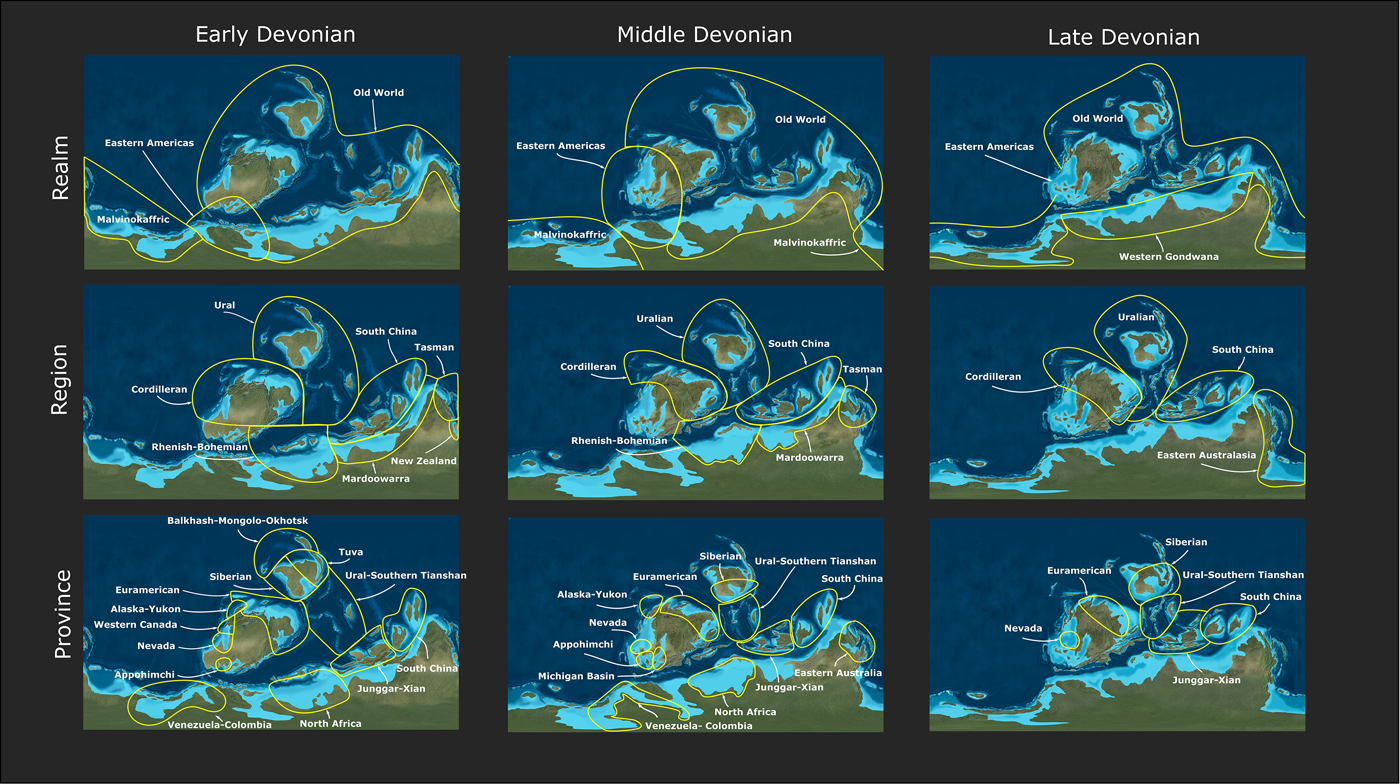
One of the aims of comparative biogeography is to discern and test natural areas within an area classification (Parenti and Ebach Reference Parenti and Ebach2009; Ebach and Michaux Reference Ebach and Michaux2017). Natural areas are defined as the geographic space occupied by natural (i.e., monophyletic) taxa (Parenti and Ebach Reference Parenti and Ebach2009). Natural areas are biogeographic units encompassing an “area of endemism” (see Lindler [Reference Lindler2001] and Wiley and Lieberman [Reference Wiley and Lieberman2011] for discussion) and are difficult to discern for the Paleozoic, as resolved phylogenies of constituent taxa are required (Rosen Reference Rosen, Myers and Giller1988a,Reference Rosenb; Lieberman and Eldredge Reference Lieberman and Eldredge1996; Ebach and Edgecombe Reference Ebach, Edgecombe, Adrian, Edgecombe and Lieberman2001; Lieberman Reference Lieberman2005, Reference Lieberman2012; Rode and Lieberman Reference Rode and Lieberman2005). Given that Devonian cladistic studies are rare, the abilities of biogeographers to distinguish artifact from natural classification has been limited, resulting in much revision and reclassification (e.g., Bigey Reference Bigey, Nielsen and Larwood1985; Blodgett et al. Reference Blodgett, Rohr and Boucot1990; Pedder and Murphy Reference Pedder and Murphy2004). To formalize a Devonian area classification, that is a bioregionalization, and create a standardized frame for future Devonian studies, the interim bioregionalization (Fig. 1; Dowding and Ebach Reference Dowding and Ebach2018) must be tested, its hierarchy established, and unstable units highlighted.
The realms, regions, and provinces of the Early, Middle, and Late Devonian based upon the bioregionalization of Boucot et al. (Reference Boucot, Johnson and Talent1969) and subsequent related revisions. Maps modified by the authors. Base maps copyright Ron Blakey, Colorado Plateau Geosystems, Inc. (from Dowding and Ebach Reference Dowding and Ebach2018: Fig. 1).

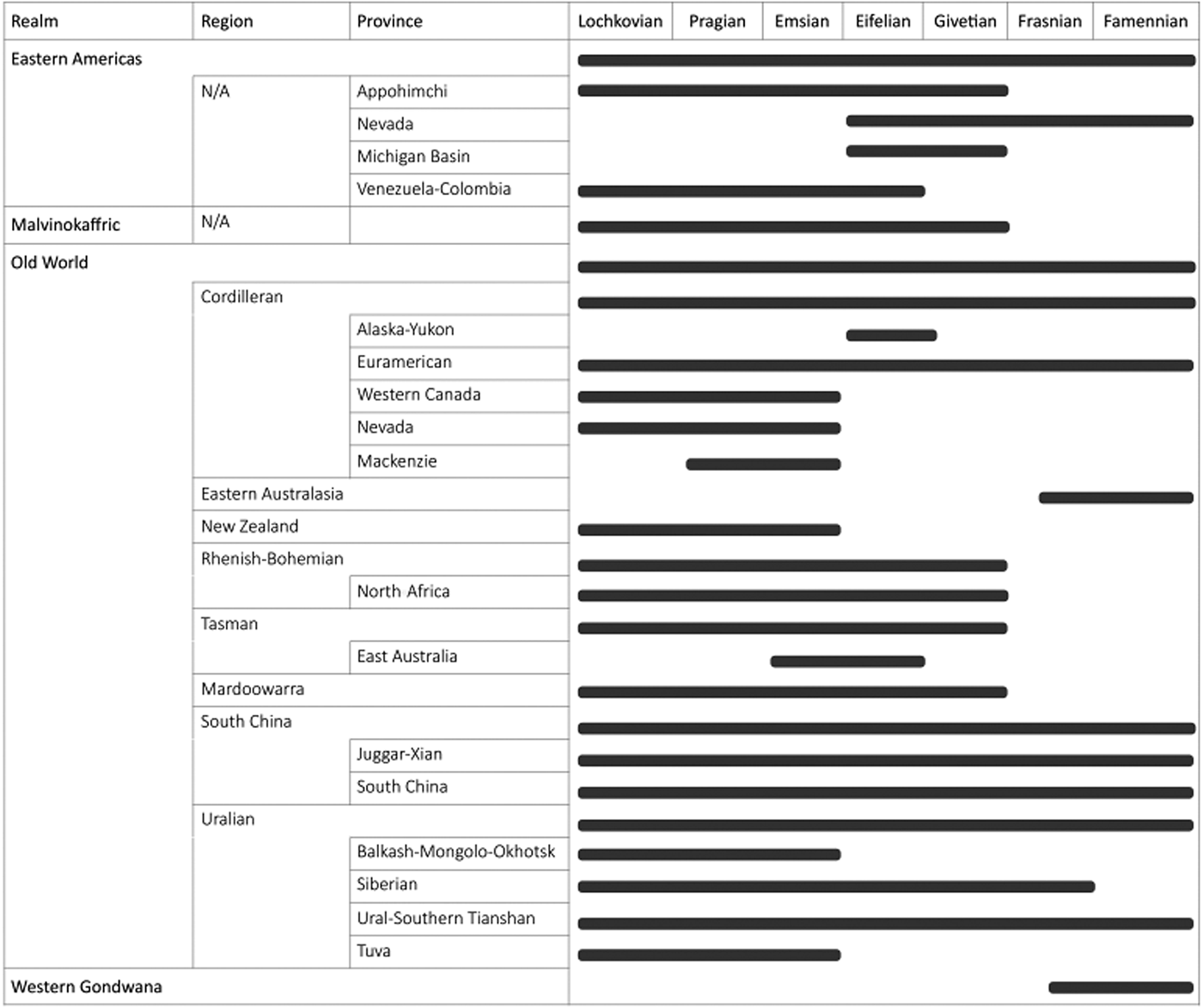
A. J. Boucot (1924–2017) established Devonian bioregionalization bridging the period between static Earth and plate tectonics, when distribution could be explained by both biotic dispersal and geodispersal (Boucot et al. Reference Boucot, Johnson and Talent1969; Boucot Reference Boucot and Ross1974). Boucot et al. (Reference Boucot, Johnson and Talent1969) diagnosed Devonian biotic areas based upon endemic and shared brachiopod fauna. Biotic areas, defined by the distribution of constituent faunas, are often blended with evolutionary, geologic, geographic, and climatic processes (Cecca and Westermann Reference Cecca and Westermann2003; Servais et al. Reference Servais, Cecca, Harper, Isozaki, Niocaill, Harper and Servais2013). These areas are organized within a hierarchy of subprovinces and provinces that represent local endemic centers encompassed by subregions, regions, and finally realms according to the International Code of Area Nomenclature (Ebach et al. Reference Ebach, Morrone, Parenti and Viloria2008; the code states that the names, such as realm and region, are not capitalized). Dowding and Ebach (Reference Dowding and Ebach2018) summarized 50 years of Devonian bioregionalization into three time slices (Early, Middle, and Late Devonian; Fig. 1). The review of over 100 areas and emendations standardized the diagnoses of published areas and formalized a functional hierarchical bioregionalization in preparation for testing. Completing the bioregionalization of Boucot et al. (Reference Boucot, Johnson and Talent1969), the interim bioregionalization comprises 4 realms, 7 regions, and 24 provinces (Fig. 2). The interim bioregionalization includes three new areas, namely the Western Gondwana realm and the Eastern Australasia and Mardoowarra regions (Fig. 1). These areas, created as best-fit units to complete the bioregionalization of Boucot, are yet to be formally assessed or quantified (Dowding and Ebach Reference Dowding and Ebach2018). Consequently, this study will provide insight into their validity and suggest whether they require revision or rediagnosis.
The ages of realms, regions, and provinces within the Devonian (based upon Boucot et al. Reference Boucot, Johnson and Talent1969 and related revisions, surmised in Dowding and Ebach Reference Dowding and Ebach2018: Table 1). Designations were made following the International Code of Area Nomenclature (Ebach et al. Reference Ebach, Morrone, Parenti and Viloria2008) and involved synonymizing areas, balancing area opening and closure dates, and coalescing bioregionalizations from multiple taxa to create a robust bioregionalization for quantitative testing.

The quantification of the source and proportions of area composition can inform or challenge our classifications. Metrics of taxic composition are exploratory tools capable of representing turnover, community collapse, recruitment, and recovery from extinction. While origination and recruitment are key to area characterization, boundary crossers and holdovers (Brett and Baird Reference Brett, Baird, Erwin and Anstey1995) have already been identified as important features of some Devonian areas (Wood Reference Wood2000; Bonuso et al. Reference Bonuso, Newton, Brower and Ivany2002; Bonelli et al. Reference Bonelli, Brett, Miller and Bennington2006). Previous research (Boucot et al. Reference Boucot, Johnson and Talent1969; Boucot Reference Boucot1985, Reference Boucot1988; Hallam Reference Hallam1994) has shown the Old World realm, in addition to its recruited diversity, had the highest maintenance of holdovers and boundary crossers, including characterizing brachiopods (eospirifers, orthids, atrypids, athyridids). The Silurian influence on Devonian fauna from the North Atlantic realm and Uralian–Cordilleran realm within the Old World realm has yet to be formally assessed, and the degree to which relict distributions inform the Old World realm's diagnosis is untested. Without an understanding of the source diversity, patterns of recruitment and the spatiotemporal signatures of biotic events remain without differentiation.
Classification and Blended Areas
Biogeographic areas, such as realms, regions, and provinces, are defined by the distribution of biota and are analogous to taxa, meaning that they undergo originations and extinctions (Parenti and Ebach Reference Parenti and Ebach2009). If a realm goes extinct, it means that its biotic composition disappears due to extinction of taxa that define the biota. Biotic areas are also part of an area classification (bioregionalization) and can be identified and quantified by the sum of their parts (Ebach and Michaux Reference Ebach and Michaux2017), but their strict origination and extinction cannot be definitively pinpointed. As with species, areas are diagnosed through the correlation and congruence of present characteristics (Ebach and Michaux Reference Ebach and Michaux2017). Blended forms exist during the establishment and demise of areas (Ferro and Morrone Reference Ferro and Morrone2014; Szumik et al. Reference Szumik, Pereyra and Casagranda2019) and, consequently, probabilistic extinction and origination of areas cannot be determined. Biotic similarity and the establishment of a temporally stratified provisional hierarchy offer a powerful alternative.
Area classifications represent hierarchical area taxonomies that are temporarily partitioned (Dowding et al. Reference Dowding, Ebach and Mavrodiev2018). The representation of hierarchy demonstrates the nesting of smaller units within larger ones (Anstey et al. Reference Anstey, Pachut and Tuckey2003) and the recognition of biogeographical processes (Rosen Reference Rosen, Myers and Giller1988a,Reference Rosenb; Rosen and Smith Reference Rosen and Smith1988). Nested areas, represented within a cluster of the phenogram, are used to support the characterization of higher-level units, such as regions and realms (Parenti and Ebach Reference Parenti and Ebach2009). Consequently, hierarchical analyses of biotic similarity afford us insight into the characterization of higher-level units, as well as observations of how changes in faunal profile (through extinction, turnover, or recruitment) affect relationships within and among areas.
Though multitaxon studies have been a feature of biogeography since the nineteenth century (Sclater Reference Sclater1858; Wallace Reference Wallace1876), the approach has not been applied to the Devonian. Currently, the bioregionalization of Boucot et al. (Reference Boucot, Johnson and Talent1969), based on brachiopod fauna, has been appropriated by authors using corals (Oliver Reference Oliver1977, Reference Oliver1990), gastropods (Blodgett et al. Reference Blodgett, Rohr and Boucot1990), bryozoans (Bigey Reference Bigey, Nielsen and Larwood1985), stomatoporoids (Stock Reference Stock, Over, Morrow and Wignall2005), trilobites (Kobayashi and Hamada Reference Kobayashi and Hamada1975), fish (Young Reference Young1981; Lebedev and Zakharenko Reference Lebedev and Zakharenko2010; Young et al. Reference Young, Burrow, Long, Turner and Choo2010), and planktonic taxa (Afanasieva and Amon Reference Afanasieva and Amon2013; Shen et al. Reference Shen, Song, Servais and Gong2018). Until now, no study has quantified multiple Devonian taxa (brachiopods, trilobites, gastropods, corals, and fishes) to test a global area classification of the Early, Middle, and Late Devonian.
This study is among the first to use multiple taxa to quantify Devonian bioregionalization (Dowding and Ebach Reference Dowding and Ebach2018) and to create a provisional hierarchy using biotic similarity. Through the consideration of metrics of composition and the representation of hierarchical area relationships, the bioregionalization of the Devonian will be critiqued, the influence of temporality (boundary crossers, first occurrences, etc.) assessed, and the area relationships through time represented.
Material and Methods
Distributional Data
A database of 676 genera with ca. 30,000 occurrences of late Silurian (Ludlow–Pridoli) and Devonian taxa, including fish (gnathostomata, agnatha, among others), brachiopods, and trilobites, was manually created from the literature and supplemented by data sets from the Palaeobiology Database (www.paleodb.org). These taxa were chosen for their varied life histories, ecology, and evolution. The limitation to three taxa was arbitrary and, in future, additional taxa will be included. Brachiopods were maintained within the analysis to provide continuity between this work and that of Boucot et al. (Reference Boucot, Johnson and Talent1969). Planktonic data were omitted because of incompatibility with nektonic or benthic forms, as acknowledged by Afanasieva and Amon (Reference Afanasieva and Amon2013).
Accepted names of genera were entered into a database along with location, age, and environmental information when available. Genera are used, as they may occupy multiple units, whether province, region or realm, while species distributions are often too narrow for interregion or realm comparison (Upchurch et al. Reference Upchurch, Hunn and Normal2002).
Based upon the interim bioregionalization of Dowding and Ebach (Reference Dowding and Ebach2018), occurrences were coded using a binary temporal area approach (TAAp) that splits preestablished areas into temporal units and codes them as individuals (Dowding et al. Reference Dowding, Ebach and Mavrodiev2018; see Supplementary Material). Silurian realms were based upon Boucot et al. (Reference Boucot, Johnson and Talent1969) and Boucot (Reference Boucot and Ross1974) and supplemented by Boucot and Blodgett (Reference Boucot, Blodgett, Brunton, Cocks and Long2001). The Silurian bioregionalization included the North Atlantic realm, Uralian Cordilleran realm, and the “Silurian Malvinokaffric realm” (Boucot Reference Boucot and Ross1974). The Afro-South American realm (Benedetto and Sanchez Reference Benedetto, Sanchez, Copper and Jin1996) was proposed for African and South American regions traditionally included within the “Silurian Malvinokaffric.” This designation has been both challenged by Boucot and Blodgett (Reference Boucot, Blodgett, Brunton, Cocks and Long2001) for its Devonian distribution and supported (Di Pasquo et al. Reference Di Pasquo, Noetinger, Isaacson, Grader, Starck, Morel and Folnagy2015) as a “subrealm” using mixed terrestrial and marine characters. For the purposes of this study, the “Afro-South American subrealm” (Di Pasquo et al. Reference Di Pasquo, Noetinger, Isaacson, Grader, Starck, Morel and Folnagy2015) was subsumed into the Devonian Malvinokaffic. Additionally, the “Silurian Malvinokaffric realm” (Boucot Reference Boucot and Ross1974) was maintained for the Silurian for consistency of nomenclature until the revision of the Silurian and a stable biogeographic rank diagnosis is achieved (i.e., realm or subrealm rank established for the Silurian and/or Devonian distribution of the Afro-South American unit).
Boucot (Reference Boucot and Ross1974) placed the “Silurian Malvinokaffric” border proximal to the Melbourne Zone of southeastern Australia and left New Zealand unassigned. These areas, which show a different relationship to the rest of the Tasman (Sandford Reference Sandford2000; Young Reference Young2003; Dowding and Ebach Reference Dowding and Ebach2016) were consequently assigned to the “Silurian Malvinokaffric realm.”
The four provinces of the South America realm (Fig. 2) are coalesced to be treated as a single unit. The Michigan Basin province is considered, according to the diagnosis of Dowding and Ebach (Reference Dowding and Ebach2018), to include, but not be limited to, the Michigan, Hudson Bay, and Illinois Basins. Diagnoses of all four provinces are included in Dowding and Ebach (Reference Dowding and Ebach2018). Lieberman and Eldredge (Reference Lieberman and Eldredge1996) present good evidence of the distinct characteristic of the Illinois Basin. The amalgamation of the distribution data from the provinces into the single treatment avoids potential internal conflicts in diagnosis.
Single occurrences (temporal or spatial), “all absences,” and cosmopolitan or widespread taxa were omitted (Young Reference Young1987; Ebach et al. Reference Ebach, Humphries, Newman, Williams and Walsh2005).
Biotic Similarity Analysis
The database was treated using TAAp (Dowding et al. Reference Dowding, Ebach and Mavrodiev2018), traditional (fixed), and blended matrices (see Supplementary Material). Traditional matrices treat all taxa as equal in age, meaning we do not gain insight into the similarity between areas in time. Blended matrices allow us to see how Early, Middle, and Late Devonian areas are similar through time at a given biogeographic rank (Dowding et al. Reference Dowding, Ebach and Mavrodiev2018). The difficulties of creating a bioregionalization within a comparatively low-diversity system can be mitigated through temporal partitioning of the data. Consequently, the temporal matrix has been applied. To address issues of hierarchy (i.e., realms being analyzed at the same rank as regions of the Old World realm), the Old World realm is assessed temporally in the “blended” analysis. The blended matrix includes all units’ recorded faunal presences and absences without temporal partitioning except for the Old World realm.
The matrices were run through a TNT v. 1.5 (Goloboff and Catalano Reference Goloboff and Catalano2016) New Technology Search using a standard implied weighting (K = 3), ratchet (1000 iterations), and drift (100 cycles). A single tree was retained in the output, therefore a consensus tree was not required.
Composition of Areas
Consideration of composition included survivorship, recruitment, and turnover. Similarity between units was considered using the Jaccard dissimilarity index (JDi; Lewthwaite et al. Reference Lewthwaite, Debinski and Kerr2017), which ranges from zero to one, with lower values indicating similarity between units:
 $${\rm JDi} = 1-\displaystyle{x \over {x + y + z\;}} $$
where x represents the number of genera the units have in common and y and z represent the taxa that are unique to each, respectively. Baselga et al. (Reference Baselga, Jimenez-Valverde and Niccolini2007) and Lewthwaite et al. (Reference Lewthwaite, Debinski and Kerr2017) observed that dissimilarity can conflate turnover and nestedness. Owing to this, a separate metric for turnover was used. Simple turnover, assessed within a single biogeographic unit, rather than adjusted or standardized, was used owing to the small sample size.
 $${\rm Turnover} = \displaystyle{{G_{t3}} \over {(G_{t_1} + G_{t_3})/2}}$$
where G is the number of genera within a unit, and t 1 to t 3 denote the Devonian time unit (Early: 1; Late: 3).
Recruitment, informative for understanding the structure of turnover and diversity, was calculated for Middle and Late divisions of each unit.
 $${\rm Recruitment} = \displaystyle{{F_b} \over {G_a}} \times 100$$
where F is the number of genera unique to time 2 (b) from time 1 (a), and G is the total count of genera in time a.
Survivorship was calculated between Early and Middle, Middle and Late, and Early and Late Devonian partitions of the biogeographic units.
 $${\rm Survivorship} = \displaystyle{{S_{\lpar {t_a-t_b} \rpar }} \over {G_{t_a}}} \times 100$$
where S is the count of taxa that survived the interval between time a and b of a given unit, divided by the total count of genera in time a.
Boundary crossers were tallied from occurrences of taxa that existed around the same area within the Silurian. Holdover total was the sum of boundary crossers that did not survive into the Middle Devonian (for discussion of terms, see Dowding et al. [Reference Dowding, Ebach and Mavrodiev2018]).
Results
Results from the biotic similarity analyses show that there were notable differences between the relationships of areas through time (Fig. 3). The Old World realm was not found to be monophyletic (Fig. 3A), grouping in the Late Devonian with the Western Gondwana realm. Silurian units presented a strong relationship, consistently grouping across both the TAAp (Fig. 3A) and fixed (Fig. 3B) treatments. The removal of the Silurian units from the blended treatment (Fig. 3C) reflects the influence of Silurian fauna within the Old World realm's regions. Comparison of the fixed (Fig. 3B) and blended (Fig. 3C) treatments illustrates the transition between the Western Gondwana, Mardoowarra, and South China units throughout the Devonian as dependent upon Silurian character influence within the Old World realm.
Results of biotic similarity analysis. A, Temporal area approach (consistency index = 0.35, retention index = 0.39); B, fixed matrix (consistency index = 0.468, retention index = 0.41); C, blended matrix (consistency index = 0.407, retention index = 0.498). East America, Eastern Americas; East Australasia, Eastern Australasia; E Dev, Early Devonian; M Dev, Middle Devonian; L Dev, Late Devonian; L Sil, late Silurian.

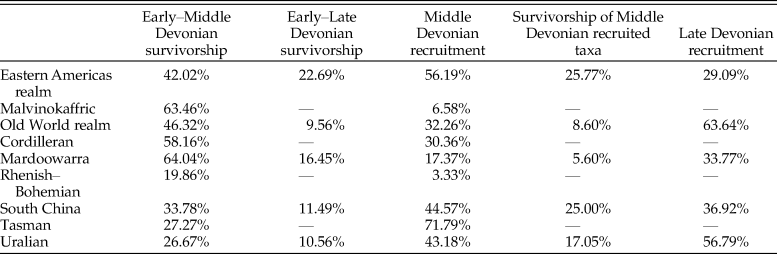
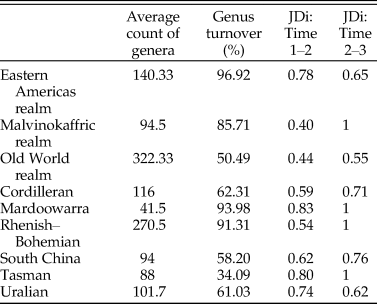
Survivorship and recruitment (Table 1) indicate that the biotic profiles of the biogeographic areas were significantly altered throughout the course of the Devonian. Areas that were thought to survive into the Late Devonian did not retain sufficient numbers of their original faunal profile to maintain area characterization. Turnover and outcomes of the JDi (Table 2) show that there is notable difference between the biogeographic areas through time. Of the realms, the Eastern Americas had the highest JDi and turnover rates, given the extinction of the Malvinokaffric biota by time 3 (Late Devonian; Table 2).
Survivorship, recruitment, and survivorship of recruited taxa per Early Devonian unit.

Average count of genera, genus turnover, and Jaccard dissimilarity index (JDi per interval for the Early to Middle Devonian (1–2) and Middle to Late Devonian (2–3).

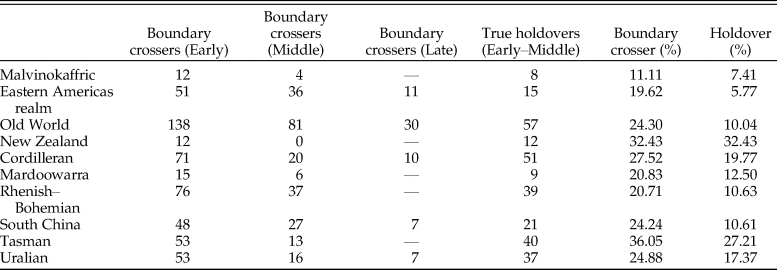
Holdovers and boundary crossers are observed in high frequency within the regions of the Old World realm (Table 3). Holdovers and boundary crossers contribute around 20–30% to area characterization, influencing diagnosis of Devonian biogeographic areas. The influence of these temporal outliers is confirmed by the biotic similarity analysis (Fig. 3) and the comparison between the fixed (Fig. 3B) and blended (Fig. 3C) analyses.
Boundary crossers from the Silurian to the Early, Middle, and Late Devonian and holdovers per Early Devonian unit.

Discussion
Old World Realm
The Old World realm, represented by the Cordilleran, Mardoowarra, Uralian, Rhenish–Bohemian, South China, Tasman, Eastern Australasia, and New Zealand regions, is shown to be split into two clusters: Early–Middle (E-M) and Middle–Late (M-L) Devonian (Fig. 3A). Turnover and survivorship within the regions (Tables 1, 2) show there is a notable difference in the profile between the beginning and end of the Devonian, with the Old World realm retaining only ca. 17% of its Early Devonian fauna. The split in the realm between E-M and M-L (Fig. 3A) reflects a significant change in faunal profile (Table 2). This interval was marked by Middle Devonian biocrises, which resulted in a substantial decline in diversity (House and Kerr Reference House and Kerr1989; Baird and Brett Reference Baird and Brett2008). The extinction events, associated with marine highstand and decreased oxygenation of epicontinental seas, affected much of the Old World realm's characteristic areas such as the Prague Basin, Ardennes, and Rheinisches Schiefergebirge (Zambito et al. Reference Zambito, Brett, Baird and Talent2012). Before its purported extinction at the end of the middle Givetian, 74% of the Old World realm's diversity occurred in the Rhenish–Bohemian region. The Middle Devonian loss of the Rhenish–Bohemian region and the extended effects of extinction within characteristic areas confounds the Late Devonian diagnosis of the Old World realm.
The collapse of the Rhenish–Bohemian region's shelly fauna during the Taghanic event (Johnson et al. Reference Johnson, Klapper and Sandberg1985, Reference Johnson, Klapper and Sandberg1986; House Reference House2002; Zambito et al. Reference Zambito, Brett, Baird and Talent2012) shifted the onus for the Old World realm's characterization to the Uralian and South China regions (Fig. 3A, Table 1). This shift is considered problematic, as the Middle Devonian biocrises also had significant influence within these two regions (House Reference House2002; Tables 1, 2). Both the Uralian and South China regions presented a survivorship of around 10% of their original generic profile into the Late Devonian. The Middle to Late Devonian transition of the Uralian region saw a 61% turnover, with a Late Devonian recruitment rate of ca. 57% (Tables 1, 2). The turnover of the Uralian region and the establishment of novel relationships between South China, the Gondwanan margin, and peri-Gondwana (Becker Reference Becker2000) suggest that relationships of the Early Devonian peak in diversity were not maintained into the Late Devonian.
The lack of continuity (Fig. 2) between the Early and Late Devonian fauna of the Old World realm is cause for revision of the area classification. Global diversity curves (Raup and Sepkoski Reference Raup and Sepkoski1982; Alroy et al. Reference Alroy, Aberhan, Bottker, Foote, Fursich, Harries, Hendy, Holland, Ivany, Kiessling, Kosnick, Marshall, McGowan, Miller, Olszewski, Patzkowsky, Peters, Villier, Wagner, Bunuso, Borkow, Brenneis, Clapham, Fall, Ferguson, Hanson, Krug, Layou, Leckey, Nurnberg, Powers, Sessa, Simpson, Tomasovych and Visaggi2008) in addition to single-taxon studies of gnathostomes (Sallan and Coates Reference Sallan and Coates2010), trilobites (Feist Reference Feist1991; Lerosey-Aubril and Feist Reference Lerosey-Aubril, Feist and Talent2000), stromatoporoids (Stock Reference Stock, Over, Morrow and Wignall2005), and bryozoans (Bigey Reference Bigey, Nielsen and Larwood1985), among others, indicate a significant extinction followed by a period of recruitment and recovery. Given the high turnover rate (Table 2), low survivorship (Table 1), and high Late Devonian recruitment (Table 1), the Old World realm is unlikely to have maintained or expanded its boundaries (Boucot Reference Boucot1985; Blodgett et al. Reference Blodgett, Rohr and Boucot1990; Hallam Reference Hallam1994; Bambach Reference Bambach2006). The Old World realm either became extinct during the Middle Devonian biocrises, or had become significantly reduced. The Late Devonian regionalization of Isaacson et al. (Reference Issacson, Diaz-Marinez, Grader, Kaldova, Babek and Deyust2008), which challenged the functional standard of Boucot et al. (Reference Boucot, Johnson and Talent1969) and the emendations that followed, should be considered as an alternative for testing in future studies.
Sources of Diversity: Temporal Distribution
Through the quantification of the areas within a bioregionalization or area classification, workers can assess the components of observed diversity. While origination and recruitment are important features of area characterization, boundary crossers and holdovers have already been identified as significant to some Devonian areas (Boucot et al. Reference Boucot, Johnson and Talent1969; Boucot Reference Boucot1985; Hallam Reference Hallam1994). The Old World realm had the highest maintenance of holdovers (10.04%) and boundary crossers (24.3%), including characterizing brachiopods (eospiriferids, orthids, atrypids, athyridids; Table 3). It has been previously established that the Old World realm's peak in diversity was during the Early Devonian (Hallam Reference Hallam1994; Boucot Reference Boucot1985; Bambach Reference Bambach2006). A significant portion of genera were carried over from the Silurian North Atlantic realm and Uralian–Cordilleran realm (Table 3).
The inclusion of Silurian holdovers inflated the effects of the Early and Middle Devonian extinctions on the Old World realm. By the Middle Devonian, 80% of the boundary crossers were extinct from the realm, contributing approximately 54% of the 292 genera lost (Table 3). The abundance of holdovers within a unit has the potential to give precedence to relict distributions and mask the relationships of novel taxa. The Rhenish–Bohemian region sources 20% of its diversity from the Silurian North Atlantic realm and Uralian–Cordilleran realm (Table 3). With the demise of the holdovers during the subsequent Middle Devonian Taghanic and Kačák biocrises, the Rhenish–Bohemian region was believed to go extinct during the Middle Devonian (Boucot Reference Boucot and Ross1974; Boucot and Blodgett Reference Boucot, Blodgett, Brunton, Cocks and Long2001). However, ca. 40% of the diversity of the Late Devonian Western Gondwana realm stems from Rhenish–Bohemian taxa. The loss of the boundary crossers is shown to have inflated the signature of extinction (77.3% loss of Early Devonian genera) and masked Late Devonian recovery (29.1% recruitment) within the Old World realm and Rhenish–Bohemian region (Tables 1, 3).
Recovery through recruitment is not simply a proxy for origination. Referring to the first occurrence of a taxon within an area, recruitment includes both processes of dispersal and origination (Johnson Reference Johnson1992; Stanley and Powell Reference Stanley and Powell2003). Within the comparatively low-diversity system of the Late Devonian, the loss of any taxon would be given higher weighting than within the Early–Middle interval. The reason for this is that the “flattening” of the data, their compression into a single plane or grid cell (Dowding et al. Reference Dowding, Ebach and Mavrodiev2018), has given precedence to high diversity, masking through density any patterns of recovery that the Late Devonian may have presented. The dramatic changes in faunal profile during the Middle and Late Devonian offer too little fidelity to the realms’ original characteristics to maintain an accurate taxonomy. Owing to this, it may be that the maintenance of the Old World realm into the Late Devonian as presented by Boucot (Reference Boucot1985) and Dowding and Ebach (Reference Dowding and Ebach2018) is an artifact of prioritizing Early Devonian taxa and Silurian holdovers at the expense of Late Devonian recruitment. Previous hypotheses are insufficient and fail to represent Late Devonian biotic events. Within a revised frame, discussions of further transgressive episodes, such as the Annulata event (Zong et al. Reference Zong, Becker and Ma2015), the Frasnian/Famennian extinction (Copper Reference Copper2002), and the barriers caused by the Late Devonian magmatic arc (Nie et al. Reference Nie, Feng, Metcalfe, Baxter and Liu2016) can be placed into a context in which the taxonomy is appropriate to recognize their influences.
Eastern Gondwana: Tasman and Eastern Australasia Regions
A number of authors have observed an Australian and Euramerican connection (Ebach and Edgecombe Reference Ebach, Edgecombe, Adrian, Edgecombe and Lieberman2001; Young Reference Young2010; Shen et al. Reference Shen, Song, Servais and Gong2018). The present study, in addition to the work of Young (Reference Young2010), would, after perfunctory assessment, seem to support the hypothesis of long-distance or biotic dispersal. Of the trilobite genera common to both regions, 75% occurred within the Ordovician and, consequently, the Australian–Euramerican connection may prove to be a temporally controlled vicariant distribution, although biotic dispersal (Platnick and Nelson Reference Platnick and Nelson1978) and geodispersal (Lieberman and Eldredge Reference Lieberman and Eldredge1996), such as proposed by Blodgett et al. (Reference Blodgett, Rohr and Boucot1990), Young (Reference Young1981, Reference Young2010), and Shen et al. (Reference Shen, Song, Servais and Gong2018) may have limited influence within the region compared with historical distribution and relationships; all are viable processes.
The discussion of process to explain patterns in the data, rather than discussion of the data and patterns themselves, is highlighted as problematic when regions that are assumed to have strong connections do not present them, for example, the east coast of Australia (Tasman region and Eastern Australasia realm) and the western coast (Mardoowarra region and Western Gondwana realm; Fig. 3A). The isolation of the western and eastern Gondwanan coast has been observed in vertebrates (Young Reference Young1981, Reference Young2010), radiolarians (Afansieva and Amon Reference Afanasieva and Amon2013), acritarcs and prasinophytes (Shen et al. Reference Shen, Song, Servais and Gong2018), and gastropods (Blodgett et al. Reference Blodgett, Rohr and Boucot1990), among others. Shen et al. (Reference Shen, Song, Servais and Gong2018) argued that the absence of a relationship between the east and west coast of Gondwana was caused by closed surface circulation in the Prototethys Ocean. This hypothesis does not, however, explain any novel relationship, such as the shared occurrence of Cordania (Ebach and Edgecombe Reference Ebach and Edgecombe1999), between east Euramerica and the eastern Australian coastline.
Additionally, despite the Mardoowarra region being annexed by the Western Gondwana realm, the results suggest a significant turnover of fauna (Fig. 3A). The main fossiliferous deposits within the northern Western Gondwana realm occur in the Canning Basin (Feist and Becker Reference Feist and Becker1997). This area was severely affected by the Middle Devonian biocrises; facies show freshwater incursions, widespread anoxia, photic zone euxinia, and syndepositional tectonics (Tulipani et al. Reference Tulipani, Grice, Greenwood, Haines, Sauer, Schimmelmann, Summons, Foster, Bottcher, Playton and Schwark2015; Playton et al. Reference Playton, Kerans, Hocking, Haines, Adams, Hurley and Frost2017). Additionally, the great Devonian interchange at or near the Frasnian/Famennian boundary saw the first occurrence of a Laurussian vertebrate fauna within the Western Gondwana realm and the appearance of Gondwanan-endemic phyllolepid placoderms within the Northern Hemisphere (Young Reference Young2010). The environmental variation, coupled with increasing faunal exchange and extended extinction events, explains the lack of continuity between the Western Gondwana realm and the Mardoowarra region and, potentially, the Eastern Australasian coastline.
Eastern Americas Realm
Key to the history of the Eastern Americas realm is both the uplift and subsequent subsidence of the Transcontinental Arch as a barrier between the east and west (see Oliver et al. Reference Oliver, Sorauf and Brett1996). Within the Eastern Americas realm, eustasy, the extinction of Silurian holdovers, and dispersal facilitated by global climatic disturbances are as influential as “first occurrences” within a unit's history (Table 1; Johnson Reference Johnson1970; Oliver et al. Reference Oliver, Sorauf and Brett1996; House Reference House2002). The middle Givetian Taghanic (Zambito et al. Reference Zambito, Brett, Baird and Talent2012) and late Eifelian Kačák events (DeSantis and Brett Reference DeSantis and Brett2011) significantly influenced the Eastern Americas realm. These associated events and the related eustasy weakened barriers between the Eastern Americas and the Old World realms, permitting exchange of fauna, including rugose corals (Oliver Reference Oliver1990; Oliver et al. Reference Oliver, Sorauf and Brett1996), gastropods (Blodgett et al. Reference Blodgett, Fryda and Lenz2001), brachiopods (Boucot et al. Reference Boucot, Johnson and Talent1969), and stomatoporoids (Stock Reference Stock, Over, Morrow and Wignall2005), among others.
Owing to the fluctuation of faunal diversity and the effect of the Middle Devonian Taghanic and Kačák biocrises (House and Kerr Reference House and Kerr1989; House Reference House1996; DeSantis and Brett Reference DeSantis and Brett2011; Jurina and Raskatova Reference Jurina and Raskatova2011), the characterization and duration of the realm has been called into question. The Middle Devonian Cordilleran region of the Old World realm shares 65% of its genera with the Middle Devonian Eastern Americas realm (Table 3). The Middle Devonian annexation of the Nevada province (Oliver Reference Oliver1990; Oliver et al. Reference Oliver, Sorauf and Brett1996; Boucot and Blodgett Reference Boucot, Blodgett, Brunton, Cocks and Long2001; Pedder and Murphy Reference Pedder and Murphy2004) blurred the diagnosis of both units. With the purported loss of the Nevada province, many “Cordilleran” taxa (such as Variatrypa) were observed within the Eastern Americas realm and have, as a corollary, weakened the unit's relationship the Old World realm and rendered it non-monophyletic (Fig. 3A). Additionally, the northwest African trilobite, Phacops rana, and members of the Asteropyginae from Armorica, suggest communication between the Old World and the Eastern Americas realm (Burton and Eldredge Reference Burton and Eldredge1974; Lieberman and Kloc Reference Lieberman and Kloc1997). The diagnosis of both units during this interval requires specific attention, both for the creation of a more robust area diagnosis and the consideration of the Eastern Americas realm's response to eustasy and extinction.
Differing interpretations suggest that the realm closed by either the Eifelian (Li Reference Li2010) or the Frasnian (Oliver Reference Oliver1990). Between the late Givetian and Frasnian, the realm lost 26% of its Middle Devonian recruited taxa (Table 1; Oliver Reference Oliver1990). Only 23% of the Eastern Americas realm taxa observed maintain their presence until the Late Devonian, with 42% of the Eastern Americas realm's diversity first occurring in the Middle Devonian (Table 1). The temporal split recorded within the realm (Fig. 3A) may support the earlier termination time. The maintenance of 23% of genera throughout the realm's duration may not be sufficient for realm-level characterization (Table 1; Ferrari Reference Ferrari2017). If, upon further inquiry, DeSantis and Brett (Reference DeSantis and Brett2011), and consequently Li (Reference Li2010), are found to be correct, then the Eastern Americas realm will require significant revision beyond the scope of the current study.
Malvinokaffric Realm
The Malvinokaffric realm is a unit that has been defined as much by the characteristics present as those absent. Described as a low-diversity, cold-water unit (Boucot et al. Reference Boucot, Johnson and Talent1969; Eldredge and Ormiston Reference Eldredge, Ormiston, Gray and Boucot1979; Boucot Reference Boucot1984, Reference Boucot1988) its boundaries are in part created through the absence of the common warm-water taxa, such as atrypid and gypidulid brachiopods, and biostratigraphic markers, such as conodonts, graptolites, and ammonoids (Oliver Reference Oliver1977, Reference Oliver1990; Koch and Boucot Reference Koch and Boucot1982; Racheboeuf et al. Reference Racheboeuf, Le Herisse, Paris, Babin, Guillocheau and Truyols-Massoni1993; Hallam Reference Hallam1994; Meyerhoff et al. Reference Meyerhoff, Boucot, Meyerhoff Hull and Dickins1996; Boucot et al. Reference Boucot, Rowell, Racheboeuf, Pereira, De Melo and De Siqueira2001; Dowding and Ebach Reference Dowding and Ebach2018). Despite this, the realm is noted for a highly endemic brachiopod (Boucot and Gill Reference Boucot and Gill1956; de Melo Reference de Melo1988; de Melo and Boucot Reference de Melo and Boucot1990) and trilobite (Eldredge and Ormiston Reference Eldredge, Ormiston, Gray and Boucot1979; Cooper Reference Cooper1982; Adrain and Edgecombe Reference Adrain and Edgecombe1996) fauna. These taxa, owing to the absence of the aforementioned biostratigraphic markers, make up the macrofaunal elements used to inform the biostratigraphy of the area (Holloway and Rustan Reference Holloway and Rustan2012).
The timing of the beginning and end of the Malvinokaffric realm is difficult, not only because of the biostratigraphic constraints, but also because the Afro-South American realm is argued to have closed in the Lochkovian (Benedetto and Sanchez Reference Benedetto, Sanchez, Copper and Jin1996). This realm, based upon brachiopod fauna, was established to encompass the “Silurian Malvinokaffric realm” and “Clarkeia fauna” (Benedetto and Sanchez Reference Benedetto, Sanchez, Copper and Jin1996; Boucot and Blodgett Reference Boucot, Blodgett, Brunton, Cocks and Long2001). The Afro-South American realm covered the Brazilian craton and northwestern Africa from the Silurian to the end of the Lochkovian, when it was replaced by the Malvinokaffric realm (Benedetto and Sanchez Reference Benedetto, Sanchez, Copper and Jin1996; Boucot and Blodgett Reference Boucot, Blodgett, Brunton, Cocks and Long2001). The temporal distribution of the Afro-South American realm was challenged by Boucot and Blodgett (Reference Boucot, Blodgett, Brunton, Cocks and Long2001) and proposed to have closed with the end of the Silurian. However, consideration of the Afro-South American realm into the Devonian and regional relationships within the Malvinokaffric realm could provide useful insight into persistence of holdovers, recovery in postextinction fauna, and the Malvinokaffric realm's relationship with the Eastern Americas realm.
Boucot et al. (Reference Boucot, Johnson and Talent1969) suggested that the Malvinokaffric realm shared the strongest affinity with the Eastern Americas realm (Koch and Boucot Reference Koch and Boucot1982; Hallam Reference Hallam1994). Current evidence (Fig.1) suggests that is an artifact of a high proportion of Silurian boundary crossers within the Old World realm and their lower incidence within the alternate realms (Table 3). The New Zealand region is here considered to be the transitionary area between the Malvinokaffric and the Old World realm (Fig. 3A). Boucot et al. (Reference Boucot, Johnson and Talent1969) observed overlap of Australocoelia and Pleurothyrella, ?Tanerhynchia distributions and suggested that southeastern Australia (Tasmania and Victoria) and New Zealand were proximal to the Malvinokaffric realm's boundary. Dowding and Ebach (Reference Dowding and Ebach2016) showed that there was a strong relationship between southeastern Australasia (Melbourne Zone and New Zealand) and that these relationships were different from those in the rest of the Tasman region. Revision and reassignment of the eastern Gondwanan units may provide key insights into the relationships between the realms during the Malvinokaffric realm's decline.
Research into the extent of the Malvinokaffric realm through time and “presence” based characterization is required for a more robust diagnosis of the unit and its relationships. Extinctions in the Malvinokaffric realm are apparently related to major regressive or transgressive events (Haq and Schutter Reference Haq and Schutter2008). The Emsian Zlíchov–Daleje events are represented within the realm, as is evidenced from the Paraná Basin showing a reduction of shelly fauna from 65 to 8 genera (Bosseti et al. Reference Bosetti, Grahn, Horodyski, Mauller, Breuer and Zabini2011). Definition through absence has made the biogeographical history of the Malvinokaffric realm ambiguous, as real timing and number of extinction events have poor chronostratigraphic constraints (e.g., Becker et al. Reference Becker, Bless and Theron1994; Lethiers et al. Reference Lethiers, Racheboeuf, Baudin and Vaccari2001; Bosetti et al. Reference Bosetti, Grahn, Horodyski, Mauller, Breuer and Zabini2011; Salas et al. Reference Salas, Rustan and Sterren2013; Sedorko et al. Reference Sedorko, Netto and Savrda2018). Consensus, at present, suggests a late Eifelian–Givetian termination coinciding with the late Eifelian Kačák event (Boucot Reference Boucot1988; de Melo Reference de Melo1988; Hallam Reference Hallam1994; Aboussalam and Becker Reference Aboussalam and Becker2011; Cocks Reference Cocks2011) with a “post-Malvinokaffric fauna” within the Eastern Australasia realm characterized by the brachiopod genus Tropidoleptus (Isaacson and Perry Reference Isaacson and Perry1977; Boucot et al. Reference Boucot, Brunton and Theron1983; Isaacson and Sablock Reference Isaacson and Sablock1990). Interestingly, Tropidoleptus was already present within the Malvinokaffric realm before the Kačák event (Penn-Clarke et al. Reference Penn-Clarke, Rubidge and Jinnah2018), and the characteristic Malvinokaffric genus Australospirifer, among others, is known to persist, co-occurring with dispersed Old World fauna into the Givetian (Isaacson Reference Isaacson1977a,Reference Isaacsonb; Boucot et al. Reference Boucot, Brunton and Theron1983; de Melo Reference de Melo1988; Hiller Reference Hiller1990; Feist Reference Feist1991; Penn-Clarke et al. Reference Penn-Clarke, Rubidge and Jinnah2018).
The Malvinokaffric realm requires additional revision and precise age constraints for the better consideration of its duration and interrelationships. Palynological biostratigraphic schemes have been proposed (Grahn Reference Grahn2005; Troth et al. Reference Troth, Marshall, Racey and Becker2011), and useful macrofaunal elements such as Dipleura dekayi and Reedops cf. R. bronni have been identified for the Middle and Early Devonian, respectively (Holloway and Rustan Reference Holloway and Rustan2012). However, the influence and end of the Afro-South American realm and the constraint of biostratigraphic schemes across the Malvinokaffric realm remain problematic (Holloway and Rustan Reference Holloway and Rustan2012). While this paper advocates movement toward revision based on testing and transparent classification, it is outside of the scope of this study to redefine and reclassify the Devonian Malvinokaffric realm. The revision that will follow the test of the bioregionalization should incorporate the information from Benedetto and Sanchez (Reference Benedetto, Sanchez, Copper and Jin1996).
Despite this, the unique biogeography of the Malvinokaffric realm and its high survivorship (Table 1) and low turnover (Table 2) suggest that it is the most robust area. As a corollary, revision and research into the Malvinokaffric realm and its biostratigraphy could yield a better understanding of the Devonian biogeographic system than that offered by the perspective centered on the Old World realm and Rhenish–Bohemian region.
Mardoowarra Region and Western Gondwana Realm
The Mardoowarra region appears to represent a stable designation within the current diagnosis of the Old World realm (Figs. 2, 3). The establishment of this region, for the inclusion of peri-Gondwanan and Western Australian fossiliferous deposits, is based upon a robust classification and formalizes the completion of Devonian bioregionalization (sensu Dowding and Ebach Reference Dowding and Ebach2018). However, results suggest that revision of the Old World realm is required. Consequently, the reassignment of the Mardoowarra region is likely, given the differences in taxic profile between the Old World realm's type locations within the Rhenish–Bohemian region and the Western Australasian fauna of the Mardoowarra region (Fig. 3). By contrast, the Western Gondwana realm, established as a best-fit area to include uncharacterized areas, is unlikely to be representative of a natural area with its current diagnosis. The faunal profiles of the Canning Basin and the annexed portion of the extinct Rhenish–Bohemian region, including some peri-Gondwanan terranes and Morocco, offer sufficient differences in taxic composition to be split between east and west (Tables 1, 2). The relationships of Morocco into the Late Devonian remained linked to the southern Laurussian shelf despite the effects of the closure of the Rheic Ocean, the opening of the Prototethys, and the Middle Devonian extinction events (Nance et al. Reference Nance, Gutiérrez-Alonso, Keppie and Linnemann2012; Eichholt and Becker Reference Eichholt and Becker2016). North Africa, previously part of the Rhenish–Bohemian region in the Early and Middle Devonian, maintained many of the extinct region's faunal characteristics into the Late Devonian (Fig. 3).
The maintenance of the relationship between North Africa and the Southern Laurussian shelf during the Late Devonian stands in contrast to the novel relationships established in the east of the Western Gondwana realm between the Canning Basin, South China, and the Urals (Fig. 3). Becker (Reference Becker2000) observed similar patterns with ammonoid distributions at the Frasnian/Famennian boundary. The increasing association between the Eastern Hemisphere units suggests that there was no biogeographic barrier strong enough between the eastern and western Prototethys and the Uralian transarctic seaways to inhibit communication (Becker Reference Becker2000). Late Devonian relationships and composition suggest that the Western Gondwana realm needs to be revised. Established as a best-fit unit to include previously unassigned areas, the characterization of the Western Gondwana realm is unstable and its relationships confounded. There appear to be two main centers of diversity within Western Gondwana; namely, the Canning Basin of Australia and the Anti-Atlas of Morocco. Revision would place the Canning Basin as the type for the eastern split and Morocco as the type for the western (Becker Reference Becker2000). Late Devonian bioregionalizations (e.g., Isaacson et al. Reference Issacson, Diaz-Marinez, Grader, Kaldova, Babek and Deyust2008) should be considered as viable alternatives to the functional standard offered by Boucot and incorporated within a revised frame.
Conclusions
The revision of area classifications is an important step toward a standardized, transparent, and productive Devonian biogeography. The presence of a standardized bioregionalization allows authors to consider their own taxa within a predictive system. Movement toward the recognition of natural areas permits testing and revision of an established area classification (bioregionalization) as opposed to rejection and reinvention.
Quantification and the TAAp to biotic similarity are powerful tools for the testing of area classifications in the absence of phylogenetic information. This combined approach permits not only the testing of the bioregionalization but also the consideration of sources, processes, and features of the data that created it. Boundary crossers have a significant influence within Devonian area classifications, and sources of diversity should be a strict consideration of future biogeographic studies. Late Devonian area classification is currently unstable and insufficient to capture recovery after the Middle Devonian extinction events or the effects of the Late Devonian extinctions. The Late Devonian area classification and the Old World realm throughout the Devonian need to be stringently revised and reconsidered.
Acknowledgments
The authors thank M. Hopkins, B. Liebermann, C. Brett, and an anonymous reviewer for their helpful comments and suggestions. E.M.D. also wishes to thank the University of New South Wales for awarding an Australian Government Research Training Program (RTP) Scholarship and the PANGEA Research Centre for funding this research. She would also like to thank R. T. Becker for his insights and interesting conversation.