The presence of Callous-Unemotional (CU) traits denotes a particular subgroup of children who are characterized by more severe and frequent acts of aggression, greater harm to the victim, and greater use of instrumental or proactive forms of aggressions (see Frick, Ray, Thornton, & Kahn, Reference Frick, Ray, Thornton and Kahn2014; Frick & Viding, Reference Frick and Viding2009 for reviews). The importance of CU traits for identifying and understanding this high-risk subgroup of youth has led to its inclusion in the Diagnostic and Statistical Manual of Mental Disorders-5 (DSM-5; American Psychiatric Association, 2013) as a specifier for Conduct Disorder, named as Limited Prosocial Emotions (Fanti et al., Reference Fanti, Eisenbarth, Goble, Demetriou, Kyranides, Goodwin and Cortese2019). These traits include a lack of remorse or guilt, callous lack of empathy, shallow or deficient affect, and a lack of concern about performance (APA, 2013; Blair, Leibenluft, & Pine, Reference Blair, Leibenluft and Pine2014). Theoretically, these characteristics are thought to reflect an absence of the conscious experience of fear, or reduced automatic reactivity to threatening or fear-inducing stimuli (Lykken, Reference Lykken1995). However, this position—commonly termed the “low fear hypothesis”—has been subject to some debate (Newman & Brinkley, Reference Newman and Brinkley1997). The majority of research on the low fear explanation has been focused on self-reported feelings of fear, the ability to recognize and understand fear in others (e.g., fearful facial expression recognition), or the capacity to form learned aversive associations between a neutral and threatening stimulus (Hoppenbrouwers, Bulten, & Brazil, Reference Hoppenbrouwers, Bulten and Brazil2016). However, few studies have examined the relationship of CU traits with both self-reported fear (i.e., fear that is consciously experienced), as well as physiological reactivity to a fear-inducing stimulus (i.e., automatic reactivity to threat). In this paper, we report the results of two studies that examined both self-reported experiential fear, and psychophysiological indices of threat reactivity, in adolescents with varying levels of CU traits.
Attempts to resolve the problem of whether CU traits are associated with low fear have been faced with the challenges of defining and measuring fear (Hoppenbrouwers et al., Reference Hoppenbrouwers, Bulten and Brazil2016). The term fear is most commonly used to refer to the aversive feeling of being afraid when one is in danger, that is, the conscious experience of fear. However, the term fear has also been used with reference to the activation of systems that detect and respond to threats in the environment, yet there is an absence of compelling evidence that this activation is necessarily tied to the conscious experience of fear (LeDoux, Reference LeDoux2013). In support of this distinction, it has been reported that conditioned or unconditioned threats presented outside of conscious awareness elicit physiological responses without the person's awareness of the stimulus (Bornemann, Winkielman, & der Meer, Reference Bornemann, Winkielman and der Meer2012; Ohman & Soares, Reference Ohman and Soares1998; Olsson & Phelps, Reference Olsson and Phelps2004) and without their reporting any particular feeling (Bornemann et al., Reference Bornemann, Winkielman and der Meer2012). A potential solution to this measurement problem is to distinguish between indices of threat reactivity, including visceral responses to threatening stimuli (e.g., changes in autonomic nervous system [ANS] activity), and the conscious experience of fear (e.g., recognizing that one is feeling scared; Hoppenbrouwers et al., Reference Hoppenbrouwers, Bulten and Brazil2016).
Studies that have examined the relationships of psychopathic tendencies with participants' feelings of being scared have often used self-report measures. For example, CU traits in youths aged 10–17 years were associated with reductions in the subjective experience of fear, but not other emotions, while children recalled an emotionally evocative life event (Marsh et al., Reference Marsh, Finger, Schechter, Jurkowitz, Reid and Blair2011). People with CU traits also seem unaware of the behaviors that make others afraid (Marsh & Cardinale, Reference Marsh and Cardinale2014). Therefore, youth with CU traits may experience low levels of fear as well poor interpretation of fear cues in others. Ratings of fearlessness also appear to vary with stability and change in levels of CU traits and conduct problems (CP) over time, with findings from a longitudinal study showing that teacher reports of fearlessness were highest for children with stable high CP and CU traits, and increases in CU traits were associated with increased fearlessness (Klingzell et al., Reference Klingzell, Fanti, Colins, Frogner, Andershed and Andershed2016). Further, children with decreasing CP and CU traits were characterized by decreases in their levels of fearlessness (Klingzell et al., Reference Klingzell, Fanti, Colins, Frogner, Andershed and Andershed2016).
To address the limitations associated with self-report measures, psychophysiological techniques have also been employed. These studies have revealed reduced autonomic reactivity among youth with CU traits using a variety of techniques. For example, CU traits were found to be associated with reduced heart rate reactivity to emotionally evocative films (Anastassiou-Hadjicharalambous & Warden, Reference Anastassiou-Hadjicharalambous and Warden2008; de Wied, van Boxtel, Matthys, & Meeus, Reference de Wied, van Boxtel, Matthys and Meeus2012), and reduced skin conductance reactivity to provocation (Kimonis, Frick, Munoz, & Aucoin, Reference Kimonis, Frick, Munoz and Aucoin2008; Muñoz, Frick, Kimonis, & Aucoin, Reference Muñoz, Frick, Kimonis and Aucoin2008) and during a pain procedure (Northover, Thapar, Langley, & van Goozen, Reference Northover, Thapar, Langley and van Goozen2015). While these findings are valuable for understanding biological markers of CU traits, they are less revealing about autonomic responses to fear in particular. This is, in part, because the stimuli used in these studies have tended to vary in content (e.g., violence, provocation), emotion (e.g., pain, anger), and valence.
More recently, a number of studies by Fanti and colleagues have examined the relationship of CU traits with fear-potentiated startle reflex, a well-established indicator of defensive motivation. These studies have revealed associations of CU traits with fearlessness, and reduced fear-potentiated startle to violent films (Fanti, Panayiotou, Kyranides, & Avraamides, Reference Fanti, Panayiotou, Kyranides and Avraamides2016; Kyranides, Fanti, & Panayiotou, Reference Kyranides, Fanti and Panayiotou2016) and during fearful mental imagery (Fanti, Panayiotou, Lazarou, Michael, & Georgiou, Reference Fanti, Panayiotou, Lazarou, Michael and Georgiou2016). However, a study that used the full dimensional scale of psychopathic traits showed that when viewing violent scenes, CU traits were associated with reduced startle potentiation, but only the grandiose-manipulation facet was associated with reduced heart rate reactivity (Fanti et al., Reference Fanti, Kyranides, Georgiou, Petridou, Colins, Tuvblad and Andershed2017). Importantly, CU traits are associated with a reduction in startle reflex even among young adults without CP (Fanti, Panayiotou, Kyranides, et al., Reference Kyranides, Fanti and Panayiotou2016). This result indicates that the presence of fearlessness is specific to CU traits in particular, rather than antisociality more generally. Consistent with the findings reviewed here, brain imaging studies have shown that the CU dimension is inversely related to activation of the amygdala, a neuroanatomical region that typically responds to fear-related stimuli, while viewing others' fearful expressions (Dackis, Rogosch, & Cicchetti, Reference Dackis, Rogosch and Cicchetti2015; Jones, Laurens, Herba, Barker, & Viding, Reference Jones, Laurens, Herba, Barker and Viding2009; Lozier, Cardinale, VanMeter, & Marsh, Reference Lozier, Cardinale, VanMeter and Marsh2014; Marsh et al., Reference Marsh, Finger, Mitchell, Reid, Sims, Kosson and Blair2008).
Although there is overwhelming evidence that CU traits are associated with reduced neural and autonomic arousal to emotionally evocative stimuli (Fanti, Reference Fanti2018), the precise mechanisms underlying this pattern of hypoarousal remain unclear. For example, low startle potentiation may not be indicative of low fear, but instead may reflect greater attention to the stimuli (Anthony & Graham, Reference Anthony and Graham1985; Bradley, Cuthbert, & Lang, Reference Bradley, Cuthbert and Lang1990; Patrick, Bradley, & Lang, Reference Patrick, Bradley and Lang1993). The use of heart rate reactivity as a measure of fear is also limited by a need to account for the underlying systems that contribute to changes in the beat-to-beat interval of the heart. The physiological changes that typically accompany emotional responses are mediated by the relative actions of the two branches of the ANS: the sympathetic nervous system (SNS) and the parasympathetic nervous system (PNS). An increase in SNS activity is associated with increases in heart rate and greater expenditure of energy, whereas increases in PNS activity are associated with reductions in heart rate and increased conservation of resources. Because of the interacting effects of the PNS and SNS, failure to account for both SNS and the PNS could lead to inconsistent results, which may explain why some studies have failed to replicate the association of autonomic activity with CU traits (de Wied et al., Reference de Wied, van Boxtel, Matthys and Meeus2012; Wagner & Abaied, Reference Wagner and Abaied2015) and antisocial behavior (Calkins & Dedmon, Reference Calkins and Dedmon2000; Pine et al., Reference Pine, Wasserman, Miller, Coplan, Bagiella, Kovelenku and Sloan1998; Scarpa, Haden, & Tanaka, Reference Scarpa, Haden and Tanaka2010).
Activation of the SNS and the PNS may be indexed using values of pre-ejection period (PEP) and respiratory sinus arrhythmia (RSA), respectively (Beauchaine, Reference Beauchaine2001). These measures of autonomic functioning have been used before to gain a better understanding of developmental psychopathology, but the interaction of PEP and RSA in relation to CU traits during fear induction remains poorly understood. PEP refers to a systolic time interval (composed of the electrical-mechanical delay occurring between the onset of depolarization and the beginning of ventricular contraction) and reflects β-adrenergic influences on the heart (Newlin & Levenson, Reference Newlin and Levenson1979). As such, PEP can be used as an index of SNS activity. SNS reactivity appears to be most notably associated with approach-avoidance tendencies (Beauchaine, Gatzke-Kopp, & Mead, Reference Beauchaine, Gatzke-Kopp and Mead2007; Brenner, Beauchaine, & Sylvers, Reference Brenner, Beauchaine and Sylvers2005), and it has been used as a marker of sensitivity to reward during incentive conditions. Consistent with a role in reward sensitivity, longer PEP durations during reward processing—indicative of lower SNS activity— have been identified among children and adolescents with externalizing behavior disorders (Beauchaine et al., Reference Beauchaine, Gatzke-Kopp and Mead2007; Beauchaine, Katkin, Strassberg, & Snarr, Reference Beauchaine, Katkin, Strassberg and Snarr2001; Crowell et al., Reference Crowell, Beauchaine, Gatzke-Kopp, Sylvers, Mead and Chipman-Chacon2006) and aggression (Beauchaine, Hong, & Marsh, Reference Beauchaine, Hong and Marsh2008). Similar findings have also been observed during emotion induction and emotion regulation among children with low prosocial behavior—used as a proxy for CU traits (Musser, Galloway-Long, Frick, & Nigg, Reference Musser, Galloway-Long, Frick and Nigg2013). These findings contribute to a growing evidence base that suggests a reduced sympathetic arousal and lowered sensitivity to reward in those children with aggressive and antisocial behavior problems.
While PEP values index SNS activity, RSA if often used to index parasympathetic influences on the heart; this is mediated by the vagus (10th cranial) nerve (Beauchaine, Reference Beauchaine2001; Porges, Reference Porges1995). Theoretically, RSA represents a marker of emotion regulation (Beauchaine, Reference Beauchaine2015; Thomson, Kiehl, & Bjork, Reference Thomson, Kiehl and Bjork2018), and several reviews have shown that a reduction in vagally mediated influences on heart are associated with emotion dysregulation and compromised functioning of emotion regulatory neural circuitry (Gillespie, Brzozowski, & Mitchell, Reference Gillespie, Brzozowski and Mitchell2018; Thayer, Åhs, Fredrikson, Sollers, & Wager, Reference Thayer, Åhs, Fredrikson, Sollers and Wager2012; Thayer & Lane, Reference Thayer and Lane2009). Thus, it is perhaps not surprising that lower levels of RSA are associated with reactive aggression and symptoms of borderline personality disorder, characterized by emotional lability and emotion dysregulation (Thomson & Beauchaine, Reference Thomson and Beauchaine2018). More proactive, instrumental types of aggression, on the other hand, appear to be associated with increases in vagally mediated influences on the heart (Brzozowski, Gillespie, Dixon, & Mitchell, Reference Brzozowski, Gillespie, Dixon and Mitchell2018; Scarpa et al., Reference Scarpa, Haden and Tanaka2010; Thomson, Kiehl, et al., Reference Thomson, Kiehl and Bjork2018). The precise relationship of CU traits with RSA remains unclear, but some studies have reported a negative association between CU traits and RSA at rest (Fanti, Reference Fanti2018).
Physiological systems work dynamically (Porges, Reference Porges2003, Reference Porges2007) and exploring interactions between SNS and PNS reactivity may provide a more precise understanding of the relationship between CU traits and fearlessness. Reciprocal SNS activation occurs when both branches act to increase physiological arousal (i.e., an increase in SNS accompanied by PNS withdrawal) and is considered a normative physiological response to dealing with stressful or challenging situations (El-Sheikh et al., Reference El-Sheikh, Kouros, Erath, Cummings, Keller and Staton2009). Reciprocal PNS activation, on the other hand, has the net effect of reducing physiological arousal (i.e., PNS activation accompanied by reduced SNS activity). In contrast to reciprocal modes, nonreciprocal patterns of ANS activity can also occur, where joint PNS and SNS activation can act concurrently on the same target organ (Berntson, Cacioppo, & Quigley, Reference Berntson, Cacioppo and Quigley1991). Depending on the relative dominance of the two branches, nonreciprocal modes can yield diametrically opposite responses in the target organ.
Both coinhibition and coactivation have been linked with greater levels of externalizing behaviors in young children (Boyce et al., Reference Boyce, Quas, Alkon, Smider, Essex and Kupfer2001; Wagner & Abaied, Reference Wagner and Abaied2015), and it is proposed in the “adaptive calibration model” that unemotional individuals may be characterized by coinhibition to unclear or ambiguous situations but show coactivation in response to immediate threat (Del Giudice, Ellis, & Shirtcliff, Reference Del Giudice, Ellis and Shirtcliff2011; Del Giudice, Hinnant, Ellis, & El-Sheikh, Reference Del Giudice, Hinnant, Ellis and El-Sheikh2012). This coactivation may represent an optimal response to facilitate behavioral and cognitive functioning in high-intensity situations, allowing the individual to be alert and attentive to potential danger, while nonetheless remaining calm and in control (Thomson, Aboutanos, et al., Reference Thomson, Aboutanos, Kiehl, Neumann, Galusha and Fanti2018). To date, only one study has examined interactions between the SNS and the PNS during fear induction in relation to psychopathic traits. In a sample of young adults, Thomson, Aboutanos, et al. (Reference Thomson, Aboutanos, Kiehl, Neumann, Galusha and Fanti2018) found that participants with higher levels of interpersonal and affective psychopathic traits showed coinhibition of the SNS and PNS in response to virtual reality fear induction, coupled with increased self-reported feelings of happiness. In contrast, increasing behavioral and antisocial characteristics were associated with PNS reactivity and reduced feelings of control. The precise pattern of cardio-autonomic activation in relation to the CU dimension in particular remains relatively unknown, and these relationships are yet to be investigated in adolescent samples.
The present study
The purpose of the present paper was to examine the relation of CU traits with SNS (PEP) and PNS (RSA) activation and consciously experienced fear during fear induction. In Study 1, we tested the relationship of CU traits with fear reactivity among typically developing adolescents from community schools by using a stratified sampling technique to create two groups that were distinguishable on the presence of high versus low CU traits (see Dadds, El Masry, Wimalaweera, & Guastella, Reference Dadds, El Masry, Wimalaweera and Guastella2008). In Study 2, we examined the continuous relationships of CU traits with fear reactivity in youth with high levels of antisocial behavior by recruiting adolescents with behavioral problems from Emotional and Behavioral Difficulties (EBD) schools. Previous work on physiological reactivity among youth with CP and CU traits has typically used picture, imagery, and movie stimuli (Fanti, Reference Fanti2018) to induce a fearful response. For the first time in an adolescent sample, Study 1 included a 3D rollercoaster experience using a cinema screen, and Study 2 included a novel three-dimensional (3D) virtual reality (VR) roller coaster simulation, each providing a more ecologically valid experience of fear. Because this is the first study to date to test cardiac SNS and PNS reactivity to fear in adolescents with CU traits, we made two competing hypotheses. Hypothesis one was based on the predictions of Del Giudice et al. (Reference Del Giudice, Ellis and Shirtcliff2011, Reference Del Giudice, Hinnant, Ellis and El-Sheikh2012) that unemotional individuals would show coactivation (i.e., SNS and PNS reactivity) under immediate threat. Thus, a positive relationship of CU traits with both SNS and PNS reactivity, and with self-reported feelings of being in control, would be expected under fear induction. Alternatively, affective and interpersonal psychopathic traits have been linked with coinhibition during a VR horror game in young adults (Thomson, Aboutanos, et al., Reference Thomson, Aboutanos, Kiehl, Neumann, Galusha and Fanti2018). Based on these results, we developed a competing hypothesis that CU traits, while under fear induction, would be inversely associated with both SNS and PNS reactivity and with feelings of being in control. The findings of these studies will help to clarify the association of CU traits with self-reported fearlessness and with psychophysiological indices of arousal during fear induction. Understanding these relationships will set the stage for future research to understand the causal relations between CU traits, fearlessness, and CP, and for developing interventions directed at reducing CU traits.
Study 1
Study 1 was designed to assess the link between CU traits and fear reactivity in typically developing adolescents. The community sample was selected to represent adolescents without serious antisocial behavior problems. Consistent with prior research, a stratified sampling method was used to compare adolescents who displayed the highest (within the top 20%) and lowest (within the bottom 20%) levels of CU traits within the community (see Dadds, El Masry, Wimalaweera, & Guastella, Reference Dadds, El Masry, Wimalaweera and Guastella2008). The objective was to assess whether adolescents with high CU traits were fearless at the physiological and emotional level.
Method
Procedure
Six hundred and ninety-six adolescents aged between 12 to 14 years from three large community schools in the North East of England were screened on the Inventory of Callous-Unemotional Traits (ICU). Participants completed the questionnaire at school within classrooms. A stratified sampling technique was used to recruit adolescents who were high (top 20%) and low (lowest 20%) in CU traits. Based on these scores, participants' parents/caregivers were invited to bring their child to complete the laboratory-based part of the study at the university 3D laboratory. From the 155 participants who were invited, 62 participants accepted the invitation. Both parent/caregiver and participants completed questionnaires before the experiment. This accommodated a stabilization period for the physiological measures. Next, participants were asked to sit and relax for a three-minute rest period (baseline condition). Participants wore 3D glasses for the 90 second roller coaster, and the six-minute space documentary (control condition). Participants completed each condition in the same order: (a) baseline (rest period), (b) fear induction (3D roller coaster), and (c) vanilla baseline (3D space documentary). After each condition, participants reported their emotional state using the SAM. Participants received a gift voucher for completing the study, and parents/caregivers were compensated for travel expenses.
Participants
Sixty-two adolescents were included in the final experiment (low CU group n = 35, high CU group n = 27). Participants were predominantly male (n = 53), White British (89%), and aged between 12 and 14 years old (M = 12.54, SD = .57). Minority ethnicities included White other (n = 3), mixed (n = 1), African (n = 1), and Bangladeshi (n = 1). Seventy-nine percent of the sample was raised by both biological parents, 6.5% by biological mother and step father, 6.5% by biological mother alone, 3.2% biological father alone, and the remaining 4.8% included participants who were raised in a shared parental custody (3.2%) or by a guardian (1.6%).
Measures
Callous-unemotional traits
The Inventory of Callous and Unemotional Traits (ICU; Frick, Reference Frick2004) is a 24-item self-report scale designed to measure callous and unemotional traits in youth. Items are scored on a 4-point Likert scale from Not at all true (0) to Definitely true (3). The ICU is a valid measure of CU traits and has been widely used in community and incarcerated samples of youth (see Pihet, Etter, Schmid, & Kimonis, Reference Pihet, Etter, Schmid and Kimonis2015). In the present study, the parent- (α = .88) and self-report (α = .90) yielded good internal consistency.
Conduct problems and prosocial behavior
Parent report of the Strengths and Difficulties Questionnaire (SDQ; Goodman, Reference Goodman1997) was administered to assess group differences in conduct problems and prosocial behavior. The SDQ items are scored from Not true (0) to Certainly true (2). The conduct problems and prosocial scales include five items. In the present sample, the internal consistency was poor for the conduct problems (α = .45) and acceptable for the prosocial scale (α = .75).
Fear-inducing environment
To safely measure emotional and physiological reactivity to fear, participants experienced a 90 second 3D roller coaster. The 3D roller coaster simulation video traverses mountains with steep drops and turns. One of the dips/valleys was determined by the computer scientists to be physiologically impossible for a human to withstand since the positive forces of gravity would be extreme at the lowest point. The control condition was the award-winning six-minute “Our Cosmic Origins” (Holliman, Reference Holliman2010) space documentary. All films were produced at the Durham Visualization Laboratory. The 3D videos were viewed on a 2.4 m rear projected PASCAD low-crosstalk screen (using a BARCO Gemini stereoscopic projection display). Participants wore lightweight glasses during the videos. The BARCO display is linked to wireless devices, which allows 3D interaction and head tracking.
ANS Fear reactivity and physiological data acquisition
Two Ag-AgCl electrocardiogram electrodes in a modified Lead II configuration, and eight Ag-AgCl impedance cardiogram paired electrodes on the neck and torso (with at least a 3-cm distance between the paired electrodes as recommended; Sherwood et al., Reference Sherwood, Allen, Fahrenberg, Kelsey, Lovallo and van Doornen1990) were placed on the participant. Respiration was recorded using RSPEC-R amplifier with a wireless respiration belt transducer. To ensure the belt was placed at maximum point of sensitivity, the participant was asked to exhale, at full exhalation the respiration belt was fastened around the abdomen of the participant. Data were recorded using Biopac MP150 with BioNomadix module transmitter (MP150-BIOPAC Systems Inc., Goleta, CA), and sampled at 1000 Hz. Data were reduced and analyzed offline, using the Biopac's Acknowledge 4.3 software. Data were visually inspected for motion artifacts and outliers. Electrocardiogram and impedance cardiography were reduced offline and the waves were coded using computer-aided event detection, but modified by visual inspection so that midbeats were created if missing (<.001%) and errors in R-wave detection were adjusted. To compensate for fluctuations due to movement, the electrocardiogram was reduced at 250 Hz and respiration was passed through a .5 Hz digital band filter. Pre-ejection period was calculated from the time between the onset of the Q wave of the ECG to the B point of the dZ/dt waveform (i.e., beginning of ejection). RSA was computed using AcqKnowledge automated function for RSA analysis, which applies the validated peak-valley method (Grossman, van Beek, & Wientjes, Reference Grossman, van Beek and Wientjes1990). RSA values reflect the millisecond difference between the minimum and maximum R-R intervals during each respiration cycle.
Participants completed the following conditions in the same order: Resting baseline, 3D roller coaster, vanilla baseline which was the 3D space documentary (which we will call our control condition). We used the vanilla baseline as a comparison with the 3D roller coaster, because several studies show that a vanilla baseline is a better comparator for calculating psychophysiological reactivity than a resting baseline (Hastrup, Reference Hastrup1986; Jennings, Kamarck, Stewart, Eddy, & Johnson, Reference Jennings, Kamarck, Stewart, Eddy and Johnson1992; Piferi, Kline, Younger, & Lawler, Reference Piferi, Kline, Younger and Lawler2000). Also, due to requests by our Psychology Ethics Subcommittee, the vanilla baseline was included last to allow for a relaxing condition to directly follow the fear-induction condition.
The measures of physiological reactivity were change scores calculated using RSA and PEP levels during the control condition and the roller coaster condition. Our primary measure of physiological reactivity was calculated for RSA by subtracting control task levels from roller coaster task levels, so higher scores indicated increases in PNS. PEP was calculated by subtracting roller coaster task levels from control task levels, so higher scores indicated increases in SNS. Thus, higher scores indicated increases in PNS and SNS reactivity, while lower scores indicated low SNS and PNS reactivity. We elected to use delta change in cardiovascular reactivity scores for three primary reasons. First, they are easily interpreted. Second, they have been found to be reliable across time and and have been found to be as reliable as residualized change scores. Third, they can be compared with reactivity reported in other studies (Boyce et al., Reference Boyce, Quas, Alkon, Smider, Essex and Kupfer2001; Thomson, Aboutanos, et al., Reference Thomson, Aboutanos, Kiehl, Neumann, Galusha and Fanti2018).
Arousal and emotional reactivity
To assess self-report of arousal and valence to the roller coaster participants were asked to report on a nine-point scale how they felt after each condition using the Self-Assessment Manikin (SAM; Bradley & Lang, Reference Bradley and Lang1994). The SAM is a nonverbal pictographic scale designed to assess feelings across emotional dimensions. The valence scale ranges from a manikin who is smiley and happy (1) to frowning and unhappy (9). The arousal scale ranges from a manikin who looks excited and wide-eyed (1) to relaxed and sleepy (9). The dominance scale ranges from feeling small and out of control (1) to in control (9). Because reactivity was of interest, scores were computed by subtracting control condition averages from roller coaster averages. On the arousal scale, positive numbers represented feeling more relaxed and negative values indicated feeling more excited. On the valence scale, a negative value was indicative of feeling more happy and a positive value was indicative of feeling less happy and more sad. A negative value on the dominance scale is indicative of feeling less in control and a positive value indicated feeling more in control.
Results
Data analysis plan
To test if the stratified groups, which were selected to be different on CU traits, were also different on behavioral and emotional symptoms, independent samples t tests were conducted on parent-report of conduct problems and prosocial behavior. Responses to the rollercoaster videos were assessed as a test of the validity of these tasks and this was done with paired-samples t tests. The t tests were examined to determine if the change in arousal ratings and autonomic reactivity to the rollercoasters differed by CU group. Because we were interested in the interaction term between SNS and PNS statistically predicting CU traits, we conducted logistic regression. Thus, we attempted to determine whether mapping the autonomic space (via an interaction between parasympathetic and sympathetic activity) would assist in classification of the high CU group. This was done on the standardized change scores of RSA and PEP, with higher values indicating greater parasympathetic activation (roller coaster RSA— control RSA) and greater sympathetic activation (control PEP—roller coaster PEP). The same was done for self-report of valence, arousal, and dominance change scores. Logistic regressions were chosen for this study because this cohort was stratified, so we predicted group membership of high or low CU grouping.
Stratification on self-report: Examining parent-reports
To test if the stratified groups were different on behavioral and emotional symptoms, independent samples t tests were conducted on parent-report of CU traits, conduct problems, and prosocial behavior. Group differences on sex and age were assessed using chi-square and a t test, respectively. The high CU group (n = 27) was significantly higher on parent-reports of CU traits, M = 24.46, SD = 9.61; t (36) = −4.75, p < .001, Cohen d = −1.32, and conduct problems, M = 2.00, SD = 1.39; t (60) = −2.11, p = .039, Cohen d = −0.53, and lower on prosocial behaviors, M = 7.00, SD = 2.42; t (34) = 3.76, p = .001, Cohen d = 1.11, than the low CU group, n = 35; M = 13.78, SD = 5.63; M = 1.29, SD = 1.27; M = 8.89, SD = 1.11, respectively. The CU groups did not significantly differ on age, t (55) = −.18, p = .859, Cohen d = 0.05, or sex, χ2 (1) = 1.07, p = .302. Overall, when compared with the low CU group, members of the high CU group were perceived by their parents as being high in CU traits, having a greater level of conduct problems, and having a lower level of prosocial behaviors.
ANS and emotional reactivity to fear
Paired samples t tests were conducted on raw score values of the levels of RSA and PEP to establish whether the 3D roller coaster induced an autonomic response when compared with the control video (space documentary). We also examined the difference in levels of RSA and PEP between the resting baseline and the 3D roller coaster and the control 3D video. Mean level of PEP, t (61) = 4.02, p < .001, was lower during the roller coaster (M = .130, SD = .02) than during the control condition, M = .136, SD = .02; Cohen d = .32, and baseline condition, M = .133, SD = .02; t (61) = 2.72, p = .009, Cohen d = .22. Mean level of RSA was lower during the roller coaster condition (M = 4.57, SD = .55) than the control condition, M = 4.69, SD = .59; t (60) = −3.25, p = .002, Cohen d = .35, and the baseline condition, M = 4.76, SD = .59; t (61) = −5.28, p < .001, Cohen d = .59. PEP was higher during the control condition than during the resting baseline condition, t (62) = −2.49, p = .016, Cohen d = -.33, suggesting less sympathetic nervous system activity during the control condition (i.e., vanilla baseline) than the resting baseline at the start of the testing session. There was no significant difference in RSA between the control condition and the baseline condition, t (60) = −1.36, p < .178, Cohen d = .03. Overall, compared with the control condition, the roller coaster was effective at inducing sympathetic activation (shortened PEP) and withdrawal in parasympathetic activity (RSA), suggesting that the roller coaster induced reciprocal sympathetic activation (high SNS and low PNS).
Paired samples t tests were conducted on the complete sample to assess whether the roller coaster was valid at influencing emotional feelings on the arousal (feeling excited or relaxed), valence (happy or unhappy), and dominance (in control or out of control) scale of the self-assessment manikin. Reactivity was measured in terms of self-assessment after the roller coaster compared with the control condition. Participants reported feeling more excited, t (64) = 7.79, p < .001, Cohen d = .95, after the roller coaster (M = 4.20, SD = 2.46) than did participants in the control condition (M = 6.17, SD = 2.36). Levels of valence were similar, t (64) = .72, p = .472, Cohen d = .09, after the roller coaster (M = 2.55, SD = 1.33) and after the control condition (M = 2.40, SD = 1.51). Participants reported feeling less in control, t (63) = 2.73, p = .008, Cohen d = .32, after the roller coaster (M = 5.75, SD = 1.86) when compared with the control condition (M = 6.33, SD = 1.62). In sum, participants found the roller coaster to increase the feeling of excitement and a loss of control. However, the roller coaster did not have a significant effect on feeling happy or sad.
CU groups and ANS reactivity to fear
A hierarchical logistic regression was performed to assess whether ANS reactivity predicted CU group membership. Odds ratios reflect the odds likelihood of being in one group over the other, based on the level of the independent variable. Because of differences in scaling of PEP and RSA, these scores were normalized by transforming values to z-scores.
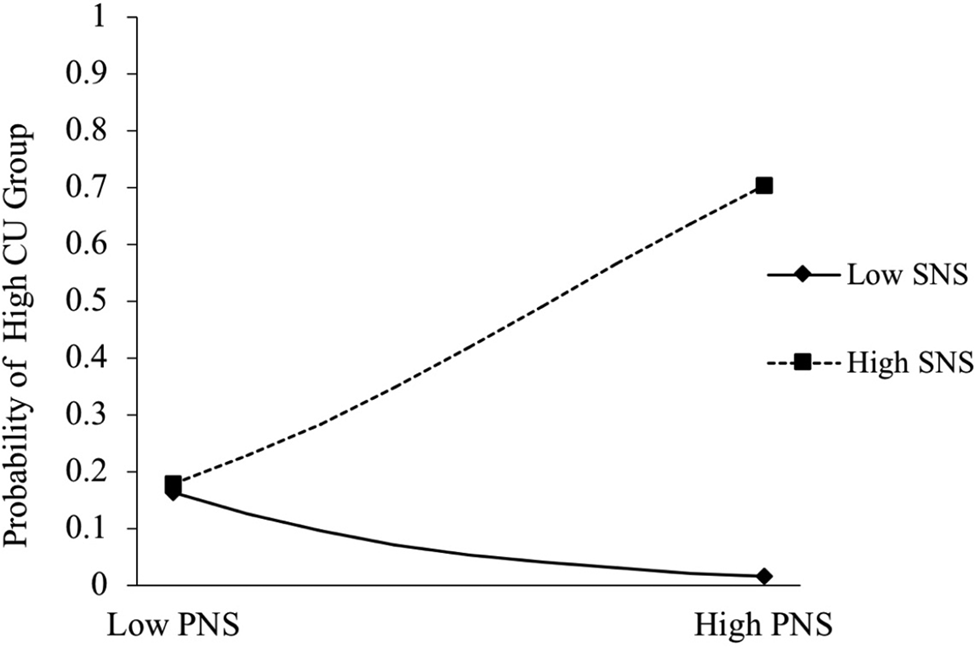
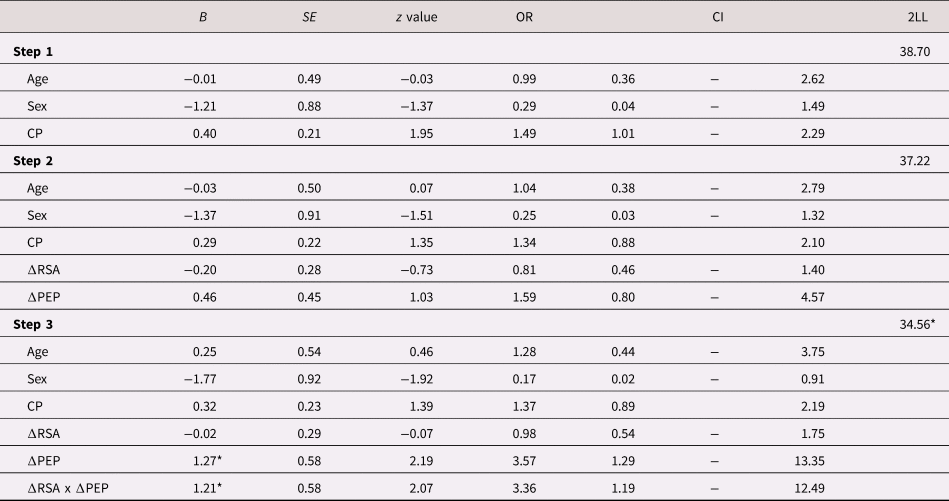
Step 1 included age, sex, and conduct problems, Step 2 added RSA and PEP, and Step 3 included the interaction term between RSA and PEP. Results are displayed in Table 1. Steps 1 (−2LL = 38.70; χ2 (3) = 6.35, p = .10) and 2 (−2LL = 37.21; χ2 (5) = 8.15, p = .15) were not significantly better fitting than the null model. RSA (p = .46) and PEP (p = .30) were not significant predictors. Step 3 was significantly better than both the null model (−2LL = 34.56; χ2 (6) = 13.46, p = .04) and Step 2 (p = .02). The interaction term between RSA and PEP was positive and significant (OR = 3.36, 95% CI = [1.19, 12.49], p =.038). Figure 1 shows that high SNS reactivity (increased SNS to the roller coaster compared with the control video greater than or equal to +1 SD) and high PNS reactivity (increased PNS to the roller coaster compared with the control video greater than or equal to+1 SD) increased the probability of being in the high CU group. Thus, coactivation of the SNS and PNS during the roller coaster condition is associated with a three times greater likelihood of being in the high CU group. To assess whether members of the high CU group were low in reactivity, post hoc t tests were conducted to test for differences in absolute change scores. The high CU group did not significantly differ in RSA, M = .10, SD = .33; t (59) = .82, p = .41, Cohen d = 0.20, or PEP reactivity, M = .007, SD = .01; t (59) = −1.56, p = .12, Cohen d = 0.21, from the low CU group, M = .17, SD = .35; M = .003, SD = .01, respectively; both showed small effect sizes. Thus, members of the high CU group were not characterized by generally lowered reactivity.
Probability of being in the high CU group based on the interaction between SNS and PNS reactivity.

ANS indices predicting CU groups (1 = High) in community sample

Note: Sex (0 = male, 1 = female); CP = Conduct Problems; ∆RSA = respiratory sinus arrhythmia reactivity; ∆PEP = pre-ejection period reactivity; CI = 95% confidence interval. *p<.05
CU Groups and emotional fear reactivity
A series of logistic regressions were conducted to determine if self-report of emotional reactivity to the roller coaster increased the likelihood of being in the high CU group. In all analyses age, sex, and conduct problems were included. Arousal, β = .10, SE = .13, OR = 1.10, 95% CI = [.85, 1.45], p = .469, and valence, β = −.23, SE = .17, OR = .79, 95% CI = [.55, 1.09], p = .169, were nonsignificant predictors of group membership. However, dominance was significant, β = .37, SE = .19, OR = 1.45, 95% CI = [1.02, 2.16], p = .048. These findings suggest adolescents who reported remaining in emotional control and dominant during the roller coaster were more likely to be higher in CU traits. However, the levels of arousal or valence did not differentiate the high and low CU groups.
Discussion
The results of Study 1 showed that coactivation of the ANS distinguished the high CU group from the low CU group of community adolescents. Thus, high CU adolescents responded to fear with greater sympathetic and parasympathetic activity, which may be indicative of maintaining alertness and control (Del Giudice et al., Reference Del Giudice, Hinnant, Ellis and El-Sheikh2012). Conscious fear, measured by emotional reactivity, differentiated those in the high or low CU groups only for the dominance scale, not for arousal or valence. Thus, the high CU group felt more in control after the fear induction than the low CU group. In sum, community adolescents high in CU traits displayed a biological profile that is indicative of being able to remain calm and alert while experiencing fear. This may give them the appearance of being fearless, and it explains their feelings of remaining in control after fear induction.
Study 2
The purpose of Study 2 was to assess the replicability of Study 1 in a sample of adolescents with high levels of emotional and behavioral difficulties. By selecting a high-risk and a community sample of adolescents we sought to understand whether the relation between CU traits and fear reactivity in a community sample was replicable in a sample with conduct problems and antisocial behavior.
Method
Participants
Sixty adolescents were recruited from Emotional and Behavioral Difficulties (EBD) schools. Participants were predominantly male (n = 50), White British (96%), and aged between 11 and 16 (M = 13.95, SD = 1.31). Based on school records, 23% had lived in care, 34% had a history of abuse, 52% had a diagnosis of Attention Deficit Hyperactivity Disorder (ADHD), 5% with Autism Spectrum Disorder, 5% with depression and a history of self-harm, and 2% with Reactive Attachment Disorder. Participants' legal caregivers gave consent for the participant, and the participant assented to be involved in the study.
Procedure
Four EBD schools in the North East of England were included in the recruitment process. Each school varied on recruitment success rate (71%, 87%, 60%, and 42%), this was due to availability of the pupils and the number of pupils on the role at each school (from eight pupils to 78). Information sheets and consent forms were sent home to caregivers, and only those who had returned a signed consent form were allowed to participate in the study. The experiment took place in a quiet room within the school. Self-report questionnaires were completed by the participant prior to the experiment to accommodate a stabilization period for the physiological measures. Participants completed each condition in the same order: (a) baseline (rest period without VR), (b) fear induction (VR roller coaster), and (c) vanilla baseline or “control” condition (VR garden). First, participants completed a three-minute rest period where they were asked to sit still and try to relax. After the rest period participants reported how they felt using the Self-Assessment Manikin (SAM; Bradley & Lang, Reference Bradley and Lang1994). The VR headset was then placed on the participant's head, at which point the child was asked to describe the VR surroundings. This allowed the participant to become familiar with the surroundings (e.g., sitting on a roller coaster) and confirm their ability to see the display. The roller coaster lasted for 90 seconds, at which point the participant was asked to report how they felt using the SAM. Next, participants were introduced to a control resting condition, which was a sunny garden set in Tuscany, Italy. Participants were asked to sit still and relax for three minutes. Participants wore headphones during the roller coaster and control condition. After the control condition participants reported how they were feeling using the SAM. All participants received a chocolate bar for completing the study.
Measures
Callous-unemotional Traits
Consistent with Study 1, CU traits were measured using the Inventory of Callous and Unemotional Traits (ICU; Frick, Reference Frick2004). In the present study, the ICU yielded good internal consistency (α = .82).
Fear-inducing environment
To safely measure emotional and physiological reactivity to fear, participants experienced a 90 second VR roller coaster. A roller coaster was selected as it is age and ethically appropriate to administer to children and adolescents for inducing a fearful response. Furthermore, in support of a roller coaster being a marker for fear (or fearlessness), the most widely used self-report measures often include roller coaster items (see the Fear Survey Schedule: Geer, Reference Geer1965; and the Situated Fear Questionnaire: Campbell et al., Reference Campbell, Coombes, David, Opre, Grayson and Muncer2016). The virtual reality headset, the Oculus Rift, has an 18-cm 3D screen (allowing for 100 degrees of direct view) with low latency 360 degree head tracking capabilities. The headset is comfortable and lightweight, which makes the headset suitable for ages seven years and up. Participants wore noise cancelling headphones while wearing the headset. The roller coaster video (RiftCoaster; Oculus VR, 2013) lasted for 90 seconds, with steep drops, tunnels, turns, and jumps. The video was designed specifically for the use with the Oculus Rift. As a control condition (VR equivalent of a baseline) participants were “sat” in a VR garden based in Tuscany, Italy (Tuscany Demo; Oculus VR, 2013). Participants experienced the control condition for three minutes.
Physiological data acquisition
The same method (and equipment) was employed from Study 1 for ANS data acquisition, reduction, and measure of ANS reactivity. Electrocardiogram and impedance cardiography were visually inspected so that mid-beats were created if missing (<.001%) and errors in R-wave detection were adjusted. PEP and RSA reactivity was computed so higher values indicated greater reactivity from the control condition. See Study 1 for full details.
Arousal and emotional reactivity
As with Study 1, the Self-Assessment Manikin (SAM; Bradley & Lang, Reference Bradley and Lang1994) was used after each condition to measure valence, arousal, and dominance.
Results
Data analysis plan
Reactivity to the VR roller coaster was assessed as a test of validity. We conducted paired-samples t tests on ANS reactivity and self-reported emotional reactivity (i.e., valence, arousal, and dominance). Our main objective was to understand the physiological profiles of CU traits, which included the interaction term between PNS and SNS activity. Therefore, we conducted hierarchical linear regressions to determine whether mapping the autonomic space (via an interaction between parasympathetic and sympathetic activity) would statistically predict levels of CU traits. This was done on the standardized change scores of RSA and PEP, with higher values indicating greater parasympathetic activation (roller coaster RSA–control RSA) and greater sympathetic activation (control PEP–roller coaster PEP). The same was done for self-report of valence, arousal, and dominance change scores.
ANS and emotional reactivity to fear
To establish whether the VR roller coaster was valid at inducing an autonomic response, paired samples t tests were conducted comparing the raw score values of levels of RSA and PEP during the roller coaster ride with the span of time of the control condition (VR garden video). Again, we examined the difference in levels during the resting baseline and the roller coaster and control condition. For the entire sample, mean levels were significantly lower for RSA, t (59) = 2.25, p = .028, Cohen d = .26, during the roller coaster (M = 4.19, SD = .74) when compared with RSA during the control condition (M = 4.34, SD = .63) and resting baseline, M = 4.55, SD = .68; t (59) = 4.19, p < .001, Cohen d = .53. Mean levels of PEP were lower during the roller coaster (M = .137, SD = .02) than during the control condition, M = .444, SD = .01; t (59) = 6.69, p < .001, Cohen d = .77, and resting baseline, M = .140, SD = .01; t (59) = 3.63, p = .001, Cohen d =.50. RSA was higher in the baseline condition than in the control condition, t (59) = 3.46, p = .001, Cohen d =.43, suggesting higher PNS activity at rest than during the control condition. PEP was lower in the baseline condition than in the control condition, t (59) = −6.23, p < .001, Cohen d =.83, suggesting higher SNS activity at rest than during the control condition.
Overall, compared with the control condition, the roller coaster induced reactivity on both PEP and RSA. Based on these results, the roller coaster produced sympathetic activation (lower PEP) and withdrawal in parasympathetic activity (lower RSA), suggesting that the roller coaster induced reciprocal sympathetic activation (high SNS and low PNS), which is considered the most common physiological response to dealing with challenging situations (El-Sheikh et al., Reference El-Sheikh, Kouros, Erath, Cummings, Keller and Staton2009).
To establish whether the VR roller coaster was valid at inducing emotional feelings, such as arousal (feeling excited or relaxed), valence (happy or unhappy), or dominance (in control or out of control), paired samples t tests were conducted on the entire sample comparing SAM after the roller coaster with the control condition. Reported arousal levels were higher, t (49) = 8.69, p < .001, Cohen d = 1.15, after the roller coaster (M = 3.73, SD = 2.74) than after the control condition (M = 7.46, SD = 2.28), with participants reporting feeling more excited after the roller coaster. Levels of valence were similar, t (49) = 1.02, p = .315, Cohen d = .19, after the roller coaster (M = 1.75, SD = 1.13) than after the control condition (M = 2.00, SD = 1.71). Therefore, the rollercoaster did not make the participant feel more or less happy. On the dominance scale, participants felt less in control, t (49) = 2.36, p = .022, Cohen d = .37, after the roller coaster (M = 6.67, SD = 2.34), than after the control condition (M = 7.54, SD = 1.74). Overall, the roller coaster did not affect adolescents' feeling happy or sad, but it did make them feel more excited and less in control.
CU Traits and ANS Reactivity to Fear
To test whether ANS reactivity predicted CU traits, a hierarchical multiple regression was performed with R (R Core Team, Reference R Core Team2016). Post hoc testing of the significant interaction term was completed using simple slopes analysis in accordance to procedures described by Aiken and West (Reference Aiken and West1991), using Pequod Package (Mirisola & Seta, Reference Mirisola and Seta2011). Collinearity diagnostic tests were conducted to ensure regression analyses were not affected by multicollinearity (tolerance > .10 and variance inflation factor < 10; Tabachnick & Fidell, Reference Tabachnick and Fidell2013). Tolerance values > 0.65 and a variance inflation factor < 1.54 were well within the acceptable range. The residuals scatter plots indicated the assumption of linearity and normality were not violated for all the regression models (Tabachnick & Fidell, Reference Tabachnick and Fidell2013). Because of differences in scaling of PEP and RSA, these scores were normalized by transforming values to z-scores, which is consistent with prior research (Berntson, Norman, Hawkley, & Cacioppo, Reference Berntson, Norman, Hawkley and Cacioppo2008; Bylsma et al., Reference Bylsma, Yaroslavsky, Rottenberg, Jennings, George, Kiss and Kovacs2015; Crowell et al., Reference Crowell, Beauchaine, Gatzke-Kopp, Sylvers, Mead and Chipman-Chacon2006).
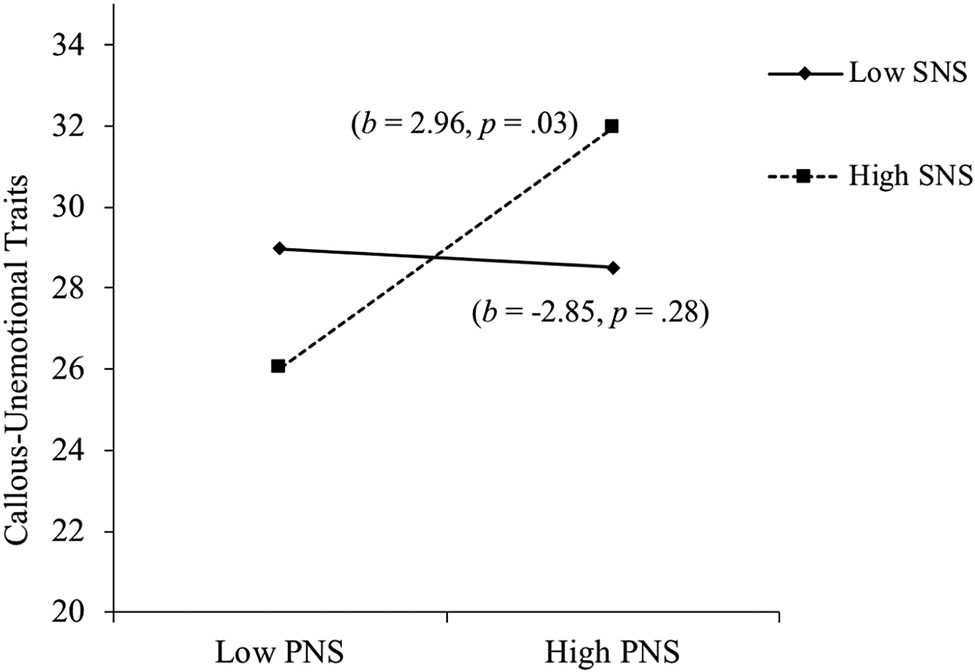
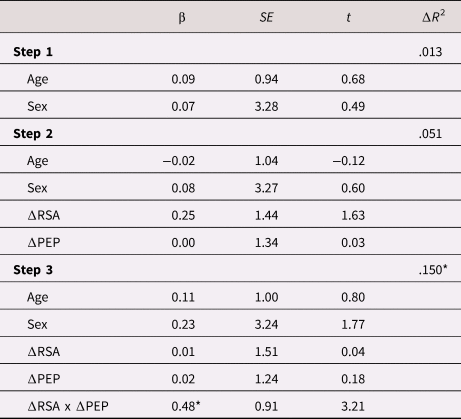
Results of the hierarchical regression are displayed in Table 2. Step 1 included age and sex, but was not significant, F (2, 57) = .38, p = .683. Step 2 included age, sex, RSA, and PEP, but was not significant, F (4, 55) = .95, p = .445. Step 3, which included all the predictors from Step 2 and the interaction between RSA and PEP, was significant, F (5, 54) = 2.94, p = .020. The interaction between RSA and PEP reactivity was significant, β = .48, SE = .91, t = 3.21, p = .002. Examination of the interaction using simple slopes analysis revealed that CU traits was predicted by high (+1 SD) RSA reactivity and high (+1 SD) PEP reactivity, β = 2.96, p = .03. Lower levels (−1 SD) of RSA and lower levels (−1 SD) of PEP reactivity was not significant, β = −2.85, p = .18Footnote 1. Therefore, a coactivated parasympathetic and sympathetic nervous system during fear induction was associated with high levels of CU traits (see Figure 2).
Interaction between SNS and PNS reactivity prediction CU Traits.

Summary of hierarchical regression for CU traits: The predictive effects of RSA and PEP

Note: Sex (0= male, 1 = female); ∆RSA = respiratory sinus arrhythmia reactivity; ∆PEP = pre-ejection period reactivity; *p<.01.
CU traits and reported fear reactivity
To test whether self-reported fear reactivity (self-report reactivity of valence, dominance, and arousal to fear induction) predicted higher levels of CU traits, a series of multiple regressions were conducted. Consistent with the ANS analyses, the regressions included change scores between the control condition and the roller coaster. The models including arousal, F (3, 49) = 2.03, p = .123, and valence, F (3, 49) = .86, p = .471, were not significant. However, the model including dominance was significant, F (3, 49) = 2.81, p = .049. Dominance was the only predictor of CU traits, β = .48, SE = .91, t = 3.21, p = .002. Thus, youth who felt more in control during fear induction showed the highest levels of CU traits.
Discussion
The results show that adolescents with high levels of CU traits display coactivation of SNS and PNS during fear induction. Coactivation occurs in a minority of people and has been said to characterize those individuals who show an unemotional predisposition (Alkon et al., Reference Alkon, Goldstein, Smider, Essex, Kupfer and Boyce2003; Del Giudice et al., Reference Del Giudice, Ellis and Shirtcliff2011). The present findings support this assertion and show that coactivation characterizes adolescents with high levels of CU traits. Thus, adolescents who are high in CU traits appear to biologically respond to fear in a way that enables them to maintain “tight self-control” (Del Giudice et al., Reference Del Giudice, Ellis and Shirtcliff2011 p.19). The only significant finding for conscious (or self-reported) fear was dominance, which suggests that adolescents who felt more in control after the roller coaster had higher levels of CU traits. The results demonstrate that adolescents with CU traits are biologically different in their autonomic and emotional response to fear.
General Discussion
Children with CU traits are described as being fearless (Fanti, Panayiotou, Lazarou, et al., Reference Fanti, Panayiotou, Lazarou, Michael and Georgiou2016; Frick & Morris, Reference Frick and Morris2004; Pardini, Reference Pardini2006), and to some degree the present findings support this assertion for adolescents. By employing cardiac measures of SNS and PNS reactivity, a consistent autonomic pattern of fear reactivity was established for adolescents high in CU traits from two different samples. That is, adolescents high in CU traits, regardless of their severity of emotional and behavioral problems, displayed coactivation of the sympathetic and parasympathetic divisions of the ANS while experiencing fear. Therefore, elevated CU traits were associated with physiological reactivity to fear, but not in a manner that is considered normative (e.g., reciprocal sympathetic activity; El-Sheikh et al., Reference El-Sheikh, Kouros, Erath, Cummings, Keller and Staton2009). In accordance with the adaptive calibration model, coactivation of the PNS and SNS during frightening or high-risk situations may give the appearance of the individual being less afraid (see Del Giudice et al., Reference Del Giudice, Ellis and Shirtcliff2011), and this may explain why youth with CU traits typically present as fearless (Fanti, Panayiotou, Lazarou, et al., Reference Fanti, Panayiotou, Lazarou, Michael and Georgiou2016; Frick & Viding, Reference Frick and Viding2009).
Coactivation is considered an optimal response during high-intensity situations, allowing for increased behavioral and cognitive functioning (Allison et al., Reference Allison, Peres, Boettger, Leonbacher, Hastings and Shirtcliff2012). For example, during high intensity situations the individual may be alert and attentive (facilitated by higher sympathetic activity) while being able to remain calm and in control of the situation (facilitated by increase in parasympathetic activity; Allison et al., Reference Allison, Peres, Boettger, Leonbacher, Hastings and Shirtcliff2012; Del Giudice et al., Reference Del Giudice, Ellis and Shirtcliff2011, Reference Del Giudice, Hinnant, Ellis and El-Sheikh2012). In other words, coactivation may help the individual to remain in control during frightening situations. If, however, the situation escalates and requires an immediate response, the parasympathetic “brake” on the heart is withdrawn, allowing for a fuller expression of sympathetic activity, resulting in an explosive response to deal with the situation (Carrive, Reference Carrive2006). Coactivation also has functional benefits (Paton, Boscan, Pickering, & Nalivaiko, Reference Paton, Boscan, Pickering and Nalivaiko2005) such that the myocardial contractility increases without increasing heart rate, which allows for more efficient cardiac output (i.e., longer ventricular filling times and higher contractility; Koizumi, Terui, Kollai, & Brooks, Reference Koizumi, Terui, Kollai and Brooks1982). Cardiac efficiency among youth with CU traits would suggest that these youth are “better” able to respond to fearful events. For example, during aggressive confrontation, parasympathetic upregulation enables the individual to remain calm, and an increase in sympathetic activity heightens vigilance and attentiveness (Del Giudice et al., Reference Del Giudice, Ellis and Shirtcliff2011). Maintaining a physiological state of self-control in high intensity situations may explain why youth with CU traits are able to successfully manipulate, intimidate, and carry out goal-directed aggression (Fanti, Frick, & Georgiou, Reference Fanti, Frick and Georgiou2009). Further, coactivation is thought to augment the rush from high-risk activities (Allison et al., Reference Allison, Peres, Boettger, Leonbacher, Hastings and Shirtcliff2012), which may explain why youth with CU traits engage in risky behaviors (White & Frick, Reference White, Frick, Salekin and Lynam2010). Thus, a coactivated physiological state during high intensity situations may differentiate youth with and without CU traits with conduct problems, providing a biological marker for the heterogeneity in conduct problems. However, this will need to be tested further.
It is important to highlight that this is the first study to assess fear induction while measuring cardiac PNS and SNS reactivity in adolescents with CU traits. While the main findings of this paper are novel, there may be an overlap with startle potentiation research in children and adults. Increased sympathetic activity, greater cardiac vagal control (deceleration of heart rate), and reduced startle response all indicate that the individual may be allocating and orienting attention to the fear stimuli (Öhman & Wiens, Reference Öhman, Wiens, Davidson, Scherer and Goldsmith2003). Thus, it is interesting that prior research has found low fear startle in children (Fanti, Panayiotou, Lazarou, et al., Reference Fanti, Panayiotou, Lazarou, Michael and Georgiou2016) and young adults with CU traits (Fanti, Panayiotou, Kyranides, et al., Reference Kyranides, Fanti and Panayiotou2016) and in adults high in psychopathy (see Patrick et al., Reference Patrick, Bradley and Lang1993; Rothemund et al., Reference Rothemund, Ziegler, Hermann, Gruesser, Foell, Patrick and Flor2012). Therefore, youth with CU traits are not physiologically unresponsive, but rather, they display diminished reactivity (Fanti, Panayiotou, Kyranides, et al., Reference Kyranides, Fanti and Panayiotou2016). Taken together, these findings suggest that youth with CU traits are paying greater attention to the fear stimuli (orienting response; Anthony & Graham, Reference Anthony and Graham1985; Bradley et al., Reference Bradley, Cuthbert and Lang1990; Lang, Bradley, & Cuthbert, Reference Lang, Bradley, Cuthbert, Lang, Simons and Balaban1997; Patrick et al., Reference Patrick, Bradley and Lang1993). Therefore, during fear inducing events, youth with CU traits may not typically respond to fear by losing physiological self-control, but rather they display a physiological profile that maintains calmness, vigilance, and attentiveness to the situation (Del Giudice et al., Reference Del Giudice, Ellis and Shirtcliff2011).
In a recent study including young adults using the 2-factor model of psychopathy, interpersonal-affective psychopathic traits were related to coinhibition (low SNS and PNS) in response to a VR horror game (Thomson, Aboutanos, et al., Reference Thomson, Aboutanos, Kiehl, Neumann, Galusha and Fanti2018). There are possible explanations of the different findings that should be considered when making comparisons. In contrast to a horror game, a VR roller coaster may be more thrilling and exciting than fear inducing. Therefore, a coactivated autonomic state may reflect an attentiveness to the thrilling stimuli rather than a fear response. This may be supported by the self-report data from both samples in the present study, which showed participants found the roller coaster to increase excitement and feeling out of control but did not significantly induce feelings of unpleasantness. In contrast, the VR horror game employed by Thomson, Aboutanos, et al. (Reference Thomson, Aboutanos, Kiehl, Neumann, Galusha and Fanti2018) induced feelings of unpleasantness as well as excitement and feelings of being less in control. Another methodological difference is that the present study focused on CU traits, whereas Thomson, Aboutanos, et al. (Reference Thomson, Aboutanos, Kiehl, Neumann, Galusha and Fanti2018) included the 2-factor model of psychopathy (interpersonal-affective and impulsive-antisociality). Because CU traits reflect the affective facet and not the combined affective-interpersonal facet of adult psychopathy, our contrasting results may be reflective of different personality constructs being measured.
Prior research has found that children with CU traits report a reduced conscious experience of fear (Fanti, Panayiotou, Lazarou, et al., Reference Fanti, Panayiotou, Lazarou, Michael and Georgiou2016). In the present study, we found that adolescents high in CU traits did not differ in their states of arousal or valence compared with youth low on CU traits. However, CU traits were related to feeling more in control after fear induction, which supports the idea that adolescents with CU traits manage fearful stimuli without losing control. This finding is complementary to the coactivated autonomic profiles associated with CU traits, and it supports the conclusion that youth with CU traits maintain a tight physiological state of control during fear induction.
In light of the findings, the present study was unable to assess sex differences because of the disproportionate number of boys in both samples. In one previous study, it was found that aggressive males tend to exhibit lower baseline PEP, whereas no significant differences were found between aggressive and nonaggressive females (Beauchaine et al., Reference Beauchaine, Hong and Marsh2008). Thus, we would urge that future research should test for sex differences in autonomic profiles of adolescents with CU traits while experiencing fear. Further, it would have been beneficial to include supplementary physiological indices to measure valence during the rollercoaster. For example, the use of electromyography would have provided information at the physiological level as to whether the participants experienced the roller coaster as appetitive or aversive. This would have allowed for a further test of the relationship between valence and CU traits. Nevertheless, the study also has many strengths. To date, this is the first study to assess PEP and RSA reactivity to fear induction in relation to adolescent levels of CU traits from both community and EBD schools. Including both community and EBD adolescent samples allowed for a direct test of the hypothesis that the autonomic profile of CU traits while experiencing fear may not be explained by high levels of conduct problems. Thus, based on these two studies, we would suggest that coactivation of PNS and SNS is specific to CU traits. This methodology has, for the first time, offered a more complete understanding of the relationship of adolescent CU traits with autonomic operations in response to fear and supported the replicability of this finding in two adolescent populations.
Prior research has suggested that youth with CU traits are characteristically unemotional and fearless (Fanti, Panayiotou, Lazarou, et al., Reference Fanti, Panayiotou, Lazarou, Michael and Georgiou2016; Frick & Morris, Reference Frick and Morris2004). At the biological level, the present findings may be interpreted to support this assertion. However, it is proposed here that a shift in thinking from being fearless to being better able to manage fearful situations may be more appropriate. Our results show that youth with high levels of CU traits are not unresponsive to fear, neither physiologically nor in terms of consciously experienced fear. Instead, CU traits in the present study were associated with increases in both SNS and PNS reactivity during fear induction, indicative of greater physiological control and feelings of dominance. Therefore, adolescents with CU traits show changes in their emotional experience during fear induction, but they are able to respond in a way that may be considered more optimal for dealing with and maintaining control of a fearful situation. This autonomic profile may give rise to the appearance of fearlessness that has been thought to characterize youth with CU traits. Having the psychophysiological disposition to better manage high intensity and fearful situations, coupled with an unemotional and callous lack of concern for others, it is perhaps unsurprising that adolescents with CU traits are able to predatorily aggress and commit more severe forms of violence.