Introduction
The vestibular apparatus is important in the regulation of postural and oculomotor control. Postural righting reactions depend on the integration of information from the visual, somatosensory and integrative vestibular systems via the vestibulospinal, vestibulocerebellar and vestibulo-ocular pathways.Reference Horak, Jones-Rycewicz, Black and Shumway-Cook1 In the absence of a fully functional vestibular system, the brain is unable to correctly integrate inherently ambiguous visual and proprioceptive cues. It has been suggested that vestibular information is used as a gravitational reference frame to prevent slow drift of the trunk in space during complex postural tasks.Reference Horak, Jones-Rycewicz, Black and Shumway-Cook1 Patients with bilateral vestibular and central vestibular loss experience multiple problems with posture control and movement, including unsteady balance, abnormal gait and various balance-related difficulties, such as oscillopsia. Vestibular disorders may also lead to falls in the elderly, which are associated with high morbidity and mortality rates.Reference Lee, Yi, Lee, Ahn and Park2
Although vestibular rehabilitation therapy is the treatment of choice in this patient population, it is less efficient in patients with bilateral vestibular loss.Reference Horak, Jones-Rycewicz, Black and Shumway-Cook1, Reference Uneri and Polat3 In a recent, non-comparative study, we have shown the efficacy of an electrotactile vestibular substitution system in improving the symptoms and signs of patients with bilateral vestibular loss caused by ototoxicity, in the early post-training period.Reference Uneri and Polat3
The current, prospective study compared two groups of patients with bilateral vestibulopathy, one rehabilitated with an electrotactile vestibular substitution system and the other with standard vestibular rehabilitation therapy.
Patients and methods
Twenty-two patients with chronic, idiopathic vestibulopathy were enrolled into this prospective study. Patients were assigned randomly and equally either to the first group, to receive the electrotactile vestibular substitution regimen incorporating the BrainPortTM balance device (developed by Bach-y-Rita et al; Wicab, Middleton, Wisconsin, USA), or to the second group, to receive standard vestibular rehabilitation therapy.Reference Bach-y-Rita, Danilov, Tyler and Grimm4 In the first group, rehabilitation with the electrotactile vestibular substitution system was undertaken in 11 patients. In the second group, two patients withdrew their informed consent and one patient did not participate in therapy regularly after the beginning of the study, so vestibular rehabilitation therapy was completed by only eight patients. Patients of both groups were followed up for at least one year at either the Department of Otorhinolaryngology, Balance Center, Acıbadem Oncology and Neurology Hospital, or the Vertigo and Balance Center, Marmara University Institute of Neurological Science. The study protocol was approved by the ethical board of the Acıbadem Oncology and Neurology Hospital, and informed consent was obtained from all included patients.
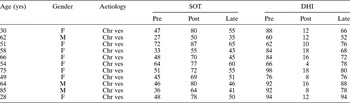
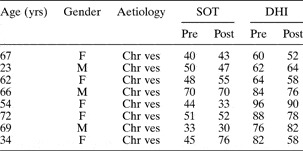
The first group comprised eight women and three men aged from 28 to 85 years, with an average age of 56.5 years (Table I). The second group comprised five women and three men aged from 23 to 72 years, with an average age of 55.8 years (Table II). All of the patients in this study had suffered from chronic vestibular dysfunction for between one and nine years (average period, 3.5 years).
Group one patients: demographics and test results

Yrs = years; SOT = sensory organisation test; DHI = dizziness handicap inventory; pre = before training; post = first post-training day; late = seventh post-training day; F = female; M = male; chr ves = chronic, idiopathic vestibulopathy
Group two patients: demographics and test results

Yrs = years; SOT = sensory organisation test; DHI = dizziness handicap inventory; pre = before training; post = first post-training day; F = female; M = male; chr ves = chronic, idiopathic vestibulopathy
These patients were followed up with clinical examinations including: the Romberg and tandem standing tests; the standing on foam test; the Fukuda stepping test; electronystagmography (ENG); and computerised dynamic posturography (NeuroCom Smart Equitest; NeuroCom International, Clackamas, Oregon, USA) using the sensory organisation test protocol and the dizziness handicap inventory.
For the Romberg test, patients were asked to stand on the floor with their feet together and their arms folded across their chest. For the tandem standing test, patients were asked to stand with the non-dominant foot placed behind the dominant foot along a straight line and with arms folded across their chest. Both tests were performed with the patient's eyes open and closed for a maximum of 60 seconds. Patients who were unable to perform the test for the maximum time on the first trial were allowed a second trial. The average time for the trials performed was used for analysis.
For the standing on foam test, patients were asked to stand with their arms folded across their chest and their feet together upon a high-density foam cushion. The test was performed with open and closed eyes for a maximum of 30 seconds. Patients who were unable to perform the test for the maximum time on the first trial were allowed a second trial. The average time for the trials performed was used for analysis.
For the Fukuda stepping test, patients were asked to perform 50 steps with closed eyes in a silent room, and with their arms stretched out horizontally in front of them. Arm rotation of 30° or more was considered a positive result.
Electronystagmography testing involved assessment of vestibular function using cold (30°C) and warm (44°C) external auditory canal irrigations. Responses to bithermal water irrigation were taken to indicate bilateral vestibular hypofunction when the average slow-phase eye velocity was less than 10°/second. The patient was considered to have bilaterally absent caloric responses if the response to bilateral irrigation was absent with and without optic fixation at both irrigation temperatures.
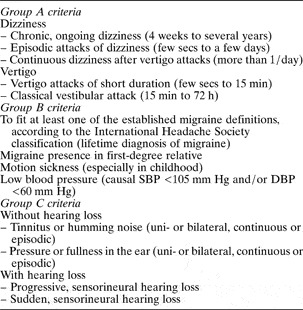
In order to be included in this study, patients required bilateral hypoactive or absent caloric responses on ENG testing, a dizziness handicap inventory score of 60 or more, and a diagnosis of chronic, idiopathic vestibulopathy. For the diagnosis of chronic, idiopathic vestibulopathy, we used the criteria shown in Table III, as follows.Reference Uneri and Polat5 Patients were diagnosed with chronic, idiopathic vestibulopathy if they had one criterion from group A, with or without one of the group C criteria, in the absence of other well known vestibular disorders. We excluded patients with benign paroxysmal positional vertigo, post-traumatic vertigo, migraine, Ménière's disease, ototoxicity associated vestibulopathy, acute vestibular attack, central vertiginous pathology or perilymphatic fistula, and those using vestibular suppressant medication.
Criteria for diagnosis of chronic, idiopathic vestibulopathy and migraine

Secs = seconds; min = minutes; SBP = systolic blood pressure; DBP = diastolic blood pressure
The diagnosis of chronic, idiopathic vestibulopathy was derived from clinical findings and vestibular evaluations, that is, the presence of imbalance and dizziness with frequent falling spells, in the absence of vertiginous manifestations or vestibular examination results indicative of any specific disease. Systemic evaluation was normal (including cerebral and cerebellar function tests, vertebrobasilar system tests, hormonal profile and temporal bone scans). All our patients had abnormal caloric responses on ENG testing, reduced sensory organisation test scores with falling spells, and high dizziness handicap inventory scores. The most important diagnostic criterion was the exclusion of well defined peripheral vestibular disorders in patients with chronic vestibular dysfunction.
The sensory organisation test, which is a component of computerised dynamic posturography, objectively identifies abnormalities in the subject's use of the somatosensory, visual and vestibular systems that contribute to postural control. The sensory organisation test objectively identifies abnormalities in the subject's use of the somatosensory, visual and vestibular systems which contribute to postural control. By controlling visual and proprioceptive input via sway referencing and/or opening and closing of the eyes, the sensory organisation test creates sensory conflict situations which enable vestibular function testing. The lower the sensory organisation test score, the higher the risk of falling.Reference Whitney, Marchetti and Schade6
However, the sensory organisation test protocol does not measure functional transfer to common movements, such as rising from sitting to standing and walking. Therefore, we added to our test protocol the dizziness handicap inventory, which was developed to measure patients' self-perceived level of handicap associated with the symptom of dizziness.Reference Jacopson and Newman7 A score of zero suggests no handicap, while a score of 100 indicates the maximum self-perceived handicap.
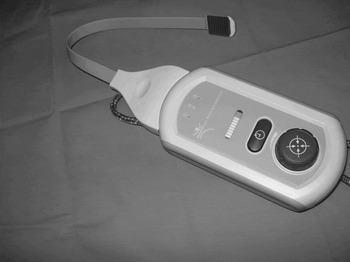
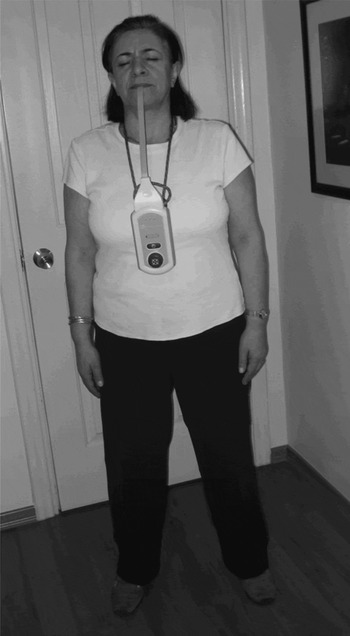
The BrainPort balance device transmits information on head position and orientation (normally provided by the vestibular system) to the brain through a substitute sensory channel via tactile sensation of the tongue.Reference Bach-y-Rita, Danilov, Tyler and Grimm4 The device has two main parts: an intraoral component and a controller (Figures 1 and 2). The intraoral component comprises an electrotactile array and tether, and a micro-electro-mechanical system accelerometer. The electrode array delivers electrotactile stimuli to the dorsum of the tongue. The micro-electro-mechanical system accelerometer senses head position in both the anterior–posterior and medial–lateral directions, and is mounted on the superior surface of the electrode array. The tether connects the system to the controller.
The electrotactile vestibular substitution balance device.

The electrotactile vestibular substitution system in use by a patient.

The controller comprises an embedded computer, safety circuits, user controls, stimulation circuits and battery power supply. Head tilt signals are converted from the accelerometer into a dynamic electrode pattern of electrotactile stimulation on the electrode array, by the controller.
When angular head tilt information (i.e. anterior–posterior and medial–lateral displacements) is received by the BrainPort balance device, it is converted into stimuli and sent to the intraoral electrotactile array, to be perceived by the tongue. Subjects perceive both the location and the motion of this stimulus on the tongue display, and interpret this information, enabling them to correct their head and body posture and thus to improve their balance, which in turn causes the intraoral target stimulus to become centred.
In our first patient group, the electrotactile vestibular substitution system regimen consisted of a total of 10 sessions of 20 minutes each; two sessions were given per day, with a four hour interval in between. The training regimen was designed to limit the patient's body sway by having the patient slowly adjust their head position in order to maintain the stimulus pattern at the centre of the intraoral display. The training positions used were: standing and walking on an ordinary floor; sitting down and standing up from a chair; standing on high density, visco-elastic memory foam; standing in the Romberg and tandem standing positions; and standing and walking on uneven surfaces. Patients began training in a position that was challenging, and were then given harder balance tasks until they could progress no further. Patients graduated to the next level when they were able to perform a trial with their eyes closed, without needing assistance to maintain their balance. Most of the exercises in this training regimen were important components of active daily life, such as standing, walking, and sitting and rising from a chair. However, some exercises involved maintaining balance in harder situations (e.g. standing on high density, visco-elastic memory foam and on uneven surfaces with closed eyes) and were included in order to boost the patient's learning ability. The exercises specifically targeted either static stability (e.g. standing involving the Romberg and tandem positions, high density visco-elastic memory foam and uneven surfaces, with both open and closed eyes) or dynamic stability (e.g. sitting and rising from a chair, and walking on a normal floor and on uneven surfaces, with both open and closed eyes). Improvements in both these components of balance were enabled through sensory substitution via the BrainPort balance device. Patients were encouraged to increase their reliance on the electrotactile tongue signal by increasing the amount of each trial spent with eyes closed and hands free.
In the second patient group, treatment involved an eight-week course of staged vestibular rehabilitation, with components of the Cawthorne–Cooksey exercises. During the first two weeks, patients attended a series of 30- to 45-minute exercise sessions, five days a week. Subsequently, the patients continued to perform the same exercises independently at home, with a written home exercise programme and instructions, on a daily basis for six weeks. Home exercises sessions were performed twice daily and lasted 20–30 minutes. The purpose of this programme was to rehabilitate the four groups of movements governed by the vestibulo-ocular, vestibulospinal and somatosensory systems and the cervico-ocular reflex.
Post-training tests were performed on the first post-training day in both groups. Additional post-training testing was undertaken in the first patient group on the seventh post-training day.
Statistical analysis
The significance of differences between pre- and post-treatment results for each group was estimated by repeated measures analysis of variance via the Tukey–Kramer multiple comparisons test and the paired-sample t-test. Differences were considered significant when the probability was p < 0.05.
Results
Before the training regimens, despite some adaptive compensatory strategies in both groups, patients were dizzy and unsteady and had difficulty walking in the dark. On ENG examination, five of the 11 group one patients and three of the eight group two patients had bilateral hypoactive caloric responses; others had no response, and sensory organisation test and dizziness handicap inventory scores were typically poor. None of the patients were capable of performing the Fukuda stepping test for 50 steps. Patients were also unable to stand in the tandem position and on foam with closed eyes for the given times, and half of the patients could not maintain a vertical posture in the Romberg position for 60 seconds.
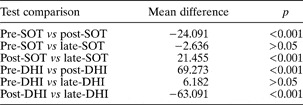
On the first post-treatment day (after five days' training with the balance device), all 11 patients in group one demonstrated improved composite sensory organisation test scores (Tables I and IV). Eight of the 11 patients also experienced a decrease in the number of falls as measured by the sensory organisation test. All group one patients demonstrated improved scores for the functional transfer aspect of the dizziness handicap inventory (Tables I and IV). Therefore, group one patients demonstrated an observable transfer of improved balance to functional dynamic activities. In addition, all of the group one patients were capable of maintaining a vertical posture with closed eyes on a soft base and in a tandem Romberg position. The patients' Fukuda stepping test results were improved, with eight of the 11 able to complete the test. Movements were smoother when transitioning from sitting to standing and during walking. Gait was more stable, including walking on uneven surfaces and in the dark. In reviewing the group one patients' results, we found a statistically significant improvement in the composite sensory organisation test and dizziness handicap inventory scores (Table IV), compared with pre-treatment results.
Statistical analysis of SOT and DHI scores: group one

SOT = sensory organisation test; DHI = dizziness handicap inventory; pre = before training; post = first post-training day; late = seventh post-training day
The patients in the first group demonstrated improved posture and balance when they were not actively using the balance device in the early post-treatment period; however, they retained few of these abilities over the following days. On the seventh post-treatment day, they were still able to stand in a vertical posture in the Romberg position, but they could not maintain this during Fukuda stepping testing. All group one patients reported a gradual decrease in post-treatment performance when walking on uneven surfaces and undertaking other daily activities. The group one patients' composite sensory organisation test scores for the seventh post-treatment day were significantly decreased compared with scores for the first post-treatment day (Tables I and IV). In addition, there was no significant difference between pre-treatment and seventh day post-treatment composite sensory organisation test scores (Table IV). Similar changes were observed for dizziness handicap inventory results; there was a significant difference between results on the first and seventh post-treatment days, but no significant difference between pre-treatment and seventh day post-treatment results (Tables I and IV).
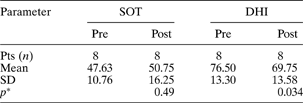
In the second patient group, although four patients had increased composite sensory organisation test scores on the first post-treatment day, compared with other group two patients, this difference was not statistically significant (Tables II and V). Group two patients' post-treatment scores for the functional transfer aspect of the dizziness handicap inventory were not significantly increased, compared with pre-treatment results (Tables II and V), and patients' symptoms (e.g. imbalance, unsteadiness, and difficulty walking on uneven surfaces or in the dark) were still present. Postural control activities and balance maintenance while walking or closing the eyes were especially limited, and had not improved as much as in group one patients. In the post-treatment period, group two patients even had persistent difficulty in maintaining a vertical posture during the Fukuda stepping test.
Statistical analysis of SOT and DHI scores: group two

*Pre vs post. SOT = sensory organisation test; DHI = dizziness handicap inventory; pre = before training; post = first post-training day; SD = standard deviation
We observed no adverse or negative side effects for either treatment method in our patients.
Discussion
In this prospective study, we assessed the efficacy of the electrotactile vestibular substitution system as a new rehabilitative tool, compared with standard vestibular rehabilitation therapy, in patients with bilateral, chronic, idiopathic vestibulopathy.
Most patients with vestibular pathology can improve their quality of life and manage balance problems to a tolerable extent using physical rehabilitative strategies.Reference Horak, Jones-Rycewicz, Black and Shumway-Cook1, Reference Telian, Shepard, Smith-Wheelock and Hoberg8, Reference Cowand, Wrisley, Walker, Strasnick and Jacobson9 These strategies make use of the plasticity of the central nervous system (CNS). Rather than repairing the damaged inner ear, such strategies instead train the CNS to adapt to asymmetrical input from the vestibulo-ocular and vestibulospinal reflexes. Thereby, they facilitate reduced dizziness provoked by head movement or movement in a busy environment, improved mobility and balance function, and improved gaze stability associated with head movement.
However, treatment of a small number of patients with chronic vestibular pathology is difficult, especially when pathology is bilateral, and may not be possible in some cases.Reference Brown, Whitney, Wrisley and Furman10, Reference Gillespie and Minor11 Older patients especially find it difficult to maintain their daily life unassisted, due to chronic dizziness and recurrent falls. Even a minor challenge such as rapid head movement can cause vertigo or imbalance, discouraging these patients from walking and making them house-bound. Younger patients also may find that clinical manifestations such as dizziness and inability to stand or walk on uneven surfaces continue after physical rehabilitation, despite training in compensation strategies.Reference Brown, Whitney, Wrisley and Furman10, Reference Gillespie and Minor11
In our study, we included patients with chronic, bilateral vestibular pathology who were not able to maintain their balance during normal daily life. We excluded patients with unilateral vestibular pathology, patients with fluctuating clinical manifestations and those with ototoxicity-induced vestibular ablation, in order to create a homogeneous patient population.
We allocated patients randomly into groups one and two, to receive electrotactile vestibular substitution and standard vestibular rehabilitation therapy, respectively. When we compared pre-treatment versus early post-treatment results, the first group showed a statistically significant improvement; all patients demonstrated an improved gait, with greater inter-limb coordination and smoother movement flow. We noticed improved integration of several gait components, such as weight transfer and more equal and appropriate step length, in these patients. Improvement was also seen for other balance challenges, such as walking along a straight line and on uneven surfaces.
Although four group two patients showed some improvement in clinical manifestations with treatment, as indicated by composite sensory organisation test scores, this difference was not statistically significant. Group two patients showed no statistically significant improvement in dizziness handicap inventory scores, and only limited improvement in postural control activities and balance maintenance while walking or with eyes closed.
The electrotactile vestibular substitution system combines the information transmission capacity of the tongue with the plasticity of the brain.Reference Bach-y-Rita, Danilov, Tyler and Grimm4, Reference Danilov and Tyler12, Reference Danilov, Tyler, Skinner, Hogle and Bach-y-Rita13 It converts head-tilt data from an oral micro-electro-mechanical system accelerometer into a pulsed electrotactile position signal presented to the anterior, superior surface of the tongue. Previous studies have suggested that it was not necessary for this data to be presented in the same form used in the natural sensory system. With training, the brain learns to appropriately interpret the artificial data provided by the device, and to utilise it as it would normal sensory data.Reference Danilov and Tyler12–Reference Tyler, Danilov and Bach-y-Rita15 The electrotactile vestibular substitution system was developed from tactile sensory substitution studies beginning in 1963, which also resulted in the development of vision substitution systems via tactile and tongue stimuli.Reference Bach-y-Rita14–Reference Ptito, Moesgaard, Gjedde and Kupers18
In the early stages of training, group one patients experienced improvement for only a few hours after using the electrotactile vestibular substitution system. However, the duration of improvement following 20-minute training sessions lengthened, from a few hours to 24 hours or more, after training with the device for five days. Despite a gradual erosion of clinical improvement over the ensuing (non-treatment) days, some rehabilitative effects still persisted, such as balance control in the Romberg position.
Bach-y-Rita et al. assessed the benefits of the electrotactile vestibular substitution system in terms of immediate and residual effects. Immediate effects were seen soon after the earlier sessions, as improvements in vertical posture and in sharpened Romberg stance standing with closed eyes. Residual effects were observed in all patients after complete disconnection from the electrotactile vestibular substitution system, and were divided into short-term effects, long-term effects and persisting effects. Bach-y-Rita and colleagues observed that one patient, who had undergone 40 training sessions, showed rehabilitative effects for eight weeks after the final electrotactile vestibular substitution system session.Reference Bach-y-Rita, Danilov, Tyler and Grimm4 These authors suggested that, although the clinical manifestations of vestibular pathology recur over time, this could be mitigated by increasing the number of training sessions. More comparative studies of the clinical applications of the electrotactile vestibular substitution system are needed in order to investigate this possibility.
In this study, we aimed to assess the efficacy of the electrotactile vestibular substitution system. Our patients demonstrated improved balance at the end of the supervised training regimen, confirming the impact of this system and indicating that effective sensory substitution was occurring. We excluded from the study patients with other vestibular pathology, in order to create a homogeneous study group. Our small patient numbers and patient selection criteria might limit the validity of our results, and our conclusions may be biased due to unknown underlying causes of vestibular dysfunction. However, we included only those patients with obvious decreased or absent bilateral vestibular functions as demonstrated on ENG examination, and with stable symptoms and signs. In addition, even if we had considered only group one, with no control group, these patients could be seen to act as their own controls, as their clinical manifestations recurred gradually over the immediate post-training period. This gradual relapse could be taken to indicate that sensory substitution had initially been achieved.
• This study aimed to determine the efficacy of vestibular rehabilitation with the electrotactile vestibular substitution system, a new treatment modality, in patients with bilateral, chronic, idiopathic vestibulopathy
• Nineteen patients were studied prospectively
• Preliminary results demonstrated the efficacy of the electrotactile vestibular substitution system in improving patient symptoms, and provided evidence of learnt sensory substitution
The results of this comparative study validated our previous study findings, in that training of patients with an electrotactile vestibular substitution system overcame their vertiginous manifestations in the early post-treatment period.Reference Uneri and Polat3 As stated in our earlier study, patients may benefit more from this system by increasing the number of training sessions and by adding other vestibular rehabilitative therapies, which would require more clinical research.
Conclusion
Preliminary results indicate that a brief period of training with the electrotactile vestibular substitution system may result in a short-term improvement in static balance and symptoms in patients with bilateral, chronic, idiopathic vestibulopathy. Further studies are needed to assess the long-term efficacy of this device after longer periods of training.
Acknowledgements
The authors thank Nural Bekiroglu PhD, Department of Biostatistics, Marmara University Faculty of Medicine, for her support and statistical analysis, and also thank Ayfer Kucukmetin AS for her support in collecting data and assistance in the training sessions.