Acquired brain injury (ABI) commonly occurs at a life stage where people are yet to or only beginning to take on key life roles and responsibilities, including parenting (Degeneffe, Reference Degeneffe2001). The cognitive, physical, communication, behavioural and psychological impacts of ABI may represent significant challenges for people either resuming the role of parent or taking on this task for the first time. While numerous generalist supports exist to facilitate parenting skills, these may not be the most appropriate for people with complex difficulties arising from ABI.
Increasingly, ABI rehabilitation is placing greater importance on the role of participation in improving long term quality of life and satisfaction (Cicerone, Reference Cicerone2004). Parenting is a highly valued social role (Ackerson, Reference Ackerson2003a) and participation in the parenting role is extremely important following ABI. However, there is limited literature on parenting after an ABI and this is especially the case for fathers. Similarly, there is a comparative lack of parenting support and assistance within the rehabilitation context that may be vital for successful fulfilment of the parenting role. Studies within other populations such as parents with mental illness or intellectual disability are more numerous and a variety of intervention approaches exist (Ackerson, Reference Ackerson2003a; Basset, Lampe & Lloyd, Reference Bassett, Lampe and Lloyd2001; Bisogni, Reference Bisogni and Cowling1999; Craig, Reference Craig2004; Kaatz, Reference Kaatz1992; Llewellyn & McConnell, Reference Llewellyn and McConnell2002) but it remains unclear as to their effectiveness for people with ABI.
Challenges to parenting: Injury and environment
Common sequelae of ABI, such as impulsivity, disinhibition, reduced self monitoring, and cognitive deficits (e.g., attention and memory difficulties) may impact on a person's ability to effectively parent (Smith & Godfrey, Reference Smith and Godfrey1995). Some studies (Devany-Serio, Kreutzer & Gervasio, Reference Devany-Serio, Kreutzer and Gervasio1995; Lezak, Reference Lezak1998) suggest that a person with an ABI who presents with behavioural complaints such as poor anger or impulse control may respond to common parenting situations with threats, bullying and other forms of child maltreatment. Lezak (Reference Lezak1998) highlighted the importance of adjustment problems and the indirect consequences of ABI, such as anxiety, paranoia and depression, impacting on family relationships, including the parent-child relationship.
Environmental barriers, such as unemployment, increased risk of poverty, public attitudes and scepticism, reduced access to transportation, housing and recreational opportunities may act as additional stressors to effective parenting (Kirshbaum, Reference Kirshbaum2000; Pessar, Coad, Linn & Willer, Reference Pessar, Coad, Linn and Willer1993). These barriers may be particularly challenging for fathers who function traditionally in gendered positions as the financial support or ‘breadwinner’ to the family as continues to be the status quo in Australia (Jones & Curtin, Reference Jones and Curtin2011; Qu, Reference Qu2008).
Parenting behaviour and implications
Changes in the parenting behaviours of individuals with ABI may include decreased role fulfilment such as showing less interest in the children, being less responsible for the children and helping less with the children. Similarly, individuals may experience an increased frequency of negative behaviours such as yelling and arguing, and being impatient with children (Pessar et al., Reference Pessar, Coad, Linn and Willer1993). Difficulties with parenting may be a significant source of distress and grief for parents with ABI, contributing towards difficulties in managing anger and aggression (Charles, Butera-Prinzi & Perlesz, Reference Charles, Butera-Prinzi and Perlesz2007).
Much of the research in this area is equivocal however. Uysal and colleagues (Uysal, Hibbard, Robillard, Pappadopoulos & Jaffe, Reference Uysal, Hibbard, Robillard, Pappadopulos and Jaffe1998) found that parents with traumatic brain injury report less goal setting, less encouragement of skill development, less emphasis on obedience to rules and orderliness, less promotion of work values, less nurturing and lower levels of active involvement with their children. On the other hand, similarities to others were found in parenting skills such as egalitarian treatment of children, encouragement of independent thinking and intellectual dialogue, parental strictness, use of punishment and anger, demands for maturity and frequency of favourable and unfavourable parental practices. Interestingly, many of these types of parenting behaviours have also been linked to either the maternal or paternal role in non-clinical populations (Lancaster, Altmann, Rossi & Sherrod, Reference Lancaster, Altmann, Rossi and Sherrod1987). Much of the literature fails to delineate between mothers and fathers in parenting behaviours and therefore the differential impacts on parental roles across gender remain unexplored.
An understanding of the impacts on parenting for mothers and fathers may be predictive of an understanding of the impacts on children. Parents often differ in their style of parenting. Importantly, studies suggest that in families where a parent has experienced an ABI, children may mirror (or react to) the cognitive, emotional and behavioural styles of the parent (Pessar et al., Reference Pessar, Coad, Linn and Willer1993; Urbach & Culbert, Reference Urbach and Culbert1991). As a result, these children are reportedly at high risk of developing emotional, behavioural and cognitive problems, with younger children particularly vulnerable. Negative implications for children after a parental traumatic brain injury may include ‘acting out’ behaviours such as receiving poor grades, temper tantrums, disobeying the injured parent, problems in school, and absenteeism from school, along with emotional problems such as limited social opportunities, poor sleep patterns and headaches (Pessar et al., Reference Pessar, Coad, Linn and Willer1993, Urbach & Colbert, Reference Urbach and Culbert1991). Relationship problems with the injured parent were reported with children often being less loving toward the parent, not wanting to spend time with the parent or unwilling to bring friends home. Parents promote social competence in their children through teaching, coaching and modelling (Lezak, Reference Lezak1998; Pessar et al., Reference Pessar, Coad, Linn and Willer1993). Therefore any differences in parenting behaviour and challenges may hold significant implications for the children of those injured. Pessar et al. (Reference Pessar, Coad, Linn and Willer1993) found that the gender of the parent with ABI is a significant factor in predicting outcomes for children. Butera-Prinzi and Perlesz (Reference Butera-Prinzi and Perlesz2004) utilised a small sample to explore children's perception of parental ABI with a specific focus on children whose father was the injured parent and noted significant impacts on children coping with the physical and psychological changes in their fathers.
The challenge for parenting research
A new era of research on parenting following ABI is needed. Interestingly, the majority of literature on parenting following ABI is quite dated. While general family functioning has been more consistently examined (e.g., Gan, Campbell, Gemeinhardt & McFadden, Reference Gan, Campbell, Gemeinhardt and McFadden2006; Sander et al., Reference Sander, Maestas, Sherer, Malec and Nakase-Richardson2012), a review of several key databases including CINAHL, MedLine and PsycInfo identified no new studies (e.g., in the last five years) that focus specifically on parenting. There are no studies at all within the ABI literature that could be located that draw attention to the unique parenting issues facing fathers specifically. Further to this, existing studies on parenting have focused on identifying problematic behaviours or aspects of individual functioning that may impact on parenting rather than elucidating the specific challenges or needs as perceived by the parents themselves. Alternatively, studies have focused on the negative consequences of parenting following ABI such as the impacts on the children. Indeed, these gaps in knowledge emerging from the exclusion of fathers, a focus on individual factors and a failure to incorporate client perspectives have equally been identified within research on parenting following mental illness (Cowling & McGorry, Reference Cowling and McGorry2012; Fletcher, Maharaj, Watson, May, Skeates & Gruenert, Reference Fletcher, Maharaj, Watson, May, Skeates and Gruenert2012) and intellectual disability (Wade, Llewellyn & Matthews, Reference Wade, Llewellyn and Matthews2008). For instance, studies have identified that mental illness can compromise parenting abilities (Baulderstone, Morgan & Fudge, Reference Baulderstone, Morgan and Fudge2012; Leinonen, Solantaus & Punamäki, Reference Leinonen, Solantaus and Punamäki2003) and that gender is an important consideration (Jacob & Johnson, Reference Jacob and Johnson2001; Nicholson, Nason, Calabresi & Yando, Reference Nicholson, Nason, Calabresi and Yando1999). Some studies have explored individual perspectives on parenting following mental illness (Ackerson, Reference Ackerson2003b; Bassett et al., Reference Bassett, Lampe and Lloyd1999). Evenson and colleagues (Evenson, Rhodes, Feigenbaum & Solly, Reference Evenson, Rhodes, Feigenbaum and Solly2008) explored parenting specifically from the perspective of fathers with psychosis and identified that emotional disengagement from children, disruptions caused by hospitalisation and concentration and memory issues could all undermine the father-child relationship. On the other hand, they identified that parenting could engender a sense of pride and purpose for fathers with mental illness. Given the episodic nature of hospitalisation in mental illness and the very different nature of mental illness, the degree to which similar issues face fathers with ABI is unknown.
Research examining the perceived challenges and needs from the perspectives of the key stakeholders involved following ABI (e.g., person with ABI, their partners and their rehabilitation providers) is lacking. An understanding of these challenges is integral to the development of effective parenting supports in the rehabilitation context.
The current study aimed to explore the perceived challenges and needs of fathers following ABI from the perspectives of the injured parent, their partners and their community rehabilitation providers. Specifically, the study asked the following research questions:
a) What are the key parenting challenges facing fathers who are receiving community rehabilitation following ABI?
b) What are the key support needs for fathers who are receiving community rehabilitation following ABI?
Method
Design
The current study utilised a qualitative collective or multiple case study approach (Stake, Reference Stake1995) to explore the parenting challenges and needs of fathers in the context of the community rehabilitation setting. The case study approach is particularly appropriate in facilitating exploration and understanding of a phenomenon within its context using a variety of data sources. Given the study aim to understand the ‘case’ of parenting challenges for fathers in the rehabilitation setting where individual contexts (e.g., family structures, home environments, pre-injury parental roles) will differ significantly across individuals, this approach was particularly useful (Baxter & Jack, Reference Baxter and Jack2008). In the current study, the case study approach was bounded by time and place to fathers who were currently receiving community rehabilitation services. Inherent in the collective case study approach is a comparison across cases, and within and across settings (Stake, Reference Stake1995).This case study approach explores differences within and between cases drawing out similarities where they exist. The case study approach allowed an inductive exploration of the initial proposition that fathering following injury is affected by personal, environmental and injury factors. In this design, data collection and analysis occur concurrently, moving back and forward between the data and these initial propositions (Baxter & Jack, Reference Baxter and Jack2008).
Participants
A total of three parents with ABI were recruited for the study from a specialist community rehabilitation provider for adults with ABI in Queensland, Australia. Participants were identified by rehabilitation coordinators from the pool of current rehabilitation clients and selected specifically because a) they currently perceived that they had a parenting role; b) had raised issues of parenting within the course of their rehabilitation program and c) were willing and able to describe and discuss their parenting. In keeping with the collective case study approach (Stake, Reference Stake1995), additional efforts were made to utilise maximum variation sampling of those cases to ensure that the data obtained was diverse and covered a range of perspectives and contexts. Of particular interest was the selection of at least one single parent and at least one father with young children. Further, there was interest in selecting at least one father who had sustained their injury prior to becoming a parent. Of the participants with ABI, one represented a single parent family, two parents had younger children (<5), and two had school aged children. Family size ranged from one to two children. There was no requirement that the parent live with the child. Participant 1(P1) was a 27-year-old married father with a 2-year-old son and another child on the way. He sustained a severe traumatic brain injury from a fall prior to becoming a parent. He had cognitive impairments including limited insight and inflexible behaviour. Participant 2 (P2) was a 46-year-old father with two children, aged 5 and 1. He was married and acquired his ABI through a cerebellar cystic lesion. He had cognitive impairments in memory and new learning, processing speed, planning organisation and problem solving. He also had difficulties with irritability and verbal aggression as well as other health issues including vertigo and nausea. Participant 3 (P3) was a 43-year-old father who was separated from his wife and had an 8-year-old son who he shared custody of. He had severe memory impairments, difficulties with insight and impairments in planning, organisation, problem solving and reasoning received as a result of a brain tumour.
Case studies traditionally use multiple data sources to understand phenomena (Baxter & Jack, Reference Baxter and Jack2008). In order to capture the range of perspectives on parenting challenges consistent with an in-depth exploration of context, participants included the partners (F1 and F2) where appropriate. As one participant did not have a partner, the sample included two partners. It was decided not to include children in this exploratory project because of the ethical considerations related to the inclusion of children and the fact that the study focus was on the perceived challenges and needs of the parent. The inclusion of the perspectives of the children will be reserved for future research. The other participants included the three rehabilitation coordinators (RC1, RC2 and RC3) who were current case managers for the individuals in community rehabilitation. Inclusive of the fathers with brain injury, partners and rehabilitation coordinators, the total sample size was eight participants.
Participants provided written consent prior to participation and were able to withdraw from participation at any point in the process. Ethical clearance from the Metro South Health Service District Human Research Ethics Committee was obtained for the project prior to recruitment of participants.
Data Collection and Procedure
Data was collected in the form of in-depth qualitative and process directed interviews to capture the complexity of the parenting experience and explore the contexts and situations within which parenting challenges emerged. Table 1 outlines the interview questions. Key to this approach was the use of Critical Incident Technique (CIT) interviewing (Flanagan, Reference Flanagan1954) which enabled an in-depth exploration of context linked to specific situations or incidents that illustrated the challenges being discussed.
Interview Protocol for Parents with ABI, Partners and Rehabilitation coordinators

All interviews were conducted by a member of the research team. Participants with ABI participated in in-person interviews in their own homes. Other stakeholders (partners and rehabilitation coordinators) also completed in-depth semi-structured interviews. Rehabilitation coordinators also provided observation data of their observations of participants and their partners in parenting situations. Interviews ranged in duration from approximately 30 minutes to 90 minutes. For Participant 1, the person with ABI and their partner were interviewed jointly. Field notes taken during the conduct of interviews were also utilised as a data source for the analysis.
Data Analysis
Data was principally qualitative in nature and was analysed using NVivo (QSR International, 2009). Due to the exploratory inductive nature of the study, data analysis utilised a combination of strategies representative of the case study approach (Stake, Reference Stake1995) and the grounded theory method (Strauss & Corbin, Reference Strauss and Corbin1998), following an open, theoretical and selective coding process within and across cases. Open coding was the initial coding phase and included an initial ‘trawl’ of the data line by line to identify concepts and categories across all pages of transcribed text and memos and to ensure theoretical coverage of the data. Labels were given to identify relevant categories and concepts and the process of constant comparison was used to compare each new line of text to existing categories to identify similarities. This process was conducted by three investigators for each case separately and then across cases. Theoretical coding was the second step in the coding process and involved the identification of relationships between categories and concepts which informed the development of propositions to be integrated into the framework. This process was conducted by two investigators firstly within and then across cases. The third step in the qualitative coding process consisted of a selective coding process involving a return to the raw data and inclusion of new information to consider the support for the identified categories and their relationships. Three investigators were responsible for this process. In this phase, the aim was to identify, define and extend the description of the process. The triangulation of investigators involved in analysis assisted to improve methodological rigour and ensure the reduction of experimenter bias.
Findings
Within and cross case analysis of the data collected from the eight interviews (three fathers, two partners and three rehabilitation coordinators), observations and field notes identified a range of parenting challenges and needs that together provided a preliminary framework or model of parenting for fathers following ABI.
An Interactive Model of Parenting for Fathers with ABI
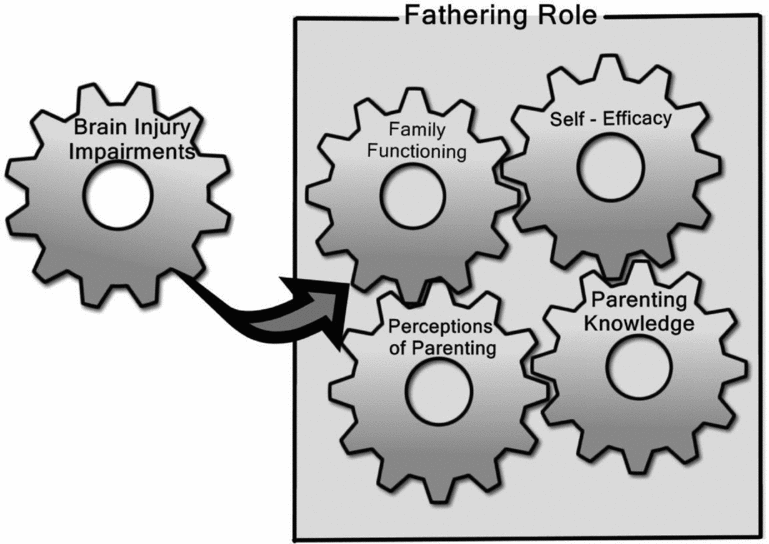
Five major parenting challenges for fathers with ABI included the ABI itself and the associated impairments, family relationships/functioning, perceptions and identity of the parenting role, parenting knowledge/skills, and confidence/self efficacy. Figure 1 highlights these key factors and the ways in which they interact to identify difficulties within the parenting role following ABI. The ‘cog’ structure of the model illustrates the interactive nature of the relationships between parenting challenges.
An interactive model of parenting for fathers with ABI

The ABI and associated impairments had a significant impact on parenting, family functioning and the dynamics of the family. A person's parenting knowledge and skills impacted on their perceptions of the parenting role and self-efficacy. Negative perceptions of parenting roles led to further demands and burden on family functioning, creating stress within the family system. Dysfunction within the family system then served to reinforce negative perceptions of parenting role and diminish confidence and self efficacy.
Each of these primary themes is discussed to depict the interactions between the factors. The source of the illustrative quotes presented throughout this section is indicated by the code number of the parent (P). Family members (F) and rehabilitation coordinator (RC) quotes are used to provide additional insights into parenting issues for participants and highlight contextual challenges.
ABI and impairments
Participants identified that their ABI led to many changes including physical difficulties, which in turn caused difficulty participating in everyday activities with their children.
He will say ‘can you come on the trampoline with me’, but I have issues with bouncing around too much, it really hurts my brain. I feel tired and fatigued and I say ‘Daddy doesn't really feel like doing that at the moment. I find that it affects me and just at this time I couldn't’. . . . but he really wants me to. . . (P2).
In addition, there were cognitive changes including planning and organisational problems, decreased attention and memory difficulties that made it very difficult for parents with an ABI to perform many daily activities. ‘It takes a while to gets things done and get organised. . . and I guess that is part of the brain injury stuff’ (P3). As one rehabilitation coordinator stated:
He obviously has lots of cognitive impairments as a result of his injury such as his inability to focus on more than one thing at a time. So he is really unable to manage if something is happening in the background, he can't deal with whatever his son is doing at that particular time or if he is not feeling well he can't deal with his son's misbehaviour (RC2).
One partner discussed the impact of the cognitive difficulties with multi-tasking and taking care of the children on the stress levels of the participant. ‘Multi-tasking is one thing, like if there are too many things on the go and having the two children as opposed to having just one, he gets too stressed. I can't have (him) together with the two kids for very long at all’ (F2). She goes on to explain how his difficulty with organisation and planning interferes with daily activities such as getting the children ready for school. ‘[He] has difficulty with organisation himself, so to get the children ready for school. . . he has his own issues and then if [the child] doesn't cooperate as well it impacts on the situation’ (F2).
Participants also reported common behavioural difficulties that are attributed to ABI including reduced frustration tolerance and losing their temper and the ways in which this impacted on their parenting. ‘I get easily frustrated and it's not really a good example for an adult to show frustration, you know, because losing your temper is wrong. . . it shows a bad example’ (P1). Partners identified how the reduced frustration tolerance with the person with ABI escalated very quickly and often led to family tension. ‘There are times where he gets really frustrated. . . he can go from normal to frustrated really quickly. . . he doesn't like build up. So I can only really intervene. . . when they are both frustrated and he is screaming’ (F1).
The changes resulting from ABI had a significant impact on the fathers who sustained the injury, often leading to an inability to return to work and the resultant loss of identity as provider for their family. One father reported feeling like a failure as he couldn't do what he was able to do pre-injury ‘You should be able to provide (financially providing). I have trouble providing for them because I don't work anymore’ (P1). People's desire to return to pre-injury functioning and change in financial circumstances was evident. ‘I want to go back to work, but I can't. . . that is what I want to do. Now I'm on a pension’ (P2).
Family relationships and functioning
The changes from the ABI also had an impact on carers/family members and the dynamics of the family. Instead of being a partner or spouse, many partners felt that they became carers after their loved one had an ABI and felt an increased sense of responsibility for the family.
It's not a normal relationship for a 26 year old in any way to be with someone 24/7 and me being in a carer role. . .It is like his Mum half the time because I have to tell him when he can do it and when he can't and obviously its frustrating. . . (F2).
Subsequently, there was an increased burden on partner and carers in relation to parenting and family functioning. This required some partners to take over with implementing parenting strategies and this was often difficult as the couple were not working together as a team. ‘I sometimes feel like I have to do too much, like I have to do everything’ (F2). Partners expressed concern about the impact of the ABI difficulties on the injured individual's ability to implement parenting strategies, further heightening their perceived need to adopt greater parenting responsibilities. ‘I worry how he will cope with [son's] tantrums, is he going to leave him at the shops?’ (F1).
One partner explained how the ABI factors impacted on the participant's ability to have consistent parenting strategies and the effect this had on the child's relationship with his parent.
He has frustration and extreme anger about not being able to handle situations with the kids, which makes [the child] a lot worse . . . and he is not consistent with his approach in dealing with him. One day he will handle things better, but if he is off, in terms of his health then he won't handle things at all. So [the child] is smart and he takes advantage of it (F2).
These factors created additional conflict/stress within the family functioning when a partner tried to assist the father with parenting strategies. As one partner explains ‘When I try to say maybe you can do this or do that, he takes offence really quickly. I say to him ‘I am not saying you're bad I am just saying there is a different way to do it’ (F1).
Participants recognised limited supports in relation to parenting. Fathers recognised that they relied very heavily on their partner to assist with many aspects of parenting and to maintain family functioning. One participant described how he often lets his wife handle any difficult situations. ‘Sometimes I don't feel like I have the stamina to deal with it, so I'm quite happy just for you to take over because I don't think I'm coping well or dealing with the situation’ (P2). Another participant stated ‘the only support is my wife. She will talk to me about situations and tell me what I can do and if I can't do anything she will take over the situation and try to fix it up’ (P1).
One participant who was in a shared parenting role identified the amplified nature of inadequate support for families. ‘Shared parenting is really difficult’ (P3). These relationships were often characterised by infrequent contact. ‘It is usually hard because I don't get to see him that often’ (P3). Implementation of parenting strategies was often very difficult because of limited supports and negotiation with his previous partner, a situation where family dynamics were strained by geographic and ideological separation. ‘There seems to be different parenting styles’ (RC3).
The changes resulting from the ABI and the increased burden on other family members had a significant impact on the family dynamics. As one rehabilitation coordinator identified.
I think it would have been a different family if he hadn't had his injury, but he did so they are just doing the best they can do. They are very well intentioned, they love their children and they really want the best for them (RC2).
Perceptions of parenting role
Parents with an ABI reported negative self perceptions as a parent due to their ABI. ‘I try to be as normal as I can, but I fail miserably’ (P2). These negative self perceptions contrasted with participants perceptions of how they should be as parents. ‘Well I don't feel that good in myself. . . I am a father and I should be able to know what to do, but sometimes I can only do so much’ (P1). Some participants with an ABI reported wanting to be a good parent and set a good example for their children, however this was often difficult due to the changes resulting from their injury. ‘I want to be a good parent. . . you are always thinking what is the best way of dealing with it. . . and you don't always know what is the best way. . .’ (P2).
Most of the participants became parents following their injury and they reported this was difficult as they had to learn new skills in being a parent as well as adjust to changes resulting from their injury. ‘You don't understand what it's like to be a parent until you become one’ (P2). Most parents with an ABI reported feeling like they were not performing well in their role as a parent but highlighted a desire to perform more effectively. ‘I just want to feel like I'm doing the right thing at the moment’ (P2).
Other family members similarly identified that parents with an ABI had difficulty in their perceptions of their role as a parent. ‘He needs to give himself more pride and stature. . . he is a full-time parent and it is hard, and he's got an injury and he does really well. So I think he needs to cut himself a bit of slack’ (F1).
Parenting knowledge and skills
Participants reported having a limited repertoire of parenting strategies. One participant described that they didn't have a variety of parenting strategies.
I get really annoyed. I say to him [the child] not to do something, he doesn't listen and then he laughs and he keeps doing it and I get frustrated. I should just walk away. . . but I just start yelling at him. I just don't know what to do. . . (P1).
This parent had sustained his injury prior to becoming a parent and therefore had no experience pre-injury of using parenting strategies. For the other two participants who were parents prior to their brain injury, cognitive impairments in memory, planning, organisation and tolerance as a result of their brain injury meant that they were often unable to recall parenting strategies and knowledge they had used prior to their injury or had greater difficulty with implementation and effectiveness of their previous knowledge and skills. This often resulted in the father utilising ineffective or punitive strategies. One partner described how the predominant strategy that was used for discipline of the child was physical punishment. ‘If he gets extremely angry then he can be physically very hard on the child . . . he picks him (up) and drags him and gets very physical because he can't handle it. . . and it just doesn't work’ (F2). Consequently, the lack of parenting strategies led to a lack of consistency with children and could result in a lower frustration tolerance for the parent with ABI. ‘Well I get frustrated and I get very angry too’ (P2).
One rehabilitation coordinator highlighted the difficulties that emerged from a lack of strategies:
He feels very out of his depth so he just tries different things all the time, but he is not consistent with any one of those strategies and doesn't really know why he is using that strategy. . . then he gets totally frustrated with it and will lose his temper with his son and then resorts back to wanting to smack (RC2).
The lack of parenting knowledge and skills often influenced family functioning and dynamics. Partners often tried to work together with the parent with an ABI when managing the children's behaviour, however due to the challenges resulting from the ABI it became very difficult. This frequently meant the partners would have to manage the situation. ‘It has escalated and then the situation gets worse and I have to intervene and try to sort everybody out. . .’ (F1). As one parenting coordinator stated ‘They just really struggle with parenting. . . they don't have the range of strategies they need to deal with different behavioural problems’ (RC2). The participants identified the importance of co-parenting and needing to work together as parents with management of the children's behaviour. This participant stated a need to develop better strategies to work together. ‘Probably working together with [wife] as joint parents. . . so knowing how to work with her so we can provide time to the children’ (P2).
One parent identified that they needed help to develop new strategies. ‘I probably need a guide, I feel I need guidance with that [parenting strategies]’ (P1). This was particularly important for this participant as a new baby was arriving soon, with consequent challenges and demands anticipated. ‘I don't know what to do, knowing what to do with (more) kids’ (P1). Another participant identified a specific goal to reduce his frustration. ‘Try to be calmer. . . about how to deal with him. . . Well rather than letting myself get angry at him, by giving him an ultimatum. . . leave that til last.’ (P2). This participant also identified the need to develop specific strategies with daily routines that could assist with family functioning and maintain positive family relationships. ‘I probably need more concrete strategies on what I should be doing. Like I say getting into bed at night, different strategies for the night before’ (P2).
It was important for the partners of participants to develop parenting strategies which involved remaining calm rather than becoming easily frustrated or overly upset or angry. As one partner explained, he needed ‘to stay calmer and talking [son] through things. . . if he used an authoritative tone, rather than an angry or frustrated tone, it could be different and change the situation’ (F2). She also reported that support was needed to assist her partner to be more consistent with discipline of the children by following through on strategies. The partners also identified how important it was to have a range of parenting strategies for the participants as it might encourage them to be more independent in their parenting role. ‘If he had a better plan. . . a plan of how to deal with that situation before it gets out of control, then I wouldn't have to come in and pick up the pieces’ (F2).
Confidence/self efficacy
Parents with an ABI described an erosion of confidence and self efficacy in the parent role. ‘I think he really lacks a lot of confidence. . .a little bit unsure in those more formal settings’ (RC3). Findings suggest that a strong reciprocal relationship existed between confidence/self efficacy and individual's perceptions of their role as a parent and their ability to manage their child's behaviour. Participants identified the impact that their ABI had on self efficacy. ‘I feel a failure as a parent about not being a normal person’ (P2). This led the individual to feel disappointed in themselves as a parent and incited worry about the impact of their ABI on the children. ‘I was disappointed in myself . . . there have been times especially in the past where I really felt I've let him [the child] down’ (P2).
Important relationships also existed between the ABI and impairments and the confidence and self efficacy of the parent with ABI. ‘All those things like self esteem. . .he doesn't get that’ (F1). One participant identified how a lack of paid work influenced their sense of self. ‘Being a parent is a job, but I want paid work. If I had that I would be really happy’ (P1). Parents with ABI didn't feel like they were doing enough and their confidence was often so low that they only saw the negative. ‘He sees what he's lost not what he has kind of gained’ (F1).
Discussion
This preliminary study aimed to explore and describe the parenting challenges and needs of a small group of parents following ABI. An interactive model of parenting for fathers following ABI was identified that suggests the ABI and associated impairments interact with perceptions of the parenting role, parenting knowledge and skills, confidence and self efficacy and family relationships and functioning to provide some understanding of the difficulties that are experienced in parenting after ABI.
To our knowledge, this is the first work of its kind to attempt to explicate the different relevant dimensions of parenting for fathers following ABI. The model however supports and extends previous research focused on parenting difficulties and highlights the challenges that the ABI and its impairments can pose for individuals in meeting their parental obligations. Cognitive difficulties such as memory impairment, reduced attention and concentration, inhibited executive functioning necessary for multi-tasking have all been identified as potential obstacles (Smith & Godfrey, Reference Smith and Godfrey1995) as have behavioural difficulties (Lezak, Reference Lezak1998). These cognitive difficulties were discussed by fathers as significant obstacles to their full participation in parenting.
Perhaps the unique finding of this study is the degree to which the ABI impacted on other aspects of parenting. The ABI, with its associated cognitive and physical impairments, combined with environmental factors such as loss of work and recreational opportunities (Pessar et al., Reference Pessar, Coad, Linn and Willer1993), led to changes in the ways that individuals perceived themselves as parents. In some instances, it was almost as if the father felt that they should forego their parenting role and leave it to their partner, placing extraordinary burden on the partner to meet both care and parenting responsibilities (Maitz & Sachs, Reference Maitz and Sachs1995; Visser-Meily et al., Reference Visser-Meily, Post, Meijer, de Port, Maas and Lindeman2005).
The interactive nature of the model is consistent with existing work on family functioning following ABI. The Circumplex Model of Marital and Family Systems (Olson & McCubbin, Reference Olson and McCubbin1982) has previously identified that family systems that are balanced are much more successful than those which are not (Kosciulek, Reference Kosciulek1996). When an ABI occurs, perceptions of parenting and identity change, confidence and perceived self efficacy as a parent are diminished and family systems and functioning enter a state of disequilibrium (Maitz & Sachs, Reference Maitz and Sachs1995). This unbalanced system opens up difficulties such as impaired communication and poor family adaptation (Kosciulek, Reference Kosciulek1996). These challenges were evident for all fathers in the current study.
The other significant finding was the perceived lack of parenting knowledge and skills that fathers felt they had. Fathers identified a lack of strategies or a ‘toolbox’ of skills from which to draw. This lack of knowledge and resources led to repetitive dysfunctional responses to parenting responsibilities and unhealthy patterns of communication within families, supporting other research (Devany-Serio et al., Reference Devany-Serio, Kreutzer and Gervasio1995; Pessar et al., Reference Pessar, Coad, Linn and Willer1993) identifying negative behaviours such as yelling, arguing and impatience.
While this model has been developed on the basis of data collected from fathers with ABI, and indeed the nature of the ABI and its impairments are central within the model, further research is needed to explore its applicability to other clinical and non-clinical populations as well as its relevance to mothers who acquire an ABI.
The model highlights the need to assess parenting knowledge and skills, confidence, perceptions of parenting and family functioning in the context of the individual nature of the ABI and impairments. Indeed, the literature on parenting with mental health populations emphasises the need to assess behavioural, cognitive and social skills (Ackerson, Reference Ackerson2003a). This reinforces the importance of specialist support when compared to generalist programmes. Indeed, it is unlikely that a group run parenting programme at a local neighbourhood centre would be able to even assess, let alone respond to the special needs in parenting created by an ABI.
Programmes and curriculum are needed that are both individualised and flexible (Clark, Brown, Bailey & Hutchinson, Reference Clark, Brown, Bailey and Hutchinson2009; Kaatz, Reference Kaatz1992). Flexibility in delivery means that parents do not have to take additional time to attend a group parenting programme away from their home. Individual programmes are more practical because there is: a) reduced stigma (Ackerson, Reference Ackerson2003a; Kirschbaum, Reference Kirshbaum2000) b) decreased financial cost to families c) less reliance on participant memory to attend and d) less organisation required on the part of the participant. The current findings highlight the difficulties experienced by fathers in terms of planning and organisation that would compromise their difficulty in attending additional commitments outside the home and place significant additional burden on their partners.
The model does highlight however the need for specialist parenting support programs within the field of ABI rehabilitation. Programs must address both parenting needs and those needs that arise as a result of individual impairments. As evidenced by the current findings that highlight the contextual challenges for parenting (e.g., shared parenting arrangements, financial stress), psychoeducational interventions may be particularly useful (Urbach & Colbert, Reference Urbach and Culbert1991). Psychoeducational aspects of intervention may assist to improve confidence and provide a toolbox of resources and strategies which individuals and families can draw on to assist their parenting. Similarly, interventions may be beneficial if they are family systems based with a whole of family approach (Clark et al., Reference Clark, Brown, Bailey and Hutchinson2009; Maitz & Sachs, Reference Maitz and Sachs1995). This may be useful even in situations where families are separated due to the different parenting styles and contextual settings of each parent.
Limitations
As with most exploratory studies, these findings are preliminary and their ultimate value in guiding practice relies on continued research with larger and more heterogenous populations, combined with more rigorous quantitative investigation of outcomes. The current study used a collective case study approach with a small sample of three fathers with ABI, their partners and rehabilitation coordinators. The strength of the findings lies in the triangulation of participants and the additional contextual information that emerged from the inclusion of these multiple data sources. Further research is warranted to examine the degree to which the different perspectives of these individuals may impact on the parenting challenges experienced. Future research should seek to utilise standardised measures of family functioning, parenting self-efficacy and parenting knowledge/skills to identify the degree to which individualised interventions can objectively enhance such outcomes.
Conclusions
Parenting for fathers following ABI is a participation role that has received little research attention. Similarly, there are few rehabilitation service models that can adequately address parenting difficulties as part of the rehabilitation process. The current study, using a community rehabilitation sample, identified a preliminary model of parenting for fathers following ABI that supports the need for an individualised approach to the provision of parenting support. Issues in parenting for fathers following ABI relate to the ABI and its impairments, the perceptions that the individuals hold of themselves as a parent, their confidence and self-efficacy in this role, their parenting knowledge and skills and their family relationships and functioning. Parenting support may be able to be tailored to assist in improving parenting knowledge/skills, self efficacy and family functioning and thereby enhancing participation in this valued life role. Case management community rehabilitation services offer the perfect environment in which to deliver such individualised parenting support without significant strain on service resources.
Acknowledgements
This work was supported by a research grant from the Community Rehabilitation Research Scheme, Queensland Health Community Rehabilitation Workforce Project. The authors wish to acknowledge the contributions to project design and implementation made by Ann Lancaster and Gina Black.
Declaration of Interest
All authors are employees of the Acquired Brain Injury Outreach Service within which this research was conducted. There are no other potential conflicts of interest to report.