With this article I aim to contribute to the ongoing debate on the relationship between finance and growth. It explores whether Sweden in the nineteenth century experienced what has been labelled a financial revolution. I define a financial revolution as: the establishment of the fundamental organisations and institutions required for a successful financial system within a relatively short time span.
To test the occurrence of such a financial revolution we expect a number of institutional and organisational changes that govern financial activities to be followed by an increase in financial activity in different financial sectors. We also expect this increase in financial services to be followed by economic growth at large and specifically within newer industries.
Empirical research on the relationship between finance and growth generally ends up testing the connection between one or a few single proxies that represent financial sector development and general growth in GDP. Thus it usually misses out on three important aspects of the financial revolution: (1) the simultaneous and interlinked development of the financial system as a whole; (2) the qualitative improvement of the financial system; and (3) the importance of the financial revolution for creative destruction by forcing structural change through economic modernisation.
I
The idea of a financial revolution has been distilled from the historical experiences of among others England, Japan, the Netherlands and the US. The US example is the extreme in this respect, putting all the financial foundations into existence within a few years.Footnote 2
Rousseau and Sylla point to six basic characteristics, or parts of a successful financial system: (1) public finance, including its debt management, is run prudently; (2) a stable currency; (3) private commercial banks involved in international and/or domestic financial business; (4) monetary authority(-ies) that can act to stabilise domestic finances and manage international financial relations; (5) a well-functioning securities market; and (6) a rapidly increasing number of corporations.Footnote 3
So far the financial revolution is more of a scheme of the basic parts that a successful financial revolution requires, than a fully consistent theory on how the financial revolution comes into place and how it promotes real economic growth. The idea is that the various parts of the financial system are dependent on institutional factors as well as on each other.
Both empirical and theoretical research supports the positive link between growth in the financial sector and the real economy. Ross Levine points out several functions provided by the financial sector that may facilitate economic growth, such as lowering information and transaction costs, better risk management, pooling of resources (by mobilising savings), and increasing the ability to specialise production. This view nurtures the idea that the financial system has to be studied as a whole.Footnote 4
What historical empirics on financial development make clear is that the institutions that are governing the financial system are of utmost importance. It is easy to miss out on the importance of institutions since the pattern of development in general went from highly regulated, not to say oppressed, markets to more liberal environments in which to conduct business. In short, the basic element of the financial revolution is institutional in nature and manages to combine successfully freedom for private initiatives based on institutions and organisations governed by the state.
Rousseau and Sylla show that, in the case of the US, opportunities to establish financial organisations, for instance banks and equity markets, supported the emerging economy's structural transformation to industrialism.Footnote 5 There are also studies showing the other side of the coin, that limiting the freedom of the financial sector, or strong and unjust competition from the state, led to reduced lending and investments in newer and thus more risky projects (for instance to finance new technologies).Footnote 6
The definition of a riskier project is a project where the financier ex ante is less able to estimate the pay off, which is the case for newer less well-known technologies. This is of importance since it is reasonable to expect that economic take-off should take place within newer technologies, i.e. what can be considered as a modern sector. This is, as argued by Schumpeter, why an oppressed financial sector impedes economic transformation and thus structural changes and economic growth in the long run.Footnote 7
But the supply of financial services is not the only part of the story. It is also a question of quality. Any agent can promise and deliver an unlimited amount of credit (for instance in the form of IOUs), but this does not mean that the credit will be trusted and used for transactions or investments. If the agent over-issues credit it will decrease in value or even become completely worthless. The difficulty is to supply the amount of credit of a quality that will ensure sustainable investments in newer technologies, and thus economic growth.
The relationship between the financial system and economic growth in Sweden has been studied before. In 1978 Lars G. Sandberg linked the success story of the Swedish economy to the relative sophistication of the Swedish banking system. This in turn he argued was a result of the comparatively early law on general schooling, providing the main part of the Swedish population with the ability to read and write.Footnote 8 Sandberg's study was later extended by Fisher and Thurman who showed that Swedish monetisation took place before the 1890s.Footnote 9
Pontus Hansson and Lars Jonung more recently studied the relationship between the financial market and economic growth in Sweden. In their 1997 paper they tested the cointegration relationship between the volume of commercial bank lending, investments and real GDP in per capita terms. The conclusion for the whole period was that the development of the financial sector and economic growth was a case of mutual interaction. For the period 1890 until 1939 finance may have had a leading impact on growth. Clearly they assumed that the role of the financial sector at large was to meet the quantitative demand for investments. Thus the driving force of the financial sector during this subperiod was simply explained by lending working as a proxy for investments.Footnote 10 However, this is an interpretation which is not compatible with empirical evidence of the sources of firms' funding for the period.Footnote 11
Peter L. Rousseau and Paul Wachtel also found in a study including the US, Canada, UK, Norway and Sweden that the Swedish financial sector in terms of total assets, the monetary base and GDP were cointegrated for the period 1870-1929.Footnote 12 However, the Swedish data used are problematic: the series on Swedish GDP is old and has been thoroughly revised; their definition of the monetary base is misleading since it also includes private bank notes in circulation that were inside money and not potential reserves for the banking system.Footnote 13
I have used a more complete database for this study. Using this new data I find that Sweden, roughly from the middle of the 1850s until the early 1870s, experienced what can be considered as a financial revolution. An important part of this revolution was the liberalisation of bank establishment. This resulted in a rapid boost in financial services, including monetisation, occurring in the late 1860s and early 1870s. The financial revolution represented by the commercial banking system and monetisation preceded increased growth in the real economy, including growth in the emerging industrial sector. The industrial sector overtook agriculture as the largest part of GDP by the end of the nineteenth century. And subsequently growth in the industrial sector preceded growth in GDP as a whole.
As a source for GDP I use the most recent series estimated by Olle Krantz. This series has the benefit of being divided into different sectors, which explains why it is possible to identify a series for growth in industry; or the modern sector as it is labelled in this article. I have also collected more accurate data on all monetary variables. These revised data also make a proper distinction in the case of Sweden between monetary base, private bank notes and liquidity (M0) possible. Liquidity is defined as Riksbank and private bank notes held by the public. The data on the commercial banks for the years before 1870 are gathered from Post & Inrikes tidning which was issued daily as the official bulletin of the state. After 1870, the balance sheets of the commercial banks were assembled in Sammandrag af Bankernas Uppgifter.
II
There are several dates for when Sweden is said to have experienced its industrial breakthrough. Lennart Jörberg pointed to the 1830s as the starting point of industrialisation, with an acceleration in growth from the 1870s. Generally, the Swedish economy is considered to have taken off in the 1870s, but the 1890s is also viewed as an important decade.Footnote 14
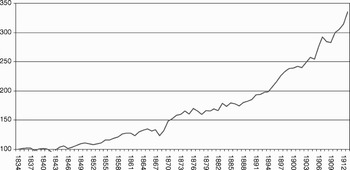
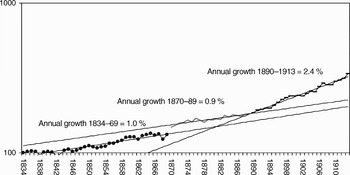
The per capita GDP index supports the interpretation that Swedish economic growth went through positive change in the 1870s and the 1890s. Average yearly growth during the period 1834 until 1913 was 1.5 per cent. Dividing the Swedish GDP growth in accordance with the schedule presented in previous research, shows that a shift in the GDP level occurred around 1870, but without leading to a continuous higher annual growth rate. From the 1890s, per capita GDP growth rate was more than two times higher than before.Footnote 15
In Figure 2 below, the choice of 1890 as the dividing line between the last two periods is based on previous research.Footnote 16 Whatever year is chosen for when the shift in GDP took place or when the acceleration began, it was after the financial revolution had increased financial services both in quantity and in quality.
Swedish per capita GDP volume indices, 1834–1913 (1834 = 100)

Growth patterns in Swedish per capita GDP (in volume index 1834 = 100). Logarithmic scale

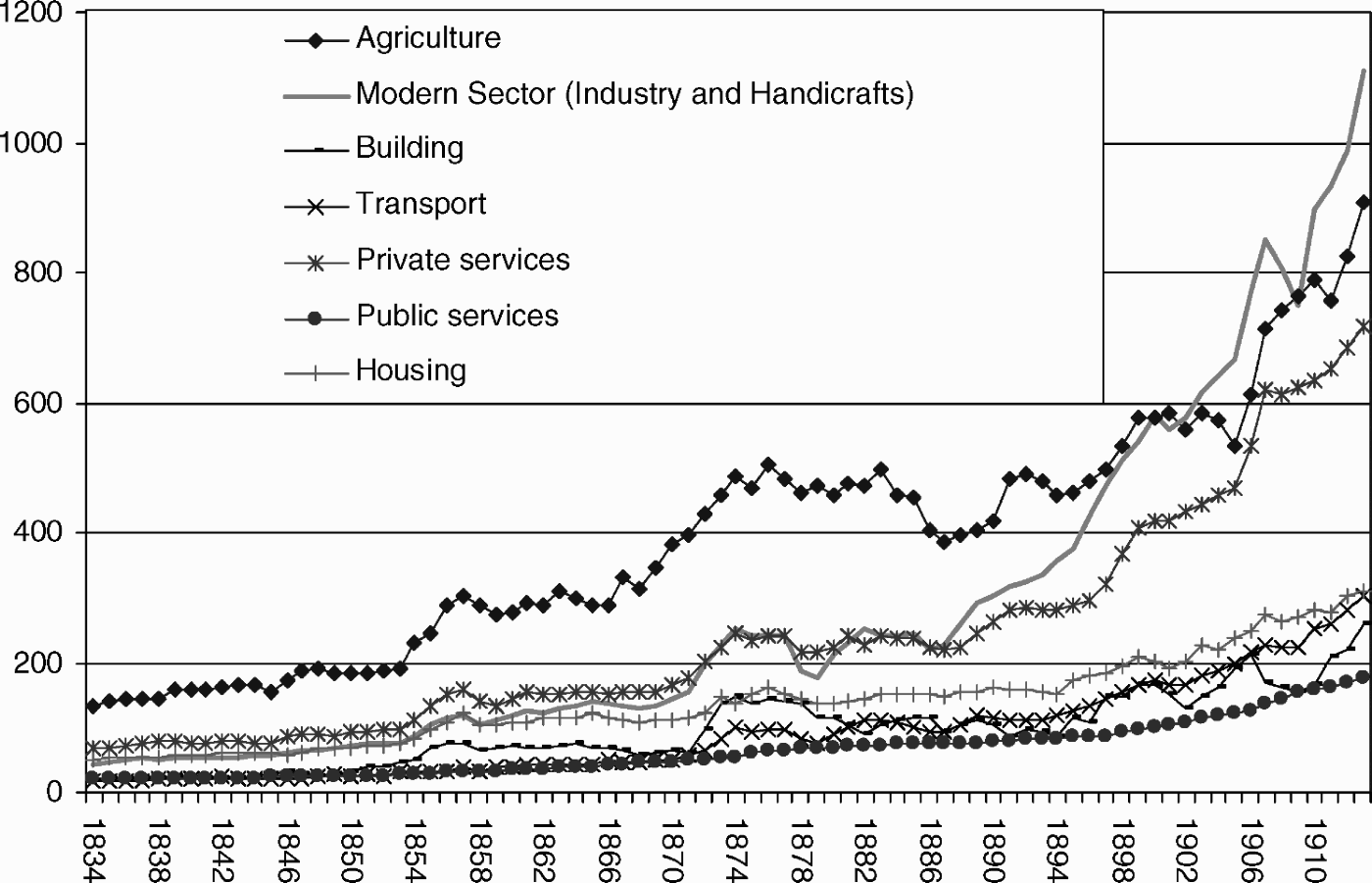
A subsequent question is when the modern industrial sector came to dominate. Figure 3 shows that both the agricultural and the industrial sectors grew in absolute terms, but the latter grew in relative importance. Agriculture was surpassed by the modern sector as the largest contributor to GDP in the middle of the 1890s.
GDP per sector (MSEK), 1834–1913
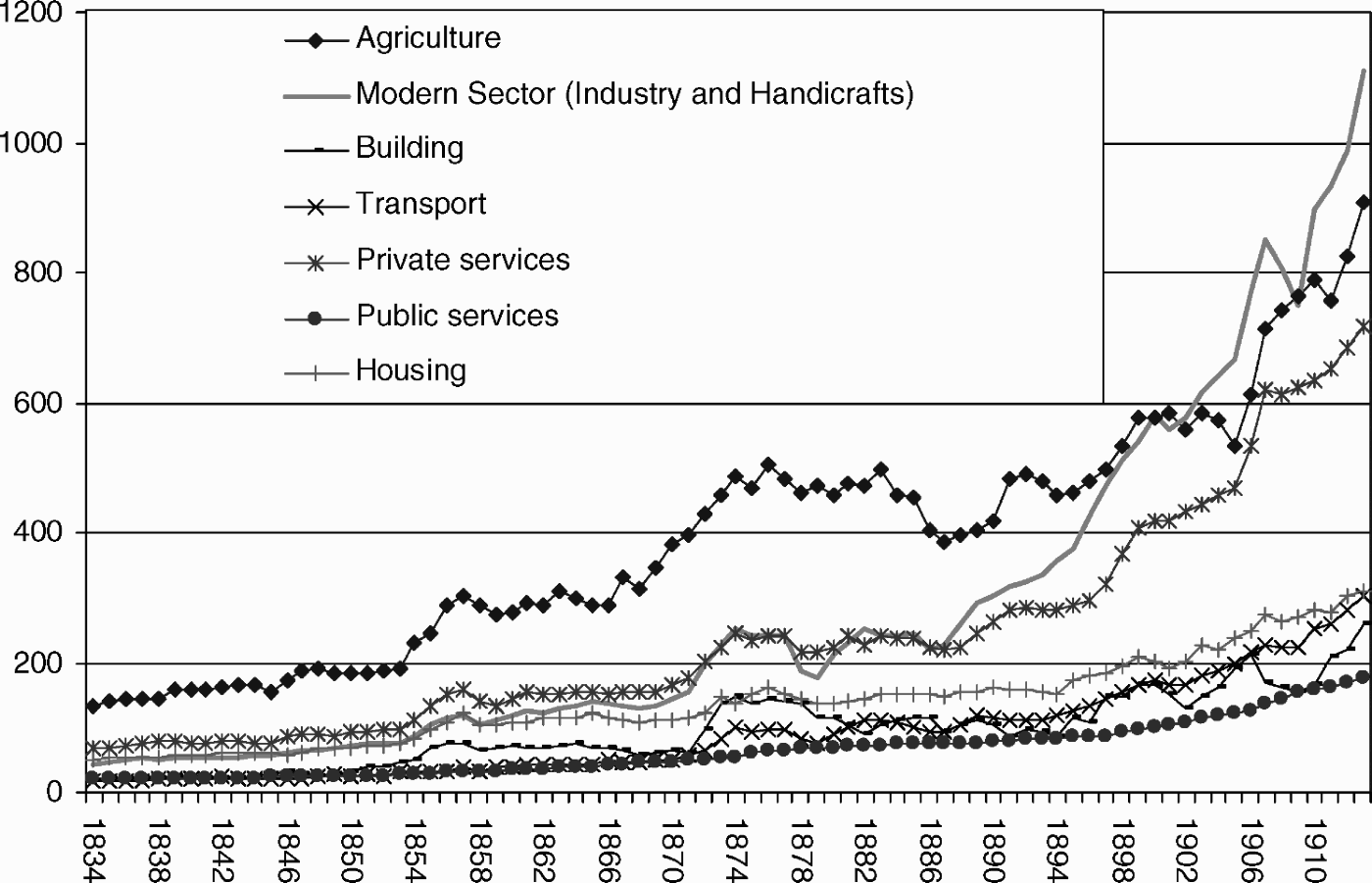
The industrial sector grew in cycles from the 1850s to the late 1870s. In the late 1880s industrial growth started to accelerate rapidly and also the private service sector grew. To some extent this may well have been due to the fact that services that had previously been conducted outside the formal market now became formally priced and paid.Footnote 17
For the entire period the rate of average annual growth in the modern sector was around 2.5 per cent. Growth in the modern sector was more volatile in the early period than is visible. The boom in the first half of the 1850s and the following slump during the crisis of 1857 and 1858 marked growth in the modern sector. So did the famine in the latter half of the 1860s as well as the boom in the early 1870s and the crisis later in that decade. It was during the latter part of the period that the highest growth was experienced. From 1880 growth in the industrial sector was almost 4 per cent per year and from 1887 almost 5 per cent, whereas it had been somewhat lower than 2 per cent a year before 1865. Thus, the average annual growth rate more than doubled. The distinct drop in the modern sector that happens in the years 1908 and 1909 may be a result of the short but intensive crisis in 1907. Since financial crises and booms were visible in the growth of the sector (with a lag) this suggests a link between the modern sector and the financial sector.
III
It has been shown that the financial deepening in Sweden, measured as the increase in the broad money supply (M2) in relation to GDP, took place in the late 1860s. The broad money supply M2 is defined as the public's holdings of liquidity plus deposits in commercial and savings banks. This financial deepening was very quick during the first five years (1868–72) when the ratio almost doubled. The deepening continued somewhat more slowly for another fifteen years (1873–87) when it again doubled and then started to increase modestly for the following 25 years until World War I. Between 1834 and 1868 the broad money supply (M2) was growing at the slow rate of 1.7 per cent annually. Between the years 1868 and 1872 it shifted upwards by 240 per cent and then kept on growing until 1913 at an annual rate of 4.6 per cent.Footnote 18 This rapid financial deepening gives rise to the question of whether Sweden experienced a financial revolution.
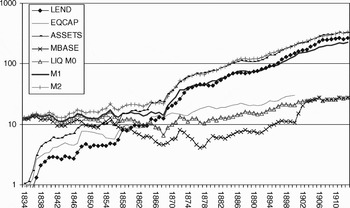
Figure 4 below suggests that the financial sector underwent a period of rapid growth that started in the late 1860s. The timing of this growth period seems to have been roughly between 1868 and 1876 with a more modest increase thereafter. There are four observations to be made from Figure 4. (1) We can clearly distinguish two periods, with 1868 as the turning point. In the second period, public deposits broke through and there was a leap in commercial bank lending and assets. (2) Post-1868 there seems to be a virtual identity between commercial bank lending (LEND) and the money supply (M1), which is defined as liquidity plus public deposits in commercial banks (the same seems to be the case for commercial bank assets (ASSETS) and the broad money supply (M2)). (3) Commercial bank equity capital had been larger than commercial bank lending but this changes in 1868. (4) Also in line with the logic of the financial revolution, the variables that provided the basis of the financial and monetary system, commercial banks' equity capital, the monetary base and liquidity, all remained relatively stable across the period.
Growth in commercial bank lending (LEND), commercial bank equity capital (EQCAP), commercial bank assets (ASSETS), monetary base (MBASE), liquidity (LIQ M0) and broad money supply (M1 and M2) in Mill. SEK, 1834–1913. Per capita and constant prices. Semi-logarithmic scale

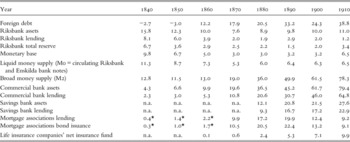
From the middle of the 1850s to the early 1870s Sweden underwent a financial revolution. Although the period 1855 until 1870 might seem arbitrarily chosen if one is looking at changes in individual institutions or organisations, a macro perspective on all the changes that took place supports this as the period when the financial revolution was taking place. The Swedish financial revolution, as had been the case in other economies, consisted of a successful combination of new institutions governing the financial sector, the establishment of trustworthy monetary and financial authorities and increasing rights and opportunities for the population to engage in financial businesses. Table 1 captures the importance of the complementarity of monetary and financial authorities with liberal opportunities for private initiatives.
Various financial measures in per cent of GDP, 1840–1910

* Only the Skåne Hypoteksf örening.
Sources: E. Lindahl, E. Dahlgren and K. Kock, National Income of Sweden 1861–1930, parts I and II (Stockholm, 1937); Krantz, ‘Swedish historical national accounts 1800-1990’; I. Nygren, Svensk sparbanksutlåning 1820–1913. En analys av de större sparbankernas kreditgivning, Meddelande från ekonomisk-historiska institutionen vid Göteborgs Universitet no. 9, Gothenburg University, 1967, and Svensk kreditmarknad 1820-1875, Meddelande från ekonomisk-historiska institutionen vid Göteborgs Universitet no. 47, Gothenburg University, 1981; Post & Inrikes tidning 1835–71; SCB, Historisk statistik för Sverige, part III: Statistiska översiktstabeller [Historical Statistics of Sweden III. Statistical Surveys − National Bureau of Statistics] (Stockholm, 1960); L. Schön, ‘Swedish current account, 1834–1912', Excel file communicated by Prof. Lennart Schön, Department of Economic History, Lund University, 1999; Sammandrag af Bankernas Uppgifter 1871–1911, E. Sommarin, Skånska Hypoteksföreningen 1836–1936. En minnesskrift (Lund, 1934); Svenska livförsäkringsbolags förening, Utvecklingslinjer inom svensk livförsäkring. Minnesskrift med anledning av Svenska livförsäkringsbolags förenings 50-års jubileum (Stockholm, 1958); Sveriges Allmänna Hypoteksbank, Sveriges Allmänna Hypoteksbank 1861–1911 (Stockholm, 1911); Sveriges Riksbank, ‘Statistiska tabeller’.
An illustrative example is how the National Bank, the Riksbank, decreased in relative importance from the 1840s, despite its assets, reserves and the monetary base all increasing in absolute terms during the period. What these figures show is how the role of the Riksbank was redefined during the period. The Riksbank became the monetary authority whose notes served as reserves in the banking sector, instead of being the main commercial bank in terms of assets and lending. This change in conjunction with the growth of private financial enterprises certainly underscores the financial revolution as a change both in institutional and quantitative financial terms.
As part of the state's role in the financial revolution, the foreign debt shows increasing financial internationalisation. Such a supply of international capital would not have been possible without the proper institutions. This foreign debt was important for two reasons: (1) it provided the economy with capital for investments, and (2) due to the fact that proper institutions existed; the bonds that were issued as liabilities by the National Debt Office to raise this capital became good-quality financial instruments (assets) assisting the development of the financial market. Most commercial banks would substitute such bonds for legal tender reserves.Footnote 19
Synergies in the financial system mean that financial variables should have grown in harmony after the financial revolution. As seen in Table 1, this was largely true in the case of Sweden. Monetary variables not including deposits were relatively stable in relation to GDP during this period. When public deposits in commercial and savings banks are included, the money supply grew from 13 per cent of GDP in 1840 to 78 in 1910. In absolute numbers, the growth was even more impressive, as GDP grew rapidly from the 1870s onwards.
Whereas cross-country studies support the view that the ratio of financial depth to GDP is of importance for the economic performance of a country, a longitudinal study of the importance of financial growth for GDP will not benefit from increased financial depth. Nevertheless, the increased financial depth indicates a rapid financial development in the case of Sweden. As the quantitative evidence suggests that a financial revolution took place around 1870, it is also true that many fundamental institutional factors changed during the period just roughly between 1855 and 1870.
1 Political representation
The necessity of the political system in facilitating the establishment of an efficient financial system has been thoroughly analysed as one of the main examples of the importance of institutions for economic growth.Footnote 20 Needless to say, this assumes the idea of a well-designed financial system as important for economic growth.
The 1809 constitution was largely based on limiting the power of the crown by increasing the power of the parliament, and especially the nobility. The political system was a form of constitutional monarchy, with the crown acting as government and the parliament consisting of male representatives of the four estates: the bourgeoisie, the clergy, the nobility and the peasantry. Of special importance in this constitutional design was the forcing of the government (the crown) to rely on parliament for funding, as the latter had the exclusive right of taxation.
From the 1840s it became obvious that belonging to an estate was not sufficient for making progress in politics. The groups in society that had the least influence within parliament, which meant the majority of the population, started to make claims for increased representation. As a result, a new constitution based on a two-chamber parliament was instigated in 1865. This change reduced the influence of the tax financed groups in society; the clergy, the nobility and of course the government (the crown). The 1865 constitution instead increased the representation of property-owing males subject to their paying taxes.
2 The Riksbank and the issuance of base money
One of the keys to developing a financial sector is the establishment of a stable currency not only open to foreign capital markets, but also to be used as base money in the banking system. In 1834, after a decision in parliament in 1830, Sweden established a specie standard that survived for eighty years until the outbreak of World War I.
The importance of the stable currency for the financial sector is illustrated by the fact that this decision was the catalyst for the first application to establish a commercial bank. No applications had been filed earlier, although the parliament and the crown had launched a special proclamation to promote private banks seven years earlier.
Later, as international markets increased in importance for the Swedish economy, the silver standard was converted into a gold standard in 1873. This change was a result of the German Reichsbank's switch to a gold standard and was made in connection with the establishment of the Scandinavian Currency Union when the unit of account was harmonised in the Scandinavian countries to the Krona.Footnote 21
Despite the problematic track record of the Swedish currency, faith in the stable currency grew in time, as it became clear that the priority of the Riksbank was to protect the fixed exchange rate above all other objectives.
From the late 1850s, the public debt increased and, since the largest part of this debt was held by foreigners, the loans were denominated in foreign currencies. The foreign debt thus put increased pressure on the importance of maintaining the fixed exchange rate as a depreciated currency would add to the problems of repaying this debt. As a consequence, the Riksbank did not jeopardise the currency by engaging in lender of last resort activities. If further funds were needed for the banking system, the state, represented by the government and the parliament, stepped in and through the National Debt Office borrowed funds from abroad (i.e. Britain, France and Germany).Footnote 22
In the 1870s cooperation between the Riksbank and the National Debt Office became more formalised. This was done with the aim of better managing the impact of the NDO's foreign borrowing on the Riksbank's ability to maintain the specie standard.
The Riksbank was not given a note-issuing monopoly in practice until 1903 when the right to issue notes for the Enskilda banks was abolished. Although the Swedish money stock from the 1830s had partly consisted of private bank notes, it was obvious throughout the period that the Riksbank was responsible for the currency. Notes issued by the Riksbank were the main component in the reserves of the banking system, whereas private bank notes were never kept as reserves.Footnote 23
With the explicit aim of ending the outdated bureaucracy of the Bank's business, the organisation was fundamentally changed between the 1860s and early 1870s. The staff was downsized, the detailed regulations regarding the activities of the Bank were cut to a third, greatly increasing the freedom of the Board and the CEO of the Bank. The previously independent Loan Office became fully integrated into the Bank. Modernising the loan business meant that funds that previously had been locked for specific purposes were freed. As a result, old-fashioned subsidised agricultural loans and other outdated loans diminished considerably, paving the way for commercial lending collateralised for instance in bonds, stocks, bills of exchange, name and current account credit. Thus the Riksbank consolidated its own position at the same time as it circulated more of its notes to be used as reserves by the banking system. As a result of this consolidation, the Riksbank in 1872 instigated a fund explicitly for the purpose of sterilisation. All in all, the institutional changes during the 1860s and 1870s ended the discretionary subsidies from the Riksbank to certain groups in society and instead focused on enabling the Bank to conduct monetary policy more efficiently.
The Riksbank clearly acted as a rudimentary form of central bank issuing base money. The commercial banks utilised the opportunity to deposit funds in interest-bearing current accounts. Since deposits in the Riksbank could be made with Enskilda bank notes from 1869, if the Riksbank were able instantly to exchange these notes for its own, it is likely that the Riksbank was engaged in clearing activities as well.Footnote 24
3 The National Debt Office managing the public debt
The importance of managing the public debt was twofold: first, as was the case with the stable currency, it served as a signal of trust to lenders, and second, if the commitment of the state was trustworthy, the public debt in turn became financial assets to be held by investors. For this to work it was essential to have a well-structured tax system reassuring investors in the public debt that the state could extract the revenues needed for repayment.
The role of the National Debt Office changed fundamentally when the parliament of 1853/54 decided to use the Office to raise the funds needed to build the core of the railroad system, but the period 1854 to 1866 was a period of trial and error with incomplete organisational and institutional practices. At first the Office lacked experience in managing foreign loans, since it did not have continuous contact with the international economy and no contracted long-term correspondents abroad. The commercial banking system was not competing to arrange the loans.Footnote 25 Because of the organisation and history of the Swedish state's financial authorities, the National Debt Office and the Riksbank acted as competitors. From the latter half of the 1860s the National Debt Office solved these problems with increased cooperation with the Riksbank and involving more domestic banks. Not only did the Office accumulate knowledge about debt management, but new forms of loans were developed better to suit the needs of the state.Footnote 26
As was the case with other countries experiencing a financial revolution, Sweden became a large net importer of capital. The costs of these loans diminished over time, and new loans could be raised to pay for older, more expensive loans by the early 1870s. Foreign loans were, however, always denominated in the lender's currency.
The loans taken by the National Debt Office were different forms of bond loans, mainly aimed at international markets. The Office's bonds were also circulating as securities on the domestic market. One of the investors in National Debt Office bonds was the Riksbank, which held these bonds as assets that could be turned into reserves when necessary.Footnote 27 The banking system also held these bonds as assets in a manner that increasingly came to replace cash reserves.
The market for domestic securities, most notably bonds, became noteworthy in size in the early 1870s. In 1861 the Mortgage Bank of Sweden was established to coordinate the business of the mortgage companies. The first domestic life insurance company was established in 1855 and the commercial banking system, within its legal boundaries, started to grow in the 1850s. As repressions on bank establishments were revoked in 1864, these banks could become fully fledged commercial banks. The result of this financial revolution was clearly visible in the rapid increase in financial services that took place in the early 1870s.Footnote 28
4 The banking system and the Swedish monetisation
The commercial banks functioned in a complementary manner. The banks turned fixed and indivisible assets into liquid liabilities. These liquid liabilities could consist of demand deposits, or private bank notes. Thus the commercial banking system was important for the financial revolution as it managed to create financial instruments also to be used as means of payments. The Enskilda bank notes were regarded as safer and more trustworthy than what had hitherto been used for payments (for instance personal IOUs and authorised assignments).Footnote 29 In an economy suffering from a lack of trustworthy means of payments, the Enskilda bank note issuance thus became an important part of the formal monetisation. This monetisation was also an important element in the creation of liquid secondary asset (or security) markets.
The need to complement the business of the parliamentary Riksbank by allowing for the establishment of private commercial banks was agreed upon in Parliament. Thus, an official Royal Proclamation in 1824 guaranteed this right, and, as with all other businesses, banks were to be run under the principle of unlimited liability. The crown had to agree each bank's regulations and grant a time-limited (ten-year) charter. The need for an anchor currency for banking business was apparent since it was the decision to reestablish the silver standard in 1830 that led to the establishment of the first commercial bank in Sweden, Skåne Enskilda Bank. Parliament agreed to the note-issuing rights of the Enskilda banks, since this was considered to be the only way of making it possible to fund banking business in a country suffering from a lack of means of payments.Footnote 30
Until the middle of the 1860s, bank establishment was more or less a monopoly affair for those who managed to be granted charters to run banking business. Strong groups in parliament, and allies of the crown, had significant interest in keeping competition as low as possible. As a result, banking establishment was limited until political representation changed.
In 1851, the increasing hostility towards the local Enskilda bank monopolies led to an attempt to create non-note-issuing banks relying on Riksbank credit; the so-called Filial banks. This indicated how under-established the banking sector was. Initially, funds that were meant to support the establishment of three Filial banks had to support eight. Within a few years, 19 Filial banks were established, competing for funds that were only a fraction of what the 12 existing Enskilda banks issued in notes. In addition, the crown, which regulated the charters, prevented the Filial banks from accepting deposits.
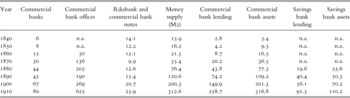
By the early 1860s, the opposing parties in parliament agreed to end the Filial banks, on the condition of freer establishment of commercial banks. From 1865, existing Filial banks either merged with existing Enskilda banks or reformed as new Enskilda banks. In addition, a number of new Enskilda banks were opened, increasing the number of commercial banks from 19 to 25 and the number of note-issuing Enskilda banks rose from 12. The number of bank offices increased as well from 50 in 1860 to 105 in 1866, and then reached a level of between four and five offices per bank, a level that was maintained until after 1900. This rapid bank establishment coincided with the abolition of the usury law and the opportunity to establish non-note-issuing limited liability banks.Footnote 31
Table 2 shows that the freer bank establishment from the middle of the 1860s immediately led to a notable increase in financial services provided by the commercial banks. Bank assets, lending and the broad money supply all more than doubled, showing the importance of developing a nationwide financial system.
Number of commercial banks and offices, money supply, bank assets and bank lending in mill. SEK per capita (constant prices 1834 = 1), 1840–1910

Sources: Brisman, Sveriges Affärsbanker; Nygren, Svensk sparbanksutlåning 1820–1913; Post & Inrikes tidning 1835–71; Sammandrag af Bankernas Uppgifter 1871–1911; SCB, Historisk statistik för Sverige, part I; Sveriges Riksbank, ‘Statistiska tabeller’.
The notes issued by the Enskilda banks were based on the fixed exchange rate maintained by the Riksbank from 1834. Although the Riksbank accepted Enskilda bank notes from banks with an exchange agent or an office in Stockholm from 1869, only notes issued by the Riksbank were kept as reserves by the banking system.
Initially, the Enskilda banks funded their business by the issuance of notes without paying much attention to deposits. With the reintroduction of the ‘postal bank bill’ in 1855, deposits became nearly as liquid as notes. Although notes initially might seem a cheaper source of funds, the discount costs the Enskilda banks faced for exchanging these notes, and increased taxes on note issuance, made deposits an equally profitable alternative. Deposits also had other advantages, as the amount of notes a bank could issue was regulated by law, which was not the case for deposits. The question of note issuance by the Enskilda banks was regularly monitored and debated in terms of banking business prudence, and consequently, even though deposits might have been somewhat more expensive for the banks than note issuance, deposits had their advantages.Footnote 32
The broad money supply stayed fairly stable between 1855 and 1868, but notes in circulation decreased. During this period the Enskilda banks altered their liabilities by substituting deposits for notes. In the late 1860s, both note issuance and deposits started to grow again, and from the year 1867, deposits were the main component of the broad money supply, which increased enormously during a few years in the late 1860s and early 1870s, suggesting a breakthrough in monetisation between the years 1868 until 1872.
The shift in money supply was accompanied by a shift in the lending pattern of the commercial banks. Ignoring the early years of extreme growth, growth in commercial bank lending for the rest of the period was at an annual rate of 7 per cent. The more liquid the economy became, the fewer cash reserves banks had to hold and the more lending they could engage in.
Already from the 1820s, the public was encouraged to save through the establishment of savings banks. Early savings bank offices were small, isolated and scattered all over the country. As part of the complementarities of the financial system, the importance of the savings banks to the credit market increased with the establishment of commercial banks. Although these organisations were meant to be philanthropic institutions supporting the virtue of saving, they also represented an increased opportunity to channel funds to the loan market through the commercial banks. A common situation was that the same individuals that sat on the board of the local savings bank also sat on the board of the local commercial bank, and/or that savings banks and commercial banks shared an office.Footnote 33
IV
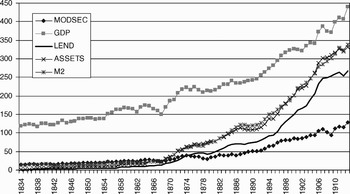
Figure 5 below shows that a general increase in formal financial services and economic growth took place in the early 1870s. If the financial system, including monetisation, was important for the economy, this should be traceable as a link between measures of the financial sector and economic growth.
Per capita economic growth (GDP), industry growth, money supply (M2) and commercial bank lending in constant prices (1834 = 1). 1000s SEK

To study the synergies between the different parts of the financial system the financial variables are divided into two groups: financial basis variables and monetary variables. Financial basis variables are: commercial bank assets (ASSETS), equity capital in commercial banks (EQCAP), and commercial bank lending (LEND). The measure of assets (ASSETS) and to some extent the equity capital (EQCAP) capture the growth and consolidation of the financial system. This growth should not be possible in the long run without sustained productivity growth. Lending (LEND) as a variable lies somewhere in between financial basis variables and monetary variables and can be considered as a channel linking wealth in the banking system to economic productivity.
Monetary variables are: monetary base (MBASE), liquidity (LIQ) and broad money supply (M1 and M2). The monetary base (MBASE) is the provision of possible cash reserves to be held by the banking system. It can either be held as liquidity by the public or lie as reserves in the banking system, thus serving to increase credit and the money supply through the money multiplier mechanism. If access to credit and means of payments are of importance for economic growth, the variable monetary base (MBASE) is expected to affect economic growth positively.
Formal liquidity (LIQ) is means of payments trusted and used for transactions by all parties. It is the main instrument by which transaction costs were avoided. This is of particular importance in an illiquid emerging economy in the process of formalising and integrating its domestic markets. The Swedish system, combining the Riksbank, an issuer of base money and with the ultimate responsibility for preserving international specie convertibility, with the private Enskilda banks as domestic note issuers, allowed a greater expansion of means of payments than otherwise would have been the case. The choice of the Enskilda banks – supported by the public – to rely more on Riksbank notes than on specie for their reserves led to a greater expansion of liquidity than otherwise would have been possible.Footnote 34 The larger acknowledgement of the means of payments, the more it can be used in larger networks, including, as became the case with the Enskilda bank notes, the entire country (and some neighbouring regions in Norway and Denmark). As transaction costs and risks decrease and investments become more liquid, more pay-offs are available for economic activity. Thus it is a likely hypothesis that the increase in formal liquidity (LIQ) supplied by the Enskilda banks on top of the Riksbank notes was related to economic growth and modernisation.
Broad money supply is measured as liquidity (LIQ) plus the public's deposits in commercial banks (M1). M2 also includes the public's deposits in savings banks. The broad money supply not only captures monetisation, but also the growth of public wealth in the banking system. The measure M1 is in some studies used as a proxy for financial deepening or financial development as a whole. But as the savings banks were important actors in the financial market, the measure M2 might be more appropriate. It is seen in Figure 4 how closely related M1 is to commercial bank lending (LEND) and M2 to their assets (ASSETS).
There are two measures of economic growth: total economic growth (GDP) and modern sector growth (MODSEC). The latter is defined as growth in industry and handicrafts and became the largest single sector of production just before the end of the century, when it surpassed the agricultural sector. This is in line with the hypothesis of creative destruction, that the financial revolution sustains investments in newer, more risky technologies.
Since the series are not stationary, that is, they are growing over time, I begin the econometric testing with cointegration tests (see Appendix). The first question is how the different financial and monetary variables were related to each other. Looking at the series of these variables (Figure 4) indicates that some of the variables indeed seemed to grow in a manner closely related to each other. Among the financial basis variables, the commercial banks' assets and lending took off in the late 1860s, and the same was the case for the broad money supplies (M1 and M2). The importance of the financial and monetary variables for economic growth and modernisation is, however, more difficult to see.
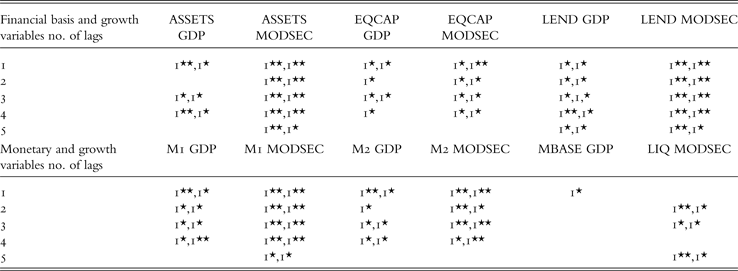
There are three important results of the cointegration tests: first, and most important, the growth of the financial and monetary variables was clearly related to economic growth and modernisation (see Table A2). Second, the growth of the financial and the monetary variables were interlinked (see Table A1) supporting the importance of the development of the financial and monetary system as a whole. Third, there was a distinct difference between the pre- and the post-financial revolution period (see Tables A1 and A2), strengthening the impact of the financial revolution for the growth of the financial system and its impact on real economic growth and modernisation.
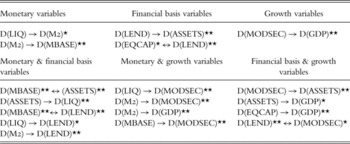
Granger causality tests further strengthen the importance of the financial and monetary development for economic growth and modernisation in the case of Sweden (see Table A3). There was a positive causality running from changes in the financial and monetary variables to changes in general economic growth and growth in the particular industrial sector. The significant results (at the 5 per cent level) of the Granger causality tests are summarised in Figure 6 below.
A stylised illustration of the significant Granger causalities in Table A3, at 5 per cent significance level

First and most importantly, the results of the Granger causality analysis suggest that growth was finance-led in the case of Sweden. Changes in the monetary variables Granger-caused changes in GDP as well as in the modern sector (MODSEC). Both the monetary base (MBASE) and liquidity (LIQ) promoted growth in the modern sector. This result concerning liquidity underlines the importance of creating means of payments with the qualities that make them accepted for transactions outside small regional networks. The specie standard kept the value of the means of payments, and the Enskilda banks supplied liquidity to an extent that facilitated economic growth. The broad money supply (M2) Granger-caused growth in the modern sector as well as in total GDP.
The financial basis in terms of commercial bank assets (ASSETS) and equity capital (EQCAP) affected overall economic growth (GDP). Lending, however, did not affect GDP but had a mutual relationship with growth in the modern sector (MODSEC). The only somewhat puzzling result is that growth in the modern sector Granger-caused changes in commercial bank assets. All in all, the results clearly support the importance of the financial system for growth as well as modernisation in the economy.
The financial variables also seemed to affect different sides of the growing economy. All the monetary variables affected growth in the modern sector as well as in overall GDP, whereas the financial basis variables seemed to be related exclusively to growth in overall GDP. This stresses the importance of the complementarity of the financial system as does the fact that growth in the modern sector fostered growth in overall GDP, and not conversely. This result highlights the importance of creative destruction for long-term economic growth.
But there is more to the picture of the financial revolution than the fact that economic growth and modernisation followed on the growth of the banking system, and the money supply. Financial and monetary variables were interlinked in the developing process into a system. The financial basis promoted the most liquid forms of the monetary variables. The monetary variables all supported lending, which in turn positively affected growth in the banking system (represented by commercial bank assets). All this supports the idea of the importance of the development of the financial sector as a system where different parts complement each other. Not least the importance of a financial system for a successful monetisation.Footnote 35
That among the monetary variables liquidity Granger-caused growth in the broad money supply is expected. The broad money supply on the other hand caused changes in the monetary base. This result is in line with the monetary approach to the balance of payments, i.e. that increased demand for money eventually forces the monetary authority to adjust the monetary base.Footnote 36 Among the financial basis variables, lending served to build up the assets of the banking system. There was a mutual relationship between equity capital and lending.
V
As was the case in other historical experiences, the Swedish financial revolution was built on complementarity between different parts of the financial sector. The synergy effects created the financial revolution and made it important for economic growth. Fundamental financial, organisational and institutional changes were made from the middle of the 1850s to the early 1870s.
A stable currency came into existence in 1834, managed by the Riksbank that prioritised the specie convertibility before all other objectives. Thus the market share of the Riksbank decreased as its role was transformed towards that of a central bank.
The National Debt Office managed the state's debt and managed from the late 1850s to import capital from international capital markets. The Office became better at both organising its business and creating high-quality financial instruments, bonds, to raise capital. Throughout the nineteenth century, bonds were the main security traded. In 1861 the then existing Mortgage Associations, which funded their lending also by bond issuance, jointly established the Swedish Mortgage Bank.
Changes in political representation made a nationwide establishment of commercial banks possible. This took place in the middle of the 1860s and was based on the tasks of the Riksbank and the National Debt Office as well as the growing securities market. The banks that were established, unlimited liability commercial banks, served the purpose of raising funds for their business by issuing notes. Besides being able to invest in local business ventures, these banks managed the monetisation by liquidating fixed assets. This led to the liquidity spiral where banks were able to substitute interest-bearing securities for cash reserves, thereby feeding monetisation further. In this manner the banks were able to consolidate and increase their lending.
The financial revolution in Sweden made its mark in the growing financial services and monetisation from the late 1860s. Growth in the real economy measured as per capita GDP in constant prices, and growth in the industrial sector of the economy accelerated later in the nineteenth century. Cointegration tests showed that financial variables and economic growth were growing in harmony. They also indicated that there were different periods, one pre- and one post-financial revolution.
The financial revolution preceded the structural transformation that made the industry the leading sector in the economy. Monetisation and public wealth in the banking system Granger-caused changes in the modern (industrial) sector as well as in overall GDP. This demonstrated the role monetisation and the financial system played for the process of creative destruction to take place. Measures of the financial system affected growth in overall GDP. The development of the financial system and monetisation were also dependent on each other, showing the importance of the financial revolution occurring as the growth of a system.
Appendix
We should note the fact that some variables are long-term stock variables such as commercial bank assets and equity capital, whereas others are more short-term flow variables such as liquidity and the monetary base. The measures of economic growth are both flow variables but, like most ‘flow’ variables in time series, they are very dependent on their size in prior periods. Variables such as commercial bank lending and the broad money supply can also be regarded as well as stock variables. Thus, it is difficult to make a clear distinction between these variables in this respect.
Cointegration
Since all the series are non-stationary I begin with testing for cointegration. Cointegration tests are used to discover stable relationships between data series if there are trends in these series. The time series are cointegrated if there exists one (or several) linear combination(-s) between the two non-stationary variables. Such a linear combination shows an econometric equilibrium relationship between the variables; that is that the variables do not move randomly in relation to each other over time.
The cointegration test shows that there existed a relationship between the financial basis and monetary variables (Table A1). In the case of the financial basis variables, commercial bank assets and equity capital shared two common vectors. That there existed two vectors is a result of the break between the pre- and the post-financial revolution. In the early period commercial bank assets and equity capital was almost at the same level, indicating one stable relationship. The difference in growth between commercial bank assets and equity capital after the late 1860s shows another relationship. Assets and lending appear to have been close throughout the period with one single vector on short term as well.
As liquidity and broad money supply (M1 and M2) were parts of each other it is not surprising that there were cointegration relationships, but the results underline the importance of the financial revolution with two cointegration vectors; one for the series before the financial revolution and one after. We can also see that there was only one vector for the relationship between the monetary base and the other monetary variables. There was no cointegration vector for the early period but one for the post-financial revolution period, which shows that the monetary base was more important for the money supply after the financial revolution.
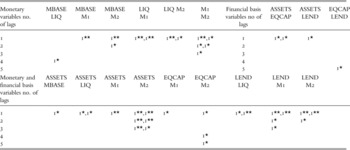
Cointegration vectors and their significance for pair wise cointegration tests between financial basis variables (assets (ASSETS), equity capital (EQCAP) and lending (LEND) of commercial banks) and monetary variables (Monetary base (MBASE), liquidity (LIQ) and broad money supply (M1 and M2)), 1834–1913, per capita and in constant prices (1834 = 1), 1000s SEK

* 5 per cent and ** 1 per cent significance level
Cointegration vectors and their significance for pair wise cointegration tests between financial basis variables (assets (ASSETS), equity capital (EQCAP) and lending (LEND) of commercial banks), monetary variables (monetary base (MBASE), liquidity (LIQ) and broad money supply (M1 and M2)) and growth variables (GDP and modern sector (MODSEC), 1834–1913, per capita and in constant prices (1834 = 1), 1000s SEK
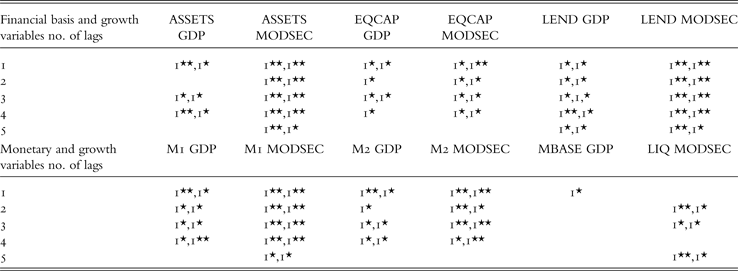
* 5 per cent and ** 1 per cent significance level
Significant Granger causalities between total assets in the commercial banking system (ASSETS), equity capital (EQCAP), the monetary base (MBASE), the liquid money supply (LIQ), the broad money supply (M1 and M2), economic growth (GDP) and growth in the modern sector (MODSEC), 1834–1913. All variables in constant prices and per capita (five lags)

* 5 per cent, ** 1 per cent, significance level
Putting the financial basis variables together with the monetary variables shows that there was a strong relationship between the broad money supply and commercial bank assets and lending. We see also that there are two cointegration vectors, indicating two different stable relationships between the series over time. Equity capital and the monetary fundamentals, i.e. the monetary base and liquidity, were not related.
The two measures of economic growth, overall GDP and the modern sector (MODSEC) represented by industry and handicrafts shared one cointegrating vector, i.e. were related. As the modern sector was one of several sectors included in the GDP this is not surprising.
As seen in Table A2, there were significant relationships between the growth of the financial and monetary system and the economy. All three financial basis variables were related to the two measures of growth, GDP and the modern sector. Exclusively, this was the case with two cointegrating vectors, which means that the development of the financial system was related to economic growth both before and after the financial revolution.
Economic growth was also related to the monetary variables. The same pattern emerges for the broad money supply as for commercial bank assets and lending. Liquidity and the monetary base as monetary fundamentals were also related to economic growth, but not in the same strong manner. As these provided a basis for the overall expansion of the financial and the monetary system, this is not surprising. It is more surprising that liquidity was related to growth in the modern sector before as well as after the financial revolution.
There was apparently a connection between the growth of the financial and monetary system and the economy, not least in the emerging industrial sector. The cointegration analysis is followed up with a Granger causality test to sort out the issue of eventual causality.
Granger causality
The Granger causality test is a test of order of occurrence, this means that it tests whether variable A changed before or after variable B, or vice versa. Since the data series are non-stationary they have been differenced to overcome this problem for the significance test. This means that we look exclusively at changes, i.e. if a change in variable A is preceding a change in variable B the next period. The results of the Granger causality tests are listed in Table A3.