Approximately 90% of all brain injuries are classified as mild, with an estimate of 1.5 million non-institutionalized new mild to moderate cases each year in the United States (Sosin, Sniezek, & Thurman, Reference Sosin, Sniezek and Thurman1996). The high prevalence of mild head injuries (MHI) largely contributes to the economic burden of all head injuries, accounting for an estimated 44% of the 56 billion dollar cost annually in the United States (Thurman, Reference Thurman, Miller and Hayes2001). Neuropsychological assessments are one contributor to the overall cost, and are often necessary to investigate residual and persistent symptoms (cognitive, physical, and/or affective) reported by 14.5% (Rutherford, Merrett, & McDonald, Reference Rutherford, Merrett and McDonald1979) to 50% (Edna & Cappelen, Reference Edna and Cappelen1987; Middleboe, Andersen, Birket-Smith, & Friis, Reference Middleboe, Andersen, Birket-Smith and Friis1992) of individuals who have sustained a MHI in their past. Prospective controlled studies show that MHI participants report a significantly higher frequency of concentration difficulties (Ponsford et al., Reference Ponsford, Willmott, Rothwell, Cameron, Kelly, Nelms and Ng2000), periods of confusion (Vanderploeg, Curtiss, Luis, & Salazar, Reference Vanderploeg, Curtiss, Luis and Salazar2007), and memory problems (Vanderploeg et al., Reference Vanderploeg, Curtiss, Luis and Salazar2007; Vanderploeg, Belanger, & Curtiss, Reference Vanderploeg, Belanger and Curtiss2009) at least 3 months, up to several years, following their injury compared to non-head-injured controls.
Despite these persistent attention and memory complaints, standard neuropsychological tests do not consistently detect deficits in cognitive functioning. Prospective controlled studies have reported residual neuropsychological deficits (at least 3 months post-injury) in various aspects of attention (Chan, Reference Chan2002; Potter, Jory, Bassett, Barrett, & Mychalkiw, Reference Potter, Jory, Bassett, Barrett and Mychalkiw2002; Solbakk, Reinvang, Neilsen, & Sundet, Reference Solbakk, Reinvang, Neilsen and Sundet1999; Vanderploeg, Curtiss, & Belanger, Reference Vanderploeg, Curtiss and Belanger2005) and information processing speed (Bernstein, Reference Bernstein2002; Potter et al., Reference Potter, Jory, Bassett, Barrett and Mychalkiw2002); although the majority fail to detect significant long-term neuropsychological impairments (for meta-analyses, see Belanger, Curtiss, Demery, Lebowitz, & Vanderploeg, Reference Belanger, Curtiss, Demery, Lebowitz and Vanderploeg2005; Binder, Rohling, & Larrabee, Reference Binder, Rohling and Larrabee1997; Vanderploeg et al., Reference Vanderploeg, Curtiss and Belanger2005). Moreover, when lingering problems are detected, they are frequently confounded by extraneous variables, such as pre-existing factors (Vanderploeg et al., Reference Vanderploeg, Curtiss, Luis and Salazar2007), co-morbid psychosocial factors (Chan, Reference Chan2002; Dischinger, Ryb, Kuferea, & Auman, 2009; Fann, Uomoto, & Katon, Reference Fann, Uomoto and Katon2001; Rapoport, McCullagh, Shammi, & Feinstein, Reference Rapoport, McCullagh, Shammi and Feinstein2005; Stulemeijer, Vos, Bleijenberg, & Van der Werf, Reference Stulemeijer, Vos, Bleijenberg and van der Werf2007), and litigation (for review, see Belanger et al., Reference Belanger, Curtiss, Demery, Lebowitz and Vanderploeg2005; Binder & Rohling, Reference Binder and Rohling1996; Tsanadis, Montoya, Hanks, Millis, & Fichtenberg, Reference Tsanadis, Montoya, Hanks, Millis and Fichtenberg2008).
An additional variable shown to confound the extent of cognitive symptoms following a MHI is the mere expectation that an individual will experience symptoms. Mittenberg, DiGiulio, Perrin, and Bass (Reference Mittenberg, DiGiulio, Perrin and Bass1992) initially reported this “expectation bias” and found that MHI patients consistently underestimated the prevalence of affective, somatic, and memory symptoms they experienced before being injured, as compared to a base rate of symptoms reported in control participants. This finding has more recently been replicated and termed the “good-old-days” bias. Specifically, individuals who have sustained a MHI in their past report experiencing significantly fewer symptoms pre-injury compared to the reported base rate of symptoms in controls, resulting in an overestimation of the actual degree of change that occurred (Davis, Reference Davis2002; Gunstad & Suhr, Reference Gunstad and Suhr2001, Reference Gunstad and Suhr2004; Iverson, Lange, Brooks, & Rennison, Reference Iverson, Lange, Brooks and Rennison2010; Lange, Iverson, & Rose, Reference Lange, Iverson and Rose2010). The influence of expectation on self-reported symptoms has largely been ignored in the MHI literature, but is a critical variable that must be considered, as most, if not all, participants/patients are aware that they are being examined because of their MHI. As a result, the effects of the “expectation/good-old-days” bias on cognitive functioning cannot be teased apart from the long-term effects of the injury itself. Accordingly, in addition to extraneous factors such as psychosocial functioning and litigation status, “expectation bias” is another factor that may largely contribute to cognitive findings reported in the MHI literature.
In addition to elevating symptom ratings, negative expectations also affect cognitive performance in individuals with a sustained MHI. Suhr & Gunstad (Reference Suhr and Gunstad2002) coined this phenomenon “diagnosis threat,” which they relate to the term “stereotype threat”: a member of a specific group may display poor task performance simply because he/she is aware that the task is thought to be performed poorly by members of that group. For example, Spencer, Steele, and Quinn (Reference Spencer, Steele and Quinn1999) found that women performed worse on the math Graduate Record Exam compared to men when they were told to expect gender differences, but had equal performance when gender differences were not mentioned. Similarly, “diagnosis threat” was evident in a study of undergraduate students who self-reported a past head injury (Suhr & Gunstad, Reference Suhr and Gunstad2002, Reference Suhr and Gunstad2005). The “diagnosis threat” MHI group, who were told that they may be experiencing cognitive problems post-injury, had lower performance on tests of general intellect, memory, and attention, as well as had slower average psychomotor speed compared to “neutral” MHI participants. Together, these studies demonstrate that negative expectations are substantial enough to result in overestimations of symptom change pre- to post-MHI and to result in cognitive impairment.
The goal of the current study was to examine the effect of diagnosis threat on self-reported everyday cognitive errors and affective functioning, as well as behavioral measures of cognitive functioning, in individuals who sustained an MHI in their distant past (at least 6 months before testing). Unlike previous diagnosis threat studies, which investigated the effect by comparing two MHI groups (i.e., “diagnosis threat” versus “neutral” MHI groups), we recruited additional non-head-injured, gender-, age-, and education-matched controls, yielding two conditions each with two groups (controls and MHI). In “diagnosis threat” condition, we examined cognitive and affective functioning in undergraduate students with and without a self-reported MHI. All participants were informed, before data collection, of their specific group membership and were told that the purpose of the study was to investigate the potential long-lasting negative effects of a MHI on memory and attention. In the “neutral” condition, we similarly examined individuals with and without a MHI on cognitive and affective measures. Here, however, participants were told the purpose of the study was to merely examine memory and attention in young adults. No mention was made of group membership, or of the possibility of long-term negative effects of a past MHI.
In each condition, a battery of questionnaires and neuropsychological tests were administered to acquire self-report and behavioral measures of memory and attention. Unique to this study, we administered self-report scales that provide separate measures of attention and memory failures in everyday life: the Attention-related Cognitive Error Scale (ARCES; Carriere, Cheyne, & Smilek, Reference Carriere, Cheyne and Smilek2008) and the Memory Failures Scale (MFS; Carriere et al., Reference Carriere, Cheyne and Smilek2008), respectively. The more commonly used self-report measure of everyday cognitive failures is the Cognitive Failures Scale (CFQ; Broadbent, Cooper, FitzGerald, & Parkes, Reference Broadbent, Cooper, FitzGerald and Parkes1982). The CFQ, however, is not limited to attention-related errors, but rather errors due to action, attention and/or memory failures, thus memory and attention-related errors cannot be distinguished from one another. Our use of the ARCES and MFS allowed us to obtain separate measures of everyday errors due to two different types of cognitive failures: attentional lapses and memory lapses, respectively. Given previous research (Suhr & Gunstad, Reference Suhr and Gunstad2002), we hypothesized the “diagnosis threat” MHI group would report more everyday failures of memory and/or attention on average, and would also show performance impairments on measures of neuropsychological functioning, compared to the “neutral” MHI group and/or compared to the non-head-injured control groups.
Methods
Participants
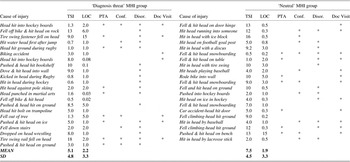
Undergraduate participants were recruited from the University of Waterloo's Research Experience Group, and received course credit for participating. The study was approved by the University of Waterloo's Office of Research Ethics. Students were prescreened for MHI, demographic and health status via a generic online questionnaire completed by all students taking Psychology courses at the beginning of the semester (see Appendix 1). A MHI was defined as any strike to the head or any acceleration/deceleration force (i.e., whiplash; Kay et al., Reference Kay, Harrington, Adams, Anderson, Berrol and Cicerone1993) that resulted in a loss of consciousness. Head injury severity was determined by duration of loss of consciousness (LOC), post-traumatic amnesia (PTA), and disorientation and/or confusion. Participants who had reported experiencing a MHI, classified by a LOC not exceeding 30 min, were invited to participate in our study. Participants could have also experienced PTA, disorientation, and/or confusion, all not exceeding 24 hr (Kay et al., Reference Kay, Harrington, Adams, Anderson, Berrol and Cicerone1993; see Table 1). Table 1 also indicates if individuals sought medical attention (“Doc Visit”). The majority of MHI participants did not undergo brain imaging following their injury, and of those who did, all reported that no brain abnormalities were detected.
Head injury characteristics

Note. MHI = mild head injury; TSI = time since injury in years; LOC = duration of loss of consciousness in minutes; PTA = post-traumatic amnesia; Conf. = confusion; Disor. = disorientation. Means and SDs bolded for TSI & LOC. Asterisks indicates that participant experienced the specific side effect (< 24hr) listed in column header.
Participants were recruited from a group of 5325 undergraduate students who completed an online prescreen questionnaire at the beginning of either the winter, spring or fall 2009 semester. Of those students, 567 (10.6%) reported experiencing a head injury in the past and 475 (8.9%) fit our criteria for MHI (period of unconsciousness less than 30 min, at least 6 months before testing). A total of 43 undergraduates with a self-reported MHI (21 females) and 44 with no history of a previous MHI (25 females) signed up to participate in this experiment. All participants completed another demographic/head injury questionnaire at the time of testing to confirm details reported in the online prescreen. All participants were fluent English speakers, and had normal or corrected-to-normal hearing and vision. Participants also reported that they had never been clinically diagnosed with a psychological disorder, neurological disorder, depression or anxiety.
The experiment title and instructions were manipulated across conditions. Twenty-one participants with no history of head injury (11 females) and 22 participants (9 females), who had reported a past MHI, signed up to take part in a study that we entitled, “Working memory in young adults who have experienced a head injury compared to young adults who have not experienced a head injury.” This condition was labeled the “diagnosis threat” condition, as all participants were explicitly informed in the Information letter that the experiment was being conducted to examine the potential negative effects of head injury on cognitive functioning. For our “neutral” condition, 23 participants (14 female) with no history of head injury and 21 participants (12 females), who had reported a past history of MHI, signed up to participate in a study we entitled “Working memory and Attention in Young Adults”; thus participants in this condition were unaware we were investigating the effects of past a MHI on cognitive functioning.
Procedure
In the “diagnosis threat” condition, all participants received an Information/Consent letter informing them that they were participating in a study entitled “Working memory in young adults who have experienced a head injury compared to young adults who have not experienced a head injury” (see Appendix 2). After signing the Consent form, participants were asked for demographic and health information. On this form, MHI participants were asked for additional details regarding their prior head injury (to supplement the information reported on the online prescreen questionnaire). Next, participants completed the neuropsychological tests and questionnaires in the following order: Digit-Span forward and backward, Trail-making A & B, CVLT, Computerized Stroop task, BDI, STAI, ARCES, and the MFS.
In the “neutral” condition, all participants received an Information/Consent letter at the beginning of the experiment informing them that they were participating in a study entitled “Working Memory and Attention in Young Adults” (see Appendix 2). Unlike those in the “diagnosis threat” condition, in which participants filled out the demographic and health questionnaire immediately after signing the Consent form, participants in the “neutral” condition first completed the neuropsychological tests and questionnaires. The demographic and health questionnaire was administered only at the very end of the test session as we did not want participants to be aware during testing that we were investigating effects of head injury. All participants were tested during the second and third months of term, and not during the final exam period, to ensure that any group differences were not related to final exam period stressors.
Self-report Questionnaires
Participants in both conditions filled out the Beck Depression Inventory (BDI; Beck, Steer, & Brown, Reference Beck, Steer and Brown1996), State-Trait Anxiety Inventory (STAI; Spielberger, Gorsuch, & Lushene, Reference Spielberger, Gorsuch and Lushene1970), the Attention-related Cognitive Error Scale and the Memory Failures Scale (ARCES and MFS; Carriere et al., Reference Carriere, Cheyne and Smilek2008). The latter two scales are composed of 12 questions that ask participants to respond by choosing one of five responses on a Likert scale ranging from “Never” to “Very Often” (see Appendix 3). Items on this scale were selected from the cognitive failures scale (Broadbent et al., Reference Broadbent, Cooper, FitzGerald and Parkes1982), Reason's diary studies (Reason & Mycielska, Reference Reason and Mycielska1982) in which participants recorded descriptions of slips of action in their daily lives, and from the authors’ own experiences, based on personal diaries of attention and memory lapses. Both the ARCES and MFS have been shown to have good distributional and psychometric properties: good range of scores, no significant deviations from normality in skewness or kurtosis, good internal consistency, and good item-total correlations (Carriere et al., Reference Carriere, Cheyne and Smilek2008).
Cognitive Measures
Attention span and working memory were assessed using the Digit-span forward and backward tasks, respectively (Wechsler, Reference Wechsler1997). The Trail-making A and B tests (Reitan & Wolfson, Reference Reitan and Wolfson1985) were used to examine processing speed and cognitive flexibility, respectively. Performance on Trial 1 of List 1 of the California Verbal Learning Test (CVLT; Delis, Kramer, Kaplan, & Ober, Reference Delis, Kramer, Kaplan and Ober1987) was examined to obtain a measure of immediate verbal memory. Participants also completed a 5-min computerized version of the Stroop task administered with E-prime v.1.2 software; Psychology Software Tools Inc., Pittsburg, PA. They were informed that a string of letters (“xxxx”, “red”, or “green”) would appear one at a time on the computer screen and to press the “z” key if the font color was red and “m” if the font color was green (counterbalanced). The task was made up of 138 trials: 46 of which were neutral (“xxxx” shown in red or green), 46 congruent (the word, “red” in red font and the word, “green” in green font), and 46 incongruent (the word, “red” in green font and the word, “green” in red font). Participants’ accuracy and response time (RT) were recorded in each condition.
Results
All data were analyzed using a 2 × 2 analysis of variance (ANOVA) with Group (control and MHI) and Instruction condition (“diagnosis threat” and “neutral”) as the independent variables. Planned independent samples t tests were administered to determine group differences when a significant interaction was detected.
Demographics
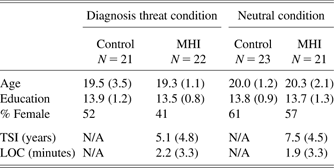
There were no significant main effects of Group, Instruction condition, or a Group × Instruction condition interaction on mean age or mean years of participants’ education (see Table 2 for means and SDs). Independent t tests showed that there were also no differences between “diagnosis threat” MHI and “neutral” MHI participants on time since injury, t(41) = −1.74, p > .05, or duration of unconsciousness, t(41) = 0.32, p > .05 (see Table 2).
Demographic characteristics
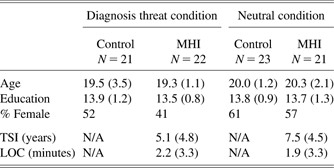
Note. MHI = mild head injury; TSI = time since injury; LOC = duration of loss of consciousness.
Self-report Measures
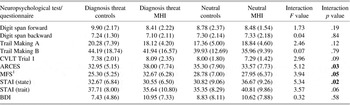
Table 3 shows the means for each measure across participant grouping.
Neuropsychological test and questionnaire results

Notes. Values represented are mean group scores (standard deviations in parentheses). Bold items indicate significant interactions. CVLT = California Verbal Learning Test; ARCES = Attention-related Cognitive Error Scale; MFS = Memory Failures Scale; STAI = State Trait Anxiety Inventory; BDI = Beck Depression Inventory.
1Once all participants completed the ‘diagnosis threat’ condition, they were emailed and asked to fill out an additional online questionnaire (the MFS). Only a subset of participants responded (MHI = 6; controls = 10). All participants in the ‘neutral’ condition completed the MFS.
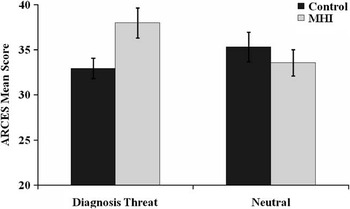
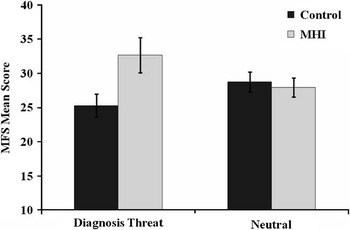
Although the main effects of Group and Instruction condition were not significant for responses to statements on the ARCES, a significant Group × Instruction condition interaction emerged, F(1,83) = 5.12, p = .03. In the “diagnosis threat” condition, MHI participants complained of more everyday attention failures compared with controls, t (15) = −2.37, p = .02 (see Figure 1). MHI participants in the “diagnosis threat” condition also reported more attention failures compared to MHI participants in the “neutral” condition, t(41) = 2.01, p = .05. No other group differences emerged. Similarly, scores on the MFS revealed a significant Group X Instruction condition interaction, F(1,57) = 3.94, p = .05. MHI participants reported higher numbers of everyday errors due to memory lapses compared to controls, and this difference was limited to those in the “diagnosis threat” condition, t(15) = −2.37, p = .03 (see Figure 2). No other group differences emerged, and the main effects were non-significant.
“Diagnosis threat” mild head injury (MHI) participants reported significantly more everyday attention-related cognitive errors compared to “diagnosis threat” control participants and “neutral” MHI participants on the Attention-related Cognitive Error Scale (ARCES). No other group differences were found.

“Diagnosis threat” mild head injury (MHI) participants reported significantly more everyday memory-related cognitive errors on Memory Failures Scale (MFS) compared to “diagnosis threat” control participants. No other group differences were found.

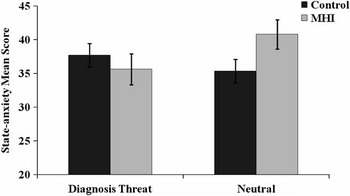
A significant Group × Instruction condition interaction was also detected on self-reported state anxiety levels, F(1,83) = 5.34, p = .02. Specifically, the “neutral” MHI group reported higher mean state anxiety scores compared to the “neutral” control group, t(42) = −2.11, p = .04 and compared to the “diagnosis threat” MHI group, t(41) = −2.52, p = .02 (see Figure 3). No other group differences emerged, and the main effects were non-significant. For the measure of trait anxiety, the interaction trended in the same direction, F(1,83) = 3.57, p = .06. Specifically, “neutral” MHI participants tended to report higher levels of trait anxiety compared to “neutral” controls, t(42) = −2.00, p = .05. There were no significant main effects or an interaction on BDI questionnaire responses.
“Neutral” mild head injury (MHI) participants reported significantly higher state anxiety levels compared to “neutral” control participants and compared to “diagnosis threat” MHI participants on the State Trait Anxiety Inventory (STAI). No other group differences were found.

Neuropsychological Task Measures
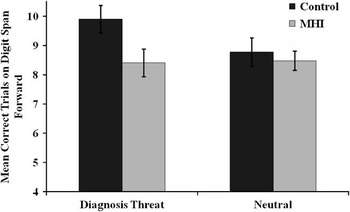
Table 3 shows the group means for each neuropsychological measure. There was a main effect of Group on Digit span forward performance, F(1,83) = 3.97, p = .05, such that, regardless of instruction type, control participants outperformed MHI participants (see Figure 4). Although the Group × Instruction condition interaction was not significant, F(1,83) = 1.73, p = .19, planned comparisons showed that controls outperformed MHI participants, t(41) = 2.24, p = .03, but only in the “diagnosis threat” condition.
Controls outperformed mild head injury (MHI) participants on the Digit span forward task, regardless of instruction type.

ANOVAs using data from the digit span backward, Trail making tests, and CVLT did not reveal any significant main effects or interactions.
Two separate 2 × 2 × 3 repeated measures ANOVAs were conducted to examine Stroop accuracy and median RT, with Group (control and MHI) and Instruction condition (“diagnosis threat” and “neutral”) as the between variables, and Trial Type (congruent, incongruent, and neutral) as the within variable. Using accuracy as the dependent variable, there were no significant main effects, and no 2-way or 3-way interactions. Using median RT as the dependent variable, the main effects and 3-way interaction did not even approach significance, although the 2-way Group × Instruction interaction was suggestive, F(1,83) = 1.07, p = .21. Specifically, MHI participants in the “diagnosis threat” condition had slower median RTs (M = 496.84 s; SD = 97.73) compared with MHI participants in the “neutral” condition (M = 448.49 s; SD = 84.10), t (41) = 1.74, p < .01.
Discussion
The key finding in this study is that the initial information provided to participants regarding the study's purpose influenced cognitive and affective self-report measures in individuals who sustained a MHI in their distant past. In line with our hypotheses, when informed that a MHI may result in persistent, but subtle, cognitive weaknesses (“diagnosis threat” instruction condition), individuals who sustained a past MHI reported significantly more attention-related errors in everyday life compared to non-head injured controls, and compared to MHI participants who were not exposed to the “diagnosis threat” instructions (“neutral” MHI group). Similarly, “diagnosis threat” MHI participants reported experiencing significantly more everyday memory failures compared to “diagnosis threat” controls. In contrast, no differences between MHI participants and controls emerged on these self-report measures, or on behavioral measures, when the study's purpose made no mention of MHI (“neutral” instruction condition). Importantly, there were no significant differences between the two control groups on any of the self-report or behavioral measures, confirming that both MHI groups were being compared to a similar control base rate. Notably, we found differences between control and MHI participants in the “neutral” condition in terms of anxiety levels: MHI participants reported experiencing higher levels of anxiety at the time of testing. “Neutral” MHI participants also reported higher state anxiety levels compared to “diagnosis threat” MHI participants.
With regard to cognitive performance, controls outperformed MHI participants on Digit span forward performance, regardless of instruction type. No other measure of neuropsychological functioning distinguished group performance, although Digit span forward and Stroop test performance showed trends suggesting that diagnosis threat may also impair attention span and slow information processing speed in MHI participants, respectively. Taken together, these results suggest that self-reports of everyday attention and memory functioning may be more susceptible to “diagnosis threat” than standard neuropsychological tests of memory and attention functioning. A novel aspect of the current study is that we not only examined the effect of diagnosis threat by manipulating instructions provided to MHI participants, but also compared these groups to their own age-, education-, and gender-matched controls. The addition of non-head-injured controls was essential as prior studies have found that even control performance may be negatively impacted by stereotype threat effects even though they are part of the “non-stereotyped” group (for a review, see Wheeler & Petty, Reference Wheeler and Petty2001). To our knowledge, this is the first study to show that non-head injured control performance was not negatively impacted by exposure to a MHI “diagnosis threat”.
The effect of “diagnosis threat” on self-reported attention- and memory-related cognitive errors in the present study is in line with past research demonstrating an underestimation of pre-injury symptoms by MHI participants compared to control base rates (Davis, Reference Davis2002; Gunstad & Suhr, Reference Gunstad and Suhr2001, Reference Gunstad and Suhr2004; Iverson et al., Reference Iverson, Lange, Brooks and Rennison2010; Lange et al., Reference Lange, Iverson and Rose2010; Mittenberg et al., Reference Mittenberg, DiGiulio, Perrin and Bass1992). We suggest that individuals who have sustained a MHI may attribute their present day cognitive errors to their past head injury, unlike non-head injured individuals, who perceive the same errors as normal everyday cognitive foibles. This “expectation” phenomenon is not unique to MHI, but rather is akin to the more general and widely-researched term, “suggestibility”. Suggestibility is an individual's proneness to accept new information while inhibiting critical judgment and has long been shown to have the power to both accelerate recovery, and worsen serious medical conditions (see Spiegel, Reference Spiegel1997 for review). We have shown that “suggestibility”, long after MHI, contributes to an increase in the frequency of self-report cognitive complaints. To our knowledge, ours is the first study to show that MHI individuals have higher levels of self-reported everyday attention and memory difficulties at least 6 months after the injury compared with non-head-injured controls, but only when they were informed of the possible negative effects head injury may have on cognitive performance.
The lack of significant differences between control and MHI participants on the majority of neuropsychological tests in this study is consistent with past reports. Standard neuropsychological tests often fail to detect deficits which distinguish individuals with a past MHI from non-head-injured controls (for meta-analyses, see Belanger et al., Reference Belanger, Curtiss, Demery, Lebowitz and Vanderploeg2005; Binder et al., Reference Binder, Rohling and Larrabee1997; Vanderploeg et al., Reference Vanderploeg, Curtiss and Belanger2005). We did, however, find that MHI participants had lower Digit span forward scores, a measure of attention span, compared to controls, which is in line with some other studies reporting neuropsychological deficits on attention tasks at least three months after MHI (Bernstein, Reference Bernstein2002; Chan, Reference Chan2002; Potter et al., Reference Potter, Jory, Bassett, Barrett and Mychalkiw2002; Solbakk et al., Reference Solbakk, Reinvang, Neilsen and Sundet1999; Vanderploeg et al., Reference Vanderploeg, Curtiss and Belanger2005). It is unclear, however, whether these are affected by diagnosis threat. Suhr and Gunstad (Reference Suhr and Gunstad2002, Reference Suhr and Gunstad2005) found that MHI participants exposed to the “diagnosis threat” had larger decrements in attention and psychomotor speed compared to MHI participants in their “neutral” condition. Psychomotor speed in our study was slower in “diagnosis threat” MHI participants than in “neutral” MHI participants on the Stroop Task, and they also showed lower Digit span scores than their controls, although our conclusions are limited by our relatively small sample size. Inconsistencies in detection of neuropsychological deficits following MHI, in the extant literature, may be a result of the heterogeneity of the MHI population being examined across studies, including, but not limited to, individual differences in time since injury, cause of injury, and MHI criteria used by researchers. It is important to keep in mind that we relied on self-report measures of MHIs in university students. Thus, we tested high-functioning young adults with head injuries that are arguably on the very mild end of the severity scale (i.e., average duration of LOC was approximately 2 min; see Table 1), which may have contributed to the lack of significant neuropsychological test findings.
Although persistent neuropsychological deficits may be present long after sustaining a single MHI (Bernstein, Reference Bernstein2002; Chan, Reference Chan2002; Potter et al., Reference Potter, Jory, Bassett, Barrett and Mychalkiw2002; Solbakk et al., Reference Solbakk, Reinvang, Neilsen and Sundet1999; Vanderploeg et al., Reference Vanderploeg, Curtiss and Belanger2005), they may be less frequent and more subtle than subjective reports. Consequently, these subtle cognitive weaknesses may only be detected by experimental paradigms that heavily tax cognitive processing resources, such as divided attention tasks (Bernstein, Reference Bernstein2002; Cicerone, Reference Cicerone1996; Pare, Rabin, Fogel, & Pepin, Reference Pare, Rabin, Fogel and Pepin2008), or through the use of neuroimaging techniques. For example, functional magnetic resonance imaging (fMRI) has shown increased neural activation in MHI participants during working memory tasks compared to non head-injured controls (McAllister et al., Reference McAllister, Saykin, Flashman, Sparling, Johnson, Guerin and Yanofsky1999, Reference McAllister, Sparling, Flashman, Guerin, Mamourian and Saykin2001; Zhang, Johnson, Pennell, & Ray, Reference Zhang, Johnson, Pennell and Ray2010), and this increase in activation has been shown to positively correlate with severity of post-concussion symptom reports (Smits et al., Reference Smits, Dippel, Houston, Wielopolski, Koudstaal, Hunink and Lugt2009). Diffusion tensor imaging (DTI) is a more recent advancement that is being used to examine the effect of a MHI on the white matter integrity. Messe and colleagues (Reference Messe, Caplain, Paradot, Garrigue, Mineo, Ares and Lehericy2010) have shown that individuals with post concussive syndrome (PCS; increased complaints beyond 3 months in cognitive, emotional, and somatic domains) had disruptions of long white matter tracts involved in various aspects of cognitive functioning compared to MHI individuals without PCS and non head-injured controls. The extent of damage has been reported to correlate with slower information processing speeds on a simple attention task (Niogi & Mukherjee, Reference Niogi and Mukherjee2008). Together these imaging studies show that MHI may result in alterations in neural functioning without affecting behavioral performance. Moreover, cognitive weaknesses may be difficult to detect in these populations because of cognitive reserve—unaffected brain areas become active to compensate for the damaged areas. Such compensation likely prevents significant cognitive decrements in individuals with a past MHI, but may result in increased complaints (i.e., everyday slips of action due to memory and attention lapses) due to less efficient neural processing on a daily basis.
A finding unique to this study was that state anxiety measures were heightened in “neutral” MHI participants compared to their matched “neutral” controls, but no such differences were found between MHI and control groups in the “diagnosis threat” condition. As well, “neutral” MHI participants reported higher levels of state anxiety compared to “diagnosis threat” MHI participants. Prior studies have also found increased levels of self-reported anxiety (Dischinger et al., Reference Dischinger, Ryb, Kufera and Auman2009; Westcott & Alfano, Reference Westcott and Alfano2005) and increased prevalence of anxiety-related disorders (Mooney & Speed, Reference Mooney and Speed2001) long after MHI. This study adds to that literature in that higher anxiety levels were reported by high-functioning undergraduate students with a MHI following the completion of a neuropsychological test battery, but only when they were unaware the effects of their head injury were being investigated. Other research shows that MHI may interrupt neural pathways important for regulating emotional states. For example, brain areas implicated in post traumatic stress disorder (PTSD) have shown to overlap with those affected by MHI; the orbitofrontal and dorsolateral cortex and hippocampus (Stein & McAllister, Reference Stein and McAllister2009).
Our study suggests that “diagnosis threat” may differentially affect emotional and cognitive processing. Group differences in self-report anxiety levels may have been undetected in the “diagnosis threat” condition because the “diagnosis threat” Information letter acted as justification for participants’ perceived poor performance. Feelings of anxiety may have been obscured by the expectation, for MHI participants, to show cognitive weaknesses. In other words, if individuals are explicitly reassured that they may show subtle cognitive deficits on these specific tasks due to their previous head injury, anxiety may be temporarily decreased. On the other hand, if MHI individuals are not provided with reassurance before cognitive task completion (“neutral” MHI group), reported anxiety levels may be elevated, and more representative of everyday levels, compared to the “diagnosis threat” MHI group and non-head-injured “neutral” controls.
The current study emphasizes that in addition to litigation, effort, malingering, psychosocial and pre-existing factors, “diagnosis threat” is another variable that should be considered when assessing cognitive status in MHI participants. In a recent report, Iverson, Zasler, and Lange (Reference Iverson, Zasler, Lange, Zasler, Katz and Zafonte2007) compared effect sizes of common variables from meta-analytic studies that influence neuropsychological functioning and found that MHI had the smallest effect size (d = −0.12) on neuropsychological performance, followed by diagnosis threat (d = −0.45), litigation (d = 0.48), depression (d = −0.49), and malingering (d = −1.1). It is important to emphasize that “diagnosis threat” studies (Suhr & Gunstad, Reference Suhr and Gunstad2002, Reference Suhr and Gunstad2005), including the current one, demonstrate the negative impact of “diagnosis threat” on cognitive performance in high-functioning undergraduate students who self-reported a prior MHI, for which the main motivation to participate was extra class credit. Thus, “diagnosis threat” may be even more apparent in participants examined in the majority of the MHI literature, as most are recruited from hospital emergency departments or neuropsychologists’ databases. Future research should continue to investigate the negative effects of suggestion/expectation on cognitive and affective functioning long-after MHI using self-report measures, sensitive behavioral tasks, and neuroimaging techniques.
Acknowledgments
This research was supported by a Discovery grant from the National Sciences and Engineering Research Council of Canada (NSERC) awarded to Dr. M.A. Fernandes and post-graduate scholarships from NSERC awarded to L.J. Ozen.
Appendix 1

Appendix 2

Appendix 3

1From Consciousness and Cognition, 17, Carriere, J. S. A., Cheyne, J., & Smilek., D., Everyday attention lapses and memory failures: The affective consequences of mindlessness, 835-847, 2008, with permission from Elsevier.