The United States is the third largest onion producing country, accounting for 1.6% of the world onion hectares and over 4% of world onion production (National Onion Association 2011). Weed control is a critical component of successful onion production. Numerous studies have documented the poor competitive ability of onion (Bond and Burston Reference Bond and Burston1996; Dunan et al. Reference Dunan, Westra, Schweizer, Lybecker and Moore1996; Menges and Tamez Reference Menges and Tamez1981; Wicks et al. Reference Wicks, Johnston, Nuland and Kinbacher1973; Williams et al. Reference Williams, Ransom and Thompson2007). If weeds are allowed to compete with onion even for a short period of time or at a low density, onion yields may be reduced. If weeds are allowed to persist for the entire season, onion yield may be reduced 96% to 100% (Bond and Burston Reference Bond and Burston1996; Wicks et al. Reference Wicks, Johnston, Nuland and Kinbacher1973).
Onions are grown on 2,000 hectares in Michigan, which ranks 11th among US states in total onion hectares (National Onion Association 2011). Most Michigan onions are grown on high organic matter soils—those which have over 10% organic matter. Onions are direct-seeded in April and May, and harvested in August, September, and October (Zandstra et al. Reference Zandstra, Grafius, Lacy and Warncke1996). Onions do not develop sufficient crop canopy to suppress weed growth, so growers must maintain complete weed control throughout the season with herbicides, cultivation, and hand weeding (Dunan et al. Reference Dunan, Westra, Schweizer, Lybecker and Moore1996, Schumacher and Hatterman-Valenti Reference Schumacher and Hatterman-Valenti2007). Cultivation is most effective early in the season, as onions are shallow-rooted and can be displaced by later cultivation. Labor for hand-weeding is expensive and may be difficult to acquire (Fennimore and Doohan Reference Fennimore and Doohan2008).
Historically, few herbicides have been labeled for use in dry bulb onion. Allidochlor [CDAA; 2-chloro-N,N-bis(prop-2-enyl)acetamide] and chlorpropham were at one time labeled for PRE weed control in onion, but their registrations in the United States have been cancelled for over two decades. Propachlor was used in some states under a Section 18 emergency label, but never received full Environmental Protection Agency registration. For many years, DCPA and pendimethalin have been the only herbicides labeled for PRE weed control after onions have been seeded. The high cost and inconsistent efficacy of DCPA make its use uneconomical in many instances (Dunan et al. Reference Dunan, Westra, Moore and Chapman1995), and it is not effective in high organic matter soils.
Bromoxynil and oxyfluorfen were the only herbicides labeled for POST broadleaf weed control in onion for many years (Cudney and Orloff Reference Cudney and Orloff1988), labeled for application to onion at the two leaf stage (LS) or later (Schumacher and Hatterman-Valenti Reference Schumacher and Hatterman-Valenti2007; Williams et al. Reference Williams, Ransom and Thompson2007). However, by the time onion develops its second true leaf, weeds often have gained a competitive advantage over onion (Loken and Hatterman-Valenti Reference Loken and Hatterman-Valenti2010). Research has demonstrated that weeds allowed to compete with onion for as few as two weeks can cause a 20% yield reduction (Wicks et al. Reference Wicks, Johnston, Nuland and Kinbacher1973). Furthermore, the ability to achieve good POST weed control with bromoxynil or oxyfluorfen diminishes as weeds become larger, and the higher herbicide rates required to improve weed control may cause serious injury to onion (Loken and Hatterman-Valenti Reference Loken and Hatterman-Valenti2010).
In recent years, several additional herbicides have been registered for use in onion. These herbicides may provide enhanced crop safety, broader weed control, and allow earlier application timing. A microencapsulated, water-dispersible formulation of pendimethalin has been developed, and research has demonstrated improved crop tolerance with the new formulation (Hatzinikolaou et al. Reference Hatzinikolaou, Eleftherohorinos and Vasilakoglou2004). S-metolachlor and dimethenamid-P are labeled for application to established onion at the two-LS and provide some PRE control of yellow nutsedge, a serious weed in onion for which there are no effective POST herbicides registered (Keeling et al. Reference Keeling, Bender and Abernathy1990). Ethofumesate and flumioxazin provide PRE and POST control of several weeds, and both herbicides are now labeled for onion (Zandstra Reference Zandstra2014). Fluroxypyr is labeled for use in onion in several states and provides POST control of volunteer potato (Solanum tuberosum L.) and several other broadleaf weeds (Boydston and Seymour Reference Boydston and Seymour2002).
Oxyfluorfen is a protoporphyrinogen oxidase inhibitor that provides good POST control of many broadleaf weeds, and has been labeled for application to onions with two or more true leaves. For many years oxyfluorfen was formulated as an emulsifiable concentrate (EC). Oxyfluorfen is now also formulated as a water-based suspension concentrate (SC), and improved crop tolerance over the EC form has been demonstrated in several vegetable crops, including onion (Richardson et al. Reference Richardson, Mueller, Yoshida, Gast and Dorich2006). Oxyfluorfen has been the primary POST broadleaf weed control herbicide in onion for about 30 yr. A recent Special Local Needs label (Anonymous 2014) allows application of the oxyfluorfen SC formulation at the onion one-LS in Michigan; several other states have similar special local needs labels.
Flumioxazin is a protoporphyrinogen oxidase inhibitor that was labeled in 2007 for over-the-top application to onions at the three- to six-LS for residual control of several weed species. Flumioxazin also has POST activity. Flumioxazin may cause onion injury if tank-mixed with other pesticides or surfactants, and applying flumioxazin alone increases the number of pesticide applications during the growing season (Norsworthy et al. Reference Norsworthy, Smith and Meister2007). The labeled application timing is the three- to six-LS, a relatively short period of time (about 3 wk) considering that many onion varieties require over 100 d to reach maturity. Postemergence application prior to the onion three-LS is needed to achieve good burndown control of emerged weeds and to prevent new weed emergence (Qasem Reference Qasem2005). To maximize the effectiveness of flumioxazin as part of an onion weed control program, a thorough assessment is needed to determine usage patterns for flumioxazin, including application timing and tank-mix compatibility with other herbicides.
Bentazon has been studied previously for POST weed control in onion, but has not been labeled for use in onion in the United States due to crop injury concerns (Ghosheh Reference Ghosheh2004; Keeling et al.Reference Keeling, Bender and Abernathy1990). No herbicides labeled for onion provide sufficient POST control of yellow nutsedge. Keeling (Reference Keeling, Bender and Abernathy1990) applied bentazon at 0.8 kg ai ha−1 to transplanted onions 5 to 6 wk after transplanting, when onions had 10 true leaves and yellow nutsedge was approximately 7.5 cm tall, over the course of two years. There was no significant onion injury or yield loss in either year. However, yellow nutsedge control varied by year, from 35% to 80%. Ghosheh (Reference Ghosheh2004) found that set-grown onions treated with bentazon at 0.75 kg ai ha−1 at the three- to four-LS were stunted 5 wk after treatment, and yields were reduced significantly compared to a hand-weeded control. Other researchers have reported variable response of onion and yellow nutsedge to bentazon application (Peachey et al. Reference Peachey, Felix and Boydston2008; Smith Reference Smith2007). It may be possible to achieve bentazon selectivity in onion, but additional research is needed to optimize application rate and timing.
The objectives of this research were to evaluate the impact of application rate and timing, and the tank-mix compatibility, of POST herbicides on weed control efficacy, crop injury, and yield in direct-seeded dry bulb onion grown on high organic-matter soil.
Materials and Methods
Field experiments were conducted in 2008 at the Michigan State University Muck Research Station in Laingsburg, Michigan. The soil at Laingsburg was a Houghton muck (euic, mesic Typic Medisaprist) containing 76% organic matter, with a pH of 6.7.
The onions were direct-seeded on April 30, 2008. Plots were 1.7 m wide by 7.6 m long, with three single rows of onion spaced 41 cm apart, and an in-row spacing of 2 cm, to achieve a final population of approximately 620,000 plants ha−1. Each plot for the flumioxazin and oxyfluorfen experiments contained one row of each of the following hybrid onion varieties: ‘Festival’, ‘Santana’, and ‘Sherman’ (all from Bejo Seeds, Inc., 1972 Silver Spur Place, Oceano, CA 93445). The experimental design was a randomized complete block with four replications. The varieties in each plot were not randomized. Within 10 d of seeding and prior to onion emergence, all plots were treated with a broadcast application of pendimethalin ACS at 2.2 kg ai ha−1 for PRE weed control plus bromoxynil at 0.3 kg ai ha−1 for POST control of emerged broadleaf weeds. This is a standard practice for Michigan onion production on high-organic soils (Zandstra et al. Reference Zandstra, Grafius, Lacy and Warncke1996). Fertilizers, insecticides, and fungicides were applied to all plots according to recommended Michigan crop production practices (Zandstra et al. Reference Zandstra, Grafius, Lacy and Warncke1996). Herbicide applications were made with a CO2-pressurized backpack sprayer calibrated to deliver 187 L ha−1 at 210 kPa using a boom with four 8002 flat-fan nozzles (Teejet® 8002, Spraying Systems Co., P.O. Box 7900, Wheaton, Illinois 60189) spaced at 40 cm for a total width of 160 cm.
In 2010, oxyfluorfen and flumioxazin experiments were conducted in a commercial onion field in Bath, Michigan on Houghton muck (euic, mesic Typic Medisaprist) containing 77% organic matter, and with a pH of 6.6. Plots in Bath were 1.7 m wide by 7.6 m long, and were planted with two double rows of the hybrid onion variety ‘Pulsar’ (Stokes Seeds, Inc., P.O. Box 548, Buffalo, NY 14240) on April 15, 2010, to achieve a final population of approximately 620,000 plants ha−1. Although the row spacing was different at the two locations, the plant population per hectare at each site was similar. Experimental design and herbicide application procedures were the same as those described for the Laingsburg location. The predominant weed species at both locations were common lambsquarters, ladysthumb, and redroot pigweed. The Laingsburg site also had hairy nightshade and yellow nutsedge.
Visual estimates of crop injury and weed control by species were recorded approximately 7 to 10 d after the initial POST herbicide application. The data for the first ratings are presented. Data for plant height, leaf number, and stand counts were averaged across the three varieties at the Laingsburg site for analysis. Visual ratings of crop and weed injury used a scale of 0% to 100%, with 0% indicating no injury or control, and 100% indicating complete plant death. Our rating system used a subjective percentage rating (0%, 10%, 20%, 30%, etc.) based on number, size, and vigor of the weeds and crop plants. This sometimes resulted in untreated plots having better control than the treated plots. Prior to harvest, the onions within a 3-m section of each row were counted. The entire plot length of 7.6 m in Laingsburg and the middle 5 m of each plot in Bath were harvested. Onions were pulled by hand, and the tops were removed with a roll topper. Yields were measured separately for each variety at crop maturity, and combined for statistical analysis of total yield per plot. The onions were not sorted by size or quality. Yields were converted to kg ha−1 for presentation.
Ratings and plant data for the three hybrids were averaged, and yields were totaled for each plot. Crop injury and weed control rating data were arcsine square-root transformed prior to analysis to stabilize variances. Data were subjected to ANOVA using the MIXED procedure of SAS® version 9.4 (SAS Institute Inc., 100 SAS Campus Dr., Cary, NC 27513).
Oxyfluorfen Experiment
Experiments were conducted to determine onion and weed responses to the EC and SC formulations of oxyfluorfen. Treatments in the oxyfluorfen experiment were arranged as a two-by-four-by-two factorial, in a randomized complete block design with four replications at Laingsburg, Michigan in 2008 and Bath, Michigan in 2010. Onions were planted on April 30, 2008 and April 15, 2010. Oxyfluorfen EC (Goal® 2XL, Dow AgroSciences, Indianapolis, IN) and oxyfluorfen SC (GoalTender®, Dow AgroSciences) were each evaluated at four rates of application (0.035, 0.071, 0.14, and 0.21 kg ai ha−1), for eight total herbicide treatments. Each combination of formulation and rate was applied first at the onion two-LS and reapplied at the four-LS. A hand-weeded control was included in the experiment for comparison, but was not included in the statistical analysis. Weed control was assessed 9 wk after planting (WAP) in 2008 and 10 WAP in 2010.
Flumioxazin Experiment
Another series of experiments was conducted to determine potential tank-mix partners for flumioxazin. The flumioxazin experiment included three rates of flumioxazin, 0, 0.036, and 0.072 kg ai ha−1; and five tank-mix treatments, flumioxazin with pendimethalin ACS, pendimethalin EC, S-metolachlor, or dimethenamid-P, at their labeled rates, or flumioxazin alone. These treatments were arranged as a three-by-five factorial randomized complete block experimental design, with four replications, at Laingsburg, Michigan in 2008 and Bath, Michigan in 2010. Onions were planted on April 30, 2008 and April 15, 2010. Treatments were applied to onions at the two-LS and again at the four-LS. In addition to the general data collection described above, height and leaf number for 10 randomly selected onion plants in each plot were recorded 8 WAP. Weed control was assessed 9 WAP in 2008 and 10 WAP in 2010.
Bentazon Experiment
Experiments were conducted at Laingsburg in 2008 and 2010 to determine onion safety with bentazon applied POST. The hybrid onion varieties ‘Highlander’ (American Takii, Inc., 301 Natividad Road, Salinas, CA 93906), ‘Nebula’ (Sunseeds-Nunhems USA, Inc., 1200 Anderson Corner Rd, Parma, ID 83660), and ‘T-439’ (American Takii, Inc.) were planted on April 30, 2008 and May 4, 2010. Treatments in the bentazon experiment were arranged in a randomized complete block design with four replications. Bentazon was applied at 0.56 or 1.12 kg ai ha−1, and some treatments included a surfactant or oxyfluorfen in the tank mix. In 2008, sequential applications of each treatment were applied at the onion two- and four-LS. The onion two-LS coincided with yellow nutsedge emergence. Due to excessive onion injury, stand thinning, and yield reduction after treatment at the two-LS in 2008, treatments were added to the experiment in 2010 to compare sequential application of bentazon beginning at the two-LS or three-LS, followed by a repeat application at the four-LS. A hand-weeded control was used for comparison. Weed control was assessed at 9 WAP in 2008 and at 12 WAP in 2010.
Results and Discussion
Because of experimental differences between locations, data for Laingsburg and Bath are presented separately for the oxyfluorfen and flumioxazin experiments. In the bentazon experiments there were significant year by treatment interactions at Laingsburg for the 2008 and 2010 seasons. Therefore, data for each year in Laingsburg are presented separately.
Oxyfluorfen Experiment
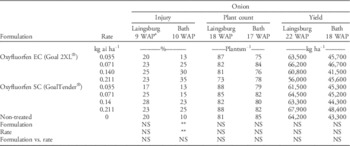
At Bath, the EC formulation caused more onion foliar injury than did the SC formulation (Table 1). The higher oxyfluorfen rates (0.140 and 0.211 kg ai ha−1) of both formulations caused more foliar injury than did the lower rates. There was no difference in onion plant count for oxyfluorfen formulation or rate at either location. There was also no difference in onion yield between the oxyfluorfen formulations or rates at either location. Overall, onions responded similarly to the two formulations of oxyfluorfen.
The effect on onions of two formulations and four rates of oxyfluorfen at Laingsburg, Michigan in 2008 and Bath, Michigan in 2010.

a Abbreviations: NS, not significant; WAP, weeks after planting; *, P≤0.05; **, P≤0.01.
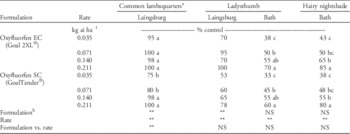
The EC formulation sometimes was more effective against weeds than the SC formulation (Table 2). The EC formulation provided over 95% control of common lambsquarters at all rates. The SC formulation provided 75% and 80% control at 0.035 and 0.071 kg ai ha−1, respectively, while the higher rates provided 98% and 100% control. Ladysthumb was more difficult to control with both formulations. The EC formulation reached 100% control of ladysthumb at Laingsburg in 2008 with 0.211 kg ai ha−1, but the SC formulation did not exceed 78% control with any rate. At Bath in 2010, the two formulations performed similarly on ladysthumb, with neither providing more than 70% control. The two formulations controlled hairy nightshade at Bath in 2010, and control improved as rate increased.
Weed control with two formulations and four rates of oxyfluorfen at Laingsburg, Michigan in 2008 and Bath, Michigan in 2010.

a Values followed by the same letter are not significantly different than others within that column. Mean separation is based on the highest level significant interaction effect. Where interactions were not significant, letters represent mean separation based on significant main effects.
b Abbreviations: NS, not significant; *, P≤0.05; **, P≤0.01.
Flumioxazin Experiment
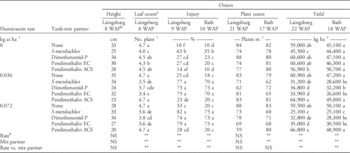
In the flumioxazin experiment, there was no difference in onion plant height between herbicide treatments at Laingsburg in 2008 (Table 3), indicating that if plants survived the herbicide applications, they grew normally. The number of leaves per plant was reduced when flumioxazin was tank-mixed with S-metolachlor, dimethenamid-P, or pendimethalin EC.
The effect on onions of three rates of flumioxazin with five tank-mix partners, applied POST at the two- and four-leaf stages at Laingsburg, Michigan in 2008 and Bath, Michigan in 2010.

a Values followed by the same letter are not significantly different than others within that column. Mean separation is based on the highest level significant interaction effect. Where interactions were not significant, letters represent mean separation based on significant main effects.
b Abbreviations: NS, not significant; WAP, weeks after planting; *, P≤0.05; **, P≤0.01.
Flumioxazin applied alone always caused some foliar injury to onions, up to 33% at the high application rate. Onion visual injury was similar when flumioxazin was applied alone or in tank mixes with pendimethalin ACS. Onion injury increased when flumioxazin was applied with S-metolachlor, dimethenamid-P, or pendimethalin EC. Injury was in the 70% to 80% range for all these tank-mix partners. There was a significant interaction between flumioxazin rate and tank-mix partner for foliar injury, probably as a result of higher injury with S-metolachlor alone without flumioxazin.
There was no difference in onion plant counts at Laingsburg in 2008. In Bath in 2010, there was significant stand reduction in onions treated with flumioxazin combinations with S-metolachlor, dimethenamid-P, or pendimethalin EC. For all crop response measurements, flumioxazin with pendimethalin ACS was similar to flumioxazin applied alone. There was a significant flumioxazin rate and mix partner response for yield. When there was no mix partner, or the mix partner was pendimethalin ACS, yields were higher than treatments with other mix partners, and yields increased slightly as flumioxazin rate increased. The improved weed control with flumioxazin probably contributed to the increases in yield in those treatments. When flumioxazin was combined with S-metolachlor, dimethenamid-P, or pendimethalin EC, yields were reduced as flumioxazin rate increased. There was a significant rate by mix partner interaction at both Laingsburg and Bath, with the S-metolachlor combination causing greater yield reduction at most flumioxazin rates and both locations.
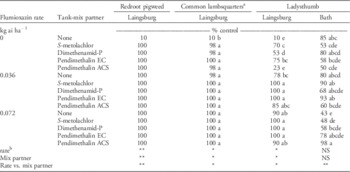
All herbicide applications provided excellent control of redroot pigweed (Table 4).
Weed control with three rates of flumioxazin with five tank-mix partners applied POST at the two- and four-leaf stages of onion at Laingsburg, Michigan in 2008 and Bath, Michigan in 2010.

a Values followed by the same letter are not significantly different than others within that column. Mean separation is based on the highest level significant interaction effect. Where interactions were not significant, letters represent mean separation based on significant main effects.
b Abbreviations: NS, not significant; *, P≤0.05; **, P≤0.01.
Flumioxazin controlled common lambsquarters 90% to 98% at Laingsburg when applied alone. The tank-mix partners contributed to a high level of common lambsquarters control. Ladysthumb was more difficult to control. At 0.036 or 0.072 kg ai ha−1, flumioxazin plus S-metolachlor, dimethenamid-P, or pendimethalin EC provided 100% control at Laingsburg in 2008. Flumioxazin plus pendimethalin ACS was slightly less effective, providing 85% to 90% control. At Bath in 2010, ladysthumb was not as well-controlled as it was in the other years and locations, but in general the presence of tank-mix partners improved ladysthumb control. Ladysthumb was not uniformly distributed in plots at Bath, and the control data were somewhat variable. Control of ladysthumb with the 0.072 kg ai ha−1 rate of flumioxazin alone (43%) was actually lower than the control achieved with the 0.036 kg ai ha−1 rate of flumioxazin (80%) and the no herbicide control (85%), making it difficult to draw conclusions from the ladysthumb control results at Bath. However, ladysthumb is a serious weed in onion and has been difficult to control with PRE and POST herbicides. While flumioxazin is not totally effective against ladysthumb, it appears to improve control.
Bentazon Experiment
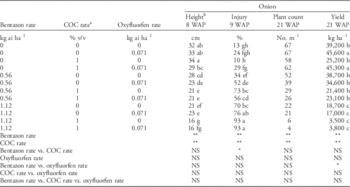
In 2008, bentazon application resulted in reduced onion height, reduced onion stand, and greater foliar injury (Table 5). Adding 0.071 kg ai ha−1 oxyfluorfen SC to bentazon at both rates tested increased onion injury and decreased yield, though results were not significantly different from bentazon alone. The addition of crop oil concentrate (COC) at the 1.12 kg ai ha−1 rate increased onion injury and decreased onion plant counts, height, and yield. Bentazon caused significant onion yield reduction at the 1.12 kg ai ha−1 rate. Bentazon at the 0.56 kg ai ha−1 rate had a yield similar to that of the untreated controls. The highest yields (45,300 and 45,600 kg ha−1) in this experiment were obtained with 0.071 kg ai ha−1 oxyfluorfen treatments as a result of good weed control and only moderate onion injury. Since all plots were hand-weeded after final ratings, the untreated plots had fair yields (25,200 and 39,200 kg ha−1).
The effects on onion growth and yield of three rates of bentazon, two adjuvant rates, and two oxyfluorfen rates at Laingsburg, Michigan in 2008.

a Abbreviations: COC, crop oil concentrate; NS, not significant; WAP, weeks after planting; *, P≤0.05; **, P≤0.01.
b Values followed by the same letter are not significantly different than others within that column. Mean separation is based on the highest level significant interaction effect. Where interactions were not significant, letters represent mean separation based on significant main effects.
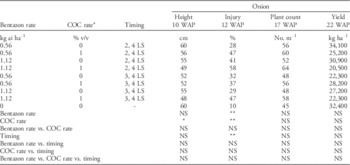
In 2010, bentazon did not reduce onion plant height at either rate or timing tested (Table 6). However, addition of COC to bentazon reduced onion plant height slightly. Bentazon caused more onion foliar injury when treatment began at the onion two-LS than when treatment began at the onion three-LS, but yield was not reduced by treatments at either stage. There was no difference between treatments in live plant counts. The addition of COC to bentazon usually resulted in greater onion visual injury.
The effects on onion growth and yield of three rates of bentazon, two adjuvant rates, and two application timings at Laingsburg, Michigan in 2010.

a Abbreviations: COC, crop oil concentrate; LS, onion leaf stage; NS, not significant; WAP, weeks after planting; *, P≤0.05; **, P≤0.01.
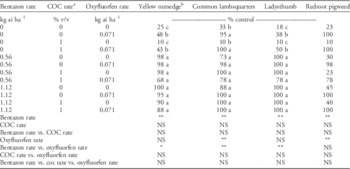
In 2008, bentazon improved control of yellow nutsedge compared to no treatment (Table 7). Addition of oxyfluorfen SC or COC to bentazon had no effect on yellow nutsedge control. All bentazon treatments, with or without COC, provided over 68% yellow nutsedge control. Bentazon and oxyfluorfen provided good common lambsquarters control. All combinations of bentazon and oxyfluorfen resulted in 100% control of ladysthumb, except for the lowest bentazon rate plus COC and oxyfluorfen, for which control was 78%. Bentazon did not provide sufficient control of redroot pigweed. Oxyfluorfen at 0.071 kg ai ha−1 provided 98% or more control of redroot pigweed.
Weed control with three rates of bentazon, two adjuvant rates, and two oxyfluorfen rates at Laingsburg, Michigan in 2008.

a Abbreviations: COC, crop oil concentrate; NS, not significant; *, P≤0.05; **, P≤0.01.
b Values followed by the same letter are not significantly different than others within that column. Mean separation is based on the highest level significant interaction effect. Where interactions were not significant, letters represent mean separation based on significant main effects.
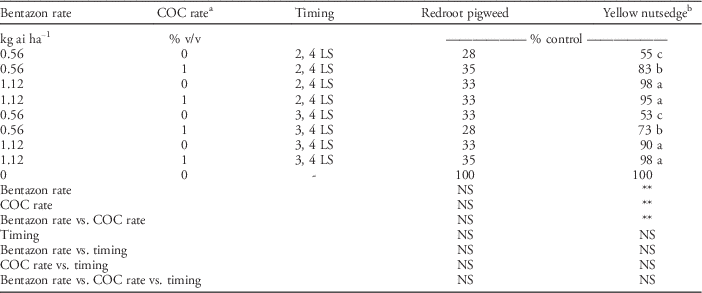
In 2010, bentazon applied with COC provided good yellow nutsedge control at all rates and timings tested (Table 8). The addition of COC improved yellow nutsedge control at the lower rate at both timings. At the higher bentazon rate, the addition of COC did not improve yellow nutsedge control. None of the bentazon treatments controlled redroot pigweed sufficiently. The untreated control had all weeds of both species removed by hand.
Weed control with three rates of bentazon, two adjuvant rates, and two application timings at Laingsburg, Michigan in 2010.

a Abbreviations: COC, crop oil concentrate; LS, onion leaf stage; NS, not significant; *, P≤0.05; **, P≤0.01.
b Values followed by the same letter are not significantly different than others within that column. Mean separation is based on the highest level significant interaction effect. Where interactions were not significant, letters represent mean separation based on significant main effects.
Other researchers have reported that environmental conditions may affect bentazon phytotoxicity in onion (Peachey et al. Reference Peachey, Felix and Boydston2008). While there may be situations where bentazon could be used safely in onion, the potential for onion injury remains a barrier to its registration.
Several effective and safe PRE and POST herbicides are registered for application to onion in the United States. However, some weeds remain difficult to control, e.g., yellow nutsedge and ladysthumb. In the current studies, the use of the aqueous formulation of oxyfluorfen (GoalTender® 4 SC) improved onion crop safety, but did not consistently control weeds. Our results indicate that while oxyfluorfen EC causes slightly higher visual injury on onion, yields are not reduced at normal use rates. If weeds are large or difficult to control, oxyfluorfen EC may be applied to improve weed control. In the studies reported here, oxyfluorfen EC improved ladysthumb control in some situations. In most field situations, oxyfluorfen SC is preferable because it has less potential to cause onion foliar injury.
Flumioxazin has been an important addition to the group of herbicides available for use in onion, particularly for the control of several difficult-to-control weeds such as common lambsquarters, ladysthumb, nightshades, and redroot pigweed. Other weeds that are controlled by flumioxazin in onion include common chickweed [Stellaria media (L.) Vill.], shepherd’s-purse [Capsella bursa-pastoris (L.) Medik.], and spotted spurge [Chamaesyce maculata (L.) Small] (Zandstra Reference Zandstra2014). The flumioxazin label restriction on tank mixes with other herbicides is based on potential adverse interactions, which may increase onion foliar injury and reduce stand. Our results indicate that flumioxazin should not be tank-mixed with an EC formulation of other herbicides, but that mixtures with the ACS formulation of pendimethalin are safe on onion. This is the only tank mix allowed by the flumioxazin label. Flumioxazin is marketed as a PRE herbicide applied after the onion three-LS. However, it has good POST activity on small weeds at the rates labeled for onion. The use of flumioxazin improved ladysthumb control in most situations.
Bentazon has been tested on onions previously, and results indicate marginal crop safety. Because of its activity on yellow nutsedge, onion growers continue to have interest in bentazon use. The problem, as demonstrated by our results, is that bentazon safety on onion is inconsistent, and its use can sometimes result in serious yield losses. Onions are more tolerant of bentazon when they are at the three-LS than when they are at the two-LS, but there is still too much potential crop injury. Typically, by the onion three-LS, yellow nutsedge has become well-established and is very difficult to control with bentazon. Unfortunately, this leaves onion growers with only S-metolachlor and dimethenamid-P for PRE suppression of yellow nutsedge, and no effective and safe options for POST yellow nutsedge control.
Acknowledgements
This project was supported by the US Department of Agriculture National Institute of Food and Agriculture (NIFA Hatch project number MICL01325) and by the Michigan State University Extension.