Introduction and motivation
It has been recognized for over half a century that solid electrolytes can offer a number of advantages over their liquid electrolyte counterparts in terms of stability, safety, and scalability.[ Reference Mrgudich 1 , Reference Takada 2 ] Lithium lanthanum titanate (LLTO) with a double-perovskite structure is a promising candidate for solid electrolyte applications due to its fast Li-ion conductivity, which is measured to be 10−3 S/cm in single-crystal LLTO at room temperature.[ Reference Inaguma, Liquan and Itoh 3 ] However, in practice, Li-ion conductivity in LLTO is about two orders of magnitude lower than the bulk measured and computed values due to high grain boundary (GB) resistance.[ Reference Inaguma, Liquan and Itoh 3 – Reference Mei, Wang, Feng, Zhao, Li, Geng, Lin and Nan 5 ]
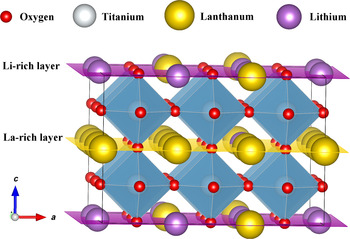
In the perovskite structure of LLTO, Li-ions, La-ions, and vacancies each occupy a fraction of the A-sites, while Ti atoms occupy the B-sites and are coordinated by 6 O atoms in octahedral geometry. Under certain processing conditions, alternating La- and Li-rich layers stack along the c-direction of the system, yielding the double-perovskite structure, as illustrated in Fig. 1. (Fig. 1 and all atomic structures throughout this document were visualized with the VESTA program.[ Reference Momma and Izumi 6 ]) The fast ionic conduction observed in LLTO occurs along the Li-rich layers of this superlattice, which contains the majority of both the vacancies and the Li-ions in the structure. The lowest energy position of Li-ions in this system is in the bottleneck of the TiO6 octahedra, rather than at the center of the A-sites.[ Reference Cheng, Bi, Huq, Feygenson, Bridges, Paranthaman and Sumpter 7 , Reference Qian, Xu, Cho, Hatsukade, Carroll and Meng 8 ]
Example double-perovskite structure of bulk LLTO (purple = Li, gold = La, white = Ti, red = O; the faces of the TiO6 octahedra are tinted blue for clarity). Li-ions, La-ions, and vacancies each occupy a fraction of the A-sites. Alternating La- and Li-rich layers stack in the c-direction.

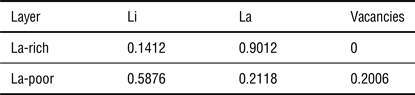
LLTO compounds with the general formula Li3x La2/3−x TiO3 have been studied for x in the range of 0.06–0.14, with x = 0.11 having the highest Li-ion conductivity.[ Reference Bohnke, Bohnke and Fourquet 9 – Reference Bohnke, Emery, Veron and Fourquet 11 ] This perovskite forms an almost cubic structure (a = 7.76236, b = 7.75363, c = 7.73692 Å), as determined by a Reitveld refinement analysis of powder diffraction data.[ Reference Cheng, Bi, Huq, Feygenson, Bridges, Paranthaman and Sumpter 7 ] The occupation probability of Li-ions, La-ions, and vacancies on A-sites in each of the La- and Li-rich layers in a bulk sample, as determined by a PDF analysis of neutron scattering experiments on LLTO, is shown in Table I. It has been reported that, given these occupation probabilities, there is no local ordering of Li- and La-ions within each layer; thus, the A-site atoms and vacancies are randomly distributed throughout a given layer.
Occupation probabilities of Li-ions, La-ions, and vacancies on A-sites in the La- and Li-rich layers of double-perovskite LLTO.[ Reference Cheng, Bi, Huq, Feygenson, Bridges, Paranthaman and Sumpter 7 ]

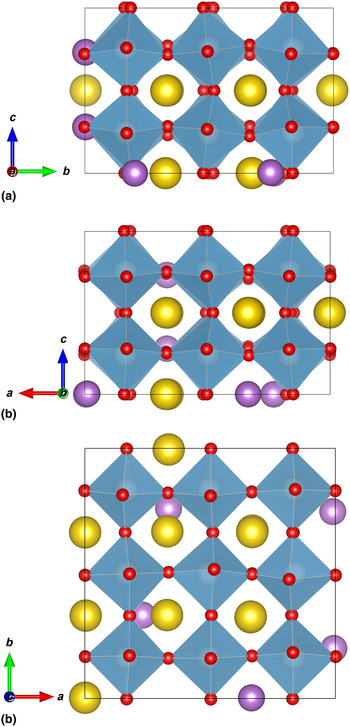
It has been shown that the TiO6 octahedra have an anti-phase rotation along the a- and b-directions of the lattice and a weak in-phase rotation in the c-direction, as shown in Fig. 2. It has been suggested that the anti-phase rotation of the TiO6 octahedra in the a- and b-directions couples with the motion of Li-ions as they diffuse along the Li-rich planes of this system, facilitating fast conduction of Li-ions by lowering the activation barrier for diffusion.[ Reference Bohnke, Bohnke and Fourquet 9 , Reference Bohnke, Duroy, Fourquet, Ronchetti and Mazza 10 ]
Rotation of TiO6 octahedra along three different directions in LLTO. Strong anti-phase rotations of the TiO6 octahedra can be seen along the a- and b-directions in (a) and (b). Weak in-phase rotations can be seen along the c-direction in (c). The anti-phase rotations assist Li-ion diffusion in Li-rich planes.

Two different types of GBs have been observed in this system. Type I GBs are deficient in Li- and La-ions in the GB region; conversely, type II GBs have continuous composition across the GB.[ Reference Ma, Chen, Liang, Nan, Ishikawa, More and Chi 12 ] Type I GBs have a measureable thickness, generally about 2 unit cells wide, the entire width of which is denuded of Li and La, while the type II GBs are atomically thin. Type II interfaces have been observed with much lower frequency than type I, and the occurrence of type II interfaces coincides with GB orientations with low mismatch. Based on microscopy studies, it is difficult to imagine a pathway for Li-ion diffusion across type I GBs (justifying the GB resistance observed in polycrystalline LLTO); however, the transport behavior of Li-ions at type II interfaces is less intuitive. Similar effects of GBs on ionic transport in other Li-rich compounds have been very recently reported.[ Reference Yu, So, Kuwabara, Tochigi, Shibata, Kudo, Zhou and Ikuhara 13 ]
Experiments observe a higher population of type I boundaries than type II boundaries. This is surprising considering that one might expect more energy to be required in forming a new phase or large composition modulation as seen in the type I boundaries. Since ion conductivity is measured macroscopically, the independent contributions of GBs with either type I or type II character to the net GB resistance of the specimen cannot be resolved experimentally unless there is a well-controlled process of controlling the GB type/density. However, since the structures of these two types of boundaries are so drastically different, it is reasonable to expect that their Li-ion conductivities would differ significantly as well. It is possible to imagine that certain GBs might offer a pathway for Li-ion diffusion that other boundaries cannot. In this case, it would be worthwhile to pursue the fabrication of a GB-engineered LLTO system in which the fraction of GBs amenable to Li-ion diffusion was increased.
To unravel these effects, we have pursued a theoretical study of the relative stability of GBs with varying compositions in LLTO using a first-principles approach. We find that the thermodynamic energy density is significantly lower for the type I GBs compared with all of the possible type II GBs. In addition to contributions from compositional differences in these boundary types, this energy difference is partly due to the fact that the total potential energy (predominantly the electrostatic piece) is virtually flat across the width of type I GBs, resulting in a vanishing space charge region i.e., leading to a large region with practically zero electric field, that lowers the stored electrostatic energy further, compared with type II GBs. Lack of a space charge layer will make ion migration relatively sluggish across type I GBs compared with the type II ones. Additionally, we have investigated Li-ion diffusion across and along Li-rich type II GBs in LLTO. The barrier to Li-ion migration is seen to be significantly lower along the GB than across it. This suggests that increasing the density of type II GBs could lead to a significant enhancement in the overall ionic conductivity. Indeed, very recent experimental studies suggest that increasing type II GB densities by annealing the sample at a high temperature can have a strong influence in enhancing the ionic conductivity in LLTO.[ Reference Ma, Cheng, Chen, Li, Sumpter, Nan, More, Dudney and Chi 14 ]
Methodology for generating model GB structures
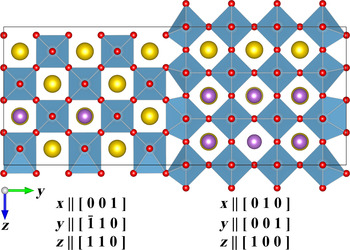
To study the relative energetics of type I and II GBs in LLTO, we model GB systems with varying interface compositions and local structure but all sharing the same orientation. Specifically, we employ the GB orientation for an experimentally observed type II GB, as shown in a representative type II GB in Fig. 3.
GB orientation used in the present study. This orientation was chosen because it was experimentally observed to be a type II boundary.[ Reference Ma, Chen, Liang, Nan, Ishikawa, More and Chi 12 ] Due to the periodic boundary conditions in the system, there are two GBs whose normal vectors are parallel to the y-axis in this structure. The TiO6 octahedra are heavily distorted at each of the GBs and slightly distorted in the xz-plane of the left grain.

In Fig. 3, the right grain's crystallographic axes are aligned with the canonical axes of the page, with the c-direction oriented along the y-axis. Due to the periodic boundary conditions in the system, two GBs are present in this structure, one at the center of the figure, and one wrapping around to connect the left-most edge with the right-most edge. The TiO6 octahedra are clearly distorted in the region near the GBs. Additionally, since the structure is made of two grains with different orientations, their periodicity in each of the x- and z-directions is not necessarily matched. In this case, the x-directions of both grains are parallel to a lattice vector of LLTO (which is nearly cubic), so minimal strain is introduced into the structure as a result of the wrapping in that direction. However, the z-directions of the two grains do not share the same periodicity, and, in order to keep the system to a reasonable size (the system in Fig. 3 already has 530 atoms) using a complete GB repeat distance was not possible. Thus, there is a noticeable amount of strain in the TiO6 octahedra of the left grain, the significance of which will be discussed shortly.
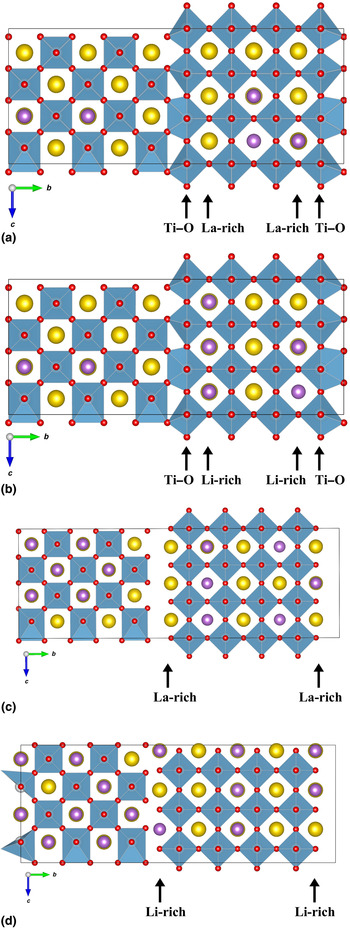
A number of variations in chemistry at the GB plane can be generated depending on the plane of atoms in the right grain that terminate at the GB. Namely, a type II GB could terminate at a La-rich layer, a Li-rich layer, or a Ti–O layer preceded by either a La- or Li-rich layer; the type II GB shown in Fig. 3 terminates at a Ti–O layer preceded by a La-rich layer.
The structures were generated by first creating two large, identical grains with a bulk structure using the experimentally obtained lattice parameters previously mentioned and site occupation probabilities shown in Table I. Each grain was then rotated to align with the desired axes and half of each grain was deleted to create an interface. The interface atoms were then individually assessed for possible overlap with atoms in the neighboring grain. Atom overlap was defined by atom pairs closer than the sum of their covalent radii (r Li = 1.34, r La = 1.69, r Ti = 1.36, r O = 0.73 Å). For overlapping atom pairs, schemes in which the deleted atom was always in the left grain, always in the right grain, always the smaller atom, always the larger atom, or randomly chosen were used, and the choice of the deletion scheme was found to have little to no effect on the overall energetics of the resulting structures as the need to delete any atoms was quite rare.
The structure, generated in this fashion, was then imported into the Ovito visualization program.[ Reference Stukowski 15 , Reference Stukowski 16 ] Within Ovito, the bicrystal was sliced along six faces in order to generate a rectangular prism. The specific cutting planes were chosen in order to minimize the structural strain associated with the imperfect periodic wrapping in the z-direction. The periodic wrapping of the system in the y-direction generated another GB, parallel to the primary interface shown in the center of Fig. 3. This secondary GB could also terminate on any of the same four possible planes as the primary interface (La-rich, Li-rich, or Ti–O preceded by either a La- or Li-rich plane). To study the relative defect energies associated with each of these possible kinds of interfaces, cutting planes in the y-direction were chosen such that the secondary and primary interfaces produced the same kind of type II GB.
For each kind of type II interface there were several additional considerations taken into account related to the GB microscopic degrees of freedom. Specifically, for each structure, variations were considered in which the translational position of the two grains with respect to one another was shifted in the x- and z-directions in units of 0.3 Å to a maximum distance of 1.2 Å. Additionally, though the lattice dimensions of the bulk system were fixed to the experimentally determined values, the optimal spacing of the grains in the y-direction had to be optimized for each interface type, which was done by incrementally increasing the spacing between grains by units of 0.2 Å up to a total of 1 Å.
Due to the fact that Li-ions, La-ions, and vacancies are randomly placed on A-sites according to the occupation probabilities in Table I, a single model of a GB terminating at either a La- or Li-rich plane would not provide sufficient information for a comparison of relative GB energies. In these cases, an ensemble of independently generated models had to be considered. We have used four distinct models (with a total of eight unique GBs) to evaluate type II GBs terminating at either La- or Li-rich interfaces. A representative example of each type II interface is shown in Fig. 4.
Representative examples of the four kinds of type II interface considered in this study. (a) Ti–O preceded by La-rich layer, 530 atoms; (b) Ti–O preceded by Li-rich, 528 atoms; (c) La-rich, 468 atoms; (d) Li-rich, 460 atoms.

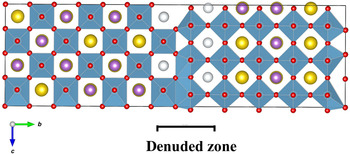
A representative type I interface was also generated for this study. In this system, all Li- and La-ions within a pre-specified distance (3 Å for the type I GB considered here) from the GB were re-assigned as Ti-ions, as shown in Fig. 5. This resulted in a GB region about 7 Å in width, which is similar to the experimentally observed type I GBs. As can be seen in Fig. 5, we did not attempt to make both the primary and secondary interfaces type I GBs due to the greatly increased number of atoms that would be required as a result of the large GB-width. We must acknowledge that this model presents a drastically oversimplified representation of a type I GB compared with the experimental observations, in which reconstructed Ti, O, and La-ions were all observed to be present in the GB structure. However, for the purpose of this study, we posit that it provides a sufficient benchmark with which to compare type II GBs.
The type I GB considered in this study.

Since the interfacial chemistry of type I GBs does not involve randomly assigned Li- and La-ions, an ensemble measurement was not required for considering this GB type, so only a single model was used.
Simulation methodology
First-principles calculations
First-principles calculations were performed with the Vienna ab initio Simulation Package (VASP)[ Reference Kresse and Furthmller 17 – Reference Kresse and Joubert 20 ] compiled with VTST Tools for performing nudged elastic band (NEB) simulations.[ Reference Henkelman and Jónsson 21 – Reference Sheppard, Xiao, Chemelewski, Johnson and Henkelman 25 ] The projector augmented wave method[ Reference Kresse and Joubert 20 , Reference Blchl 26 ] was used with Perdew, Burke, and Ernzerhof's implementation of the generalized gradient approximation for the exchange and correlation functional.[ Reference Perdew, Burke and Ernzerhof 27 , Reference Perdew, Burke and Ernzerhof 28 ] In all simulations, a Monkhorst-Pack 1 × 1 × 2 k-mesh was used with a plane-wave cutoff of 400 eV. The dimensions of the superlattice were manually optimized as previously described, so no relaxation of the box dimensions was allowed during the ionic relaxation process.
GB defect energy calculation
To obtain the structures that are shown in Figs. 4 and 5, we considered over 100 different initial geometries and chemistries. These structures were screened by doing a minimum of five ionic relaxation steps, which we found to be sufficient for determining which geometric parameters would result in the ground state model. Due to the significant energy differences in the ground state structure candidates we considered, which often differed by more than 10 eV, this minimal number of convergence steps was effective for screening. Subsequently, for the configurations with low energies, atomic forces were further relaxed using the RMM-DIIS algorithm.[ Reference Pulay 29 ] The defect energy per unit area in the system was calculated according to Eq. (1) in eV/Å2 for type II interfaces, where e total is the total energy of the system in eV, E ideal is the energy per unit volume of the bulk LLTO system determined using the same simulation parameters, V is the volume of the present system, and A GB is the area of a GB interface. Since both the secondary and primary GBs contribute to the total defect energy, the defect energy is divided by a factor of 2.
 $$E_{{\rm defect}} = \displaystyle{{e_{{\rm total}} - E_{{\rm ideal}}V} \over {2A_{{\rm GB}}}}.$$
Due to the imperfect wrapping at periodic boundaries in this system, the entire defect energy cannot be attributed to the presence of the GBs alone, but rather, includes contributions from all strained interfaces in the system. However, by comparing systems with similar dimensions and wrapping behavior, the relative energies of the GB interfaces can be compared. Similarly, as our primary and secondary interfaces are only ~1.6 nm apart, it is probable that an interaction energy associated with the proximity of these GBs to one another affects the overall defect energy of the system. Since our goal is to draw conclusions regarding the relative energy of the different possible interfaces in this system, we ensure that the models under consideration are similar in dimension and make the assumption that the GB–GB interaction energies are similar in all cases. Based on some of our studies of systems (unpublished) in which the primary and secondary GBs did not have the same composition, we have found this assumption to be reasonable.
The type I GB in our system contains both one type I interface and one type II interface (in which a Ti–O layer is at the secondary interface and is preceded by a La-rich layer). Thus, an alternate equation is required for determining the defect energy at our type I GB, as given by Eq. (2), with E Type II being the energy per unit area of the type II interface at the secondary GB in eV/Å2 and all other terms being defined as in Eq. (1).
 $$E_{{\rm defect}} = \displaystyle{{(e_{{\rm total}} - E_{{\rm ideal}}V) - E_{{\rm Type\; II}}A_{{\rm GB}}} \over {A_{{\rm GB}}}}.$$
Ion migration barrier calculations
It has been observed that the presence of GBs in LLTO dramatically reduces the Li-ion conductivity of a sample. Given the predominance of type I GBs observed in LLTO samples and their deficiency in both Li and La, one can intuit the resistive properties of these boundaries. However, a type II GB with a Li-rich interface might provide a pathway for GB diffusion of Li-ions. Due to the macroscopic nature of Li-ion conductivity measurements, this cannot be experimentally determined. Thus, we have investigated the activated pathway associated with pushing a Li-ion across a GB into a vacancy in a neighboring grain and along the GB plane into a vacancy in the same grain. To perform these calculations, we have used the NEB technique as implemented in VASP compiled with VTST Tools.[ Reference Henkelman and Jónsson 21 – Reference Sheppard, Xiao, Chemelewski, Johnson and Henkelman 25 ]
As previously mentioned, it has been shown that the transition state associated with Li-ion diffusion in bulk LLTO occurs when a Li-ion is diffusing from one bottleneck of a TiO6 octahedra to another within the same A-site, rather than when a Li-ion diffuses from one A-site into a neighboring, empty A-site, as in the canonical diffusion model.[ Reference Qian, Xu, Cho, Hatsukade, Carroll and Meng 8 , Reference Moriwake, Gao and Kuwabara 30 ] The reason for this is believed to be related to the coupling of the anti-phase rotation of the TiO6 octahedra with Li-ion passage through a bottleneck.[ Reference Moriwake, Gao and Kuwabara 30 ] At GBs, the rotational behavior of the TiO6 octahedra is interrupted due to the presence of the boundary distorting these polyhedra, and for the case of the trans-GB diffusion process, the direction of Li-ion transport is out of the plane of fast Li-ion conduction in our current GB orientation. We begin by setting the end points of the NEB calculation as the relaxed GB structure that results when the Li-ion is placed in the center of each neighboring A-site. These endpoints are possibly separated by multiple activation barriers, so we choose a large number of images (in this case, 11 images) to get a starting point for calculating the energy landscape of Li-ion diffusion at GBs. All atoms in the system are able to change position during the NEB process, which allows for any rotational behavior of the TiO6 octahedra to take place. However, this adds the complication that relaxation and motion of other Li-ions in the system may occur throughout the process, convoluting the interpretation of our results. By performing NEB calculations, we can identify the low-energy points along the reaction trajectory and, if necessary reset the calculation from more reasonable reaction endpoints.
We use two different randomly initialized GB configurations to study diffusion across the GB and along the GB plane in the z-direction within the terminal Li-rich plane (see Fig. 3 for references to orientation). Since these are computationally demanding calculations (a typical NEB calculation with 40 ionic relaxation steps will require 10,000–15,000 CPU hours); we restricted our study to these representative systems. The NEB calculations were restarted after each 40 ionic steps until the reaction trajectory converged.
Results and discussion
Relative stability of different GB interfaces in LLTO
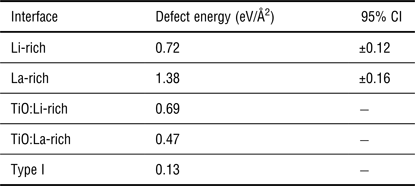
Defect energies per unit area, calculated for GBs with different interfacial chemistries in double-perovskite LLTO, are shown in Table II. For type II boundaries terminating on either a La-rich or a Li-rich plane, in which four different structures were used to obtain an average value of the defect energy density, 95% confidence intervals are also shown.
Defect energy density for each kind of interface investigated in this study; 95% confidence intervals on the reported defect energy densities are shown in cases where an ensemble of systems were used to investigate a given interface type.
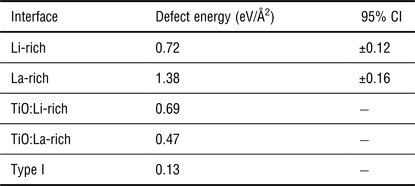
From this data, it is clear that the type I boundary considered here is significantly lower in energy than any of the type II boundaries (over 72% lower than the lowest energy type II interface), which is in agreement with the experimental observation that type I GBs are much more common than type II GBs. It is noteworthy that, even for this GB—the orientation of which was chosen based on the experimental observation that it was a type II GB—the energetically favored interface has type I chemistry. The type I GB studied here is greatly simplified compared with the type I interfaces that have been observed experimentally, but its clear energetic advantage in this configuration demonstrates the strength of the driving force for type I GBs in LLTO.
A TiO layer preceded by a La-rich layer was found to be the lowest energy type II interface. This is again consistent with the experimental findings of TiO layers in most of the grain boundaries. The Li-rich interface and the interface in which a TiO layer is preceded by a Li-rich layer have similar defect energy densities and are about 35% higher in energy than the most favorable type II interface. Since the energy differences between these three kinds of type II interface are much smaller than those distinguishing the type I and II interfaces, it is possible to imagine that type II interfaces with each of these three chemistries might exist in a bulk LLTO specimen. The type II interface terminating on a La-rich plane had a significantly higher energy than any of the other interfaces considered (likely due to the large steric and electrostatic repulsions of the La-ions at the interface), as such, we do not expect that a GB with this interfacial chemistry would be experimentally observed. This also points to why an ion-denuded GB (i.e., a purely TiO interface) or a GB with some amounts of TiO shows a lower energy. Presence of such regions separates out regions of high ionic charges (i.e., regions of high Li/La concentrations), thereby widening the space charge region, and hence reducing the electrostatic field (E) inside the region, and hence the electrostatic energy (E) that is proportional to it i.e.,
 $E \sim {\bf E}^2$
.
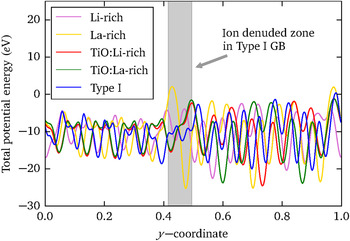
To further investigate the contribution of the width of the space charge region to interface stability, we consider the total potential energy of the bicrystal as a function of position along the axis parallel to the GB normal (i.e., the y-coordinate for our structures). Figure 6 shows this information for the five different GB compositions analyzed here, where the position along the y-axis has been normalized. The gray area indicates the width of the ion denuded region for the type I GB (blue curve in Fig. 6). In this region, the potential energy of the type I GB is relatively flat, corresponding to a large region of zero electric field, i.e., the electric field region or the space charge region gets screened very quickly and there is a large region with practically zero average field. While this will lead to a lower electrostatic stabilization of this type of GB, lack of a space charge layer will make it difficult for charged species to cross this boundary. Conversely, the type II GBs with a thin TiO layer at the interface, preceded by either a La-rich layer (green curve in Fig. 6) or a Li-rich layer (red curve in Fig. 6), have a very narrow region where the potential energy is flat, suggesting a non-overlapping, yet a significant space charge region. Both the Li-rich GB (violet curve in Fig. 6) and the La-rich GB (yellow curve in Fig. 6) have a very wide space charge region; however, the La-rich GB has a much more drastic change in the potential energy across the interface than the Li-rich interface suggesting larger fields. The fluctuations in potential energy away from the interfaces correspond to the alternating atomic layers in this double-perovskite structure. As such, we find a strong anti-correlation between the GB stability and the field strength as well as the spatial extent of the space charge layer inside the GB region. This is a very important finding in our study and needs to be corroborated by experiments in the near future. This also suggests that the grain boundaries that perhaps lead to fast ionic transport due to presence of a space charge layer may not necessarily be energetically preferred due to the large electrostatic cost of such a layer. Other factors including interface composition, strain and atomic reconstruction should also contribute to the energy differences seen in these different GBs.
Total potential energy versus normalized y-coordinate for the five different GB classes considered. The gray area identifies the width of the ion denuded region in the type I GB.

Li-ion conduction along and across Li-rich interfaces
From an intuitive perspective, Li-rich interfaces provide the best prospects for Li-ion diffusion at GBs in LLTO. Since we have found that it is energetically possible, if rare, for Li-rich GBs to exist in a polycrystalline LLTO specimen, it is worth investigating the activated pathways associated with Li-ion conduction at interfaces of this kind. We have performed NEB calculations of Li-ion diffusion across the GB interface in a randomly initialized system as well as Li-ion diffusion along the GB-plane in the z-direction.
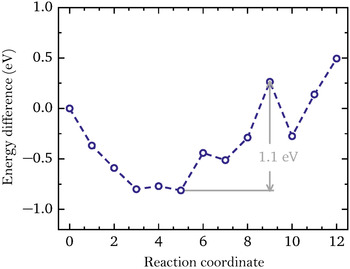
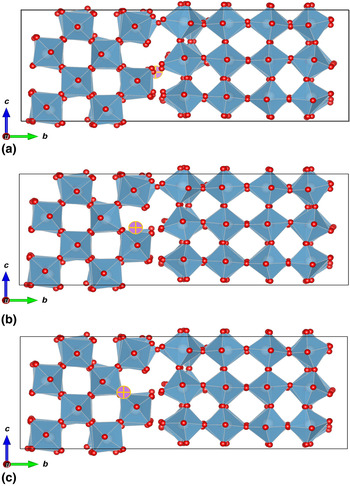
The results of the NEB calculation for Li-ion conduction across the GB are shown in Fig. 7. The complexity of diffusion events in this system, in which many atoms participate in the stabilization of the Li-ion during the diffusion process, required more than 2000 NEB relaxation steps to obtain this converged trajectory. Snapshots of the atomic configuration of the diffusing Li-ion at the minimum, transition state, and adjacent minimum for this migration event are shown in Fig. 8. From Figs. 7 and 8, we observe an energy barrier of ~1.1 eV associated with the Li-ion breaking away from the distorted TiO6 octahedra at the boundary.
NEB calculations of Li-ion diffusion across the Li-rich GB plane.

Snapshots of Li-ion diffusion across a Li-rich GB in LLTO. (a) Li-ion in the lowest energy position in the TiO6 bottleneck between the two grains. (b) Saddle point configuration, Li-ion between TiO6 bottlenecks. (c) Li-ion in low-energy bottleneck away from the GB. All non-migrating Li- and La-ions have been removed from the image for clarity, and the migrating Li-ion has been marked with a yellow cross.

Additionally, we note that when the Li-ion is positioned at the boundary interface it is in a trapped state, 0.5 eV lower in energy than the final state of this event. As in the case of bulk Li-ion diffusion, the TiO6 octahedra rotate to lower the energy of the activated state; however, the effect is less pronounced than in the bulk because the rotations are more localized to the region of the Li-ion at the boundary.
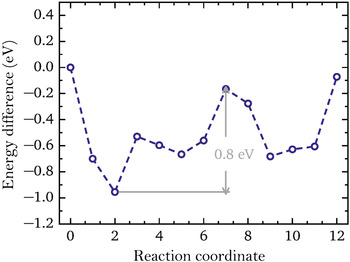
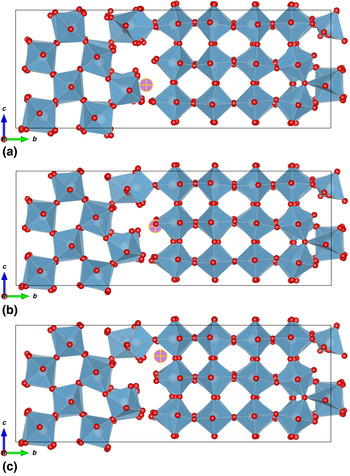
The results of the NEB calculation for Li-ion conduction along the z-direction of the GB are shown in Fig. 9, where almost 1500 NEB relaxation steps were required to achieve a converged trajectory. Snapshots of the atomic configuration of the diffusing Li-ion at the minimum, transition state, and adjacent minimum for this migration scenario are shown in Fig. 10. We find an energy barrier of ~0.8 eV associated with Li-ion diffusion along the boundary.
Li-ion diffusion in the z-direction along a Li-rich GB in LLTO.

Snapshots of Li-ion diffusion along a Li-rich GB in LLTO. (a) Li-ion in low-energy initial position away from the center of the A-site. (b) Saddle point configuration with Li-ion asymmetrically stabilized by TiO6 terminating at the GB. (c) Final configuration with Li-ion at off-center position in neighboring A-site. All non-migrating Li- and La-ions have been removed from the image for clarity, and the migrating Li-ion has been marked with a yellow cross.

In the bulk, the activation energy associated with Li-ion diffusion in the fast-conduction plane is reported to be of the order of 0.19–0.28 eV[ Reference Bohnke, Emery, Veron and Fourquet 11 , Reference Moriwake, Gao and Kuwabara 30 ] Thus, the Li-ion diffusivity across and along a Li-rich GB, as considered here, is 14 and 9 orders of magnitude slower than bulk diffusion at room temperature, respectively (assuming Arrhenius diffusion behavior). In pursing the present study, we have made the intuitive assumption that, of all boundary types possible in LLTO, Li-rich boundaries would present the greatest likelihood of enabling Li-ion conduction. However, it is possible that an alternative boundary chemistry may offer a lower-energy pathway. It is also possible that in the presence of a high ionic concentration, Li-ions would build up at the GB under an external bias, and alternative migration schemes, such as the interstitialcy mechanism as opposed to vacancy mechanism, may dominate, thereby reducing the absolute migration barrier.
Conclusions
In this study, we have investigated the interfacial chemistry of grain boundaries in double-perovskite LLTO. A recent study has shown that the majority of GBs in LLTO are denuded of Li and La-ions (type I GBs), but that a minority of GBs has continuous composition across the GB (type II GBs). Using a first principles approach, we have investigated the relative stability of four different kinds of type II GBs as well as a type I GB, all with a GB orientation that corresponded to an experimentally observed type II GB. Due to the random assignment of Li-ions, La-ions, and vacancies within La- and Li-rich layers, an ensemble of systems was used to determine an average defect energy density associated with GBs terminated on La- and Li-rich layers. The atomic configuration files associated with the different GB structures compared in this document are available in the supplementary materials. We obtain two very important conclusions about ion migration in polycrystalline samples with Li-rich compositions: (1) regions denuded of charged ions are energetically more stable due to a vanishing (in type I GBs and TiO-terminated type II GBs) of the space charge region, which leads to a reduced electrostatic energy density; and (2) ion migration along a GB is significantly faster than migration across it, suggesting that a larger density of type II GBs with minimal composition change could lead to very fast ionic conduction. Indeed, a very recent study suggests that an increased density of type II GBs significantly enhance Li-ion conductivity in LLTO, consistent with our predictions.[ Reference Ma, Cheng, Chen, Li, Sumpter, Nan, More, Dudney and Chi 14 ] Since type II GBs have been observed to occur in polycrystalline LLTO, we suggest that three kinds of type II GBs (terminated at a Li-rich interface or a TiO interface preceded by a Li- or La-rich layer) may be expected to exist in a specimen given their relative similarities in defect energy densities. Conversely, the type II GB terminated on a La-rich plane was much higher in energy than the other type II GBs, so we do not expect this GB to be present in a bulk specimen.
Supplementary material
The supplementary material for this article can be found at https://doi.org/10.1557/mrc.2016.58.
Acknowledgments
This work was performed at the Center for Nanophase Materials Sciences, a US Department of Energy Office of Science User Facility. This work made use of computational resources at the NERSC computing facility which is supported by the U.S. DOE Office of Science under Contract No. DE-AC02-05CH11231. K.C.A. acknowledges support from a DOE Computational Science Graduate Fellowship under Grant No. DE-FG02-97ER25308 and support from the Fannie and John Hertz Foundation. P. G. would like to acknowledge the Laboratory Directed Research and Development Program (LDRD) of Oak Ridge National Laboratory, managed by UT-Battelle, LLC, for the U. S. Department of Energy.