





1 Introduction
Given a countable group G and a compact Hausdorff abelian group X, an action
$G\curvearrowright X$
 by continuous automorphisms is called an algebraic action. There is a correspondence—via Pontryagin duality—between algebraic actions of a group G and
$\mathbb {Z}[G]$
 -modules, where
$\mathbb {Z}[G]$
 is the integral ring of G. More precisely, every algebraic action
$G\curvearrowright X$
 induces a
$\mathbb {Z}[G]$
 -module structure on the Pontryagin dual
${X}^{\wedge }$
 , and every discrete
$\mathbb {Z}[G]$
 -module M gives rise to an algebraic action
$G\curvearrowright {M}^{\wedge }$
 . Of particular importance are algebraic actions arising from finitely generated
$\mathbb {Z}[G]$
 -modules, namely, actions of G by continuous group automorphisms of the metrizable space
${(\mathbb {Z}[G]^n/J)}^{\wedge }$
 , where
$J\leq \mathbb {Z}[G]^n$
 is a
$\mathbb {Z}[G]$
 -submodule.
One dynamical property of such actions that has been a subject of interest for several decades now is expansivity, that is, the ability to distinguish any two different elements up to a fixed distance by simultaneously translating them with a suitable group element. This property is relevant, for instance, in the study of entropy of group actions [Reference BowenBow11, Reference Deninger and SchmidtDS07]. The research on expansivity of algebraic actions was initiated in [Reference Kitchens and SchmidtKS89, Reference SchmidtSch90] for G free abelian, see [Reference SchmidtSch95] for a thorough exposition. In [Reference Einsiedler and RindlerER01], the authors deal with more general groups and provide a characterization of expansivity of the action
$G\curvearrowright {(\mathbb {Z}[G]/J)}^{\wedge }$
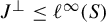
 in terms of the triviality of the annihilator
$J^\perp \leq \ell ^\infty (S)$
 , viewing the ideal
$J\leq \mathbb {Z}[G]$
 as a subset of
$\ell ^1(S)$
 . When
$J=(a)$
 is the principal ideal generated by
$a\in \mathbb {Z}[G]$
 , it is proven in [Reference Deninger and SchmidtDS07] that
$G\curvearrowright {(\mathbb {Z}[G]/(a))}^{\wedge }$
 is expansive if and only if a is invertible in
$\ell ^1(G)$
 . In [Reference Chung and LiCL15, §3], the authors conclude an analogous result for finitely generated
$\mathbb {Z}[G]$
 -submodules of
$\mathbb {Z}[G]^n$
 , see also the exposition in [Reference Kerr and LiKL16, Ch. 13].
Algebraic actions of semigroups—that is, actions of countable semigroups by endomorpshims of a compact Hausdorff abelian group—have been recently explored [Reference Bruce and LiBL24, Reference Bruce and LiBL26]. We will be interested in studying the action
$S\curvearrowright {(\mathbb {Z}[S]^n/J)}^{\wedge }$
 , where
$J\leq \mathbb {Z}[S]^n$
 is a right
$\mathbb {Z}[S]$
 -module. It will be shown in §3 that the topological group
${(\mathbb {Z}[S]^n/J)}^{\wedge }$
 is isomorphic to a subgroup
$X_J$
 of
$(\mathbb {T}^S)^n$
 , which is metrizable, and the action
$S\curvearrowright X_J$
 arising from the restriction shift action
$S\curvearrowright (\mathbb {T}^S)^n$
 will be called the algebraic action induced by J. We aim to study, for these actions, the property of expansivity, which we formally define now.
Definition 1. A continuous action
$S\curvearrowright X$
 on a compact metric space
$(X,d)$
 is called expansive if there exists
$\epsilon>0$
 (the expansivity constant) such that for every pair of distinct elements
$x,y\in X$
 , we have that
$\sup _{s\in S}d(s\cdot x,s\cdot y)\geq \epsilon $
 .
To our knowledge, there has been no research around expansivity of algebraic semigroup actions
$S\curvearrowright X_J$
 . Some complications arise when we replace a group G by a semigroup S. For instance, S could have no identity element, which plays a role in expansivity. For instance, the shift action of the additive semigroup of positive natural numbers
$\mathbb {N}_{+}$
 on
$\{0,1\}^{\mathbb {N}_{+}}$
 is not expansive. Even further, it might happen that
$\ell ^1(S)$
 is a non-unital Banach algebra—or might not even admit an approximate identity, as is the case of
$\mathbb {N}_+$
 —which prevents us from speaking of invertibility and makes unclear how to extend the results from [Reference Chung and LiCL15, Reference Deninger and SchmidtDS07]. Another problem is that the language in which the results from [Reference Chung and LiCL15, Reference Deninger and SchmidtDS07, Reference Einsiedler and RindlerER01] are framed involves the Banach
$^*$
 -algebra structure of
$\ell ^1(G)$
 : see, for instance, [Reference Chung and LiCL15, Lemma 3.8], [Reference Deninger and SchmidtDS07, Theorem 3.2], and [Reference Einsiedler and RindlerER01, Theorem 8.2]. For a general semigroup S, however, there is no clear involution on
$\ell ^1(S)$
 .
The main purpose of this article is to explore the extent to which the characterizations of expansivity of algebraic group actions, as well as the techniques used to prove them, hold up when we replace the acting group by a semigroup. Our first main result completely determines the class of semigroups for which expansivity of the algebraic action
$S\curvearrowright X_J$
 is characterized by the triviality of the annihilator of
$J\leq \mathbb {Z}[S]^n$
 , viewing J as a subset of
$\ell ^1(S)^n$
 . This characterization is analogous to the equivalence between properties (i) and (ii) in [Reference Einsiedler and RindlerER01, Theorem 8.1] and that between properties (1) and (2) in [Reference Chung and LiCL15, Lemma 3.8].
Theorem A. Let S be a semigroup. The following statements are equivalent.
-
(i) There exists a finite subset $K\subseteq S$
 such that
$S=KS$
.
-
(ii) For every right $\mathbb {Z}[S]$
-submodule
$J\leq \mathbb {Z}[S]^n$
, the action
$S\curvearrowright X_J$
is expansive if and only if
$J^\perp =\{0\}$
.


In the case where
$\ell ^1(S)$
 is left-unital, our second main result extends the characterization in terms of invertibility conditions when J is finitely generated. This stands in close analogy with the equivalence between properties (1) and (4) in [Reference Chung and LiCL15, Lemma 3.8], and follows the techniques therein.
Theorem B. Let S be a semigroup such that
$\ell ^1(S)$
 has a left identity. Then, given
$\mathbf {A}\in \mathrm {M}_{k\times n}(\mathbb {Z}[S])$
 and a left identity
$\mathbf {I}\in \mathrm {M}_n(\ell ^1(S))$
 , the following are equivalent.
-
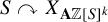
(i) The algebraic action $S\curvearrowright X_{\mathbf {A}\mathbb {Z}[S]^k}$
is expansive. -
(ii) There exists $\mathbf {B}\in \mathrm {M}_n(\mathbb {Z}[S])$
that is right
$\mathrm {Re}\{\mathbf {I}\}$
-invertible in
$\mathrm {M}_n(\ell ^1(S))$
such that
$\mathbf {B}\mathbb {Z}[S]^n\subseteq \mathbf {A}\mathbb {Z}[S]^k$
.




If
$\ell ^1(S)$
 is additionally unital, the above conditions are equivalent to the following.
-
(iii) There exists $\mathbf {B}\in \mathrm {M}_n(\mathbb {Z}[S])$
invertible in
$\mathrm {M}_n(\ell ^1(S))$
such that
$\mathbf {B}\mathbb {Z}[S]^n\subseteq \mathbf {A}\mathbb {Z}[S]^k$
.



Under the additional hypothesis of stable finiteness of
$\ell ^1(S)$
 , which is satisfied by every inverse semigroup with finitely many idempotents, we obtain the following corollary.
Corollary C. Let S be a semigroup such that
$\ell ^1(S)$
 is unital and stably finite. Then, for every
$\mathbf {A}\in \mathrm {M}_n(\mathbb {Z}[S])$
 , the following are equivalent.
-
(i) The algebraic action $S\curvearrowright X_{\mathbf {A}\mathbb {Z}[S]^n}$
is expansive. -
(ii) The matrix $\mathbf {A}$
is invertible in
$\mathrm {M}_n(\ell ^1(S))$
.



The article is organized as follows. In §2, we introduce some preliminaries and notation. Section 3 deals with the correspondence between algebraic actions of S and right
$\mathbb {Z}[S]$
 -modules arising from Pontryagin duality. The main section of the article is §4, where we prove Theorems A and B. In §5, we study the conditions on S appearing in Theorems A, B, and Corollary C. Since the conditions from Theorems A and B are immediately satisfied when S is a monoid, in §6, we study two concrete classes of semigroups that are not monoids but still satisfy these conditions, including Rees matrix semigroups.
2 Preliminaries and notation
2.1 Semigroups and actions
A semigroup is a set S together with an associative binary operation
$S\times S\to S$
 , denoted by
$(s,t)\mapsto st$
 . We shall only deal with countable semigroups in this article. A monoid is a semigroup S admitting an identity element, that is, an element
$1_S\in S$
 such that
$1_Ss=s1_S=s$
 for all
$s\in S$
 . Standard references regarding the algebraic theory of semigroups are [Reference Clifford and PrestonCP61, Reference Clifford and PrestonCP67].
Let S be a countable semigroup. An action of S on a set X, denoted by
$S\curvearrowright X$
 , is a map
$S\times X\to X$
 ,
$(s,x)\mapsto s\cdot x$
 , such that for all
$s,t\in S$
 and
$x\in X$
 , we have
$s\cdot (t\cdot x)=st\cdot x$
 . If S is a monoid, we moreover require that
$1_S\cdot x=x$
 for all
$x\in X$
 . Given an action
$S\curvearrowright X$
 and
$x\in X$
 , we define the orbit
$Sx:=\{s\cdot x:s\in S\}$
 . If X is a topological space,
$S\curvearrowright X$
 is an action and for each
$s\in S$
 , the map
$x\mapsto s\cdot x$
 is continuous, we say that the action
$S\curvearrowright X$
 is continuous.
Given two actions
$S\curvearrowright X$
 and
$S\curvearrowright Y$
 , a map
$\phi \colon X\to Y$
 is called S-equivariant if
$\phi (s\cdot x)=s\cdot \phi (x)$
 for all
$s\in S$
 and
$x\in X$
 . A conjugacy between two continuous left actions
$S\curvearrowright X$
 and
$S\curvearrowright Y$
 is an S-equivariant homeomorphism
$\phi \colon X\to Y$
 .
2.2 Product spaces and matrices
We introduce some notation regarding product spaces and matrix spaces. If X is a set and
$n\geq 2$
 , elements
$\mathbf {x}=(x_1,\ldots ,x_n)\in X^n$
 will be regarded as
$1$
 -row matrices. If X has the structure of an additive group, then for any
$x\in X$
 and
$1\leq i\leq n$
 , the element
$x\mathbf {e}_i\in X^n$
 will denote the tuple
$(x_1,\ldots ,x_n)$
 with
$x_i=x$
 and
$x_j=0$
 for all
$j\neq i$
 .
Matrices in
$\mathrm {M}_{n\times k}(X)$
 will be denoted with bold capital letters. Let
$\mathbf {x}= (x_1,\ldots ,x_n)\in X^n$
 ,
$\mathbf {x}'=(x_1',\ldots ,x_k')\in X^k$
 , and
$\mathbf {A}=(a_{ij})_{i,j}\in \mathrm {M}_{n\times k}(X)$
 . If
$\star \colon X\times R\to X$
 is a right R-module structure and
$\ast \colon R\times X\to X$
 is a left R-module structure, the expressions
$\mathbf {x}\star \mathbf {A}\in X^k$
 and
$\mathbf {A}\ast \mathbf {x}'\in X^n$
 are defined in the usual way, that is, the jth coordinate of
$\mathbf {x}\cdot \mathbf {A}\in X^k$
 and the ith coordinate of
$\mathbf {A}\ast \mathbf {x}'$
 are respectively

2.3 The semigroup integral ring and convolution algebra
Let S be a countable semigroup. In the forthcoming sections, we will deal with two Banach spaces associated with S. We consider

and

As usual, for every
$n\in \mathbb {N}$
 , we consider the product Banach spaces
$\ell ^\infty (S)^n$
 and
$\ell ^1(S)^n$
 with the corresponding norms defined as

for all
$\mathbf {f}=(f_1,\ldots ,f_n)\in \ell ^\infty (S)^n$
 and
$\mathbf {a}=(a_1,\ldots ,a_n)\in \ell ^1(S)^n$
 . The
$\mathbb {C}$
 -bilinear map
$\langle \cdot \,,\cdot \rangle \colon \ell ^\infty (S)^n\times \ell ^1(S)^n\to \mathbb {C}$
 will denote the canonical dual pairing, so that, for all
$\mathbf {f}=(f_1,\ldots ,f_n)\in \ell ^\infty (S)$
 and
$\mathbf {a}=(a_1,\ldots ,a_n)\in \ell ^1(S)$
 ,

Given
$F\subseteq S$
 , we write
$\mathbf {1}_F\in \ell ^\infty (S)$
 to denote the characteristic function of F. More generally, if
$f\in \ell ^\infty (S)$
 , the element
$f\mathbf {1}_F\in \ell ^\infty (S)$
 will denote the map that takes the value
$f(s)$
 at every
$s\in F$
 and
$0$
 elsewhere. In the particular case where
$F=\{s\}$
 , we let
$\delta _s:=\mathbf {1}_{\{s\}}$
 .
Together with the convolution product
$\ast \colon \ell ^1(S)\times \ell ^1(S)\to \ell ^1(S)$
 given by

the space
$\ell ^1(S)$
 becomes a Banach algebra, called the convolution Banach algebra of S. We define the integral ring of S to be the subring
$\mathbb {Z}[S]\leq \ell ^1(S)$
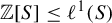 of finitely supported maps with values in
$\mathbb {Z}$
 . From the fact that
$\delta _s\ast \delta _t=\delta _{st}$
 for all
$s,t\in S$
 , we see that
$\{\delta _s:s\in S\}$
 is a subsemigroup of
$\mathbb {Z}[S]$
 isomorphic to S. We refer the reader to [Reference Dales, Lau and StraussDLS10] for details on the Banach algebra
$\ell ^1(S)$
 .
Given
$n\in \mathbb {N}$
 ,
$\mathrm {M}_n(\ell ^1(S))$
 is the Banach algebra of
$n\times n$
 matrices with coefficients in
$\ell ^1(S)$
 , with the usual matrix product and the norm

2.4 Pontryagin duality
Given a locally compact abelian group X, its Pontryagin dual
${X}^{\wedge }$
 is the locally compact abelian group consisting of all continuous group homomorphisms
$\varphi \colon X\to \mathbb {T}$
 with pointwise multiplication and the topology of uniform convergence on compact subsets. The Pontryagin–Van Kampen duality theorem (see e.g., [Reference Hewitt and RossHR79, Theorem 24.2]) asserts that the map

is an isomorphism of topological groups, that is, a homeomorphic isomorphism of groups. The Pontryagin dual of a compact abelian group is a discrete abelian group, and vice versa. A concrete example of this is
${\mathbb {Z}}^{\wedge }\simeq \mathbb {T}$
 and
${\mathbb {Z}}^{\wedge \wedge }\simeq {\mathbb {T}}^{\wedge }\simeq \mathbb {Z}$
 .
3 Algebraic semigroup actions and right
$\mathbb {Z}[S]$
-modules

We will be interested in the class of algebraic semigroup actions, that is, actions of semigroups by continuous endomorphisms of compact Hausdorff abelian groups. Pontryagin duality gives a correspondence between such actions and right
$\mathbb {Z}[S]$
 -modules, which we proceed to describe now.
Let
$S\curvearrowright X$
 be an action by group endomorphisms of a compact Hausdorff abelian group X. Then, we can define a right
$\mathbb {Z}[S]$
 -module structure on the abelian group
${X}^{\wedge }$
 by setting

This is well defined as a consequence of the fact that
$x\mapsto s\cdot x$
 is a continuous group homomorphism for all
$s\in S$
 . Conversely, if M is a right
$\mathbb {Z}[S]$
 -module, we regard its underlying additive group structure as a discrete abelian group, so that
${M}^{\wedge }$
 is a compact Hausdorff abelian group. An action
$S\curvearrowright {M}^{\wedge }$
 by group endomorphisms can be defined by setting

This action is continuous, as the convergence in the topology of
${M}^{\wedge }$
 is given by uniform convergence. It is not difficult to see that, under the above described procedure, an algebraic action
$S\curvearrowright X$
 is conjugate to the algebraic action
$S\curvearrowright {X}^{\wedge \wedge }$
 induced by the right
$\mathbb {Z}[S]$
 -module structure on
${X}^{\wedge }$
 obtained from the action
$S\curvearrowright X$
 . This yields the desired correspondence between algebraic actions of S and right
$\mathbb {Z}[S]$
 -modules.
We will restrict ourselves to studying algebraic actions arising from finitely generated right
$\mathbb {Z}[S]$
 -modules. To give a concrete description of the Pontryagin dual of a finitely generated right
$\mathbb {Z}[S]$
 -module, we let
$\pi \colon \mathbb {R}\to \mathbb {T}$
 be the canonical projection map and extend it to
$\pi \colon \ell ^\infty (S,\mathbb {R})^n\to (\mathbb {T}^S)^n$
 for all
$n\in \mathbb {N}$
 in the natural way. We start with the following lemma.
Lemma 3.1. The product
$\langle \cdot \,,\cdot \rangle \colon (\mathbb {T}^S)^n\times \mathbb {Z}[S]^n\to \mathbb {T}$
 given by the formula
$\langle \mathbf {x},\mathbf {a}\rangle :=\pi (\langle \hat {\mathbf {x}},\mathbf {a}\rangle )$
 , where
$\mathbf {x}\in (\mathbb {T}^S)^n$
 ,
$\mathbf {a}\in \mathbb {Z}[S]^n$
 , and
$\hat {\mathbf {x}}\in \ell ^\infty (S,\mathbb {R})^n$
 , is such that
$\pi (\hat {\mathbf {x}})=\mathbf {x}$
 is well defined.
Proof. If
$\hat {\mathbf {x}}=(\hat {x}_1,\ldots ,\hat {x}_n)$
 and
$\hat {\mathbf {x}}'=(\hat {x}_1',\ldots ,\hat {x}_n')$
 are elements of
$\ell ^\infty (S,\mathbb {R})^n$
 such that
$\pi (\hat {\mathbf {x}})=\pi (\hat {\mathbf {x}}')\in (\mathbb {T}^S)^n$
 , then
$\hat {\mathbf {x}}-\hat {\mathbf {x}}'\in (\mathbb {Z}^S)^n$
 . Hence,

for all
$\mathbf {a}=(a_1,\ldots ,a_n)\in \mathbb {Z}[S]^n$
 , so that
$\pi (\langle \hat {\mathbf {x}},\mathbf {a}\rangle )=\pi (\langle \hat {\mathbf {x}}',\mathbf {a}\rangle )$
 .
We first analyze the algebraic action induced by a free right
$\mathbb {Z}[S]$
 -module of finite rank. For each
$n\in \mathbb {N}$
 ,
$\mathbb {Z}[S]^n$
 gives rise to an algebraic action
$S\curvearrowright (\mathbb {Z}[S]^n)^\wedge $
 via the formula

where
$\varphi \in (\mathbb {Z}[S]^n)^\wedge $
 ,
$a_1,\ldots ,a_n\in \mathbb {Z}[S]$
 and
$s\in S$
 . The topological group isomorphism

provided by the Pontryagin duality, gives a conjugacy between the action
$S\curvearrowright (\mathbb {Z}[S]^n)^\wedge $
 and the shift action
$S\curvearrowright (\mathbb {T}^S)^n$
 defined as

With slight abuse of notation, which comes from identifying
$(\mathbb {T}^S)^n\simeq (\mathbb {T}^n)^S$
 , we will sometimes denote the element
$(x_1(ts),\ldots ,x_n(ts))$
 by
$\mathbf {x}(ts)$
 , so that
$(s\cdot \mathbf {x})(t)=\mathbf {x}(ts)$
 . We now give a detailed account of the conjugacy between
$S\curvearrowright {(\mathbb {Z}[S]^n)}^{\wedge }$
 and
$S\curvearrowright (\mathbb {T}^S)^n$
 .
Proposition 3.2. The topological group isomorphism
$\Phi \colon {[\mathbb {Z}[S]^n]}^{\wedge }\to (\mathbb {T}^S)^n$
 defined by

is a conjugacy with inverse given by
$\Phi ^{-1}(\mathbf {x})(\mathbf {a})=\langle \mathbf {x}, \mathbf {a}\rangle $
 for all
$\mathbf {x}\in (\mathbb {T}^S)^n$
 and
$\mathbf {a}\in \mathbb {Z}[S]^n$
 .
Proof. We first check that
$\Phi $
 is bijective. Let
$\varphi \in (\mathbb {Z}[S]^n)^{\wedge }$
 ,
$a_1,\ldots ,a_n\in \mathbb {Z}[S]$
 , and write
$\Phi (\varphi )=(x_1,\ldots ,x_n)$
 so that
$x_i(t)=\varphi (\delta _t\mathbf {e}_1)$
 for every
$t\in S$
 and
$1\leq i\leq n$
 . Then,

so
$\Phi ^{-1}(\Phi (\varphi ))=\varphi $
 . However, if
$(x_1,\ldots ,x_n)\in (\mathbb {T}^S)^n$
 and
$s\in S$
 , then writing
$\Phi (\Phi ^{-1}(x_1,\ldots ,x_n))=(y_1,\ldots ,y_n)$
 , we have

for all
$t\in S$
 and
$1\leq j\leq n$
 , so
$\Phi (\Phi ^{-1}(x_1,\ldots ,x_n))=(x_1,\ldots ,x_n)$
 . Therefore,
$\Phi $
 is a bijection with inverse
$\Phi ^{-1}$
 .
Since the topology on
${(\mathbb {Z}[S]^n)}^{\wedge }$
 is given by convergence on compact (hence finite) subsets of
$\mathbb {Z}[S]^n$
 , it is readily checked that
$\Phi $
 is continuous. It is thus a homeomorphism, as the involved spaces are compact Hausdorff.
Finally, to see that
$\Phi $
 is S-equivariant, note that for every
$\varphi \in {(\mathbb {Z}[S]^n)}^{\wedge }$
 and
$s,t\in S$
 , writing
$\Phi (s\cdot \varphi )=(x_1,\ldots ,x_n)$
 and
$\Phi (\varphi )=(y_1,\ldots ,y_n)$
 , we find that

Thus,
$\Phi (s\cdot \varphi )=s\cdot \Phi (\varphi )$
 .
Corollary 3.3. Let
$J\leq \mathbb {Z}[S]^n$
 be a right
$\mathbb {Z}[S]$
 -submodule and let

The action
$S\curvearrowright {(\mathbb {Z}[S]^n/J)}^{\wedge }$
 is conjugate to the restriction of the action
$S\curvearrowright (\mathbb {T}^S)^n$
 to
$X_J$
 .
Proof. Let
$\Psi \colon \{\varphi \in \mathrm {Hom}(\mathbb {Z}[S]^n,\mathbb {T}):\varphi \rvert _J\equiv 0\}\to \mathrm {Hom}(\mathbb {Z}[S]^n/J,\mathbb {T})$
 be the topological group isomorphism granted by the universal property of the quotient group. By considering the action of S induced by Pontryagin duality upon the domain of
$\Psi $
 , and the restriction of the action
$S\curvearrowright {(\mathbb {Z}[S]^n)}^{\wedge }$
 to the codomain of
$\Psi $
 , it is clear that
$\Psi $
 defines a conjugacy, as

for all
$\mathbf {a}\in \mathbb {Z}[S]^n$
 . Therefore, noting that for the conjugacy
$\Phi $
 from Proposition 3.2 we have

it follows that
$\Phi \circ \Psi ^{-1}$
 defines a conjugacy
${(\mathbb {Z}[S]^n/J)}^{\wedge }\to X_J$
 .
Definition 3.4. Let
$J\leq \mathbb {Z}[S]^n$
 be a right
$\mathbb {Z}[S]$
 -submodule and let

The action
$S\curvearrowright X_J$
 given as the restriction of the action
$S\curvearrowright (\mathbb {T}^S)^n$
 to
$X_J$
 will be called the algebraic action induced by J.
4 Expansive algebraic semigroup actions
The purpose of this section is to study the property of expansivity for actions arising from finitely generated right
$\mathbb {Z}[S]$
 -modules. We will work with a fixed metric compatible with the product topology on
$(\mathbb {T}^S)^n$
 . Let
$\rho $
 be the standard metric on
$\mathbb {R}/\mathbb {Z}$
 , that is, the one defined as follows for
$\alpha _1,\alpha _2\in \mathbb {R}/\mathbb {Z}$
 :

where
$\hat {\alpha }_i\in \mathbb {R}$
 is such that
$\pi (\hat {\alpha }_i)=\alpha _i$
 for
$i=1,2$
 . Then, taking an enumeration
$\{s_1,s_2,s_3,\ldots \}$
 of S, the formula

for
$\mathbf {x}=(x_1,\ldots ,x_n)$
 and
$\mathbf {y}=(y_1,\ldots ,y_n)$
 , defines a metric on
$(\mathbb {T}^S)^n$
 bounded by
$1$
 .
4.1 A general characterization of expansivity
Given a right
$\mathbb {Z}[S]$
 -submodule
$J\leq \mathbb {Z}[S]^n$
 , the annihilator of J is defined by

Proposition 4.1. Let S be a semigroup such that
$KS=S$
 for some finite
$K\subseteq S$
 . Then, for every right
$\mathbb {Z}[S]$
 -submodule
$J\leq \mathbb {Z}[S]^n$
 , the following are equivalent.
-
(i) The action $S\curvearrowright X_J$
is expansive. -
(ii) We have $J^\perp =\{0\}$
. -
(iii) There exists a finitely generated right $\mathbb {Z}[S]$
-submodule
$\omega \leq J$
with
$\omega ^\perp =\{0\}$
.


Proof. Let us prove that (i) implies (ii). It suffices to show that
$J^\perp \cap \ell ^\infty (S,\mathbb {R})^n=\{0\}$
 . Let
$\mathbf {f}\in \ell ^\infty (S,\mathbb {R})^n$
 be such that
$\langle \mathbf {f}, \mathbf {a}\rangle =0$
 for all
$\mathbf {a}\in J$
 . Then,
$\langle \unicode{x3bb} \mathbf {f}, \mathbf {a}\rangle =0$
 for every
$\unicode{x3bb} \in \mathbb {R}$
 and
$\mathbf {a}\in J$
 , so Proposition 3.3 allows us to conclude that
$\pi (\unicode{x3bb} \mathbf {f})\in X_{J}$
 for every
$\unicode{x3bb} \in \mathbb {R}$
 .
By expansivity, there exists an open neighborhood U of
$\mathbf {0}\in X_J$
 such that
$\bigcap _{t\in S}t^{-1}U=\{0\}$
 (take, for instance,
$U=B(0,\epsilon )$
 with
$\epsilon>0$
 the expansivity constant). Since the shift action
$S\curvearrowright \ell ^\infty (S,\mathbb {R})^n$
 is by isometries, and the map
$\pi \colon \ell ^\infty (S,\mathbb {R}^n)\to (\mathbb {T}^n)^S$
 is continuous and S-equivariant, there exists
$\unicode{x3bb} _0\in \mathbb {R}$
 such that
$S\pi (\unicode{x3bb} \mathbf {f})\subseteq U$
 for all
$0<\unicode{x3bb} <\unicode{x3bb} _0$
 . Hence,

which means
$\pi (\unicode{x3bb} \mathbf {f})=0$
 for all
$0<\unicode{x3bb} < \unicode{x3bb} _0$
 . In other words,
$\unicode{x3bb} \mathbf {f}\in \ell ^{\infty }(S,\mathbb {Z})^n$
 for all
$0<\unicode{x3bb} < \unicode{x3bb} _0$
 , so we must have
$\mathbf {f}=0$
 . Thus, we have property (ii) as desired.
Now, we prove that (ii) implies (iii). Let
$K\subseteq S$
 be a finite subset satisfying
$S=KS$
 and consider
$\Omega =\{\omega \leq J:\omega \text { is a finitely generated right }\mathbb {Z}[S]\text {-submodule}\}$
 ordered by inclusion. Assume that
$\omega ^\perp \neq \{0\}$
 for all
$\omega \in \Omega $
 . Then, we can find for each
$\omega \in \Omega $
 a non-zero element
$\mathbf {f}^\omega =(f^\omega _1,\ldots ,f^\omega _n)\in \omega ^\perp $
 and, by renormalizing, we may assume that
$\|\mathbf {f}^\omega \|_\infty =1$
 . Moreover, since
$S=KS$
 and
$s\cdot \mathbf {f}^\omega \in \omega ^{\perp }$
 for all
$s\in S$
 , by replacing
$\mathbf {f}^\omega $
 with
$s\cdot \mathbf {f}^\omega $
 for a suitable
$s\in S$
 , we may assume that
$\|\mathbf {f}^\omega \rvert _K\|_\infty \geq 1/2$
 . By compactness of
$([-1,1]^n)^S$
 , we may take a limit point
$\mathbf {f}=(f_1,\ldots ,f_n)\in \ell ^\infty (S)^n$
 of the net
$(\mathbf {f}^\omega )_{\omega \in \Omega }$
 , where
$\Omega $
 is ordered by inclusion. Note that it must be the case that
$\|\mathbf {f}\rvert _K\|_\infty \geq 1/2$
 , so in particular,
$\mathbf {f}\neq 0$
 . However, since
$\langle \mathbf {f}^\omega , \mathbf {a}\rangle =0$
 for all
$\mathbf {a}\in \omega $
 and
$\omega \in \Omega $
 , if
$\mathbf {a}\in J$
 and
$\epsilon>0$
 , then taking
$\omega \in \Omega $
 large enough so that
$\mathbf {a}\in \omega $
 and
$\sum _{i=1}^{n}\|(f_i-f^{\omega }_i)\mathbf {1}_{\mathrm {supp}(a_i)}\|_\infty <\epsilon $
 , we have

Thus,
$\langle \mathbf {f}, \mathbf {a}\rangle =0$
 for all
$\mathbf {a}\in J$
 , which implies
$\mathbf {f}\in J^\perp =\{0\}$
 , and this is a contradiction.
Let us see that (iii) implies (i). Since the metric
$\rho $
 is invariant under translations by elements of
$\mathbb {R}/\mathbb {Z}$
 , we have that
$d(\mathbf {x},\mathbf {y})=d(\mathbf {x}-\mathbf {y},0)$
 for all
$\mathbf {x},\mathbf {y}\in X_\omega $
 , and so it suffices to show that there exists
$\epsilon>0$
 such that, for an arbitrary non-zero element
$\mathbf {x}=(x_1,\ldots ,x_n)$
 of
$X_\omega $
 ,
$\sup _{s\in S}d(s\cdot \mathbf {x},0)\geq \epsilon $
 . Let
$\mathbf {x}$
 be such an element. There exists a non-zero
$\mathbf {f}=(f_1,\ldots ,f_n)\in ([-1/2,1/2]^S)^n$
 with
$\pi (\mathbf {f})=\mathbf {x}$
 and such that

Now, since
$\omega ^\perp =\{0\}$
 and
$\mathbf {f}$
 is non-zero, we must have that
$\langle \mathbf {f}, \mathbf {a}\rangle \neq 0$
 for some
$\mathbf {a}\in \omega $
 . Writing
$\omega =\mathbf {A}\mathbb {Z}[S]^k$
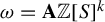 for some
$k\in \mathbb {N}$
 and
$\mathbf {A}=(a_{ij})_{i,j}\in \mathrm {M}_{n\times k}(\mathbb {Z}[S])$
 , we have
$\mathbf {a}=\mathbf {A}\ast \mathbf {b}$
 for some
$\mathbf {b}=(b_1,\ldots ,b_k)\in \mathbb {Z}[S]^k$
 . Therefore,

so there must exist
$t\in S$
 and
$1\leq j\leq k$
 such that
$\langle \mathbf {f}, \mathbf {A}\ast \delta _{t}\mathbf {e}_j\rangle \neq 0$
 . Since
$\mathbf {x}\in X_\omega $
 , we have that
$\pi (\langle \mathbf {f}, \mathbf {a}\rangle )=\langle \mathbf {x}, \mathbf {a}\rangle =0$
 for all
$\mathbf {a}\in \omega $
 , by Proposition 3.3. Hence,
$\langle \mathbf {f},\mathbf {a}\rangle \in \mathbb {Z}$
 for every
$\mathbf {a}\in \omega $
 , and in particular,
$\langle \mathbf {f},\mathbf {A}\ast \delta _{t}\mathbf {e}_j\rangle \in \mathbb {Z}$
 , yielding
$|\langle \mathbf {f},\mathbf {A}\ast \delta _{t}\mathbf {e}_j\rangle |\geq 1$
 . Therefore, using the fact that
$\|a_{ij}\ast \delta _t\|_1\leq \|a_{ij}\|_1\|\delta _t\|_1=\|a_{ij}\|_1$
 , we get

With this, since
$KS=S$
 , we have

Taking an enumeration
$\{s_1,s_2,\ldots \}$
 of S, there is some
$r\geq 1$
 such that
$K\subseteq \{s_1,\ldots ,s_r\}$
 . Since
$\rho $
 is bounded by
$1$
 , the metric
$\rho /(1+\rho )$
 is bounded below by
$\rho /2$
 , and we have

for all
$\mathbf {y}=(y_1,\ldots ,y_n),\mathbf {y}'=(y_1',\ldots ,y_n')\in (\mathbb {T}^S)^n$
 and
$t\in K$
 , which implies

Therefore,
$\epsilon := (2^{r+1}\|\mathbf {A}\|_1)^{-1}$
 is an expansivity constant for
$S\curvearrowright X_\omega $
 . Since
$\omega \leq J$
 , by duality, we have
$X_J\subseteq X_\omega $
 , yielding the expansivity of
$S\curvearrowright X_J$
 .
It turns out that the existence of a finite
$K\subseteq S$
 with
$S=KS$
 is necessary for the equivalence between properties (i) and (ii) in Proposition 4.1. This is already implicitly contained in [Reference Ceccherini-Silberstein, Coornaert and PhungCSCP26, Proposition 4.2] for the case where
$n=1$
 and
$J=m\mathbb {Z}[S]$
 for some
$m\geq 2$
 .
Theorem A. Let S be a semigroup. The following statements are equivalent.
-
(i) There exists a finite subset $K\subseteq S$
such that
$S=KS$
. -
(ii) For every right $\mathbb {Z}[S]$
-submodule
$J\leq \mathbb {Z}[S]^n$
, the action
$S\curvearrowright X_J$
is expansive if and only if
$J^\perp =\{0\}$
.


Proof. It follows from Proposition 4.1 that (i) implies (ii), so let us prove that (ii) implies (i). Assume statement (ii) and suppose that
$KS\subsetneq S$
 for every finite
$K\subseteq S$
 . The algebraic semigroup action of S upon the closed subgroup
$X\leq \mathbb {T}^S$
 given by

cannot be expansive by [Reference Ceccherini-Silberstein, Coornaert and PhungCSCP26, Proposition 4.2], but we include a brief proof for completeness. For any given
$\epsilon>0$
 , there exists a finite
$K\subseteq S$
 such that
$d(x,y)<\epsilon $
 whenever x and y coincide on K. Choose an element
$s_K\in S-KS$
 , and let
$x,y\in X$
 be equal over
$S-\{s_K\}$
 and such that
$x(s_K)\neq y(s_K)$
 . Then,
$ts\neq s_K$
 for every
$s\in S$
 and
$t\in K$
 , so

Hence,
$s\cdot x$
 and
$s\cdot y$
 coincide on K for all
$s\in S$
 , implying
$d(s\cdot x,s\cdot y)<\epsilon $
 for all
$s\in S$
 . As this has been done for arbitrary
$\epsilon>0$
 , we conclude that
$\sup _{s\in S} d(s\cdot x,s\cdot y)=0$
 but
$x\neq y$
 , so that
$S\curvearrowright X$
 is not expansive.
Observe that
$x(s)\in \{0,1/2\}$
 if and only if
$\langle x, 2\delta _s\rangle =2x(s)=0$
 . Hence, we have that
$X={[\mathbb {Z}[S]/2\mathbb {Z}[S]]}^{\wedge }$
 . Thus, X is the algebraic action associated with the right
$\mathbb {Z}[S]$
 -module
$J=2\mathbb {Z}[S]$
 . Now, if
$f\in J^\perp $
 , then for every
$t\in S$
 , we have

so
$f=0$
 . Hence,
$J^\perp =\{0\}$
 , but
$S\curvearrowright X_J$
 is non-expansive.
Taking into consideration Theorem A, we introduce the following definition.
Definition 4.2. A semigroup S will be called expansive if there exists a finite subset
$K\subseteq S$
 such that
$S=KS$
 .
4.2 Expansivity and invertibility
The purpose of this subsection is to study expansivity of algebraic actions for a semigroup S such that
$\ell ^1(S)$
 admits a left identity. We start by observing that in this situation, S always satisfies property (i) of Theorem A.
Lemma 4.3. If
$\ell ^1(S)$
 has a left identity, then S is expansive.
Proof. Let
$e\in \ell ^1(S)$
 be a left identity. Then,
$\mathrm {Re}\{e\}\in \ell ^1(S)$
 is a left identity too. Let
$K\subseteq S$
 be a finite subset such that
$\|\mathrm {Re}\{e\}\mathbf {1}_{K^{\text {c}}}\|_1<1$
 . Note that, for every
$s\in S$
 , we have

and hence,
$\{t\in S:st=s\}\cap K\neq \varnothing $
 . Indeed, if it were not the case, we would have

which is absurd. Therefore, for every
$s\in S$
 , there exists
$t\in K$
 such that
$s=ts\in KS$
 and we conclude that
$S=KS$
 .
The characterizations in Proposition 4.1 were inspired by the group-theoretical versions from [Reference SchmidtSch95, Lemma 6.8], [Reference Einsiedler and RindlerER01, Theorem 8.1], and [Reference Deninger and SchmidtDS07, Theorem 3.2]. Nonetheless, we closely followed the arguments in [Reference Chung and LiCL15, §3], where the authors provide a characterization of expansivity that involves the Banach
$^*$
 -algebra structure of
$\mathrm {M}_n(\ell ^1(G))$
 (see, e.g., [Reference Chung and LiCL15, Lemma 3.8]). This language proves useful to obtain a characterization in terms of invertibility conditions in
$\mathrm {M}_n(\ell ^1(G))$
 , but is not available for actions of general semigroups. It suffices, however, to frame things in terms of the dual maps associated with the convolution product.
Definition 4.4. The dual convolution product
$\star \colon \ell ^\infty (S)\times \ell ^1(S)\to \ell ^\infty (S)$
 is given by

for all
$f\in \ell ^\infty (S)$
 and
$a\in \ell ^1(S)$
 .
We regard the dual convolution product as a product
$\star \colon \ell ^\infty (S)^n\times \mathrm {M}_n(\ell ^1(S))\to \ell ^\infty (S)^n$
 for every
$n\geq 1$
 , as explained in §2.2.
Proposition 4.5. We have
$\langle \mathbf {f},\mathbf {A}\ast \mathbf {b}\rangle =\langle \mathbf {f}\star \mathbf {A},\mathbf {b}\rangle $
 for all
$\mathbf {f}\in \ell ^\infty (S)^n$
 ,
$\mathbf {A}\in \mathrm {M}_{n\times k}(\ell ^1 (S))$
 , and
$\mathbf {b}\in \ell ^1(S)^m$
 . In particular, for all
$n\in \mathbb {N}$
 , the product
$\star \colon \ell ^\infty (S)^n\times \mathrm {M}_n(\ell ^1(S))\to \ell ^\infty (S)^n$
 is the dual right Banach
$\mathrm {M}_n(\ell ^1(S))$
 -module structure on
$\ell ^\infty (S)^n$
 , associated with the left Banach
$\mathrm {M}_n(\ell ^1(S))$
 -module structure
$\ast \colon \mathrm {M}_n(\ell ^1(S))\times \ell ^1(S)^n\to \ell ^1(S)^n$
 .
Proof. For all
$\mathbf {f}=(f_1,\ldots ,f_n)\in \ell ^\infty (S)^n$
 ,
$\mathbf {A}=(a_{ij})_{i,j}\in \mathrm {M}_{n\times k}(\ell ^1(S))$
 and
$\mathbf {b}=(b_1,\ldots ,b_k)\in \ell ^1(S)^k$
 , it holds that

Hence, the first claim is proved. The left
$\mathrm {M}_n(\ell ^1(S))$
 -module structure
$\ast \colon \mathrm {M}_n(\ell ^1(S)) \times \ell ^1(S)^n\to \ell ^1(S)^n$
 is determined by the maps
$\psi _{\mathbf {A}}\colon \ell ^1(S)^n\to \ell ^1(S)^n$
 ,
$\mathbf {b}\mapsto \mathbf {A}\ast \mathbf {b}$
 . What we have just proven implies that for all
$\mathbf {A}\in \mathrm {M}_n(\ell ^1(S))$
 , the map
$\varphi _{\mathbf {A}}\colon \ell ^\infty (S)^n\to \ell ^\infty (S)$
 ,
$\mathbf {f}\mapsto \mathbf {f}\star \mathbf {A}$
 is exactly the dual map of
$\psi _{\mathbf {A}}$
 . Hence, the maps
$\varphi _{\mathbf {A}}$
 determine a right
$\mathrm {M}_n(\ell ^1(S))$
 -module structure, dual to
$\ast \colon \mathrm {M}_n(\ell ^1(S))\times \ell ^1(S)^n\to \ell ^1(S)^n$
 . Finally, the fact that

implies that said right
$\mathrm {M}_n(\ell ^1(S))$
 -module structure is Banach.
Proposition 4.6. Let S be an expansive semigroup. Then, for every
$\mathbf {A}\in \mathrm {M}_{n\times k}(\mathbb {Z}[S])$
 , the following are equivalent.
-
(i) The action $S\curvearrowright X_{\mathbf {A}\mathbb {Z}[S]^k}$
is expansive. -
(ii) The map $\varphi _{\mathbf {A}}\colon \ell ^\infty (S)^n\to \ell ^\infty (S)^k$
given by
$\mathbf {f}\mapsto \mathbf {f}\star \mathbf {A}$
is injective.
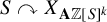


Proof. Note that, for every
$\mathbf {A}\in \mathrm {M}_{n\times k}(\mathbb {Z}[S])$
 , we have
$(\mathbf {A}\mathbb {Z}[S]^k)^\perp =\mathrm {ker}(\varphi _{\mathbf {A}})$
 . Indeed, we know from Proposition 4.5 that
$\langle \mathbf {f},\mathbf {A}\ast \mathbf {b}\rangle =\langle \mathbf {f}\star \mathbf {A},\mathbf {b}\rangle $
 for all
$\mathbf {f}\in \ell ^\infty (S)^n$
 and
$\mathbf {b}\in \ell ^1(S)^m$
 . Hence, if
$\mathbf {f}\star \mathbf {A}=0$
 , then
$\langle \mathbf {f},\mathbf {A}\ast \mathbf {b}\rangle =0$
 for all
$\mathbf {b}\in \mathbb {Z}[S]^k$
 , so
$\mathbf {f}\in (\mathbf {A}\mathbb {Z}[S]^k)^\perp $
 . However, if
$\mathbf {f}\in (\mathbf {A}\mathbb {Z}[S]^k)^\perp $
 , we have that
$\langle \mathbf {f}\star \mathbf {A},\mathbf {b}\rangle =0$
 for all
$\mathbf {b}\in \mathbb {Z}[S]^k$
 , which immediately implies
$\mathbf {f}\star \mathbf {A}=0$
 . The equivalence between statements (i) and (ii) is now a direct consequence of Theorem A.
We will work with the following notion of invertibility in the case where
$\ell ^1(S)$
 is left unital.
Definition 4.7. Let
$\mathfrak {A}$
 be a Banach algebra. If
$e\in \mathfrak {A}$
 is a left identity, an element
$a\in \mathfrak {A}$
 will be called right e-invertible if there exists
$b\in \mathfrak {A}$
 such that
$ab=e$
 .
Proposition 4.8. Assume that
$\ell ^1(S)$
 is left unital and let
$\mathbf {I}$
 be a left identity in
$\mathrm {M}_n(\ell ^1(S))$
 . If
$J\leq \mathbb {Z}[S]^n$
 is a right
$\mathbb {Z}[S]$
 -submodule and there exists an element
$\mathbf {A}\in \mathrm {M}_n(\mathbb {Z}[S])$
 that is right
$\mathbf {I}$
 -invertible in
$\mathrm {M}_n(\ell ^1(S))$
 such that
$\mathbf {A}\mathbb {Z}[S]^n\leq J$
 , then the action
$S\curvearrowright X_J$
 is expansive.
Proof. We first claim that
$\mathbf {f}\star \mathbf {I}= \mathbf {f}$
 for every
$\mathbf {f}\in \ell ^\infty (S)^n$
 . To show this, we first prove that for a left identity
$e\in \ell ^1(S)$
 , we have
$f\star e= f$
 for all
$f\in \ell ^\infty (S)$
 . Indeed, for all
$r\in S$
 , it holds that
$e\ast \delta _r= \delta _r$
 , so
$(f\star e)\star \delta _r=f\star (e\ast \delta _r)=f\star \delta _r$
 . By Lemma 4.3, S is expansive, thus, for every
$s\in S$
 , we can write
$s=rr'$
 for some
$r,r'\in S$
 . We then have

and we conclude that
$f\star e=f$
 , as desired. Next, note that if
$a\in \ell ^1(S)$
 is such that
$a\ast b= 0$
 for all
$b\in \ell ^1(S)$
 , then it holds that
$f\star a= 0$
 for all
$f\in \ell ^\infty (S)$
 . Indeed, for all
$r\in S$
 , we have
$a\ast \delta _r= 0$
 , implying

Finally, write
$\mathbf {I}=(e_{ij})_{i,j}$
 . By considering the products
$\mathbf {I}\ast \mathbf {A}_{ij}$
 , where
$\mathbf {A}_{ij}$
 is the matrix with all entries equal to zero except for the entry
$(i,j)$
 , which is an arbitrary
$a\in \ell ^1(S)$
 , it is readily checked that
$e_{jj}$
 is a left identity in
$\ell ^1(S)$
 for all
$1\leq j\leq n$
 , and that
$e_{ij}$
 satisfies
$e_{ij}\ast b= 0$
 for every
$b\in \ell ^1(S)$
 and
$i\neq j$
 . Hence, for every
$\mathbf {f}=(f_1,\ldots ,f_n)\in \ell ^\infty (S)^n$
 , we get

and the claim is proven.
The result now follows directly from the claim. Let
$\mathbf {f}\in (\mathbf {A}\mathbb {Z}[S]^n)_\infty ^\perp $
 and
$\mathbf {B}\in \mathrm {M}_n(\ell ^1(S))$
 such that
$\mathbf {A}\ast \mathbf {B}=\mathbf {I}$
 . Then, as
$\mathbf {f}\star \mathbf {I}= \mathbf {f}$
 , we have
$\mathbf {f}=\mathbf {f}-(\mathbf {f}\star \mathbf {A})\star \mathbf {B}=\mathbf {f}-\mathbf {f}\star (\mathbf {A}\ast \mathbf {B}) =0$
 . Therefore,
$(\mathbf {A}\mathbb {Z}[S]^n)_\infty ^\perp $
 is trivial and so is
$J^\perp \subseteq (\mathbf {A}\mathbb {Z}[S]^n)^\perp $
 . Since S is expansive, we conclude by Theorem A that
$S\curvearrowright X_J$
 is an expansive action.
Remark 4.9. Proposition 4.8 can be established for a semigroup S such that
$\ell ^1(S)$
 has a left approximate identity, in terms of the notion of approximate invertibility defined in [Reference Esmeral, Feichtinger, Hutník and MaximenkoEFHM23]. However, we will see in Proposition 5.1 that if S is expansive and
$\ell ^1(S)$
 admits a left approximate identity, then necessarily
$\ell ^1(S)$
 has a left identity.
Lemma 4.10. Let
$\mathfrak {A}$
 be a Banach algebra with a left identity e. Then, the set of right e-invertible elements of
$\mathfrak {A}$
 is open and non-empty.
Proof. Note that e is clearly right e-invertible, so that the set of right e-invertible elements is non-empty. Let
$a\in \mathfrak {A}$
 be right e-invertible and let
$a^{-1}\in \mathfrak {A}$
 be such that
$aa^{-1}=e$
 . Given
$x\in \mathfrak {A}$
 with
$\|x\|<\|a^{-1}\|^{-1}$
 , define
$S_n := a^{-1}+\sum _{k=1}^{n}a^{-1}(xa^{-1})^{k}$
 and note that
$\|xa^{-1}\|< 1$
 , so the series
$\sum _{k=1}^{\infty }\|a^{-1}(xa^{-1})^{k}\|$
 converges. Since
$\mathfrak {A}$
 is a complete normed space, every absolutely convergent series converges (see [Reference BollobásBol99, Theorem 2.8]), so we can define
$S_\infty :=a^{-1}+\sum _{k=1}^{\infty }a^{-1}(xa^{-1})^{k}$
 . Thus,

showing that
$a-x$
 is right e-invertible. Hence, every element at a distance less than
$\|a^{-1}\|^{-1}$
 from a is right e-invertible and we get that the set of right e-invertible elements is open.
We now proceed to expand the characterization from Proposition 4.1 for finitely generated J. Note that, for a given left identity
$\mathbf {I}\in \mathrm {M}_n(\ell ^1(S))$
 , the real part
$\mathrm {Re}\{\mathbf {I}\}$
 is also a (possibly different) left identity in
$\mathrm {M}_n(\ell ^1(S))$
 .
Theorem B. Let S be a semigroup such that
$\ell ^1(S)$
 has a left identity. Then, given
$\mathbf {A}\in \mathrm {M}_{k\times n}(\mathbb {Z}[S])$
 and a left identity
$\mathbf {I}\in \mathrm {M}_n(\ell ^1(S))$
 , the following are equivalent.
-
(i) The algebraic action $S\curvearrowright X_{\mathbf {A}\mathbb {Z}[S]^k}$
is expansive. -
(ii) There exists $\mathbf {B}\in \mathrm {M}_n(\mathbb {Z}[S])$
that is right
$\mathrm {Re}\{\mathbf {I}\}$
-invertible in
$\mathrm {M}_n(\ell ^1(S))$
such that
$\mathbf {B}\mathbb {Z}[S]^n\subseteq \mathbf {A}\mathbb {Z}[S]^k$
.




If
$\ell ^1(S)$
 is additionally unital, the above conditions are equivalent to the following.
-
(iii) There exists $\mathbf {B}\in \mathrm {M}_n(\mathbb {Z}[S])$
invertible in
$\mathrm {M}_n(\ell ^1(S))$
such that
$\mathbf {B}\mathbb {Z}[S]^n\subseteq \mathbf {A}\mathbb {Z}[S]^k$
.


Proof. The fact that (ii) implies (i) directly follows from Proposition 4.8.
We prove now that (i) implies (ii). By Corollary 4.6, the map
$\varphi _{\mathbf {A}}\colon \ell ^\infty (S)^n\to \ell ^\infty (S)^k$
 given by
$\mathbf {f}\mapsto \mathbf {f}\star \mathbf {A}$
 is injective. Consider now the
$\mathbb {C}$
 -linear map
$\psi _{\mathbf {A}}\colon \ell ^1(S^1)^k\to \ell ^1(S)^n$
 given by
$\mathbf {a}\mapsto \mathbf {A}\ast \mathbf {a}$
 . By Proposition 4.5, we know that
$\varphi _{\mathbf {A}}$
 is the dual map of
$\psi _{\mathbf {A}}$
 . Now,
$\psi _{\mathbf {A}}$
 must have dense image in
$\ell ^1(S)^n$
 , because otherwise, there exists an element
$\mathbf {a}\in \ell ^1(S)^n-\overline {\mathrm {im}(\psi )}$
 and by the Hahn–Banach theorem, we may extend the zero functional on
$\overline {\mathrm {im}(\psi )}$
 to obtain an element
$\mathbf {f}\in \overline {\mathrm {im}(\psi _{\mathbf {A}})}^\perp \subseteq \ell ^\infty (S)^n$
 such that
$\langle \mathbf {f},\mathbf {a}\rangle \neq 0$
 . Thus,
$\mathbf {f}$
 is non-zero but
$\langle \mathbf {f},\psi _{\mathbf {A}}(\mathbf {b})\rangle =0$
 for all
$\mathbf {b}\in \ell ^1(S)^k$
 , so that
$\varphi _{\mathbf {A}}(\mathbf {f})=\psi _{\mathbf {A}}^*(\mathbf {f})=0$
 , which contradicts the injectivity of
$\varphi _{\mathbf {A}}$
 .
Let
$\epsilon>0$
 and let
$\mathbf {e}_1,\ldots ,\mathbf {e}_n$
 be the rows of
$\mathbf {I}$
 . Since
$\mathrm {im}(\psi _{\mathbf {A}})$
 is dense in
$\ell ^1(S)^n$
 , we may choose elements
$\mathbf {a}_1,\ldots ,\mathbf {a}_n \in \ell ^1(S^1)^k$
 such that for all
$1\leq i\leq n$
 , we have
$\|\psi _{\mathbf {A}}(\mathbf {a}_{i})-\mathbf {e}_i\|_1<\epsilon /n$
 . Observe that, for all
$1\leq i\leq n$
 ,

Hence,
$\|\mathbf {A}\ast \mathrm {Re}\{\mathbf {a}_i\}-\mathrm {Re}\{\mathbf {e}_i\}\|_1<\epsilon /n$
 . Since
$\mathbb {Q}[S]^k$
 is dense in
$\ell ^1(S^1,\mathbb {R})^k$
 and
$\psi _{\mathbf {A}}$
 is continuous, we can choose elements
$\mathbf {b}_{i}\in \mathbb {Q}[S]^k$
 such that
$\|\mathbf {A}\ast \mathbf {b}_i-\mathrm {Re}\{\mathbf {e}_i\}\|_1<\epsilon /n$
 for all
$1\leq i\leq n$
 . Hence, defining
$\mathbf {B}_\epsilon \in M_{k\times n}(\mathbb {Q}[S])$
 to be the matrix whose ith column is
$\mathbf {b}_i$
 , we get

By Lemma 4.10, the set of right
$\mathrm {Re}\{\mathbf {I}\}$
 -invertible elements is an open subset of
$\mathrm {M}_n(\ell ^1(S))$
 . Hence, taking
$\epsilon $
 sufficiently small, we can ensure that
$\mathbf {A}\ast \mathbf {B}_\epsilon $
 is right
$\mathrm {Re}\{\mathbf {I}\}$
 -invertible. Furthermore, since the rows of
$\mathbf {B}_\epsilon $
 are elements from
$\mathbb {Q}[S]^k$
 , we may take
$m\in \mathbb {N}$
 such that
$m\mathbf {B}_\epsilon \in \mathrm {M}_{k\times n}(\mathbb {Z}[S])$
 . Therefore, the matrix
$\mathbf {B}:=\mathbf {A}\ast m\mathbf {B}_\epsilon $
 belongs to
$\mathrm {M}_n(\mathbb {Z}[S])$
 , is right
$\mathrm {Re}\{\mathbf {I}\}$
 -invertible, and satisfies
$\mathbf {B}\mathbb {Z}[S]^n\subseteq \mathbf {A}\mathbb {Z}[S]^k$
 .
Finally, assume that
$\ell ^1(S)$
 has an identity e. It is already clear that (iii) implies (ii). To see that (i) implies (iii), first note that for all
$s\in S$
 , we have

Thus,
$\delta _s\ast \mathrm {Im}\{e\}=0$
 for all
$s\in S$
 , which implies
$\mathrm {Im}\{e\}=e\ast \mathrm {Im}\{e\}=0$
 . Hence,
$e=\mathrm {Re}\{e\}$
 and we conclude that
$\mathbf {I}=\mathrm {Re}\{\mathbf {I}\}$
 as well. The same argument of the proof of the fact that (i) implies (ii) allows us to construct a matrix
$\mathbf {B}\in \mathrm {M}_n(\mathbb {Z}[S])$
 arbitrarily close to
$\mathbf {I}$
 such that
$\mathbf {B}\mathbb {Z}[S]^n\subseteq \mathbf {A}\mathbb {Z}[S]^k$
 . Since the set of invertible elements of
$\mathrm {M}_n(\ell ^1(S))$
 is open, we can assume that such
$\mathbf {B}$
 is invertible.
Definition 4.11. A unital ring R is called stably finite if for every
$n\geq 1$
 , every right invertible element from
$\mathrm {M}_n(R)$
 is also left invertible.
Corollary C. Let S be a semigroup such that
$\ell ^1(S)$
 is unital and stably finite. Then, for every
$\mathbf {A}\in \mathrm {M}_n(\mathbb {Z}[S])$
 , the following are equivalent.
-
(i) The algebraic action $S\curvearrowright X_{\mathbf {A}\mathbb {Z}[S]^n}$
is expansive. -
(ii) The matrix $\mathbf {A}$
is invertible in
$\mathrm {M}_n(\ell ^1(S))$
.



Proof. By the equivalence between statements (i) and (iii) from Theorem B, we just need to show that
$\mathbf {A}$
 is invertible in
$\mathrm {M}_n(\ell ^1(S))$
 if and only if there exists
$\mathbf {B}\in \mathrm {M}_n(\mathbb {Z}[S])$
 that is invertible in
$\mathrm {M}_n(\ell ^1(S))$
 satisfying
$\mathbf {B}\mathbb {Z}[S]^n\subseteq \mathbf {A}\mathbb {Z}[S]^n$
 . Clearly, the invertibility of
$\mathbf {A}$
 implies this last condition. For the other direction, assume such
$\mathbf {B}$
 exists. It then follows that
$\mathbf {B}\mathrm {M}_n(\ell ^1(S))\subseteq \mathbf {A}\mathrm {M}_n(\ell ^1(S))$
 for every
$n\geq 1$
 . Since the identity element
$\mathbf {I}\in \mathrm {M}_n(\ell ^1(S))$
 belongs to
$\mathbf {B}\mathrm {M}_n(\ell ^1(S))$
 , there must exist
$\mathbf {C}\in \mathrm {M}_n(\ell ^1(S))$
 such that
$\mathbf {A}\ast \mathbf {C}=\mathbf {I}$
 , so
$\mathbf {A}$
 is right invertible in
$\mathrm {M}_n(\ell ^1(S))$
 . By the stable finiteness of
$\ell ^1(S)$
 , we conclude that
$\mathbf {A}$
 is invertible in
$\mathrm {M}_n(\ell ^1(S))$
 .
5 Expansive semigroups and their Banach algebras
In this section, we study conditions on the semigroup S appearing in Theorem, A, B, and Corollary C: expansivity, the existence of identities in
$\ell ^1(S)$
 and stable finiteness of
$\ell ^1(S)$
 . We start by clarifying the relationship between these first two notions and pointing out some conditions that imply them. Then, we study stable finiteness in the context of inverse semigroups with finitely many idempotents.
5.1 The relation between expansivity of S and unitality of
$\ell ^1(S)$

As we already saw in Lemma 4.3, expansivity of S is always satisfied when
$\ell ^1(S)$
 has a left identity. The following proposition gives a converse for that result under an additional hypothesis. There, a left approximate identity in a Banach algebra
$\mathfrak {A}$
 is a net
$(e_{\alpha })_{\alpha }$
 in
$\mathfrak {A}$
 such that
$e_\alpha a\to a$
 for every
$a\in \mathfrak {A}$
 .
Proposition 5.1. Let S be a semigroup. Then,
$\ell ^1(S)$
 admits a left identity if and only if S is expansive and
$\ell ^1(S)$
 admits a left approximate identity.
Proof. It is shown in [Reference Dales, Lau and StraussDLS10, Proposition 4.3] that if
$\ell ^1(S)$
 has a left approximate identity and
$S=FS$
 for some finite
$F\subseteq E_S$
 , then
$\ell ^1(S)$
 has a left identity. We will show that if S is expansive and
$\ell ^1(S)$
 admits a left approximate identity, then such F exists. Let
$(e_\alpha )_{\alpha }$
 be a left approximate identity in
$\ell ^1(S)$
 . Note that for every
$s\in S$
 , we have
$e_\alpha \ast \delta _s\to \delta _s$
 , so that

In particular, for every
$s\in S$
 , there exists
$r\in S$
 with
$rs=s$
 . Let
$K\subseteq S$
 be a finite subset with
$S=KS$
 . Choose, for every
$t\in K$
 , an element
$r_t\in S$
 with
$r_tt=t$
 , and let
$K'=\{r_t:t\in K\}$
 . Then, for every
$s\in S$
 , we can write
$s=ts'$
 with
$t\in K$
 and
$s'\in S$
 , and it follows that
$r_ts=r_tts'=ts'=s$
 . Hence,
$K'$
 is finite and for every
$s\in S$
 , there is
$t\in K'$
 with
$ts=s$
 (in particular,
$K'S=S$
 ).
Let
$n:= |K'|$
 and set
$K^{\prime }_n:= K'$
 . If every element
$t\in K'$
 satisfies
$t^2=t$
 , we are done by taking
$F=K^{\prime }_n$
 . Otherwise, if
$t\in K'$
 is not an idempotent, there is
$t'\in K'$
 with
$t't=t$
 and
$t'\neq t$
 . It follows that every element
$s\in S$
 satisfying
$ts=s$
 also satisfies
$t's=t'ts=ts=s$
 , so we can define
$K_{n-1}':= K^{\prime }_n-\{t\}$
 and still for every
$s\in S$
 , there is
$t\in K^{\prime }_{n-1}$
 satisfying
$ts=s$
 . By iterating this process, we see that for some
$1\leq k\leq n$
 ,
$F:= K^{\prime }_k$
 is a subset of
$E_S$
 and satisfies
$S=FS$
 .
Example 5.2. There are examples of semigroups S such that
$\ell ^1(S)$
 does not have a left identity, but has a left approximate identity. Take the semigroup
$\mathbb {N}_\wedge $
 of natural numbers with the operation
$n\wedge m=\min \{n,m\}$
 for all
$n,m\in \mathbb {N}$
 . The sequence
$(\delta _n)_{n\in \mathbb {N}}$
 is an approximate identity in
$\ell ^1(\mathbb {N}_\wedge )$
 , but there is no left identity element (see [Reference Dales, Lau and StraussDLS10, Example 4.10]).
In the case where S is a cancellative semigroup, that is, if for all
$s,t\in S$
 , we have
$s=t$
 whenever
$sr=tr$
 or
$rs=rt$
 for some
$r\in S$
 , the relation between the hypotheses becomes stronger.
Proposition 5.3. Let S be a cancellative semigroup. The following assertions are equivalent:
-
(i) S is expansive;
-
(ii) the algebra $\ell ^1(S)$
has a left approximate identity; -
(iii) the algebra $\ell ^1(S)$
has a left identity; -
(iv) S is a monoid.


Proof. The equivalence between assertions (ii) and (iv) is proven in [Reference GrønbækGrø88, Corollary 1.3 and Remark 1.4], and since (iv) implies (iii) and (iii) implies (ii), the equivalences between assertions (ii), (iii), and (iv) follow. That (iii) implies (i) was proven in Lemma 4.3, so it just remains to prove that (i) implies (iii).
Let
$K\subseteq S$
 be finite such that
$S=KS$
 , and note that if
$t=t's$
 for some
$t,t'\in K$
 with
$t\neq t'$
 and
$s\in S$
 , then every
$r\in S$
 satisfying
$r\in tS$
 also satisfies
$r\in tS=t'sS\subseteq t'S$
 . Hence, by removing such t from K and iterating the process, we may assume that every
$t\in K$
 satisfies
$t=ts_t$
 for some
$s_t\in S$
 . With this, we get by left cancellativity that

so that
$t^2=t$
 for every
$t\in K$
 . Now, assume
$|K|\geq 2$
 and let
$t_1,t_2\in K$
 be different elements. Then,
$t_1t_2=t_1^2t_2=t_1t_2^2$
 , so left and right cancellativity yield that
$t_1=t_1t_2=t_2$
 . Hence,
$|K|=1$
 and we write
$K=\{t\}$
 . Note that for every element
$s\in S$
 , it holds that
$s=ts'$
 for some
$s'\in S$
 , so
$ts=tts'=ts'=s$
 and we conclude that t is a left identity element. Finally, by right cancellativity and the fact that
$st=st^2$
 , we get
$s=st$
 for every
$s\in S$
 and we obtain that S is a monoid, as desired.
We now point out some conditions that imply expansivity or unitality of
$\ell ^1(S)$
 . Recall that a semigroup S is called regular if for every
$s\in S$
 , there exists
$s^*\in S$
 with
$ss^*s=s$
 and
$s^*ss^*=s^*$
 . Also, an element
$e\in S$
 is called an idempotent if
$e^2=e$
 , and we denote by
$E_S$
 the set of idempotent elements of S. When S is regular, the elements
$ss^*$
 and
$s^*s$
 are idempotents for all
$s\in S$
 , and thus,
$E_SS=SE_S=S$
 .
Expansivity of S, that is, the existence of a finite
$K\subseteq S$
 with
$S=KS$
 , is immediately implied by any of the following conditions:
-
• S has a left identity, or more generally, if $\ell ^1(S)$
has a left identity (Lemma 4.3); -
• S is regular and it either has a finite set of idempotents or is finitely generated.

However, examples of non-expansive semigroups include
$\mathbb {N}_\wedge $
 from Example 5.2 and any cancellative semigroup that is not a monoid, by Proposition 5.3.
Moving to the existence of an identity in
$\ell ^1(S)$
 , it is clear that this is immediately satisfied by every monoid. We also include the following two examples.
Example 5.4. (Semigroups with an amenable Banach algebra)
Given a Banach algebra
$\mathfrak {A}$
 , we denote by
$\mathfrak {A}\,\hat {\otimes }\,\mathfrak {A}$
 the completion of
$\mathfrak {A}\otimes \mathfrak {A}$
 with respect to the norm

and call it the projective tensor product of
$\mathfrak {A}$
 and
$\mathfrak {A}$
 . The space
$\mathfrak {A}\,\hat {\otimes }\,\mathfrak {A}$
 becomes a Banach
$\mathfrak {A}$
 -bimodule via the formulas
$a\cdot (u\otimes v)=(au)\otimes v$
 and
$(u\otimes v)\cdot a=u\otimes (va)$
 . Letting
$\Delta _{\mathfrak {A}}\colon \mathfrak {A}\,\hat {\otimes }\, \mathfrak {A}\to \mathfrak {A}$
 be the map given by
$a\otimes b\mapsto ab$
 , a bounded net
$(d_\alpha )_{\alpha }$
 in
$\mathfrak {A}\,\hat {\otimes }\,\mathfrak {A}$
 is called an approximate diagonal if
$\Delta _{\mathfrak {A}}d_\alpha $
 is a right approximate identity in
$\mathfrak {A}$
 and
$a\cdot d_\alpha -d_\alpha \cdot a\to 0$
 for all
$a\in \mathfrak {A}$
 . A Banach algebra
$\mathfrak {A}$
 is called amenable if it admits an approximate diagonal. For definitions and an overview of the theory of amenable Banach algebras, we refer the reader to [Reference Bonsall and DuncanBD73, Reference RundeRun20]. There is considerable literature regarding the amenability of semigroup Banach algebras [Reference Dales, Lau and StraussDLS10, Reference Duncan and NamiokaDN78, Reference Duncan and PatersonDP90, Reference GrønbækGrø88, Reference MunnMun55]. Amenability of the Banach algebra
$\ell ^1(S)$
 imposes strong conditions upon the semigroup S: it is a regular semigroup with finitely many idempotents [Reference Duncan and PatersonDP90, Theorem 2] and
$\ell ^1(S)$
 is a unital algebra [Reference Dales, Lau and StraussDLS10, Corollary 10.6].
Example 5.5. (Inverse semigroups with finitely many idempotents)
A semigroup S such that every
$s\in S$
 admits a unique
$s^*\in S$
 with
$ss^*s=s$
 and
$s^*ss^*=s^*$
 is called an inverse semigroup. This is equivalent to saying that S is a regular semigroup such that every two idempotents commute with each other (see, e.g., [Reference Clifford and PrestonCP61, Theorem 1.17]).
The following observation is made in [Reference Duncan and NamiokaDN78, p. 6]. If S is an inverse semigroup, then
$E_S$
 is a commutative subsemigroup of S. Thus, by [Reference Hewitt and ZuckermanHZ56, Theorem 5.8], the algebra
$\ell ^1(E_S)$
 is semisimple. If moreover
$E_S$
 is finite, then
$\ell ^1(E_S)$
 is finite-dimensional and semisimple; hence, isomorphic to a finite product of simple
$\mathbb {C}$
 -algebras. By the Wedderburn–Artin theorem, we conclude that
$\ell ^1(E_S)$
 is isomorphic to a finite product
$\prod _{i=1}^n\mathrm {M}_{n_i}(D_i)$
 , where each
$D_i$
 is a division
$\mathbb {C}$
 -algebra. Hence,
$\ell ^1(E_S)$
 has an identity
$e\in \ell ^1(E_S)$
 . Note that the associated element
$e\mathbf {1}_{E_S}\in \ell ^1(S)$
 satisfies

and therefore,
$e\mathbf {1}_{E_S}\ast \delta _s=(e\mathbf {1}_{E_S}\ast \delta _{ss^*})\ast \delta _{s}= \delta _{ss^*}\ast \delta _{s}= \delta _{s}$
 for all
$s\in S$
 . Hence,
$e\mathbf {1}_{E_S}$
 is an identity in
$\ell ^1(S)$
 , so
$\ell ^1(S)$
 is unital.
5.2 Stable finiteness for inverse semigroups with finitely many idempotents
Throughout this section, S will be an inverse semigroup. If
$|E_S|<\infty $
 , Example 5.5 above shows that
$\ell ^1(S)$
 is unital, so in particular, S is expansive by Lemma 4.3. We want to see that in this case,
$\ell ^1(S)$
 is also stably finite, so that S satisfies the hypothesis of Corollary C.
Kaplansky observed that
$\mathbb {C}[G]$
 is stably finite for every
$n\geq 1$
 if G is a group [Reference KaplanskyKap69, p. 122]. This is a consequence of the fact that in this case, the reduced group
$C^*$
 -algebra
$C^*_r(G)$
 admits a faithful trace and implies in fact that
$\ell ^1(G)$
 is stably finite. We will follow the same proof strategy for S. We point out that if
$|E_S|<\infty $
 , then the universal groupoid
$\mathscr {G}_{\mathbf {u}}(S)$
 associated with S is Hausdorff (see, e.g., [Reference SteinbergSte10, Theorem 4.20]), so by [Reference SteinbergSte26, Corollary 7.9] and the paragraph thereafter, the reduced
$C^*$
 -algebra
$C_r^*(S)$
 admits a faithful trace. Hence, the results in [Reference SteinbergSte26] provide a more general framework in which
$\ell ^1(S)$
 , if unital, is stably finite. Notwithstanding that, the proof under the assumption of finitely many idempotents becomes more concrete and direct, so we include it for completeness.
Recall that if
$\mathfrak {A}$
 is a
$C^*$
 -algebra, a faithful trace is a positive linear map
$\tau \colon \mathfrak {A}\to \mathbb {C}$
 with
$\tau (ab)=\tau (ba)$
 for all
$a,b\in \mathfrak {A}$
 , such that
$\tau (a^*a)>0$
 whenever
$a\neq 0$
 . The following result is well known.
Proposition 5.6. Every unital
$C^*$
 -algebra
$\mathfrak {A}$
 admitting a faithful trace is stably finite.
Proof. If
$\mathfrak {A}$
 admits a faithful trace
$\tau '$
 , then the trace
$\tau \colon \mathrm {M}_n(\mathfrak {A})\to \mathbb {C}$
 defined for every
$\mathbf {A}=(a_{ij})_{i,j}\in \mathrm {M}_n(\mathfrak {A})$
 by
$\tau (\mathbf {A})=\sum _{j=1}^n\tau '(a_{jj})$
 is faithful, since

whenever
$\mathbf {A}\neq \mathbf {0}$
 .
The assertion that every right invertible element of
$\mathrm {M}_n(\mathfrak {A})$
 is also left invertible is equivalent to the following statement: for all projections
$\mathbf {0}\leq \mathbf {Q}\leq \mathbf {P}$
 admitting an element
$\mathbf {V}\in \mathrm {M}_n(\mathfrak {A})$
 with
$\mathbf {P}=\mathbf {V}^*\mathbf {V}$
 and
$\mathbf {Q}=\mathbf {V}\mathbf {V}^*$
 , we have
$\mathbf {P}=\mathbf {Q}$
 [Reference Rørdam, Larsen and LaustsenRLL00, Lemma 5.1.2]. If
$\mathbf {P},\mathbf {Q},\mathbf {V}\in \mathrm {M}_n(\mathfrak {A})$
 are as above, we get

and since
$\mathbf {P}-\mathbf {Q}$
 is positive, we get that
$\mathbf {P}=\mathbf {Q}$
 . Hence, every right invertible element from
$\mathrm {M}_n(\mathfrak {A})$
 is invertible and we conclude that
$\mathfrak {A}$
 is stably finite.
We proceed to give the definition of the reduced
$C^*$
 -algebra of S. Recall that
$E_S$
 is a commutative subsemigroup of S. We write
$p\leq q$
 if
$p,q\in E_S$
 are elements such that
$pq=p$
 . Denote by
$I(S)$
 the inverse semigroup of all bijections
$\sigma \colon A\to B$
 between subsets
$A,B\subseteq S$
 . The Vagner–Preston theorem [Reference PatersonPat99, Proposition 2.1.3] provides an injective homomorphism of semigroups
$\gamma \colon S\to I(S)$
 by setting

Define
$\unicode{x3bb} (s)\in \mathcal {B}(\ell ^2(S))$
 so that
$\unicode{x3bb} (s)(\delta _t)=\delta _{st}$
 if
$tt^*\leq s^*s$
 and
$0$
 otherwise. We get a
$^*$
 -homomorphism
$\unicode{x3bb} \colon S\to \mathcal {B}(\ell ^2(S))$
 , which by a theorem of Wordingham [Reference WordinghamWor82] is a faithful representation of S. This extends to a
$^*$
 -representation
$\unicode{x3bb} \colon \ell ^1(S)\to \mathcal {B}(\ell ^2(S))$
 .
Definition 5.7. The reduced
$C^*$
 -algebra
$C_r^*(S)$
 is the
$\|\!\cdot \!\|$
 -closure of
$\unicode{x3bb} (\ell ^1(S))$
 in
$\mathcal {B}(\ell ^2(S))$
 .
Proposition 5.8. If S is an inverse semigroup and
$E_S$
 is finite, then
$C^*_r(S)$
 admits a faithful trace. In particular,
$\ell ^1(S)$
 is stably finite.
Proof. Let
$\tau \colon C^*_r(S)\to \mathbb {C}$
 be given by

To prove that
$\tau $
 satisfies
$\tau (ab)=\tau (ba)$
 for all
$a,b\in C^*_r(S)$
 , it suffices to show
$\tau (\unicode{x3bb} (s)\unicode{x3bb} (t))=\tau (\unicode{x3bb} (t)\unicode{x3bb} (s))$
 for all
$s,t\in S$
 . Note that, by the definitions of
$\unicode{x3bb} (s)$
 and
$\unicode{x3bb} (t)$
 , we have

where
$\Omega _{s,t}:=\{p\in E_s:p\leq t^*t,tpt^*\leq s^*s\text { and }stp=p\}$
 . It is thus enough to show that
$|\Omega _{s,t}|=|\Omega _{t,s}|$
 . Consider the map
$\theta \colon \Omega _{s,t}\to \Omega _{t,s}$
 given by
$p\mapsto tpt^*$
 for
$p\in \Omega _{s,t}$
 . We first note that it is well defined. Indeed, if
$p\in \Omega _{s,t}$
 , we want to show that
$\theta (p)\in E_S$
 , and satisfies
$\theta (p)\leq s^*s$
 ,
$s\theta (p)s^*\leq t^*t$
 and
$ts\theta (p)=\theta (p)$
 . Note that, for such p, we have that:
-
• $(tpt^*)^2=tp(t^*t)pt^*=tt^*tp^2t^*=tpt^*$
, so
$\theta (p)\in E_S$
; -
• the condition $tpt^*\leq s^*s$
by definition yields
$\theta (p)\leq s^*s$
; -
• the fact that $stp=p$
implies
$pt^*s^*=p$
because
$p\in E_S$
, and since
$pt^*t=p$
, we get $$ \begin{align*} (s\theta(p)s^*)(t^*t)&=(stp)t^*s^*t^*t=(pt^*s^*)t^*t=pt^*t\\ &=p=stp=st(pt^*s^*)=s\theta(p)s^*, \end{align*} $$and so $s\theta (p)s^*\leq t^*t$
; and
-
• $ts\theta (p)=t(stp)t^*=tpt^*=\theta (p)$
.


Hence,
$\theta $
 is well defined. Now, if
$tpt^*=tqt^*$
 for
$p,q\in \Omega _{s,t}$
 , then

so
$\theta \colon \Omega _{s,t}\to \Omega _{t,s}$
 is an injection. By symmetry, the map
$\eta \colon \Omega _{t,s}\to \Omega _{s,t}$
 given by
$e\mapsto ses^*$
 is an injection as well, so we have proven that
$|\Omega _{s,t}|=|\Omega _{t,s}|$
 .
Let us see that
$\tau $
 is faithful. For every
$a\in C^*_r(S)$
 , the element
$a^*a$
 is self-adjoint with non-negative spectrum and so the continuous functional calculus (see, e.g., [Reference Reed and SimonRS72, Theorem VII.1]) gives a self-adjoint element
$|a|\in C^*_r(S)$
 such that
$|a|^2=a^*a$
 . Also, if
$s\in S$
 , then

so the element
$a^*a-|a|\unicode{x3bb} (s)^*\unicode{x3bb} (s)|a|$
 is positive. Thus,
$\tau (|a|\unicode{x3bb} (s)^*\unicode{x3bb} (s)|a|)\leq \tau (a^*a)$
 . With this, if
$\tau (a^*a)=0$
 , then for every
$s\in S$
 , we have

which implies
$(a\unicode{x3bb} (s))(\delta _p)=0$
 for all
$p\in E_S$
 . Taking
$p=s^*s$
 , we have
$s^*s\leq s^*s$
 so that
$\unicode{x3bb} (s)(\delta _{s^*s})=\delta _{ss^*s}=\delta _s$
 , yielding
$a(\delta _s)=0$
 for all
$s\in S$
 . Hence,
$\tau $
 is faithful.
Example 5.9. (Bicyclic monoid)
The bicyclic monoid is the free monoid B generated by two elements
$s,t$
 subject to the relation
$st=1_B$
 . This is an example of an inverse monoid, but the set
$E_B$
 of idempotents is infinite. As a monoid,
$\ell ^1(B)$
 is unital, but
$\ell ^1(B)$
 is not stably finite, as
$\delta _s\ast \delta _t=e$
 , but
$\delta _{t}\ast \delta _s=\delta _{ts}\neq e$
 . One can see that for
$\mathbf {A}=(\delta _s)\in \mathrm {M}_1(\mathbb {Z}[B])$
 , the assertion of Corollary C fails. Indeed, since
$\mathbf {A}$
 is right invertible in
$\mathrm {M}_1(\mathbb {Z}[B])$
 , then by Theorem B, the action
$B\curvearrowright X_{\mathbf {A}\mathbb {Z}[B]}$
 is expansive. However,
$\mathbf {A}$
 cannot be invertible in
$\mathrm {M}_1(\ell ^1(B))$
 .
Question 5.10. In [Reference Ceccherini-Silberstein, Coornaert and PhungCSCP25], the authors prove that for every surjunctive monoid S and field K, the ring
$K[S]$
 is stably finite. Is it true that
$\ell ^1(S)$
 is stably finite for this class of monoids?
6 Concrete examples
In this final section, we study expansivity and unitality of
$\ell ^1(S)$
 for two particular classes of semigroups.
6.1 Rees matrix semigroups
The following class of semigroups is of fundamental importance in the theory of semigroups. We refer the reader to [Reference Dales, Lau and StraussDLS10, Ch. 4] for an overview of this class with a special focus on their Banach algebras and concrete examples.
Let G be a group and set
$G^0:=G\cup \{0\}$
 . Let
$I,\Lambda $
 be finite sets and
$\mathbf {P}=(p_{\unicode{x3bb} j})_{\unicode{x3bb} ,j}\in \mathrm {M}_{\Lambda \times I}(G^0)$
 . Consider the set
$I\times G^0\times \Lambda $
 with the operation

Define the Rees matrix semigroup with sandwich matrix
$\mathbf {P}$
 as the Rees quotient

Proposition 6.1. Let
$I,\Lambda $
 be two finite sets, G be a countable group and
$\mathbf {P}\in \mathrm {M}_{\Lambda \times I}(G^0)$
 . Set
$S=\mathrm {M}^0(G;I,\Lambda ,\mathbf {P})$
 . We have the following.
-
(i) The semigroup S is expansive if and only if $\mathbf {P}$
has a non-zero entry. -
(ii) There exists a finite $K\subseteq E_S$
with
$S=KS$
if and only if every column of
$\mathbf {P}$
contains a non-zero entry.


Proof. Write
$\mathbf {P}=(p_{\unicode{x3bb} i})_{i,\unicode{x3bb} }$
 . Let us prove statement (i). Since S contains a non-zero element, it is clear that if
$S=KS$
 , then
$\mathbf {P}$
 is non-zero. Conversely, let
$i_0\in I$
 and
$\unicode{x3bb} _0\in \Lambda $
 be such that
$p_{\unicode{x3bb} _0 i_0}\in G$
 , and note that
$K:=\{(i,1_G,\unicode{x3bb} _0):i\in I\}$
 is finite and satisfies

for all
$(i,g,\unicode{x3bb} )\in S$
 . Hence,
$S=KS$
 .
To see statement (ii), note that for
$g\in G$
 , we have that
$(i,g,\unicode{x3bb} )$
 is an idempotent if and only if
$p_{\unicode{x3bb} i}\in G$
 and
$g=p_{\unicode{x3bb} i}^{-1}$
 . Thus, if
$S=KS$
 for some
$K\subseteq E_S$
 , then for all
$i\in I$
 , there must be some
$\unicode{x3bb} \in \Lambda $
 with
$p_{\unicode{x3bb} i}\in G$
 . Conversely, assume for each
$i\in I$
 , there is
$\unicode{x3bb} (i)\in \Lambda $
 such that
$p_{\unicode{x3bb} (i) i}\in G$
 . Then,
$K:=\{(i,p_{\unicode{x3bb} (i)i}^{-1},\unicode{x3bb} (i)):i\in I\}\subseteq E_S$
 is finite and

yielding
$S=KS$
 .
The matrix
$\mathbf {P}$
 can be regarded as an element of
$\mathrm {M}_{\Lambda \times I}(\ell ^1(G))$
 in a natural way by identifying
$g\in G$
 with
$\delta _g\in \ell ^1(G)$
 , and
$0\in G^0$
 with
$0\in \ell ^1(G)$
 . The results in the following proposition are well known. See, e.g., [Reference Dales, Lau and StraussDLS10, pp. 68, 69].
Proposition 6.2. The following statements hold.
-
(i) The map $(a_{i\unicode{x3bb} })_{i,\unicode{x3bb} }\longmapsto \sum _{(g)_{i,\unicode{x3bb} }}a_{i\unicode{x3bb} }(g)\delta _{(g)_{i\unicode{x3bb} }}$
provides an isometric isomorphism of Banach algebras
$\mathrm {M}_{I\times \Lambda }(\ell ^1(G))\longrightarrow \ell ^1(\mathrm {M}^0(G;I,\Lambda ;\mathbf {P}))/\mathbb {C}\delta _0$
with multiplication in
$\mathrm {M}_{I\times \Lambda }(\ell ^1(G))$
given by
$\mathbf {A}\cdot \mathbf {B}:=\mathbf {A}\mathbf {P}\mathbf {B}$
for all
$\mathbf {A},\mathbf {B}\in \mathrm {M}_{I\times \Lambda }(\ell ^1(G))$
. -
(ii) The algebra $\ell ^1(\mathrm {M}^0(G;I,\Lambda ;\mathbf {P}))$
is unital if and only if
$|\Lambda |=|I|$
and
$\mathbf {P}$
is invertible as an element of
$\mathrm {M}_{I\times \Lambda }(\ell ^1(G))$
.






Remark 6.3. Examples 10.13, 10.14, and 10.15 in [Reference Dales, Lau and StraussDLS10] provide matrices
$\mathbf {P}\in \mathrm {M}_n(G^0)$
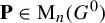 that are invertible in
$\mathrm {M}_n(\ell ^1(G))$
 , but such that
$\mathbf {P}^{-1}\not \in \mathrm {M}_n(\mathbb {Z}[G])$
 . In these examples, the norm of the identity element of
$\ell ^1(S)$
 belongs to
$\mathbb {Q}-\mathbb {Z}$
 , so that
$\mathbb {Z}[S]$
 is a non-unital ring, but
$\ell ^1(S)$
 is still a unital algebra.
6.2 Disjoint unions of semigroups
This class of semigroups appears in [Reference Ceccherini-Silberstein, Coornaert and PhungCSCP26, Remark 4.7]. Let
$\Sigma _1,\ldots ,\Sigma _n$
 be semigroups, z be a symbol, and set

We turn
$\amalg (\Sigma _1,\ldots ,\Sigma _n)$
 into a semigroup with the operation

Note that no element from
$\amalg (\Sigma _1,\ldots ,\Sigma _n)$
 can fix the elements of
$\Sigma _1,\ldots ,\Sigma _n$
 at the same time. Thus,
$\amalg (\Sigma _1,\ldots ,\Sigma _n)$
 cannot have a left identity.
Proposition 6.4. Let
$n\geq 2$
 ,
$\Sigma _1,\ldots ,\Sigma _n$
 be semigroups, and set
$S=\amalg (\Sigma _1,\ldots ,\Sigma _n)$
 .
-
(i) The semigroup S is expansive if and only if each $\Sigma _i$
is expansive. -
(ii) The algebra $\ell ^1(S)$
has a left identity if and only if each
$\ell ^1(\Sigma _i)$
has a left identity.


Proof. To see statement (i), note that the ‘only if’ part follows by taking
$K_i:=K\cap \Sigma _i$
 for each
$1\leq i\leq n$
 , where
$K\subseteq S$
 is finite such that
$S=KS$
 , and the ‘if’ part by taking
$K:=K_1\sqcup \ldots \sqcup K_n$
 , where each
$K_i\subseteq \Sigma _i$
 is finite such that
$\Sigma _i=K_i\Sigma _i$
 .
Now we prove statement (ii). Consider, for
$1\leq i\leq n$
 , the character
$\varphi _{\Sigma _i}\colon \ell ^1(\Sigma _i)\to \mathbb {C}$
 given by

It can be verified that
$\ell ^1(S)\simeq \mathbb {C}\oplus \bigoplus _{i=1}^{n}\ell ^1(\Sigma _i)$
 , where the product of
$(\alpha ,a_1,\ldots ,a_n)$
 and
$(\beta ,b_1,\ldots ,b_n)$
 is given in the first coordinate by

and defined coordinate-wise in the last n coordinates. It is then clear that if
$\ell ^1(S)$
 has a left identity
$(\varepsilon ,e_1,\ldots ,e_n)$
 , then each
$e_i$
 is a left identity in
$\ell ^1(\Sigma _i)$
 .
Conversely, if for each
$1\leq i\leq n$
 there is a left identity
$e_i\in \ell ^1(\Sigma _i)$
 , then the element
$e:= (1-n,e_1,\ldots ,e_n)$
 is a left identity in
$\ell ^1(S)$
 . Indeed, for all
$(\beta ,b_1,\ldots ,b_n)\in \ell ^1(S)$
 , we have, by (1), that the first coordinate of the product
$(1-n,e_1,\ldots ,e_n)\cdot (\beta ,b_1,\ldots ,b_n)$
 is

where we use the fact that
$\varphi _{\Sigma _i}$
 is a character, so
$\varphi _{\Sigma _i}(e_i)=1$
 for all
$1\leq i\leq n$
 . This yields
$(1-n,e_1,\ldots ,e_n)\cdot (\beta ,b_1,\ldots ,b_n)=(\beta ,b_1,\ldots ,b_n)$
 ; hence,
$\ell ^1(S)$
 has a left identity.
Acknowledgements
The author is indebted to Tullio Ceccherini-Silberstein for suggesting the topic of research, fruitful discussions and constant encouragement. Thanks are also due to Santiago G. Rendel, Eduardo Silva and an anonymous reviewer for several comments that improved the exposition of this article, and to G. H. Esslamzadeh for correspondence on amenability of semigroup Banach algebras.
Funding
The last stages of this work were funded by the Deutsche Forschungsgemeinschaft (DFG, German Research Foundation) under Germany’s Excellence Strategy EXC 2044/2-390685587, Mathematics Münster: Dynamics–Geometry–Structure.


 Open access

