Introduction
Aldabra, part of the Seychelles Islands group, is an isolated atoll in the Indian Ocean. In spite of the low elevation, absence of rock outcrops and strong maritime influence, it harbours an interesting lichen flora (Seaward & Aptroot Reference Seaward and Aptroot2009). The family Thelotremataceae, for example, is represented by three species, including two unknown to rest of Africa, one of which is new to science.
The Thelotremataceae is a group of characteristic forest lichens largely restricted to the lowland tropics. Probably because of this preferred habitat they remained poorly known for a long time. Hale (Reference Hale1974, Reference Hale1978, Reference Hale1981) contributed much to an improved species delimitation, based on TLC analysis and rich collections obtained from logging sites. He discovered many additional species and proposed a new generic division. This was still considered artificial and, in particular, Frisch (Reference Frisch2006) proposed a more detailed generic division based on a study of African representatives. The genus Thelotrema is now restricted to species similar to and closely related to Thelotrema lepadinum, lacking carbonization in the ascocarps, with a proper excipulum free from the thalline margin, with well-developed periphysoids, and ascospores with a thick outer wall.
The group belongs to the Ostropales, or if one prefers to keep the lichenized representatives separate, to the Graphidales. Recent DNA studies suggest that it is not a monophyletic group and that it is better to refer to them as thelotremoid lichens (Mangold et al. Reference Mangold, Martìn, Lücking and Lumbsch2008).
Method
The Iodine-reaction was carried out by applying Lugol without pre-application of KOH solution.
The Species
Leucodecton compunctum (Ach.) A. Massal
Hymenium c. 130 μm, clear; ascospores 8 per ascus, grey-brown, muriform, 6–8 × 2–3 celled, 19–25 × 9–12 μm, with thick outer wall.
Chemistry. Stictic acid present.
New to Africa. This species is widely distributed in the tropics, although it is not recorded from Africa by Frisch (Reference Frisch2006). The ascocarp pores in this species are very tiny and easily overlooked, and the species is easily mistaken for a pyrenocarpous lichen or a species of Pertusaria.
Specimens examined. Seychelles: Aldabra: Cinque Cases, on Mystroxylon aethiopicum, 1973, R. J. Hnatiuk 730493 (BM); ibid., 1973, R. J. Hnatiuk 730799 (B, BM); ibid., Île Polymnie, on Apodytes dimidiata, 1973, R. J. Hnatiuk 730961 (BM).
Thelotrema euphorbiae A. Frisch
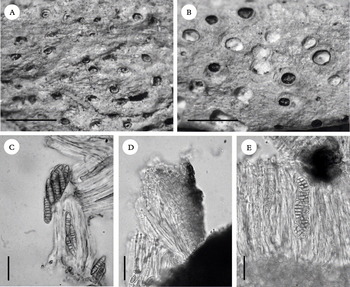
(Fig. 1A & C)
Thelotrema species from Aldabra. A & C, T. euphorbiae; A, habit (Hnatiuk 730855 pp); C, ascospores (Hnatiuk 730855 pp); B, D & E, T. hnatiukii; B, habit (type); D, section of excipulum; E, ascospores. Scales: A & B = 1 mm; C–E = 20 μm.

This recently described species (Frisch Reference Frisch2006) is so far known only from Tanzania. It appears to be not uncommon on Aldabra, and may be more widespread on the Seychelles, Mascarenes and in coastal tropical East Africa.
Specimens examined. Seychelles: Aldabra: Île Polymnie, on Apodytes dimidiata, 1973, R. J. Hnatiuk 730960 (B, BM); ibid., Cinque Cases, on Polysphaeria multiflora in dense scrub c.1·3 km from shore, 1973, R. J. Hnatiuk 730855 pro parte (BM).
Thelotrema hnatiukii Sipman sp. nov
A Thelotrema euphorbiae persimili differt excipulo proprio fusco et ascosporis submuriformibus 12 × 9 ad 17 × 7 μm.
Typus: Seychelles, Aldabra, Cinque Cases, on Polysphaeria multiflora in dense scrub c.1·3 km from shore, 27 September 1973, R. J. Hnatiuk 730855 (BM—holotypus).
(Fig. 1B, D & E)
Thallus pale grey, endophloeodic.
Ascocarps 0·5–0·8 mm wide, lepadoid, with slightly raised thalline margins and round, 0·2–0·5 mm wide pores; proper exciple when dry free from the margin and visible though the pore, brown; hymenium 60–75 μm, clear, I−; hypothecium I+ blue; spores colourless, submuriform, I− (or very pale blue), with scarce endospore; ascospores 8 per ascus, 12 × 9 – 17 × 7 μm, 4(–6) × 1–2 cells (most but not all transverse segments with a longitudinal septum).
Chemistry. Thallus K+ yellow, in section + KOH no red crystals; TLC: stictic acid with traces of norstictic and probably cryptostictic and constictic acids (Hnatiuk 730855).
Notes. The new species closely resembles T. euphorbiae in the size of the ascocarps, the endophloeodic thallus and the small, colourless, I− spores. It differs by the spores being submuriform rather than transversely c. 9-septate, and the brownish rather than colourless proper exciple, visible through the pore. It is named in honour of the collector, whose careful collecting led to the discovery of this inconspicuous species.
The colourless, muriform spores bring to mind T. lepadinum (Ach.) Ach. However, it may be not closely related to this species because it has small spores, a thin, predominantly endophloeodic thallus, and it grows at low altitude in the tropics. This suggests that T. euphorbiae and T. hnatiukii may form a separate lineage independent from T. lepadinum, and perhaps closer to grey-spored Thelotrema species such as T. monosporum Nyl., which share the thin thallus and tropical lowland habitat. However, in view of the great similarity between Thelotrema species, it seems better not to speculate further about its affinities within the genus but to await macromolecular results.
Since Aldabra is an atoll, the new species is probably not an endemic evolved locally, but is more likely to be widespread in the Seychelles, the Mascarenes and coastal East Africa in woodland with a pronounced maritime climate.
Additional specimens examined. Seychelles: Aldabra: Cinque Cases, on Ficus reflexa, 1973, R. J. Hnatiuk 730461 (BM); ibid., on Terminalia boivinii, in dense scrub, c.1·3 km from shore, 1973, R. J. Hnatiuk 730837 (BM).
Prof. M. R. D. Seaward (Bradford, UK) generously provided the specimens while investigating unworked lichen collections from interesting origins. He is closely co-operating with Dr A. Aptroot (Soest, Netherlands), who provides the correct affinity of a large proportion of these.