Although adolescents tend to spend more time with peers than parents, their parents continue to influence their psychosocial development (e.g., Cui et al., Reference Cui, Criss, Ratliff, Wu, Houltberg, Silk and Morris2020; Miller-Slough & Dunsmore, Reference Miller-Slough and Dunsmore2016; Steinberg & Morris, Reference Steinberg and Morris2001). Since Eisenberg et al. (Reference Eisenberg, Cumberland and Spinrad1998) proposed a heuristic model of parental emotion socialization (ES), numerous cross-sectional, longitudinal, experimental and interventional studies have documented significant associations between parental emotion-related socialization behaviors (ES practices) and child and adolescent socioemotional adjustment (see Eisenberg, Reference Eisenberg2020; Spinrad et al., Reference Spinrad, Morris and Luthar2020, for reviews). ES practices are theorized to impact children’s social and emotional competence, which in turn are linked to child and adolescent developmental outcomes (see Eisenberg et al., Reference Eisenberg, Cumberland and Spinrad1998; Morris et al., Reference Morris, Silk, Steinberg, Myers and Robinson2007, for reviews). However, empirical studies of ES still suffer from a lack of longitudinal designs with controls for stability (e.g., previous levels of ES and child outcomes) and tests of bidirectional effects. Moreover, most previous studies have focused on samples from Western societies (particularly the US and European), thus limiting the generalizability of the ES literature. Because values and practices associated with ES are shaped by cultural norms and ideologies (Raval & Walker, Reference Raval and Walker2019) and subject to social and economic changes (Yoshikawa et al., Reference Yoshikawa, Way and Chen2012), studies of populations not based in Western societies are needed to fully capture child experiences of ES in specific contexts. To fill in such research gaps, we examined bidirectional prospective effects between parental ES and adolescent psychosocial adjustment among a sample of urban adolescents and their parents in contemporary China. In the current study, we disaggregated the between- and within-family effects of parental ES practices and involved multiple informants of parental ES practices. We also explored moderating roles of adolescent biological sex given sex differences in both ES and adolescent psychosocial adjustment (e.g., Shortt et al., Reference Shortt, Katz, Allen, Leve, Davis and Sheeber2016; Silk et al., Reference Silk, Steinberg and Morris2003).
Parental emotion socialization and adolescent adjustment
Parental ES is broadly defined as parents’ socializing behaviors that influence how a child experiences, expresses, and regulates emotions, consistent with parents’ beliefs, values, and goals about emotion, particularly with a goal of facilitating the child’s adaptation to the society (Eisenberg et al., Reference Eisenberg, Cumberland and Spinrad1998). Researchers have highlighted several parental ES practices, including parents’ discussion of emotions, teaching of specific emotion regulation (ER) strategies, and parents’ reactions to their child’s emotions (e.g., Eisenberg et al., Reference Eisenberg, Fabes and Murphy1996, Reference Eisenberg, Cumberland and Spinrad1998; Morris et al., Reference Morris, Silk, Steinberg, Myers and Robinson2007). Parents’ reactions include negative strategies such as invalidating, minimizing, and punishing children’s negative emotions and positive strategies such as validating emotions, encouraging appropriate expression, and constructive coaching (e.g., Cui et al., Reference Cui, Criss, Ratliff, Wu, Houltberg, Silk and Morris2020; Fabes et al., Reference Fabes, Poulin, Eisenberg and Madden-Derdich2002; Gottman et al., Reference Gottman, Katz and Hooven1996; Perry et al., Reference Perry, Dollar, Calkins, Keane and Shanahan2020).
Various clinical and community studies of Western (mostly US and European) samples have documented associations between parental ES practices and adolescent psychosocial adjustment, including depressive symptoms (e.g., Brand & Klimes-Dougan, Reference Brand and Klimes-Dougan2010; Hastings et al., Reference Hastings, Klimes-Dougan, Kendziora, Brand and Zahn-Waxler2014; Katz & Hunter, Reference Katz and Hunter2007; Klimes-Dougan & Zeman, Reference Klimes-Dougan and Zeman2007; O’Neal & Magai, Reference O’Neal and Magai2005; Sanders et al., Reference Sanders, Zeman, Poon and Miller2015; Shortt et al., Reference Shortt, Katz, Allen, Leve, Davis and Sheeber2016; see Schwartz et al., Reference Schwartz, Sheeber, Dudgeon and Allen2012, for a review). Positive parental ES practices have been found to protect adolescents from internalizing problems (e.g., Cui et al., Reference Cui, Criss, Ratliff, Wu, Houltberg, Silk and Morris2020; Katz et al., Reference Katz, Maliken and Stettler2012; Morris et al., Reference Morris, Cui, Jespersen, Criss, Cosgrove, Morris and Mendez Smith2022). For example, US mothers’ acceptance and expression of their own emotions were linked to fewer depressive symptoms in young adolescents (Katz & Hunter, Reference Katz and Hunter2007). Parents’ emotion coaching, characterized by parents’ understanding and validation of child emotions, and helping children solve problems involving emotions, was associated with fewer depressive symptoms (e.g., Gottman et al., Reference Gottman, Katz and Hooven1996; Shortt et al., Reference Shortt, Katz, Allen, Leve, Davis and Sheeber2016; Stocker et al., Reference Stocker, Richmond, Rhoades and Kiang2007). Generally, positive parental ES practices reflect parents’ warmth, understanding, and empathy in response to children’s negative emotions (Magai et al., Reference Magai, Consedine, Gillespie, O’Neal and Vilker2004; O’Neal & Magai, Reference O’Neal and Magai2005). Such strategies facilitate children’s understanding of their own emotions and their internalization of adaptive ER strategies such as problem solving to reduce negative affect when negative events occur, which in turn link to lower levels of depressive symptoms (e.g., Eisenberg et al., Reference Eisenberg, Cumberland and Spinrad1998; Gottman et al., Reference Gottman, Katz and Hooven1996; Morris et al., Reference Morris, Silk, Steinberg, Myers and Robinson2007, Reference Morris, Criss, Silk and Houltberg2017; Perry et al., Reference Perry, Dollar, Calkins, Keane and Shanahan2020; Zeman et al., Reference Zeman, Cassano, Adrian, Barrett, Fox, Morgan, Fidler and Daunhauer2013).
Parental positive ES practices have also been posited to foster positive sense of self among adolescents. Self-esteem is the evaluative side of self-concept, and it rises across adolescence (Birkeland et al., Reference Birkeland, Breivik and Wold2014; Bleidorn et al., Reference Bleidorn, Arslan, Denissen, Rentfrow, Gebauer, Potter and Gosling2016). Adolescents with higher global self-esteem tend to be well adjusted whereas those with lower global self-esteem typically have adjustment problems, including added risk of developing depressive symptoms (e.g., Babore et al., Reference Babore, Trumello, Candelori, Paciello and Cerniglia2016; Behnke et al., Reference Behnke, Plunkett, Sands and Bámaca-Colbert2011; J. Kim & Cicchetti, Reference Kim and Cicchetti2006; Orth et al., Reference Orth, Robins and Roberts2008). Thus, it is important to understand factors facilitating the development of self-esteem. Adolescent’s sense of self-acceptance and self-worth (i.e., self-esteem) continue to be strengthened by parents’ consistent affirmation and acceptance. Empirically, authoritative parenting, which is characterized by high parental acceptance and support, as well as high sensitivity and emotional availability has been related to greater self-esteem (e.g., Babore et al., Reference Babore, Carlucci, Cataldi, Phares and Trumello2017; Behnke et al., Reference Behnke, Plunkett, Sands and Bámaca-Colbert2011; Gecas & Schwalbe, Reference Gecas and Schwalbe1986; Wouters et al., Reference Wouters, Colpin, Luyckx and Verschueren2018). Mother’s acceptance of her own emotions, which is one dimension of meta-emotion philosophy that is associated with positive ES practices, was linked to higher self-esteem of their adolescent child (Katz & Hunter, Reference Katz and Hunter2007).
To our knowledge, very few studies have directly examined the relations between parental ES practices and adolescent self-esteem. Positive parent-youth emotional communications, parental emotional support, and parents’ empathizing with youth’s emotion convey to the adolescent that their parent trusts them and understands their feelings, which can increase their self-worth (Demo et al., Reference Demo, Small and Savin-Williams1987; Gottman et al., Reference Gottman, Katz and Hooven1996). A common misperception is that the construct of self-esteem is not relevant to Asian countries (e.g., Heine et al., Reference Heine, Lehman, Markus and Kitayama1999) and thus studies of self-esteem development have been almost entirely absent in studies of Asian populations. However, self-esteem is an important psychological construct for Chinese as the move from planned to market economy has created an increasingly self-oriented culture (e.g., Brown et al., Reference Brown, Cai, Oakes and Deng2009; X. Chen et al., Reference Chen, Fu, Yiu and Bornstein2019). In the current study, we sought to investigate the relations between parental positive ES practices and adolescent self-esteem and depressive symptoms as two major and closely related psychosocial adjustment outcomes in a Chinese sample.
Longitudinal studies testing bidirectional effects
Although there have been numerous empirical studies on parental ES, several gaps and limitations in the extant literature exist. First, many studies of ES are cross-sectional (e.g., Cui et al., Reference Cui, Zhang and Han2021; Klimes-Dougan & Zeman, Reference Klimes-Dougan and Zeman2007; Shortt et al., Reference Shortt, Katz, Allen, Leve, Davis and Sheeber2016; see Miller-Slough & Dunsmore, Reference Miller-Slough and Dunsmore2016, for a review). Second, many longitudinal studies of ES are not able to control for previous levels of psychological adjustment (i.e., stability paths), making them weak for causal inference (Perry et al., Reference Perry, Dollar, Calkins, Keane and Shanahan2020; see Eisenberg, Reference Eisenberg2020, for a review). Third, most longitudinal studies of ES have focused on parent-driven effects only without considering child-driven or bidirectional effects (e.g., Byrd et al., Reference Byrd, Vine, Frigoletto, Vanwoerden and Stepp2021; Cui et al., Reference Cui, Criss, Ratliff, Wu, Houltberg, Silk and Morris2020; Eisenberg, Reference Eisenberg2020; Katz et al., Reference Katz, Maliken and Stettler2012; O’Neal et al., Reference O’Neal, Weston, He, Huang, Pine, Kamboukos and Brotman2017; Thompson et al., Reference Thompson, Zalewski, Kiff, Moran, Cortes and Lengua2020). Despite calls for examining bidirectional effects both generally in developmental science (Gottlieb, Reference Gottlieb1991) and in emotional socialization (Eisenberg et al. Reference Eisenberg, Cumberland and Spinrad1998; Eisenberg Reference Eisenberg2020), empirical longitudinal studies involving bidirectional effects are still scarce.
A few studies have suggested bidirectional child-parenting effects across development, particularly during adolescence. For example, Zvara et al. (Reference Zvara, Sheppard and Cox2018) found bidirectional effects between parents’ sensitive parenting (i.e., supportive, respectful, warm, engaged, and stimulating parenting) and adolescent externalizing problems, and between fathers’ sensitive parenting and adolescent internalizing problems among a large sample of American families. Further, Otterpohl et al. (Reference Otterpohl, Wild, Havighurst, Stiensmeier-Pelster and Kehoe2022) found that German adolescents’ externalizing problems predicted increases in parental negative responses to adolescents’ anger (e.g., neglecting, overriding, magnifying, and punishing), which in turn predicted increases in adolescents’ internalizing problems. During adolescence, as children are striving for autonomy and independence, their relationship with parents may become more reciprocal. On one hand, their emotional lives and psychosocial wellbeing continue to be susceptible to parental influences (Cui et al., Reference Cui, Criss, Ratliff, Wu, Houltberg, Silk and Morris2020). On the other hand, adolescents’ emotional arousal and dysregulated emotions may elicit parents’ specific responses and trigger parents to adjust their responses to adolescents’ emotions (Cui et al., Reference Cui, Zhang and Han2021; Morris et al., Reference Morris, Cui, Jespersen, Criss, Cosgrove, Morris and Mendez Smith2022; Otterpohl et al., Reference Otterpohl, Wild, Havighurst, Stiensmeier-Pelster and Kehoe2022). When adolescents have positive views and feelings toward themselves, their parents may become more involved in emotion communications with them. Thus, to better understand the relations between parenting and child developmental outcomes, it is important to examine bidirectional effects of ES practices and psychosocial adjustment outcomes particularly during adolescence.
Further, advancements in statistical approaches allow for testing the robustness of bidirectional effects. Specifically, random-intercept cross-lagged panel model (RI-CLPM) has been adopted to distinguish between- and within-family effects (i.e., comparing to other families vs. comparing to their own usual/trait levels of behaviors; Orth et al., Reference Orth, Clark, Donnellan and Robins2020). For example, among young children, Neppl et al. (Reference Neppl, Jeon, Diggs and Donnellan2020) used RI-CLPM to investigate the effects of both interindividual and intraindividual variations in positive parenting (indicated by positive mood, communication, and assertiveness), and found significant effects of within-parent variation in positive parenting on within-child variation in self-regulation. Stable between-individual differences in child self-regulation predicted their school performance across time. Similarly, Van Lissa et al. (Reference Van Lissa, Keizer, Van Lier, Meeus and Branje2019) adopted RI-CLPM to examine bidirectional effects between parenting (i.e., support and control) and adolescent ER in which they distinguished between variation due to stable between-family differences and variation due to within-family fluctuations. They found that at the within-family level, maternal support (i.e., reassurance of worth, reliable alliance, companionship, instrumental aid, intimate disclosure, affection, and nurturance) predicted increases in adolescent girls’ ER, while paternal control predicted decreases in both girls’ and boys’ ER. More importantly, adolescent ER predicted increases in maternal support and decreases in both maternal and paternal psychological control. Such analyses offer comprehensive understanding of stability and change between and within families. We adopted the RI-CLPM to examine effects of between- and within-family variations in parental ES practices and adolescent psychosocial outcomes in the current study.
Multiple informants and differential effects
Parental ES practices assessed with multiple informants are critical for accurate understanding of the implications of parental ES (Eisenberg, Reference Eisenberg2020). Parental ES practices have typically been measured as children’s perceptions of parental responses (e.g., Cui et al., Reference Cui, Criss, Ratliff, Wu, Houltberg, Silk and Morris2020; Sanders et al., Reference Sanders, Zeman, Poon and Miller2015), sometimes as parental self-reports (e.g., Di Giunta et al., Reference Di Giunta, Rothenberg, Lunetti, Lansford, Pastorelli, Eisenberg, Thartori, Basili, Favini, Yotanyamaneewong, Pena Alampay, Al-Hassan, Bacchini, Bornstein, Chang, Deater-Deckard, Dodge, Oburu, Skinner and Uribe Tirado2020), and occasionally been observed (e.g., Havighurst et al., Reference Havighurst, Wilson, Harley, Prior and Kehoe2010; Lougheed et al., Reference Lougheed, Craig, Pepler, Connolly, O’Hara, Granic and Hollenstein2016). However, adolescents and their parents usually have distinct perceptions and interpretations of parental behaviors and their relationships (Demo et al., Reference Demo, Small and Savin-Williams1987; Korelitz & Garber, Reference Korelitz and Garber2016). For example, Byrd et al. (Reference Byrd, Vine, Frigoletto, Vanwoerden and Stepp2021) found differential, even opposite, effects of adolescent- versus parent-reported ES practices on adolescent outcomes. Such informant discrepancies may be contingent on the specific parenting behavior, parents’ sex, or children’s age and may indicate specific mothe–child or father–child relationship problems (De Los Reyes & Ohannessian, Reference De Los Reyes and Ohannessian2016). Further, there may be quantitative and qualitative differences in maternal and paternal ES practices. For instance, adolescents’ mothers may be more involved in ES than fathers (e.g., Brand & Klimes-Dougan, Reference Brand and Klimes-Dougan2010; Garside & Klimes-Dougan, Reference Garside and Klimes-Dougan2002). Studies have also found that maternal and paternal ES show both similar and differential effects on child or adolescent outcomes (e.g., Brand & Klimes-Dougan, Reference Brand and Klimes-Dougan2010; McDowell & Parke, Reference McDowell and Parke2005). For example, Neppl et al. (Reference Neppl, Jeon, Diggs and Donnellan2020) coded both mother and father ES practices and found that both predicted increases in effortful control among young children. Di Giunta et al. (Reference Di Giunta, Rothenberg, Lunetti, Lansford, Pastorelli, Eisenberg, Thartori, Basili, Favini, Yotanyamaneewong, Pena Alampay, Al-Hassan, Bacchini, Bornstein, Chang, Deater-Deckard, Dodge, Oburu, Skinner and Uribe Tirado2020) found that mothers’ but not fathers’ self-efficacy about anger regulation predicted adolescents’ irritability. Behnke et al. (Reference Behnke, Plunkett, Sands and Bámaca-Colbert2011) found that perceived fathers’ but not mothers’ support (warmth and affection) was positively linked to adolescent self-esteem for both boys and girls. Although the implications of informant discrepancies on parental ES are still unclear, we aimed to explore whether there were differential effects of parental ES reported by multiple informants in the current sample.
Further, parental ES practices may also have differential effects on their daughters versus sons, as mothers and fathers may differ in dealing with daughters’ and sons’ specific emotions such as anger and sadness (e.g., Brown et al., Reference Brown, Craig and Halberstadt2015; Cunningham et al., Reference Cunningham, Kliewer and Gamer2009; Demo et al., Reference Demo, Small and Savin-Williams1987; Eisenberg et al., Reference Eisenberg, Fabes and Murphy1996; Godleski et al., Reference Godleski, Eiden, Shisler and Livingston2020; Hastings et al., Reference Hastings, Klimes-Dougan, Kendziora, Brand and Zahn-Waxler2014; Shortt et al., Reference Shortt, Katz, Allen, Leve, Davis and Sheeber2016). However, the differential effects of parental positive ES practices for boys versus girls are still unclear. For example, Shortt et al. (Reference Shortt, Katz, Allen, Leve, Davis and Sheeber2016) found that parents of boys with depressive disorder were more accepting of boys’ sadness than parents of girls with depressive disorder. Fathers of adolescent boys with depressive disorder were more aware of boys’ anger and sadness than fathers of boys without depressive disorder. There were no significant group differences on mothers’ awareness of daughters’ versus sons’ negative emotions. The effects of other ES practices such as acceptance of adolescent negative emotions and emotion coaching were similar for both fathers and mothers. Lougheed et al. (Reference Lougheed, Craig, Pepler, Connolly, O’Hara, Granic and Hollenstein2016) did not find sex differences in the association between observed maternal supportive co-regulation (i.e., positive emotional directive, validation, and reappraisal) during a parent-youth conflict discussion task and depressive symptoms. Therefore, more studies are needed to test differential effects for girls versus boys. Thus, although the underlying mechanisms for the differential effects are not entirely clear, we explored whether the associations between parental ES practices (adolescent perceived, mother-reported, and father-reported) and adolescent psychosocial adjustment outcomes would differ by adolescent sex.
Examining emotion socialization in urban Chinese context
Cultural transitions and social and economic changes are important contexts for parental socialization and human development (Bronfenbrenner & Morris, Reference Bronfenbrenner, Morris, Damon and Lerner2006; X. Chen et al., Reference Chen, Fu, Yiu and Bornstein2019; Yoshikawa et al., Reference Yoshikawa, Way and Chen2012). Most previous ES studies have been conducted in the US (see Raval & Walker, Reference Raval and Walker2019 for a review). The current study seeks to understand the implications of specific parental ES practices for adolescent psychosocial development in contemporary urban China, a rapidly changing society that has been transitioning from a planned to a market economy since the early 1980s. While traditional Chinese culture emphasized the expression of emotions in poetry, literature, and the arts starting from Confucius in the 6th century b.c. (Frijda & Sundararajan, Reference Frijda and Sundararajan2007), more recent Chinese history that includes the Mao-led Communist revolution starting in 1949 shifted their attitude toward emotions, as well as arts and culture dramatically. China after the revolution began to perceive emotions, as reflected in arts, literature, and culture, as “bourgeois” and as the antithesis of the revolution that focused on the needs of the proletariat and thus as getting in the way of “achieving social ends” (Potter, Reference Potter1988). After the fall of the Maoist government, emotions began valued once again but mainly as a way to maintain social harmony (Bond, Reference Bond1993; Cui et al., Reference Cui, Tang and Huang2022). The ambivalent relationship to emotions, evident in the 20th century Chinese history, is also likely reflected in parental ES, with parents neglecting the socialization of their children’s emotions (Kohnstamm et al., Reference Kohnstamm, Halverson, Mervielde and Havill1998). Chinese parents in the late 20th century have been reported to see the discussion of emotions as irrelevant and insignificant and engage in little emotional communication with children (S. H. Chen et al., Reference Chen, Kennedy and Zhou2012). They also tend to model emotionally reserved behavior particularly from fathers to sons (S. Y. Kim & Wong, Reference Kim, Wong, Kurasaki, Okazaki and Sue2002). Cross-cultural comparisons generally suggest that compared to North American parents, Chinese and Chinese immigrant parents participating in studies over the past three decades are more authoritarian, who were colder, stricter, more psychologically controlling, and expressing fewer emotions in parent–child interactions (e.g., Camras et al., Reference Camras, Kolmodin and Chen2008; Wu & Chao, Reference Wu and Chao2005).
Recent studies suggest that while Chinese parents retain goals of raising a compliant, well-behaved, self-controlled, and academically competent child and using both psychological and behavioral controlling strategies (Ng et al., Reference Ng, Pomerantz and Deng2014), they are also adopting new “more Western” goals of raising a socially and emotionally competent child and becoming warm, responsive, and caring about their children’s social and emotional competencies (e.g., X. Chen, Reference Chen2012; Cui et al., Reference Cui, Zhang and Han2021; Li, Reference Li2020; Way et al., Reference Way, Okazaki, Zhao, Kim, Chen, Yoshikawa, Jia and Deng2013). Specifically, in the emotion domain, these studies suggest that contemporary Chinese (particularly urban, well-educated) parents are increasingly allowing autonomy, engaging in affective communications with their children, encouraging their children to express their own ideas and emotions, and teaching specific ER strategies (positive ES practices we are focusing on in the current study). These socialization tactics may be particularly critical for adolescents, who are striving for independence and self-expression of ideas and emotions (Morris et al., Reference Morris, Silk, Steinberg, Myers and Robinson2007, Reference Morris, Cui, Jespersen, Criss, Cosgrove, Morris and Mendez Smith2022). Given the cultural differences and changes in the value of emotions and parenting, it is important to examine the roles parental ES play in child development in Chinese families, particularly everyday specific positive emotional interactions between parents and youth. Such empirical investigations are very few. Therefore, the current study used an urban Chinese sample of adolescents and their parents to better understand emotion-related parenting in contemporary urban Chinese families.
The current study
The current study investigated prospective bidirectional effects between parental positive ES practices and adolescent psychosocial adjustment (i.e., depressive symptoms and self-esteem). First, we adopted RI-CLPM to examine the temporal bidirectional within-family effects between parental positive ES practices and adolescent development outcomes, controlling for between-family effects. Second, we explored whether these effects differed between adolescent girls and boys. As we had adolescent-reports of parental ES, as well as mother and father self-reports of their own ES practices (maternal and paternal ES), we tested the effects of ES practices reported by different informants in separate models.
Method
Participants
Participants were 710 students in Grade 7 (50% girls; Mage = 12.41, SD = 0.59 at T1) from three public middle schools that were purposively sampled in Nanjing, China, with the goal of having high-, middle-, and low-achieving middle schools in the study. Nanjing is a medium-sized city in China with a population of approximately seven million people at the time of study. Participants were followed longitudinally across 3 years (across their middle school years). Data were collected during the fall semesters (Ns = 691 in Grade 8 and 669 in Grade 9). We also had mothers and/or fathers return their questionnaires over the 3 years (N mothers = 392, 533, 421; and N fathers = 369, 439, 411; Mage = 38.76, SD = 3.34 for mothers at T1; Mage = 41.76, SD = 4.14 for fathers at T1). The educational attainment of the parents varied widely in the sample; 64% of the mothers and 57.3% of the fathers had an educational level of high school or below, whereas 36% of the mothers and 42.7% of the fathers had an educational level of college or above. Most adolescents were born during the One Child Policy. Parents’ generation have witnessed rapid transition from planned to market economy and grandparents’ generation have lived through Cultural Revolution.
Procedure
Ethical approval from Southeast University, parent consents, and adolescent assents were obtained before data collection. Graduate research assistants administered a 40-minute survey to the students during classroom time at all time points. We also asked students to take blank parent questionnaires back home for their parents to fill in. Students brought parent completed questionnaires back to school and we collected questionnaires from the schools. In many families, only one parent (either mother or father) completed the questionnaires. Fewer than 200 families had both mother and father returned questionnaires at all three time points. Measures were translated into Chinese and back translated to English to ensure translation equivalence.
Measures
Emotion socialization practices
The emotion socialization measure was developed particularly for this study based on the ES literature. This 10-item measure was created based on emotion coaching work (Gottman et al., Reference Gottman, Katz and Hooven1996) to assess parental emotion encouragement (“Encourage you to talk about your feelings/emotions”, “Encourage you to show your emotions if you feel good about something”), emotion talk/sharing (“Tell you when they [parents] feel happy”, “Tell you when they do not feel good”, “Ask you whether you are happy about things that happened to you”, “Ask you why you are upset or angry about things that happened to you”), and emotion teaching (“Teach you to calm down when you are sad”, “Take the time to explain to you the feelings of others”, “Tell you to control your emotions, like overexcitement or arrogance, in front of others”, “Tell you to refrain from crying in the face of difficulties”). Adolescents rated these items about their parental use of ES tactics overall on a 5-point Likert scale, 0 (never), 1 (rarely), 2 (sometimes), 3 (often), and 4 (always). Their father and mother rated his/her own ES strategies separately using the same items but with adapted wording for parent reports. The item scores were averaged to create the final ES practices scores. Exploratory factor analyses revealed that a one-factor model fit best for all data across all three time points and informants. Cronbach’s αs ranged from 0.85 to 0.93 across the three informants.
Depressive symptoms
Depressive symptoms were assessed using a shortened version of the Children’s Depressive Inventory (CDI; Kovacs, Reference Kovacs1981). The 13-item self-report scale measures cognitive, affective, and behavioral symptoms of depression. Adolescents were asked to choose one out of three statements for each item. We used a 0, 1, 2 scoring system and some items were reverse scored. The 13 item scores were averaged to yield a single aggregated score. Lower scores indicated lower levels of reported depressive symptoms. The CDI has been used with Chinese populations and has yielded good reliability (X. Chen & Li, Reference Chen and Li2000; Dong et al., Reference Dong, Wang and Ollendick2002). Cronbach’s αs were 0.82 across all time points.
Self-esteem
The 10-item Rosenberg Self-Esteem Inventory (Rosenberg, Reference Rosenberg1965) was used to assess adolescents’ self-esteem. Adolescents were asked to rate each item on a 4-point scale, ranging from 1 (strongly disagree) to 4 (strongly agree), indicating how well each of these items described himself or herself. Some items were reverse-coded, and item scores were averaged. Higher scores indicated higher levels of self-esteem. This scale has been used with Chinese populations and has yielded good reliability (Cheung, Reference Cheung1996; Shek, Reference Shek1992). Cronbach’s αs in the current study were 0.79, 0.86, and 0.87 for the three time points.
Analytical strategies
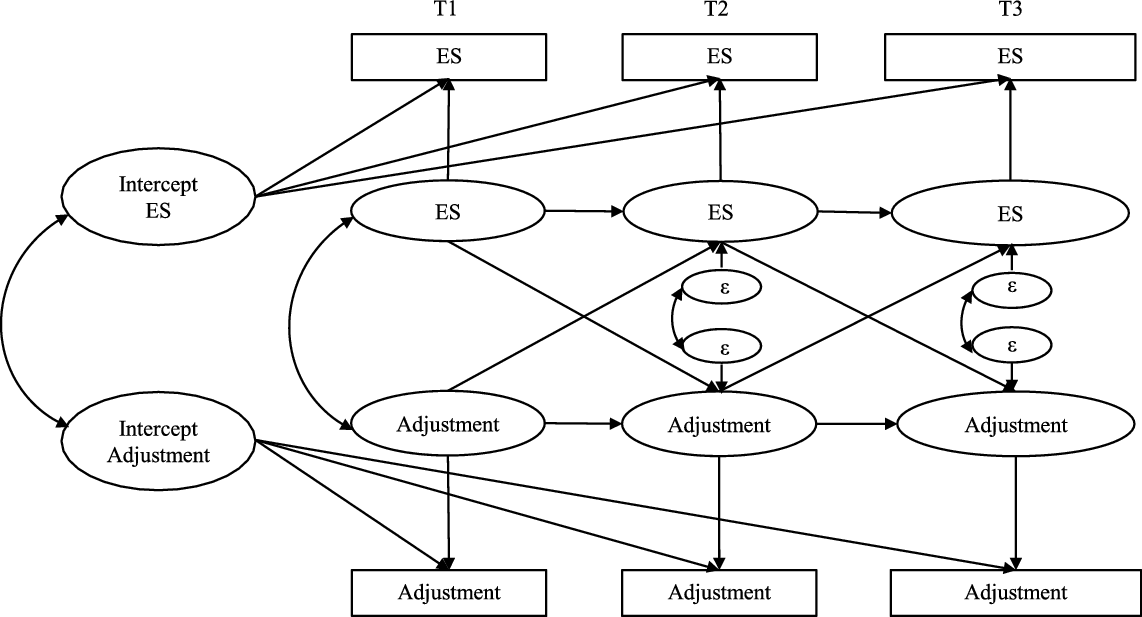
Descriptive and correlational analyses were conducted in SPSS 20. We employed the random intercept cross-lagged panel model (RI-CLPM) to examine the prospective effects of parental ES practices and adolescent developmental outcomes (see Figure 1 for our conceptual model). As recommended by Orth et al. (Reference Orth, Clark, Donnellan and Robins2020), we used RI-CLPM to examine the associations between within-family variations in parental ES practices (comparing to parents’ usual levels) and within-family variations in adolescent outcomes (comparing to adolescents’ usual levels), controlling for between-family effects (stable, trait-like differences) by involving the random intercepts of parental ES practices and adolescent outcomes.
Conceptual RI-CLPM. Note. ES = Emotion Socialization; Adjustment = Self-Esteem or Depressive Symptoms. Parental education was controlled in all models.

All analyses were conducted using Mplus 8 (Muthén & Muthén, Reference Muthén and Muthén1998–2017). Full information maximum likelihood (FIML) estimation was employed to handle missing data. Mother-reported maternal ES practices, father-reported paternal ES practices, and adolescent-reported overall parental ES practices were tested in separate models. Initially, we explored the hypothesized associations by keeping the two outcome variables in the same models. However, we encountered a linear dependency issue, and the models would not converge. We therefore tested self-esteem and depressive symptoms in separate models. First, we examined measurement invariance across time for each focal construct. Next, conceptual models were tested. Model fit indices were examined for adequate fit (relative χ2 test [χ2/df] < 5, comparative fit index [CFI] > 0.95, root mean square error of approximation [RMSEA] < 0.06, standardized root mean square residual [SRMR] < .08; Marsh et al., Reference Marsh, Hau and Wen2004; Schumacker & Lomax, Reference Schumacker and Lomax2004). Parental education level was controlled in all models. Last, we explored whether these prospective between- and within-family effects differed by adolescent sex using multigroup analyses. Nested models with and without certain equality constraints were compared to obtain the final most parsimonious model based on significance of Δχ2. We did not find significant moderation effects of adolescent sex on the hypothesized associations.
Results
Measurement invariance
Conducting a series of confirmatory factor analyses (CFAs) in Mplus 8, we tested configural, metric, scalar, and strict invariance of the parental ES practices measures, adolescent self-esteem, and depressive symptoms measures. We reached metric invariance across time for all these measures. In later moderation analyses, we also reached metric invariance for these measures between girls and boys.
Descriptive analyses
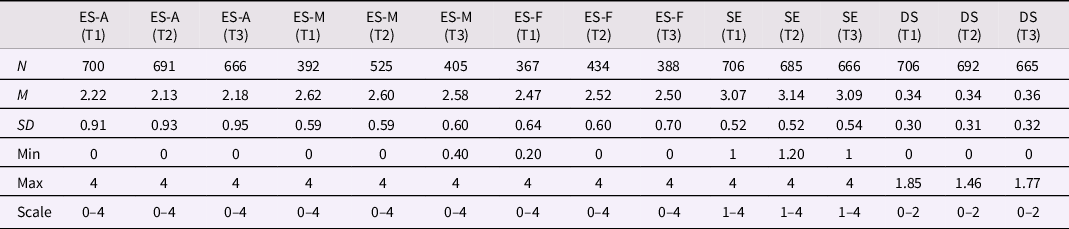
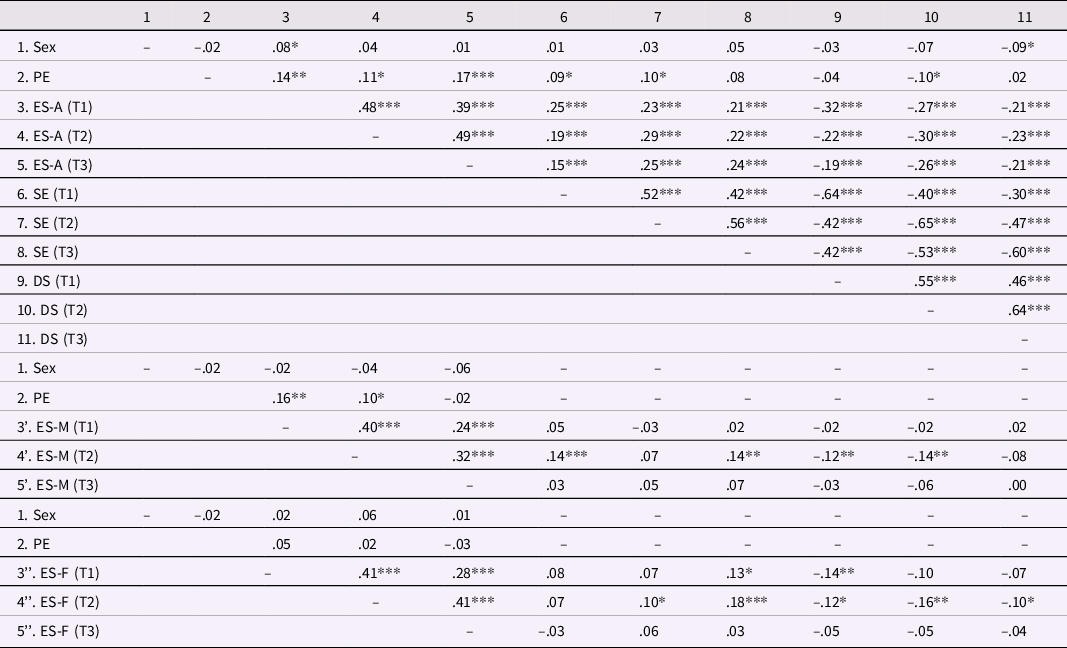
Descriptive statistics are presented in Table 1 and correlations among focal variables are presented in Table 2. T-tests showed that adolescent girls reported higher levels of depressive symptoms compared to adolescent boys at T3, t(663) = 2.25, p = .03, Cohen’s d = .17. The sex difference on depressive symptoms was marginally significant at T2, t(690) = 1.75, p = .08, Cohen’s d = .13. Adolescent boys reported higher levels of perceived parental ES practices than girls at T1 only, t(698) = −2.02, p = .04, Cohen’s d = .15. Mothers reported higher levels of positive ES practices than fathers at T1, t(757) = 2.70, p = .007, Cohen’s d = .20. The difference was marginally significant at T2, t(957) = 1.87, p = .06, Cohen’s d = .12. However, neither mothers nor fathers showed significantly different levels of positive ES practices to daughters versus sons at any wave.
Descriptive statistics

Note. ES-A = Adolescent-Reported Emotion Socialization; ES-M = Mother-Reported Emotion Socialization; ES-F = Father-Reported Emotion Socialization; SE = Self-Esteem; DS = Depressive Symptoms.
Correlations among focal variables

Note. PE = Parental Education (1 = below high school; 2 = high school; 3 = above high school); ES-A = Adolescent-Reported Emotion Socialization (#3, 4, 5); SE = Self-Esteem; DS = Depressive Symptoms; ES-M = Mother-Reported Emotion Socialization (#3’, 4’, 5’); ES-F = Father-Reported Emotion Socialization (#3’’, 4’’, 5’’). Sex was coded as 0 (girls) and 1 (boys). *p < .05. **p < .01. ***p < .001.
Correlations showed that parental education levels were positively linked to adolescent- and mother-reported ES practices, and positively linked to adolescent self-esteem (Table 2). Parental supportive ES practices were relatively stable across time, as were self-esteem and depressive symptoms. Further, significant associations between adolescent-reported parental ES practices and psychosocial adjustment outcomes outnumbered those for mother- and father-reported ES practices. However, the directions were in the expected direction (Table 2).
RI-CLPM examining prospective bidirectional effects
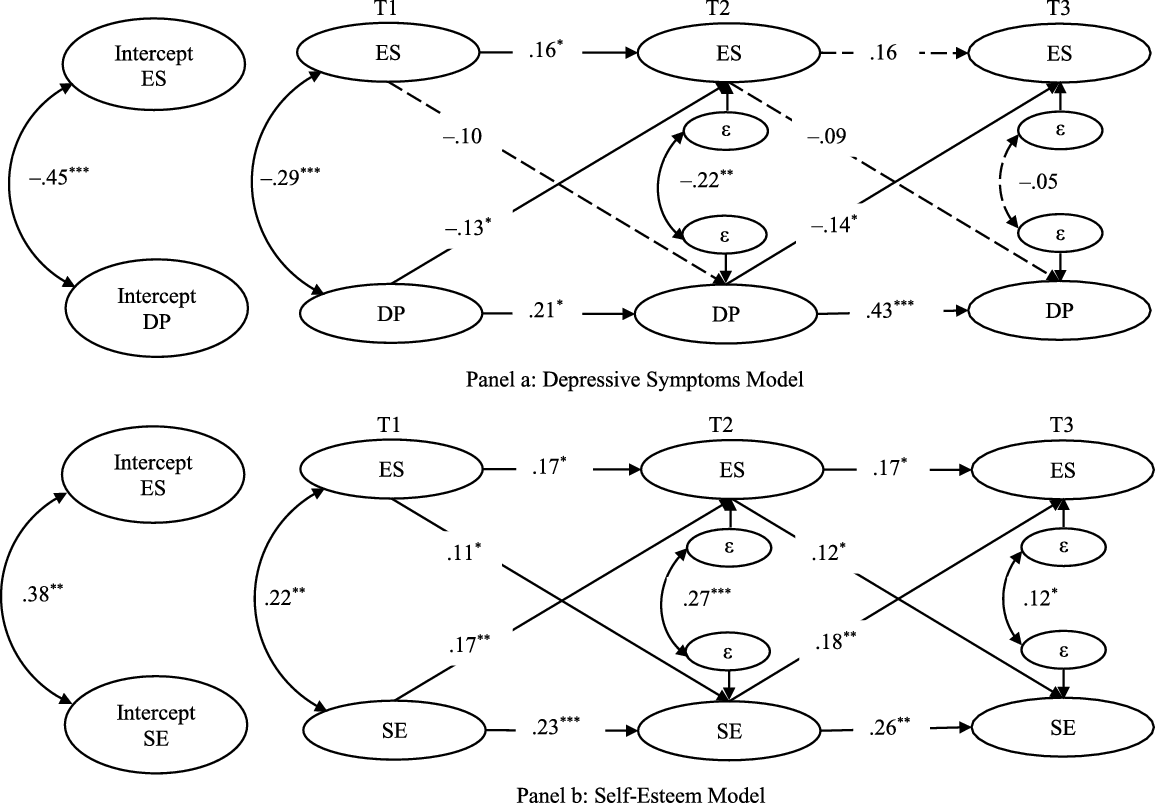
All RI-CLPMs fit the data well, χ2s/dfs < 2.19, CFIs > 0.95, RMSEAs < 0.07, SRMRs < .04. Using adolescent-reported parental ES practices data, we found that at the between-family level, parental ES practices were negatively associated with depressive symptoms as expected. Further, we found significant within-family effects of depressive symptoms on parental ES practices but no bidirectional effects (Figure 2, panel a). Specifically, lower levels of depressive symptoms (comparing to adolescents’ own usual levels) significantly predicted increases in parental use of positive ES practices.
Prospective within-person effects of adolescent-reported parental ES practices. Note. ES = Emotion Socialization; DP = Depressive Symptoms; SE = Self-Esteem. Parental education was controlled. All coefficients were standardized. *p < .05. **p < .01. ***p < .001.

Based on adolescent-reported parental ES practices data, we also found positive associations between parental ES practices and self-esteem at the between-family level. We also found significant bidirectional within-family effects between parental ES practices and adolescent self-esteem (Figure 2, panel b). Specifically, higher parental positive ES practices (comparing to parents’ own usual levels) predicted increases in self-esteem among adolescents across time. Meanwhile, adolescents’ higher levels of self-esteem predicted increases in parental use of positive ES practices.
However, using mother- and father-reported ES practices data, we found significant within-family effects of both maternal and paternal ES practices at T2 on adolescent self-esteem at T3, β = .16, p = .05, and β = .26, p = 0.002, respectively. For all analyses, we did not find significant moderation effects of adolescent biological sex.
Discussion
In response to the gaps in our understanding of Chinese parents and youth, particularly in the areas of ES and psychosocial adjustment, we utilized a longitudinal design to examine prospective bidirectional effects between parental positive ES practices and adolescent psychosocial adjustment, specifically depressive symptoms and self-esteem, among a sample of urban Chinese adolescents and their parents. We adopted the RI-CLPM to disentangle between- and within-family effects and examined effects of parental positive ES practices reported by multiple informants, adolescents, mothers, and fathers. Finally, we explored whether these prospective bidirectional effects differed by adolescent sex.
Prospective effects between parental ES and adolescent outcomes
Generally, comparing to other parent–youth dyads in the study (at the between-family level), we found significant associations between parental ES and adolescent psychosocial adjustment (both depressive symptoms and self-esteem) based on adolescent reported parental ES practices. More importantly, compared to their own usual/trait levels (at the within-family level), we also found significant child effects of depressive symptoms on parental ES practices and bidirectional effects between parental ES practices and adolescent self-esteem using adolescent reported data. Using both mother- and father-reported ES data, we found parent effects on adolescent self-esteem, but not on depressive symptoms.
Taken together, across between- and within-family levels of analyses, we found robust effects of higher adolescent depressive symptoms on decreases in parental positive ES and bidirectional effects between positive parental ES and self-esteem. Overall, these findings add evidence to the literature of ES during adolescence. When we simultaneously considered both parent and child effects and examined both between- and within-family effects, we found strong child effects of depressive symptoms on less positive parental ES practices across levels of analyses. It is possible that when adolescents are showing depressive symptoms, they are emotionally disengaged and withdrawn, which may make it difficult for their parents to emotionally engage with them and use positive strategies (e.g., encouraging their adolescent children to talk about and share feelings, sharing their own emotions, teaching them about regulation; Katz & Hunter, Reference Katz and Hunter2007; Katz et al., Reference Katz, Shortt, Allen, Davis, Hunter, Leve and Sheeber2014). Similarly, Cui et al. (Reference Cui, Zhang and Han2021) found significant negative associations between perceived child difficultness (temperamentally difficult and lacking self-regulatory capability) and positive ES practices cross-sectionally among Chinese parents of school-age children. When parents see their children as temperamentally difficult with high negative emotionality and having difficulty in regulating themselves, parents may feel stressed and less likely be emotionally supportive (Eisenberg et al. Reference Eisenberg, Fabes and Murphy1996, Reference Eisenberg, Fabes, Shepard, Guthrie, Murphy and Reiser1999). This may be particularly difficult for parents of adolescents, who may encounter various other stressors in life (e.g., meeting family financial needs, coping with stress from work, handling relationships issues) and need to overcome communication barriers to emotionally support their adolescent children in distress. It is also likely that adolescents with depressed mood would perceive their parents to be less positive. Nonetheless, our study concurs with the necessity to consider child effects and ideally examine bidirectional effects between parenting and child developmental outcomes (e.g., Cui et al., Reference Cui, Zhang and Han2021; Morris et al., Reference Morris, Cui, Steinberg, Larzelere, Morris and Harrist2013, Reference Morris, Cui, Jespersen, Criss, Cosgrove, Morris and Mendez Smith2022; Shewark et al., Reference Shewark, Ramos, Liu, Ganiban, Fosco, Shaw, Reiss, Natsuaki, Leve and Neiderhiser2021; Van Lissa et al., Reference Van Lissa, Keizer, Van Lier, Meeus and Branje2019). Future studies could further examine such bidirectional effects and examine the underlying mechanisms to better understand the associations between parental emotion socialization and developmental outcomes among adolescents.
We did not find evidence that parental positive ES practices predicted lower depressive symptoms at the within-family level. Although some previous studies have found protective effects of parental positive ES against adolescent internalizing problems, most of these studies are cross-sectional (e.g., Katz & Hunter, Reference Katz and Hunter2007; Shortt et al., Reference Shortt, Katz, Allen, Leve, Davis and Sheeber2016; Stocker et al., Reference Stocker, Richmond, Rhoades and Kiang2007). When previous waves of outcomes were controlled in longitudinal studies (controlling for stability), researchers have revealed stronger effects of negative ES than positive ES on children’s development of psychopathology, including depressive symptoms (e.g., Cui et al., Reference Cui, Criss, Ratliff, Wu, Houltberg, Silk and Morris2020; O’Neal et al., Reference O’Neal, Weston, He, Huang, Pine, Kamboukos and Brotman2017; Otterpohl et al., Reference Otterpohl, Wild, Havighurst, Stiensmeier-Pelster and Kehoe2022). These patterns of empirical findings may suggest stronger evidence for within-domain predictions rather than cross-domain predictions, such that positive ES contributes to gains in effective ER and positive development, whereas negative ES contributes to emotion dysregulation and developmental psychopathology (e.g., Eisenberg et al., Reference Eisenberg, Fabes, Shepard, Guthrie, Murphy and Reiser1999; O’Neal & Magai, Reference O’Neal and Magai2005; Otterpohl et al., Reference Otterpohl, Wild, Havighurst, Stiensmeier-Pelster and Kehoe2022; Zvara et al., Reference Zvara, Sheppard and Cox2018). However, more research is warranted to test within- versus cross-domain prediction.
The bidirectional effects between parental positive ES practices and adolescent self-esteem were quite robust in the current study. These effects were evident at both the between- and within-family levels. It is possible that self-esteem and depression may be different in their susceptibility to socialization. Although depressive symptoms are relatively robust over time, self-esteem may be more sensitive to social influences (e.g., parenting). It may also be possible that it is easier to find associations because self-esteem is more normally distributed. Nonetheless, our findings are consistent with previous cross-sectional studies of the between-family effects of parenting on self-esteem (e.g., Babore et al., Reference Babore, Carlucci, Cataldi, Phares and Trumello2017; Behnke et al., Reference Behnke, Plunkett, Sands and Bámaca-Colbert2011; Wouters et al., Reference Wouters, Colpin, Luyckx and Verschueren2018). More importantly, we cross validated the bidirectional effects at the between- and within-family level. Previous within-person level analyses have found significant bidirectional effects between positive parenting and adolescent ER (e.g., Neppl et al., Reference Neppl, Jeon, Diggs and Donnellan2020; Van Lissa et al., Reference Van Lissa, Keizer, Van Lier, Meeus and Branje2019). We found similar effects between parental positive ES practices and adolescent self-esteem. Self-development (e.g., self-understanding and self-identify) is among the major tasks for adolescent development. Emotionally supportive parents are likely to provide positive feedback to their adolescents and create a positive emotional climate within the family, which foster the development of self-esteem. Meanwhile, when adolescents feel good about themselves, their parents also are more likely to be emotionally supportive and attuned to them. Our study adds further evidence of these bidirectional effects that unfold over time.
Multiple informants and sex differences
We found more significant effects when we used the adolescent perceived parental ES data compared to parent-reported ES data. This is consistent with previous findings. For example, Van Lissa et al. (Reference Van Lissa, Keizer, Van Lier, Meeus and Branje2019) found stronger associations between adolescents’ perceived parenting (compared to parent self-reports of parenting) and adolescents’ ER. Bidirectional effects were evident using adolescent perceived data, particularly for self-esteem. Although these findings may suffer from common-method bias, as both parental ES and adolescent outcomes were adolescent self-reports, the consistent between- and within-family findings provided strong evidence for these associations. Generally, the pattern of our findings is consistent with literature which found that effects of positive parenting differed by informants (e.g., Brand & Klimes-Dougan, Reference Brand and Klimes-Dougan2010; Byrd et al., Reference Byrd, Vine, Frigoletto, Vanwoerden and Stepp2021; Klimes-Dougan & Zeman, Reference Klimes-Dougan and Zeman2007; Van Lissa et al., Reference Van Lissa, Keizer, Van Lier, Meeus and Branje2019). Our findings support the understanding that adolescents’ perceptions of parenting are better predictors for their adjustment outcomes than how parents perceive their own parenting (Abar et al., Reference Abar, Jackson, Colby and Barnett2015; Hannigan et al., Reference Hannigan, McAdams, Plomin and Eley2016). However, differential effects of mothering and fathering are still not conclusive (e.g., Behnke et al., Reference Behnke, Plunkett, Sands and Bámaca-Colbert2011; Di Giunta et al., Reference Di Giunta, Rothenberg, Lunetti, Lansford, Pastorelli, Eisenberg, Thartori, Basili, Favini, Yotanyamaneewong, Pena Alampay, Al-Hassan, Bacchini, Bornstein, Chang, Deater-Deckard, Dodge, Oburu, Skinner and Uribe Tirado2020). Our findings of maternal and paternal positive ES were consistent at the within-family level regarding adolescent self-esteem. This is consistent with previous understanding that mothers and fathers may influence child psychosocial adjustment in the same way as long as they are caring, loving, and authoritative (Lamb, Reference Lamb2012; Pleck, Reference Pleck2007). However, future studies should continue to examine the potential differential effects of mothering and fathering and understand the underlying mechanisms.
Consistent with previous studies (e.g., Brown et al., Reference Brown, Craig and Halberstadt2015; Klimes-Dougan & Zeman, Reference Klimes-Dougan and Zeman2007; Van Lissa et al., Reference Van Lissa, Keizer, Van Lier, Meeus and Branje2019), we found that mothers tend to be more emotionally supportive than fathers to both adolescent girls and boys. However, we did not find significant moderating effects of adolescent biological sex on the effects of parental positive ES. Parents may differ in the use of positive and negative ES practices to their daughters versus sons. Further, the effects of positive ES may not differ by adolescent sex, whereas those of negative ES may differ for boys versus girls. For instance, besides a few differences in parental awareness and acceptance of their adolescents’ negative emotions (e.g., anger and sadness), Shortt et al. (Reference Shortt, Katz, Allen, Leve, Davis and Sheeber2016) found that more adolescent sex differences on parents’ punitive and minimization reactions. Similarly, Godleski et al. (Reference Godleski, Eiden, Shisler and Livingston2020) found that maternal negative reactions to boys’ negative emotions at boys’ early school-age predicted their aggression and behavioral dysregulation at late adolescence, but these associations were not significant for girls. Although we did not find sex differences on our hypothesized associations, future studies should continue to involve fathers’ data and test such potentially different effects among mother–daughter, mother–son, father–daughter, and father–son pairs (Brand & Klimes-Dougan, Reference Brand and Klimes-Dougan2010; Li, Reference Li2020). Further, a developmental perspective needs to be considered that such differences in socialization as a function of parent and child sex may manifest differently along development (e.g., Cassano & Zeman, Reference Cassano and Zeman2010; Morris et al., Reference Morris, Cui, Jespersen, Criss, Cosgrove, Morris and Mendez Smith2022).
The role of changing contexts
It worth noting that the findings from our sample of Chinese families are quite consistent with those found in the US. Cross-cultural studies have documented mean-level differences in parental ES-related dimensions such as warmth and affection. Although Chinese parents may appear less emotionally expressive in socialization than Western parents when using Western norms, parents may express emotions (e.g., warmth) in different manners and use different approaches to discuss emotions with children (e.g., Cheah et al., Reference Cheah, Li, Zhou, Yamamoto and Leung2015; Fivush & Wang, Reference Fivush and Wang2005; Li, Reference Li2020; Wang & Fivush, Reference Wang and Fivush2005). For instance, Raval and colleagues have found a few ES practices that were unique to Asian parents such as Indian and Chinese parents (e.g., Raval et al., Reference Raval, Raval and Deo2014, Reference Raval, Li, Deo and Hu2018; see Raval & Walker, Reference Raval and Walker2019, for a review). However, although parents from different cultures may differ in the frequency of certain ES practices, the associations between parental ES and child and adolescent outcomes may remain consistent (e.g., Babore et al., Reference Babore, Trumello, Candelori, Paciello and Cerniglia2016; Di Giunta et al., Reference Di Giunta, Rothenberg, Lunetti, Lansford, Pastorelli, Eisenberg, Thartori, Basili, Favini, Yotanyamaneewong, Pena Alampay, Al-Hassan, Bacchini, Bornstein, Chang, Deater-Deckard, Dodge, Oburu, Skinner and Uribe Tirado2020; see Eisenberg, Reference Eisenberg2020; Friedlmeier et al., Reference Friedlmeier, Corapci and Cole2011, for reviews). This may be particularly true for parental positive ES practices in the current Chinese context where parents are generally concerned about child social and emotional competencies and involved in social and emotional parenting (X. Chen et al., Reference Chen, Fu, Yiu and Bornstein2019; Way et al., Reference Way, Okazaki, Zhao, Kim, Chen, Yoshikawa, Jia and Deng2013). Nonetheless, future studies should continue to examine culturally salient ES practices in non-Western cultures to better understand cultural differences in parental ES.
Our findings should be understood within a rapidly changing urban Chinese context. Influenced by the group-oriented and patriarchal cultural traditions, Chinese parents, particularly fathers, tended to be assertive and emotionally reserved. The more recent rapid social and economic changes in China have led to changes in family dynamics and parenting (Yoshikawa et al., Reference Yoshikawa, Way and Chen2012). Contemporary Chinese parents, particularly those with single child as their “only hope”, tend to invest all their material and emotional resources in their children regardless of child biological sex (Fong, Reference Fong2002). They are becoming warmer and more affectionate, and more interested in children’s socioemotional well-being (Way et al., Reference Way, Okazaki, Zhao, Kim, Chen, Yoshikawa, Jia and Deng2013), particularly for fathers (Li, Reference Li2020). Fathers and mothers assume similar roles because of increasing gender equality (Chuang, Reference Chuang, Mancini and Roberto2009), and Chinese parenting is generally gender equal (Wang & Chang, Reference Wang, Chang and Bond2010). With the ongoing economic development and social changes, contemporary Chinese urban parents are becoming emotionally more involved with their children. In such urban Chinese context, positive ES behaviors such as sharing emotions, talking about emotions, and teaching emotions and emotion regulation may have positive implications for Chinese adolescent psychosocial adjustment.
Limitations and future directions
Although the current findings add to the growing evidence of bidirectional effects between parental ES practices and adolescent psychosocial adjustment, they must be interpreted with the study’s limitations in mind. First, the findings should be understood in the Chinese contexts among adolescents in their middle school years. For example, Way et al.’s (Reference Way, Okazaki, Zhao, Kim, Chen, Yoshikawa, Jia and Deng2013) analysis of mothering narratives from this same cohort of Chinese one-child families revealed that these mothers were particularly attuned to their adolescents’ current and future happiness in ways that were distinct from how the mothers had remembered being raised during the Cultural Revolution. The mothers’ self-conscious awareness of their parenting strategies during the middle school years of intensifying academic competition, within the rapidly changing Chinese social context, may have shaped their ES practices. Future studies should involve older adolescents to examine whether the associations hold. Second, we only focused on parental positive ES practices but not negative ones. As discussed previously, future studies should examine effects of negative ES practices such as punishing and dismissing among Chinese samples. Relatedly, our positive ES practices measure was a composite of several positive strategies rather than specific dimensions. Although in our current sample, the different dimensions loaded on the same factor and the effects were the same on adolescent outcomes, future research could further examine the potential differential effects of each dimension. Further, parental ES practices in response to adolescents’ specific emotions such as anger and sadness should also be systematically tested. Parental ES practices measured from observation of parent-adolescent interactions studies would also provide important additional data. Fourth, we only had three waves of data. More waves of data may have yielded more robust findings for such complicated RI-CLPM models (Orth et al., Reference Orth, Clark, Donnellan and Robins2020). Fifth, it is important to collect valid data from both parents from the same family. To increase sample size of parent reports and assure the quality of parent data, future studies should adopt more robust approaches of collecting data from parents such as administering questionnaires to them directly during parent–teacher meetings. Future research could also benefit from multiple informant data to examine parent and child unique and shared effects of parenting or perceptual differences on adjustment outcomes (e.g., Feinberg et al., Reference Feinberg, Howe, Reiss and Hetherington2000; Jager et al., Reference Jager, Yuen, Bornstein, Putnick and Hendricks2014).
Conclusions
This 3-year, multi-informant, longitudinal study suggests that in emotion socialization studies, it is critical to consider the nature of ES practices (positive vs. negative), include multiple informants, and integrate between- and within-family analyses. Our study suggests that during adolescence in the urban Chinese context, both parents continue to influence their adolescent children in the social and emotional domains (e.g., Cui et al., Reference Cui, Criss, Ratliff, Wu, Houltberg, Silk and Morris2020; Morris et al., Reference Morris, Silk, Steinberg, Myers and Robinson2007). Moreover, adolescent psychosocial developmental outcomes may also affect how parents communicate with them, particularly in the emotional domain (e.g., Eisenberg, Reference Eisenberg2020). These findings indicate that practitioners may need to take adolescents’ current psychosocial adjustment status as well as both mothers’ and fathers’ practices into account when implementing programs to enhance emotion socialization and socioemotional development.
Funding statement
This research was supported in part by the NYU-ECNU Institute for Social Development at NYU Shanghai Internal Fund.
Conflicts of interest
None.