Introduction
The volume of discourse on suffering, poverty, and sickness in early Christian texts has led Judith Perkins to postulate that Christian identity coalesced around the idea of the “self” as constantly under siege and in agony.Footnote 1 These sources explore the gory details of martyrdoms in rhetorical ekphraseis—vivid descriptions that aimed to create images in the minds of their listeners. The presentation of the deaths and sufferings of saints in such sensorily evocative language indicates a desire to consider this affective subject matter and its potential to act as a devotional aid that strikes the heart, stirs the soul, and marks the glory of the martyrs on the memory. The universality of the model of the self as a soul tied to a suffering body, however, is complicated by the fact that not all areas of cultural production present suffering in the same manner as do the texts that form the subject of Perkins’s analysis.Footnote 2 Images of suffering, martyrdom, Christ’s passion, and even the theme of death are rare in late antique visual art, an absence for which art historians have sought explanations.Footnote 3 Christian art in these centuries instead favored themes of salvation and triumph over death that emphasized the victory of Christ and the hopes of believers. How are we to reconcile the starkly different handling of suffering—and its ultimate religious expression, martyrdom—across early Christian texts and images?
Considering the contrasting treatment of this theme in the visual and verbal realms will throw light on larger questions related to early Christian visuality, ideas about the senses and perception, and attitudes to material images.Footnote 4 This essay takes up the problem of the dearth of images of suffering and martyrdom in the material arts against the backdrop of contemporaneous textual treatments of martyrdom to explore the differing roles of different senses and media in late antique religious devotion. Focusing on a set of ekphrastic texts that purport to describe violent paintings within martyria depicting the torture and execution of saints, it examines how these texts conceive of the material images they describe and the mental images they conjure in the listener’s imagination and “spiritual senses.” These ekphraseis convey the power assigned to sight in the ancient world as an interactive, immediate, and confrontational mode of knowing in their presentations of artworks that “break out of their frames” to blur and extend reality in ways that transform both art object and viewer. In this they echo statements from early Christian authors on vision both as a form of violence and as an activity whose immediacy brought with it the danger that an unprepared viewer may fail to perceive the true spiritual meaning behind the literal surfaces of events seen.
I argue that these concerns about the perils of vision underlie the preference for using language to stimulate controlled visual perceptions of martyrdom in the mind. In the early Christian realm of imagination, the intellect could carefully construct spiritually informed visions that reperformed the sufferings of the martyrs and channeled the confronting power of the visible to propel the soul to imitation. Ekphrastic texts modeled proper responses to visual stimuli that risked being misperceived, guiding listeners in visualization exercises that helped them learn to see beyond the literal. Such ekphraseis prepared listeners to perceive the true significance behind the physical sights of the world, training that was especially needed to encounter the visceral visuals of martyrdoms. This problem of properly perceiving the sensory elements of martyrdom is expressed in illustrative passages from the Martyrdom of Polycarp that oppose the literal and abject state of the martyrs’ tortured bodies, their skin “ripped to shreds by whips, revealing the very anatomy of their flesh, down to the inner veins and arteries,”Footnote 5 to the glorified state of their souls that can be perceived only with the spiritual senses:
And the fire of their inhuman torturers was cold to them, because they kept their eyes on the goal of escaping the fire that is eternal and never extin-guished. And with the eyes of their hearts they looked above to the good things preserved for those who endure, which no ear has heard nor eye seen, which have never entered into the human heart, but which the Lord revealed to them, who were no longer humans but already angels.Footnote 6
The martyrs themselves here model this form of perception, continually reinterpreting the data of their senses in the light of spiritual understanding. They feel the heat of their earthly tortures as cold, inverting the meaning of corporeal sensations to illustrate the falsity of this sensorial world and the existence of a higher reality. It is not the eyes or ears but “the eyes of their hearts,” their spiritual senses, that make known to them their exalted condition gained through martyrdom. The narrator echoes their perceptual paradigm of sensing beyond and in opposition to the literal—a common demand for Christians not only in confrontation with martyrdoms, but also in pilgrimage sites, sacred shrines, liturgical settings, and elsewhere—and affirms for listeners that the martyrs are not the broken human bodies they appear to be but in fact “already angels.”Footnote 7 Martyrdom, as a triumph won in conflict with the physical world, presents a challenge to human perception.
Early Christian culture correspondingly took up the task of conditioning the senses to face this sensory challenge. Accounts of martyrial suffering in texts, poems, and sermons instructed Christians to look beyond exteriors to perceive suffering as triumphant endurance, destroyed bodies as spiritual perfection, and deaths as victorious rebirths. Early Christian art’s reticence in depicting martyrdom reflects the dangers inherent in spectatorship and in material images. Its heroic representations, however, though radically different in tone than the visualizations cultivated via the rhetorical genre of ekphrasis, similarly function to model proper perception and understanding for a viewer without presenting the literal appearance of martyrdom to the physical eyes. Art’s iconography provides visions of the saints as they exist in heaven and as they should be imagined with the “eyes of the mind,” demonstrating the work of spiritual seeing for the viewer as part of their preparation for learning to see anew.
The Invisibility of Martyrdom in Early Christian Art
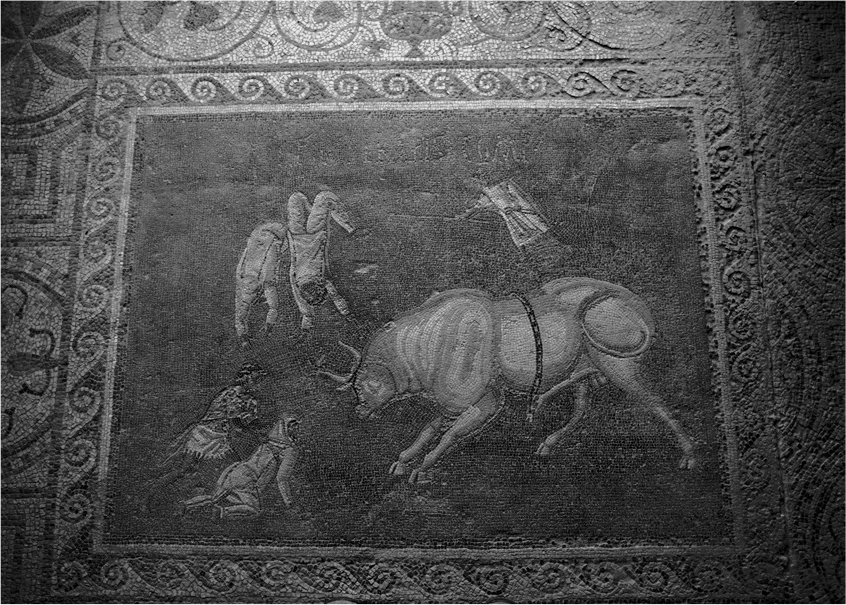
Roman visual culture was awash in images of violence that Christian art chose not to replicate. Violence and suffering appeared in art in the context of arena spectacles, depictions of defeated enemies, and scenes from tragic myth.Footnote 8 Objects of all types, from mosaics to mass-produced pottery, depicted scenes of action in the arena, including executions like those undergone by Christian martyrs.Footnote 9 The details of these gruesome scenes are highlighted, for example, in numerous mosaics of amphitheater violence that decorated the dining rooms of luxurious Roman houses from the second to fourth centuries CE.Footnote 10 The Silin Villa near Leptis Magna, for example, contains a floor mosaic of a “barbarian” victim on his hands and knees driven towards an enormous white bull by an attendant (fig. 1).Footnote 11 Two other men have already been thrown into the air by the bull. The mosaic functioned as part of the program of entertainment for guests, as attendees debated the potential outcomes of the fights displayed or related the images back to spectacles witnessed in recent games.
(top left): Floor mosaic of bull tossing “barbarians,” from the Silin Villa near Leptis Magna, Libya. Roman, c. 193–235 CE (Photo: © Istituto Centrale per il Restauro / ph. Angelo Rubino).

Fig. 1 Long description
The mosaic features a central image of a bull in motion, with two barbarians being tossed by the animal. The scene is surrounded by intricate geometric patterns and decorative borders. The barbarians are depicted in dynamic poses, emphasizing the action and violence of the moment. The background includes additional figures and elements that contribute to the overall narrative of the mosaic. The detailed craftsmanship highlights the Roman artistic style of the period.
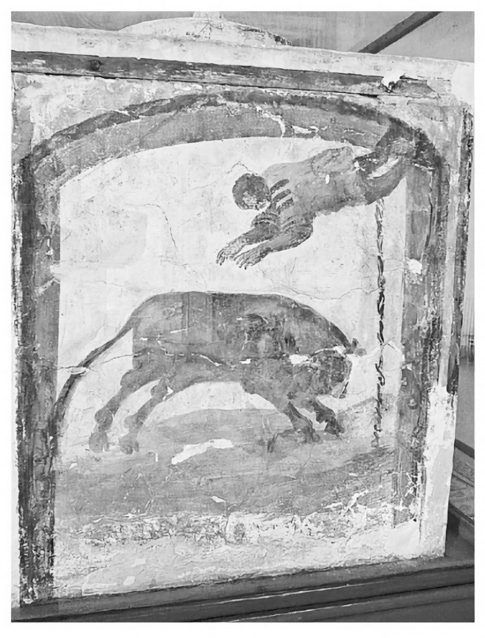
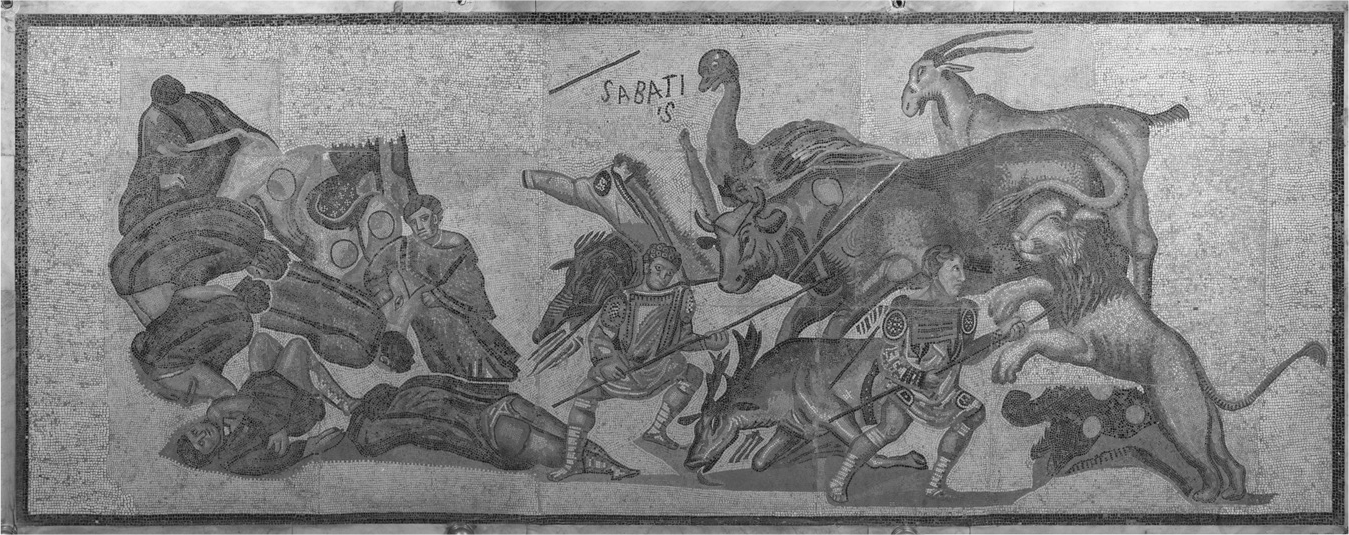
The many elements of the Roman art of execution could easily provide iconographic types for imagining the martyrs but were not adopted into Christian artworks. The martyr Blandina, for example, was wrapped in a net and fatally tossed by a bull.Footnote 12 Perpetua too was thrown by a wild cow before her death.Footnote 13 This bull mosaic from Leptis Magna, or perhaps the painted cippus from the Thaenae necropolis in Tunisia showing the blood of a man tossed by a bull streaming to the ground (fig. 2),Footnote 14 or the venatio mosaic from the Galleria Borghese of a bull trampling down a crowd of wounded men (fig. 3)Footnote 15 could have been suitable models for envisioning the martyrdoms of Perpetua and Blandina and for conveying the depth of their sufferings. No such images exist from late antiquity. Felicity Harley-McGowan has laid out many of the obstacles that prevented early Christians from adapting the violent iconography of Roman art.Footnote 16 She argues that such images, representing executions of criminals and barbarians, carried connotations of oppression and defeat that needed to be reversed through significant iconographic modification to convey an appropriately Christian meaning.Footnote 17 Roman viewers were accustomed to seeing those in pain in art as “others”—transgressors outside the social order or distinctly foreign enemies. The Silin Villa mosaic victims are clearly marked as foreigners by their boxy long-sleeved tunics worn over pants and head coverings. Those subject to violence are subjugated outsiders, contrasted with an authoritative figure in a longer tunic—a Roman official—whose gesture invites the viewer to gaze upon the unfolding scene from a similarly privileged position.Footnote 18 Such games and their depictions reinforced the Roman power structure and solidified the virtuous citizen’s sense of identity.Footnote 19 Even Christian commentators like Tertullian tended to see the punishments of criminals in the arena as just.Footnote 20
(top right): Man tossed by a bull, painted cippus from the Thaenae necropolis, Tunisia. Roman, 3rd cent. CE (Photo courtesy of Giuseppina Legrottaglie).

Fig. 2 Long description
The image depicts a man in mid-air, being thrown by a charging bull. The scene is framed within an arched border, suggesting it is part of a larger artwork or structure. The man appears to be in a dynamic, desperate pose, indicating the force of the bull's action. The background is relatively plain, focusing attention on the dramatic interaction between the man and the bull.
(bottom): Bull trampling crowd of men, detail of floor mosaic from the Galleria Borghese. Roman, 4th cent. CE (Photo: © Galleria Borghese / ph. Mauro Coen).

Fig. 3 Long description
The mosaic shows a chaotic scene where a large bull is trampling a group of men. The men are in various states of distress, with some being thrown into the air by the bull's force. The word 'SABATIS' is inscribed above the scene, possibly indicating a name or event. The detailed artwork captures the dynamic movement and intensity of the moment, reflecting the Roman art style of the 4th century CE.
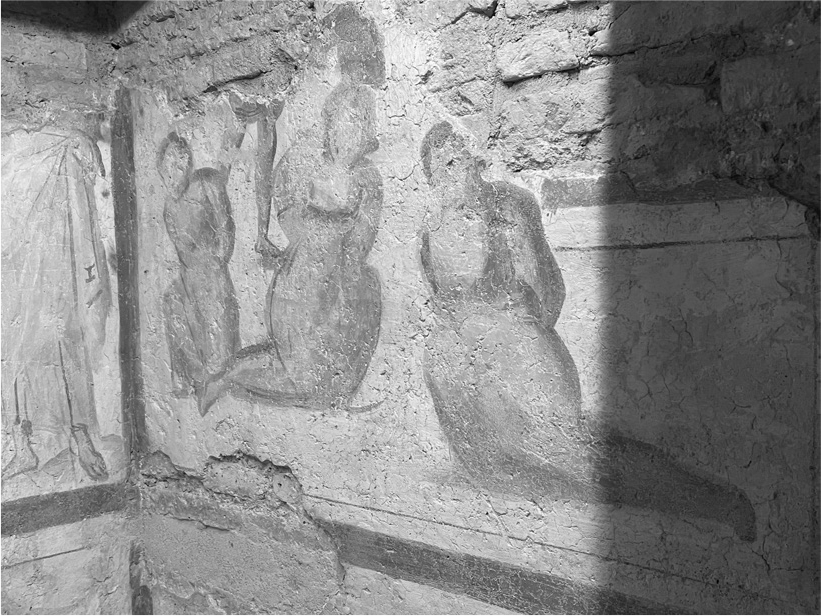
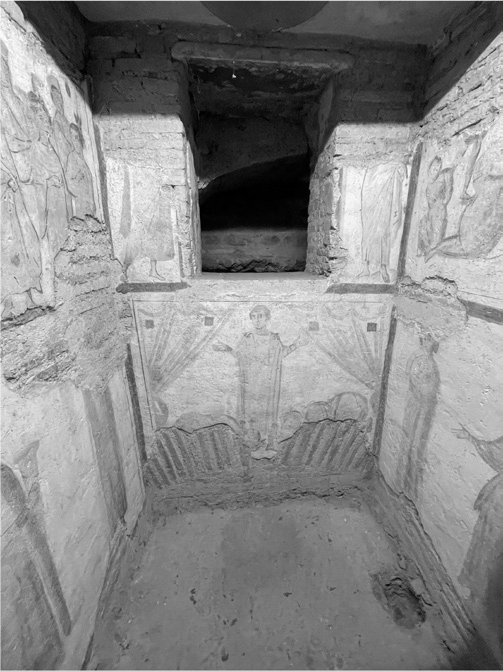
The Roman iconography of violence, infused with traditional meanings of transgression and otherness outlined by Harley-McGowan, would, moreover, have offered viewers only the literal appearance of a scene and therefore fully relied on those viewers to supply the proper Christian meaning to the event. Would viewers participating in a nascent Christian visual culture be able to see, like the narrator of the Martyrdom of Polycarp did, the martyrs as “already angels” with their spiritual eyes when given artworks illustrating bodies being “ripped to shreds”? That early Christian art emphatically did not trust its audience to accomplish this task is apparent in its suppression of the violence and physical realities of martyrdom. The very few works of art of that period that contain scenes of martyrdom feature no explicit violence, instead venturing to offer the moments preceding the event, in which the convicted saints are led to or kneel before their executioner. Emphasis is placed on the moments before death, as in the frescoed private shrine from the second half of the fourth century at Santi Giovanni e Paolo on the Caelian Hill in Rome (fig. 4) that shows the arrest of three unidentified martyrs.Footnote 21 The two men and a woman kneel in the sequence’s final image, with the legs of two executioners behind them. The viewer is invited to imagine the resolution of the scene, but the image does not go further than implying the horrific outcome.Footnote 22 This impending execution is balanced by the image of an orant in glory on the main wall of the shrine (fig. 5), countering the narrative temporality in the scene of the execution with eternal, spiritual temporality in the representation of the orant.
(left): Martyrs kneeling, back wall of private shrine from domus on the Caelian Hill, Rome, c.350–400 CE (Photo: author).

Fig. 4 Long description
The fresco shows three figures kneeling against a back wall in a private shrine. The figures are depicted in a simple, stylized manner, with minimal detail. The setting appears to be an interior space, likely a domestic or religious environment. The fresco is part of a larger artwork from a domus on the Caelian Hill in Rome, dating back to the late fourth century CE. The figures are likely martyrs, as suggested by the context of the shrine and the historical period.
(right): Orant, back wall of private shrine from domus on the Caelian Hill, Rome, c.350–400 CE (Photo: author).

Fig. 5 Long description
The image depicts a frescoed private shrine from the Caelian Hill in Rome, dating back to around 350-400 CE. The focal point is an orant figure, a common representation in early Christian art, positioned on the back wall. The orant is depicted with arms raised in prayer, symbolizing a state of divine communion. The surrounding walls of the shrine are adorned with additional frescoes, though the details of these are less discernible. The overall setting suggests a place of worship or personal devotion, emphasizing the spiritual significance of the orant figure.
In contrast to the rare images of imminent martyrdom, the most common method for representing martyrs in late antique art was, of course, the iconic portrait image that erases all traces of physical suffering. In the mid-fourth century, saints began to be pictured in greater numbers in bust or full-length portraits.Footnote 23 Gold glass medallions show saints, such as the young Roman martyr Agnes, triumphant with crowns and palms of victory. On these, Agnes appears richly dressed and wearing jewelry—she is far from the humiliations of the amphitheater.Footnote 24 She stands in prayer, showcased between busts of Peter and Paul or alone within a tree-lined garden, and receives jeweled crowns of victory from pairs of birds.Footnote 25 The gold leaf of the medallions infuses her pristine body with heavenly light. The tortures of saints depicted in such a manner are invisible, though alluded to symbolically in the accoutrements of triumph won through these tortures—objects that refer to their sufferings without bringing them before the eyes of the viewer.
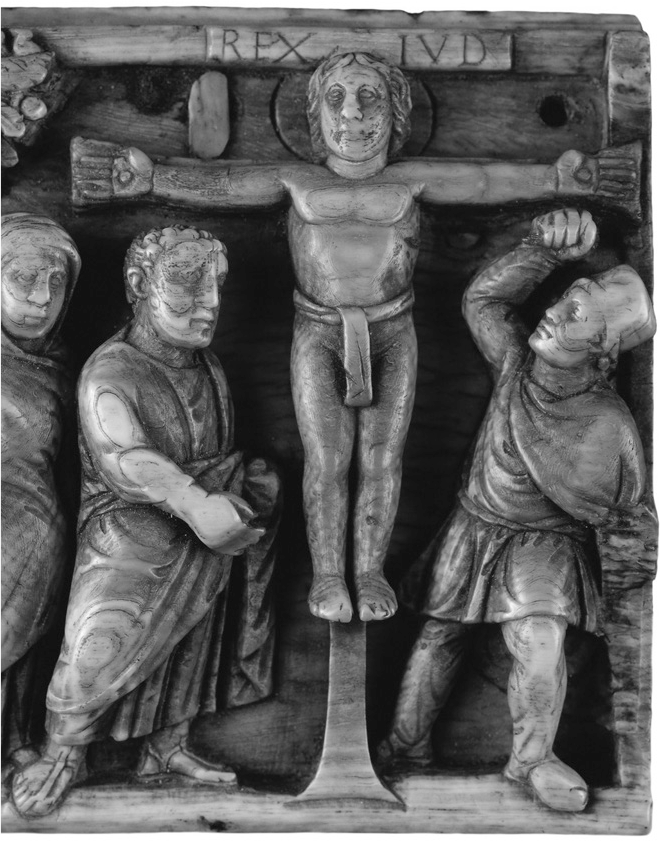
A parallel reticence in visualizing violence plays out in early Christian art’s approach to representing the passion of Christ, the model to which martyrs’ experiences conformed.Footnote 26 Despite its basic importance to the entire Christian tradition, Christ’s death is rarely illustrated before the sixth century.Footnote 27 When they do occur, late antique images of the crucifixion focus on the theme of Christ’s triumph over death while at the same time avoiding the physical facts of this death. Christ was consistently shown alive on the cross with his eyes open and few signs of suffering. The crucifixion scenes on the early fifth-century ivory plaque in the British Museum (fig. 6) and on the wooden doors (432–440 CE) of Santa Sabina in Rome show Christ muscular, barrel chested, in near nudity like an ancient hero and with head held high.Footnote 28
Detail of relief-carved ivory plaque showing the Crucifixion, Rome, c. 420–430 CE, British Museum 1856,0623.5 (Photo: © The Trustees of the British Museum).

Fig. 6: Long description
The relief-carved ivory plaque depicts the Crucifixion of Christ, created in Rome around 420-430 CE. The central figure is Jesus Christ nailed to a cross, with two other figures standing beside him. The plaque is intricately carved, showing detailed features of the figures and the cross. The text 'I REX IVD I' is inscribed above the cross. The figures are dressed in simple robes, and the overall style is characteristic of early Christian art.
The story of Christ’s death is not, however, absent from early Christian art. Rather than denied as a problematic sign of weakness,Footnote 29 the crucifixion is continually referenced through signs like the cross, the staurogram (which resembles an elemental crucified figure) and the chi-rho that displace the representation of violence into the realm of language.Footnote 30 The passion is also referenced through pictorial symbols like the paschal lamb, the visual resemblance of the orans prayer posture, and typological symbols like the sacrifice of Isaac.Footnote 31 All function as substitutes for overt images of the death and suffering of Christ, just as crowns and laurels stood in place of scenes of martyrdom. Such signs brought his ordeal to the mind of the viewer equipped with the knowledge needed to perceive their layers of spiritual significance and with the desire to see. Though its actual usage is rare in the earliest Christian art, authors speak of perceiving the cross embedded within more elaborate pictures like the anchor-and-fish symbol and the masts of ships.Footnote 32 Pictures of seemingly unrelated things were treated as fertile ground for searching out and imagining what was otherwise “unrepresentable,” for those who knew how to look.
Seeing Martyrdom in Ekphraseis
Representations of dead or injured holy persons were very rare in late antique art despite the iconographies of violence available for adoption from other areas of visual culture. The suffering of the martyrs, however, is not only present in contemporaneous written sources and reports of oral discourse but, in fact, features there prominently. The extreme violence of events relayed in texts and the details of suffering therein have led David Frankfurter to characterize martyrologies as a kind of sadomasochistic pornography.Footnote 33 A wide variety of textual sources treat martyrdom in this explicit manner.Footnote 34 The fourth-century Latin poet Prudentius’s Crowns of Martyrdom, a set of fourteen lyric poems on the lives of martyrs, contains especially vivid descriptions of violence and dismemberment,Footnote 35 as do the writings of third-century Egyptian Christians, notably Origen.Footnote 36 Especially interesting for the question of why it was desirable to create images of martyrial violence in mental visualizations cultivated through textual rhetoric but not in the visuals of art are several accounts that purport to describe explicitly violent paintings inside martyria. These reports of paintings of the torture and execution of saints seemingly contradict the evidence of the material record surveyed above, from which only a small number of works depict martyrdom in any direct way. The gulf between the content of these passages and the objects to which they could refer reflects not the existence of atypical works of art preserved only in description, but rather the disjunction between the input of the physical senses and the apprehension of the martyrs in the spiritual senses. These texts demonstrate a distinction between physical and mental vision, presenting the imagination as a space where the visualization of violence and its effects was encouraged as part of religious practice.
These texts all belong to the rhetorical genre of ekphrasis and build upon centuries of Greco-Roman oratory and composition.Footnote 37 Although the modern era’s definition of ekphrasis is a rhetorical description of a work of art, the exercise, from the classical through the Byzantine period, was “a descriptive speech bringing the thing shown vividly before the eyes.”Footnote 38 Ancient and medieval authors crafted ekphraseis describing people, places, objects, and events, and not only art—but all these works share the aim of creating visual impressions in the mind of material things in the world through auditory phenomena.Footnote 39
The best known of the ekphraseis purporting to describe violent images of martyrdom is the late-fourth century Ekphrasis on Saint Euphemia, written by Asterius of Amaseia (ca. 350–410 CE).Footnote 40 Its narrator recounts a series of paintings at the shrine containing Euphemia’s relics in Chalcedon. The series begins with Euphemia’s trial before a judge, progresses to a scene of her torture, followed by an image of her at prayer in her prison cell, and culminates in a final scene of her burning to death with her arms raised in prayer. The division of scenes is not clear in his telling, and the author favors an animated energy that continually moves the action forward. Guards drag Euphemia from the courtroom and begin her torture, as a new scene builds upon the previous moment. The vivid description of the picture of executioners hacking out Euphemia’s teeth has many features that do not accord with the character of early Christian art as we know it:
And the representation continues forward. Some public executioners, naked in short tunics, already began the deed: one of them grabbed her by the head and pulled it back, handing it to the other so that the virgin’s face is prepared for her punishment. The one standing by her side starts to cut out the pearls of her teeth. The hammer and the gimlet appear to be the instruments of pun-ishment. From this point on, I cried, and my feelings strike my speech. The painter so vividly depicted the drops of blood that you would say they truly flow from the lips. Lamenting, I went away.Footnote 41
The action in the painting described by Asterius is already in progress, and the violence is no longer implied and foreshadowed in Euphemia’s martyrium in the way that it is in real works of art like the frescoes on the Caelian Hill; instead, the viewer in her shrine is exposed to the full agony of the saint’s torture. The clear and gruesome depiction of Euphemia’s suffering and the drops of blood are difficult to imagine in any fourth-century image of a saint. Scholars have asked how this and comparable ekphrastic passages relate to the material record.Footnote 42 Many have rightly treated their most shocking features as rhetorical elements, perhaps inspired by real paintings but not actually part of the original objects.Footnote 43
The independence of these mental visions from real works of art, as well as the grim extremes they can present, is even more apparent in Prudentius’s Crowns of Martyrdom 11 on the martyr Hippolytus. The narrator of the poem visits the catacombs of the Via Tiburtina where the saint is interred. He begins to recount the story of Hippolytus’s death before moving inside the tomb and coming across a painting there—both visually evocative passages in this poem, first on the death and then on the painting, communicate scenes of shocking violence.Footnote 44 While outside the tomb, the narrator relays how Hippolytus was lashed to a pair of wild horses. He switches to the present tense at the moment the horses begin to run:
As bristling thicket-thorns tear up the body bit-
By-bit, they rip apart his flesh, dismembering it.
Some parts cling to bushes, some, from rocks, run red;
Some stick to limbs, some soak the earth as if it bled.Footnote 45
The method of the saint’s execution is given with great visual specificity and the immediacy of present action. Next, the narrator moves inside the tomb and encounters a painting, the description of which allows him to pick up the story of Hippolytus where he left off.Footnote 46 The painting in the tomb is said to show the aftermath of the saint’s dismemberment, as crying followers go about the field retrieving the bits of his body:
Above the tomb, a life-like image of his bloody
Corpse appears—a painting of his bleeding body.
Excellent father, there I saw the bleeding tops
Of rocks, and stains on briers with their crimson drops,
And where a hand quite good at greenery had caught
Vermilion images of crimson blood, well-wrought.
The broken bones were clear to see, all wrenched or shattered;
They lay about in chaos, where they had been scattered.
And there was Hippolytus’s loving flock
That tracked his broken course, in tears, in shock.
Eyes searching as they went, they gathered mangled parts.
Though stunned with grief, the people clasped these to their hearts …
Amidst the blood-soaked sand, they use their robes for drying,
Lest one drop remain to taint the dust it’s dyeing.
And where the stains have stuck to thorns with blood’s warm spray,
They press their sponges as they whisk it all away.Footnote 47
This section builds directly on the preceding ekphrasis of Hippolytus’s death with little difference in treatment, though only the second is based on a painting. Prudentius demonstrates that art was just one possible starting point for the elaboration of an immersive visual scene. Artworks could serve as anchors for visual description in ekphraseis but were often devices subservient to larger rhetorical goals. We should thus seek the source of these graphic details elsewhere than in physical pictures in martyria—these appear in the additional layer of sensory interpretation that authors (and properly trained viewers) performed in response to religious visual stimuli.Footnote 48
Ekphrastic Visualization in the Performance of Christian Devotion
Reasons for the extremity of the visions recounted in texts are suggested in the emotional responses modeled by the narrators and in the performative and participatory context in which ekphraseis might be received: these factors aided and prepared listeners to perceive the divine truths within abject material surfaces. Narrators’ perceptual responses to artworks and visions of martyrdom were instructive guides for listeners in their own responses to challenging physical sights, pointing them to see these deaths as inspiring and noble achievements. The texts’ sensorily evocative language moreover grants listeners the opportunity to practice their own responses to martyrdom within the safety of their active (as opposed to passive) imaginations—not yet to the martyrdoms of real-life encounters or represented in material pictures, but those built up in mental visions. These visualizations were exploratory spaces where devotees could trial their reactions to the sufferings of martyrdom and train their abilities to find divine truth therein, led along in the process of finetuning their senses by the narrator or orator.
Ekphraseis of religious art frequently focus on conveying the deep emotions spectators underwent in the process of viewing works of art within the highly charged atmospheres of sacred settings. Ruth Webb and Liz James emphasize the importance of emotion to ekphraseis,Footnote 49 which, in their words, “represent a living response to works of art.”Footnote 50 The narrator’s reaction to the disturbing images in the tomb of Euphemia in Asterius’s ekphrasis is shown as strongly emotional—he cries and laments, his feelings “strike his speech.” Gregory of Nyssa wrote that he experienced similarly tearful reactions when viewing paintings of the sacrifice of Isaac: “I have often seen this event in painting, and I could not pass by the sight without tears, as art brought the story vividly under my eyes.”Footnote 51 Asterius and Gregory are moved with reverential awe in contemplating representations of personal sacrifices for God, signaling to listeners the spiritual merits in these scenes of overt suffering and loss. Not only did such texts chronicle the narrator’s experience of a work of art or other scene, but they aimed to induce an experience in the recipient,Footnote 52 with the emotional response of the narrator guiding that of others.Footnote 53 Ekphraseis could thus guide a hearer to see and to feel in response to the phenomenon of martyrdom.
The language of this guidance evoked sensory cues to immerse and transform hearers, both in reference to the internal emotional sensations mentioned above and to external bodily sensations. The physicality of the accounts in ekphrastic martyr stories warrants their inclusion under Patricia Cox Miller’s and James Elkins’s term “visceral seeing,” meaning a kind of seeing or imagining that provokes a response from the viewer’s body and in so doing breaks the distinction between the viewer and the image.Footnote 54 Gruesome descriptions of bodily injury conjure a corporeal response, often empathetic or mimetic, and physically involve their hearers. Basil of Caesarea’s Homily on the Forty Martyrs of Sebaste involves the hearer in the Christian soldiers’ freezing deaths by detailing the effects of cold on bodies in general instead of on the bodies of the martyrs:
The body that has been exposed to cold first becomes all livid as the blood freezes. Then it shakes and seethes, as the teeth chatter, the muscles are con-vulsed, and the whole mass is involuntarily contracted. A sharp pain and an unspeakable agony reaches into the marrows and causes a freezing sensation that is impossible to bear. Then the extremities of the body are mutilated, as they are burned [by the frost] as if by fire. For the heat is driven from the extremities of the body and flees to the interior; it leaves the parts that it has abandoned dead, and tortures those into which it is compressed, as little by little death comes on by freezing.Footnote 55
The listener is invited to imagine the bodily sensations experienced by the group of martyrs within their own body to understand the nature of their suffering. Imagined scenes of violence and trauma wrenched the listener out of everyday existence and elicited strong feelings of horror and awe. Ekphrastic texts brought about such experiences through emotional cues (pathos) and sensory prompts that enhanced one another in descriptions that varied radically in tone and content from the representations of martyrdom in early Christian art.
Ekphrastic enterprises were dependent on Aristotle’s notion of enargeia, the ability to make vivid, which was celebrated by orators and which relied especially upon techniques of visualization (the creation of mental images that might be subsumed under the term phantasia).Footnote 56 A fifth-century teacher of rhetoric in Constantinople, Nikolaos the Sophist, wrote that enargeia is the spark that distinguishes ekphrasis, which tries to make “hearers into spectators,” from straightforward narration.Footnote 57 Techniques recommended by instructors for creating this “energy” included the use of abundant descriptive detail to stimulate the visualizing mind and the presentation of things in parts so that the mind had the chance to build up a thoroughly immersive picture.Footnote 58 Aelius Theon, whose first century Exercises (Progymnasmata) served for the instruction of orators, defined ekphrasis as “bringing what is portrayed clearly before the sight”—in other words, using language to stimulate the sense of vision over and above the other senses.Footnote 59 Emotion and visualization were mutually reinforcing, with the resulting mental images having the power to alter the listener. This power was recognized by the first century rhetor Quintilian who clearly stated the link between rhetoric’s ability to create visualizations and its ability to stir the emotions: “it is through these [ekphraseis] that images of absent things are represented to the mind in such a way that we seem to see them with our eyes and to be in their presence. Whoever has mastery of them will have the most powerful effect on the emotions.”Footnote 60 The importance of visualization techniques in committing things to memory in the ancient and medieval worlds is well known, and such experiences of imagining created impressions on the mind, forming it and helping to shape religious experience.Footnote 61 The emotive and physical impact of ekphraseis of violence made them a forceful pedagogical tool, as Meghan Henning has argued for literary descriptions of sinners’ torments in hell. Descriptions of the agonies of hell grew in vividness and detail as early Christian apocalypses built upon their New Testament predecessors and developed into a distinctive genre of paideia.Footnote 62 Martyrologies may possibly follow a similar stylistic trajectory, capitalizing on the persuasive power of graphic description.Footnote 63
The potential transformative power of such ekphraseis makes it no surprise that they found a role in Christian worship, as parts of sermons, readings, and martyrologies, as communities sought to commemorate and imitate the martyrs and as devotees looked for ways to gain closeness with the divine. Readings or sermons inside saints’ shrines containing excruciating details of torture created an acute sense of physical holy presence by transforming listeners into eyewitnesses.Footnote 64 In one sermon Augustine characterizes hearing the martyr stories as akin to watching them unfold in front of him: “I go and watch the martyrs; when the Passions of the martyrs are read, I am a spectator, watching them.”Footnote 65 Oral performances of sermons and martyr stories guided audiences through visualization of affective images with the goal of making the martyr saint present.Footnote 66 Eusebius begins his Martyrs of Palestine with an exhortation to commemorate the martyrs with words that bring the scene of martyrdom to the eyes: “Let us therefore tell the clear signs and glorious manifestations of the divine doctrine, and frame in writing an imperishable monument, and let us make their wondrous excellence a lasting vision before our eyes.”Footnote 67 As such, emotive elements and visual cues in a text allowed for dramatic readings to which audiences typically responded with gestures and noisy reactions.Footnote 68 These were participatory occasions, with intense interaction between speakers and listeners. Augustine’s description of hearing the passion of Cyprian read shows his feeling of personal involvement in the drama: “Look, here am I, watching Cyprian; I’m crazy about Cyprian … I’m delighted by him … I rejoice when he wins.”Footnote 69 The level of participation was such that it involved a personal “reperformance” of the scene in the hearer’s mind. James and Webb explain the final sentence of Asterius’s ekphrasis (“now it is time for you, if you wish, to complete the painting”) as representative of this creative participation: “The listeners are invited to create a picture in their own minds which they themselves may embellish.”Footnote 70 The fact that stories of the deaths and trials of the martyrs were not fixed narratives but often varied in their retellings suggests that such stories were not valued as historically-accurate accounts but instead as tales for the construction of emotive memory and devotional response. These narratives were meant to be re-performed to some degree in the mind of whoever tells, listens to, or remembers such a life.
The framework in which we should interpret his ekphrastic passages is outlined for us by Asterius himself: “For argumentative education is an inferior and weaker teacher than practical action: the more it is said that the sight is more precise than hearing, the more it is agreed that the actions are superior to words. Looking at the gravestones inscribed with letters, making the agony of the martyr precisely visible.”Footnote 71 This complex statement foreshadows arguments made after Byzantine Iconoclasm in justification of religious art, like that by Photius on the power of sight being superior to that of hearing.Footnote 72 Sight is linked by Asterius to action and presented as having a strong effect upon the mind, while hearing and conversation had a far weaker influence. In Asterius’s telling, though, it is not only the paintings in martyria that make the suffering of the martyr visible—it is also the words of his ekphrasis that stimulate the sense of sight and make the martyr’s suffering visible in mental images.
“Struck by a Wound”: Viewing Art and Reality
Given the appeals to the sense of vision in the ekphraseis of martyrdoms considered above, why then would a work of visual art not serve to prompt the same constructive response in early Christian devotion? Some clues are found in the characteristics of the artworks as presented in the ekphraseis themselves: they consistently break out of their frames and either intrude upon the real world or subsume the viewing subject into their world of representation. We have seen how Prudentius’s ekphrasis on the painting in Hippolytus’s shrine “dissolves its own frame, erasing the distinction between the painting being described and the poem describing it.”Footnote 73 While Prudentius’s narrator is pulled into an immersive picture, the narrator of Asterius’s ekphrasis perceives the blood from the painting entering into his reality: “the painter so vividly depicted the drops of blood that you would say they truly flow from the lips.”Footnote 74 This melding of the real and the depicted echoes a common trope in classical writers’ discussions on art: sculpture and paintings were often characterized as so realistic that they fooled human and animal viewers into interacting with them as if they were real.Footnote 75 This trope, meant to praise the painter’s ability and technique, also presented a vision of artworks as extensions of reality and as deeply affective to viewers.Footnote 76 Stories abound of artworks coming to life, bewitching viewers, or making them fall in love.Footnote 77 Numerous Hellenistic epigrams celebrated the verisimilitude of Myron’s bronze cow statue, with many attributing life to the sculpture, like the epigram by Evenus: “Either a complete hide of bronze clothes here a real cow, or the bronze has a soul inside it.”Footnote 78 Early Byzantine ekphraseis too treated the art of expert craftsmen as able to blur real and represented experience. Although seeming highly abstract to a modern viewer, this art was still praised by its contemporaries for its ability to seemingly break the boundary into daily life. Henry Maguire has shown that the Byzantines considered their own art to be strikingly realistic—the abundant references to verisimilitude in their ekphraseis was not just a trope inherited from classical rhetoric, but an indicator of how the Byzantines viewed their art.Footnote 79
The confusion produced by realistic art, in which it tempts interaction and might very well respond, reflects the transformative power assigned to the sense of sight in the ancient world. This topic has been of interest to scholars of early Christian and medieval art since Robert Nelson drew attention to the tactile metaphors the Byzantines used to write about seeing.Footnote 80 Nelson read Photius’s ninth-century ekphrasis on the Virgin and Child mosaic in the apse of the Hagia Sophia as pointing to Photius’s subscription to an ancient optical theory of extramission, in which rays emerge from the eye to “grasp hold” of the viewed object.Footnote 81 Nelson argued that post-Iconoclastic Byzantines conceived of sight as an active activity in which the eyes embraced their objects with a force akin to touch, legitimizing sight and consequently art as methods for gaining access to divinity.Footnote 82 However, late antique ideas about vision were not straightforward, with several different conceptions and theories coexisting. The Aristotelian model, never forgotten by late antique thinkers, was close to intromission, in which forms/rays/light emanating from an object are received by the eye.Footnote 83 The sixth-century Aristotelian commentator John Philoponos, for example, presented his own intromissionist theory of the eye being affected by the viewed object.Footnote 84 Models between extra- and intromission also existed (termed “interactionist”), and this spectrum perhaps better explains attitudes in practice.Footnote 85 Both the gaze of the eyes and the object seen were generally held to have powerful effects upon one another. The gaze united viewer and object and locked them into a space of heightened tension and interpenetration. The Evil Eye could wound, but those who looked upon the face of the Medusa were turned to stone. All models involved contact between seen and seer: “within the Graeco-Roman imaginary, and across a remarkably long timespan, to see was to enter upon a dynamic, reciprocal and mutually implicative relationship with the thing seen.”Footnote 86 What is beheld with the eyes acts upon the viewer and in turn provokes action. The direct and immediate nature of sight meant that a viewer must come prepared to see.
Ancient views on the sense of vision and the confronting power of the visible permeate Christian comments on the act of looking as a form of violence in itself. This can be observed in statements by early Christians on the danger inherent in viewing the Roman games—spectacles designed to be seen and to occasionally showcase martyrdoms. The Christian rejection of violence made such exhibitions abhorrent. However, commentary on the topic goes beyond condemnation of sinful enjoyment derived from the games to condemn the simple gazing upon such violence as a form of action that inflicts additional violence.Footnote 87 Theophilus of Antioch wrote: “We are forbidden even to witness gladiatorial shows lest we should become participants and accomplices in murders.”Footnote 88 Athenagoras of Athens presents a similar sentiment: “We, deeming that to see a man put to death is much the same as killing him, have abjured such spectacles,” and “we do not even look on, lest we should contract guilt and pollution.”Footnote 89 Tertullian, too, equates beholding with doing: “Why should it be lawful to see what is shameful to do?”Footnote 90 These authors speak of witnessing as a form of active participation, as a form of enacting violence upon the subject and in turn contracting contagion. In The Martyrdom of Saints Perpetua and Felicitas, the crowd at Carthage demanded that the martyrs’ bodies be brought into the center of the arena, “so that their eyes could participate in the killing as the sword entered their flesh.”Footnote 91 This powerful statement equates the spectatorial gaze to the blade of a sword. The interactive power of sight is on full display in these quotations: the spectator’s eye performs “much the same” thing as it witnesses, and the sight of such action risks infecting the viewer with spiritual pollution.
Amongst such attitudes, a Christian viewer must be very careful about what they should look upon.Footnote 92 Christians were admonished to be on guard against the constant threat of seduction into idolatry or sin by the spectacles of Roman public life. John Chrysostom advocates maintaining a chastity of the eyes by avoiding spectacles.Footnote 93 Augustine describes how his friend Alypius was transfixed by the sight of violence and thereby instantly pulled into sin: “For when he saw that blood, he drank deep of its barbarity and did not turn himself away but fixed his gaze and drank in the torments and was unaware, and found gratification in the wickedness of the contest, and became drunk on the pleasures of blood.”Footnote 94 Viewers who were not masters of their senses and spirits were at constant risk of engaging with the image of a spectacle improperly, especially the executions that so excited massive crowds and were indistinguishable from heroic martyrdoms to the physical eyes. Alypius’s example is especially telling about the effects of vision on the soul. Although he intended to keep his eyes closed after being dragged to the games by friends, the noise of the crowd piqued his curiosity, and he made the fatal mistake of opening his eyes:
At once he was struck by a wound to his soul that was deeper than the wound the combatant he was now eager to watch suffered to his body. He sank down, more pitiable than the man whose fall had given rise to the shouting. That noise entered into his ears and unlocked his eyes, to make a way for the striking down and subjugation of a mind that up to this point had been confident rather than courageous.Footnote 95
Not only can the eye of the spectator pierce those it looks upon, as in Perpetua’s Passion, but what enters through the eye can likewise wound the soul.Footnote 96 Augustine’s language likens this process to a sudden physical assault, as the contact established by the gaze overwhelms the untrained viewer.
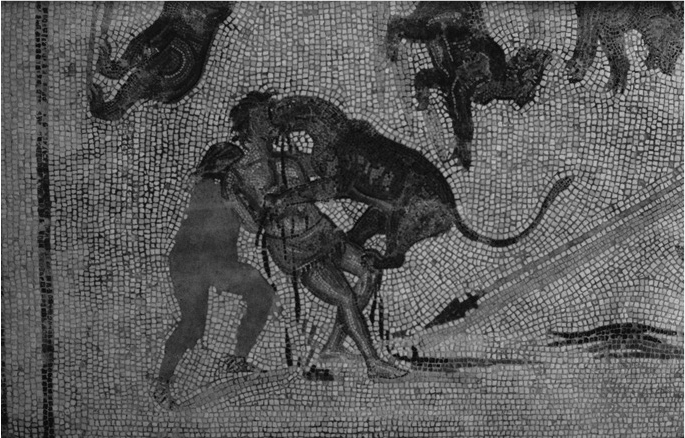
Such visceral experiences of spectatorship were provided (and cultivated) in Roman art. Besides furnishing material for conversation between dinner party attendees, mosaics in dining rooms could immerse guests in an experience of the arena, simulating it for them in miniature. The mosaic from a triclinium in the Sollertiana Domus in Thysdrus faces us with the type of violent encounter that Christian authors feared made spectators complicit (fig. 7).Footnote 97 A prisoner is shown attacked by a leopard in frightening detail. The leopard bites his face as its claws sink into his chest and thigh; the mostly nude man is held up by a bestiarius as he loses his footing. Blood drips onto the ground from his wounds. The mosaic scene, filling the floor space, turns the viewer into spectator, who looks down from the couch of the triclinium into a miniaturized arena.Footnote 98 This spectatorial position was one that would have made many Christians deeply uncomfortable and exposed to a sinful complicity and guilt.Footnote 99
(left): Detail of floor mosaic of executions from the Sollertiana Domus, Thysdrus, Tunisia. Roman, late-2nd / early-3rd cent. CE. El Jem Museum (Photo: Margaret Alexander Papers and Records of the Corpus des Mosaïques de Tunisie, Dumbarton Oaks, Trustees for Harvard University, Washington, D.C.).

Fig. 7 Long description
The mosaic showcases a scene of executions, featuring a gladiator in combat with a fallen opponent. The intricate design includes various figures and elements that evoke the intensity of the arena. The mosaic is part of the collection at the El Jem Museum and dates back to the late 2nd or early 3rd century CE.
Such art was a source of visual danger that early Christian images, purged of the excruciating details and spectatorial immediacy of martyrdom, were not. Artwork illustrating the deaths of the martyrs in the grisly manner of the Thysdrus prisoner’s mauling, even if intended to be honorific, would have undoubtedly provoked unease. Such depictions could raise the risk of somehow re-enacting the torture of the saints through gazing upon their victimized bodies. They would also pose the danger of simply falling into enjoyment of the cruel spectacle, like Augustine’s friend who was not able to mount a defense against the intoxicating instancy of sight. Early Christian depictions emphatically do not allow their viewers to see or be complicit in the horrors of the martyrs’ deaths. They present “spiritual” images in accordance with those that would be seen by the “eyes of the heart.” Just as reliquaries of precious metals and gemstones helped Christians to see relics as more than humble and decrepit bodily fragments, late antique artworks cloaked the martyrs in pristine and adorned bodies, bathed in light and gold.Footnote 100 By referencing the suffering and deaths of the martyrs but not overtly showing them, early pictures of martyrs similarly allow the viewer to reflect upon the meaning of martyrial suffering in a more controlled manner, guided by iconographical markers of sanctity.
Such caution in representing martyrdom was not necessary within the visions of ekphrasis, which were able to avoid the problematic physical contact and uncontrolled immediacy of sight via the organ of the eyes. Indeed, despite their celebration of using language to stimulate visual perception, the rhetors of late antiquity distinguished different modes of seeing and did not entirely equate bodily sight with mental sight or visualization. Aelius Theon qualifies his discussion of ekphrasis cited above, stating that ekphrasis makes the listener “all but see” the subject.Footnote 101 His qualification is important. Violent ekphraseis, though they retain some of the catalytic power of physical vision, may have been acceptable because the things conjured therein are “almost seen” and do not have the same active and dangerous power as a sight in the world. They remain imagined and, like the events presented in a theater, real but not fully real and unable to lock viewers into the reciprocal relationship of the gaze.Footnote 102
Violent images produced in the mind in response to verbal descriptions do not carry the same horrific immediacy, as they are carefully constructed first by the words of their authors and then by those engaged in the act of responsive visualization. The participatory element so key to the reception of texts, and especially religious texts, in which the listener “reperforms” the scene for themselves, makes violence allowable and even helpful: the imaginer is in control of building the vision and not subject to it. They are able to consider and reflect on the meaning of each component, crafting visions that accord with their understanding of divine truth. While in the world, although the viewer can generally choose to direct their gaze, there is a large element of chance in what they ultimately encounter. In contrast, while imagining in an appropriate setting, the mind is active in creating the image. The appropriate place for representing violence is in the active mind’s eye, informed by the emotional responses modeled by ekphrastic authors that provided the blueprints for listeners’ own proper reactions to highly charged material.Footnote 103
Conclusion
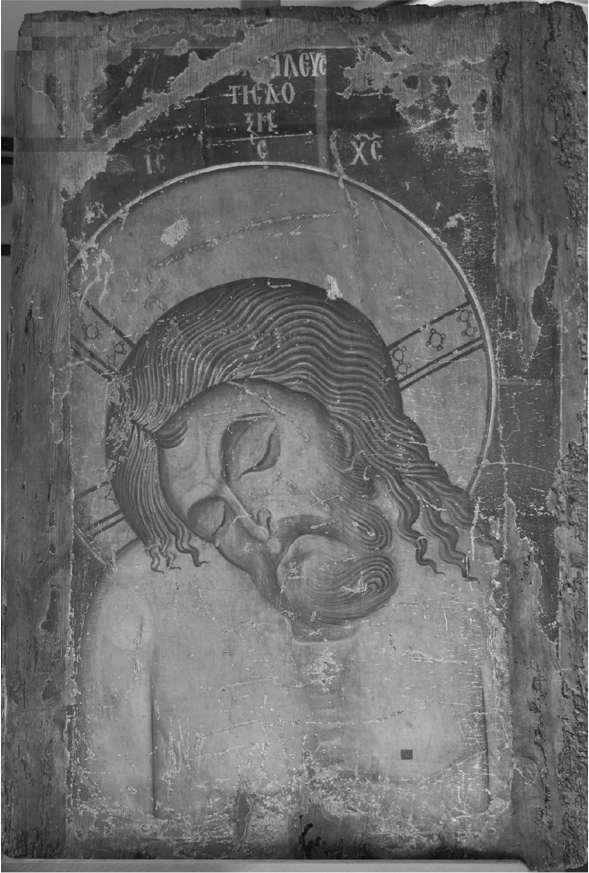
Centuries later into the Byzantine period, Christ’s body could be shown bent and his eyes closed to signify pain and death. In middle-Byzantine crucifixions, like the mosaic in the narthex of Hosios Loukas, for example, the swaying lines of Christ’s body emphasize his physical expiration: he is reduced to dead weight.Footnote 104 His head sags forward in death, and streams of blood pour from his hands, side, and feet onto the skull at the base of the Cross.Footnote 105 This transition in iconography culminates in a new image in the eleventh and twelfth centuries: the Man of Sorrows, exemplified by a bilateral icon from Kastoria, in which the lifeless corpse of Christ confronts the viewer as a portrait bust, his death and humanity unmistakable (fig. 8).Footnote 106 Violent representations of martyrdoms entered art alongside the torments of Christ’s Passion. The Menologion of Basil II, for example, illustrates the martyr Tryphaena gored by a bull in a depiction with many parallels to the old Roman iconography of arena violence that had been bypassed by early Christian art—the jagged wound on Tryphaena’s abdomen, the streams of blood, the saint’s tense and crouching posture, and the aggressive and lunging bull are reminiscent of earlier Roman representations of executions by wild beast.Footnote 107 Medieval viewers saw divine strength in these images of holy death and suffering, and the emotive power of such representations etched deep impressions in their minds and strengthened their own devotion.
(right): The Man of Sorrows, obverse of two-sided icon, tempera on wood, late-12th cent. CE, Kastoria, Byzantine Museum (Photo: © National Archives of Monuments — Ministry of Culture and Sports).

Fig. 8 Long description
The Man of Sorrows icon, a two-sided piece, features a frontal depiction of Christ's upper body with a halo behind his head. His head is tilted downwards, eyes closed, and his expression conveys deep sorrow and suffering. The icon is painted in tempera on wood and dates back to the late-12th century CE. It is housed in the Byzantine Museum in Kastoria. The reverse side of the icon is not visible in this image.
Before such depictions of pain and violence could constructively enter the Christian repertoire, though, both ekphrasis and art worked to address the perceptual challenge that faced early Christian witnesses to martyrdoms in life and in visual art. Augustine summarizes this challenge of paradoxical seeing in a passage explaining the kinds of images that should be formed in the minds of listeners during the reading aloud of martyr stories:
The materially-minded look on, and think how wretched and unfortunate those martyrs are, thrown to wild beasts, beheaded, burned with fire, and they are filled with detestation and horror. Others, however, look on, as do the holy angels also, and don’t fix their attention on the mangling of bodies, but instead marvel at the completeness of faith. A splendid spectacle offered to the eyes of the mind is a spirit whole and unbroken while the body is torn to pieces. That is what you people gaze on with pleasure when the accounts of such things are read in church. After all, if you didn’t form some sort of picture of what happened, it would mean you weren’t listening at all.Footnote 108
Augustine is ultimately warning here against forming the incorrect mental images when listening to a martyr’s passio, but in doing so he distinguishes between different ways of looking—the material mode of looking and the looking that occurs within the spiritual senses, of the sort that angels do. Seeing the broken body, apparent as the outward appearance of things, is undesirable. The spiritual eye, on the other hand, perceives the strength of the martyr’s faith, the true but not straightforwardly visible import of the scene. This eye pierces the paradoxes of strength through weakness, life through death, and provides the necessary exegesis of encountered images.
Verbal and visual media tailored their respective approaches to preparing Christians to see martyrdom with their spiritual eyes in ways that reflected contemporary views about the interactivity and immediacy of vision. Ekphraseis guided hearers to respond to images of martyrdom and allowed them to build their own responsive visions. Art, which partook in the direct relationships constructed by the physical process of sight, took a different and more cautious tact: there is remarkable correspondence between the language—“the completeness of faith,” “a spirit whole and unbroken”—that Augustine uses to describe the proper image one should understand when bringing the martyrs to mind and the way early Christian art allows one to envision the martyr: inviolate, strong, and victorious over the trials of the world through their profession of faith. Why run the risk of tripping up a “materially-minded” viewer with depictions of external agony and images that might be mistaken for lurid Roman spectacles? By suppressing the physical experience of the martyrs in favor of the spiritual, early Christian iconography makes visual art into an appropriate vehicle for apprehension by the senses until the culture has thoroughly learned to see.