





Background
Volunteering can be defined as planned and sustained unpaid work or activity to benefit others outside of the family or household in which the individual freely chooses to participate (Salamon & Sokolowski, Reference Salamon and Sokolowski2016). Volunteering provides some unique benefits to organizations, recipients, and volunteers themselves (Salamon & Sokolowski, Reference Salamon and Sokolowski2016). Volunteers benefit from improved participation, self-belief, confidence and socialization (Grönlund & Falk, Reference Grönlund and Falk2019) as well as physical and mental health (Nichol et al., Reference Nichol, Wilson, Rodrigues and Haighton2024).
Volunteering remains highly segregated by gender, with women generally more likely to volunteer than men (58% versus 52%) (UK Civil Society Almanac, 2023). This disparity has been attributed to gendered socialization, particularly regarding helping others, leading women to have stronger motivations to volunteer than men (Clary et al., Reference Clary, Snyder and Stukas1996). This ethic of care, which is positively associated with volunteering, is more likely to be present in women (Karniol et al., Reference Karniol, Grosz and Schorr2003). In contrast, men are more likely to volunteer when they perceive a specific reason for engagement, such as a sense of moral obligation (Einolf, Reference Einolf2011). Since men are less motivated to volunteer to begin with, these reasons for engagement have a stronger influence on men than on women (Einolf, Reference Einolf2011).
In particular, these gendered patterns are reflected in the continued underrepresentation of female volunteers in maritime search and rescue (SAR), particularly in operational and leadership roles (International Maritime Rescue Federation, 2025). Research shows that women prefer voluntary roles focused on caring while men prefer roles which might place them in danger (Wymer, Reference Wymer2011). For example, women are more likely to volunteer in health and social care, particularly volunteer care roles outside the family, while men are more likely to volunteer in politics, finance or science (Borromeo, Reference Borromeo2021). In addition, some volunteer roles have dominant gender norms, with men commanding voluntary emergency services and women dominating voluntary caring roles (Musick & Wilson, Reference Musick and Wilson2007). Research has also shown that women are less likely to volunteer in organizations with strong male norms, in all gender equality contexts (Wemlinger & Berlan, Reference Wemlinger and Berlan2016).
These gender differences in volunteering could be explained by gender role spillover theory that hypothesizes that gender based behavior in one area of life can spill over into other areas (Marshall & Taniguchi, Reference Marshall and Taniguchi2012). According to this theory, an individual’s gender-based behavior and expectations emerge from culturally patterned relations and define the rights and responsibilities for men and women that pervade into their various social roles, and the way they behave as men or women in any particular context (Marshall & Taniguchi, Reference Marshall and Taniguchi2012).
However, feminist security theory provides another valuable perspective for understanding how gender and power dynamics operate in the context of emergency volunteering (Blanchard, Reference Blanchard2003). This approach focuses on uncovering gender-based hierarchies, dismantling patriarchal systems of violence, and striving towards a concept of shared security (Blanchard, Reference Blanchard2003). The theory also questions the idea that gender roles are fixed, highlighting how these roles shift during times of conflict and peace, thereby opening space for new roles and relationships to emerge (Blanchard, Reference Blanchard2003). Emergency volunteering environments, in particular, can serve as settings where traditional gender expectations are not only questioned but potentially transformed (Cadesky et al., Reference Cadesky, Smith and Thomas2019).
In the UK, like many other countries, there is a reliance on both voluntary and public emergency services due to limited government funding (UK Parliament, 2020) with volunteering contributing around £20 billion to the UK economy each year (UK Civil Society Almanac, 2021). Maritime rescue, operated by the charity Royal National Lifeboat Institution (RNLI), relies on volunteers (RNLI, 2025). RNLI, established in 1824 as ‘a large body of men…in constant readiness to risk their own lives’ (RNLI, 2025) required 145 years to accept their first official female crew member and another 42 years until their first all-female crew, with volunteers remaining predominantly male (Streetwise Opera, 2025). Almost two centuries later, when one RNLI station launched its first all-female lifeboat crew, some comments on social media were negative toward women (Streetwise Opera, 2025).
Allowing women to take on traditional male volunteer roles is not only a fundamental human right but increases the available volunteer and talent pool, as well as fostering a more innovative and productive service through diversification of perspectives and skills (Kitada et al., Reference Kitada, Piñeiro and Mejia2019). Having more women in maritime SAR is vital for building diverse, resilient teams that better reflect the communities they serve. Increased representation improves operational capabilities by bringing varied experience and expertise to SAR (Kitada et al., Reference Kitada, Piñeiro and Mejia2019).
However, there is a paucity of research on female volunteers in maritime SAR. Research on the employment of women in the maritime sector reports it remains dominated by males (Reva & Kumalo, Reference Reva and Kumalo2020). Historically, women were not permitted to engage in maritime roles, and in some cultures, a woman on board a ship was considered bad luck, creating an environment in which discrimination against women is deeply entrenched (Reva & Kumalo, Reference Reva and Kumalo2020). Gender stereotypes significantly impact women’s opportunities for advancement in this male-dominated field, often limiting them to administrative or supportive roles (Grimett, Reference Grimett2024). Additional barriers include a 45% wage disparity between men and women, discrimination, abuse, and harassment (Grimett, Reference Grimett2024). An international survey combining responses from both employed and volunteer women in maritime SAR also reported issues related to gender discrimination (International Maritime Rescue Federation, 2021); however, results for volunteers alone could not be disaggregated.
Therefore, this research aimed to gather essential data on female volunteers in maritime SAR, addressing the gap in female representation within a male-dominated, high-risk volunteering environment. To achieve this aim, the study sought to: profile the demographic and experiential characteristics of female maritime SAR volunteers; analyze the motivations underpinning their participation and retention; examine the perceived benefits of involvement; and identify structural and cultural changes needed to enhance women’s inclusion and representation within maritime SAR. By doing so this contributes to the international debate on equity of experiences and supports organizational change (O’Brien et al., Reference O’Brien, Hanlon and Apostolopoulos2023). In particular, this research provides recommendations for male-dominated voluntary organizations to support efforts to encourage and empower more female volunteers in operational roles.
Methods
This study involved a cross-sectional online survey, with both open and closed questions, reported according to the Consensus-Based Checklist for Reporting of Survey Studies (CROSS) (Sharma et al., Reference Sharma, Duc, Thang, Nam, Ng, Abbas, Huy, Marušić, Paul, Kwok and Karbwang2021) with original protocol available on the Open Science Framework (https://doi.org/10.17605/OSF.IO/YN7ZF). The study received full ethical approval from Northumbria University College of Reviewers (reference number: 6821).
Sample
Participants were females volunteering in operational SAR roles with the RNLI. The RNLI is the largest charity that saves lives at sea around the coasts of the United Kingdom, the Republic of Ireland, the Channel Islands, and the Isle of Man, as well as on some inland waterways. Non-probability, voluntary response sampling was used. Based on a population size of 899, using a 95% confidence level and 10% margin of error, a minimum sample size of 87 was needed (Cochran, Reference Cochran1977).
Recruitment
With permission from the RNLI, recruitment took place at both the first RNLI Women in SAR conference (7th and 8th March 2024), via social media, specifically the RNLI #WomeninSAR private Facebook group (549 members on 21/10/2024), and distributed across RNLI regions via systems support coordinators. The lead author, also an RNLI woman in SAR and a member of the Facebook group, was responsible for recruitment. Study adverts, distributed both physically at the conference and on social media, contained a link taking participants directly to the survey. No incentives were provided for completion of the survey to discourage multiple participation.
Survey
As there was no validated questionnaire that addressed the research aim, the survey was developed specifically for this study. The questions focused on characteristics of female maritime SAR volunteers, motivations underpinning participation, benefits of involvement, and changes needed to enhance women’s inclusion and representation within maritime SAR. The survey was piloted with five women (two non-operational and two operational SAR volunteers, one expert in equality, diversity and inclusion, aged 23–53), resulting in changes to terminology, clarification to questions, and additional options for responses. The survey was available in Jisc (an online survey tool designed specifically for education and research organizations) between 8th March and 8th April 2024 and took approximately 10 minutes to complete. Anonymity was assured by creating anonymous links through Jisc with no authorization or authentication process. Participants were asked to provide informed consent prior to completing the survey by selecting the “I agree” response. See Supplementary Material 1.
Analysis
For open questions, inductive thematic analysis was used, derived from a grounded approach to develop themes. For closed questions, data were entered into Excel. Descriptive statistics were used. Data were anonymized by using a code word created by each respondent which related to their data. Anonymized data was generalized and therefore unidentifiable. Participants could withdraw their data from the study without reason or prejudice. During the survey itself, participants were free to withdraw at any point by closing their browser. Participants could then withdraw after completion of the survey and before publication by providing the authors with their code word so the authors could destroy the data linked with that word. The final anonymized data set has been deposited, with participant consent, into Northumbria University Institutional Research Data Repository so that others can verify findings, in line with best practice (https://figshare.northumbria.ac.uk/articles/dataset/Cross-sectional_survey_of_female_volunteers_in_maritime_search_and_rescue/27269673?file=49916886).
Deviations from protocol
Following preregistration of the protocol, the number of female volunteers in operational roles with the RNLI decreased from 1094 to 899. Therefore, we recalculated our original sample size, reducing the minimum sample size needed from 89, as stated in the protocol, to 87 presented here, prior to distribution of the survey.
Results
Response rate
In total, 209 individuals completed the questionnaire. In April 2024, there were 899 women in volunteer operational SAR roles in the RNLI, suggesting a response rate of 23%.
Characteristics of female maritime SAR volunteers
Female volunteers’ ages ranged from 19 to 78 years with a mean age of 42.3 years (SD = 11.9), although three chose not to disclose their age. Most (99%) were assigned female at birth, identified as women, and were heterosexual (84%). Almost a third were married or in a civil partnership (31%), while another third were single (31%). In total, 97% described themselves as either White (86%) or Irish (11%). Over half were educated to honors degree or above and 71% were working full time (see Supplementary Material 2).
For those female volunteers who were employed (n = 180), most worked in Public Service, Utilities and Health (n = 70, 39%), followed by Private Sector Services (n = 51, 28%), Education and Research (n = 27, 15%), Maritime and Transport (n = 25, 14%), Manufacturing (n = 4, 2%), Agriculture, Food and Forestry (n = 2, 1%) and Infrastructure, Construction and Related sectors (n = 1, 1%). Prior to joining the RNLI, 43% (n = 90) stated that they had maritime experience elsewhere with 57% (n = 51) stating via a hobby, 38% (n = 34) via their career (including in leisure and tourism (n = 9), instruction and education (n = 13), fishing (n = 3), the navy (n = 6), the oil industry (n = 1), own sailmaking business (n = 1) and other (not specified) (n = 1)) and 5% (n = 5) via other maritime voluntary roles. Almost a quarter of those who responded (n = 206) volunteered in Scotland (n = 50, 24%) although there was good representation from all six RNLI areas (see Figure 1).
Female volunteers by RNLI area.

Fig. 1 Long description
A map of the British Isles divided into six shaded regions based on R N L I area responders. A legend in the top-left corner provides the following data:
* Scotland: dark gray, n equals 50 (24 percent).
* South East: medium gray, n equals 37 (18 percent).
* Ireland: black, n equals 36 (17 percent).
* North and East: light gray, n equals 32 (16 percent).
* South West: white, n equals 30 (15 percent).
* Wales and West: medium-dark gray, n equals 21 (10 percent).
Geographically, Scotland covers the northernmost part of the map. Ireland is the separate island to the West. The North and East region covers the eastern coast of England. Wales and West covers the western coast of England and all of Wales. The South East covers the southeastern tip of England, and the South West covers the southwestern peninsula.
The Index of Multiple Deprivation (IMD), the official measure of relative deprivation for small areas in England, ranks every small area, called lower-layer super output areas (LSOA), in England from 1 (most deprived area) to 32,844 (least deprived area). IMD rank for female volunteer respondents’ postcodes was determined to a maximum decile value. A decile of 1 means the postcode is in the bottom 10% of the deprivation index, a decile of 2 means the postcode is in the bottom 20%, and so on. While IMD ranged from 1 to 10, almost 60% of respondents were in the top half of the deprivation index (see Supplementary Material 3).
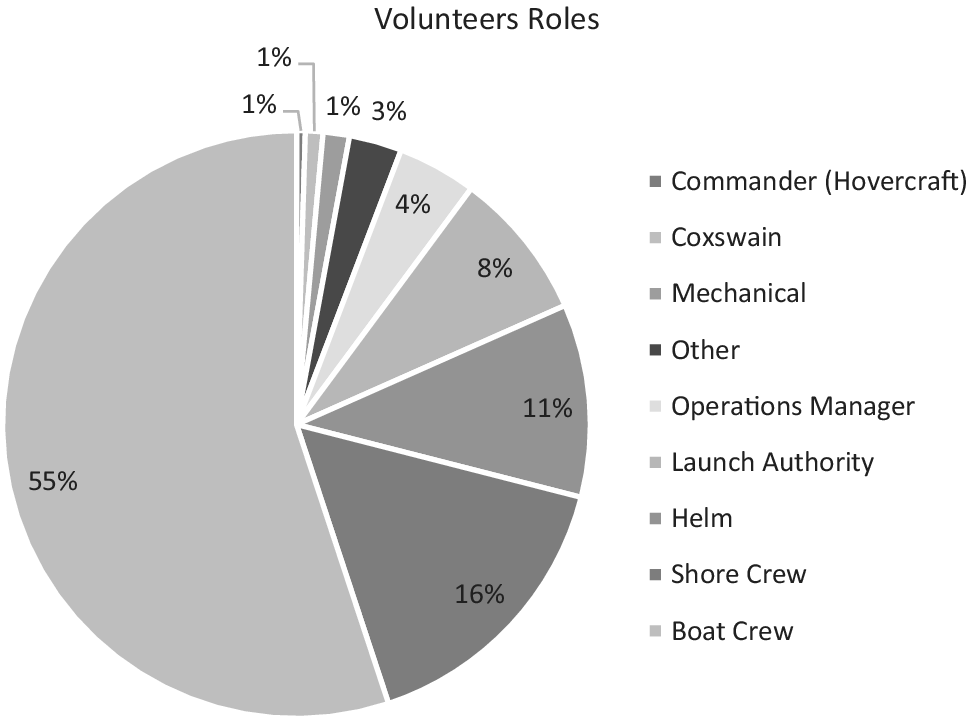
Most of the female volunteers who responded (n = 207) were volunteer boat crew (n = 114, 55%) or shore crew (n = 33, 16%), while there were few female volunteers in mechanical (n = 3, 1%), coxswain (n = 2, 1%), or commander (n = 1, 1%) roles (see Figure 2).
Female volunteers’ current (operational) role within the RNLI.

Six (3%) respondents reported volunteering in other operational roles, including former shore crew (n = 1), driver (n = 1), educator (n = 1), administrator (n = 1), press officer (n = 2). Length of current voluntary service for the RNLI ranged from just 1 month to 34 years and 10 months, with a mean of 85 months (SD = 83), although three respondents chose not to disclose length of service. Approximately one third of female volunteers (n = 71) also held at least one other voluntary role within the RNLI (including other operational and non-operational roles) and approximately two thirds (n = 140) held other volunteering roles elsewhere. Most (53%) reported volunteering for between 2 and 5 hours per week (n = 79) although some reported this with additional pager time, 24% reported volunteering between 6 and 10 hours per week (n = 35), 7% reported volunteering between 11 and 15 hours per week (n = 10) and 7% reported volunteering over 20 hours per week (n = 11). Finally, 9% reported volunteering for a significant number of hours but this is likely to include the time on pager (n = 13).
Motivations underpinning female maritime SAR volunteers’ participation and retention
In total, 205 respondents provided reasons as to why they volunteered within an operational role for the RNLI. Reasons for joining the RNLI were categorized into seven themes outlined below.
Giving back to the community
The most common reason (n = 68) for joining the RNLI, was the importance of giving back to the community or helping others, often due to recognition of the work undertaken by the RNLI and sometimes after experiencing or witnessing a rescue incident, or both: “Being a sailor I wanted to support a charity close to my heart, also was rescued and whilst sailing in the [anonymised] was part of a helicopter exercise” (ID 87).
Life experience
Respondents cited life experiences as crucial to their motivation, for some (n = 10), interest in the RNLI began in childhood due to family holidays, RNLI junior membership or undertaking the Duke of Edinburgh’s Award while for others (n = 12), requiring rescue themselves or witnessing a rescue was a key driver in their motivation to join the organization: “My partner and daughter’s dad drowned…I was that family member waiting on the water’s edge awaiting a stranger to tell me if my partner was found” (ID 129). For many other respondents (n = 47), work or hobbies linked to their volunteer role, with many engaging in paddleboarding, surfing or sailing in their spare time. Three respondents clearly chose their voluntary role as it differed from their usual work role and brought diverse experiences to their lives: “I also wanted a volunteering role that was significantly different to my day job, to learn new skills and not feel like I was just working extra hours” (ID 123).
Personal learning and self-growth
Many respondents (n = 21) recognized their desire to learn new skills and over a fifth of respondents (n = 46) were motivated by personal challenge, self-growth or new opportunities: “To be honest, I didn’t think I could volunteer in an operational role because I was a woman and I had no maritime experience and I kick myself for thinking like that. I joined when I was 53 and liked the challenge of trying something new” (ID 29). These opportunities were often beyond divorce, relocation or bereavement to find identity, support mental health, or prove a point. For example, three respondents wanted to demonstrate to their daughters what women could achieve, while one respondent stated: “Following my dad…being told no as a teenager drove me harder to join” (ID 63).
Sense of community
Some respondents (n = 21) joined the organization for social reasons, usually enmeshed with the community in which they were living: “As an immigrant I did not know many people in the UK so I felt volunteering would be able to get me in touch with my local community and begin to settle into the area better” (ID 22).
Familial links
Although some respondents wished to “follow in [Dad’s] footsteps” (ID 47) or stated that a family member was “a fisherman” (ID 80) or “a tractor driver” (ID 42), familial links accounted for a relatively small number of responses (n = 30).
When is the time right? A serendipitous opportunity
Despite some respondents recognizing their opportunity to participate due to children growing older or roles becoming available, some respondents did not plan to volunteer until someone “tapped them on the shoulder” (ID 43) by recognizing potential in their skill set (n = 23). On occasions they were inspired by a particular individual or “an article in my local newspaper” (ID 80). Eight respondents, living in coastal areas, recognized their earlier desire to join, but due to family or work commitments had to wait until the time was right to embrace new learning or to have time to volunteer.
Love of the RNLI
Some respondents (n = 19) urged their love of the RNLI as an organization stating how it was an “amazing charity” (ID 15) and the “best decision of my life to join” (ID 93). Responses included having pride in belonging to the RNLI and relocating to coastal areas so that they could join: “I can’t thank the RNLI and all those involved enough, I have come a long way from the first day I started to now, it’s not only within the RNLI it’s helped, but out with, it has pushed me and encouraged me to do things I’d never have done if it wasn’t for the RNLI” (ID 31). Joining the RNLI was not always straightforward. This was reported to be due to lack of vacancies in certain areas: “I’ve wanted to but only recently had a role become vacant” (ID 68) or gender stereotypes, sometimes real: “I saw a rescue and thought I want to do that. Joined as the only female. Heard a few years ago from senior crew they had to fight to get me on as some didn’t want female crew. Now, we have six” (ID 34). Sometimes perceived: “I did some dinghy sailing at a local club and was interested so asked about joining up and was surprisingly accepted!” (ID 45).
Perceived benefits of volunteering in maritime SAR
In total, 200 respondents provided a range of qualitative comments in relation to what they considered were the benefits of volunteering with the RNLI in an operational role. Overall, while respondents reported that “the benefits will vary for each volunteer” (ID 43), they also reported, “the benefits of joining have been immense” (ID 23). Reported benefits were categorised into 10 themes outlined below.
Self-esteem
The most cited benefits (n = 149) related to self-esteem, with respondents experiencing positive feelings of “pride” and “purpose.” This was achieved through making a difference to people’s lives and giving back to the local community by providing a vital and valued service with the aim of helping others in need and saving lives: “The feeling of helping/saving people is very rewarding. As it’s voluntary it makes it feel extra special to (possibly) put your life on the line for others and I think we are an emergency service although not given that status and people appreciate it” (ID 178).
Skills development
The second most cited benefit (n = 139) related to the opportunity to learn, develop and share a wide range of skills, knowledge and experience which allowed for personal growth and professional development. This included continued opportunities to attend, free of charge, high-quality education and training on a variety of topics which might not otherwise have been available, and which provided transferable skills: “I have never had a paid role that has offered me so much training and development as the RNLI has in my volunteer role” (ID 95).
Camaraderie
The ability to meet new people, make friends, and camaraderie, allowing more opportunity to socialize was the third most cited benefit to volunteering in an operational role (n = 120). Respondents reported that volunteering gave them the opportunity to meet new but like-minded people from a variety of different backgrounds who held a common goal, allowing strong and long-lasting friendships to be formed and a feeling of community to be established. Respondents often described their fellow volunteers as a second, extended or close-knit family, with one participant reporting meeting their partner through the RNLI: “The friendships you build along the way, the bond you have with the fellow crew, and the laughs, how we all come together for one purpose when the pager goes off” (ID 59).
One crew
Many respondents reported the benefits associated with feeling part of a team (both local and national) (n = 54). For one respondent, being part of a team was the most prominent benefit in an all-round positive experience: “I have had many amazing experiences since joining the RNLI…I have been part of a shout whereby we were officially told we saved two lives…I have been on an episode of Saving Lives at Sea which was pretty awesome and I have learnt many new skills that have helped me outside of the RNLI, but above everything I am part of a team who go above and beyond for each other and that is something very special and something that was never mentioned but has been such a highlight since joining the RNLI” (ID 156). Other respondents quoted the RNLI’s approach to equality, diversity and inclusion of “one crew”: “Brilliant set of people, each bringing their own set of skills whether it’s boat crew, shore crew, Lifeboat Operations Manager, shop volunteers, press officer, or ladies lifeboat guild, (hope I haven’t missed anyone out!) which equates to our team being a successful and effective ‘One Crew’” (ID 165). Although one respondent reminded that some assumptions remained: “once you get past the incorrect assumption that it’s an “old boys club,” you realize it’s inclusive, diverse and suitable for most people” (ID 172).
Confidence
Many respondents (n = 39) also reported an increase in confidence and empowerment through being challenged in their volunteering role, demonstrating their commitment to the organization: “An increase in confidence…push out of the comfort zones! The RNLI are an excellent organisation, and you really could not ask for better” (ID 31).
Representing women
Some respondents (n = 18) reported the benefits of being a positive role model, particularly when representing women in a mostly male crew and inspiring other women, including the volunteers’ own daughters: “Role model for other women and girls - if you can see her, you can be her” (ID 192).
Other less frequently mentioned benefits included the opportunity to be active outdoors/on the water (n = 7): “I spend most my working day alone, carrying out calculations so it’s great to get some fresh air.” (ID 17), enjoyment (n = 6): “And then there are pure fun times, watching dolphins play with the boat, spotting whales.” (ID 11), improved mental and physical health (n = 4): “I am much stronger emotionally and physically” (ID 143) and flexibility and variety (n = 3): “with being a volunteer I have the freedom to step away when I need to, recharge and come back in a better position to help” (ID 113).
Changes needed to enhance women’s inclusion and representation within maritime SAR
Qualitative comments were provided by 186 respondents in relation to what they would like to see next for women in SAR. There was recognition that change was occurring but that “there’s still a way to go and more to be done” (ID 203). Eight themes were constructed from the data outlined below.
More women in SAR
The most frequently cited “want” related to more women in SAR (n = 59). Some respondents believed this could be achieved via awareness raising or reducing stigma: “Within the crew there are no issues with having female crew, but externally there is still so much stigma and sexism. Every RNLI social media post about a female crew is always met with comments about how women shouldn’t be crew, we’re not strong enough, we’re not brave enough, etc. I’d love to see a world where women in SAR is promoted externally as well as internally and eventually becomes the norm for the next generation” (ID 161). Other respondents cited the importance of role modeling to encourage more women to volunteer within SAR: “I think women need to have more confidence to go into roles which have been traditionally male dominated. Young women and young men need to see women in these roles. You can’t be it if you can’t see it” (ID 29). While most respondents wanted “more girls stepping up for roles they are very capable at doing” (ID 180) one participant felt that due to the nature of the role there was a need for more strong female volunteers: “The role of someone in SAR is hard physical work (crew) and time demanding. It would be great to see more strong women joining” (ID 177).
Equal opportunities
Respondents next spoke most frequently (n = 55) about wanting continued commitment, more acknowledgment and greater prominence for women in SAR: “Better recognition for women. Women visibly aware to all in RNLI in higher positions. Get the message out in more rural communities that it’s not just beefy salty blokes out there doing it!” (ID 65). This included respondents wanting equal opportunities as well as equity with their male counterparts and less discrimination: “More female helms/coxswains in place, less discrimination because we are women” (ID 30). Respondents frequently provided accounts of entrenched discrimination: “I was set a ‘test’ that others didn’t have to achieve to be able to join the crew. Getting into the D class unaided using just my strength over the sponson…One helm hated me…When I was put on a helm plan some protested, asked it to be taken away, spread rumours about my knowledge and skills and personal life…Whatever I did it was wrong. I’ve had my tyres let down, someone drove at me, I’ve been recorded, intimidated, watched, followed…every time I achieved, progressed or made headway, it was written off that it was because I had slept with helms, mechanics, management etc. I think I’m up to five different named affair allegations on station. And that started from day one…” (ID 91). However, there was some recognition of equality once offshore: “When at sea I find all are equal as we all need and rely on one another, and I am very humbled to be part of such an amazing institution.” (ID 92). Some respondents reported merely wanting more equilibrium, including not over-representing women: “Balance. I would like to stop seeing women over-represented. I totally understand the need for women to be seen to show others it is possible and to encourage young women. It has been pushed a bit far in my opinion and a balance in male versus female representation would be good” (ID 131). Again, while there was acknowledgment of change having taken place, some challenges were deep-rooted: “I’ve suffered all sorts of sexist and masochistic behaviour during my 23 years. Things are slowly improving but we are not yet equals. Women have to put in 110% effort to get recognition for things men could put 80% effort into” (ID99) and respondents reported dissatisfaction at the pace of change: “It’s still a frustrating environment to be in as a female. A lot more needs to be done within the RNLI to make women feel like equals” (ID 201).
Opportunity to support each other
Respondents also spoke frequently (n = 52) about wanting more opportunities to meet and talk to other women in SAR to learn from and support each other: “A forum where female crew could share their concerns would be great. Starting salvage pump classic example of needing some technique and not having to rely on pure strength” (ID 17). This included the opportunity to socialize as well as suggestions for a buddy scheme: “I would love to see some regional-based training activities and social opportunities to be able to network and support each other. Also, if we could create a mentorship scheme that women could access if they needed to when joining or progressing through training for support and guidance. This is especially important for those women who don’t have support of other women within their crew” (ID 23).
Female-friendly equipment and training
Many respondents (n = 34) reported challenges related to ill-fitting kit designed for their male counterparts: “told when I asked for size four boots just to make do with the size six that were there” (ID 29). So, it was natural that respondents wanted more female friendly equipment, including facilities for changing and toileting as well as personal protective equipment specifically designed for females: “Sort out the PPE issue once and for all, it’s appalling for women. Sort out the ergonomics on our assets” (ID 99). Respondents also reported wanting more female-friendly training, including female-led training and female-only courses: “I’m super interested in female only training and how women would develop into the leadership roles if they were trained for them, and not the traditional gendered training aimed at men” (ID 91).
Normalizing women in SAR
Many respondents (n = 26) shared uncomfortable situations such as “resistance when I first joined” (ID 17) to “I’ve suffered all sorts of sexist and masochistic behaviour during my [service]” (ID 99) and therefore reported wanting women in SAR to be normalized: “For it to be a normal thing. On my helm pass-out it was made to be a big thing ‘The first female helm’ no it should just be new helm - not first female helm” (ID 67). This came hand in hand with removing old fashioned stereotypes and behavior: “Some of the senior members coxswains/mechanics (at my station anyway!) can treat it as a dictatorship I was once told by the coxswain not to show up on shouts when the weather is really bad, so I wouldn’t have to put him in a position to have to tell me that I wouldn’t be selected to go out as crew!! No male crew has ever been told that!!!” (ID 206). Respondents reported that this would allow women to feel able to come forward to report unacceptable behavior: “Tackling inherent misogyny diplomatically as well as equipping women to call out misogyny or providing safe space for them to do so in a way that doesn’t cause a big ruckus but reminds male colleagues that they have a duty of care and respect” (ID 140).
Updated policies and practices
Some responses (n = 8) reflected wider societal debates, such as “lack of understanding around pregnancy, postnatal period and breastfeeding” (ID 46), challenging experiences for “single parents” (ID 49) and resentment of “retirement ages” (ID 177). This led to a small number of respondents reporting wanting updated policies and practices, particularly around pregnancy, maternity and childcare: “Better (or any!) support around family planning, pregnancy, postpartum care and return to service. To know that you don’t have to make the choice of your SAR role OR family. That we can be supported to have both as with any other workplace” (ID 110).
Greater diversity
Some respondents (n = 3) wanted to see greater diversity not only among women in SAR but also men and more visibility of diversity on promotional and training materials: “Diversity of ethnicity and backgrounds (RNLI is dominated by white British; although I’m white, I’m Italian, it would be great to meet someone with different background and stories)” (ID 184). Although, in contrast one respondent reported the inclusive nature of their lifeboat station and how their collective training had been beneficial: “We also have to learn from the diverse backgrounds in our stations. I enjoy continuously learning and the meeting of other crew at the RNLI college is a massive part of learning and developing as crew, helms, people.” (ID 173).
Better links with other SAR services
Finally, a small number of respondents (n = 3) wanted better links and communication with other SAR services, including a better understanding of how to volunteer with them: “More communication/team building between the individual SAR services land and sea (fire brigade/Coastguard/RNLI/mountain rescue etc.)” (ID 60).
Convergent patterning
Participants who were motivated by giving back to the community tended to report benefits associated with improved self-esteem and camaraderie and wanted to see cultural change and better representation of women in SAR. This group of participants tended to be Shore Crew or hold higher command roles, was older on average, and had a slightly longer service record than other participants. This coherent civic framing across all three dimensions (motivation, benefits, change) suggested a stable, identity-rooted orientation to volunteering in SAR. Those participants motivated by maritime life experience tended to report benefits associated with skills development, camaraderie and confidence. While this group also wanted to see more women in SAR, in addition, they wanted operational changes such as female-friendly equipment and training and updated policies and practices. This maritime passion framing suggested a clear maritime identity coupled with a consistent desire to improve the operational context of women in maritime SAR and was common among Boat Crew and Launch Authorities. Finally, a group of participants who were motivated by personal learning and self-growth reported benefitting from skill development and the support of “One Crew” while they particularly wanted to see change with regards to training pathways. Skills and career framing was concentrated among Helms and Launch Authorities, longer serving, and notably those focused on organizational progression barriers. Their change demands were less focused on getting more women in SAR and more focused on what happened to those who were already there. The Familial links motivation group showed the least internal coherence. Family framing was not associated with any particular benefit or a distinctive set of desired changes, which suggested that family connection may function as a contextualizing entry point rather than a stable volunteer identity in its own right.
Discussion
Most female volunteers in maritime SAR in our survey were assigned female at birth, identified as women, and were heterosexual. Most were either married, in a civil partnership or were single, with a mean age of 42.3 years. Again, the majority described themselves as either white or Irish, were educated to honors degree or above and were working full time in the public service, utilities and health sector. Most were in the top half of the IMD. Approaching half of the women had previous maritime experience, and most were shore or boat crew with an average of 7 years of current length of service. The majority volunteered between 2 and 5 hours per week, and many also volunteered in other roles outside of the RNLI. It is difficult to compare the characteristics of female volunteers in maritime SAR with female volunteers throughout the UK due to a lack of suitable comparative data. Statistics on formal volunteering among both men and women in England show that female volunteers in maritime SAR are less ethnically diverse and more likely to be in full-time employment than other formal volunteers (Department for Culture, Media and Sport, 2023). While statistics on formal volunteering among both men and women in England do not include data on education (Department for Culture, Media and Sport, 2023), female volunteers in maritime SAR are more highly educated when compared to the general population (Department for Culture, Media and Sport, 2023; Office for National Statistics, 2023). Other studies have found a positive link between education and volunteering, reporting individuals with higher levels of education being more likely to volunteer (Gil-Lacruz et al., Reference Gil-Lacruz, Marcuello and Saz-Gil2019). This connection is especially strong among women compared to men (Gil-Lacruz et al., Reference Gil-Lacruz, Marcuello and Saz-Gil2019). However, like most other male and female formal volunteers in England, those women from the least deprived areas show higher rates of volunteering in maritime SAR than those from the most deprived areas (Department for Culture, Media and Sport, 2023). This is surprising given that two in every three of the coastal towns in England and Wales are highly deprived (Office for National Statistics, 2020). Interestingly, rates of unemployment are also typically high in coastal towns (Office for National Statistics, 2020) and research which has examined the influence of employment on volunteering has shown that women who are employed on a part-time basis are more likely to volunteer than those employed full time (Taniguchi, Reference Taniguchi2006). However, most of the women volunteers in SAR that we surveyed worked full time.
While previous research has suggested that familial relations are important motivators for volunteers at the RNLI (O’Toole & Grey, Reference O’Toole and Grey2016), the women in our survey were more typically motivated by giving back to the community or helping others, which is the main reason cited for formal volunteering in general (Department for Culture, Media and Sport, 2023). When we consider why women volunteer for SAR, it is interesting to note that respondents’ language of care was significant. Other research has reported the reasons individuals volunteer in civilian volunteer SAR organizations are largely similar to those in more common volunteer settings (Breen et al., Reference Breen, Meyer, Becker, Purdum and Nolan2024). However, these SAR volunteers also showed a unique motivation related to external rewards and evolving personal stories, which seemed to follow a recurring cycle that helped sustain their involvement (Breen et al., Reference Breen, Meyer, Becker, Purdum and Nolan2024).
Female volunteers in maritime SAR in our survey reported benefits of volunteering in operational roles with the RNLI, including self-esteem, skills development, camaraderie, One Crew, confidence, representing women, opportunity to be active outdoors/on the water, enjoyment, improved mental and physical health, and flexibility and variety. The social, mental, and physical health and well-being benefits of volunteering are well established (Nichol et al., Reference Nichol, Wilson, Rodrigues and Haighton2024); however, for women in SAR there was the added benefit of acting as a role model for other women who might be encouraged to volunteer. It was cited as important, however, for women in SAR to be given equally demanding operational roles as men. The importance of the type of role offered to women in SAR has been highlighted in other research, which reported that women in SAR were often given subordinate roles, perpetuating gender stereotypes and limiting the potential for change (Weller et al., Reference Weller, Clarke and Brown2021).
Women also reported wanting to see more women in maritime SAR, equal opportunities (including gender balance and not over-representing one gender), the opportunity for women in SAR to support each other, female-friendly equipment and training, normalizing women in SAR, and updated policies and practices related to women in SAR. This is not surprising given that getting married and becoming a parent tends to reduce women’s involvement in volunteering but not men’s, suggesting that traditional gender roles may limit women’s chances of participating in volunteer activities more than men’s (Quaranta, Reference Quaranta2016). Women also reported wanting to see greater diversity of women in maritime SAR and better links with other SAR services. These findings reflect an international survey of both paid and volunteer women in maritime SAR (n = 721) where issues related to gender discrimination were also reported (International Maritime Rescue Federation, 2021). Internationally, while male colleagues were generally supportive and issues were improving, male dominance remained, which resulted in indirect discrimination, for example, in terms of the facilities and equipment provided (International Maritime Rescue Federation, 2021). Again, like our survey, some respondents to the international survey did not support affirmative action and argued for gender-neutral recruitment and workplace practices (International Maritime Rescue Federation, 2021). While it is not possible to tell how many respondents to the international survey were based in the UK, they recommended taking simultaneous action to provide appropriate facilities and equipment, ensure fair working conditions, offer mentoring and other forms of in-role support, promote female role models, guarantee equal opportunities and flexible work arrangements, foster inclusive internal and external communications, and implement recruitment initiatives that either target women specifically or highlight a commitment to equality and diversity (International Maritime Rescue Federation, 2021). Within the past four years, it is appreciated that some progress has been made and the profile of women in maritime SAR has been raised (International Maritime Rescue Federation, 2025). However, there is still much to be done, and while our survey with female RNLI volunteers mirrors findings from international surveys of women in maritime SAR, we need to continue to strive for gender equality, for formalized mentorship and retention of trained personnel.
Gendered institutions can discourage some individuals from volunteering, disproportionately impacting women and resulting in a noticeable absence of female volunteers, often referred to as ‘missing women’ (Cadesky et al., Reference Cadesky, Smith and Thomas2019). Addressing this issue requires actively challenging gender inequality and empowering women to take on volunteer roles (Cadesky et al., Reference Cadesky, Smith and Thomas2019). This not only enables them to assume new responsibilities but also helps to break down assumptions about their skills and capacities, ultimately contributing to the re-shaping of their identities (Cadesky et al., Reference Cadesky, Smith and Thomas2019) a perspective aligned with feminist security theory (Blanchard, Reference Blanchard2003). Maritime SAR appears to be one area of volunteering where women are pushing the boundaries of gender stereotypes as highly skilled leaders giving back to their local communities despite the barriers to their involvement.
Our findings extend feminist security theory by demonstrating that women are not just subjects affected by gendered security structures but also active agents who transform them through participation in high-risk volunteering. In the context of RNLI SAR, women’s presence challenges longstanding assumptions that maritime emergency response is a masculine domain defined by physical endurance, strength, and technical expertise. By undertaking operational roles, training, and decision-making responsibilities in SAR, female volunteers disrupt the symbolic and practical boundaries that have historically excluded them. Their participation reconfigures everyday practices, team dynamics, and perceptions of competence within these spaces, gradually normalizing women’s authority and capability in operational SAR. In doing so, women volunteers do not simply enter pre-existing security spaces; they actively reshape them, illustrating how gendered security environments can be renegotiated from within through embodied practice, collective labor, and institutional engagement.
Challenging and uncomfortable situations reported by some women volunteers of the RNLI also mirrored research findings related to aggression, psychological violence and sexual harassment among seafarers (Sanz-Trepiana et al., Reference Sanz-Trepiana, Bost, Jégo, Lucas and Fort2024). While both men and women reported such issues, women were significantly more affected, meaning that commitment is required from workplaces and organizations to tackle such behavior. Following research and feedback from volunteers, the RNLI is demonstrating such commitment. Future research should focus on longitudinal data to monitor progress as well as understanding the public’s response to women in maritime SAR.
To address the “missing women” gap, non-governmental organizations, governments and international bodies should adopt gender-sensitive recruitment, retention and progression strategies. These could include proactive outreach to women, transparent pathways into operational and leadership roles, and mentoring programs that connect new volunteers with experienced female role models. Practical changes such as female-appropriate equipment, facilities, and training schedules compatible with paid work and caregiving responsibilities could further reduce participation barriers. Equally important are organizational cultures that normalize women’s presence in high-risk volunteering through inclusive communication, zero-tolerance policies on discrimination, and recognition of women’s operational and leadership competence. By embedding these measures, institutions can move beyond symbolic inclusion toward structural transformation, ensuring that women’s participation meaningfully reshapes gendered security spaces in humanitarian and crisis response contexts.
While differences in motivation were evident, three internally coherent volunteer profiles emerged: civic; maritime passion; and skills and career; each characterized by a consistent alignment between motivation, perceived benefits, and desired organizational change. Notably, camaraderie and one crew emerged as a universal benefit across all profiles, suggesting that regardless of what draws women to maritime SAR, the relational rewards of the role consistently exceed initial expectations. The existing literature on volunteer motivation and typologies has largely relied on mixed-gender samples, with gender treated as a moderating or demographic variable rather than as a primary lens of analysis (Pepper, Reference Pepper2022). Female-specific volunteer typologies remain comparatively rare, and where women are studied as a distinct group, research has tended to focus on community health or welfare volunteering contexts rather than operationally demanding, male-dominated emergency services roles (Panday et al., Reference Panday, Teijlingen and Barnes2024). The present study therefore makes a distinct contribution in offering a motivational profile analysis drawn exclusively from female volunteers within a physically demanding maritime SAR context. Findings from mixed gender volunteer research may obscure important patterns in how women specifically experience, sustain, and make meaning from their volunteer roles. Future research might usefully apply longitudinal methods to examine whether these profiles are stable over time and whether they predict retention and progression within maritime SAR organizations.
As far as we are aware this is the first survey of female volunteers working in operational roles in the RNLI and provides novel baseline data on which to build, given there is limited data on female volunteers in the UK. However, the survey response rate was relatively low, and a very small number of respondents appeared to be in non-operational roles (perhaps due to having dual roles) or were retired.
Supplementary material
The supplementary material for this article can be found at http://doi.org/10.1017/S0957876526000653.
Acknowledgements
We would like to thank all respondents to the survey as well as the RNLI Director of Lifesaving Operations, John Payne, who gave us permission to approach and survey women in SAR and his successor, Leanna Lakes, who approved the final version of the manuscript. We would also like to thank Natasha Davies who contributed to the early stages of this research.
Author contribution
Both authors contributed to the study conception and design, material preparation, data collection and analysis. The first draft of the manuscript was written by Catherine Haighton and both authors commented on previous versions of the manuscript. Both authors read and approved the final manuscript.
Funding statement
The authors did not receive support from any organization for the submitted work.
Competing interests
Kay Heslop is currently a volunteer in an operational role with the RNLI. Catherine Haighton has no conflicts of interest to declare.
Ethical standard
The study received full ethical approval from Northumbria University College of Reviewers (reference number: 6821).
Informed consent
Participants were asked to provide informed consent prior to completing the survey by selecting the “I agree” response.



 Open access

