The New and Old Worlds have markedly contrasting immigration histories. For the most part, North America has received immigrants, and Europe has sent them. Thus, one might reasonably expect that North American and European attitudes toward immigration and immigrants would be sharply different.
We posit just the opposite. We do not claim complete universality for the factors underlying resistance to immigration. But we hypothesize that immigration attitudes will be surprisingly similar across different industrial countries for two basic reasons. First, the process invokes comparable cultural, political, and economic threats to the receiving nation. Second, anti-immigrant prejudice correlates highly with other intergroup prejudices whose correlates, in turn, are remarkably similar across nations. This close linkage of anti-immigrant prejudice with other prejudices has often been observed (e.g., Beaton et al., Reference Beaton, Tougas, Clayton and Perrino2003; Burns and Gimpel, Reference Burns and Gimpel2000; Kessler and Freeman, Reference Kessler and Freeman2005; Pereira et al., Reference Pereira, Vala and Ramos2005), and we observed it in our 2002 German data. A six-item measure of anti-immigrant prejudice (listed in Table 1) correlates with measures of anti-homosexuality (+0.39), anti-Semitism (+0.42), anti-homeless people (+0.40), and even prejudice against all types of newcomers to the respondent's area (+0.49). Using the same data, Zick and his colleagues (Zick et al., Reference Zick, Wolf, Küpper, Davidov, Schmidt and Heitmeyer2007) have shown that a single factor—group-focused enmity—can account for this covariation across diverse prejudices. These results are consistent with the long-noted fact that prejudices of many types tend to be highly and positively correlated (Adorno et al., Reference Adorno, Frenkel-Brunswik, Levinson and Sanford1950; Allport Reference Allport1954).
Survey Items

We test our basic contention of the similar predictors on anti-immigration attitudes with the results from two recent surveys using national probability samples of German citizens. And we compare our findings with those reported by others for Canada and the United States. For use in these comparative purposes, we avail ourselves of the abundance of studies of immigration attitudes in North America previously conducted throughout social science—in economics, political science, social psychology, and sociology. We shall not attempt a complete review of this vast research literature, but we will report on recent studies from each of these diverse disciplines.
Germany, Canada, and the United States offer ideal contrasts for our purposes. Canada and the United States are among the world's leading receiver nations, and have been throughout their national histories. The United States now annually receives more than 1.2 million legal and illegal immigrants (Center for Immigration Studies 2001). This number exceeds that of the entire, more populous, European Union (EU). Canada receives more immigrants as a percentage of its smaller population than the United States—about 225,000 legal immigrants annually (Canadian Council for Refugees 2005). This figure is roughly one-third that of annual legal immigration into the United States. In Canada, a nation with roughly one-seventh of the U.S. population, Asians make up the dominant immigrant group. In the United States, Asians and Latinos predominate.
Germany represents a pointed comparison. It ranks fourth in the EU in its population percentage of resident foreigners (about 9%)—behind Luxembourg, Belgium, and Austria. Together with Belgium and Austria, German respondents report the most negative attitudes toward immigrants in the EU (Kessler and Freeman, Reference Kessler and Freeman2005; Wagner and Van Dick, Reference Wagner and van Dick2001). Immigration to Germany, unlike immigration to North America, is heavily weighted with Muslim immigrants—especially Turks, but also Arabs and Bosnians. Furthermore, citizenship is far more difficult to obtain in Germany than in Canada and the United States. This means foreigners residing in Germany, even when they are second- and third-generation residents, are likely not to be citizens and still considered part of the immigrant population. Thus, our prejudice measure in Table 1 asks about resident foreigners rather than immigrants per se.
These three nations also view the process of immigration in starkly dissimilar terms (Esses et al., Reference Esses, Wagner, Wolf, Preiser and Wilbur2006). Although they have somewhat different immigration policies (Bloemraad Reference Bloemraad2006), both Canadians and Americans often describe themselves as “a nation of immigrants” (Kennedy Reference Kennedy1964; Iacovetta Reference Iacovetta1998). By contrast, many Germans believe that immigration is a relatively novel event in their history, that their nation has never before been a major receiving nation for immigrants. A far right-wing, anti-immigration political party, the Republikaners, tried to exploit this belief in the 1990s by flatly stating in their party platform that “our land is not a country of immigration” (Republikaner 1990, p. 18). But this is a popular myth. Germany has received numerous immigrants in earlier times, especially Italians and Poles, the latter who came in large numbers as needed workers for Ruhr Valley coal mines and industry, and also East German farms, starting in 1871 (Federal Ministry of the Interior 2004). Fans of American professional basketball can note this history from the name of Dirk Nowitzki, the German superstar of the Dallas Mavericks, a descendant from this earlier immigration.
THE GERMAN SURVEY DATA
The Surveys
For our German results, we utilize two surveys conducted in 2002 and 2004 from the ten-year project on prejudice headed by Wilhelm Heitmeyer (Reference Heitmeyer2002, Reference Heitmeyer2004) of Bielefeld University. The respondents were all sixteen years of age or older. Our analyses treat the responses of only those respondents who had no migration background—2722 respondents in 2002, and 1314 in 2004. These well-conducted phone surveys of large probability samples of German citizens provide an array of highly relevant predictors of prejudice against resident foreigners.
To limit chance effects, our analyses were conducted in two stages. Initially, a random half of the respondents was used to develop the analysis. Then, as a form of replication, the analysis developed on the first half was tested on the remaining half. There were no significant differences between the two halves, so the data were combined to increase the statistical power of the full analyses.
Using the EM algorithm in SPSS for maximum-likelihood estimates, we replaced the missing data with imputed estimates. Following the recommendations of Schafer and Graham (Reference Schafer and Graham2002), all our results employ the EM estimates. This choice obviously increases sample size and statistical power. But, more importantly, our data more closely approximate the assumptions underlying the EM imputation (a large sample and items missing at random) rather than that of list-wise deletion (items missing completely at random). But because the missing data never exceed 5.5% in the 2002 data and 7% in the 2004 data, the results reported here with the EM imputation do not differ significantly from the same analyses using list-wise deletion.
The Measures
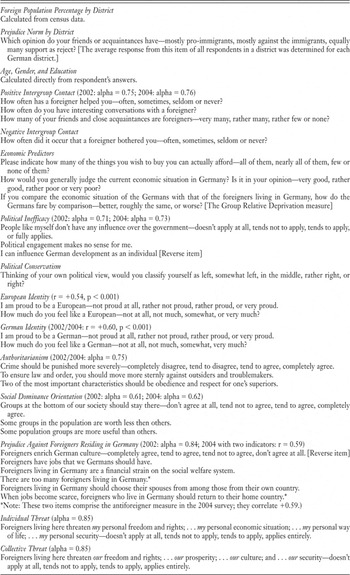
Forty items measure the nineteen variables being tested. Table 1 lists the items used in the order in which we enter them in the regressions, together with their relevant reliability statistics. For a hierarchical regression analysis, we employ seven blocks of predictors provided in the 2002 survey that have been shown to predict attitudes toward immigrants and immigration in previous research: (1) social-context location variables, (2) demographic characteristics, plus (3) contact, (4) economic, (5) political, (6) identity, and (7) personality variables.
The two social-context location variables are entered first and measure two aspects of the respondent's district—the percentage of foreigners and the immigration attitudes of the friends of all the district's respondents. (A district is a state-organizational unit that usually comprises a big city or a number of smaller cities, towns, or rural areas. District populations vary widely—between 35,700 and 3,382,200 inhabitants.)
The next block—age, gender, and education—uses demographic characteristics to locate the respondent within the social context. The third block introduces the experience that the respondent has had, both positive and negative, in direct contacts with immigrants. Three items assess the respondents' amount of positive contact with resident foreigners—how often they have been helped by foreigners and had interesting conversations with foreigners, as well as how many resident foreigners they have as friends. The one-item measure of negative intergroup contact concerns being bothered by a foreigner.
The fourth and fifth blocks of variables consider economic and political factors often held to be key predictors of immigration attitudes. Three indicators tap economic deprivation. The last of these indicators—group relative deprivation (GRD)—has often been shown to predict increased prejudice (Pettigrew et al., Reference Pettigrew, Christ, Wagner, Meertens, van Dick and Zick2007a; Walker and Smith, Reference Walker and Smith2001). Its personal equivalent—individual relative deprivation (IRD)—is less predictive (Walker and Pettigrew, Reference Walker and Pettigrew1984); and its relationship with prejudice is typically mediated though GRD (Pettigrew Reference Pettigrew, Walker and Smith2001). Both of these past findings are replicated in our 2002 data: IRD relates less with anti-immigrant prejudice (+0.20) than with GRD (+0.31), and the IRD effect is significantly mediated by GRD (z = 8.71, p < 0.001) (Preacher and Leonardelli, Reference Preacher and Leonardelli2006; Sobel Reference Sobel1982).
Two political factors are used: a single item measuring the respondent's left-right stance, and a three-item scale measuring political inefficacy. This second measure taps a sense of alienation and powerlessness specifically involving the political system. It is frequently used in political science to predict nonvoting (e.g., as “internal inefficacy”; Southwell and Everest, Reference Southwell and Everest1998), but it also correlates positively with prejudice (Pettigrew Reference Pettigrew, Sears, Sidanius and Bobo2000).
The final two blocks enter four psychological variables—European and German identities and the two major personality correlates of prejudices of many types, authoritarianism and social dominance orientation (SDO). Two items assess European identity—how proud the respondents are to be European and how much they feel like Europeans. Comparable items tap German identity. The identity concept is basic to social identity theory—one of psychology's principal theories of prejudice (Tajfel Reference Tajfel1982).
The three-item authoritarianism scale, drawn from Altemeyer (Reference Altemeyer1988, Reference Altemeyer1996), taps the two dominant components of the concept—authoritarian aggression and authoritarian submission. The three-item SDO scale is drawn from Sidanius and Pratto (Reference Sidanius and Pratto1999). Unlike the authoritarian items, these items explicitly mention groups.
The next six items in Table 1 comprise the prejudice measure. With one reversal item, this scale serves as the dependent variable in our analyses of the 2002 survey data. The two designated items serve as the dependent variable in the analyses of the 2004 data. As the item content reveals, this scale taps a rather blatant form of prejudice against resident foreigners.
Inspired by the work of the Stephans (Reference Stephan and Stephan1985), the final two scales shown in Table 1 are from the 2004 survey and concern two types of threat. Four items each tap threats from immigration in four domains that can be felt personally and/or collectively for the German people—a distinction similar to that of individual versus group relative deprivation.
It should be noted that the term foreigners in the survey's items refers only to foreigners who are living in Germany; from the German perspective, Turkish migrant workers constitute the prototype of foreigners living in the nation. In 2003, 8.9% (7.34 million) of Germany residents were officially recognized as foreigners; those of Turkish descent constituted the largest foreign group (1.88 million). Pretests revealed that about half of German respondents think of a person of Turkish origin when asked about a foreigner living in Germany.
GERMAN RESULTS
Overall 2002 Results
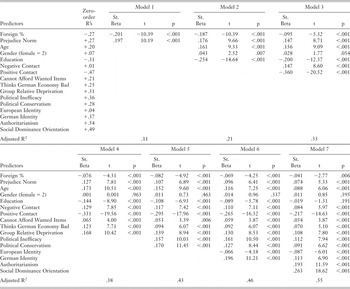
Table 2 presents the overall results from the 2002 German survey. Model 7, encompassing all sixteen predictors (without threat, which was not included in the 2002 survey), reveals that at each level there are important variables. Living in an area where anti-immigration prejudice is normative relates with negative views of immigrants. So, too, are other clusters of respondents: older Germans, the poorly educated, those without positive contact with immigrants, the economically deprived, political conservatives, and the politically alienated. At the psychological level, those respondents who identify themselves as German but not as European and those who score high on measures of social dominance and authoritarianism are particularly prone to anti-immigration opinions.
Predictors of German Attitudes toward Resident Foreigners

As Table 2 reveals, the complete Model 7 accounts for 55% of the variance in anti-immigration prejudice. There is, of course, considerable multicollinearity in this model. Hence, a leaner model with just four predictors—prejudice norm, positive contact, authoritarianism, and SDO—can account for 51% of the variance.
The Role of Threat in the 2004 Survey
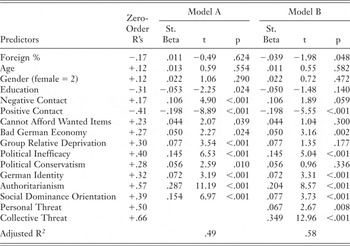
Only in the 2004 survey are there measures of both individual and collective threat. Table 3 enters these two variables as an additional block to those in Table 2. Two controls that were included in the 2002 survey were not available in the 2004 survey: prejudice norm and European identity. But with fourteen controls, the threat measures—especially collective threat—significantly contribute to the prediction.
Predictors of German Attitudes toward Resident Foreigners, 2004

COMPARING THE GERMAN WITH EUROPEAN AND NORTH AMERICAN RESULTS
How do the German results in Tables 2 and 3 compare with previous work on immigration attitudes conducted in Europe and North America?
Social Context Predictors
Our attempt to estimate the attitudinal climate and norms concerning immigrants by each district in Germany is captured in the second variable, the prejudice norm. Its strength—even in Table 2's Model 7—attests to the power of the normative climate in shaping views about immigration. We located only one other study that used a comparable predictor. Mulder and Krahn (Reference Mulder and Krahn2005, p. 436) employed a community-attitude index for eight cities and towns in Alberta, Canada, and found it significantly related to their respondents' support for ethnic diversity.
Our other contextual variable, foreign percentage in the respondent's district, has been analyzed often in previous research. Note how its effect is sharply reduced when the contact predictors are entered in Model 3. This result is consistent with previous analyses. An area's minority percentage influences prejudices against minorities by two counteracting processes: (1) a larger minority population ratio leads to greater intergroup contact and less prejudice, but (2) the higher the minority percentage, the greater the threat and heightened resentment by the majority. Hence, in Table 2, when the contact measures are introduced in Model 3, the positive coefficient of the foreign percentage is sharply reduced. And, in Table 3, when the threat measures are introduced, the coefficient is increased.
With these same data, we have explored this phenomenon in depth elsewhere (Pettigrew Reference Pettigrew, Peacock and Thornton2007; Wagner et al., Reference Wagner, Christ, Pettigrew, Stellmacher and Wolf2006). Other investigators have also analyzed the effects of minority percentage and arrived at similar conclusions (Dixon Reference Dixon2006; Dixon and Rosenbaum, Reference Dixon and Rosenbaum2004; Hood and Morris, Reference Hood and Morris2000; Stein et al., Reference Stein, Post and Rinden2000).
A host of moderators determine which of the two effects of minority percentage occurs. If there is, for example, strict intergroup segregation in an area, this structural context will obviously restrict contact and allow the threat effects of increased hostility to the minority to prevail. This was long the situation in the U.S. South, and research in that region has repeatedly found that increases in an area's Black population ratio relate to greater White racial prejudice against Blacks (Pettigrew and Campbell, Reference Pettigrew and Campbell1960; Pettigrew and Cramer, Reference Pettigrew and Cramer1959; Taylor Reference Taylor1998). If, however, the minority group is largely located in less segregated and politically liberal cities, as are immigrants in modern Germany, increases in an area's percentage of foreigners will relate to increased acceptance of immigrants, as in Table 2. In these circumstances, contact effects overcome threat effects.
Not surprisingly, then, research on this topic finds varied results as a function of the moderators of the contact-threat relationship: (1) greater prejudice (Dixon Reference Dixon2006; Taylor Reference Taylor1998); (2) no significant effects (Citrin et al., Reference Citrin, Green, Muste and Wong1997; Kessler and Freeman, Reference Kessler and Freeman2005; Pantoja Reference Pantoja2006; Pew Research Center 2006); or (3) greater acceptance (Dixon Reference Dixon2006; Fetzer Reference Fetzer2000b; Hayes and Dowds, Reference Hayes and Dowds2006; Hood and Morris, Reference Hood and Morris2000; Kalin Reference Kalin1996; Stein et al., Reference Stein, Post and Rinden2000; Taylor Reference Taylor1998). But one caveat must be made. These apparent effects of population proportions may reflect in part a self-selection bias (Dustmann and Preston, Reference Dustmann and Preston2001). That is, more tolerant natives may be more willing to move to areas with large numbers of immigrants, while more prejudiced natives may be careful to avoid such areas.
Demographic Characteristics
Age
Table 2 reveals that older Germans are more prejudiced against resident foreigners than are younger Germans, even in the context of a sixteen-variable regression. Although the zero-order correlation is +0.12, age fails to attain significance in the Table 3 regressions.
Other European studies have uncovered comparable results (Fetzer Reference Fetzer2000a, p. 13; Reference Fetzer2000b, p. 127; Kessler and Freeman, Reference Kessler and Freeman2005, pp. 841–842; Mayda Reference Mayda2006, p. 517). In their analyses of fifteen EU countries, Jackson et al. (Reference Jackson, Brown, Brown and Marks2001, pp. 446, 450) found a zero-order correlation of +0.13 between age and the extreme response of wanting “to send immigrants back.” These investigators also uncovered a reversal in Great Britain, where younger Britons more often chose this response. Using the same data set for analyzing Northern Ireland data, Hayes and Dowds (Reference Hayes and Dowds2006, pp. 468, 470) report no age differences.
Age has been repeatedly found to be a positive correlate of anti-immigration opinion in North American research. In an eleven-variable model, Mulder and Krahn (Reference Mulder and Krahn2005, p. 436) found age to be a major predictor of Canadian attitudes toward immigration. As elsewhere, older Canadians were significantly more opposed to immigration than were younger Canadians. With a national sample, Palmer (Reference Palmer1996, p. 185) reported a more complex pattern: older Canadians favored low levels of immigration, but younger Canadians were more opposed to non-White immigration.
Fetzer (Reference Fetzer2000b, p. 98) found that Americans sixty years of age or older were significantly more anti-immigrant and anti-immigration than were others. With two American surveys, Ha (Reference Ha2007) noted that age was significantly and positively related to attitudes against both immigrants and immigration. And older Californians voted more frequently for the anti-immigrant Proposition 187 in 1994 than did others (Hood and Morris, Reference Hood and Morris2000). Other American studies report that older Americans are somewhat, though not significantly, more negative toward immigration (e.g., Burns and Gimpel, Reference Burns and Gimpel2000, p. 201; Citrin et al., Reference Citrin, Green, Muste and Wong1997, p. 875; Pantoja Reference Pantoja2006, p. 525; Stein et al., Reference Stein, Post and Rinden2000, p. 298).
These relatively consistent age findings further confirm other results which indicate that cultural, rather than economic, concerns are paramount in the opposition to immigration. Elderly respondents are largely past their working years; and, after a long lifetime, they are likely to be more enmeshed in their national cultures and traditions.
Gender
Both Tables 2 and 3 reveal gender to be one of the weakest predictors. In Table 2, females tend to be more anti-immigrant in Model 2. But, once the two contact variables are entered in Model 3, this effect is reduced. This finding suggests that female respondents score significantly lower in the positive contact scale (p < 0.001). And Sobel tests reveal that positive contact is acting as a mediator of the gender link with anti-immigrant attitudes (z = 3.65, p < 0.001). Furthermore, once the three economic variables are entered in Model 4, the gender effect on anti-immigrant prejudice is erased. This finding reflects the fact that the female respondents score significantly higher than do males on all three of the economic deprivation variables (p < 0.001). And Sobel tests reveal that two of the economic variables entered into Model 4 are acting as mediators of the gender link with anti-immigrant attitudes: German economic situation is poor (z = 2.97, p < 0.01), and foreigners in Germany are doing economically better than Germans (z = 4.27, p < 0.001) (Preacher and Leonardelli, Reference Preacher and Leonardelli2006; Sobel Reference Sobel1982).
Table 3 also finds females slightly more antiforeigner as well as more economically derived. Consistent with these results, gender has rarely been found to be important in previous research on immigration opinions. In Europe, Fetzer (Reference Fetzer2000b, pp. 113, 126) found no significant gender differences in anti-immigration attitudes in either France or Germany, nor did Hayes and Dowds (Reference Hayes and Dowds2006, pp. 468, 471–472) in Northern Ireland. In their test of fifteen EU countries, Jackson and his colleagues (Jackson et al., Reference Jackson, Brown, Brown and Marks2001, pp. 446, 450) found women to be more negative toward immigration in just three countries, and there was no overall gender effect for the complete data set. For the full EU, Kessler and Freeman (Reference Kessler and Freeman2005, pp. 839, 841–842) obtained mixed results. There were no appreciable gender differences on whether there were “too many” immigrants in the country, but men were significantly more likely to believe that their nation should “not accept” immigrants.
Blake (Reference Blake2003, p. 503) and Mulder and Krahn (Reference Mulder and Krahn2005, p. 436) failed to unearth significant gender differences in Canada using their immigration measures, but Palmer (Reference Palmer1996, p. 185) found Canadian females to be more resistant to immigration. United States data are similar. Espenshade and Hempstead (Reference Espenshade and Hempstead1996, p. 564) uncovered no gender differences concerning the respondents' desired level of immigration. Likewise, Citrin et al. (Reference Citrin, Green, Muste and Wong1997, pp. 866, 870, 875) failed to obtain any significant gender differences on desired level of immigration or on delaying benefits to immigrants. Changing results across time were discovered by Burns and Gimpel (Reference Burns and Gimpel2000, p. 219). In the 1992 American National Election Study, females voiced significantly more often a desire to “decrease immigration a lot.” Four years later, in the 1996 study, females advocated an increase in immigration significantly more than did men. Ha (Reference Ha2007) obtained a racial difference; White American males were significantly more prejudiced against immigrants, while there were no gender differences among Black Americans.
Education
Better-educated people are generally more tolerant toward a range of outgroups, and attitudes toward immigrants are no exception. Tables 2 and 3 show education is negatively and significantly related to our anti-immigrant measure. Note, however, that once the authoritarianism and social dominance measures are entered into the regression, education loses some of its predictive power (Table 2, Model 7). This result indicates that part of education's link with anti-immigrant prejudice derives from the fact that well-educated respondents are also less likely to be authoritarian (−0.38) and socially dominant (−0.22). Indeed, Sobel tests for mediation show that both authoritarianism (z = 9.75, p < 0.001) and SDO (z = 4.77, p < 0.001) significantly mediate the education-prejudice relationship.
These education findings track earlier studies in both Europe and North America. European survey studies have also found educated respondents to be more accepting of both immigrants and immigration (Fetzer Reference Fetzer2000a, Table 1, p. 13, p. 126; Hayes and Dowds, Reference Hayes and Dowds2006, p. 468; Kessler and Freeman, Reference Kessler and Freeman2005, pp. 841–842; Mayda Reference Mayda2006, pp. 517, 526).
There are, however, minor exceptions in the literature, where education is still a negative, but not statistically significant, correlate of anti-immigration views. Fetzer (Reference Fetzer2000a, Table 1, p. 13, p. 113) did not find a significant effect of education on anti-immigration views in France. And Jackson and his co-workers (Jackson et al., Reference Jackson, Brown, Brown and Marks2001, pp. 446, 450) failed to find significant effects for education on anti-immigration views in fifteen EU nations, although they did obtain a significantly negative relationship for the entire data set.
Mulder and Krahn (Reference Mulder and Krahn2005, p. 436) found education to be the most important of eleven predictors of support for immigration in Canada. Both Blake (Reference Blake2003, p. 503) and Palmer (Reference Palmer1996, p. 185), who analyzed national probability sample surveys, also determined education to be a major predictor of positive Canadian attitudes toward immigration.
Similar results are routinely uncovered in U.S. studies (e.g., Burns and Gimpel, Reference Burns and Gimpel2000, p. 219; Fetzer Reference Fetzer2000a, p. 13; Ha Reference Ha2007). Fetzer (Reference Fetzer2000b, p. 98) found education to be a major negative predictor of both anti-immigrant and anti-immigration views. For Citrin and his colleagues (Citrin et al., Reference Citrin, Green, Muste and Wong1997, p. 875), education proved to be the most important predictor of immigration attitudes in their twenty-variable regression. A Texas survey determined that the well educated would allow more immigrants to enter the United States, though the difference did not attain statistical significance (Stein et al., Reference Stein, Post and Rinden2000, p. 298). Well-educated Californians voted against the anti-immigrant Proposition 187 more often than did others (Hood and Morris, Reference Hood and Morris2000). Likewise, the Pew Research Center (2006) found well-educated respondents to be more resistant to extreme anti-immigration policies such as requiring new identification cards, restricting social services for illegal immigrants, and amending the U.S. Constitution to bar from citizenship the children of illegal immigrants.
But can we accept these consistent results at face value? Jackman (Reference Jackman1973) thinks not. She questions the lower scores of the well educated on various measures of authoritarianism and prejudice. Jackman holds that the greater cognitive sophistication of the educated puts in doubt their responses to such scales. The well educated, she believes, are more likely to perceive the prejudice measure's purpose and respond with more socially acceptable answers. However, later research, using both survey and experimental data from Western Europe, casts doubt on Jackman's contentions (Pettigrew et al., Reference Pettigrew, Stellmacher, Christ and Wagner2007b; Wagner and Zick, Reference Wagner and Zick1995).
Contact
German respondents report far more positive than negative intergroup contact. More than 80% in both the 2002 and 2004 samples reported having had interesting conversations with resident foreigners on occasion; more than 60% in both samples reported having been helped by foreigners on occasion. By contrast, 65% of the respondents in both surveys reported having never been bothered by a foreigner.
We regard these sharp differences between positive and negative intergroup interactions to be of both theoretical and policy importance. At first these results may seem surprising. Negative contacts are often publicized, while the far more numerous positive contacts go unrecognized as routine events. But this discrepancy helps to explain why contact leading to increased prejudice is so rare in the research literature (Pettigrew and Tropp, Reference Pettigrew and Tropp2006).
This phenomenon emerges in U.S. probability survey data as well. Four out of every five respondents in a 1993 poll characterized their experiences with individual immigrants as “favorable” and viewed the new immigrants as “very hard working.” Two-thirds reported that they believed that new immigrants would be “welcomed” into their neighborhood (Lapinski et al., Reference Lapinski, Peltola, Shaw and Yang1997, pp. 367, 368).
Model 3 in Table 1 introduces both positive and negative contact variables. These inclusions sharply enhance our prediction of anti-immigration prejudice. Positive contact is especially strong, though negative contact also proves to be an important predictor. Consistent with our earlier discussion, the entrance of the contact variables in Model 3 greatly reduces the effect of the foreign population percentage variable. The importance of positive intergroup contact for reducing prejudice has now been firmly established in social psychology (Brown and Hewstone, Reference Brown and Hewstone2005; Pettigrew Reference Pettigrew1998; Pettigrew and Tropp, Reference Pettigrew and Tropp2006), and its critical role is underscored by the fact that the contact measures remain highly significant in Model 7. The contact variables are also predictive in Table 3.
The German results are consistent with the vast intergroup-contact literature. A meta-analysis of 515 studies involving 250,000 subjects demonstrated that contact typically reduced prejudice toward an array of outgroups—from racial and disabled groups to homosexuals and the elderly (Pettigrew and Tropp, Reference Pettigrew and Tropp2006). When cross-group friendship is established, the effects are even stronger (Pettigrew Reference Pettigrew1997).
Other European studies have also revealed the importance of direct contact. In their Northern Ireland research, Hayes and Dowds (Reference Hayes and Dowds2006, pp. 468, 470) concluded that contact, especially friendship across sectarian lines, was the most important correlate of attitudes toward immigrants. They found that even having friends from another nation significantly related to greater acceptance of immigrants. Fetzer (Reference Fetzer2000b, p. 144) found that personal contact was significantly related to pro-immigration opinions. But he also noted that proximity measures had little effect—a common finding because proximity does not guarantee actual face-to-face contact, much less the possibility of friendship (Festinger and Kelley, Reference Festinger and Kelley1951).
Studies in receiving countries further corroborate the importance of contact with immigrants. Fetzer (Reference Fetzer2000b, p. 108) noted that personal contact in the United States related to reduced anti-immigrant attitudes. In New Zealand, contact with immigrants proved to be the central predictor in Ward and Masgoret's (Reference Ward and Masgoret2006, p. 677) model of attitudes toward immigrants. Generalization of intergroup contact can also influence immigration attitudes. Hence, Americans who have cross-racial friends are significantly more accepting of immigrants (Ha Reference Ha2007).
The one salient exception is an Alberta study that reported only slightly positive effects of contact on immigration attitudes—none of them statistically significant (Mulder and Krahn, Reference Mulder and Krahn2005, p. 436). But, on closer examination, this extraordinary result may reflect an inadequate measure of contact. Neither friendship nor direct interaction was assessed; rather the Canadian respondents were asked an informational question about their nation's immigration policy and whether they knew of any immigrants or refugees. One can “know” of immigrants without actually having personal contact with them. This same problem arises for the many studies that mislabel an area's immigrant population proportion as contact (e.g., Fetzer Reference Fetzer2000b; Pantoja Reference Pantoja2006; Stein et al., Reference Stein, Post and Rinden2000).
Economic Deprivation
The most popular explanations for opposition to immigration appeal to economics. It is commonly assumed that the economically vulnerable—the unemployed and the poorest citizens—will resist the process the most. While not entirely wrong, the data from our study and many others demonstrate that the role of economic factors is considerably more complex than has been generally thought. Our surveys lack straightforward measures of unemployment. But three measures that tap economic deprivation offer correlates in both the 2002 and the 2004 samples. These relationships, however, are relatively modest in predictive value compared to other predictors such as the personality and threat variables.
Anti-immigrant prejudice is strongest among those who cannot afford many things that they would like to have, who think the current German economic situation is poor, and who think foreigners are doing economically better than Germans. This third measure, group relative deprivation (GRD), has often been found to correlate positively with a wide array of prejudice measures (Pettigrew et al., Reference Pettigrew, Peacock and Thornton2007; Walker and Pettigrew, Reference Walker and Pettigrew1984; Walker and Smith, Reference Walker and Smith2001). All three measures suggest that subjective judgments of the economy may be more important correlates of anti-immigrant opinions than are objective measures such as unemployment.
Although these results run counter to much popular discourse about resistance to immigration, they are consistent with other research. Fetzer (Reference Fetzer2000a, p. 13; Reference Fetzer2000b, pp. 83, 89, 113, 127) failed to find any significant relationships between unemployment and immigration opinions in France, Germany, or the United States. Kessler and Freeman (Reference Kessler and Freeman2005, p. 835) also failed to find unemployment links with overall anti- immigration sentiment in the EU. Other survey research did not find unemployment to be a predictor of immigration opinions in the United States (Citrin et al., Reference Citrin, Green, Muste and Wong1997, pp. 866–867; Ha Reference Ha2007). And neither poor nor unemployed Californians voted more than others did for the anti-immigrant Proposition 187 (Hood and Morris, Reference Hood and Morris2000).
But Canadian research offers an exception. Palmer (Reference Palmer1996) reported that unemployment status and the unemployment rate were significant predictors of his respondents' desires for minimal immigration. Though he showed that concerns about culture and crime are also important, he concluded that unemployment concerns were central among many types of Canadians.
But these gross unemployment results cannot tell the full story. With their EU data, Kessler and Freeman (Reference Kessler and Freeman2005, p. 835), discovered that an interaction term for unemployment with the area's foreign population was highly correlated with the views that there were “too many” immigrants and that immigrants should not be allowed to take jobs. This suggests that it is not unemployment per se that evokes opposition to immigration, but the fears it provokes when there are many local immigrants. This possibility is supported by further findings. An index that taps how survey respondents believe that immigration will impact jobs is highly correlated with U.S. opinions about immigration (Citrin et al., Reference Citrin, Green, Muste and Wong1997, pp. 866–867). And detailed social psychological research in Canada shows that the belief in zero-sum resources—that what the immigrants get economically will necessarily come out of the dominant group's pocket—is central to such fears (Esses et al., Reference Esses, Dovidio, Jackson and Armstrong2001; Jackson and Esses, Reference Jackson and Esses2000).
Income and personal financial predictors provide modest results at best. In Canada, neither Blake (Reference Blake2003, p. 503) nor Mulder and Krahn (Reference Mulder and Krahn2005, p. 436) uncovered significant relationships between personal finances and opinions concerning immigration. Other studies show only small effects (Burns and Gimpel, Reference Burns and Gimpel2000, p. 213; Hayes and Dowds, Reference Hayes and Dowds2006, p. 465; Ha Reference Ha2007; Hood and Morris, Reference Hood and Morris2000; Pantoja Reference Pantoja2006, p. 525). For instance, in a national survey, 31% of economically secure Americans thought that Hispanic immigrants significantly increased crime, compared to 43% of less secure Americans (Pew Research Center 2006).
Similar to our results, two studies using diverse measures uncovered significant positive associations between pessimism about the U.S. economy and anti-immigration opinions (Burns and Gimpel, Reference Burns and Gimpel2000, pp. 213, 219; Espenshade and Hempstead, Reference Espenshade and Hempstead1996, p. 559).
The results of Table 3 suggest, however, that economic concerns are influential in the perception of immigrants as a collective threat. Note that when the threat variables are introduced in Model B, the effects of two of the deprivation measures are reduced. Indeed, Sobel tests reveal that collective threat is acting as a mediator of the links between each of these economic variables with anti-immigrant attitudes: many things wanted but cannot afford (z = 3.06, p < 0.01), and foreigners in Germany are doing economically better than Germans (z = 6.01, p < 0.001) (Preacher and Leonardelli, Reference Preacher and Leonardelli2006; Sobel Reference Sobel1982).
In general, we concur with Citrin and his colleagues, that for anti-immigration prejudice there is only a “restricted role of economic motives rooted in one's personal circumstances” (Citrin et al., Reference Citrin, Green, Muste and Wong1997, p. 858). Our caveat is that subjective economic deprivation indicators such as group relative deprivation have some modest predictive power and are involved in the perception of collective threat.
Political Predictors
Two favorite variables of political scientists, political conservatism and political inefficacy, contribute substantially to the prediction of our antiforeigner measures (Tables 2 and 3). Indeed, these two predictors tend to be more powerful than the economic predictors. Political conservatives are considerably more antiforeigner in all our models up to Model B in Table 3. Once the threat variables are introduced, the relationship between conservatism and immigration attitudes is eliminated. This results from the fact that political conservatism is significantly related to personal threat (+0.21) and especially to collective threat (+0.30). As would be expected from these findings, Sobel mediation tests reveal that both personal threat (z = 7.25, p < 0.001) and collective threat (z = 10.29, p < 0.001) mediate the conservatism-prejudice association (Preacher and Leonardelli, Reference Preacher and Leonardelli2006; Sobel Reference Sobel1982).
Previous research on both sides of the Atlantic has shown that respondents with conservative ideologies are typically more opposed to immigrants and immigration. Conservatives in the EU have believed significantly more often than others that there are too many immigrants in their countries and that no further immigrants should be accepted (Kessler and Freeman, Reference Kessler and Freeman2005, pp. 841–842).
Using Canadian university students, Beaton and her colleagues (Beaton et al., Reference Beaton, Tougas, Clayton and Perrino2003) showed that conservative values relate to anti-immigration opinions directly (r = +0.43) and indirectly by enhancing traditional (+0.28) and newer forms of racism (+0.41). Using U.S. university students, Short (Reference Short2004) found political conservatism to be a major predictor of their anti-immigration attitudes. Similarly, three survey studies found political conservatives to be more anti-immigration in U.S. probability samples (Burns and Gimpel, Reference Burns and Gimpel2000, p. 219; Citrin et al., Reference Citrin, Green, Muste and Wong1997, pp. 865–866, 875; Ha Reference Ha2007). Political conservatives also appear to act on their beliefs in the voting booth: they were strong supporters of the anti-immigrant Proposition 187 vote in California (Hood and Morris, Reference Hood and Morris2000).
U.S. opposition to immigration also relates to a general isolationist perspective on many international issues (Espenshade and Hempstead, Reference Espenshade and Hempstead1996). Finally, in a 2006 Pew Survey, 83% of conservative Republicans would deny basic social services to illegal immigrants and 52% would bar citizenship to the children of illegal immigrants (Pew Research Center 2006).
We are not aware of any research on immigration attitudes that employed a political inefficacy scale. But several variables have been tested that approximate the reverse of our measure. Blake (Reference Blake2003, p. 503) determined for his Canadian respondents, and Ha (Reference Ha2007) for his U.S. respondents, that political trust is a strong predictor of pro-immigration views. And interest in politics is also associated with pro-immigration attitudes (Ha Reference Ha2007).
Identity Predictors
Social psychologists favor measures of social identity. Both the 2002 and 2004 data reveal German identity to relate significantly with anti-foreigner attitudes. In addition, Table 2 demonstrates that the two identities—German and European—have contrasting relationships with anti-immigrant prejudice: German identity correlated again with anti-foreigner views, but European identity with pro-foreigner views. This difference emerges despite the fact that the two identities are not rivals; people can easily think of themselves as German and European, for the two identities operate at different levels. Indeed, the two identities correlate positively (+0.42) and yet relate differently to immigration attitudes. This accounts for the fact that the zero-order correlate of European identity with anti-immigrant prejudice in Table 2 is +0.04. But once German identity is partialled out, the correlation becomes −0.07.
Two earlier studies have shown that European identity relates to more positive opinions about immigration (Kessler and Freeman, Reference Kessler and Freeman2005, pp. 841–842; Luedtke Reference Luedtke2005, p. 101). In addition, our finding that German identity relates positively to anti-immigration views replicates previous work. In Europe, national identity and national pride typically relate positively with anti-immigration views (Luedtke Reference Luedtke2005; Jackson et al., Reference Jackson, Brown, Brown and Marks2001). Indeed, Luedtke (Reference Luedtke2005) maintains that strong national identities are primarily responsible for the EU's difficulties in gaining central control over immigration policy for the entire union.
Only in Belgium is there a more complex situation, reflecting its deep ethnic divide (Maddens et al., Reference Maddens, Billiet and Beerten2000). In Flanders, strong Flemish identification links with antiforeigner attitudes, while Belgian identification links with greater acceptance of resident foreigners. However, in Wallonia, just the opposite applies: strong Wallonian identity and weak Belgian identity relate to less antiforeigner sentiment.
Three U.S. survey studies support the dominant trend. In a Texas survey, a strong U.S. identity significantly predicted that the respondent wished to restrict the number of immigrants allowed into the United States (Stein et al., Reference Stein, Post and Rinden2000, p. 298). Using probability data from various national surveys, Mayda (Reference Mayda2006) and Ha (Reference Ha2007) both have shown that national pride correlates significantly with anti-immigration opinions.
Personality Predictors
Authoritarianism and social dominance orientation are the two primary personality predictors of most types of prejudices. And, as expected, they are among the most important predictors in both Tables 2 and 3. Authoritarianism is closely related to SDO (+0.37 and +0.34 in our samples), and has some of its effects on prejudice mediated by SDO (Pettigrew et al., Reference Pettigrew, Stellmacher, Christ and Wagner2007b). Yet both remain important in Models 7, A, and B, because they stress different features. Authoritarianism taps conformity to authority and tradition, while SDO emphasizes group hierarchy and dominance.
Canadian experiments shed further light on why SDO proves to be so central in understanding anti-immigration attitudes (Jackson and Esses, Reference Jackson and Esses2000). Because subjects who score high on SDO are concerned with group power, they view immigrants to “their” country not so much as a personal threat but as a collective threat to the societal and cultural dominance of the native population. The experiments demonstrated that high-SDO subjects were far less willing than were others to grant empowerment to immigrants in such forms as helping them to adjust to Canadian life and to overcome the barriers they face in Canadian society. Moreover, this unwillingness to help by those with a socially dominant orientation was almost completely mediated by their firm belief in the zero-sum nature of societal resources. They tend to believe that, if the immigrants get more, then other Canadians will get less. It is notable that these relationships did not hold for authoritarianism.
Consistent with this interpretation is the difference in SDO as a predictor between Models A and B in Table 3: the standardized beta is almost halved once the threat variables are introduced. And a Sobel test reveals that collective threat significantly mediates part of SDO's association with prejudice (z = 7.82, p < 0.001) (Preacher and Leonardelli, Reference Preacher and Leonardelli2006; Sobel Reference Sobel1982).
Threat Predictors
The findings of the sixteen predictors in Table 2 point to the focal role of threat in anti-immigration attitudes. But, unfortunately, we had no direct measures of threat in the 2002 survey on which Table 2 is based. This was corrected in the 2004 survey, and Table 3 shows the regression results when both personal and collective threats are entered last. Note, however, that, in the 2004 analysis, neither prejudice norm nor European identity was assessed. The full regression here accounts for 58% of the variance in the two-item antiforeigner dependent variable. The special role of group power and collective concerns throughout our results suggests a leaner model. Five key predictors in the 2004 sample—collective threat, social dominance orientation, authoritarianism, positive contact, and group relative deprivation—account for 55% of the prejudice variance.
Indeed, collective threat proves to be by far the strongest predictor of antiforeigner attitudes in the full model, and it is more critical to understanding opposition to immigration than is personal threat; zero-order correlations with prejudice are +0.66 for collective threat, versus +0.50 for personal threat. Moreover, collective threat mediates most of the association between personal threat and anti-immigrant prejudice (Sobel test: z = 11.96, p < 0.0001). In other words, personal threat is important in increasing anti-immigration views largely through heightening the sense of collective threat.
Previous work has also highlighted the role of threat. A German study observed that both realistic and symbolic threat correlated with negative contact—as it does in our results (+0.29 with personal threat, and +0.22 with collective threat). This work also discovered strong relationships between “cultural discordance” and threat; thus, Italian immigrants were perceived as far less threatening than Turkish immigrants (Rohmann et al., Reference Rohmann, Florack and Piontkowski2006).
Jackson and his co-workers (Jackson et al., Reference Jackson, Brown, Brown and Marks2001, pp. 441, 450) noted in fourteen out of fifteen EU nations that threat from immigrant “encroachment” correlated significantly and positively with the extreme response of wanting to send all immigrants back to their home countries. Much like the items in the collective threat scale of the 2004 survey in Table 1, encroachment included insecurity fears and threats to our way of life.
CONCLUSION
Our German data, supported by the recent research literatures of four disciplines, highlight the importance of a particular set of predictors of attitudes toward immigration and immigrants. Each of the disciplines supplies important predictors from their varying perspectives. From sociology, normative context, population ratios, age, and education all prove to be important. From economics, several forms of perceived economic deprivation predict anti-immigration views. From political science, conservatism and a sense of political inefficacy link with opposition to immigration. And from social psychology, intergroup contact, national identity, authoritarianism, social dominance orientation and perceived threat all predict at the individual level of analysis.
What is remarkable about these findings is their consistency across such a wide range of factors, as evidenced by the diversity of the cited research. We have also noted the same predictors in studies of both sending and receiving countries with contrasting national immigration histories and policies. We found the same predictors in work guided by different theories from four social science disciplines, using dissimilar data sets, methodologies, sets of control variables, and types of target groups and respondents.
Within the context of industrial nations, immigration appears to evoke opposition from similar segments of the native population. Why? We offer two explanations. First, prejudice against immigrants is highly correlated with other forms of prejudice, and thus shares with prejudice many common features found in prejudice research throughout the world. Second, immigration can threaten native populations in similar ways across industrial nations. Economic and political threats are aroused, but considerable research points to the special significance of cultural threats experienced as collective rather than directly individual in nature.
In sum, we concur with Palmer's conclusion that “opposition to immigration is not simply racism in disguise but a complex attitude resulting from an interplay between various concerns and moderating beliefs about immigration's consequences” (Palmer Reference Palmer1996, p. 180). But one further point needs to be added. Recall three features of our analysis of anti-immigration opinions: (1) issues of group power, dominance, and traditionalism are especially critical; (2) group relative deprivation is a more important predictor than is individual relative deprivation; and (3) collective threat is more important than is personal threat. Considered together, these trends strongly suggest that broader societal issues, rather than narrowly personal concerns, form the core of the anti-immigration attitudinal syndrome.