Introduction
In this study we investigated whether DSM-IV anxiety, mood, non-alcohol substance use disorders (DSM-IV abuse and dependence) and externalizing disorders that occur prior to DSM-IV alcohol use disorders (AUDs) are associated with an increased risk and speed of transition from first alcohol use (AU) to DSM-IV alcohol abuse (AA) and alcohol dependence (AD) in adolescence and young adulthood. In this regard, we also examined the role of early onset of prior mental disorders (PMDs) and gender.
AU is associated with the risk of serious consequences such as cardiovascular disease, unintentional injuries (Rehm et al. Reference Rehm, Taylor and Room2006) and AUDs. AUDs (especially AD) are disabling mental disorders (Hasin et al. Reference Hasin, Stinson, Ogburn and Grant2007) and may occur as early as in adolescence and young adulthood (Bonomo et al. Reference Bonomo, Bowes, Coffey, Carlin and Patton2004; Grant et al. Reference Grant, Dawson, Stinson, Chou, Dufour and Pickering2004 a; Nelson & Wittchen, Reference Nelson and Wittchen1998). AD with onset in adolescence is especially malignant (Hingson et al. Reference Hingson, Heeren and Winter2006). AUDs are highly co-morbid with mood, anxiety, externalizing and other substance use disorders. Co-morbidity is more frequent in younger adults (Burns & Teesson, Reference Burns and Teesson2002; Kendler et al. Reference Kendler, Prescott, Myers and Neale2003; Grant et al. Reference Grant, Stinson, Dawson, Chou, Dufour, Compton, Pickering and Kaplan2004 b; Hasin et al. Reference Hasin, Stinson, Ogburn and Grant2007).
Mental disorders and their symptoms are risk factors for AUDs and problematic AU (Kushner et al. Reference Kushner, Sher and Erickson1999; Crum & Pratt, Reference Crum and Pratt2001; Zimmermann et al. Reference Zimmermann, Wittchen, Pfister, Kessler and Lieb2003; Goodwin et al. Reference Goodwin, Lieb, Höfler, Pfister, Bittner, Beesdo and Wittchen2004; Haynes et al. Reference Haynes, Farrell, Singleton, Meltzer, Araya, Lewis and Wiles2005). For example, social phobia and pronounced depressive symptoms predicted AD (Gilman & Abraham, Reference Gilman and Abraham2001; Crum et al. Reference Crum, Green, Storr, Chan, Ialongo, Stuart and Anthony2008 a; Buckner & Turner, Reference Buckner and Turner2009). Externalizing disorders are well-documented risk factors for AUDs (Elkins et al. Reference Elkins, McGue and Iacono2007). However, few studies on this topic fulfill all of the following criteria: inclusion of young adolescents, a long follow-up interval and a wide range of DSM-IV diagnoses considered as predictors and control variables (Buckner et al. Reference Buckner, Schmidt, Lang, Small, Schlauch and Lewinsohn2008 a). Therefore, we investigate various DSM-IV PMDs as risk factors for DSM-IV AUDs with thorough adjustment for covariates in a 10-year prospective epidemiological study including young adolescents.
We hypothesized that an excess risk of AUD exists for especially early PMD onset. Earlier PMDs show greater severity and co-morbidity, poorer health outcomes and problematic coping styles (Beesdo et al. Reference Beesdo, Bittner, Pine, Stein, Höfler, Lieb and Wittchen2007; Keenan-Miller et al. Reference Keenan-Miller, Hammen and Brennan2007; Hammen et al. Reference Hammen, Brennan, Keenan-Miller and Herr2008; Sansone & Sansone, Reference Sansone and Sansone2009). Early-onset PMDs predict problematic substance use behaviors that are related to AUDs (DeWit et al. Reference DeWit, Adlaf, Offord and Ogborne2000; Bonomo et al. Reference Bonomo, Bowes, Coffey, Carlin and Patton2004; Crum et al. Reference Crum, Storr, Ialongo and Anthony2008 b; Sihvola et al. Reference Sihvola, Rose, Dick, Pulkkinen, Marttunen and Kaprio2008). Major depression and social phobia also occurred earlier in subjects with secondary AUD than in subjects without AUD (Grant et al. Reference Grant, Hasin and Dawson1996; Buckner et al. Reference Buckner, Timpano, Zvolensky, Sachs-Ericsson and Schmidt2008 b).
It is also of interest to determine whether PMDs play a role in the speed of transition to AUDs. The substance-specific latency between first use and onset of a substance use disorder is longer for alcohol than for cannabis and cocaine (Wagner & Anthony, Reference Wagner and Anthony2002; Behrendt et al. Reference Behrendt, Wittchen, Höfler, Lieb and Beesdo2009). It can span more than 10 years (DeWit et al. Reference DeWit, Adlaf, Offord and Ogborne2000) with considerable inter-individual variation. Some adolescents develop an AUD in the first 2 years after first AU (Wittchen et al. Reference Wittchen, Behrendt, Höfler, Perkonigg, Lieb, Bühringer and Beesdo2008). Information on the promoters of such rapid transitions would improve the understanding of individual differences in AUD development and help to identify subjects who need timely interventions (Wittchen et al. Reference Wittchen, Behrendt, Höfler, Perkonigg, Lieb, Bühringer and Beesdo2008) and have poorer AD prognoses (Hingson et al. Reference Hingson, Heeren and Winter2006). However, factors characterizing these subjects remain understudied. Because of lower self-efficacy (John et al. Reference John, Meyer, Rumpf and Hapke2004), higher impulsivity (Kliegel et al. Reference Kliegel, Ropeter and Mackinlay2006), and instrumental AU (Thomas et al. Reference Thomas, Randall and Carrigan2003) in mental disorders, PMDs may lead to reduced control over AU. Therefore, we hypothesized that any and early PMDs are associated with faster transitions to AUDs.
Although gender differences in AUDs (Grant et al. Reference Grant, Dawson, Stinson, Chou, Dufour and Pickering2004 a), mood, anxiety and externalizing disorders (Blazer et al. Reference Blazer, Kessler, McGonagle and Swartz1994; Wittchen et al. Reference Wittchen, Nelson and Lachner1998 b; Kendler et al. Reference Kendler, Prescott, Myers and Neale2003; Wilhelm et al. Reference Wilhelm, Mitchell, Slade, Brownhill and Andrews2003) are well documented, the role of gender in the relationship between PMD and the speed of transition to AUD remains unclear. Female gender has been linked with faster transitions to alcohol problems (Randall et al. Reference Randall, Roberts, Del Boca, Carroll, Connors and Mattson1999), but more recent studies found no or little evidence for a faster AUD development in women (Wagner & Anthony, Reference Wagner and Anthony2007; Wittchen et al. Reference Wittchen, Behrendt, Höfler, Perkonigg, Lieb, Bühringer and Beesdo2008). We hypothesized that there are no gender differences in the speed of transition to AUD.
Given this background we examined whether (1) PMDs are associated with a higher risk of AUDs and a higher speed of transition from first AU to AUD, (2) associations with speed of transition differ by gender and (3) early PMD onset is associated with the risk and speed of transition.
Method
Study sample and design
The Early Developmental Stages of Psychopathology (EDSP) study is a prospective longitudinal community study on the prevalence, course, vulnerabilities and risk factors of substance use and substance use disorders in adolescence and early adulthood. The study includes a baseline (T0; conducted in 1995) and three follow-up assessments (T1, T2, T3) (Wittchen et al. Reference Wittchen, Perkonigg, Lachner and Nelson1998 c; Lieb et al. Reference Lieb, Isensee, von Sydow and Wittchen2000; Beesdo et al. Reference Beesdo, Pine, Lieb and Wittchen2010).
The study sample consisted of 3021 German-speaking subjects (1533 males, 1488 females) aged 14–24 years at baseline. The sample was drawn randomly from government registries in metropolitan Munich, Germany. As the study focused on early developmental stages of psychopathology, individuals aged 14–15 years were sampled at twice the probability of those aged 16–21 years, who were sampled at twice the probability of those aged 22–24 years. The follow-up examinations were carried out approximately 1.6 years (T1, median interval since baseline), 3.5 years (T2) and 8.2 years (T3) later. At T1, only the younger cohort of subjects aged 14–17 years at baseline was assessed (n=1228). Response rates were 70.9% at T0 (n=3021), 84.3% (n=2548) at T2 and 73.2% (n=2210) at T3. At T3, the age range was 21–34 years. Further detailed information on the study can be found elsewhere (Wittchen et al. Reference Wittchen, Perkonigg, Lachner and Nelson1998 c; Lieb et al. Reference Lieb, Isensee, von Sydow and Wittchen2000).
Participants were asked whether they were willing to answer questions on illegal substances truthfully (commitment probe). A total of 142 subjects who declined at one or more waves were excluded from all analyses with variables concerning illegal substances.
Any AU, regular AU (at least weekly) or hazardous AU (⩾20 g of ethanol for women or ⩾40 g of ethanol for men almost every day) at T0 did not predict drop-out at any follow-up, with one exception: in the younger cohort, regular AU at T0 predicted drop-out at the first but not at any other follow-up (if subjects did not participate in T1, the T0–T2 interval was covered in the T2 assessment).
The cumulative incidence rate up to T3 was 97.7% for AU (n=2929), 24.7% for AA (n=741) and 11.0% for AD (n=327).
Diagnostic assessment
At all assessment waves, participants were interviewed face to face with the computer-assisted, fully standardized Munich-Composite International Diagnostic Interview (DIA-X/M-CIDI; Wittchen & Pfister, Reference Wittchen and Pfister1997; Wittchen et al. Reference Wittchen, Lachner, Wunderlich and Pfister1998 a), an updated version of the World Health Organization (WHO) CIDI (Wittchen & Semmler, Reference Wittchen and Semmler1990). The lifetime version was used at baseline; a follow-up interval version was used at the subsequent waves. With the DIA-X/M-CIDI it is possible to assess symptoms, syndromes and diagnoses of 48 mental disorders, along with information about onset, severity and impairment. For the diagnoses presented here, the computerized M-CIDI/DSM-IV algorithms were applied. The DIA-X/M-CIDI is supplemented by a respondent's booklet including symptom lists and cognitive aids to help the respondent with answering symptom questions. The test–retest reliability and validity of the DIA-X/M-CIDI diagnoses have been established (Lachner et al. Reference Lachner, Wittchen, Perkonigg, Holly, Schuster, Wunderlich, Türk, Garczynski and Pfister1998; Reed et al. Reference Reed, Gander, Pfister, Steiger, Sonntag, Trenkwalder, Sonntag, Hundt and Wittchen1998; Wittchen et al. Reference Wittchen, Lachner, Wunderlich and Pfister1998 a). Interviewers, most of whom were clinical psychologists, received intensive training on the DIA-X/M-CIDI, followed by monitored practice interviews at baseline and booster sessions before each subsequent wave. Further information has been provided elsewhere (Wittchen et al. Reference Wittchen, Perkonigg, Lachner and Nelson1998 c; Lieb et al. Reference Lieb, Isensee, von Sydow and Wittchen2000).
Assessment of AU and AUD
AU and AUD were assessed with the DIA-X/M-CIDI section on AU, which begins with questions on quantity, frequency, age of onset and age of recency of use. For the assessment of diagnostic criteria, at least minimal AU was required; defined as (1) AU at least three times a week, or more than three ‘standard drinks’ per drinking day, in subjects who had drunk on more than 12 occasions in at least 1 year of their lives (applied for AD) or (2) AU on at least 13 occasions in a 12-month period (for AA). AD was also assessed in subjects who met the minimal AU criteria in shorter periods. The following AU levels were considered here: any use, DSM-IV dependence and DSM-IV abuse (non-hierarchical).
Statistical analysis
To account for different sampling probabilities at baseline according to age, and response rates at baseline varying over age, gender and geographic region, data were weighted. The Stata Software package version 11.0 (StataCorp, 2009) was used for all calculations and to compute robust variances, confidence intervals (CIs) and p values (by applying the Huber–White sandwich matrix) required when basing analyses on weighted data (Royall, Reference Royall1986). Cumulative lifetime incidence was generated using the last observation carried forward (LOCF) method, that is the information obtained until the last available assessment was taken into account. This enabled us to use information from subjects who had dropped out of the study during the assessments. According to CIDI conventions, age of AUD onset was defined as age at first AUD symptom.
The Kaplan–Meier (Therneau & Grambsch, Reference Therneau and Grambsch2000) estimator was used to estimate the age-dependent cumulative lifetime incidence of AU and mental disorders. Cox regressions were applied for assessing overall differences in risk of transition from first AU to AUD over time (time scale=years from first AU to AUD) across PMD status. Covariates (factors of interest and control variables) were entered into the Cox regression analysis as time-dependent covariates to ensure that PMD had occurred prior to AUD [age of onset of PMD <t, t=1, 2, …, minimum (age of onset AUD – age of onset AU, age at last assessment – age of onset AU)]. In the Cox regression, cases with AU and AUD onset within the same 12-month period (i.e. length of transition=0 years) are excluded automatically in Stata (StataCorp, 2009). To prevent this, we shifted the time scale by 1 year upwards, by replacing 0 years by 1 year, 1 year by 2 years, and so on.
Different curves according to birth cohort and gender were allowed for by fitting stratified Cox regressions (Therneau & Grambsch, Reference Therneau and Grambsch2000). Schoenfeld residuals were used to test whether group differences varied over time (Therneau & Grambsch, Reference Therneau and Grambsch2000). When necessary, the interaction term covariate×number of years since AU was added to the model, to improve the model fit and to assess how strongly the hazard ratios (HRs) varied over time. Here, the model-based time-dependent HR is given by: HR(t)=HR (main effect of covariate)×HR (interaction effect of covariate)t, where t is the number of years since onset of AU.
For the Cox regression analysis, we used data from subjects with lifetime AU (n=2929). Few subjects had reported AU, AUD or mental disorders other than AUD, but had not provided the respective age of onset information. Data from these subjects were excluded from the survival analysesFootnote 1.Footnote † To assess whether early PMD onset was associated with a higher speed of transition to AUD we used the dimensional age of onset of the respective PMD, that is we determined whether higher (compared to lower) age of onset was associated with the speed of transition. Subjects with PMD onset after or in the same year as AUD onset were excluded from this analysis.
First, the Cox regression analysis was conducted with adjustment for age and gender (model I). In model II, we additionally adjusted for other PMDs: if the covariate of interest was a mood disorder, we adjusted for any anxiety disorder and non-alcohol substance use disorders (nicotine dependence, cannabis abuse or dependence, abuse or dependence of illegal drugs other than cannabis). If the covariate of interest was an anxiety disorder, we adjusted for any mood disorder and non-alcohol substance use disorders. When the covariate of interest was a non-alcohol substance use disorder, we adjusted for all other non-alcohol substance use disorders, any anxiety and any mood disorder. With externalizing disorders as covariate, we adjusted for any mood, any anxiety and all non-alcohol substance use disorders. For anxiety disorders that were significant predictors in model II, we repeated model II with additional adjustment (model IIA) for selected other anxiety disorders (other anxiety disorders were selected as covariates only if they were significant predictors in model II) and for a category of those anxiety disorders that are otherwise not considered as covariates here because of insufficient power (see next section). In model III, we repeated model II with additional adjustment for externalizing disorders. Statistical power did not permit differentiation between substance use disorders related to illegal drugs other than cannabis.
Covariates
Covariates (PMDs) were calculated from their cumulative lifetime status and the respective age of onset variable for: any mood, any anxiety and any non-alcohol substance use disorderFootnote 2, major depression, dysthymia, bipolar disorder (bipolar I and bipolar II disorder), specific phobia, social phobia, nicotine dependence, cannabis abuse (non-hierarchical) and somatoform disorders (any DSM-IV somatoform disorder or somatoform/dissociative syndrome including SSI 4/6). For phobias, impairment was assessed but only requested for DSM-IV diagnosis after age 17 because of the possibly limited reliability of impairment reports in young respondents and because these disorders occur particularly early (Wittchen et al. Reference Wittchen, Lieb, Schuster, Oldehinkel and Rapoport1999 a, b). DSM-IV panic attacks were considered and are subsequently listed among the anxiety disorders but not included in the any anxiety disorder variable. Diagnosis of externalizing disorders (conduct or antisocial personality disorder) was obtained from parental reports on conduct disorder at T1 and participants’ reports on both disorders at T2 resulting in information on 2638 subjects. Age of onset of antisocial personality disorder was set to age 13 by conventionFootnote 3.
Results
Co-morbidity and temporal sequence
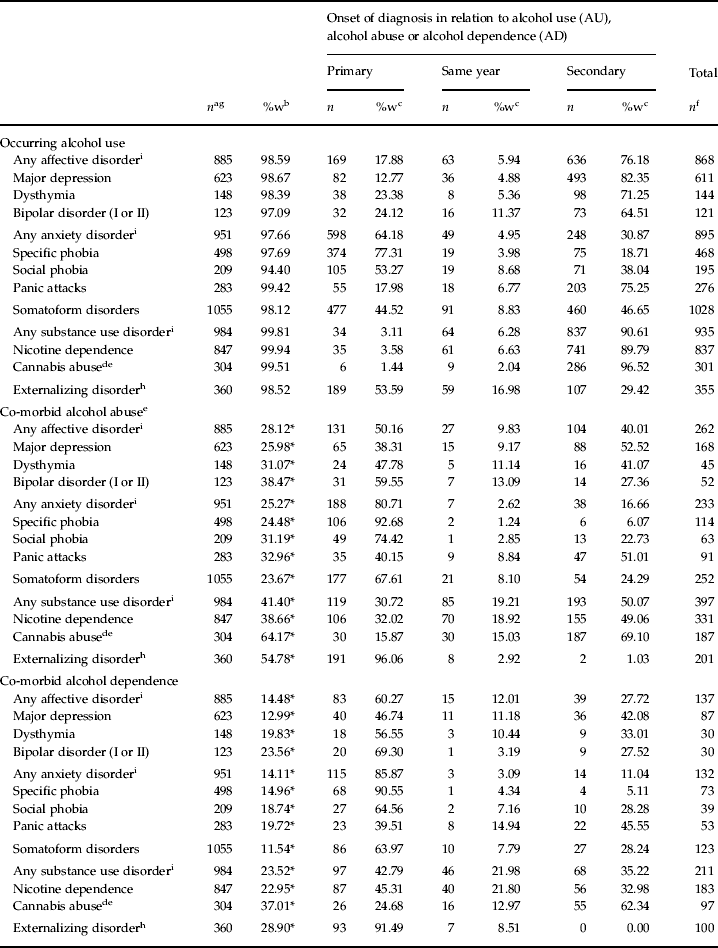
Table 1 shows that rates of lifetime AU in subjects with lifetime mental disorders were comparable to those in the entire sample. The risk of lifetime AUD was elevated for all considered lifetime disorders (all p values <0.05). In the case of lifetime co-morbidity, onset of specific mental disorders occurred prior to AU in over 50% of subjects with specific phobia, social phobia and externalizing disorders, but secondary to AU for 64.5–96.5% of cases of all other mental disorders except somatoform disorders. Other mental disorders mainly occurred primary to AA (except major depression, dysthymia, panic attacks and substance use disorders) and to AD (except substance use disorders, major depression and panic attacks).
Sequence of alcohol use, DSM-IV alcohol use disorders (AUDs) and co-morbid mental disorders (T0–T3; n=3021)Footnote a

a Based on cumulative incidence; T0–T3; n=3021.
b Weighted percentage of AU and AUD among subjects with the respective mental disorder.
c Weighted row percentages.
d n=142 excluded (unwilling to answer drug questions truthfully).
e Hierarchy rule not applied.
f Number of co-morbid cases; only cases who provided age of onset information were considered.
g Total number of cases with the respective diagnosis in the sample (irrespective of alcohol use or alcohol use disorder).
h Either conduct disorder or antisocial personality disorder; based on information from 2638 subjects at T1 and T2.
i Any anxiety disorder: panic disorder, agoraphobia without history of panic disorder, generalized anxiety disorder, obsessive–compulsive disorder (OCD), post-traumatic stress disorder (PTSD), specific and social phobia; any mood disorder: major depression, dysthymia, bipolar disorder I or II; any non-alcohol substance use disorder: nicotine dependence or any illegal substance use disorder.
* Higher risk of lifetime alcohol abuse or dependence (odds ratio adjusted for gender and age at last observation significant with p<0.05; table with odds ratios and 95% confidence intervals available upon request).
PMD and the risk and speed of transition to AUD
Model I: adjusted for age and gender
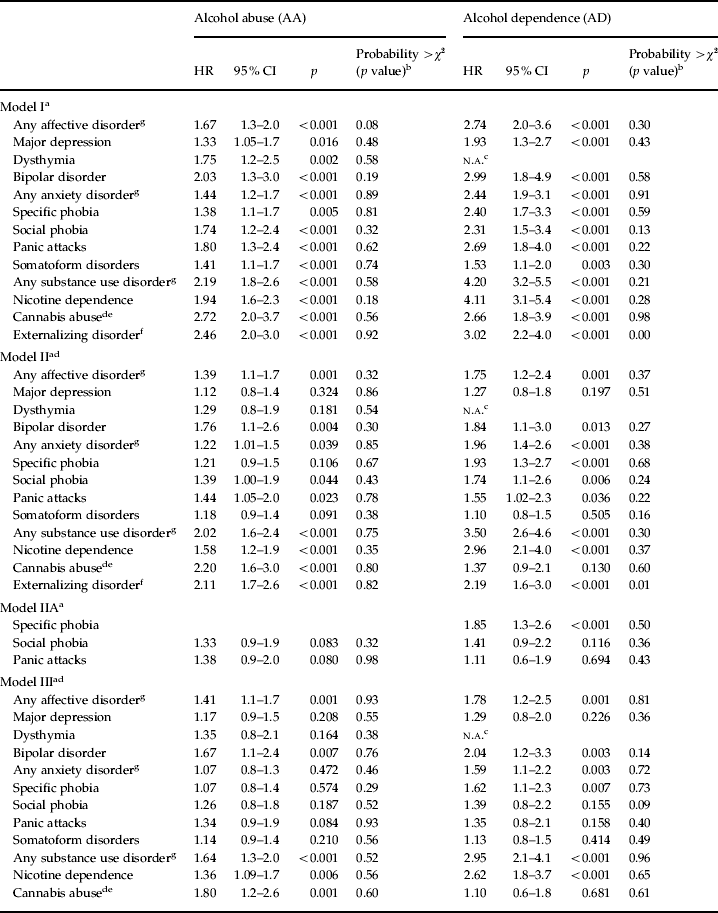
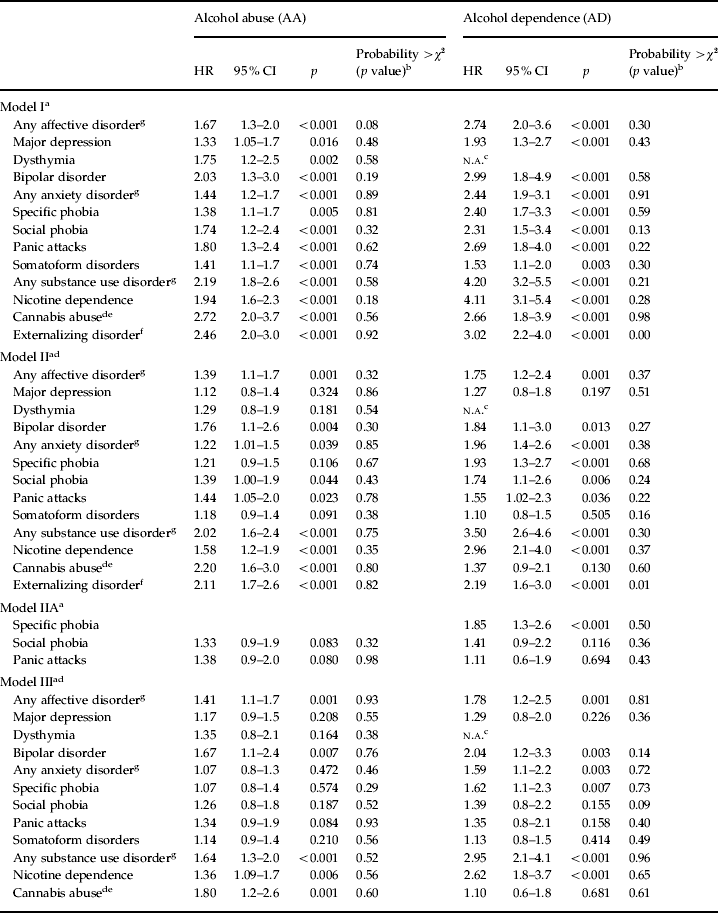
Table 2 shows that all mood and anxiety disorders, cannabis abuse, nicotine dependence, somatoform and externalizing disorders were associated with a higher risk for AA and AD (comparison group in models I–III were subjects without the respective PMD). Two significant interactions with time (not shown in Table 2) were found: social phobia was associated with a lower speed of transition to AD (main effect HR 1.19, interaction effect HR 1.14, 95% CI 1.02–1.27, p=0.019). Externalizing disorders were associated with a higher speed of transition to AD (main effect HR 4.69, interaction effect HR 0.89, 95% CI 0.82–0.98, p=0.018).
The risk of DSM-IV alcohol abuse and dependence by prior mental disorders (PMDs): overall difference in models I–IIIFootnote a
HR, Hazard ratio; CI, confidence interval; n.a., not applicable.
a Model I: adjusted for gender and age at last observation. Model II: additionally adjusted for substance use disorders (nicotine dependence, cannabis abuse or dependence, abuse or dependence of illegal drugs other than cannabis), any anxiety disorder (not if the covariate of interest was an anxiety disorder), and any mood disorder (not if the covariate of interest was a mood disorder). When the covariate of interest was a substance use disorder, the specific analysis was not adjusted for this particular, but for all other substance use disorders. When the covariate of interest was an externalizing disorder, the analysis was adjusted for any mood, any anxiety and all non-alcohol substance use disorders. Model IIA: as model II but with additional adjustment for anxiety disorders that predicted the respective alcohol use disorder (AUD) in model II and for an aggregated variable including generalized anxiety disorder, obsessive–compulsive disorder (OCD), post-traumatic stress disorder (PTSD), agoraphobia without history of panic disorder and panic disorder. Model III: as model II with additional adjustment for externalizing disorders.
b Schoenfeld Residual Test with p<0.05 indicates that HRs depend on time.
c Not applicable because of insufficient statistical power.
d n=142 excluded (unwilling to answer drug questions truthfully).
e Hierarchy rule not applied.
f Either conduct disorder or antisocial personality disorder; information available from T1 and T2 (n=2638).
g Any anxiety disorder: panic disorder, agoraphobia without history of panic disorder, generalized anxiety disorder, OCD, PTSD, specific and social phobia; any mood disorder: major depression, dysthymia, bipolar disorder I or II; any non-alcohol substance use disorder: nicotine dependence or any illegal substance use disorder.
Model II: additional adjustment for other PMD
Bipolar disorder, social phobia, panic attacks, nicotine dependence, cannabis abuse and externalizing disorders were associated with a higher risk of AA. AD was predicted by bipolar disorder, specific phobia, social phobia, panic attacks, nicotine dependence and externalizing disorders. Surprisingly, in model II, social phobia was associated with a higher speed of transition to AD (main effect HR 0.95, interaction effect HR 1.12, 95% CI 1.008–1.26, p=0.035), as were externalizing disorders (main effect HR 3.25, interaction effect HR 0.90, 95% CI 0.83–0.98, p=0.027).
Model IIA: adjustment for selected anxiety disorders
In this model, all associations were adjusted for rare anxiety disorders and for those particular anxiety disorders that were significant predictors in model II. Social phobia did not predict AA (additional covariate: panic attacks). Panic attacks did not predict AA (additional covariate: social phobia). Specific phobia predicted AD (additional covariates: social phobia, panic attacks). Social phobia was not associated with the risk but with a higher speed of transition to AD (main effect HR 0.79, interaction effect HR 1.12, 95% CI 1.002–1.26, p=0.045; additional covariates: specific phobia, panic attacks). Panic attacks did not predict AD (additional covariates: specific and social phobia).
Model III: additional adjustment for externalizing disorders
In this model, bipolar disorder, cannabis abuse and nicotine dependence were associated with a higher risk of AA. AD was predicted by bipolar disorder, specific phobia and nicotine dependence. Social phobia was associated with a higher speed of transition to AD (main effect HR 0.69, interaction effect HR 1.14, 95% CI 1.009–1.30, p=0.036).
Gender differences
To assess whether associations between PMD and the speed of transition to AUD differed by gender, we added the interaction term PMD×gender×time to the model. The only significant interaction was found for dysthymia×gender×time (AA as outcome, p=0.015). In the male and female subgroups, the results on the association between dysthymia×time and AA indicated a trend towards a faster transition to AA in women with dysthymia (main effect HR 2.19, interaction effect HR 0.84, 95% CI 0.70–1.02, p=0.093) and a trend towards a slower transition to AA in men (main effect HR 1.91, interaction effect HR 1.05, 95% CI 0.92–1.18, p=0.424), but the results were not significant.
Earlier PMD onset
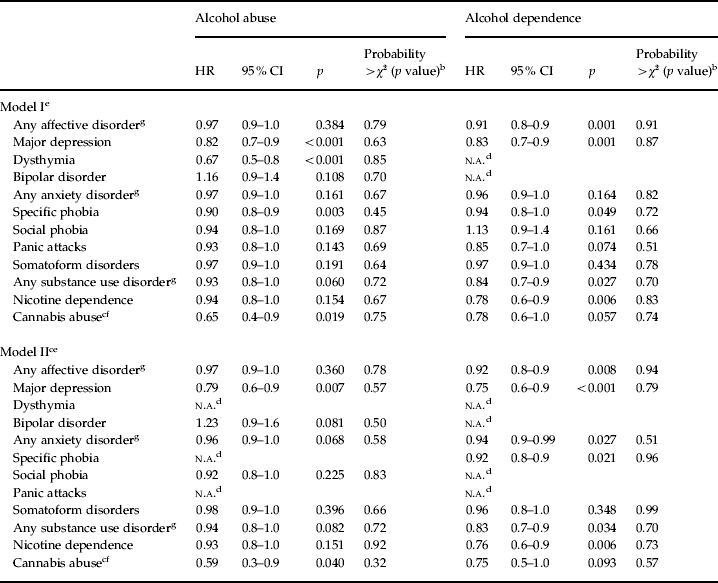
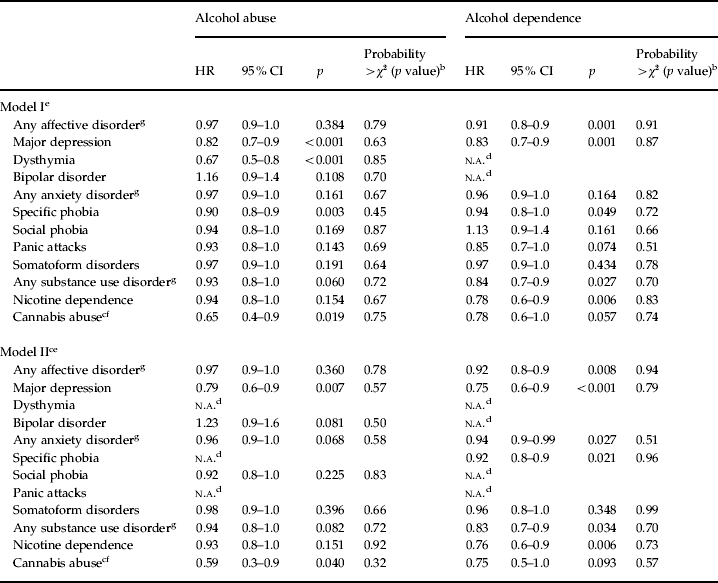
Earlier age of onset of major depression, dysthymia, specific phobia and cannabis abuse was associated with a higher risk of AA. In model II, this was found for major depression and cannabis abuse. Table 3 shows that earlier onset of major depression, specific phobia and nicotine dependence was associated with a higher risk of AD in both models.
Earlier onsetFootnote a of a prior mental disorder (PMD) and the risk of transition to DSM-IV alcohol use disorders (AUDs)
HR, Hazard ratio; CI, confidence interval; n.a., not applicable.
a Continuous variable; age of onset of the respective disorder.
b Schoenfeld Residual Test with p<0.05 indicates that HRs depend on time.
c n=142 excluded (unwilling to answer drug questions truthfully).
d Not applicable because of insufficient statistical power.
e Model I: adjusted for gender and age. Model II: additionally adjusted for substance use disorders (nicotine dependence, cannabis abuse or dependence, abuse or dependence of illegal drugs other than cannabis), any anxiety disorder (not if the covariate of interest was an anxiety disorder), and any mood disorder (not if the covariate of interest was a mood disorder). When the covariate of interest was a substance use disorder, the specific analysis was not adjusted for this particular, but for all other substance use disorders.
f Hierarchy rule not applied.
g Any anxiety disorder: panic disorder, agoraphobia without history of panic disorder, generalized anxiety disorder, obsessive–compulsive disorder (OCD), post-traumatic stress disorder (PTSD), specific and social phobia; any mood disorder: major depression, dysthymia, bipolar disorder I or II; any non-alcohol substance use disorder: nicotine dependence or any illegal substance use disorder.
In model I, later age of onset of panic attacks was marginally associated with a faster transition to AA (main effect HR 0.73, interaction effect HR 1.07, 95% CI 1.01–1.13, p=0.011) and AD (main effect HR 0.63, interaction effect HR 1.06, 95% CI 1.006–1.12, p=0.029). Because of insufficient statistical power, these associations could not be investigated in model II. After adjustment for covariates, later age of onset of cannabis abuse was associated with a faster transition to AA (main effect HR 0.05, interaction effect HR 1.76, 95% CI 1.17–2.66, p=0.007). No other significant association with speed was found (the results on the interaction with time are available upon request). Externalizing disorders were not considered here because of lacking variance in age of onset (see Covariates section).
Discussion
We examined, in a community sample of adolescents and young adults, whether different PMDs are associated with a higher risk and speed of transition to AUDs, whether associations with speed differed by gender and whether early onset of PMD was associated with rapid transitions. The main findings are: (1) several specific PMDs were associated with a higher risk of AUDs, but only social phobia and externalizing disorders were associated with a higher speed of transition (to AD). (2) No gender differences in associations between PMD and the speed of transition were found. (3) Early onset of several PMD was associated with higher risk but not with the speed of transition.
Several PMDs predicted AUDs. Bipolar disorders predicted AUDs after adjustment for covariates. This adds to cross-sectional evidence on the co-morbidity of bipolar disorder/mania and AD (Burns & Teesson, Reference Burns and Teesson2002; Grant et al. Reference Grant, Stinson, Dawson, Chou, Dufour, Compton, Pickering and Kaplan2004 b) by showing that bipolar disorders are risk factors for AUD in adolescence and young adulthood. In accordance with the study by Buckner et al. (Reference Buckner, Schmidt, Lang, Small, Schlauch and Lewinsohn2008 a), we found no association between major depression and AD after adjustment for anxiety and other disorders. A mediational relationship may exist between anxiety disorders, major depression and AUDs (Buckner et al. Reference Buckner, Schmidt, Lang, Small, Schlauch and Lewinsohn2008 a), as anxiety disorders typically occur earlier than mood disorders and predict these (Bittner et al. Reference Bittner, Goodwin, Wittchen, Beesdo, Höfler and Lieb2004; Kessler et al. Reference Kessler, Berglund, Demler, Jin, Merikangas and Walters2005; Beesdo et al. Reference Beesdo, Pine, Lieb and Wittchen2010).
Non-alcohol substance use disorders were consistently associated with the risk of AUDs, even after adjustment for externalizing disorders. Externalizing disorders are important risk factors for substance use disorders and the existence of a shared vulnerability has been suggested (Krueger, Reference Krueger1999; Sung et al. Reference Sung, Erkanli, Angold and Costello2004; McGue & Iacono, Reference McGue and Iacono2008). Our results suggest that once a substance use disorder has occurred, it may contribute to the development of AUDs independent of externalizing disorders. It is of concern that nicotine dependence, which predicted AUD, is highly prevalent (cumulative incidence rate 28.5%; Wittchen et al. Reference Wittchen, Behrendt, Höfler, Perkonigg, Lieb, Bühringer and Beesdo2008) in this young sample. Nicotine dependence and cannabis abuse may be proximal risk factors for AUD. This is indicated by the overlap of the incidence periods of these disorders (Wittchen et al. Reference Wittchen, Behrendt, Höfler, Perkonigg, Lieb, Bühringer and Beesdo2008) and leaves little time for intervention before a multiple substance use disorders status develops.
Externalizing disorders were associated with a higher risk of AUDs and a faster transition to AD, independent of all other PMDs. This adds to the consistent findings on these disorders as risk factors for AU and AUDs (Bonomo et al. Reference Bonomo, Bowes, Coffey, Carlin and Patton2004; King et al. Reference King, Iacono and McGue2004; McGue & Iacono, Reference McGue and Iacono2008). The impulsivity observed in these disorders may foster a rapid development of excessive AU.
Specific phobia was associated with the risk of AD. Specific phobia may represent an early general vulnerability for anxiety, which may be related to AD (Brückl et al. Reference Brückl, Wittchen, Höfler, Pfister, Schneider and Lieb2007; Stinson et al. Reference Stinson, Dawson, Chou, Smith, Goldstein, Ruan and Grant2007; Fehm et al. Reference Fehm, Beesdo, Jacobi and Fiedler2008; Beesdo et al. Reference Beesdo, Pine, Lieb and Wittchen2010). However, the association was independent of other anxiety disorders and may thus be specific. In adults, specific phobia is associated with impaired functioning (Ramsawh et al. Reference Ramsawh, Stein, Belik, Jacobi and Sareen2009), which may be associated with AD. However, high case numbers for specific phobia may have played a role here.
Social phobia was associated with a higher risk and speed of transition to AD even after adjustment for covariates. This adds to the finding that social phobia predicts AD in early adulthood independent of other mental disorders reported at about age 16 (Buckner et al. Reference Buckner, Schmidt, Lang, Small, Schlauch and Lewinsohn2008 a). Our adjustment took into account other PMDs, including those with incidence phases that reach into late adolescence/early adulthood, as nicotine and drug dependence (de Graaf et al. Reference de Graaf, Bijl, Spijker, Beekman and Vollebergh2003; Kessler et al. Reference Kessler, Berglund, Demler, Jin, Merikangas and Walters2005; Wittchen et al. Reference Wittchen, Behrendt, Höfler, Perkonigg, Lieb, Bühringer and Beesdo2008) and panic attacks that predict AUDs (Goodwin et al. Reference Goodwin, Lieb, Höfler, Pfister, Bittner, Beesdo and Wittchen2004). Impaired life quality and individual functioning and the intent to relieve anxiety in social situations in social phobia (Thomas et al. Reference Thomas, Randall and Carrigan2003; Acarturk et al. Reference Acarturk, de Graaf, van Straten, ten Have and Cuijpers2008; Fehm et al. Reference Fehm, Beesdo, Jacobi and Fiedler2008) may contribute to instrumental AU and thus to the higher risk and speed of transition to AD. In conclusion, social phobia is an important promoter for AD and rapid transitions to AD in adolescence and young adulthood. Thus, it may be predictive of early-onset AD, which is particularly severe (Hingson et al. Reference Hingson, Heeren and Winter2006). Of note, these results were found with a definition of social phobia that was less strict for subjects under age 18. Some research indicates that subthreshold social phobia is associated with AD (Fehm et al. Reference Fehm, Beesdo, Jacobi and Fiedler2008).
The finding that several PMDs are associated with the risk of AUD independent of other PMDs may indicate the existence of different underlying mechanisms such as impulsivity, self-medication by use of anxiolytic alcohol effects, and cross-sensitivity or cross-tolerance for different substances.
Associations with speed of transition were few. Thus, our results confirm for several PMDs that one factor (i.e. early AU onset) is not necessarily associated with both risk and speed of transition to AUD (DeWit et al. Reference DeWit, Adlaf, Offord and Ogborne2000; Behrendt et al. Reference Behrendt, Wittchen, Höfler, Lieb and Beesdo2009). Prerequisites of heavy AU (e.g. availability, social acceptance) may not be present until later adolescence (Poelen et al. Reference Poelen, Scholte, Engels, Boomsma and Willemsen2005; van Zundert et al. Reference van Zundert, van Der Vorst, Vermulst and Engels2006). This may also explain the lack of gender differences in the speed of transition in relation to PMDs. This lack of gender differences occurs in accordance with recent studies that find small or no gender differences in the speed of transition to AD (Wagner & Anthony, Reference Wagner and Anthony2007; Wittchen et al. Reference Wittchen, Behrendt, Höfler, Perkonigg, Lieb, Bühringer and Beesdo2008).
Nicotine dependence and cannabis use disorders were not associated with more rapid transitions to AUD, possibly because their main incidence phases overlap with those of AUD (Wittchen et al. Reference Wittchen, Behrendt, Höfler, Perkonigg, Lieb, Bühringer and Beesdo2008). These disorders may be proximal predictors that occur towards the end of the transition to AUD. Subjects with mood disorders may not experience the short-lived alcohol effects as a significant contribution to symptom relief, which may prevent a fast development of instrumental drinking.
Early age of onset of PMD was associated with a higher risk but not a higher speed of transition to AUD. An excess risk of AUD was found for early onset of nicotine dependence, specific phobia and cannabis abuse. In contrast to major depression per se, early major depression was associated with the risk of AUD independent of anxiety disorders. Thus, early psychopathology may be a relevant distal risk factor for AUD and warrants attention in the prevention of AUD in adolescence/early adulthood. Our results add to the finding that problem behaviors in childhood and adolescence predict AU-related problems in adulthood (Pitkänen et al. Reference Pitkänen, Kokko, Lyyra and Pulkkinen2008). The links between early psychopathology and AUD remain to be identified. The stability of psychopathology into adolescence may play a role here (Dubow et al. Reference Dubow, Boxer and Huesmann2008; Hayatbakhsh et al. Reference Hayatbakhsh, McGee, Bor, Najman, Jamrozik and Mamun2008).
Limitations
We could not consider all PMDs of interest because of insufficient statistical power. The study covers the high-risk phase of AUD in adolescence/early adulthood but does not permit conclusions concerning AUD onset in middle/late adulthood. We used retrospective age-of-onset information that may underlie recall bias.
Future research should identify factors associated with rapid transitions to AUD and the mechanisms linking early psychopathology with AUD. Here, investigating the role of parental AU and AUD would be of interest. It would be important to investigate which characteristics of PMDs as certain symptoms or subtypes (as of specific phobia) are related to AUDs. We used non-hierarchical AA diagnosis in order to take into account all AUDs that occurred over the observed period. In future research it may be of interest to investigate cases that develop AA only.
In summary, we could show that PMDs are rarely associated with rapid transitions to AUDs in adolescence and early adulthood. However, different PMDs play an important role as risk factors for AUDs in this period.
Acknowledgements
Funding and support: this paper was prepared in the context of the project ‘Community-based need evaluation II and allocation and transfer’ (primary investigator: H.-U. Wittchen) of the German Addiction Research Network ASAT (Allocating Substance Abuse Treatments to Patient Heterogeneity). Contact information: email: asatkoordination@mpipsykl.mpg.de (www.asat-verbund.de). This work is part of the Early Developmental Stages of Psychopathology (EDSP) Study and is funded by the German Federal Ministry of Education and Research (BMBF), project numbers 01EB9405/6, 01EB 9901/6, EB01016200, 01EB0140 and 01EB0440. Some of the fieldwork and analyses was also supported by grants from the Deutsche Forschungsgemeinschaft (DFG) LA1148/1-1, WI2246/1-1, WI 709/7-1 and WI 709/8-1. The principal investigators are Dr H.-U. Wittchen and Dr R. Lieb. Core staff members of the EDSP group are: Dr K. von Sydow, Dr G. Lachner, Dr A. Perkonigg, Dr P. Schuster, Dr M. Höfler, H. Sonntag, Dr T. Brückl, E. Garczynski, Dr B. Isensee, A. Nocon, Dr C. Nelson, H. Pfister, Dr V. Reed, B. Spiegel, Dr A. Schreier, Dr U. Wunderlich, Dr P. Zimmermann, Dr K. Beesdo-Baum, Dr A. Bittner, Dr S. Behrendt and S. Knappe. Scientific advisers are Dr J. Angst (Zurich), Dr J. Margraf (Basel), Dr G. Esser (Potsdam), Dr K. Merikangas (NIMH, Bethesda), Dr R. Kessler (Harvard, Boston) and Dr J. van Os (Maastricht). The EDSP project and its family genetic supplement have been approved by the Ethics Committee of the Medical Faculty of the Technische Universitaet Dresden (no: EK-13811). All participants provided informed consent.
Declaration of Interest
Dr K. Beesdo-Baum has received speaking honoraria from Pfizer. Dr H.-U. Wittchen has received research support from Eli Lilly and Company, Novartis, Pfizer and Schering-Plough. He has also been a consultant for Eli Lilly, GlaxoSmithKline Pharmaceuticals, Hoffmann-La Roche Pharmaceuticals, Novartis, Pfizer and Wyeth, and has received speaking honoraria from Novartis, Schering-Plough, Pfizer and Wyeth.