

INTRODUCTION
Trichinella spiralis is an intracellular parasitic nematode that is distributed worldwide and can infect almost all mammals, including humans. The life-cycle of T. spiralis is completed within a single host species and infection starts with the consumption of infective muscle larvae (ML) and digestion of the protective capsule within the host stomach. Larvae undergo 4 fast moults in intestinal epithelial cells and eventually develop into sexually mature adults (Ad) approximately 2–3 days post-infection (p.i.). Freshly released newborn larvae (NBL) are carried to host tissues by blood flow and invade new host cells. The NBL penetrate striated muscle cells and undergo developmental changes. Larvae that are older than 14 days can be infective to subsequent potential hosts and may remain viable for the entire life-span of the host (Despommier, Reference Despommier, Despommier, Gwadz, Hotez and Knirsch2000).
To date, little is known about the molecular mechanisms that are involved in parasite development and survival within the host. Identification of stage-specifically expressed genes will be important for elucidation of these mechanisms. ML, Ad and NBL are 3 major stages in the life-cycle of T. spiralis that exhibit distinct antigenicity, indicating differential regulation of many parasite proteins (Parkhouse and Ortega, Reference Parkhouse and Ortega-Pierres1984; Boireau et al. Reference Boireau, Vayssier, Fabien, Perret, Calamel and Soule1997). Previously, very few developmentally regulated antigens have been characterized, except the ML stage-specific TSL-1 antigens identified by monoclonal antibodies (Ortega-Pierres et al. Reference Ortega-Pierres, Yepez-Mulia, Homan, Gamble, Lim, Takahashi, Wassom and Appleton1996; Boireau et al. Reference Boireau, Vayssier, Fabien, Perret, Calamel and Soule1997). Several genes expressed during the ML stage were identified recently (reviewed by Boireau et al. Reference Boireau, Vallée, Le Guerhier, Blaga, Fu, Hernandez-Bello, Ortega Pierres and Liu2004) and one of these genes has been speculated to be involved in nurse cell formation (Vassilatis et al. Reference Vassilatis, Despommier, Misek, Polvere, Gold and Van der Ploeg1992). Mitreva et al. (Reference Mitreva, Jasmer, Appleton, Martin, Dante, Wylie, Clifton, Waterston and McCarter2004, Reference Mitreva, Appleton, McCarter and Jasmer2005) generated a T. spiralis expression sequence tags (ESTs) database (http://www.nematode.net/Species.Summaries/Trichinella.spiralis/index.php) containing 3262 unique genes from cDNA libraries of immature L1 larvae (also known as NBL), mature ML and adults (3-day-old adults, Ad3). However, the majority of the identified genes have been clustered in only 1 developmental stage.
Pure adult worm populations are difficult to obtain because at day 2 p.i., adults are still mixed with different stages of larvae, and at days 5 and 6 p.i. many NBL are formed in the female adult uterus. It has been investigated whether adults at day 3 p.i. (Ad3) represent a stage without any NBL (Liu et al. Reference Liu, Zhu, Xu, Lu and Boireau2001), although they may contain some fertilized eggs in early stages of development (Zhu et al. Reference Zhu, Garcia-Reyna, Fu, Yang, Li, Yang, Liu, Ortega-Pierres and Boireau2005). On the contrary, female adults contain all developmental stages (from fertilized eggs to NBL) of the embryo in the uterus beginning at day 4 p.i. Moreover, due to technical difficulties in obtaining sufficient, pure NBL, to date only 1 gene has been published as NBL stage-specific (Zarlenga et al. Reference Zarlenga, Boyd, Lichtenfels, Hill and Ray2002).
In an attempt to identify stage-specifically expressed genes of T. spiralis, subtracted cDNA libraries of NBL, Ad3 and Ad5 were constructed respectively, using a suppression subtractive hybridization (SSH) technique (Diatchenko et al. Reference Diatchenko, Lau, Campbell, Chenchik, Moqadam, Huang, Lukyanov, Lukyanov, Gurskaya, Sverdlov and Siebert1996). A number of stage-specific cDNAs derived from NBL, Ad3 and Ad5 were identified and analysed. The data generated from this study have provided new knowledge to our understanding of T. spiralis gene expression mechanisms during various developmental stages. The identification of stage-specifically expressed genes will not only provide new information for the understanding of parasite biology, but will also have a major impact on the establishment of novel immunodiagnostic and control methods.
MATERIALS AND METHODS
Parasites
Muscle larvae (ML) of T. spiralis strain ISS 534 was maintained by serial passage in OF1 mice and recovered from infected mice by pepsin-HCl (1% pepsin, 1% HCl at 42°C for 45 min) digestion of striated muscles at 35 days p.i. Adult-stage parasites were collected from the small intestines of Wistar rats 3 (Ad3) and 5 (Ad5) days post-infection with 10 000 ML, respectively. NBL were recovered from Ad5 incubated in culture medium for 24 h, purified by filtration through a 25 μm filter and centrifuged at 600 g for 10 min (Blair, Reference Blair and Campbell1983). In order to get sufficient NBL for cDNA library construction, nearly 1 million adult worms were collected from 200 Wistar rats and approximately 50 million NBL were purified. All parasites were extensively washed 3 times in phosphate-buffered saline and stored at −80°C until further usage.
RNA isolation and cDNA library construction
Total RNA was purified from T. spiralis parasites of ML, Ad3, Ad5 and NBL stages according to the method described by Chomczynski and Sacchi (Reference Chomczynski and Sacchi1987). Poly (A)+RNAs were isolated from total RNA using a Poly (A) Quick mRNA Isolation Kit (Stratagene, USA). cDNA libraries of ML, Ad3 and Ad5 were previously constructed (Liu et al. Reference Liu, Zhu, Xu, Lu and Boireau2001; Zhu et al. Reference Zhu, Garcia-Reyna, Fu, Yang, Li, Yang, Liu, Ortega-Pierres and Boireau2005). The cDNA library of NBL was constructed using the lamda ZAP II cDNA synthesis kit (Stratagene, USA), according to the instructions provided by the manufacturer, with minor modifications (Vayssier et al. Reference Vayssier, Le Guerhier, Fabien, Philippe, Vallet, Ortega-Pierres, Soule, Perret, Liu, Vega-Lopez and Boireau1999). Phagemids of the cDNA libraries were excised from the ZAP phage vectors by in vivo mass excision, as described by the manufacturer (Stratagene, USA), and transformed into E. coli Xlolr strain cells. Plasmids were extracted using a Qiagen plasmid preparation kit (Qiagen, USA).
Construction of NBL, Ad3 and Ad5 subtracted cDNA libraries by suppression subtractive hybridization (SSH)
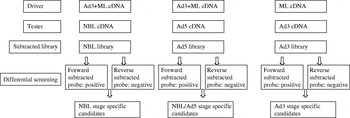
Subtracted cDNA libraries were constructed using the PCR-select cDNA Subtraction Kit (Clontech, USA), according to the manufacturer's recommended protocol. Forward and reverse subtractions were performed according to the manufacturer's protocol. cDNA was synthesized from Ad3, Ad5 or NBL mRNA, digested with Rsa-I and ligated to adapters to produce ‘tester’ cDNA for each stage (containing the transcripts of interest). The tester cDNA was hybridized with an excess of cDNA synthesized from ML or Ad3 mRNA (‘driver’ as reference or background cDNA) to remove common cDNA transcripts and generate subtracted cDNA libraries. The probe made from the forward subtracted cDNA was used as forward subtracted probe and the probe made with reverse subtracted cDNA was used as reverse subtracted probe (made by performing a reverse subtraction). The suppression subtractive hybridization (SSH) procedure is shown in Fig. 1.
Schematic illustration of the SSH assay. The NBL subtracted cDNA library was constructed by subtracting cDNAs common to ML and Ad3 from NBL. The Ad3 subtracted cDNA library was constructed by depletion of common cDNAs to ML from Ad3. In order to obtain Ad5 stage-specifically expressed genes, the Ad5 subtracted cDNA library was constructed by depletion of cDNAs common to ML and Ad3 from Ad5. Using this approach, it was expected that mRNAs specifically transcribed in Ad5 would be obtained together with mRNAs from embryos and NBL in Ad5 females. PCR products amplified from subtracted cDNAs of NBL, Ad3 and Ad5 were cloned into the pT-Adv vector (AdvanTAge PCR Cloning Kit, Clontech, USA) and transformed into E. coli TOP10F cells. The PCR-selected Differential Screening Kit (Clontech, USA) was used to screen all 3 subtracted cDNA libraries in order to identify stage-specific transcripts. Bacterial colonies corresponding to subtracted cDNA libraries were randomly selected, cultured overnight and spotted (20 μl/point) in duplicate on Hybond-N nylon membranes (Amersham Biosciences, Sweden). Membranes were hybridized with radioactively labelled cDNA probes of forward subtracted cDNA and reverse subtracted cDNA, respectively. Colonies hybridized with the forward subtracted probe but not with the reverse subtracted probe were selected and sequenced as candidate clones for further identification.

Sequence analysis
Selected clones were sequenced from both 5′ and 3′ ends using the dideoxy chain-termination method on an automated DNA sequencer (ABI Applied Biosystems, Model 377). After removal of flanking vector and adapter sequences, DNA sequences were analysed with the DNATools program (Rehm, Reference Rehm2001). Comparison against GenBank nucleotide and protein databases was performed using the BLAST network server at the National Center for Biotechnology Information (Altschul et al. Reference Altschul, Madden, Schaffer, Zhang, Zhang, Miller and Lipman1997).
Verification of stage specificity of cDNA clones
Southern blots using plasmids derived from the cDNA libraries were carried out to determine the stage specificity of subtracted cDNA clones. Subtracted cDNA inserts of selected clones by Differential Screening were excised from pT-Adv plasmids by digestion with EcoR I, and gel purified (QIAquick Gel Extraction kit, Qiagen, USA). Purified fragments were labelled with α-32P dCTP (ReadyPrime; Amersham Biosciences, Sweden) as probes. Twenty μg of plasmids DNA derived from the cDNA libraries of ML, Ad3, Ad5 and NBL were digested with Eco RI and Xho I, separated on 1% agarose gels and transferred to Hybond-N nylon membranes (Amersham Biosciences). After pre-hybridization for 2 h at 42°C in hybridization buffer (5×SSC, 5×Denhardt's solution, 0·5% SDS, 50% formamide and 20 μg/ml denatured salmon sperm DNA), membranes were hybridized with labelled probes at 42°C overnight. After hybridization, membranes were washed 3 times under high stringency conditions with 0·1×SSC, 0·1% SDS and exposed to X-ray films for 72 h at −80°C. Further confirmation for some clones were carried out by Northern blot, total RNAs from Ad5 (25 μg) and ML (6·25–100 μg) were denatured in 1×MOPS with 2·2 m formaldehyde and 50% deionized formamide at 65°C for 10 min, separated on a 1% formaldehyde agarose gel and transferred to Hybond-NX nylon membranes (Amersham Biosciences). Probe preparation and hybridization procedures were the same as described for Southern blot analysis. Complementary DNA was synthesized from total RNA from ML, Ad3, Ad5 and NBL. Primers used to amplify candidate cDNA clones were designed and the stage specificity was further verified by RT-PCR analysis.
RESULTS
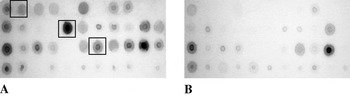
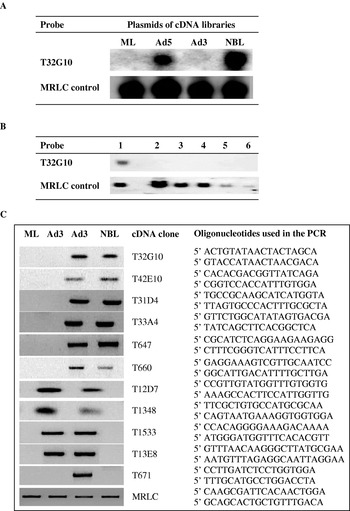
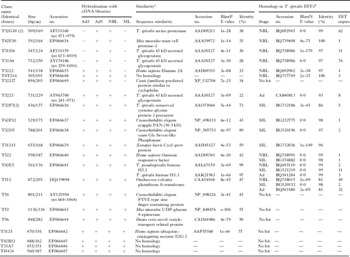
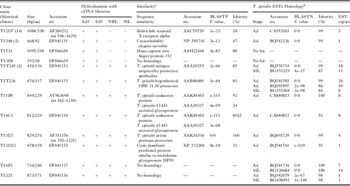
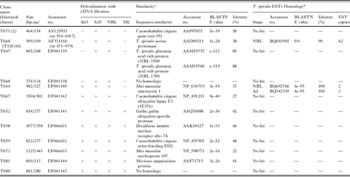
Subtracted cDNA libraries of NBL and Ad with enriched stage-specific transcripts were constructed by SSH. Totally 132, 96 and 48 clones randomly selected from NBL, Ad3 and Ad5 subtracted cDNA libraries, respectively, were subjected to primary identification using a PCR-selected Differential Screening Kit (see partial result in Fig. 2), and 24, 27 and 13 of these clones were selected. The plasmids of all selected clones were sequenced and redundant sequences were discarded. As a result, 22, 12 and 12 sequences from NBL, Ad3 and Ad5 subtracted cDNA libraries were primarily confirmed. Since the nucleotide sequence of clone T668 from the Ad5 subtracted cDNA library was identical to that of clone T32G10 from the NBL subtracted cDNA library, a total of 45 unique cDNA clones was obtained, as described in Tables 1, 2 and 3. The length of the cloned cDNAs ranged from 305 to 1504 base pairs (bp), with an average length of 731 bp. Using the threshhold of an E value ⩽1e-5 for a significant match, 18 of the 45 clones had no matches in the previously established T. spiralis ESTs database, and 9 showed no homology to any known database genes and were likely novel and unique T. spiralis sequences. The stage specificity of all 45 candidates was finally identified by Southern blot and some (T32G10 and T31D4) were further confirmed by Northern blot. The hybridization result of clone T32G10 is shown in Fig. 3A, where cDNAs from NBL and Ad5 but not from ML and Ad3 were hybridized. Northern blot analysis of clone T32G10 showed a similar result, T32G10 hybridized to the RNA of Ad5, but not ML (Fig. 3B). Hybridization results for all 45 clones are summarized in Tables 1, 2 and 3. The stage specificity of the cDNA clones identified by Southern blot was further confirmed by RT-PCR (Fig. 3C).
Screening of subtracted cDNA clones by dot blot hybridization. Randomly selected clones were spotted on nylon membranes in duplicate. The membranes were probed with labelled forward subtracted probe and reverse subtracted probe, respectively. The clones recognized by forward subtracted probe but not reverse subtracted probe were selected as candidate clones for sequencing and further characterization. (A) Results of NBL subtracted clones hybridized to forward subtracted probe (NBL cDNA subtracted by combined Ad3 and ML cDNA using SSH). Spots marked with open squares were identified as positive clones. (B) Results of NBL subtracted clones hybridized to reverse subtracted probe (combined Ad3 and ML cDNA subtracted by NBL cDNA using SSH).

Confirmation of stage-specifically expressed genes. (A) Verification of the stage specificity of NBL subtracted cDNA clone T32G10 by Southern blot with cDNAs from ML, Ad5, Ad3 and NBL. Equal amounts (20 μg) of plasmids from the cDNA libraries of Trichinella spiralis ML, Ad3, Ad5 and NBL were digested with Eco RI and Xho I, separated on 1% agarose gels, transferred to Hybond-N Nylon membrane, pre-hybridized and then hybridized with radio-isotope labelled cDNA clone T32G10. A duplicate membrane hybridized with the cDNA (1010 bp) of myosin regulatory light chain (MRLC) of T. spiralis (GenBank Accession no. AF331157) was used as positive control. (B) Verification of the stage specificity of NBL subtracted cDNA clone T32G10 by Northern blot with total RNA of Ad5 and ML. Twenty-five μg of total RNA from Ad5 (lane 1), 100 μg, 50 μg, 25 μg, 12·5 μg and 6·25 μg of ML total RNA (lanes 2–6) were separated by electrophoresis, transferred to duplicate Hybond-N Nylon membranes, pre-hybridized and then hybridized with radio-isotope labelled cDNA clone T32G10. Hybridization with the cDNA (1010 bp) of myosin regulatory light chain (MRLC) of T. spiralis was used as positive control. (C) Verification of the NBL or Ad stage-specific transcripts by RT-PCR. Reverse-transcription PCR amplification from cDNA derived from muscle larvae (ML), 3-day-old adult (Ad3), 5-day-old adult or newborn larvae (NBL) using primers designed specifically to selected cDNA clones from subtracted libraries. Amplification of MRLC was performed as positive control.

Analysis of NBL subtracted clones (Tester: NBL cDNA, Driver: ML+Ad3 cDNA)

a The BLASTP program was used to search the non-redundant protein databases at the National Center for biotechnology Information.
b The BLASTN program was used to search the EST databases at the National Center for biotechnology Information.
Analysis of Ad3 subtracted clones (Tester: Ad3 cDNA, Driver: ML cDNA)

a The BLASTP program was used to search the non-redundant protein databases at the National Center for biotechnology Information.
b The BLASTN program was used to search the EST databases at the National Center for biotechnology Information.
Analysis of Ad5 subtracted clones (Tester: Ad5 cDNA, Driver: Ad3+ML cDNA)

a The BLASTP program was used to search the non-redundant protein databases at the National Center for biotechnology Information.
b The BLASTN program was used to search the EST databases at the National Center for biotechnology Information.
NBL stage-specifically expressed genes
Six NBL stage-specific clones were confirmed. Four of these clones were from the NBL subtracted cDNA library (Table 1) and 2 were from the Ad5 subtracted cDNA library (Table 3). Clone T32G10 contained a 509 bp insert exhibiting 99% identity to the T. spiralis ESTs database cluster TS00065.cl consisting of 62 ESTs and encoding a putative protein with a trypsin-like serine protease domain. Clone T42E10, showing 100% sequence alignment to a T. spiralis NBL EST BQ739408, was homologous to serine proteases of other organisms. Clone T31D4 and T33A4 showed high similarity to the T. spiralis ESTs database of NBL TS00013.cl, and the predicted proteins were homologous to DNase II. Of the 2 clones from the Ad5 subtracted cDNA library, clone T647 demonstrated a high similarity to previously confirmed NBL stage-specifically expressed genes encoding the glutamic acid-rich antigenic protein family (GenBank Accession no. AAM19757; Zarlenga et al. Reference Zarlenga, Boyd, Lichtenfels, Hill and Ray2002) (Table 3). Clone T660 from the Ad5 library showed no significant similarity to any sequence in the database and is, therefore, a novel T. spiralis NBL stage-specifically expressed gene. Strikingly, of the 22 clones identified from the NBL subtracted cDNA library, only 6 could be found in the NBL EST database (Table 1).
Ad3 stage-specifically expressed genes
Twelve candidate clones from the Ad3 subtracted cDNA library were identified, of which 10 matched T. spiralis Ad3 ESTs. From these 10 clones, 4 also aligned sequences from the ML ESTs database (Table 2). Only 4 of these were eventually confirmed as Ad stage-specific by Southern blot, in which they hybridized only to plasmids containing T. spiralis adult (Ad3 and Ad5) cDNA. Clone T12D7 was the most dominant among the 12 candidate clones. It encoded a putative protein with homology to zebra fish retinoid X receptor alpha (GenBank Accession no. AAC59720). Clone T1348 encoded a putative protein with homology to C. elegans caveolin (GenBank Accession no. NP_501743). The third clone T1533 did not match any T. spiralis ESTs and encoded a C2H2 type zinc-finger-containing protein. The fourth clone T13E8 showed no significant similarity to any known genes.
Ad5 stage-specifically expressed genes
From the 12 identified candidate clones from the Ad5 subtracted cDNA library, most (10/12) did not match any sequence in the T. spiralis EST database (Table 3), and only one, clone T671, was confirmed as an Ad5 stage-specific expression gene encoding a protein with sequence homology to cuticle collagens of other nematodes.
Members of gene families
Clones T11B9 and T14C1 from the Ad3 subtracted cDNA library and T3223 from the NBL subtracted cDNA library showed high identity not only to each other, but also to a sequence from the T. spiralis Ad EST database (CA840813) and to a T. spiralis unknown mRNA sequence (GenBank Accession no. AF399957). However, the encoded amino acid sequences of these clones are all homologous to DNase II. Thus, these genes were members of a DNase II family in T. spiralis. Clone T1T245 matched a T. spiralis Ad EST (BQ576714) with identity up to 99% and also showed 87% identity to a T. spiralis ML EST (BG353329) and TspE1 mRNA sequence (GenBank Accession no. U01847, Arasu et al. Reference Arasu, Ellis, Iglesias, Ubeira and Appleton1994). This clone was a new member of the T. spiralis TspE1 family. A number of other clones showed differential identity to T. spiralis ESTs from different stages and were found to be members of various T. spiralis gene families. For example, clone T1T226 showed 99% identity with a T. spiralis Ad EST BQ541583 but 86% identity to ML EST BG353368, Ad EST BQ693897 and a T. spiralis hypothetical ORF 11.30 precursor mRNA (GenBank Accession no. U88238). Clone T32F7 from the NBL subtracted library showed 86% identity to T. spiralis ML ESTs and 88% identity to a T. spiralis developmentally regulated Ts-ccg-2 (Gare et al. Reference Gare, Boyd and Connolly2004), which is dominantly expressed in ML but only marginally expressed in Ad. Clone T512 from the NBL subtracted library encoded a putative glutathione S-transferase (GST) with various degrees of identity to the T. spiralis cluster TS01149 (Mitreva et al. Reference Mitreva, Jasmer, Appleton, Martin, Dante, Wylie, Clifton, Waterston and McCarter2004). Clone T43E5 from the NBL subtracted library contained a cDNA with an open reading frame encoding a 137 aa putative histone H3, which showed 99% identity with T. pseudospiralis histone H3.3 and 94% identity with T. spiralis histone H3.3 (Mak et al. Reference Mak, Su and Ko2001).
Non stage-specifically expressed genes
There are 25 clones described in Tables 1, 2 and 3 that were not stage-specific, as they hybridized to cDNA libraries of all developmental stages. Some clones were derived from transcripts of universally expressed genes. For instance, clone T13E3 (in Table 2) encodes a T. spiralis serine protease precursor and clone T3125 (in Table 1) aligns, with a high score (E value 1e-64), to Homo sapiens ubiquitin. Several clones (T42F12, T32D5, T54, T667, T659, T658) were found to be homologous to sequences of C. elegans and other nematodes. But some clones, such as clones T54, T53, T56, T3125, T652, T672 and T681 (in Tables 1 and 3), did not match any EST in the T. spiralis EST database, even though they demonstrated similarity to sequences from various other organisms. Sequences of clone T14F1 and T1223 were found in the two EST databases of Ad and ML, respectively, but further analysis of these clones indicated they were expressed during all stages. Sequences from clones T42B12, T33A7, T41G4 and T680 (in Tables 1 and 2) were not present in any T. spiralis database despite the fact that they hybridized to all T. spiralis cDNA libraries, indicating they were derived from novel T. spiralis genes.
DISCUSSION
Cloning and characterization of genes that are developmentally regulated in the parasite life-cycle is an essential step towards understanding parasite biology and related pathogenesis. T. spiralis is a parasite that has a relatively short inter-stage phase inside mammalian hosts with the exception of the ML, which poses challenges for targeting genes that are specifically up-regulated during certain developmental stages. In recent years, the SSH technique has been successfully applied to identify differentially expressed genes in parasites such as Trypanosoma cruzi (Weston et al. Reference Weston, Patel and Van Voorhis1999), Plasmodium falciparum (Dessens et al. Reference Dessens, Margos, Rodriguez and Sinden2000; Spielmann and Beck, Reference Spielmann and Beck2000), Heterodera glycines (Gao et al. Reference Gao, Allen, Maier, Davis, Baum and Hussey2001), Leishmania mexicana (Bellatin et al. Reference Bellatin, Murray, Zhao and McMaster2002), Bothriocephalus acheilognathi (Luo et al. Reference Luo, Nie, Chang, Song and Yao2004) and Oesophagostomum dentatum (Cottee et al. Reference Cottee, Nisbet, Abs El-Osta, Webster and Gasser2006). This technique has also been used to identify genes encoding heat shock proteins in the infective larvae of T. spiralis (Mak et al. Reference Mak, Su and Ko2001). A clone encoding protein Ts-CCG-1 with a nematode-specific cysteine-glycine domain was recently obtained from a subtracted cDNA library of T. spiralis-ML, and showed 90% sequence identity to an homologous gene in T. pseudospiralis (Gare et al. Reference Gare, Boyd and Connolly2004). In the present study, several T. spiralis NBL and Ad stage-specifically expressed genes exhibiting absolute (on/off) transcription differences were identified by SSH. Due to technical difficulty in obtaining a sufficient amount of RNA from NBL stage parasites, subsequent steps of stage-specific identification for most of the candidate clones were performed by primary hybridization to plasmids derived from different cDNA libraries of specific parasite stages instead of Northern blot. The RT-PCR analysis also confirmed the stage specificity of candidate clones. Our results strongly indicate that cDNAs can be used as a substitution for mRNA, especially when sufficient RNAs are not easy to prepare, although transcripts from certain stage-specifically up-regulated genes may be missed.
An EST database was previously established with a large number of EST cluster sequences from stages ML, Ad and immature L1 (NBL) of T. spiralis parasites (Mitreva et al. Reference Mitreva, Jasmer, Appleton, Martin, Dante, Wylie, Clifton, Waterston and McCarter2004). Only a very limited number of the sequences were experimentally confirmed as truly stage-specifically expressed genes. Since the parasite used in this study is a Chinese T. spiralis isolate (ISS534) which is different from the clone used in the EST sequencing project, variation in sequence between different isolates is possible in spite of the fact that some sequences showed up to 99% identity with database entries. In the present study using the SSH technique, not only the most abundant transcripts, such as NBL stage-specific transcripts T32G10 and T31D4/T33A4, but also several new stage-specific cDNAs not present in the T. spiralis EST database (Mitreva et al. Reference Mitreva, Jasmer, Appleton, Martin, Dante, Wylie, Clifton, Waterston and McCarter2004) were identified. Several clones, such as T12D12, T14F1 and T1223, were found to be transcribed during all T. spiralis stages, although their homologous clusters in the EST database were only represented in Ad and ML stages. This was probably due to quantity limitations in the T. spiralis EST database, which may not represent full coverage of the total transcriptome of the genome, as the number of EST sequences currently deposited is much lower than that of C. elegans, which is around 19 000 genes (The C. elegans Sequencing Consortium, 1998). This limitation was probably due not only to limited sequencing but also to the strategy used for cDNA library construction. For instance, PCR was used in the construction of a cDNA library for EST sequencing (Mitreva et al. Reference Mitreva, Jasmer, Appleton, Martin, Dante, Wylie, Clifton, Waterston and McCarter2004).
Interestingly, our results are in contrast to information found in the T. spiralis EST database, in which the majority of identified genes were clustered in only 1 developmental stage. Furthermore, the genes that we termed stage-specific include only those that are restrictively activated in 1 developmental stage. Variation in transcription level has been found in some universally activated genes at different stages in a previous study (Dabrowska et al. Reference Dabrowska, Jagielska, Ciesla, Plucienniczak, Kwiatowski, Wranicz, Boireau and Rode2004). For example, the histone H3-like gene (clone T43E5 in this study) was differentially expressed at all 3 developmental stages, but showed greatest activation in fast-growing NBL-stage parasites (Dabrowska et al. Reference Dabrowska, Jagielska, Ciesla, Plucienniczak, Kwiatowski, Wranicz, Boireau and Rode2004).
Our results also confirm the existence of gene families in T. spiralis. The first is a family of serine protease genes. Protease activities have previously been detected in T. spiralis ML extracts and several genes encoding serine proteases have been characterized (Criado-Fornelio et al. Reference Criado-Fornelio, Armas-Serra, Gimenez-Pardo, Casado-Escribano, Jimenez-Gonzalez and Rodriguez-Caabeiro1992; Armas-Serra et al. Reference Armas-Serra, Gimenez-Pardo, Jimenez-Gonzalez, Bernadina and Rodriguez-Caabeiro1995; Todorova et al. Reference Todorova, Knox and Kennedy1995; Moczon and Wranicz, Reference Moczon and Wranicz1999; Todorova, Reference Todorova2000; Todorova and Stoyanov, Reference Todorova and Stoyanov2000). An ML stage-specific serine protease gene was recently cloned (Romaris et al. Reference Romaris, North, Gagliardo, Butcher, Ghosh, Beiting, Panico, Arasu, Dell, Morris and Appleton2002; Nagano et al. Reference Nagano, Wu, Nakada, Boonmars and Takahashi2003) and a new member of this family that likely results from the fusion of 2 genes was recently identified by our group (Trap et al. Reference Trap, Fu, Le Guerhier, Liu, Le Rhun, Romand, Perret, Blaga and Boireau2006). T32G10 is the first cDNA clone encoding a serine protease specifically expressed during the NBL stage. This protease probably plays a crucial role in the development or migration of NBL in host tissues, since NBL represents the only stage moving out of the cytoplasmic environment and into host tissues. The second is composed of members of the DNase II-like family, such as NBL stage-specific clones T31D4 and T33A4. This family is related to cluster TS00013.cl, comprised of 67 ESTs in the T. spiralis NBL EST database. The deduced amino acid sequences of clones T11B9 and T14C1 from the Ad3 subtracted cDNA library and T3223 from the NBL subtracted cDNA library also carry the signatures of DNase II-like proteins, which are mainly expressed during the Ad stage. The ML stage-specific p43 glycoprotein (Vassilatis et al. Reference Vassilatis, Despommier, Misek, Polvere, Gold and Van der Ploeg1992), which has been suggested to be involved in the formation of nurse cells, also possessed a DNase II-like motif. Thus, it is speculated that the T. spiralis parasite retains a large DNase II-like gene family and some of the individual gene members are developmentally regulated. Although DNase activity has been detected in T. spiralis muscle larvae (Mak and Ko, Reference Mak and Ko1999; Mak et al. Reference Mak, Chung and Ko2000), its potential function in Ad and NBL stages remains to be elucidated. Some cDNAs showed homology with known members of the Trichinella gene family such as clone T647 (T. spiralis gene family encoding glutamic acid-rich proteins, Zarlenga et al. Reference Zarlenga, Boyd, Lichtenfels, Hill and Ray2002) and T1T245 (T. spiralis antigen targeted by protective antibodies, Arasu et al. Reference Arasu, Ellis, Iglesias, Ubeira and Appleton1994; Mitreva et al. Reference Mitreva, Jasmer, Appleton, Martin, Dante, Wylie, Clifton, Waterston and McCarter2004) were also identified.
The occurrence of the highly abundant stage-specific clone T12D7 in the Ad3 subtracted library was surprising because the SSH subtraction steps included a normalization step that should equalize the abundance of cDNAs within the target population. However, it is most likely that, despite an equalization step in the selection procedure, a high transcription level of this gene led to transcript over-representation in our subtracted library. The amino acid sequence encoded by this gene is closely similar to that of retinoid X receptors, which have been found to be involved in the regulation of eukaryotic gene expression (Krishna et al. Reference Krishna, Majumdar and Grishin2003). Thus, the protein encoded by T12D7 may potentially be involved in the regulation of T. spiralis embryo development; however, more biological investigations are necessary for further confirmation.
Adult stage-specific cDNA clone T1348 encoded a protein with homology to caveolin protein, an integral membrane protein found in caveolae that functions as a plasma membrane scaffolding protein to facilitate organization and concentration of signalling molecules within caveolae (Okamoto et al. Reference Okamoto, Schlegel, Scherer and Lisanti1998). Interestingly, the gene encoding caveolin-1 in the nematode, C. elegans, was found to be mainly up-regulated in eggs (Tang et al. Reference Tang, Okamoto, Boontrakulpoontawee, Katada, Otsuka and Lisanti1997). Current evidence suggests that the caveolin gene family is structurally and functionally conserved from worms (C. elegans) to man (Tang et al. Reference Tang, Okamoto, Boontrakulpoontawee, Katada, Otsuka and Lisanti1997), and caveolins in T. spiralis probably possess similar functions. The Ad5 stage-specific clone T671 showed high similarity to a cuticle collagen of C. elegans (GenBank Accession no. AAP97871), that was mostly expressed at high levels in embryos. Since developing embryos exist in some Ad5-stage parasites, we speculated that this cDNA was derived from mRNA transcribed from a gene that was activated during embryogenesis of T. spiralis.
In conclusion, SSH is a useful technique for the identification of stage-specifically expressed genes of T. spiralis. We have successfully identified several developmentally regulated genes that are preferentially activated in either NBL or Ad stages of this parasitic nematode. However, the protein expression of these genes and their biological significance requires further analysis. Correlation between gene transcription and protein expression will be further investigated. Our findings that up-regulation of genes encoding serine proteases and DNase II-like family have paved the way for further study of mechanisms involving parasite migration and nurse cell-formation inside the host. Identification of parasite stage-specifically expressed functional proteins will have major implications in the search for candidates to be used for the development of specific and sensitive immunodiagnosis and effective immunoprevention.
This work was supported by grants of EU TRICHIPORSE QLRT-2000-01156, PRA BT 03-02 and grant of China 863, PROGRAM 2006AA022451. We thank Catherine Trap, Jean François Fabien and Qiang Lu for all of their help with the experiments, and we are grateful to Dr Isabella Valle and Dr Xingquan Zhu for their helpful comments. The cloning and analysis of the complete coding sequences of the following clones/genes have been reported elsewhere: clone T12D7, Zhu et al. (Reference Zhu, Garcia-Reyna, Fu, Yang, Li, Yang, Liu, Ortega-Pierres and Boireau2005); clone T54, Fu et al. (Reference Fu, Liu, Kapel, Meng, Lu, Wu, Chen and Boireau2005a); clone T671, Fu et al. (Reference Fu, Liu, Kapel, Meng, Lu, Wu, Chen and Boireau2005b).