

Homelessness in Australia has been recognised as a growing problem. On census night in 2011, 105,237 people were counted as being homeless (Australian Bureau of Statistics [ABS], 2011). Aboriginal and Torres Strait Islander persons are proportionally overrepresented in this figure as 25% of homeless people identify as Aboriginal and Torres Strait Islander persons. Yet Aboriginal and Torres Strait Islander people only make up 2.5% of the total population (ABS, 2011). Over 40% of the homeless population are female, however 62% who received assistance from homelessness services in 2009/10 were women (Australian Institute of Health and Welfare [AIHW], 2011).
Indigenous people are also overrepresented in the number of people who access specialist homelessness services with 22% of clients identifying as being of Aboriginal and / or Torres Strait Islander origin (Australian Institute of Health and Welfare [AIHW], 2013). In particular, more Indigenous women accessed services (62%) compared to the non-Indigenous female client group (57%). This difference was particularly noticeable in the younger age groups, with a larger number of young women identifying as being of Aboriginal and or Torres Strait Islander origin. Also, a higher number of Indigenous people presented with family (38%) compared to 27% of the non-Indigenous persons seeking assistance with family (AIHW, 2014).
The overrepresentation of Indigenous people who are homeless is even more prominent in regional areas in Far North and North West Queensland. While the Indigenous population in Townsville accounts for approximately 8% of the population, 40% of clients using the homeless services hub were Aboriginal or Torres Strait Islander persons (Keeffe & Newbould, Reference Keeffe and Newbould2013). In Cairns and Mount Isa, the overall rates of homelessness are more than double the national rate (113 per 10,000 and 150 per 10,000 respectively compared to the national rate of 53 per 10,000) (Queensland Government & Queensland Council of Social Services, 2012).
It has been argued that homelessness is more complex than simply the lack of an appropriate dwelling (Thompson, Reference Thompson2007). There are many pathways leading to and perpetuating homelessness. Experiencing domestic and family violence was the main factor reported by clients of homelessness services in 2012–13 (AIHW, 2013). In particular, 33% of women mentioned this as the main reason for seeking assistance compared to 9% of men. A case study examining the experiences of women in a women's shelter in Tennant Creek (NT) found that the main driver of homelessness was domestic violence (Memmott, Nash, Bafour & Greenop, Reference Memmott, Nash, Baffour and Greenop2013). Domestic violence was also exacerbated by overcrowding in homes. On the other hand, it has been suggested that some women do not like to state violence as the main cause of their homelessness, instead citing relationship difficulties or substance abuse (Adkins, Barnett, Jerome, Jeffernan & Minnery, Reference Adkins, Barnett, Jerome, Heffernan and Minnery2003). Socio-cultural factors such as shame may be a factor in what is reported by women experiencing homelessness.
Women are particularly vulnerable to homelessness if they are experiencing domestic and family violence as the perpetrator often remains in the home (Chung, Kennedy, O’Brien & Wendt, Reference Chung, Kennedy, O’Brien and Wendt2000). Also, the disadvantaged economic position of some women and the possible separation from family support bring challenges for women in this situation. Other reasons for homelessness reported were financial difficulties (16%) and housing crisis (15%) (AIHW, 2013).
Overcrowding has been identified as another factor leading to homelessness. Visiting family and friends can be problematic for those who have secured temporary public or leased housing, as visits by disruptive relatives can cause tenants to lose their property (Mokaraka & Scott, Reference Mokaraka and Scott2012). While women in some studies spoke about this causing distress, they felt they were unable to refuse visitors because of cultural obligations (Memmott & Nash, Reference Memmott and Nash2012; Mokaraka & Scott, Reference Mokaraka and Scott2012). Thus Indigenous mobility patterns can cause extra stress, overcrowding and financial difficulty. Family and kinship responsibilities can prevail and prevent Indigenous women from refusing visitors even if they do not have the capacity to accommodate them (ABS, 2014). This puts Indigenous women at increased risk of homelessness as they may not be able to keep housing once they have secured it.
The context of living in rural and remote communities may place women at particular risk of continued homelessness. Scarce resources, lack of affordable housing and difficulties to access services have been identified as issues affecting Indigenous women and their children living in remote areas of Australia (Oberin, Reference Oberin2006). For example, the lack of health services in remote communities was found to be a contributor to Indigenous persons being homeless in Darwin, while a member of the family received medical treatment (Parsell & Phillips, Reference Parsell and Phillips2014). Additionally, temporary mobility was seen as a factor in homelessness with an increase in people travelling from remote communities for events such as a football carnival. This mobility pattern was also found in research examining homelessness in the regional centres of Mount Isa, Tennant Creek and Geraldton (Memmot, Nash and Birdsall-Jones, Reference Memmot, Nash and Birdsall-Jones2013).
Homeless families experience many risk factors, and children are directly implicated by their homelessness situation. The effects of living in temporary accommodation on children range from delayed development, learning difficulties, social and mental health problems (Vostanis, Grattan & Cumella, Reference Vostanis, Grattan and Cumella1998). Witnessing violent incidents may also detrimentally affect children. Indigenous women interviewed during a research project on homelessness reported that their children had witnessed at least two violent incidents against the mother (Cooper & Morris, Reference Cooper and Morris2005). For mothers, not being able to meet their children's needs and having children removed from their care has also been shown to be detrimental to women's well-being (Shier, Jones & Graham, Reference Shier, Jones and Graham2011). Families’ needs are complex and homelessness service providers must consider children's experiences and address their needs also.
While for some people, a period of homelessness may be short-lived, a considerable proportion of women are exposed to a long-term vulnerability to living homeless and to experience repeated episodes of homelessness (Robinson, Reference Robinson2011). Apart from the potential negative effects of risk factors leading to homelessness, being homeless itself may leave lasting psychological trauma. Additionally, factors associated with being homeless, such as social stigma and exclusion from the job market and housing rental market, may predispose women to further periods of homelessness (Shier et al., Reference Shier, Jones and Graham2011).
On the other hand, a strengths based approach challenges the portrayal of homeless Indigenous women as victims of their circumstance (Martin & Kunnen, Reference Martin and Kunnen2008). Cooper (Reference Cooper2004) described women as having survival skills despite being impacted by considerable negative circumstances. Furthermore, Parsell, Tomaszewski and Phillips (Reference Parsell, Tomaszewski and Phillips2014) found that homeless persons do experience agency and resiliency, and have played active roles in shaping their future. Nonetheless, homeless people are regarded as vulnerable with diminished autonomy (Martin & Kunnen, Reference Martin and Kunnen2008). It seems important to also explore the capacity and resilience of homeless Indigenous women in this research.
Stereotypical images of the homeless population are changing. The homeless person is not the old person sleeping rough on the park bench anymore (Tually, Faulkner, Cutler & Slatte, Reference Tually, Faulkner, Cutler and Slatte2008). While official homelessness figures provide insight into the issue, they are not the only source of information about the extent of homelessness in Australia. First-hand accounts of individual experiences of Aboriginal and Torres Strait Islander women have not been widely reported in the literature. Pathways into homelessness may differ for Indigenous people (Memmott & Chambers, Reference Memmott and Chambers2010). We know little about women who engage with homelessness services, and what we do know seems to come from stakeholders such as service providers (Parsell et al., Reference Parsell, Tomaszewski and Phillips2014). The research approach of inviting homeless Indigenous women to talk about their experiences is inclusive and seems preferable to treating this marginalised subgroup as passive service users without a voice (Martin & Kunnen, Reference Martin and Kunnen2008; Parsell et al., Reference Parsell, Tomaszewski and Phillips2014). It is deemed important that housing policy development take into account the experiences and views of homeless Indigenous women.
This study aimed to explore the lived experiences of Indigenous women who are homeless, and the pathways leading to homelessness. Also, it was investigated which services were accessed, what are barriers for accessing services, and what type of assistance would be helpful for Aboriginal and Torres Strait Islander women living in Far North and North West Queensland. The perspective of homeless Indigenous women is considered to be critical to ensure a comprehensive understanding of the high rates of homelessness in this subgroup. Thus this study aimed to complement the views of service providers on homelessness experienced by Indigenous women in the Mount Isa and Cairns region (Graham, Wallace, Selway, Howe & Kelly, manuscript in preparation).
Methods
Client service providers were asked to refer Indigenous women (who agreed voluntarily to participate in the interviews) to the principal researcher. Full ethical and privacy considerations were upheld in seeking this request from clients. A script and prompts were developed and used by a female Indigenous member of the research team to ensure ethical protocols were adhered to in seeking consent from all women.
The female Indigenous researcher conducted the one-on-one interviews with the Mount Isa homeless Indigenous women who volunteered to participate in this project. While the women were agency referred, interviews occurred in settings preferred by the homeless women being interviewed. The riverbank was a popular option. A female Indigenous research assistant under the direction of the female Indigenous researcher conducted the Cairns one-on-one interviews. The interviews were all conducted at the Homelessness Service Hub in Cairns. All participants received a gift basket containing food and refreshments.
These interviews aimed to gather information about the lives of Indigenous women who have become homeless. The interviews were transcribed and analysed thematically to identify themes, recurrent patterns and key issues.
Results
Cairns
Four women were interviewed in Cairns; one decided not to be included in the study. Two of the women interviewed are both 18 years old and single without children. Both were educated to a Year 10 level and had been homeless for two years. The third interviewee has four children and had been homeless for six months. Other demographic data, age and level of education, for the third interviewee were missing. Home countries were Rockhampton and Cherbourg. It was significantly more difficult to attract Indigenous women in Cairns to participate in an interview with the researcher compared to Mount Isa.
Interview Themes
The first interview question was: “What sort of things happened that made you homeless and can you tell me a little bit about where you were before you became homeless and how long ago it was”. One interviewee became homeless after moving to Cairns for employment with a company that had closed down by the time she had arrived. She was unable to obtain an affordable rental property for her family of four children without employment and lived in her vehicle with the children.
Family problems were the reason for two of the women interviewed. One woman decided to move out of home when she was 16 years old due to disagreements with her mother.
Mum would have people come and stay sometimes I didn't know some of the people and some of them would bring grog. . . Sometimes I would have to share my room with people I didn't know I hated that. (CNS_2)
Disagreements with a parent also led to another woman becoming homeless. Her father was seeing a new girlfriend whom she didn't get along with. She mentioned that at first it was exciting not to have to listen to her father anymore however it became difficult looking for food without any money.
We had a screaming match and Dad told me that if I didn't like Sarah (name has been changed) then I should go and live somewhere else. (CNS_3)
The second question in the interview asked whether this was the first time that the women had been homeless. For all the women interviewed in Cairns, it was the first time they had been homeless.
The third question in the interview asked: Do you think homelessness can be prevented? Why/why not? One of the young women interviewed said she is not sure if homelessness can be prevented. The other interviewee surmised it would be easy if one had money to rent a flat and buy furniture and food.
Question four asked: What type of services or people would you have liked access to during this/these time(s)? The young women interviewed seemed to be able to help each other out. They did visit the school counsellor to seek assistance, however they ceased seeing the school counsellor out of fear of being forced to live in foster care. During their period of homelessness, they had always found someone to stay with.
Question five asked: Did you access any services that help people? The young women mentioned that they were too scared to access any services. The women interviewed in Cairns accessed Centrelink for financial assistance and the Homelessness Hub. One of the woman's children was identified as “being at risk” by the school and received assistance from Act 4 Kids, which referred her to the Homelessness Hub.
Question six of the interview asked: What else is needed to help women like yourself? Some of the women felt there was a need in Cairns for a hostel for young women to feel safe. One woman mentioned that she found it difficult to find help and to access the appropriate services.
Other themes
Safety was experienced as an issue by all the women interviewed in Cairns. Two of the women were 16 years old when they became homeless and spoke about frightening experiences when sleeping rough in a park. One woman and her children were temporarily staying at the back of a friend's house in a shed with four other families. However, she feared for the safety of her teenage daughters as other families had teenage boys. She decided to live in their vehicle again instead. None of the women spoke about family and domestic violence as an issue. Racial discrimination was a topic mentioned by one of the women who said she preferred to talk to real estate agents over the phone so that she would not be judged for her appearance.
There were some positive outcomes: one of the women found employment and is in stable housing with her children. The two young women received help from a friend's mother. They spoke about getting an apartment to share in the future. One of the women would like to undertake vocational training to be able to get a good job.
Mount Isa
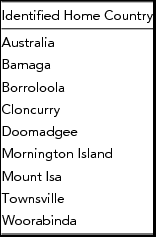
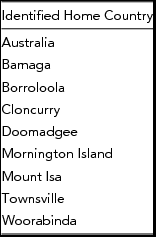
Twelve women were interviewed in Mount Isa. Their ages ranged from 20 to 54 years. Education ranged from Year Five to tertiary level qualifications. Most women were educated at least to Year Ten, with a number having completed Years 11 and 12. While two women had no children, the average number of children they had was two, with a range from one to five. Five women identified themselves as being single, four reported being in de facto relationships, and two were separated from a spouse, while one was married. Home Country appears in Table 1. Ngurri Ngurri Women's Shelter, Centacare, Serenity House Women's Shelter, Nawamba House and Jimaylya Topsy Harry Centre had referred the women who volunteered to be interviewed to the researchers.
Home Country
The longest reported period of waiting for housing was nine years, while the minimum was two weeks. The average period of waiting for housing was two years.
Interview Themes
The first interview question was: “What sort of things happened that made you homeless and can you tell me a little bit about where you were before you became homeless and how long ago it was”. A number of themes emerged. In relation to alcohol, one woman said that she had moved away becoming homeless because I didn't want to be around alcohol and that all the time (ISA_1). Another interviewee outlined a pattern of homelessness throughout her life that she linked to an accident her mother had that appeared to lead to her mother's depression and alcoholism:
Um well, it started when I was young. It started with my mum after she had a bit of accident and her own problems and I guess life just started being a struggle too for her.. . . . .But yeah, anyway we came back here and then mum became involved with alcohol and from there, more or less alcohol took control of her you know. And then found ourself homeless, like live with other family and that. It wasn't very stable you know, we moved around a lot. Yeah, since then, yeah, we missed out on a lot of schooling because we didn't have a stable home you know? I grew into a teenager and then started moving around again myself you know, with family members – like go to Camooweal or to Lake Nash, back to Doomadgee, to Hughenden, you know. I just moved around a lot and just sort of looked after myself you know? It's been pretty hard (ISA_2).
Another interviewee (ISA_3) reported that a failed relationship had led to homelessness and alcoholism:
Well the reason why I became homeless is because me and my ex had a fall out and then. These not the only ones I met. There a lot of homeless people that got nowhere to sleep because they love to live in the creek or . . . Same with me – and there's a lot of offers to go to Topsy Harry or KASH (The Kalkadoon Alcohol Sobriety House has been run by the Salvation Army since 2012; it was previously managed by the Kalkadoon people), but we love our alcohol that's all. We don't like to go there. Because when you come to be an alcoholic you don't want to go (ISA_3).
Relationship breakdown also led to other women becoming homeless:
Well I was staying with my sister, cousin sister. My partner he got a job and he went out for a couple of weeks to Birdsville? and he started being nasty then, you know? With personal stuff and all this and that. Made me feel out of place. That's why I was looking for somewhere else to stay then. I come here then (ISA_4).
I was in a relationship and then I fell pregnant with my baby and then when my baby was 2 months I found out that my partner was having an affair – and I’m from Townsville – I’m on maternity leave – and so when I moved out of home I come here because I got no family here or anyone. So I’ve been here with my baby for a while now. I got a transfer with my job out here 7 years ago and last year I met my partner and then had my baby this year in May and then yeah, we fell apart so I come here. . . . Like, even with me going back to work – I’m going back to work early – I still will find it hard to afford the rent on my wage alone, and so I’m stuck with what to do sort of thing. (ISA_11)
Another woman (ISA_10) had been a carer up until the death of her cousin. She had been living in her cousin's home while she cared for her.
Yeah, well I was homeless before my cousin fell sick with cancer and she came back from Darwin and that was in August. And my contract run out with Qld Health. I didn't want to live with family anymore. I want to find my own accommodation and everything.. . . . . But my cousin was sick with cancer anyway and so I said no, I’m going to go and look after my cousin. So she passed away this year in August. As soon as she passed away I went and let housing know and they immediately evicted me – because I hadn't been there 2 years. These are the new RTA rules. You have to be there 2 years for succession of tenancy. I’d been there 15 months – just short of it. And I said well I’m sorry she died before the 2 years was up, you know. So yeah, they kicked me out in the street. I had nowhere to go. I had nowhere mate. (ISA_10)
The other women interviewed indicated that they had become homeless because it was no longer possible, or no longer desirable to stay with relatives. They were waiting on housing. Only one woman mentioned a violent relationship, which resulted in her leaving her partner and becoming homeless.
The second question in the interview asked whether this was the first time that the women had been homeless. There were a fairly even number of responses reporting never having been homeless before and being homeless for the second time. Only a small number reported previous homelessness on repeated occasions. Some interviewees provided vague or inaudible responses to this question, perhaps indicating some unease with this question.
The third question in the interview asked: Do you think homelessness can be prevented? Why/why not? While two women did not know if it was possible to prevent homelessness, one interviewee pointed to the need for the provision of suitable places for women leaving relationships:
Yeah I reckon (it can be prevented). Well it's really good that Centacare is here in Mount Isa. I reckon it should be in other places too. Especially with single mothers – like some of their men they live with you and somewhere down the track they feel that they don't want it anymore, that relationship – they just want to be on their own or free to do what they want to do – and then they leave, the mother, then with the pain and struggle. (ISA_2)
A woman with a young child who had left her partner and is going to return to work after maternity leave also felt that affordable housing was a priority:
So they basically said the best option for me is to go private – like go through real estates and all that, and I’ve been looking through them and the 2 bedroom – I even looked at the 1 bedroom because he's only 6 months old – and there are some that – I suppose I would be pushing myself for $400 a week. There was one that was $260 a week but then going in there, there was no fans. The TV wouldn't be able to fit in the lounge room, no cupboard, no bed space. So if I was to have to go to that I would have to put my food on the floor basically, and because I’ve got to sterilize for the baby – formula that I leave on the bench and there was no room. And I want to find somewhere – because I don't have a car – that I can walk to and from work, because I used to do that anyway, and even though there were places close to work, there's not enough room for me to do it. (ISA_11)
More accommodation for single women was seen as another way of preventing homelessness.
They could put up another one of these. Yeah. For women. It's mainly all the women eh? You know, like all the single woman and that? Your own privacy and everything, you know? (ISA_4)
It's really hard for single women in Mount Isa. They think that everyone works in the mines here, but even so working in the mines, you know, you still got other bills. You know you pay $500 a week for a 2 bedroom flat – the cheapest I’ve seen was three hundred and something. You can't afford that. Even working, you’re just working to pay your rent. (ISA_10)
Another interviewee pointed to the lack of affordable accommodation generally as a contributor to homelessness:
I think the Mount Isa Council has a lot to answer for really. Because like the mines. You bring people in and the infrastructure is not here. You need to think about the people in the town who are paying taxes here. Like, even the sewerage system. They just had to do a real quick job of it now because the pipes weren't big enough for people here in Mount Isa. It's disgusting. So, it's just growing and growing. And they are not being prepared for it. Not having a 5 or 10 year plan. Like, we’re expecting this many people to come here because we got the mines and now they going to talk about uranium. What's all the local people going to do? You know, all these people come with all their money and everything – where do the local people go? And it's not only black fellas. (ISA_10)
Other interviewees reinforced this:
More accommodation – that's all really – at an affordable price. The thing about it is that there are a lot of houses here that are all boarded up Housing Commission. They should get onto it straight away because there is an emergency situation. I was just so lucky that this was here. Because I suffer with severe depression as well and it just really stressed me out. I was sick and had nowhere to live – it just. . . (ISA_10)
Across the board, so when, you know, for workers like us that are working for non-government, there's facilities with housing for them. I’ve been working in Centacare Homeless where 5 of the people who are homelessness workers are actually homeless, out of 11 or something and they’re having to bunk in and get a house together, and for the people that maintain the housing here – like QBuild workers and contractors, they can't get enough people to fix their houses because they can't afford to live here either. If you’re just a chippy by trade. . . (ISA_9)
And I’ve been into Ray White and I’ve enquired about a flat for $360 here on West Street and although I’ve never done it before when I’ve rented before, but they wanted copies of my pay slips and everything, and I was like OK fair enough, and they said that it was semi-approved for me to get the unit, however my rent wouldn't be $360, they’ve put it up to $510, and I asked them why and they said because of the area of location. I said it's not like I’m living by the sea and I kind of figured that because they – I put it that because they seen my pay and they thought they could, or would put it up a bit. My wage alone – like paying rent – I would be living off – with rent alone I would be living off what, $500 or $600 possible, and then I got to pay for my electricity. . . (ISA_11)
The need for accessible, affordable short-term and long-term accommodation in Mount Isa was a strong theme that emerged throughout the interviews. While some expressed a need for secure accommodation for single women with and without children, such as units, flats or hostels, others were in need of a house that could accommodate other family members including children. The provision of accommodation for women leaving difficult relationships was also seen as important in preventing Indigenous women's homelessness. Overall, the most common response to how to prevent homelessness was to provide sufficient housing for those in need of housing.
Question four asked: What type of services or people would you have liked access to during this/these time(s)? As one woman noted: There are no services out in Doomadgee (ISA_1), so even minimal service provision in the home country of some of these women may be of assistance. When women leave their home country and seek services in Mount Isa, available services may not always meet their needs though. One woman with a 12-year-old son pointed out that:
. . .it hard too sometimes hey, when you go to shelters and that, because they don't take boys over a certain age. Yeah and that's why she is finding it hard to find accommodation too and she is living with my other cousin and she got him and her other boy. (ISA_2)
Another woman expressed a need for accommodation that caters for married and defacto couples:
Well, like, homeless people, like for married couple, if they can put them in a place where they can stay – because they don't want to be separate. Yep, yep. Because Arthur Petersen Centre – like, they’re married couple and then your husband or your defacto got to sleeping with all the men and the wife got to go and sleep in the women quarters. Married couples – I don't know – I don't know how to put it, but I just tell you. Married couples, I don't know if – oh probably at Topsy Harry – I never been down there. But like men, husband and wife or defacto, they need to sleep together. (ISA_3)
One interviewee felt that there was too little accommodation for women in Mount Isa generally, while also noting the current need to accommodate homeless women and women who have been subject to domestic violence (and who are also homeless) at the same shelter:
Centacare got a room here for me and Disability Services too; they did really good as well. So they really helped me out. And so, being here is good. But this is not for homeless people. It's for domestic violence, you know. There's a lot of domestic violence but they’ve got nowhere to go because we’re all in here as well. And like one house, it's got no air conditioning now and they sort of can't put anyone in it – you know, because they’re running out of money as well, they said. So they cut their staff back. In Mount Isa there's nothing for women. There's heaps of boarding houses for men – like there's Oz Care and they’ve got boarding houses everywhere. Across from the Council, down across from K-Mart – everywhere for men, but nothing for women. And like, with Oz Care, you stay there for a while and you get a job and you can even move into a unit then, but women aren't allowed in those either, so there's nowhere to go. And it's really played with my head a lot. (ISA_10)
Centacare was endorsed by a number of women as a facility that they needed access to when they become homeless, while others indicated that they did not know what services they would have liked to have available. One interviewee indicated that she preferred to look after herself rather than access services.
Question five asked: Did you access any services that help people?
One woman reported that a rehabilitation centre had helped to turn around her life:
Yeah, you know, like how they had KASH as a rehabilitation centre for alcoholics and that. That was really good – they took me in – I could have lost my kids during the thing I was going through by drinking and all that you know. Or they could have been hurt or something, but yeah - it was really good to be out in that environment. No alcohol and stuff like that. Yeah, I reckon it would be good to have a rehabilitation centre for families, like single mum trying to get her life back on track after a bad relationship or something like that. Yeah, it would be really good. Like some, well you look at some alcoholics – you know you can't stop them. They only stop for a little while – when they get sick of it, but they’ll go back and get back on it eh? Yeah, it would be good to have a rehabilitation centre for families. Even whether for partners – and to have counselling done and stuff like that you know. And it's also hard for a mother – for her partner to walk out on her and her children, you know. It's really hard. (ISA_2)
Disability services, Centacare and the Neighbourhood Centre were all seen as providing valuable services to homeless Indigenous women:
Well Disability Services – they’ve been really good. And because of my wrists and everything –oh, and they said being Aboriginal is a disability – so you know, they’re really good eh. And Centacare homeless – they were good too. And otherwise, I’ve gone to the Neighbourhood Centre. They were excellent as well – really good eh. And the things I found out you know. I couldn't believe it – they said there's – up there you can get a loan. Wow eh. I just couldn't get over it you know. Even the dole office. Now things have changed since you were last unemployed eh, you know. And they explain it. I still can't understand it all you know. Just get and . . . I’m like, well I haven't been on the dole really, I’ve always worked. (ISA_10)
Some of the other women seemed less sure about accessing services that they knew could help:
I was going to give up hope – get a tent and go down the river. I was giving up hope. We kept walking past (Topsy Harry) all the time and looking in. We were frightened to come in and ask see. One Christian lady and she been tell me about that place now, because she used to live here and I said you take me there then. Come that Sunday and moved in Tuesday and never moved from here ever since. (ISA_4)
Another woman felt that KASH may be able to help her and other women, but also thought that she would be unlikely to go to KASH. There was also a sense that the facility was already operating at capacity:
Oh, that Riverside, down dinner camp there – see I don't know. Yeah, her name Sue (Sue's name has been changed to protect her identity). She works down there but she said that no one can go to KASH until after Christmas. Because like, they try and help – they try and help lot of people, not only me and my partner, but there's a lot of – not only all us mob, but there's other mob there. I think the Riverside actually might help – help like partners for any other homeless people for flats, but I don't really know see. Because I don't go to them things. (ISA_3)
This was not the only service seen to be operating at capacity:
there's Serenity House. And there's Mawamba Women's Shelter. Most of the time they always full.
Other women talked about help received from Oz Care and Centrelink mentioning that both services visited Topsy Harry twice a week. Another indicated that I was supposed to go to ATODS but I didn’t (ISA_3). Centacare was the service mentioned most often by the women during interviews. A comment was made about the positive effect of service providers meeting emotional needs in addition to housing needs:
Yeah, it's really good too you know – like sometimes you feel down and you want to talk to someone and you’re not comfortable to talk to your family and you would rather talk to someone else about it. It's really good when they understand – it makes you feel really good inside. (ISA_2)
One interviewee mentioned a sense of embarrassment accessing services and decided to only use services when she really needed to.
Well I’ll keep them for when I really need it again. Yeah, but I haven't needed anyone since then because I was very embarrassed too. Because my mother and grandmother never went to a place in their lives, you know. (ISA_10)
Question six of the interview asked: What else is needed to help women like yourself? One interviewee felt that a stable home and good support were very necessary in order to help women who face homelessness.
To have a stable home and having support around you. Yeah.. . . . . And to know that you can pick a phone up and call for help and they’ll come. Really good. . . ..And the reason why young mothers and whatever make these choices, because there is no help there, especially with counselling and stuff like that. I suppose it's experiencing life as you grow you know. Yeah, and like talk to you and sort of pull you through it too you know. I mean I know a lot of young mums around here who have lost their home and on the grog and drugs, you know.. . . You just don't know where to turn to and sometimes it's very hard, really hard and very emotional. Yeah, I remember when me and my partner started breaking up it was very emotional. I used to just cry you know, a lot.. . . Yeah and having a very bad relationship does bring you right down you know. I had a very violent one. But yeah, pulled through it a bit now. (ISA_2)
Another woman needed a job and an affordable place to live. Others expanded on the need for affordable housing, along with need for the provision of houses with more bedrooms:
Well I’m not sure. I need a job. Yeah, work and affordable places to live. There's just nothing. It just seems the Council doesn't think about anybody in this town. . ..: Flats for single women. . .. Yeah, at an affordable price. (ISA_10) (Other in background): At an affordable price in town. Sorry Val, am I allowed talking on this tape? Some of the women are bunking in together – going together so they can get a house between them. Yeah, well that's what my friend and I were talking about, doing that too. (Other): there's not enough for a big family to be in them. . .if you’ve got a lot of kids.). Yeah – but even in Housing there's only a few 4 or 5 bedroom houses. Because I know with my brother, he had a lot or problems because he's got 9 children. That's a bit too much, but anyway. . .. . . But still there is a real shortage of big housing. And now they say they’re going to mine uranium out here – where are they going to put all those people that come out here? (Other): There's 2, 3 bedroom houses advertised. I know one close to near where I live – because they’re old 1950's Housing Commission houses that most people have paid off and $550 a week for renting a house like that. Like, my mortgage is way less than that – my mortgage payments are way less and cheaper to buy than to rent in town. But you got to have the means to rent. Yeah, that's what I was just saying – I’m going to apply to IBA for a loan to buy a house. It's the only way to go. But I have to get a job. Oh, you can do it too on the dole, but you have to show a pattern of saving and you can't save on the dole eh? Not unless you live in a place like this – like it's $100 a week. It's really good. Yeah, cheapest place in town.
Having a job though does not protect women from homelessness:
I have to tell work that I live here and my manager's said I’m not promising, but I want to try and see if we could put you up in one of our houses temporarily until you can get your own place and they said that the catch is that if we get more staff you will have to move out. (ISA_10)
But then there mightn't be a place here for her to come back to. (ISA_11)
Yeah, that's why I didn't want to take that risk. I will stay here until I can get somewhere. But that's when none of my clients had come here – they won't put any here because I’m here and then it puts them in a thing because then we have mums and that come down and then there's no accommodation for them and that's to say Nawamba (Aboriginal Islander Development Recreational Women's Association Nawamba House) does have spare houses. Mary (not her real name) says she won't ring Nawamba because I’m here. Yeah, it causes a catch 22 situation all around. (ISA_10)
One woman had been living with her dying cousin while caring for her. When her cousin died she found herself homeless, with no apparent options available. In her experience, the inflexible nature of the Residential Tenancies Authority (RTA) and new Government laws compounded her problems:
(I’m homeless) because of the new Government laws, RTA laws, yeah that says there's no succession of tenancy unless you’ve been there two years. Two years is a long time, but 15 months is a fair while too – not far off two years. And that's what I said to them. I said well I been in there 15 months longer than anyone you going to put in there, and the house was spotless too when I moved out as well, you know. They said, as a carer Kate (named changed to protect her identity) you just need to take your stuff and move. . ..But, there was no flexibility at all. It was – if we wanted to put you in that flat Kate – we have to apply to the Attorney General and that, you know. And they just no help. They just no help, they’re a bit on a power trip in Housing, they really are you know. And they just stand there and say no and if you get angry or frustrated, they got their little ways of getting back at you. Like sending you an assessment or whatever – until they’re ready you know. Nasty little people eh, you know – working in Housing eh? And there's no Aboriginal people in there either. They’re all white and they all stand over you, you know. I was there and one old lady come in – her and I was gunna live in a tin shed – in this weather. There's so many empty houses and flats around but they’re not putting anyone into them. I don't know – because there's so much homelessness, you’d think they’d get onto it straight away to get those houses up and get people into them. (ISA_10)
Problems associated with the wet season while being homeless were also mentioned. The best help that one woman said she could receive was housing:
Well flood come. Well anywhere – it was flooding - we went and sleep up here where the house (?), me and my partner and the rest of the family. Well, just put it this way, I don't really care where I sleep until me and my partner get a flat. That's all I got to say and there's nothing else after that. (ISA_3)
A number of interviewees mentioned the need for housing and services specifically aimed at women because the husbands are right, they go off and live with their mates and that, but the woman with the child or children are left with nothing (ISA_10). The need for care groups for children was expressed as well.
Other themes
Most of the women talked about children during the interviews. A lot of the women reported having left their own children with relatives during periods of homelessness.
The little boy was in my care and he turned 12 and then I send him back home because I needed space. He back home now. (ISA_1)
I got 5 girls. They with family member. They’re coping good. They right where they are. (ISA_5)
My oldest one, well he live with my sister. He is about 12. (ISA_2)
But my youngest one she's with my youngest sister in the territory. She is going to school and she's happy as Harry (ISA_3)
There were kids here before, a long time ago. . .. . . Yeah – but you don't have your children here? No. (ISA_4)
One woman mentioned that her children had been removed from their care by Child Safety Services due to her own alcoholism: Child Safety took my children because I was drinking too much. (ISA_6)
Comments were made about the pressures of being young with children and being homeless with children.
Yeah. It's sort of hard living with family members and moving around with the kids. Especially with kids these days. They have to be at school to learn you know. And you cannot put a child in school or keep them in school while you’re moving around. It's just too hard and complicated for yourself too. Yeah – that's why I think some mothers give up on their kids and just end up drinking, drinking you know. Because they don't have that support, you know. I see a lot of mums around here they got lot of kids and they don't live with them. They in Child Safety and that. (ISA_2)
It was mentioned that homelessness shelters will not take in families with many children or boys over the age of 12 years.
If you got more children they (shelters) won't take you. Like over 5 or something (ISA_2)
However when asked how the children were coping, all women agreed that the children cope well. The women who had children staying with family particularly indicated that they were doing well. Positive comments were made about their own homelessness situation and the future, showing resilience and hope.
Yeah, to help your children you need to help yourself. I’m really, really happy with what I got now. I’m just trying to focus on the future and keep going, you know. And I got this chance now. I don't want to mess up again, like alcohol and stuff. (ISA_2)
It's been really great here all that stress just lifted off I have been able to sleep and the kids are in a routine. I will have my own house and the children will have their own bedrooms and food. (ISA_7)
Some of the women expressed a feeling of strength about their own choices, particularly when deciding to leave a partner or family, even if it led to a period of homelessness.
It made me stronger in life too. . . Well now I feel lot stronger because I know it wasn't me. I was the one who tried all the time. (ISA_2)
Like I wanted their company and that, but you know sort of bit the wrong way too, you know, like sitting down with a beer and whatever, yeah was sort of falling out of control you know. Yeah, way out of control. And then I needed to go. (ISA_2)
Racial discrimination was discussed by a few women, who indicated that they were treated differentially when calling a real estate agency inquiring about private rental properties compared to walking in to enquire. Also, the lack of Indigenous staff within the Department of Housing was noted.
I mean, I hear people say if I go in there they’ll say there's nothing. If I ring up and talk like a white person there's something, but. . . (ISA_11)
I been on the phone and they’re like yes, come in, come in. I’ve walked in and said I was just called about, I got asked to come in and see this property, blah blah, and they stare at me and they’re like, we’ve actually got someone looking at that. And they just look at you like. . . So I just walk out. (ISA_10)
Other barriers mentioned were long waiting lists for housing and the difficulties associated with the remoteness of home country, for example expensive air fares, particularly with children, and the lack of services in remote communities. Domestic violence was not specifically brought up by most women, except in relation to the shelters.
But this is not for homeless people. It's for domestic violence, you know. There's a lot of domestic violence but they’ve got nowhere to go because we’re all in here as well. (ISA_10)
Discussion
The semi-structured interviews with homeless Indigenous women aimed to provide an insight into the lived experience of homelessness and aimed to build on a survey of service providers’ perspectives of Indigenous women's homelessness (Graham et al., manuscript in preparation). It was deemed important to tell the stories of the women, and to explore the barriers they face, which services they accessed and which services or people they would like to have access to. While there were similar themes revealed in both the service providers’ responses and the interviews with the Indigenous women, there were also noteworthy differences.
One of the main reasons for homelessness as reported by prior research (AIHW, 2013) and the service providers’ survey (Graham et al., in prep) is domestic and family violence. However, women who were interviewed for this project did not talk about experiencing domestic and family violence. Many women mentioned the breakdown of relationships, which led to alcoholism and homelessness. About an equal number of women spoke about the need to escape the effects of alcohol and to not want their own children to be exposed to such an environment. Some spoke of an intergenerational pattern of homelessness as the cause of their own homelessness. Only one interviewee specifically mentioned that she had been in a violent relationship.
This seems to be in contrast with other reports, which identifies domestic and family violence as the key reason driving women into homelessness. However, it is conceivable that the interviewees were not comfortable sharing this information. Also, when the women spoke of the effects of failed relationships and alcoholism, a hidden element of these could be in fact violence and there may be shame associated with speaking about a violent relationship. This is consistent with Adkins et al. (Reference Adkins, Barnett, Jerome, Heffernan and Minnery2003), who have suggested women may not report violence as the major cause of their homelessness. For example, two women said they were homeless because it was no longer possible to stay with family, without giving a specific reason. Additionally, a selection bias could have played a part. The interviewees were not randomly selected for the study but referred to the research team by the agencies. The women who chose to participate in the research may well be women who have not experienced domestic violence. Even though the women interviewed for this project did not cite domestic violence as a reason for becoming homeless, the possibility of it occurring cannot be excluded. Interviewees did refer to domestic violence but only when talking about the strained capacity of shelters.
Alcohol was one of the reasons of homelessness often mentioned in the interviews. It particularly seemed that women chose to leave their home country to escape the negative effects of alcoholism and to remove their children from this experience. It also became apparent that some women were homeless due to their own struggle with alcohol. Alcohol and other drugs were also found to be a main driver in homelessness in previously reported research. In this context, rehabilitation services seem useful, and interviewees did report accessing such services, such as the Kalkadoon Aboriginal Sobriety House (KASH) in Mount Isa.
While many women spoke about the expense of rental properties and child care, particularly in Mount Isa, none of them named financial difficulties as leading to their own homelessness. It seemed that financial hardship made it more difficult to secure housing after having become homeless, which suggests financial hardship to be a perpetuating factor of homelessness rather than the main cause. Many women spoke of the need of affordable housing when asked about what services are needed to assist homeless women. In Mount Isa, the median rent for units ranges from $270 per week for a one bedroom unit to $400 per week for a three bedroom unit (Residential Tenancies Authority, 2014). Similarly, median rent for houses ranges from $430 per week for a two bedroom house to $580 per week for a four bedroom house. In the service providers’ survey, financial hardship, together with family violence and alcohol and other drugs, was mentioned as a major contributing factor. With a property market asking for above average rent, the need for affordable housing suitable for single women, women with children and larger families is apparent. Some women have also mentioned the benefits of financial aid in the form of loans for bond payments or purchases of white goods and furniture.
As identified in the service providers’ survey (Graham et al., manuscript in preparation), children are affected by the homelessness situation. Many women spoke about their children living with family members and expressed that the children were coping well. While it seems like a distressing situation for the women living apart from their children, there is an element of strength and resilience in this type of communal child care. The interconnectedness of Aboriginal and Torres Strait Islander peoples’ social and kinship networks may protect children's well-being despite the mother experiencing homelessness. On the other hand, some women spoke about their own children and children of other women being removed by Child Safety Services. Clearly, homeless women with children need to be acknowledged by service providers as individuals with particular needs.
Other similarities with the service providers’ survey (see section 3) were the mention of long waiting lists for housing, occurrences of prior homelessness, the racial discrimination experienced by Indigenous women and the lack of homelessness services in remote areas. Generally, analysis of the interviews and the women's demographic information shows that this is not a homogenous group. It became clear that services and housing are needed for single women, women with children, couples, larger families and women leaving partners due to domestic and family violence.
It seems that current services in Mount Isa and Cairns are, however, being accessed by homeless Indigenous women due to the referral of the participants by agencies, these interviews did not include the experiences of Indigenous women who do not access services. It bears mention that there are barriers for Indigenous women accessing homelessness services. Several of the women felt that some service providers were operating at capacity; others were not sure about accessing services or did not want to approach a service. For example, alcohol dependency seemed to prevent some of the women from getting the assistance they needed. In addition, there was a level of embarrassment expressed at needing help with their situation. On the other hand, some staff of service providers were referred to by name and seem to make a difference in some of the interviewed women's lives by listening, understanding and advocating for them. Despite the difficulties experienced during periods of homelessness, some of the women expressed a sense of hope and resilience and saw themselves in housing in the near future. These elements of strength and capacity as well as looking into the future with hope were consistent with Parswell et al.'s (Reference Parsell, Tomaszewski and Phillips2014) findings. This suggests that homeless Indigenous women are not passive service users but are active in determining their outcomes.
Limitations
Limitations of this study include a potential selection bias and a small sample size. Participants were referred to the research team by service providers; thus the interviews were held with women who had sought services and agreed to share their experiences. This could explain the lack of reports of domestic and family violence as a major contributing factor to homelessness in comparison with the findings of the service providers’ survey and prior research. Alternatively, the women could have been ashamed to talk about violent relationships. The findings of this study cannot be generalised to women who do not access homelessness services. The sample size was small and restricted to Far North and North West Queensland, however, the richness of the interview data does provide important insights into the lived experience of homeless Indigenous women.
Conclusion
The issues described by Indigenous homeless women in this study are comparable to the topics highlighted in the service providers’ survey and provide a snapshot of the lived experience of homeless Indigenous women. Reasons for homelessness for the women interviewed circle around relationship breakdowns, patterns of repeated homelessness, lack of access to services in remote areas and lack of affordable housing. The recurrent theme in both surveys is the need for affordable housing, suitable to accommodate a variety of family groups, from single women to large families. Housing policies development should consider the voices of Indigenous women who are homeless or at risk of becoming homeless as the unique personal stories provide a more holistic assessment of homelessness as experienced by Indigenous women.
Acknowledgements
The researchers gratefully acknowledge the Mercy Foundation for assisting with funding for this study, and the women from Cairns and Mount Isa who participated in this research.
Declaration of Conflict of Interest
None.