

1. Introduction
Estonia, like many other countries in Central and Eastern Europe, was strongly affected by the global financial crisis. However, even before the onset of the global crisis Estonia was experiencing negative effects of the burst of the domestic property bubble at the end of 2007. Thus, after a period of credit-driven boom, the Estonian economy plunged into a severe recession in 2008-2009. While the years between 2000 and 2007 had witnessed high economic growth (averaging about 8% per year), the Estonian economy entered into a dramatic downturn: its GDP fell by 5.1% in 2008 and by 13.8% in 2009.
The fiscal performance of Estonia during the economic crisis, however, poses a puzzle. Based on such a large economic downfall in 2009 (the third largest in the European Union), one would have expected the public sector deficit to increase, but, surprisingly, Estonia recorded a budget deficit of 1.7% of GDP in 2009 (Eurostat). Thus, while most other countries in the European Union (and elsewhere) that were hit hard by the crisis opted for discretionary fiscal measures or at least allowed the automatic fiscal stabilizers to work – mirrored by higher expenditures and increased public sector deficits – the Estonian government chose to take a different route and adopted a number of austerity packages combining expenditure reductions and tax increases in order to constrain the deficit. Altogether, in 2009, the Estonian government implemented fiscal austerity measures totalling a remarkable 9% of GDP (European Commission 2010: p. 249). As a result, in 2009, Estonia was among the five countries in the European Union that fulfilled the Maastricht debt and deficit criteria; it had the third lowest deficit, after Luxembourg (with its deficit amounting to 0.7% of GDP) and Sweden (0.5% of GDP).Footnote 1
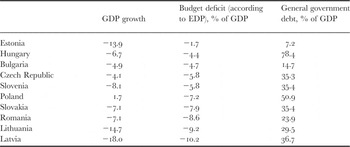
As Staehr (Reference Staehr2010a: p. 22) puts it, in the Central and Eastern European region, Estonia stands out as a “hardliner”, who has been committed to fiscal discipline, while other countries have either undertaken expansionary expenditure policies (the Czech Republic, Poland, Slovakia and Slovenia) or had to ask help from the IMF (Latvia, Hungary and Romania). Staehr (Reference Staehr2010b: p. 689) also notes that the budget balance as a percentage of GDP worsened from 2008 to 2009 for all CEE countries that are members of the EU, except Estonia. As can be seen from Table 1, the Estonian case stands out among the CEE countries by having simultaneously the third largest drop of GDP in the region and the lowest budget deficit (and the lowest public debt) in 2009. For comparison, Latvia and Lithuania witnessed somewhat higher drops in GDP than Estonia (18% and 14.7% respectively), but they recorded significantly higher budget deficits than Estonia (10.2% and 9.2% respectively).
Selected economic and fiscal indicators for EU members from the CEE region, 2009

Source: Eurostat.
In the background of the high deficits recorded in most EU countries in 2009 and austerity packages adopted in 2010, Estonia has been applauded as a “poster-child” of fiscal discipline (see e.g. Economist 2009, 2010) and was granted the permission to join the euro-zone as of 1 January 2011. In the light of the resumed growth in the second half of 2010, the praise for Estonia's fiscal retrenchment (combined with the refusal to devalue the currency) has become even louder. Also, in credit markets Estonia's credit default swaps valuation halved in the first half of 2010 (that is, the perceived likelihood of default halved). While it is odd that Estonia's debt is being valued at all as it is not publicly traded to begin with, it is a sign of a general tendency to see in Estonia an example par excellence of handling the crisis.
The recent fiscal developments in Estonia raise an important question: Why did Estonia choose fiscal retrenchment in 2009, instead of opting for counter-cyclical fiscal policy? Though the critique of fiscal stimulus and calls for budget cuts returned in 2010, one has to understand that the actions of the Estonian government in 2009 were as “far away as it could get” from the fiscal policy approach adopted in most developed countries, which makes it stand out as a curious outlier. Indeed, in both the EU and CEE context, and against the backdrop of the fall in economic output, the Estonian fiscal indicators appear almost as a “sheer magic” (Kattel Reference Kattel2010). This paper seeks to explicate the policy choices of the Estonian government during the crisis and to analyze what were the main reasons behind the commitment to fiscal discipline and fiscal consolidation in 2009. It also examines to what extent the factors pointed out by the literature on political economy of fiscal adjustment played a role in influencing the fiscal policy choices of the Estonian government and whether the theoretical framework put forth by discursive institutionalism helps to explain and understand the developments of fiscal policy in Estonia. The case study makes use of policy documents, media discussions, verbatim records of the parliament, and personal communication with political actors. It is also worth emphasizing that this article provides only positive analysis of different factors that have influenced fiscal policy choices in Estonia; it does not conduct normative or evaluative analysis of the desirability and impacts of these policies.
The paper is structured as follows. Section 2 discusses factors that can potentially influence fiscal policy choices of a government and outlines the core propositions of discursive institutionalism, which is employed as the analytical lens for examining the Estonian case. Section 3 gives an overview of the fiscal adjustment (budget cuts and tax increases) undertaken by the Estonian government in 2009. Section 4 seeks to explain why Estonia opted for fiscal retrenchment instead of counter-cyclical budgetary policies. Section 5 concludes.
2. Analytical Framework
2.1. Fiscal policy options during the Great Recession
In the face of a major economic downturn, a government is in principle faced with a choice between counter-cyclical, a-cyclical or pro-cyclical fiscal policy. In the case of a counter-cyclical policy option, the government can either let the automatic stabilizers work or it can choose to go beyond that and undertake discretionary fiscal policy measures in the form of stimulus packages entailing expenditure increases, tax cuts or both, financed from accumulated reserves or loans. On the other hand, in the case of pro-cyclical fiscal policy during an economic downturn, the government would curb expenditures and raise taxes in order to deal with the falling tax revenues without having to incur loans.
The global financial crisis and economic recession of 2007–2009 (what we call here “the Great Financial Crisis” and “the Great Recession”) witnessed the return of the importance of more activist fiscal policy in both academic debates and government's actions (see, inter alia, Auerbach Reference Auerbach2009; Arestis and Sawyer Reference Arestis and Malcolm2010). While the “new consensus” that had emerged from the convergence of the ideas of neo-classical economics and new Keynesians emphasised the primary role of monetary policy as a macro-economic policy instrument and called for fiscal policy rules to dampen excessive deficits (see, for example, Arestis Reference Arestis2009a, Reference Arestisb for overviews and critical assessment), the new “fiscal activism”, which emerged in 2009, advocated more extensive use of fiscal policy measures.
Given the dimensions of the crisis, lesson-drawing from the policy actions taken during the Great Depression of the 1930s became a focal point in the discussions over how to put a break on the economic slowdown. Even the International Monetary Fund, which in the past has been notorious for proposing pro-cyclical measures to “stabilize” economies in crisis, called for an active and concerted use of discretionary fiscal policy in 2009 (see, for example, Spilimbergo et al. 2008; IMF 2009). Inspired by Keynesian ideas, many governments went beyond just letting the automatic stabilizers to work and engaged in discretionary fiscal policy in the form of fiscal stimulus packages, combining government investment, government consumption and tax cuts.
It is, of course, too early to say whether this swing in academic discourse and policy instruments would amount to a “paradigm shift”, but, it is safe to say that, at least in 2009, many (if not most) of us were Keynesians both in rhetoric and in action. While in 2010, the debate over fiscal policy has become more polarized again, witnessed by critiques of excessive deficits, concerns of public debt sustainability, fears of sovereign debt default and calls for fiscal consolidation (e.g., Buiter Reference Buiter2010; Candelon and Palm Reference Candelon and Palm2010), the previous year had seen a remarkable consensus among policy-makers in developed countries – at least with regard to the general principle (though not necessarily on specific details about what a fiscal stimulus package should look like) about how a government should act to mitigate the real economy effects of the crisis.
In the developing and emerging markets, however, the scene of fiscal policy discourse and policy action was more complicated. These countries did not always have the leeway or capacity to undertake more activist fiscal policy. Indeed, even though the IMF recommended activist fiscal policy entailing stimulus packages in developed countries, it was more cautious with regard to recommending such policies in developing or emerging economies.Footnote 2 In the CEE region, the spectrum of fiscal policy actions was more varied than in the “old” EU member states as a whole. While Poland, the Czech Republic, Slovenia and Slovakia decided to adopt counter-cyclical fiscal policy measures and increased their expenditures in 2009, then Latvia, Hungary, Romania and Estonia decreased their expenditures in the midst of the crisis. It is important to note here, however, that the expenditure reduction efforts in Latvia, Hungary and Romania were driven by conditionalities imposed by the agreements with the IMF (implying that these countries did not have the luxury of “choosing” their fiscal policy course independently anymore). Estonia, however, despite having the “luxury” of choice (as it had significant reserves and very low level of public debt), adopted a clearly pro-cyclical fiscal policy stance and independently undertook extensive fiscal consolidation (Staehr Reference Staehr2010b: p. 687).
2.2. How to Explain Fiscal Policy Choices?
In the light of the Keynesian turn in policy practice and resurgence of Keynesian arguments in academic debates in 2009, an obvious question to academics interested in the political economy of fiscal governance is: why did countries still differ in their fiscal policy responses to the economic downturn? In particular, why, despite the widespread diffusion of fiscal activism in 2009, did at least some countries choose to forego fiscal stimulus and, in the face of falling tax revenues, engage in fiscal retrenchment instead? Obviously, when the government faces objective borrowing constraints (in the form of inability to issue domestic bonds or high interest rates when trying to borrow from international markets), it would be forced to consolidate its public finances, instead of opting for fiscal stimulus – either automatically (when there are simply no revenues to cover expenditures) or as a result of loan conditions imposed by the lender of last resort (like the IMF). In the absence of such clear constraints on borrowing, however, one needs to probe closer. It may be that the polity has tied itself to a mast of extremely strict fiscal rules, imposing limits on public debt or budget deficit. Or, it can be that since the governing parties are committed disciples of neo-liberal economic principles, they are skeptical of the effectiveness of fiscal policy and hence reluctant to engage in fiscal activism. Or, there may be some other factors in play. Which of these factors (or configurations of factors) play a causal role in shaping fiscal policy choices is difficult to say a priori on the basis of the existing literature on the political economy of fiscal policy. Indeed, the existing literature has attempted to explain differences in fiscal policy (like deficit spending, discretionary fiscal interventions or fiscal consolidations) during times of “normal” cyclical fluctuations, whereas the Great Recession has been more extreme in its dimensions and effects.
On the basis of the existing literature, for example, one would conjecture that the ideology of the governing party (or parties) and the existing political institutions play a relevant role in fiscal policy choices. One would expect, for example, left-leaning governments to have undertaken counter-cyclical fiscal measures and engaged in fiscal expansion and right-leaning governments to embark on a-cyclical or even pro-cyclical fiscal policy (Cusack Reference Cusack1999; Carlsen Reference Carlsen1997; Pamp Reference Pamp2008). As Cusack (Reference Cusack1999) and Carlsen (Reference Carlsen1997) argue, leftist parties would be reluctant to tighten fiscal policy during a recession since high unemployment (induced by the economic slump) hurts their main constituencies (who are economically more vulnerable); hence, they would argue for stimulating the demand and incurring deficits. The right-leaning parties, however, when faced with slackening demand, would endorse a tighter fiscal stance since they would consider the economic slump to be a natural result of the market mechanisms, which would eventually correct themselves (and activist fiscal policy would be seen only to interfere with the natural workings of the market). In addition, Carlsen (Reference Carlsen1997) argues, drawing on Hibbs (Reference Hibbs1977), that right-leaning parties place a greater emphasis on lower inflation and would hence be averse to using expansive fiscal stimulus. In the backdrop of the dimensions of the Great Recession and the sense of urgency for action that prevailed, however, the ideological colouring of the parties in power seems to have a rather weak explanatory power as a whole – although it would still be necessary to examine the role of this factor in particular cases.
With regard to institutional factors that are considered to shape fiscal policy choices in the political economy literature, fiscal rules have gained widespread attention during the recent decades (for a literature overview, see Raudla Reference Raudla2010: ch. 6). Though during times of normal fluctuations, fiscal rules (like balanced budget requirements, borrowing restrictions or debt ceilings) may – at least in principle – act as constraints on fiscal choices (depending on the design of the rules and sanctioning mechanisms provided), one would expect the explanatory power of those rules to have weakened during the Great Recession – either because such rules provide for exceptions during economic emergencies or because political actors would consider deviation from such rules to be meaningful during such a major economic downturn. However, a fiscal rule may provide explanatory insights in specific cases, especially when combined with factors that have turned the fiscal rule into a focal point of policy action.
Going beyond the more “simple” political economy explanations that consider the effects of different political, ideological and institutional factors in isolation, one could attempt to make use of somewhat more elaborate theoretical approaches that attempt to combine these factors into a more coherent framework. Given their focus on the interaction between ideas and institutions, approaches such as discursive institutionalism (Schmidt Reference Schmidt2008, Reference Schmidt2010), ideational institutionalism (Hay Reference Hay2001; Blyth Reference Blyth2002) and historical institutionalism that focus on ideas (e.g., Hall 1993) could be fruitful. Based on these approaches, one would expect fiscal policy choices of a polity to be shaped by a configuration of programmatic ideas that have contributed to the formation of particular kinds of institutions, which, in turn, re-enforce these very same ideas by structuring incentives and facilitating specific forms of discourse (see, for example, Blyth Reference Blyth2002). According to these approaches, the emergence of (new) policy ideas also depends, on the one hand, on the existing institutional structure, which acts as a (potential) filter by limiting access to policy-making arenas, and on the other hand, on the discursive processes enfolding on these arenas (Schmidt Reference Schmidt2008, Reference Schmidt2010). Although the literature of discursive institutionalism is still in its early phases of development and is yet to formulate more specific hypotheses and predictions, some general propositions can be put forth. First, drawing on Campbell (Reference Campbell1998: p. 399), one would expect that a programmatic idea concerning fiscal policy will be translated into actual policy, if it “provides clear and simple solutions to instrumental problems, fits existing paradigms, conforms to prevailing public sentiment, and is framed in socially appropriate ways.” Second, fiscal policy choices of a polity are likely to be shaped by policy legacies and to reflect path-dependent developments: policy choices made at some “open” period (or critical juncture) are likely to influence policy options available further down the path (see, among others, Hall 1993; Pierson Reference Pierson2000; Blyth Reference Blyth2002). On the one hand, political actors would engage in “social learning”, whereby, as Hall (1993: p. 288) puts it, “changes in policy at time-1” would be “a response to policy at time-0 and its consequences” (see also Greener Reference Greener2001). On the other hand, the policy options made in t-0 can turn into constraints, especially on the level of institutional capabilities that have been created as a result of initial policy choices (see, e.g., Pierson Reference Pierson1994; Campbell Reference Campbell1998). The institutional capabilities here can also influence the content and the spectrum of policy ideas that are considered feasible (and hence worthy of further consideration) by the dominant policy actors in the subsequent periods (see, e.g., Hall 1993; Schmidt Reference Schmidt2008). Third, the general political institutional setting influences how likely the departures from this particular policy path are: the more actors are allowed to participate in the coordinative discourse, which generates new policy ideas and alternative causal narratives, the more likely it is that the existing policy programmes are challenged (Schmidt Reference Schmidt2008, Reference Schmidt2010). Schmidt (Reference Schmidt2008), conjectures, for example, that in “simple polities”, communicative discourse (aimed at persuading the public) is likely to dominate, while in “compound polities” (with a larger number of actors participating in policy-making), political actors are more likely to focus on “coordinative discourse”.
The case of Estonia provides for a unique opportunity to explore fiscal policy-making during a major crisis, since its government voluntarily chose to go for fiscal consolidation – despite large accumulated reserves, remarkably low public debt level and existing opportunities to borrow – instead of adopting counter-cyclical fiscal policy measures in 2009. In addition, the Estonian case provides an opportunity to test to what extent the vocabulary, mechanisms and conceptual frameworks put forth by the literature on discursive institutionalism helps to understand and explain this curious case in fiscal policy-making.
3. Overview of budgetary adjustments in 2009
Following a period of unsustainable boom, the Estonian economy started slowing down in 2007, after the two dominant banks in Estonia tightened lending conditions. After the burst of the domestic property bubble, the economy started contracting at the end of 2007. The Lehman bankruptcy in 2008 exacerbated the bust in Estonia and the output of the Estonian plummeted dramatically, falling by 5.1% in 2008 and by 13.8% in 2009. As a result, the tax revenues undershot the projected levels and the forecasted budget deficit arose significantly. The Estonian government responded to the recession with fiscal tightening and undertaking a wide range of austerity measures. In 2009, two supplementary budgets were passed in February and June 2009 totalling 7.5% of GDP in measures. Additional measures amounting to 1.5% of GDP were taken in autumn 2009 in the form of one-off dividends from state-owned enterprises).
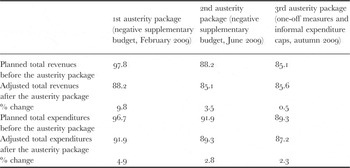
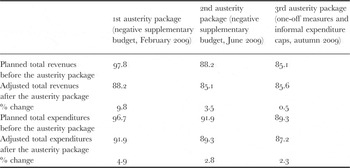
The budget of 2009, adopted in December 2008, was based on the assumption that the GDP would drop by 3.5% in 2009 (Raudla Reference Raudla2011). It entailed revenues of 97.8 billion kroons and expenditures of 98.4 billion kroons. In January, in the face of significantly lower tax revenues than expected, the Minister of Finance opted for sequestering the expenditures and imposed a cap on ministries’ monthly outlays. In February, the government compiled a negative supplementary budget, which was presented to the legislature on 20 February 2009 and adopted it on the same day. With this document, revenues projections were reduced by 9.6 billion kroons and expenditures lowered by 6.6 billion kroons (see Table 2). In the first austerity package, the focus was on operating expenses and transfers. For example, operational expenses of the central government were cut by 7%, sick leave benefits were curtailed, pension increase was capped and investments in road construction were reduced.
The content of austerity packages adopted in 2009 (billion kroons)
Source: Raudla (Reference Raudla2011).
With the economic outlook worsening in March 2009, the government started to prepare the next austerity package. This time, however, the bargaining process was significantly longer and more confrontational than had been the case in the previous round. While the ideologically dispersed coalition government (consisting of the rightist Reform Party, conservative Pro Patria and Res Publica Union and leftist Social Democrats) had managed to stifle the internal ideological tensions up to that point, then in this round the partisan differences prevailed in the discussions over possible austerity measures. By mid-May, the coalition government had still not been able to resolve their disagreements and the Social Democrats left the coalition (or they were “kicked out”, depending on one's perspective).
In June 2009, the minority cabinet consisting of the two remaining parties submitted the second austerity package to the parliament. Although the government did not have a parliamentary majority needed for passing the act (as they only had 50 seats out of 101), it managed to push the negative supplementary budget through the parliament with the help of the votes obtained from the Green party. In exchange for the Greens’ support, the minority government increased environmental fees and taxes. In contrast to the previous austerity measures that had concentrated on expenditure cuts, the package adopted in June 2009 entailed both expenditure cuts and tax increases. On the expenditure side, for example, the operating expenses were cut by further 8% (in addition to the 7% cut imposed in February) and the unemployment insurance benefits were curbed. The main tax increases were the following: the VAT rate was raised from 18% to 20% (as of 1 July 2009); the unemployment insurance contribution rate rose from 0.9% to 4.2%; pollution fees were increased by 20% and fuel excise by 12%.
A number of further measures were adopted by the cabinet in autumn 2009 but these “adjustments” were not formalized in law with a negative supplementary budget. For most part, the government adopted one-off budgetary measures; for example, it took out dividends from state-owned companies and sold shares of the Estonian Telecom. Also, the cabinet imposed some further expenditure constraints on the ministries by agreeing not to spend all the foreseen appropriations.
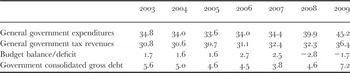
In sum, Estonia undertook very extensive fiscal adjustments in 2009. While in early 2009, the adjustment took the form of budgetary retrenchment – with extensive cuts made to investments, transfers and the government wage bill – then in mid-2009, the cutbacks were complemented with tax increases. As a result of tax increases and contracting economy, the proportion of tax revenues in GDP has increased from 32.4% in 2007 to 36.4% in 2009 (see Table 3). In the light of the figures showing that general government expenditures increased from 34.8% of GDP to 45.2% of GDP it may, at first, sight be confusing to talk about fiscal “retrenchment” in 2009. This increase in overall expenditure ratio has been driven, in part, by a significant drop in the denominator. In addition, the government massively increased the use of European (structural) funding.Footnote 3 It is also important to note that despite such an increase in the expenditure/GDP ratio, the fiscal policy stance of Estonia was still strongly pro-cyclical, which makes it stand out in the EU context.
Fiscal indicators for Estonia, 2003–2009, % of GDP

Source: Eurostat 2011.
4. Discussion
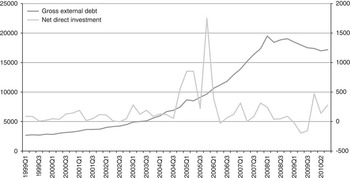
As was mentioned in the introductory section, it is puzzling that Estonia opted for fiscal retrenchment during the economic recession, instead of following the example of most other countries in the European Union, including several CEE countries, which made use of counter-cyclical fiscal measures. Hence, it is obvious to ask: why did the Estonian government decide to adopt a series of austerity packages and to avoid significant budget deficits, despite the fact that the international economic policy discourse was clearly favouring fiscal activism to counter the crisis and dampen the effects of the recession? The question is all the more pertinent as Estonia is a small open economy vulnerable to experience economic cycles in somewhat amplified form. Indeed, it can be argued that a currency board system with heavy reliance on FDI without any form of capital controls or FDI management policies – as is the case in Estonia – is particularly prone to both debt-led growth during upswings and FDI reversals during downswings, as indeed happened in Estonia. (See Figure 1)
Estonia's gross external debt and net direct investments (right axis), 1999–2010 (MEUR). Source: Bank of Estonia

In the following subsections, the discussion of the fiscal policy choices in Estonia proceeds on two different levels. First (in section 4.1.), the arguments of the dominant political actors themselves are outlined, followed by section 4.2., which puts these arguments into context and elaborates on the economic and institutional conditions that have given rise to such fiscal policy discourse. Section 4.2. also discusses to what extent the factors pointed out by the existing literature on the political economy of fiscal adjustment can help to explain the Estonian case and whether the analytical prism offered by discursive institutionalism is helpful for understanding the fiscal policy choices in Estonia.
4.1. Why did Estonia opt for fiscal consolidation in 2009: the explanations by political actors
In 2009 a variety of arguments explaining the necessity of fiscal retrenchment were put forth by the leading political actors. An analysis of the political discourse reveals three distinct – although clearly inter-related – lines of reasoning presented in defence of the fiscal austerity measures taken. First, it was argued in rather simplistic terms that “when we do not have money, we cannot spend”. Second, as the crisis got worse in the course of 2009, the dominant argument came to be that fiscal consolidation would be the “solution” to the crisis because it would allow Estonia to join the euro-zone and restore investor confidence. Third, there were also some calls to take the long-term view of economic policy, instead of a short-term focus.
First, the simplest of the arguments presented was the following: “If we do not have money, we cannot spend.”Footnote 4 According to this line of reasoning, incurring a budget deficit and taking loans was precluded as a feasible option; it was based on appeals to the “common sense” and parallels with a family budget. The argument of “we do not have money” was somewhat curious, however, given that the government had accumulated significant reserves by 2009: during the boom years of 2003–2007, budget surpluses had been transferred into a rainy-day fund (called the Stabilisation Reserve). Making use of the reserves, however, would have increased the formal figure of the budget deficit, which made the government reluctant to resort to it. Although there were a number of calls by the opposition to use the rainy-day fund since the “rainy days” had obviously arrived, the governing coalition stated that one may need this money when things get “even worse”. The government also argued that owing to large reserves that the government had, it may be able to borrow on more favourable terms in the future. At the same time, the “we do not have money” line of reasoning was complemented by the argument that borrowing was expensive and difficult. For example, it was noted that because of the currency board system, the possibilities for the government to borrow were limited or that the interest rates at which the government could borrow during the crisis were too high.
Second, a dominant line of reasoning that emerged in the political discussions in 2009 was that “cutting the expenditures is necessary in order to get us out of the crisis” (see e.g. Seaver Reference Seaver2009; Kase Reference Kase2009), Under this general message, a number of specific arguments were presented. The political actors emphasised that the primary task of the state during a crisis is to maintain the value of the currency and, through that, help to stabilise the economy. Further, it was repeatedly argued that fiscal discipline was the main vehicle for re-establishing trust in the Estonian economy: fiscal austerity was expected to send a positive signal about the trustworthiness of the Estonian state, reflected in the assessments of the international rating agencies, whose opinions, in turn, would influence the attractiveness of Estonia in the eyes of foreign investors and encourage them to invest in Estonia again.Footnote 5 Indeed, the leading political actors noted that by maintaining fiscal discipline Estonia would be able to distinguish itself from the other Central and Eastern European countries (including the other Baltic countries) and, through that, attract further investments (see, for example, Laar Reference Laar2009; Ligi Reference Ligi2009). As the minister of finance Jürgen Ligi put it, the negative risk ratings of the (CEE) region would spill over to Estonia and “kill our investments” (Riigikogu verbatim record, 21 October 2009). Strongly interlinked with the previous set of arguments was the goal to adopt the euro. In order to qualify for the euro, Estonia had to fulfil the Maastricht criteria, including the requirement not to exceed the deficit limit of 3% of GDP. While in 2007–2008, Estonia had not been able to join the euro-zone because of high inflation, the political actors hoped to make use of the deflationary pressures during the recession to finally meet the inflation criterion. Indeed, joining the euro-zone emerged as one of the main goals of the government during the crisis and the deficit limit of 3% became the main focal point in discussions over fiscal policy. The President of the Bank of Estonia noted, for example, that the future economic growth of Estonia would be clearly dependent on joining the euro-zone and that postponing the euro would mean the loss of 1% of GDP per year (Lipstok Reference Lipstok2009). It was hoped that the adoption of the euro would put an end to speculations about the plans to devalue the Estonian currency, increase investor confidence and distinguish Estonia from the other (problem-ridden) economies in Central and Eastern Europe (especially the other Baltic countries). Although the political actors often noted that “the euro is not an end in its own”, it acquired a strong symbolic value and one can argue that it provided a strong stimulus to keep the deficit under the limit of 3%. Indeed, the prospect of joining the euro-zone made the political actors more willing to inflict pain through austerity measures, in the hope that the arrival of the euro would compensate the painful measures in the eyes of the electorate. In addition to the “euro-argument”, the political actors stated a number of times that if Estonia does not get out of the crisis on its own (via expenditure cuts), then, “others would start making decisions for us”. This argument was clearly inspired by the experience of the neighbouring country Latvia, who had to apply for help from the IMF. As the former prime minister Mart Laar stated, “If we do not cut the budget, Estonia would become the ‘serf’ of the IMF” (Eesti Ekspress 2009). Or, as another leading figure of the Pro Patria and Res Publica Union, Margus Tsahkna put it, “If Estonia did not manage to cut 8 billion kroons, then the IMF would take over the governing of Estonia and a total chaos would follow: then we would have to cut expenditures and increase taxes as well.” (Anvelt Reference Anvelt2009) Alongside the fear of losing the ability to make one's own decisions, the reference to external actors (like the IMF, the EU and the OECD) were made by political actors in order to confirm the “soundness” of Estonia's chosen course of fiscal retrenchment.Footnote 6 It was constantly stated in the political debates that the IMF and the EU approve of the austerity measures taken by Estonia (see, for example, Ligi Reference Ligi2009; Hankewitz Reference Hankewitz2009).
It is noteworthy that although there were some calls for caution about the pro-cyclical nature of the austerity measures, aggravating the economic recession (Linnamäe Reference Linnamäe2009; Niitra and Meister Reference Niitra and Meister2009), a more dominant view in the political discourse was that in a small open economy like Estonia, active fiscal policy would be relatively toothless (see, for example, arguments in Ligi Reference Ligi2009; Postimees 2009). It was also argued that if the government were to incur budget deficits in order to ameliorate the crisis, a double-dip crisis would ensue – with the second dip following when the government withdraws the fiscal measures. Altogether, it appears that while many other countries in the world witnessed the return of Keynesianism as a leitmotif for fiscal policy in 2009, the Estonian government was more convinced of the non-Keynesian effects of fiscal consolidation and expected the cutbacks to have expansionary effects. As the President of the Bank of Estonia Andres Lipstok emphasised, “In a small country, achieving budgetary balance through expenditure cuts can be expansionary; it can invigorate the economy, because it increases investor confidence” (Lipstok Reference Lipstok2009).
Third, there were persistent calls by the dominant political actors to take a “long-term” view: it was emphasised that loans, once incurred, have to be paid back, together with interest, which would necessitate increasing taxes in the future, with detrimental effects on Estonian competitiveness and attractiveness as a destination of foreign investments (see Juhan Parts as quoted in Postimees 2009).
4.2. Factors influencing fiscal policy discourse in Estonia
With regard to the role of the main factors that have been pointed out by the political economy literature of fiscal adjustment – partisan ideology and fiscal rules – the Estonian case shows that existing literature, as a whole, points to the correct direction. For example, the ideological colouring of the parties in power certainly played an important role in the fiscal policy of the government. The dominant parties in the coalition government that undertook fiscal consolidation in 2009 were right-leaning. The left-leaning Social Democrats were willing to go ahead with fiscal adjustment until spring 2009, but when the austerity measures proposed by the right-leaning coalition partners touched upon the core ideological positions of the Social Democrats, they left the coalition. While in the public discourse, the right-leaning Reform Party and the Pro Patria and Res Publica Union persistently favoured fiscal austerity and complying with the Maastricht criteria in order to join the common currency, the other parties in the parliament were rather equivocal. The left-leaning Centre Party and the People's Union, for example, became more and more critical with each round of cuts and voiced concerns that the economic and social costs of the austerity packages may outweigh the benefits of joining the euro-zone. At the same time, while the opposition parties argued against the content of the austerity measures and focussed on tax increases instead, they did not propose a full-fledged alternative fiscal policy programme with clear counter-cyclical elements.
The Maastricht fiscal criteria are extremely relevant for understanding the Estonian case. Since the Estonian government aspired to join the euro-zone by 2011, the size of austerity measures was calculated with reference to the 3% deficit criterion. As the government regarded joining the common currency as an important step in getting “Estonia out of the crisis”, the deficit ceiling of 3% turned into a major focal point in fiscal policy discourse in 2009. Had the Maastricht criteria postulated a lower or higher level of deficit, the Estonian government would have adjusted the budget correspondingly.
Altogether, while these factors provide some explanatory insights to the Estonian case, one is still left wondering why the goal of joining the euro-zone became so important in 2009 or why the left-leaning opposition was not willing or able to put forth an alternative fiscal policy programme. In order to understand the Estonian case in more detail, the analytical insights of those approaches that focus on interactions between ideas and institutions (and how these interactions evolve over time) may be helpful.
Indeed, the explanation of why the Estonian government decided to consolidate the budget in 2009 should also include the experience of Estonia during previous crises. Both during the major crises in 1993–1994 and in 1999, the response of the government had been to cut expenditures in order to curtail the budget deficit. As such policy steps had always “paid off”, in the sense that the period of fiscal adjustment was followed by high economic growth, the political actors came to consider it as a “natural response” in the case of a fiscal shock. In other words, one can argue that the austerity packages adopted in 2009 reflected path dependent policy choices, whereby the political actors reacted to the fiscal shock in the same way that they had reacted during the previous crises.
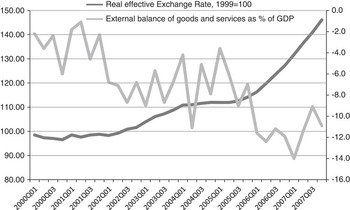
As argued by Raudla (Reference Raudla2010: ch.7), the commitment to fiscal discipline in Estonia until 2007 had been driven by a number of factors. First, given the choice of the currency board system in Estonia, the commitment to fiscal discipline by government was seen as very important for maintaining the stability of the currency. Indeed, one of the key challenges faced by former Soviet republics in the early 1990s was to align global and domestic prices without prolonged and crippling inflation (see, e.g., Sachs Reference Sachs1995). Because of the traumatic experiences with the hyperinflation at the beginning of the 1990s, during which many people lost their savings, having one's own currency was seen as a “saviour” from the perils of the high inflation. Against this background, maintaining the stability of Estonia's own currency was seen as one of the “cornerstones” or “holy cows” in the Estonian politics (see, for example, Korhonen Reference Korhonen2000). Second, the need to maintain budget balance was repeatedly pointed out by the IMF, which had an important influence on the public finance discourse in Estonia. One of the important reasons behind such an extensive influence of the IMF over Estonian budgeting was the fact that the Estonian economy was highly dependent on foreign sources of investment and the politicians reckoned that the IMF's opinions on a country play an important role in influencing the international rating agencies, which, in turn, would shape the decisions of foreign investors. Such a financial strategy, relying as it did on exchange rate stabilization backed-up by currency peg and board system, and fiscal balance, virtually ensured foreign savings based growth strategy, as is evident from Figure 1 above. However, one of the main pitfalls of the latter is financial fragility that in Estonia's case consisted in both vulnerability to reversal of foreign financial flows and in rapid loss of competitiveness through currency appreciation. This led to significant loss in external competitiveness. (See Figure 2) Third, given the successful economic development of Estonia in the 1990s, certain policy choices came to be seen as important guarantors of success – almost as “talismans” that cannot be neglected because this would bring bad luck. It was repeatedly argued by the politicians in the second half of the transition period that the currency board, the balanced budget and the proportional income tax are the three “holy pillars” of the Estonian politics, which cannot be challenged since “they are the bases for Estonian economic success”. Thus, the norm of balanced budget became a quasi-constitutional norm in Estonia, which could not be challenged without incurring significant political costs. Indeed, this norm has been considered to be important by all governments, irrespective of their ideological orientation (see, e.g., Lagerspetz and Vogt Reference Lagerspetz and Vogt1998).
Estonia's real effective exchange rate and external balance (right axis), 2000–2007. Source: Eurostat

It is also important to note that since regaining independence, economics as academic discipline developed in Estonia more or less according to international mainstream ideas. In other words, in contrast to many leading developing countries, such as Brazil, there is no significant domestic heterodox economic tradition. This is important not only because of intellectual debates. Indeed, ever since first free elections in 1992, Estonia has had governments leaning more or less clearly towards neoliberal economic policies. (See, e.g., Sikk Reference Sikk2006) Thus, it can be said that not only were at the outset of the crisis heterodox ideas relatively alien to Estonian academic and policy discourse, there was essentially no experience with alternative macro-economic policy ideas either among politicians or public servants.
In addition to the prevalence of particular political ideas and the perception of these political ideas as quasi-constitutional norms by major political actors, it is important to note that the neo-liberal ideas and policies that emerged during the critical juncture of 1992–1993 shaped the institutional developments of the state apparatus. Given the commitment to neo-liberal non-interventionist economic policies (often implying no-policy policy) in Estonia since 1992, there have been few possibilities to build up bureaucratic or political capacities of macro-management of the economy. The combination of the currency board arrangements with fixed exchange rate, openness to trade and capital, and balanced budgets were often perceived as virtuous because of the simplicity and automaticity built into these arrangements, implying passiveness of the state in managing the economy. In fact, one of the reasons why the currency board system was chosen in the first place was that the officials and analysts in Estonia lacked the capacity to conduct more active monetary and exchange rate policy. It can also be argued that Estonia drew “negative” lessons from the Scandinavian experience in 1970s and 1980s where growth spurts were followed by currency devaluations. (Mjoset Reference Mjoset2000) In fact, the Scandinavian model consisted of intricate management of boom-bust cycles as these economies relied on domestic resource-based industries and their successive upgrading cycles where devaluations served as key measures to siphon off financial fragility and return international competitiveness to exporting industries. (Kattel Reference Kattel2009) Estonia, along with the rest of the Baltic economies, in turn, chose financial stability that eventually generated financial fragility that these economies lacked the means to deal with as the policy competencies to steer and manage the economy were left undeveloped. Hence, when faced with a major economic shock, the idea of actively steering the economy out of the crisis appeared rather alien – there were no procedures and no analytical competencies for policy-makers to draw on. This helps one to understand why the fiscal policy in Estonia – despite the Keynesian turn in both the policy discourse and fiscal policy actions in many other countries – remained non-Keynesian.
With the deepening of the crisis, Estonia had an option to devalue its currency and thus attempt to regain some of the lost competitiveness. However, as credit to households rose very rapidly between 2000 and 2007 from 7.1% to 43.3% as a percentage of GDP (Kattel Reference Kattel2010) and gross debt of households as % of income reached nearly 90% by 2007 (Eurostat), nearly 80% of the debt was denominated in Euros. (Haiss, Paulhart and Rainer Reference Haiss, Paulhart and Rainer2009) This rendered the option of exchange rate change potentially doubly painful (soaring liabilities and falling income) and, as a consequence, devaluation was right away discarded from policy discussions. While devaluation may not have had direct impact on fiscal policy, it could have served as one probably highly necessary element in economic restructuring efforts. By discarding this option, and with next to no experience in heterodox economic policy, government had relatively few choices left to deal with the crisis but to revert to fiscal retrenchment. Indeed, hanging on to the currency peg under the circumstances described in Figure 1 above and Figure 2 below, made sure that Estonia's kroon was all but doomed as an independent currency and euro become almost a mandatory exit strategy for kroon and thus for the government as well. While the Prime Minister (who is still in office; Ansip has presided over various coalition governments since 2005) argued still in 2006 that he would not sacrifice economic growth in order to curb inflation (Estonia did not fulfil the Maastricht inflation criteria in 2006 and thus missed euro zone entrance in 2007), with the onset of the crisis and by rejecting devaluation, euro zone entrance became almost inevitably the panacea of Estonian discussions and with it also the level of public deficit.
In sum, one can argue that it was the ideational commitment of the governing parties that drove the discourse on fiscal adjustment in Estonia. This commitment to fiscal discipline was further supported by an external anchor (the Maastricht criteria and the goal to join the euro-zone) and by perceived reactions of the financial markets and rating agencies to the steps undertaken by the Estonian government. Further, the conviction that fiscal austerity should be the justified course of action during a recession was buttressed by experiences of Estonia during the previous crises, when the fiscal discipline had been applauded by external actors and followed by economic upturns. The symbolic importance of the balanced budget in the political discourse (both coordinative and communicative), combined with rather passive monetary policy (implicit in currency board arrangements) and rudimental industrial policy, throughout the 1990s and 2000s, had resulted in under-development of economic policy capacities on both the elected and bureaucratic policy-making arenas.
When attempting to understand and explain the Estonian fiscal policies, the theoretical insights, analytical framework and vocabulary offered by discursive institutionalism (Schmidt Reference Schmidt2008, Reference Schmidt2010) are indeed very useful. As Schmidt (Reference Schmidt2008, Reference Schmidt2010) argues, the “background ideational abilities” of the agents help us to understand how institutions are created and their “foreground discursive abilities” are useful in explaining how institutions persist or change. Indeed, as can be seen from the Estonian case, the prevalence of particular policy ideas hindered the development of specific institutions needed for more active management of the macro-economy. The constellation of general political institutions in Estonia – which make Estonia more akin to a “simple polity” rather than to a “compound polity”Footnote 7 – have constrained the “coordinate discourse” (referring to discourse among policy actors) by limiting the number of sources that can provide inputs to national policy-making, resulting in a situation where there is only one policy narrative or a causal story concerning economic development in Estonia and not a set of competing narratives or stories. Instead, the policy discourse on fiscal policy in Estonia has primarily been “communicative discourse”, whereby the political elites seek to persuade the public of the necessity and appropriateness of the existing fiscal (and other economic) policies.
5. Conclusions
As a curious twist to the global economic crisis of 2008–2010, Estonia becomes the 17th member of the euro zone in the aftermath of this crisis. It is certainly a surprising result for a country that experienced globally one of the steepest falls in GDP during the crisis. One of the main reasons Estonia became a member of the euro zone was its ability to keep public deficit within the Maastricht criteria (3% of GDP). This was accomplished with extensive fiscal consolidation in 2009. Estonia's heavy fiscal retrenchment was clearly against the international tide of increasing public spending in order to offset the crisis. This paper explored why the Estonian government opted for cutting expenditures and increasing taxes, instead of engaging in counter-cyclical fiscal policy.
In sum, we argue that it was the ideational commitment of the governing parties that drove the discourse on fiscal adjustment in Estonia. This commitment to fiscal discipline was further supported by an external anchor (the Maastricht criteria and the goal to join the euro-zone) and by perceived reactions of the financial markets and rating agencies to the steps undertaken by the Estonian government. Further, the conviction that fiscal austerity is the justified course of action during a recession was buttressed by experiences of Estonia during the previous crises, when the fiscal discipline had been applauded by external actors and followed by economic upturns. The symbolic importance of the balanced budget in the political discourse (both coordinative and communicative), combined with rather passive monetary policy (implicit in currency board arrangements), throughout the 1990s and 2000s resulted in under-development of macro-economic policy capacities on both among politicians and civil servants.
With regard to a major factor stressed in the literature on political economy of fiscal adjustment – partisan ideology and fiscal rules – the Estonian case provides support. The ideological colouring of the right-leaning parties in power certainly influenced the decision to adopt austerity measures instead of stimulus packages and/or letting the automatic stabilizers work. At the same time, though the left-leaning opposition parties argued against the details of the austerity measures, they did not put forth a full-fledged alternative fiscal policy programme that would have entailed clear counter-cyclical elements. The Estonian case study also indicates that the existence of a fiscal rule (like the Maastricht criterion) can be extremely relevant for understanding fiscal policy choices in a polity. As the government viewed joining the common currency as an important step in “getting Estonia out of the crisis”, the deficit ceiling of 3% turned into a major focal point in the public discourse over fiscal policy in 2009.
However, while these factors provide important explanatory insights to the Estonian case, they do not provide an exhaustive explanation. The analytical insights of those approaches that focus on interactions between ideas and institutions (and how these interactions evolve over time) offer a more complete understanding of the fiscal policy choices in Estonia during the recent crisis.
In particular, the austerity packages adopted in 2009 reflected path dependent policy choices, whereby the political actors reacted to the fiscal shock in the same way that they had reacted during the previous crises. Since the fiscal consolidations had paid during the previous crises (as the period of fiscal adjustment was followed by high economic growth) the political actors came to consider it as a “natural response” in the case of a fiscal shock. In addition to the prevalence of particular political ideas and the perception of these political ideas as quasi-constitutional norms by major political actors, it is important to note that the neo-liberal ideas and policies that emerged during the critical juncture of 1992–1993 shaped further institutional developments of the Estonian state. Given the commitment to neo-liberal non-interventionist economic policies (often implying no-policy policy) in Estonia since 1992, there have been few possibilities to build up bureaucratic or political capacities of macro-management of the economy. Hence, when faced with a major economic shock, the idea of actively steering the economy out of the crisis appeared rather alien: there were no procedures and no analytical competencies for policy-makers to draw on.
Theoretically, the Estonian case study shows that the existing literature on the political economy of fiscal governance could strongly benefit from the insights of discursive institutionalism, which emphasises interactions between policy (and also programmatic) ideas and institutions. The literature on discursive institutionalism can provide useful vocabulary, typologies, points of focus, and explanations of mechanisms for understanding fiscal policy choices in a particular polity.
Acknowledgements
The authors would like to thank Wolfgang Drechsler, Erkki Karo, James Savage, Jan Kregel, and the anonymous reviewers for their valuable comments on earlier drafts of this paper. The paper also benefited from the comments of participants at the annual conference of the Association of Budgeting and Financial Management, 7–9 October 2010, in Omaha, Nebraska. Research for this article was carried out with the financial support of the Mobilitas Grant of the European Social Fund (no. MJD43), the Estonian target financing grant (no. SF0140094s08), and Estonian Science Foundation grant no 8418.