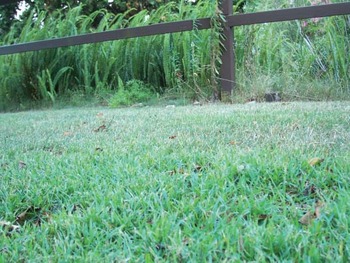
It is often said that the grass is greener on the other side (Fig. 1). In order to quantify the level of proof of the proposition, a Cochrane Collaboration review was undertaken of all the trials involving the greening of grass.
Plot of grass on ‘this’ side; greenness of grass on ‘the other’ side cannot be determined from this view.

Objectives
To determine whether the grass is greener on the other side and, if so, how much greener and whether it is worth moving to the other side.
Search strategy
Beginning on a wet, idle weekend, the investigator carefully reviewed all personal ideas regarding grass. Views were then solicited from those related to the investigator in any way, including relations by blood and marriage, co-members of sporting and academic groups, neighbours and friends, and including a limited number of complete strangers who happened to be sharing the bus or coffee queue. The search strategy included a visit to the grass display plots in the Sydney Botanic Gardens and perusal of fertilisers on display in a representative selection of hardware shops. Finally, databases were searched for trials involving the greening (deliberate or accidental) of grass, both on this and the other side.
Selection criteria
All randomised, placebo-controlled trials comparing plots of grass were considered for the review.
Data collection and analysis
One rater independently collated trial data, and assessed trial quality. Investigators were contacted to obtain missing data. Summary statistics were stratified by grass type (couch, buffalo, kikuyu, hybrids and other) and side (here or there). Dichotomous and continuous measures were calculated using a random effects model; heterogeneity was assessed; and subgroup/sensitivity analyses were undertaken.
Main results
Nine hundred and eighty-seven studies were identified involving 8648 lawns. Of the 987 studies, 362 were not properly randomised and were excluded. An additional 280 were excluded because there was no control. In 168 studies ‘this’ and ‘the other’ side were not clearly defined, thus leading to exclusion. In a further 106 studies, the control condition did not appear to have received equal treatment (e.g. not being watered, less fertiliser, subjected to a non-equivalent degree of trampling etc.); therefore, these were excluded along with 69 studies that suffered from such extensive missing data that they were deemed unreliable and excluded. This left two studies, one of which had an n of 4 (the lawns of the investigator and three neighbours) and was deemed to be unrepresentative. The only remaining study came very close to meeting the criteria for inclusion. It was very well designed with a very large sample size but, unfortunately, it was discontinued while the grasses were still at seedling stage due to impounding of the ammonium nitrate which was to be used in fertilising the plots, thus rendering the results inconclusive. Hence, there were no results that met the demanding criteria of the Cochrane method and so no conclusions can be drawn.
Summary
Evidence suggests that lawns get greener if they are watered and fertilized; however, the question of whether the grass is greener on the other side could not be answered using Cochrane methodology.
Discussion
Cochrane reviews have become the sine qua non of evidence-based medicine, and current medical school teaching of evidence-based medicine relies heavily on the Cochrane Database. However, so many studies fail to meet criteria for the reviews that medical students frequently conclude that there are no effective treatments for a given condition. The value of a single randomised controlled trial (RCT) is diminished as less objective; yet, meta-analyses themselves inevitably involve some subjective judgements (e.g. about criteria for inclusion) Reference Voils, Barroso, Hasselblad and Sandelowski(1,Reference Robertson, Idris and Boyle2) and may draw inaccurate conclusions Reference Muncer, Taylor and Craigie(3,Reference Ludtke4). The RCT can at least be seen as complementary to meta-analysis Reference Villar and Piaggio(5) and a case could be made that including all available RCTs for consideration is an essential component of compiling a comprehensive evidence base. Likewise, uncontrolled or non-randomised studies, case studies and qualitative research may still have valuable information about treatments, and may not represent the greatest source of variation in results (e.g. (Reference Robertson, Idris and Boyle2,Reference Furlan, Tomlinson, Jadad and Bombardier6,Reference Smith7)).
Conclusions
Perhaps it is time to take a second look at the place of the Cochrane review in identifying treatments with demonstrated efficacy. A balanced view of the evidence for a given treatment might include reference to a range of study methods, with individual trials being assessed for power and adequacy of design to determine the relative weight to be accorded.