1. Introduction
What impact does exposure to two languages have on the development of grammar in bilingual children? We address this question in the domain of object omission, where some variability is present in the monolingual input, and where, for certain language combinations, bilingual children have been shown to differ from monolinguals. The children in the present study are exposed to French and English, two pronominal languages. Our goal is to assess possible bilingual effects in both languages of bilingual children, and to articulate a proposal as to why and when such effects may appear. We show that delays can be detected in a given domain and language combination where cross-linguistic influence is less likely, and that this effect appears in both languages. We propose that a developmental default representation, retained by virtue of reduced and ambiguous input, is responsible for this effect. In the next section, we discuss several aspects of cross-linguistic influence, one of which is known as bilingual delay.
1.1 Cross-linguistic influence
The last two decades of research in child bilingualism have shown that the two languages of bilingual children are separated (see De Houwer, Reference De Houwer1990; Genesee, Reference Genesee1989; Meisel, Reference Meisel1986; Paradis, Reference Paradis2001; Paradis & Genesee, Reference Paradis and Genesee1996) yet languages can influence one another. The direct influence of one language on the other is generally known as cross-linguistic influence, and a key question for the study of child bilingualism is to define under which circumstances (i.e., in which grammatical domains, and under which conditions of exposure) it can occur (see also Strik & Pérez-Leroux, Reference Strik and Pérez-Leroux2011). Previous research on language interaction has generally identified two main conditions for cross-linguistic influence. First, it appears to be constrained by language-external conditions, such as dominance from one language over the other or frequency of a given structure in the source language (see Döpke, Reference Döpke1998; Yip & Matthews, Reference Yip and Matthews2000). Second, it seems to be constrained by language-internal or grammatical conditions, such as structural compatibility and domain-specific vulnerabilities (see Hulk & Müller, Reference Hulk and Müller2000; Müller, Reference Müller2003). Many recent studies examining cross-linguistic influence have emphasized the role of interfaces, such as the one between syntax and pragmatics (see for instance Müller & Hulk, Reference Müller and Hulk2001; Paradis & Navarro, Reference Paradis and Navarro2003; Serratrice & Sorace, Reference Serratrice, Sorace, Beachley, Brown and Conlin2003). Other studies question whether cross-linguistic influence is limited to the syntax–pragmatics interface, or whether vulnerability should be stated in language processing terms, such as language activation and inhibition or syntactic priming (Meisel, Reference Meisel, Caunt-Nulton and Kulatilake2007a; Pérez-Leroux, Cuza & Thomas, Reference Pérez-Leroux, Cuza and Thomas2011; Sorace, Serratrice, Filiaci & Baldo, Reference Sorace, Serratrice, Filiaci and Baldo2009). However, the general assumption seems to be that cross-linguistic influence is a unidirectional phenomenon (i.e., something that happens only in one of the languages as the result of influence from the other) that depends on a particular language combination.
Cross-linguistic influence in bilingual children can manifest as differences in rates of development with respect to monolinguals, rendered as an acceleration or delay effect (see Bernardini & Schlyter, Reference Bernardini and Schlyter2004; Gawlitzek-Maiwald & Tracy, Reference Gawlitzek-Maiwald and Tracy1996; Kupisch, Reference Kupisch2007, among others). Another effect of cross-linguistic influence can be transfer, i.e., the introduction of a certain structure from one language into the other (see Döpke, Reference Döpke2000; Yip & Matthews, Reference Yip and Matthews2000, among others). For some authors, cross-linguistic influence can give rise only to quantitative differences (for examples of delays or acceleration, see Meisel, Reference Meisel, Caunt-Nulton and Kulatilake2007a, Reference Meisel2009, Reference Meisel, Kail and Hickman2010, among others), whereas for other authors some qualitative changes can occur under constrained conditions (for example, wh-in-situ questions in Dutch under the influence of French, see Strik & Pérez-Leroux, Reference Strik and Pérez-Leroux2011). We are concerned here with quantitative effects, specifically the factors inducing delay, the affected grammatical domains, and the role of the input. In the next section, we discuss the specific type of developmental phenomenon that interests us, the protracted development of pronominal objects in bilingual acquisition with respect to monolingual acquisition, and the explanations proposed, under the general idea of cross-linguistic influence.
1.2 The bilingual delay in the acquisition of objects: Previous studies
Previous studies on object omission in bilingual acquisition have mostly considered combinations of topic drop or null argument languages with non-null argument languages. In a topic-drop language, the constituent in a topicalized position can be omitted; an example of topicalized object drop is provided in (1) (from Müller & Hulk, Reference Müller and Hulk2001).
-
(1)


In null argument languages, such as Mandarin or Japanese, a null object can refer freely to a previously established discourse antecedent, as illustrated in (2); see Huang (Reference Huang1982, Reference Huang1984).
-
(2)

French and English, considered non-null argument languages, mostly disallow discourse-linked referential null objects. In a referential reading, both languages require an overt pronoun, as shown in (3)–(6).
-
(3) *John read this book and I read__ too.
-
(4)
-
(5) John read this book and I read it too.
-
(6)


The general result of dual language acquisition of this type of language pairing (topic-drop/null object language and non-null object language) is a delay in one language in bilingual acquisition with respect to monolingual acquisition. Bilingual children omit more, and for a longer period, than monolingual children in the non-null argument language. Considering previous research, the phenomenon seems to be dependent on the language combination. For instance, work by Müller and colleagues has shown that for the phenomenon of object drop and object pre-posing, the Germanic language (German or Dutch) influences the Romance language (French or Italian) and not vice versa (Hulk, Reference Hulk2000; Hulk & Müller, Reference Hulk and Müller2000; Müller & Hulk, Reference Müller and Hulk2001; van der Linden & Hulk, Reference Van der Linden and Hulk1996). However, development in the Germanic language is not analyzed in these studies; the authors generally mention that monolingual and bilingual children show similar development in this domain.
We concentrate in more detail on the concept of cross-linguistic influence as “indirect influence” proposed by Müller and Hulk (Reference Müller and Hulk2001), who analyzed the spontaneous speech of children between early two and three years of age. The authors proposed that cross-linguistic influence happens only when two conditions are met: 1) the affected property is at the interface between pragmatics and syntax (the C-domain in their framework), and 2) there is structural overlap between the two languages. In the specific case of object omission, both conditions are met, according to the authors. First, object omission (or object drop) in initial grammars can be characterized universally as an instance of empty topics licensed via a default discourse-licensing strategy. This developmental phase, termed the “Minimal Default Grammar” by the authors, has the properties found in a language such as Chinese. Second, a combination of languages, such as German and French, presents the necessary structural overlap: the default discourse-based strategy (discourse licensing of empty objects) is present in both languages in the early grammar. Moreover, in French, the input can be ambiguous between discourse-licensing strategy and morphological licensing. For example, a construction such as (7) could reinforce the discourse-licensing strategy (Hulk & Müller, Reference Hulk and Müller2000, p. 230):
-
(7)

The construction with an object clitic in (8), despite indicating a morphological licensing strategy (the preverbal clitic, as an affix on the verb, licenses a null object in the complement position), could also lead to a null object analysis because of the preverbal position of the clitic, which differs from the postverbal position normally occupied by other types of complement:
-
(8)

On the other hand, German, as a topic-drop language, only provides input consistent with the discourse-licensing strategy. Therefore, according to Müller and Hulk (Reference Müller and Hulk2001), German input, in addition to the French ambiguous input, reinforces the discourse licensing of null objects in French. In other words, indirect influence seems to entail the use of relevant input from one language (the topic-drop construction in German) in order to reinforce a licensing strategy in the other language (discourse licensing in French). This indirect influence manifests itself as a quantitative difference with respect to monolinguals: bilingual children omit objects at a higher rate and for a longer period of time in French than monolingual francophone children.Footnote 1 For example, some naturalistic data show that omissions among monolingual French children range between 11% and 20%, with a resolution time late into the third year in these studies (see Jakubowicz, Müller, Riemer & Rigaut, Reference Jakubowicz, Müller, Riemer, Rigaut, Hughes, Hughes and Greenhill1997; Müller & Hulk, Reference Müller and Hulk2001; van der Velde, Jakubowicz & Rigaut, Reference Van der Velde, Jakubowicz, Rigaut and Lasser2002). However, subsequent work taking into account only the clitic context shows that omissions can be as high as 60% in spontaneous speech (Pirvulescu, Reference Pirvulescu2006). For bilingual children, Müller and Hulk (Reference Müller and Hulk2001) show that object omission in French can be as high as 100%, and older three-year-olds still omit approximately 25% of objects in spontaneous speech.Footnote 2
Similarly, Yip and Matthews (Reference Yip and Matthews2000, Reference Yip, Matthews, Cohen, McAlister, Rolstad and MacSwan2005) analyze a naturalistic corpus of two Cantonese–English bilingual children from two to three years of age. The authors find evidence for licensing of null objects in child English. They attribute this overgeneration of null objects to a cross-linguistic influence from Cantonese.Footnote 3 They argue that this effect is both quantitative (higher rate of null objects in English for bilinguals compared to monolingual English) and qualitative (transfer of the null topic syntactic structure from Cantonese to English). The directionality of transfer appears to be determined by language dominance, with non-target structures found more prevalently in English when Cantonese is the dominant language.Footnote 4 They also consider input ambiguity, specifically in English, as a relevant factor in this case. The fact that some verbs in English can appear without an object makes the English input superficially consistent with null objects. Some examples are given in (9), involving optionally transitive verbs, in (9a), verbs with indefinite, non-specific omitted arguments, in (9b), and certain verbs and constructions allowing the omission of a referential object, in (9c) (all examples taken from Yip & Matthews Reference Yip, Matthews, Cohen, McAlister, Rolstad and MacSwan2005).
-
(9)
-
a. Let's eat.
-
b. The chef-in-training chopped and diced all afternoon.
-
c. John aimed at the target and missed (it).
-
The authors hypothesize that this combination of transfer and input ambiguity leads to illicit null objects that can still remain in the English of bilingual children as old as six, while they disappear much earlier in monolingual Anglophones: by age 3 in spontaneous speech, and by age 4 in an experimental setting (for spontaneous speech, see Bloom, Reference Bloom1990; Huang, Reference Huang1999; Hyams & Wexler, Reference Hyams and Wexler1993; Ingham, Reference Ingham1993/1994; for experimental data, see Pérez-Leroux, Pirvulescu & Roberge, Reference Pérez-Leroux, Pirvulescu and Roberge2008).
Under both types of analysis, a bilingual effect is obtained only when one of the languages of the bilingual child allows null objects. The prediction this makes is that bilingual children acquiring two languages that do not allow null objects (such as English and French, for example) should not exhibit more object omissions than monolingual children. We seek to test this prediction in the current study. It should also be considered that studies of interactions between two languages that differ with respect to the grammatical property investigated (topic-drop/null object language and non-null object language) run the risk of confounding two possible sources of bilingual effects: those due to the grammatical differences (unidirectional cross-linguistic influence), and those that might be due to the mere exposure to two languages (general bilingual effect).
1.3 Input effects
One of the strong results of the past decade's work on bilingual acquisition is that mere exposure to two languages does not result in protracted development in bilinguals as compared to monolinguals (Genesee, Reference Genesee2001; Meisel, Reference Meisel, Cenoz and Genesee2001; Nicoladis & Genesee, Reference Nicoladis and Genesee1997; Paradis & Genesee, Reference Paradis and Genesee1996); the language faculty seems well-equipped to acquire two or more languages simultaneously. As we saw in the previous sections, one of the most important effects of cross-linguistic influence in bilingual acquisition are the changes in the developmental timetable, resulting in acceleration or delay of one of the languages of the bilingual child, in contrast to the monolingual development. However, delay in the absence of cross-linguistic influence – what we call bilingual delay – has been documented in diverse domains.
First, reduced input in imbalanced bilingual acquisition (in terms of traditional length of exposure measure or cumulative length of exposure, which takes into account the total daily amount of exposure according to a parental questionnaire) was shown to affect morpho-phonologically opaque grammatical structures, such as gender-marking in Dutch (Unsworth, Argyri, Cornips, Hulk, Sorace & Tsimpli, Reference Unsworth, Argyri, Cornips, Hulk, Sorace, Tsimpli, Pirvulescu, Cuervo, Pérez-Leroux, Steele and Strik2011; for other domains, see Meisel, Reference Meisel2007b; Paradis, Nicoladis & Crago, Reference Paradis, Nicoladis, Crago, Caunt-Nulton, Kulatilake and Woo2007). Second, inherently reduced exposure in (balanced) bilingual exposure was shown to result in reduced lexicon size in each of the bilingual's two languages (see Bialystok, Luk, Peets & Yang, Reference Bialystok, Luk, Peets and Yang2010, and references therein). Moreover, dual input was associated with delays in regulating pronominal dependencies regardless of the language combinations (for example the delay in correctly preferring null subjects in [–Topic Shift] contexts and overt subjects in [+Topic] contexts; see Sorace et al., Reference Sorace, Serratrice, Filiaci and Baldo2009). Similarly, effects have been found by Pérez-Leroux, Pirvulescu and Roberge (Reference Pérez-Leroux, Pirvulescu and Roberge2009a) in children acquiring French in a French/English bilingual context: francophone children (identified as monolinguals by their parents) growing up in an English-speaking environment had almost twice as many object omissions as francophone monolingual children from Montreal. Exposure to another language (although, presumably, mostly limited to receptive skills) seems to have played a role in the domain of object omission. Pirvulescu, Pérez-Leroux and Roberge (Reference Pirvulescu, Pérez-Leroux, Roberge, Braunmüller and Gabriel2012) also show that bilingual francophone children omit more object clitics than do monolingual francophone children. This effect cannot be attributed to cross-linguistic influence for either study, since the other language is English, a language which does not allow null objects. Moreover, since the object optionality stage ends earlier in English than in French monolinguals (Pérez-Leroux et al., Reference Pérez-Leroux, Pirvulescu and Roberge2008) it precludes the possibility of influence from English to French in terms of developmental timetables. These two studies were limited by the fact that in one case the delay could be associated with a bilingual context but not necessarily with bilingual acquisition – since children's exposure to the second language was mostly limited to receptive skills (Pérez-Leroux et al., Reference Pérez-Leroux, Pirvulescu and Roberge2009a) while in the other case the delay has been only investigated in French (Pirvulescu et al., Reference Pirvulescu, Pérez-Leroux, Roberge, Braunmüller and Gabriel2012).
Effects on the developmental rate of acquisition can also occur as a result of ambiguous input. We have seen in Section 1.2 that some studies defined ambiguous input for bilingual children as resulting from specific language combinations (Müller & Hulk, Reference Müller and Hulk2001; Yip & Matthews, Reference Yip and Matthews2000, Reference Yip, Matthews, Cohen, McAlister, Rolstad and MacSwan2005). Yet the same studies suggested that input can also be ambiguous within a single language. The authors alluded to the fact that input ambiguity within a language can be a factor in bilingual delay in the sense that the language with ambiguous input will be more vulnerable to cross-linguistic influence. Furthermore, developmental delays as a result of ambiguous input have also been proposed for monolingual acquisition. In particular, an analysis of patterns of object omission in parental speech in various corpora of children acquiring French or English by Pérez-Leroux, Pirvulescu, Roberge, Thomas and Tieu (Reference Pérez-Leroux, Pirvulescu, Roberge, Thomas, Tieu, Gurski and Radisic2006) seems to support this view of input-related delay. These authors showed that input relevant to null objects can be potentially ambiguous, in that some utterances can provide potential evidence for the existence of a null object with reference to a linguistic antecedent. In French, the following example could, from the child's point of view, be taken to license a referential null object of the Chinese type:
-
(10)

The verb lire can be interpreted as having a referential null object referring to the “magazine” in the previous utterance. While such an inference is pragmatically regulated in adult grammar, the emerging grammar could treat it as syntactically represented through a null topic analysis. The same kind of ambiguity can be found in English:
-
(11) We have to get rid of all the ugly dishes before your date arrives.
Okay, you wash __ and I’ll dry __.
(Goldberg, Reference Goldberg2001, p. 515)
Compare examples (10) and (11) with the Chinese example below:
-
(12)

An analysis of child-directed speech showed that, from a quantitative perspective, a substantial proportion of input is ambiguous as regards the context needed for the child to infer that English and French are not null topic languages. Such a context is the “individuated context”, where an antecedent is available in the preceding discourse (MOT = mother, FAT = father):
-
(13)
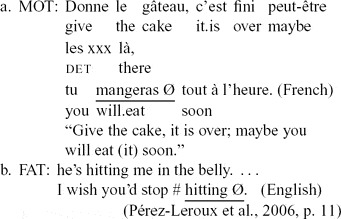
The underlined expressions in (13) are ambiguous between the referential (eat the cake/hit me) and the non-referential (eating lunch/hitting in general) reading of the object. They could then be analyzed, in the child grammar, as having a referential null element in the object position. It is proposed that this ambiguity is at the core of the object omission period of monolingual acquisition in both French and English, and possibly in other languages. All children are assumed to present a stage of object pronoun optionality that reflects the free availability of referential null objects. Children exposed to a language like French retain the referential null object longer than children exposed to a language like English because of the wider variety of (compatible) null object contexts in French (see Cummins & Roberge, Reference Cummins and Roberge2005; Pérez-Leroux et al., Reference Pérez-Leroux, Pirvulescu and Roberge2008).
Input ambiguity would therefore pose a problem for the monolingual child, but what is the effect of such language-internal ambiguity when the child is exposed to any two languages and the amount of input is reduced? Previous studies, while pointing out the possible influence of language-internal ambiguity even in bilingual acquisition, were not able to assess it because of the particular language combinations that pointed towards one language influencing the other. To start addressing the question of the bilingual delay, we will spell out our assumptions underlying direct object constructions across languages in the next section.
2. Object omission and the target grammar
2.1 The variety of null objects within and across languages
As we have seen in the preceding section, input to children can contain a variety of null object constructions that are potentially ambiguous within one language; when we look across languages, we also see that a large variety of referential null objects exists. As mentioned in Section 1.2 above, there are languages that recover null arguments from the context, such as Mandarin or Japanese (discourse-oriented languages). In other languages, the null object option interacts with the syntactic structure, such as the null object in a topicalized position in German; see the examples in (1) and (2) above.
Similar null referential objects are also present in languages with pronominal systems. In some cases, such as European Portuguese, anaphoric discourse-linked null objects coexist with accusative clitics. Raposo (Reference Raposo, Jaeggli and Silva-Corvalán1986) argues that there is free variation in European Portuguese between null objects and accusative clitics. Similarly, there are referential null objects with contextually determined antecedents in Polish, as shown in (14).
-
(14)

Finally, referential null objects can be found in some languages with developed systems of morphological V–object agreement, such as Pashto, as in (15).
-
(15)

In English, while referential null objects are not available syntactically, deictic instances where the missing object is recovered from context are attested:
-
(16) Here, read __!
Did you like __?
As we have seen above, there are also instances where the missing object has the appearance of referring to an antecedent, as shown in (17).
-
(17) While I wait for you, I’ll buy a newspaper and I’ll read…
However, previous analyses propose that this is not a truly anaphoric use of null objects. Rather, it is the result of pragmatic inference (Cummins & Roberge, Reference Cummins and Roberge2005).
In French (Cummins & Roberge, Reference Cummins and Roberge2005; Lambrecht and Lemoine, Reference Lambrecht, Lemoine, Chuquet and Frid1996; Larjavaara, Reference Larjavaara2000, among others), a referential null object construction seems to exist, albeit in a restricted way. The exact nature of this construction remains unclear; Grüter (Reference Grüter2009, p. 217) puts it this way:
[T]here appears to be converging evidence that referential null objects are indeed attested in French, although their exact distribution is only poorly understood at this point. Although earlier studies proposed that referential null objects were confined to a closed (albeit large) class of transitive verbs …, more recent work assumes the null instantiation of referential direct objects to be a fully productive, though strongly stigmatized, option in contemporary French, constrained by pragmatic, discursive, and stylistic factors.
An example is given here from Noailly (Reference Noailly1997, p. 100):
-
(18) Et la tête qu’il fait le jour où on rapporte au logis un store décoré d’une photo de Marylin … S’il déteste Ø vraiment, on le case dans la salle de bain …
“And the look on his face the day you bring home a blind decorated with a photo of Marilyn (Monroe) … If he really hates Ø, you stick it in the bathroom …”
This non-exhaustive list of cross-linguistic null object possibilities is meant to illustrate the variety that can potentially be found in the input. It could be that the target language has a fairly restricted set of referential null object constructions, as in French for instance, or a more developed system, as in Portuguese.
In order to accommodate this variety in the target grammar, recent theoretical research proposes that null referential arguments, being bundles of active but silent features, are universally available in syntax, whereas their distribution is constrained by surface factors (V2, lexical complementizers, etc.) acting as interpretative limitations (see Sigurðsson, Reference Sigurðsson2011). Referential null arguments can be clause-externally licensed, as in Chinese (discourse-linked) or Burmese (antecedent-linked), or clause-internally licensed, as in the Germanic and Romance languages. Moreover, it has also been proposed that implicit indefinite objects are syntactically represented. For example, Landau (Reference Landau2010) proposes not only that referential null objects are represented syntactically, but that generic, indefinite null objects are too, such as in the following example:
-
(19) A general can force __ to obey his orders.
(Landau, Reference Landau2010, p. 372)
Going one step further, and following such work as Cummins and Roberge (Reference Cummins and Roberge2005) and Hale and Keyser (Reference Hale and Keyser2002), Pérez-Leroux et al. (Reference Pérez-Leroux, Pirvulescu and Roberge2008) assume that all verbs (unergatives and transitives alike) can map onto a transitive structure; following this idea, a structural complement position at V root must always be available, irrespective of the overt or non-overt manifestation of the direct object. The representation of this general verbal transitivity is given in (20):
-
(20)
(Hale & Keyser, Reference Hale and Keyser2002, p. 93)

In terms of language acquisition, the variety of null object constructions presented in this section underscores the need for children's initial grammar to be sufficiently flexible to accommodate the range of possibilities found in their target grammar(s). Pérez-Leroux et al. (Reference Pérez-Leroux, Pirvulescu and Roberge2008) propose that child grammar includes the null object representation in (20), which can initially be used referentially and is the simplest null object representation available within the hypothesis space specified by UG. Data from acquisition studies show that in early grammars, object omission appears along with the pronominal option (Jakubowicz et al., Reference Jakubowicz, Müller, Riemer, Rigaut, Hughes, Hughes and Greenhill1997; Müller, Crysmann & Kaiser, Reference Müller, Crysmann and Kaiser1996; Pérez-Leroux et al., Reference Pérez-Leroux, Pirvulescu and Roberge2008, among others). Within this framework, the interpretation is that the default null object appears to be available along with language specific options, such as the clitic construction in French, or the strong pronoun in English. However, French and English differ in their typology of null objects: it has been proposed that French has a wider variety of null object constructions than does English (see Cummins and Roberge, Reference Cummins, Roberge, Auger, Clements and Vance2004), therefore resulting in a more complex (ambiguous) input. This results in comparatively more omissions and a longer omission period in the acquisition of French pronominal objects than found in English (Pérez-Leroux et al., Reference Pérez-Leroux, Pirvulescu and Roberge2008). Accordingly, it has been shown that in a language (and in the contexts) where there is free variation between null objects and accusative clitics, such as European Portuguese, the rate of omission is higher and children take longer to converge with the adult norm (see Costa, Lobo, Carmona & Silva, Reference Costa, Lobo, Carmona, Silva, Gavarró and Freitas2007; Costa, Lobo & Silva, Reference Costa, Lobo, Silva, Larranaga and Guijarro-Fuentes2012). In conclusion, a universal null object representation can accommodate the cross-linguistic variety in the availability and licensing of null objects; this represents the starting point of the acquisition process. The pace of development is language-specific and guided by the input, i.e. by the range and variety of null object construction available in the target grammar.
2.2 Hypothesis and predictions: The bilingual effect
As we have seen, previous studies of monolingual children show that null object constructions present an inherent ambiguity, in that the adult use of transitive verbs can often appear in a context with a potential antecedent (see examples (10) and (11) above). Moreover, some languages present more complex input in the domain of object realization (such as French) than others (such as English). The issue of input ambiguity and variability is relevant for both monolingual and bilingual acquisition. We propose that in both modes of acquisition, the child will cope with the ambiguity in the same way: by retaining the default representation in (20) until it is fully replaced by the target alternative(s). If this is correct, we should expect the same developmental curve in the acquisition of object clitics in both monolingual and bilingual children, along with language-specific developmental rates. However, it has been argued that in monolingual acquisition, the overall frequency in the input of a grammatical property (as evidenced in particular sentences, or tokens) correlates with the timing of the acquisition of the property (Yang, Reference Yang2002). In Yang's variational learning model, all grammars in the Universal Grammar space are initially available to a learner. Successful or unsuccessful parsing changes the weight and the probability of selecting a given grammar for future parses. If a particular structure contains several options (as direct objects in French) or the relevant marker is less robust in the input, this will count as ambiguous input for the learning mechanism and it will take longer to arrive at the target. The child converges on the target because, in each language, s/he will encounter the relevant marker and the target grammar, according to the model, is rewarded each time this happens. This will gradually lead to the prominence of this target grammar. We know that the bilingual acquisition context represents a case where, especially for balanced bilinguals, there is reduced input in each language when compared to monolingual acquisition of the same languages (Paradis & Genesee, Reference Paradis and Genesee1996). Could this reduction in the input affect the frequency of the relevant grammatical markers in the domain of object omission? If yes, then it might affect the data available for the reweighting algorithm and lead to language-specific delay in target grammar selection beyond the delays observed in monolingual acquisition.
Importantly, the hypothesis of ambiguous input across languages due to language overlap is eliminated by our choice of French and English. Following the idea of ambiguous input within each language and reduced input for both languages, we present two competing hypotheses:
Hypothesis 1: Bilingual Effect Hypothesis
Delay is induced by both ambiguous input within each language and reduced input across languages. In the case of objects, this will lead to longer retention of the default representation in both languages (i.e. object omission). We therefore expect bilingual children to produce more omissions in both French and English than their monolingual counterparts. Following monolingual developmental asymmetry (i.e. language-internal ambiguity), we expect generally more omissions in French than in English. At the same time, we expect language exposure and use to affect the frequency of the relevant grammatical property, and as such to alter the rate of omissions in unbalanced bilinguals.
Hypothesis 2: Cross-Linguistic Influence Hypothesis
If the timing of the acquisition of a construction is important, there could be a delay in English as a result of influence from French, as French monolinguals experience slower convergence towards the target. Alternatively, as pronominal convergence is faster in English, English could influence French, and we could expect an acceleration effect of pronominal convergence in French.Footnote 5 Clearly, one effect that we would not expect under this hypothesis would be to observe significantly more omissions in the French of bilingual children (i.e. a delay in French bilinguals) when compared to the French of monolinguals, as there is no possibility of that type of cross-linguistic influence from English.
3. Methodology: Participants and the experimental task
3.1 Participants
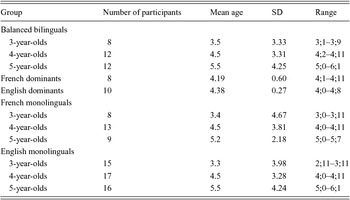
A total of 128 children participated in this study, between the ages of three and six years. The language groups (French and English) are composed of 32 simultaneous balanced bilinguals, 18 unbalanced bilinguals (French-dominant and English-dominant), 48 monolingual English children (from the Toronto area) and 30 monolingual French children (from the Montréal area). We employed a language questionnaire based on an adapted language history questionnaire by Paradis et al. (Reference Paradis, Nicoladis, Crago, Caunt-Nulton, Kulatilake and Woo2007). Designation as balanced bilinguals was based on two factors: a measure calculated from parental evaluation of child language ability (completely fluent/quite fluent/somewhat fluent/not fluent), and the parental report on current language exposure and use (based on who speaks what language to the child among his immediate family/caregivers and friends, and the language used for watching TV and reading).Footnote 6 The judgments were assigned numeric values: from 1 to 4 for French and from –1 to –4 for English. The level of bilingualism was the sum of French and English language ability.Footnote 7 The complete profile of a balanced bilingual is as follows: parental scores for language ability between –1 and 1; attendance in a francophone daycare in the Greater Toronto Area; and an average of 45% use outside the school for each language (ranging between 28% and 80% use at home). The profile of a French-dominant child is as follows: parental scores for language ability of 2 or 3; an average of 85% use outside the school (range between 50% and 85%); living in the greater Montréal area, in a French-language majority province (Québec); some exposure to English, either at home or at school; and French as the main language of interaction, although the child is able to understand English and interact in English at various levels. The profile of an English-dominant child is as follows: parental scores for language ability of –2 or –3; an average of 91% use outside the school (range between 66% and 100%); lives in the Greater Toronto Area, in an English-language majority province (Ontario); exposure to French in bilingual French–English schools, but very limited proficiency in French; and English as the main language of interaction outside the school. Monolingual French and English children will have scores of 4 and –4, respectively.
We separated the dominant groups (French and English) from the balanced ones for two reasons. First, only among the four-year-old children did a range of various dominance levels occur. Second, we wanted to ensure that there was a strong opportunity for a bilingual effect to be detected if there was one, while at the same time guarantee that any effects could not be attributed to French or English being the weak language (i.e. language dominance effects). First, in Section 4.1 below, we are concerned only with comparisons between balanced bilinguals and monolinguals. Then, in Section 4.2, we make a comparison between balanced and unbalanced bilinguals.
Monolingual and balanced bilingual children were separated into age groups, as summarized in Table 1. This follows previous elicitation studies on monolingual French and English children, where three-year-olds are shown to be in an omission stage (see Pérez-Leroux et al., Reference Pérez-Leroux, Pirvulescu and Roberge2008) but resolution of the omission stage is different across languages. In studying the balanced bilingual population, we sought to examine whether it would show alterations in the timetable of development in French and English.
Bilingual and monolingual children by age groups.

3.2 Experimental design
French and English versions of a Picture Elicitation Task were used, with order of language counter-balanced across participants. Two testers, one native French speaker and one native English speaker, administered the sessions. Eight optionally transitive verbs were used with different events in each language (i.e., different pictures): eat, drink, read, cut, hit, push, tickle, lick, and the French equivalents manger, boire, lire, couper, frapper, pousser, chatouiller, and lécher.Footnote 8 The verbs were in a semi-randomized order for each language (with different orderings of verbs for the French and English versions). For French, four objects were masculine and four feminine. For each language, there was one training item and four distracters for a total of 13 items per elicitation task. Half of the items had an animate object and half an inanimate object in order to add diversity in the task corresponding to how clitics are used in the language. Examples of the elicitation task are provided in (21) and (22):
-
(21) Animate story
What is the mean boy doing to the dog?/
Qu’est-ce que le garçon méchant fait au chien?
Target clitic response: He is hitting it. / Il le frappe.
he it hit
Null object: He is hitting __. / Il frappe.
he hit
-
(22) Inanimate story
What is the boy doing with the juice? /
Qu’est-ce que le garçon fait avec le jus?
Target clitic response: He is drinking it. / Il le boit.
he it drinks
Null object: He is drinking __. / Il boit ___.
he drinks
4. Results
4.1 The bilingual delay in French and English
Responses were coded according to the status of the direct object, as in (23).
-
(23)
-
a. Pronominal answer: Elle le pousse./She is pushing it.
-
b. DP answer: Il boit le lait./He is drinking milk.
-
c. Null answer: Il mange __./He is eating __.
-
d. Other: non-responses, non-relevant responses, and responses not using the target verbs
-
e. Other pronominals: in the case of French, non-target strong pronominals such as lui “him”
-
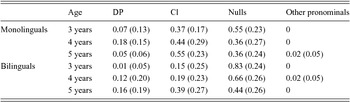
We eliminated “other” responses but we kept the “other pronominals” responses. Our first question was to investigate whether there is a bilingual effect in both languages. For this, we analyzed only the balanced bilingual group and the monolingual groups. The comparison with monolinguals was carried out for both French and English. The results for French are provided in Table 2.
Mean proportions (with standard deviations in parenthesis) of object types produced by bilingual (balanced) and monolingual French children.

For French, an age by group factorial ANOVA on the proportion of null responses as dependent variable (age: 3-, 4- and 5-year-olds, bilingual status: bilinguals, monolinguals), revealed a main effect of age (F(2,57) = 5.10, p = .009), and of bilingual status (F(1,57) = 11.01, p = .002). There was no statistical interaction between age and number of languages (F(2,57) = 1.20, p = .306). Post-hoc analyses for age using Fisher LSD on the bilingual group show significant differences between 3- and 5-year-olds (p = .005) and differences approaching significance for and 4- and 5-year-olds (p = .063), but no significant difference between 3- and 4-year-olds (p = .198). In other words, the behaviour with respect to omissions seems to change between 4- and 5-year-olds. For monolingual children, even if the amount of omissions differs between 3- and 4-year-olds, the difference did not reach significance (p = .23).
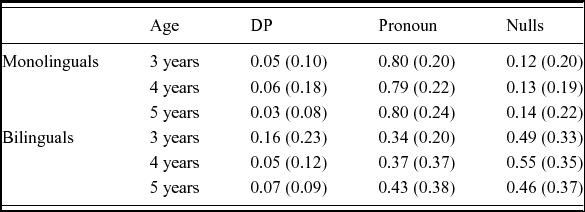
For English a similar age by group factorial ANOVA found no significant age effects (F(2,74) = 0.15, p = .859). As is the case of French, a comparison between monolinguals and bilinguals revealed that omissions are significantly higher in the bilingual than in the monolingual group (F(1,74) = 33.57, p < .000); there was no statistical interaction between age and number of languages (F(2,74) = .235, p = .79). The proportion of responses per type per group is presented in Table 3.
Mean proportion (with standard deviations in parenthesis) of object types produced by bilingual (balanced) and monolingual English children.

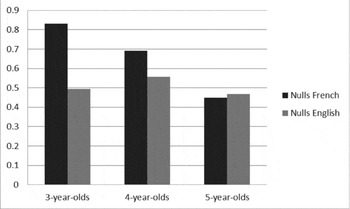
In both French and English, these simultaneous bilingual children have significantly higher omissions than their monolingual peers. One additional observation from Tables 2 and 3 is that the rate of omissions is higher in French than English. A mixed design ANOVA on the bilingual children alone, with language as the within-subjects factor and age as between-subjects factor, reveals a significant effect of language (F(1,29) = 4.41, p = .04). Figure 1 illustrates the differences between the two languages of bilingual children with respect to object omission.
Comparison of omissions in the two languages of bilingual children (mean proportions).

In sum, these results indicate that while there are significantly higher rates of omissions in both languages of bilingual children with respect to monolinguals, there are also differences in the rate of omissions across the two languages. The bilinguals’ rate of omission in each language partially reflects the behaviour of monolinguals in the respective language, showing a higher rate of omissions in French than in English. This result was expected, given the developmental asymmetry between the two languages in monolingual populations.
Our Bilingual Effect Hypothesis is thus confirmed. We found more omission in French and English produced by bilingual children than in the production of their monolingual age mates. The rates of omission, even if higher in magnitude in bilinguals than in monolinguals, follow the specific developmental patterns between French and English identified in the literature. However, we need to determine if the delay in bilingual English could be the effect of development in French influencing development in English. To this effect, we performed a three-way ANOVA with age, bilingual status and language as independent variables and object omission as the dependent variable. The results reveal an expected significant main effect of bilingual status (bilinguals vs. monolinguals) and of language (French vs. English) but, crucially, no interaction between the bilingual status and language (F(1,130) = 2.54, p = .113). We therefore conclude that the delay in bilingual English could not originate out of an influence from French. We can then maintain our hypothesis that asymmetric development follows the developmental timetable of each language, and that the bilingual delay is due to an overall bilingual effect.
If bilingual input induces delay, what would be the effect of language imbalance on object omissions? We explore this question in the next section.
4.2 Language dominance and the bilingual delay
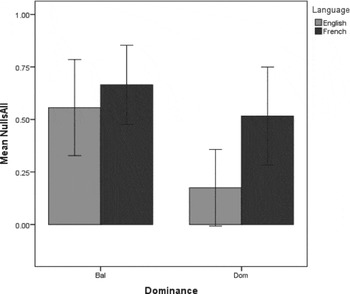
To test the second part of our Bilingual Effect Hypothesis, we investigated the effect of language dominance. To this purpose, we considered the data from the two groups of unbalanced bilinguals. One was a group of eight French-dominant children and the other was a group of ten English-dominant children (see their profiles in Section 3). Twelve age-matched balanced bilinguals were selected for comparison, for the effect of being a balanced bilingual vs. a dominant one. The effect of language dominance in French (comparing French balanced vs. French-dominant) and English (comparing English balanced vs. English-dominant) was assessed, and the results are presented in Figure 2.
Comparison of omission per language proficiency: subsample of balanced bilinguals age matched to unbalanced bilinguals (mean proportion).

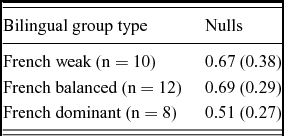
As before, higher rates of null objects were found in French. An ANOVA with language (French vs. English) and language dominance (dominant in either French or English vs. balanced bilinguals) revealed a main effect of language (F(1,40) = 7.813, p = .008). There were more omissions in French than in English. Interestingly, there was also a significant effect of dominance (F(1,40) = 5.629, p = .023). Balanced bilinguals omitted more than dominant children, in each language. Although the language effects seemed more pronounced in the unbalanced bilinguals, there was no significant interaction between language and dominance (F(1,40) = 1.503, p = .227). In order to control for possible effects of English dominance over French, i.e. cross-linguistic influence resulting in the acceleration of pronominal convergence in French, we looked at the rate of omissions in the French of English dominants and compared with the French of balanced and dominant bilinguals. The results, presented in Table 4, show no difference in the rate of omissions.
Mean proportion (with standard deviation in parenthesis) of object omission in French across the various bilingual groups.

It is interesting to note that asymmetrically bilingual children do not omit more in their weak French than balanced bilinguals do. There appears to be some key threshold between being dominant in one language, and balanced bilingualism that translates into null object retention. However, further reduction in the input does not seem to have additional effects on the extent of omissions.
5. Discussion
The results show that there is a bilingual effect in our population: bilinguals omit more and their development is protracted when compared to monolinguals. We did not find signs of English influence on French: having English as the other language does not lead to faster resolution of omissions in the French of these bilingual children. On the other hand, slower development in French does not seem to influence development in English, as no interaction has been found between language and bilingual status. These results confirm all aspects of our Bilingual Effect Hypothesis. First, bilinguals omit significantly more direct objects than monolinguals, in both languages. Second, development in each language of the bilinguals follows the developmental curve of monolinguals for each language, and we observe a quicker resolution in English than in French. Third, language imbalance has an effect on omissions: for each language, the more balanced the bilingual, the more omissions we find, and conversely, the more dominant in one language, the fewer omissions in that language, and we see results converging with the monolingual baseline.
Therefore, as cross-linguistic influence is ruled out, bilingualism itself seems to be the source of the effect found in our data. This might be surprising because, in principle, bilingual acquisition (defined as two languages from birth) is expected to result in native-like attainment and to follow monolingual acquisition rates: several previous studies show that bilinguals having an average of around 40–60% language exposure perform like monolinguals in various grammatical domains and on various standardized proficiency tests (Barreña, Ezeizabarrena & García, Reference Barreña, Ezeizabarrena, García, Pérez-Vidal, Juan-Garau and Bel2008; Thordardortir, Reference Thordardottir2008; Unsworth et al., Reference Unsworth, Argyri, Cornips, Hulk, Sorace, Tsimpli, Pirvulescu, Cuervo, Pérez-Leroux, Steele and Strik2011). However, effects of bilingualism have been found in certain domains. While these effects are more commonly found in receptive vocabulary size (Bialystok et al., Reference Bialystok, Luk, Peets and Yang2010), some studies also show effects in the grammatical domain. For example, studies on the acquisition of pronominal subjects showed that, regardless of whether the bilinguals’ other language is a null subject language (Spanish) or not (English), the process of anaphora resolution in Italian is affected (see Serratrice, Sorace, Filiaci & Baldo, Reference Serratrice, Sorace, Filiaci and Baldo2009; Sorace et al., Reference Sorace, Serratrice, Filiaci and Baldo2009, both with older bilingual children). Although these effects also exist to a lesser extent in monolingual children, the authors propose that the difference between bilinguals and monolinguals may be in higher costs in terms of processing efficiency for bilinguals. That is, they are less efficient than monolinguals in the integration of multiple sources of information, and therefore resort to a default redundant pronoun in order to alleviate the processing load.
Although a processing account might be compatible with our results, we advocate a grammatical explanation based on the same underlying representation in both bilinguals and monolinguals. The child has to resolve a syntactic problem, namely to determine under what conditions each language allows object omission (i.e. restriction of the default representation). We propose that retention of the default null object representation is supported by virtue of overall reduced bilingual input and input ambiguity within each language. Considering the null object possibilities across languages presented in Section 2, we assume that the common denominator between all languages is the structure in (20); moreover, null objects used referentially are part of the initial representation in the grammar of a child. This makes object omission in pronominal contexts possible in French and English child grammar, languages that otherwise do not allow (or drastically restrict) null objects in this particular context. We share, with Müller and colleagues, the idea that this initial representation in early grammar is a default universal structure, present in both monolinguals and bilinguals. We diverge in considering that this universal default is not a null topic, as in the Chinese-type grammar, which the child must then eliminate. Such a parametric approach is tied up with other characteristics of the initial parametric choice. The null object assumed by Müller and Hulk (Reference Hulk2000) is a variable, and it is assumed that a Chinese-like recoverability mechanism is in place, such that the null object is recovered from the discourse through an empty IP-adjoined topic. According to this proposal, the change from a Chinese-type grammar to a French-type grammar is triggered by the lexical instantiation of the CP domain, which makes the null object (PRO) illicit in the adjoined IP position. However, a correlation between the appearance of lexical elements in the CP field and the appearance of object clitics was not confirmed by subsequent studies on monolinguals (see Grüter, Reference Grüter2006; Pirvulescu, Reference Pirvulescu2006; van der Velde et al., Reference Van der Velde, Jakubowicz, Rigaut and Lasser2002). Moreover, as in the case of monolinguals, we observe optionality in the use of nulls vs. pronominals (clitics in French and strong pronouns in English) in the same context. Our proposal further diverges from the approach presented by Müller and colleagues in that, while also adopting a variational learning approach, we do not consider the delay to be the results of “indirect influence” (i.e. input ambiguity across languages), because with our choice of languages, the issue of language overlap is eliminated.
To explain congruent behaviour between bilinguals and monolinguals, along with quantitative differences between the learning curves of the two populations, we have considered the implications of the variational model of grammatical learning, according to which the actual rate of language development is a function of concurrent changes in the probability of selecting one particular grammar within a competition model of multiple grammars (Yang, Reference Yang2002, Reference Yang2004). In such a model, the starting point is a UG-defined hypothesis space where all possibilities are available to the child:
Each grammar Gi is paired with a weight pi, which can be viewed as the measure of prominence of Gi in the learner's language faculty. In a linguistic environment E, the weight … is determined by the learning function L, the linguistic evidence in E, and the time variable t, the time since the outset of language acquisition. (Yang, Reference Yang2002, p. 26)
Within this approach, the linguistic evidence relevant for the selection of a grammar over the competitors (i.e. signatures) is a set of sentences analyzable only with the target grammar. Each time the learning mechanisms encounter signature sentences, the prominence of the target grammar is enhanced, a cumulative effect. The frequency sensitivity effects are not unlike reinforcement processes proposed in lexical connections within cognitive networks (see Tamburelli, Reference Tamburelli2008, p. 18, and references therein) while the underlying architecture of the system implemented for accounting for frequency effects are different. For bilingual children, it is obvious from our data that the target grammar – the clitic structure in the case of French, the pronominal structure in the case of English – becomes more and more prominent as the children get older. However, omissions linger even in the case of five-year-olds. The input to which bilingual children are exposed is not cumulatively more ambiguous. Rather, it simply contains more variety (variation at the same time within and across languages), and is therefore less robust than that of monolinguals. If the input is more variable, then the relevant amount of data in the input (signatures, in Yang's terminology) is reduced in bilinguals, relative to monolinguals. Therefore, in both languages the statistical footprint of a particular grammar takes longer to detect, and the UG default is retained for a longer time. In our account, the bilingual delay is thus a function of a less robust input, leading to a reduction of the relevant structures, combined with the general ambiguity present within each language. This gives us both the observed general bilingual effect and the language-specific acquisition timing, without making generalizations to other grammar domains.
How much input is enough? At what levels of bilingual exposure do developmental delays appear? Two observations must be contrasted here. One is the classic observation that simultaneous bilingual children can acquire core aspects of clausal syntax with monolingual patterns and within monolingual age-range (Paradis & Genesee, Reference Paradis and Genesee1996). The other, arising from the present study and other studies, is that bilingual exposure seems to have the potential, at least for some domains such as objects, to induce developmental delays in balanced bilingual children. Our study shows that similar exposure to two languages already induces a delay with respect to the monolingual environment. Taking balanced bilinguals as a baseline, comparative analysis on a small sample (the four-year-old groups) revealed that further reduction in the input does not result in greater delays. However, greater exposure does have a significant impact in decreasing the rate of omissions. Clearly, balanced bilingual exposure as defined in our study and within the age frame considered has effects in the domain of object omission.
So, input quantity per se is not the problem, but rather input quantity for some domains. Crucially, we have identified these as having an acquisition default and a high prevalence of input ambiguity. In monolinguals, the argument offered was that the default null object is retained because of the prevalence of utterances such as (13), which are compatible with an activity reading in a non-null object grammar, and a referential null object grammar. Considering the variational learning framework, two scenarios can be offered as an account for why this domain is vulnerable to delay. In one scenario, reduction of the use of null objects may be achieved by successive (positive) experience with pronouns. Overall lower levels of exposure would reduce the opportunity for the variational learning algorithm to reward the non-null object grammar. In the other, the source of vulnerability is not rewarding the right grammar, but demoting the incorrect grammar. Castilla and Pérez-Leroux (Reference Castilla and Pérez-Leroux2010) point to certain contexts that could provide information as to the status of null objects. Negative contexts can be such contexts. According to Pérez-Leroux, Pirvulescu and Roberge (Reference Pérez-Leroux, Pirvulescu, Roberge, Chandlee, Franchini, Lord and Rheiner2009b), in negative clauses (e.g. She is not eating), the scope of negation disambiguates the referential from the non-referential null object. Under the anaphoric reading, the object has scope over negation (i.e., “for a previously identified x, she is not eating x, but she may be eating something else”). The non-referential reading has scope under negation (i.e., “there is no x, so that she is eating x”). Crucially, these are extensionally distinct. Similarly, contexts where the implied reference is defeated may serve this purpose:
-
(24) Child:He brought a sandwich, but he is not eating Ø.
Adult: Yes he is eating; just not the sandwich.
-
(25) Adult:He brought a magazine and he sat down to read. But he read something else, not the magazine.
Concrete scenarios of these types could lead to the demotion of the referential null object grammar, and to its gradual or categorical demise. It seems plausible that such situations may not be frequent, which would explain why monolingual children retain referential nulls long after they acquire pronouns. If these contexts are both crucial and exceedingly rare, we can easily imagine how input reduction may limit a bilingual child's opportunity to experience these contexts and reconsider the status of null objects.
The take-home message is that we should expect delays, but only in domains where there is an available structural default and where the available linguistic evidence enhancing the target grammar may already be infrequent. This would be very different from the case of acquiring the interactions between finiteness, subject case, and negation, the structural dimensions considered in Paradis and Genesee (Reference Paradis and Genesee1996). In such cases, where the signature structures are both unambiguous and frequent, bilinguals would not be vulnerable to delays.