INTRODUCTION
The topic of the exceptional patient with cancer has been referred to as “spontaneous remission,” “spontaneous healing,” “spontaneous regression” (Abdelrazeq, Reference Abdelrazeq2007), “miracle cures” (Hirshberg & O'Reagan, Reference Hirshberg1993), “remarkable recovery” (Hirshberg & Barasch, Reference Hirshberg and Barasch1996), or “exceptional disease course” (Fønnebø et al., Reference Fønnebø, Drageset and Salamonsen2012). Although a remarkable recovery or spontaneous regression of cancer is an inexplicable, rare event, many physicians have seen it within their practice. This phenomenon has little formal investigation, but is well documented in published case studies (Abdelrazeq, Reference Abdelrazeq2007; Hirshberg & Barasch, Reference Hirshberg and Barasch1996; Keilholz, Reference Keilholz2007). The purpose of this study was to better understand the patient's experience of an exceptional disease course after a diagnosis of cancer, an aspect that has had little research. This understanding may have significant clinical implications.
BACKGROUND
Researchers have speculated on possible mechanisms including physiological factors and genetic and epigenetic mechanisms.1 Spiritual issues have also been discussed (Abdelrazeq, Reference Abdelrazeq2007; Hirshberg & Barasch, Reference Hirshberg and Barasch1996; NCI Office of Cancer Survivorship Data, 2010; Hök et al., Reference Hök, Forss and Falkenberg2009; Ventegodt et al., Reference Ventegodt, Morad and Hyam2004). Although the true incidence of these events is unknown, a review of reported cases from 1900 to 1987 estimated approximately 20 cases a year (Challis & Stam, Reference Challis and Stam1990) while another review estimated the occurrence as no more than one in 60,000 to 100,000 patients with cancer (Jerry & Challis, Reference Jerry and Challis1984), suggesting a relatively rare event. However, another review revealed hundreds of case reports of spontaneous remissions (Hirshberg & Barasch, Reference Hirshberg and Barasch1996). One explanation for this discrepancy postulates that exceptional disease course is only reported in cases when the patient returns to the provider, or that these cases are not reported in the literature unless the regression is both dramatic and durable (Franklin, Reference Franklin1982).
The National Research Center in Complementary and Alternative Medicine in Norway (NAFKAM) established an Exceptional Case History Register of patients whose outcomes differed from what was expected after use of conventional medicine. Personal conversation with them revealed that as of July of 2011 they have 302 documented cases of exceptionally positive outcomes and five with negative outcomes (NAFKAM, 2011). As there is no registry or systematic tracking of these individuals in the United States, little is known about these survivors.
To better understand the experiences of these patients, a qualitative narrative approach was used in this study. The study was conducted in two sites: one in the United States and one in Israel. When the data from the two sites were examined, a common theme across both sites was that of personal activism. This report will focus on the findings in the United States site of the study.
METHODS
Narrative research has emerged as an important area in medical anthropology as well as in hermeneutic phenomenology. In both the telling and the interpretation of experiences, narrative mediates between the inner world of thoughts and feelings and the outer world of actions (Frenkel et al., Reference Frenkel, Shachar and Engebretson2010; Green & Thorogood, Reference Green and Thorogood2009; Mattingly & Garro, Reference Mattingly and Garro2000; Reissman, Reference Riessman2008). Illness narratives can also give detailed descriptions of a patient's experience over the course of an illness or treatment. Working with narrative techniques requires dialogical listening to the voice of the narrator (the patient) and the reflexive monitoring of the act of interpretation (Josselson et al., Reference Josselson, Lieblich and McAdams2002; Klienman, Reference Klienman1988). This project was approved by the Institutional Review Boards of the hospital and the university.
Sample and Recruitment
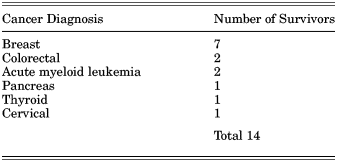
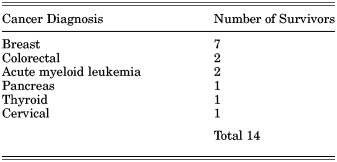
Fourteen (4 male, 10 female) cancer survivors of various cancer diagnoses, all with advanced disease and with average longevity since diagnosis of 11 years (range 4–23 years) were interviewed. The cancers were varied; with multiple types and sites (Table 1). Inclusion criteria included: English speaking, ≥18 years, with a pathology confirmation of advanced cancer diagnosis and exceptional status confirmed by the attending physician. Participants were recruited from physician's practices at a large cancer center in the southwest as well as from its’ institutional tumor registry. The patient's oncologist reviewed and approved contact for each patient. The disease course of exceptional outcomes exceeding expectations of the medical community was determined using the four categories suggested by Hirshberg and Barasch (Reference Hirshberg and Barasch1996): delayed progression, long survival, inadequate treatment, no treatment. Records were reviewed by an additional oncologist to confirm the exceptional disease course. Upon confirmation, the primary oncologist contacted the patient and the researcher followed up with a phone call further explaining the study and setting a time for the interview. Verbal consent was obtained and recorded prior to the interview. Interviews were conducted face to face, or by telephone, if they lived a distance from the center.
Number of Survivors and their cancer diagnosis
Data Collection
Narrative interview techniques were used to elicit a reflective account of their experience according to what they felt was important to talk about. The interview began with an open-ended question: “tell me about your experience of your illness.” Additional probes were sparingly used only for further elaboration, i.e., “Could you elaborate on that,” “Could you give me an example of …” or for clarification, i.e., “I want to make sure that I understand correctly,” “When you said …” These interviews were conducted by one interviewer and lasted about an hour. All interviews were audio recorded, subsequently transcribed and validated.
Data Analysis
Cross case thematic analysis was used to discern common elements across the narratives and identify emergent themes (Frenkel et al., Reference Frenkel, Shachar and Engebretson2010; Mattingly & Garro, Reference Mattingly and Garro2000). Initially, three researchers individually read all the narrative accounts and independently made summary statements. After multiple readings, two of the researchers began to identify codes, categories, themes, and patterns across the cases. These were discussed until the researchers reached consensus, and a coding schema was developed based on the relationship among components, and subsequently applied to the entire data set for validation (Lieblich et al., Reference Lieblich, Tuval-Mashiach and Zilber1988). The schema continued to be refined; exemplars were identified and critically examined for fittingness. The findings were then related to extant literature.
Findings
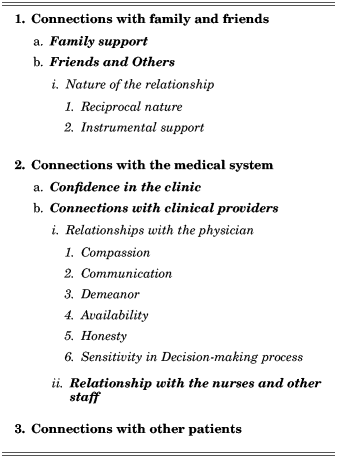
The major underlying theme across all the United States informants was one of external and internal connection (Table 2). External connections with others included: friends and family, the local medical system and providers, including physicians and nurses, and finally other patients. Internal connections included an awareness of connecting with the self, nature and God. One participant summarized: “You need God there, and after God, you have to have your family and friends with you … you've got to have your doctors and all with you … and this is one of the ways I have survived it.” While all these connections are important and may be related, this report focuses on external connections.
External connections with others
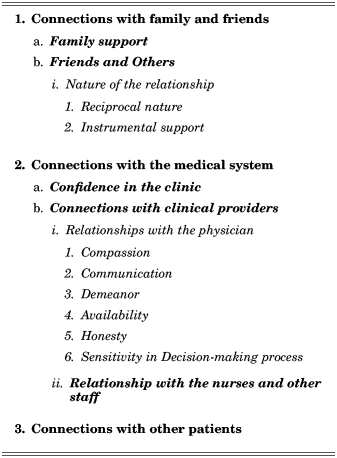
External Connections with Others
The participants articulated the importance of connections with others as major factors in dealing with their illness experience. The specific nature and meaning of personal connections with family and friends, as well as connections with the medical system, providers and other patients were well described. One man summarized the importance of these connections “the combination of the physicians and God and my family and my friends is the reason I'm here today.”
Connections with Family and Friends
Family Support
One man commented on the support of his wife “I'm the luckiest guy in the world. I've got the greatest wife in the world … we've been married 47 years … there's no reason not to be happy.” One woman noted that her husband moved to the city where she was receiving treatments to “help me heal.” Family members accompanying them to clinic and regular visits to the hospital were much appreciated. A woman described her husband taking days off from work to accompany her to her treatments and they would “go out to lunch together … [to have] time together because we didn't know if I was going to make it or not.” Several noted that they “couldn't have made it without” their spouse. One man reflected on the stress of his wife in managing his health care “I just didn't know until later just how difficult a time she was having.”
One man reported that his daughter was the one responsible for him going to the clinic, while another man's daughter moved to be closer to him and states “not a day goes by that she is not here to see about me.” Several reported tension, strife, and discord in their families. In one case, siblings didn't trust a husband to be able to take on a role of caretaker for his wife. This discord was resolved as they saw him develop the role of a supportive partner. Several reported being somewhat “overwhelmed” by family attention, while others who had to travel to the cancer center reported becoming aware of how much they missed their family.
Friends and Others
One woman noted that she found it helpful to talk with someone who wasn't family “to get things off my chest.” Many reported circles of friends devising systems of communication for daily checks. Alternatively, one informant reported friends who didn't come “… said they were afraid of hospitals and didn't want to see me like that … that was very hard to take.” A young woman described, “the hard part is when your disease drags on and on and on and the friends start falling away because they have their own lives.” This woman iterated the importance for the medical team to understand what the support system is like and the personal impact if it's not there. One man stated “going through something like this without somebody there by your side … it is dang near impossible.”
Nature of the Relationship: Reciprocal or Instrumental
Reciprocal nature was described by one informant who was in isolation for a lengthy period as the joy he felt with “over 400 visits while I was in the hospital … friends come … to the window and talked to me and give me encouragement … they knew that I loved them … I was working real hard to survive this illness.” One woman with a small baby found spending time with her parents and children was very special for everyone, “all this scary stuff, all these negative things going on in my life … and if I wasn't going to make it … that I was able to have that time with my family and [baby].” Speaking of her relationships with family, friends, and her church family, one woman stated “I believe that I'm not always the one to be the taker. I need to be a giver also.”
Instrumental support was described as family or friends driving them to medical appointments, cleaning the house, bringing food, caring for children, etc. One woman noted that her mother “was taking care of things in the world outside of the leukemia … I didn't have to worry … keep my mind off other things, just to concentrate on getting better.” “Someone caring for the children” was cited by several informants. “You have to give up that role of superwoman and let people give and be gracious and accept the chicken casseroles four nights in a row.” Another reported her sister's support by “stepping in to be the mom … [and] alternative thinker … suggesting meditation, special teas and mushrooms.” Having friends or family with them for visits to the doctor was particularly helpful.
Connections with the Medical System: The Clinic and Clinical Providers
Confidence in the Clinic
Several described confidence in being treated at a well-respected clinic. Some transferred to the clinic because of its reputation. One family bought a house near the clinic stating “I don't want to venture too far from Dr. [X], my medical center, from all the professionals there.” Several were reassured by the fact that that they would be seen by a team. One woman stated, a “conglomerate of opinions and experts … [who] might see something that somebody else didn't see.” While many equated something fearful or “very serious” in going to a cancer center, most stated that they had confidence that they were getting the best care for their disease.
Connections with Clinical Providers: Physicians and Others
While most accounts focused on the relationship with their physician, other providers were also mentioned as “giving dignity to the patient” and adding a “personal touch … even down to the techs that take you back to drink the barium.” The message to all providers was summed up by this informant “Everyone needs to be alert that they are making an intrusion on a human being multiple times [blood draws]. They need to understand that this is not something that we really enjoy, to have this in our lives.” Another person stated “If [the staff] would show more compassion to the people, then I think that … we would save a lot more people.”
Relationships with the Physician: Compassion and Communication
Compassion
Compassion was a key quality in the relationship with one's physician. One woman described “a kind of duality (or separation) of medical care and compassion,” but went on to say “I haven't seen that in my treatment … compassion goes such a long way in treatment.” Another patient commented that her doctor was like “a friend and advisor.” One informant expressed gratitude for her physician and “his calm, quiet, compassionate nature.” Some linked compassion with the ability to pick up nuances and attend to detail and “asking what's going on in a person's life, because that‘s so connected to their treatment.”
Communication Patterns: Demeanor, Availability, Honesty, Sensitivity in Decision-Making Process
Communication was crucial in their relationships with their physician. Many had seen several physicians, allowing for comparisons. Having a positive demeanor and being open and available was very important, “like they really were honestly there for you, I always felt like when I was there that I was in their hands.”
Demeanor
One woman described a physician's sensitive style as “he really does care … he has a demeanor about him that is frank, is straightforward. He doesn't pull any punches, but his demeanor while he's doing that; gives you a sense of calmness.” A sense of caring and concern was noted, “you always felt like he was there for you.” A sense of humor and cheerfulness contributed to patient's looking forward to their clinic visits. Another felt that her doctor's “upbeat” demeanor made her feel more upbeat.
Availability
Several mentioned that the physician did not appear rushed when talking with them and was always available via phone or e-mail. Many physicians clearly established their availability as reported by these statements: “if you need me, call me or shoot me an email … if you're in pain, don't suffer,” “if ever you have any questions call me … call me if you need anything.” This was interpreted as opening communication for patients when they felt scared or nervous. One woman reported comfort talking with the Fellow, with questions that she “thought were stupid or … embarrassed to ask the doctor … or that she would be wasting the doctor's time … I could always ask her (the Fellow) … could this happen or what should I expect.”
Honesty
Honesty was another important communication attribute, “always upfront … he tells it like it is,” “open, honest,” “he is frank, straightforward … doesn't pull any punches.” In one case, the patient was very relieved that the physician told her not to feel guilty about not going to the doctor sooner and focused on what they were going to do. Honesty was coupled with a sense of care, compassion, and hope: “he was concerned about me personally.” In comparison, to other physicians who were harsh, they appreciated the physician who could sense what and how to discuss these sensitive issues. One patient remarked, “[the doctor] didn't say, ‘okay, you're dying.’ He said ‘we don't know, I've got other patients who have had the same situation that you've got’ and one patient had been [diagnosed] seven years and she was still doing fine … it didn't dwell on the death part of it so much, but he gave me hope.” A surgeon warned her patient against getting a lot of information from the internet or reading books which generally report the worst cases “your situation is so new … we're seeing good responses with patients and it's just so new … you're only going to hear about the worst cases [from the internet]; you're not going to hear about patients who do well.” Several commented on their physician's good sense of timing in giving the right amount of information, especially in the beginning “good about giving me the information as I needed it or as I brought it up,” and “good doctors that know exactly only what you want to hear … that you don't want to know everything.” Another patient specified “I don't need to know the numbers [test results] or anything about them … I don't get involved in the technical details of my condition.” In contrast, several commented that they had wished that someone had explained to them more about a certain procedure or what they might experience
Sensitivity in the Decision-Making Process
Trust in the physician and hope were uppermost in planning their care. Many spoke of having total confidence in their physician's decisions about treatment “I would 100% rely on his suggestions of what he needed to do … I would do whatever he asked me to do gladly.” or “I haven't always wanted to hear what [my doctor] said, but I've always trusted him to make the best decisions.” Some patients did not want to be involved in details of decision-making and often reported that the doctor and patient made a plan based on the patient's preference for level of involvement. The doctor and staff “are the experts, and I trust them that they are going to do what they need to do and what I need and tell me, and I try to do what they tell me.”
Relationship with the Nurses and Other Staff
Positive support from nurses was very important as this informant expressed: “nurses can pick up nuances, and they can help kind of quiet your anxiety a lot. It may come as second nature to some, but there is so much anxiety in patients from so many sources that a touch with the hand or something really goes a long way.” Some reported that nurses gave excellent suggestions such as keeping active “she said ‘set a goal for yourself’… (which was) really helpful.” Another reported helpful advice “… just don't dwell on the cancer so much.” The nurses making referrals was also noted: “when women get to this stage of treatment (radiation) they need help… like counseling because they're down…this was really helpful.”
Connections with Other Patients
Friendships developed among patients: “we shared how we felt … some of them became real good friends.” The issue of death was ever present and one woman expressed the dance with death “talking and meeting other people (patients) … it's inevitable that somebody on your journey, you're going to lose, and it makes you think about that death factor and how far, again, am I away from it? Is it in the opposite corner? It moves a little closer, we move together; we move apart — me and death. You want to keep them in the ring opposite, as far away as possible, but there are different times where I think you move together and whether it's through a friend or through comparing yourself to that friend, it's always there. Cancer, I think, will forever, until there is the end-all cure for all cancers, cancer is going to have a relationship with death.”
Informants discussed their appreciation for others who have had the disease. One even expressed gratitude for the women who had cancer and gone before her “I'm not the only one doing the fight.” Another stated “it's therapy to sit in a waiting room and talk to other patients … knowing that you're not the only one in that boat.”
Many found hope in talking to other survivors. It was good to know that there was somebody else — even a few people out there who had fought it, and beat it; that was really hopeful to me.” “I really clung to the fact that she was doing well … I can do that … I want to be her … I thought about her a lot.” One patient related her competitive nature to other survivors “people that handled [illness] seemed to have a determination about them that they were going to get better. They were going to beat the odds.” Another found these discussions very powerful as “they are there for one reason only and that's to let you know that you can survive this disease.”
Several participants thought about others who didn't have good support and reported “a sense of gratitude, because I did have so much help and support and think about people who don't.” The cancer center has a volunteer program that uses former patients to help others. One woman spoke of her experiences “I let other people tell me about their situation and then, if I can give them … some hope.” Another expressed satisfaction in “knowing that I'm giving back because I took a lot when I was going through my treatments.”
DISCUSSION
The prominence and importance that these informants placed on connections may be related to the loneliness that is attendant with a life-threatening illness. Three areas of loneliness have been identified: social, emotional and existential (Ettema et al., Reference Ettema, Derksen and van Leeuwen2010). Social loneliness refers to lack of engaging with a social network, loss of social roles and social connections with friends, and family. Emotional loneliness refers to a feeling of aloneness, even in the presence of others. Existential loneliness is emptiness and sadness resulting from ones awareness of their fundamental separateness as a human being (Moustakas, Reference Moustakas1961). All of these forms of loneliness are likely to be present in patients being treated for cancer.
A meta-analysis of social loneliness and mortality research over the past 20 years, concluded that social isolation is associated with mortality as well as morbidity (Holt-Lunstad et al., Reference Holt-Lunstad, Smith and Layton2010). The participants in this study were very articulate in the importance they placed on the supportive (emotional and instrumental) relationships with friends and family. The experience of serious illness, hospitalization and traveling for treatments often posed barriers to these connections.
Confronting emotional loneliness and even existential loneliness in facing a life-threatening illness was reflected in their relationships with others and particularly with clinicians. The importance of physician-patient relationship and good communication were critically important element in this connection. The identified characteristics of physicians may buffer the emotional experience of loneliness and isolation and facilitate their feelings of connection. Patient centered care and patient-provider communication is becoming a topic of much interest. Suchman (Reference Suchman2006) has advocated for the centrality of patient centered care and understanding the complex nature and patterns of patient-provider relationships. Beach and Inui (Reference Beach and Inui2006) identified four principles of relationship centered health care (1)include the personhood of the participants, (2) affect and emotion are important components, (3) all relationships occur in the context of reciprocal influence, and (4) the formation and maintenance of genuine relationships in health care is morally valuable.
LIMITATIONS
It is important to note that participants were not asked about what they attributed their exceptional status to, so no causal effect is inferred. Data was gathered after treatment so may not reflect their perspectives during treatment. While data from qualitative studies is not generalizable, findings are often applicable to a number of settings.
IMPLICATIONS
Many providers might agree that family and friends are important supports; however, there are multiple logistical and other barriers to including these supportive elements in patient care. Hence, this element of care often goes unrecognized and underutilized. It behooves clinicians to understand the vital importance of these relationships to the health and wellbeing of patients and attempt to minimize the isolation that frequently occurs.
Patients dealing with advanced disease often suffer from spiritual and psychological distress and the loss of the will to live (Hall et al., Reference Hall, Edmonds and Harding2009). Some existing programs may help to address these needs. Health care practitioners can offer interventions such as Dignity Therapy, an individualized, short-term therapy to help patients and their families improve their quality of life, while having an increased sense of dignity, decreased sadness, and possible change in how the family perceives them (Chochinov et al., Reference Chochinov, Kristianson and Breibart2011). Dignity therapy helps patients explore what matters most to them and what they would most like to have remembered (by others) with questions such as “Tell me a little about your life history; particularly the parts that you either remember most or think are the most important? When did you feel most alive?” The sessions are transcribed and the patient is then able to leave it with a family member or friend (Chochinov et al., Reference Chochinov, Hack and Hassard2005). In a study of family members of patients who had participated in Dignity Therapy by McClement and colleagues (Reference McClement, Chochinov and Hack2007), the participants reported that the therapy decreased the patients’ suffering, helped their sense of dignity, their sense of purpose, as well as helped them prepare for death. For themselves, the family members reported that the transcribed document helped them with their grieving.
Another established approach to help oncology patients is group psychotherapy, which has been an important intervention and could provide another pattern of connection for these patients. Many of these interventions stem from the early study by Siegel in 1989, of women with metastatic breast cancer in a structured support group (Leszcz & Goodwin, Reference Leszcz and Goodwin1998). Supportive-expressive group therapy has helped patients deal with the disease, the emotions and the existential questions that often go along with the breast cancer, as well as improve their social support and their relationship with their family and physicians (Classen et al., Reference Classen, Butler and Koopman2001; Spiegel et al., Reference Spiegel, Butler and Giese-Davis2007; Lemieux et al., Reference Lemieux, Beaton and Hogg-Johnson2007).
Meaning can play an important part in those who are facing a life threatening illness. At these critical times, connections with others and a sense of the continuum of one's life, can be of great importance (Briebart, Reference Briebart, Poppito and Rosenfeld2012). Meaning-centered care is an individual brief psychotherapeutic approach that was shown to improve quality of life and spiritual suffering in patients with advanced cancer. Each weekly session focuses on different facets of meaning, such as transcendence, values and priorities (Greenstein & Breibart, Reference Greenstein and Breibart2000; Breibart et al., Reference Breibart, Gibson and Poppito2004).
The importance of the relationship with the physician highlights another relationship of patient care that is often marginalized related to its importance. Many providers feel rushed and over-scheduled or may not have confidence in their skills to provide the type of communication that these informants found so useful. Efforts to improve patient-physician communications such as I*Care, a program from a major cancer center, on interpersonal communication and relationship enhancement, is readily available as it uses CD ROMs as well as other resource. Included in the I*Care program is the SPIKES protocol, a series of steps used when having to deliver bad news: 1. Setting up the interview, 2. assessing the patient's Perception, 3. obtaining the patient's Invitation, 4. giving Knowledge and information to the patient, 5. addressing the patient's Emotions with empathic responses, and 6. Strategy and Summary. Good communications skills can be learned and need to be reinforced (NCCN Clinical Practice Oncology Forum a Teleinterview, 2012); Baile et al., Reference Baile, Buckmanb and Lenzia2000). In their book Mastering Communication with Seriously Ill Patients: Balancing Honesty with Empathy and Hope, Back, Arnold, and Tulsky (Reference Back, Arnold and Tulsky2009) address the needs for effective communication with persons who have life-threatening diseases by offering a roadmap for physicians and clinicians (Back, Reference Back2006; Lee et al., Reference Lee, Back and Block2002).
The importance of connections and relationship begs further attention, as little research has been conducted on issues of loneliness and connections in serious illness. It is imperative that health care providers address the existential, psychological, and spiritual needs of patients to help them have better relationships, stronger connections, quality of life, meaning and purpose.