Doing Research on Managing Cultural Heritage
This article focuses on change processes in the management of the archaeological chain in China, that is the full sequence of activities related to cultural heritage, from archaeological discovery to research, conservation, museum definition and public access. Basically, we are interested in the organization of professional work involved in the chain: more than archaeology, conservation or museology in themselves, our interest is in ways of structuring, regulating and organizing the work of archaeologists, conservators and museologists.Footnote 1
Recent decades have brought many important phenomena affecting the evolution of the archaeological chain in a country presenting such a rich heritage, with new managerial problems in the modernization of professional activities. The extraordinary process of economic growth has had enormous impacts on heritage: infrastructure construction, building activities and the transformation of urban contexts often involve the discovery (and sometimes the destruction) of new archaeological finds, and represent threats to existing monuments.Footnote 2 Tourism – both international and domestic – has become a new phenomenon as well, offering both opportunities and problems for heritage.Footnote 3 What is astonishing in the Chinese context is the magnitude, in terms of millions of visitors,Footnote 4 and the potential revenues and profits which are never publicly documented. The changes currently affecting professional communities are also hugeFootnote 5: an increasing process of contamination, if not integration, with the international community of scholars can be pointed out (see for instance the establishment of principles for conservationFootnote 6) which implies to some extent a less politically driven agenda compared to the past for museologistsFootnote 7 and archaeologists.Footnote 8 However the deliberate use of heritage for political purposes, both internally and internationally, as a means of fostering national identity and as a tool of cultural diplomacy is still crucial for the sector.Footnote 9
This article presents the main findings of field research carried out in the Luoyang area by the authors in cooperation with Chinese officials. It is a view from the outside because we are not Chinese, and thus we tend to adopt a comparative/relativist attitude, trying to understand forms, ways and degrees to which phenomena taking place at the global level occur also in China: conflicts between curatorial and customer oriented views, the trade-off between effectiveness and resources, division and conflict of roles between different administrative levels, issues of coordination (between macro and micro levels), making money and spending across entities (subsidies), budgeting, business plans, and questions of sustainability.
We are “foreigners” also in another sense: we are looking at professional dynamics from the outside, as experts in management and organization. As such, we relate the professional dynamics of archaeology and museology to broader administrative changes taking place in the country. At the core of this approach are the conditions for action, human and financial resources, and feasibility and sustainability issues. What makes such research interesting at a general level (even for those not interested in heritage), is that internal professional dynamics tend to interact, sometimes uncomfortably, with more general trajectories of change of the public sector, inside which most heritage institutions tend to fall.Footnote 10 In this sense, heritage can be seen as a special “laboratory” to understand changes inside the public sector all over the world.
However, such a double lens is rarely used. Most of the people involved in the field are archaeologists, architects and historians, all of whom have strong professional interests and focus on substantive aspects related to their different professional values. Articles addressed specifically to the issue of managing, using the lenses of organizational and management knowledge, are rare.Footnote 11 On the other hand, the crucial literature on the transformation of the centralized planned economy into a market socialist economy in the last few decadesFootnote 12 very rarely investigates administrative phenomenon at a micro level.
For research of this type, specific methodological conditions were necessary. First, a relatively small research context had to be selected, to allow field investigation with a micro focus. The municipality of Luoyang was chosen for both historical and organizational reasons: as the ancient capital of 13 dynasties, Luoyang has an rich composition of heritage from Shang to Tang, along with a more recent revolutionary history. This is reflected in an unusually complex organizational structure. Moreover – and most important – through personal connections we had unique conditions for access to data.
In this context we were allowed to develop nine in-depth case studies. The nine entities were chosen in order to grasp the variety of management issues along the archaeological chain. The Cultural Relics Bureau (Wenwu guanli ju 文物管理局) plays a key role in coordinating between local government and cultural institutions operating in the area. The two archaeological teams are in charge of the fundamental step within the archaeological chain (excavation). Three museums were included, each with a very different identity, situation and phase in their life cycle: the Luoyang Museum (Luoyang bowuguan 洛阳博物馆), once the most important museum of the area now facing serious problems of renovation; the Ancient Tombs Museum (Gumu bowuguan 古墓博物馆), where tombs of nobles and emperors have been moved or reproduced; and the “Horse & Chariot” (Zhouyang zhouwangcheng “Tian zi jia liu” bowuguan 洛阳周王城 “天子驾六”博物馆), a recent institution, created to exhibit an important burial pit of the Eastern Zhou Dynasty discovered in 2002. Three other sites open to the public were also analysed: Guan Lin 关林, a temple founded on the tomb of General Guan Yu; Han & Wei (Han Wei gucheng yizhi 汉魏故城遗址), the remains of the ancient capital located about 15 kilometres east of the present city of Luoyang; and Longmen Grottoes (Longmen shiku 龙门石窟), a huge and astonishing group of Buddhas carved in the rocks on the banks of the Luo River and the most important site in Luoyang. The final case study investigates the functioning of the system for cultural heritage at the county level, the Yanshi Administration (Yanshi wenwu guanli ju 偃师文物管理局): this helps us to understand relationships between different levels of government administration.
Drawing on a common underlying framework,Footnote 13 each case history provides a short reconstruction of specific constitutive elements, an assessment of effectiveness in curatorial terms and, when relevant, visitors’ data, plus an investigation of efficiency in terms of human and financial resources. We take a sort of ethnographic approach that is outside the mainstream of management studies. We attempt to see things “in the shoes of professionals,” to paraphrase a common expression, looking at micro impacts as they take place, and working “with” professionals and administrators in a mixed Sino-Italian team.Footnote 14 The fieldwork involved extensive interviews with people in Luoyang, through a series of meetings (the director, the administrator, at least one curator) at all nine entities investigated, often repeated, giving a total of 70–80 interviews during a three-year period.
In contrast to what normally occurs in China, accounting and financial data and internal documents were generously provided. Indeed, these case histories are the exception to the rule, even for Chinese scholars, as there are few cases where readers can understand and investigate internal allocation processes. Furthermore, actual practices inside Chinese entities were opened to investigation; besides general issues in cultural and heritage policy, this allowed us to understand how public entities work in the field, giving a much more “zoomed-in” picture of the heritage sector in China. Finally, this access made critical understanding possible, rather than forcing us to adopt some sort of “official” celebrative tone. This is a very crucial point, as serious management analysis is something that wishes to address issues, questions, problems and difficulties (see for instance the normal SWOT approach, which addresses Strengths but also Weaknesses, Opportunities but also Threats). Such an open-minded attitude is uncommon (not only in China), and certainly increases the value of our findings. It provides a fresh view of issues and concerns as they tend to be perceived by internal actors in these Chinese institutions; a view from the inside that, dialoguing with the view from the outside, is the major value of our research.
The Archaeological Chain in Luoyang
Luoyang has a long history and an extraordinarily rich heritage. It also has significant development potential, with four main projects for the establishment of archaeological parks currently on the agenda. However, the richness in quantitative terms and the peculiar physical nature of the sites also have significant organizational consequences, influencing both the administrative structure and potential visitor appeal. Each of the nine case studies analysed through field research presents specific elements of interest and results. While detailed discussion is available elsewhere,Footnote 15 this section looks at their ability to illuminate some major institutional issues.
Institutional complexity and fragmentation
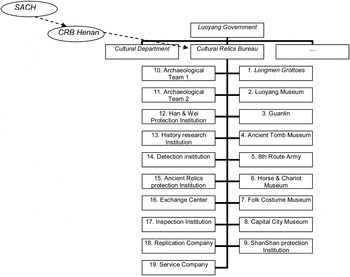
In Luoyang municipality 19 entities (shiye danwei 事业单位) report to the Cultural Relics Bureau (CRB), the administrative body at the local level responsible for operating cultural institutions. Nine of them are historical sites or museums open to the public (see the right-hand side of Figure 1), and ten are cultural institutions working in other areas of the archaeological chain, from detection to excavation, protection, research and exhibition (see the left-hand side of Figure 1). There are further important institutions in the area which are not under the direct control of the CRB: five sites open to the public at the county level; the White Horse Temple (Bai ma si 白马寺), the oldest Buddhist temple in China; the Institute of Archaeology (Kaogu yanjiuyuan 考古研究院) of the China Academy of Social Sciences (CASS), with four excavation sites in the Luoyang area; and archaeological departments of various universities occasionally involved in excavations.
Luoyang Cultural Relics Bureau Institutional Setting

This unusually high number of entities involved in the archaeological chain is related to the richness of the area in historical terms, and it is more the exception than the rule in China (normally just a few entities will be involved). For the same reason the CRB in Luoyang has a special status, reporting directly to the mayor (in the rest of China CRBs usually report to the culture department at the city level). Most importantly, while administratively speaking the CRB is subordinate to the mayor, from a professional point of view it is under the supervision of the Provincial Cultural Relics Bureau and the State Administration of Cultural Heritage (Guojia wenwu ju 国家文物局). Such a complex picture addresses some of the important features in the Chinese approach to heritage in general, with some specific elements for the situation in Luoyang.
First, the system is characterized by a high degree of decentralization. In economic terms this means that almost 90 per cent of expenditure in the cultural sector takes place at the town level or below.Footnote 16 At the institutional level it describes a particularly fragile administrative solution: being subordinated to the local government, the ability of the bureau to preserve heritage sites may clash with other local interests and therefore be reduced. For example, if the mayor is involved in urban development projects that could damage local heritage, the director of the CRB has little power to resist his “boss.”Footnote 17 This is a totally different situation from, say, Italy, where heritage preservation at the local level is given to peripheral branches of the ministry which report directly to the central government, rather than to the local administration. In Luoyang the higher status of the CRB might temper this risk, but does not eliminate it.
Second, a peculiar hierarchical complexity emerges in the Luoyang context. The 19 operating institutions under the CRB have different administrative levels: Longmen Grottoes is first level, History Research Institution (Lishi wenwu kaogu jianjiusuo 历史文物考古研究所) and Luoyang Museum are second level, and the others are third level. While this has direct implications in terms of status and resources provided, decisions about classification are largely dependent on their relative historical power.Footnote 18 The institutions outside the bureau's control also have different statuses and follow different hierarchical lines: the county museum reports to the culture department of the county administration, the White Horse Temple reports to the religious department, and CASS is a national institution with a direct relationship to the central state.
In such a context, institutional ambiguity leaves room for potential conflicts. Suffice it to say that after three years of field research, we are still unsure whether Longmen Grottoes reports to the CRB or directly to the mayor (see also below). Moreover, conflicts may emerge when different administrative bodies have overlapping interests in specific sites. This is the case, for instance, with the CRB and the Religious Department regarding preservation of the White Horse Temple. In the Han & Wei site three different counties have responsibilities over the area, while CASS plays an important role.
Guan Lin Temple is an interesting case of conflicting interests between upper and lower levels, with a serious gap between decision-making and responsibility. The historical and religious value of the temple has ensured good performance in terms of visitors for many years and is almost self-sufficient financially. In 2002 the municipality decided to enlarge the square at the entrance to the site, using a bank loan as funding. The cost of the loan, however, was charged to the Guan Lin Temple. This has created a serious impact on the financial sustainability of the entity as a whole, with substantial losses, as the self-generated margin will never be able to pay off the loan and its interest. In addition to a mismatch between decision and responsibility levels, at a more general level this case provides a good example of how “bad debts” that no one will be able to reimburse are generated in China's public sector.Footnote 19
Another consequence of such design is the institutional fragmentation characterizing the system, with significant overlaps of duties and rights among entities. The most striking evidence lies in the peculiar co-existence in Luoyang of two archaeological teams. The situation is the result of an administrative structure decided in the 1980s that distinguished the Luoyang area from Luoyang City, assigning each zone to a different archaeological team. Following administrative reforms in the 1990s, the two teams were brought inside the same municipal area. Rather than integrating or merging them, however, the conservative choice of giving them different “territories” (the east and the west part of the area under the municipal government) was made, without a more rational design based on specialization (such as in terms of dynasties, periods or nature of the finds). A major consequence is the widespread duplication of resources (space, personnel, equipment, knowledge, skills), which increases the cost of the activity.
The lack of ability to share knowledge and experience among experts is, however, even more dangerous. Given the fragmentation of the archaeological chain, there is little cooperation between entities, which has negative impacts in terms of efficiency and missed opportunities for research and restoration activity. A sort of “institutional jealousy” emerges, where each institution does restoration and research on its “own” finds, without sharing people, equipment or – above all – knowledge. Objects excavated by the two archaeological teams, which should be transferred to museums after a short time, are often kept in their own depots, with no possibility of being protected, restored, researched or exhibited by others. The Ancient Tombs Museum also holds important finds and frescoes in its depots that are inaccessible to other institutions in the area or to independent researchers. There emerges a serious problem of coordination and control, where the whole system could benefit from a more rational design and better integration of policies and practices.
In addition, today the CRB, along with higher governmental levels, is promoting a huge development plan for the city based on the establishment of four national archaeological parks. Despite its potential interest, this is likely to cause a dramatic increase in complexity and costs of coordination in terms of strategy, activities, human and financial resources management, and control.
The central role of salvage excavation
Unlike in other areas, cultural heritage in Luoyang is mainly concentrated underground, so that heritage is mainly concerned with archaeology and excavation activities. From the administrative point of view, the consequence is that in Luoyang the archaeological chain is also based economically on excavation work, with significant results.
Archaeological teams in China have three main functions: excavation (“on purpose” and salvage), protection (preservation in depots and restoration) and research. At a general level, “on purpose” excavation refers to academic excavation projects that are driven by predefined archaeological aims. Salvage (or “chance”) excavation reflects the need to save from destruction heritage discovered as a result of urban development.Footnote 20
In the Luoyang area, “on purpose” excavation is quite rare, apart from CASS interventions. Given rapid urban development, almost all recent work by the two archaeological teams has been salvage excavation, which has a distinct organizational form. Before any construction by development companies, the CRB must carry out “detection”: a survey of the soil, made with long wooden sticks, in search of archaeological evidence. If objects are discovered, the archaeological team responsible for the area is asked by the CRB to start more systematic excavations, the cost of which is charged to the construction company.
This procedure ensures that salvage excavation is highly profitable for the archaeological teams, and this has positive effects: the whole system benefits from the archaeological teams’ revenues, and there is the possibility of “self-financing” excavations that lead to new collections and museums. But such a funding mechanism also creates perverse incentives: the two archaeological teams get money for excavation, but not for preservation or research. This is why “on-purpose” excavation is of little interest to the two archaeological teams, while in-depth studies and conservation activities are definitely underdeveloped.Footnote 21
In addiction, compulsory excavation reports – which should be presented within three years after digging – are sometimes not prepared, even though State Administration of Cultural Heritage urges teams to respect this important stage. Since nobody can have access to the findings for research or study before publication by the teams, this is likely to reduce not only internal research and protection activity, but also inter-institutional cooperation.
The Horse & Chariot Museum provides evidence of such problems. After a positive detection investigation in 2001, initial plans to build a car park were quickly halted. Excavations led to the discovery of several important pits and tombs of the Eastern Zhou and in less than two years a charming new museum was opened. Despite the formal rules, however, three years after the discovery the excavation report had still not been prepared,Footnote 22 with consequent restrictions of site access for other researchers. What kind of conservation has been carried out is not shared knowledge. For example, what are the risks associated with the treatments used, or the risk of exposure to air pollution? What will remain of these discoveries in 20 years’ time, with fragile wooden structures petrified by sand, no one really knows. Moreover, time pressure during the excavation stage eventually halted the digging, more because of organizational than professional problems: the team was “running out of money” or had other work to do. Finally, systematic reporting on administrative aspects of the entire event was also lacking: there was no initial budget of time and costs,Footnote 23 weakening the overall “learning effect” among professionals and institutions.
To sum up, growing urbanization in Luoyang encourages and finances extensive salvage excavation activities. Institutional fragmentation and economic disincentives, however, discourage archaeologists from a systematic study of their finds and from cooperation with the successive steps of the archaeological chain. Interesting, there is no ongoing discussion on the need to reorganize the archaeological chain.Footnote 24
Extraordinary projects versus ordinary activity
Another organizational element has an important impact on the overall system: the whole organization of professional work is based on the logic of extraordinary rather than current activity. Instead of repairing existing buildings, facilities and exhibitions, new projects are constantly developed, leaving current problems substantially unsolved.
This is why the once special and attractive Museum of Ancient Tombs faces today serious preservation problems. The peculiar museum concept (the reproduction of buried tombs) and its poor structural construction (such as water infiltration) are certainly some of the reasons, but there are also organizational ones. According to administrative rules, restoration is not normally financed by the city government, which funds only operating costs such as museum salaries and daily expenditures. Restoration receives resources (as special funds) only if ad hoc “special projects” are carried out by the museum and approved by the CRB. In their absence, conservation is simply suspended.Footnote 25 Consequently, even though the Ancient Tombs Museum lacks funds to restore the tombs and update the humidity control system, a new exhibition building to enlarge the museum will soon be opened. The extra space could be an important opportunity for the museum to increase exhibitions and visibility. However the risk is that it will distract attention from current preservation and exhibition problems, leaving the “old” exhibition in ongoing degradation.
Luoyang Museum is another example of this strategy of “solving by enlarging.” Once the city's most prestigious museum, today it faces several problems: low visitor numbers, lack of exhibition space, poor preservation of the collections, lack of relevant skills and low levels of earned income. As a response, a major development plan is currently in progress, including the construction of a new large building, the development of security and preservation systems, and the opening of new exhibition to display larger collections.Footnote 26 The new museum is certainly an answer to the lack of space, and perhaps also to the current poor performance in terms of visitors, but it is questionable to what extent problems in human and financial resources can be solved in this way. Indeed, additional problems could emerge, with further needs for coordination and monitoring the new structure, while distracting attention from the old ones.
There is probably a national or cultural peculiarity here: creating a new institution seems easier than changing existing ones. But there is also an administrative element, since gaining financial support for new projects seems to be much easier than funding ongoing activities. More generally, in large projects such as these, the risk is that greater attention, commitment and funding are given to initial developments and much less to subsequent operations and running costs. The lack of a culture of feasibility (carefully planning and monitoring ordinary activities) common to cultural organizations all over the world is associated here with the lack of professional skills in planning, raising a serious problem of “capacity building,” to borrow a term from the World Bank vocabulary.
Curatorial value versus visitor attractiveness
Excessive commodification is not found in Luoyang, at least so far, which makes it different from elsewhere in China.Footnote 27 Indeed, a conflict between the (high) historical value and (low) visitor attractiveness of many of the “big sites” can be observed, increasing the future risks of such gigantic projects in terms of sustainability.
Given Chinese traditional construction technology,Footnote 28 archaeological heritage in Luoyang consists mostly of wood and earth (particularly earth for sites under development, such as Erlitou 二里头, Shang Capital, Han & Wei, and Sui & Tang). This physical nature makes it very difficult to protect the sites, and visitor appeal may also be limited.
Han & Wei is a good example of a difficult heritage site: it includes the earthen remains of the Han wall, plus the remnants of a pagoda from the period, with original earthen foundations covered by recently reconstructed stones. The heritage is of great historical importance, yet it is very complex to preserve and, in its present state, is not appealing to visitors. The identity of the site is still unclear: potentially it could become an archaeological park, though actually it is not yet an open site. It represents a sort of “awakening organization,” an entity currently visited by no one, which is going to be transformed into an important archaeological park. What kind of attraction this will represent for potential visitors, however, is largely obscure.
The Yanshi Administration is another complex case. As a county entity, it performs a variety of tasks from general preservation to more direct involvement in managing museums within the county. At present the museum appears to be a very local and marginal entity with an unclear identity. What is the value for visitors of this small collection, full of replicas, while the original pieces are shown elsewhere in more important museums? In addition, in this county there are two crucial excavation sites (Erlitou and Shangcheng) which are closed to the public, yet are of extreme importance for archaeological knowledge.Footnote 29 Here again, a large archaeological park project is currently under development. Despite the historical meaning of the area, however, neither the potential value for visitors nor the relationship between the new sites and the museums has been defined. A business plan that discusses actions, money and people is desperately needed, while an integrated strategy on the overall visitor attractiveness of the Luoyang area should be developed.
Decentralization and outsourcing
Within the general issue of institutional decentralization, Longmen Grottoes provides a particularly interesting case, where decentralization is brought to its extreme. The site is one of the most important grottoes in China, a constitutive element of Luoyang's heritage identity (together with the White Horse Temple and Guan Lin), and the only Unesco World Heritage site in the area. Beside the management of the grottoes themselves, there are several challenges in protection and maintenance of the broader area, including the construction-restrictive zone and the buffer zone around the site. Site management since the 1950s has been a complex process with continuous changes, where the two major tasks (site management and environmental protection) have been structured differently and recombined between different administrative bodies: a sign of the complexity of finding adequate institutional and organizational solutions. In 2002 the Research Academy of the Longmen Grottoes was set up, with responsibility of both site/heritage management and environmental protection, thus finally re-coupling the two issues in an integrated way.
Interestingly, the relationship between the Research Academy and the CRB is rather ambiguous: the new entity is a “county-level institution” (a higher status compared to other operating cultural institutions, somehow similar to the status of the CRB). This peculiar institutional status should have positive aspects for the site itself (easy to manage, more flexibility), but there is the associated risk of losing a united view of heritage issues, efforts and organizations in the Luoyang area. Even more interesting are the processes of decentralization taking place at lower administrative levels, that is, below the Longmen Grottoes as a whole. The chain from governmental entities (xingzheng danwei 行政单位) to operating ones (Longmen as a shiye danwei) in this case gives rise to a further process of “externalization” from Longmen to other entities (the “second organization,” such as the Scenic River Administration) or even “privatization” to private companies such as the Electric Car Company or a private company running the hotel. There are therefore three distinct levels in the institutional design of Longmen: the internal offices and departments of the Research Institution (in charge of site management, narrowly defined); external entities under the control of the Institution (mainly responsible for environmental protection); and external entities run as private businesses (in charge of commercial services to tourists). If positive benefits are associated with a similar process of decentralization and devolution of authority, such a mixture of different organizational forms raises problems both at the analytical level, in terms of market power and transfer of economic rents, and above all in terms of transparency.
Effectiveness and Efficiency Issues in Managerial Practices
Following the previous section's discussion of the management of the archaeological chain in relation to professional discourse and institutional structure, this section investigates some broader elements in general management processes. The international literature on arts organizations focuses on three main themes: visitor orientation, human resources and financial resources.Footnote 30 In Luoyang there is a great variety of situations along the archaeological chain among the nine entities, within a management continuum. In other words, the management process in Luoyang recapitulates the institutional fragmentation that characterizes the organizations themselves.
Managing visitors
Data concerning visitors were generously provided (see Table 1). Despite serious problems with their reliability,Footnote 31 this is an extremely interesting opportunity to look at managerial practices in this context.
Number of Total Visitors in the Case Studies, 1995–2005

Sources: Internal data.
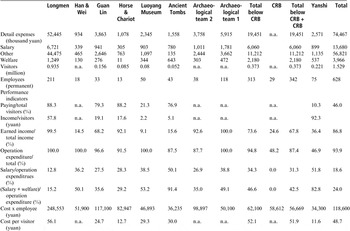
To what extent visitors are actually managed is an open question, with three major problems to address. First, there is a wide variety of visitor performance among different entities (see below, Table 4). Paying visitors make up around 80 per cent of the total overall, with two exceptions (the Luoyang Museum and the Yanshi Museum, with 21 and 10 per cent respectively). Income per visitor shows excellent performance for the Longmen Grottoes (57.8 yuan), positive for Guan Lin and the Horse & Chariot Museum (19.1 and 17.6 yuan respectively), and very modest for the Ancient Tombs Museum and the Luoyang Museum (5.1 and 2.2 yuan). Finally, the relationship between visitors and permanent employees is also interesting, in a sense demonstrating the “productivity” of employees in terms of visitors attracted, and hence the relationship between the appeal of the site for visitors and the allocation of human resources. By this measure, relatively good performance indicators can be found for the Horse & Chariot site (6,538 visitors per employee) and for Guan Lin and the Longmen Grottoes (4,887 and 4,429), and less satisfying ones for the Luoyang Museum, Ancient Tombs and Yanshi (1,600, 1,209 and 696 respectively). Understanding such a variety in visitor performance within the area would be a preliminary step towards a proactive attitude in managing visitors: while visitor numbers are primarily related to the value in themselves of collections and sites, they can also be increased by individual policies (communication, exhibitions, activities). The fact that such a benchmarking exercise has not been conducted suggests that visitors are not managed: well-performing museums simply coexist with badly-performing ones.
Second, in the context of the entities open to visitors at the city level – reporting both to the CRB or independent entities – important questions can be raised about the additional impacts of institutional fragmentation. The opportunity to create a “circuit,” to direct visitors from one of the most visited entities to the others, is not exploited: no information on the rest of Luoyang Museums is available in the Longmen Grottoes for instance, nor the White Temple. The variety in visitor performance among the museums shows that this is a lost opportunity, especially in terms of the possibility of intercepting part of the flow of cultural tourism in a broader geographical area (such as the Terracotta Warriors or Shaanxi History museum in Xi'an).
Third, for better or for worse, the overall situation of Luoyang does not represent a case of overexploitation of heritage as is sometimes the case in China. A possible explanation is the prevailing attitude of professionals over other potentially competing logics; indeed all over the world visitor orientation is not at the core of the professional values of a “good archaeologist.”Footnote 32 Moreover, given the importance of heritage in the area, sufficient resources are available to reduce pressure to turn to income-generating strategies. Furthermore, the economic situation of the municipality and province is far from poverty and underdevelopment, which are often associated with cases of heritage overexploitation; local government has in this sense a multiplicity of “businesses” to work with.
Human resources practices
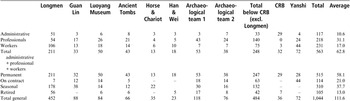
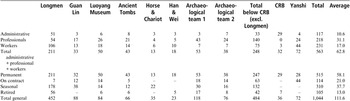
Change affecting the management of human resources is one of the most difficult variables to investigate, but surely one the most interesting elements of the Chinese “gradual revolution.”Footnote 33 Domestic debate addresses the issue of lack of talent,Footnote 34 sometimes referring to performance evaluation in handling human resources.Footnote 35 Whether this is wishful thinking or actual practice is hard to understand. International scholars, on the other hand, are intrigued by the complex political and social processes that have accompanied the downsizing of the state bureaucracy during the 1980s and 1990sFootnote 36 with reference to both the ruling class (nomenklatura), and the whole apparatus of state-salaried employees, the bianzhi 编制 system (“the number of established posts”Footnote 37), or the cadre system.Footnote 38 The tendency at the local level to resist the policy of downsizing is often referred to in the literature,Footnote 39 which also addresses the issue of chaobian 超编 (“the widespread tendency to exceed the allocated staff quota at all levels”).Footnote 40 Field research on actual practices in managing people, however, is missing: how posts are established is a black box that the macro-level discussion above cannot address. How are “quotas” assigned? What is the relationship – if any – with the work load characterizing each individual organization (a controversial issue also inside the difficult transformation of Western public management)? With field research like ours, thanks to open access to some relevant data, we can assemble a preliminary understanding of similar practices at the micro level. Starting from some crucial numbers for the entities under investigation, we can try to infer “quota management” practices (see Table 2).
Human Resources of the Nine Case Histories
Source: Our elaboration on internal documents.
There are a few considerations on the nature of available sources. Data on many issues are systematically collected in the day-to-day life of each institution, including publications by archaeologists for career development. However they are not represented in useful ways for managerial purposes, corroborating the idea that political control is the actual goal of such record-keeping. For instance, the human resource classes in Table 2 – administrative, professional, workers – are not related to specific tasks. The meaning of “on contract” positions is unstable even at the local level: sometimes they are a sort of flexible position (people doing the same jobs as permanent employees, but with lower salaries, no insurance and no long-term contract, as in the Horse & Chariot case); but more often they merely represent inherited welfare policies (people doing almost nothing, not even going to work in the Ancient Tombs case, and receiving a very minimal salary).
In substantive terms, the quali-quantitative structure of human resources across different entities shows significant variety. Positions are not associated with the organizational needs of the entity but rather to the entity's status, such a status being a political decision from the centre and managed according to national rules.Footnote 41 If additional people are needed, “on contract” people are hired, provided that the entity can afford their salaries, as is the case at the Horse & Chariot Museum. Overstaffing is the general situation, however, estimated at 30–40 per cent in all our other case studies, not including the number of retired people that represent costs for the individual entities (105 out of 515 permanent posts at the aggregated level). The differences between “new” and “old” entities is striking: with more visitors (80,000 compared with 60,000), the Horse & Chariot Museum has half the number of employees of the Ancient Tombs Museum (35 compared with 66). Work load – though never measured or monitored, very telling missing data – is likely to differ in the two situations. Differently from what could be expected, within the general overstaffing, work time and workloads are more than relaxed.
In terms of recruiting and career development, the cadre system at the top is visible in some of our cases, though it is impossible to investigate. The director of the Horse & Chariot Museum comes from the army rather than being an archaeologist, while the director of the Luoyang Museum is there because of her reputation as a painter and her political connections, despite the poor performance of the museum. However, professionals are not marginalized, and their career is based on their professional credentials, although “new” posts and skills, such as marketing and general management knowledge (especially on the accountancy-financial side) are rarely encountered.Footnote 42 The so-called “lack of talent” is thus not a question of unavailable skills, but rather an issue of human resource management processes.
Quite surprisingly, the reward (and punishment) system is not effective. Though the director of the CRB was aware of badly performing entities in the area in terms of either professional achievements or visitor performances, there was nothing he could do to make things change, as firing people and career development was largely out of his control, and not only at the top level. This situation represents a rather unexpected “anarchy” inside a socialist bureaucracy.
Financial resources
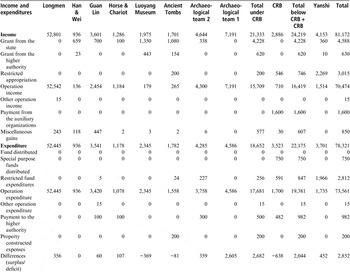
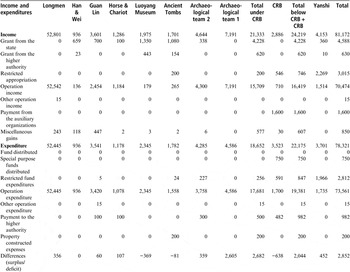
The access to internal financial data provided in our resource in extraordinary: normally, similar data simply cannot be found in the literature at all (Table 3). Here again some comments about the nature of sources is needed before commenting on the substantive elements of the data.Footnote 43
A Tentative Example: An Integrated View of Financial Information about Cultural Entities in the Luoyang area (2005, thousands of yuan)
Source: Our elaboration on internal data.
The situation is puzzling: each of the entities we analysed, like the rest of the million shi ye danwei in China, has its own financial statement. However, a proper notion of accountability is lacking. Most of the time, a very partial report is provided, often without “extra-budgetary” items such as self-generated income. The justification is that reporting is made to the source of funding on an item-by-item basis (for example, reports to government about the governmental budget). Whatever the norm states – indeed “extra budget” is a well-known issue in the administrative reform debate – there is no notion that an entity should report all resources received and spent. Associated with this, the issue of lack of transparency in financial information emerges. Beyond hiding data or providing false data, you have to know exactly what kind of income and expenditures are relevant in order even to ask for the data, and only then – at least in case of a collaborative project such as our research – will you get them. In addition, income and expenditure data are not usually presented in the reporting system: normally a balance sheet plus the list of expenditures is provided.Footnote 44 Finally, the financial information of individual entities is simply aggregated, without collectively presenting the total and the individual data. All in all, the reconstruction of data in Table 3 is not a given: it is not a set of data that is already prepared and used in Luoyang; it is rather our elaboration, overcoming the lack of emphasis on income and expenditure data for individual and aggregate figures.
Based on such an integrated view, we can comments on the financial situation of various entities. Presenting the breakdown of the data while still preserving individual information allows for an internal comparison between different entities, underlying once again the variety among them. The data in Table 3 help to reveal power relationships inside the archaeological chain. On the one hand Longmen Grottoes appears in a strong position, since its income and expenditures (52.8 and 52.4 million yuan respectively) are bigger than the total figures of other entities under the CRB plus the CRB itself (24.2 and 22.1 million yuan). Also, the instrumental role of the CRB and its indirect importance in the overall system is stressed by its low percentage in terms of expenditure along the archaeological chain (3.5 million out of 78.3 million yuan including Longmen, or 22.1 million yuan excluding it), or even more so in terms of income (2.9 million out of 81 or 24 million yuan respectively). Moreover, the anomalous wealth of the archaeological teams can be seen: expenditure was not able to follow income, thus leaving consistent savings (2.6 million yuan for archaeological team number 1 and 352,000 yuan for archaeological team number 2). Indeed those savings largely explain the aggregate savings in 2004 (2.8 million yuan), despite losses at some entities (the CRB itself, with a negative balance of 638,000 yuan, and the Luoyang Museum, with minus 369,000 yuan).
Table 4 proposes a tentative benchmarking exercise that allows us to construct several additional performance indicators and gain further insights on internal variation within the system. First, different attitudes towards income generation can be observed, with some self-funding entities (Longmen Grottoes 99.5 per cent and Horse & Chariot 92.1 per cent), other low-performing entities (Ancient Tombs 15.6 per cent and the Luoyang Museum 9.1 per cent), and Guan Lin in a central position (68.2 per cent). The different situations in terms of internal economies can also be addressed by considering the proportion of salaries and welfare expenditures to operation expenditures. Focusing on museums for the sake of simplicity, this ranges from 29.2 per cent at Horse & Chariot to 53.2 per cent at Luoyang Museum to 91.4 per cent at Ancient Tombs, describing situations of different efficiency which are interestingly enough much higher for the most recent institution. The cost per visitor also presents great internal variety, from 12.6 yuan at Horse & Chariot to more than 29.0 yuan for Luoyang Museum and Ancient Tombs.
A Benchmark Exercise

Source: Our elaboration on internal data.
From a process point of view, the most interesting element of Table 4 is that it is merely our exercise as researchers: nothing similar was found in Luoyang itself. This is a sign of a lack of managerial control in cultural heritage. A very peculiar aspect in our experience is that financial data are very hard to obtain, but at the same time no one really cares about them. “Nobody before you did such an in depth analysis of data. We simply fill in the format, we pass these data to the above administrative entities, and that's it.”Footnote 45 Though information from Tables 3 and 4 would, in another context, give important suggestions on how to intervene in the management process of an individual entity, here the administrative system is not used for decision-making purposes. Investment decisions are based on other considerations (none of the decisions to set up four archaeological parks included a business plan). But in addition, ongoing decisions are not linked to actual performance. Differences in performance do not allow the CRB director to intervene, since funding decisions for the coming year are based on other kinds of bargaining logic.
Conclusion
A contradictory picture emerges from our research on the management of the archaeological chain in Luoyang. On the one hand, a high dynamism characterizes changes affecting the archaeological chain: there is a continuous flow of discoveries and a re-legitimation of professional discourse in the context of international collaboration, among other issues. On the other hand, major institutional issues have been addressed in this article: institutional complexity and fragmentation, the growing importance of salvage excavation and its incentive mechanism for excavations only, a bias towards extraordinary projects, and potential differences in the value of sites for historians compared to visitors. This situation was found to have negative impacts on both curatorial issues (duplication and lack of cumulative knowledge in excavation, research and conservation) and visitor orientation (the loss of opportunity for a more integrated communication and promotion strategy).
On a more general level – beyond the professional meanings of our research findings in terms of the organization of Chinese archaeology, museology and conservation – the partial or even contradictory nature of changes in managerial action emerge. Major issues in terms of managing human resources have been investigated (lack of workload analysis for staffing decisions, general overstaffing, lack of an effective discipline and rewarding and punishment system), as well as issues in financial resources (with issues of transparency, accountability and responsibility).
There are surely some general cultural issues involved here. Nothing could be further from the usual excess of “managing by numbers” found in Western management; rather, decisions and numbers are not systematically linked. Financial resources allocation follows a different logic from that of (Western?) managerialism: a logic of politics, nationalism (particularly in the case of heritage) and the inner game of bureaucracies drive administrative and institutional issues.
The call for management (or better, “scientific management” as it is called in the Tenth Five-Year Plan) is recurrent in many documents and discussions. But it is more the form that the substance which is adopted. Income and expenditure statements are not used, the articulation of individual entities as independent shiye danwei has little to do with power delegation as the international literature suggests, and performance is not on the agenda, either in investment or in current operation contexts. It is a discourse on managing without the establishment of a performative principle. Or at least, it represents a partial application of the former in contrast with the belonging principle (belonging to the nation, the state, the Party). The convergence towards well-established managerial models is apparent, in a context that could be defined as partial/seeming isomorphism,Footnote 46 while the role of the inner trajectory of the transformation of the political and administrative system remains huge.