On 2 December 1823, President James Monroe gave his seventh annual message to the American Congress. This speech, which came to be known as the “Doctrine,” outlined the plans for United States foreign policy in the future and stated its interest in expanding in South America. About a year later, Monroe addressed Congress again, urging them to hasten the “civilizing” of the Indians. In 1830, the final act of this long and tragic project was consummated when Andrew Jackson's Removal Act forcibly displaced the Indian tribes to the west of the Mississippi river. The two moments were connected; Indian removal at home represented the domestic application of similar policies of involvement abroad. Both had for objective the management of the various Natives throughout North and South America; the American republic needed room to grow. This growth reverberated uneasily across the Atlantic and raised a series of interrelated questions for the British, who now had an imperial competitor in the hemisphere. London had to decide whether it was worth preserving its foothold in the New World, by force if necessary. American periodic military and diplomatic attempts at expanding northwards into the Canadian colonies forced the colonists to reflect on their allegiances and place on the continent, with the War of 1812 promising to be a test of the resolve of both. Yet, despite Thomas Jefferson's conviction that acquiring Canada was going to be merely a matter of marching, the end of the war demonstrated that London was not ready to concede British North America just yet. Colonial loyalty to the Crown allowed Britain to cling to the New World, but the gradual consolidation of the United States as a second continental center of power – economic, military, and cultural – complicated the dynamics of Canadian colonialism.
The literature of the times echoed the new shifting transatlantic and continental patterns of belonging. This article explores the uses of race and empire as tropes of colonial otherness in the novel The Canadian Brothers (1840), and proposes settler colonialism as an alternative investigative paradigm for early Canadian fiction. The Canadian Brothers, originally published in English in Montreal, is the second installment of what was intended to be a foundational narrative by English Canadian author John Richardson (1796–1852). A contemporary and imitator of Fennimore Cooper, Richardson adapted Cooper's historical frontier romance template for his own ideological reasons. Hailed as Canada's first novelist, his work has long been explored by critics in a variety of directions that I do not intend to revisit here.Footnote 1 Indeed, I argue that, despite the overwhelmingly national thrust of most existing criticism, Richardson was committed to crafting a usable past for Canada that would distinguish it from the United States by reasserting its membership in the British Empire, rather than by inventing a separate national identity. The first part of the task was particularly problematic. Throughout the nineteenth century, Canada remained the last outpost of the British Empire in North America; nonetheless, the colonies shared with American culture and with the other settler cultures of the Americas an uneasy triangulation of belonging and identity compounded by enduring anxieties of whiteness and authenticity. On the one hand their shared colonial past undermined the ideological validity of the still-fresh nineteenth-century political borders; on the other, the neo-imperial position that the United States was assuming in the hemisphere turned the American republic into an alternative reference point – to be emulated, feared, or rejected.
Capturing this multilayered dynamics in colonial Canadian literature faces a series of methodological hurdles. Since the 1990s, scholars of Canadian studies have grappled with the postcolonial lexicon and struggled to find ways to apply it to Canadian literature. Scholars like Linda Hutcheon, Donna Bennett, Diana Brydon, Alan Lawson, and Stephen Slemon have explained the difficulty of applying the postcolonial lens to Canadian literature by postcolonialism's heavy reliance on the concept of nation-state.Footnote 2 Arguably, postcolonialism remains a useful investigative framework for Native literatures or even for some twenty-first-century Canadian authors; yet things become muddled when examining early Canadian literature without acknowledging the settler status of Canadian cultures and the avowed or repressed legacy of that settlerhood on subsequent national identity formations and national narratives. This is largely due to the nature of settler colonialism in general. Settler societies occupied an ambiguous position vis-à-vis the imperial center; one the one hand, they were inhabited by colonists who shared with the mother country both race and cultural origins, and who expected to enjoy the full benefits of their Britishness. On the other hand, metropolitan fears of cultural creolization undermined the imperial rhetoric of sameness. In Chris Tiffin and Alan Lawson's terms, these settler subjects functioned “at the very site of the operation of colonial power … part of the imperial enterprise,” simultaneously its instruments and its recipients, both “mediator and mediated, excluded from the unmediated authority of Empire and from the unmediated authenticity of the indigene.”Footnote 3
It is this in-betweenness of the white settler elites and its lingering echoes in the literary culture of anglophone Canada that postcolonialism is ill-equipped to deal with. First, Canada's place in the empire continued, culturally and politically, well into the twentieth century, and its narratives of collective identity never quite matched the belligerent nationalism of its southern neighbor. Second, at the heart of the postcolonial methodological toolkit lies the colonizer–colonized binary, a distinction which fails to truly capture the position of the white colonial elites in Canada – those who produced and consumed the literature that was to be later integrated in the national canon. Indeed, throughout the history of British North America, these various Euro-settlers in the colonies engaged in simultaneous, yet unequal, power relations with one another and with the Native peoples who inhabited the land; not surprisingly, one single postcolonial approach cannot be used to asses these various literary outputs. And finally, if postcolonial theory is predicated on the break with the empire and the rise of the nation, when does Canada's postcolonial era begin and for whom? Which group yielded and still yields power over whom, speaks for whom, silences whom? To further complicate things, is the United States a new empire and Canada its economic and cultural colony? In 2012, reflecting once more on the vexing issue of Canada's postcolonialities, Laura Moss concluded that the question is no longer vital, and recommended instead a critical focus on the connection between “art and place, memory and representation, and history, violence, and speech.”Footnote 4
In the following pages, I approach Richardson's historical fiction as a way to move beyond the limitations of postcolonial theory when applied to early Canadian content, and to propose an alternative methodological approach. The Canadian Brothers is particularly well suited for testing such larger theoretical points, given its conscious emplotment of North American history in the larger imperial paradigm, as well as the author's awareness of the role that political ideologies play in articulating collective forms of belonging. I suggest that using settler colonialism to discuss this novel can open a fruitful avenue of investigation for Canadian literature in general, as this approach provides a shared hemispheric lexicon that can potentially bridge the pre- and post-Confederation divide and, possibly, the English–French divide. Recent studies in Creole identities in the Americas have refined previous understandings of settler colonialism, allowing for an exploration of the colonial New World beyond the categories of national and imperial, whether modern or early modern.Footnote 5 This use of settler colonialism dissociates the term “Creole” (and the related “creolization,” “creolism,” etc.) from the racial connotations dominant in American and Canadian studies scholarship, using it instead to designate a discourse of difference applied to the white settlers throughout the hemisphere. More to the point, settler colonialism can better illuminate the layered regional colonialisms of the continent, where Acadians, French Canadians, English Canadians (native born or not), British officials, and American citizens found themselves entangled in complex transatlantic, hemispheric, and regional hemispheric networks of power, oppression, and privilege. It examines early Canadians in relationship with the other Euro-Creole groups in North America, with whom they shared a colonial past, a legacy of Native entanglement and local geography, and the constant triangulation between indigenous formations and European identities.
This triangulation relies on racial and ideological boundaries. Elsewhere I propose the term “protopatria” to describe the literary construction of an embryonic settler-colonial homeland, which allows for the synchronic comparison of early North American cultural formations beyond the political category of nation-state.Footnote 6 Indeed, The Canadian Brothers projects mid-nineteenth-century imperial projects and colonial arrangements onto the early nineteenth-century North American geography and past; Canadian creolism is predicated on the colony's special relationship with the Indian nations and on Canada's place in the British Empire; and Canadian race attitudes become a litmus test for imperial membership. Richardson both echoes and departs from similar attempts to coopt indigenous culture in contemporaneous American literature. On the one hand he contrasts the imperial British discourse of racial tolerance and British military alliances with the Natives in the War of 1812 with the brutality of American policies towards the Natives, in order to demonstrate American difference from the Canadian colonies. On the other hand, his critical attitude towards all European military and commercial interventions in the New World both foregrounds the rootedness of Creole settler colonialisms in European imperialism, and exposes the arbitrariness and constructedness of the political boundaries dividing the continent.
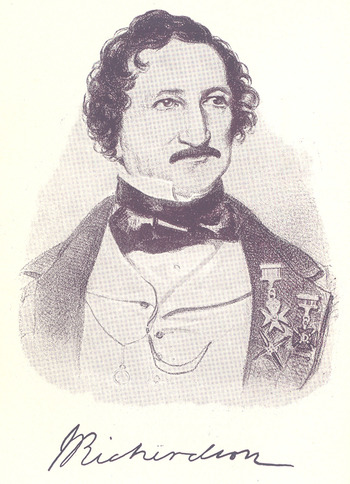
John Richardson (1796–1852), in John Richardson, Wacousta: A Tale of the Pontiac Conspiracy, with illustrations by Charles W. Jefferys (Toronto: Historical Publishing Company, 1906), iv. Holdings of the Library of Congress, Washington, DC, PZ3.R394 W4 PR9199·2.R53.

This flexibility of perspective can be traced back to the author's background. John Richardson was a multicultural product of the first British Empire in North America; through his mother, he was part Ottawa, through his father, he was part Scottish, and his own life experiences anchored him firmly in the imaginary space of the British Empire. Richardson was barely a teenager when the War of 1812 started; he joined the army, fought against the American troops alongside Tecumseh, and was taken prisoner of war for a year in Kentucky. Upon his release in 1815, he took up an ensignship in the British Imperial Army and spent the next twenty-three years sailing the seas of the empire. He returned to Upper Canada in 1838 as a journalist for The Times, and remained there a mere eight years before moving to the United States, where, after a brief career writing pulp fiction, he died in abject poverty. In 1832, when Richardson's first frontier novel, Wacousta, came out in London, the demand for fiction featuring American Indians was peaking on the British market. Stories about America and its Natives already had a history in British literature. Indians were cycled and recycled as text from New York to London and back by white authors, at the same time as settlement was physically displacing them. In the United States, while the country was debating whether the Indians should or would ever be able to be active participants in the political and social life of the new republic, writers were discovering their usefulness in defining an emerging American national identity. Unlike his American counterparts, Richardson offers an unapologetically pro-imperial take on the history of the continent. Whether dealing with eighteenth-century Indian–British conflicts on the frontier, as in Wacousta, or with American–British struggles in the War of 1812 in its sequel, the North American past Richardson re-creates in his historical romances implies a British Canadian protopatria that prefigures the political communities of the mid-nineteenth century.
RACE POLICIES
Richardson's novel came out at a time when the fate of the American Indian was a matter of pressing concern on both sides of the Atlantic. In the early decades of the nineteenth century, British North America consisted of a loose collection of colonies united more by their allegiance to the empire and fear of American annexation than by any shared commonalities.Footnote 7 This was also a time of feverish administrative experimentation, when policies towards the Natives were transformed by the new political and demographic needs of the colony, by the example of American policies, and by the rise of scientific racism. The resulting arrangements responded to the specifics of colonial and American political cultures respectively. In 1830, Great Britain shifted jurisdiction over Indian affairs in Canada from military officers to civilian administrators, at the same time as the United States was putting Indian affairs under the responsibility of the War Department. The Royal Proclamation of 1763 remained the ruling document that governed white–Indian relations, positioning the Crown as the sole intermediary between Native and settler land interests in Canada. This situation was dictated by practical reasons as much as by ideological ones: after the War of 1812, Britain no longer needed Native military support to defend the colonies. At the same time, a vibrant anti-slavery movement brought race to the forefront of public conversations in Britain and politicized the fate of the Native populations across the empire.Footnote 8
Then there was the matter of Canada's conflicted relationship with the United States, whose proximity influenced popular mores, and made it essential to identify clear cultural and political differences between the two communities. Native policies served this purpose beautifully. First, at the heart of colonial policies in North America lay the idea of an orderly frontier, so that legality in all settlement matters played a symbolic and ideological role in distinguishing the Canadian political order from that of the United States. Second, Canadian political culture was quite genial to an active government role in economic development and social policy; while in the United States the Indian question became yet another element in the squabble over states’ rights and federal authority, in Canada the role of the state in the policies of settlement was never seriously challenged from the ground up. At any rate, given the previously cooperative relationship between the colonial societies in British North America and the Natives in the seventeenth and eighteenth centuries, and particularly due to the relatively low flow of immigration during these decades by comparison with the United States, there was no strong popular anti-Indian sentiment in Canada to condone a systematic program of violent removal of Native communities. When in 1836 Sir Francis Bond Head, the new lieutenant governor of Upper Canada, tried to eliminate the paternalistic programs meant to “civilize” the Indians and to replace them by an aggressive policy of land surrenders and removal, the British Colonial office (who initially seemed to support Bond Head's initiatives) was forced to swiftly back down because of vigorous public outcry.Footnote 9
Arguably, both in Canada and in the US the official rationale for all relocation policies was Indian welfare, although in both cases Native rights and independence were systematically trampled and Native cultural survival relentlessly threatened by imperial and federal assimilationist, so-called “civilizing,” programs. But the assault on Native land was far greater in the United States, a reality which translated into strong popular support for the sweeping and brutal removal programs that punctuated the post-Jacksonian years. In the 1790 US Articles of Confederation, the federal government had retained the exclusive right to manage Indian affairs; this trend was continued by a series of Supreme Court decisions that formalized relationships between whites and Indians, denied Native nations their sovereignty, and reduced all American Indians to the status of “wards of the state.”Footnote 10 Removal as a national policy officially began in the United States in 1830. In his message to Congress on the Indian Removal in December that year, Jackson bluntly articulated what seemed the natural choice of a generation: “What good man would prefer a country covered with forests and ranged by a few thousand savages to our extensive Republic … occupied by more than 12,000,000 happy people, and filled with all the blessings of liberty, civilization and religion?”Footnote 11 Canada did not have a comparable Indian removal policy, but starting in the 1830s it too embraced a set of policies of protection, separation, and civilization meant to Christianize the Natives and include them into Canadian society, against their will if necessary.Footnote 12 Throughout the first half of the nineteenth century the two governments engaged in consistent relocations, which profoundly altered the nature of the Native communities and their independence across the continent.
Elsewhere across the British Empire, references to American slavery and Native policies consistently served to showcase the cultural differences between the United States and Britain (and, by extension, Canada), allowing the British to take the moral upper ground when attacking the strident nationalism of certain American politicians or writers.Footnote 13 As new scientific theories turned races into immutable categories, race in North America became increasingly relevant for the legitimization of the European presence on the continent. This relevance was inflected differently in a national versus an imperial context. In the United States, whiteness allowed American Creoles to assert a post-Revolutionary European lineage; race became both a powerful ideological tool that legitimized neocolonial policies towards other groups in the Americas, and a precondition for full citizenship.Footnote 14 British North America experienced a less radical shift towards whiteness, because there the continued symbolic membership in the empire offered Canadian Creole elites an alternative path to Britishness. Instead, racial tolerance became a litmus test for British civility. Britons everywhere liked to believe that the Natives in the Canadian colonies enjoyed a far superior fate to those in the United States. Britishness was believed to embody a unique mix of liberty and order favorably contrasted to the American laissez-faire capitalism and unbridled popular democracy, which opened the path to abuse of vulnerable minorities at the hand of the majority.Footnote 15 Building on these cultural assumptions, Richardson's emplotment of difference in The Canadian Brothers follows the dominant rhetorical pattern: the Americanness of the Americans was confirmed by the way in which they treated the blacks and Indians in their power; by implication, the Britishness of the Canadians could be assessed the same way.
SETTLER-COLONIAL AMBIGUITIES
The Canadian Brothers is best understood when discussed in tandem with its prequel, Wacousta (1832). The plot follows the fate of a garrison beleaguered by the violence and ruses of Wacousta, a vengeful white in Indian disguise. The protagonist uses Pontiac's rebellion of 1763 as the vehicle of his personal vendetta against Colonel de Haldimar, the officer in charge of the fort. After countless bloody battles, the British soldiers manage to defeat Wacousta with the help of some friendly Natives, and order is reestablished on the frontier, although most of the de Haldimar family die in the process. In the last pages of the book, Wacousta's mate, a mad Englishwoman with her own reasons for hating de Haldimar, utters a curse upon the surviving de Haldimars before vanishing in the forest. The Canadian Brothers takes up the story of the two remaining heirs of the de Haldimar family on the background of the War of 1812. While in Wacousta the events that trigger the plot take place in Europe, The Canadian Brothers is set in a North America that already has a history which informs its present. The descendants of lawless, anarchist Wacousta and of his mate, Ellen Halloway, are United States citizens, whose paths intersect with those of the Grantham brothers, the last descendants of Colonel de Haldimar, Canadian, and staunch supporters of the British rule. The plot of the novel sets out to demonstrate the depth of their imperial loyalties.
In his 2003 article “I too am a Canadian,” Douglas Ivison argues that, unlike the more clearly colonial perspective of its prequel, The Canadian Brothers marks the transition towards a postcolonial take on Canadian identity, as it articulates a Canadianness that is still contained within the British empire but which rejects total subordination and struggles to resist the neo-imperial threat posed by the United States.Footnote 16 Ivison's analysis relies on the default postcolonial binary of colonizer/colonized, and as such fails to capture the ambivalence that characterizes the novel's treatment of both the British and the Americans. During a routine operation, Gerald Grantham captures an American ship. On board he meets the mysterious American Matilda Montgomerie, falls in love, and is ready to sacrifice his career and duty to be close to her. As the story unfolds, we learn that Matilda is the daughter of the vile Yankee spy Desborough, and Wacousta's granddaughter. In prey of his romantic obsession with Matilda, Gerald is torn between love and duty, succumbs to the former, and deserts the British army and temporarily renounces his identity and his loyalties to Crown, country, and family. The ultimate proof of his love is murder: Matilda asks him to kill an American officer who had insulted her honor. Yet Gerald discovers he cannot silence his conscience, refuses Matilda's demand, warns the American of the lady's plans, and helplessly watches her commit suicide. He returns to his regiment only to die on the battlefield of Queenston Heights, accidentally killed by his own brother, Henry, who mistakes him for an American spy. In turn, Henry dies at the hand of a Desborough gone wild with revenge. With the deaths of both brothers, the prophecy that ends Wacousta is fulfilled, as Gerald's infatuation with the beautiful American led to the demise of the entire de Haldimar line.
Daniel Coleman views The Canadian Brothers as a typical loyalist allegory of fraternity and fratricide, whose narrative function is to “manage considerable anxieties at play in the contested field of loyalist discourse” and to legitimize the violence that begot two nations in North America.Footnote 17 Yet, like Ivison's postcolonial reading of the novel, Coleman's emphasis on the Canadian need to forget the national trauma in order to move forward still overlooks the racial and cultural commonalities that the fratricidal brothers share with some of the American protagonists. Richardson codes the indigeneity of Desborough and Matilda as inauthentic, and the two Americans as false Creoles. Desborough lives in the forests, alone, crossing borders, eating Indian flesh, and communing with the wilds in a grotesque and dystopian version of Natty Bumppo, while his daughter blatantly disregards all rules of morality in her pursuit of personal vengeance; by contrast, the two Grantham brothers uphold the ideals of British civility and are marked as the genuine Creoles. At the same time, they – and their British fellow officers – also share values and rules of chivalry with American officers of similar class, background, and inclinations. In acknowledging these commonalities, the plot encapsulates the tension between Europeanness and indigeneity that is a characteristic of Creole cultures, but complicates it by placing it in a continental framework. Canadian creolism is triangulated twice: once between British culture and the indigeneity promised by the New World, and a second time, between the political communities represented by Britain and the United States.
Race represents the point where the two processes intersect and partially overlap. It is also where the boundaries of national civility – British, Canadian, and American – are most clearly marked. On the one hand, the Creole search for settler authenticity is predicated on an avoidance of racial hybridity articulated in the removal or transfer of people who can be construed as exogenous Others, although this transfer does not preclude forms of cooperation.Footnote 18 At the heart of the Creole settler situation lies resistance to racial hybridity: Canadians are white Britons living in North America. On the other hand, the novel highlights national variations in attitudes towards race, as much as it silently acknowledges continental similarities. Although Native and black characters play an important role in loyalist narratives, “they are generally expendable by the time the narrative closes,” so that “the fraternal allegory ‘whitens’ the loyalists’ involvement in warfare by justifying it as altruism on behalf of oppressed non-whites.”Footnote 19 Yet in Richardson's foundational and loyalist diptych whiteness is fragmented. The only character that appears in both Wacousta and The Canadian Brothers is the faithful black servant Sambo, whose reassuring loyalty to the Grantham brothers serves to bolster the white civility of the Canadians, while significantly representing Richardson's only reference to blackness in early America in these two texts.Footnote 20 Sambo's character does not threaten Creole whiteness, but rather problematizes it. On the one hand, his long-standing relationship with the Grantham family validates the existence of two sets of Creole values and punctuates the transition from the wild Wacousta to his selfish and amoral American progeny, and from law-abiding de Haldimar to the two Canadian brothers. On the other hand, as the only witness to events in both novels, Sambo stands for the untold story of black slavery and servitude in North America, as well as for a set of shared cultural attitudes towards blackness that span political borders and are further developed in Matilda's story: the young American persuades Gerald to murder her former fiancé because the latter has falsely accused her of sexual relations with a slave, an accusation whose scandalous nature is never questioned in the novel, and is implicitly acknowledged by American and Canadian characters alike.
The continental context of the two competing Anglo-creolisms of The Canadian Brothers illuminates the role that political categories play in shaping Richardson's literary imaginary, sometimes undermining, at other times building upon, shared racial assumptions. It also complicates the theoretical approaches to creolism and creolity that have emerged in research up to this point. These trends tie Creole self-imaginings across the hemisphere to a specific political model blending republican institutions with “the indigenous difference that marked off the modern world of the Americas from premodern Europe.”Footnote 21 Yet the imperial subjects foregrounded in Richardson's novel do not strive to become republican citizens – quite the opposite. In Richardson's protopatria, local forms of self-definition compete with imperial ones in a taxonomy of colonial belonging where Britain is no longer the only pole of identification available to the Anglo-Creole communities on the continent. The American woman who seduces the Canadian brother epitomizes the lure of a new model of creolization, rooted in the American ideals of liberty, democracy, and laissez-faire capitalism. Richardson ultimately rejects this tantalizing model, coding it as alien to Britishness and to the values of the Canadian polis; nonetheless its existence and appeal testify to the impact of political formations on the Creole imaginaries of nineteenth-century North America and their coexistence with imperial forms of belonging.
The appeal of this alternative creolism consistently underpins the interactions of the protagonists in all contexts. In the introduction to Wacousta, “Canadian” refers to the French Canadian inhabitants of the colonies, but in The Canadian Brothers the term designates the colonists in Upper and Lower Canada in general. Yet, when used by British characters, “Canadian” is used as an affront. The tensions between British officials and colonial nationals are visible early on in the novel. In the first chapter, Gerald Grantham goes missing while in command of a gunboat that could have intercepted an American vessel on its way to Detroit. The British soldiers on guard question Gerald's loyalty because of his Canadian birth, which is likely to make him more susceptible to American sympathies. One of the British officers, Captain Moulineux, comments on the dangers “of entrusting so important a command to a Canadian.”Footnote 22 Proving Canadian loyalty is therefore a necessity in order to compensate for a North American birth and gain full access to Britishness. The British General Isaac Brock defends the two Canadian officers.Footnote 23 In defense of Henry and Gerald, General Brock emphasizes the irrelevance of one's actual place of birth: “If … the mere circumstances of their having received existence amid these wilds can make them Canadians, they certainly are Canadians; but if the blood of a proud race can make them Britons, such they are.”Footnote 24 Brock's statement is juxtaposed against the Canadian Colonel D'Egville's advice to Henry Grantham, who takes offense at being called “a Canadian” by another British officer. D'Egville urges Henry to ignore the subversive intention of the comment, and to turn insult into a point of pride:
And if he did utter such taunt, why acknowledge it as such? … [A]re you ashamed of the name? I too am a Canadian, but far from endeavoring to repudiate my country, I feel pride in having received my being in a land where everything attests the sublimity and magnificence of Nature.Footnote 25
The incident frames the Creole dilemma of the two brothers by juxtaposing two strategies for conceptualizing individual and national identity – one rooted in the New World, the other in the imagined global community of empire.
REPRESENTING NATIVES
Richardson's fiction hints at the possibility of a world where whites and Natives live, love, and fight side by side. Creole indigeneity is predicated on knowledge of the land and on alliance with the Native peoples; in Canada, Britishness must also be predicated on loyalty to the Crown and rejection of the American model. Richardson responds to contemporaneous ideological needs by reintroducing the colonial history of Native–British cooperation into cultural conversations about Canada's future. Across the Atlantic, the stereotype of the Noble Savage evoked closeness with nature and an authenticity that had been irretrievably lost in Europe. In North America, the Indian-as-symbol had a more complicated cultural career. As the frontiersmen of Jacksonian America acquired more political rights, they became the “Indianized,” egalitarian agents of democracy, while the real Indians were inevitably supposed to vanish in the sunset, making the American community the heir of their cultural legacy. In nineteenth-century British North America too, Indian warriors populated the pages of imaginative literature. Yet, rather than proto-republican democrats, they were described as the products of inborn aristocratic propensities, whose selfless interest in the well-being of their people and their support of the British in the Revolution, made them “specific specimens for royalist, anti-American ideals.”Footnote 26 These quasi-aristocratic literary Natives embraced the same values the Americans rejected, and helped the British understand the land and repel military invasion. As such, they epitomized the imperialist roots of the Canadian protopatria: the aristocrats of nature as co-founders of the future Creole community.
In both interpretations, the Native becomes an empty signifier, to be interpreted depending on the ideological needs of the two Creole communities trying to stake their claim to indigeneity. Richardson's fiction departs from this model; his novels capture the Natives’ agency in their dealings with the Empire. They may not be progenitors of the new Canadian nation, but then again, neither of the Grantham brothers survives either. In both Wacousta and The Canadian Brothers, the Natives are political and military forces to be reckoned with. Richardson's portrayal of Tecumseh, whom the author had met in person, is a case in point. The Indian leader is introduced in the first chapter of The Canadian Brothers, and he enjoys the appreciation and friendship of the British officers who treat him as their equal:
The greeting between Tecumseh and these officers was such as might be expected from warriors bound to each other by mutual esteem. Each held the other in the highest honor, but it was particularly remarked that while the Indian Chieftain looked up to the General with the respect he felt to be due to him … his address to his companion … was warmer and more energetic … and indicating … the fullest extent of approbation.Footnote 27
Friendships are based on affinity and are essentially nonhierarchical relationships. We learn that while Tecumseh respects General Brock, he feels attached to Commodore Barclay by a “secret bond of sympathy,” and that “the General seemed to claim the admiration and the respect for the Indian – the Commodore, this admiration and friendship.” This attraction stems from physiognomic similarities. Richardson compares the former's “eagerness of expression” with the “vivacious fire that flashed, even in repose, from [Tecumseh's] own swarthier and more speaking features.”Footnote 28 This emphasis on physical correspondences serves both to construct Tecumseh's appearance outside the exoticizing framework of his race or dress, and to hint at a deeper commonality and civility between the two men, only confirmed by the subsequent developments of the plot. The Canadian Brothers also includes numerous examples of cross-national friendships between British and American officers at war. But by applying to Tecumseh the same codes of the military brotherhood as to the Anglo-Creole protagonists, Richardson suggests that emotional alliances transcend racial borders. Imagined as an equal, rather than as a tool, Tecumseh proves his loyalty to Canada through his deeds and becomes a member in a civil brotherhood that supersedes national or racial identifications.
Tecumseh's actions and comments on the decisions of the British officers indicate his awareness of the degree to which his assistance was needed; they also present him as personally invested in the project, and not as a mere executor of imperial orders. For instance, unbound by military conventions about rank, he feels free to voice his discontent with the decision of Brock's successor, General Proctor, to abandon their position in Amherstburg. He even “carried his contempt and indignation so far, as to term him the coward he believed him to be” and, comparing Proctor with Commodore Barclay, plainly showed everyone “how high the one had been raised, how low the other had been sunk, in the estimation of the truly brave.”Footnote 29 Tecumseh deconstructs European conventions of warfare and military leadership. His critique of Proctor's battle strategy places European and Native war practices within the same analytical framework, and astutely engages the social and military realities of the conflict by questioning the validity of hierarchies not based on worth. The Indian leader's strong criticism of a British general with whom he is technically allied posits the former as an individual who refuses to be picturesque, ahistorical, and timeless, or passive and providing only cannon fodder for the depleted British army.
As allies of the British army, the Natives are constructed as individuals who abided by a social code that placed courage – and the related forms of violence that qualified as courage – at the center of its construction of masculinity. Richardson uses the same strategy in drawing Tecumseh's portrait along classic lines: “His rather florid countenance was eminently fine, if not handsome, offering, in its more Roman than Grecian contour, a model of quiet, manly beauty.”Footnote 30 His other warriors evoke key figures of British history. The chief Split-log is described as “afflicted with an aldermanic rotundity of person;” his head recalls “that of the gigantic Memnon, in the British Museum.” The clothing and head-cover of the second chief, Round-head, evoke “one of his puritanical sly-eyed namesakes of the English Revolution,” while the third chief, Walk-in-the-water, bears “a striking resemblance to the portraits of Oliver Cromwell,” and both were “characterized by an unconscious imitation of the Roundheads of the Revolution.”Footnote 31 By using terms borrowed from British history to describe the Natives, Richardson performs an elaborate domestication of otherness. He moves from a strange and threatening reality, which he apprehends metaphorically, to its constitutive elements.
Richardson goes back and forth between unflinching descriptions of Indian nobility and agency and gory depictions of Indian violence and barbarity. Nevertheless, he positions himself as one who truly understands Indian culture and acknowledges similar behavior on the side of Americans and Europeans alike; his textual references to Indian violence are almost always balanced by mentions of white brutality and lack of scruples. In Wacousta, Indian bloodshed is triggered by European ruses, and in The Canadian Brothers “the backwoodsmen of the new states” and the wild Kentuckians scalp, kill, and transgress civility to the same extent that the Indians do.Footnote 32 While offering stereotypical views of the Indian scalping his enemies with his tomahawk, Richardson also provides a contextualization for the practice, as one of the many Indian customs which may have appeared barbaric to European audiences but which had its own psychological, cultural and social causes. “It is not the mere desire to inflict wanton torture, that influences the warrior, but an anxiety to possess himself of that which gives indisputable evidence of his courage and success in war.” Richardson operates within the same moral framework when he assesses Indian and European war violence. The transnational context makes them conclude: “after all, Indian cruelty does not exceed that which is practiced even at this day in Europe.”Footnote 33
The brutal practices of the Spanish Guerillas are juxtaposed to those of the Indian tribes, in a comparison where Richardson is at pains to ensure readers of the authenticity of his sources:
I have numerous letters, recently received from officers of my acquaintance now serving in Spain, all of which agree in stating that the mutilations perpetrated by the Guerilla bands, on the bodies of such of the unfortunate French detachments as they succeed in overpowering, far exceeds anything imputed to the Indians of America.Footnote 34
This account of intra-European barbarity reveals the Eurocentrical rhetoric of civilization as hypocritical, and explodes the stereotype of the Native as irrational purveyor of violence. Nevertheless, the novel also exposes Richardson's Creole ambivalences, as he reluctantly acknowledges Canada's own status as colonizer vis-à-vis the Natives. Thus at one level Richardson's fiction offers a fantasy of Creole indigeneity in which the Canadian settler culture successfully negotiates the pulls of the dual poles of authenticity represented by empire and the Natives. At another level, the voice of empire is modified by the new geography, society, and ideological episteme it encounters in North America. Particularly Richardson's analysis of race policies in North America in chapter 6 of The Canadian Brothers dramatizes the repressed anxieties about the British (and implicitly Canadian) share of responsibility in the fate of the Natives in North America.
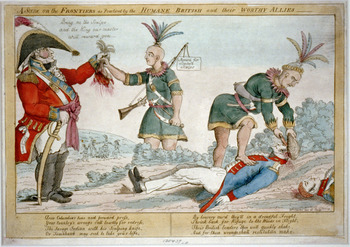
“A scene on the frontiers as practiced by the ‘humane’ British and their ‘worthy’ allies.” By William Charles, 1776–1820. Philadelphia, 1812. Courtesy of the Library of Congress Prints and Photographs Division Washington, D. C. 20540 USA, https://lccn.loc.gov/2002708987

BETWEEN REPUBLIC AND EMPIRE
In 1832, while working on an earlier draft in England, Richardson had sent chapter 6 of the future Canadian Brothers to King William IV. The correspondence indicates that the monarch consented that the book be dedicated to him.Footnote 35 As presented there, the larger project was not clearly described as a novel, but rather as a “work which treats of the policy of employing the Indians in any future war we may have with the United States.”Footnote 36 In the end, the volume was dedicated instead to Sir John Harvey, the lieutenant governor of New Brunswick, and a veteran of the War of 1812, but in his 1840 preface Richardson still included the letters sent to the king in 1832–33 to make a double point. The first was that, “from its historical character,” The Canadian Brothers “was deemed of sufficient importance not to be confounded with mere works of fiction.”Footnote 37 The second, less clearly derived from his past exchanges with Whitehall, was that the novel was intended “to do justice to [the American] character” and to restore “that healthy tone of feeling which it has been endeavoured to show had existed during the earlier years of the present century.”Footnote 38 By identifying his work as “history” and therefore superior to mere “fiction,” Richardson asserts its authenticity; by prompting his readers to reflect on the deeper significance of chapter 6, he positions himself as purveyor of a colonial truth which the metropole could not voice about the consequence of its imperial ventures; and finally, by including the final disclaimer against any accusations of pro-Americanism, he assumes the position of Creole mediator between continental realities and European perceptions.
The chapter opens with a lengthy defense of the controversial British policy of using Indians in the war against the United States, and evolves into a sophisticated exploration of the local entanglements of colonial (British) and postcolonial (American) imperialisms in North America. Richardson's imaginary creation of the Canadian polity as tolerant and humanitarian is predicated on the existence of the United States as a racist and intolerant Other. The pretext is a dinner party where the Canadian Colonel D'Egville invited his British fellow officers, Tecumseh, and some of his Indian chiefs, as well as the American Major Montgomerie. The writer starts by asserting the Britishness of the colonies as an indicator of racial pluralism and inclusiveness, and ends with a more general critique of Euro-imperialism in the New World. After the ladies of the house withdraw and Tecumseh departs, the conversation drifts towards Indian affairs in North America. Major Montgomerie's delight at having met Tecumseh leads into a more general analysis of British alliances with the Natives in the war. Fictional and nonfictional characters voice their opinions on the matter: the British General Brock and Commodore Barclay, and the Canadian D'Egville argue with Montgomerie over the legitimacy of using “savages” in a “civilized” conflict. Richardson resists describing the demise of the Native Americans as an inevitable result of the spread of civilization; in doing so, he subverts the ideological closure of the imperial narrative of conquest and settlement of the New World by laying bare the double standard systematically applied to the Native Americans by all European powers, Britain included.
General Brock and Commodore Barclay voice common British criticisms of American policies towards the Natives in order to explain Tecumseh's animosity towards the United States. Land policies and territorial expansion are interpreted in a transnational framework; Major Montgomerie invokes the growth in population that determined the Americans to forcibly take land from the Indians, but Commodore Barclay's reply exposes the tenuousness of the justification: “were the citizens of the United States condensed into the space allotted to Europeans, [they] might safely dispense with half the Union at this moment.” Barclay further challenges Montgomerie's argument by applying it to a hypothetical situation involving European actors:
What would be thought in Europe, if, for instance to illustrate a point … Spain, on the principle of might, should push her surplus population into Portugal, compelling the latter kingdom to retire back on herself, and crowd her own subjects into the few provinces that might yet be left to them. [sic]Footnote 39
The American Major Montgomerie rejects the comparison; he views the Natives as completely beyond the reaches of civilization, exempt from any rights and protections that derive from it, and with no possible impact on the future of Canada or the United States. Montgomerie's Eurocentric reading of “civilization” is merely a convenient shorthand for “race:” the officer reverts to a discourse of whiteness, and uses the rules behind one system of exploitation (slavery) to assess the legitimacy of another (the displacement of the Natives).
Both [Spain and Portugal] are civilized powers, holding the same rank and filling nearly the same scale among the nations of Europe. Moreover, there does not exist the same difference in the natural man. The uneducated negro is, from infancy and long custom, doomed to slavery, wherefore should the copper coloured Indian be more free?Footnote 40
By contrast, Barclay, Brock, and D'Egville describe their Native allies by emphasizing those qualities that render them compatible with British ideas of civility, and project upon Indian realities European notions and forms of organization: Tecumseh becomes the patriot leader of a country, and the warring Indian tribes are likened to European nation-states. To them, the Native peoples have been wronged by the United States in ways that would have been inacceptable in a European context; their retaliation is therefore legitimate, and their alliance to the British is a justified strategic decision. Particularly to the Canadian D'Egville, the Natives are crucial political players; he places the legacy of cooperation between Britain and the Indian nations in the context of recent events in colonial history, concluding that the Natives still have the power to shape the fate of the two Anglo-Creole communities on the continent:Footnote 41
At whatever epoch of her existence the United States may extend the hand of conquest over these provinces, with the Indian tribes that are now leagued with us crowding to her own standards, not all the armies England may choose to send to their defense will be able to prevent it.Footnote 42
Richardson was doing nothing particularly different from other British writers criticizing American Indian policies. However, in the same dialogue, the author also embeds a sharp critique of British imperialism in general. While the British and Canadian protagonists blame the present state of affairs on the American declaration of war, Montgomerie points out that Native–European conflicts stem from imperialism and colonialism in general, both of which preceded the creation of the American republic. As such, he refuses to accept the notion of a color-blind British civility, and exposes all European imperial ventures as rooted in the systematic exploitation and eradication of Native peoples all over the world. When General Brock grandly argues “against the right of a strong power to wrest from a weaker what may be essential to its own interest,” Major Montgomerie encourages his interlocutor to “merely glance … upon those provinces which have been subjugated by more civilized Europe.”Footnote 43 His reply draws the line of difference across the Atlantic, separating the New World – as recipient of European colonialism, from the Old World – as agent of colonialism, and questions the implied contrast between the civilized imperialism of Europe and the uncouth imperialism of the United States; in short, the British claims to tolerance and progress are revealed to be as empty as the American ones:
Look at South America, for instance, and then say what we have done that has not been far exceeded by the Spaniards in that portion of the hemisphere … Look again at the islands of the West Indies, the chief of which are conquests by England. Where are the people to whom Providence had originally assigned those countries, until the European … tore them violently away. [sic] Gone, extirpated, until scarce a vestige of their existence remains, even as it must be, in the course of time, with the Indians of these wilds …Footnote 44
Montgomerie's critique of European colonialism elsewhere is intended to legitimize the Indian removal in North America: if other “civilized” powers do it, violence against the Natives merely confirms the place of the United States among them. In this reading, “civilization” becomes a label that obscures the hegemonic power over discourse, territory, and bodies, whether the country wielding this power is physically located in Europe or in North America. By making an American officer expose the double standard which the British applied to American race politics, Richardson's text indirectly also challenges the reliance of British rhetoric of race as a way of constructing a coherent American national Other. This ambivalence of Richardson's critique of European imperialism in North America illuminates the complexities of his position as a settler subject in a liminal space of empire, complicit in imperial policies, and yet able to criticize from the periphery. At one level, Richardson's chapter goes against the triumphalist, loyalist ethos of the rest of the novel by subverting British civilizational certainties and their narrative of pro-British Canadian allegiance. At another, it indicates Richardson's very modern awareness of the constructedness of national identity and of its imagined dimension. The essential British claim to moral superiority over (and difference from) the Americans on account of their attitudes towards the Natives is exposed to be constructed and situational. Britons and Americans may relish in their narcissism of minor differences, but to the Natives they are the same. Montgomery points out to his British and Canadian interlocutors, “although we are a distinct people in the eyes of the civilized world, still we are the same in those of the natives, who see in us, not the emancipated American, but merely the descendant of the original Colonist.”Footnote 45 To Brock's Eurocentric gaze which projected European concepts and ideas about political organizations upon existing tribal structures, Richardson has Mongtomerie assume the Native gaze in order to blend the various constructed shades of national distinctions between British, Canadians, and Americans into the same category of intrusive Others, and to expose the whole idea of “civilization” as merely a convention too.
CONCLUSIONS
Even subversive fictional interpretations of history cannot be entirely divorced from the official position of the state. The metanarrative structuring them provides the “metaphysical mediation between the state and the lifeworlds of its subjects.”Footnote 46 Consequently, the fictional representations of the nation and the stories about its past serve to connect individuals to the state because they narrativize the relationship between the people and what Pease calls the “civi-territorial complex” of the nation, construed as natural and different from all others.Footnote 47 Richardson's historical romance of Canadian Creole rootedness in the land and in Native–white cooperation proposes a model of colonial identity predicated on the idea of civility, where racial attitudes serve as a litmus test of Britishness. In its use of the history of the War of 1812 as backdrop for the symbolic choices made by the protagonists, The Canadian Brothers firmly situates Canada in the larger space of the British world, and foregrounds the alternative creolity represented by the United States as a potentially disruptive element to the imperial continuum. The Britishness of the Canadians is assessed and contrasted with the otherness of their American neighbours via an analysis of the cultural practices and official policies related to the rights of the Natives in North America, although Richardson acknowledges the shared commonalities between the two Creole communities. Despite this ambivalence, the foundational narrative of white–Indian cooperation that John Richardson proposes in The Canadian Brothers provides the connection points between, on the one hand, a vision of the Canadian protopatria within the British imperial state apparatus, and, on the other, the latter's subject positions: its pre-constituted norms of belonging and allegiance; its assumptions about law, race, monarchy, and hierarchies; and the historical sites where the past could be used to validate these assumptions.