INTRODUCTION
Congridae are found worldwide in tropical, sub-tropical and temperate latitudes and are one of the largest and most diverse families of the Anguilliformes (Smith, Reference Smith and Böhlke1989). The Congridae family is formed of approximately 191 species in three subfamilies: Heterocongrinae, Bathymyrinae and Congrinae (Hatooka, Reference Hatooka2001; Nelson, Reference Nelson2006). Congrinae is formed of 22 genera (Hatooka, Reference Hatooka2001). Although the taxonomy of Congrinae has been debated, it is known that the genus Conger has approximately 14 species: C. cinereus (Rüppell, 1830); C. conger (Linnaeus, 1758); C. erebennus (Jordan & Snyder, 1901); C. esculentus (Poey, 1861); C. japonicus (Bleeker, 1879); C. macrocephalus (Kanazawa, Reference Kanazawa1958); C. myriaster (Brevoort, 1856); C. oceanicus (Mitchill, 1818); C. oligoporus (Kanazawa, Reference Kanazawa1958); C. orbignianus (Valenciennes, 1837); C. philippinus (Kanazawa, Reference Kanazawa1958); C. triporiceps (Kanazawa, Reference Kanazawa1958); C. verreauxi (Kaup, 1856); and C. wilsoni (Bloch & Schneider, 1801) (Kanazawa, Reference Kanazawa1958; Smith, Reference Smith and Böhlke1989). In these Conger species, distribution, growth and reproductive ecology of C. myriaster, C. conger, C. oceanicus and C. orbignianus are partly known because of their economic importance (e.g. Richard et al., Reference Richard, Ray and Douglass1986; Hood et al., Reference Hood, Able and Grimes1988; Bell et al., Reference Bell, Witting and Able2003; O'Sullivan et al., Reference O'Sullivan, Moriatry, FitzGerald, Davenport and Mulcahy2003; Gorie et al., Reference Gorie, Tanda and Katayama2004; Katayama et al., Reference Katayama, Ishida, Shimizu and Yamanobe2004; Correia et al., Reference Correia, Antunes, Wilson and Coimbra2006; Figueroa et al., Reference Figueroa, Macchi and Haimovici2010; Miller et al., Reference Miller, Yoshinaga, Aoyama, Otake, Mochioka, Kurogi and Tsukamoto2011; Kurogi et al., Reference Kurogi, Mochioka, Okazaki, Takahashi, Miller, Tsukamoto, Ambe, Katayama and Chow2012). However biology of the other Conger species, including C. japonicus, is poorly known (Katayama & Kurogi, Reference Katayama and Kurogi2008).
Juvenile and adult beach conger Conger japonicus live on coastal and continental shelf areas along south-western Japan, the northern Yellow Sea and the Korean Peninsula (Yongbo, Reference Yongbo1996; Miller et al., Reference Miller, Yoshinaga, Aoyama, Otake, Mochioka, Kurogi and Tsukamoto2011). The fish is a demersal and carnivorous species, feeding on fish, crustaceans and other organisms. It usually inhabits rocky bottoms, ranging from 1 to 276 m in depth (Shouji, Reference Shouji2003; Hatooka, Reference Hatooka and Nakabo2013). Although this species is occasionally captured in coastal areas where fishermen employ fish-casting lines and set nets, the amount of catch is low compared with that of C. myriaster, and there is no information about where it spawns.
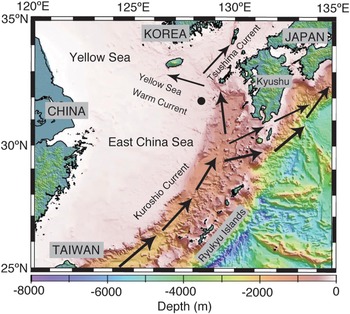
The present study was conducted in the East China Sea, located at temperate and subtropical zones bordered by China, Korea and Japan, covering a large continental shelf. The hydrography is mainly characterized by the Kuroshio, which flows north-eastward along the eastern margin of the continental shelf, the two branches of the Kuroshio, the northward flowing Tsushima and Taiwan warm current, and the southward flowing cold currents along the coast of China (Ichikawa & Beardsley, Reference Ichikawa and Beardsley2002). This area is an important fisheries area for many fish species including several species of marine eels and invertebrates. As far as we know, this is the first report to record body size of the beach conger. In addition, we show hydrographic profiles from the collection site and concurrently captured demersal fish and invertebrate fauna in the otter trawl in the East China Sea.
MATERIALS AND METHODS
Specimens were captured on 4 April 2013 in the East China Sea (31°52.16′N 127°42.94′E) (Figure 1) at a depth of 140 m by otter trawling. Trawling was conducted by the training ship ‘Nagasaki Maru’, Nagasaki University, Japan, an 842 ton stern trawler. A bottom trawl net, with a 50 mm main trawl and a 30 mm cod end mesh, was towed for 90 minutes at approximately 2.3 knots (towing distance estimated was approximately 6.4 km). The net mouth was approximately 17 m wide and 10 m high. Prior to the trawl, a conductivity–temperature–depth (CTD; Sea-Bird Electronics) profile was made at the same sampling point with the trawl sample (Figure 1). Additionally, dissolved oxygen and concentration of chlorophyll-a were also measured.
Sample location (•) of the beach conger Conger japonicus. A conductivity–temperature–depth profile was also made for measurements at the same location. Bathymetry and ocean currents are shown.

After the trawl catch was sorted, total catch for each species were weighed to the nearest kilogram, except for the beach conger. Biomass of each species was expressed by catch (kg) per hour. For the beach conger, morphometric measurements and meristic counts were performed to the nearest millimetre using digital Vernier calipers and a ruler. The beach conger was also weighed to the nearest gram. External and internal appearances were photographed. Gonad was also observed under a microscope to identify sex according to Nemoto et al. (Reference Nemoto, Kawai and Ishida2004), which is based on C. myriaster.
Identification of the beach conger was made based on the description of Hatooka (Reference Hatooka and Nakabo2013), on the extended body; large pectoral fin among conger family; eye is behind posterior nares; no segment on dorsal and anal fins; pre-anal length is 30–45% of total length; in-line dentition on the premaxilla; no white spots on the head and trunk; dorsal fin origin is behind the pectoral fin insertion; lateral line pores 35–39 in front of anal opening; head length is approximately 14% of total length; 15–16 pectoral fin rays and 142–145 vertebrae.
RESULTS AND DISCUSSION
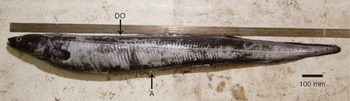
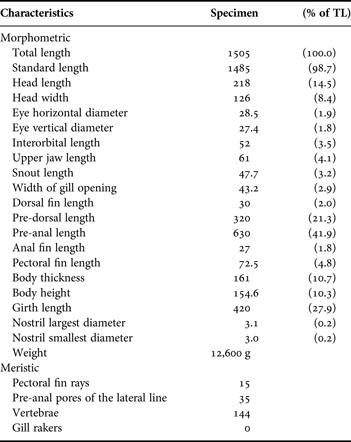
External appearance of the beach conger is shown in Figure 2. The body colour was completely black just after capture. The morphometric measurements with percentages of total length (% of TL) and meristic counts are shown in Table 1. The beach conger captured was 1520 mm long and 12,600 g weight, which is approximately an increase of 120 mm and 2600 g over previous records for the beach conger. Previously, the record body sizes of the beach conger were 1300 mm (5626 g) along the coast of the Boso Peninsula, Japan (Shouji, Reference Shouji2003), and 1400 mm along the Japanese coast (estimate of weight for female according to Shouji (Reference Shouji2003) is approximately 10,000 g) (Masuda et al., Reference Masuda, Amaoka, Araga, Uyeno and Yoshino1984; Hatooka, Reference Hatooka and Nakabo2013), and 1260 mm (6200 g) in the northern Yellow Sea (Yongbo, Reference Yongbo1996).
External appearance of the beach conger Conger japonicus caught in the East China Sea. Note that the body colour was completely black just after capture. Arrows indicate: A, level of anus; DO, dorsal fin origin.

Morphometric measurements (in mm and % of total length (TL)) and meristic counts of the beach conger Conger japonicus (female) caught in the East China Sea.

In other Conger species, 2100 mm (54,400 g) of C. oceanicus in Maine Bay, USA, and 2002 mm (54,100 g) of C. conger off the coast of Ireland were recorded (Bigelow & Schroede, Reference Bigelow and Schroede1953; Fannon et al., Reference Fannon, Fahy and O'Reilly1990). A 1270 mm C. myriaster in Mekawa Bay, Japan, and a 1540 mm C. orbignianus from South Brazil were also recorded (Katayama & Kurogi, Reference Katayama and Kurogi2008; Figueroa et al., Reference Figueroa, Macchi and Haimovici2010). Thus, these Conger species can reach quite large sizes of >2 m, which is probably larger than most other genera of the Congrinae.
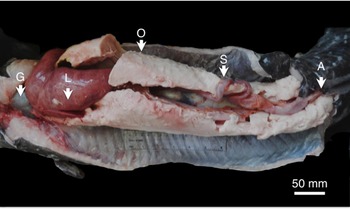
In this study, the specimen was female with an empty stomach (Figure 3). Its ovary was yellowish-white with a rough texture, paired structures which run the length of the body cavity and extend past the anus (Figure 3). They were attached to the peritoneum on either side of the swim bladder, and approximate percentage of space occupied by the ovary into the abdominal cavity was 80%. Tiny oocytes were visible through the ovary wall.
Ventral view of ovary of the beach conger Conger japonicus. Arrows indicate: A, level of anus; G, gallbladder; L, liver; O, ovary; S, stomach.

The ovary was partway developed, because this specimen had the highest gonadsomatic index level (GSI = gonad weight/body weight × 100) of this species (GSI = 9.5, M. Yagi and Y. Morita; unpublished data), compared with previous eels captured along the coast of the Boso Peninsula, Japan that had GSI values ranging from 0.2 to 8.3 (Shouji, Reference Shouji2003). The GSI levels appear generally to be directly related to the degree of gonad development. In C. myriaster, GSI <1 female individuals were immature, whereas individuals (GSI: 2–4) were relatively mature with the oocytes at the oil droplet or the primary yolk globule stages (Okamura et al., Reference Okamura, Utoh, Zhang, Yamada, Horie, Mikawa, Tanaka, Motonobu and Oka2000). Therefore, according to these values, the sampled ovary could be maturing in preparation for spawning.
The specimen was collected at 140 m depth on the slope of the continental shelf and near the northern branch of Kuroshio in the East China Sea. Shouji (Reference Shouji2003) found that the beach congers larger than 1000 mm were only female, and maximum size of males was 920 mm (1705 g). He also reported that the sex-ratio of females is higher than males at depths less than 276 m along the coast of the Boso Peninsula, Japan (female is 77.7%, male 10.8% and unidentified 11.5%) (Shouji, Reference Shouji2003). Although the reason for these differences in body size and sex-ratio between male and female is currently unknown, it may be due to differences of growth rate and/or habit use among the sexes. It is known that the growth rate of females is faster than that of males in C. myriaster (Nabeshima, Reference Nabeshima2001). Furthermore, in Conger species such as C. myriaster, C. conger and C. oceanicus only females are found in continental shelf areas, whereas males and females occur in shallow coastal areas (Cau & Manconi, Reference Cau and Manconi1984; Hood et al., Reference Hood, Able and Grimes1988; Ishida et al., Reference Ishida, Yamanobe, Goto, Katayama and Mochioka2003; Gorie et al., Reference Gorie, Tanda and Katayama2004). Sexual maturation of Conger species is thought to occur during their migration towards their deep-sea spawning areas (Sbaihi et al., Reference Sbaihi, Fouchereau-Peron, Meunier, Elie, Mayer, Burzawa-Gerard, Vidal and Dufour2001; Figueroa et al., Reference Figueroa, Macchi and Haimovici2010). Therefore, females of the beach conger may also have a higher growth rate and migrate to deeper waters to spawn. Further surveys on reproductive ecology, growth and migration of this eel species are clearly required in the future.
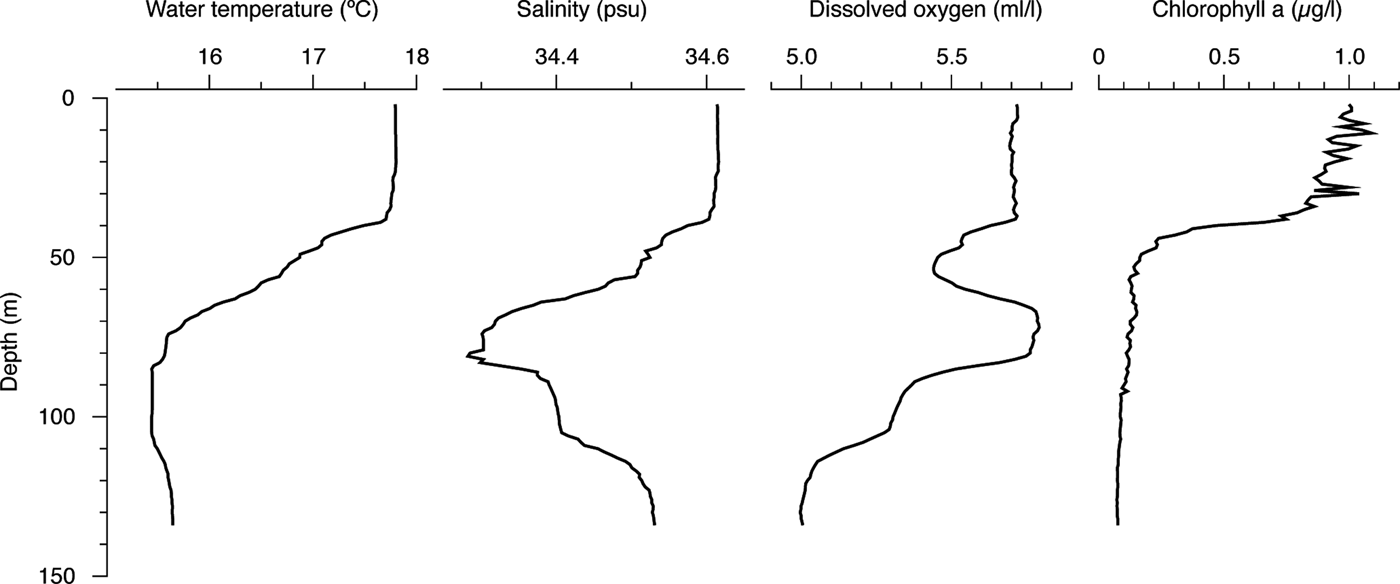
The CTD profiles are shown in Figure 4. Thermocline appeared from 40 to 75 m in depth. From 40 to 70 m, salinity decreased, but it increased from more than 80 m depth. Dissolved oxygen tended to gradually decrease; finally, chlorophyll-a dramatically decreased at 50 m depth. Bottom trawling was conducted at 140 m depth. Thus, the beach conger and other species caught by trawling inhabited at approximately 15.8°C, 34.5 psu, 5.0 ml/l in dissolved oxygen and nearly zero chlorophyll-a.
Profiles of water temperature, salinity, dissolved oxygen and chlorophyll-a at the survey point in the East China Sea on 4 April 2013.

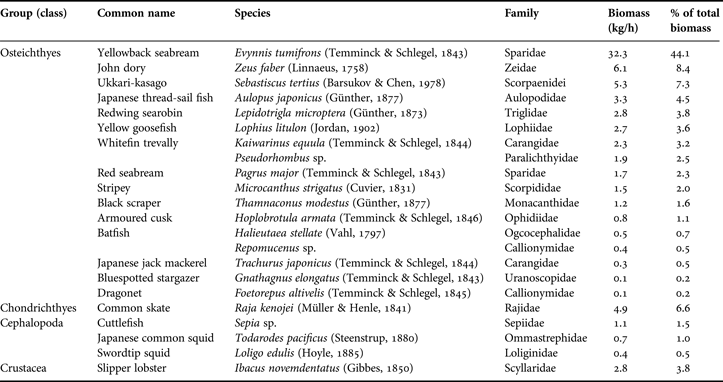
The species composition of catch by the trawling is also shown in Table 2. Abundant species by assorted group, Osteichthyes, Chondrichthyes, Cephalopoda and Crustacea were yellowback seabream Evynnis tumifrons (Temminck & Schlegel, 1843), common skate Raja kenojei (Müller & Henle, 1841), cuttlefish Sepia sp. and slipper lobster Ibacus novemdentatus (Gibbes, 1850), respectively. No food was found in the stomach of the beach conger, but the diet of this eel species might include some of the small fish or crustaceans that were collected (Table 2) by the trawl. In this study the beach conger had the largest body size among the catch. Body size and feeding habit of fish are fundamental determinants of the ecological niche in the marine environment (Woodward & Hildrew, Reference Woodward and Hildrew2002). The beach conger may play a key role as one of the top predators among demersal marine species in the East China Sea.
Total biomass (in kg/h) and its percentage (% of total biomass) of the catch by otter trawling in the East China Sea, except for the beach conger.

ACKNOWLEDGEMENTS
We thank Yoshifumi Ura, Kiyokazu Ozaki, Mitsuteru Yamaguchi, Takeshi Nagao, Norio Fujiwara, Hideaki Matsushima, Tadashi Imada, Taiji Kitamura, Kazuharu Yokota, Keishi Kuma, Yoshimasa Kondo, Kimiaki Yamagata, Naoyuki Nakao, Tomomi Fukahori, Shinji Sonokawa, Shigeru Matsumoto and Ryuji Noguchi of the training ship ‘Nagasaki Maru', Nagasaki University for essential help in operating the ship. This study is supported by the Ministry of Education, Culture, Sports, Science and Technology of Japan.