Introduction
Maternal smoking has been studied as an insult occurring at a critical developmental period, possibly setting the individual's susceptibility to certain pathological conditions throughout life. Besides the classical description of altered fetal growth,Reference Bernstein, Plociennik, Stahle, Badger and Secker-Walker 1 individuals exposed to tobacco smoking during fetal life also seem to be at risk for other conditions such as alterations in the respiratory and circulatory systems,Reference Billaud and Lemarie 2 , Reference Blake, Gurrin and Evans 3 behavioral issuesReference Thapar, Fowler and Rice 4 and obesity.Reference Sowan and Stember 5 These effects can be independent of intrauterine growth restriction (IUGR) and represent the specific effects of cigarettes.Reference Wideroe, Vik, Jacobsen and Bakketeig 6
Recently, other researchers and we have shown that IUGR alters feeding behavior in adulthood,Reference Lussana, Painter and Ocke 7 , Reference Barbieri, Portella and Silveira 8 suggesting that this fetal life event could influence the ontogeny of hypothalamic nuclei involved in the control of energy consumption and expenditure. Intriguingly, although there are several reports showing that smoking alters caloric consumption, energy expenditure, preference for different flavorsReference Grunberg 9 and body weight,Reference Albanes, Jones, Micozzi and Mattson 10 it is not known whether the exposure to smoking during pregnancy would impact the feeding behavior of the offspring. Interesting studies in monkeys have shown that nicotine exposure during gestation diminishes the mRNA for neuropeptide Y in the arcuate nucleus of the offspring.Reference Grove, Sekhon and Brogan 11
On the basis of such data, our objective was to determine whether the exposure to maternal smoking during gestation influences the offspring feeding behavior in adulthood, independent of the IUGR effects. Our hypothesis was that maternal smoking during gestation can influence the consumption of macronutrients in adulthood, possibly contributing to the well-known vulnerability to obesity of these individuals.
Method
This was a cross-sectional evaluation of a longitudinal, prospective cohort study involving subjects born in the municipality of Ribeirão Preto (state of São Paulo, southeast of Brazil) from June 1, 1978 to May 31, 1979. During this period, there were 9067 births, with the mothers of 6973 babies residing in this city at the time of delivery and being included in the study (6827 singletons and 146 twin deliveries). Of the 6827 singletons, 246 died during the first year of life and 97 died before the age of 20, yielding a total of 343 deaths.Reference Oliveira, Bettiol, Barbieri, Gutierrez and Azenha 12 Data from mothers and children, including anamnesis and anthropometry, were collected by trained personnel at the time of birth. The study was approved by the Ethics Committee of the University Hospital, Medical School of Ribeirão Preto.
Between April 2002 and May 2004, 2103 individuals were invited for further evaluation, to whom the team applied a detailed life style history questionnaire (including information on physical activity) and a socio-economic questionnaire, in addition to performing physical examination and anthropometric assessment. A detailed description of the cohort and a comparison of this sample with the original population have been published.Reference Barbieri, Bettiol and Silva 13 , Reference Goldani, Barbieri, Silva and Bettiol 14 Briefly, the 2004 sample was randomly selected and comparable with the original population with regard to birth weight, birth length and maternal age, being slightly wealthier. For the purpose of this study, only singletons were included in the analyses. Furthermore, individuals born with a gestational age of less than 34 weeks were also excluded (due to the small number of such births, the birth weight ratio (BWR) calculation for this subgroup was not accurate, see below). Therefore in this study, we analyzed data from 2010 individuals.
Subjects were divided into two groups: adults who were exposed (a) or not (b) to maternal smoking during gestation. The information about maternal use of cigarettes during pregnancy was obtained with a standardized questionnaire at the time of birth, and coded as a categorical variable categorized into smoked at any time of pregnancy v. never smoked during the pregnancy, resulting in the variable ‘maternal smoking’ (yes or no). Any amount of smoking reported during the pregnancy was considered as exposure. Mothers that reported to have stopped smoking before pregnancy (n = 85) were considered as non-smokers.
Individuals completed a food frequency questionnaire developed and adapted for the Brazilian population.Reference Tomita and Cardoso 15 , Reference Molina, Bettiol and Barbieri 16 The food frequency questionnaire has the ability to classify individuals according to their usual dietary patterns. Total calories consumed per day and the percentage of fat, carbohydrate and protein were calculated using the DietPRO Professional 4.0 software (Software Agromídia Ltda) and compared between groups. The carbohydrate/protein ratio was calculated by dividing the amount of carbohydrate by the amount of protein consumed.Reference Layman, Boileau and Erickson 17
Economic and social data were obtained on two occasions. Maternal data were obtained by a standardized questionnaire applied to the mothers soon after delivery and demographic information was collected from official records.Reference Goldani, Barbieri, Silva and Bettiol 14 The subjects’ data were obtained using a standardized questionnaire on the occasion of their return for evaluation at 24 years of age. Physical activity was evaluated with a standardized questionnaire,Reference Hallal and Victora 18 using the metabolic cost or unit of resting metabolic rate and classifying the individuals as ‘active’ or ‘sedentary’.Reference LaMonte, Nahas, Neff, Bartoli and Ainsworth 19
Weight and height were measured by trained personnel. Body mass index (BMI) was calculated by dividing weight in kilograms by height in square meters.Reference Keys, Fidanza, Kcarvonen, Kimura and Taylor 20 The concept of IUGR was based on the BWR, which is the ratio between the newborn's weight and the local population's sex-specific mean birth weight for each gestational age.Reference Kramer, Platt, Yang, McNamara and Usher 21
Statistical analysis
Continuous data were reported as mean (s.d.) and categorical data were reported as frequency (n) and percentage. Spontaneous macronutrient intake was evaluated using analysis of covariance, with maternal smoking as a factor. The model was controlled for participants’ (BWR, smoking, schooling, current BMI and physical activity) and maternal factors (schooling). A preliminary analysis was conducted to evaluate the relation between known factors related to food intake and each outcome. The remaining significant or biologically important variables became the covariables. In the preliminary analysis, we used the Student's t-test, ANOVA or Pearson's correlation.
Statistical significance was assumed if the P-value was equal to or lower than 0.05. Analysis was performed using the Statistical Package for the Social Sciences (SPSS) version 16.0.
Results
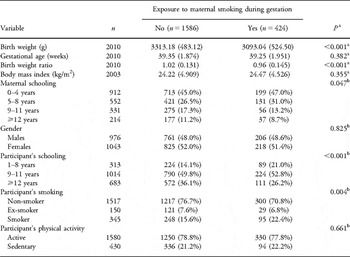
The total number of subjects examined was 2010. The average age of the subjects was 23.9 years (s.d. = 0.7) and the mean weight was 69.7 kg (s.d. = 16.40). Table 1 depicts the characteristics of the participants, showing that the BWR (P = 0.001) and maternal schooling (P = 0.047) were significantly lower in the group exposed to maternal smoking during gestation, as expected. The group exposed to tobacco during fetal life was also more likely to have fewer years of schooling (P < 0.001) and to be a smoker (P = 0.004) in adulthood. There were no differences between groups regarding current BMI, physical activity or gender distribution.
Participants’ characteristics

Data are presented as mean (s.d.) or n (%).
a P-value for Student's t-test.
b P-value for the χ 2test.
A preliminary analysis demonstrated that gender (P < 0.001 for total caloric intake, P = 0.79 for carbohydrate to protein intake ratio), maternal schooling (P = 0.005 for total caloric intake, P < 0.0001 for carbohydrate to protein intake ratio) and subject's schooling (P < 0.001 for total caloric intake, P < 0.001 for carbohydrate to protein intake ratio) as well as subject's smoking (P < 0.001 for total caloric intake, P < 0.001 for carbohydrate to protein intake ratio) were significantly associated with the outcome (either food consumption, macronutrient preference or both). Although physical activity was not significantly associated with the outcome, its inclusion was considered to be biologically relevant in the adjusted analysis. For BMI and BWR, although the analysis did reach statistical significance (P < 0.05) they had a very weak correlation with the two outcomes. However, we also considered these variables as biologically relevant, and therefore they were kept in the adjusted analysis.
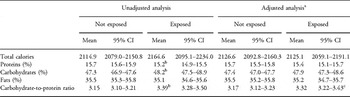
Total caloric consumption did not differ between groups exposed or not to smoking during fetal life (P = 0.970). Furthermore, there were no differences in the percentage of fat (P = 0.322), protein (P = 0.148) or carbohydrates (P = 0.143) consumed. However, individuals exposed to smoking during fetal life prefer to consume more carbohydrates in detriment of proteins when the carbohydrate/protein ratio is examined (P = 0.014), independent of the birth weight. The unadjusted analysis showed differences in the carbohydrate/protein ratio (P = 0.001) and also in the percentage of protein (P = 0.007) and carbohydrates (P = 0.026) between the groups. No differences in the percentage of fat (P = 0.171) or total caloric intake (P = 0.213) were found (Table 2).
Comparison of food consumption between individuals exposed or not to maternal smoking during gestationFootnote a

CI, confidence interval.
a Adjusted for individual's physical activity, smoking, schooling, birth weight ratio, body mass index, gender and maternal schooling.
b P < 0.05, Student's t-test.
c P < 0.05, Analysis of covariance.
Because of the frequent association of maternal cigarette smoking during pregnancy with lower socio-economic status, we further explored the data set with regard to maternal education. For this, we compared the individuals exposed to smoking during fetal life (n = 424) with a random subset of not exposed individuals (n = 426), matched by maternal education. This analysis also showed differences in the carbohydrate/protein ratio (exposed 3.39 ± 0.60, not exposed 3.20 ± 0.60, P = 0.023) and in the percentage of protein (exposed 15.21 ± 0.17, not exposed 15.73 ± 0.17, P = 0.027) consumed between the groups. No differences in the percentage of fat (exposed 35.08 ± 0.27, not exposed 35.15 ± 0.27, P = 0.873), carbohydrates (exposed 48.23 ± 0.35, not exposed 47.64 ± 0.35, P = 0.234) or total caloric intake (exposed 2160.36 ± 35.15, not exposed 2124.65 ± 35.19, P = 0.473) were found.
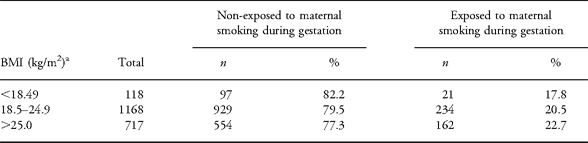
Although we observed this differential feeding behavior in individuals exposed to maternal smoking during gestation, a χ 2 test showed that the prevalence of smoking during pregnancy did not differ between BMI categories (P = 0.305; Table 3).
Prevalence of maternal smoking during pregnancy in the different BMI categories of the offspring

BMI, body mass index.
a χ 2 analysis, P = 0.332.
Discussion
In this study, we demonstrated for the first time that individuals exposed to smoking during fetal life have a higher preference for carbohydrates over protein in adult life. These effects are seen even after adjusting for variables that influence feeding behavior such as socio-economic status, current smoking, physical activity, current BMI and birth weight. This finding is important considering the high prevalence of smoking among women during the childbearing years and the increased worldwide prevalence of obesity. Similar to other fetal life insults such as undernutrition,Reference Barbieri, Portella and Silveira 8 maternal smoking possibly influences an individual's physiology and metabolism on a long-term basis, leading to more or less vulnerability to different environmental stimuli in adulthood. This vulnerability may be associated with a higher risk for metabolic diseases in adulthood.
The hypothalamic–pituitary–adrenal (HPA) axis has been proposed to be susceptible to fetal programming, the process by which an adverse fetal environment leads to permanent adaptations to guarantee survival, but this may become maladaptive later in life. Studies have shown that different types of early life stressors persistently affect the activity of the HPA axis.Reference De Rooij, Painter and Phillips 22 , Reference Chadio, Kotsampasi and Papadomichelakis 23 Maternal smoking during gestation could be acting similar to these other early life insults, programming the HPA axis to a determined level of functioning and therefore influencing feeding behavior.Reference Pecoraro, Reyes, Gomez, Bhargava and Dallman 24 It has been already shown that children exposed to tobacco smoking in utero have significantly higher levels of adrenocorticotropin hormone (ACTH) when compared with children who were not exposed.Reference McDonald, Walker and Perkins 25
Another interesting finding is that this study did not find an association between maternal smoking during pregnancy and BMI. One explanation is that our cohort is composed of young adults and is more likely to become significantly overweight only later in life. Although some studies have shown that maternal smoking is associated with overweight in childhood,Reference Von Kries, Toschke, Koletzko and Slikker 26 few studies have been conducted on adults.Reference Power and Jefferis 27 It is possible that an adaptive response to this adverse fetal life event would be a differential body composition that does not necessarily reflect body weight per se. A limitation of this study was the lack of this type of measurement.
Studies in animals have also not found an association between exposure to nicotine during fetal life and body weight gain.Reference Franke, Park, Belluzzi and Leslie 28 Interestingly, the same study showed that, despite the lack of differences in relation to body weight, there are significant changes in the neural circuit related to natural and drug reinforcement. In another study, the authors reported that newborns exposed to smoking during gestation have signs of withdrawal.Reference Law, Stroud and LaGasse 29 Similar to drugs of abuse, withdrawal signs suggest sensitization of the mesolimbic dopaminergic system due to the exposure to tobacco smoking in utero. It is known that individuals exposed to smoking during pregnancy are at an increased risk of becoming smokers themselves later in life,Reference Buka, Shenassa and Niaura 30 a finding that was also replicated in this study. Considering the similarities in the activation of the mesolimbic pathways in the presence of drugs of abuse and in the consumption of palatable foods.Reference Avena, Long and Hoebel 31 it is possible that the effect observed in this study was due to cross-sensitization,Reference Cadoni, Valentini and Di Chiara 32 whereby the exposure to tobacco smoking during gestation led to an increased sensitivity of the dopaminergic mesolimbic system to another ‘drug’ (carbohydrates). In agreement with this hypothesis, some studies have shown cross-sensitization between morphine, cocaine and food in animals,Reference Le Merrer and Stephens 33 as well as between nicotine and methyphenidate.Reference Wooters, Neugebauer, Rush and Bardo 34
It is possible that smoking during pregnancy, acting during a critical developmental period, programs the organism on a permanent basis. Intriguingly, an ex-smoker consumes greater quantities of palatable foods.Reference Myrsten, Elaerot and Ednren 35 After 8 h of withdrawal, adult smokers ingest twice as much palatable food in comparison with non-smokers, without differences in the consumption of regular foods (Schachter, S., Nesbitt, P 1970, Unpublished data)36. By analogy, after birth and the cessation of tobacco exposure, the individuals from our study could be persistently exhibiting a behavior similar to that of a former smoker.
Another limitation of the study is the lack of precision in food questionnaires, which limits defining the definite composition of foods by macronutrient class, leading to a possible underestimation of the proportion of protein in the diet and an overestimation of carbohydrate intake.Reference Schaefer, Augustin and Schaefer 36 However, in this case, the entire sample would be subjected to this same limitation. It is also important to mention that the food frequency questionnaire is based on usual dietary patterns and could simply reflect availability and convenience rather than actual preferences. In addition, the low socio-economic status associated with maternal smoking during pregnancy could play a role in the feeding habits, as foods rich in carbohydrates are usually less expensive than protein. However, our results persisted even after controlling for such variables. Moreover, recent research has shown that evaluations of habitual consumption using food frequency questionnaires correlate well with the actual preference for certain foods.Reference Larson, Neumark-Sztainer and Harnack 37 Finally, the lack of information on timing of exposure and second-hand exposure to tobacco in our study does not allow us to infer about fetal sensitive periods or the dose of exposure to tobacco, warranting further studies to explore these questions.
It is important to highlight that, although IUGR is associated with specific spontaneous feeding preferences in adulthood,Reference Lussana, Painter and Ocke 7 , Reference Barbieri, Portella and Silveira 8 the association between exposure to tobacco smoking during gestation and feeding preferences in the adult offspring described here is independent of the effects of smoking on fetal growth, considering that we adjusted the analysis for such confounder. Therefore, we propose that feeding preferences in adulthood may be affected by different events occurring during pregnancy, and possibly also by the interaction of these events, which on a long-term basis could play a role in the risk for metabolic disturbances and obesity. There are both experimentalReference Klaus 38 and human evidenceReference Layman, Boileau and Erickson 17 , Reference Layman, Evans and Erickson 39 demonstrating the association between the increased ratio of carbohydrate-to-protein intake and worse utilization of body fat while maintaining lean body mass, negative changes in blood lipids with increased triglyceride levels and diminished satiety, even considering the same energy intake. These effects seem to have long-term duration.Reference Layman, Evans and Erickson 39 Although the mechanism for these differential effects on body composition remains unknown, some authors have suggested that the changes in body composition associated with a higher carbohydrate-to-protein ratio intake may be associated with either targeting of body fat or wasting of muscle protein, or both.Reference Layman, Boileau and Erickson 17 This suggests that a chronic persistent small imbalance in the food preferences, increasing the carbohydrate-to-protein ratio, could potentially prone the individual to the development of increased adiposity and lipid alterations in the long term.
In conclusion, maternal smoking during fetal life is associated with an increased preference for carbohydrates in detriment of proteins during young adulthood independent of the effects of IUGR. This effect persists after adjusting for confounding variables and therefore may be due to the programming of the metabolism and/or central systems involved in the regulation of energy intake and expenditure. It is possible that the altered feeding preferences reported here may play a role in the increased risk for metabolic disturbances and obesity in these individuals later in life. Knowledge about these specific behavioral habits may be of importance when considering primary care and prevention.
Acknowledgments
This work was supported by Fundação de Amparo à Pesquisa do Estado de São Paulo (FAPESP) and Conselho Nacional de Desenvolvimento Científico e tecnológico (CNPq). Ayres C, Silveira PP, Portella AK, Agranonik M and Goldani MZ were mostly involved in the conception and hypothesis formulation, data analysis and drafting the article. Silva AA, Bettiol H and Barbieri MA were mostly involved in the design and acquisition of the data and in revising the paper for important intellectual content.
Statement of interest
The authors declare no conflicts of interest.