Increasing herbicide resistance in western Canada (Heap Reference Heap2017) has increased the search for novel weed management techniques to add to current cropping systems. Three of the problem weeds in western Canada are wild oat, false cleavers (hereafter called cleavers), and volunteer canola. Wild oat is a nearly ubiquitous weed with high rates of seed shatter, seed dormancy, and a competitive nature (Beckie et al. Reference Beckie, Francis and Hall2012; Shirtliffe et al. Reference Shirtliffe, Entz and Van Acker2000). More than $500 million per year is spent to control wild oat, but because it is the most resistant-prone weed in western Canada, additional control options are needed (Beckie et al. Reference Beckie, Francis and Hall2012, Reference Beckie, Blackshaw, Low, Hall, Sauder, Martin, Brandt and Shirriff2013a, Reference Beckie, Lozinski, Shirriff and Brenzil2013b; Mangin et al. Reference Mangin, Hall and Beckie2016). Cleavers’ prevalence is increasing faster than any other weed in western Canada (Leeson et al. Reference Leeson, Thomas, Hall, Brenzil, Andrews, Brown and Van Acker2005); it is difficult to control in many crops, has shown resistance to acetolactate synthase inhibitors and quinclorac, and is at high risk for selection of glyphosate resistance in the subhumid regions of western Canada (Beckie et al. Reference Beckie, Lozinski, Shirriff and Brenzil2013b; Heap Reference Heap2017). These characteristics make cleavers a priority for management by nonherbicidal methods. Canola is one of western Canada’s most prominent crops; however, an average of more than 4,300 seeds m−2 are lost at harvest to the seedbank, resulting in a large, herbicide-resistant (glufosinate or glyphosate) volunteer canola population (Beckie et al. Reference Beckie, Warwick, Nair and Seguin-Swartz2003; Cavalieri et al. Reference Cavalieri, Harker, Hall, Willenborg, Haile, Shirtliffe and Gulden2016; Hall et al. Reference Hall, Topinka, Huffman, Davis and Good2000). Increased abundance of volunteer canola (Leeson Reference Leeson2016; Leeson et al Reference Leeson, Thomas, Hall, Brenzil, Andrews, Brown and Van Acker2005), potential impacts of crop competition through difficult to manage volunteers, and high densities make volunteer canola another priority target for additional management options.
Harvest weed seed control (HWSC) is a new method of weed management that was evaluated and optimized in Australia (Walsh et al. Reference Walsh, Newman and Powles2013). These technologies target weed seeds that are otherwise dispersed by harvesters, typically in the chaff fraction, which is broadcast back onto the field through spreader systems (Petzold Reference Petzold1956; Shirtliffe and Entz Reference Shirtliffe and Entz2005; Walsh and Powles Reference Walsh and Powles2007; Walsh et al. Reference Walsh, Newman and Powles2013). While HWSC methods are effective in controlling weed seeds in the chaff fraction (Walsh et al. Reference Walsh, Harrington and Powles2012; Walsh and Newman Reference Walsh and Newman2007; Walsh and Powles Reference Walsh and Powles2007), their ability to decrease weed populations depends on seed retention of the target species (Walsh and Powles Reference Walsh and Powles2014) and canopy height at which the weed seeds are retained relative to crop harvest height (Walsh et al. Reference Walsh, Broster, Aves and Powles2016). However, these characteristics are likely to vary with species, climatic conditions, and agroecoregions (Barroso et al. Reference Barroso, Navarrete, Sanchez De Arco, Fernandez-Quintanilla, Utman, Perry and Hull2006; Petzold Reference Petzold1956; Shirtliffe et al. Reference Shirtliffe, Entz and Van Acker2000). Adapting harvesting to more effectively harvest weed seeds may have detrimental effects on snow capture, avoidance of rocks, harvest efficiency, and residue retention (Cutforth and McConkey Reference Cutforth and McConkey1997; McMaster et al. Reference McMaster, Aiken and Nielsen2000; Špokas and Steponavičius Reference Špokas and Steponavičius2010). Ideal target weeds would retain seeds until or past crop harvest above typical harvest heights. It is not known whether wild oat, cleavers, and volunteer canola meet these ideal characteristics.
The objective of our study was to evaluate the suitability of wild oat, cleavers, and volunteer canola as targets for HWSC management through determination of their seed retention characteristics at three western Canadian sites. In addition, potential effects of crop species competition and crop seeding density on these characteristics were investigated.
Materials and Methods
This study was conducted over 2 yr (2014 and 2015) at three locations: Lacombe and St Albert, Alberta, and Scott, Saskatchewan. Four treatments of crop and seeding-rate combinations were established in a randomized complete block design with four replicates to measure seed retention and height of seed retention as affected by crop species. Two crops, wheat (‘Harvest’), and fababean (‘Snowdrop’), were chosen for their variation in competitive ability and maturity dates. Pulse crops such as field pea (Pisum sativum L.) and fababean are less competitive than a cereal crop like wheat (Harker Reference Harker2001). However, fababean is also a longer-season crop and is harvested later than wheat. Each crop was seeded on the same date in mid-May at 1X- or 2X- recommended seeding rates: 30 or 60 seeds m−2 for fababean and 200 or 400 seeds m−2 for wheat. Before crop seeding (same day or day prior), wild oat, cleavers, and volunteer canola were cross-seeded at a depth just below the soil surface across the plot area, with each weed in a separate strip. Weed seeds were sourced individually at each site. Wild oat was seeded at 200 seeds m−2 in both years. Cleavers were seeded at 200 seeds m−2 in 2014 but at 400 seeds m−2 in 2015 at Scott and Lacombe due to low germination. Volunteer canola was a true F2 population without seed treatment used at all sites and was seeded at 75 seeds m−2. Seeding rates were based on target weed densities of 15 to 20 plants m−2 based on seed viability and typical observed self-thinning rates. At Lacombe, and at Scott in 2015, a ConservaPak (ConservaPak Seeding Systems, Indian Head, Saskatchewan, Canada) air drill with knife openers at 22.8-cm row spacing was used. In 2014, the Scott location was seeded using a hoe drill with 25-cm row spacing. In both years, the St Albert sites were established with a Fabro plot seeder (Fabro Enterprises, Swift Current, Saskatchewan, Canada) with 20-cm row spacing. Plot sizes in Lacombe both years and at Scott in 2015 were 4 by 12 m. At St Albert both years and at Scott in 2014, plot size was 4 by 6 m. For each weed at Lacombe and at Scott in 2015, there was 4 by 4 m of area from which to collect data, while at St Albert and at Scott in 2014 the area was 4 by 2 m. All trials were established by direct seeding into barley (Hordeum vulgare L.) stubble, with the exception of St Albert in 2014, which was seeded into canola stubble to limit the establishment of cleavers at that research location to where they were already present. Fertilizer nitrogen, phosphorus, and sulfur were applied based on soil-test recommendations.
After plant emergence, crop and weed densities were counted. Once weeds reached the reproductive stage (seed formation visibly beginning on plant), seed shed was assessed by placing shatter trays between the crop rows in the plots. Shatter trays measured 25.5 by 15.5 cm and were lined with mesh for water drainage. Two shatter trays were placed in each weed species strip in each plot for a total of 6 shatter trays plot−1. These trays were checked twice weekly for an approximate 2-mo period (end of July/beginning of August to end of September/beginning of October), and shed seed was collected, air-dried, and counted. It is possible that seed predation occurred during the collection period; twice-weekly collections mitigated some of that risk. Germination tests on shed seeds were conducted following the protocol used by Burton et al. (Reference Burton, Beckie, Willenborg, Shirtliffe, Schoenau and Johnson2016) beginning in the year following the field season (i.e., 2015 for the 2014 field season) to allow for dormancy breaking. A maximum of 75 seeds shatter tray−1 were evaluated for germination/viability (3 replicates of 25 seeds each, if possible). Germinated seedlings were counted for 2 wk and considered germinated at visible radicle emergence. Ungerminated seeds after that period were tested for viability using a press test (Sawma and Mohler Reference Sawma and Mohler2002; Ullrich et al. Reference Ullrich, Buyer, Cavigelli, Seidel and Teasdale2011).
Based on crop maturity, weeds were harvested at three timings: in wheat and fababean at wheat-swathing timing (hard dough stage; BBCH=87), in wheat at direct-harvest timing (BBCH=99) and in fababean at direct-harvest timing (BBCH=89/97). Weeds were harvested by cutting at ground level from a 0.5 m−2 quadrat in each weed strip of plot and then sectioned into four heights: 0 to 15, 15 to 30, 30 to 45, and ≥45 cm above ground level. A threshold height of 15 cm for cereals and oilseeds has been used in previous seed-retention studies (Burton et al. Reference Burton, Beckie, Willenborg, Shirtliffe, Schoenau and Johnson2016; Walsh and Powles Reference Walsh and Powles2014), with seeds produced below this height considered to be noncollectable. While some pulse crops are harvested close to ground level (i.e., field pea, lentil [Lens culinaris L.]) to collect as many pods as possible, fababeans are also harvested 15 cm above ground level. Samples were dried at low heat (≤30 C) until dry weight stabilized, weighed, threshed, and cleaned. Seeds at each height interval were counted.
Using the number of seeds shed and number of seeds retained, the average total number of seeds produced per m−2 was determined and used to calculate the percentage of seeds retained over time. Growing degree days (GDD) were calculated (Equation 1), with a base temperature of 5 C, for each shatter-tray collection date and used as the independent variable for further analyses.
 $${\rm GDD}\,{\equals}\mathop{\sum}{\left( {{{T_{{{\rm max}}} {\plus}T_{{{\rm min}}} } \over 2}} \right)} {\minus}T_{{{\rm base}}} $$
Statistical Analysis
SAS v. 9.4 (SAS Institute 1995) was used for all analyses. Weed densities were analyzed with PROC MEANS for each site-year. For seed retention, PROC GLIMMIX was used with treatment (fababean 1X, fababean 2X, wheat 1X, wheat 2X), site-year, and their interactions considered as fixed effects, and replicate as a random effect to determine which data could be pooled, using a beta-error distribution. Due to a significant site-year by treatment interaction, data were not combined across site-years.
Wild oat and cleavers percentage seed retention were regressed against GDD using one of four models: logistic, segmented, quadratic, and linear, while segmented or linear regressions only were applied to canola data. PROC NLMIXED was used to conduct nonlinear regression with a logistic model (Equation 2).
 $$Y\,{\equals}\,D{\plus}{{\left( {A{\minus}D} \right)} \over {\left\{ {1{\plus}{\rm exp}\left[ {B{\asterisk}{\rm log}\left( {{x \over G}} \right)} \right]} \right\}}}$$
where Y is percentage of seed retained, D is the upper limit, A is the lower limit, B is the slope, x is GDD, and G is GDD where 50% of seeds are lost. For logistic regressions, bounds were imposed on A and D to be ≥ 0 and ≤ 100, respectively.
PROC NLMIXED was also used for segmented line regression (Equation 3).
 $$Y\,{\equals}\,L{\plus}U{\asterisk}\left( {R{\minus}x} \right){\plus}V{\times}\left( {x{\minus}R} \right) \color{grey}{\times} \left( {x{\minus}R} \right)$$
where Y is percentage of seed retained, L is the asymptote, U and V are slopes of the first and second line segments respectively, x is GDD, and R is the breakpoint GDD value. In two cases (see “Results and Discussion”), the second line segment was evaluated as a quadratic; in this situation, an additional (x−R) term was added to the end of the equation (Equation 3).
PROC REG was used for quadratic regression (Equation 4).
 $$Y\,{\equals}\,Ax^{2} {\plus}Bx{\plus}C$$
where Y is percentage of seed retained, x is GDD, A and B are slope values, and C is the intercept. PROC REG was also used for the linear model (Equation 5).
 $$Y\,{\equals}\,Mx{\plus}B$$
where Y is percentage of seed retained, x is GDD, M is slope, and B is the intercept.
For all regression models, a parameter contrast was used to determine whether seeding rate was significant (α=0.05). Where seeding rate was nonsignificant, data were pooled within species. A single regression model is presented for each site-year, crop, and weed based on adjusted R2 comparisons between all regressions for that data set; the model with the highest adjusted R2 value is presented (Littel et al. Reference Littel, Stroup and Freund2002).
Height of seed retention was analyzed in PROC GLIMMIX with a Gaussian error distribution because of failure to converge with a beta-error distribution. Fixed effects for each species included site-year, height, harvest timing, and treatment (crop and seeding rate); replicate was a random effect.
Seed viability was analyzed for each species using PROC REG (Equation 5). Analysis was conducted across site-years and treatments. Due to the sample size variability within site-years and treatments for each GDD, trends in viability versus GDD across site-years and treatments are discussed.
Results and Discussion
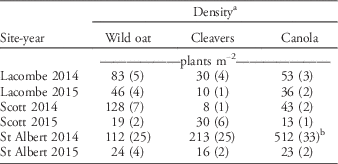
Weed and crop populations established well at all sites. There were generally lower weed densities in 2015 than in 2014, with some exceptions (Table 1), likely due to the widespread drought across the Canadian prairies that year (Agriculture and Agri-Food Canada 2016). For May through July in 2015, Lacombe had 82% of long-term average precipitation, St Albert 70%, and Scott 56% (data not shown). Wild oat populations ranged from 19 to 128 m−2 and cleavers populations from 8 to 213 m−2 (Table 1). Volunteer canola populations ranged from 13 to 53 m−2; one notable exception was 512 canola m−2 in St Albert in 2014 due largely to volunteers from the preceding crop.
Wild oat, cleavers, and canola densities at each site-year (n=4).

a SEs are in parentheses.
b This location was seeded on canola stubble. High canola populations are related to volunteers from the preceding crop.
Seed Retention
Seed retention decreased as GDD increased. Seed retention over time varied by species, site-years, and treatments. Location and the location by treatment (crop and seeding rate) interactions were significant for all three species (P≤0.0001 in all cases). Why retention over time differs within a species between site-years is unclear, although the range of variation becomes apparent when the experiment is conducted for multiple site-years.
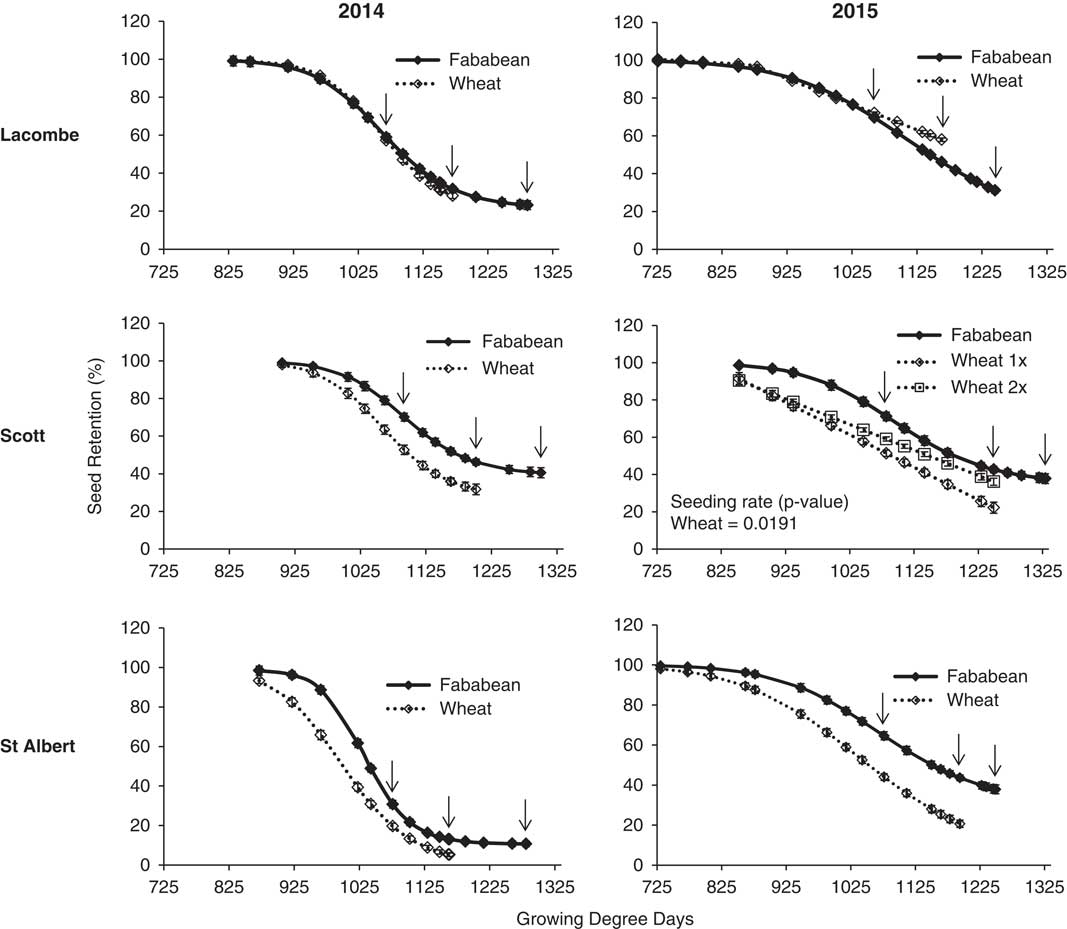
Wild oat had consistently early seed shed (Figure 1). Retention at the time of wheat swathing averaged 56% (range 20% to 72%). Seed retention at wheat and fababean direct-harvest timings averaged 33% (5% to 58%) and 30% (11% to 41%), respectively. However, retention was variable between sites and years. Although not consistent for every site-year, wild oat in wheat plots generally had lower retention than wild oat in fababean plots (Figure 1). This may be related to the increased competition faced by wild oat in wheat when compared with fababean leading to an increased rate of maturity (Harper Reference Harper1977). Seeding rate effects on seed retention were typically not significant, but where significant did not show decreased retention with increased seeding rate as hypothesized. The majority of seed retention over time responses were best described by a logistic model (Supplementary Table 1) rather than the sigmoidal response reported by Shirtliffe et al. (Reference Shirtliffe, Entz and Van Acker2000), suggesting variability in retention over time. The estimates for retention in wheat are consistent with those of Shirtliffe et al. (Reference Shirtliffe, Entz and Van Acker2000) but lower than Australian and recent Canadian estimates at wheat harvest (Burton et al. Reference Burton, Beckie, Willenborg, Shirtliffe, Schoenau and Johnson2016; Walsh and Powles Reference Walsh and Powles2014). This may be due to different wild oat species or genotypes/ecotypes, use of different crop cultivars, seeding dates, seeding rates, row spacings, or fertility regimes. Additionally, both high and low wild oat seed retention has been observed in hundreds of prairie crop fields surveyed near harvest time (HJB, personal observations). Variability in wild oat seed retention should be expected given the plasticity of the species, potential differences in wheat cultivar maturity and competitiveness, and the rapid change in seed retention close to maturity. Although a wide range of retention levels was observed at each harvest timing in our study, even at the earliest collection date (wheat swathing), greater than 40% of wild oat seeds were unavailable for HWSC. Demographic models have indicated that more than 80% of wild oat seeds would need to be retained and controlled for HWSC to be effective in reducing wild oat populations (Tidemann et al. Reference Tidemann, Hall, Harker and Alexander2016); based on the measured retention values, high levels of HWSC efficacy on prairie wild oat populations are unlikely. Burton et al. (Reference Burton, Beckie, Willenborg, Shirtliffe, Schoenau and Johnson2016) also concluded that wild oat may not be well controlled by HWSC methods.
Wild oat seed retention as a function of growing degree days (GDD) and treatment by site-year. Regression equation parameter estimates are listed in Supplementary Table 1. Arrows indicate wheat swath timing, wheat direct-harvest timing, and fababean direct-harvest timing, respectively, from left to right. SE bars and P-values for seeding-rate coefficient comparisons are shown.

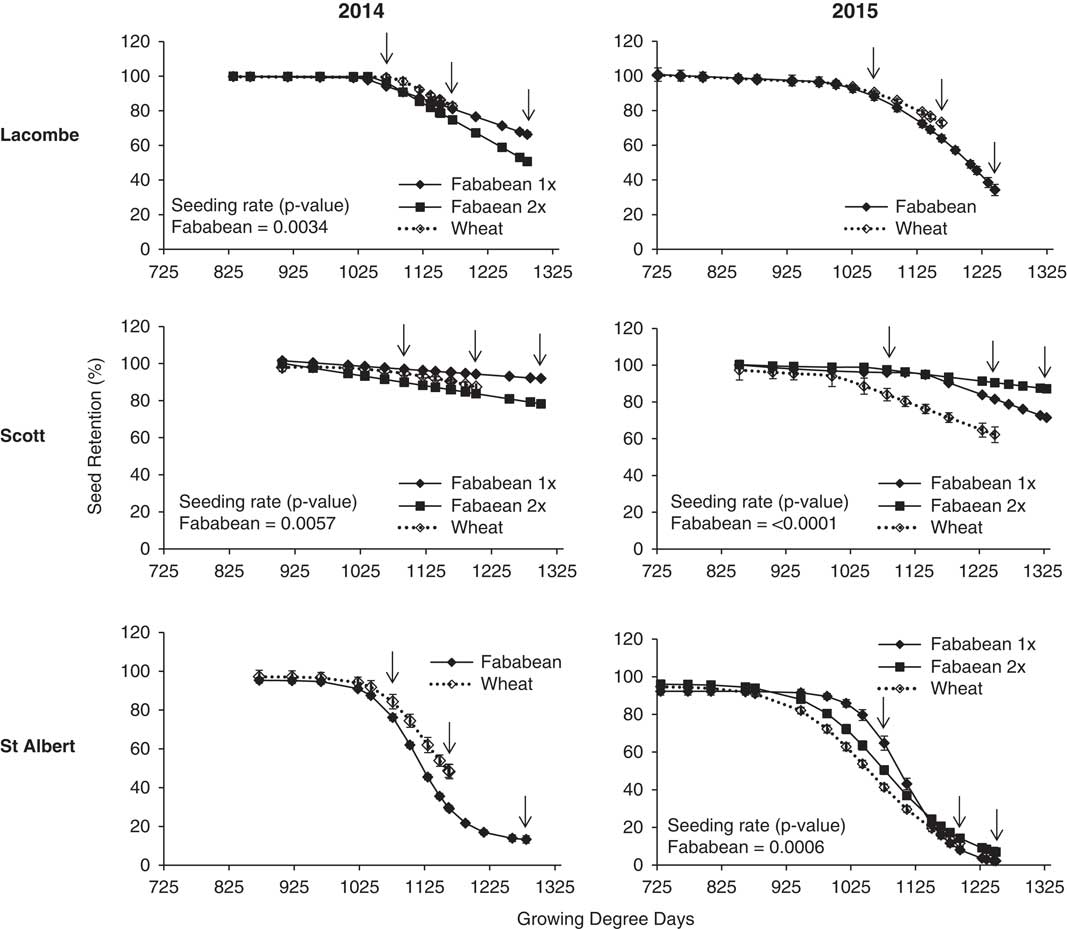
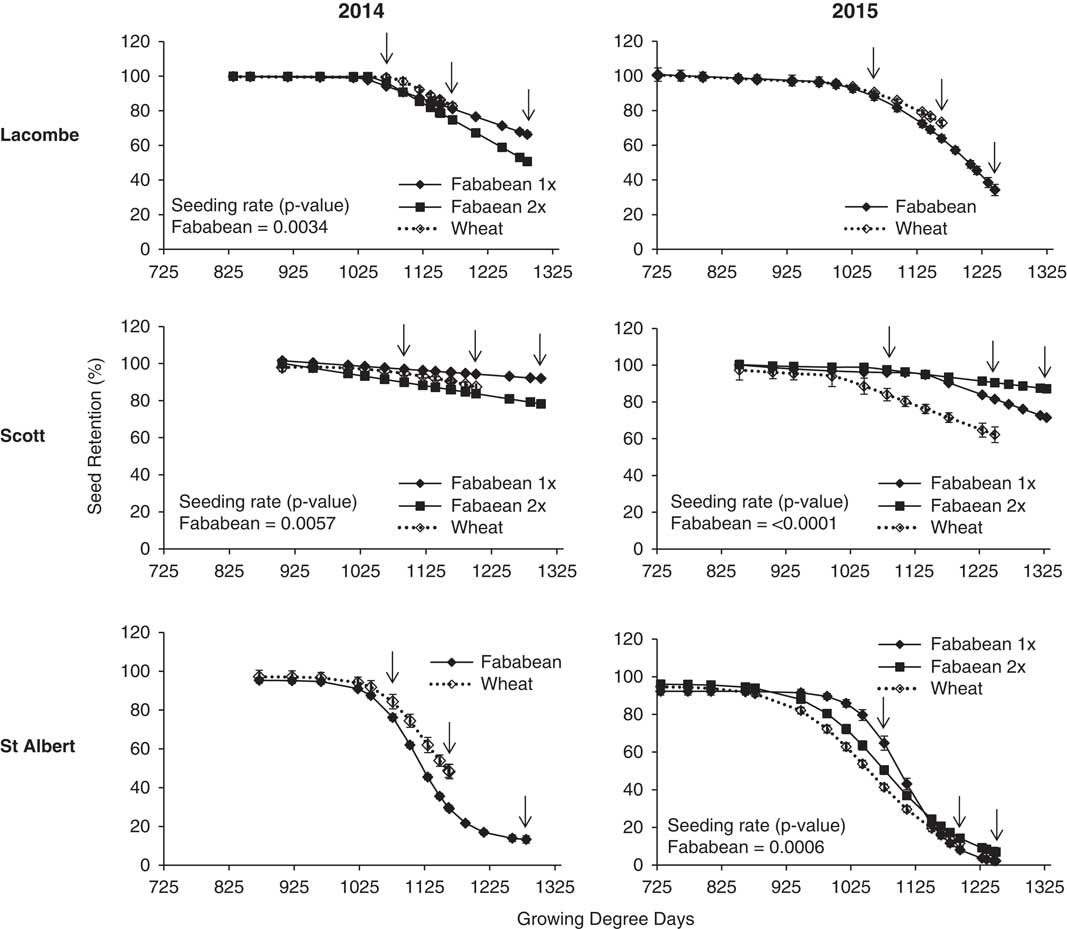
Cleavers seed retention was highly variable among site-years (Figure 2). At wheat swathing, cleavers retention averaged 84% (range 41% to 99%). St Albert is a unique site with lower retention values in both years at all timings, although the reason for this retention pattern is unclear. At wheat direct harvest, retention averaged 62% (8% to 94%); at fababean direct harvest, retention averaged 50% (3% to 92%). Best-fit regression models differed by site-year, and included logistic, segmented line, quadratic, and linear responses (Supplementary Table 2). A unique case is Lacombe in 2015, where the lower line segment in the segmented regression was best fit by a quadratic model for both wheat and fababean. The variability in cleavers retention values and patterns makes it difficult to predict the effect of HWSC on managing cleavers populations. At the Scott and Lacombe locations, the high seed-retention levels at wheat swathing indicate that managing cleavers populations by swathing versus direct harvesting may increase the efficacy of HWSC. Seeding rate was only significant in affecting seed retention in fababean. However, there is no consistent trend among site-years in terms of seeding-rate effects (Figure 2). Seed retention of cleavers in wheat from this study is lower than the percentage of cleavers seed retained measured by Burton et al. (Reference Burton, Beckie, Willenborg, Shirtliffe, Schoenau and Johnson2016). The reason for this discrepancy is unclear but highlights variation in seed retention of different populations as influenced by different agronomic factors. Based on the measured retention values, HWSC efficacy on cleavers will be highly variable and cropping-system dependent, but more effective than on wild oat.
Cleavers seed retention as a function of GDD and treatment across site-years. Regression equation parameter estimates are listed in Supplementary Table 2. Arrows indicate wheat swath timing, wheat direct-harvest timing, and fababean direct-harvest time, respectively, from left to right. SE bars and P-values for seeding-rate coefficient comparisons are shown.
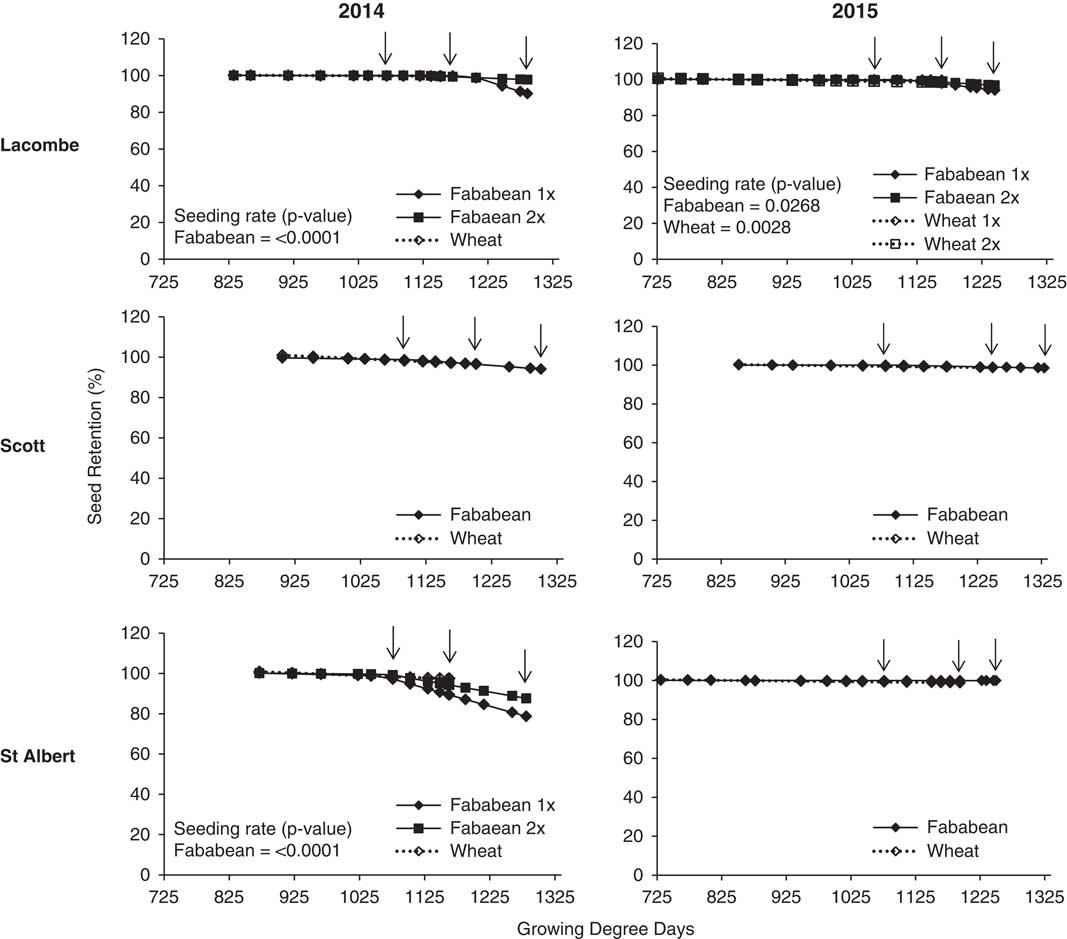
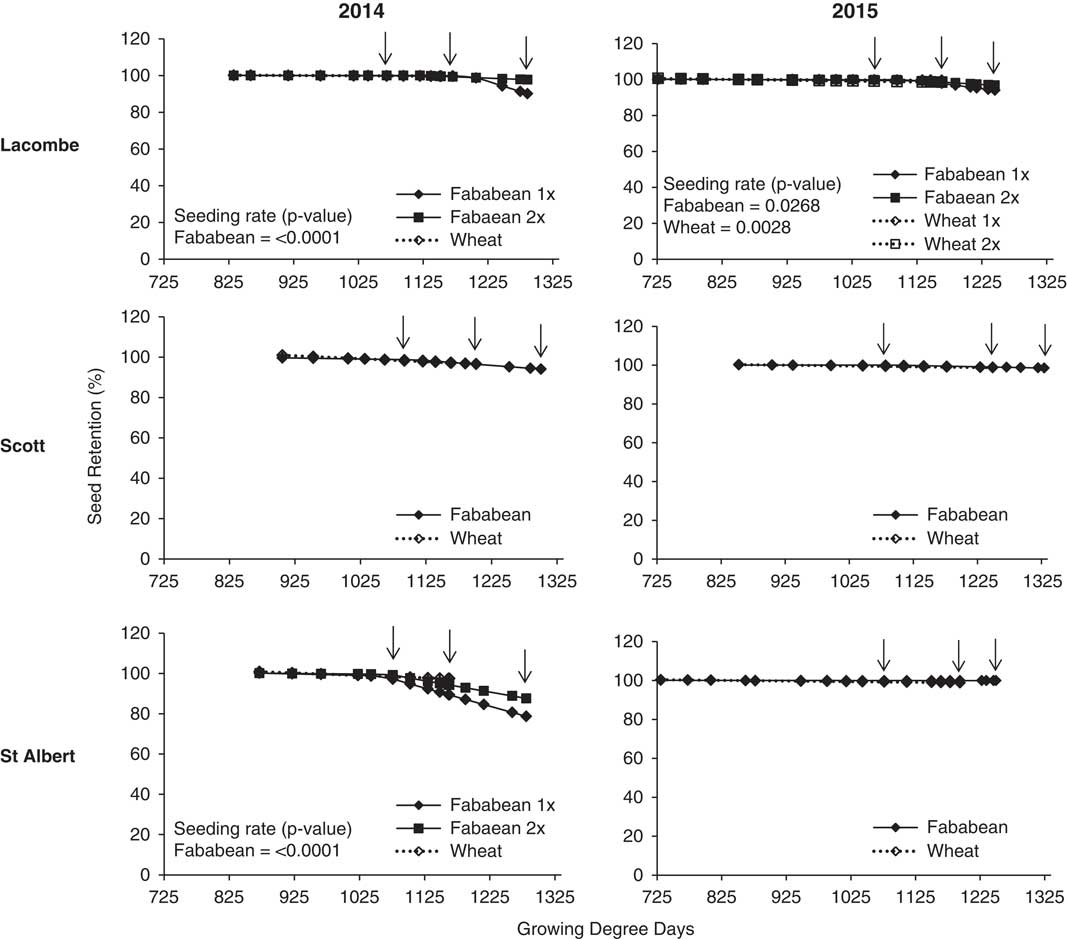
Canola seed retention was the greatest of all the species, with very low percentages of seeds shed over the study period for any site-year (Figure 3). Best-fit regression models were primarily linear for canola grown in wheat and segmented for canola grown in fababean; however, R2 values were relatively low due to minimal seed losses (Supplementary Table 3). Seed retention over time among crop treatments was similar during the time both crops were sampled, with the decrease in retention in fababean primarily occurring after wheat direct-harvest timing (Figure 3). Canola seed retention at wheat swathing averaged 99% (range 97% to 100%). At wheat and fababean direct harvest, retention averaged 98% (89% to 99%) and 94% (79% to 99%), respectively. The lowest retention was at St Albert in 2014, when the site was seeded on canola stubble and had a dense population of volunteer canola. The increased competition may have resulted in an increased rate of canola maturity and therefore increased seed shed. With the exception of St Albert in 2014, canola seed retention was >90% and often >95%. The lack of seed shed for volunteer canola and a low degree of variability in seed retention over time highlights the potential for volunteer canola to be managed with HWSC.
Canola seed retention as a function of GDD and treatment across site-years. Regression equation parameter estimates are listed in Supplementary Table 3. Arrows indicate wheat swath timing, wheat direct-harvest timing, and fababean direct-harvest time, respectively, from left to right. SE bars and P-values for seeding-rate coefficient comparisons are shown.
Height of Seed Retention
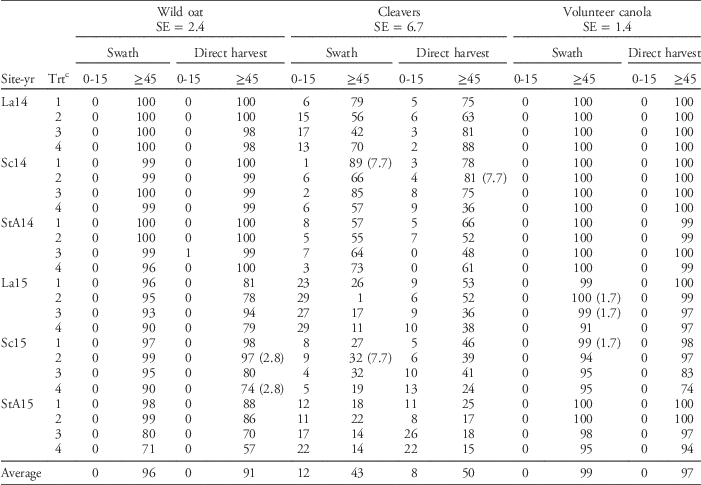
For wild oat and canola, the four-way interaction of site-year, treatment, harvest timing, and height was significant (P<0.0001). The three-way interactions of site-year, treatment, and height, and site-year, timing, and height were significant for cleavers (P<0.0001 for both). Percentage of seeds at harvest for fababean and wheat were evaluated at their respective direct-harvest timings; percentages at swathing are from the wheat swath timing for both species. Across all species, seed retention was more highly concentrated in the upper canopy in 2014 than in 2015 (Table 2); this is likely related to drought effects on both crop and weed heights in 2015 leading to shorter plants, later-emerging plants, and more seeds present throughout the canopy. The dispersion of seeds in the canopy was particularly evident for cleavers when comparing 2014 and 2015 results. Wild oat and canola seeds were both retained high in the crop canopy with 1% and 0% of their seeds considered noncollectable, respectively. For cleavers, an average of just under 10% was considered noncollectable, leaving more than 90% of seeds in the collectable fraction. Among all treatments and site-years, a maximum of 29% of seeds was noncollectable, leaving 70% available for HWSC in a “worst-case” scenario. There is a trend in wild oat and canola for a greater spread of seeds through the canopy at direct harvest compared with swathing, particularly in 2015. This may be due to maturation of tillers/branches and later-emerging plants. Cleavers does not show the same pattern, likely due to seed maturity and loss occurring from the ground up for this species (Malik and Vanden Born Reference Malik and Vanden Born1988). Overall, height of seed retention does not appear to pose a limitation for HWSC for these species.
Percent of seeds retained in 0 to 15 cm and ≥45 cm, listed by site-year, treatment, and harvest timing.Footnote a , Footnote b

a Abbreviations: La14, Lacombe 2014; La15, Lacombe 2015; Sc14, Scott 2014; Sc15, Scott 2015; StA14, St Albert 2014; StA15, St Albert 2015.
b SEs are given for each species; different SEs due to missing data are given in parentheses (applies to whole treatment). An average for the % of seeds across site-years and treatments is shown at the bottom.
c The treatments are defined as follows (crop-seeding rate): 1, fababean 1X; 2, fababean 2X; 3, wheat 1X; 4, wheat 2X.
Shed Seed Viability
The viability of shed seeds collected in shatter trays was highly variable. While there was a significant regression for increasing viability as GDD increased (unpublished data), adjusted R2 was low for all species (wild oat=0.02, cleavers=0.14, canola=0.19). For nearly every collection timing for every site-year, viability of seeds ranged from 0% to 100% (unpublished data). This high variability, combined with small sample sizes for some treatment and GDD combinations, led to a low ability to determine trends and treatment effects. However, because viability measurements up to 100% were recorded for nearly every timing and weed combination with high variability in the measurements, assuming seeds are viable minimizes the risk of overestimating efficacy. Therefore, each seed shed before HWSC is implemented could potentially contribute to the following year’s population; each seed lost before harvest should be assumed to decrease the efficacy of HWSC.
Based on percentage seed retention and plant height of seed retention, wild oat, cleavers, and volunteer canola can be classified by their potential to be controlled by HWSC techniques. While height of seed retention does not hinder control of wild oat, poor seed retention at harvest limits HWSC potential. Because wild oat is the “driver” weed most likely targeted for control and the most important herbicide-resistant weed in western Canada (Beckie et al. Reference Beckie, Lozinski, Shirriff and Brenzil2013b), an inability to control it effectively will be a significant challenge in the acceptance and adoption of HWSC techniques in the Canadian Prairies. Although the potential for HWSC of wild oat may be limited, field research is needed to determine the long-term impact of these technologies on prairie populations.
High variability across site-years in pattern, timing, and overall seed loss makes the effect of HWSC on cleavers population abundance difficult to predict. Across all site-years, collection of cleavers at wheat swath timing substantially increased the percentage of retained seeds. Inclusion of swathing in cropping systems may be an effective way to manage cleavers through use of HWSC.
With most of the seeds retained high in the canopy and a high level of seed retention, canola volunteers are likely to be managed effectively with HWSC technologies. Considering high seed losses are known to occur once canola enters the combine, HWSC is likely to be an important addition in managing volunteer canola populations, particularly in subsequent broadleaf crops, and for minimizing genetic co-mingling between canola cultivars.
HWSC suitability ranking of tested species is canola>cleavers>wild oat. While HWSC will have a fit for specific weed species in western Canada, it is important to consider the selection pressure being imparted by these technologies. HWSC techniques will select for individuals in the populations with seeds maturing/retained below 15 cm, earlier maturation, and earlier seed loss (Ashworth et al. Reference Ashworth, Walsh, Flower, Vila-Aiub and Powles2015). This should not impede the adoption of HWSC in western Canada but should continue to encourage research and development into alternate control strategies and producer use of integrated weed management systems.
Acknowledgments
The authors would like to acknowledge the technical assistance of J. Zuidhof, L. Michielsen, P. Reid, E. Sroka, A. Kapiniak, C. Gampe, L. Raatz, E. Martin, K. Topinka, S. Shirriff, and many graduate and summer students. Funding for this project was provided by Alberta Crop Industry Development Fund and Agriculture and Agri-Food Canada and through the National Science and Engineering Research Council, the Alberta Wheat Commission, and the Izaak Walton Killam Scholarships for BDT.
Supplementary material
To view supplementary material for this article, please visit https:/doi.org/10.1017/wsc.2017.58