Introduction
Mass-gathering events occur when a significant number of people are in attendance at a particular location for a specific purpose and for a defined period of time. The National Association of Emergency Medical Services Physicians defines 1,000 persons as the minimum number of attendees to consider the need for mass-gathering medical care.Reference Jaslow, Yancy and Milsten 1 , Reference Arbon 2 Given these events represent unique challenges for Emergency Medical Services (EMS) systems, medical preparation involves detailed planning and coordination among various public, private, and medical organizations. Preparing specifically for a major motorsports event brings the added element of the inherent danger in the sport to the drivers and crew, and the need for additional personnel to provide adequate coverage. Although rare, motorsport events also add the potential for a mass-casualty situation, given the proximity of fans to high-speed vehicles.
Medical preparation for mass gatherings, including motorsport events at existing sites, has been reported in the past.Reference Bock, Cordell, Hawk and Bowdish 3 - Reference Nardi, Bettini and Bozzoli 7 Guidelines exist with recommendations that stress detailed preparation for transportation, communication, and medical staffing.Reference Chesser, Norton, Nolan and Baskett 8 However, there is no published literature outlining specific preparatory details for inaugural mass-gathering motorsport events.
The 2012 United States Grand Prix (Austin, Texas) provided a unique opportunity to develop and implement a comprehensive preparedness plan that could serve as a “best practice” framework for inaugural motorsports events. The medical team developed and implemented this plan in coordination with public safety agencies, EMS leadership, and hospital trauma services.
The details of this preparation for a mass-gathering motorsports event at a new racetrack facility are reported with the procedures and methods used. Descriptive data on the details of the medical care rendered during a 3-day race period are also reported.
Methods
Study Design and Population
After review and approval from the Seton Institutional Review Board (Seton Family of Hospitals, Austin, Texas USA), a retrospective descriptive study utilizing postevent summaries was completed for patients evaluated at the United States Grand Prix from November 16-18, 2012. “After Action Reports” provided by the Federation International de L'Automobile (FIA), the City of Austin Office of Homeland Security, and from Austin Travis County Emergency Medical Services (ATCEMS) also were reviewed. 9 , 10
Study Setting
The United States Formula One Grand Prix included the construction of a purpose-built 3.43 mile (5.52 km) motor racing circuit track and facility (375 acre footprint on a 1,000 acre plot of land) named Circuit of the Americas (COTA), located on the outskirts of Austin, Texas. The facility was designed and built to host a variety of motorsports, athletic, and entertainment events in the future, but its main focus, and very first event, was to be the pinnacle of motorsports events.
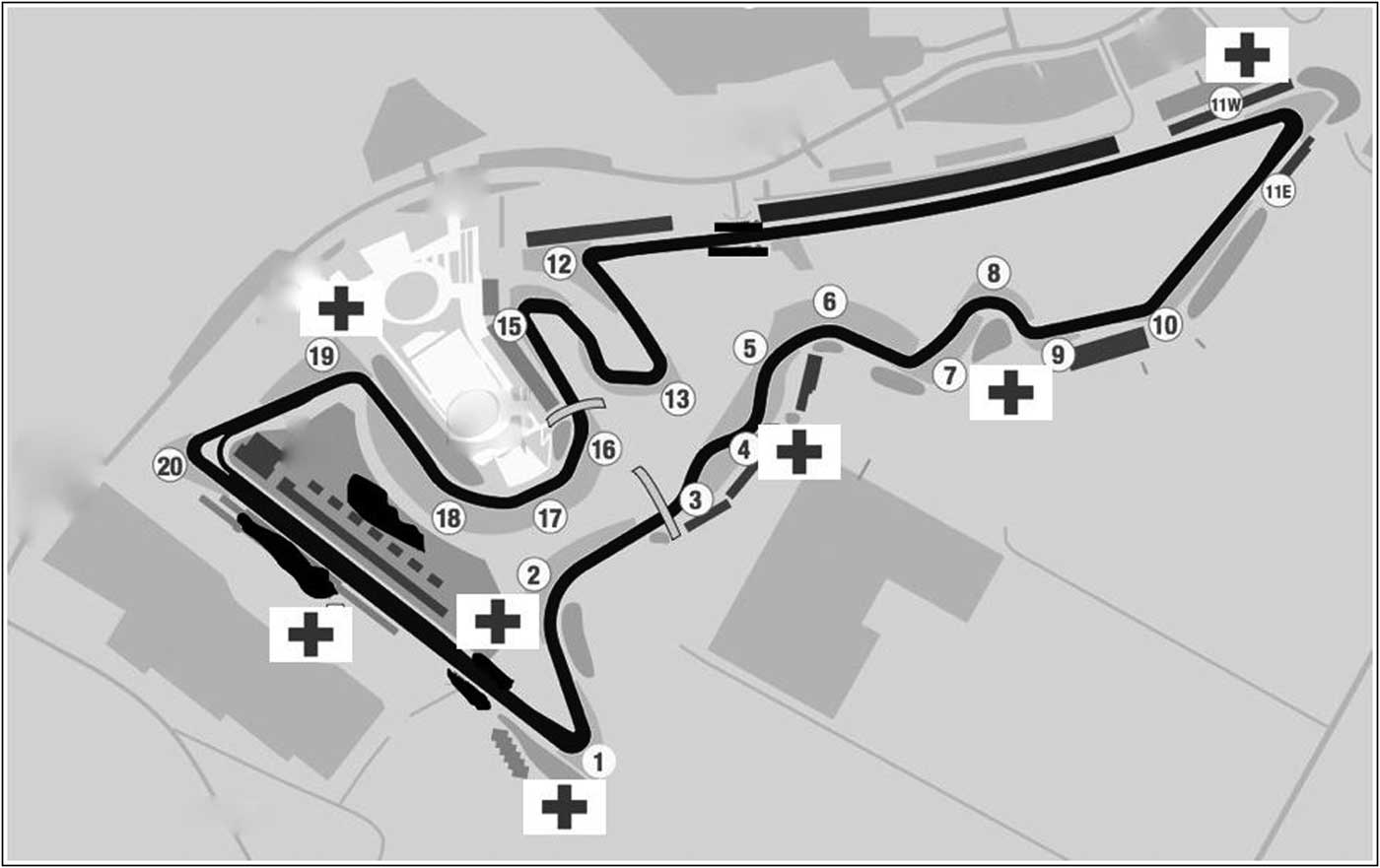
Given that this new facility is located outside the metropolitan area with limited local infrastructure, a medical center was built at the racetrack to provide medical services during ongoing events. The medical center was strategically placed at the end of pit row, below Turn 2, on the infield side of the track (Figure 1). The large size of the venue, and the fact that the majority of patients do not necessarily need treatment at the medical center, led to the creation of six medical tents placed strategically around the track to treat minor conditions. These tents were erected as temporary structures, and were approximately ten by ten feet in size. They were stocked with first aid level supplies.
Circuit of the Americas Turn Numbers, Medical Center, and Medical Tents

Data Collection and Processing
A standardized patient care record consisting of demographics, vital signs, initial evaluation, treatment, and disposition was created for every patient encounter. All relevant reports were compiled and collected by the primary investigator. Patient data were collected from standardized patient care records from the track medical facility, medical tents, and EMS electronic patient care records. Data elements were defined a priori by the research team, abstracted by the primary investigator, and entered into Microsoft Excel (Microsoft Corp., Redwood, Washington USA) for analysis. Data were cleaned and verified by a second investigator for accuracy.
Data Analysis
Basic descriptive statistics were performed; all continuous variables were reported as averages and all categorical variables as percent frequencies. For consistency with previously reported literature on mass-gathering medicine, participant medical usage rates (MURs) are reported as a rate of patients per 10,000 (PPTT) participants using official estimates of attendance as the denominator for all calculations.Reference Hawkins and Brice 11 , Reference Milsten, Maguire, Bissell and Seaman 12 Data were entered into a Microsoft Excel Spreadsheet, Version 2010 (Microsoft Corporation, Redmond, Washington USA).
Results
Overall Results
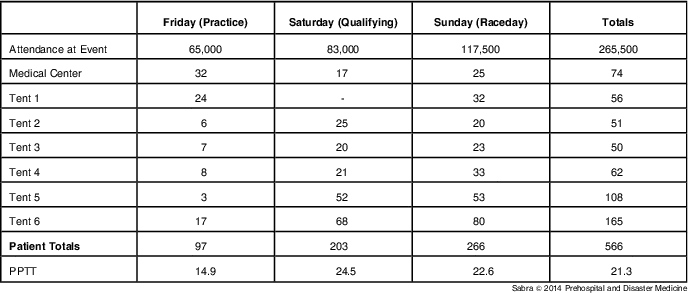
Attendance at the US Grand Prix totaled 265,500 spectators over the 3-day event. As expected, the highest single-day attendance was on the actual raceday, with 117,500 attendees. A total of 566 patients were seen in the track tents and medical center over the 3-day period, and there was an average MUR of 21.3 patient visits at the track per 10,000 attendees. When combined with the 22 patients who were taken directly to the hospital by EMS personnel, this average increased to 22.1 PPTT attendees. Visits increased and correlated directly with the higher attendance numbers throughout the course of the event (Table 1).
Census, Medical Usage Rate

Abbreviation: PPTT, patients per ten thousand.
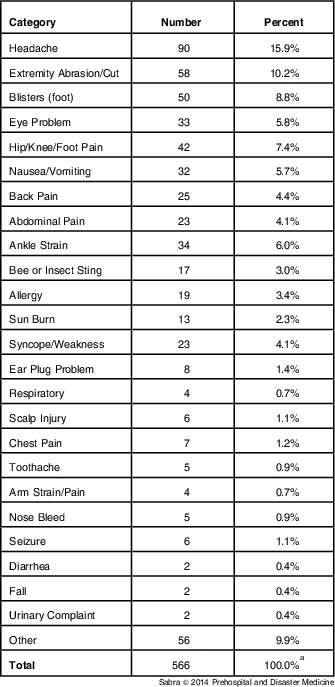
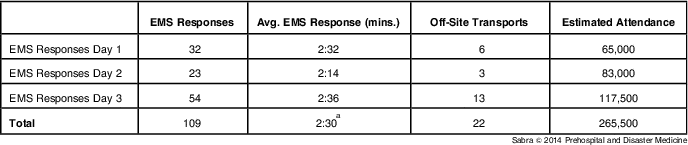
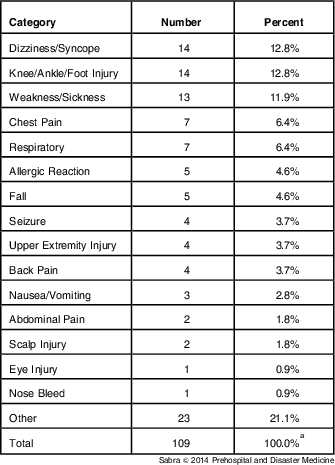
Of the 566 patients evaluated at the tents and medical center, only eight were transported off site to a hospital. The majority of the presenting complaints were minor in nature (Table 2). This translates to 98.6% of patients seen at the track medical facilities being cared for without hospital transfers. Even with the addition of the 22 patients taken directly by EMS to a hospital, the on-site care rate remained high at 95.6%. There were 109 EMS calls placed within the track during the event, with an average response time of two minutes and 30 seconds (Table 3). Twenty-five persons (22.9%) declined treatment. Three calls (2.8%) were cancelled. In 16 calls (14.7%), the patient was not present upon arrival of the EMS team. Twenty-one (19.3%) were transported directly to a local area hospital, 43 (39.4%) were transported to the on-site medical center for evaluation, and two (1.8%) were taken to a first aid tent. Twenty-nine calls (26.6%) were related to a traumatic incident, 71 (65.1%) were nontraumatic, and nine (8.3%) were unknown. Of the 71 nontraumatic calls, 17 (23.9%) were for weakness, near syncope, or syncope/unconscious; ten of the 17 (58.8%) were on the hottest of the three days (Table 4). There were no serious injuries and no deaths reported for any patients cared for by EMS, or those seen at the tents and medical center.
Medical Tent Chief Complaints

aDifference due to rounding.
EMS Responses and Times

Abbreviation: EMS, Emergency Medical Services.
aAverage was calculated based on total seconds of response for each day and total number of calls.
EMS Calls: Chief Complaints

Abbreviation: EMS, Emergency Medical Services.
aDifference due to rounding.
Event Planning and Emergency Operations
The City of Austin, Texas and Travis County, as well as state and regional partners, established an Area Command at the Austin/Travis County Emergency Operations Center (EOC). A centralized command center was established given the large scale of the Grand Prix and expected attendees, its duration over multiple days, and the presence of multiple supporting venues across the city. The EOC addressed multiple issues in planning, communications, and logistics, including coordinating with the Federal Aviation Administration to determine helicopter flight paths for the hundreds of flights to the track.
Emergency Medical Services
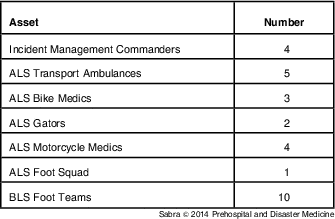
Austin/Travis County EMS is the sole provider of prehospital medical services for the city of Austin and the Travis County area (population 1.1 million) with approximately 120,000 responses per year. In addition to routine 911 EMS, ATCEMS is responsible for the provision of medical support at large public events. For this event, the ATCEMS mass-gathering plan consisted of the strategic deployment of EMS assets throughout the venue to provide EMS coverage and rapid response for the attendees (Table 5). This was done in coordination with an on-site medical facility staffed by emergency physicians for triage and treatment of lower-acuity illness and injury.
EMS On-Site Assets

Abbreviations: ALS, Advanced Life Support; BLS, Basic Life Support; EMS, Emergency Medical Services.
Emergency Medical Services assets were distributed throughout the venue, utilizing the direction of the turns, and using a pattern of numerical progression around the track for quick reference to the closest EMS resources. Basic Life Support foot teams were allocated on the track from the main grandstands onto Turn 1, and then counter-clockwise around the track to Turn 20, before reaching the main grandstand. All requests for EMS services were dispatched with the closest BLS foot team and closest Advanced Life Support (ALS) resource. High-risk ALS patients identified by EMS in the venue were to be transported off-site via air medical services, if necessary. When EMS did transport off-site with noncritical patients, they were directed to rendezvous with another system ambulance at a predefined area to facilitate a quick “in-service” turn around to minimize impact on system resources. To manage the EMS responses outside of COTA property and surrounding community with traffic congestion, EMS utilized paramedics on motorcycles or in a squad vehicle to ensure timely EMS response and quicker access amongst the traffic congestion.
Communications
Within the computer assisted dispatch system, a “geo-fence” was defined for EMS communications at this venue. This allowed for the creation of a unique response plan for the event without interfering with 911 EMS system resources. It also allowed for any 911 calls within the defined “geo-fence” to be sent immediately to the dedicated EMS Communication Medic at the EOC, who would then triage and dispatch the dedicated EMS resources assigned to this event utilizing a P25 Digital Trunked 800 mhz system (Motorola Solutions, LLC, Schaumberg, Illinois USA). Emergency medical services communications for the race were provided by two certified and dedicated event dispatchers at the EOC. Base-station radios were located at all of the first aid tents throughout the track, and portable radios were carried by paramedic crews and foot teams.
Site Medical Facilities
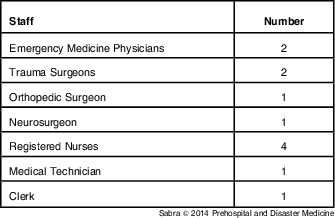
Medical coverage at the track was based around a new medical center, which was constructed according to Formula One and FIA guidelines, with interior spaces modeled after the affiliated Level 1 trauma center emergency department. The medical center has a minor treatment area with six stations, as well as a separate 2-bay trauma area capable of treating major casualties. The center was staffed each day (Table 6) according to FIA and Formula One regulations. 13
Medical Center Staffing

The ambulance area is situated immediately next to the trauma stations to facilitate quick patient offloads, and contains a decontamination wash station to clean potential spilled fuel off of patients before they may enter inside. Two permanent helipads are in place directly next to the medical center ambulance entrance. A medical evacuation helicopter was kept on site during the entire event with two paramedic flight crew members. A backup helicopter and crew were kept immediately available to backfill any evacuated flights.
Affiliated Trauma Hospital
According to Formula One and FIA regulations, there must be a designated trauma hospital ready to receive patients during the event. 13 An inspection of the hospital by an FIA official and evaluation of its capabilities is undertaken several months prior to the race, and no changes to the designation of a hospital may be undertaken within two months of the race. For the United States Grand Prix, the approved and designated hospital is the University Medical Center at Brackenridge under the Seton Family of Hospitals. This is an American College of Surgeons certified Level 1 trauma center, located in downtown Austin, Texas, 17 miles from the track.
Medical Oversight
Medical care and decision making at the racetrack itself was under the direction of an FIA-approved Chief Medical Officer (CMO). The CMO was responsible for the recruitment, implementation, operation, and running of the medical care, rescue services, and evacuation at the racetrack. As part of the medical oversight planning process, the CMO served as the main medical liaison to coordinate the level of medical coverage with public safety agencies and hospital leadership to ensure a maximal level of readiness and medical support. Medical personnel assigned to cover the track received motorsport-specific medical briefs and targeted education in preparation for potential accidents and injuries.
Discussion
This research describes the preparatory details for an inaugural mass-gathering motorsport event. These events present significant challenges for community EMS and hospital resources. Proper preparation from a medical standpoint for an inaugural motorsports mass-gathering event such as the United States Grand Prix took a large effort and coordination on the part of numerous entities. Complete preparation does not simply involve the creation and staffing of a track medical center; it also includes preparation in conducting a comprehensive assessment of event characteristics that may predict the need for medical services. 9
One of the concerns with a large number of spectators at any mass-gathering motorsports event is the potential for a delay in access to a spectator in need of medical attention. Several strategies were utilized to minimize response time and manage any potential barriers for access. First, EMS resources were allocated throughout the racetrack with a higher concentration at locations with a higher number of spectators. Distribution of EMS assets utilizing a pattern of numerical progression around the track seemed effective in minimizing confusion at the time of dispatch. Multiple pre-event briefings, walkthroughs, and grid mapping exercises allowed for all providers to be familiar with the racetrack. Second, the creation of the 911 call “geo-fence” allowed for the almost immediate dispatch after a call was placed, which minimized processing time. Finally, the use of alternative transport modalities, such as motorcycles and gators, helped with effective mobility through crowds and any physical barriers present at the track.
The majority of EMS calls for this event were for nontraumatic events. A sizeable number of patients declined treatment, or were not present, upon EMS arrival. A majority of patients in the EMS call group were transferred to the on-site medical center, or directly to a hospital. The number of calls per day was not directly related to number of attendees, although the greatest number occurred on raceday, which had the highest number of spectators, highest temperatures, and longest duration of events.
Although an accurate prediction of patient volume and type for mass-gathering events is challenging, the types of patient evaluations seen at this event were typical for a large motorsports event. Most of the evaluations were for minor complaints, such as headaches, blisters, and sprains. These results are consistent with reports seen in both older and recent medical literature.Reference Bock, Cordell, Hawk and Bowdish 3 - Reference Nardi, Bettini and Bozzoli 7 , Reference Locoh-Donou, Guofen, Welcher, Berry, O'Connor and Brady 14 Data from the 2012 US Grand Prix allows predictability of approximately 22 patient visits per 10,000 spectators for this venue. Medical usage rate data for other Formula One events have not been published for comparison, but the rate for this single event is significantly higher than that reported over an 8-year period for the Indianapolis 500 (Indianapolis, Indiana USA). Bock et al reported a MUR of 3.5 PPTT spectators seen at the medical center for that event.Reference Bock, Cordell, Hawk and Bowdish 3 A likely explanation for the large difference in MUR versus this study's rate is likely the exclusion of patients who were evaluated at first aid stations.
One aspect of medical care at this event that deserves particular attention is the high on-site care rate. Most patients received a disposition without the need for transport to an off-site medical facility. On-site physician-level medical care at large mass gatherings significantly reduces the number of patients requiring transport to hospitals.Reference Martin-Gill, Brady and Barlotta 15 Furthermore, the presence of trained prehospital and nursing personnel at the peripheral care sites allowed for the majority of cases to receive final dispositions without referral to the medical center. This arrangement keeps the medical center from becoming overcrowded with minor complaints and injuries, thus allowing for a high level of readiness for major injuries or potential mass-casualty situations.
An important highlight of the medical care at the 2012 United States Grand Prix is that there were zero driver or crew injuries. This safety accomplishment is evidence of major advances in car and track design over the past several decades. Given the current safety of the sport for most drivers, and supported by the fact that all rendered care for this event was on spectators, it is mandatory that medical preparedness plans for motorsports events place realistic emphasis on spectator care preparations. A comprehensive plan includes strategies for both “motorsports medicine” and “mass-gathering” medicine. These two areas of medicine are distinctly different and should be treated as such in preparedness planning.
The staffing and medical personnel necessary for event coverage can be roughly estimated by expected crowd size with a predictive analysis of patient numbers. Several studies in the past have described medical preparedness for mass-gathering events based upon crowd size.Reference Bowdish, Cordell, Bock and Vukov 4 , Reference Sanders, Criss and Steckl 16 - Reference Arbon, Bridgewater and Smith 18 Other authors have looked at variables surrounding an event, such as weather, crowd size, type of event, and crowd mobility, to possibly predict MURs.Reference DeLorenzo, Gray and Bennett 19 - Reference Diehl, Morris and Mannis 21 These patient visit estimations will vary based not only upon the crowd size, but the type of event as well. Certain motorsports events will attract older or younger crowds, as well as various behavior patterns which may lead to more injuries. The weather also plays a crucial role in spectator complaints, with an expected increase in dizziness, fatigue, exhaustion, and heat stroke presentations with higher temperatures.
Overall, the implementation of the medical preparedness plan for this motorsports event was successful. The plan allowed for the ability to treat spectators at the racetrack in a highly efficient manner with limited impact on the EMS system and community hospitals. All requests for medical care during the 3-day event were managed successfully with the allocated resources for this event.
Limitations
This study was limited to a single event occurring over a 3-day period, which is infrequent. As a retrospective study, there were a number of limitations associated with this study design. Data not captured, or lack of complete records by medical personnel, may have caused the total patient volume to be underestimated. Also, there is a possibility that incidents with minor illnesses or complaints may have not been reported to an EMS provider or a medical tent nurse.
Conclusion
The inaugural US Formula One Grand Prix was a mass-gathering motorsport event with a moderate number of patients requiring medical attention throughout the 3-day event. Most patients had minor medical conditions that did not require transportation to off-site medical facilities. The preparedness plan was implemented successfully with minimal impact on 911 EMS system resources and local medical facilities. This medical preparedness plan may serve as a model to other cities preparing for an inaugural motorsports mass-gathering event.