Introduction
Neoliberalism has been seen as one of the ideational driving forces for societal and political change in Western democracies (Crouch Reference Crouch2013) spurring a wide range of changes in different realms of politics and society (Centeno and Cohen Reference Centeno and Cohen2012): a retreat of the interventionist state, visible by reduced taxation and privatisation (Zohlnhöfer et al. Reference Zohlnhöfer, Engler and Dümig2017); a shrinking welfare state, characterised by increased individual responsibility, less generous benefits and an emphasis on workfare (Simmons et al. Reference Simmons, Dobbin and Garrett2006; Béland Reference Béland2009; Ferrera Reference Ferrera, Thatcher and Schmidt2013); and an increased penal state, characterised by a turn towards harsher punishment in Western liberal democracies (e.g. Garland Reference Garland2001; Wacquant Reference Wacquant2009b). Reaching beyond specific policy domains, some authors have even related economic neoliberalism with a growing penal state, treating neoliberal ideology as general pressure that affects not only the economic and social realm, but also law and order policies:
[T]he state stridently reasserts its responsibility, potency, and efficiency in the narrow register of crime management at the very moment when it proclaims and organizes its own impotence on the economic front, thereby revitalizing the twin historical-cum-scholarly myths of the efficient police and the free market. (Wacquant Reference Wacquant2009b: xviii)
A cross-national comparison of welfare generosity and penal policies seems to support this claim. Cavadino and Dignan have for instance famously shown that the rise of neoliberal ideology has led the Anglo-Saxon family of nations to resort to incarceration much more heavily than the rest of the Western world (Cavadino and Dignan Reference Cavadino and Dignan2006), and the Scandinavian countries in particular. Related observations of systematic cross-country differences have been made by Lacey (Reference Lacey2008) emphasising differences in capitalist systems.
However, when it comes to the reasons for this pattern, the picture is complex. Some authors, drawing on the seminal 1939 study by Rusche and Kirchheimer (Reference Rusche and Kirchheimer1968), discuss the two policy sectors as linked by discourse (Melossi Reference Melossi1987), as instruments to handle “social marginality” (Beckett and Bruce Reference Beckett and Bruce2001) or to control labour surplus (Rodríguez-Menés and López-Riba Reference Rodríguez-Menés and López-Riba2019). Others hold that the nature of the capitalist system is responsible for the correlation between welfare generosity and penal policies (Lacey Reference Lacey2008; Lacey et al. Reference Lacey, Soskice and Hope2018), while further studies have argued that welfare states affect individual’s life chances and opportunity structures, e.g. through education and labour market security, resulting in different crime rates as well as penal policy reactions (Sutton Reference Sutton2010). However, the absence of politics and political parties in most of these accounts is striking. Evidently, power resources of classes and the respective political parties have been a powerful explanation of welfare state development (Korpi Reference Korpi1983; Esping-Andersen Reference Esping-Andersen1990; Korpi and Palme Reference Korpi and Palme2003) and political dynamics have also been discussed as affecting law and order and penal policies (Simon Reference Simon2007; Wenzelburger Reference Wenzelburger2015). However, the question whether political parties and competition between them affect the relationship of welfare and penal policies has been not studied, yet.
In this contribution, we show that political parties are key if we want to understand the apparent covariance between penal and welfare policies. In terms of theory, we argue that political parties matter in two respects. First, building on recent theories of party competition, which suggest that parties compete on both an economic left–right dimension and a cultural [Green-Alternative-Libertarian/Traditional-Authoritarian-Nationalist (GALTAN)] dimension, we expect that parties hold distinct positions towards welfare state and penal issues. Whereas some parties, such as conservatives, will push for both penal harshness and welfare retrenchment, others, such as liberal parties, are critical of a big welfare state as well as of tough penal policies. Depending on government participation of these parties, this may result in contradicting trends in both policy domains. Second, we argue that some parties can be expected to actually relate penal and welfare policies in an ideologically coherent way. This is true not only for the obvious candidate – conservative parties – but also for social democrats that embarked on a “third-way” policy platform. Building on the recent literature (Tham Reference Tham2001; Wenzelburger and Staff Reference Wenzelburger and Staff2017), we argue that third-way social democratic parties, which are electorally most vulnerable to welfare cutbacks, are likely to mix welfare cutbacks and harsher penal policies because they feel the need to show their voters that they still care about their security. They compensate, in a sense, the loss of social security with penal harshness – a strategy that speaks to broader sociological concepts of different means of social control. As our arguments largely draw on political and economic changes that have affected Europe from the 1980s onwards, both arguments are mainly applicable to this specific period and region.
In terms of empirics, we contribute a new dataset to the literature. It covers legislative changes in welfare and penal policies between the 1990s and 2014 in Denmark, Germany, the United Kingdom (UK) and France. The data enable us not only to test the actual legislative output – which is where partisan ideology should be most visible (Knill and Tosun Reference Knill and Tosun2012, 292) – but it also contains information on the time when a piece of legislation was enacted. We therefore can analyse whether penal legislation systematically follows welfare legislation. Our empirical analysis reveals that indeed, liberal parties push for less welfare and more liberal penal policies – a finding that shows that neoliberal ideology does not affect all parties and policy domains simultaneously. Second, we find that compensation effects are indeed visible for social democratic governments, but – surprisingly – not for conservative parties. As our dataset starts in the mid-1990s when the third way was en vogue, this can be interpreted as a corroboration of the claim that social democrats that retrenched the welfare state resorted to tougher penal policies to signal their commitment to security by other means.Footnote 1
The remainder of this article is structured as follows: in the next section, we discuss the existing theoretical and empirical literature on the penal–welfare nexus as well as literature on partisan effects, especially with regard to law and order policy. Based on this, we formulate our main hypotheses. The third section will then set out our methodological approach and explain the dataset before we will present the regression analyses in the fourth section. A discussion of the study’s results in relation to the literature concludes the article.
Theory
Parties and the penal–welfare nexus: a largely neglected field of study
Empirically, comparative criminology has asserted in recent years that some connection seems to exist between the welfare state and the penal state. Most existing studies focus on cross-national differences and therefore emphasise variance in levels. In an important contribution, Cavadino and Dignan (Reference Cavadino and Dignan2006) established a link between the level of punitiveness and the type of political economy drawing on Esping-Andersen’s famous “worlds of welfare” typology (Esping-Andersen Reference Esping-Andersen1990) – with the less generous liberal welfare states being also more punitive than the more generous social democratic ones, although exceptions exist. Embedding this idea into the broader concept of the varieties of capitalism (Hall and Soskice Reference Hall and Soskice2001), Lacey (Reference Lacey2008) supports this finding and the general link between welfare provision and punitiveness with liberal market economies exhibiting higher punitiveness as coordinated market economies [see also Downes and Hansen (Reference Downes, Hansen, Armstrong and McAra2006)]. Relying on a set of indicators instead of the imprisonment rate only, Wenzelburger (Reference Wenzelburger2018) confirms that countries group in distinct clusters reflecting their law and order policies as well as welfare state regimes [see also Norris (Reference Norris2009)]. Similarly, Lappi-Seppälä (Reference Lappi-Seppälä2008) finds a link between welfare provision or de-commodification and imprisonment rates. Finally, while Tonry (Reference Tonry and Tonry2007, 17) acknowledges that greater income inequality is associated with higher imprisonment rates, he also points out that “distinctive national histories and cultural attitudes of individual countries” are most influential to explain national variations (Tonry Reference Tonry2015, 512).
While these studies reveal relevant patterns, comparing cross-national differences in penal and welfare policies is not a very precise test of the question of whether governments purposefully change penal and welfare policies in tune. In this respect, two different accounts have been put forward. The first explanation for such a penal–welfare nexus has been proposed by Wacquant (Reference Wacquant2009b), who argues that neoliberalism has to be understood as the common background for both welfare state retrenchment and penal harshness. The slightly different variations of his principal arguments converge on the view that inequality and poverty increase as a result of neoliberal economic and social policies (essentially, welfare retrenchment) to which governments then respond by toughening penal policies. The second explanation has been put forward by Sutton (Reference Sutton2010) and (Reference Sutton2013). He argues that the welfare state, or, more precisely, the labour market as well as education systems, structure opportunities of individuals over their life course and thereby affect their risk of committing a crime and, relatedly, aggregate rates of imprisonment. In this second explanation, inclusive labour markets and education systems favouring both employment and security lead to less crime and less punishment.
Although these studies advance our understanding of why welfare cutbacks may be accompanied by harsher penal policies, politics and political parties only play a minor role. While Wacquant seems to argue that neoliberalism affects all (in his cases, mostly the United States (US)) governments in a similar way (Wacquant Reference Wacquant2001, 404),Footnote 2 Sutton concedes that left-party power may actually be a root cause of the development of inclusive labour markets as well as “cross-class solutions to a wide range of social policy issues, including, apparently, less punitive responses to crime” (Sutton Reference Sutton2004, 185). Empirically, while not directly modelling the partisan influence on the penal–welfare nexus, he has repeatedly shown that left-party power – depending on the model specification – restricts mass incarceration (Sutton Reference Sutton2000, Reference Sutton2004, Reference Sutton2010, Reference Sutton2013). However, by focusing on a left–right divide (which may adequately represent the US party system), this work underestimates the multidimensionality of most other party systems in advanced democracies. The next section will, therefore, give a more complete account of how governmental policies are shaped by political parties and party competition.
Party competition on welfare and penal policies
The theory of partisan politics explains policy outputs by analysing (1) which parties form the government and (2) by inspecting the ideological stance of these parties (Häusermann et al. Reference Häusermann, Picot and Geering2013; Schmidt Reference Schmidt1996). It is therefore crucial to understand how ideological differences of parties come about because they will affect policies once a party reaches office. According to standard theories of party competition (Sartori Reference Sartori1976; Stokes Reference Stokes1999; Adams et al. Reference Adams, Merrill and Grofman2005), the ideological position of parties is formed in electoral competition for votes because parties’ most important goal is to win elections, access to office, and, by this means, to influence policies in the interest of their constituency. However, the context in which this competition takes place varies substantially between countries: while the US party system is largely based on a single mainly economic dimension opposing Republicans and Democrats (Benoit and Laver Reference Benoit and Laver2006, 116), European party systems feature a greater number of parties, which exhibit distinct mixes of policy preferences along different policy dimensions. Especially from the 1990s onwards, most party systems in Western industrialised countries have developed two main dimensions of competition: an economic axis opposing parties of the left, that push for more state intervention in the economy and generous welfare states, to parties of the right, that hold a liberal view of free markets and individual responsibility; and a more and more important cultural axis (GALTAN) that opposes green/alternative/liberal (GAL) and traditional/authoritarian/nationalist (TAN) values, which are then represented in party competition by, for instance, green and liberal parties on the one and right-wing populist parties on the other hand (e.g. Kitschelt and Hellemans Reference Kitschelt and Hellemans1990; Kriesi et al. Reference Kriesi, Grande, Lachat, Dolezal, Bonschier and Frey2008; Kitschelt and Rehm Reference Kitschelt, Rehm, Beramendi, Häusermann, Kitschelt and Kriesi2016). If we adhere to this view, penal policies are an issue of the GALTAN axis as they touch positions towards authoritarian values and a more repressive public order (see also, Wenzelburger Reference Wenzelburger2015).
This more adequate understanding of partisan competition has consequences for our theorising about whether welfare and penal policies are related. For welfare policies, the dynamics are quite straightforward. Based on Hibbs (Reference Hibbs1977) or Castles and McKinlay (Reference Castles and McKinlay1979), many studies confirmed the thesis that “parties matter” for welfare (Bradley et al. Reference Bradley, Huber, Moller, Nielsen and Stephens2003; Korpi and Palme Reference Korpi and Palme2003; Allan and Scruggs Reference Allan and Scruggs2004; Potrafke Reference Potrafke2017) – although, following the findings by Pierson and others (Pierson Reference Pierson1994; Huber and Stephens Reference Huber and Stephens2001; Kittel and Obinger Reference Kittel and Obinger2003), in a more nuanced way after the 1990s (Schmitt Reference Schmitt2016; Jensen and Wenzelburger Reference Jensen and Wenzelburger2020b; Savage Reference Savage2019). Hence, we expect that the standard left–right distinction holds for the partisan politics of the welfare state.
When it comes to penal policies, things get more complicated. Whereas European conservative parties, in general, favour free-market policies and advocate for a strong state in matters of security and crime (von Beyme Reference von Beyme1982, 72–73), liberal parties in Europe have evolved as a defensive movement against the intrusions of monarchic states into the matters of its citizens. This applies to the relationship between market and state and explains the position of these parties on the economic axis, although left-liberal parties (such as the Dutch D66) are more open to state intervention than classic market-liberal ones (such as the Dutch VVD). Yet, it also applies to the GALTAN axis, where liberal parties also advocate limited state power over the individual citizen as institutionalised by civil rights (Smith Reference Smith and Kirchner1988; von Beyme Reference von Beyme1982, 47, 53). Green parties share the liberal stance on penal issues but are more pro-welfare (to different degrees, depending on the national context). Finally, the stance of Christian democratic and social democratic parties is more centrist. Christian democrats have been shown to favour a more repressive stance on penal policies while, at the same time, having a reputation of being clearly pro-welfare without supporting too universalistic programmes (Van Kersbergen and Manow Reference Van Kersbergen and Manow2009). And social democrats, while being the main advocates of state intervention and a strong welfare state, have developed over time a less distinct position in the realm of penal policies (e.g. on the GALTAN-axis). In fact, although traditionally following a rehabilitative ideal, European social democratic parties since the 1990s turned towards a much tougher policy position (Tham Reference Tham2001; Estrada Reference Estrada2004; Newburn Reference Newburn2007; Wenzelburger and Staff Reference Wenzelburger and Staff2017). They seem to struggle to cater to the traditional voter segment of the industrial worker with a more repressive stance while, at the same time, trying to garner the voter groups of sociocultural professionals, who clearly have a liberal view on penal policies (Kitschelt and Rehm Reference Kitschelt, Rehm, Beramendi, Häusermann, Kitschelt and Kriesi2016).
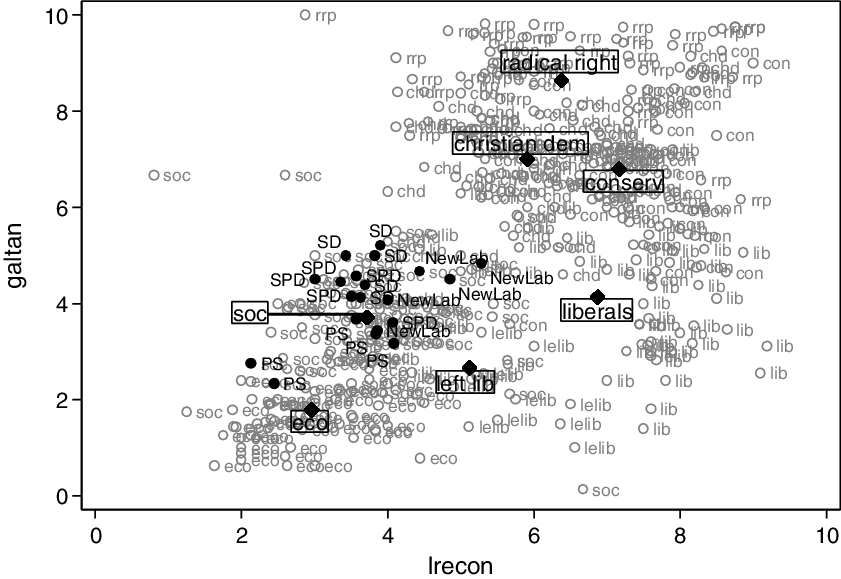
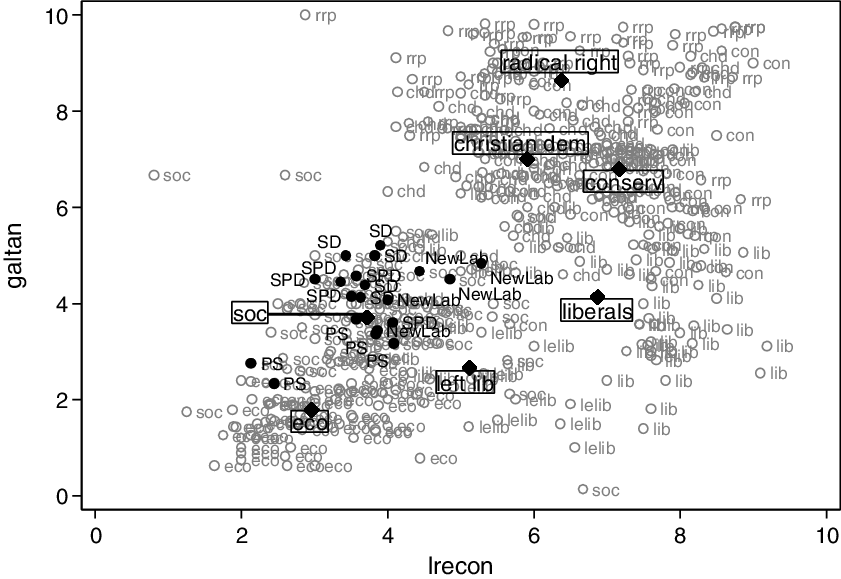
To substantiate this theoretical point empirically, we illustrate the positions of the major parties in 14 Western European countries (on the basis of the Chapel Hill expert surveyFootnote 3 [Bakker et al. Reference Bakker, de Vries, Edwards, Hooghe, Jolly, Marks, Polk, Rovny, Steenbergen and Vachudova2012)] between 1999 and 2010 (Figure 1). In this figure, we have also plotted the mean values of the major party families (in purple). Given that party systems are dynamic and exposed to very country-specific features [e.g. the existence of regional parties (e.g. in Spain) or agrarian parties (e.g. in Scandinavia)], the data show a rather impressive coherence with our theoretical argument: in terms of economic policies, the “classic” left–right divide is clearly visible, whereas on the GALTAN dimension, liberal parties – and especially left-liberal ones – hold a more liberal position. Also, as expected, social democrats are more centrist on the GALTAN axis and more leftist on economic issues. On average, they hold almost the same position as market-liberals but are fairly more repressive than left-liberals. However, the average position for social democrats hides some substantial variation, as illustrated by the highlighted parties from our country sample: it is evident that those social democratic parties that have turned towards a more centrist course (“Third Way”) are both more repressive on the GALTAN-dimension as well as more economically conservative.Footnote 4
Party competition and the penal–welfare nexus.
Note: y-axis: (mean) position of the parties on the GALTAN-axis; x-axis: (mean) position of the parties on the economic left–right axis. All data are based on the positions estimated in the Chapel Hill expert survey (1999–2010) (Bakker et al. Reference Bakker, de Vries, Edwards, Hooghe, Jolly, Marks, Polk, Rovny, Steenbergen and Vachudova2012); party labels: SD: cocial democrats (DEN); SPD: social democrats (Germany); PS: Socialist Party (France); NewLab: New Labour (UK). Party families: eco: ecologist/green parties; soc: social democratic parties.
From this discussion, it follows that, in terms of European party politics, there is not much theoretical ground to expect a clear-cut left–right divide in terms of penal policies that follow the idea of left-wing leniency and right-wing repressiveness. Instead, we would expect that the position on the GALTAN-dimension matters most for penal policies whereas, for welfare policies, market liberals and conservatives should strive for smaller welfare states and social democrats adopting more generous social policies.Footnote 5 The upshot of our argument can be condensed in the following hypotheses:
H1 (penal): The stronger the left-liberal or green parties are represented in a government, the less punitive is the government’s penal policy.
H2 (welfare): The stronger the market-liberal and secular conservative parties are represented in a government, the less generous is the government’s welfare policy.
The partisan politics of the penal–welfare nexus
As we have seen, party politics do not necessarily imply that penal and welfare policies move in parallel. However, while the separate theories of penal and welfare policies help us to understand how political parties affect the trajectories of legislation in both domains, it does not tell us much about the theorised nexus of both. To recall, the idea of a penal–welfare nexus considers both policies as different ways of social control. Consequently, in the era of neoliberalism when welfare policies are under pressure and retrenchment becomes the name of the game, an increasing reliance on penal harshness as a means of social control is the result. In other words, we have to ask which party family may be more or less inclined to actually link welfare and penal policies when in office, that is to adopt penal legislation in direct connection with welfare legislation.
The case of liberal parties illustrates that this reasoning is very different from H1 and H2. According to our theoretical expectation above, liberal parties should push for less repressive penal and less generous social policies. However, while this expectation makes sense for both policy domains separately, it is difficult to come up with a theoretical argument why liberals should actually link both policy domains, why they should, for instance, accompany welfare cutbacks with more lenient penal policies.
This is different for both conservative and social democratic parties. Following our expectation above, conservatives ideologically prefer more repressive penal policies and a less expansive welfare state – an expectation well supported by the empirical literature (e.g. Roché Reference Roché, de Maillard and Surel2012). Theoretically, following the criminological literature, it has also been shown that these parties link both welfare cuts and penal harshness in an overall neoliberal ideological discourse about punishment and welfare (Wacquant Reference Wacquant2009a). To secure electoral support by their constituents in the middle and upper classes fearing social unrest and disorder following welfare retrenchments, conservative parties reaffirm the authority of the state via tougher penal policy (Wacquant Reference Wacquant2009b, 7; 128–129). The ongoing capacity of the state to act and authorise its authority, despite an ideologically motivated welfare retrenchment, is (symbolically) proven by draconian sentencing and police presence. Quite straightforwardly then, we can expect that conservative parties should opt for a strategy, that relates a tough-on-crime stance and a rollback of the welfare state in an overarching strategy.
H3 (penal–welfare nexus): The strength of conservative parties in government will condition the penal–welfare nexus: if conservative parties dominate the government, welfare state cutbacks will be followed by more repressive penal policies.
More interestingly, however, the other party family for which such a link can be theorised are social democrats that governed in a context of “permanent austerity” (Pierson Reference Pierson and Pierson2001). This expectation rests on two related arguments: ideology and vote-seeking. In terms of ideology, many social democratic governments endorsed the ideas of the third way, combining supply-side economics with welfare state reforms directed at activation and more precise targeting of benefits to certain groups (e.g. Clasen Reference Clasen, Goul-Andersen, Clasen, Halversen and van Oorschot2002; Huo Reference Huo2009; Arndt Reference Arndt2013). The ideological basis was influenced by social theorist Anthony Giddens who argued that “inequality can no longer, if it ever could, be countered only by income transfers from the more to the less affluent” (Giddens Reference Giddens2000, 53). Instead, he recommended a more universal approach to inequality, which includes policies that were usually owned by the right, such as fighting crime and family breakdown (on Spain, see e.g. Medina-Ariza Reference Medina-Ariza2006). Hence, the ideological foundations of the third way actually linked up welfare and penal policies forming a common approach: supply-side economic policies, welfare state reform, and “tough on crime, tough on the causes of crime” were two sides of the same coin, an actual penal–welfare nexus. Older British approaches in critical criminology even point out a general link between the welfare and penal policy stance of (British) social democracy: “Hence, punishment for repentance is the social democratic second-line of social defence: it is the proclamation of the general interest against sectarian or individual recalcitrance. Thieves and hooligans harm not only the conduct of a conforming social life, but threaten also the meaningfulness – and hence the existence – of welfare programmes” (Taylor et al. Reference Taylor, Walton, Young, Taylor, Walton and Young1975, 13).
From a vote-seeking perspective, linking penal and welfare policies also made sense. First of all, working-class voters live in those areas which suffer most from crime – and social-democratic leaders, such as Tony Blair, were well aware of this. “Labour people, certainly our voters, were really anxious about law and order issues and far more likely to be tough than soft,” he writes in his memoirs, because usually the liberal middle-class “weren’t the victims, but the poorer people – the very ones we said we represented – were” (Blair Reference Blair2010, 55). Given that social democrats could no longer attract working-class citizens with the promise to expand the welfare state – due to the economic context – promising and implementing tough-on-crime policies was actually an intelligent electoral strategy to appeal to the working class (Drinkwater and Jennings Reference Drinkwater and Jennings2017) [for a related argument, see also Stenson and Edwards (Reference Stenson, Edwards, Stenson and Sullivan2001)]. The Swedish criminologist Henrik Tham (Reference Tham2001, 417) contrasts this with other political parties: “Conservative and Liberal parties have a tradition of favouring the slogan “He rules best who rules least.” For Social Democrats, the very basis of their political platform is the idea that society can and should be improved for political reform. In a situation where representatives of an activist political party are restrained by the economy, the temptation to demonstrate indignation and to expand politics in the area of morality and symbolic action must be quite compelling.” Reflecting these arguments on the third-way social democracy, we therefore formulate the following hypothesis:
H4 (penal–welfare nexus): The strength of third-way social democratic parties in government will condition the penal–welfare nexus: if third-way social democracy dominates the government, welfare state cutbacks will be followed by more repressive penal policies.
While the hypotheses follow straightforwardly from the theoretical model, two remarks are in order. First, concerning causal order, it should be emphasised that we expect penal policy changes to be reactions to welfare cutbacks, i.e. that they follow after welfare state retrenchment has been implemented. There are at least two reasons for assuming this direction of causality relating to the policy process and to electoral competition. In terms of policy-making, given that governments can hardly prepare and adopt several big reforms at the same time (Jones and Baumgartner Reference Jones and Baumgartner2005) and welfare state reforms are more pressing in times of fiscal constraint, it is conceivable that governments focus on social policy change first and compensate via penal policies in the second step, only if they succeed in adopting cutbacks. In addition, considering the dynamics of electoral competition, social policies should be more important to governments than penal policies, because they dominate the public agenda (Green-Pedersen Reference Green-Pedersen2019, 66; Svallfors Reference Svallfors and Svallfors2012), particularly so in Western Europe. Therefore, our theorised link of compensation should be most relevant in situations in which governments cut welfare (and then compensate via tougher penal policies). Admittedly, Rusche and Kirchheimer (Reference Rusche and Kirchheimer1968) argue that the penal–welfare nexus can be explained by the more cost-efficient control of labour surplus via repressive penal policy, which may suggest that welfare cutbacks come first. Yet, this classic argument about a linking mechanism may have lost some force in modern Europe as the cost of housing a single prisoner, e.g. in Germany, exceeds unemployment benefits by roughly 30,000 € per year (IAB 2017, 4; JM NRW 2018). In addition, our argument is chiefly about welfare policy change – and not unemployment (which we control for in our analyses below). Hence, while it seems difficult to come up with a theoretical argument according to which the welfare state is cut as a reaction to penal harshness, there are good theoretical reasons to expect the causal order as hypothesised above – namely that penal policy changes follow changes to welfare legislation.
Second, it is important to emphasise that the theoretical framework is based on the dynamics that have been visible in European party systems during the last 20 years or so. Two-party systems as in the US have different characteristics, although, even there, the significance of the GALTAN-dimension of party competition is increasing. Finally, party competition in societies in Europe after 1989 is largely different from the situation in the postwar period (and even before), where the traditional economic cleavage has been much more important (Inglehart Reference Inglehart2008; Kriesi et al. Reference Kriesi, Grande, Lachat, Dolezal, Bonschier and Frey2008). What we propose here is a model for European party systems after 1989 – a model that might not travel well to countries with other party system characteristics and to other periods of time.
Methods and data
Data on welfare and penal legislation
Our analysis is based on legislative events in four countries – Denmark, Germany, the UK and France – between 1990 and 2014. As the measurement of legislative events involved a manual coding of changes to penal and welfare legislation, an analysis covering a large number of countries was beyond the scope of this research. The selection of four European political systems follows directly the advice by King et al. (Reference King, Keohane and Verba1994, 140–141), who suggest sampling on independent variables in order to achieve a heterogeneous sample, if an intentional selection of observations is needed. The political systems of Denmark, Germany, the UK and France do not only differ systematically in terms of Lijphart’s (Reference Lijphart2012, 305–306) executives-parties and federal-unitary dimensions but also in terms of policy sector-related variables, such as crime rates, prison population and size of police forces (Eurostat). Moreover, the structure of the political economy and the welfare state differs between the four countries: our selection covers all three “worlds of welfare capitalism” (Esping-Andersen Reference Esping-Andersen1990) as well as the different varieties of capitalism (Hall and Soskice Reference Hall and Soskice2001; Thelen Reference Thelen2014). This is important as both, welfare regimes and the structure of the capitalist economy, have been argued to influence penal policies (Cavadino and Dignan Reference Cavadino and Dignan2006; Lacey Reference Lacey2008; Wenzelburger Reference Wenzelburger2018). Hence, the four countries selected cover much variance on the side of explanatory variables as well as a major part of the European population and economy making them “substantively important cases” (Goertz and Mahoney Reference Goertz and Mahoney2012, 184–185).
In order to test our hypotheses, we run multiple regression analyses on a unique dataset that combines information on individual legislative events in the realm of penal and welfare policies that change the legislative status quo. For legislation on welfare policies, we use the WSRD (Jensen and Wenzelburger Reference Jensen and Wenzelburger2020b). The dataset of the project is based on individual changes to welfare state legislation in five European countries (Britain, Denmark, Finland, France and Germany) between the 1970s and today and contains information about what individual policy instruments (e.g. changes to the benefit duration and the benefit level of the qualification criteria) have been changed and coding of the direction of the change (cutback, expansion, or status quo) [for a discussion of the coding, see Lee et al. (Reference Lee, Jensen, Arndt and Wenzelburger2020)]. Legislative changes to penal policies have been coded by the authors. The coding involves a measure that indicates in what direction a piece of penal policy legislation has changed the status quo, ranging from −3 (strongly liberalising) to +3 (strongly repressive) (Wenzelburger and Staff Reference Wenzelburger and Staff2016, Reference Wenzelburger and Staff2017; Wenzelburger Reference Wenzelburger2020). The values of −3 to +3 are assigned depending on the breadth (how many people are affected by a change?) and the depth of the legislative proposal (how strongly are civil liberties restricted?) (for a more thorough discussion of the coding scheme, see Wenzelburger and Staff Reference Wenzelburger and Staff2016).
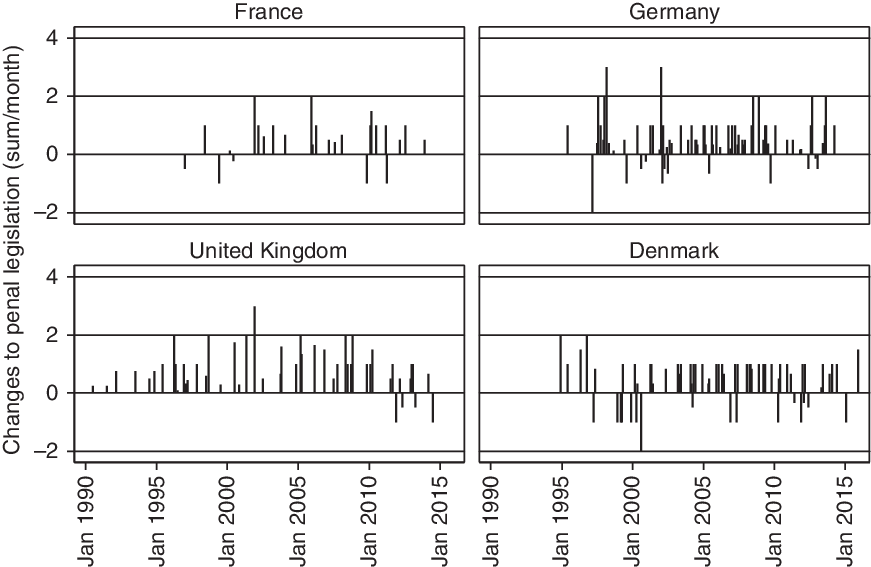
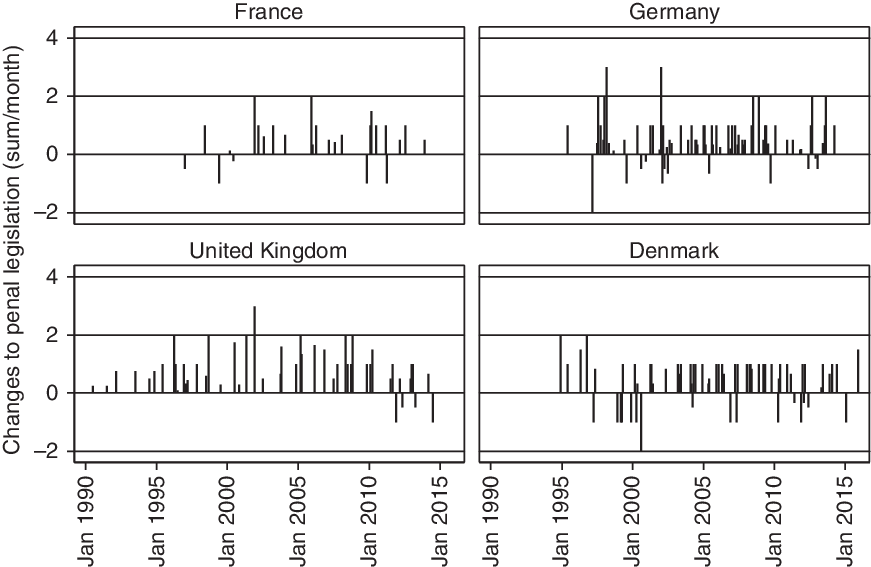
Figure 2 provides an overview of the coded legislative changes in penal policies aggregated as a sum of individual months in the four countries.Footnote 6 Several observations stand out. First, it is clear from the graph that legislative activity was more intense in Germany, the UK and Denmark than in France – a finding that confirms the literature on legislative activity (Brouard et al. Reference Brouard, Wilkerson, Baumgartner, Timmermans, Bevan, Breeman, Breunig, Chaqués, Green-Pedersen, Jennings, John, Jones and Lowery2009). Second, the graph illustrates the more repressive legislative stance in Britain compared to Germany and Denmark (but also to France). This is mostly due to the high legislative activity under the three government mandates of Prime Minister Tony Blair from 1997 to 2005 – and very much in line with qualitative literature (Newburn and Reiner Reference Newburn, Reiner and Seldon2007; Wenzelburger and Staff Reference Wenzelburger and Staff2017). Third, the French pattern points to a distinctive period of harsher penal policy-making, which starts in 2002 and lasts until 2008 or so. Again, this reflects well with what we know from qualitative studies on penal policies in France and the shift towards tougher policies during the Presidencies of Jacques Chirac (2002–2007) and Nicolas Sarkozy (2007–2012) (Mucchielli Reference Mucchielli2010; Bourgoin Reference Bourgoin2015).
Changes to penal legislation in four countries.
Note: Own data collection.
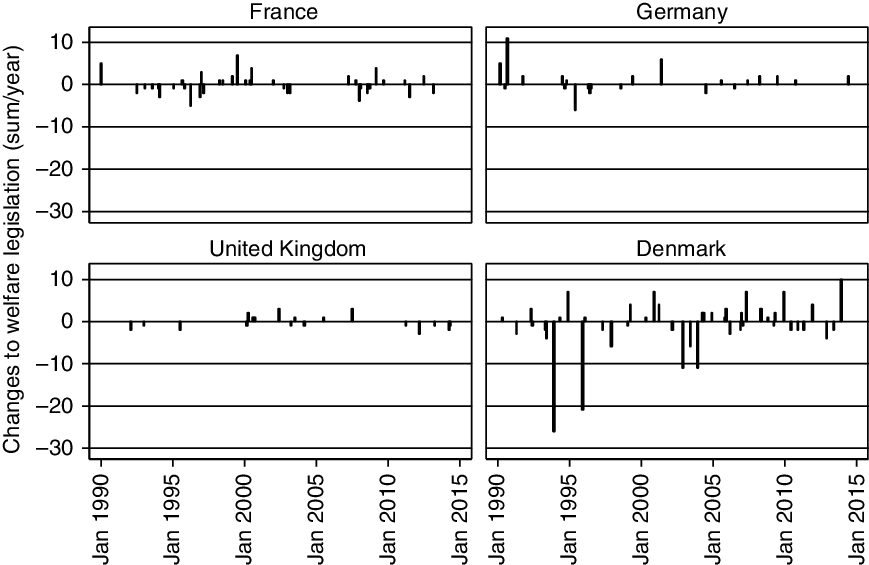
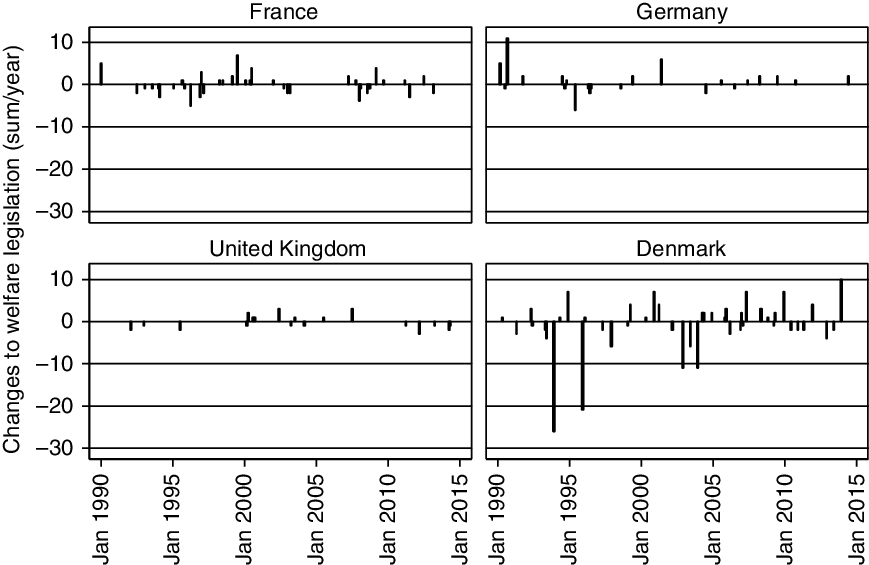
When it comes to welfare policies, the first impression is quite different: all countries have seen cutbacks and expansions – but to different degrees. In Germany, for instance, the budget consolidation packages of the last Kohl government in the mid-1990s are clearly visible, and so are the Hartz reforms in the mid-2000s adopted by the “red-green” coalition headed by Chancellor Schröder [for a more thorough review of German legislation, see Wenzelburger et al. (Reference Wenzelburger, Arndt and Jensen2018)]. Similarly, the British retrenchment in the mid-1990s is also discernible, and so is the slightly expansionist stance under New Labour in the 2000s – a picture that fits well with the qualitative evidence (Clasen Reference Clasen2005). In France, finally, one can observe a clear cutback-expansion-cutback pattern that corresponds to the rather austere policies under the Balladur and Juppé governments in the 1990s, followed by an expansionist stance of the left-wing government by Jospin, and, again, a more retrenchment-oriented stance under the Prime Ministers Raffarin, de Villepin and Fillon from 2002 onwards [for qualitative evidence, see Elbaum (Reference Elbaum2011), Palier (Reference Palier2005)]. Finally, most changes have been coded in Denmark with three big labour market reform packages introduced in 1993, 1995 and 1998 standing out as particularly voluminous instances of welfare retrenchment (Arndt Reference Arndt2013, 132–137). Finally, it is also visible that the extent of legislative changes varies between countries. This is why we include country dummies in the regression analyses to account for these idiosyncrasies (this is similar to estimating fixed effects regression).
Methods, dependent and independent variables
Our regression analysis comes in two steps. In the first step, we test penal and welfare legislation individually using the partisanship variables as main independent variables and combining them with a standard set of covariates that have been shown to be influential in state-of-the-art quantitative studies of penal (Sutton Reference Sutton2004; Wenzelburger Reference Wenzelburger2015) and welfare policies (Allan and Scruggs Reference Allan and Scruggs2004; Schmitt Reference Schmitt2016). As discussed above, the dependent variables in these regressions are individual changes to the legislative status quo (n = 743 for the welfare dataset and n = 880 for the penal policy dataset). Both dependent variables are ordinal scaled, running from −1 to 1 in the case of welfare state legislation, and from −2 to 3 in the case of penal legislation. Concerning independent variables, we control for the fiscal and economic context in both instances (growth, unemployment and public debt), including violent crime (homicide) and fear of crime to the penal policy regressions and union density and the openness of the economy for welfare policies. These covariates belong to the standard indicators used in quantitative studies on the respective policies.
Partisan effects are tested via an indicator that calculates the share of cabinet seats held by the respective party family, as we are primarily interested in the question whether it matters for policy change that a certain party is part of the government (or not) (for summary statistics, see Table A1, Appendix). We differentiate between the main party families in which we are interested, that is conservatives, social democrats, greens and liberal parties (see Table 1). Moreover, in Denmark and France where left-liberal parties exist, we distinguish between left liberals and market liberals. German and British liberals are coded as market liberals given that this strand dominated the two parties during our observation period. We also include a dummy measuring for the only social democratic government that has been largely immune to the ideas of the third way, which is the French government of Jospin from 1997 to 2002 (Clift Reference Clift2000; Bell Reference Bell2003).Footnote 7
Coding of party families and their participation in cabinet (in brackets)

Note: We only report the coding for the time period covered in our analysis (see first column).
For both regressions, we use ordinal logistic regression and run a linear ordinary least squares (OLS) model as a robustness check, given that our units of analysis are individual legislative changes and therefore ordinal scaled. For both regressions, we focus on similar time periods (1990–2014)Footnote 8. Besides, we include country dummies to account for unit-specific heterogeneity and estimate robust standard errors (Huber–White sandwich estimator) to account for misspecification in the data. Country dummies are particularly relevant because the extent of legislative activity seems to follow country-specific patterns (see Figures 2 and 3).
Changes to welfare legislation in four countries.
Note: Data collected by WSCEP (Jensen et al. Reference Jensen, Arndt, Lee and Wenzelburger2018).
In order to test H3 and H4, we build – in the second step – a dataset that combines both the welfare state change in the six months preceding a legislative change of penal policies as an independent variable and, as a dependent variable, the size of penal policy change. We use a lag of six months here not only to avoid endogeneity – penal policies in year t can hardly affect welfare policy in years t-7 to t-1 – but also, because our hypothesised theoretical link of penal policy change compensating for welfare cutbacks suggests that penal policy change is a reaction to welfare cutbacks and not the other way around – which implies a time lag. Taking an average of six months before the implementation of a penal policy change seems reasonable given the length of a legislative process.Footnote 9
Empirical analyses
The empirical investigation of the penal–welfare nexus is structured in two steps. In the following paragraphs, we first analyse whether the participation of market-liberal and conservative parties is significantly related to welfare state retrenchment. This comes down to testing H2. In the second, step, we estimate regressions to predict penal policy change. Here, we are chiefly interested in the effect of left-liberal and green parties (H1) as well as whether a nexus between penal and welfare policies is visible in the data under the condition that conservative (H3) and third-way social democratic (H4) parties are strongly represented in government. We always present models in which we include the indicators of partisan strength in the cabinet (share of cabinet seats of the respective party) and the full set of covariates distilled from the literature first. We then go on and present parsimonious models to see whether our results hold if we exclude nonsignificant variables.
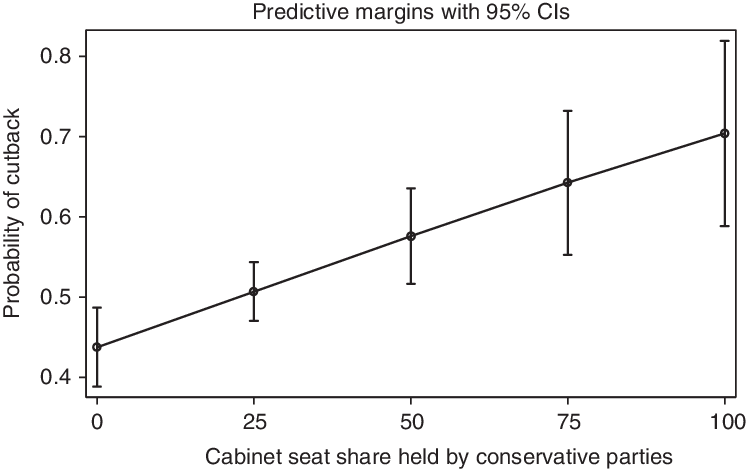
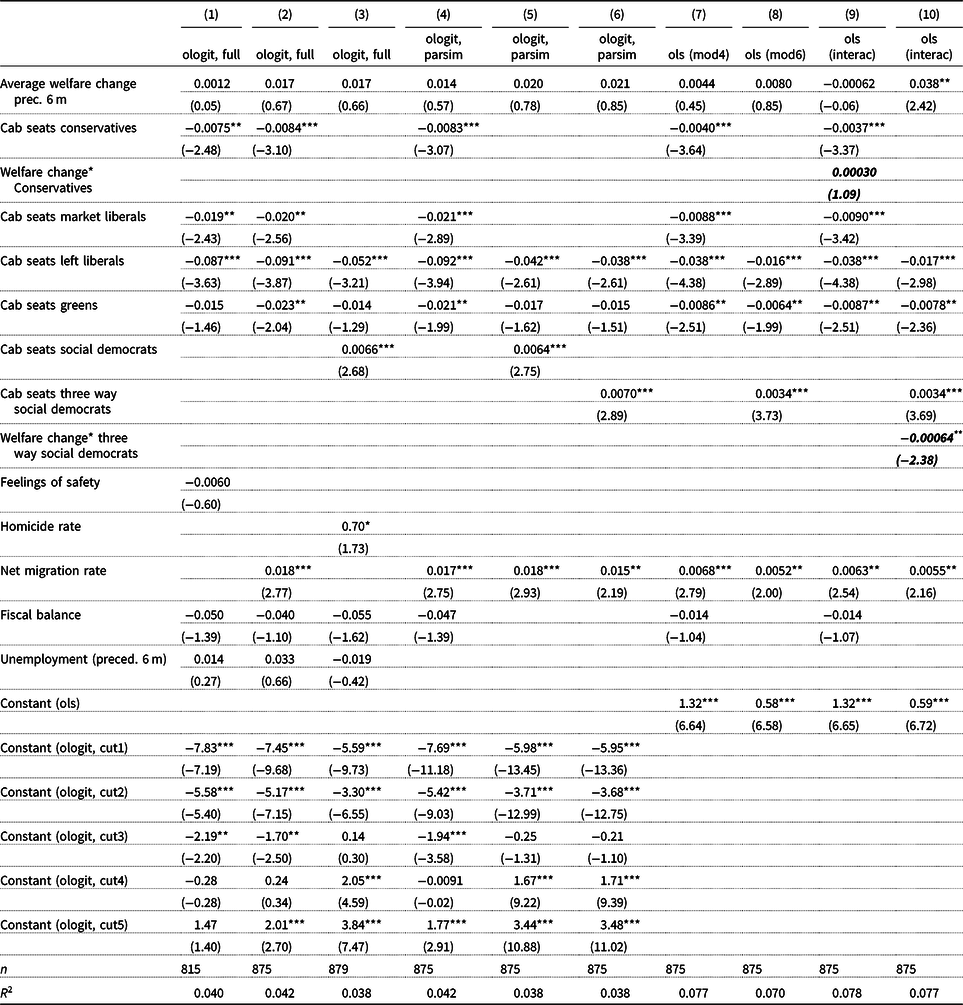
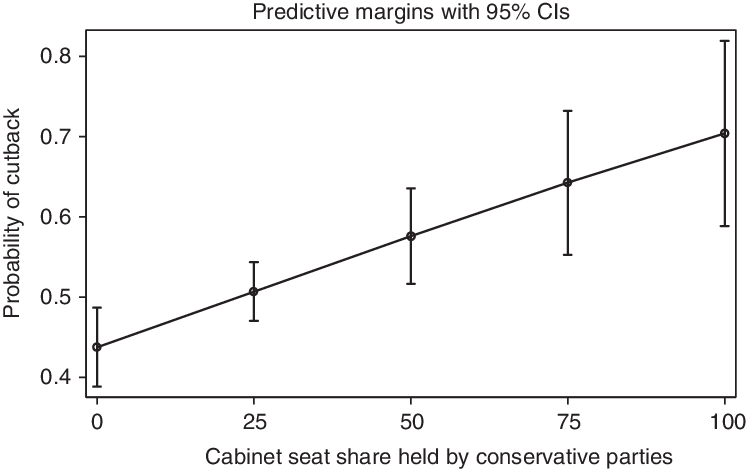
Table 2 reports the results for the empirical associations between the cabinet share of different party families and welfare legislation. Our main independent variables (in H2) are the cabinet shares of conservative and market-liberal parties. We also include social democratic parties in separate estimations, as they are highly correlated with (the absence of) conservative parties in government. The results of all models are clear-cut: a higher share of conservative parties in government is associated with more pronounced welfare cutbacks. This confirms H2. The same seems to be true for market-liberal parties, too, but the lower significance (and the absence of it in the linear models) shows that this effect needs to be taken with a grain of salt. In contrast, strong government participation of social democrats increases the chances of welfare state expansions. The results for left-liberal and green parties do not point to relevant associations.Footnote 10 In terms of substance, Figure 4 illustrates the results for H2. Based on predictive margins, an increase in the conservative cabinet seat share from 0% to 50% raises the probability of a cutback from around 45% to 55% and over 65% for an entirely conservative cabinet (e.g. in Britain 1990–1997).
Political parties’ impact on welfare legislation
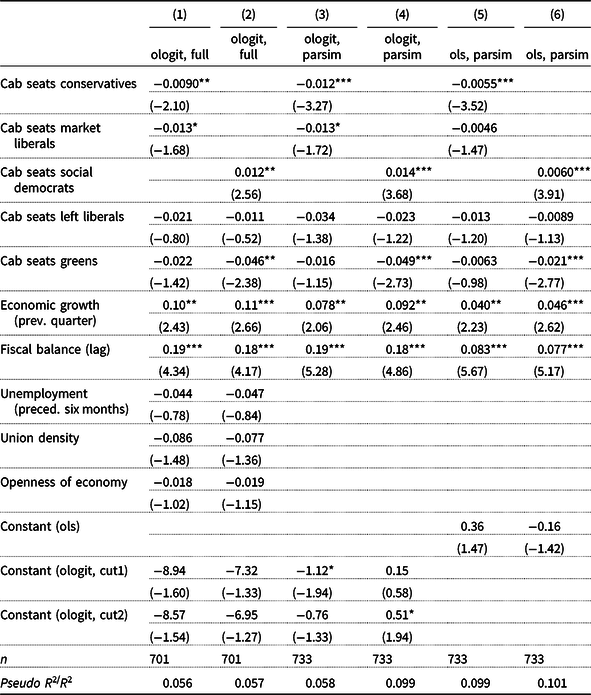
Note: Country dummies included; * p < 0.1, ** p < 0.05, *** p < 0.01.
Marginal effect – probabilities of cutback and conservative parties.
From the covariates included in the model, only economic growth and fiscal balance seem to affect the probability of welfare state change significantly. The direction is as expected: high growth and a positive fiscal balance increase the chances for expansions: the better the economic prospects, the more money is there to spend on welfare. In sum, the results as reported in Table 2 are a solid corroboration of the “old politics” thesis, according to which social democratic parties still affect welfare legislation in a positive sense, even in times of permanent austerity – although the relationship might have been even stronger in the decades before (Jensen and Wenzelburger Reference Jensen, Wenzelburger, Careja, Emmenegger and Giger2020a).
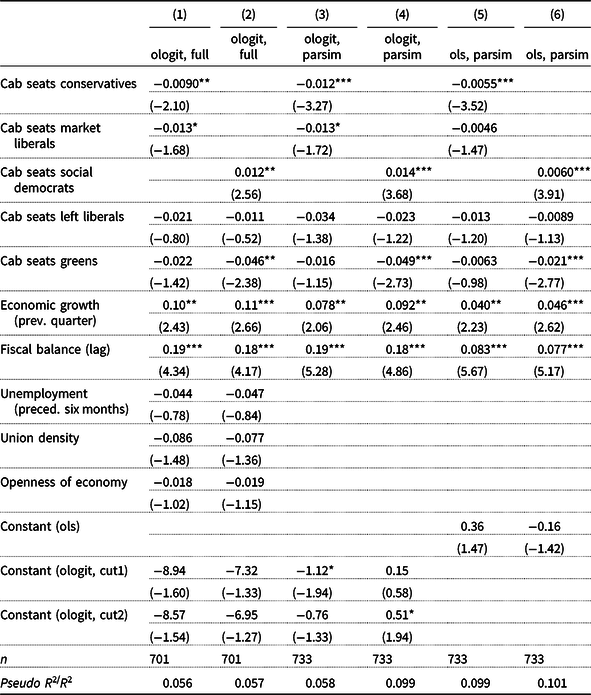
Table 3 Footnote 11 presents the results for penal legislation to test the direct influence of left-liberal parties on penal policies (H1) as well as the theorised conditional influence of conservative (H3) and third-way social democratic parties (H4) on the nexus of welfare and penal policies. We report estimations of both ordinal logit regressions and, for the ease of interpretation, linear OLS – but the results are similar. As for welfare legislation, we present full models in which we have included the cabinet seat shares of the relevant parties and covariates (models 1–3), as well as more parsimonious models (4–8) in which we omit clearly nonsignificant variables. Again, conservatives/market liberals and social democrats are not included simultaneously due to high correlation. The same is true for three of our covariates, namely fear of crime, homicide, and the migration rate, which is why we do not include them together in the models. Furthermore, we include two interactions reflecting H3 and H4 in models 9 and 10. Additional interactions for other parties are included in the Appendix (Table A2).
Political parties’ impact on penal legislation
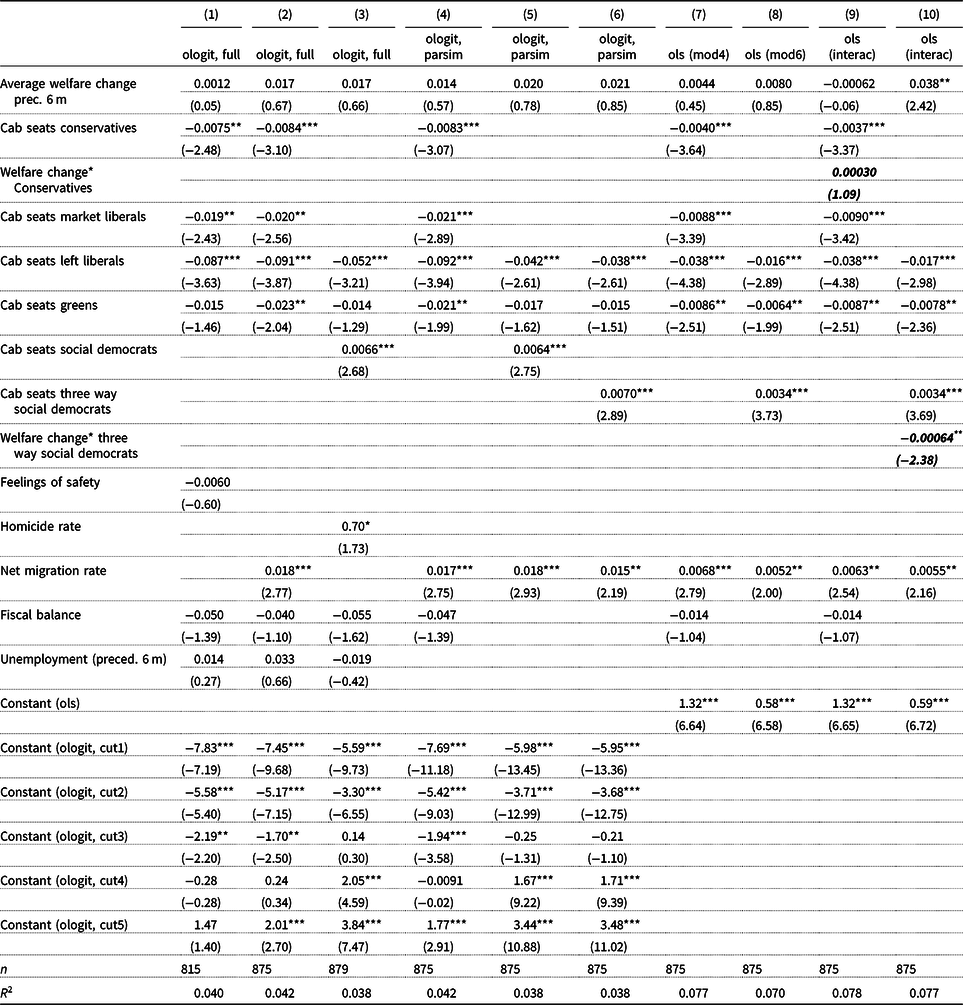
Note: Country dummies included; *p < 0.1, **p < 0.05, ***p < 0.01; z- (t-) statistics in parentheses.
Several observations can be made from Table 3. First of all, supporting H1, the regression estimates indicate a negative relationship between the presence of left-liberal parties and less repressive penal legislation. The effect is substantial for left-liberals but also visible for market liberals. The same is true for green parties, although the results are less robust here. Interestingly, although not hypothesised directly, social democrats seem to be more repressive than conservatives during our observation period: in fact, the presence of conservative party significantly reduces the repressiveness of penal legislation, although the size of the effect is very small (compared, e.g. to the coefficient for left-liberal parties). These results mesh well with case study evidence on Britain, according to which New Labour has strongly increased the toughness of law and order policies, whereas the successor Coalition government of Conservatives and Liberal Democrats slightly reduced repressiveness (Blackbourn Reference Blackbourn2018, 297; Pantazis and Pemberton Reference Pantazis and Pemberton2012, 654). Similarly, one could also argue that social democrats can be more repressive in terms of penal legislation because they are more interventionist on the welfare side, or that conservatives often govern together with market liberals, which push them towards the more liberal pole. At any rate, the results are somewhat surprising and warrant further inspection. From the covariates, only the migration rate is significantly (and positively) related to penal harshness. Given the fact that both policies are often related (Fitzgerald et al. Reference Fitzgerald, Curtis and Corliss2012), this is rather unsurprising. Again, as in many criminological studies, a direct association between homicide rates and penal policies could not be found. Moreover, a direct relationship between the change of welfare state legislation in the six months before a penal policy change is clearly not discernible (see coefficient for the first variable).
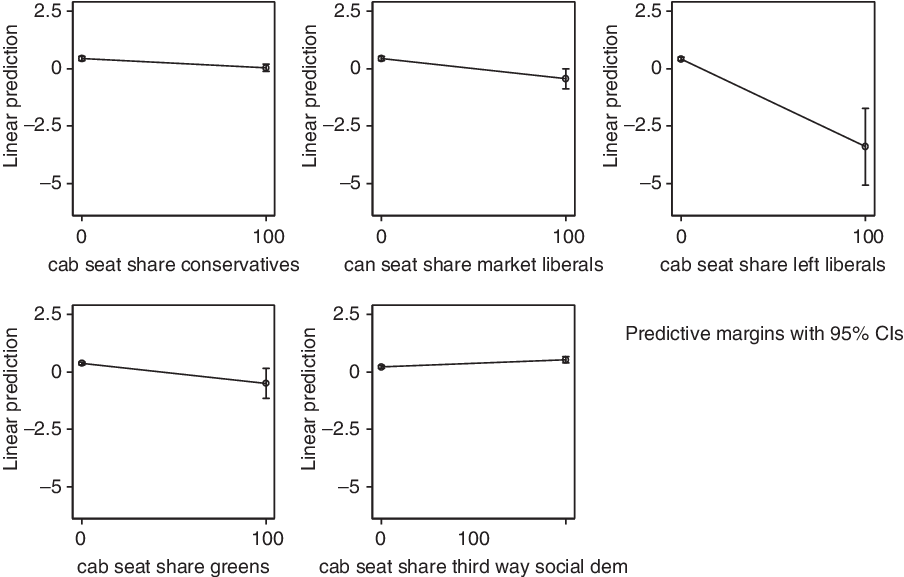
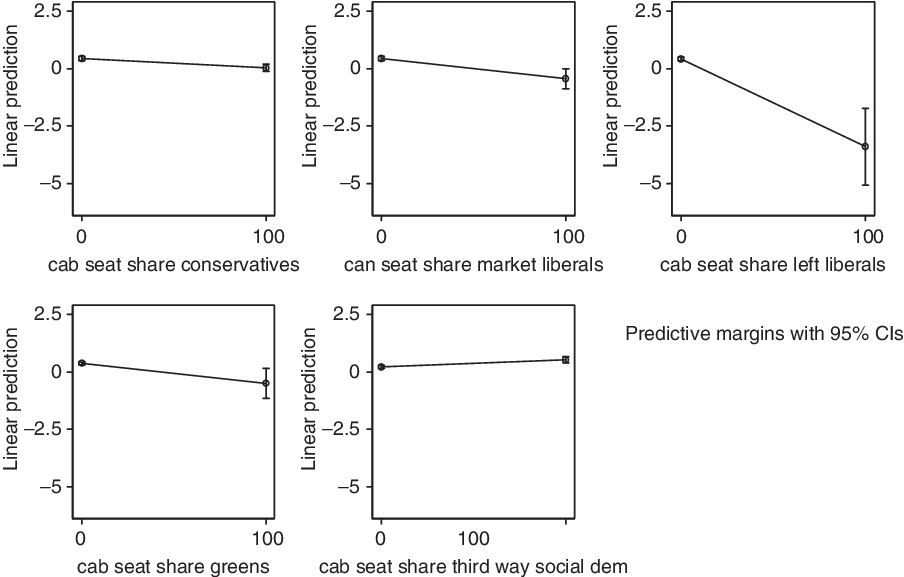
In order to see more clearly the strength of partisan influence, Figure 5 illustrates the marginal effects. The y-axes of all graphs are set to the same value to visualize the strength of the relationship between the cabinet seat share of the respective party and the size of penal policy change (ranging from −2 to 3, with higher values indicating more repressive policies). From the figure transpires that left-liberal parties are the party family that most substantially pushing penal legislation toward a more liberal pole, followed by market liberals and greens (though less significant here, due to weak government participation for the greens). Hence, within the camp of liberal parties, it seems that left-liberals are most effective in pushing back tendencies to implement harsher penal policies. Moreover, the graphs also show that the somewhat surprising the negative coefficient of conservative cabinet seat shares and the positive coefficient of social democrats – which both are, however, much weaker in terms of effect size.
Predictive margins – penal policy and cabinet seat shares of parties.
Note: Graphs based on model 7 (first four graphs) and model 8 (last graph) in Table 3.
To sum up our findings on direct partisan effects of liberal parties (H1 and H2), we can conclude that while liberal and parties restrict the harshness of law and order legislation, they also push for welfare cutbacks. However, differentiating between left-liberals and market liberals adds some nuance to this finding. While left-liberals are more influential than their market-liberal sisters on penal policies, the opposite is true for welfare policies, where market liberals have a stronger effect.
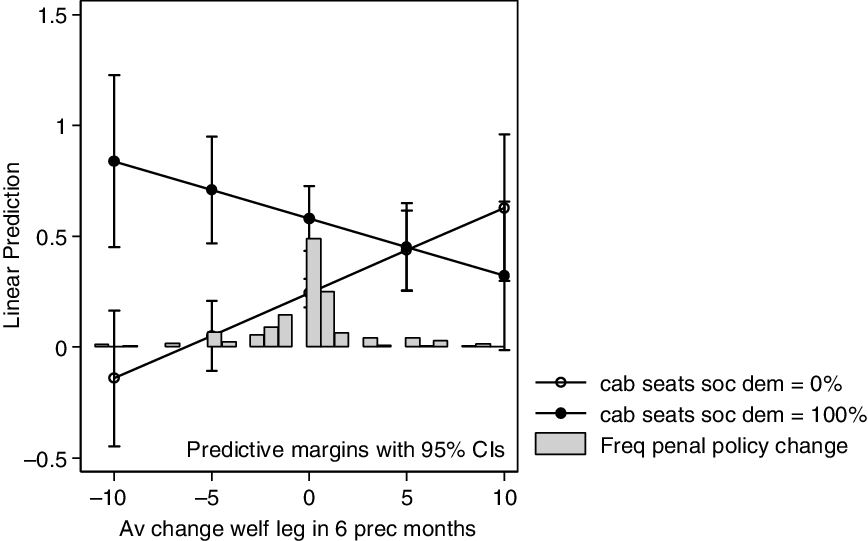
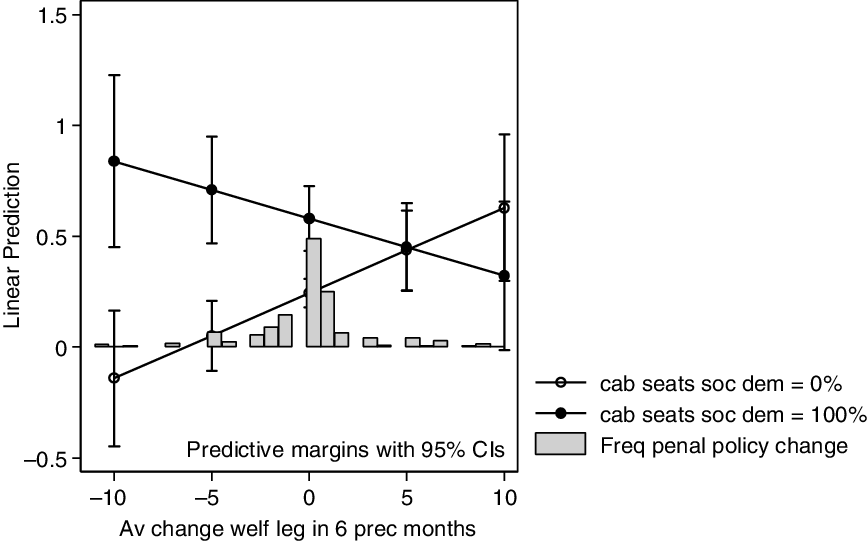
To inspect the conditional penal–welfare nexus as put forward by H3 and H4, we have introduced interaction terms between the indicator of lagged average welfare change and the cabinet seat share of both conservatives and third-way social democrats in the parsimonious models 4 and 5 in Table 3. The results of our analysis indicate that governments made up by third-way social democrats indeed seem to implement harsher penal policies in the months after a welfare cutback.Footnote 12 For conservative parties, however, we do not find such an effect (see model 9 in Table 3). Figure 6 visualises how the effect of recent welfare cutbacks on penal legislation is conditioned by social democratic government participation by calculating the marginal effects for two cases: a purely third-way social democratic government (such as New Labour, upper line with filled circles), and a government where third-way social democrats are absent (lower line with hollow circles). The interpretation is straightforward: our model predicts an increase in penal repressiveness if a third-way social democratic government has cut welfare in the six months before the penal policy change. The effect decreases as welfare legislation becomes more expansive. The opposite is true if no third-way social democrats are in office. This result together with the nonsignificant effect for conservative parties, for which no increase in penal harshness is estimated by our regression when the welfare state is cut, therefore lend support to H4 but reject H3. In sum, it, therefore, seems a penal-welfare nexus does not exist generally but it does exist under specific circumstances – namely if social democratic governments have set out to cut the welfare state.Footnote 13 The interesting dissimilarity between the two main European party families might be related to different time horizons in their electoral motivation for linking the policy sectors in the first place – and our measurement. The necessity for conservative parties to assure middle- and upper-class constituents of the state’s potency via penal policy might only arise as a long-term effect of welfare state retrenchment (Wacquant Reference Wacquant2009b). Our measurement based on actual reforms catches much better a more direct penal–welfare nexus, of course. In this regard, the electoral strategy of third-way social democrats – to compensate for fiscally necessary welfare cuts with more intervention via the penal state – can manifest interaction effects over a shorter time horizon.
Third-way social democrats and the penal–welfare nexus.
Note: Based on model 10 in Table 3.
Discussion and conclusion
This study aimed to critically explore the penal–welfare nexus. Based on the idea of partisan effects, we argued that rather than a direct link between welfare and penal policy, the partisan composition of governments explains both the direction of penal and welfare policy individually, and whether welfare state changes are indeed followed by changes of penal policies. Adding to the literature on penal and welfare policies, we tested our expectations on a newly collected dataset which is based on manually coded measures of penal and welfare legislation.
Our article made two main contributions to the debate on the penal–welfare nexus. First, we argued that the standard approach to the analysis of partisan influence, opposing parties from the left and from the right, is inappropriate in the case of penal policies, because the programmatic position of liberal parties, who have repeatedly participated in governments, cuts across the standard left–right axis by pushing for economically right wing but culturally liberal penal policies. This theoretical claim was supported by our regression analysis on both penal and welfare policies: we found, indeed, substantial and significant evidence that higher cabinet seat shares of liberal and green parties, and left-liberals in particular, are associated with a less punitive penal policy output (H1). Similarly, our regression models show a strong and significant relationship between the presence of conservative- and market-liberal parties in government and cutbacks in welfare policy (H2).
Second, on the question of the nexus between penal and welfare legislation, i.e. the question whether harsher penal policies follow after welfare state retrenchment, we have theorised that again, partisan politics should matter. Our argument here relates to both the literature on the conservatives toughening up welfare and penal legislation and to the literature on third-way social democracy which maintains that a direct link between more repressive penal policies in connection with welfare cutbacks is most probable if social democratic parties govern. The empirical evidence generated based on our data is mixed. While the regression estimations do not confirm a relationship between welfare cutbacks and penal repression in the case of conservative governments (H3), we indeed find evidence for a penal–welfare nexus in legislation if third-way social democratic parties are strongly present in government (H4).
These findings add to the works by Sutton (Reference Sutton2000, Reference Sutton2004, Reference Sutton2010, Reference Sutton2013) and Wacquant (Wacquant Reference Wacquant2001, Reference Wacquant2009b) by looking beyond the well-studied US case and the most disadvantaged social strata of society, and by introducing a more fine-grained measure of partisanship than in the Suttons’ analyses (Sutton Reference Sutton2004) building on a more complex theory of party competition on welfare and law and order issues. Finally, by presenting new hand-coded data on legislation, we are able to move beyond studies of imprisonment rates that are plagued by the very rough measure of policies via an outcome measure that is rather distant from the actual policy-making process.
Admittedly, as our analysis is based on a small sample of four countries, further investigations of possible cross-policy compensation effects between welfare and penal policy on a broader sample of nations are badly needed. Indeed, our findings on the social democratic influence on the penal–welfare nexus may well be influenced by the fact that the cases of Britain, Denmark and Germany are prominent cases of third-way governments. Nevertheless, as the third way has also affected other social democratic parties in Europe (Merkel et al. Reference Merkel, Petring, Henkes and Egle2008), similar patterns may also be visible in other nation-states during a similar period of time.
Supplementary material
To view supplementary material for this article, please visit https://doi.org/10.1017/S0143814X20000161
Data Availability Statement
Replication materials are available in the Journal of Public Policy Dataverse at https://doi.org/10.7910/DVN/H1S6B6.
Acknowledgement
Preliminary versions of this article have been presented at workshops in Barcelona, Darmstadt and Columbus (OH), where we profited greatly from the comments by discussants and audiences. We would like to thank all coders in the associated projects and especially Lukas Øeby Feldbæk Nielsen of Aarhus University for their research assistance.
Funding statement
This work is partly based on two research projects funded by the German Research Foundation (DFG, grant: WE 4775/2-1) and the Danish Council of Independent Research (grant 4003-00013).