

Affect is intriguing. More and more researchers have attempted to understand the impact of affect on psychological processes such as memory (e.g., Spachtholz, Kuhbandner, & Pekrun, Reference Spachtholz, Kuhbandner and Pekrun2014) and creativity (e.g., Tan & Qu, in press). To examine affect, it is essential to successfully elicit mildly positive and negative affects as well as neutral affect in participants (Gasper & Middlewood, Reference Gasper and Middlewood2014; Kaufmann & Vosburg, Reference Kaufmann and Vosburg2002). A variety of techniques to experimentally elicit affective states have been developed: Researchers can ask participants to (a) watch affective film/video clips (e.g., Averill, Reference Averill1969; Jenkins & Andrewes, Reference Jenkins and Andrewes2012; McHugo, Smith, & Lanzetta, Reference McHugo, Smith and Lanzetta1982; Philippot, Reference Philippot1993; Sato, Noguchi, & Yoshikawam, Reference Sato, Noguchi and Yoshikawam2007; Von Leupoldt et al., Reference Von Leupoldt, Rohde, Beregova, Thordsen-Sörensen, Zur Nieden and Dahme2007); (b) engage in affective imagination (e.g., Wood, Saltzberg, & Goldsamt, Reference Wood, Saltzberg and Goldsamt1990); (c) listen to affective music (e.g., Jallais & Gilet, Reference Jallais and Gilet2010; Mongrain & Trambakoulos, Reference Mongrain and Trambakoulos2007); (d) read affective statements/texts (e.g., Velten, Reference Velten1968; Verheyen & Göritz, Reference Verheyen and Göritz2009); (e) view affective pictures (e.g., Lang, Greenwald, Bradley, & Hamm, Reference Lang, Greenwald, Bradley and Hamm1993; Schneider, Gur, Gur, & Muenz, Reference Schneider, Gur, Gur and Muenz1994); (f) accept surprising gifts (e.g., Estrada, Isen, & Young, Reference Estrada, Isen and Young1997; Isen & Daubman, Reference Isen and Daubman1984); and (g) recall previous emotional events (e.g., Chentsova-Dutton & Tsai, Reference Chentsova-Dutton and Tsai2007; Jallais & Gilet, Reference Jallais and Gilet2010) (see Coan & Allen, Reference Coan and Allen2007 for review).
Among these techniques, showing participants film/video clips that contain specific affective contents has been widely used (Westermann, Spies, Stahl, & Hesse, Reference Westermann, Spies, Stahl and Hesse1996). As an art of multi-media, film is rich in emotion expression and can influence the audience affectively and cognitively, implicitly, and explicitly. Indeed, film makers can use numerous techniques to influence the affective states in an audience (e.g., Keast, Reference Keast2014). As summarised by Gross and Levenson (Reference Gross and Levenson1995), video clips are ‘readily standardized, involving no deception, and being dynamic rather than static’ (p. 87). The visual and auditory features of videos are effective to capture the attention of the audience (Rottenberg, Ray, & Gross, Reference Rottenberg, Ray, Gross, Coan and Allen2007). Moreover, this technique is less intrusive. Relatively speaking, compared to other affect-induction methods such as recalling previous emotional events, participants feel less manipulated when being asked to watch video clips (Jenkins & Andrewes, Reference Jenkins and Andrewes2012). Hence, video affect induction has a relatively high ecological validity (Rottenberg et al., Reference Rottenberg, Ray, Gross, Coan and Allen2007). Furthermore, emotional film clips are able to induce strong and measureable physiological changes (Frazier, Strauss, & Steinhauer, Reference Frazier, Strauss and Steinhauer2004). Finally, most films produced nowadays are targeted to audiences across the whole world. It is assumed that the video presentation induction procedure is relatively free from gender and culture differences.
Although a library of effective and reliable video clips has been developed after decades of effort (see Gross & Levenson, Reference Gross and Levenson1995; Hewig et al., Reference Hewig, Hagemann, Seifert, Gollwitzer, Naumann and Bartussek2005; Schaefer, Nils, Sanchez, & Philippot, Reference Schaefer, Nils, Sanchez and Philippot2010), it is questionable whether these video clips are valid for the current iGeneration. Unlike the past generation, the iGeneration is constantly connected with the Internet, lives in cyberspace, and uses digital technology including multiple media and computer games heavily (e.g., Rosen, Reference Rosen2010). Hence, researchers need to re-examine the validity of these classical video clips before showing them to the participants who equipped themselves with digital technology. For example, some of those video clips, such as When Hally Met Sally and The Champ (Death Scene), were produced more than two decades ago. The young generation nowadays may not have sufficient background information to understand the contents presented in the videos, which may influence their experience of the target affects (Goldenberg, Lee, & O'Bannon, Reference Goldenberg, Lee and O'Bannon2010). Furthermore, the iGeneration tends to have short attention span, often engage in multiple tasks at the same time, and are used to multimedia exposure (e.g., Rosen, Reference Rosen2010). Such experience may influence individuals’ perceptual and attentional skills (e.g., Oei & Patterson, Reference Oei and Patterson2015). Furthermore, people who are used to virtual reality systems may find that passively watching video clips lacks dynamic interaction (Gorini et al., Reference Gorini, Mosso, Mosso, Pineda, Ruíz, Ramíez, Morales and Riva2009; Lee et al., Reference Lee, Ku, Jang, Kim, Choi, Kim and Kim2002). It is unclear whether the iGeneration are still responsive to affective manipulation via watching video clips. Therefore, it is theoretically and practically important to examine what types of video clips are effective in eliciting the corresponding affects in young adults.
Additionally, although men and women respond to the most affective situations similarly, gender differences do exist (Bagozzi, Wong, & Yi, Reference Bagozzi, Wong and Yi1999; Bianchin & Angrilli, Reference Bianchin and Angrilli2012; Fernández et al., Reference Fernández, Pascual, Soler, Elices, Portella and Fernández-Abascal2012; Fischer, Rodriguez Mosquera, van Vianen, & Manstead, Reference Fischer, Rodriguez Mosquera, van Vianen and Manstead2004). In particular, while recoding participants’ self-reports and physiological signals (e.g., skin conductance), Bradley, Codispoti, Cuthbert, and Lang (Reference Bradley, Codispoti, Cuthbert and Lang2001) found that men and women basically responded similarly to pictures depicting instinctive contents such as threat, families, and nature. However, for the pictures depicting defensive contents, men and women motivationally responded to them differently: Upon viewing aversive pictures such as contamination and accidents, regardless of the contents per se, women showed greater defensive reactivity and rated these pictures as more unpleasant than men did. Additionally, upon viewing erotica pictures, men showed greater appetitive activation and rated these pictures more pleasant than women did. Hence, when examining the common mechanisms of affect induction in both men and women, it is important to have a set of video clips that are effective for both genders.
Another question that the field has not fully examined is whether the classic video clips are suitable for audiences of different cultures, given that previous studies were mainly conducted on the Western population (e.g., Jenkins & Andrews, Reference Jenkins and Andrewes2012; Schaefer et al., Reference Schaefer, Nils, Sanchez and Philippot2010). Although Western and Eastern share the commonalities in perceiving and experiencing basic emotions (e.g., Matsumoto, Reference Matsumoto1992; Scherer, Banse, & Wallbott, Reference Scherer, Banse and Wallbott2001), they also differ from each other in interpreting and displaying emotions, especially complex emotions (e.g., Bagozzi et al., Reference Bagozzi, Wong and Yi1999; Ekman, Reference Ekman1971; Ekman et al., Reference Ekman, Friesen, O'Sullivan, Chan, Diacoyanni-Tarlatzis, Heider and Tzavaras1987; Jack, Garrod, Yu, Caldara, & Schyns, Reference Jack, Garrod, Yu, Caldara and Schyns2012; Von Leupoldt et al., Reference Von Leupoldt, Rohde, Beregova, Thordsen-Sörensen, Zur Nieden and Dahme2007). Sato and colleagues (Reference Sato, Noguchi and Yoshikawam2007), for instance, showed eight previously validated video clips such as When Harry Met Sally and The Champ (Death Scene) to a Japanese sample and found that although some of the clips evoked the target affects in Japanese participants, some of the clips also elicited non-target affects. For example, instead of feeling amused after watching the video clip When Harry Met Sally, the Japanese participants reported being surprised, aroused, and embarrassed. According to Sato and colleagues (Reference Sato, Noguchi and Yoshikawam2007), it was against Japanese women's cultural beliefs and social norms for a woman to act out a fake orgasm in public; hence, these participants felt rather negatively while viewing this video clip. These findings suggest that for some video stimuli, cultural backgrounds have strong impacts on how people interpret and respond to them (Bender, Spada, Rothe-Wulf, Traber, & Rauss, Reference Bender, Spada, Rothe-Wulf, Traber and Rauss2012). According to Chiu (Reference Chiu2014), people will respond to a scene or an event negatively if they believe it is threatening their cultural identity. Thus, to develop a set of video clips that are effective to people of different cultures, we should select contents that are common to most cultures and avoid displaying any contents which potentially may intimidate the audience.
The Present Study
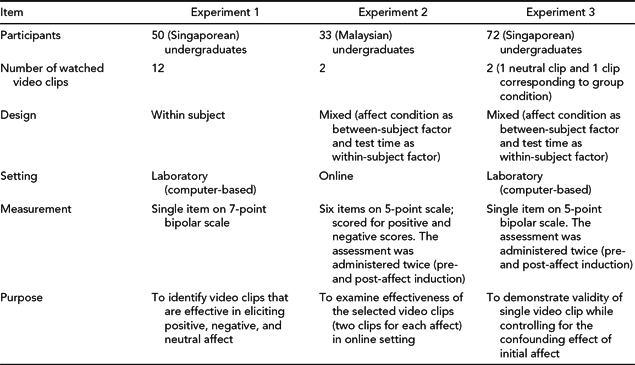
The study has aimed to develop a set of video clips that are effective at eliciting corresponding positive, negative, and neutral affects in both male and female Asian young adults. To select the positive and negative video clips, we reviewed literature and conducted search at Google.com and YouTube.com with key words such as the saddest movie/video. For positive and negative affects, we selected five video clips each that were consistently nominated by Internet users as eliciting corresponding affects. Then we followed Bradley and colleagues’ (Reference Bradley, Codispoti, Cuthbert and Lang2001) findings and removed the video clips depicting erotica or contamination from the list as they may induce different affective responses in males and females. Additionally, following Chiu (Reference Chiu2014), we removed videos that potentially may threaten any cultural identities of young adults from the list. For neutral video clips, we followed previous studies and selected four documentary videos. Eventually, there were 12 candidates on our list, four video clips for each affect, including two classical and 10 contemporary video clips. Given the mixed findings about the video clip When Harry Met Sally, we still kept it in our study with the assumption that the iGeneration may not feel awkward about the faking orgasm sense. Given that the iGeneration tends to have short attention span (e.g., Rosen, Reference Rosen2010), in line with the procedure used in previous studies (e.g., Platte, Herbert, Pauli, & Breslin, Reference Platte, Herbert, Pauli and Breslin2013), we kept all the video clips less than 3 min long. Three experiments were conducted and in each experiment, undergraduate students of different ethnicities reported their mood after watching a video clip. However, in Experiment 1, we used a within-subject design to examine the effectiveness of these 12 video clips in inducing target affects. To further examine the validity of these video clips, we used mixed designs in Experiment 2 and 3. Table 1 shows a summary of the three experiments.
Summary of the Three Experiments

Experiment 1
Participants
Fifty undergraduate students (half of them were female) of different ethnicities in Singapore participated in the experiment in exchange for course credits. Their mean age was 20.56 (SD = 1.51), ranging from 18 to 24 years old.
Materials
Video clips
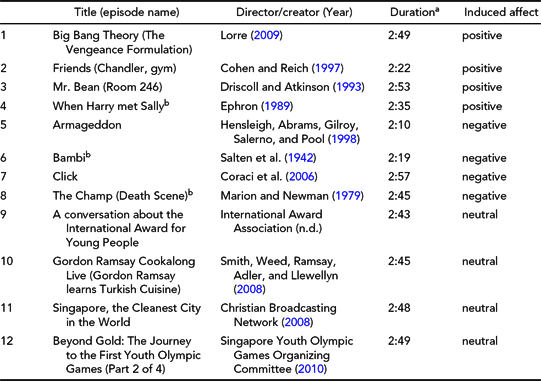
Twelve video clips, four video clips for each affect, positive, negative, and neutral affects were used (see Table 2 for the title, content, and duration of each video clip). All of them were widely identified either in Google.com or YouTube.com as prone to elicit corresponding feeling.
Video Clips Examined in Experiment 1
Note: aDuration is presented in minute and second format. bClips that were examined in Gross & Levenson's (Reference Gross and Levenson1995) study.
Affect checking
Participants were instructed to indicate their valence (i.e., ‘How do you feel after watching the video?’) on a 7-point scale, ranging from 1 being very unpleasant to 7 being very pleasant.
Design and procedure
We used a within-subject design by showing participants all 12 video clips. The video clips were presented in two different random orders, Order A and Order B. To control for the presentation order of these video clips, half of the participants was randomly assigned to watch all the video clips according to Order A and the other half watched all the video clips according to Order B. Additionally, gender was the other independent variable.
After obtaining informed consent, the experimenter verbally explained the procedure of the study and answered any questions that participants asked. In particular, participants were told that they would watch a visual file comprising 12 video clips and instructions. At the end of each video clip, a text-form instruction was shown on the screen asking participants to stop the visual file by pressing the space bar key, answer the affect checking item, and press the space bar key again to resume the visual file and proceed to the next video clip. Participants were told that the experimenter would not ask them any questions about the video clips per se, to ensure that participants would relax during their video watching (see Jausovec, Reference Jausovec1989 for a similar procedure). After watching all the video clips and reported their feeling, participants answered a demographic questionnaire, including items such as age and gender, and were then debriefed, thanked, and dismissed. The whole experiment took approximately 60 minutes. The procedure was approved by the Institutional Review Board.
Results and Discussion
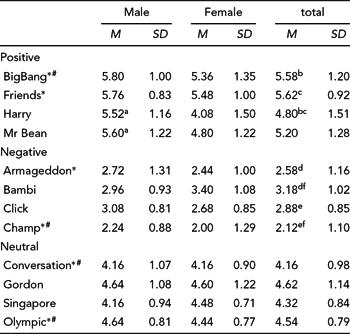
Multivariate analysis of variance (MANOVA) with the order of video clips as a between-subject factor was conducted to examine respondents’ feeling toward each video clip. Results revealed no significant differences on participants’ reports of pleasantness, F(1, 48), ps > 0.5, with the exception of the neutral clip entitled Gordon Ramsay Cookalong Live, F(1, 48) = 4.78, p = .034, η 2 = 0.91. When watching this clip after an amused clip, participants reported significantly more pleasant (M = 4.96, SD = 1.34) than when watching this clip after a sad clip (M = 4.28, SD = 0.79), t(48) = −2.187, p = 0.034, Cohen's d = 0.62. Therefore, the rest of 11 video clips were kept and the valence scores for these video clips were combined along the dimension of video clip presentation order for further analysis (see Table 3 for the mean and standard deviation for each video clip).
Descriptive Statistics of Affect Scores Reported by Participants in Experiment 1
Note. Affect was rated on a 7-point scale (1: very unpleasant; 7: very pleasant). BigBang = Big Bang Theory (The Vengeance Formulation); Friends = Friends (Chandler, gym); Harry = When Harry met Sally; Mr Bean = Mr. Bean (Room 246); Armageddon = Armageddon (Harry Says Goodbye); Champ = The Champ (Death Scene); Conversation = A Conversation about the International Award for Young People; Gordon = Gordon Ramsay Cookalong Live; Singapore = Singapore, the Cleanest City in the World; Olymplic = Beyond Gold: The Journey to the First Youth Olympic Games (Part 2 of 4).
a mean scores that significantly differed from opposite gender, b~fscores that have same superscript were significantly differed from each other. *clips that were selected and tested in Experiment 2. #clips that were selected and tested in Experiment 3.
In order to examine the main effects of video clips and gender on valence, several 4 (Video clips) × 2 (Gender) repeated-measure analyses of variance (ANOVAs) were conducted for positive, negative, and neutral affects respectively. For positive affect, the within-subject effect of video clip was found to be significant, F(3, 144) = 6.35, p < 0.001, η 2 = 0.12, as well as the main effect of gender, F(1, 48) = 13.13, p = 0.001, η 2 = .22. The effects, however, were qualified by a significant interaction effect, F(3, 144) = 2.87, p = 0.039, η 2 = 0.06. Further analyses showed that, compared to female participants, male participants rated When Harry met Sally, t(48) = 3.802, p < 0.001, d = 1.13, and Mr. Bean, t(48) = 2.31, p = 0.025, d = 0.67, as more pleasant. Moreover, significant differences among video clips were observed in female, but not male, participants, F(3, 72) = 7.25, p < 0.001, η 2 = 0.23. Bonferroni-adjusted post-hoc analysis showed that when compared to When Harry Met Sally, female participants felt more pleasant after watching Big Bang Theory, p = 0.04) and Friends, p = 0.02. There was no significant difference between Big Bang Theory and Friends suggesting that both male and female participants rated the two video clips equally pleasant.
For negative affect, video clip differences were found to be significant, F(3, 144) = 12.12, p < 0.001, η 2 = 0.20. Bonferroni adjusted post-hoc analysis showed that compared to watching Bambi, participants rated the Armageddon, p = 0.006, and The Champ (Death Scene), p < 0.001, significantly more unpleasant. Participants also perceived The Champ (Death Scene) as more unpleasant than Click, p = 0.002. The main effect of gender and interaction effect (of video clip and gender) were not found. Among these four video clips, both male and female participants rated Armageddon and The Champ (Death Scene) equally unpleasant.
For neutral affect, 3 (Video clips) × 2 (Gender) ANOVA on neutral clips revealed no significant difference in valence rating scores. The results suggest that the three video clips were equally effective. However, the Singapore, the Cleanest City in the World was excluded because the narrator in this video discussed the penalty for littering which may elicit negative feelings in the participants.
The results showed that the six selected video clips elicited corresponding affect successfully. For each type of affect, two video clips that had significantly higher scores than the other two clips and did not show significant gender differences were kept. For positive affect, Big Bang Theory and Friends were kept. For negative affect, Armageddon and The Champ (Death Scene) were kept. For neutral affect, A Conversation about the International Award for Young People and Beyond Gold: The Journey to the First Youth Olympic Games were kept. Given that within each affect type, there were also no significant differences between the two selected video clips, we averaged participants’ self-reported valence scores. Then a 3 (Affect type: positive, negative, vs. neutral) × 2 (Gender) repeated-measure ANOVA was conducted to further ensure that each affect type was different from each other and all these video clips were free from gender differences. Results showed that there was a significant affect type difference, F(2, 96) = 185.20, p < 0.001, η 2 = 0.79. Post-hoc analysis showed that participants reported significantly more pleasant emotions (ps < 0.001) after watching positive video clips (M = 5.36, SE = 0.12) than negative video clips (M = 2.35, SE = 0.13) and neutral video clips (M = 4.35, SE = 0.11). Moreover, participants also reported significantly more unpleasant reactions after watching negative video clips than neutral video clips (p < 0.001).
Experiment 1 has revealed that six video clips (two clips for each type of affect group) are effective in eliciting target affects in both male and female young adults. However, there were some limitations in this experiment. First, participants’ initial affects were not measured. To further validate the effects of these video clips, we should measure participants’ affective states both before and after affect induction. Secondly, we showed participants all 12 video clips. Potentially, what participants reported might be a mixture of what they just watched and what they watched previously. Hence, to control this potential mixture effect, instead of showing participants all three types of video clips, in Experiment 2, we only showed each participant video clips of one type of affect. Lastly, in Experiment 1, we only asked participants to report how pleasant they were, which may not be comprehensive enough. Thus, in Experiment 2, we asked participants to report their feelings along two dimensions of six items, joyful, happy, amused, unhappy, sad, and depressed/blue. Additionally, instead of testing participants in a psychological laboratory, we put these video clips online so that participants could watch them and report their feelings on their own.
Experiment 2
Participants
Thirty-three Malaysian undergraduate students (72.7% were female) of different ethnicities participated in the experiment voluntarily. Their mean age was 22.06 (SD = 1.64), ranging from 20 to 27 years old.
Materials
Video clips
The six video clips (two clips for each type of affect group) that were found to be effective in Experiment 1 were used in this experiment to induce positive, negative, and neutral affects.
Valence checking
Instead of responding to a single item as in Experiment 1, participants reported their feelings on six items: joyful, happy, amused, unhappy, sad, and depressed/blue on a 5-point Likert scale, ranging from 1 (not at all) to 5 (extremely). Positive scores were created by the average of the first three items and the composite of the remaining items accounted for negative scores. Participants answered the items before and after the affect induction to assess the fluctuation of affect. Reliability of the items was good: 0.95 for pre-manipulation positive affect, 0.90 for pre-manipulation negative affect, 0.95 for post-manipulation positive affect, and 0.93 for post-manipulation negative affect.
Design and Procedure
Unlike Experiment 1, a mixed design – affect condition as between-subject factor and test time (pre-manipulation vs. post-manipulation) as within-subject factor – was used in the present study to examine whether positive and negative video clips can induce positive and negative affects, respectively, as assumed. The study was conducted online. After completing the informed consent form, participants were randomly assigned to one of the three affect groups (i.e., positive, negative, and neutral) and answered the first measure of affect (pre-manipulation). Respondents watched two video clips corresponding to their group condition and followed this by the second measure of affect (post-manipulation) and a demographic questionnaire. The whole study took approximately 10 minutes.
Results and Discussion
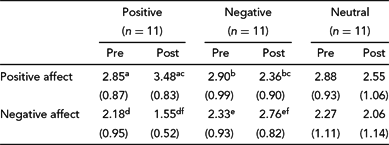
Table 4 shows mean and standard deviation for valence scores across groups. Positive scores were submitted to a 2 (Test time: pre- vs. post-manipulation) × 3 (Affect type) ×2 (Gender) repeated-measure ANOVA. The results showed that only Time × Affect interaction effect was significant, F(2, 27) = 8.29, p = 0.002, η 2 = 0.38. Further analyses using paired-sample t-tests showed that there were significant differences between the pre- and post-manipulation scores. Compared to their initial affective scores, participants in the positive group felt more pleasant, t(10) = 4.18, p = 0.002, d = 1.26, whereas the negative group reported lower positive feeling, t(10) = 2.24, p = 0.049, d = 0.69, after watching the video clips. Other effects were not found. Additionally, one-way ANOVAs revealed a significant main effect of affect on post-manipulation score, F(2, 30) = 4.55, p = 0.019, η 2 = 0.23. In particular, the positive group reported a significantly higher score than the negative group did, p = 0.026. A difference was also observed between the positive group and neutral group, though the difference was marginally significant (p = 0.076). There was no difference between the negative group and neutral group.
Descriptive Statistics of Pre- and Post-Manipulation Affect Scores Reported by Participants in Experiment 2
Note. Affect was rated on a 5-point scale (1: very unpleasant; 5: very pleasant). Standard deviations were shown in parentheses. Pre: Pre-manipulation measured scores. Post: Post-manipulation measured scores. Scores with same superscript were significantly differed from each other.
Similarly, analysis on negative scores revealed a significant Time × Affect interaction effect, F(2, 27) = 7.43, p = 0.003, η 2 = 0.36. Further analysis only found a main effect of affect on post-manipulation score, F(2, 30) = 5.43, p = 0.01, η 2 = 0.27. Post-hoc analysis showed that the negative group scored higher than the positive group did (p = 0.01) but there were neither significant differences between the negative group and neutral group nor between the positive group and neutral group. Additionally, significant differences between the pre- and post-manipulation scores were observed in both positive and negative groups. The positive group reported a lower score, t(10) = 3.60, p = 0.005, d = 1.49, while negative group reported a higher score than their baseline, t(10) = 2.83, p = 0.02, d = 0.99. No other effect was found.
Taken together, the results have replicated the findings of Experiment 1 by showing that the six video clips were effective in eliciting corresponding affects even when participants watched these video clips on their own, outside of standardised psychological laboratories and without an experimenter conducting the test. Although all participants reported similarly at baseline, the participants who just watched positive video clips reported more pleasant effects whereas the participants who just watched sad video clips reported more unpleasant effects. Moreover, after watching amused video clips, participants reported feeling more pleasant whereas after watching sad video clips, participants reported feeling more unpleasant compared to their baseline. As a contrast, after watching neutral video clips, participants did not report significant changes in terms of pleasantness. These indicate that these video clips were powerful-inducing target affects whether they were used online or in laboratories.
Unlike Experiment 1 in which we only asked participants to report their feelings along the pleasantness-unpleasantness scale, in Experiment 2, we asked participants to report their feelings in terms of six aspects and then categorise them into two dimensions. The results obtained from Experiment 1 were similar to those obtained from Experiment 2, suggesting that it was efficient to just ask participants to report their feelings of pleasantness-unpleasantness. However, the measures used in Experiment 1 and 2 both required participants to respond verbally. Potentially, participants may be more judgemental and selective with their responses compared to being asked to select a response from cartoon pictures (e.g., Lang, Reference Lang, Sidowski, Johnson and Williams1980). Hence, in Experiment 3, following Lang's (Reference Lang, Sidowski, Johnson and Williams1980) procedure, we would use the Self-Assessment Manikin (SAM) to measure participants’ affect change.
Furthermore, we used two video clips in Experiment 2, so potentially, participants were induced to feel the target affects due to the accumulative effects of the two video clips. To further prove the effectiveness of the video clip in eliciting the target affect, we should show participants only one video clip.
Nevertheless, unlike Experiment 1, we did not find significant differences between positive and neutral groups, and between negative and neutral groups. It was possible that compared to having the experiment conducted by researchers in a standardised laboratory, when this experiment was conducted on the Internet by participants themselves, the manipulation was less powerful. However, it was possible that participants’ initial affective states may interfere with the effectiveness of the video clips (Cacioppo, Gardner, & Berntson, Reference Cacioppo, Gardner and Berntson1999; Diener & Diener, Reference Diener and Diener1996). Therefore, it may be necessary to neutralise participants’ initial affective states.
To investigate these issues, in Experiment 3, we first followed the porcedure used in Kaufmann and Vosburg's (Reference Kaufmann and Vosburg2002) study by showing all participants a neutral video clip, then we asked participants to report their feelings via using the SAM (Lang, Reference Lang, Sidowski, Johnson and Williams1980), and lastly we showed each participant one target video clip and asked them to report their feelings again. As the results were similar regardless of whether we tested participants in a psychological laboratory or via an online programme, we conducted Experiment 3 in a psychological laboratory.
Experiment 3
Participants
Seventy-two Singaporean undergraduate students (61.1% were female) of different ethnicities participated in the experiment in exchange for course credits. Their mean age was 20.92 (SD = 1.58), ranging from 19 to 25 years old (one participant did not report age).
Materials
Video clips
In the two previous experiments, for each type of affect, two video clips have been found to be equally effective in eliciting target feelings. Hence, only one of the two video clips for each type of affect was used in the present study. Specifically, the clips used were Big Bang Theory for positive affect, The Champ (Death Scene) for negative affect, and A Conversation about the International Award for Young People for neutral affect. In addition to these three clips, another neutral clip that introduces preparation of the first Youth Olympic Games was also used to neutralise participants’ (pre-manipulation) affect.
Valence checking
Similar to Experiment 1, the effectiveness of the affect induction procedure was evaluated by asking participants to indicate their feelings after watching the clip (i.e., valence). We adapted an item from the SAM (Lang, Reference Lang, Sidowski, Johnson and Williams1980) and modified the item for the purpose of the present study. Specifically, participants indicated their feelings on five emotional facial icons, ranging from 1 (very sad) to 5 (very happy). Participants answered the item before and after the affect induction to assess the fluctuation of affect.
Design and procedure
As in Experiment 2, a mixed design was used to further examine effectiveness of the video clips in affect induction. However, unlike Study 2, the present study was conducted at a psychological laboratory. Moreover, prior to the induction procedure, all participants watched a neutral video clip (Beyond Gold: The Journey to the First Youth Olympic Games) and answered the first measure of affect to check the neutralisation effect of the clip. After that, a second video clip corresponding to the participants’ group condition was shown and followed by the second measure of affect. Finally, after answering a demographic questionnaire, participants were thanked, briefed, and dismissed. The whole study took approximately 10 minutes.
Results and Discussion
Table 5 shows the mean and standard deviation for each affect type. One-sample t-tests showed that for each group, after watching the initial neutral video clip, participants’ feelings were significantly higher than neutral (i.e., 3), ps < 0.006, but also significantly lower than happy (i.e., 4), ps < 0.003. To examine the manipulation effect, we conducted a 2 (Test time) × 3 (Affect type) × 2 (Gender) repeated-measure ANOVA. The results showed that there was a significant effect of affect type, F(2, 66) = 32.24, p < 0.001, η 2 = 0.49. The main effect, however, was qualified by the Time × Affect interaction effect, F(2, 66) = 34.86, p < 0.001, η 2 = 0.51. Further analysis showed that the affect type difference was only significant during post-manipulation, suggesting that the neutralisation and affect induction were successful. Post-hoc pairwise comparison with the Bonferroni correction revealed that the participants who watched the positive video clip reported significantly more pleasant than did those who watched negative video clip (p < 0.001) and those who watched neutral video clip (p < 0.001). Moreover, the negative group also reported significantly more unpleasant feelings than did the neutral group (p < 0.001). Additionally, significant test time differences only appeared in positive and negative groups. Compared to before watching the target video clips, the participants who watched the positive video clip reported feeling significantly more pleasant, t(24) = 4.57, p < 0.001, d = 0.92, and the participants who watched the negative video clip reported feeling significantly less pleasant, t(23) = 8.09, p < 0.001, d = 1.70, but the participants who watched the neutral video clip did not report any significant change in terms of feeling of pleasantness, t(22) = 1.45, p = 0.16, d = 0.42. No other effects were found.
Descriptive Statistics of Pre- and Post-Manipulation Affect Scores Reported by Participants in Experiment 3
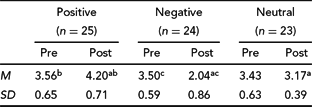
Note. Affect was rated on a 5-point scale (1: very unpleasant; 5: very pleasant). Pre: Pre-manipulation measured scores. Post: Post-manipulation measured scores. Scores with same superscript were significantly differed from each other.
Taken together, the results indicate that the affect induction was successful and the four video clips were equally effective in eliciting target affects in women and men. More importantly, the results replicate the findings of Experiment 1 and Experiment 2 by showing significant between-subject differences among all three groups and within-subject differences in both positive and negative groups. The convergent findings provide a strong support to the effectiveness of the clips.
To control participants’ initial affective states, we showed all participants a neutral video clip. The results revealed that, consistent with previous findings (Cacioppo et al., Reference Cacioppo, Gardner and Berntson1999; Diener & Diener, Reference Diener and Diener1996), participants in all conditions had a mildly positive baseline even after watching the neutral video clip. Additionally, our results also showed that participants did not report significant affect changes after watching the second neutral video clip. Together, these results suggest that when testing participants in a well-controlled environment, participants may generally feel mildly positive and neutral video clips may not really serve the function of neutralising participants’ affect. Hence, future comprehensive studies are needed to systematically examine whether it is necessary to include a neutral video clip to neutralise participants’ affect during affect induction.
To control potential carry-over effect, we showed each participant only one target video clip. The results showed that positive and negative video clips successfully changed participants’ feeling of pleasantness and a neutral video clip did not change participants’ feeling of pleasantness significantly. However, some people may question whether the initial neutral video clip may have a carry-over effect on the following video clip. We would assume that if the initial neutral video clip had any impact, it would have the same impact on all three target video clips. The fact that these three video clips induced significantly different affects suggests that the initial neutral clip may not influence participants in watching the following video clips. Nevertheless, for a more accurate result, future studies can examine the effectiveness of these video clips by showing participants only one target video clip.
General Discussion
The purpose of the current study is to develop a set of short video clips for affect induction. We selected 12 video clips that were widely rated to elicit our target affects by the Internet users. The duration of these video clips were all less than three minutes. Results of three experiments have shown that these six video clips, two clips from each category of affect, are effective in eliciting corresponding affects in both genders.
In particular, Big Bang Theory (The Vengeance Formulation) and Friends (Chandler, gym) are effective in inducing positive affect. The story plots of these two clips were easy for the audience to follow, but also involved small twists which were beyond the expectation of the audience. As a result, the audience reported that these clips were funny. Consistent with Bradley and colleagues’ (Reference Bradley, Codispoti, Cuthbert and Lang2001) findings, our results have shown that both genders respond to this type of appetitive content positively. Unlike these two video clips, female participants rated the video clips showing the faked orgasm of When Harry Met Sally, and competing with another customer for eating spoiled oysters of Mr. Bean, less pleasant than male participants did. Similar to Big Bang Theory and Friends, the faking orgasm and food competition scenes also surprised the audience. However, compared to the first two clips, the faking orgasm and food competition scenes involved more physical actions. Possibly because of this, men rated these scenes more pleasant than women did. Unlike Sato and colleagues’ (Reference Sato, Noguchi and Yoshikawam2007) findings, our results showed that female undergraduate students rated the faking orgasm neither positively nor negatively.Footnote 1 These results are broadly in line with the suggestions that people from different cultural backgrounds may respond differently toward the same event (e.g., Chiu, Reference Chiu2014).
Additionally, we have found that two clips, the death scene of The Champ and the father saying final words to his daughter before sacrificing himself scene of Armageddon, are effective in inducing negative affect. In particular, The Champ (Death Scene), the previously validated video clip is still powerful and effective in evoking negative affect. It is possible that in these video clips, the death scene and self-sacrifice elicited roughly the same type of defensive reactions in people regardless of their generation, gender, and culture. Although the video clip of Bambi also depicts the death of a main character, it was an animal story presented in a cartoon format and hence, was less powerful than The Champ in eliciting negative feelings. Likewise, the death scene of Click depicted the main character attempting to apologise to his family members before he died. Participants may have difficulties in empathising with the character without knowledge about his previous misbehaviours and regrets, hence, they reported less negative feelings after watching the scene.
Lastly, our results have shown that two clips, A Conversation about the International Award for Young People and Beyond Gold: The Journey to the First Youth Olympic Games (Part 2 of 4) are effective in inducing neutral affect. These two clips depict interviews with people involved in the events and do not contain any affective materials. The video clip, Singapore, the Cleanest City in the World, on the other hand, may elicit negative feelings as the discussion about penalty for littering may remind participants about restriction.
Our findings are especially important in terms of methodology. This new set of video clips, targeted to audiences across the world, can not only induce affects effectively, but also have relatively similar effects on males and females in two different countries. Furthermore, these video clips can induce target affects even when participants watched them on their own outside of the standardised testing environment. Thus, this new set of video clips permits researchers to collect data via online platforms as well as in traditional psychological laboratories. Moreover, potentially, researchers can also use these video clips for people with multi-cultural experiences. Further studies, however, are needed to replicate the findings of the present study.
In spite of these contributions, our studies also have limitations. In particular, we only asked participants to self-report their feelings after watching the video clips. Although this method has been widely used (e.g., Isen & Daubman, Reference Isen and Daubman1984; Verheyen & Göritz, Reference Verheyen and Göritz2009; Von Leupoldt et al., Reference Von Leupoldt, Rohde, Beregova, Thordsen-Sörensen, Zur Nieden and Dahme2007) and we asked participants to report their feelings along different aspects via multiple manners, the self-report method has also been criticised as prone to biases and lack of objectivity (Adams, Soumerai, Lomas, & Ross-Degnan, Reference Adams, Soumerai, Lomas and Ross-Degnan1999; Levine & Safer, Reference Levine and Safer2002). Future studies may consider using objective measurements such as recording physiology responses (e.g., skin conductance; Chentsova-Dutton & Tsai, Reference Chentsova-Dutton and Tsai2007) to examine the efficacy of these six video clips in eliciting target affects (Elices et al., Reference Elices, Soler, Fernández, Martín-Blanco, Jesús Portella, Pérez and Carlos Pascual2012; Fernández et al., Reference Fernández, Pascual, Soler, Elices, Portella and Fernández-Abascal2012). Additionally, although we aim to develop a set of video clips that are effective for people from different cultural backgrounds and indeed we selected the video clips that are produced for people across the world and rated by people across the world as eliciting the target affects, we did not specially test Western participants with these video clips. In addition to this sampling issue, cohort effect may be another problem with our study. Our participants were those who used Facebook, Twitter, and YouTube often. Future studies should examine whether these video clips would be equally valid and effective for adults with different cultural and technological backgrounds. Additionally, future studies can also further compare the effects of these six video clips with the effects of other affect induction procedures (e.g., recalling past emotional events). Furthermore, as these video clips are available on the Internet, it is possible that some participants may have watched them previously. Future studies should consider how previous exposure to these videos might influence the effects of affect induction. Finally, in the current study, following Chiu's (Reference Chiu2014) suggestion, we selected videos that were relatively neutral and non-threatening for various cultures. Nevertheless, these video clips may potentially prime participants with particular cultural mindset and knowledge (see Hong, Moris, Chiu, & Benet-Martínez, Reference Hong, Moris, Chiu and Benet-Martínez2000 for details). Such mental sets or cultural packages may interfere with the affect that participants should experience. Future studies can further examine this issue.
In conclusion, we have developed a new set of video clips to induce positive, negative, and neutral affects in young Asian adults. Among these six videos, two clips, Big Bang Theory (The Vengeance Formulation) and Friends (Chandler, gym), are effective in inducing positive affect and two clips, The Champ (Death Scene) and Armageddon (Harry Says Goodbye), are effective in inducing negative affect, and two clips, A conversation about the International Award for Young People and Beyond Gold: The Journey to the first Youth Olympic Games (Part 2 of 4), are effective in inducing neutral affect. Furthermore, these video clips are free from gender differences. These videos are widely rated as eliciting particular types of affect, suggesting that these video clips are relatively free from cultural differences. Moreover, when tested outside of standardised laboratories, these videos still successfully induced target affects in these participants who often occupied themselves with digital technology. Hence, our work has contributed to the field by developing a new tool to induce affect in the iGeneration and has also brought some insight into the theoretical discussion on methodological issues in affect induction as well as potential gender and culture differences in emotional interpretation and display.