


In recent decades, wars and armed conflicts in various regions of the world—particularly in the Middle East and more recently in conflicts such as the Russia-Ukraine war—have posed significant challenges to health care systems.Reference Chol, Negin and Garcia-Basteiro1–Reference Hryhorczuk, Levy and Prodanchuk4 These crises not only increase the demand for health care services but also strain existing infrastructures, often leading to their partial or complete collapse.Reference Keasley, Blickwedel and Quenby5–Reference Sticher, Wegner and Pfeifle7 Consequently, health care systems increasingly require innovation and adaptation to effectively respond to the needs of affected populations during such crises.Reference Chol, Negin and Garcia-Basteiro1, Reference Daw8–Reference Levy and Sidel10
A growing body of research has highlighted the multifaceted impacts of armed conflicts on health care delivery, emphasizing both the innovative responses that arise and the persistent challenges that remain. For instance, studies have documented successful interventions, such as the deployment of mobile health units and the use of telemedicine, which have improved access to care in conflict-affected regions.Reference Hadi, Hawsawi and Abu Aqil11–Reference Mohamed, Abdi and Mohamed14These innovations demonstrate the resilience of health care systems, showcasing how adaptability can mitigate some of the adverse effects of war. However, many studies tend to focus narrowly on specific case studies, often overlooking broader patterns and the effectiveness of various innovations across different contexts.Reference Browning and Merrikh15, Reference Dewachi, Rizk and Singh16 Additionally, while some research provides valuable insights into operational strategies, they frequently fail to quantify the impact of these innovations on health outcomes, leading to a gap in the empirical evidence needed for comprehensive policy recommendations. This review seeks to bridge these gaps by systematically analyzing both successful and unsuccessful innovations in health care systems during armed conflicts, thereby contributing to a more nuanced understanding of how to enhance crisis management and improve health outcomes in affected populations.
The significance of the research will lie in determining and exploring the innovative ideas in health systems in countries experiencing armed conflicts. In light of recent global events, further research is being called for to help hone responses to crises. Such innovations in this field could result in cost reductions, efficiency improvements, and improved health outcomes. The present study also investigates successful and unsuccessful experiences from different countries and tries to suggest feasible strategies for boosting health care systems in war-affected contexts.
For the purpose of assessing the results of health innovations in conflict zones, clear evaluation indicators are necessary. Mortality rates, access to health care, and operational efficiency are metrics that serve as benchmarks of success.Reference Hassanain, Edwards and Venables17, Reference Malembaka, Altare, Bigirinama, Bisimwa, Banywesize, Tabbal and Boerma18 For instance, improvements in maternal and child health status can be used to show the success of decentralized governance or telemedicine, while outpatient visits or vaccination coverage rates can be used to show the success of mobile clinics and digital tools. These indicators are crucial in the framework of the adaptive health system approach to ensure that innovations are meaningful and replicable in other crisis contexts.Reference Abajobir, de Groot and Wainaina19–Reference Balakrishnan, Gopichandran and Chaturvedi21
While the literature on adaptive health systems is primarily focused on regions such as the Middle East and Eastern Europe, other regions of the world, including sub-Saharan Africa and Central Asia, face their own challenges. For instance, countries like South Sudan and Afghanistan have been through many years of conflict, which has led to the breakdown of health care.Reference Ahmed, Elhassan and Elnour22–Reference Yusuf, Hussain and Sultan24 However, mobile clinics, community health worker programs, and telemedicine have become innovations that provide lifesavers but require unique solutions due to extremely limited resources, geographic isolation, and limited aid. Thus, the review of these regions is presented in this paper to demonstrate the diversity of the approaches used to design the Adaptive Health Systems Strategies (AHSS) in different contexts.Reference Phutke, Patil and Jain25–Reference Ahmed28
The objectives of this research include identifying innovations and successful approaches related to managing health care crises in the context of a war situation. The key questions this paper attempts to answer include: What types of innovations have been implemented within health care systems during a crisis? How can the experiences of countries experiencing war be applied to improving health care systems in other parts of the world? And what challenges that remain, requiring deeper study?
This research continues to highlight the significance of evaluating not only the positive impact of adaptive health systems on the response to a crisis but also the limitations of such systems in the context of an armed conflict. As such, the study seeks to offer practical recommendations for policy-makers and practitioners seeking to improve the readiness of the health care system in the face of armed conflicts by identifying these challenges in more detail.
The article is organized into 4 major sections: Methods, Results, Discussion, and Conclusion. The Methods section shall outline the methodology of the research and selection criteria of studies, while the Results shall focus on the data analysis and identification of innovations. Discussion shall present interpretation of results and give policy recommendations. Finally, the Conclusion shall summarize key findings and their implications for the future of health systems in contexts of armed conflict.
Methods
Study Design
A systematic review is thus chosen for this study because it will be able to examine the literature on adaptive health systems and managerial innovations during the crises of armed conflict comprehensively and meticulously. This approach, with a predefined structured transparent protocol, offers the ability to accurately identify and compare various innovations to address complex, multilevel questions of the study. It offers a comprehensive summary of the available evidence, highlights areas where research is lacking, and facilitates an in-depth comprehension of the contemporary literature, which is essential for evaluating health systems in regions affected by conflict. Moreover, the systematic review allows for an analysis of those factors that influence health innovations; it provides a thorough investigation of their interrelations and consequences. This thus enhances the robustness and dependability of the results and provides necessary insights for decision-makers and practitioners involved in humanitarian health initiatives.
PRISMA methodology
To conduct this systematic review, the Preferred Reporting Items for Systematic Reviews and Meta-Analyses (PRISMA) framework shall serve as the main guideline. The PRISMA framework is a comprehensive and validated tool for conducting a systematic review. It guides one through the systematic identification, screening, assessment, and synthesis of the data in a way that is transparent. The steps involved will be as follows:
-
1. Defining Research Questions and Inclusion/Exclusion Criteria: Precisely defining research questions and establishing criteria for study selection.
-
2. Literature Search: Conducting an exhaustive search across scientific databases and credible sources to identify relevant studies.
-
3. Screening of Sources: Performing initial and secondary screening of sources to select studies pertinent to the topic.
-
4. Quality Assessment of Studies: Evaluating the methodological quality of the selected studies.
-
5. Data Extraction: Extracting the requisite data from the chosen studies.
-
6. Data Analysis and Synthesis: Analyzing and synthesizing the extracted data to present final results.
-
7. Reporting of Results: Providing a transparent and comprehensive report of the findings and research outcomes.
Following the PRISMA methodology ensures that the systematic review is conducted with the necessary thoroughness and transparency, hence making the findings reliable and generalizable. This guideline framework is particularly important in complex, multi-faceted studies, one example being the management of health systems during crises caused by armed conflicts.
Research Question and PIO Framework
The research question serves as a cornerstone in guiding the scope and direction of a systematic review, ensuring transparency, focus, and relevance throughout the research process. It plays a critical role in defining objectives, establishing inclusion and exclusion criteria, and structuring analyses to comprehensively examine specific dimensions of the topic. In this study, the research question is formulated as follows:
What innovations have been implemented in adaptive health systems during armed conflicts, and how do these innovations influence crisis management outcomes in affected regions?
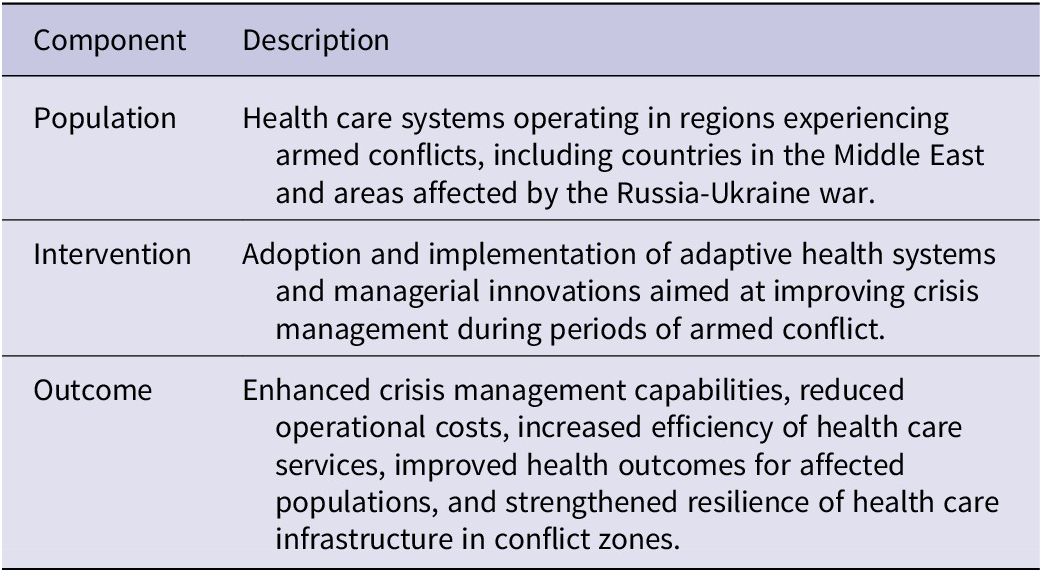
To address this question, the study employs the PIO framework (Population, Intervention, Outcome) to systematically investigate adaptive health systems in the context of crisis management during armed conflicts. The components of the framework are defined as follows:
Population: Health care systems operating in conflict-affected regions, including countries in the Middle East and areas impacted by the Russia-Ukraine war.
Intervention: The adoption and implementation of adaptive health systems and managerial innovations aimed at enhancing crisis management during periods of armed conflict.
Outcome: Improved crisis management capabilities, reduced operational costs, increased efficiency of health care services, better health outcomes for affected populations, and strengthened resilience of health care infrastructure in conflict zones.
This structured approach, detailed in Table 1, facilitates the analysis of how interventions impact health care delivery in conflict-affected regions and supports the development of robust health management strategies. The keywords and their equivalents are presented in Table 2.
PIO framework for the study
Keywords and their common equivalents

Search Protocol
A systematic search strategy will be designed to systematically search for articles and materials on adaptive health systems and managerial innovations related to armed conflicts. The proposed databases that will lead the basis of the search include: PubMed, Scopus, Cochrane Library, and Web of Science. The search period will cover from the inception of these databases to October 1, 2024, with no specific time restrictions. This approach ensures that all work relevant to the subject published from the most ancient record to the most recent is considered and summarized. In addition, for relevance and quality, only publications in the English and French languages will be considered, as they form the major proportion of scientific inputs relevant to the topic under research.
The search strategy will involve a list of identified keywords that include “Adaptive health systems,” “Crisis management,” “Armed conflicts,” “Health innovations,” “Health systems in war,” “Humanitarian health responses,” and “Wartime health systems.” The keywords, along with their common synonyms retrieved from PubMed, are outlined in Table 1-1. Combinations of these terms will be utilized, together with Boolean operators such as AND or OR, in view of maximizing both comprehensiveness and precision of the results that will be obtained. This protocol will try to cover the most extensive range of research that may be conducted on the complex dimensions of health system management in conflict situations by utilizing various combinations of keywords and their synonyms. This systematic approach is wide in focus to ensure the capture of all relevant studies that contribute to an advanced understanding of adaptive health systems and their innovative coping strategies during armed conflicts.
The following inclusion and exclusion criteria have been established to select appropriate articles:
Inclusion Criteria:
-
• Studies that examine health systems during periods of armed conflict.
-
• Studies that investigate managerial innovations in health crises during wars and conflicts.
-
• Articles published in reputable, peer-reviewed scientific journals.
-
• Studies that provide empirical data or conduct analytical reviews.
-
• Studies focusing on post-2000 periods that address health crisis situations in conflict-affected regions.
Exclusion Criteria:
-
• Studies that focus on health systems outside the context of armed conflicts.
-
• Articles that discuss health innovations in non-conflict-related crises.
-
• Literature reviews that lack systematic analysis or empirical evidence.
-
• Articles published before 2000, unless they specifically address revolutionary innovations in health systems during conflicts.
Search Strategies for PubMed, Scopus, Cochrane Library, and Web of Science:
To systematically identify relevant articles and resources related to adaptive health systems and managerial innovations during armed conflicts, a comprehensive search strategy was developed for each of the selected databases: PubMed, Scopus, Cochrane Library, and Web of Science. The search strategies utilize the predefined keywords and their common equivalents as outlined in Table 1-1. Additionally, the search queries incorporate Boolean operators (AND, OR) to ensure comprehensive and precise retrieval of relevant studies.
Synthesis of Results
The data extracted from the selected articles for in-depth review consisted of many key elements: reference details, description of the health program, age and other characteristics of the study population (including sample size), research design, geographical location, the primary objectives of the study, and any challenges or limitations identified. After that, the above pieces of information were collected with due care and were then analyzed with great detail to notice the knowledge gaps, as reflected in Table 3. The reference organization for the study was done using the EndNote referencing software. The information extracted was then archived using Microsoft Excel. This systematic way of organization ensured a comprehensive synthesis of the findings, thereby enhancing the reliability and clarity of the analysis.
Key elements of selected studies on adaptive health systems and innovations during armed conflicts

For the purposes of transparency and clarity in the systematic review process, data synthesis necessitated a detailed integration of both qualitative and quantitative research to facilitate an exhaustive grasp of adaptive health systems in the situation of armed conflicts. Qualitative methods, including interviews and case studies, have revealed contextual obstacles and innovative solutions adopted in conflict-affected areas, whereas quantitative analysis has yielded quantifiable results, including mortality rate reductions and efficiency improvements in service delivery. Synthesis of these various sources of information was enabled through the use of thematic analysis that facilitated recognition of emerging patterns and innovations across various regions and settings.Reference Thomas and Harden29 Papers were excluded categorically on the basis of predetermined criteria that involved a failure to be applicable to armed conflict contexts, insufficient empirical evidence, or publication in a language other than English. As an example, 487 studies were excluded due to a lack of evidence or because they did not meet the predetermined inclusion criteria. Such rigorous methodology ensured that only relevant and high-quality studies were considered, thus enhancing the reliability and generalizability of the findings. With an in-depth exploration of these factors, this review provides a strong foundation for understanding the complex nature of health system adaptations during crises.
Results
Overview of Selected Studies
The systematic review identified a total of 5432 articles across four databases (PubMed, Scopus, Cochrane Library, and Web of Science) based on the initial search strategy. After removing duplicates and performing primary and secondary screenings, 92 studies were deemed eligible for full-text review. Following a thorough evaluation against the inclusion and exclusion criteria, 21 articles were ultimately included in the final synthesis. These articles provided valuable insights into various innovations and adaptive strategies implemented in health care systems during armed conflicts across diverse geographical contexts including the Middle East, Africa, Eastern Europe, and South Asia.
The article selection process is illustrated in Figure 1, which outlines the systematic PRISMA flow diagram for identifying relevant literature from January 2000 to February 2024. The diagram includes details on the number of records identified through database searches, the removal of duplicates, and the screening process. Additionally, it highlights that some articles were excluded for meeting more than 1 exclusion criterion, such as being unrelated to conflict-affected health systems, lacking empirical evidence, or being published in languages other than English.
Systematic PRISMA article identification process inclusive of literature from January 2000 to February 2024. 1 Search engine suggestions of relevant studies and existing knowledge and resources. 2 Some articles excluded for more than 1 category.

This systematic review examines the diverse populations affected by armed conflicts, focusing on vulnerable groups such as civilians in Ukraine, women and children in countries like Angola, Eritrea, Ethiopia, Mozambique, and Rwanda, as well as internally displaced individuals in Colombia and Yemen. The findings indicate that millions of people, including Ukrainian civilians and women and children in several African countries and various regions of the Middle East, are significantly impacted by these conflicts. This review employs a range of methodologies, including observational studies, qualitative interviews, and literature reviews, to gather comprehensive information about the health challenges faced by these populations.
Geographically, the research encompasses regions such as Ukraine, Colombia, Yemen, Palestine, Syria, South Sudan, and various areas across Africa and the Middle East. These studies emphasize the critical health challenges arising from armed conflicts and explore the innovations within health systems designed to address the needs of affected communities amid ongoing violence. Innovations include the deployment of community health workers, the establishment of mobile health units, and the integration of digital technologies, all aimed at ensuring continuity of care and improving health outcomes for individuals living in conflict-affected areas. Overall, this review highlights the resilience and creativity of health systems striving to provide essential services in the face of significant challenges.
Main Concepts and Analysis of Health System Innovations for Adaptation in Conflict-Affected Areas
In regions affected by conflict, health systems face unprecedented challenges that demand rapid and effective adaptations. The following key concepts emerge from a systematic review of 21 articles focused on innovations that enhance the adaptability of health systems in these contexts:
-
1. Decentralization of Health Governance: Empowering local decision-making is crucial for improving governance and responsiveness to community needs. Decentralization allows health systems to tailor their strategies to the unique circumstances of affected populations, fostering a more effective and locally relevant health response.
-
2. Training and Deployment of Community Health Workers (CHWs): CHWs are instrumental in maintaining essential maternal and child health services, particularly in conflict-affected areas where traditional health care infrastructure may be compromised. Their presence not only fills critical gaps in service delivery but also builds trust within communities, which is essential during times of instability.
-
3. Health Financing Reforms: Adequate resource allocation is vital for sustaining health services amid disruptions caused by conflict. Reforms aimed at increasing financial resources and reallocating budgets can enhance the resilience of health systems, ensuring they can continue to operate effectively even in challenging environments.
-
4. Adaptation of Health Services in Wartime: Strategies to protect and enhance health care delivery during conflict are crucial. This includes exploring mechanisms that safeguard health services and improve access to care, ensuring that essential health services remain available despite the challenges posed by violence.
-
5. Mobile Health Units and Increased Security: The establishment of mobile health units addresses the challenges posed by violence and instability. These units can reach populations that are otherwise inaccessible, providing critical health services and enhancing the overall security of health care provision in conflict zones.
-
6. Emergency Preparedness Strategies and Collaboration: Effective health service delivery during crises relies on robust emergency preparedness strategies. Collaboration with local and international partners, such as UNRWA, enhances the ability to respond swiftly and effectively to health needs arising from conflicts.
-
7. Use of Digital Technologies: The integration of digital health technologies, including Geographic Information Systems (GIS) and electronic health records, improves data management and service coordination. These technologies enable better tracking of health trends and resource allocation, facilitating more informed decision-making.
-
8. Universal Health Coverage (UHC) and Maternal Health: Innovations aimed at improving maternal and child health during crises are essential. Strategies that enhance UHC in conflict settings can lead to significant improvements in health outcomes for vulnerable populations.
-
9. e-Health and Telemedicine Innovations: The development of communication tools and online learning platforms fosters access to information and health care services, even in areas where traditional health care delivery systems have been disrupted. Telemedicine serves as a flexible solution that bridges the gap in care delivery.
-
10. Mechanisms to Address Health Needs in Wartime: The use of mobile clinics and emergency medical teams provides immediate health care responses to the urgent needs of affected populations. These mechanisms are critical for ensuring continuity of care in unstable environments.
These are health system innovations during armed conflicts that are not merely reactive; they are a strategic direction toward continuity of care for improved health outcomes among the most vulnerable populations. Decentralization at the decision-making level allows local health authorities to formulate responses that reflect particular needs of respective communities. It is here that the deployment of CHWs becomes pivotal in the delivery of care and building trust within the community—a precondition for any form of effective health intervention in these uncertain times.
The added value is the resilience that characterizes improved health systems, which are more resilient to support pressures that arise from conflicts. Mobile health initiatives, coupled with telemedicine, introduce flexibility and timeliness beyond traditional infrastructure constraints in real-time health interventions at locations most needed.
Adoption of digital technologies smoothest operations and makes health service delivery effective and easy to monitor health trends for effective resource allocation. In essence, these innovations position the health systems more ably to navigate the complexities of care delivery in conflict zones as a means of safeguarding the health and well-being of the most vulnerable populations from adversity.
These studies together demonstrate significant achievements in both access to health and service delivery aspects in war-affected regions. The main resultant features deal with increased awareness of humanitarian crises, reduced maternal and child mortality rates, and better coordination among health actors. Remarkably, some of these studies reported more than a 50% reduction in the maternal mortality ratio with better access to maternal health care services. It supported innovations in health care delivery—for instance, mobile clinics and telemedicine. Increased outpatient visits and successful medical evacuations outlined resilience in the health systems in response to conflicts. The mental health support services were greatly improved, as well as disease surveillance—supporting timely health responses.
Health care delivery in war situations is fraught with grave concerns like the destruction of health facilities, resource shortages, and threats to health professionals. That the militancy and political unrest persist and hamper the distribution of medical materials and render it exceedingly difficult to obtain regular care only adds to the problem. Stigma, discrimination, and the chaos of war also make it difficult to obtain reliable information and track health programs. These circumstances illustrate how badly we need effective plans to enhance health care in conflict-affected regions. In Yemen and Syria, for instance, the near collapse of health care facilities has illustrated how much we need innovative thinking, such as mobile health centers and telemedicine, to serve the needy even in such situations.Reference Briody, Rubenstein and Roberts30–Reference Bashour, Kharouf and DeJong33
Along with these positive results, a plethora of challenges and limitations face the delivery of health care in conflict zones. Health infrastructure was grossly destroyed, resources were very rare, coupled with a continuous threat to the safety of the health care staff serving in the area. Continuous violence, political instability, along with poor medical supplies, further complicates the situation and makes consistent health care access difficult to maintain. Added to this are stigma, discrimination, and the general disorder of war, which further reduce the accuracy of data collection and make effective monitoring or reassessment of health interventions quite impossible. These challenges outline with urgency the need for comprehensive strategies in strengthening the health care systems in areas of conflict.
Discussion
This study focused on the adoption of innovations and managerial strategies adopted in health care systems within crisis and wartime situations. The results from this study indicated that adopting adaptive health care frameworks and managerial innovations may lead to improved health outcomes while simultaneously reducing costs. Furthermore, the study discovered that different countries have different experiences when implementing these various innovations due to local conditions and individual requirements. Consequently, the analyses from the 21 selected articles illustrated a very positive effect of such innovations on health care performance in crisis situations.
The findings of this study confirm many previous works in the same area. For instance, previous studies have established those managerial innovations can improve efficiency and access to health care services even during periods of crisis. However, there are also some points of discrepancy in specific cases. While various literature highlights significant milestones in the implementation of adaptive health care systems, others point out infrastructural barriers and a lack of access to resources that may negatively affect the effectiveness of such innovations. These inconsistencies illustrate the complex and multifaceted nature of health care systems during periods of war and underscore the importance of local and cultural contexts.
This becomes important for this research, as it clearly shows that both innovations and managerial strategies have pivotal roles in the strengthening of health systems during crisis periods. The findings provide a good avenue for researchers and policy-makers to devise more efficient strategies in tackling health crises through comprehensive understanding from the different countries reporting successful and unsuccessful experiences. This research can also form the basis of recommendations for training programs and capacity-building initiatives among health care workers in affected areas.
Nevertheless, this research is not without its limitations that warrant attention. Initially, the choice to source articles exclusively from 4 databases may have led to the exclusion of significant and pertinent studies. Additionally, the emphasis on articles available in English could constrain the range of cultural viewpoints and experiences represented. Moreover, the data collected may be characterized as unstable and unreliable, owing to the fluctuating circumstances inherent in war and humanitarian emergencies. The overall findings of the study can be influenced by these factors, necessitating caution when extrapolating results to other contexts.
The findings of this study demonstrate the significant positive impacts of adaptive health interventions in conflict-affected regions. Key innovations, such as decentralized governance, community health worker programs, and mobile health units have resulted in measurable improvements in health outcomes. For instance, maternal mortality ratios decreased significantly in some areas due to enhanced access to maternal health care services. Additionally, the integration of telemedicine and information technology improved service delivery by enabling more efficient resource management and rapid responses to health emergencies. These successes underscore the critical role of adaptive strategies in mitigating the adverse effects of armed conflicts on health care systems, particularly in resource-constrained environments.
Ethical dilemmas are an ongoing concern in the provision of health care in situations of armed conflict. The security of health professionals is constantly undermined by the risk of violence, while infrastructural constraints like damaged facilities and scarce medical supplies limit regular service delivery. Stigma and discrimination also pose challenges to the access of needy populations to care. Addressing these ethical issues requires a holistic response in the form of enhanced protective action for health care workers, equitable access to resources, and collaboration with local and international stakeholders to enhance ongoing health care coverage in affected territories. These interventions are essential to promote trust as well as to establish resilience for affected populations.Reference Lamblin, Derkenne and Trousselard34–Reference Bernal, Garcia-Betancourt and León-Giraldo36
Future studies should explore the experiences of various countries’ health systems, with a focus on cultural and social perspectives. Additionally, scholarship should also turn toward analyzing how digital innovations and new technologies impact the effectiveness of health care services during the crisis period. It can also act as instrumental means that allow increasing the availability of services and reducing the related costs. Besides that, developing collaborative programs with non-governmental organizations (NGOs) and local communities can enhance health care infrastructures and increase community involvement in crisis management.
Conclusion
This study highlights the importance of adaptive health systems and innovative management strategies in strengthening the effectiveness and resilience of health care during conflicts and emergencies. There have been remarkable developments, including decentralized management, community health worker programs, and mobile health units. However, still lingering challenges such as destroyed infrastructure, shortages, and security issues still make it hard to access sustainable health care. These findings form a sound basis for the continuation of research on how to improve health services in conflict areas.
Long-term research needs to study how effectively these innovations can grow and survive in the long term, especially in underrepresented areas like sub-Saharan Africa and Central Asia. There is also a need to track how new technologies, including artificial intelligence and telemedicine, can improve responses in emergencies and decrease costs. A comparison across a number of countries could provide insightful information on how cultural, social, and local factors impact the success of these programs.
In conclusion, this review shows how important it is to place emphasis on adaptive health strategies in a bid to reduce the negative effect of armed conflicts on health care systems. Through highlighting good practices from other places and encouraging cooperation among governments, NGOs, and local communities, health systems can be reinforced to better deal with future emergencies. These measures will improve health outcomes directly and enable the creation of more robust and equitable health care systems in vulnerable areas.
Data availability statement
All data generated or analyzed in this review are included in the published article.
Acknowledgments
The authors gratefully acknowledge the financial support provided by Abadan University of Medical Sciences (Grant number: 2234).
Author contribution
Majid Alizadeh led the review process and was responsible for the initial screening of the articles. Maryam Jafar Sameri, Samireh Mahdavi, and Fouad Baghlani participated in the article screening. Majid Alizadeh was the primary author of the manuscript. All authors engaged in discussions during the development of the manuscript and approved the final version.
Funding statement
This study was funded by the research affair of Abadan University of Medical Sciences, Grant number: 2234.
Competing interests
The authors declare that they have no competing interests. The views expressed in this article are solely those of the authors and do not represent any official policy or endorsement by their affiliated institutions.
Ethical standard
This systematic review did not require ethical approval or participant consent as it involved the analysis of existing literature.



