1. Introduction
The Pan-African Orogeny represents tectonic, magmatic and metamorphic events that occurred during Neoproterozoic to earliest Palaeozoic time (Kröner & Stern, Reference Kröner, Stern, Shelley, Cocks and Pilmer2004). The orogenic cycle reveals the opening and closing of large oceanic realms along with the accretion and collision of buoyant crustal blocks. Pan-African activities culminated in the creation of the late Neoproterozoic supercontinent Gondwana. The Arabian–Nubian Shield (ANS) is one of the largest tracts of juvenile crust on Earth formed during the Neoproterozoic period, via accretion of arcs that existed between major fragments of East and West Gondwana (Stern, Reference Stern2002; Johnson & Woldehaimanot, Reference Johnson, Woldehaimanot, Yoshida, Windley and Dasgupta2003; Meert, Reference Meert2003; Stoeser & Frost, Reference Stoeser and Frost2006; Abu-Alam et al. Reference Abu-Alam, Santosh, Brown and Stüwe2013).
Mafic–ultramafic assemblages of the ANS encompass ophiolitic and non-ophiolitic complexes. The ophiolitic complexes represent ancient oceanic lithospheric fragments formed in orogenic belts along major suture zones (Dilek & Furnes, Reference Dilek and Furnes2011; Kakar et al. Reference Kakar, Kerr, Mahmood, Collins, Khan and McDonald2014; Abdel-Karim et al. Reference Abdel-Karim, Ali, Helmy and El-Shafei2016, Reference Abdel-Karim, Ali and El-Shafei2018; Sedki et al. Reference Sedki, Ali and Mohamed2019; Ali et al. Reference Ali, Ntaflos and Sami2020). The non-ophiolitic complexes occur either as layered or as Alaskan-type gabbroic intrusions with some ultramafic rocks (Abd El-Rahman et al. Reference Abd El-Rahman, Helmy, Shibata, Yoshikawa, Arai and Tamura2012; Abdel Halim et al. Reference Abdel Halim, Helmy, Abdel-Rahman, Shibata, El-Mahallawi, Yoshikawa and Arai2016; Abdallah et al. Reference Abdallah, Ali and Obeid2019). The Alaskan-type intrusions are concentrically zoned intrusions emplaced during post-tectonic processes and are uplifted fragments of the deep levels of island arcs (Helmy et al. Reference Helmy, Yoshikawa, Shibata, Arai and Kagami2015; Abdallah et al. Reference Abdallah, Ali and Obeid2019). The mafic–ultramafic intrusions of Wadi Kamal, Hail and Lakathah in the Arabian Shield are akin to Alaskan-type intrusions (Collenette & Grainger, Reference Collenette and Grainger1994; Harbi, Reference Harbi2008). In contrast, the layered intrusions occur as undeformed, small elliptical bodies along major structures, mostly lacking ultramafic rocks (El-Mettwaly, Reference El-Mettwaly1992; Azer & El-Gharbawi, Reference Azer and El-Gharbawi2011). The layered gabbroic intrusions comprise tholeiitic, calc-alkaline and alkaline rocks suggesting coeval derivation from different sources (Be’eri-Shlevin et al. Reference Be’eri-Shlevin, Katzir and Whitehouse2009).
Mafic plutonism in the ANS was generated in diverse tectonic regimes. Older gabbro occurs as an essential part of obducted ophiolites and as a member of subduction-related metagabbro-diorite complexes. Ophiolitic and island-arc metagabbros are regionally metamorphosed up to lower-amphibolite facies (El Ramly, Reference El Ramly1972; El Sharkawy & El Bayoumi, Reference El Sharkawy and El Bayoumi1979; Takla et al. Reference Takla, Basta and Fawzi1981; El Gaby et al. Reference El Gaby, List, Tehrani and Said1990). Younger gabbro is mostly fresh intrusive mafic rock formed in a post-collisional setting (Takla et al. Reference Takla, Basta and Fawzi1981; El Gaby et al. Reference El Gaby, List, Tehrani and Said1990; Khalil et al. Reference Khalil, Obeid and Azer2015; Surour et al. Reference Surour, Ahmed and Harbi2017).
Mafic magmatism that occurred during Neoproterozoic time in the Arabian Shield documents two separate pulses (i.e. Cryogenian and Ediacaran) represented by older metagabbros and younger fresh gabbros (e.g. Johnson et al. Reference Johnson, Andresen, Collins, Fowler, Fritz, Ghebreab, Kusky and Stern2011, Reference Johnson, Halverson, Kusky, Stern and Pease2013). Older metagabbros formed during Cryogenian time (∼850–780 Ma) are rarely stratified and are related to calc-alkaline arc magmatism (Surour et al. Reference Surour, Ahmed and Harbi2017). Conversely, younger fresh gabbros were formed during Ediacaran time (∼620–590 Ma) in a post-collisional regime following the late stages of arc amalgamation in the Arabian Shield (Surour et al. Reference Surour, Ahmed and Harbi2017).
Generally, the gabbroic intrusions in the Arabian Shield are poorly studied, lacking comprehensive geological, petrological, mineralogical and geochemical data. Recently, as far as we know, only one international paper by Surour et al. (Reference Surour, Ahmed and Harbi2017) focused on the mineral chemistry of some gabbros from the Asir region in the western Arabian Shield of Saudi Arabia.
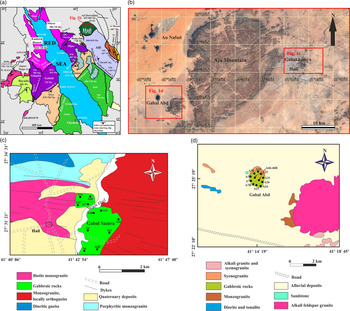
The present study deals with fresh gabbroic rocks located in the Gabal Samra and Gabal Abd areas of the Hail region (Fig. 1), which represents the northeastern part of the Arabian Shield. In fact, except for very little geological information presented in an old local report by Kellogg & Stoeser (Reference Kellogg and Stoeser1985), there are no comprehensive studies of these gabbros. These rocks are poorly studied as most studies focused on the granitic intrusions (e.g. Robinson et al. Reference Robinson, Foden and Collins2015 a,b; Abdallah et al. Reference Abdallah, Azer and Alshammari2020). So, this study presents the first detailed geological, mineralogical and bulk-rock chemical data for these rocks. The new data were used to better understand the tectonic setting of the Neoproterozoic mafic magmatism in the Arabian Shield and to constrain the nature of the mantle source as well as the conditions of crystallization and melting.
(a) Location of the Hail region within the Arabian–Nubian Shield (ANS) terrains (Johnson & Woldehaimanot, Reference Johnson, Woldehaimanot, Yoshida, Windley and Dasgupta2003). (b) Google Earth photo shows location of the Gabal Samra and Gabal Abd within the Hail region (map data: Google, Landsat/Copernicus). Simplified geological maps (modified after Ekren et al. Reference Ekren, Vaslet, Berthiaux, Le Strat and Fourniguet1987) show (c) Gabal Samra, and (d) Gabal Abd. Sample locations are shown. Location of (b) is indicated in (a), and similarly location of (c, d) is indicated in (b).

2. Geological setting
The ANS was produced during Neoproterozoic time (900–550 Ma) by accretion of intra-oceanic arcs during the Mozambique Ocean closure and Gondwana amalgamation (Ali et al. Reference Ali, Kröner, Hegner, Wong, Li, Gahlan and Abu El Ela2015). The subduction process started at ∼870 Ma followed by arc–arc convergence and terrane suturing at ∼780 Ma (Johnson & Woldehaimanot, Reference Johnson, Woldehaimanot, Yoshida, Windley and Dasgupta2003). These events mark the beginning of ocean closure and Gondwana assembly. The terrane amalgamation proceeded until ∼600 Ma, causing juxtaposition of East and West Gondwana. The final assembly of Gondwana was reached by ∼550 Ma following overlapping phases of basin creation, rifting, compression, strike-slip faulting and gneissic dome formation in association with extension and/or thrusting (Johnson & Woldehaimanot, Reference Johnson, Woldehaimanot, Yoshida, Windley and Dasgupta2003).
The diverse tectonic features of the post-amalgamation events indicate that the final assembly of Gondwana required alternating episodes of late Neoproterozoic extension and shortening, uplift, and depression, deposition and erosion (Johnson & Woldehaimanot, Reference Johnson, Woldehaimanot, Yoshida, Windley and Dasgupta2003). The Najd Fault System comprises late Neoproterozoic NW- and NE-trending strike-slip faults and shear zones affecting the northern part of the Arabian Shield (Johnson & Woldehaimanot, Reference Johnson, Woldehaimanot, Yoshida, Windley and Dasgupta2003). The NW-trending faults are common and generally sinistral, whereas the NE-trending faults are subordinate and dextral. These strike-slip faults were formed at ∼640–540 Ma (Abdelsalam & Stern, Reference Abdelsalam and Stern1996). Both trends of the fault sets form a conjugate pair.
The Arabian Shield of Saudi Arabia, a part of the ANS, forms an exposure of juvenile continental crust on the eastern side of the Red Sea rift. The Hail region is situated on the northeastern part of the Arabian Shield (Fig. 1a). A small NW-trending fault with apparent sinistral offset was documented in the Hail region, possibly related to the Najd Fault System (Delfour, Reference Delfour1981). Granitic and gabbroic intrusions together with numerous dyke swarms were emplaced during the regional extension of the Arabian Shield (e.g. Surour et al. Reference Surour, Ahmed and Harbi2017; Abdallah et al. Reference Abdallah, Azer and Alshammari2020). Late Proterozoic intrusive rocks occupy the southern section of the Hail region. The rest of the region is covered by the Cambrian–Ordovician Saq sandstone and Ordovician–Devonian Tabuk Formation. Two assemblages of Precambrian intrusive rocks were recognized in this region (Kellogg & Stoeser, Reference Kellogg and Stoeser1985). An older, partially deformed, orogenic assemblage (>620 Ma) comprises rocks ranging from gabbro to syenogranite with predominant monzogranite and granodiorite. They were possibly formed in an island-arc setting. A younger post-collisional assemblage (590–565 Ma) mainly includes the Akash granitic pluton and Aja Mountain granitic batholiths. The granitic Aja Mountain with an elevation of ∼1535 m is the most common geological feature of the Hail region, extending in a NE–SW direction. It is a pear-shaped massif pluton and borders Hail city from the west. Regionally, the older intrusive sequence constitutes part of a large, heterogeneous and locally remobilized intrusive assemblage extending ∼50 km SW of the Hail region (Kellogg, Reference Kellogg1983). A recent geochronological study by Robinson et al. (Reference Robinson, Foden and Collins2015 a,b) distinguished four magmatic groups in the Arabian Shield of Saudi Arabia: (1) ∼870–675 Ma island-arc and syn-orogenic I-type magmatism, (2) ∼640–585 Ma I- and A-type magmatism, (3) ∼610–600 Ma post-orogenic A-type magmatism, and (4) <600 Ma anorogenic A-type magmatism. Accordingly, the older magmatic assemblage in the Hail region is generally equivalent to groups 1 and 2. The local report of Kellogg & Stoeser (Reference Kellogg and Stoeser1985) suggested that the studied Gabal Samra and Gabal Abd gabbros belong to the orogenic assemblage (>620 Ma), and were considered as metagabbros. It is important to note that the stratigraphic nomenclature in the local report of Kellogg & Stoeser (Reference Kellogg and Stoeser1985) was preliminary and has not been confirmed by petrological and geochemical studies. Interestingly, a similar scenario occurred for the Sinai mafic magmatism, where the post-collisional gabbroic intrusions were mapped and considered as metagabbros (Khalil et al. Reference Khalil, Obeid and Azer2015). In general, the metagabbros were formed during the Cryogenian period (∼850–780 Ma) as arc- and collisional-related intrusions, whereas the younger fresh gabbros such as the studied Samra and Abd gabbros were formed as post-collisional intrusions during the Ediacaran period (∼620–590 Ma) in the late stages of arc amalgamation in the Arabian Shield (Johnson et al. Reference Johnson, Andresen, Collins, Fowler, Fritz, Ghebreab, Kusky and Stern2011, Reference Johnson, Halverson, Kusky, Stern and Pease2013; Surour et al. Reference Surour, Ahmed and Harbi2017). The metagabbros were formed during a period of regional metamorphism, which must pre-date the unmetamorphosed younger fresh gabbros (e.g. Surour et al. Reference Surour, Ahmed and Harbi2017). Mineralogical characteristics (i.e. presence of primary olivine, pyroxene, plagioclase, amphibole and biotite with scarcity of altered mineral phases) of the studied gabbros are typical of unmetamorphosed mafic rocks. Geological field studies and geochemical data on the basement rocks of the Arabian and Nubian Shield indicate that the younger post-collisional gabbros were intruded by post-collisional A-type granitic rocks (i.e. alkali feldspar granite, alkaline granite, monzogranite, syenogranite and syenite) (Khalil et al. Reference Khalil, Obeid and Azer2015; Surour et al. Reference Surour, Ahmed and Harbi2017; Abdallah et al. Reference Abdallah, Azer and Alshammari2020). Field relations clearly show that the studied gabbros were intruded by post-collisional A-type monzogranite and syenogranite (Fig. 1b, c). Accordingly, the geological and mineralogical characteristics are typical of the younger post-collisional gabbros. Moreover, the geochemical data of the present study support emplacement in a post-collisional regime.
The mafic intrusions of Gabal Samra occur to the east of Aja Mountain, whereas those of Gabal Abd occur to the southwest (Fig. 1b). No xenoliths were recorded in the studied gabbroic rocks. We collected a total of 23 rock samples for petrographic study and geochemical analysis. This included 11 samples from Gabal Samra and 12 samples from Gabal Abd. The distribution and location of the collected samples are shown in Figure 1c, d.
2.a. Gabal Samra
Gabal Samra is a prominent black mountain located directly east of Hail city (Fig. 1b, c) and consists of a suite of intrusive rocks. The Samra intrusive suite (Fig. 1c) comprises gabbro with monzogranite and dioritic gneiss. Based on the present field study, the Samra gabbro is intrusive and shows a contact with the country rocks (i.e. sharp intrusive contact) that is consistent with the younger variety of gabbro. Moreover, this study shows that the samples have petrographic, mineralogical and geochemical characteristics of the younger fresh gabbro. Gabal Samra occurs as moderate- to low-relief conical-shaped intrusions (Fig. 2a), covering about 3 km2. The Samra gabbros are fresh, massive, black to dark grey (Fig. 2b), and medium- to coarse-grained rocks. They are intruded by monzogranite (Fig. 1c) and by mafic and felsic dyke swarms (Fig. 2c) and are characterized by quartz- and pegmatite-veins (Fig. 2b). Some gabbroic varieties are locally foliated and intruded by dolerite dykes (Fig. 2d). Many of the mafic dykes cutting the gabbroic rocks are strongly foliated. The width of the dykes reaches up to several metres.
Field photographs of (a–d) Samra and (e–h) Abd showing (a) general view of Gabal Samra exhibiting conical-shaped intrusions; (b) close-up view of fresh massive gabbro with pegmatite vein; (c) felsic dyke swarms dissecting gabbro; (d) dolerite dyke invading foliated gabbro; (e) general view of Gabal Abd displaying isolated, elongated gabbro masses surrounded by sand dunes and alluvial deposits; (f) intrusion of syenogranite into gabbroic rocks; (g) foliated gabbroic rocks; (h) exfoliation and boulder weathering of gabbroic rocks. Hammer for scale is ˜30 cm in length.

The predominant granitic rocks in the Samra area comprise biotite monzogranite, porphyritic monzogranite and locally gneissose monzogranite. They are mainly massive, pale pink to greyish pink in colour, medium- to coarse-grained and hypidiomorphic to porphyritic rocks. Porphyritic monzogranites occur several kilometres north of the Hail region and are leucocratic with a characteristic porphyritic texture. Biotite monzogranites show a sharp contact with gabbros in the northeastern part of Hail city. Dioritic gneisses represent the oldest rock unit and cover ∼15 km2 north of Hail city. They are strongly foliated with a well-developed compositional banding and are intruded by porphyritic monzogranite. Numerous mafic to felsic dykes (up to ∼400 m width) intruded these granitic rocks.
2.b. Gabal Abd
Gabal Abd is located southwest of the Aja Mountain granitic rocks and Hail region (Fig. 1b). Its intrusive suite (Fig. 1d) comprises alkali feldspar granite, syenogranite, monzogranite and diorite along with gabbroic rocks. The gabbroic intrusions occur as isolated, large elongated masses surrounded by sand dunes and alluvial deposits (Fig. 2e). Alkali feldspar granites form a large intrusion covering the southeastern part of the study area along with small bodies of monzogranite, alkali granite and syenogranite (Fig. 1d). Also, small intrusions of diorite and tonalite with syenogranite occur to the west of Gabal Abd (Fig. 1d). The alkali feldspar granites are the most common A-type granitic rocks in the study area. They are medium- to coarse-grained rocks with a characteristic pink colour and massive appearance. The syenogranites belong to A-type granitic rocks and show a pink to yellowish pink colour with a medium- to coarse-grained and hypidiomorphic appearance. They intruded the Abd gabbroic rocks (Fig. 2f). The monzogranites are pale pinkish in colour, medium grained and mainly hypidiomorphic.
There are no any previous studies on the Abd gabbroic rocks. Based on the field observations, the gabbroic rocks were intruded by syenogranite (Fig. 2f) with a sharp intrusive contact. They are fresh, massive rocks with a greenish dark colour and are medium to coarse grained. Also, mafic and aplite dykes together with quartz-veins cut through the gabbroic complex. The veins and dykes range from a few centimetres to several metres in width. In some places, strongly foliated gabbro is present (Fig. 2g), probably related to regional shear zones of the Najd Fault System. The gabbroic rocks show exfoliation and boulder weathering (Fig. 2h). The boulder weathering is also observed in the other younger fresh gabbros from the Arabian Shield (Surour et al. Reference Surour, Ahmed and Harbi2017). Hybrid rocks are commonly observed along the contact between the granite and gabbro indicating that they represent part of the same magmatic suite. Generally, coarse-grained to pegmatitic mesocratic to leucocratic gabbros are also observed.
3. Petrography
Overall, both the Samra and Abd mafic intrusions are composed of similar gradational varieties of gabbros (i.e. olivine, pyroxene-amphibole and anorthositic gabbros) with comparable petrographic features. The gabbroic rocks show a melanocratic to mesocratic colour index. They are composed mainly of plagioclase, pyroxene and amphibole with subordinate olivine and biotite. Accessory minerals are represented by opaque minerals (chromite, sulfides and Fe–Ti oxides), apatite and titanite. Minor serpentine and chlorite are present as secondary constituents. The common texture is hypidiomorphic-granular (Fig. 3a). Moreover, the rocks show evidence of ophitic to sub-ophitic, intergranular and cumulate textures (Fig. 3).
Photomicrographs showing petrography, mineralogy and textures of the studied gabbros. (a) Hypidiomorphic-granular texture. Some amphibole crystals show twinning. (b) Olivine phenocryst rimed by pyroxene corona. (c) Simple twinned clinopyroxene with schiller structure. Slight amphibole rim grows around pyroxene. (d) Cumulate plagioclase texture with interstitial opaque minerals. Some plagioclase crystals show signs of deformation. (e) Plagioclase crystals enclosed within pyroxene forming ophitic textures. Minor alterations are observed in plagioclase. (f) Intergranular texture. (g) Interstitial amphibole and biotite. (h) Plagioclase crystals with interstitial amphibole. All under crossed nicols except (g). Abbreviations: Ol – olivine; Opx – orthopyroxene; Cpx – clinopyroxene; Plag – plagioclase; Amph – amphibole; Bt – biotite; Opq – opaque minerals.

Olivines form fresh rounded to sub-rounded grains and show slight iddingsite alteration along cracks. Sometimes, olivine phenocrysts are rimmed by pyroxene forming a corona structure (Fig. 3b). Pyroxenes are mainly clinopyroxene (diopside, augite and minor pigeonite) with scarce orthopyroxene (enstatite). Clinopyroxene shows schiller structure (Fig. 3c), which is characteristic of layered and discordant intrusions. This schiller structure is not exsolved ortho- or clinopyroxene, but is composed of very small rods of black opaque minerals (i.e. possibly magnetite). Plagioclase occurs as coarse prismatic crystals forming a cumulate texture (Fig. 3d) and as lath-shaped crystals with well-developed lamellar twinning and occasional compositional zoning. Plagioclase can be partially or totally enclosed by clinopyroxene, developing sub-ophitic and ophitic textures (Fig. 3e). The mafic minerals (e.g. pyroxene and amphibole) fill the angular interstices between the plagioclase crystals, forming an intercumulus texture (Fig. 3f). Amphibole and biotite are found as interstitial phases (Fig. 3g). Amphibole is a green variety and occurs as platy and prismatic crystals (Fig. 3a, g). Occasionally, simple twinning is observed in the amphiboles. Plagioclase interstices are filled with intercumulus amphibole (Fig. 3h). Biotite is yellowish brown, and is found as prismatic phenocrysts and as shred-like crystals with perfect cleavage in one direction (Fig. 3a, g). It exhibits parallel extinction and characteristic bird’s eye texture during extinction (Fig. 3a). Fine euhedral apatite crystals occur as inclusions in biotite. Opaque minerals comprise chromite, sulfides and Fe–Ti oxides. Generally, chromite is formed earlier and most probably as a cumulus phase. The sulfides and Fe–Ti oxides are present as interstitial (intercumulus) phases (Fig. 3d).
4. Analytical methods
Microprobe analyses of different mineral phases (online Supplementary Material Tables S1–S10) were performed with a JEOL JXA8200 electron microprobe at the Faculty of Earth Sciences, King Abdulaziz University, Jeddah, Saudi Arabia. The conditions of the electron beam were 15 keV accelerating voltage, 20 nA probe current, 3 µm beam diameter and 20 s counting time for each element. The analytical results were corrected using the ZAF method. Ferric and ferrous iron in amphibole was stoichiometrically estimated with the Gualda & Vlach (Reference Gualda and Vlach2005) method. The analyses were carried out using different standards: ferro-hornblende for Si and Al; eskolaite for Cr (99.99 wt % Cr2O3); periclase for Mg; wollastonite for Ca; fayalite for Fe; nickel oxide for Ni (99.99 wt % NiO); KTiPO5 for K and Ti; jadeite for Na; and manganosite for Mn. In rare cases, quartz and corundum were used as standards for Si and Al, respectively.
Twenty-three representative rock samples were analysed for major oxides, trace elements and rare earth elements (REEs) (Table 1) at the Department of Geology, Northwest University, China. Major elements were analysed using 0.7 g sample powders mixed with 3.6 g Li2B4O7, 0.3 g LiF, 0.4 g NH4NO3 and two to three drops of 1.5 % (w/w) LiBr solution. The mixtures were put into platinum (Pt 95 % + Au 5 %) crucibles, and melted in a high-frequency melting instrument into glass beads then analysed by X-ray fluorescence (XRF) (Rigku RIX2100). Trace elements and REEs were analysed using 50 mg sample powders digested using HNO3, HF and HClO4 in polytetrafluoroethylene (PTFE) bombs with steel sleeves heated with an electronic oven at 190 °C for 48 hours. The final solutions were diluted to 80 g using 2 % HNO3 with internal standard (10 ng/g Rh in the solution) and analysed using an inductively coupled plasma mass spectrometer (ICP-MS) (Agilent 7500a). USGS rock standard (BCR-2, BHVO-1 and AVG-1) analyses show a precision and accuracy better than 5 % for major elements and 10 % for trace elements. For details of sample preparation, we refer to Kun et al. (Reference Kun, Ruidong, Wenyong, Rui and Ping2014).
Major, trace- and rare earth elements of the studied gabbros

Mg no. = 100*Mg/(Mg + Fe2+)
5. Results
5.a. Mineral chemistry
The mineral chemistry of various phases reflects parental magma compositions and crystallization history conditions. Chemical compositions and structural formulas of silicate (olivine, plagioclase, pyroxene, amphibole, biotite, titanite, serpentine) and opaque (chromite, sulfides, Fe–Ti oxides) minerals are listed in online Supplementary Material Tables S1–S10.
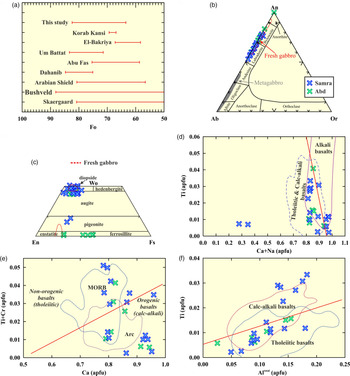
Olivine compositions are enriched in MgO (31.5–44.1 wt %; online Supplementary Material Table S1), indicating the relatively primitive nature of their parental mafic magma. They have a relatively wide range of Fo63.54–82.23 contents, suggesting normal magma fractionation of different olivine generations. They overlap those of younger gabbros from the ANS as well as gabbroic intrusions from Bushveld and Skaergaard (Fig. 4a).
(a) Olivine compositions compared with those in younger gabbroic intrusions. Data sources: Arabian Shield – Surour et al. (Reference Surour, Ahmed and Harbi2017); Nubian Shield (e.g. Umm Battat, El-Bakryia, Korab Kansi, Abu Fas, Dahanib) – Dixon (Reference Dixon1981); M. F. Sadek, unpub. Ph.D. thesis, Ain Shams Univ. (1994); Abdel-Karim et al. (Reference Abdel-Karim, El-Awady, Helmy, El-Afandy and Abdallah2011); Bushveld and Skaergaard intrusions – Wager & Brown (Reference Wager and Brown1967). (b) Ab–An–Or ternary diagram for plagioclase (Deer et al. Reference Deer, Howie and Zussman1992). Fields of metamorphosed and fresh gabbros are after Surour et al. (Reference Surour, Ahmed and Harbi2017). (c) Plots of pyroxene compositions on quadrilateral classification diagram (Morimoto et al. Reference Morimoto, Fabries, Ferguson, Ginzburg, Ross, Seifert, Zussman, Aoki and Gottardi1988). Pyroxene compositions from fresh gabbros in Arabian Shield (Surour et al. Reference Surour, Ahmed and Harbi2017) are shown for comparison. (d) Ti v. Ca + Na, (e) Ti + Cr v. Ca, and (f) Ti v. Altotal diagrams after Leterrier et al. (Reference Leterrier, Maury, Thonon, Girard and Marchal1982).

Feldspars are calcic plagioclase (CaO = 10.98–24.90 wt %), ranging from anorthite to labradorite (Fig. 4b) (online Supplementary Material Table S2). They have anorthite contents (An52.92–99.93) comparable to those of fresh gabbros from the Arabian Shield and higher than those from metagabbros (Fig. 4b; Surour et al. Reference Surour, Ahmed and Harbi2017). This range is also similar to that of gabbroic intrusions in the Eastern Desert of Egypt (Abdel Halim et al. Reference Abdel Halim, Helmy, Abdel-Rahman, Shibata, El-Mahallawi, Yoshikawa and Arai2016; Mogahed, Reference Mogahed2019).
Pyroxenes comprise both ortho- and clinopyroxene similar to fresh gabbros from the western Arabian Shield (Fig. 4c; Surour et al. Reference Surour, Ahmed and Harbi2017). Orthopyroxene compositions in the Abd gabbros are classified as enstatite (Fig. 4c) with low CaO contents (<1 wt %; online Supplementary Material Table S3). They have a relatively wide range of enstatite contents (En = 0.50–0.76; online Supplementary Material Table S3). Compared to coexisting clinopyroxene, enstatite shows low Al2O3 contents (online Supplementary Material Table S3). Clinopyroxenes range from diopside to augite in Samra and Abd, with minor pigeonite in Samra (Fig. 4c). Their Mg no. values range between 0.69 and 0.96. They have low TiO2 (mostly <1.0 wt %) and Na2O (average 0.26 wt %) typical of igneous clinopyroxenes from sub-alkaline rocks (Le Bas, Reference Le Bas1962) (online Supplementary Material Table S3). Moreover, they show a wide range of compositions extending across those of tholeiitic and calc-alkali basalts (Fig. 4d–f). Generally, the clinopyroxene Mg no. values are comparable to those of fresh gabbroic intrusions in the Eastern Desert of Egypt (Mg no. 0.71–0.86; Abdel Halim et al. Reference Abdel Halim, Helmy, Abdel-Rahman, Shibata, El-Mahallawi, Yoshikawa and Arai2016).
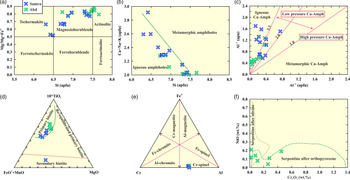
Amphiboles show calcic compositions and are classified mainly as magnesiohornblende with subordinate tschermakite and actinolite (Fig. 5a and online Supplementary Material Table S4). They show variable TiO2 contents (0.02–3.8 wt %). The Si and Ca + Na + K contents reflect their primary igneous origin (Giret et al. Reference Giret, Bonin and Léger1980) (Fig. 5b). Moreover, the Aliv/Alvi ratios indicate mostly igneous calcic amphiboles, with some analyses showing a low-pressure metamorphic origin (Fig. 5c; Fleet & Barnett, Reference Fleet and Barnett1978). They have Mg no. values (mostly 0.77–0.90) similar to those for fresh gabbroic intrusions in the Eastern Desert of Egypt (Abdel Halim et al. Reference Abdel Halim, Helmy, Abdel-Rahman, Shibata, El-Mahallawi, Yoshikawa and Arai2016).
Amphiboles Si (apfu) compared with (a) Mg/Mg + Fe2+ and (b) Ca + Na + K. Amphibole compositional fields are from Leake et al. (Reference Leake, Woolley, Birch, Burke, Ferraris, Grice, Hawthorne, Kisch, Krivovichev, Schumacher, Stephenson and Whittaker2004). Igneous and metamorphic amphiboles are after Giret et al. (Reference Giret, Bonin and Léger1980). (c) Aliv/Alvi ratio variation in amphiboles structure. Ca-amphiboles of igneous and metamorphic (low- and high-pressure) origin are from Fleet & Barnett (Reference Fleet and Barnett1978). (d) Plot of biotite compositions on FeO + MnO–10*TiO2–MgO ternary diagram after Nachit et al. (Reference Nachit, Ibhi, Abia and Ohoud2005). (e) Plot of chromite compositions on Cr–Fe3+–Al ternary diagram. (f) Plot of serpentine compositions on NiO–Cr2O3 binary diagram after Kodolanyi et al. (Reference Kodolanyi, Pettke, Spandler, Kamber and Gmeling2012).

Biotites show morphological and optical features (i.e. euhedral crystals, strong brown colour and pleochroism) suggesting a primary nature. Primary magmatic biotites can be discriminated from those of secondary origin using the ternary relationship (FeO + MnO)–10*TiO2–MgO (Nachit et al. Reference Nachit, Ibhi, Abia and Ohoud2005). Except for one spot, the analysed biotites from the studied gabbros plot in the field of primary magmatic origin (Fig. 5d). Furthermore, they show physicochemical features reflecting their equilibrium with a magmatic liquid. These features include high TiO2 (2.6–5.51 wt %) and XFeO (>0.5; XFeO = (FeOT/(FeOT + MgO)) and the low Alvi (<1) and indicate their primary origin (Nachit et al. Reference Nachit, Ibhi, Abia and Ohoud2005) (online Supplementary Material Table S5).
Accessory phases comprise chromite, titanite, sulfides and Fe–Ti oxides. Chromite compositions (online Supplementary Material Table S6) are classified as Cr-spinel and plot adjacent to the Cr–Al join (Fig. 5e). They have low Cr no. (37.65–39.28) and Mg no. (34.78–37.01) values similar to those of spinel in fresh layered gabbroic intrusions of the Eastern Desert of Egypt (Abdel Halim et al. Reference Abdel Halim, Helmy, Abdel-Rahman, Shibata, El-Mahallawi, Yoshikawa and Arai2016). Titanite has high TiO2 (38.75–44.36 wt %) and CaO (26.57–28.74 wt %) with low Al2O3, FeO, MnO and MgO concentrations (online Supplementary Material Table S7). Sulfide compositions comprise pyrite and chalcopyrite (online Supplementary Material Table S8). Pyrite shows a wide range of S (36.29–54.06 wt %), Fe (47.33–63.19 wt %) and Cu (0.00–0.53 wt %) contents. Conversely, chalcopyrite has a limited range of S (34.96–35.38 wt %), Fe (30.26–31.15 wt %) and Cu (33.80–34.30 wt %) contents. Fe–Ti oxides are magnetite and ilmenite (online Supplementary Material Table S9). Magnetite has high FeO (87.36–96.41 wt %) and low TiO2 (0.00–2.87 wt %) contents, whereas ilmenite has high FeO (42.82–51.11 wt %) and TiO2 (44.41–53.28 wt %) contents. Serpentine represents minor alteration products. It is composed mostly of SiO2 (42.13–46.30 wt %) and MgO (35.89–41.29 wt %) with low Al2O3 (0.31–1.71 wt %) and Cr2O3 (0.02–0.45) contents (online Supplementary Material Table S10). The SiO2 and MgO contents are consistent with the antigorite phase (Wicks & Plant, Reference Wicks and Plant1979). Additionally, the Cr2O3 and NiO contents indicate serpentine after both olivine and orthopyroxene (Fig. 5f).
5.b. Bulk-rock geochemistry
Major oxides, trace elements and REE abundances of the gabbroic rocks from Gabal Samra and Gabal Abd are listed in Table 1. The gabbroic rocks exhibit a narrow range of SiO2 contents (45.98–49.61 wt %) with low total alkalis (1.21–3.13 wt %) and plot inside the compositional field of typical gabbros on a total alkali–silica (TAS) diagram (Fig. 6a). They have a sodic nature (Na2O/K2O >1). Their Zr/Ti and Nb/Y ratios are typical of sub-alkali basalt (Fig. 6b). According to the Y and Zr contents, they show a tholeiitic character (Fig. 6c). This geochemical feature is in harmony with the pyroxene data (Fig. 4d). They show a wide range of Mg no. (54.57–80.17), MgO (1.6–13.8 wt %), Cr (19.36–1383 ppm), Ni (7.14–149.41 ppm) and Sc (2.69–93.77 ppm) contents.
Chemical nomenclature and classification diagrams for the gabbroic rocks. (a) Total alkalis versus SiO2 (Middlemost, Reference Middlemost1994); (b) Zr/Ti–Nb/Y (Pearce, Reference Pearce and Wyman1996); (c) Y–Zr (Barrett & MacLean, Reference Barrett, MacLean and Lentz1994).

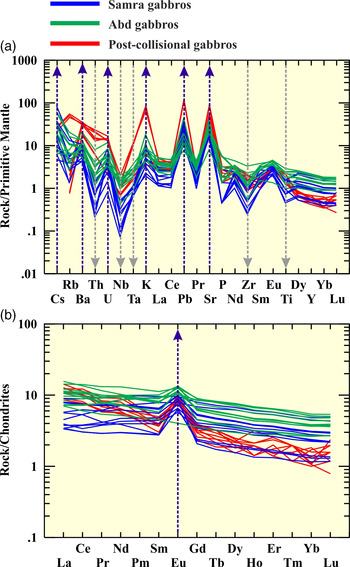
In the primitive mantle-normalized spider diagram (Fig. 7a), the studied gabbros show a depletion of Nb and Ta and enrichment of Pb, Sr, K and U. They display large ion lithophile element (LILE) enrichment (e.g. Cs, Ba, K and Sr) and high-field-strength element (HFSE) depletion (e.g. Th, Nb, Ta, Zr and Ti). In the chondrite-normalized REE patterns, they are enriched in light rare earth elements (LREEs) compared to heavy rare earth elements (HREEs) and show positive Eu anomalies, as do younger fresh gabbros from the western Arabian Shield (Fig. 7b). Generally, their trace-element and REE patterns are comparable to those of younger fresh gabbros from the western Arabian Shield (Fig. 7). They show positive Eu and Sr anomalies together with high Al2O3 contents (up to 28.66 wt %). They have low (Tb/Yb)N values (1.22–1.66).
(a) Primitive mantle-normalized trace-element patterns. (b) Chondrite-normalized REE patterns. Normalization values are from Sun & McDonough (Reference Sun, McDonough, Saunders and Norry1989). Post-collisional gabbros from the western Arabian Shield (Surour et al. Reference Surour, Ahmed and Harbi2017) are shown for comparison.

6. Discussion
6.a. Alteration and crustal contamination effects
The low loss on ignition (LOI) contents (mostly <2.5 wt %) and absence of Ce anomalies (Fig. 7b) of the studied gabbros indicate a negligible effect of alteration (Polat & Hofmann, Reference Polat and Hofmann2003). Moreover, the Rb/Zr, Sr/Zr, Ba/Zr and Ba/La ratios are not correlated with LOI values, indicating restricted element mobility and an insignificant role of post-magmatic alteration (e.g. Ali & Ntaflos, Reference Ali and Ntaflos2011; Ali et al. Reference Ali, Ntaflos and Upton2013; Farahat et al. Reference Farahat, Ali and Hauzenberger2017; Abdallah et al. Reference Abdallah, Ali and Obeid2019). The low Th/La ratios (<0.2) along with the negative Zr and Th anomalies suggest insignificant contamination with crustal materials during magma genesis (e.g. Plank, Reference Plank2005; Yang & Zhou, Reference Yang and Zhou2009). The low Th/Nb (average = 0.3) and Th/Ce ratios (average = 0.03) also suggest that the crustal contamination process was insignificant in the genesis of the gabbroic magmas (Taylor & McLennan, Reference Taylor and McLennan1995; Condie, Reference Condie2003). Their low Lu/Yb ratios (0.14–0.15) are identical to mantle-derived magmas and lower than continental crust, indicating derivation from a mantle source lacking contamination with continental crust (Sun & McDonough, Reference Sun, McDonough, Saunders and Norry1989; Rudnick & Gao, Reference Rudnick, Gao, Rudnick, Holland and Turekian2003). These inferences are also supported by their low SiO2 and total REE contents (e.g. Eyuboglu et al. Reference Eyuboglu, Dilek, Bozkurt, Bektas, Rojay and Sen2010; Abdallah et al. Reference Abdallah, Ali and Obeid2019). Therefore, the bulk-rock compositions reflect a primary geochemical signature and reveal the original nature of their mantle source.
6.b. Magma differentiation and crystallization conditions
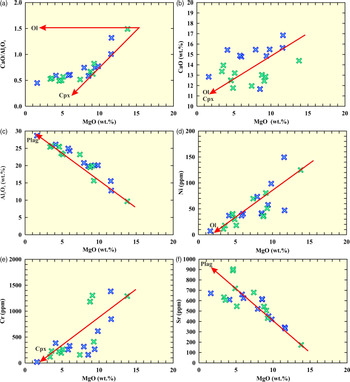
The generally sub-parallel chondrite-normalized REE patterns (Fig. 7b) likely reveal that the gabbroic magmas underwent fractional crystallization. Gabbroic samples (S19 and A23) have the highest Mg no., Cr, Co and Ni contents compared to other rock samples, suggesting that they possibly represent the early magmatic products with olivine fractionation from their primary magmas. The wide range of Mg no., Cr, Ni and Sc contents (Table 1) in the studied gabbros are consistent with variable degrees of olivine and pyroxene fractionation. The broad correlations between MgO and CaO/Al2O3 and CaO (Fig. 8a, b) indicate that they have experienced significant fractionation of olivine and clinopyroxene. This is supported by the positive correlations between MgO and Ni and Cr (Fig. 8d, e). The increase of Al2O3 and Sr with decreasing MgO (Fig. 8c, f) probably indicates plagioclase accumulation. Furthermore, the positive Eu and Sr anomalies (Fig. 7) confirm a role of plagioclase accumulation during the evolution of the studied gabbros.
MgO versus (a) CaO/Al2O3, (b) CaO, (c) Al2O3, (d) Ni, (e) Cr, and (f) Sr plots to show the possible fractional phases of the studied gabbros during magmatic evolution.

Based on the empirical model of Sack & Ghiorso (Reference Sack and Ghiorso1991), the crystallization temperature of the Cr-spinel in the studied gabbros approximates 1050 °C (Fig. 9a). Amphibole crystallization pressure ranges from 3.54 to 7.75 kbar (Schmidt, Reference Schmidt1992), comparable to that of layered mafic intrusions from southern Sinai (4.8–6.8 kbar; Azer et al. Reference Azer, Obeid and Gahlan2016). They crystallized at high oxygen fugacity conditions (fO2) (Fig. 9b), similar to layered gabbros in southern Sinai (Azer et al. Reference Azer, Obeid and Gahlan2016). The biotite compositions of the Abd gabbros contain higher MgO (11.32–13.05 wt %) and TiO2 (4.01–5.51 wt %) contents compared to those of the Samra gabbros, likely suggesting early crystallization at a higher temperature.
(a) Cr-spinel empirical thermometer (after Sack & Ghiorso, Reference Sack and Ghiorso1991). Equipotential curves and Fe3+/Fe2+ of melt are from Irvine (Reference Irvine1965) and Agata & Adachi (Reference Agata and Adachi2014). The equipotential curves shifting towards the left represents magmatic differentiation, whereas the parallel arrow shows the elemental exchange trend. (b) Fet/(Fet + Mg)–Aliv diagram for amphiboles (Anderson & Smith, Reference Anderson and Smith1995).

6.c. Mineralogical implications
The existence of amphiboles of primary igneous origin in the studied gabbros is consistent with the hydrous nature of the parental magma(s). This is also supported by the presence of primary biotites. Moreover, the occurrence of An-rich plagioclases (An52.92–99.93) suggests that their primary melts were Na-depleted and Al- and H2O-enriched, because plagioclase crystallization under hydrous conditions leads to increasing An contents (e.g. Carmichael et al. Reference Carmichael, Turner and Verhoogen1974; Sisson & Grove, Reference Sisson and Grove1993; Panjasawatwong et al. Reference Panjasawatwong, Danyushevsky, Crawford and Harris1995; Martel et al. Reference Martel, Pichavant, Bourdier, Traineau, Holtz and Scaillet1998; Koepke et al. Reference Koepke, Feig, Snow and Freise2004). Their Ca-rich nature (online Supplementary Material Table S2) likely reflects their crystallization from arc-like magmas (Ballantyne, Reference Ballantyne, Parson, Murton and Browning1992). The clinopyroxene and spinel compositions (Fig. 12) also show an arc-like character. The clinopyroxene (up to Wo51) and olivine (up to Fo82.23) compositions suggest crystallization of these minerals from mafic magmas under hydrous conditions (Kushiro, Reference Kushiro1990; Kushiro & Mysen, Reference Kushiro and Mysen2002; Mysen, Reference Mysen2014). The gabbroic rocks contain augite and pigeonite characteristic of tholeiitic suites (Fodor & Keil, Reference Fodor and Keil1979). Moreover, the pyroxene data indicate a mainly tholeiitic character (Figs 4f, 11a). These implications reflect crystallization from hydrous, mainly tholeiitic, mafic magmas with arc-like signatures, which were probably inherited from the previous subduction process in the ANS.
6.d. Nature of the mantle source and melting conditions
The identical chondrite-normalized REE patterns of the studied gabbros reflect their derivation from a common mantle source. The rocks show low Nb, Ta, Zr and Hf concentrations and sub-chondritic Nb/U (average = 6.46), Nb/Ta (average = 7.79) and Zr/Hf ratios (average = 29.08), revealing mantle source depletion by a former melt extraction event (e.g. Jochum et al. Reference Jochum, Seufert, Spettel and Palme1986; Yang & Zhou, Reference Yang and Zhou2009).
The HREE contents in mafic magmas can be used to constrain mantle melting depths (e.g. Blundy et al. Reference Blundy, Robinson and Wood1998; Walter, Reference Walter1998; Tang et al. Reference Tang, Zhang and Ying2006). The relatively low HREE contents of the studied gabbros (e.g. YbN = 1.18–5.41) suggest residual garnet in their mantle source (Tang et al. Reference Tang, Zhang and Ying2006). The (Gd/Yb)N ratios greater than unity indicate garnet in the residue (Walter, Reference Walter1998). So, the high (Gd/Yb)N ratios (1.36–1.90) confirm the garnet signature in the mantle residue. Moreover, high ratios of (Dy/Yb)N = 1.13–1.48 indicate that the gabbroic melts were produced from a garnet-peridotite source (Blundy et al. Reference Blundy, Robinson and Wood1998). The presence of garnet as a residual phase in the source region requires a melting depth exceeding ∼70–80 km at the garnet stability field (Tang et al. Reference Tang, Zhang and Ying2006). This HREE signature suggests a relatively deeper origin for the gabbroic rocks.
6.e. Modification of the mantle source
The geological field relations of the studied gabbros are consistent with post-collisional mafic magmatism. The trace-element and REE patterns (Fig. 7) are also similar to post-collisional mafic rocks. However, the mineralogical and geochemical data show arc-like features (Figs 10a, 11, 12), suggesting that their arc- and subduction-like signatures were probably inherited from the previous collisional stage in the ANS (e.g. Khalil et al. Reference Khalil, Obeid and Azer2015; Gahlan et al. Reference Gahlan, Obeid, Azer and Asimow2018).
(a) Nb/U–Nb diagram. Fields for island-arc basalts and Nb-enriched arc basalts are from Defant et al. (Reference Defant, Jackson and Drummond1992) and Schiano et al. (Reference Schiano, Clocchiatti, Shimuzu, Maury, Jochum and Hofmann1995), respectively. (b) La/Ba–La/Nb diagram. Ocean-island basalt (OIB), mid-ocean ridge basalt (MORB) and HIMU (high-U/Pb) mantle source fields are from Saunders et al. (Reference Saunders, Storey, Kent, Norry, Storey, Alabaster and Pankhurst1992).

Pyroxene compositions plotted on (a) Ti v. Aliv diagram (Beccaluva et al. Reference Beccaluva, Macciota, Piccardo and Zeda1989) and (b) Aliv∗100/2 v. TiO2 diagram. The arc- and rift-cumulate trends are from Loucks (Reference Loucks1990). (c) Cr no. v. Mg no. for the studied spinels compared to spinels from the subduction-related magmatic rocks (New Georgia arcs; Ramsay et al. Reference Ramsay, Crawford and Foden1984) and MORB (Sigurdsson & Schilling, Reference Sigurdsson and Schilling1976; Dick & Bullen, Reference Dick and Bullen1984). Abbreviations: IAT – island-arc tholeiite; MORB – mid-ocean ridge basalt.

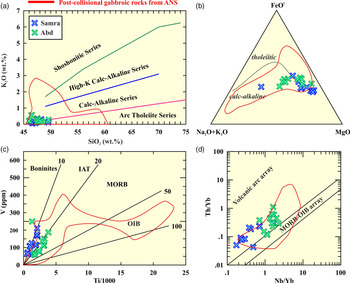
(a) K2O–SiO2 diagram (Peccerillo & Taylor, Reference Peccerillo and Taylor1976). (b) AFM diagram. The dashed line separating tholeiitic and calc-alkaline rocks is after Irvine & Baragar (Reference Irvine and Baragar1971). (c) V–Ti diagram (Shervais, Reference Shervais1982). (d) Th/Yb–Nb/Yb diagram (Pearce, Reference Pearce2008). Post-collisional gabbroic rocks from the ANS are shown for comparison (Khalil et al. Reference Khalil, Obeid and Azer2015; Surour et al. Reference Surour, Ahmed and Harbi2017; Eldougdoug et al. Reference Eldougdoug, Abd El-Rahman and Harbi2020). Abbreviations: IAT – island-arc tholeiite; MORB – mid-ocean ridge basalt; OIB – ocean-island basalt.

A mantle peridotite source modified by subduction components is widely agreed for the post-collisional magmatism (e.g. Bonin, Reference Bonin2004; Khalil et al. Reference Khalil, Obeid and Azer2015; Surour et al. Reference Surour, Ahmed and Harbi2017; Gahlan et al. Reference Gahlan, Obeid, Azer and Asimow2018; Farahat & Ali, Reference Farahat and Ali2019). Subduction input raises contents of mobile elements (LILEs; Cs, Rb, Ba, U, K, Pb and Sr) and volatiles (i.e. H2O, Cl and S) (e.g. Hawkesworth et al. Reference Hawkesworth, Gallagher, Hergt and McDermott1993; Wallace, Reference Wallace2005). On the other hand, immobile elements (HFSEs; Nb, Ta, Zr, Hf and Y) remain in the subducted slab, leading to their depletion compared to LILEs (Prouteau et al. Reference Prouteau, Scaillet, Pichavant and Maury2001; Bonin, Reference Bonin2004). Accordingly, the LILE enrichment and the HFSE depletion (Fig. 7a) indicate subduction-like signatures. Moreover, these characters are similar to other late Neoproterozoic post-collisional mafic magmatism in the ANS (Khalil et al. Reference Khalil, Obeid and Azer2015; Surour et al. Reference Surour, Ahmed and Harbi2017; Gahlan et al. Reference Gahlan, Obeid, Azer and Asimow2018; Farahat & Ali, Reference Farahat and Ali2019). The low HFSE content likely reflects the contribution of an arc-related source, and the high LILE content probably reveals that subducted oceanic sediment was also involved in their petrogenesis (Eyuboglu et al. Reference Eyuboglu, Dudás, Santosh, Zhu, Yi, Chatterjee, Jeong, Akaryali and Liu2016). The fluid mobile element (FME; such as Cs, U, Pb and Sr) enrichments (Fig. 7a), and the high Ba/Th (796), Ba/La (38) and Ba/Nb (232) average ratios support the signatures of sediment-derived fluids, which were inherited from the previous subduction event (Cisterna et al. Reference Cisterna, Koukharsky, Coira, Günter and Ulbrich2017; Abdel-Karim et al. Reference Abdel-Karim, Ali and El-Shafei2018 and references therein). The La/Nb ratios (>1.4) also reflect subduction-like signatures (Condie, Reference Condie2003 and references therein), as do the Nb/U ratios, which are consistent with arc-like basalts (Fig. 10a).
Oceanic basalts show relatively elevated and invariable Nb/U ratios (Hofmann et al. Reference Hofmann, Jochum, Seufert and White1986; Hofmann, Reference Hofmann1997). Numerous continental flood basalts conversely show low Nb/U and Nb/La ratios, as do the studied gabbros. This Nb fractionation could happen through melt–rock reactions during asthenospheric magma ascent through the lithospheric mantle due to the different reaction rates of minerals in metasomatized peridotite (Arndt & Christensen, Reference Arndt and Christensen1992). So, the low Nb/U and Nb/La ratios and negative Nb anomalies of the studied gabbros might indicate contributions of metasomatized lithospheric mantle into their asthenospheric source through a melt–rock reaction process (e.g. Tang et al. Reference Tang, Zhang and Ying2006). This inference is further supported by the relationship between the La/Ba and La/Nb ratios (Fig. 10b), which shows deviation of the studied gabbros from oceanic basaltic melts produced from an asthenospheric source towards lithospheric mantle. So, this trend shown by the studied rocks (Fig. 10b) might also reflect that asthenosphere-derived magmas interacted with lithospheric mantle. We suggest that the gabbroic parental magmas were derived from adiabatic decompression melting of a depleted asthenospheric mantle interacting during ascent with metasomatized lithospheric mantle.
6.f. Geotectonic setting
Geological field study and mineralogical data indicate that the studied gabbros are generally unmetamorphosed and undeformed. Moreover, field relations show that they are intruded by younger monzogranite and syenogranite. These traits are typical of gabbros emplaced in a post-collisional setting and distinguish them from the early phase of subduction-related gabbroic rocks in the ANS, which are metamorphosed and deformed (e.g. Khalil et al. Reference Khalil, Obeid and Azer2015; Surour et al. Reference Surour, Ahmed and Harbi2017; Gahlan et al. Reference Gahlan, Obeid, Azer and Asimow2018).
On the Ca–Ti diagram, clinopyroxene compositions plot in the orogenic/non-orogenic basalts fields (Fig. 4e) (Leterrier et al. Reference Leterrier, Maury, Thonon, Girard and Marchal1982). The Aliv–Ti diagram shows affinity to island-arc tholeiites (IAT) (Fig. 11a; Beccaluva et al. Reference Beccaluva, Macciota, Piccardo and Zeda1989). Moreover, they show a trend transitional between arc- and rift-cumulate rocks (Fig. 11b). These transitional features of clinopyroxenes are possibly due to emplacement in a post-collisional setting during an extensional phase. The Cr-spinels have Cr no. and Mg no. values similar to those of subduction-related rocks in New Georgia (Fig. 11c; Ramsay et al. Reference Ramsay, Crawford and Foden1984). In addition, their values are comparable to those of layered gabbroic intrusions emplaced during post-collisional extension (Abdel Halim et al. Reference Abdel Halim, Helmy, Abdel-Rahman, Shibata, El-Mahallawi, Yoshikawa and Arai2016). Primary calcic amphiboles and An-rich plagioclases usually crystallized from hydrous magmas with arc-like signatures (Jakes & White, Reference Jakes and White1972; Hébert & Laurent, Reference Hébert, Laurent, Malpas, Moores, Panayiotou and Xenophontos1990; Ballantyne, Reference Ballantyne, Parson, Murton and Browning1992).
The trace-element and REE patterns of the studied gabbros are comparable to those of gabbros formed in a post-collisional setting (Fig. 7). According to the SiO2–K2O correlation and AFM diagram (Fig. 12a, b), they show arc-tholeiitic-like features with a slight calc-alkaline tendency. The Ti–V diagram (Fig. 12c) shows a transitional character between IAT and mid-ocean ridge basalt (MORB). All these implications are in harmony with the pyroxene data (Fig. 4d–f). Additionally, the Nb/U ratios are comparable to those of basalts having island-arc-like features (Fig. 10a). On the Th/Yb–Nb/Yb diagram, they plot above the mid-ocean ridge – ocean-island basalt (MORB–OIB) array and within the volcanic arc array, indicating subduction-like characters (Fig. 12d). These geochemical features resemble those of post-collisional gabbroic rocks from the ANS (Fig. 12). It is important to note that the discrimination diagrams cannot distinguish between arc and post-collisional settings. We suggest that the arc- and subduction-like characters displayed by the pyroxene and spinel compositions and by the bulk-rock compositions were likely inherited from the previous subduction event in the ANS.
We conclude that the post-collisional mafic magmatism in the Arabian Shield was probably produced owing to lithospheric extension and upwelling of asthenospheric mantle at the end of the Pan-African orogenic cycle. Moreover, the lithospheric extension is most likely related to the activity of the Najd Fault System. In summary, the geological field relations supported by mineralogical features and geochemical data argue for generation of the studied gabbros during post-collisional extension.
7. Conclusions
The gabbroic rocks of Saudi Arabia represent an important part of the mafic magmatism in the Neoproterozoic Arabian Shield. The present study focused on the gabbroic rocks located in the Gabal Samra and Gabal Abd areas of the Hail region, which belongs to the Arabian Shield of Saudi Arabia. Geological field relations and studies, reinforced by mineralogical and geochemical data, demonstrate their largely unmetamorphosed and undeformed nature, and indicate emplacement in a post-collisional regime. Their mineralogical and geochemical characteristics suggest crystallization from hydrous, mainly tholeiitic, mafic magmas, possibly with inherited arc-like signatures from the previous subduction process in the ANS.
The studied gabbros have Nb/U, Nb/Ta and Zr/Hf ratios below chondritic values, suggesting depletion of their mantle source. Additionally, the elevated (Gd/Yb)N and (Dy/Yb)N ratios reflect derivation from a garnet-peridotite source with a garnet signature in the mantle residue. This inference indicates melting at a depth greater than ∼70–80 km at the garnet stability field. They have geochemical features comparable to other post-collisional gabbros of the Arabian Shield. The present study suggests that the gabbroic rocks could have originated by adiabatic decompression melting of a depleted asthenospheric mantle, followed by interaction during ascent with metasomatized lithospheric mantle in an extensional regime, likely related to the Najd Fault System activity, at the end of the Pan-African Orogeny.
Acknowledgements
The authors would like to thank Prof. Mohamed Abd El-Wahed, Tanta University, for redrawing the geological maps. We are also grateful to Prof. Shehta E. Abdallah, Zagazig University, for providing mineral and bulk-rock chemistry. The editor Dr Kathryn Goodenough and two anonymous referees are greatly thanked for their valuable suggestions and comments, which indeed helped us to improve the manuscript. This research received no specific grant from any funding agency, commercial or not-for-profit sectors.
Supplementary material
To view supplementary material for this article, please visit https://doi.org/10.1017/S0016756821000182