Kefir is a milk fermented product, originated in Caucasian mountains many centuries ago, that has become popular in many European countries and Canada and its consumption has been associated with several health-promoting properties such as antimicrobial, antitumoral, immunological and hypocholesterolemic effects (Farnworth, Reference Farnworth2005). The milk is fermented with a mixed microflora confined to a matrix of discrete “kefir grains” in which yeasts and lactic acid bacteria (lactobacilli, lactococci, leuconostoc) coexist in a symbiotic association and are responsible for the acid-alcoholic fermentation (Angulo et al. Reference Angulo, Lopez and Lema1993; Garrote et al. Reference Garrote, Abraham and De Antoni2001). Because kefir composition is very complex, it is difficult to maintain a constant quality of fermented milk, and the shelf life of the product is limited (Zabala, Reference Zabala2004). Taking into account the health promoting properties attributed to kefir and the difficulty of industrial production and storage, it could promising to use a mixture of microorganisms isolated from kefir for the formulation of a new product.
Our workgroup have isolated and characterized more than 100 bacterial and yeast strains from kefir grains which showed differences in surface and probiotic properties such as bile salts and low pH resistance, adhesion to Caco-2 cells and inhibitory power against intestinal pathogens in vitro (Garrote et al. Reference Garrote, Delfederico, Bibiloni, Abraham, Perez, Semorile and De Antoni2004; Golowczyc et al. Reference Golowczyc, Mobili, Garrote, Abraham and De Antoni2007, Reference Golowczyc, Gugliada, Hollmann, Delfederico, Garrote, Abraham, Semorile and De Antoni2008).
Among the microorganisms studied in the present work the yeasts Saccharomyces cerevisiae CIDCA 8112 and Kluyveromyces marxianus CIDCA 8154 showed a very high resistance to bile salts and were capable to down regulate pro-inflammatory response induced in intestinal epithelial cells in vitro and in vivo (Romanin et al. Reference Romanin, Serradell, González-Maciel, Lausada, Garrote and Rumbo2010). Lactobacillus plantarum CIDCA 83114 showed a high inhibitory power against Salmonella spp. and Shigella spp. in vitro (Golowczyc et al. Reference Golowczyc, Gugliada, Hollmann, Delfederico, Garrote, Abraham, Semorile and De Antoni2008) and prevented detachment of eukaryotic cells and minimized both F-actin rearrangements and morphological alterations mediated by enterohemorrhagic Escherichia coli O157:H7 on Hep-2 cells (Hugo et al. Reference Hugo, Kakisu, De Antoni and Perez2008). Lactobacillus kefir CIDCA 8348 through its S-layer inhibited the invasion of Salmonella enterica into Caco-2 cells (Golowczyc et al. Reference Golowczyc, Mobili, Garrote, Abraham and De Antoni2007). Lactococcus lactis CIDCA 8221 has the ability to grow and acidify the milk faster than the other microorganisms already mentioned (Garrote Reference Garrote2000). In addition, other authors have demonstrated the ability of strains of Lc. lactis to inhibit pathogens by production of bacteriocins (Bravo et al. Reference Bravo, Rodriguez and Medina2009).
The possibility to optimize the conditions to obtain a dehydrated microbial product with capacity to recover viability after rehydration would be the first step to increase the shelf life of a product and avoid the undesired changes in composition and properties that occur during preservation. Freeze-drying is one of the most commonly used procedures for preservation of microbial culture collections and concentrated starter cultures. However, during freeze-drying cells experience adverse environmental conditions, such as low temperature and low water activity, which reduces their viability. In this sense, the use of cryoprotectants has been demonstrated to improve the survival rates of different microorganisms and their effect seems to be one of the most important parameters during freezing and freeze-drying procedures (De Antoni et al. Reference De Antoni, Pérez, Abraham and Añón1991; de Urraza & De Antoni, Reference de Urraza and De Antoni1997; Carvalho et al. Reference Carvalho, Silva, Ho and Teixeira2004; Blanquet et al. Reference Blanquet, Garrait, Beyssac, Parrier, Denis, Hébrard and Alric2005). Different authors have demonstrated that carbohydrates and proteinaceous substances exert a protective effect on survival of bacterial or yeast strains during freeze-drying and storage. In particular, various sugars were found to be protective for different lactobacilli (Leslie et al. Reference Leslie, Israeli, Lighthart, Crowe and Crowe1995; Linders et al. Reference Linders, Wolkers, Hoekstra and van‘t Riet1997; Selmer-Olsen et al. Reference Selmer-Olsen, Birkeland and Sorhaug1999; Carvalho et al. Reference Carvalho, Silva, Ho, Teixeira, Malcata and Gibbs2002, Reference Carvalho, Silva, Ho, Teixeira, Malcata and Gibbs2003, Reference Carvalho, Silva, Ho, Teixeira, Malcata and Gibbs2004). Among proteinaceous systems, milk or its proteins were commonly employed as cryoprotectant (Abraham et al. Reference Abraham, De Antoni and Añón1990; Abadias et al. Reference Abadias, Benabarre, Taixidó, Usall and Viñas2001; Blanquet et al. Reference Blanquet, Garrait, Beyssac, Parrier, Denis, Hébrard and Alric2005; Otero et al. Reference Otero, Espeche and Nacer Macías2007).
On the other hand, since the safety of probiotic is usually an issue of discussion in the health area, it is necesary to investigate not only the benefits but also the potential side effects of administration of probiotic microorganisms. A good safety indicator is the absence of microbial translocation through the epithelial barrier and the passage into sterile body sites. Although a degree of translocation in healthy hosts has been reported (Pavan et al. Reference Pavan, Desreumaux and Mercenier2003), when the integrity of the intestinal mucosa is interrupted or when the immune system is unable to control the translocated microorganisms they could produce a local infection or reach the bloodstream causing sepsis (Berg, Reference Berg1999).
The aim of this work was the development of a microbial mixture constituted of microorganisms isolated from kefir, the evaluation of freeze-drying for the preservation of the product in cryoprotected conditions, and the maintenance of the in vitro probiotic properties and the in vivo safety of the freeze-dried mixture. The results of this work will be essential in order to develop a freeze-dried microbial concentrate which could be used as a probiotic supplement of the diet or industrial starter culture.
Material and Methods
Microorganisms and culture conditions
Pure cultures used in this study comprised Lactococcus lactis CIDCA 8221, Lactobacillus plantarum CIDCA 83114, Lactobacillus kefir CIDCA 8348, Kluyveromyces marxianus CIDCA 8154 and Saccharomyces cerevisiae CIDCA 8112. These strains were previously isolated from kefir grains and have been identified and characterized by Garrote et al. (Reference Garrote, Abraham and De Antoni2001) and Delfederico et al. (2006). The original reference cultures were maintained in milk at −80°C. Both lactobacilli and yeasts were propagated in MRS-broth (DIFCO, Detroit, USA) for 48 h at 30°C. Lactococcus lactis was grown in 1.1.1 growth media (1% w/v of tryptone – Difco, Detroit, USA – 1% w/v of yeast extract – Biokard Diagnostic, Beauvais, France – and 1% w/v of lactose – Mann Research Laboratories, NY) (Abraham et al. Reference Abraham, De Antoni and Añón1990) for 24 h at 30°C. Shigella sonnei (isolate n° 67212 from Hospital de Niños Sor Maria Ludovica de La Plata) was cultured in Tryptone soy broth (TSB) (Biokard Diagnostic, Beauvais, France) at 37°C with shaking for 18 h.
Preparation of products for freeze-drying procedure
Each microorganism was cultured individually as described above. Microbial cultures were harvested by centrifugation at 10 000 g for 15 min and washed three times and resuspended in sterile phosphate buffered saline (PBS) pH=7·2 (microbial suspensions). To obtain the microbial mixture (MM), a combination of 1 ml of each microbial suspension was centrifuged at 10 000 g for 15 min and resuspended in 1 ml sterile UHT milk or UHT milk with added trehalose (Mann Research Laboratories Division of Becton Dickinson & Co) (300 mm) or sucrose (Anedra, Argentina) (300 mm) or PBS. The final concentration of bacteria and yeasts in MM was 109 CFU/ml and 106 CFU/ml respectively. To obtain the milk product fermented with MM (FMM), 1 ml MM was added to 9 ml UHT milk and finally incubated at 30°C during 48 h until pH=4·90. The final concentration of microorganisms in the FMM was 109 bacterial CFU/ml and 106 yeast CFU/ml.
Freeze-drying and storage conditions
The ampoules with 200 μl of MM or FMM with or without cryoprotector were frozen at −80°C for 8 h and freeze-dried for 24 h in air using a HETO 7D4 Lab Equipment. Dried cells were stored at 4°C during a period ranged for 1 to 180 days. Immediately after freeze-drying and at different time intervals of storage, samples taken at random were rehydrated to the original volume with sterile deionised water and plated for enumeration of viable microorganisms.
Enumeration of microorganisms
The number of viable cells was determined as colony forming units per ml (CFU/ml). Serial dilutions of samples (from 10−1 to 10−9) were prepared in 0·1% tryptone and plated on MRS agar, 1.1.1 agar and YGC agar (Biokard Diagnostic, Beauvais, France). Plates were incubated at 30°C for 24–48 h in aerobic environment. The survival rate was calculated as CFU/ml after freeze-drying divided by CFU/ml before freeze-drying.
Plate count of Shigella sonnei was performed in Nutrient agar (Biokard Diagnostic, Beauvais, France).
Shigella inhibition assay
Overnight cultures of Shigella sonnei with approximately 108 CFU/ml were centrifuged (3000 g for 15 min) and the pellets were suspended at equal volume in TSB. Ten ml of either freeze-dried or fresh MM resuspended in TSB were added to Shigella culture at 1:1 ratio and incubated at 37°C with shaking at 180 rpm. Enumeration of Shigella was performed at different time intervals (3, 8, 24, 48 h) as indicated. Cultures of Shigella in TSB and TSB with 30% v/v of UHT milk added were performed as controls.
Translocation assay
Seven-week-old BALB/c females were fed daily ad libitum with a 1/100 dilution of freeze-dried MM in sterile water (approximately 108 bacteria per ml and 106 yeasts per ml) for 7 or 20 consecutive days. Control group were offered milk (diluted 1/100 in PBS). Each experimental group consisted in 5 mice housed in cages kept in controlled environment of temperature and with a 12 h dark/light cycle. All animals received, simultaneously a sterile conventional balanced diet.
At the end of each feeding period, mice were killed by CO2 chamber and liver, spleen and a 3-cm portion of small intestine were removed aseptically. Liver and spleen were homogenized in 0·1% sterile tryptone water (0·1 g per ml) and 100 μl of each organ homogenate was plated on VRBG Agar (Biokard Diagnostic, Beauvais, France) for enterobacteria, 1.1.1 Agar for lactococci, MRS agar for lactobacilli, YGC agar for yeasts and Nutritive Agar (AN). Plates were incubated under aerobic conditions for 24 h at 37°C for VRBG and AN, and for 24–48 h at 30°C for lactobacilli and lactococci. At the end of the incubation period, plates were examined. Translocation was considered to have occurred when colonies were observed on agar plates, since liver and spleen are organs normally devoided of microorganisms. Additionally, intestinal content was washed with 1 ml sterile PBS, and serial dilutions of samples were plated on the same culture media mentioned above.
Statistical analysis
Differences in survival rates of microorganisms were statistically tested by using Student t-test to determine any significant difference.
Results
Effect of cryoprotectants on freeze-drying resistance
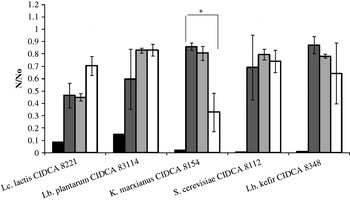
The protective effects of the milk, and milk supplemented with 300 mm-trehalose or 300 mm-sucrose on the survival of each of all strain mentioned in Material and Methods were studied. The survival rates obtained with UHT milk as cryoprotectant were significantly higher (P<0·05) for all the microorganisms compared with those observed with PBS (Fig. 1). Addition of trehalose or sucrose did not increase the survival rates of lactobacilli (Lb. kefir CIDCA 8348 and Lb. plantarum CIDCA 83114), Lc. lactis CIDCA 8221 and Sac. cerevisiae CIDCA 8112, whereas survival rate of K. marxianus CIDCA 8154 decreased in presence of 300 mm-sucrose (P<0·05; Fig. 1).
Survival (N/No) of Lc. lactis CIDCA 8221, Lb. kefir CIDCA 8348, Lb. plantarum CIDCA 83114, S. cerevisiae CIDCA 8112 and K. marxianus CIDCA 8154 freeze-dried in PBS (▪), UHT milk ( ), UHT milk supplemented with 300 mM trehalose (
 ) or 300 mm sucrose (□) after freeze-drying procedure. No: counts of viable microorganisms (CFU/ml) before freeze-drying. N: counts of viable microorganisms (CFU/ml) after freeze-drying. *P<0·05 vs UHT milk. In all cases, survival with the cryoprotectant is significantly different to survival in PBS buffer (P<0·05).

All these results taken together, indicated that the addition of sugars to UHT milk did not improve the cryoprotective action of the milk. Therefore, UHT milk alone was used as cryoprotectant for all subsequent experiments.
Effect of storage and type of product on freeze-drying resistance
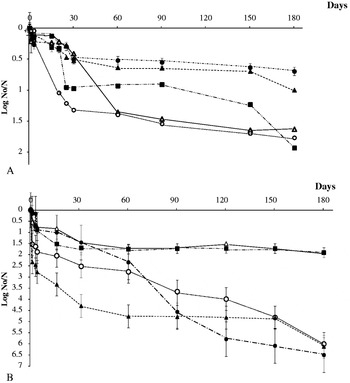
In order to study the capacity of each component of the freeze-dried MM to survive during storage after freeze-drying, the survival rates at different times of storage at 4°C were analysed. When freeze-drying was performed with the MM all microorganisms suffered a reduction in survival rates between 0·5 and 1 log after 30 d storage (Fig. 2A). However, in the freeze-dried FMM there were a noticeable reduction of survival rates for all microorganisms (between 1·5 and 4·5 log) after the same time of storage (Fig. 2B).
Survival (log No/N) of each microorganism in the freeze-dried MM (A) or freeze-dried FMM (B) versus storage time at 4°C. Lc. lactis CIDCA 8221 (•), Lb. plantarum CIDCA 83114 (▵), Lb. kefir CIDCA 8348 (▪), Sac. cerevisiae CIDCA 8112 (○) and K. marxianus CIDCA 8154 (▴). No: counts of viable microorganisms (CFU/ml) before freeze-drying. N: counts of viable microorganisms (CFU/ml) after freeze-drying.

Between 30 and 180 d storage, the viability of each microorganism in the MM decreased almost 2 log (Fig. 2A). However, during the same period of storage, the survival of each microorganism in the FMM showed a different behaviour. A significant reduction in survival rates of Lb. plantarum CIDCA 83114 and yeasts (Sac. cerevisiae CIDCA 8112 and K. marxianus CIDCA 8154) decreased almost 6 log after 180 d storage at 4°C (Fig. 2B).
Since freeze-dried MM without previous fermentation showed a better stability than the FMM, we selected MM to perform all the subsequent experiments.
Shigella inhibition assay
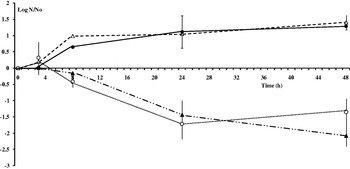
The incubation of Shigella with either the MM freeze-dried or not produced a bactericidal effect which is evident after 24 and 48 h of incubation, since a decrease of 2 log in Shigella viability was observed with both treatments (Fig. 3). The same figure shows that controls performed without MM did not affect Shigella viability. These results suggest that freeze-drying did not have a negative effect on the capacity of microbial mixture to inhibit Shigella growth in vitro.
Survival (Log N/No) of Shigella sonnei versus time of incubation in presence of freeze-dried (○) or fresh (▴) MM. Control of Shigella in TSB (▵) and TSB with milk (•).

The inhibitory effect of MM on Shigella viability could be attributed to the presence of acids, since a decrease of pH (from 6·0 to 5·0) during the first 24 h of incubation of Shigella with freeze-dried or fresh MM compared with controls in TSB was observed. According to this, when Shigella culture in TSB was acidified to pH 5·0 with lactic acid a decrease of 4 log in viability within 24 h incubation was observed (data not shown).
Translocation of microorganisms
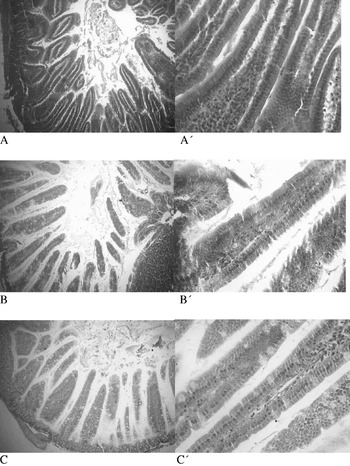
In order to evaluate safety of feeding with freeze-dried MM, we performed a translocation assay in mice. The administration of freeze-dried MM during 7 or 20 d did not induce the translocation of microorganisms to liver or spleen, since no colonies were detected on any of five agar media selected to this assay (Table 1). Moreover, no cellular infiltration was observed by microscopic observation of haematoxylin-eosin stain of histological slices of small intestine from treated and control mice (Fig. 4).
Haematoxylin-eosin stain of histological slices of small intestine from treated and control mice. Panel A and A′: control mice; panel B and B′: mice treated daily with freeze-dried MM for 7 days; panel C and C′: mice treated for 20 days. Panels A, B and C: 10×. Panels A′, B′ and C′: 40×.

Translocation of microorganisms to spleen and liver after administration ad libitum of freeze-dried microbial mixture to BALB/c mice for 7 or 20 days.

† Counts are given in CFU per cm of small intestine
‡ Counts are given in CFU per 0·1 g of organ
Discussion
To the present, there are a small number of bibliographic references about the development of microbial concentrates or starters containing mixtures of bacteria and yeasts however they do not include studies about probiotic properties of those mixtures (Mugula et al. Reference Mugula, Narvhus and Sørhaug2003; Loveness et al. 2007). Additionally, although the application of freeze-drying procedures to preserve microorganisms is well documented, most of the work was performed using individual strains of bacteria or yeasts, and there are only few reports including mixtures of bacterial strains (Champagne et al. Reference Champagne, Gardner, Brochu and Beaulieu1991; Morgan et al. Reference Morgan, Herman, White and Vesey2006).
This study shows the development of a probiotic mixture containing different strains of lactobacilli and yeasts isolated from kefir grains which can be preserved by freeze-drying. Given the safety profile assumed from the origin of selected strains, this product could be an attractive microbial mixture to develop a new probiotic supplement for human consumption. However, mechanisms of probiotic action in vivo are not yet elucidated. Based on the results of our study we hypothesise that the microbial mixture of lactic acid bacteria and yeast isolated from kefir grains could prevent or decrease the duration time and recurrence of gastrointestinal infections. These hypotheses are based on the evidence that Lb. kefir CIDCA 8348 through its S-layer decrease the invasion of Caco-2 cells by Salmonella enterica (Golowczyc et al. Reference Golowczyc, Mobili, Garrote, Abraham and De Antoni2007) and Lb. plantarum CIDCA 83114 showed a high inhibitory power against enteropathogens in vitro (Golowczyc et al. Reference Golowczyc, Gugliada, Hollmann, Delfederico, Garrote, Abraham, Semorile and De Antoni2008; Hugo et al. Reference Hugo, Kakisu, De Antoni and Perez2008). On the other hand, K. marxianus CIDCA 8154 is a lactose fermenter yeast (Echeverría et al. Reference Echeverría, Garrote and De Antoni2007) that could alleviate the lactose intolerance by the increase of β-galactosidase at intestinal level. A large randomized placebo controlled trial is necessary to confirm these findings. In addition, both yeasts (K. marxianus CIDCA 8154 and Sac. cerevisae CIDCA 8112) have been shown to exert anti-inflammatory effects on stimulated intestinal epithelium in vitro and in vivo (Romanin et al. Reference Romanin, Serradell, González-Maciel, Lausada, Garrote and Rumbo2010).
Since all microorganisms included in the formulation are mesophiles, fermentation continues in refrigeration conditions. Like in the case of milk fermented with kefir grains, the shelf life of these products is less than one week because acidification and gas production increase during storage at 4–10°C leading to a non acceptable product. For this reason, the alternative is the preservation in a dehydrated state. The comparison of survival of each strain in freeze-dried MM and freeze-dried FMM indicates that it was not possible to preserve the viability of yeasts in the last product. These results suggest that the acids produced during fermentation affect the capacity of microorganisms, especially yeasts, to survive freeze-drying in adverse environmental conditions. In contrast, after freeze-drying MM, the viability of all microorganisms (bacteria and yeasts) was compatible with future development of a probiotic mixture, since the final concentration of microorganisms was not lower than 107 CFU/ml after 6 months storage at 4°C.
In our study, the protective effect of milk was evident for all the microorganisms analysed here, meanwhile the addition of sugars to the milk (trehalose or sucrose) did not increase the viability of any of the strains. These results agree with those reported by Carvalho et al. (Reference Carvalho, Silva, Ho, Teixeira, Malcata and Gibbs2002) where the addition of sugars to 11% skim milk did not improve the viability of Lb. plantarum and Lb. rhamnosus during the freeze-drying process. However, conditions employed to perform freeze-drying (e.g. phase of growth, suspending fluid, cell concentration, volume of suspension, drying and freeze-drying technique) could strongly affect microbial viability which has been reported by different authors (Tsvetkov & Brankova, Reference Tsvetkov and Brankova1983; Berny & Hennebert, Reference Berny and Hennebert1991; Lodato et al. Reference Lodato, Segovia de Huergo and Buera1999). The ability of cells to remain viable and functionally active during long-term storage is an important requirement of potential probiotic strains (Sanders & Klaenhammer, Reference Sanders and Klaenhammer2001). In case of the MM, the inhibitory action against Shigella (mainly due to decrease of pH) did not change significantly after freeze-drying process. These results are in concordance with Juárez Tomás et al. (2009) who reported that different strains of lactobacilli maintain their probiotic properties (production of H2O2, lactic acid and bacteriocins) during storage at 4° C after freeze-drying process.
Several authors have been reported the possibility of bacterial translocation after administration of probiotic microorganisms (Kunz et al. Reference Kunz, Noel and Firchok2004; Land et al. Reference Land, Rouster-Stevens, Woods, Cannon, Cnota and Shetty2005). In this study, we found that the administration of the freeze-dried MM to mice for 7 to 20 d did not induce translocation of lactic acid bacteria, yeasts or indigenous enterobacteria. Similar results were reported by Vinderola et al. (Reference Vinderola, Duarte, Thangavel, Perdigon, Farnworth and Matar2005) who have administrated several dilutions of kefir fermented milk to mice for 7 d and Yakabe et al. (Reference Yakabe, Moore, Yokota, Sui, Nobuta, Fukao, Palmer and Yajima2009) who evaluated one strain of Lb. brevis as a probiotic in rats. Moreover, there were no histopathologic changes in gastrointestinal tissue upon freeze-dried MM administration, consistent with results reported by other authors for different probiotic microorganisms (Zhou et al. Reference Zhou, Shu, Rutherfurd, Prasad, Gopal and Gill2000; Abe et al. Reference Abe, Muto, Yaeshima, Iwatsuki, Aihara, Ohashi and Fujisawa2009). Consequently with these results and taking into account the origin of the strains the microbial mixture proposed in this study can be considered a safe product.
In conclusion, freeze-drying in milk is a good procedure to preserve the microbial mixture viability, the in vitro capacity to inhibit Shigella and the in vivo non-translocation of the kefir-isolated microorganisms and enterobacteria. This study contributes to the knowledge of the effect of freeze-drying process and preservation of the behaviour of bacteria and yeasts in a mixture. To our knowledge, this is the first report regarding a safe freeze-dried microbial mixture potentially probiotic containing different strains of both kefir-isolated bacteria and yeasts with potential industrial application. These results will aid to the development of a new food-based product that could help in the prevention of infectious diseases.
This work was supported by the Agencia Nacional de Promoción Científica y Tecnológica (ANPCyT), Consejo Nacional de Investigaciones Científicas y Tecnológicas (CONICET), Comisión de Investigaciones Científicas de la Provincia de Buenos Aires (CIC-PBA) and Universidad Nacional de La Plata (UNLP). P. Bolla is a fellow of CONICET; M.A. Serradell is a member of the Carrera de Investigador Científico y Tecnológico of CONICET; G.L. De Antoni is a member of the Carrera de Investigador Científico of CIC-PBA and Professor of Microbiology of Departamento de Ciencias Biológicas, Facultad de Ciencias Exactas, UNLP; P. de Urraza is a Professor of Microbiology of Departamento de Ciencias Biológicas, Facultad de Ciencias Exactas, UNLP. Authors are grateful to Jorge Ventureira for technical assistance, Marina Golowczyc for critical reading of the manuscript and to the Hospital de Niños Sor María Ludovica de La Plata for provision of Shigella sonnei strain.