Introduction
Water is an obligatory resource for large vertebrates, and when free water becomes scarce and temperatures increase, permanent waterholes can play an essential role for large vertebrates’ survival, especially in semi-arid and seasonal environments (Ogutu et al. Reference Ogutu, Reid, Piepho, Hobbs, Rainy, Kruska, Worden and Nyabenge2014, Sirot et al. Reference Sirot, Renaud and Pays2016, Strauch Reference Strauch2013, Valeix Reference Valeix2011, Vaughan et al. Reference Vaughan, Cabrera, Moore and Vaughan1997, Western Reference Western1975). Accordingly, the spatio-temporal patterns of water availability influence animal movements, habitat use and behaviour (Kluever et al. Reference Kluever, Gese and Dempsey2017, Pastorini et al. Reference Pastorini, Nishantha, Janaka, Isler and Fernando2010). For example, previous research on herbivore and carnivore interactions in African semi-arid savannas and elsewhere has shown that waterholes promote diversity and shape ecosystem dynamics (e.g. ecological interactions) during periods of water scarcity (Gaylard et al. Reference Gaylard, Owen-Smith, Redfern, du Toit, Biggs and Rogers2004, Harris et al. Reference Harris, Sanderson, Erz, Lehnen and Butler2015, Jarman Reference Jarman1972), and in the south-western USA, free water provisioning influences spatial and temporal use of water sites by ungulates and carnivores (Harris et al. Reference Harris, Sanderson, Erz, Lehnen and Butler2015, Kluever & Gese Reference Kluever and Gese2016). Waterholes, because of their scarcity, are small natural features that often play outsized ecological roles (Davis et al. Reference Davis, Kerezsy and Nicol2017, Hunter Reference Hunter2017). Such ecological dependencies and consequences are essential to identify in the face of climate change as the concerns of changes in waterhole occurrence dependability have been demonstrated for a number of systems and species (Chamaillé-Jammes et al. Reference Chamaillé-Jammes, Valeix and Fritz2007, Duncan et al. Reference Duncan, Chauvenet, Mcrae and Pettorelli2012, O’Farrill et al. Reference O’Farrill, Schampaert, Rayfield, Bodin, Calme, Sengupta and Gonzalez2014).
Relatively little is known about the importance of water resource availability in the highly diverse neotropics (Mandujano & Gallina Reference Mandujano and Gallina1995, Vaughan & Weis Reference Vaughan and Weis1999) due to logistical difficulties and the fact that typically invasive sampling methods are likely to alter animal behaviour (Carrillo et al. Reference Carrillo, Saenz and Fuller2002). For example, in the late 1990s Cabrera (Reference Cabrera1999) sampled use of waterholes by mammals via direct observations at Santa Rosa National Park in Costa Rica and reported very low occurrence of felid species, as well as other mammals, attributing these results to the effect of his presence on large vertebrate behaviour. Camera traps, however, offer a non-invasive method for sampling elusive species in difficult-to-survey landscapes, generating valuable data to better understand animal behaviour, activity patterns, demographic parameters and habitat use (O’Connell et al. Reference O’Connell, Nichols and Karanth2011, Rowcliffe & Carbone Reference Rowcliffe and Carbone2008, Rovero & Zimmermann Reference Rovero and Zimmermann2016). As a result, their use at waterholes has proved effective (Harris et al. Reference Harris, Sanderson, Erz, Lehnen and Butler2015).
We used camera trapping and the rates at which photographs were obtained to elucidate current patterns of seasonal use waterholes and pathways by 10 large-mammal and four large-bird species in the dry forest of north-western Costa Rica. Given that the influence of arid conditions on species dependence for surface water is largely contingent on their foraging strategy (Harris et al. Reference Harris, Sanderson, Erz, Lehnen and Butler2015), we expected a variety of species-specific distribution responses to season (wet and dry) and locations (waterholes and paths) that could reflect the biology of the species and give insights into their interactions. We hypothesized that, during the dry season, waterholes should influence a species’ independent photographs (a metric of pathways/waterhole use) with respect to its free-water dependency. There is evidence that in harsh environments carnivores, but not most herbivores, can obtain enough water from food (i.e. prey) to meet their moisture requirements without relying on free water (Feldhamer et al. Reference Feldhamer, Drickamer, Vessey, Merritt and Krajewski2007) and thus can establish specific foraging zones not tied to water that still maximize their energy budgets (MacArthur & Pianka Reference MacArthur and Pianka1966, Ndaimani et al. Reference Ndaimani, Tagwireyi, Sebele and Madzikanda2016). Therefore, we suspected that observations of jaguar (Panthera onca, Linnaeus), for example, would be most common on trails and roads, regardless of season. Conversely, observations of most herbivores would be more common at waterholes in the dry season; this would be especially true for tapir (Tapirus bairdii, Gill) whose surface area/body mass relationship reduce its ability to dissipate heat (Feldhamer et al. Reference Feldhamer, Drickamer, Vessey, Merritt and Krajewski2007), thus making it more waterhole dependent in the dry season (Foerster & Vaughan Reference Foerster and Vaughan2002).
Methods
Study area
This study was conducted in Santa Rosa National Park (SRNP), one of the three national parks within the Guanacaste Conservation Area (GCA) located in north-west Costa Rica (10°53′1″N, 85°46′30″W; Boza Reference Boza1992). SRNP encompasses 387 km2 and is dominated by seasonally dry forest, which is one of the few remaining tropical dry forests in Central America (Gillespie et al. Reference Gillespie, Grijalva and Farris2000, Janzen Reference Janzen and Carirns1988). During the early 1900s, forested lands throughout SRNP and the larger GCA were converted to pastures for cattle grazing and the grass species Hyparrhenia rufa (Nees) Stapf was introduced as forage. This species became a threat to the remaining old-growth forest patches due the high fuel load it presented and the potential of spreading anthropogenic fires inside the SRNP (Janzen Reference Janzen1986, Janzen & Hallwachs Reference Janzen, Hallwachs and Kappelle2016). Due to the rarity of dry-forest ecosystems, a large-scale restoration effort was initiated in the 1980s involving, among other things, the recovery of abandoned pastures by active fire suppression (Klemens et al. Reference Klemens, Deacon, Cavender-Bares, Bullock, Mooney and Medina2011).
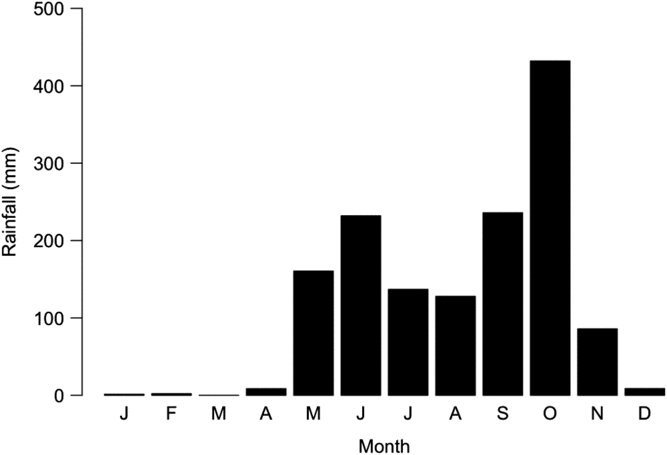
Mean annual rainfall in SRNP totals 1600 mm but is highly seasonal (monthly averages from 0 mm to 1040 mm); the wet season (months with ≥40 mm of rain) is May to November, and the dry season (with almost no rain and temperatures over 37°C) is December to April (Figure 1). During the dry season, many forest patches lose their leaves and few evergreen-forest patches retain them. In addition, most of the rivers and streams in the study area run dry and the remaining waterholes become important providers of free water for large vertebrates (Campos & Fedigan Reference Campos and Fedigan2009).
Mean monthly rainfall in Santa Rosa National Park in north-western Costa Rica during 2011–2015.

Data collection
During the dry and wet seasons of 2011–2015, automatic trail cameras (Bushnell®, Trophy Cam models 119436, 119446, 119456) were deployed at 50 different sites within SRNP. Half of the cameras (n = 25) were placed at waterholes and half on pathways (roads, n = 11; human trails, n = 9; and animal paths, n = 5) that jaguars were likely to use; cameras were deployed for an average of 53 d (range = 34–244). Each camera was attached to a tree at a height of ∼40 cm and set to be active for 24 h d−1 in video mode with the minimum delay (1 s) between consecutive triggers. Once deployed, cameras were checked on average every 22 d to replace batteries and change SD memory cards, if necessary. For each camera deployment, we recorded the location type (waterhole or pathway type), camera operation dates (and therefore, number of trap nights), season (wet or dry), and the number of independent photo events for each species. Photos or videos were considered an independent record of a species if they were: (1) taken at least 30 min apart (e.g. a series of three photos of the same species taken in consecutive seconds = 1 photo event); (2) consecutive photos of the same species could be identified as different individuals (spots, scars, horns/antlers, sex) and not part of the same group (e.g. 15 min apart, going in opposite directions = two photo events); or (3) photos of the same species separated by photos of a different species (e.g. species 1, followed 2 min later by a species 2, followed 5 min later by species 1 = one species with two photo events and another species with one photo event).
Statistical analyses
To examine and identify potential data issues (e.g. normality, overdispersion, outliers) and fulfil model assumptions, we followed the data exploration protocol suggested by Zuur et al. (Reference Zuur, Ieno and Elphick2010). The rates at which the number of independent photos of species at a site accrued (i.e. photographic or photo rates) were analysed using generalized linear models (GLM; Zuur et al. Reference Zuur, Ieno, Walker, Saveliev and Smith2009) with a log link function, as is customary for count data, implemented using the statistical software R version 3.1.3. Due to overdispersion in the counts, we assumed a negative binomial error distribution (Venables & Ripley Reference Venables and Ripley2002, Zuur et al. Reference Zuur, Ieno, Walker, Saveliev and Smith2009), and to account for variation in effort, we used the logarithm of the number of trap nights as an offset to standardize the counts.
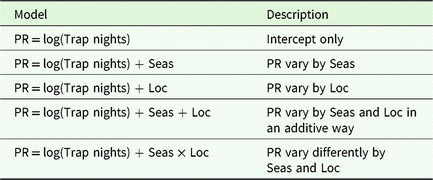
In order to assess the effect of seasonality (Seas) and site location (Loc) on photo-capture rates (no. of independent photos per 100 trap nights), five a priori models were developed for each species. One model included the intercept, two models included only one each of the singular predictors (e.g. Seas or Loc), one model included the additive effect of the two predictors, and one model included the first-order interactions for the two predictors (Table 1).
Description of five a priori candidate models evaluating the effect of seasonality (Seas) and site location (Loc) on photo-capture rates (PR; no. of independent photos per 100 trap nights) of large vertebrate species in Santa Rosa National Park in north-western Costa Rica

The empirical support for these five candidate models was evaluated using the Akaike Information Criterion (AIC) (Burnham & Anderson Reference Burnham and Anderson2002), throughout model comparison we selected the most plausible models for each species due the highest Akaike weight (W; range = 0 to 1; Anderson Reference Anderson2007). Based on the W we assessed the evidence from one model over another (Burnham & Anderson Reference Burnham and Anderson2002). Because we were particularly interested in those models showing interactions and the additive effects of season and location on photo rates, we included in the confidence set of models, based on the W value, those for species where the interaction and the additive effect of season and location differed by <10% from the top model (Thompson & Lee Reference Thompson and Lee2000). To better interpret the magnitude of top additive and interacting models, the seasonal mean differences in photographic rates at pathways (roads, human trails and animal paths) and waterholes were contrasted on a response scale, and depicted in graphs.
Results
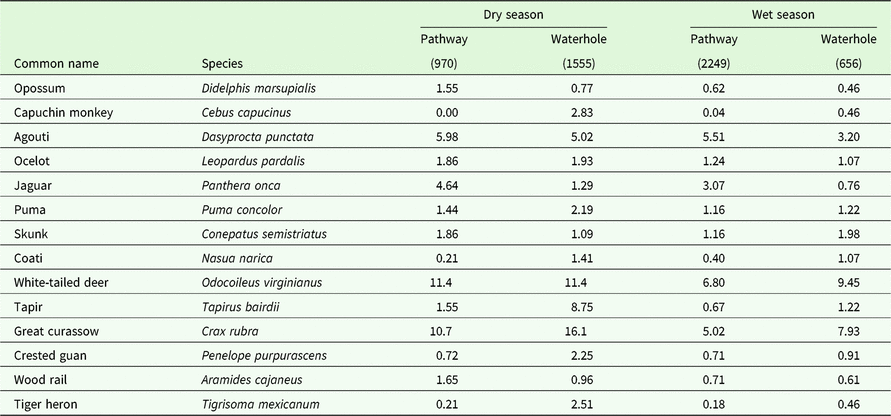
With a total effort of 5430 trap nights we recorded 2681 independent photo events of 64 species of amphibian, bird, mammal and reptile. Of these, 14 species (10 mammals and four birds) were independently photographed >40 times and included in our analyses (Table 2). During the dry season, average photo-capture rates were more than twice as high on pathways for opossum (Didelphis marsupialis, Linnaeus 1758) and jaguar, and more than twice as high at waterholes for capuchin monkey (Cebus capucinus, Linnaeus 1758), coati (Nasua narica, Linnaeus 1758), tapir, and tiger heron (Tigrisoma mixicanum, Swainson 1834) (Table 2). The highest photo-capture rate of any species during the dry season was that for great curassow (Crax rubra, Linnaeus 1758) at water holes. During the wet season jaguar were photographed on trails at >2 times the rate at waterholes, and capuchin monkey and tiger herons were photographed at waterholes >2 times the rate on trails (Table 2). The highest photo-capture rate of any species during the wet season was that for white-tailed deer (Odocoileus virginiaus, Zimmermann 1780) at water holes.
Photo-capture rates (no. of independent photos per 100 trap nights; no. of trap nights in parentheses) of the most commonly photographed large vertebrate species at seasonal waterholes and on pathways (roads, human trails, and animal paths) in Santa Rosa National Park in north-western Costa Rica during 2011–2015

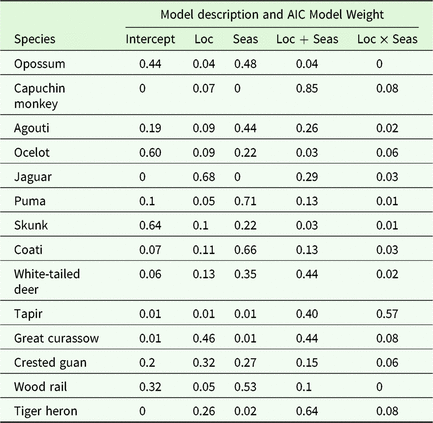
Model selection based on W showed that the null model was the most plausible for skunk (0.64) and ocelot (Leopardus pardalis, Linnaeus 1758; 0.60). For opossum (0.48), agoutis (Dasyprocta punctata, Gray 1842; 0.44), puma (Puma concolor, Linnaeus 1771; 0.71), coati (0.66), and wood rail (Aramides cajaneus Müller 1776; 0.53), the most plausible model included only a seasonal (Seas) effect, whereas for jaguar (0.68), great curassow (0.46) and crested guan (Penelope purpurascens Wagler 1830; 0.32), location (Loc) had the most influence (Table 3); however, the additive effect of location and season for great currasow (0.44) was very near the top model. The most plausible model for white-tailed deer (0.44), capuchin monkey (0.85) and tiger heron (0.64) included the additive effect of location and season, and for tapir (0.57) included the interaction of these two predictors.
Model importance weights for 10 mammal and four bird species, describing the effect of seasonality (Seas) and site location (Loc) on photo-capture rates in Santa Rosa National Park in north-western Costa Rica. For the most parsimonious model (W = 1), weights indicate the evidence for a given model compared with the other models (i.e. the larger the number the more evidence for that model)

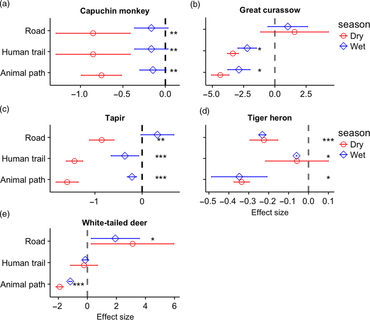
Capuchin monkey photo rates were significantly higher at waterholes during the dry season compared with any pathway, although during the wet season the rates on pathways increased substantially, though they did not differ from waterholes (Figure 2). Tapir photo rates were lower in the dry season on roads, human trails, and animals paths compared with waterholes, and during the wet season, tapir photo-capture rates on human trails and animals paths followed the same pattern but were of less magnitude (Figure 2). For white-tailed deer, photo-capture rates were lower during the dry and wet seasons on animal paths. Although empirical evidence based on the W (Table 3) showed an interaction of season and site location for great curassows, finer analyses showed differences at human and animal paths, and only marginal differences between seasons (Figure 2). On human trails and animal paths tiger heron photo-capture rates were different from those at waterholes but with no seasonal effect, though on roads rates were highest at waterholes during the dry season (Figure 2).
Mean differences in photo-capture rates for capuchin monkey (a), great currasow (b), tapir (c), tiger heron (d) and white-tailed deer (e), showing the effect of seasonality (dry/wet) and locations (animal path, human trail, road) among waterholes and three types of pathways in Santa Rosa National Park in north-western Costa Rica. Statistical significance P < 0.05; * significant location effect, ** significant seasonal effect, *** significant effect of both seasonality and location. Error bars represent the 95% confidence interval.

Discussion
We used camera trapping as a non-invasive technique to assess the effect of climate seasonality on patterns of waterhole use of macrofauna in the tropical dry forest, and hypothesized that seasonality would be most identifiable for species like tapirs that are thought to be water-dependent. We found statistical evidence of interacting effects of season and location for tapirs, and an additive effect for white-tailed deer, capuchin monkeys, tiger herons, and great curassows. In tropical-seasonal ecosystems, megaherbivores frequently increase their use of waterholes during the driest months (Moreira-Ramírez et al. Reference Moreira-Ramírez, Reyna-Hurtado, Hidalgo-Mihart, Naranjo, Ribeiro, Garcia-Anleu and Ponce-Santizo2016, O’Farrill et al. Reference O’Farrill, Schampaert, Rayfield, Bodin, Calme, Sengupta and Gonzalez2014, Pérez-Cortez et al. Reference Pérez-Cortez, Enrique, Panti, Reyna-Hurtado and Jorge2012) and our observations suggest that waterholes become rare places that are selected for use due to the favourable microclimate and habitat conditions for megafauna.
During the dry season, tapirs and white-tailed deer were found more frequently at waterholes and roads; nevertheless, the results showed some dependency on waterholes, even during the wet season, for both species. Though white-tailed deer marginally increased the use of waterholes during the dry season, they also used roads regardless of the season, perhaps as a strategy to avoid predation in risky places such as waterholes (Valeix Reference Valeix2011). For tapirs, hydration and shade are key elements for diurnal site selection (Alger et al. Reference Alger, Vaughan and Forester1998). Our results indicate that during the dry season the occurrence of tapirs at shady places near the streams increases due to the value of these unique places for heat dissipation, agreeing with Keith (Reference Keith1984) who found strong site fidelity near permanent streams for one female and two male tapirs in SRNP. Harris et al. (Reference Harris, Sanderson, Erz, Lehnen and Butler2015) mentioned that large herbivores could forage temporarily in risky places during periods of resource scarcity due to high energetic rewards, although still using the less vulnerable areas the most. In our area, this might mean road pathways for white-tailed deer where herbivores can easily detect and escape from predators.
Capuchin monkeys are mostly diurnal and arboreal, and seldom have been recorded at camera traps on pathways, but others have noted that during the onset of the dry season, especially during the driest months (March–April), they tend to cluster near waterholes (Campos & Fedigan Reference Campos and Fedigan2009). We found that capuchin monkeys increased the use of waterholes during the dry season and observed troops sipping at waterholes during the peaks of high daily temperatures, an adaptation to heat stress and water scarcity (Campos & Fedigan Reference Campos and Fedigan2009). It is plausible that investing most of the time at waterholes during periods of food scarcity could minimize the energy budget intake, allowing capuchin monkeys to invest this energy in reproduction or increasing the body mass across groups (Bergstrom et al. Reference Bergstrom, Thompson, Melin and Fidegan2017, Campos et al. Reference Campos, Morris, Alberts, Altmann, Brockman, Cords, Pusey, Stoinski, Strier and Fedigan2017).
Waterhole use by carnivores in this study differed from patterns previously reported in other seasonal environments. In arid ecosystems of South Africa and North America, seasonality directly influenced patterns of prey distribution, and as a consequence prey tended to aggregate at waterholes during extended drought periods, thus attracting predators to such places (Kalle et al. Reference Kalle, Ramesh, Qureshi and Sankar2014, Kluever et al. Reference Kluever, Gese and Dempsey2017, Sirot et al. Reference Sirot, Renaud and Pays2016, Valeix Reference Valeix2011). Our data suggest that ocelots use pathways and waterholes alike regardless of season, jaguars used pathways the most regardless of season, and pumas used trails less, especially during the dry season. This could suggest some avoidance of jaguars by pumas, reflecting findings by Harmsen et al. (Reference Harmsen, Foster, Silver, Ostro and Doncaster2010) who hypothesized differential use of trails based on photo-capture rates. However, Gutiérrez-González & López-González (Reference Gutiérrez-González and López-González2017) found that jaguar and puma exhibited sympatric behaviour based on the abundance and distribution of white-tailed deer.
Evidence of a seasonal difference in observation frequencies were found for opossums, agoutis and coatis regardless of the location type, suggesting that spatial distribution of water is perhaps not as limiting as the temporal distribution of water. This finding partially supports the insights of Alfaro (Reference Alfaro2014), describing apparent synchronicity patterns between falling fruits-precipitation regimes and mammal relative abundance in SRNP (Alfaro Reference Alfaro2014). In addition to this, Paredes et al. (Reference Paredes, Norris, Oliveira and Michalski2017) highlighted the importance of temporal distribution of water as a driver of changes in photo-capture rates of medium-size frugivores-omnivores across a latitudinal gradient. The amount of preformed water contained in juicy fruits could partially augment the amount of free water physiologically required by some mammals during periods of drought. In SRNP, most of the tree species produce fruits and seeds during the dry season as a strategy to increase the chances of dispersion (Hallwachs Reference Hallwachs, Estrada and Fleming1986, Sáenz Reference Sáenz1994); thus, perhaps species like opossums, agoutis and coatis do not have to depend on water sources during the dry season as do other large vertebrates inhabiting the dry forest.
Photo-capture rates of only tiger herons and great curassows were influenced by seasonality and location, almost always with higher photo rates at waterholes. This pattern in cracids perhaps is a response of their habitat preferences; Parker (Reference Parker2002) described curassows as inhabiting humid and narrow ridge areas with the presence of high ground structures to escape from predators, and based on its diet of fruits, arthropods and a few small vertebrates. Tiger herons seem tied to aquatic habitats and heavily associated with riparian zones, preying small fishes, frogs and crabs (Parker Reference Parker2002).
Our analysis, as well as other studies in arid ecosystems, suggests that spatial and temporal distribution of water varies in its importance to large vertebrates in the dry forest of SRNP. Tapirs, white-tailed deer, tiger herons and capuchin monkeys were the most dependent of waterholes during the dry season, but road pathways also played an important role during the wet season, perhaps for movement. Detailed comparison of waterholes and specific types of pathways (roads, animal paths and human trails) showed methodological implications of locations influencing the photo rates of all species, suggesting a factor to account for in camera trap studies. Finally, the ecological link between water/climate regimes and wildlife distribution patterns in seasonal ecosystems should lead to a better understanding of the consequences of changing climate regimes, and future research should consider variables such as evapotranspiration, vegetation dynamics and detailed resource phenology when considering species distributions and abundances.
Acknowledgements
We are grateful to all the volunteers and students who collaborated in the fieldwork. Thank you also to Roger Blanco, and all personnel of Guanacaste Conservation Area for their support in the field, and B. Kluever for his valuable comments and suggestions for improving the manuscript.
Financial support
We thank the National University of Costa Rica, Rufford Foundation, Gifford/Wyle family and National Ministry of Science and Technology of Costa Rica for financial support.