Introduction
Cognitive decline and dementia are important public health problems, but some risk factors for cognitive decline and dementia are potentially modifiable (Kukull, Reference Kukull2006). Adults tend to peak in cognitive ability at age 40 and then show a gradual decline in cognitive functioning thereafter (Anderson et al., Reference Anderson, Anderson, Northam, Jacobs and Catroppa2001). This decline involves a wide range of cognitive domains including executive functioning, processing speed, memory, and attention (Clark et al., Reference Clark2006). Years of education, genetics, general health, and socioeconomic status can affect cognitive decline (Compton et al., Reference Compton, Avet-Compton, Bachman and Brand2003), as well as a variety of medical and neurological conditions. Furthermore, inflammation may be a factor in cognitive decline (Dziedzic, Reference Dziedzic2006).
C-reactive protein (CRP) is a biomarker for general inflammation, and high levels of CRP are associated with cardiovascular disease, stroke, cancer, and obesity (Ho and Lipman, Reference Ho and Lipman2009). In addition, elevated levels of CRP may be associated with cognitive deficits. Based on their review of six studies investigating the association between CRP and cognitive function, Kuo et al. (Reference Kuo, Yen, Chang, Kuo, Chen and Sorond2005) concluded that elevated CRP is associated with cognitive decline and the progression of Alzheimer's disease. In a study of subjects with schizophrenia, Dickerson et al. (Reference Dickerson, Stallings, Origoni, Boronow and Yolken2007) found that while CRP was not associated with psychosis, patients with CRP levels higher than 5.0 mg/μL had significantly lower cognitive functioning than those with CRP levels less than 5.0 mg/μL. In a prospective study of cognitive function in older adults (n = 650), Tilvis et al. (Reference Tilvis, Kahonen-Vare, Jolkkonen, Valvanne, Pitkala and Strandberg2004) reported that cognitive decline at 5 years was associated with elevated CRP. Similarly, Yaffe et al. (Reference Yaffe2003) determined that levels of interleukin-6 and CRP are associated with cognitive deficits but only in subjects having the highest levels of these proteins.
In contrast to studies showing an association between CRP and cognitive deficits, Aiello et al. (Reference Aiello, Haan, Blythe, Moore, Gonzalez and Jagust2006) investigated whether CRP modified the association between cytomegalovirus, herpes simplex virus type-1, and cognitive function and found that although there was a relationship between high levels of cytomegalovirus and cognitive deficit, the latter was not modified by CRP. Dik et al. (Reference Dik, Jonker, Hack, Smit, Comijs and Eikelenboom2005) retrospectively examined cognitive functioning in a large cohort (n = 1284) in relation to four inflammatory proteins and concluded that cognitive decline was associated with high levels of α1- antichymotrypsin but not CRP, interleukin-6, and albumin. Other research suggests that high inflammatory protein levels only have an effect on cognition in the presence of moderating variables. Alley et al. (Reference Alley, Crimmins, Karlamangla, Hu and Seeman2008) assessed levels of interleukin-6 and CRP in relation to baseline cognitive functioning and cognitive change over time. Initial results indicated that high levels of these inflammatory proteins were associated with lower baseline cognition. However, these effects were not present after control for confounding. Finally, Teunissen et al. (Reference Teunissen2003) reported that while CRP appears to have an effect on some aspects of cognitive performance, there was no overall strong relationship between CRP and cognitive decline.
Among the studies that found a relationship between CRP and cognition, gender differences were unexplored. Gender, however, could be an important factor in the relationship between CRP and cognition in that previous research has consistently shown that there are gender differences in cognitive functioning among older individuals (Finkel et al., Reference Finkel, Reynolds, Berg and Pedersen2006). Examining gender differences in cognition in 2,307 older adults, Aartsen et al. (Reference Aartsen, Martin and Zimprich2004) found that women had better memory function than men. In a group of 578 older adults, women performed better on verbal memory tasks than did men (van Hooren et al., Reference van Hooren, Valentijn, Bosma, Ponds, van Boxtel and Jolles2007). The apparent cognitive differences between elderly men and women indicate that gender may affect any association between CRP and cognition in the elderly.
To better understand the association between CRP and cognition in older women and men, we meta-analyzed cross-sectional studies comparing cognition assessed by the Mini-Mental State Examination (MMSE; Folstein et al., Reference Folstein, Folstein and McHugh1975) or an MMSE-based assessment and reporting CRP levels and gender.
Methods
Paper selection
Using the electronic databases PubMed and PsychInfo, we identified peer-reviewed studies that examined the relationship between CRP and cognitive functioning with the following search terms: “C-reactive protein AND cognition”, Interleukin-6 AND cognition, inflammatory proteins AND cognition, cognition disorders AND C-reactive protein, and cognitive impairment AND C-reactive protein. Searches were repeated with neuropsychological function replacing cognition and inflammation replacing inflammatory. After identifying relevant papers, we reviewed the reference sections of these papers to identify additional relevant papers.
Inclusion criteria
Identified papers were included in the study if they were written in English, contained MMSE scores or scores from an MMSE-based assessment, and their means and standard deviations or standard errors in high and low CRP groups (i.e. high tertile versus low tertile, high quintile versus low quintile, etc.), and the gender composition of the samples.
We included only studies that assessed cognitive function using the MMSE or an MMSE-based measure to minimize heterogeneity between cognitive assessments in the source studies. Because cognitive tests can differ in sensitivity and specificity, outcomes from different cognitive tests assessing similar constructs can produce different results. For example, assessing memory functioning in a sample of mild brain-injury patients, Guilmette and Rasile (Reference Guilmette and Rasile1995) found that the use of cognitive tests of varying sensitivity and specificity led to a diagnostic accuracy ranging from 68% to 83%. Accordingly, we included only studies that used the MMSE (Folstein et al., Reference Folstein, Folstein and McHugh1975) or an MMSE-based assessment of cognitive functioning because of its widespread use in clinical practice and research (Nieuwenhuis-Mark, Reference Nieuwenhuis-Mark2010).
Statistical analysis
We calculated standardized effect sizes for each identified study by subtracting the mean MMSE score for the low CRP group from the mean MMSE score for the high CRP group and dividing the difference by the pooled estimate of the standard deviation of the cognitive scores. To correct for bias from small sample sizes, we obtained an unbiased estimator of effect size by multiplying the standardized effect size by the J-correction factor to obtain the Hedges g statistic (Hedges and Olkin, Reference Hedges and Olkin1985; Borenstein et al., Reference Borenstein, Hedges, Higgins and Rothstein2009). We then combined the individual effect sizes and associated variance according to the methods given by Whitehead (Reference Whitehead2002). We also calculated a U statistic (distributed as a χ2) to test for the significance of the combined effect sizes from the individual studies and a Q statistic (also distributed as a χ2), which evaluates consistency among the individual effect sizes. A significant Q value warns of heterogeneity among the source studies (Borenstein et al., Reference Borenstein, Hedges, Higgins and Rothstein2009).
Results
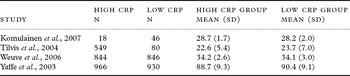
After screening abstracts and titles for potential studies, we retrieved and reviewed 46 full papers. From these, we identified four papers that met the inclusion criteria (Table 1). We excluded papers if they failed to measure cognitive status with the MMSE or an MMSE-based assessment, if they did not report cognitive function in high and low groups of CRP, if the sample was primarily composed of people with medical or neurological diseases that might affect cognitive functioning, or if the participants were selected because of a cognitive disorder. In addition, we excluded papers that did not include the data needed to calculate effect sizes, such as mean MMSE scores and their standard deviations or standard errors or that used longitudinal rather than cross-sectional designs. Cognitive scores for the high and low CRP groups in each study are shown in Table 2.
Characteristics of the source studies

MMSE = Mini Mental State Examination.
aapproximate number.
bThe correlation coefficient between the Phone Interview and the MMSE is 0.94.
Scores on cognitive measure for high and low CRP groups

Notes: CRP = C-reactive protein; SD = standard deviation.
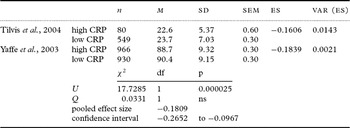
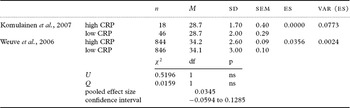
Two of the identified studies used both male and female subjects (Yaffe et al., Reference Yaffe2003; Tilvis et al., Reference Tilvis, Kahonen-Vare, Jolkkonen, Valvanne, Pitkala and Strandberg2004), whereas the other two papers included only female subjects (Weuve et al., Reference Weuve, Ridker, Cook, Buring and Grodstein2006; Komulainen et al., Reference Komulainen2007). The combined analysis of the four identified studies produced a U value of 7.04 (p = 0.008); however, the Q statistic (11.26) was significant (p = 0.010), indicating significant heterogeneity among the four source studies and suggesting that combing them into a summary statistic was inappropriate. The U statistic for the male–female combined group (with a total number of subjects of 2,525) was significant (U = 17.73, p = 0.000025) with a pooled effect size of −0.1809 (95% confidence interval, −0.2652 to −0.0967, p = 0.000025, Table 3), indicating that the cognitive performance of the low CRP subjects was higher than the cognitive performance of the high CRP subjects. Further, the Q statistic (0.033) was not significant, indicating that it was appropriate to combine the individual effects sizes into a summary measure. In contrast, the U statistic for the all-female studies (with a total of 1,754 subjects, although 96.4% of the subjects came from just one of the two studies) was not significant (U = 0.520) with a pooled effect size of 0.0345 (95% confidence interval, −0.0594 to 0.1285, Table 4). The Q statistic (0.016) also was not significant, indicating that it was appropriate to combine effects. The difference in effect size between the two groups (combined male–female groups versus the all-female group) suggests that CRP may be associated with lower cognitive scores in the combined group than in the female-only group).
Combined male and female subjects

Note: CRP = C-Reactive Protein; SD = standard deviation; SEM = standard error of the mean; ES = effect size; var (ES) = variance of the effect size; ns = not significant.
Female subjects only

Note: CRP = C-Reactive Protein; SD = standard deviation; SEM = standard error of the mean; ES = effect size; var (ES) = variance of the effect size; ns = not significant.
Discussion
The primary aim of this study was to determine whether gender affects the association between CRP concentrations and cognitive ability in elderly people. Indeed, even though there was a significant difference in cognitive ability between high and low CRP groups overall (p = 0.008), the associated Q statistic indicated significant heterogeneity between studies. When female-only source studies and male–female combined source studies were analyzed separately, the associated Q statistics became non-significant, indicating that it was appropriate to pool those particular source studies into one effect size. Upon doing this, the effect size between the high and low CRP groups in the female-only sample was not significant, but the difference between high and low CRP groups in the combined male–female sample was significant (p = 0.000025). As such, the main finding is that CRP is significantly associated with deficits in general cognitive ability determined by the MMSE or MMSE-related methods in samples composed of both women and men but not in the women-only samples. This finding suggests that the association between CRP and cognitive deficits may be stronger in men than in women. That is, cognitive ability in elderly men may be more susceptible to elevated concentrations of CRP than in elderly women. If so, findings on the association between CRP and cognition may tend toward inconsistency unless gender is taken into account.
Broadly consistent with the observation that cognition in elderly men may be more susceptible to elevated levels of CRP than it is in elderly women are findings that men aged 70–89 years have a higher prevalence of mild cognitive impairment than do women (Petersen et al., Reference Petersen2010). Further, older men appear to have more cognitive deficits than do older women (Aartsen et al., Reference Aartsen, Martin and Zimprich2004; Finkel et al., Reference Finkel, Reynolds, Berg and Pedersen2006; van Hooren et al., Reference van Hooren, Valentijn, Bosma, Ponds, van Boxtel and Jolles2007). Men may generally be more susceptible to the deleterious effects of inflammation than are women as suggested by the finding that CRP was associated with a 12% reduction in survival time and a one-year reduction in expected lifespan in men but not in women (Wassel et al., Reference Wassel, Barrett-Connor and Laughlin2010). While factors in addition to inflammation may well contribute to differences in cognitive ability between elderly men and women, part of the difference in cognitive deficits between older women and men could be due to differential susceptibility to CRP.
The cross-sectional design of this meta-analysis precludes an assessment of the causal relationship between CRP and cognitive deficits wherein cognitive deficits could lead to elevated CRP concentrations instead of elevated CRP concentrations resulting in cognitive deficits. Similarly, we did not investigate other potentially confounding variables such as smoking history and socioeconomic status that may alter the association between CRP concentrations and cognitive deficits.
Several additional factors temper the interpretation of the findings reported herein. Only four studies met our inclusion criteria. Two of these reported data on only female subjects, two reported data on combined female–male sample, and none reported data on male-only subjects. We therefore based the analysis on the percentage of male or female subjects and not solely on male samples versus female samples. If anything though, this design would tend to underestimate the differences between women and men. If there is a difference between women and men, an all-male sample compared to an all-female sample would show a greater difference between groups than would the available mixed male–female sample we used compared to an all-female sample. Although the number of source studies in the meta-analysis was small, the results are based on a fairly large number of individual subjects. An additional limitation, however, is that in the female-only studies, one study contributed 96.4% of the subjects; in the mixed-sex samples, one study contributed 75.1% of the subjects.
In summary, the association between CRP and cognitive deficits appeared stronger in elderly men than in elderly women in this small meta-analysis, although limitations based primarily on the small numbers of source studies and factors common to all cross-sectional designs limit this conclusion and make the results susceptible to new studies. Within the context of these limitations, the results suggest that gender may be an important variable to consider when studying the association between inflammation and cognition.
Conflict of interest
None.
Description of authors' roles
Dawson Hedges and Thomas Farrer were involved in study design and analysis, data entry, and writing of the paper. Bruce Brown conducted data analysis and was involved in writing the paper.