Introduction
CHDs are the most common congenital defects at birth.Reference Biber, Andonian and Beckmann1 with a worldwide prevalence of 8 per 1000 live births.Reference Van der Linde, Konings and Slager2 Advances in paediatric cardiology, including imaging techniques, cardiac surgery, and both diagnostic and therapeutic interventional procedures, have allowed more than 85% of these patients to survive into adulthood.Reference de Vinuesa Pastora and Erwin3 Currently, the main approach not only in paediatric cardiology but also in general medicine is multidisciplinary care. In recent years, special emphasis has been placed on psychological care, as it has been observed that both patients and their families experience significant socio-legal and emotional disturbances.Reference de Vinuesa Pastora and Erwin3
Multiple studies have focused on identifying psychological alterations in children with CHD; however, very few have investigated psychosocial morbidity among parents, who may develop multiple psychological disturbances in the short and medium term. Critical events include diagnosis, prolonged hospital stays, invasive procedures, and subsequent interventions, all of which may lead to psychological problems.Reference Biber, Andonian and Beckmann1 In the study conducted by Lawoko et al.,Reference Lawoko and Soares4 it was found that patients with CHD may present persistent psychological problems in 7–22% of cases, mainly depression (18%), anxiety (16–18%), somatisation (31–38%), and hopelessness (16%). Similarly, the systematic review conducted by Woolf-King et al.Reference Woolf-King, Anger and Arnold5 showed that approximately 25–50% of parents of children with CHD present elevated symptoms of depression and/or anxiety. In addition, these high levels of parental stress and intense emotions can affect parental behaviour, disrupt the parent–child relationship by reducing parental sensitivity, and negatively impact the well-being of both the child and the parent.Reference Mels, Goossens, De Groote and Vandekerckhove6
In many cases, these disorders are not only related to the patient”s underlying condition but are also compounded by social and economic factors, which are often limited and require additional support that is not provided in many institutions. Therefore, the objective of this study was to identify psychological alterations in parents of children with CHD at different stages of care, from diagnosis to resolution, among patients treated at our institution.
Methods
A cohort study was conducted, including the stress and anxiety levels experienced by parents of children with congenital heart disease (PMNCC) and stress and anxiety levels experienced by parents of children with congenital heart disease who do not undergo surgery (PMNCR) questionnaires. The quantitative component involved comparing scores from two questionnaires that measure state anxiety (STAI-E) and trait anxiety (STAI-R). These were administered to parents during paediatric cardiology outpatient visits, including parents of patients undergoing surgical protocols as well as those who had already undergone surgical or interventional procedures. Patients with both univentricular and biventricular physiology were included.
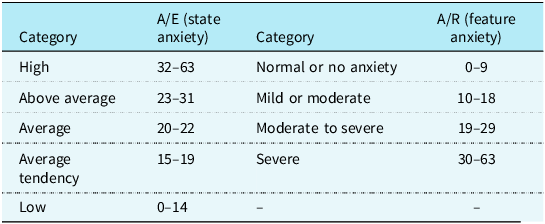
Questionnaire scores ranged from 0 to 63. The following guidelines are recommended for interpretation (Table 1).
Interpretation of PMNCC and PMNCR

Table 1 Long description
A table categorizing state anxiety and feature anxiety scores. The table has two main sections: A/E (state anxiety) and A/R (feature anxiety). Each section has categories with corresponding score ranges. The A/E section includes categories High (32-63), Above average (23-31), Average (20-22), Average tendency (15-19), and Low (0-14). The A/R section includes categories Normal or no anxiety (0-9), Mild or moderate (10-18), Moderate to severe (19-29), and Severe (30-63).
Statistical analysis
A descriptive analysis was performed by estimating minimum and maximum values and percentages for continuous numerical variables, and percentages for categorical variables. Inferential statistics included the chi-square test for qualitative variables and the t test for quantitative variables, with a significance cut-off of 0.005.
Results
Demographic characteristics
A total of 459 questionnaires were administered in the paediatric cardiology outpatient clinic to guardians or parents of children with CHD.
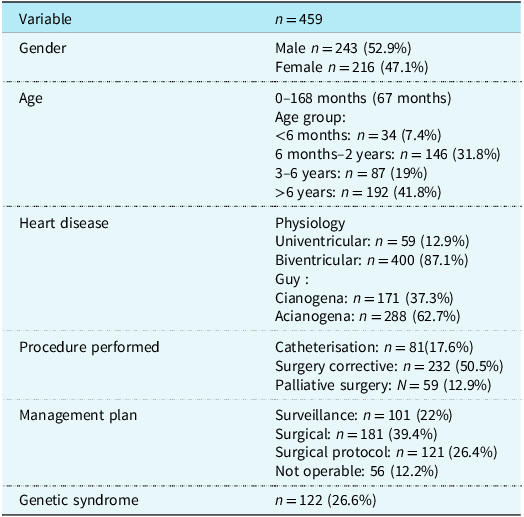
The predominant patient sex was male (52.9%). The mean age was 5 years, with patients ranging from the neonatal period to 14 years of age. The main age group was children older than 6 years (41.8%), followed by those aged 6 months to 2 years (31.8%). A genetic syndrome was present in 26.6% of cases.
Regarding the type of heart disease, biventricular physiology predominated (87.1%) and 62.7% of cases were acyanotic. Previous surgery was reported in 48.6% of patients, of which 50.5% were corrective procedures.
With respect to the therapeutic plan, 26.4% of patients were undergoing a surgical protocol, while 12.2% were not receiving surgical management (Table 2).
Demographic and clinical characteristics of patients with CHD

Table 2 Long description
The table presents demographic and clinical characteristics of patients with CHD. It has 7 rows and 2 columns. The columns are labeled 'Variable' and 'n=459'. The rows detail gender, age, heart disease, procedure performed, management plan, and genetic syndrome. Row 1: Gender, Male n=243 (52.9 percent), Female n=216 (47.1 percent). Row 2: Age, 0-168 months (67 months), Age group: <6 months: n=34 (7.4 percent), 6 months-2 years: n=146 (31.8 percent), 3-6 years: n=87 (19 percent), >6 years: n=192 (41.8 percent). Row 3: Heart disease, Physiology, Univentricular: n=59 (12.9 percent), Biventricular: n=400 (87.1 percent), Guy: Cianogena: n=171 (37.3 percent), Acianogena: n=288 (62.7 percent). Row 4: Procedure performed, Catheterisation: n=81 (17.6 percent), Surgery corrective: n=232 (50.5 percent), Palliative surgery: n=59 (12.9 percent). Row 5: Management plan, Surveillance: n=101 (22 percent), Surgical: n=181 (39.4 percent), Surgical protocol: n=121 (26.4 percent), Not operable: n=56 (12.2 percent). Row 6: Genetic syndrome, n=122 (26.6 percent).
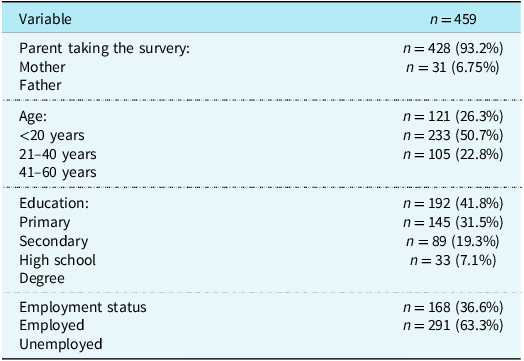
In 93.2% of cases, the questionnaires were completed by mothers. The demographic characteristics of respondents are shown in Table 3.
Demographic characteristics of respondents

Table 3 Long description
A table showing demographic characteristics of respondents. The table has 459 respondents and includes columns for parent taking the survey, age, education, and employment status. Row 1: Parent taking the survey, Mother, 428 (93.2 percent), Father, 31 (6.75 percent). Row 2: Age, less than 20 years, 121 (26.3 percent), 21-40 years, 233 (50.7 percent), 41-60 years, 105 (22.8 percent). Row 3: Education, Primary, 192 (41.8 percent), Secondary, 145 (31.5 percent), High school, 89 (19.3 percent), Degree, 33 (7.1 percent). Row 4: Employment status, Employed, 291 (63.3 percent), Unemployed, 168 (36.6 percent).
Questionnaire results
For the state anxiety questionnaire (STAI-E), the mean score was 36. High anxiety levels were observed in 81.3% of participants, while 18.7% showed above-average levels. Regarding severity, 82.6% presented severe anxiety and 17.2% moderate anxiety.
For the trait anxiety questionnaire (STAI-R), the mean score was 43, with high levels observed in 91.5% of participants and above-average levels in 7.2%. Severe anxiety predominated in 96.7% of cases (Table 4).
Questionnaire results

Table 4 Long description
A table with four rows and three columns. The columns are labeled Questionnaire, Score, Outcome, and Type. The rows are labeled A/E outcome (state) and A/R outcome (feature). For A/E outcome (state), the score ranges from 23-58 with a mean of 36. The outcomes are High with 420 participants (91.5 percent), Above average with 33 participants (7.2 percent), Average with 3 participants (0.7 percent), and Average tendency with 3 participants (0.7 percent). The types are Mild with 1 participant (0.2 percent), Moderate with 79 participants (17.2 percent), and Severe with 379 participants (82.6 percent). For A/R outcome (feature), the score ranges from 22-57 with a mean of 43. The outcomes are High with 420 participants (91.5 percent), Above average with 33 participants (7.2 percent), Average with 3 participants (0.7 percent), and Average tendency with 3 participants (0.7 percent). The types are Moderate with 15 participants (3.3 percent) and Severe with 444 participants (96.7 percent).
Associations.
A/E State.
STAI-E (state anxiety) questionnaires
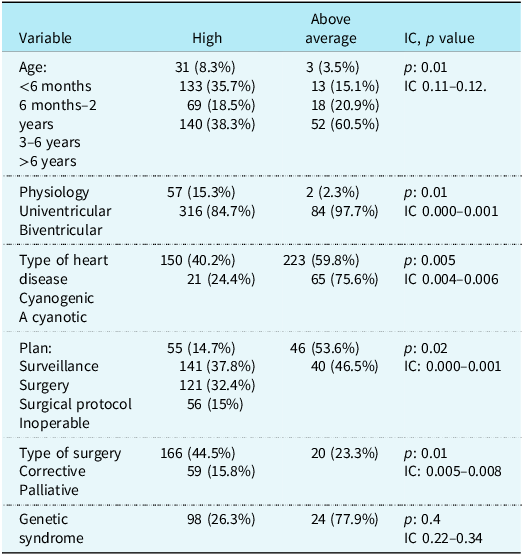
No significant associations were observed between the patient”s age group and high or above-average state anxiety levels, as patients older than 6 years predominated in both categories (38.3% and 60.5%, respectively). No significant association was found between anxiety level and cardiac physiology, with biventricular physiology predominating in both high anxiety (84.7%) and above-average anxiety (97.7%). However, this may be explained by the higher proportion of patients with biventricular physiology in the sample.
A significant association was observed in patients with cyanotic CHD, with high anxiety levels present in 40.2% of cases. Additionally, parents of patients who had already undergone corrective procedures presented elevated anxiety levels (Table 5).
Associations of A/E state outcome with variables

Table 5 Long description
A table comparing anxiety levels in patients with different variables. The table has 8 rows and 5 columns. Column headers are Variable, High, Above average, IC, and p value. Row labels include Age, Physiology, Type of heart disease, Plan, Type of surgery, and Genetic syndrome. Row 1: Age, High, 31 (8.3 percent), Above average, 3 (3.5 percent), IC, p: 0.01, IC 0.11-0.12. Row 2: <6 months, High, 133 (35.7 percent), Above average, 13 (15.1 percent), IC, p: 0.01, IC 0.11-0.12. Row 3: 6 months-2 years, High, 69 (18.5 percent), Above average, 18 (20.5 percent), IC, p: 0.01, IC 0.11-0.12. Row 4: 3-6 years, High, 140 (38.3 percent), Above average, 52 (60.5 percent), IC, p: 0.01, IC 0.11-0.12. Row 5: >6 years, High, , Above average, , IC, p: 0.01, IC 0.11-0.12. Row 6: Physiology, High, 57 (15.3 percent), Above average, 2 (2.3 percent), IC, p: 0.01, IC 0.000-0.001. Row 7: Univentricular, High, 316 (84.7 percent), Above average, 84 (97.7 percent), IC, p: 0.01, IC 0.000-0.001. Row 8: Biventricular, High, , Above average, , IC, p: 0.01, IC 0.000-0.001. Row 9: Type of heart disease, High, 150 (40.2 percent), Above average, 223 (59.8 percent), IC, p: 0.005, IC 0.004-0.006. Row 10: Cyanogenic, High, 21 (24.4 percent), Above average, 65 (75.6 percent), IC, p: 0.005, IC 0.004-0.006. Row 11: A cyanotic, High, , Above average, , IC, p: 0.005, IC 0.004-0.006. Row 12: Plan, High, 55 (14.7 percent), Above average, 46 (53.6 percent), IC, p: 0.02, IC 0.000-0.001. Row 13: Surveillance, High, 141 (37.8 percent), Above average, 40 (46.5 percent), IC, p: 0.02, IC 0.000-0.001. Row 14: Surgery, High, 121 (32.4 percent), Above average, , IC, p: 0.02, IC 0.000-0.001. Row 15: Surgical protocol, High, 56 (15 percent), Above average, , IC, p: 0.02, IC 0.000-0.001. Row 16: Inoperable, High, , Above average, , IC, p: 0.02, IC 0.000-0.001. Row 17: Type of surgery, High, 166 (44.5 percent), Above average, 20 (23.3 percent), IC, p: 0.01, IC 0.005-0.008. Row 18: Corrective, High, 59 (15.8 percent), Above average, , IC, p: 0.01, IC 0.005-0.008. Row 19: Palliative, High, , Above average, , IC, p: 0.01, IC 0.005-0.008. Row 20: Genetic syndrome, High, 98 (26.3 percent), Above average, 24 (77.9 percent), IC, p: 0.4, IC 0.22-0.34.
A/R Feature.
STAI-R (trait anxiety) questionnaire
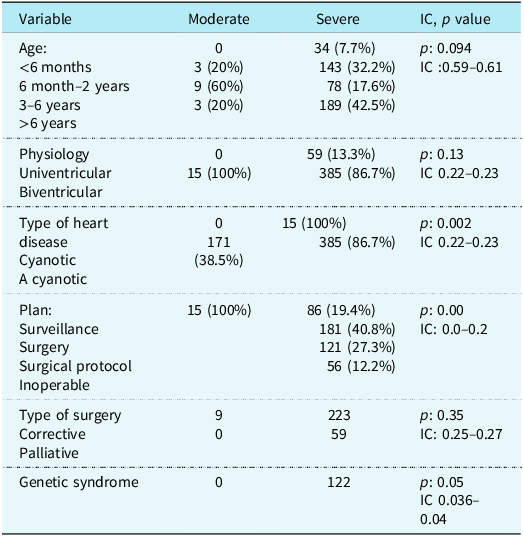
The main trait anxiety categories were moderate and severe; however, these groups were not comparable, as only 3.2% of the total sample presented moderate trait anxiety, while the remainder presented severe anxiety. No significant differences were found among age groups, with moderate anxiety observed in 60% and severe anxiety in 42.5%.
Regarding cardiac physiology, biventricular physiology predominated, accounting for 100% of moderate cases and 86.7% of severe cases. With respect to the type of CHD, cyanotic heart disease predominated in severe trait anxiety, with a statistically significant p value of 0.002. Parents of patients who had already undergone surgery also predominated in the severe trait anxiety group, accounting for 40.8% of cases (Table 6).
Associations of A/R trait outcomes with variables

Table 6 Long description
A table comparing variables with moderate and severe outcomes across different categories. The table has 10 rows and 5 columns. Column headers are Variable, Moderate, Severe, IC, and p value. Row labels include Age, Physiology, Type of heart disease, Plan, Type of surgery, and Genetic syndrome. Row 1: Age, Moderate: 0, <6 months: 3 (20 percent), 6 month–2 years: 9 (60 percent), 3–6 years: 3 (20 percent), >6 years: 0, Severe: 34 (7.7 percent), <6 months: 143 (32.2 percent), 6 month–2 years: 78 (17.6 percent), 3–6 years: 189 (42.5 percent), >6 years: 0, IC: p: 0.094, IC: 0.59–0.61. Row 2: Physiology, Moderate: 0, Univentricular: 15 (100 percent), Biventricular: 0, Severe: 59 (13.3 percent), Univentricular: 385 (86.7 percent), Biventricular: 0, IC: p: 0.13, IC: 0.22–0.23. Row 3: Type of heart disease, Moderate: 0, Cyanotic: 171 (38.5 percent), A cyanotic: 15 (100 percent), Severe: 385 (86.7 percent), Cyanotic: 15 (100 percent), A cyanotic: 0, IC: p: 0.002, IC: 0.22–0.23. Row 4: Plan, Moderate: Surveillance: 15 (100 percent), Surgery: 0, Surgical protocol: 0, Inoperable: 0, Severe: Surveillance: 181 (40.8 percent), Surgery: 121 (27.3 percent), Surgical protocol: 56 (12.2 percent), Inoperable: 86 (19.4 percent), IC: p: 0.00, IC: 0.0–0.2. Row 5: Type of surgery, Moderate: Corrective: 9, Palliative: 0, Severe: Corrective: 223, Palliative: 59, IC: p: 0.35, IC: 0.25–0.27. Row 6: Genetic syndrome, Moderate: 0, Severe: 122, IC: p: 0.05, IC: 0.036–0.04.
Discussion
When a child is diagnosed with CHD, a medical–surgical care plan is initiated, posing multiple challenges for parents. These include frequent medical appointments, numerous diagnostic and therapeutic procedures, prolonged hospitalisations, multiple surgeries, and exposure to life-threatening situations.Reference Moro, Iudici and Turchi9 Parents and families may experience psychological and social sequelae associated with the diagnosis, acceptance of the disease, illness perception, and the demands of raising a child with CHD. Social stereotypes may influence coping behaviours in both parents and children, exacerbating social isolation and marginalisation.Reference Moro, Iudici and Turchi9, Reference Elissa, Bratt, Axelsson, Khatib and Sparud-Lundin10
The economic dimension must also be considered, as parents often experience financial instability due to work absences and increased medical expenses, negatively affecting their overall health. Consequently, the burden of care falls directly on parents, who endure sustained pressure throughout the course of their child”s illness.Reference Vainberg, Vardi and Jacoby11 Therefore, caregiver involvement and well-being must be considered a priority, as parental mental health directly impacts both their own quality of life and their child”s treatment outcomes.Reference López, Frangini and Ramírez12
Several instruments are available to assess anxiety levels, among which the STAI is one of the most widely used. It measures two dimensions: state anxiety, a transient emotional condition characterised by tension and apprehension, and trait anxiety, a relatively stable predisposition to perceive situations as threatening.Reference Dominguez, Portela Pino and Domínguez Rodríguez7
In this study, parents who reported high and statistically significant levels of state anxiety were predominantly those whose children had cyanotic CHD (40.2%). The remaining variables did not show statistical significance, consistent with the findings reported by Hoyos et al.Reference Hoyos, Well and O’Connor8
Regarding the therapeutic stage, Hoyos et al.Reference Hoyos, Well and O’Connor8 reported anxiety symptoms in 29.2% of parents during the preoperative period, similar to our findings (27.3% with severe anxiety), increasing to 40.8% among parents of patients who had already undergone surgery.
Conclusions
The results indicate that parents of children with CHD are at significant risk of developing psychological disorders, particularly anxiety. In many cases, emotional and social support is insufficient. Therefore, healthcare teams should incorporate specific interventions focused on education, coping strategies, and psychological and social support as part of comprehensive multidisciplinary care.
Financial support
The authors declare that they have no financial or non-financial conflict of interest that is directly related to the publication of the article.
Author contribution
All authors contributed to the study conception and design.